Surgical site infection (SSI) is the most common healthcare-associated infection among hospitalized patients in the United States.Reference Anderson, Pyatt, Weber and Rutala 1 SSI incidence reported by the National Healthcare Safety Network (NHSN) after breast operations from 2006 to 2008 was 2.3% for inpatient breast operations and 0.6% for outpatient breast operations.Reference Edwards, Peterson and Mu 2 The NHSN recommends surveillance for SSIs for 30 days or 90 days after surgery if an implant is involved, and the NHSN combines all breast surgical procedures into a single category (eg, breast-conserving surgery (BCS), reduction mammoplasty, mastectomy, and implant and flap reconstruction). 3
In contrast to the low incidence reported by the NHSN, breast surgery SSI rates reported from individual institutions vary widely. The variation in reported rates depends on the type of breast operation, definitions used for infection, surveillance methods to identify infections, and length of postoperative follow-up.Reference Hall and Hall 4 Using standardized surveillance for 1 year after surgery, we previously reported SSI rates for specific breast operations at a single institution ranging from 1.1% after reduction mammoplasty, 4.4% after mastectomy, 6.2% after mastectomy with immediate flap reconstruction, to 12.4%–16.5% after mastectomy with immediate implant.Reference Olsen, Chu-Ongsakul, Brandt, Dietz, Mayfield and Fraser 5 , Reference Lankiewicz, Yokoe and Olsen 6
The goal of our study was to determine the incidence of SSI in a large population of women with private health insurance following mastectomy with and without immediate implant or flap reconstruction performed at many different facilities.
MATERIALS AND METHODS
Data Source
We conducted a retrospective cohort study using data from 12 Anthem-affiliated plans in the HealthCore Integrated Research Database (HIRDSM).Reference Warren, Nickel, Wallace, Mines, Fraser and Olsen 7 Collected data included all fully adjudicated claims submitted from providers, facilities, and outpatient pharmacies linked to health-plan enrollment information. Fully insured women enrolled in a fee-for-service plan with medical coverage of hospital and physician services were eligible for inclusion in the cohort. Due to unique risk factors for infection, we excluded women coded for end-stage renal disease, organ transplant, or HIV-positive status. Medical claims were restricted to paid claims.
The database contained up to 5 diagnosis codes [International Classification of Diseases, 9th Revision, Clinical Modification (ICD-9-CM)] per claim from 2004 to 2008 and up to 12 diagnosis codes per claim from 2009 to 2011. Inpatient hospitals included up to 5 ICD-9-CM procedure codes per claim (8 in 2009–2011), whereas provider and ambulatory facility claims used CPT-4 (Current Procedural Terminology, 4th edition) codes.
Patient Population
We identified mastectomy operations with at least 1 day follow-up after operation among women aged 18–64 years from January 1, 2004 to December 31, 2011 using ICD-9-CM and/or CPT-4 procedure codes from inpatient and outpatient facility and provider claims (Online Appendix 1). Because of coding inaccuracy and the limited clinical detail in claims data, we implemented steps to increase the likelihood that the procedures we included were truly mastectomies, as described below. We allowed a maximum of 2 mastectomies per woman during the study period. We excluded claims that contained CPT-4, HCPCS, or UB-04 revenue codes truncated to 4 digits or that populated fields reserved for ICD-9-CM procedure codes, as well as claims in which a mastectomy procedure code was present only on 1 line on a single claim with no other claims on the same date, as described previously.Reference Nickel, Wallace, Warren, Mines and Olsen 8
In 1,300 (6.7%) operations, CPT-4 or ICD-9-CM procedures codes for BCS were present during the same hospital admission or within 3 days of mastectomy. Because concurrent BCS and mastectomy is unlikely and because the incidence of SSI after BCS is lower than after mastectomy, we created an algorithm to determine the most likely procedure. We included any of the following information as evidence that mastectomy was performed: procedure code for reconstruction (Online Appendix 1), CPT-4 pathology code 88309 (modified radical mastectomy), prophylactic removal of the breast (V50.41), mastectomy coded by both facility and surgeon, BCS and mastectomy on opposite breasts per CPT-4 modifier codes, BCS coded only by an assistant surgeon, or diagnosis of acquired absence of the breast in the year following surgery (V45.71). We excluded procedures more consistent with BCS, including surgeon coding only for BCS (mastectomy-only coded by assistant surgeon or facility), and other diagnoses and procedures consistent with BCS but not mastectomy (Online Appendix 2).Reference Olsen, Nickel and Margenthaler 9
Establishing the Surgery Date
Different mastectomy dates within 7 days were counted as a single surgery date because of potential date inaccuracy, particularly on provider claims.Reference Li, King, deGara, White and Winget 10 When 2 or more dates within 7 days were coded for mastectomy, we incorporated supplemental evidence from unique provider claims for reconstruction, anesthesia, and pathology to determine the most likely surgery date. We excluded facility- and provider-only mastectomy claims that lacked additional evidence for operation, including anesthesia, pathology, or a surgery revenue code (Online Appendix 1).Reference Olsen, Nickel and Margenthaler 9
Classification of Procedures
We classified the mastectomy as unilateral or bilateral based on ICD-9-CM procedure and CPT-4 codes, billed units, and CPT-4 modifier codes (Online Appendix 1). When discrepancies occurred between the provider and facility, we considered the procedure to be bilateral unless there was only a single billed unit for pathology. We defined immediate reconstruction based on procedure codes for tissue expander/breast implant and/or flap reconstruction within 7 days of mastectomy (Online Appendix 1). We prioritized the provider classification of the flap in the case of discrepant facility and provider information. We did not use facility CPT-4 codes to classify flap reconstruction because flap procedures are not performed in ambulatory surgeries. Similarly, we did not classify flap reconstruction if it was only coded by a facility with length of stay <2 days using ambiguous procedure codes (ICD-9-CM 85.7, 85.70, or 85.79), due to likely misclassification (eg, local tissue rearrangement for wound closure coded as a flap).
Indication for Mastectomy
We used ICD-9-CM diagnosis codes to identify carcinoma in situ (CIS), locally invasive, regionally invasive, and metastatic breast cancer, as described previously.Reference Olsen, Nickel and Margenthaler 9 We classified the indication for mastectomy at the time of the first operation ranked hierarchically: metastatic, regional, local breast cancer, CIS, or benign/prophylactic mastectomy. Mastectomy was considered prophylactic if an ICD-9-CM diagnosis for prophylactic breast removal, family history (V16.3), or genetic susceptibility to breast neoplasm (V84.01) was coded within 7 days of surgery. Because the majority of second or contralateral mastectomies are prophylactic,Reference Gao, Fisher and Emami 11 , Reference Nichols, Berrington de, Lacey, Rosenberg and Anderson 12 we ranked prophylactic codes highest for subsequent operations. If no prophylactic diagnoses were coded within 7 days of the second operation, we used the cancer-stage hierarchy.
Identification and Timing of Surgical Site Infection
SSIs first coded from 2 to 180 days after surgery were identified using ICD-9-CM diagnosis codes from inpatient and outpatient facilities and provider claims (Online Appendix 3). Coding of Staphylococcus aureus within 7 days of ≥1 of the following was considered consistent with an SSI: procedure code for incision/drainage, diagnosis of a noninfectious wound complication, or cellulitis. In accordance with the NHSN definition, 3 a diagnosis code for cellulitis on the same claim as a procedure code for incision/drainage or on the day of implant removal without insertion was classified as an SSI. We previously validated these diagnosis codes in breast surgery patients within 180 days of surgery using microbiology and clinical data based on the NHSN definition for SSI.Reference Olsen and Fraser 13
We excluded claims with laboratory CPT-4 codes (88104–88399) because these diagnosis codes may have indicated diagnostic workup. Because ICD-9-CM diagnosis code 611.0 could indicate either breast infection or inflammatory breast cancer, we did not use it as evidence for SSI if it was also coded in the month before mastectomy. Because our goal was to identify infections attributable to surgery, we excluded cellulitis codes after the start of radiotherapy.
SSI onset was defined according to the timing and location of diagnosis. For SSIs newly coded by an inpatient facility during the original operative admission, we assigned the date of SSI to the discharge date if the difference between the discharge and admission date was ≥2 days. For SSIs diagnosed during a subsequent inpatient admission, SSI onset was assumed to be the hospital readmission date. For SSIs diagnosed initially by a provider or in an outpatient setting, the onset date was defined as the first service date.
The SSI observation period was 180 days post-surgery, with earlier censoring for the end of insurance enrollment, subsequent mastectomy, implant, flap, or nipple reconstruction. We censored 1 day after the subsequent surgery because an SSI coded within 1 day after surgery was considered preexisting and attributable to the previous surgery. Non–breast-specific SSI codes (eg, 998.59) were not classified as SSIs if they were first coded after a subsequent non-breast NHSN operation.
ICD-9-CM diagnosis codes for SSI or cellulitis coded from 30 days before to 1 day after mastectomy were considered preexisting infections. For operations with a preexisting infection, we required a minimum 30-day gap after mastectomy with no coding of SSI or cellulitis to identify an SSI incident.
Indicators Consistent with Infection
Incision/drainage, implant removal or exchange, and outpatient antibiotic prescription claims after mastectomy and within 14 days of a claim coded for SSI (before censoring) were identified (Online Appendix 3). Antibiotic prescriptions within 2 days of mastectomy or mastectomy hospital discharge were considered prophylactic and were excluded.
Statistical Analysis
The incidences of SSI within 180 days after mastectomy with and without immediate reconstruction were compared using a χ2 test. A Kruskal-Wallis test was used for continuous variables. All data management and statistical analyses were performed using SAS v9.3 (SAS Institute, Cary, NC).
RESULTS
A total of 19,422 mastectomy operations were initially identified from 2004 through 2011. The number of procedures was reduced to 18,696 among 18,085 women after excluding procedures with no supporting evidence for operation (n=208), subsequent mastectomy operations following a bilateral mastectomy (n=8), and dually coded operations that were more likely BCSs (n=510).
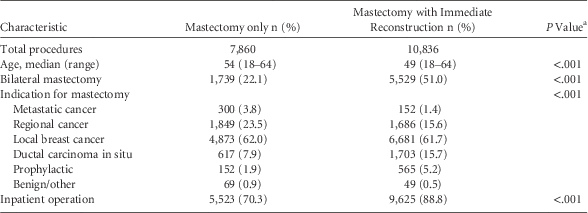
Immediate implant or flap reconstruction was performed in 58% of operations (Tables 1 and 2). Women with reconstruction were younger, more likely to have bilateral mastectomy, and more likely to have the mastectomy performed during an inpatient hospitalization. The majority of women had local breast cancer, but a larger proportion of the mastectomy-only population had regional or metastatic breast cancer (27.3% vs 17.0%, P<.001). Women with prophylactic mastectomy were more likely to have immediate reconstruction than women with other indications for mastectomy [78.8% (565 of 717) vs 57.1% (10,271 of 17,979); P<.001].
Characteristics of Mastectomy Operations in 18,085 Patients

a P per χ2 test for categorical variables and Kruskal-Wallis test for continuous variables.
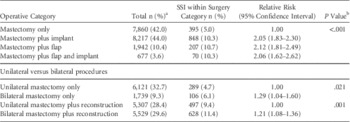
Incidence of Surgical Site Infection (SSI) For Mastectomy With and Without Immediate Reconstruction and Unilateral versus Bilateral Operations

a Number and percentage of procedures compared to the total number of mastectomy procedures performed (N=18,696).
b P per χ2 test.
The SSI incidence rate within 180 days following mastectomy with and without reconstruction was 8.1% (1,520 of 18,696). The SSI incidence rates were 5.0% after mastectomy only, 10.3% after mastectomy plus implant, 10.7% after mastectomy plus flap, and 10.3% after mastectomy plus flap and implant (P<.001; Table 2). Among mastectomies with and without reconstruction, the SSI risk was significantly higher after bilateral compared with unilateral procedures (P=.001 and P=.021, respectively; Table 2). SSI incidence rates were similar after prophylactic mastectomy with reconstruction compared to mastectomy with reconstruction for other indications [10.1% (57 of 565) vs 10.4% (1,068 of 10,271); P=.814]. The SSI incidence rate was higher for inpatient versus outpatient procedures for mastectomy only [5.4% (301 of 5,523) vs 4.0% (94 of 2,337); P=.008], but the incidence rates were similar for inpatient and outpatient procedures with immediate reconstruction [10.4% (1,004 of 9,625) vs 10.0% (121 of 1,211); P=.637].
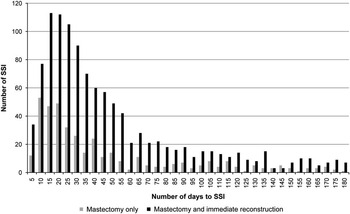
The time to presentation with SSI varied depending on whether mastectomy only or mastectomy plus immediate reconstruction was performed (median time to onset 26 vs 33 days; P=.006). Among mastectomy-only patients, SSIs were first coded within 30 days post-mastectomy in 55.4% (219 of 395) of procedures. Following mastectomy only, the onset of 18% of SSIs were coded 31–60 days post-surgery, the onset of 9.4% of SSIs were coded 61– 90 days post-surgery, and the onset of 16.7% of SSIs were first coded 91–180 days post-surgery (Figure 1). Among mastectomy patients with reconstruction, the onset of 47.2% of SSIs occurred within 30 days of surgical procedures (531 of 1,125). Following mastectomy with reconstruction, the onset of 27% of SSIs were coded 31–60 days post-surgery, the onset of 10.9% of SSIs were coded 61–90 days post-surgery, and the onset of 15.3% of SSIs were first coded 91–180 days post-surgery. The SSI incidence rates within 30 days post-mastectomy with implant and with flap reconstruction were the same (47.3% and 46.4%, respectively).
Days to surgical site infection (SSI) following mastectomy with and without immediate reconstruction (n=1,520 SSI).

Within 60 days post-mastectomy, the majority of the infections characterized as SSIs (83.3%, 930 of 1,116) were coded with a standard SSI code (eg, 683, 998.5x, or 996.69). The remaining SSIs with onset ≤60 days post-mastectomy were coded for cellulitis, staphylococcal infection, or breast abscess plus incision and drainage or implant removal/exchange (7.6%, n=85) or breast abscess alone (9.1%, n=101). The SSI incidence rate with onset >60 days post-mastectomy coded with standard SSI codes was lower than that for SSIs with onset nearer the surgery date (62.9%, 254 of 404), and the incidence rates coded for cellulitis/staphylococcal infection with a wound care procedure (15.6%, n=63) and breast abscess alone (21.5%, n=87) were higher than SSIs with onset nearer the surgery date (P<.001).
Among women with prescription drug coverage (87% of women with SSIs), SSI coding was present on a single claim for 36% (475 of 1,317). Of SSIs coded on only 1 claim, 86% (410 of 475) had additional evidence supporting the SSI diagnosis, including 69% (n=328) with an outpatient antibiotic prescription claim and 54% (n=258) with an incision/drainage or implant removal/exchange within 14 days of the SSI claim.
DISCUSSION
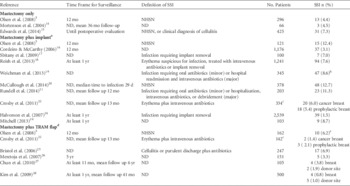
SSI incidence in this cohort of younger women was twice as high after mastectomy with reconstruction compared with mastectomy only and was higher after bilateral compared with unilateral procedures. The SSI incidence rate of 5.0% after mastectomy only is consistent with infection rates reported in the last decade from individual US institutions (Table 3).Reference Olsen, Chu-Ongsakul, Brandt, Dietz, Mayfield and Fraser 5 , Reference Mortenson, Schneider and Khatri 14 , Reference Edwards, Stukenborg, Brenin and Schroen 15 For mastectomy with implant reconstruction, the SSI incidence rate was 10.3% compared with incidence rates in the surgical literature from individual US institutions since 2006, which range from 1.5% to 12.7% (Table 3).Reference Olsen, Chu-Ongsakul, Brandt, Dietz, Mayfield and Fraser 5 , Reference Cordeiro and McCarthy 16 – Reference Mitchell 24 The SSI incidence in our cohort for mastectomy with flap reconstruction was 10.7%. It is more difficult to compare the SSI rate after immediate flap reconstruction to rates reported from individual institutions because the majority of published studies do not separate infection rates after immediate reconstruction versus delayed flap reconstruction. SSI rates per person reported after primarily immediate TRAM flap reconstruction in the last decade range from 0.8% to 6.9%,Reference Olsen, Chu-Ongsakul, Brandt, Dietz, Mayfield and Fraser 5 , Reference Crosby, Garvey and Selber 22 , Reference Bristol, Lennox and Clugston 25 – Reference Kim, Eom, Ahn, Son and Lee 28 although 3 of these studies did not specifically describe the observation period for infection,Reference Crosby, Garvey and Selber 22 , Reference Bristol, Lennox and Clugston 25 , Reference Chun, Sinha, Turko, Lipsitz and Pribaz 27 and only our prior study used the NHSN definition for SSI (Table 3).Reference Olsen, Chu-Ongsakul, Brandt, Dietz, Mayfield and Fraser 5
Methods and Surgical Site Infection (SSI) Incidence Rates by Mastectomy and Type of Reconstruction

NOTE. ND, not described; NHSN, National Healthcare Safety Network; TRAM, transverse rectus abdominis myocutaneous.
a Sbitany (2009), unclear whether all implants were immediate reconstruction.
b SSI and incidence is per breast (n=546) rather than per person (n=345).
c All procedures were bilateral; SSI and incidence are per side (ie, cancer side and prophylactic side).
d Bristol (2006) and Chun (2010), not all TRAMs were immediate reconstruction.
e 10 infections at the patient level; 6 breast SSIs; 7 donor site SSIs; 3 women had dual infections.
The NHSN breast surgery SSI rate is much lower than that reported in our studies because the NHSN breast category includes simpler procedures with lower SSI rates, such as BCS,Reference de Blacam, Ogunleye and Momoh 29 which can comprise a large proportion of breast operations from some hospitals. The higher risk of SSI after mastectomy compared with other breast procedures may be due in part to the larger incision, longer operative time, and potential for large dead space after complete removal of the breast with accumulation of lymphatic or serous fluid. The addition of reconstructive surgery, with or without a foreign body and additional surgical site(s), increases the length of procedure and further increases the risk of SSI.
In part, the variation in SSI rates reported after mastectomy with immediate reconstruction in the surgical literature may be due to variation in the definition used for infection (Table 3). In a study of SSIs associated with implant reconstruction, implant removal was required to define infection,Reference Halvorson, Disa, Mehrara, Burkey, Pusic and Cordeiro 23 while in others intravenous antibiotic therapyReference Crosby, Garvey and Selber 22 and/or surgical treatment was required.Reference Reish, Damjanovic and Austen 18 In many reports, the criteria used to define SSI were not stated.Reference Cordeiro and McCarthy 16 , Reference Sbitany, Sandeen, Amalfi, Davenport and Langstein 17 , Reference Mitchell 24 , Reference Meretoja, Rasia, von Smitten, Asko-Seljavaara, Kuokkanen and Jahkola 26 – Reference Kim, Eom, Ahn, Son and Lee 28 Most studies in the surgical literature do not report infection rates per person but rather per breast, making comparisons difficult.
Recently, a number of investigators have used the American College of Surgeons National Surgical Quality Improvement Program (NSQIP) database to study 30-day complication rates after breast operations. Nguyen et al reported an incidence of SSI of 2.5% after mastectomy-only using 2005–2009 data,Reference Nguyen, Costa and Vidar 30 although partial and subcutaneous mastectomies were included, which have lower risk of SSI.Reference Olsen, Chu-Ongsakul, Brandt, Dietz, Mayfield and Fraser 5 Mioton et al reported an SSI rate of 3.4% after mastectomy with immediate implant reconstruction from 2006 to 2010,Reference Mioton, Smetona and Hanwright 31 and Costa et al found that the SSI rate after immediate flap reconstruction was 4.9% using 2005–2009 NSQIP data.Reference Costa, Rommer and Peric 32
In our present study, the 180-day incidence of SSI was 10.4% after mastectomy with reconstruction compared with 5.0% after mastectomy only, similar in magnitude to the difference in SSI rates found previously in a single-institution study.Reference Olsen, Chu-Ongsakul, Brandt, Dietz, Mayfield and Fraser 5 When we restricted the observation time to 30 days post-surgery, the SSI incidence after mastectomy only in our current study was 2.8%, very similar to the 2.5% rate reported by Nguyen et al using NSQIP data. In contrast, the 30-day incidence of SSI we calculated after mastectomy with implant reconstruction was 4.9%, higher than the 3.5% rate reported by Nguyen et al. In addition, we found that only 47% of SSIs were coded within 30 days after mastectomy with reconstruction. In a previous institutional study, we found that 52% of SSIs were coded within 30 days after mastectomy with implant reconstruction.Reference Lankiewicz, Yokoe and Olsen 6 This finding highlights the importance of continuing surveillance beyond 30 days postoperatively to capture SSIs, particularly for operations involving a foreign body, as recommended by NHSN. 3
We found a significantly higher incidence of SSI in women with bilateral compared to unilateral mastectomy, both with and without reconstruction. Osman et al reported higher risk of SSIs after bilateral compared to unilateral mastectomy-only in women with breast cancer using NSQIP data.Reference Osman, Saleh, Jackson, Corrigan and Cil 33 In another study using NSQIP data, Fischer et al found that bilateral surgery was an independent risk factor for surgical complications.Reference Fischer, Tuggle, Au and Kovach 34 This is important information to present to women given increasing use of contralateral prophylactic mastectomy in women with unilateral breast cancer and bilateral prophylactic mastectomy in high-risk women.Reference Cemal, Albornoz and Disa 35 , Reference Pesce, Liederbach, Czechura, Winchester and Yao 36
By definition, using claims data for SSI surveillance involves secondary analysis of data collected for administrative purposes. Potential exists for misclassification of diagnoses and likely undercoding of SSIs, particularly minor infections during the 90-day global surgical reimbursement period. 37 Thus, our calculations for the incidence of SSI after mastectomy are likely underestimates of the true infection rates after these procedures. It is also possible that some SSIs classified as attributable to mastectomy were due to another procedure, particularly infections coded >30 days after mastectomy in the absence of an implant. We minimized this factor by censoring at the time of subsequent breast and NHSN procedures, but it is possible that an SSI could be attributable to a non-NHSN procedure. Finally, we could not capture the onset of signs and/or symptoms of SSI in claims data; we were limited to defining the onset of infection based on the first paid claim coded for SSI, resulting in overestimation of the time to onset of infection in some cases.
The SSI incidence after mastectomy in this large, geographically diverse cohort of younger women was 8.1%, much higher than the SSI incidence for breast surgical procedures reported by the NHSN. Only half of all SSIs were coded on medical claims within 30 days of surgery. Additional studies with verification of infection meeting NHSN definitions are needed to determine whether longer-term SSI surveillance after mastectomy is warranted. Our finding of variation in SSI incidence for mastectomy only compared to mastectomy with immediate reconstruction suggests that stratification of SSI rates by type of procedure is important.
Acknowledgments
We thank Cherie Hill for database and computer management support.
Financial support: This work was supported by the National Institutes of Health (NIH) (grant no. 5R01CA149614 to MAO). Additional support was provided by the Centers for Disease Control and Prevention (CDC) Epicenters Program (grant no. U54CK000162 to VJF and MAO). The findings and conclusions in this document are those of the authors, who are responsible for its content, and do not necessarily represent the official view of the NIH or the CDC.
Potential conflicts of interest: MAO reports consultant work with Merck, Pfizer, and Sanofi Pasteur and grant funding through Pfizer, Cubist Pharmaceuticals, and Sanofi Pasteur for work outside the submitted manuscript. All other authors report no conflicts of interest relevant to this article.
Supplementary material
To view supplementary material for this article, please visit http://dx.doi.org/10.1017/ice.2015.108.