Why do governments borrow in international bond markets given the policy constraints implied by market scrutiny? In particular, why do developing countries issue bonds when they can access cheaper finance from international financial institutions (IFIs)? A long-standing debate in international political economy examines the constraints that bond markets impose on borrowing countries' policy choices (Drezner Reference Drezner2001; Garrett Reference Garrett1998; Mosley Reference Mosley2000; Mosley Reference Mosley2003). I contribute to this literature by arguing that borrowing governments' perception of market constraints depends on global liquidity. When liquidity is abundant, investors are less attentive to borrowers' policies, institutions, and economic performance, being willing to extend finance even to borrowers they would otherwise deem too risky. Borrowing governments therefore perceive the policy constraints imposed by international markets to be lower when markets are liquid. I illustrate these dynamics using data on the timing of sub-Saharan African bond issues and interview data on the Ethiopian, Ghanaian, and Kenyan governments' decisions to enter international bond markets.
This letter makes the following contributions. First, it extends debates on the relationship between states and international markets. While analyses have largely concluded financial markets do not fetter government policy in advanced economies (Clark and Hallerberg Reference Clark and Hallerberg2000; Garrett Reference Garrett1998; Mosley, Paniagua, and Wibbels Reference Mosley, Paniagua and Wibbels2020; Oatley Reference Oatley1999), several studies suggest markets impose greater policy constraints on developing countries (Bodea and Hicks Reference Bodea and Hicks2015; Mosley Reference Mosley2003; Wibbels Reference Wibbels2006). By exploring the contingent nature of market discipline in developing countries, this article illuminates the limits of market constraints precisely where they are expected to be greatest. Second, the article contributes to a growing literature on the political effects of global capital cycles (Arias Reference Arias2018; Ballard-Rosa, Mosley, and Wellhausen Reference Ballard-Rosa, Mosley and Wellhausen2019; Bauerle Danzman, Winecoff, and Oatley Reference Bauerle Danzman, Winecoff and Oatley2017; Betz and Kerner Reference Betz and Kerner2015). Several studies examine how fluctuations in global liquidity affect investor behavior; I focus on the perceptions and behavior of borrowers. In so doing, I extend recent literature on the political determinants of borrowers' creditor choice (Arias, Mosley, and Rosendorff Reference Arias, Mosley and Rosendorff2019; Bunte Reference Bunte2019; Cormier Reference Cormier2020), emphasizing the role played by global liquidity cycles.
Why Enter International Bond Markets? A Cyclical Account
Market Scrutiny and Policy Constraint
Conventional accounts of bond market constraint of government policy go as follows. International investors lend to governments at a price that reflects the perceived risk of default; governments that appear more likely to default borrow at a higher price. To price default risk, investors evaluate broad macroeconomic indicators such as inflation, budget deficits, or government consumption (Ahlquist Reference Ahlquist2006). Especially when lending to developing countries, investors have limited information and little trust, making them more sensitive to policies that seem to put repayment at risk (Mosley Reference Mosley2003).
In this logic, governments trade off across costs when they borrow in international markets. Borrowers can pay the political cost of reforming policies to gain market access at a lower interest rate or maintain their policy and pay the surcharge lenders impose for the anticipated default risk.Footnote 1 If borrowers have a particularly weak reputation in international markets, they may find themselves shut out entirely. To secure market access, they must adjust the offending policies. As a result, international markets can act as a constraint on government policy, narrowing borrowing governments' “policy space” or “room to move” (Mosley Reference Mosley2000).
Liquidity Cycles and Market Scrutiny
This standard account of market discipline is largely country-specific, with investors evaluating governments' performance and policies without reference to the global context. However, inspired by an earlier literature in economics (Kindleberger Reference Kindleberger1978; Maxfield Reference Maxfield1998; Minsky Reference Minsky, Altman and Sametz1977), an emerging literature in international political economy stresses the role of global capital cycles as a systemic factor shaping investor behavior (Arias Reference Arias2018; Bauerle Danzman, Winecoff, and Oatley Reference Bauerle Danzman, Winecoff and Oatley2017; Betz and Kerner Reference Betz and Kerner2015).
When liquidity is abundant, investors' search for yield makes them more acceptant of policies and economic performance they normally associate with default risk. Countries that previously paid a surcharge to borrow in international markets may now find willing investors (Naqvi Reference Naqvi2019). Ballard-Rosa, Mosley, and Wellhausen (Reference Ballard-Rosa, Mosley and Wellhausen2019) find that global liquidity conditions determine whether democratic institutions enhance borrowers' access to international capital. While democracies are usually able to borrow more easily than non-democracies, this dissipates when bond markets are flush with capital. Investors become more risk acceptant during phases of global liquidity, whether of non-democratic institutions or policies that might put repayment at risk.
One potential alternative explanation for investors' lack of scrutiny during a liquidity glut could be if those new borrowers entering international markets during this time had lower levels of pre-existing debt, leading investors rationally to worry less about default. However, this account goes against a common assumption in the sovereign debt literature, namely, that first-time borrowers have unproven reputations for repayment and will likely face greater scrutiny and higher costs (Tomz Reference Tomz2007). Moreover, although many developing countries received debt forgiveness in the 2000s, those entering bond markets are still likely to carry debt from other sources, such as bank or bilateral loans (Bunte Reference Bunte2018; Bunte Reference Bunte2019; Horn, Reinhart, and Trebesch Reference Horn, Reinhart and Trebesch2019), making the default risk more than negligible even for first-time bond issuers. Thus, a lack of investor scrutiny during liquidity gluts is more likely to reflect investors' search for yield than lower default risk among borrowers.
Liquidity Cycles and Borrower Perception of Policy Constraints
I argue that borrowing governments are aware of, and responsive to, investors' shifting risk acceptance during phases of greater global liquidity. This shapes governments' own perception of the likely costs and constraints associated with borrowing in international bond markets. Direct encounters with potential investors during “roadshows” and the experiences of peers lead government officials to internalize the lack of investor scrutiny at the height of a liquidity glut.
Investor risk acceptance and reduced scrutiny of borrower performance means borrowing governments perceive the costs and constraints typically associated with market discipline to be lower during liquidity gluts. Under normal conditions, a borrower would have to pay a price for maintaining a policy such as capital controls, or even be shut out of markets entirely if investors deem the borrower too risky. During phases of abundant liquidity, however, borrowers know they can enter markets from which they were previously excluded and can do so at a lower price, without having to pay the political cost of reforming their policies to satisfy market scrutiny. This reduced cost removes the trade-off at the heart of the conventional account of market discipline.
The shift in borrower perceptions prompted by global liquidity applies not only to the price borrowers pay when they issue bonds, but also to subsequent bond market sensitivity. Borrowing governments pay interest on their debt at the rate at which the bond was issued, but fluctuations in secondary markets affect the price at which the government can later refinance outstanding debt and the price at which domestic firms raise international capital. Therefore, in addition to the cost paid at issue, borrowing governments also face a risk that investors will scrutinize government policy in subsequent months and years. If governments perceive investor scrutiny to be low in the present, they likely anticipate this future risk to be lower.
The lower perceived market constraint during periods of abundant liquidity explains why governments pursue bond market finance even when they can access cheaper loans from IFIs. Unlike bond investors, donors attach conditions and performance criteria to concessional loans that entail scrutiny and constraint of government policy. Borrowing governments that are especially constrained by the requirements of IFIs—such as left-wing governments that diverge substantially from IFI prescriptions (Cormier Reference Cormier2020) or governments that lack the backing of influential IFI shareholders (Clark and Dolan Reference Clark and Dolan2021; Stone Reference Stone2004)—will thus be especially attracted by bond finance flexibility during phases of greater liquidity. Even if borrower policy preferences sufficiently align with IFIs that adherence to loan conditions does not impose a substantial political cost, the transaction costs associated with the monitoring of IFI loans can make these unattractive compared to the flexibility of bond finance.
These dynamics will be especially pronounced among first-time borrowers since these governments do not have existing bond debt to roll over and can choose opportune moments to borrow. Nevertheless, repeat borrowers likely also make borrowing decisions based on perceptions of policy constraints. A government with outstanding debt may return to the markets well before a bond expires, choosing a moment when the perceived costs are low. Moreover, repeat borrowers decide how much debt to issue. Perceptions of low policy constraints might encourage a repeat borrower to borrow in large volumes, not simply rolling over existing debt.
I expect the following about borrowing governments’ perceptions during a phase of global liquidity: (1) officials believe political costs of borrowing in international markets to be low; and (2) officials see the higher financial costs of bond finance compared to IFI loans as a price worth paying for policy flexibility.
The African Bond Boom
I illustrate these arguments about borrower perceptions of the costs and constraints of international borrowing with the explosion of bond market debt issued by sub-Saharan African countries since the mid-2000s. Before 2006, only South Africa had issued an international bond. Since then, sixteen countries in sub-Saharan Africa have tapped international markets. Most African countries do not borrow in their own currency; as of 2018, 85 per cent of sub-Saharan African countries' external long-term public debt was denominated in hard currencies, with the vast majority in US dollars.Footnote 2 The near-simultaneous entry of multiple African countries into international bond markets suggests lenders became willing to lend to borrowers they previously did not deem creditworthy. I argue it also reflects governments' changed perception of the political costs and constraints of market discipline.
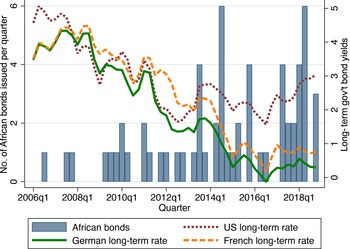
To track the extent of African governments' foray into international bond markets, I collect data on the timing of individual bond issues.Footnote 3 The timing of bond issues speaks directly to the relationship between global liquidity conditions and African governments' bond market access. As Figure 1 shows, the frequency of African bond issues increased from 2010 onward as yields on long-term advanced-economy bonds dropped in the aftermath of the global financial crisis and prolonged Eurozone crisis. The correlation between quarterly long-term yields and the number of African bond issues is −0.19 for US ten-year bonds, −0.39 for German ten-year bonds, and −0.41 for French ten-year bonds. African governments' borrowing in international markets is clearly correlated with increased global liquidity. However, coincidence in timing could reflect either investors' willingness to lend or borrowers' willingness to borrow, or both. To identify the effect of borrowing governments' perception of potential market constraints, I turn to three case studies.
Quarterly international, foreign-currency bond issues by sub-Saharan African governments and long-term government bond yields of advanced economies, 2006–18.
Sources: Capital IQ Database, Bloomberg, Financial Times, Reuters, Federal Reserve Bank of St. Louis.

Issuing Bonds During a Liquidity Glut: Three Cases
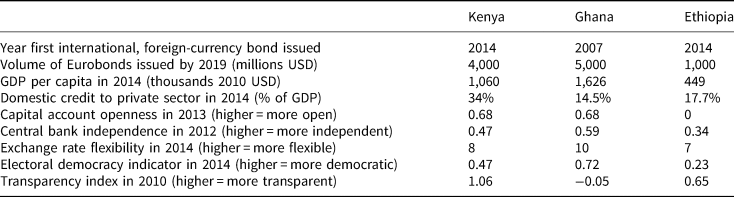
The aim in comparing the three cases is to identify whether and how global liquidity affects officials' perceptions of the constraints associated with entering international bond markets. If officials across different contexts have similar accounts of the political costs of entering bond markets during the bond boom, this is an indication that global liquidity plays an important role in governments' behavior. I select three countries—Kenya, Ghana, and Ethiopia—that all issued international bonds but vary along dimensions that could determine the government's appetite for borrowing in bond markets, such as their financial sector development, capital account openness, and transparency (see Table 1). I use a subset of 120 interviews I conducted with government officials, donor representatives, and analysts in January–August 2017 in Accra, Nairobi, and Addis Ababa to investigate the expectations that officials perceived market constraints to be low and saw the financial cost of market finance as a price worth paying for greater flexibility.
Attributes of case-study countries

Notes: GDP = gross domestic product; USD = US dollar.
Sources: World Bank World Development Indicators (Domestic credit data for Ethiopia is from 2008); IMF Wang-Jahan Capital Account Openness Index; Garriga (Reference Garriga2016) for central bank independence; Ilzetzki, Reinhart, and Rogoff (Reference Ilzetzki, Reinhart and Rogoff2019) for exchange rate; Varieties of Democracy (V-Dem) 10 for electoral democracy; Hollyer, Rosendorff, and Vreeland (Reference Hollyer, Rosendorff and Vreeland2015) for transparency.
Kenya
Kenya's electoral budget cycles and high-profile corruption likely flagged it as a default risk prior to the African bond boom. Once investors expanded their appetite for African debt, however, Kenya found many willing lenders when it entered bond markets in 2014. The country raised $2 billion, the largest African first-time issuance outside South Africa, with the bond four times oversubscribed. Kenya returned to the markets in 2018 and 2019 after its contested and drawn-out 2017 election, raising roughly $2 billion each time.
Political costs
Entering international bond markets, Kenya's government could reasonably expect market scrutiny over endemic public sector corruption and electoral budget cycles driven by fraught and expensive elections. Nonetheless, government officials did not anticipate punishing responses from international markets, reflecting the casual demeanor of investors toward corruption allegations. One candid financial analyst noted that corruption was not much of a deterrent for investors, saying:
The broad appeal of the [Kenyan] bond is that it is increased exposure to the Africa growth story…. If you are comfortable with the current political risks in Kenya … and have a view on [the cost of] corruption generally, [the Anglo Leasing corruption scandal] is not really politically central. (quoted in Manson and Blas Reference Manson and Blas2014)
The perceived lack of scrutiny underpinned government officials' sanguine attitude about market discipline, which also applied to government policy. Officials noted that market appraisals of government performance were shaped by the regular assessments of international rating agencies, giving the government more leeway in day-to-day operations. As one National Treasury official put it: “The good news is that international markets do react to rating agencies, they don't react to the daily paper.”Footnote 4 The sense of market distance from government policy was further reinforced by the fact that Kenya was too small a share of global bonds to attract investors' serious examination. One former staff member of the National Treasury described the government's borrowing strategy as “Go for capital markets because they don't ask questions, because you're just a small part of the portfolio.”Footnote 5 Observers linked the low level of market attention to the appetite for yield. As one donor official noted: “the markets are at a level where ‘As long as I know I'll get my money back, I don't care,’ so they're not following that closely where the money goes. The government also doesn't encourage market scrutiny, they would prefer there wasn't market scrutiny.”Footnote 6
Paying for autonomy?
Officials contrasted bond market finance favorably with the alternative of donors' development loans, despite the higher interest rates on bonds. Lower transaction costs were a large part of this comparison. Bonds are disbursed in larger volumes and released more quickly than development finance, with no comparable reporting requirements. Noting the political benefits of such speed and flexibility, a senior official from the Central Bank commented: “There's political pressure to complete projects, which makes rapid financing attractive.”Footnote 7 Outlining the frustrations with perceived inefficiencies of concessional development finance, one Kenyan official concluded: “With concessional finance, in some cases, cheap is expensive.”Footnote 8
The comparative appeal of bond market finance went beyond lower transaction costs. Government officials also stressed the greater autonomy they had over uses of bond market finance, which made concessional finance politically costly in comparison. One official contrasted market expectations with the demands of donors, noting: “In a way, the Eurobond affects the relationship with donors … if I borrow and I get friendly terms, then I prefer that.”Footnote 9
Ghana
Ghana was among the first sub-Saharan African countries to enter international bond markets, issuing its first bond in September 2007. While the country's mid-2000s oil discoveries and political stability boosted Ghana's creditworthiness, market enthusiasm also led investors to overlook recurrent electoral budget cycles. The country's 2007 ten-year $750 million bond was priced at 8.5 per cent and oversubscribed by a multiple of four. Both of Ghana's main political parties subsequently borrowed in international markets as the country became a repeat issuer in following years, returning to the markets every year but one between 2013 and 2020.
Political costs: market scrutiny?
In Ghana's case, market scrutiny was less likely to focus on grand corruption than in Kenya. Instead, the aspect of Ghana's policymaking likely to attract the focus of investors was persistent budget deficits, closely linked to electoral budget cycles. As a senior official in the Ministry of Finance explained: “We have a competitive election system … every time there is an election, trade unions go on strike and they are a strong force in elections. That is a structural, systemic feature of elections in this country that no party is in a position to be able to control.”Footnote 10 These are precisely the types of structural weaknesses one might expect investors to respond to with market discipline.
Nonetheless, Ghanaian officials pursued international bond finance without being deterred by potential market reactions to economic performance. Officials explaining the government's confidence entering markets attributed this in large part to the arm's-length approach of investors. A senior advisor who had prepared the bond issues explained: “One of the nice things about the Eurobond markets is that no one polices your use of funds.… We're running a primary budget deficit, so it's not magic to see that Ghana is borrowing for consumption spending.” He elaborated: “You would think that investors care [about how funds are spent], wouldn't you? But they don't, they're just hunting yield.”Footnote 11
Paying for autonomy?
Just as in Kenya, Ghanaian officials prized the ease of bond market finance compared to the transaction costs and policy limitations of official donor finance. A Ministry of Finance official explained:
We are spoiled for choice now … so the importance of the traditional donors has drastically decreased. They're no longer pleasing to us because of their paperwork and their small size … if traditional donors do not change their ways to suit us, then we don't need them, these alternatives give us an option.Footnote 12
It was not only the inefficiency of official finance that made it unattractive in comparison, but also the policy requirements that would need to be met to access this finance. These views were summarized in a survey of Ministry of Finance officials, which found that “despite the cost of Eurobonds … vis-à-vis marginally less costly offers from official lenders, the government of Ghana favours this source of development finance given relative volumes, flexibility in use, and the absence of conditionality” (MacCarthy Reference MacCarthy2016, 24).
Ethiopia
In Ethiopia's case, the country's poverty and the government's state-led development agenda, including close government control of the financial sector, likely led to the country being shut out of international bond markets before the African bond boom. Nonetheless, in December 2014, Ethiopia issued a first-time $1 billion ten-year bond at an interest rate of 6.625 per cent. Commenting on these attractive terms, the Financial Times noted: “The pricing … shows how years of ultra-lax monetary policy in the US, Europe and Japan is allowing countries on the fringes of the frontier market category to tap the international capital market at relatively low cost” (Blas Reference Blas2014).
Political costs: market scrutiny?
Of the cases, Ethiopia's access to bond markets is probably the strongest indication of global bond markets' exuberance about African borrowers. Not only is Ethiopia among the poorest countries to have borrowed in international financial markets, but it also issued its first bond while at the height of a development plan that included government control over the financial sector, foreign exchange rationing, and a closed capital account. All the same, Ethiopia issued at a rate lower than Kenya's 2014 bond issue, despite Kenya's much larger economy and more market-friendly development model.
Officials acknowledged that investor interest in Ethiopia was driven by the abundance of global liquidity. As an official in the Ministry of Finance who oversees fiscal planning noted: “What makes investors more interested [in Ethiopia] is the opportunity. There [in developed economies] opportunities are very narrow, capital is sitting there, with negative interest rates … it [the investment] is looking for opportunities, taking risks.”Footnote 13 Given the divergence between Ethiopia's development approach and the expectations of bond market investors, the atmosphere of greater risk acceptance was necessary to open up the possibility of bond market finance to the Ethiopian government.
Paying for autonomy?
Just as in Kenya and Ghana, the financial costs of bond market finance were interpreted in Ethiopia in light of the autonomy associated with the bond market compared to the financing offered by development banks. A senior official at Ethiopia's Central Bank described the trade-off as follows: “Of course, it's [bond finance is] not cheap, but nevertheless it's very good. It's more flexible, it's not project-tied, it's not tied to conditions.”Footnote 14
This interpretation of the trade-offs—in which bond market finance was seen as more expensive but granting greater autonomy—was possible because of the understanding that international investors were taking a more relaxed approach to economic policy in light of global liquidity conditions. For instance, a respondent at Ethiopia's Central Bank explained:
Investors are pragmatic people, they have pragmatic concerns, they don't have any ideology. They're different from the IMF [International Monetary Fund] or the World Bank. For developing countries, it gives an alternative. Before these capital markets, most of our access was determined by what the IMF is talking about us.Footnote 15
The characterization of investors as pragmatic and flexible is an indication of investors' risk acceptance during this period of greater global liquidity.
Conclusion
With respect to bond markets and developing-country governments, the question of whether international markets constrain the autonomy of governments appears to be a question of “when” rather than “whether.” Investors are less likely to discipline and constrain borrowing governments when liquidity is abundant. In response, governments adjust their assessment of the political costs and constraints downward during periods of global liquidity, leading them to see market finance as more flexible than official finance.
This emphasizes that borrowers' choices matter. By focusing on sovereign borrowers and their perceptions, this study adds to a growing body of work that explains variation in developing countries' demands for external finance, rather than seeing patterns of sovereign debt as exclusively determined by creditors' willingness to lend (Arias, Mosley, and Rosendorff Reference Arias, Mosley and Rosendorff2019; Bunte Reference Bunte2019; Cormier Reference Cormier2020). Secondly, the findings highlight how global liquidity affects the interaction between borrowing governments and their creditors, stressing the conditional nature of governments' perceptions of borrowing costs.
Future work should further investigate how governments' trade-offs change during global capital cycles. Governments that are less constrained by the conditions of official finance might find bond finance less attractive, which might explain why some African governments (such as Uganda) did not borrow in international markets during the bond boom. Moreover, it is worth exploring how politicians' and officials' time horizons intersect with their perceptions of cyclical market scrutiny. Do borrowers expect their successors to bear the cost of a later market comedown?
Data availability statement
Data replication files and instructions for Figure 1 can be found in Harvard Dataverse at: https://doi.org/10.7910/DVN/BJY2HW
Acknowledgments
I thank Ben Ansell, Pritish Behuria, Dorothee Bohle, Christopher Cramer, Elizabeth Cobbett, Florence Dafe, Emily Jones, Natalya Naqvi, Layna Mosley, Sam Rowan, Ricardo Soares de Oliveira, three anonymous reviewers, and the editor for their insightful comments on earlier versions of this article. Participants at the 2019 Oxford Politics of African Economic Policy workshop, the 2019 International Studies Association meeting, and the 2019 European University Institute Workshop on the Future of Capitalism provided helpful feedback. Any errors are my own.
Financial Support
I gratefully acknowledge support from the UK Economic and Social Research Council (grant number ES/J500112/1).