Introduction
The well-established relationship between socioeconomic status and health appears to have its roots in childhood. There is a significant effect of family income on children's health (Bor et al., Reference Bor, Najman, Andersen, Morrison and Williams1993; Currie, Reference Currie1995; Spencer, Reference Spencer1996; Dooley and Curtis, Reference Dooley and Curtis1998; Curtis et al., Reference Curtis, Dooley, Lipman and Feeny2001; Case et al., Reference Case, Lubotsky and Paxson2002; Currie and Stabile, Reference Currie and Stabile2003; Dowd, Reference Dowd2007; Propper et al., Reference Propper, Rigg and Burgess2007; Condliffe and Link, Reference Condliffe and Link2008; Murasko, Reference Murasko2008; Dowd et al., Reference Dowd, Zajacova and Aiello2009; Khanam et al., Reference Khanam, Nghiem and Connelly2009; Chatterji et al., Reference Chatterji, Lahiri and Song2011; Contoyannis and Li, Reference Contoyannis and Li2011). There is also evidence that the impact of income on child health increases as children age (Case et al., Reference Case, Lubotsky and Paxson2002; Currie and Stabile, Reference Currie and Stabile2003; Case et al., Reference Case, Lee and Paxson2008; Condliffe and Link, Reference Condliffe and Link2008; Khanam et al., Reference Khanam, Nghiem and Connelly2009). Moreover, the effects of early child health on adult health and outcomes are beginning to be documented (Currie and Hyson, Reference Currie and Hyson1999; Case et al., Reference Case, Fertig and Paxson2005; Oreopoulos et al., Reference Oreopoulos, Stabile, Roos and Walld2008; Currie, Reference Currie2009; Contoyannis and Dooley, Reference Contoyannis and Dooley2010; Currie et al., Reference Currie, Stabile, Manivong and Roos2010). It is important to understand the mechanisms that underlie the relationship between income and child health and to understand why inequalities may widen with age in order to inform possible policy actions to reduce inequalities in health and other outcomes. In addition, by focussing on children, we are able to remove the potential bias from reciprocal causality that is common in studies of adult health, for example, where changes in income affect health, but health also affects income through ability to work.
The economics literature suggests at least two hypotheses that explain why income has a significant impact on children's health and why this impact increases with age. The first hypothesis relates to children's ability to cope with health shocks. Children in families of varying levels of socioeconomic status may experience similar rates of injuries or illnesses, but parents with higher education and higher income may be in a better position to invest in health (such as healthy habits, diets and social supports) and to make better decisions about the use of health services, both of which may cushion the impact of these shocks (Case et al., Reference Case, Lubotsky and Paxson2002; Propper et al., Reference Propper, Rigg and Burgess2007; Dearden et al., Reference Dearden, Sibieta and Sylva2011). As older children would, on average, have had chronic health conditions for longer periods, an increase in the protective effect of income with age would point to a cumulative effect of income on health. Some studies have shown that the effects of health conditions such as asthma on parent-assessed child health are stronger for children with low vs higher family income, and for some conditions there is evidence that this effect increases with age (Case et al., Reference Case, Lubotsky and Paxson2002; Currie and Lin, Reference Currie and Lin2007; Case et al., Reference Case, Lee and Paxson2008; Condliffe and Link, Reference Condliffe and Link2008). However, other studies did not find differences in the long-term effect of health conditions, and low birth weight, on general health or mortality by socioeconomic status (Currie and Hyson, Reference Currie and Hyson1999; Currie and Stabile, Reference Currie and Stabile2003; Oreopoulos et al., Reference Oreopoulos, Stabile, Roos and Walld2008).
The second hypothesis relates to the arrival rate of health shocks. According to this hypothesis, children in families with socioeconomic disadvantage may experience higher rates of illness, injuries and other health shocks that may relate to the environment in which they live. The effects of income would also be cumulative with age but through an increase in incidence, as opposed to differences in the severity or management of these conditions (Murasko, Reference Murasko2008). Studies have shown that children in lower-income families suffer more new health shocks as measured by the arrival of new health conditions than do children from higher-income families, both in the short term and in the long term (Currie and Stabile, Reference Currie and Stabile2003; Condliffe and Link, Reference Condliffe and Link2008).
To date no study has explicitly tested the hypothesis that it is through differential access to health care – that is, higher-income parents are better able to access needed health care for their children when they fall ill – that the socioeconomic gradient in children's health steepens as they age.Footnote 1 One study of health outcomes in infants in Ontario showed that the neighbourhood income gradient in mortality was reduced somewhat among infants with complex chronic conditions compared with those without such conditions because these infants are identified at birth as high-risk infants and are immediately in contact with the health system (Wang et al., Reference Wang, Guttmann, To and Dick2009). These findings suggest a possible mediating effect of health care on the socioeconomic gradient in health.
The purpose of this study was to examine whether children in families with different levels of income have different patterns of health care use, and whether adjusting for these differences explains any part of the steepening gradient in health that we observe as children age. Building on the literature, we also examine the role that specific conditions, injuries and maternal health play in explaining the steepening gradient. We find that while doctors’ visits, prescription medication use and inpatient admissions within the last year, and in the last survey year (i.e. two to three years prior), are strongly correlated with reported poor health, controlling for these visits does not alter the steepening gradient found between income and health. Further, the protective effect of income appears to be stronger among children who use doctor's services and have a prescription medication, but not among those with inpatient visits.
The remainder of the paper is organised as follows. First, we provide a brief overview of the Canadian health system and a summary of the evidence of socioeconomic inequalities in health care use. Second, we describe the data source and variables used for the analysis. Third, we outline the methodology that we use to test whether prior health care use helps to explain the socioeconomic effects on child health. Finally, we present the results of the analyses, and then discuss these findings and their limitations in the concluding section.
An overview of health care in Canada
Canada provides universal coverage of health services that are financed by general taxation and are provided free at the point of use. The health system is organised at the provincial level: each province administers a single-payer health system to achieve universal coverage of physician and hospital care. The 1984 Canada Health Act serves as the legislative underpinning of the health system; it outlines the conditions for which the federal government assists in the funding of provincial health programmes through cash transfers. One of the conditions is to ensure reasonable access to health services (limited to medically necessary physician and hospital services) without financial or other barriers. Prescription drugs outside hospital, community and long-term care services and dental care are subsidised to varying degrees across the provinces for specific population groups through a patchwork of programmes. Children in low-income families receiving social assistance are included in provincial prescription drug programmes and hospital-based programmes to assist with the financing of medications help to fill the gaps in coverage for these populations (Ungar et al., Reference Ungar, Daniels, McNeill and Seyed2003). Moreover, school-based dental programmes and subsidised dental care for children exist in some provinces and municipalities but dental care remains almost exclusively privately financed.
Although direct financial barriers to access have been removed for the majority of health services for children (with the important exception of dental care and prescription medications), geographical, cultural or linguistic variations in accessibility may disproportionately affect lower socioeconomic groups. Considerable evidence points to the differential use of health services in the general adult population even in the context of a universal health system. For example, individuals with higher income are more likely to visit a specialist but less likely to be hospitalised than those with lower income in most high-income countries (van Doorslaer et al., 2004) and across Canadian provinces (Allin, Reference Allin2008; Jiménez-Rubio et al., Reference Jiménez-Rubio, Smith and van Doorslaer2008) even after adjusting for differences in health status by income.
The association between socioeconomic status and the use of health care services among children has received less attention. Some studies have explored inequalities in the use of health services among children using administrative data sources. In Ontario, a recent study identified increased odds of inadequate preventive and primary care among those residing in areas with lower income, as well as increased odds of avoidable hospitalisations, even after adjusting for variations in supply (Guttmann et al., Reference Guttmann, Shipman, Lam, Goodman and Stukel2010). In Manitoba, age- and sex-standardised rates of hospitalisation are significantly higher for children living in lower-income neighbourhoods, whereas the use of specialists is higher among higher socioeconomic groups (Brownell et al., Reference Brownell, Kozyrkyj, Roos, Friesen, Mayer and Sullivan2002). In Toronto, Canada, children from lower socioeconomic groups have higher rates of avoidable hospitalisations, and these rates persist up to nine years of age, which indicates shortcomings in primary care for these children (Agha et al., Reference Agha, Glazier and Guttmann2007). This is consistent with an earlier study from Québec that showed that among children with asthma those with fathers in the least advantaged occupational groups were significantly more likely to be admitted to hospital, even after controlling for disease severity (Amre et al., Reference Amre, Infante-Rivard, Gautrin and Malo2002). Using two survey waves of the National Longitudinal Survey of Children and Youth in Canada, a recent study also found lower income to be associated with an increased likelihood of hospitalisation but a decreased likelihood of a visit to a physician, controlling for general health and asthma status (To et al., Reference To, Dell, Tassoudki and Wang2009).
Data
We used data from a nationally representative survey in Canada: the National Longitudinal Survey of Children and Youth (NLSCY). The aim of the NLSCY was to develop a national database on the characteristics and life experiences of children and youth in Canada as they grow from infancy to adulthood. The NLSCY contains a detailed battery of questions about child health status, health care use, socioeconomic and demographic information. The survey collects information from the person most knowledgeable (PMK) about the child (usually the mother), the spouse of the PMK, the children themselves once they reach 10 years of age and the child's teacher and principal when relevant. The survey sampling method is based on the Labour Force Survey, which is a stratified, multistage design that uses probability sampling. It excludes children living on Indian reserves or Crown lands, residents of institutions, full-time members of the Canadian Armed Forces and residents of some remote regions.
The NLSCY initially surveyed 22,831 children aged 0–11 years in 13,439 households in 1994/95, with follow-up surveys every two years until 2008/09. Additional cohorts of children aged 0 and 1 were added in each survey cycle in order to ensure the full age range would be available for each cross-section. Information on health care was asked only for children up to 15 years of age. We excluded infants less than one year of age because of the challenges with rating health of infants. In addition, children had to have survey responses for at least two survey waves in order to conduct the lagged analysis. Less than 10% of the sample contributed to all eight cycles of the survey. This study includes data from children aged 1–15 years from 1994/95 to 2008/09, yielding a total of 66,291 observations.
Consistent with past studies (Case et al., Reference Case, Lubotsky and Paxson2002; Currie and Stabile, Reference Currie and Stabile2003), we measure child health on the basis of the question that is asked to the parent. The question asks the PMK about the general health of their child, with five possible responses: excellent, very good, good, fair or poor. We collapse these five categories into a binary indicator of poor health (that is equal to good, fair or poor health). It is possible that parent-assessed general health is measured with some bias. We are particularly concerned with the possibility that any bias is systematically related to socioeconomic status. Previous studies have shown similar socioeconomic gradients in child health with parent-reported health and physician-reported health (Case et al., Reference Case, Lubotsky and Paxson2002). Propper et al. (Reference Propper, Rigg and Burgess2007) were able to directly test the effect of maternal ‘misreporting’ health by comparing her assessments of her partner's health with the partner's own estimates: they found misreporting was associated with the mother reporting that her child has more symptoms. They did not test whether this effect differed by socioeconomic status.
We measure socioeconomic status on the basis of lagged total family income (which is measured as a continuous variable) and mother's education (measured as a binary variable indicating whether the mother has more than a high school education). We adjust family income to year 2000 prices using the annual consumer price indices. Health care use in the past year is measured by three binary variables: one or more physician visits (compared with no visits), one or more hospital inpatient admissions (compared with no admissions) and one or more prescription medications (compared with no medication). It is likely that the effect of health care services would be lagged, whereby visiting a physician today will lead to treatments that may have an effect in the following year. Therefore, we run two sets of models: one with health care use measured in the past year and another with health care use measured in the previous survey wave (therefore referring to health care use that took place in the past two to three years).
Unfortunately, there is no information available on the reasons for the health care visits, which may be different for children living in higher- or lower-income families (e.g. children in higher-income families may be more likely to visit a physician for preventive care than children in lower-income families). In some cases, this will be a limiting factor in our ability to interpret differences in use of health care across income groups.
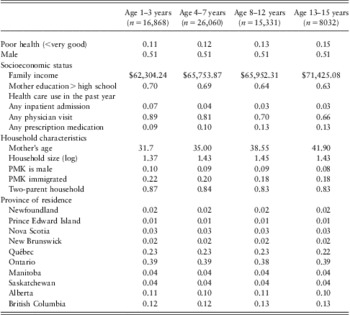
For additional analyses, we make use of information on whether the child had been diagnosed with a long-term condition in the past survey year, and, if so, which condition (allergies, asthma, heart disease, bronchitis, epilepsy, mental troubles, learning disabilities, psychological disabilities or any other condition). Finally, we include indicators of maternal health in the past survey year: general health is measured by the same question that is asked for children (and collapsed into a binary variable that is equal to one if the mother reports less than very good health); and maternal depression is calculated on the basis of positive responses to a set of questions relating to depression (e.g. “I felt that I could not shake off the blues even with help from my family or friends”), where a dummy variable is created to signify some depression-related symptoms at least three days in the past week. Descriptive statistics for the indicators of child health and health care use are summarised in Table 1.
Description of the sample, by age category (means)

PMK = person most knowledgeable.
Methods
We begin by estimating a model on the basis of previous analyses (Currie and Stabile, Reference Currie and Stabile2003) and that uses eight waves of pooled survey data (vs the three waves in Currie and Stabile) to model current child health on past income and a set of time invariant child- and family-related factors:

where health is a measure of child health (parental assessed) for each child, i. SES is socioeconomic status (family income measured in the past survey wave, mother's education), age is a complete set of age dummies, τt is a set of time dummies and household includes a set of variables measuring whether the child lives in a two-parent household, the size of the household, the mother's age, whether the PMK is male, whether the PMK immigrated to Canada and province of residence.
Following Case et al. (Reference Case, Lubotsky and Paxson2002) and Currie and Stabile (Reference Currie and Stabile2003), we estimate this model with linear probability models (with the outcome as the binary variable indicating poor health). We also run ordered probit models with health measured in four levels (excellent, very good, good and fair or poor). These results are shown for our initial estimates and are available on request for the remaining estimates. These models allow us to estimate the independent effect of the socioeconomic variables (income and education) on the likelihood of a child being in poor health, while controlling for other individual and family characteristics that may also affect children's health. We estimate the model separately for the different age groups, 1–3 years, 4–7 years, 8–12 years and 13–15 years, to test whether the coefficients on the log of household income and maternal education increase with child age. We cluster the standard errors on the child to account for repeated observations.
To test the hypothesis that the steepening gradient in child health is explained by children in families with higher socioeconomic status being better able to cope with one or more health shocks through their use of health care services, we take the following steps. We estimate models of health care use using the same variables as above, to test whether there are any income effects on use, and whether these effects change with age. We then include measures of past health care use in equation (1), and then the interactions between lagged use and lagged income, to see whether patterns of prior health care use mediate the steepening gradient in health as children age.
In a series of sensitivity analyses, we test whether including dummy variables for each of the individual health conditions, and their interactions with income, affect the steepening of the gradient, as in previous studies (Case et al., Reference Case, Lubotsky and Paxson2002). In addition, in light of the evidence that parents’ health, in particular mothers’ mental health, affect child health and may explain the relationship between family income and child health, we re-estimate the models of health, including indicators of mother's physical and mental health, by age group (Case et al., Reference Case, Lubotsky and Paxson2002; Propper et al., Reference Propper, Rigg and Burgess2007; Khanam et al., Reference Khanam, Nghiem and Connelly2009; Violato et al., Reference Violato, Petrou and Gray2009). There is a possibility of reverse causation between mothers’ health and family income (Propper et al., Reference Propper, Rigg and Burgess2007), for instance, through mothers’ withdrawal from the labour market due to ill health; however, in the absence of information on parental health status early in the child's life for the entire sample (questions about maternal health following the birth of the child were only asked of mothers of children aged zero to three years), we rely on two-year lagged maternal health.
As we are interested in the reasons why we observe an increasingly protective effect of income in health as children age, we pay particular attention to changes in the coefficients of income on health in the different age groups.
Results
Socioeconomic status and child health
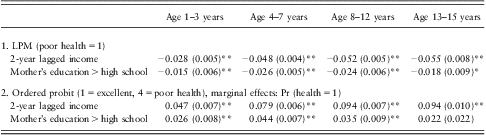
We find evidence of a significant effect both of family income and mother's education on child health, consistent with previous findings using data from the 1990s (Currie and Stabile, Reference Currie and Stabile2003). Table 2 reports the coefficients of effects of family income and mother's education on child health, as estimated with linear probability model and ordered probits, separately by age group. It appears that the protective effects of family income rise with age. We find that a doubling of past family income is associated with an increase in the likelihood of reporting excellent or very good child health of 2.8 percentage points for the one to three years age group, compared with 5.5 percentage points for the 12–15 years age group. The 95% confidence intervals around the point estimates of income for the different age groups allow us to test whether the coefficients are truly different from one another. We find that the effect of income on health in the one to three years age group is significantly different from the effect in the four to seven years age group; however, the confidence intervals overlap slightly for the top three age groups such that we cannot reject that these coefficients are the same.
Regression coefficients of income and maternal education for LPM and ordered probit models of child health, by age group, 1994/95–2008/09
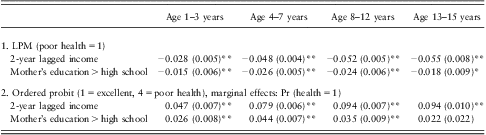
PMK = person most knowledgeable; LPM = linear probability model.
Notes: Robust standard errors in parentheses. Other variables in the regression models are: year effects, log of family size, dummy variables for single age, sex, a dummy indicating that the child belongs to a two-parent household, a dummy that the PMK is a male, a dummy that the PMK was an immigrant to Canada, and mother's age. Keeping infants less than one year-old leaves the income coefficients from all models largely unchanged. The marginal effects of income and maternal education on child health remain unchanged from those of the LPM when we estimate the model with random effects specification. When we re-estimated the models using probit instead of LPMs, the marginal effects of family income and mother's education are largely unchanged; therefore, we present only the results of the linear models in the remainder of the paper.
*p < 0.10; **p < 0.05.
Health care use and child health
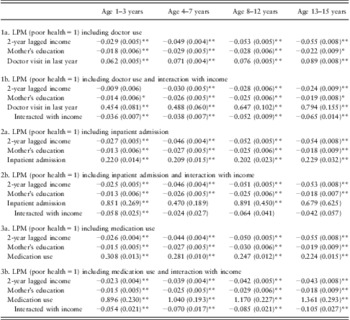
Can the differences in health care use that we observe by socioeconomic status help to explain the steepening gradient in health as children age? Table 3 shows the results of the models of poor current child health that include the different measures of health care use in the past year. In all models, the effects of family income and mothers’ education on child health remain negative and increase with age, even after we control for prior health care use. Moreover, there is little change to the magnitude of the effects when we include information on health care use in the models of child health. We also test whether the relationship between income and reported health differs based on contacts with the health care system by interacting past income and the various measures of past health care use. The protective effect of income appears to be greater for those who had contact with the health system, in particular with regard to physician care and use of prescription medications: the coefficients of the interaction terms between having a prior physician visit, having used medication and family income are all negative and significantly different from zero. However, the interaction between income and inpatient visits is not significant, except at the youngest ages.
Regression coefficients of income and maternal education, including health care use in the past year, for LPMs of child health, by age group, 1994/95–2008/09
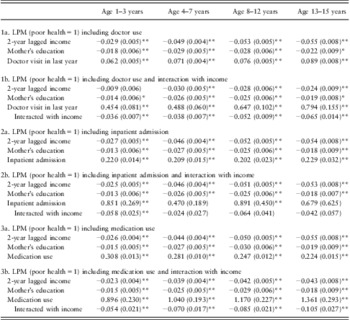
LPM = linear probability model.
Notes: Robust standard errors in parentheses. All other variables listed in Table 1 are included here.
*p < 0.10; **p < 0.05.
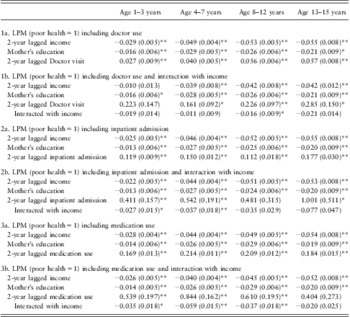
Table 4 reports on the models of current child health as a function of two to three lagged health care utilisations (with measures of health care utilisation from the previous survey wave). The interactions between family income and past physician visits remain negative but are no longer significant in some cases. The remainder of the results, including the significant interactions between income and use of medications, are unaltered when we use this longer time lag.
Regression coefficients of income and maternal education, including health care use reported in the past survey wave (i.e. two to three years prior), for LPMs of child health, by age group, 1994/95–2008/09
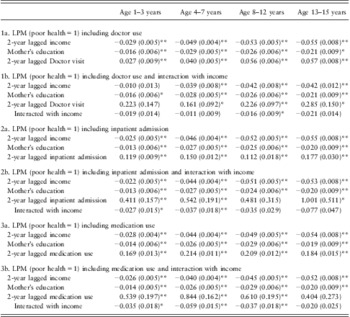
LPM = linear probability model.
Notes: Robust standard errors in parentheses. All other variables listed in Table 1 are included here.
*p < 0.10; **p < 0.05.
Although it is difficult to make any inferences about why those who visited the health care system had a stronger income–health relationship than those who did not, it does not appear to be the case that among users of physician services and prescription drugs (which require at least some use of physician services), and use of care mitigates the gradient. It is worth considering two differing scenarios and the predictions these scenarios offer for the sign of the coefficient on the interaction term. On the one hand, children who seek care may do so because they are sick, regardless of income, but lower-income families have a higher probability of being sick and needing care. In this case, if seeking care was beneficial to health (i.e. curative), one might predict a positive interaction term indicating that access to care when sick reduces differences between high- and low-income families, but that lower-income families are more likely to be sick. On the other hand, lower-income families may use care only when sick but higher-income families may use both preventative care and care when sick. In this case, if care is beneficial to health, then we might expect either a positive or a negative interaction term depending on whether the benefits of preventative care are greater than the effects of curative care. Moreover, we would expect the interaction term to be different between types of health care that are likely to be preventative (doctor visits) and those that are much more likely to be curative (hospital admissions).
Our results are more consistent with the second hypothesis than the first. We find a negative interaction term on doctor visits and medication use, not a positive one, and we find a less robust interaction term for inpatient admissions than for doctor visits and medications.
Health conditions and child health
We further test whether the steepening gradient changes when we control for different health care conditions. We first test whether including a set of long-term conditions affects the estimates of socioeconomic status on health at the different ages, and then we test whether the conditions have different effects on general health according to family income. We find that reporting asthma, allergies, bronchitis, mental health problems or another condition in the prior survey wave increases the likelihood of current parent-assessed poor health, and for previously diagnosed asthma and allergies the long-term effects on poor health are greater among children from lower-income families (as indicated by the negative and significant interaction terms between past condition and family income; results are available on request). These results suggest that family income plays a protective role in the overall health of children with long-term conditions.
We also include information on prior injuries to test whether injuries may have a greater effect on health among children in lower-income families and whether these effects may increase with age. We find that the effects of income and maternal education remain largely unchanged by the inclusion of this variable. However, in all age groups, having an injury in the past year increases the likelihood of being in poor health. The interaction terms between reporting an injury and family income are negative but not significant for the oldest two age groups: there is a non-significant trend suggesting that injuries have a greater impact on overall health of children in lower-income families (results are available on request).
Maternal and child health
Some studies have suggested that the relationship between socioeconomic status and child health is mediated through the parents’, and in particular the mothers’, health: children whose mothers have poor health are more likely to experience poor health themselves because either they inherited predispositions to ill health or they grow up in a less nurturing or less healthy environment (Propper et al., Reference Propper, Rigg and Burgess2007; Khanam et al., Reference Khanam, Nghiem and Connelly2009). We find significant associations between both prior maternal health and prior maternal depression and current child health (results are available on request). However, we still see a significant effect of family income on child health (although it is slightly reduced), and that the effect increases significantly after three years of age, even after controlling for past maternal health.
Discussion
This paper set out to test the hypothesis that the increasing impact of family income on children's health is mediated in part by the interactions the children have with the health care system. We found evidence that children's use of health care services differed according to family income. Importantly, incorporating information on children's health care use in the models of parent-assessed poor health did not change the estimated effect of family income and mother's education on health, nor did it account for the steepening gradient. Interactions between income and use are consistent with a model where higher-income families use both preventative and curative care and lower-income families use more curative care, resulting in a greater protective effect of income on those who use physician care and medications. Among health care users, the income–health gradient continues to steepen as children age.
We replicated the findings from previous studies from other jurisdictions (Case et al., Reference Case, Lubotsky and Paxson2002; Currie and Lin, Reference Currie and Lin2007; Case et al., Reference Case, Lee and Paxson2008; Condliffe and Link, Reference Condliffe and Link2008) and showed that the protective effect of income was greater among children with long-term conditions, asthma in particular, than children without these conditions. A study of children and youth with asthma in Toronto, Canada, showed that income adequacy had a significant impact on asthma control (Cope et al., Reference Cope, Ungar and Glazier2008). This income effect remained even after adjusting for prior health care contacts and medication use, consistent with our results, which further suggests the need to look outside the health care system to understand these persistent inequalities in health. Our finding of a significant effect of injuries on child health in Canada, and a non-significant interaction between reporting an injury in the past year and family income, suggests that there may be an increased severity of injuries faced by children in families with lower income, a greater number of injuries sustained and/or a reduced capacity to recover from these injuries. The association between socioeconomic status and injuries among children, as well as the increased severity of injuries among the more socioeconomically disadvantaged has been found elsewhere (Roberts and Power, Reference Roberts and Power1996; Faelker et al., Reference Faelker, Pickett and Brison2000; Simpson et al., Reference Simpson, Janssen, Craig and Pickett2005; Poulos et al., Reference Poulos, Hayen, Finch and Zwi2007; Owens et al., Reference Owens, Zodet, Berdahl, Dougherty, McCormick and Simpson2008; Leininger et al., Reference Leininger, Ryan and Kalil2009). This research suggests a need to focus policy attention to reducing the arrival rate, severity and management of injuries among children and youth.
In contrast with previous studies in England (Propper et al., Reference Propper, Rigg and Burgess2007) and Australia (Khanam et al., Reference Khanam, Nghiem and Connelly2009), but consistent with the US evidence (Case et al., Reference Case, Lubotsky and Paxson2002), we found that including indicators of maternal health in the models of child health only moderately reduced the effect of income on child health in Canada. There is a strong association between past maternal health and current child health: we found that mothers who reported their health to be poor in the past survey years were significantly more likely to report their children's current health to be poor as well. Previous studies have also found a strong association between mothers’ health and family income; therefore, some of the effect of family income on child health that we found appears to be mediated by the mother's health.
Overall, this study found that accounting for children's use of health care services did not explain the steepening gradient in child health with age. These findings raise questions as to the role of social services beyond the health system in contributing to the steepening socioeconomic gradient in child health with age, and to the possible differences in quality and type of health care services used across children in different socioeconomic groups.
Acknowledgments
Funding from the Canadian Institutes of Health Research and the Centre for Urban Health Initiatives, University of Toronto, is gratefully acknowledged. Sara Allin received postdoctoral funding support from the Canadian Health Services Research Foundation, the Comparative Program on Health and Society, and the ACHIEVE Research Partnership: Action for Health Equity Interventions, at the Centre for Research on Inner City Health, Keenan Research Centre, St Michael's Hospital. The authors would like to thank Professor Tony Culyer for his comments on an earlier version of this paper, the participants at the 2010 Health care technology and place Annual Interdisciplinary Workshop for their questions and comments, and two anonymous reviewers for their thoughtful review.