Doctor Atomic, John Adams's 2005 opera about physicist J. Robert Oppenheimer and the creation of the first nuclear weapon, culminates in a dense, theatre-shaking wave of sound. Dissonant orchestral clusters crash against thick layers of digital audio samples. All action on stage stops; the only sense of movement comes from sound coursing throughout the opera house. The effect is at once powerful and discomforting. Adams and his sound designer, Mark Grey, evoke this epochal detonation using a spatialised electroacoustic sound design, one that destabilises the traditional sonic frame of operatic production and immerses the audience in sound.
This article uses the sound design of Doctor Atomic to advocate for an engagement with the spatial dimensions of electroacoustic music generally, and within opera specifically. Sound design originated in cinema, where it most often refers to the post-production process of arranging and situating layers of music, sound effects and speech within a stereo or multichannel sound field. Its dramatic and immersive potential is significant. For Adams, sound design encompasses the acoustic preparation and real-time organisation of singers, instrumentalists, electroacoustic sounds and – most importantly – ‘the actual room itself’.Footnote 1 In opera, film, television and video games, sound design is aimed fundamentally at using sound to activate and make use of the space inhabited by listeners.
Opera offers scholars a productive field for examining the social, political and ethical spaces constructed by sound.Footnote 2 Herbert Lindenberger and Jane Fulcher, among others, have explored the political dimensions of opera as a social institution.Footnote 3 And attention to the mise en scène of opera reveals much about how the visual space of the stage and its signifiers can complement or counterpoint the libretto and music in meaningful ways.Footnote 4 But the use of electroacoustic sound in opera since at least the 1960s also warrants a Euclidean consideration of sonic space; that is, the physical locations of sound sources as well as sound's directional movement (or seeming movement). The paradigm of sound emanating solely from the stage area is increasingly inapt, and an investigation into sound's spatial valences, along with its interaction with music and mise en scène, affords critical avenues for understanding how drama and meaning are constructed in many twentieth- and twenty-first-century operas.
Sound design marks a significant shift in operatic production, with the sound designer acting as a new and influential creative agent who problematises conventional hierarchies between composer, performer and conductor, and even the distinction between audience and performer. It is a site of productive tension for both artists and scholars. Pamela Rosenberg, the then-general director of the San Francisco Opera (SFO) who commissioned Doctor Atomic, reflected, ‘Probably the most tense part of the whole production process was trying to get the sound design right. It was the thing that various people felt the most upset about.’Footnote 5 For scholars, sound design can complicate the conventional distinctions between opera's multimedial elements. Is sound design best understood as a component of scenography, akin to lighting, set or costume design, and therefore part of an opera's production history and changeable?Footnote 6 Or is it more closely allied with opera's music and libretto, (ideally) fixed and immutable?
I will argue here for the latter, and also suggest that sound design as a new element of the operatic text has particularly significant ramifications for the study of opera's other media, especially the performance space and the performing body. Doing so will highlight the epistemological limitations of the traditional score, as well as the conventional methodologies used to study it. The orchestral score for Doctor Atomic, for instance, indicates only when digital audio samples – specified by a generic descriptor – begin and end, and reveals little or nothing about dynamics, rhythmic or pitch features, timbre or spatial placement and trajectory.Footnote 7
To help make the case for a disciplinary turn towards sound design in opera studies, I draw on interviews with director Peter Sellars and sound designer Mark Grey, as well as close listening and an examination of what I refer to as the ‘digital score’ of Doctor Atomic: the opera's electronic components, including digital sound files and the software that indicates their spatial placement and dynamics. In analysing the relationships between the orchestral score, digital score and mise en scène, I aim to reveal how sound design participates in the more ‘drastic’ qualities of performance – what Nina Sun Eidsheim has identified as the ‘tactile, spatial, physical, material, and vibrational sensations … at the core of all music’.Footnote 8
With several productions in the United States and Europe since its premiere, as well as multiple video and sound recordings, Doctor Atomic has become one of the more enduring operas of the new millennium.Footnote 9 This, despite an ambivalent critical reception and continued concerns over the viability of its libretto, a ‘cut-and-paste’ assemblage of poetry and historical documents compiled and arranged by the director and Adams's long-time collaborator Peter Sellars.Footnote 10 Although Doctor Atomic serves as a useful subject for a case study of sound design's place in contemporary opera, my intent is neither to canonise nor idealise. Rather, this article attends to the technicity of opera, uncovering the ‘host of media and materialities’ that Gundula Kreuzer has shown lie embedded within opera's musical, verbal and visual signifying systems.Footnote 11
The first section outlines the temporal framework of Doctor Atomic and the ways in which Sellars and Adams play with visual space through the mise en scène. My concern, however, is primarily with sonic space, and in the subsequent two sections I situate the opera within a broader history of spatialisation and sound design in cinema, theatre and Western classical music. Drawing on interviews with Sellars and Grey, I consider the dramaturgical implications of sound design for the opera house and demonstrate how the opera's sound design acts as a structural component of the narrative. In this, Doctor Atomic differs from operas that incorporate digital audio samples primarily to enrich the aural texture and establish more concretely the physical settings of scenes using identifiable sonic phenomena.Footnote 12
The fourth section examines Doctor Atomic’s sound design in greater detail. Juxtaposing Grey's comments with reception history and analyses of the orchestral and digital scores, I trace the development of Doctor Atomic’s sound design from its post-9/11 origins in On the Transmigration of Souls to its continued transformations in productions subsequent to its SFO premiere. These changes are indicative of what Alice Miller Cotter has called Adams's ‘ethos of revision’, an ongoing process of reshaping his music in response to internal and external forces.Footnote 13 The final section of the article takes a hermeneutic turn, using SFO archival documents and a close reading of the opera's final moments to forge a link between its sound design and the conflicting cultural and musical politics of its primary creators, Adams and Sellars.
Abstracting time and space
In the final scene of Doctor Atomic, Robert Oppenheimer (hereafter ‘Oppie’) emphatically declares, ‘No! there are no more minutes, There are no more seconds! Time has disappeared; it is Eternity that reigns now!’Footnote 14 This quotation from Charles Baudelaire's poem ‘La Chambre double’, in an opera that revolves around waiting, underscores one of the more notable features of the opera: its manipulation of time. The libretto reflects a preoccupation with time, with pre-existing poems that overtly reference its passage or suspension. Adams's score abounds with the lyrical, rhythmically complex and harmonically rich sound that has come to characterise his post-millennial music, and the composer uses shifting rhythms and tempi, particularly in the second act, to govern the perceptual and dramatic passage of time as the detonation nears.Footnote 15
Adams and Sellars play with time on multiple levels. Set in Los Alamos, New Mexico, during the days and hours leading up to the detonation in July 1945, Doctor Atomic and its representation of historical events loosely parallel the structure of the implosion-design plutonium device that Robert Oppenheimer and his team devised. Just as the space of the bomb's core is compressed into a supercritical mass to achieve nuclear fission, the difference between time elapsing in the opera house (performance time) and time represented in the opera (fictional time) steadily contracts (Fig. 1).Footnote 16 Whereas the opening scenes of Act I take place at an unspecified time in the weeks leading up to the detonation, the first act's final scene takes place the night before the test, and Act II portrays the remaining hours leading up to the explosion in New Mexico's Jornada del Muerto desert a fraction of a second before 5.30am.
Doctor Atomic temporal structure.

Musical topics, stylistic allusions and ostinatos within the orchestra signify temporal distortions. Borrowing Igor Stravinsky's distinction between two oppositional experiences of musical time, Yayoi Uno Everett argues that some motifs ‘constitute topics that represent the ontological “passing” of time, whereas other topics and style quotation (referencing music by Stravinsky, Wagner, Orff and Debussy) represent the psychological realm of the subjects who await the countdown’.Footnote 17 Atop the second act's ticking ostinatos, periodic sung references to the countdown confirm that the difference between performance time and fictional time is diminishing.Footnote 18
Fictional time mushrooms in the closing moments; some six minutes of performance time elapse between Oppie's pronouncement ‘Zero minus two minutes’ and the detonation of the ‘Gadget’ (the nuclear device's nickname). In effect, time slows. The density of musical time increases as the orchestra enacts a gradual accelerando that stretches for over 150 bars (Act II scene 4, bb. 334–504). In the final seconds before the bomb, however, time seems to stand still (bb. 498–504). Adams calls for a rallentando from  = ♩ = 100 to ♩ = 60 that synchronises the ticking of the orchestra with that of a clock.Footnote 19 Fictional time and performance time align; temporal boundaries metaphorically collapse into a shared past, present and future. Yet the last sounds of Doctor Atomic, which foreground the acousmatic voice of a woman repeating the Japanese phrase ‘O mizu o kudasai. Kodomotachi’ (‘Water, please. The children’), also imply that the narrative time of the opera has leapt forward to the bombing of Hiroshima on 6 August 1945. The effect of this temporal distortion, writes Everett, offers a synchronic, rather than diachronic, experience of narrative, which ‘catapults the audience from the diegetic “now” in July 1945 to the non-diegetic “then”, and casts the operatic narrative within a broader historical framework for the viewers to contemplate on the opera's socio-political messages’.Footnote 20
Adams recognises that this temporal structural is unorthodox. Offering something of an apologia in his 2008 autobiography, he wrote:
The long, dreamlike second act will always present a challenge for directors and conductors. Where act I follows a more or less logical narrative thread, act II is a nearly ninety-minute symphonic arch that oscillates back and forth between a real-time event (the countdown) and a deliberately abstracted treatment of time and space that is part dream vision and part sudden, terrifying apparition.Footnote 21
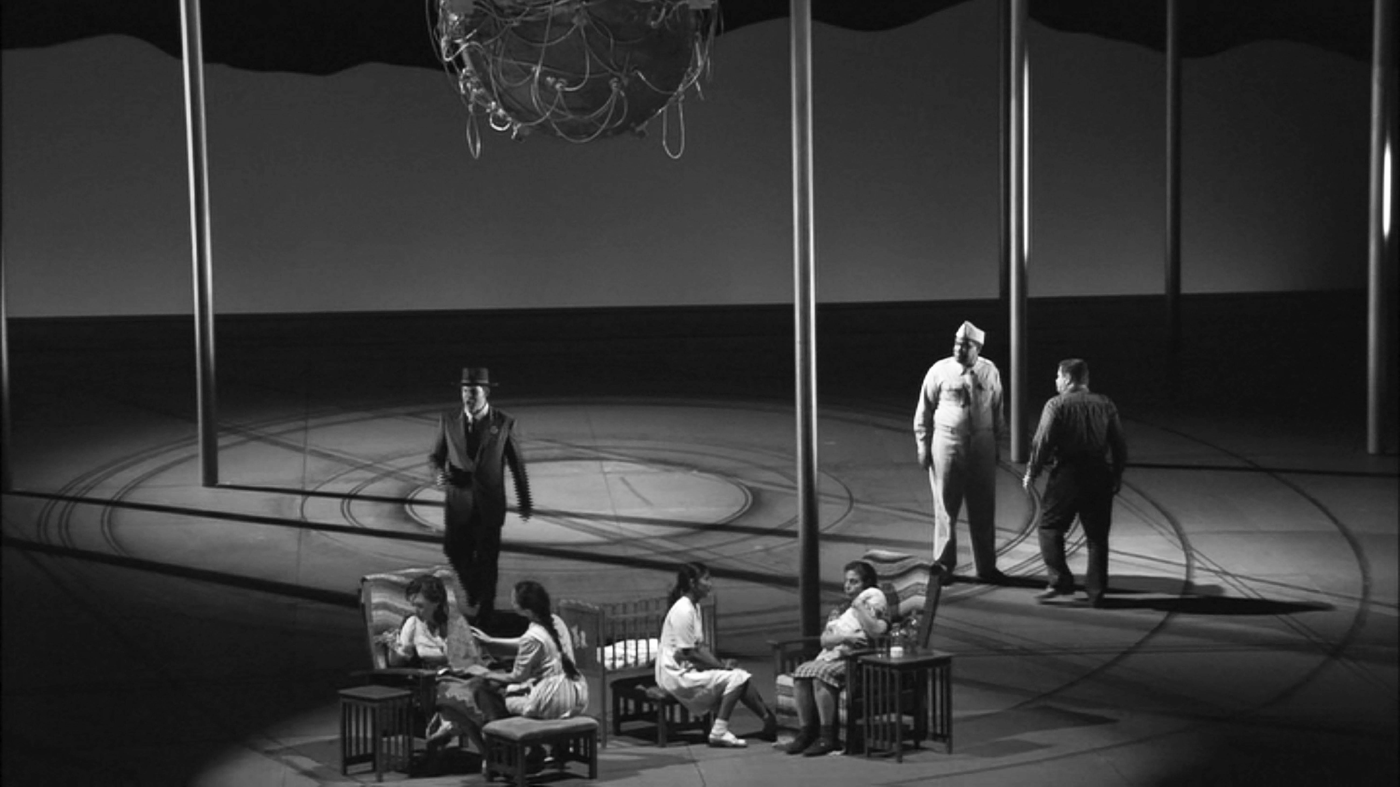
As Adams noted, space is manipulated in Doctor Atomic as well. The second act merges disparate spaces at the scenic level, for instance, with simultaneous representations on stage of two different locales as well as a fiery choral manifestation of Oppie's apocalyptic thoughts in the ‘Vishnu’ chorus (Act II scene 3). In Sellars's original staging of Act II scene 2 (Fig. 2), the Gadget hovers menacingly over Kitty Oppenheimer, her Tewa maid Pasqualita and other members of the household as General Leslie Groves, Edward Teller and Oppie – ostensibly at the test site – discuss the possibility that it might ignite the atmosphere.Footnote 22 Whether the events in different locales are meant to take place sequentially or simultaneously is unclear. By employing the equivalent of filmic cross-cutting between two synchronic narrative threads, Adams and Sellars use space to obfuscate the representation of historical time in what many critics perceived as an overly static second act.Footnote 23
Sellars's Act II scene 2 mise en scène.

The opera's abstraction of time and space also plays out on a sonic level. Largely overlooked by critics and scholars, this sonic abstraction is aimed at dissolving traditional boundaries between spectator and performer, between fiction and reality. In an opera dealing with the twentieth century's most devastating technological creation, Adams fittingly attempts this dissolution of the theatrical fourth wall by embracing a charged and fraught form of technology (at least within the operatic world): amplification.Footnote 24
Sound design and the opera
The sound design of Doctor Atomic initially arose from a crisis of representation: how could Adams stage the detonation of the Gadget? ‘I struggled for months over how to treat the explosion’, he reflected. ‘No operatic evocation of an atomic bomb could go head-to-head with the dazzling effects available to a Hollywood director … But avoiding the detonation entirely or treating it in the manner of Sophocles or Aeschylus, by having it verbally described by a third-party observer, seemed a perverse solution.’Footnote 25 Orchestral sound would pale in comparison with blockbuster visual spectacle. Yet, in an instance of what Jay Bolster and Richard Grusin have termed ‘remediation’, Adams allayed this particular operatic worry by adopting a thoroughly cinematic device: sound design.Footnote 26
Sound design in cinema was born in the 1970s as ‘New Hollywood’ filmmakers such as George Lucas, Steven Spielberg and Martin Scorsese took advantage of new audio technologies. Walter Murch introduced the term in 1979 to describe his work on Francis Ford Coppola's film Apocalypse Now, for which Murch placed sound effects and music within the spatial quadrants of venues boasting multichannel arrays.Footnote 27 The definition of sound design in film has since expanded to include the creation of sound effects, often through the digital manipulation of found sounds.Footnote 28 Doctor Atomic employs sound design both in the original sense of the term – by placing sounds within a multidimensional theatre space – and in the broader usage, with stand-alone electroacoustic passages that open each act and digital audio samples that are woven into an orchestral fabric.
Sound design precedents exist in spoken and musical theatre traditions as well.Footnote 29 In its modern theatrical conception, the term refers to the construction of the sonic space through amplification, sound effects and musical recordings. With the advent of digital sound in the late 1980s, directors began exploring the dramaturgical potential afforded by new technologies. In his Foreword to a 1992 book on sound design (one of the earliest), Sellars, whose directorial work encompasses spoken theatre, enthused about the immersive and even spiritual dimensions of theatre sound:
The technology has become available to allow sound to begin to occupy the place in theatre arts that it occupies in our lives. This technology is still evolving, and as it does, the nature of theatre itself will be transformed … We are in a position to completely reorient the relationship between performer and audience, to transform a theatrical space, to create distance or sudden proximity, to create a densely populated zone or an endless arid expanse. We are in a position to evoke simultaneous layers of experience: flashbacks, premonitions, visitations, inner voices, the mind wandering or becoming suddenly, unbearably concentrated … door buzzers and thunderclaps are no longer isolated effects, but part of a total program of sound that speaks to theatre as ontology.Footnote 30
Sellars's reference to a ‘total program of sound’ sounds almost Wagnerian, as if he is advocating for a sonic Gesamtkunstwerk. For him, sound technology promises a means to a transformational end, one that works with both physical and psychological space and demonstrates an equivalency between art and life.
Although adopted rapidly by theatre and film artists, sound design has been only slowly incorporated by composers as a constitutive element of opera, despite ample historical precedents for spatial music. From the cori spezzati of Adrian Willaert and Giovanni Gabrieli to the antiphonal offstage brass ensembles of Hector Berlioz's Requiem, composers have played with interactions between space and music, taking into account the placement and trajectory of sound. Even Claudio Monteverdi played with the imagined acoustic space of operatic performance by composing musical echoes in his Orfeo. And in the late nineteenth century, Richard Wagner took the idea of space as an immersive musical and dramatic parameter to a Romantic extreme with the construction of the Bayreuth Festspielhaus.Footnote 31
In the early twentieth century, Edgard Varèse and Charles Ives, among others, continued experimenting with the relationship between music and space using traditional instrumental forces. Varèse theorised musical space as an element of sound on a par with melody, harmony and dynamics:
We have actually three dimensions in music: horizontal, vertical, and dynamic swelling or decreasing. I shall add a fourth, sound projection—that feeling that sound is leaving us with no hope of being reflected back, a feeling akin to that aroused by beams of light sent forth by a powerful searchlight—for the ear as for the eye, that sense of projection, of a journey into space.Footnote 32
One realisation of his vision came at the 1958 Brussels World's Fair, where several installations engaged with the theme of nuclear disarmament. Varèse's Poème électronique for Le Corbusier's and Iannis Xenakis's Philips Pavilion took part in the emerging field of spatialised electroacoustic music begun earlier that same decade by Pierre Schaeffer and Pierre Henri (Symphonie pour un homme seul, 1950) and Karlheinz Stockhausen (Gesang der Jünglinge, 1955–6).Footnote 33 With a multitrack tape diffused via an eleven-channel sound system to an estimated 350 loudspeakers, the effect for one critic was finding oneself ‘literally in the heart of the sound source’.Footnote 34
In interviews leading up to Doctor Atomic’s premiere, Adams constructed an aesthetic bridge between himself and Varèse, who he called the ‘original post-nuclear composer’ and a ‘guardian angel’ for the opera.Footnote 35 Paying homage to the earlier composer, Adams refers to the electroacoustic preludes that open each act as musique concrète. Although Varèse did compose musique concrète, the term is more readily associated with Schaeffer, and Adams's use of the term belies the aesthetics and praxis of Schaeffer's initial experiments. Many of Adams's sound objects retain their representational qualities. The sounds of thunder, rain and truck engines, for instance, remain clearly identifiable as such, rather than being transformed into musical objects.Footnote 36 Adams seems less invested in terminological precision than in linking himself to the mid-century musical modernism that coincided with the dawn of the atomic age.
Moreover, his selection of Varèse – a naturalised US citizen, like many Los Alamos scientists – rather than Bernd Alois Zimmermann, Stockhausen or some other composer as a compositional ‘angel’ points to Adams's overt American nationalism. Zimmermann's serial opera Die Soldaten (1965) ends, like Doctor Atomic, with an atomic detonation that combines orchestral forces with prerecorded screams and destructive noises to create a visceral, sonic explosion.Footnote 37 Zimmermann also advocated for a ‘pluralistic’ form of opera that incorporated amplification, tape and sound engineering, electronic music and musique concrète (among other media), all of which would converge within a dynamic architectural space capable of effecting various spatial relationships.Footnote 38 And Stockhausen's early experiments with spatial serialisation and ordering carried over into his later dramatic works, most prominently in the monumental seven-opera cycle LICHT (1977–2002).Footnote 39 Each opera featured a variety of spatial designs, perhaps most memorably illustrated by the Helikopter-Streichquartett from Mittwoch, which requires members of an amplified string quartet to play from separate helicopters circling an auditorium.Footnote 40
By the early 1980s, more opera composers began enriching their orchestral palettes with electronic sounds. With The Mask of Orpheus (1986), Harrison Birtwistle relied on IRCAM composer Barry Anderson to ‘realise’ six electronic interludes as well as the electronic ‘auras’ that pervade each act. Anderson projected this electronic music, as well as amplified voices and select instruments, in four channels via speakers laid out across the stage, thus preserving the integrity of opera's proscenium-based sound field.Footnote 41
To be clear, none of these mid-century composers utilised the term ‘sound design’. But we can see these earlier musical experiments with space (with or without electroacoustic technologies) as precedents for contemporary approaches to sound design, which as a constellating term can and often does encompass acoustic and electroacoustic music, amplification and spatialisation.
Libby Larsen was one of the first opera composers to employ sound as a broader design element. With Frankenstein (1990), Larsen and her collaborators attempted to redefine the experience of opera by incorporating video, live-mixed electroacoustic sound and even an olfactory element (the latter proved unfeasible).Footnote 42 Larsen's decision to incorporate sound design reflected concerns over classical music's sonic currency:
Since before Frankenstein, I had thought for a long time that the traditional orchestral palette was quite atrophied and losing relevancy in the common ear of our culture, because our common ear had really grown up with directed sound, mixed sound, and mediated sound.Footnote 43
Like Sellars, Larsen recognised the increasingly mediated nature of everyday sounds and sought to adjust her music accordingly.
Damien Colas has demonstrated that opera composers have frequently adapted compositional developments in European music as dramaturgical tools, leading to an expansion of possible subjects for operatic treatment.Footnote 44 Larsen, for one, has noted the relevance of sound design for operas dealing with scientific or technological themes, such as her Frankenstein and A Wrinkle in Time. The gradual adoption of mid-twentieth-century developments in electroacoustic composition by opera composers from Birtwistle and Stockhausen to Larsen and Saariaho thus conforms to a broader pattern in opera history, and Adams's use of sound design participates in a post-1945 operatic tradition of using electronic means to experiment with the relationship between space and music.
Sound design, sound designer
Doctor Atomic was not the first time Adams brought amplification into the opera house or concert hall, but it does mark his most extensive engagement with it. Adams's admixture of the electronic and the acoustic has been a staple of his operatic writing since Nixon in China in 1987; all his stage works call for electronically amplified singers, and many include electronic instruments as well. Adams writes in his autobiography:
Ideally, when electronic sound sources are involved, the entire listening space should be organized and acoustically prepared … By 2000, with all my stage works I was requiring that every aspect of the production be subject to sound design. This extended not only to the performers—the singers, chorus, orchestra, and electronic sounds—but to the actual room itself.Footnote 45
Although Eidsheim has demonstrated that composers typically write for the naturalised, acoustic spaces they know, Adams instead composes for a space he imagines.Footnote 46 His statement foregrounds the dynamic relationship between sound and space that technologies of electroacoustic control negotiate in performance.Footnote 47 Given that every performance space is unique, however, Adams's desire to ‘organise’ listening spaces – or create an electronically manipulated soundscape that supersedes the natural acoustical environment of the performance space – has necessitated a new role in the creation and performance of opera: the sound designer.
Since the mid-1990s Adams has collaborated repeatedly with sound designer Mark Grey. Trained and active as a composer, sound engineer and sound designer, Grey met Adams in 1990 at CalArts, where Grey taught summer workshops in electronic music. When Jonathan Deans, the sound designer who worked on The Death of Klinghoffer, was unavailable for I Was Looking at the Ceiling and Then I Saw the Sky, Adams turned to Grey. As a sound designer and technical coordinator, Grey has worked with ensembles such as the Kronos Quartet, Paul Dresher Ensemble and Los Angeles Philharmonic, as well as venues including the Lyric Opera of Chicago, Park Avenue Armory and Houston Grand Opera. His sound design work with Adams encompasses both dramatic and concert works, including the 9/11 musical memorial On the Transmigration of Souls.Footnote 48
Transmigration was Adams's first work to employ multichannel sound. Its genesis in the year leading up to the first anniversary of the 9/11 attacks coincided with the early conceptual stages of Doctor Atomic, a fact that speaks to their shared sound aesthetic. In this twenty-five-minute piece for chorus and orchestra, Adams weaves recordings of voices and the New York cityscape into a surround-sound fabric. To describe its aesthetic potential – which supersedes the natural acoustical environment of the performance space – Adams invokes the long-standing modernist trope of breaking down divisions between art and life. ‘I just love the idea of New Yorkers coming in off of Broadway, walking into the hall and sitting down, and the lights coming down and then the traffic sound coming back up’, Adams said in 2004. ‘In that way it was very nice that it was the first piece on the program, because it created this wonderful kind of blur between life and art.’Footnote 49 Adams also relied on the sound design of Transmigration to evoke a sense of space. He hoped to elicit ‘the same sort of feeling one gets upon entering one of those old, majestic cathedrals in France or Italy … [where] you experience an immediate sense of something otherworldly’.Footnote 50
As happened with their previous collaboration, Grey's work on Doctor Atomic began in the compositional stage. Once Adams completed the orchestral score, most likely in the spring or early summer of 2005, Grey compiled for Adams a library of sound effects (drawn partly from the Library of Congress's audio archives) that could be used in composing the opera's electronic music sections.Footnote 51 With Grey's help, Adams then constructed the opera's sound design, which went through multiple iterations in the two months leading up to the October premiere. ‘John will create what he creates, and then my goal is to re-assemble his vision into the theatre’, Grey said of his working relationship with Adams.Footnote 52 In practical terms, this logic of authorial fidelity meant recreating in the opera house with Ableton Live software what Adams had initially pieced together in his studio with Digital Performer sequencing software.
Grey's work with Doctor Atomic entailed a performative element as well.Footnote 53 In addition to designing and installing sound systems for the opera houses where Doctor Atomic was initially performed, Grey took an active role in performances, controlling the overall soundscape of the opera by live-mixing amplified singers, instruments and digital samples. One of the challenges of sound design, Grey observed, lies in maintaining a consistent sound regardless of the venue: ‘Each venue is so different, but you can choose different technologies – like different loudspeaker technologies, different mixing consoles – to modify each venue to get that result for that consistency and for preserving the presentation.’Footnote 54 As a result, the digital score for Doctor Atomic contains a number of ‘archived shows’ that record some of Grey's modifications – at least in terms of software – for the performances in San Francisco, Amsterdam, Chicago, London and New York.Footnote 55 But these digital records necessarily still leave out certain performative elements, such as the appropriate dynamic balance between sonic forces.
In addition to its acoustic implications, the use of amplification has both musical and dramaturgical ramifications. Musically, the use of microphones allows Adams to balance large orchestral forces and electronic timbres with the lighter, more lyrical voices he prefers; this is the vocal aesthetic that pushed him towards amplification with Nixon in China.Footnote 56 Dramaturgically, amplification gives stage directors – especially Peter Sellars in the original production – significant freedom in blocking and choreography. This, according to SFO musical administrator Kip Cranna, was one of Adams's other goals in using amplification.Footnote 57 Rather than ensuring that performers are always facing the audience when singing, with amplification Sellars could stage them so that they are singing towards the stage wings, the rafters or even the back of the stage.Footnote 58 For Sellars, sound design in contemporary opera is a necessity:
In all theatre sound design is absolutely crucial. It's part of how we experience theatre now because we experience the world as sound that has been designed … coming to us through speakers … All the new operas I work on have amplification. [It adds] one more poetic dimension to what we're doing – it literally makes the close-up possible. It means that, for example, I don't have to have the singers facing forward when they're singing and I can have spatial relationships that can be completely redefined by the sound engineering … It really begins to shape the material as it would be shaped in a film. So, yes, it is part of a different dramaturgy … I would go so far as to say that it is built-in as an element of opera in our lifetime.Footnote 59
Sellars's statement – like his earlier Foreword – again suggests an equivalency between art and life: the mediated sounds of life necessitate a similar sonic mediation in the theatre. Acknowledging the influence of film and speaking in visual terms (‘it makes the close-up possible’), he also highlights the complex interrelationship between sound and space, noting the power of the former to transform and redefine the latter.
This transformation, however, is an invisible one, and to a degree, inaudible. Amplification should remain, for Grey, ‘transparent’. This aesthetic of sonic authenticity envisions the technology of transmission as a kind of ‘vanishing mediator’, to use a term coined by Jonathan Sterne in reference to questions of recording fidelity, ‘where the medium produces a perfect symmetry between copy and original and, thereby, erases itself’.Footnote 60 In live theatre, where electronic reproduction is instantaneous, this aesthetic requires that the sound designer maintain an illusion of spatial fidelity – what is known as localisation. Grey has adapted a sound design aesthetic developed on Broadway to give the aural illusion that sound always emanates from the singers, and not from speakers:
I ended up taking and adapting a lot of their sound design ideas that they used for Broadway onto the opera stage, but not with the Broadway result … You don't want the singer to be onstage – say, centre – singing and you're hearing the sound coming from the speaker [on either side of the stage]. That's the wrong approach. So the idea was to take these front fills and to use them actually as the driving force behind a lot of the vocal sound and really pull the vocal sound localised to the stage, so it feels like it's always coming from that singer. And when you line them across the stage, when a singer's all the way downstage right, you can snap the sound image mainly to that one front fill speaker and really focus, which is basically what I do for a piece like Nixon in China here [in San Francisco]. So that's why it feels localised all the time.Footnote 61
Unlike in Broadway musicals, the amplification in Adams's opera remains hidden; the audience should not realise that the singers’ voices are electronically reinforced. To create the amplification transparency desired by Adams, then, an effective sound designer must be attuned not only to the balance between singers, orchestra and electronic samples, and to the music's progression through time, but also to the movements of the singers in order to place the origin of the amplified sound close to the singer's location and reinforce a sonic spatial authenticity.
The choreographic freedom allowed by amplification also has a deeper implication: it suggests a restructuring of the spatial relationship between performer and spectator. Rather than maintaining the audience-oriented presentation necessitated by the proscenium frame in traditional acoustic performances, amplification allows performers to disregard, in a sense, the imagined fourth wall of the stage through which audiences peer. Although the theatrical frame still exists in the presence of the proscenium arch and the physical positioning of the audience has not changed, the use of amplification subverts the visual and dramaturgical conventions imposed by the acoustics of the opera house. Sonic purity is traded for spatial verisimilitude.
With sound design, then, composers and directors can subvert not only the visual constraints of the traditional horseshoe design of opera houses, but also the sonic limitations of conventional orchestral and vocal forces.Footnote 62 Developed virtually in parallel with the scientific advances that made nuclear weaponry possible, electronic sound technologies have created, as Sellars's preceding quote suggests, new dramaturgies that remap visual and aural space in opera.
The dramaturgy of sound design
Sound design still poses additional questions for operatic dramaturgy, and its centrality in Doctor Atomic lends weight to these inquiries. What rules and principles govern the sonic and spatial interactions among the opera's voices, instruments and digital samples?Footnote 63 How does the sound design help to structure the narrative and heighten its dramatic import? To what degree does it interact with the libretto? Answering these questions necessitates a closer examination of the opera's sound design.
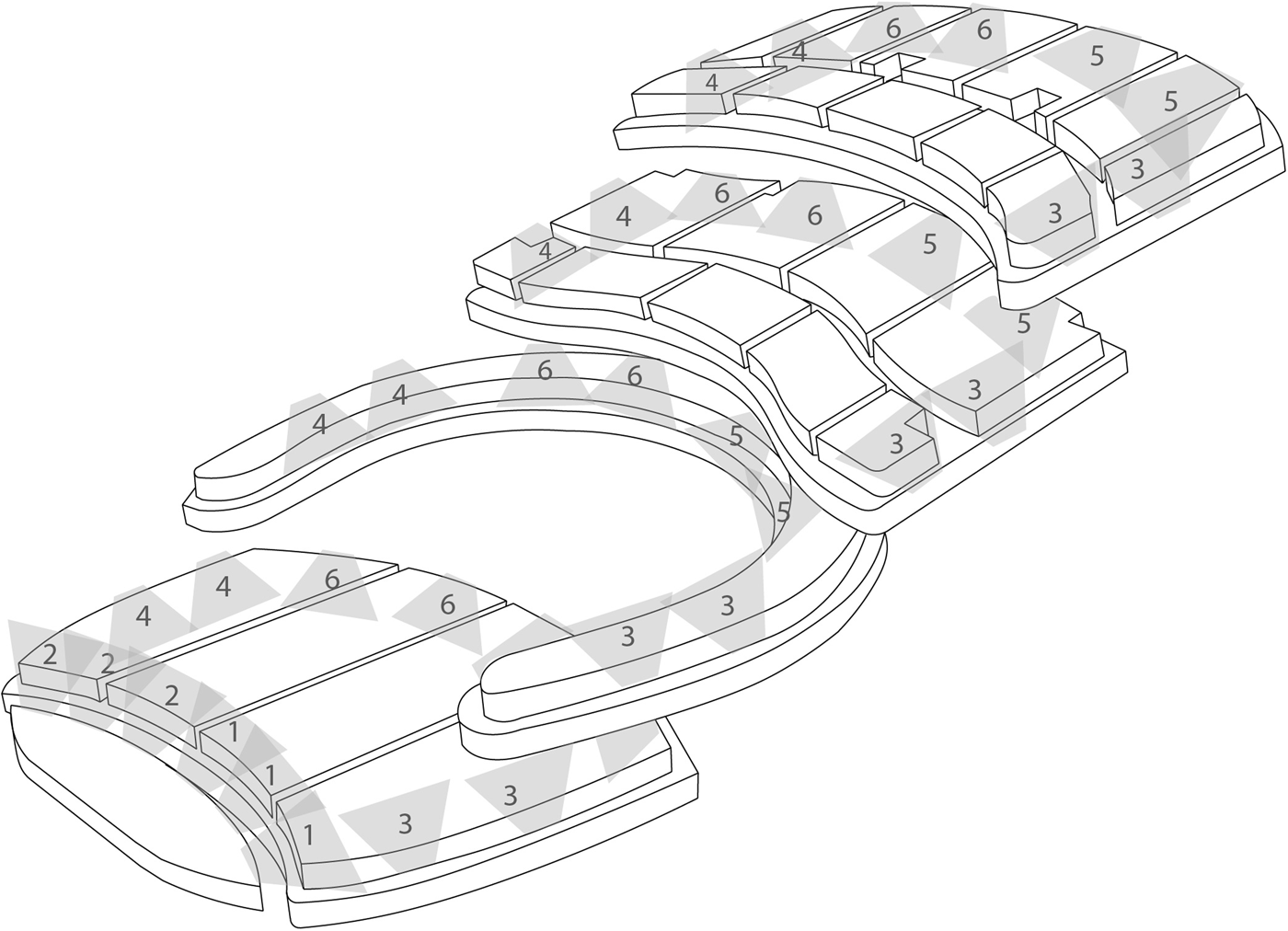
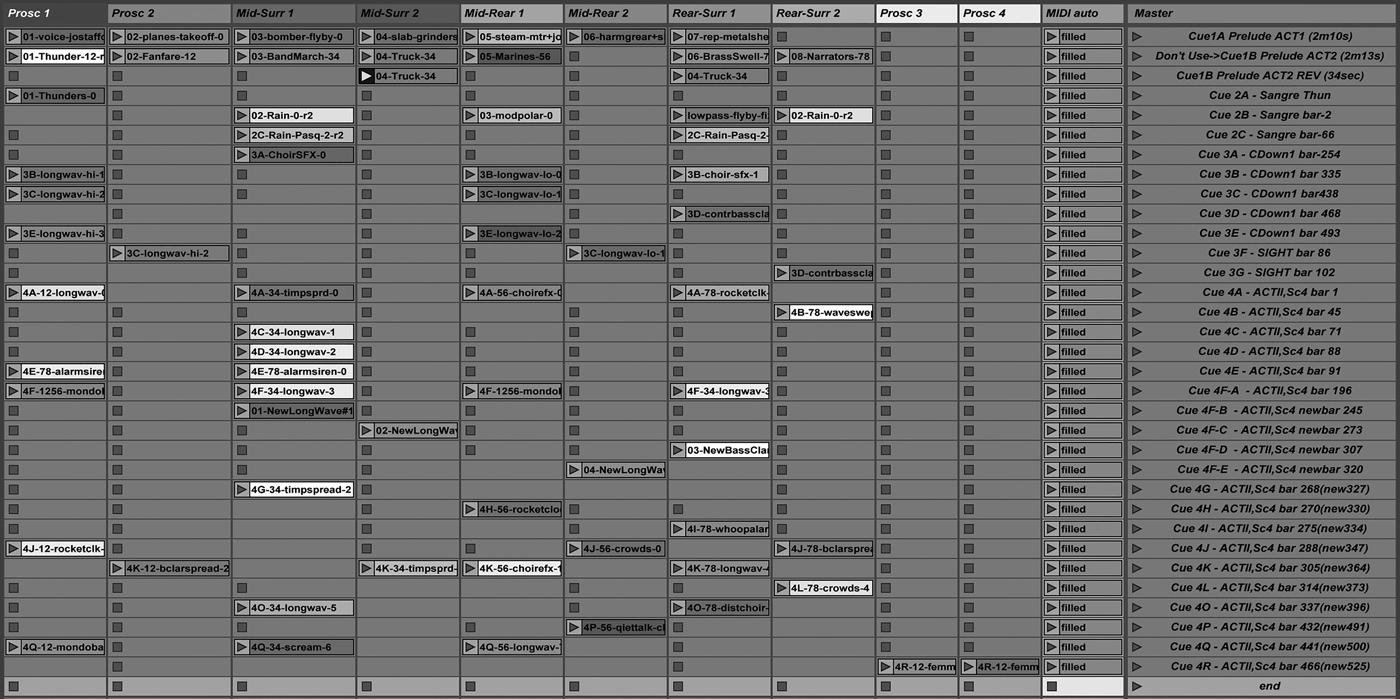
Doctor Atomic utilises a six-zone surround-sound system: zones 1 (left) and 2 (right) emanate from the stage via the main PA system, zones 3 (left) and 4 (right) occupy the middle ground of the audience on each level, and zones 5 (left) and 6 (right) provide sound coverage that comes from the rear of the opera house on each seating level (Fig. 3). Soloists, chorus and discrete sections of the orchestra combine with digital samples within these sonic zones.Footnote 64 Fig. 4, which contains a list of all cues as they appear in the Ableton Live sequencing software used for performances, shows that the front and side zones (1–4) never play more than two digital files, likely owing to the fact that voices and orchestra already emanate from these more frontal zones. By contrast, the rear zones (5 and 6) include up to four channels simultaneously. Adams does not, however, use surround sound throughout the entire opera, for reasons that will become apparent shortly.
Approximate surround-sound set-up for Doctor Atomic at San Francisco Opera.

Ableton Live session view of Doctor Atomic, showing all cues and sound files.

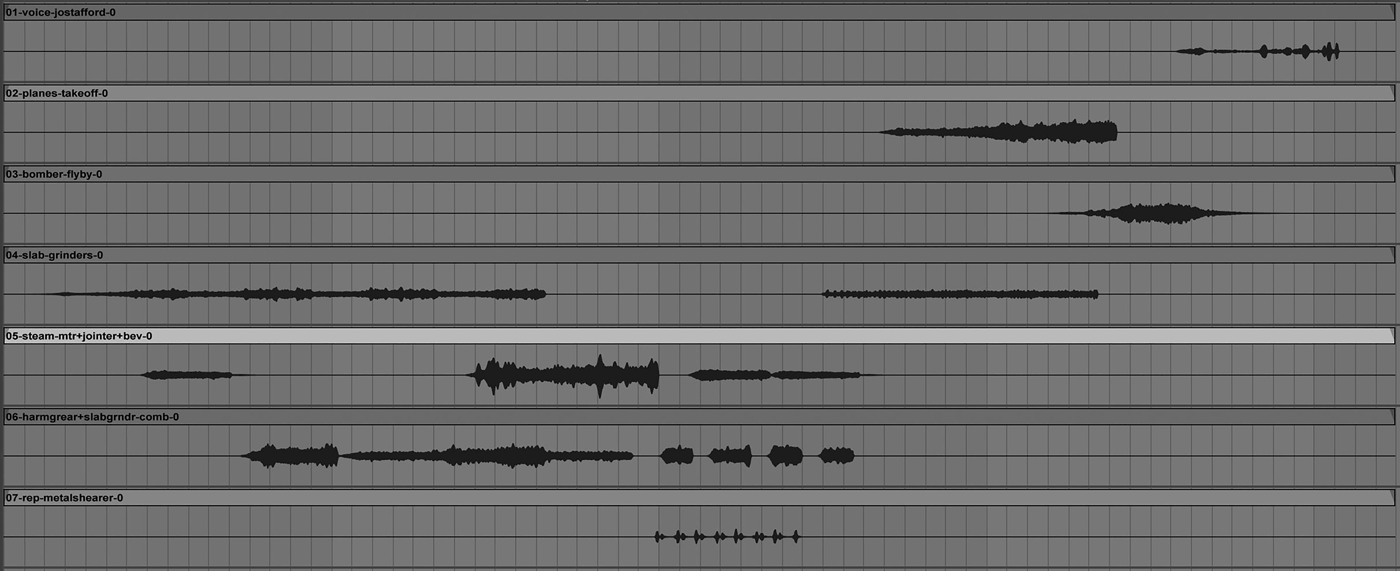
The ‘found’ sonic objects of Doctor Atomic offer a parallel with the found elements of the libretto. Their placement within the dramatic arc of the opera, however, is more selective: they appear primarily at the opening of each act. The opera begins with two minutes and ten seconds of so-called ‘musique concrète’ à la Varèse. At first, seemingly aimless introductory noises bleed from one sound into the next. The soundscape begins with a combination of the bottom four tracks listed in Fig. 5. Speakers in zones 1 and 2 remain silent, while noise surrounds the audience from the sides and the rear, and the sounds pan actively between the left and right sides of the space. Adams has described these buzzing, crackling power-tool-derived sounds as an aural representation of the inside of an electron accelerator. But given the irregular temporalities of the opera, the shifting sonic fuzziness also gives the impression of a radio sputtering into a barren, post-apocalyptic landscape, broadcasting random sounds from a self-destroyed civilisation.Footnote 65 These alien noises begin to give way around 01:22 to the more recognisable sound of spinning airplane propellers, which dominates the front (proscenium) right channel of the surround-sound system.Footnote 66 The propeller sound slides upward in pitch from e until it plateaus around c ′. This pitched ascent, accompanied by a crescendo, seems to place the audience in the path of the oncoming plane, which also moves from zone 2 to zone 1. As the airplane ascends, a new sound (‘03-bomber-flyby-0’) enters in zone 3, giving the impression of one continuous ascent. By 01:47, the propeller sound has shifted to the side channels in full volume. The plane sound then travels again from zone 3 to zone 4; it is now above the audience and nearing the sonic horizon to the right of the audience. As the airplane fades away around the two-minute mark, a static-laced snippet of Jo Stafford's rendition of the 1946 pop song ‘The Things We Did Last Summer’ enters in the two front zones.
Ableton Live arrangement view of ‘Cue1A Prelude ACT1’.

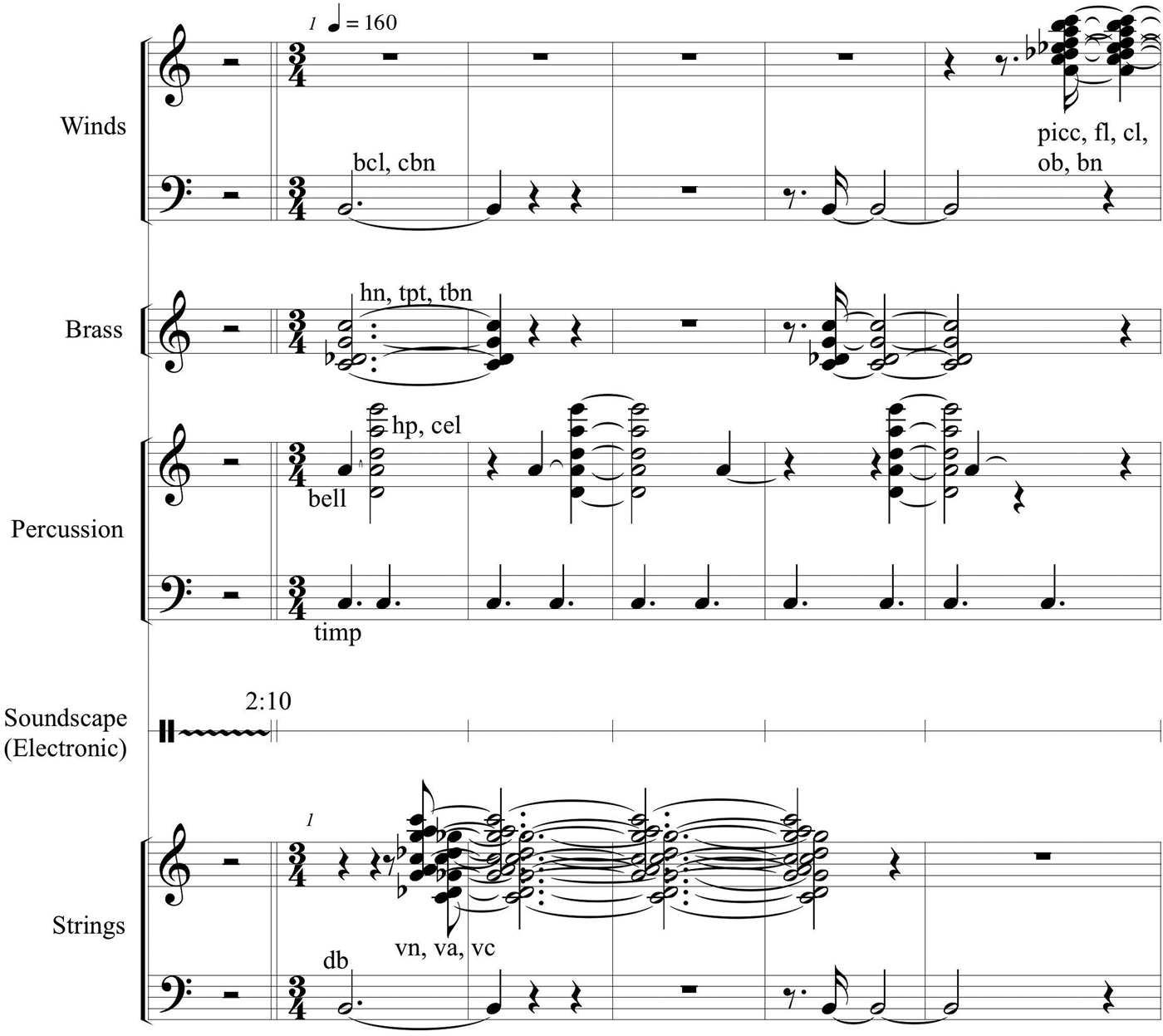
Though ostensibly a song about a summer love affair that has soured over the passage of time, in the context of Doctor Atomic the lyrics of the song are suggestive. The titular refrain, ‘the things we did last summer I'll remember all winter long’, alludes retrospectively to the development of the atomic bomb, viewed perhaps from the vantage of nuclear winter. Adams, however, includes only the opening lines from the second A section of the slow, orchestral AABA ballad: ‘The midway and the fun, the kewpie dolls we won / The bell you rang’. Adams illustrates the unheard portion of this line (‘to prove that you were strong’) sonically: the orchestra crashes into the aural space, cutting off the vocal slide up to a b′ (‘rang’) with a dissonant, dense cluster of chords undergirded by a low B pedal point. Tolling chimes and a throbbing dotted-crotchet timpani pulse imbue the music with a sense of rhythmic urgency (Ex. 1). The harmonic dissonance complements the metric dissonance of the chimes, timpani and other percussion instruments – an effect that Everett describes as multiple clocks all counting down at different speeds.Footnote 67 Most importantly, the opera has returned to a front-oriented sound placement by the end of the opening soundscape. Thus, Adams negotiates the transition from electronic to orchestral sound spatially, preparing the audience for the traditional aural presentation of the first act, during which sound emanates entirely from the proscenium. He also moves from aural abstraction towards the more representationally concrete, first with airplane sounds and then with texted music.
Act I scene 1, bb. 0–5. Reduction.

According to the published orchestral score, the second act opens similarly, with an identically timed section of musique concrète. In the first few productions, this soundscape included rolling thunder, idling truck noises, white noise static and electronic beeping that intermingled with the voice of an announcer (likely from the radio broadcast ‘Voice of America’) and big-band and orchestral snippets, such as the Marines’ Hymn, ‘The Halls of Montezuma’. The sound design files provided by Boosey & Hawkes, however, call for a revised Act II prelude of only 34 seconds, which places the sounds of heavy trucks in the mid-surround and rear-surround speakers. As in the first act, this opening soundscape gives way to a sudden fortissimo orchestral statement that nearly saturates the chromatic pitch space, and the surround-sound environment disappears abruptly.
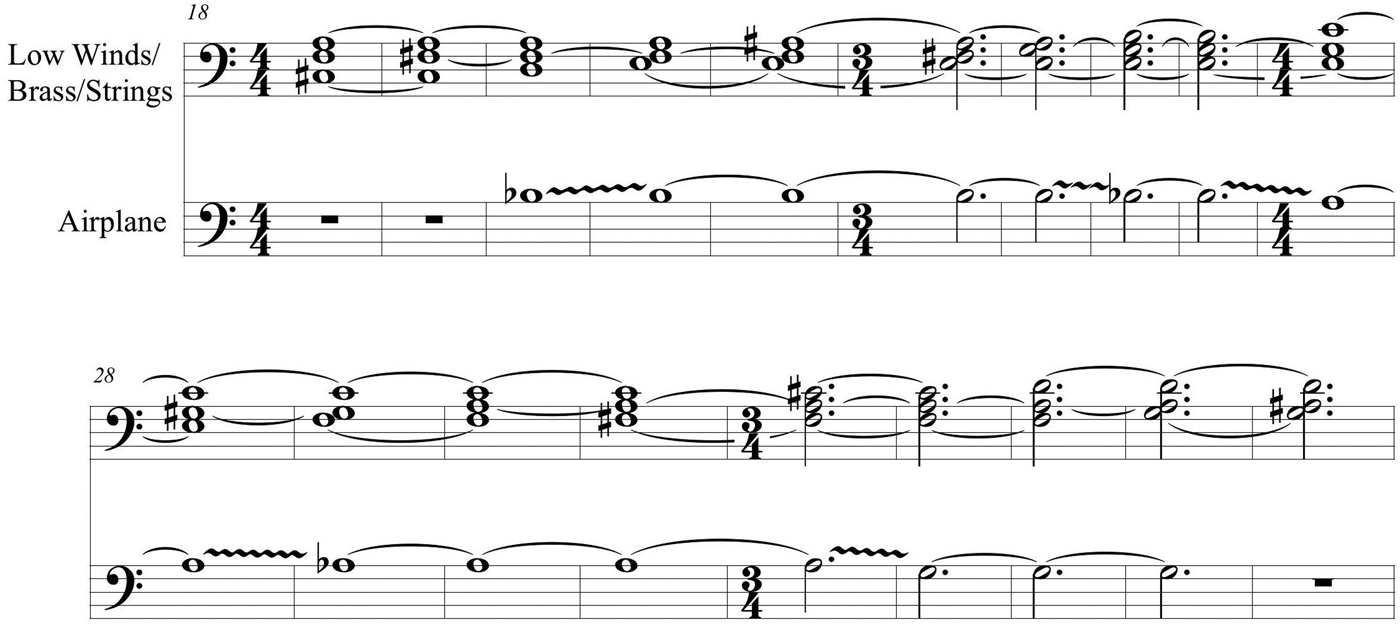
The immersive soundscape returns, however, in the Act II interlude after scene 1, ‘Rain over the Sangre de Cristos’. Audio samples of thunder, rain and an airplane blend with a dissonant, moody orchestral texture. Whereas the thunder seems to emanate from the stage (zones 1 and 2), rain surrounds the audiences (zones 3–6). In combining the acoustic and electronic, Adams attempts to blend the two. A tuned gong and tam-tam initiate the thunder and rain samples, and a distant airplane, virtually indistinguishable from the buzzing, tremolo strings, provides a gradual, gliding descent from b to g that counterpoints the chromatic ascending 5–6 sequence (Ex. 2).
Act II scene 2 Interlude, bb. 18–36. Harmonic reduction.

Throughout the remainder of Act II, digital samples are virtually omnipresent, increasing in number as the detonation approaches. Acoustic and electronic sounds continue to overlap through timbre, texture and pitch. Adams, for instance, pairs the ‘Low Crowd Muttering’ sample with choral mutterings and vowel sounds (Act II scene 3, bb. 273–6, 342–57), and the ‘Low Clarinet’ in b. 468 sounds two octaves below the horns and Edward Teller.Footnote 68 The samples also move increasingly from concrete to abstract in terms of signification. The identifiable sounds of rain and thunder, for instance, give way to samples such as ‘Long Waves’ and ‘Bass Clarinet Spread’, which utilise infrasonic frequencies designed more to elicit a general physiological unease than to evoke a distinct physical object or natural phenomenon. Following the sound of a ‘two-minute warning’ rocket (b. 330), the opening orchestral motive (Fig. 1) returns vehemently in Act II scene 4, b. 351, preceded by a surround-sound mixture of ‘Timp. Spread’, ‘Rocket Sound’ and ‘Screaming Babies’, and further supplemented by ‘Bass Clarinet Spread’. The proliferating use of digital samples over the course of the second act thus complements the opera's temporal framework (Fig. 1); time and space become increasingly dense.
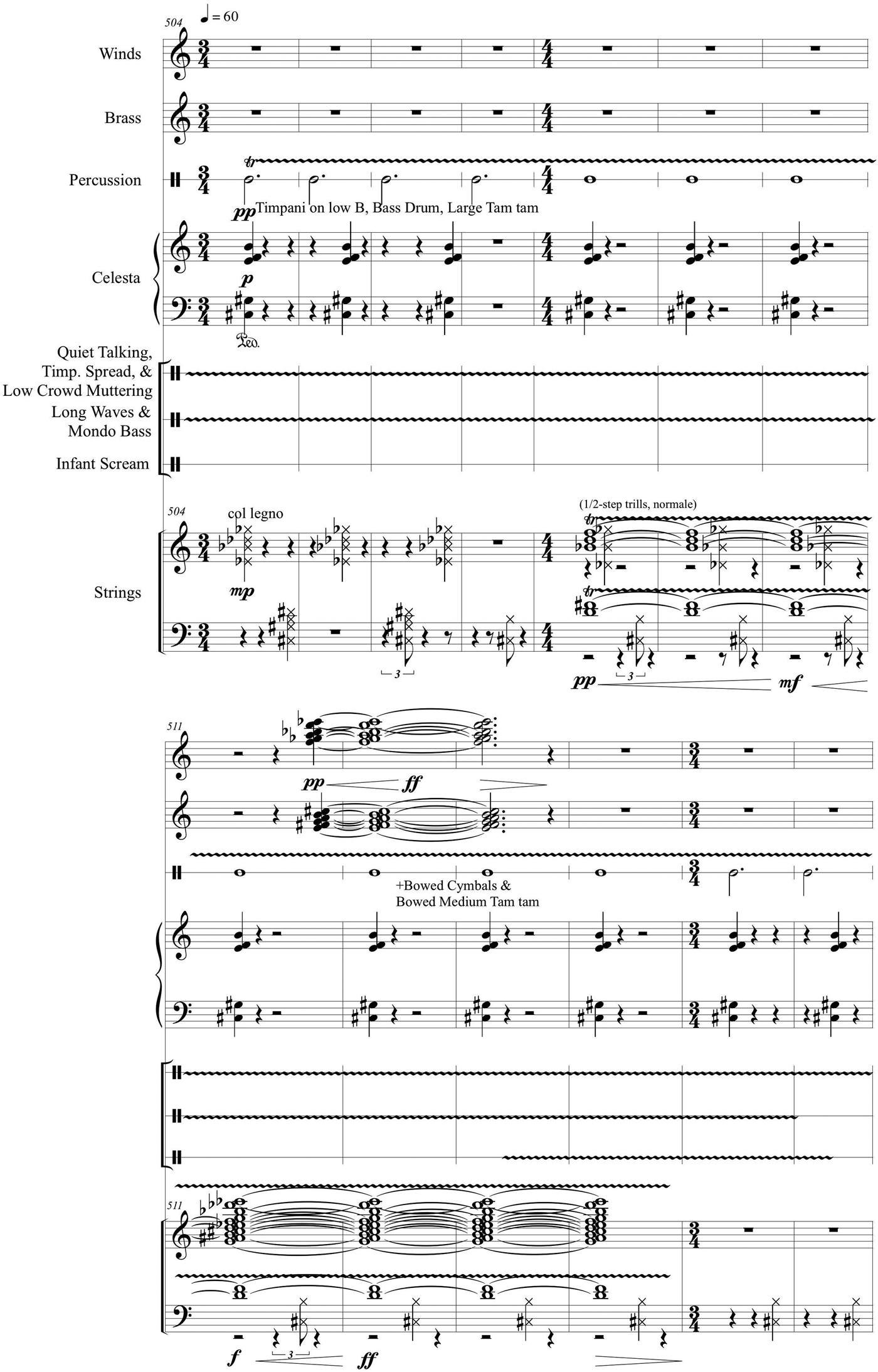
The opera concludes with a wash of sound that brings together orchestral and electronic forces. At its dynamic peak in b. 513 (Ex. 3, bb. 504–16), an electronically-distorted ‘Infant Scream’ cuts through a dissonant sonic mass of trilled divisi strings and percussion, clustered winds and brass and five electronic samples that Adams has layered gradually: ‘Low Crowd Muttering’ (b. 354–end; zones 5–6), ‘Long Waves’ (bb. 396–413, zones 5–6), ‘Quiet Talking’ (bb. 491–526, zones 5–6), ‘Mondo Bass’ (bb. 500–15, zones 1–2) and ‘Timp. Spread’ (bb. 500–22).Footnote 69 At this moment, the audience and the onstage characters feel the Gadget's impact, rather than at its detonation at b. 504.Footnote 70 After this claustrophobic immersion in what has effectively become noise, the emergence of a woman's voice from zone 1 is startling. The semitone misalignment of fifths between the celesta and harp in the closing bars (c ′-g
 ′ against d′-a′) finds a spatial equivalent in the ‘Japanese woman’ sample, as the heavily reverbed voice flickers briefly from the left channel to the right (an effect added, according to the ‘archived’ Ableton shows, on 8 October 2005). And the ‘Low Crowd Muttering’, a sonic constant for nearly 200 bars, extends even beyond the tolling harp, celesta and tuned gongs, which fade to silence in the final notated bar (b. 540).
Act II scene 4, bb. 504–16. Reduction.

Adams and Grey employ the multichannel system strategically. Rather than using surround sound throughout Doctor Atomic, the opera plays on the difference between front-based and surround sound to draw the audience into the historical events portrayed on stage.
In the opening soundscapes and throughout the second act, Grey mixes voices, orchestra and electronic samples in surround sound to create a more realistic – and less specifically musical – sound atmosphere:
[In] the second act, all the way up until the testing of the bomb, we're introducing more and more of these pedal tones, soundscapes, broadening. What we want to do is transport the audience in the second act out of [the opera house]. Because the whole first act you've been focused frontal, where when you start to introduce these kinds of situations that are around the audience, the focus is still always on the stage. Because you've been connected to it for so long during the evening, once you start to introduce things into a surround sound, then the feeling of the walls disappearing starts to happen. And so all of sudden the space gets a lot wider, a lot bigger, without the audience even really realizing it. So most people had no idea what was going on, because … often some of these soundscapes were so buried in the texture, but it just created this width of sound that you couldn't get any other way. And so it helped transport the audience to the next level. And it was literally a crescendo all the way to the testing of the bomb. And so by the time the bomb is there, it doesn't feel out of place, it doesn't feel awkward, because it's actually been around you the whole time, it's just been creeping in and snaking through, and psychologically playing with the space.Footnote 71
As Grey makes clear, the sound design of the opera shifts over the course of the two acts from proscenium-based sound reinforcement to a surround-sound design. Composer Denis Smalley, a pioneer in theorising spatialisation, would identify this as a perspectival shift from prospective space to circumspace, in which ‘sound can move around the listener and through or across’ a listener's personal space.Footnote 72 By surrounding the audience in the second act with so-called ‘diegetic’ sounds such as rain, thunder and the droning of a distant airplane, Adams dissolves the aural boundary traditionally established by the proscenium arch, effecting a continuous spatialisation that extends the stage into the audience aurally. Grey reserves the surround-sound channels primarily for atmospheric effects, with only a small amount of orchestral reverb and singers mixed in.Footnote 73 Ambient noises combine with pitched material, such as pedal tones, to flesh out the sonic palette of the orchestra and voices. Grey's use of spatial metaphors to describe the resultant sound mix – transporting the audience, making the theatre walls disappear – again reinforces the relationship between sound and space.Footnote 74
The observation that ‘most people had no idea what was going on’ is borne out by the opera's reception. Although several preview articles highlighted the opera's electroacoustic component, only a handful of the close to ninety critics who attended opening night referenced it.Footnote 75 In fact, the sound design of Doctor Atomic changed over the course of the San Francisco performances and subsequent productions. In the earliest performances, Grey and Adams struggled to find an appropriate balance between orchestral and electroacoustic forces. Rosenberg recalled:
After I think it was the third or the fourth performance, [Adams] decided that the levels for the musique concrète at the beginning of the two minutes of electronic sounds … needed to be brought way up, that it had been too soft. And so then the first performance where Mark [Grey] brought those up, they were brought up to such a level that when Donald [Runnicles] started the orchestra, it was like an anticlimax, instead of leading into this crashing orchestral sound.Footnote 76
The lively blogging community of the early millennium recorded an even more telling account of these balance issues. Robert Gable, writing on his blog aworks, noted a sonic disparity between his seats in the balcony circle at SFO and row P in the orchestra, where he sat for an earlier performance: the ‘chorus in particular had more presence and the electronica sounded better integrated [in the balcony]. The opening sounds last week gave a ping-pong effect, as if being at a cinema multiplex.’Footnote 77 In a related post on her blog Iron Tongue of Midnight, Lisa Hirsch astutely noted that Grey's location in the auditorium, in the orchestra-level standing room, helped to account for the marked difference in sound quality between different sections of the opera house: ‘If [Grey has] got control over balances and amplification to that extent, and he's waaaaaay back in center field, no wonder the balances sound better from the back of the orchestra than the middle.’Footnote 78 Even Adams confessed, in retrospect, ‘Ironically, the one hall that seems to have stumped us is San Francisco Opera House.’Footnote 79
Grey and Adams continued work on the opera's sound design throughout the initial production run, determining the placement of sounds within the surround-sound zones. These changes, which fit Adams's habit of revisions, speak to Doctor Atomic as ‘work’ rather than ‘a work’ – that is, its ontological status was far from fixed, as is evidenced by Grey's labouring to find an appropriate balance.Footnote 80 Adams's subsequent revisions to the orchestral score after the SFO performances necessitated changes to the digital score; Grey added four samples to Act II scene 4 in May 2007.Footnote 81 The digital score and ‘archived shows’ reveal that Grey and Adams continued to experiment with these placements during the subsequent production runs at the Netherlands Opera (June 2007) and Chicago Opera (December 2007–January 2008). In the middle of the Netherlands performances, for instance, Grey moved the placement of the ‘Japanese woman’ sample from an equal spatial distribution between zones 1 and 2 to a purely zone 1 placement, a change that more strongly highlights the spatial flickering effect described earlier in this article. And during the Chicago performances, Grey and Adams replaced the Act II opening ‘musique concrète’ with an abbreviated version.
Grey has recorded all of this digital information into a series of automated commands, so future sound designers performing in Doctor Atomic can simply initiate the cues using a laptop computer running the Ableton Live software music sequencer and monitor the overall balances.Footnote 82 Despite its seeming simplicity, this task still poses its challenges. Unlike more recent sound design in film, where THX certification processes ensure that a THX film operated on THX equipment in equivalent spaces will achieve a consistent and uniform sound playback across venues, sound designers in opera must confront extreme variations in audio equipment and physical space.Footnote 83 These variances across opera houses make it more difficult to achieve consistency in sound presentation.
Beginning with the 2006 Netherlands performances, Adams and Grey found a more novel way of playing with the boundary between the stage and audience. At the moment of the Gadget's detonation, they made the opera house shake. Recalling the 2008 Metropolitan Opera production, Grey revealed how they achieved this effect:
Every building essentially has nodal points – the overtone series, you know? When we did the first rehearsals of that [at the Met], Peter Gelb was like, ‘It should be louder!’ So what we did was we had the sound department go and basically get, I don't know, six more subwoofers, and we attached them to the structural portions of the house at the proscenium wall, and strapped them against the support beams. And then, basically what I did was I ran tone through those subwoofers at the frequency that activates the room. I actually didn't change the volume levels of what I was presenting. I just added more subwoofer to it and it was like, ‘Holy shit, that was great!’ When we first detonated the bomb with all this new technology, the orchestra freaked out. They were like, ‘Oh my god, is the ceiling going to come down?’ Because it felt like the building was going to come apart. And so they brought in structural engineers, they brought in dB [decibel] readers, they had to generate union loudness levels of all this stuff that they had to administer to each orchestra member, like pregnant orchestra members were worried that this was going to affect their children, their unborn child – all totally valid things. Because, you know, when the building is doing that, it feels like an earthquake.Footnote 84
In a richly symbolic decision, Grey positioned subwoofers at the very place in the theatre that separates audience from performer and reality from fiction: the proscenium. At the climax of Doctor Atomic, then, Adams and Grey collapse the theatrical fourth wall by introducing a haptic element into the theatrical experience. As sub-bass frequencies blur the dividing lines between the senses, sound and touch intermingle, leading to a collapse of space from a public zone into an intimate zone, to borrow terminology from Edward Hall's categorisation of space in social situations.Footnote 85 All of these relationships are contingent, however, insofar as each performance venue will have its own frequency at which it begins shaking.
This dissolution of theatrical spatial boundaries finds an equivalent musical rupture in the opera's climax. The combination of orchestral dissonance and samples effectively creates a wash of noise, making the detonation of the Gadget a moment when noise and music become virtually indistinguishable. Like the fusion of art and life, the transgression of the boundary between noise and music is another long-standing modernist trope. According to sound historian Douglas Kahn, this action ‘stood at the center of the existence of avant-garde music, supplying a heraldic moment of transgression and its artistic raw material, a border that had to be crossed to bring back unexploited resources, restock the coffers of musical materiality, and rejuvenate Western art music’.Footnote 86 And as music transforms into noise in the opera's final minutes, sound also supersedes sight, marking yet another hierarchical destabilisation. Onstage characters, silent and motionless, stare into the audience.
Placed alone at the beginning of both acts and the conclusion of the opera, Adams privileges and foregrounds electroacoustic sound. It, not the orchestra, sets the tone for the opera and occupies its final moments, and these sections of musique concrète frame the sonic presentation of Doctor Atomic just as the proscenium arch frames the story's visual elements. Moreover, the increasing density and spatialisation of the electroacoustic texture throughout the second act functions structurally, charting a sonic vector from music towards noise and a social vector from the public towards the personal.
Although Adams was not the first to employ operatic sound design, the surround soundscapes of Doctor Atomic represent a developmental milestone for the composer within his own stage oeuvre. Sound design solved the urgent theatrical problem of how to represent the bomb and offered the potential for a different dramaturgy. At the same time, it offers scholars a window into the divergent musical and cultural politics that animated Adams and Sellars's collaboration.
The politics of sound design
Sellars believes that art offers an opportunity to effect social and moral change.Footnote 87 While still interested in the dramatic potential of Robert Oppenheimer as a character and in the moral implications of the atomic bomb, Sellars's primary goal in Doctor Atomic was constructing a parable of unchecked, concentrated power. In a 2013 interview, Sellars reflected:
In the twenty-first century we were all confronted by the spectre of the national security state, and massive decisions being made for all of humanity by a very small group of people in underground conference rooms. So, [Doctor Atomic addresses] that idea that democracy is not a representative entity anymore … The birth of that national security state was the atomic project … This gave us a way of talking about a period where a kind of state-within-the-state was created and where large-scale decisions that had devastating consequences, short and long term, were made by a bunch of people, a small group of people, who did consider themselves as gods.Footnote 88
More than simply expressing re-awakened nuclear anxieties, Doctor Atomic, from Sellars's perspective, critiques the post-Cold War attitude of American exceptionalism – memorably captured by Francis Fukuyama's 1989 proclamation of the ‘End of History’ after the downfall of the Soviet Union and the triumph of America's free-market economy and liberal democracy.Footnote 89 This attitude experienced a resurgence after 9/11, buoyed by the foreign policy and military decisions of the second Bush administration.
In a synopsis of Doctor Atomic, drafted in 2002 while the opera was still in its conceptual phase, this critique of the military-industrial complex plays out over a second act depiction of Robert Oppenheimer's 1954 fall from power.Footnote 90 But with Alice Goodman's departure from the creative team in June 2003, the opera's scope shrank significantly. Lacking the longer narrative arc of Oppenheimer's public career, Sellars turned to documentary materials to enact his critique. He sees the inclusion of declassified government documents as central to the opera's socio-political, and indeed moral, significance:
The libretto consists of classified documents that were meant to be buried alive forever. And now that very thing that President Truman was not allowed to read—because the security apparatus kept it away from the President of the United States—is being sung in the clear light of day by chorus and orchestra … which again offers some hope for the world.Footnote 91
Sellars's stance on the opera's message contrasts sharply with Adams's. When embarking on the project, Adams purportedly told Sellars ‘I don't want this opera to be all about the morality and the politics’, and in 2008 he continued to insist, ‘I didn't “set out” with any moral or ethical issues to promote. My intentions couldn't be further from those who want to use art to promote social goals.’Footnote 92 No doubt sensitive to the ongoing fallout from Klinghoffer (in the wake of 9/11, the Boston Symphony Orchestra had cancelled planned performances of its choruses), Adams likely sought to avoid a similarly contentious reception by virtuously proclaiming his apolitical aesthetic.Footnote 93
The autonomous artwork can only ever be an ideal, however, as politics and other cultural factors are always already embedded.Footnote 94 In one of the clearest instances of Adams's attempts to de-politicise the opera, he removed a short scene that would have concluded it after the Alamogordo testing. In spoken dialogue over music, the singers portraying General Groves and Lt Colonel Rea of Oak Ridge Hospital would have re-enacted a telephone conservation from 25 August 1945, in which Groves suggested that news reports of the horrific suffering from radiation burns on Hiroshima and Nagasaki bomb survivors were Japanese propaganda designed to arouse sympathy.Footnote 95 In a late change to the opera that took place in May 2005, Adams discarded this planned ending, noting:
I felt it was too ironic, too freighted with implied criticism of the US position on the war … I found those very short phrases that a Japanese mother had been heard speaking in the immediate aftermath of the Hiroshima blast … I found her words to be powerfully expressive of the final result of all the technology and warfare that had been brought to bear on these helpless civilians. I think it proved to be the right way to end the opera. How else could I have done it?Footnote 96
Adams's rhetorical question here seems aimed at self-absolution for perceived political or dramatic sins. A lengthy spoken epilogue might have been dramatically unsatisfying after the climactic detonation; some critics found Adams's failure to make a strong ethical statement politically unsatisfying.Footnote 97 But Adams's need to justify his ‘apolitical’ ending also speaks to the US socio-political climate of the early 2000s, in which resurgent nationalism met criticism of the US wars in Afghanistan and Iraq with hostility.
Adams has implied that the opera's ethical or political message – such as it is – is conveyed sonically. In his autobiography, Adams reflected that an opportunity presented itself through the representation of the Gadget’s detonation:
At the high point of [the] countdown, with the chorus singing frantic, wordless exclamations, the entire cast takes cover, lying prone on the stage, staring straight into the eyes of the audience. The audience members gradually realize that they themselves are the bomb.Footnote 98
The audience's journey towards enlightenment that Adams describes mirrors his own coming to terms with Hiroshima and the atrocities of the twentieth century. In the final compositional stages, unsure of how to conclude the opera, Adams turned to his notebook on Buddhist writings. In 1995 he had written in it: ‘Become one with the bomb, the Holocaust. There is no escaping it.’Footnote 99 But Adams's description of these final moments also foregrounds the spatial implications of Sellars's staging, as the cast participates in a dissolution of the theatrical fourth wall that positions the spectators as the detonation site. The audience's immersion via sound design, although not explicitly referenced in Adams's comment, seems to be his best attempt – three years after the premiere – at imparting an operatic moral by implicating post-9/11 civic complacency towards government overreach and violence abroad, or at least demanding an acknowledgement of history's horrors.
If the sound design reveals relatively little about Adams's cultural politics, it speaks volumes about his musical politics. Adams views his incorporation of sound design into opera as Wagnerian in innovation. In an interview with Alice Miller Cotter, Adams reflected:
I made the egotistical comparison with Wagner yesterday that he knew what he wanted for a sound picture, and he knew he wanted to have brass and big sumptuous powerful orchestration, but it would be have to be coming from underneath the stage and so he devoted his life to making that happen, and I've sort of done that in a way with sound design.Footnote 100
For Adams, sound design – like Wagner's construction of Bayreuth and its orchestral pit – marks an operatic development with transformative implications. Seemingly unaware of sound design's many historical precedents, Adams appears to accept credit for its incorporation into opera. Moreover, he does so in a way that furthers Wagnerian discourse about Doctor Atomic.
Critics, perpetuating Sellars's comment calling Doctor Atomic a ‘Götterdämmerung for our time’, readily aligned Adams with Wagner, pointing to an ‘ominous brass motif’ reminiscent of Fafner and the way Adams ‘embed[ed] much of the opera's psychological meaning in the orchestra’.Footnote 101 And Grey's comments about using sound design to ‘transport the audience’ and making the walls ‘disappear’ evoke Wagner's oft-quoted vision for his operas, in which ‘the public … forgets the confines of the auditorium, and lives and breathes now only in the artwork which seems to us as Life itself’.Footnote 102 These Wagnerian comparisons serve to reinforce Adams's self-positioning as a composer, in the vein of the Romantic genius, whose authority in the social space of the opera house is undisputed.
Sound design thus offers Adams the opportunity for greater authorial control, with the digital score acting as a technological extension of the traditional orchestral score. And the conductor, previously the prized interpreter and mediator between score and performance, becomes secondary to the sound designer, who is responsible for the (electro)acoustic balance in the opera house. This usurpation prompted Donald Runnicles, who conducted the SFO production, to complain that ‘the conductor is just a marionette’.Footnote 103 With the digital score's automation, a similar complaint might be made by future sound designers of Doctor Atomic, who will necessarily take a less active role than Grey did. As a performer, the sound designer – like the sound design – functions as a kind of vanishing mediator who negotiates between the composer's intention (as embedded in the digital score) and the performance.
As a technology of sonic control, sound design conflicts with Sellars's democratising impulses. Where the director uses declassified documents to critique the US national security state and amplification to achieve greater gestural and choreographic freedom for performers, Adams uses electroacoustic sound and the digital score to reinforce and extend his compositional authority. Their fundamental conception of theatre – as seen through Doctor Atomic – offers a further area of contrast. Where Sellars sees theatre as a Brechtian tool for socio-political change (recall again the staging of the opera's final scene, with characters staring into the audience), Adams's emphasis on immersion and sonic spectacle reflects the nineteenth-century theatrical conventions that Brecht critiqued. Indeed, in response to initial criticism of a dynamically unconvincing ending, Adams promised audiences in a pre-opera talk on 22 October 2005, ‘You'll get your explosion.’Footnote 104
Loving sound design
Sound design has become increasingly prominent in the new millennium, especially for a younger generation of opera composers who are writing unconventional operas for spaces outside the opera house. Missy Mazzoli's Song from the Uproar (2012) and Christopher Cerrone's Invisible Cities (2014) both make extensive use of sound design; the former to supplement the sonic textures created by NOW Ensemble, the latter to allow headphone-wearing audience members to experience the opera throughout Los Angeles Union Station.Footnote 105 Even more traditional composers, including Mark Adamo, have used sound design, albeit sparingly.Footnote 106 In the field of classical music outside of opera, the ubiquity of the sound designer or sound engineer in new music groups speaks to the growing prevalence of electroacoustic technologies in performance; the Philip Glass Ensemble, Steve Reich and Musicians, Bang on a Can, International Contemporary Ensemble and Ensemble Modern all employ a dedicated sound technician.Footnote 107
For American opera houses, sound design is rarely novel anymore thanks to the operas of Larsen, Adams and Saariaho, as well as productions of American Golden Age musicals such as Annie Get Your Gun and Showboat. In the latter instance, sound design becomes critical in negotiating audiences’ expectations of a musical theatre sound and the conventions of operatic singing and production. In addition, the Metropolitan Opera's successful MetHD simulcasts change the way audiences hear opera, with listeners accustomed to opera in the movie theatre potentially bringing their new sonic expectations into the opera house.Footnote 108 A continued use of sound design would have numerous implications for opera praxis and scholarship.
First, sound design marks a potentially significant shift in operatic production, with the sound designer acting as a new and influential agent in both the creation and the performance of opera. As a performer, the sound designer's instruments include the computer, mixing console and loudspeakers, and for Doctor Atomic, the opera house itself. As an important collaborator who deals with sound – typically the composer's domain – the sound designer complicates conventional understandings of musical authorship. Moreover, whereas the conductor traditionally controls what the audience hears, with amplified sound the sound designer, positioned in the audience, becomes the arbiter of a performance's sonic presence. As Grey has noted, conductors and singers typically resist its use at first, sensing a loss of agency.
Although a rather new component of opera production, sound design thus fits within a longer history of technology either upsetting or re-inscribing hierarchies within the opera house. In the deus ex machina of Baroque operas, visual spectacle created by hidden machines captured audiences’ imaginations, temporarily foregrounding mise en scène over music and text. And Wagner's use of steam at Bayreuth, which Kreuzer argues ‘symbolized his quest for directorial command’, had tangible ramifications for the musicians, who complained that the mist was damaging their instruments.Footnote 109
Sound design also reveals the increasing limitations of conventional notation for opera. The score of Doctor Atomic indicates when samples begin and end, but makes no reference to dynamics, the balance between orchestra, singers and samples, or the placement and movement of the samples within the surround soundscape.Footnote 110 Although these notational limitations are not new in the broader context of the Western art music tradition – the twentieth century is rife with challenges to conventional notation – within the standard operatic repertory it is nevertheless unusual. For opera scholarship, the notational limitations of sound design pose new challenges, and entail a rethinking of the operatic soundscape and conventional epistemology.
Dramaturgy is one such domain in need of renewed study. In Doctor Atomic, sound design creates new relationships between the opera's components. Amplification affords a wider variety of vocal timbres while electroacoustic sounds complement and supplement the purely acoustic. Most significantly, operatic space is restructured, allowing new possibilities for staging and novel spatial experiences for audiences. The sound design in Doctor Atomic at the broadest level complements the temporal structure created by the notated music. Smalley has pointed out this close liaison between time and space in spatialised acousmatic music, noting that ‘when space changes, so often will temporal structures’.Footnote 111 Although space is not the primary articulator of form in Doctor Atomic, it is not difficult to imagine an opera in which, as Smalley envisions, musical form privileges space and ‘time acts in the service of space’.Footnote 112
Finally, the use of sound design in opera raises inevitable questions of liveness and concerns over eroding expectations of sonic authenticity.Footnote 113 This technological encroachment has been the subject of intense consternation in the opera world, one that is strongly paralleled by the theme of technological anxiety in Doctor Atomic. In the United States, where tastes tend towards the conservative in spite of the proliferation of new operas in the past four decades, the subject is particularly charged, apt to provoke impassioned rebuttals in defence of a genre and tradition that historically has prized the power and beauty of the live, unamplified voice.Footnote 114 Within the opera itself, Adams hints at this contentious relationship between opera and electroacoustic sound. When in Act II Oppie asks with regard to the Gadget, ‘To what benevolent demon do I owe the joy of being thus surrounded?’, high-pitched electroacoustic pulses warp around the audience in response.
But ‘live’ and ‘mediated’ sound are not so easily delineated. In the case of Doctor Atomic, sound is only partially mediated; the acoustic and the electroacoustic are co-present, their relationship subject to the discretion of the sound designer. In one sense, the use of sound design to shake the theatre can be interpreted as a reaffirmation of the irreproducibility of live performance, insofar as the haptic element is unlikely to be experienced outside the opera house.Footnote 115 By that logic, perhaps aficionados of ‘live’ performance and scholars alike should learn to stop worrying and love sound design.