Introduction
Depressive disorder is one of the most prevalent psychiatric disorders, affecting around 340 million people worldwide (Hosman et al. Reference Hosman, Jané Llopis and Saxena2004). It is associated with a substantial deterioration in quality of life and economic loss in the community and workplace (Kessler, Reference Kessler2012; Saarni et al. Reference Saarni, Suvisaari, Sintonen, Pirkola, Koskinen, Aromaa and Lonnqvist2007). Thus, the primary prevention of depressive disorder is an important strategy for global mental health.
Cognitive behavioral therapy (CBT) is an effective approach to help prevent any depressive disorder. Two previous meta-analyses have shown that CBT is an effective measure for preventing major depressive disorder. One meta-analysis of 15 studies with various types of CBT reported that the risk of depressive disorder decreased 16% on average in the intervention groups (Cuijpers et al. Reference Cuijpers, van Straten, Smit, Mihalopoulos and Beekman2008). Another meta-analysis of the effect of the ‘Coping with Depression (CwD)’ program (Lewinsohn, Reference Lewinsohn1984) has shown that the program decreased the risk of major depressive disorder by 38% (Cuijpers et al. Reference Cuijpers, Munoz, Clarke and Lewinsohn2009). However, a major limitation still exists in the dissemination of these CBT interventions: the programs usually require professionals who are well trained in CBT (WHO, Department of Mental Health and Substance Abuse, 2001, 2005, 2011); time, cost, and stigma are other barriers to accessing such a program (Ruwaard et al. Reference Ruwaard, Lange, Bouwman, Broeksteeg and Schrieken2007).
An innovative way to deliver CBT-based treatment widely is using an Internet-based computerized cognitive behavioral therapy (iCBT) program (Titov et al. Reference Titov, Andrews and Sachdev2010). An iCBT program is particularly beneficial because of its high anonymity (Gega et al. Reference Gega, Marks and Mataix-Cols2004) and high accessibility (Spek et al. Reference Spek, Cuijpers, Nyklicek, Riper, Keyzer and Pop2007). To date, five previous randomized controlled trials (RCTs) have investigated the effect of iCBT programs on reducing depressive symptoms. Among these, three studies used a program called ‘MoodGYM’ (Christensen et al. Reference Christensen, Griffiths and Korten2002), which was compromised of cognitive restructuring, behavioral technique, assertiveness and self-esteem training, and problem-solving technique, with findings of a favorable effect of the program in reducing self-reported symptoms of depression among male adolescents (Calear et al. Reference Calear, Christensen, Mackinnon, Griffiths and O'Kearney2009), university students (Lintvedt et al. Reference Lintvedt, Griffiths, Sorensen, Ostvik, Wang, Eisemann and Waterloo2013), and in a community population (Christensen et al. Reference Christensen, Griffiths and Jorm2004). We also have reported that a six-session iCBT program improved symptoms of depression in a RCT in the workplace (Imamura et al. Reference Imamura, Kawakami, Furukawa, Matsuyama, Shimazu, Umanodan, Kawakami and Kasai2014). One remaining study used an original program including cognitive restructuring, behavioral technique, and psychoeducation for sleep hygiene and stimulus control and alcohol consumption, but did not show a significant effect on depressive symptoms in a community population (Patten, Reference Patten2003). However, no previous RCT has investigated the effect of an iCBT program on reducing the risk of depressive disorder that is diagnosed using standardized diagnostic criteria, such as the DSM-IV (APA, 2000).
The aim of this study was to investigate whether an iCBT program already shown to improve depressive symptoms at 6-month follow-up among workers (Imamura et al. Reference Imamura, Kawakami, Furukawa, Matsuyama, Shimazu, Umanodan, Kawakami and Kasai2014) could decrease the risk of DSM-IV major depressive episode (MDE) through 12 months, including the original 6-month follow-up of the trial plus an extended 6-month follow-up. While the control group was also provided the same iCBT program at the 6-month follow-up, the control group was only given the opportunity to experience the program after a time lag and supposedly less intensively due to fewer reminders being sent to this group. A different timing and intensity of learning from iCBT may result in a lower risk of MDE in the intervention group compared to the control group.
Method
Study design
The original trial was registered at the UMIN Clinical Trials Registry (UMIN-CTR) (ID: UMIN000006210). The study was a RCT on the effects of an iCBT for improving depressive symptoms and MDE among workers (Imamura et al. Reference Imamura, Kawakami, Furukawa, Matsuyama, Shimazu, Umanodan, Kawakami and Kasai2014). Participants were randomly allocated either to the intervention or the control group after they completed a baseline online questionnaire survey. An online follow-up survey was conducted after 3 months and then 6 months from baseline. After the 6-month follow-up (i.e. the end of the RCT), participants assigned to the control group were provided a chance to study with the same iCBT program. Because the extension of the follow-up period was decided after the start of this study, we provided the iCBT program to the participants in the control group after the 6-month follow-up according to the original protocol. All participants were followed up at 12 months after the baseline survey.
Participants
Participants were recruited from employees of two information technology (IT) companies, that is, all workers from one company (N = 290) and all workers from three departments of a second company (N ~ 1500), during the period from September to October 2011. The first study site was a middle-sized company developing a computer system, located in the central Japan. The second site was the Tokyo headquarters office of a large IT services company (N ~ 10 000) specialized in system operations, monitoring and maintenance for data centers, contact centers, and networks. Participants were recruited by means of an invitation e-mail from their company management. The inclusion criteria for the baseline survey were (1) not diagnosed with a major depressive disorder in the past month (using the web-based self-administered version (Peters et al. Reference Peters, Clark and Carroll1998; Shimoda et al. Reference Shimoda, Inoue, Tsuno and Kawakami2014) of the WHO Composite International Diagnostic Interview 3.0 (WHO-CIDI 3.0; Kessler & Ustun, Reference Kessler and Ustun2004); (2) not diagnosed with lifetime bipolar disorder (WHO-CIDI 3.0); (3) no sick leave totaling ⩾15 days due to personal health problems during the past 3 months; and (4) not receiving medical treatment for mental health problems during the past month.
Participants who fulfilled the inclusion criteria were randomly allocated to an intervention or a control group (N = 381 for each group). Stratified permuted-block randomization was then conducted. Participants were stratified into four strata based on two factors, a K6 score [⩾5 or <5; Kessler's Psychological Distress Scale (K6); Kessler et al. Reference Kessler, Andrews, Colpe, Hiripi, Mroczek, Normand, Walters and Zaslavsky2002] at the baseline survey and the company (A or B) to which each participant belonged. A stratified permuted-block random table was generated by an independent biostatistician. Enrollment was conducted by a clinical research coordinator, and assignment was undertaken by an independent research assistant. The stratified permuted-block random table was password-protected and blinded to the researcher. Only the research assistant had access to the table during random allocation.
The intervention
Participants allocated to an intervention group studied the new iCBT program. Please refer for the details of this program elsewhere (Imamura et al. Reference Imamura, Kawakami, Furukawa, Matsuyama, Shimazu, Umanodan, Kawakami and Kasai2014). Briefly, the program was a 6-week, six-lesson, web-based training course to provide CBT-based stress management skills with a 30-min lesson per week. The CBT components of the program included self-monitoring, cognitive restructuring, assertiveness, problem-solving, and relaxation. At the end of each lesson, the participants were asked to submit homework to facilitate their understanding, but on voluntary basis. Participants who submitted their homework received feedback from trained clinical psychologists.
Intervention group
Participants completed six weekly lessons and homework for the iCBT program. They were asked to study the six lessons within 10 weeks following the baseline survey. Participants were reminded by e-mail from a clinical research coordinator to complete a lesson and/or to submit a homework assignment if they had not yet done so. No incentive was given to participants. Company management did not know which participants completed the lessons. Five trained clinical psychologists worked to give feedback on submitted homework. A clinical psychologist was not assigned to a particular participant; rather, the assignment of a homework assignment to a clinical psychologist was on a first-come first-served basis.
Control group
Participants in the control group received a short e-mail message about non-CBT stress management tips, such as getting good sleep and not drinking too much, once a month for 6 months from the baseline. Participants both in the intervention group and the control group were also able to use an internal employee assistance program service. All employees from one of the companies were provided a one-session e-learning program on stress management. Participants in the control group were provided a chance to learn the iCBT program after their 6-month follow-up. The control group participants were informed of their access to the program and given one reminder by e-mail to complete the program. This decision not to send frequent reminders was made in consultation with the companies under the study, considering that a few participants complained about frequent e-mails during the intervention.
Outcome measurements
Incidence of MDE
The primary outcome measurement was the onset of MDE during the 6- and 12-month follow-ups. The onset of MDE during the follow-up was assessed using the web-based self-administered version of the Japanese WHO-CIDI 3.0 depression section (Kessler & Ustun, Reference Kessler and Ustun2004; Kawakami et al. Reference Kawakami, Takeshima, Ono, Uda, Hata, Nakane, Nakane, Iwata, Furukawa and Kikkawa2005), according to DSM-IV-TR criteria. Only symptoms that occurred during the previous 12 months were assessed for this study. The web version has been shown to have a good concordance with the clinical diagnosis of MDE (Inoue et al. Reference Inoue, Kawakami, Tsuno, Tomioka and Nakanishi2013) and be reliable in a 1-year test–retest survey (Shimoda et al. Reference Shimoda, Inoue, Tsuno and Kawakami2014). An incident case with MDE was identified if a respondent reported an episode of MDE either at the 6- or 12-month follow-up. An onset month for an episode of MDE was also enquired. In addition, two other definitions were applied to identify sub-threshold depressive episodes: one required a shorter duration of symptoms (i.e. ⩾7 days, rather than ⩾2 weeks); the other one required having a fewer symptoms (i.e. ⩾3, instead of having ⩾5).
Beck Depression Inventory – II (BDI-II)
The Beck Depression Inventory – II (BDI-II) is a 21-item self-report inventory that measures depressive symptoms such as sadness, pessimism, suicidal thoughts or wishes, tiredness or fatigue, loss of energy, and loss of pleasure, among others (Beck et al. Reference Beck, Steer and Brown1996; Hiroe et al. Reference Hiroe, Kojima, Yamamoto, Nojima, Kinoshita, Hashimoto, Watanabe, Maeda and Furukawa2005). Each item is scored on a scale ranging from 0 to 3, with a higher score indicating more serious depressive symptoms.
Kessler's Psychological Distress Scale (K6)
Psychological distress was measured by the Japanese version of K6 (Kessler et al. Reference Kessler, Andrews, Colpe, Hiripi, Mroczek, Normand, Walters and Zaslavsky2002; Furukawa et al. Reference Furukawa, Kawakami, Saitoh, Ono, Nakane, Nakamura, Tachimori, Iwata, Uda, Nakane, Watanabe, Naganuma, Hata, Kobayashi, Miyake, Takeshima and Kikkawa2008). The K6 scale consists of six items assessing the frequency with which respondents have experienced symptoms of psychological distress during the past 30 days. The response options range from 0 (none of the time) to 4 (all of the time). The internal reliability and validity found in previous studies are acceptable (Furukawa et al. Reference Furukawa, Kawakami, Saitoh, Ono, Nakane, Nakamura, Tachimori, Iwata, Uda, Nakane, Watanabe, Naganuma, Hata, Kobayashi, Miyake, Takeshima and Kikkawa2008).
Demographic characteristics
Demographic data, such as age, gender, marital status, occupation, education, and chronic disease were collected.
Statistical analysis
A survival analysis was conducted to test for the effectiveness of the intervention for the time to the onset of MDE while controlling for censoring effects due to the differential length of follow-up or the completion of follow-up without the onset of MDE. Length of follow-up for each participant was represented by either the number of months between the baseline and the onset of MDE or the end of the 12-month follow-up period (or 6-month follow-up if a respondent dropped out at the 12-month follow-up), whichever came first. The cumulative incidence of MDE at the 6- and 12-month follow-up, as well as event-free survivals at every follow-up month, were estimated using the Kaplan–Meier method; the statistical significance of the difference between the cumulative proportions of having MDE at 6- and 12-month follow-ups in the intervention and control groups was tested.
A log-rank test was conducted to test the difference in survival probabilities between the intervention and the control groups. A single covariate Cox discrete time hazard model was also used to test the difference and estimate hazard ratio (HR), with 95% confidence intervals (CIs), for having MDE in the intervention group compared to those in the control group. The intervention effect was also estimated, adjusting for dependent censoring and using the inverse probability of censoring weighted (IPCW) method for conducting a sensitivity analysis (Robins & Finkelstein, Reference Robins and Finkelstein2000). The number needed to treat (NNT) to achieve prevention of one case of onset of MDE was calculated at 6- and 12-month follow-ups. A similar Cox discrete time hazard model was also conducted using the two types of sub-threshold diagnoses of depressive episodes to investigate the effects of iCBT on preventing depressive episodes including subclinical cases.
For BDI-II and K6, mixed models for repeated-measures conditional growth model analyses were conducted using a group (intervention or control) × time (baseline, 3-, 6-, or 12-month follow-up) interaction as an indicator of intervention effect. An intention-to-treat (ITT) analysis was conducted. Effect sizes and 95% CIs were calculated using Cohen's d among those who completed the questionnaire at baseline and at a follow-up. The values of 0.2, 0.5, and 0.8 are generally interpreted as being suggestive of small, medium, and large effects, respectively (Cohen, Reference Cohen1992). All statistical analyses were conducted using SPSS Statistics 21.0 (IBM Corp., USA).
Ethics
The Research Ethics Review Board for the University of Tokyo, Graduate School of Medicine (No. 3083) approved the study procedures.
Results
Participant flowchart
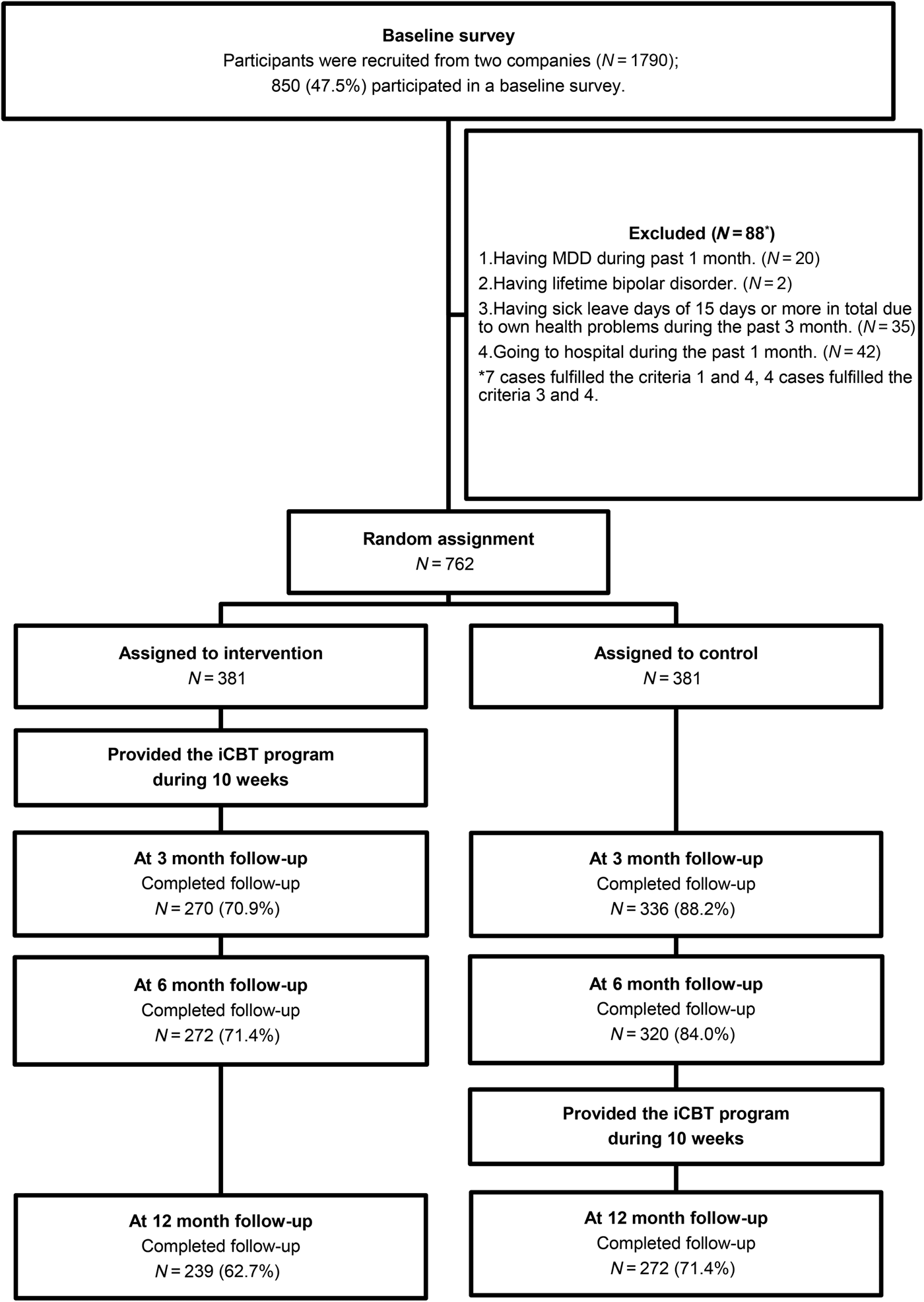
The participant flowchart is shown in Fig. 1. A total of 850 (47.5%) of all workers in the target workplaces completed a baseline survey. Of those, 88 were excluded: 20 did not fulfill criterion no. 1 (not diagnosed for a major depressive disorder in the past month), and two did not fulfill criterion no. 2 (not diagnosed with a lifetime bipolar disorder). An additional 35 did not fulfill criterion no. 3 (not having taken ⩾15 sick-leave days in total due to their own health problems during the past 3 months); and 42 did not fulfill criterion no. 4 (not having gone to hospital during the past month). Further, seven did not fulfill criteria nos. 1 and 4, and four did not fulfill criteria nos. 3 and 4. The remaining 762 participants were randomly allocated to an intervention or a control group (N = 381 to each group).
Participant flowchart.

At the 6-month follow-up, 272 (71.4%) participants in the intervention group and 320 (84.0%) in the control group completed the follow-up survey. At the 12-month follow-up, 239 (62.7%) participants in the intervention group and 272 (71.4%) in the control group completed the follow-up survey. Drop-out rates were significantly higher for the intervention group both at the 6-month follow-up (χ2 = 17.4, p < 0.01) and at the 12-month follow-up (χ2 = 6.05, p = 0.01). Reasons for dropping out of the study were not assessed.
Baseline characteristics
Demographic characteristics were similar for both the intervention and control groups. Average age (standard deviations) was 38.0 (9.2) and 37.2 (8.8) years , respectively. Most participants were males (85.3% and 82.4% for the intervention and control groups, respectively), married (55.6% and 59%, respectively), and graduates of university or higher education (73.0% and 72.7%, respectively). Most of the participants were employed as professionals (67.2% and 73.0%, respectively); the others worked as managers, clerical workers, production, or sales workers. A small proportion of the participants had chronic disease (10% and 11.5%, respectively).
Process evaluation
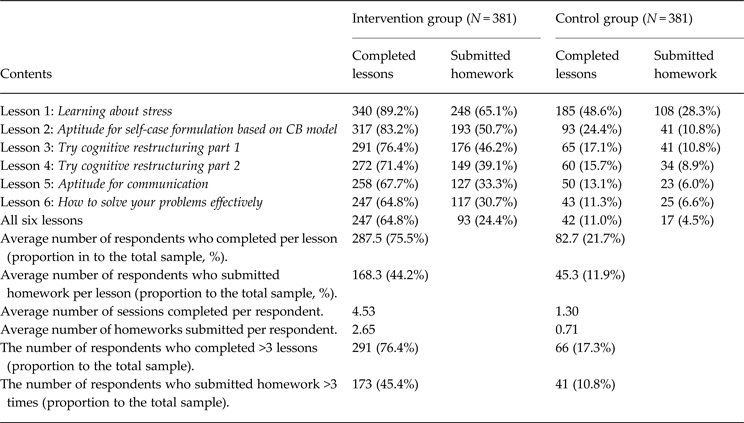
Most (89%) participants in the intervention group completed lesson 1, and 65% submitted their homework after completing this lesson (see Table 1). The proportion of those who completed lessons and submitted homework gradually decreased during the later lessons. About two-thirds of the intervention group completed all six lessons, while only a quarter of these submitted all six homework assignments. Three-quarters (76%) of the intervention group completed at least three lessons, and about half (45%) submitted at least three homework assignments. In contrast, only half of the participants in the control group completed lesson 1, and 28% submitted their homework after completing this lesson. About one in ten in the control group completed all six lessons; only 4% submitted all six homework assignments. In the control group, 17% completed at least three lessons, and 11% submitted at least three homework assignments. The average number of lessons the respondents received was 4.5 in the intervention group and 1.3 in the control group. The average number of homework assignments submitted was 2.7 in the intervention group and 0.7 in the control group.
Progress of learning in the iCBT program in the intervention and control groups

Effects of iCBT programs on preventing MDE
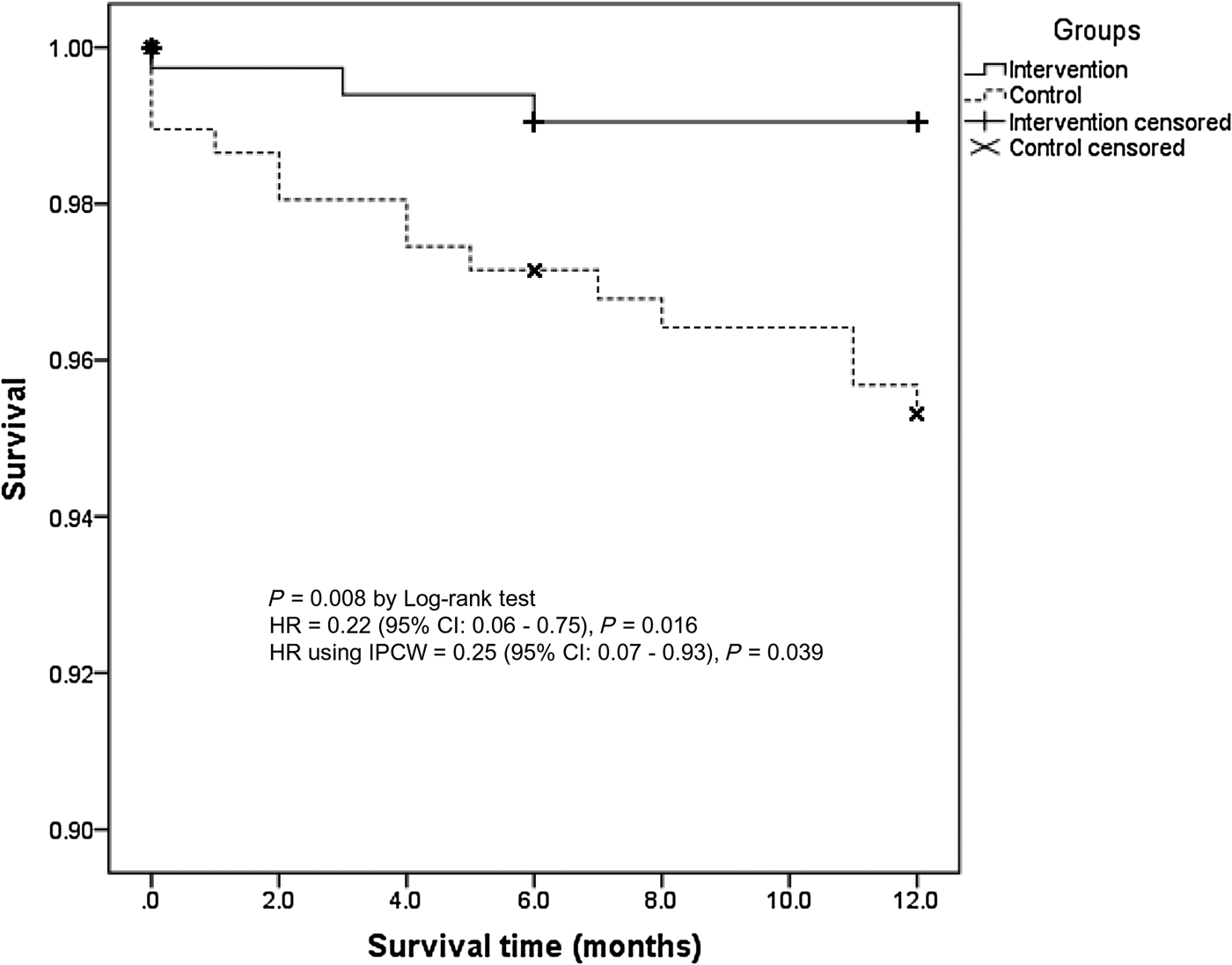
During the 12-month follow-up, three participants (0.8%) in the intervention group and 15 participants (3.9%) in the control group reported a new onset of MDE. During the last 6 months, no one in the intervention group and five participants in the control group reported new onset of MDE. Using the Kaplan–Meier method, the estimated event-free probabilities in the intervention group at 6- and 12-month follow-up were both 0.99, standard error (s.e.) = 0.01, while the probabilities in the control group were 0.97 (s.e. = 0.01) and 0.95 (s.e. = 0.01) at the 6- and 12-month follow-ups, respectively (Fig. 2).
Kaplan–Meier survival curves for not having major depressive episode (MDE) in the intervention and control groups during 12-month follow-up. Log-rank significance test for the group difference and hazard ratio (HR) and 95% confidence intervals (CIs) of having MDE for the intervention group compared to the control group by using Cox discrete time hazard regression analysis.

Participants in the intervention group had a marginally significantly lower incidence than the control group at the 6-month follow-up (log-rank χ2 = 3.26, p = 0.07), and a significantly lower incidence at the 12-month follow-up (log-rank χ2 = 7.04, p < 0.01). The HR of MDE for the intervention group compared to the control group was 0.22 (95% CI 0.06–0.75) during the 12-month follow-up, estimated using the Cox discrete time hazard model. The adjusted HR using the IPCW method was 0.25 (95% CI 0.07–0.93).
NNT for preventing the onset of MDE
At 6-month follow-up, a relative risk (RR) of having MDE in the intervention group was 0.30 and marginally significant (p = 0.09); the NNT to achieve prevention of one case of onset of MDE was 55 (95% CI 28–33681). At the 12-month follow-up, a RR of having MDE in the intervention group was 0.20 and statistically significant (p < 0.01); the NNT to achieve prevention of one case of onset of MDE was 32 (95% CI 19–100).
Effects of the iCBT program on preventing a sub-threshold depressive episode
By applying a sub-threshold definition of a depressive episode, which requires a shorter duration of symptoms (⩾7 days), the number of cases increased from 15 to 16 (4.2%) in the control group, while the number of cases in the intervention group remained the same (three or 0.8%). The Cox discrete time hazard model yielded a significantly lower HR for the intervention group compared to the control group (HR 0.20, 95% CI 0.06–0.70). By applying the other sub-threshold definition of a depressive episode that requires fewer symptoms (⩾3), the number of cases increased to 11 (2.9%) in the intervention group and to 21 (5.5%) in the control group. The HR was not significant, but still smaller for the intervention group (HR 0.58, 95% CI 0.28–1.20).
Effects of the iCBT program on BDI-II and K6
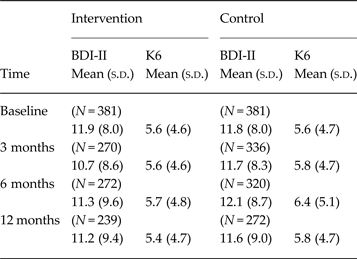
Average scores of BDI-II decreased at 3-month follow-up in the intervention group, while the scores remained the same in the control group (see Table 2). The difference was maintained at 6-month follow-up, but became smaller at 12-month follow-up. An average score of K6 was lower at 6-month follow-up in the intervention group than in the control group. However the difference became smaller at 12-month follow-up. The estimated effect of the iCBT program on BDI-II or K6 based on the mixed-model analysis was not significant (see Table 3). The effect sizes (Cohen's d) were also small (<0.10).
Means (s.d.s) of outcome variables at baseline, and 3-, 6- and 12-month follow-ups in the intervention and control groups

BDI-II, Beck Depression Inventory – II; K6, Kessler's Psychological Distress Scale.
Effect of the internet-based computerized cognitive behavioral therapy program on BDI-II and K6

CI, Confidence interval; BDI-II, Beck Depression Inventory – II; K6, Kessler's Psychological Distress Scale; T1, baseline; T4, 12-month follow-up.
Discussion
In the 12-month follow-up of the participants in the RCT of a six-session iCBT program, the intervention group showed a significantly lower incidence of MDE at 12-month follow-up than the control group, with a HR of 0.22. To the best of our knowledge, the present study is the first to demonstrate that an iCBT program is effective in preventing MDE in a non-clinical working population. On the other hand, the iCBT program did not show a significant intervention effect on depression symptom checklist scores, such as BDI-II and K6, at 12-month follow-up.
The control group of the present study was provided the iCBT program at the 6-month follow-up. However, the process evaluation of the iCBT program indicated that the control group engaged much less intensively in learning from the program compared to those in the intervention group, which possibly was attributable to the participants in the control group not receiving as many reminder emails as those in the intervention group or to the control group not maintaining their motivation to study the iCBT program after waiting 6 months. Thus a differential intensity of the CBT-based training received by the two groups may have resulted in the difference in the incidence of MDE. In addition, the intervention group started the iCBT program 6 months earlier than the control group. The effect of stress management psychoeducation usually lasts for 6 months (Rowe, Reference Rowe1999). Thus the intervention group may have had a chance to use their CBT knowledge and skill for a longer period than the control group, which could be associated with a lower risk of MDE in the intervention group. Such advantages in the intervention group may have resulted in a large difference in exposure to CBT knowledge and experience between the two groups.
According to the Kaplan–Meier method, incidence of MDE in the intervention group was one-third at 6-month follow-up and one-fifth at 12-month follow-up compared to the control group. The HR estimated by Cox regression analysis was significantly lower for the intervention group. The present findings are consistent with previous meta-analyses, which suggested that face-to-face CBT was effective in preventing the onset of MDE, (Cuijpers et al. Reference Cuijpers, van Straten, Smit, Mihalopoulos and Beekman2008, Reference Cuijpers, Munoz, Clarke and Lewinsohn2009). The HR for having MDE in the intervention group was 0.22 (or 0.25 for the analysis using the IPCW) and even smaller than HRs reported from previous studies (0.62–0.84). In the present study, a certain proportion of participants in the control group studied the program at the 6-month follow-up. This event may have weakened the intervention effect. The observed preventive effect for MDE may be somewhat underestimated. The effect could be attributable to several features of the present program, which included cognitive restructuring and other skills to serve the broader needs and preferences of the participants, e.g. the CWD program (Lewinsohn, Reference Lewinsohn1984), a CBT education program proven effective in preventing depression (Cuijpers et al. Reference Cuijpers, Munoz, Clarke and Lewinsohn2009). The present program also used a comical story, which may have motivated and helped participants to learn CBT skills. The present iCBT program may indeed be a promising tool to use to help prevent MDE in the working population.
Using a diagnostic criterion of subclinical depressive episode that requires a shorter duration (i.e. ⩾7 days) of symptoms did not much increase the number of cases with an episode. Thus, the observed HR for having the episode in the intervention group was quite similar to that for having MDE and statistically significant (0.20, p = 0.01). Further, when the other diagnostic criterion of a subclinical depressive episode was used, requiring fewer symptoms (i.e. only ⩾3), the number of cases more than tripled in the intervention group and increased 1.4 times in the control group. The HR for having an episode was still lower in the intervention group, but no longer significant (0.58, p = 0.14). The effect of the iCBT program may be more prominent for preventing the onset of MDE than for preventing minor depressive episodes.
In the present study, the NNTs to achieve prevention of one case of onset of MDE were 55 at the 6-month follow-up and 32 at the 12-month follow-up. These figures were similar to those previously reported for NNT in face-to-face CBT for preventing the onset of major depressive disorders (NNT = 42) (Cuijpers et al. Reference Cuijpers, van Straten, Smit, Mihalopoulos and Beekman2008). With consideration for the fact that iCBT can be delivered to many workers at a low cost, this iCBT may be a promisingly more cost-effective approach than the face-to-face CBT for preventing the onset of MDE among healthy workers.
The study failed to show significant effects of the iCBT program on improving depressive symptoms measured by BDI-II or K6 at 12-month follow-up, while the effects were reported to be significant or marginally significant at 6-month follow-up (Imamura et al. Reference Imamura, Kawakami, Furukawa, Matsuyama, Shimazu, Umanodan, Kawakami and Kasai2014). This may be partly because the control group also had the opportunity to experience the iCBT program after the 6-month follow-up, and because the initial effect of learning iCBT in the intervention group may have started attenuating. It may be interesting to note that the effect of iCBT on MDE was still observed while the effect on depressive symptoms started to decrease at the 12-month follow-up. An interpretation is that the effect of iCBT on preventing MDE may be related to cumulative symptom levels over the follow-up improved by the program. The other interpretation is that improved psychological resources, such as decreased dysfunctional attitude and thoughts, obtained by learning from iCBT, not depressive symptoms themselves, may be important for preventing MDE.
Strength and limitations
A total of 850 (47.5%) of all workers in the target workplaces completed a baseline survey. The initial response was high. Participants were recruited by an invitation e-mail from their company staff. This may have enhanced the participation in this study. The proportion of completers of the program in the intervention group (64.8%) was relatively high. We measured MDE using the CIDI, which had several merits compared to using a symptom checklist for depression. It can assess an episode during the entire follow-up period, while a symptom checklist only measures current symptoms at follow-up. It also follows the DSM-IV criteria more strictly to diagnose MDE.
A major limitation of this study was in the study design. While we kept the original intervention and control groups the same as in the original RCT design, the control group was provided the iCBT program at the 6-month follow-up. About half of the participants in the control group studied the first lesson, but only 11% completed all the lessons. This ‘contamination’ could have resulted in an underestimation of the effect of the iCBT program on MDE in this study. Another limitation was that the study was not a pre-designed study, but rather a post-hoc follow-up. The statistical power of the study was not pre-determined and was clearly not sufficient to detect an odds ratio of 0.5. The present findings may have been observed, therefore, by chance.
A second major limitation is that MDE was not diagnosed by a clinician, but measured by self-report, which might have been affected by the perception of participants or by situational factors at work. In addition, the validity of the web-based CIDI depression section still needs further validation.
The incidence of MDE in this study was low. While the figure was quite similar to the 12-month prevalence of MDE in the general population in Japan (Kawakami et al. Reference Kawakami, Takeshima, Ono, Uda, Hata, Nakane, Nakane, Iwata, Furukawa and Kikkawa2005), this may be partly attributable to our eligibility criteria that excluded participants who had ⩾15 days sick-leave in the past 3 months. It is not clear how large a cost-benefit would be expected for this program by preventing only a small number of MDE cases. The effect of the iCBT program and its cost-benefit would be better investigated among workers at risk.
Other limitations include the fact that participants were recruited from two IT companies in Japan as follows: first, most participants were males, working as professionals, and university graduates. Participants with lower levels of education may have had difficulty in learning from the program. The participants had their own PCs in their offices or homes. The participants were also supposed to have experience using a PC and studying online programs. The generalization of the present findings to the entire working population is thus somewhat limited. Second, the rate of completing lessons and homework was moderate in the intervention group, which may have weakened the findings. Third, the dropouts from the 6- and 12-month follow-ups were around 30% and significantly higher in the intervention group. These dropouts may have produced bias, particularly if the intervention group participants who developed MDE during the follow-up were more likely to quit the program. A further RCT should be conducted to test whether the iCBT program is effective in preventing the onset of MDE, particularly for a longer period of follow-up and a larger sample with more diverse characteristics, in terms of occupation and educational attainment.
Acknowledgements
The present study was supported by the Grant-in-Aid for Scientific Research (A) 2009 and 2010 (No. 20240062) and the Grant-in-Aid for Young Scientists (B) 2014 (No. 26860433) from the Japan Society for the Promotion of Science. The sponsor of the study had no role in study design, data collection, data analysis, data interpretation, or writing of the report. The authors had access to the data in the study and the final responsibility to submit the paper. We appreciate the help of the following persons in completing this project: Takayuki Narumi, Jun Naoi, Keisuke Kito, Chinatsu Narumi, Fukiko Ueda, and Mizuho Yamagishi.
Declaration of Interest
K.I. is employed part-time by Chugai Pharmaceutical Company and Medical Care Toranomon as a clinical psychologist. N.K. has received honoraria for speaking at CME meetings sponsored by GlaxoSmithKline, Eizai and Pfizer. He is on the advisory board for Sekisui Chemicals and Junpukai Health Care Center. He has received royalties from Chuo-Hoki-Shuppan, Igaku-Shoin, Kyobun-do, Life Science, Maruzen, Nanko-do, Nanzan-do, and Fujitsu Software Technologies Ltd, and research grants from Fujitsu Software Technologies Ltd, Softbank Co. Ltd, and Japan Management Association. T.A.F. has received lecture fees from Eli Lilly, Meiji, Mochida, MSD, Pfizer and Tanabe-Mitsubishi, and consultancy fees from Sekisui and Takeda Science Foundation. He is a diplomate of the Academy of Cognitive Therapy. He has received royalties from Igaku-Shoin, Seiwa-Shoten and Nihon Bunka Kagaku-sha. The Japanese Ministry of Education, Science, and Technology, the Japanese Ministry of Health, Labor and Welfare, and the Japan Foundation for Neuroscience and Mental Health have funded his research projects. Y.M. has received lecture fees from Union of Japanese Scientists and Engineers, EPS Co. Ltd, and Statcom Co. Ltd, and consultancy fees from Zeria Pharmaceutical Co. Ltd, Ono Pharmaceutical Co. Ltd, Mebix Co. Ltd. He has received royalties from Igaku-Shoin and Ewanami-Shoten. A.S. works for Hitachi Systems Ltd as a part-time consultant. He is on the advisory board for Junpukai Health Care Center and Ds's Mental Health Laboratory. He has received royalties from Baifukan, Kawashima-shoten, Seishin-shobou, and Seiwa-Shoten. R.U. is employed by Health Wave Co. Ltd as a clinical psychologist. S.K. is employed by Square-Enix Co. Ltd as a contract employee. She also worked part-time for Dice Creative Co. Ltd. K.K. has received lecture fees from Astellas, Novartis, Eli Lilly, Otsuka, Dainippon-Sumitomo, and Yoshitomi pharmaceutical companies. He has received collaborative research grants from Astellas, Hitachi Co, and Hitachi Medical, and research grants from Yoshitomi, Dainippon-Sumitomo, Astellas, and GSK.