

1. Introduction
The goal of this paper is to bring evidence for the borrowing of a phoneme into the phonology of Resígaro (ISO 639-3: rgr), a virtually extinct (Seifart Reference Seifart2015: 99) northern ArawakanFootnote 1 language described in Allin (Reference Allin1976, Reference Allin1979) and more recently in work by Frank Seifart (e.g., Seifart Reference Seifart2011, Reference Seifart2012a,Reference Seifartb, Reference Seifart2015).Footnote 2 After an introductory outline of Resígaro phonology and its internal classification, and a brief discussion of its history of contact with Bora, a language of the Bora-Muinane family (sections 2 and 2.1), I will review the evidence for the diachronic split of a low vowel *a in the history of Resígaro. Virtually every study concerned with the comparative linguistics of the Arawakan family, and of Resígaro in particular, has identified this diachronic split as a way to account for two segmental correspondence sets: while Resígaro a is matched by a in other northern Arawakan languages in non-final position, a in these other languages matches Resígaro ɯ word-finally. As I show in section 3, however, existing treatments of this distinguishing diachronic development of Resígaro are either not explicit enough or downright wrong. The problem lies, I claim, not with the identification of the relevant segmental correspondences, but rather with the diachronic account offered for the change that gave rise to them. I advance and substantiate the hypothesis that this was a primary split (that is, a simple case of allophone redistribution) that depended critically on the previous adoption of loans from Bora. The adoption of many Bora grammatical morphemes and some open-class items was responsible for the phonologization of ɯ in Resígaro. This hypothesis is further articulated in section 4, where I show that Bora ɯ is consistently retained as ɯ in Resígaro. Moreover, Bora source forms with word-final a appear with word-final ɯ in Resígaro, a fact consistent with a chronology in which the massive influx of grammatical and lexical morphemes of Bora origin preceded the phonologization of ɯ, which in turn preceded the primary split of *a. Section 5 discusses more general problems with contact-based explanations, showing how the argumentation presented here differs by being more explicit and, therefore, more compelling, than most ‘areal effects’ proposed on diachronic phonological developments. I also relate the proposed contact-based development in Resígaro phonology with the known and inferred nature of the contact between Resígaro and Bora. Finally, section 6 is devoted to conclusions and a synthesis of the proposals made here.
2. The Resígaro language and a brief outline of its phonology
The traditional territory occupied by Resígaro speakers lies between the Putumayo and Caquetá rivers in southeastern Colombia. At the time when descriptive material on the Resígaro language was produced, only a handful of Resígaro speakers were found living in villages composed mainly of members of other ethnic groups, mostly Ocaina and Bora (see Allin Reference Allin1976: 1; Seifart Reference Seifart2012a: 370–371).
Though the internal classification of the Arawakan family remains arguably less advanced than that of other major language families of South America (see Campbell Reference Campbell, Campbell and Grondona2012: 71–72), similarities in lexicon, phonology and grammar have led to the nearly consensual recognition that Resígaro is particularly closely related to a set of Arawakan languages spoken in northwestern Amazon. The languages in this set vary between authors and reference works, though Baniwa (Baniwa do Içana/Curripaco),Footnote 3 Tariana, Yucuna, Piapoco, Achagua and Cabiyari are most often included (see Payne Reference Payne1985; Aikhenvald Reference Aikhenvald, Dixon and Aikhenvald1999: 70, Reference Aikhenvald2001: 182–190; Ramirez Reference Ramirez2001b : 447–472; Seifart Reference Seifart2012a: 371, Reference Seifart2015: 99). These languages will be the focus here for comparison with Resígaro.
The Resígaro phonological segmental inventory is presented in tables 1 and 2, following Allin (Reference Allin1976: 47–48, 70–71) and Seifart (Reference Seifart2012a: 372). Ramirez (Reference Ramirez2001b) proposes a much smaller segmental inventory for Resígaro, analyzing aspirated obstruents, as well as the voiceless nasals, as underlying clusters with h. I assume here the monosegmental analyses of Allin (Reference Allin1976) and Seifart (Reference Seifart2012a), though this is not critical for any of the claims advanced here. The language also has two distinctive tones, low (L) and high (H), the latter being indicated by an acute accent mark.
Resígaro consonants

Resígaro vowels

The two back vowels of Resígaro, o and ɯ, differ not only in height but also in that the latter is unrounded, even though it is usually represented as <u> in many of the sources and reference works discussed here (see Allin Reference Allin1976: 48, 69–70). I will use the phonetically transparent symbol ɯ consistently in this article, because some of the comparative literature dealt with here gives the impression that this vowel has been mistakenly assumed to be a rounded vowel, due, no doubt, to the attribution of a literal phonetic interpretation to the grapheme <u> . Thus, Payne (Reference Payne, Derbyshire and Pullum1991: 476), after proposing that Proto-Arawakan (PA) had a contrast between *o and *u, two back rounded vowels, goes on to discuss the status of this same distinction as attested in some of the daughter languages, including languages like Terena, Wayuunaiki, Achagua, all having two back rounded vowels u and o, but also includes Resígaro, where only o is in fact a back rounded vowel (see e.g. Allin Reference Allin1976: 48, 70). Ramirez's (Reference Ramirez2001b: 465) discussion of the opposition between u and o in his Japurá-Colombia subgroup, and in particular of the origins of the contrast between u and o (< a + u) in Achagua and Yucuna, also brings the split of *a in Resígaro to the fore, implying that the resulting opposition is in all these cases one between two back rounded vowels. It seems fitting, therefore, to represent the unrounded nature of the vowel <u> as explicitly as possible in the transcription conventions adopted.
2.1 Resígaro historical linguistics and the impact of contact with Bora
Much of the attention directed towards Resígaro in the historical linguistic literature stems from the massive morphological borrowing of particular morphosyntactic sub-systems, coupled with a less spectacular number of open-class lexical loanwords and some degree of grammatical restructuring, that resulted from prolonged contact with Bora, a member of the Bora-Muinane family (see Aikhenvald Reference Aikhenvald2001; Seifart Reference Seifart2011, Reference Seifart2012b , Reference Seifart2015). For this reason, and due to the paucity of reliable data on the language preceding the work of Allin (Reference Allin1976, Reference Allin1979), even the genetic affiliation of the language was a matter of debate for some time, until Payne (Reference Payne1985) convincingly showed that the language is clearly a member of the Arawakan language family. Based on a careful investigation of the known effects this contact situation had on Resígaro grammar and lexicon, Seifart (Reference Seifart2012b, Reference Seifart2015: 106) infers a sociolinguistic contact situation in which bilingual knowledge of Bora may have been general among Resígaro speakers, in a close and prolonged contact situation.
So far, most of the discussion and in-depth investigation of the linguistic consequences of contact between Bora and Resígaro has focused on the lexicon and on the morphology of Resígaro. In his review of the demonstrated cases of lexical and morphological borrowing in Resígaro, Seifart (Reference Seifart2015: 100–103) notes that about 5% of its vocabulary is composed of Bora loans, about half of which belong to more cultural areas of the vocabulary. This proportion is much smaller than that reported earlier by Aikhenvald (Reference Aikhenvald2001: 182), who found 24% of Bora loans in a list of 100 basic and 218 non-basic vocabulary items. Contrasting with the relative paucity of Bora loans among Resígaro open-class lexical items, the language has borrowed entire paradigms of inflectional and derivational morphemes, including about 20 noun class and gender markers, six number markers and eight roots used in the derivation of numerals, demonstratives and other pro-forms (I present many of these morphemes in section 4; see Seifart Reference Seifart2012b for details).
The relatively low numbers for lexical borrowing combined with morphological/grammatical borrowing and structural convergence (Seifart Reference Seifart2015: 103–106) suggest that a general inhibition against lexical borrowing was characteristic of the Resígaro, a trait shared with other peoples of the Putumayo and Vaupés regions of northwestern Amazon (Seifart Reference Seifart2011: 87–88). As for phonology, the focus of the present article, Seifart (Reference Seifart2015: 104, based on Aikhenvald Reference Aikhenvald2001 and Seifart Reference Seifart2011, Reference Seifart2012a, Reference Seifart2012b) cites only contrastive tone as a possible but uncertain case of loan phonology in the language. Aikhenvald (Reference Aikhenvald2001: 185) proposes that effects of the contact with Bora can be found elsewhere in the phonology of Resígaro, such as the presence of contrastive glottal stops and of a CVC syllable structure where only the glottals h and ʔ can occur in coda position. However, these claims have not received any detailed scrutiny or consideration in the published literature. In the remainder of this article, I argue that Resígaro has developed a high back unrounded vowel ɯ as a result of contact with Bora, as this vowel segment cannot be traced back to the language's inherited core of Arawakan etyma.
3. The split of *a in Resígaro: An improved formulation
As the focus of this article is an aspect of the historical phonology of Resígaro vowels, it seems fitting to begin in comparative terms and to consider the diachronic development of the entire vowel inventory of the language. Two of Resígaro's closest relatives, Baniwa and Piapoco, have four vowels: one low vowel a, two front vowels i and e, and a single back rounded vowel, symbolized as either u or o (see de Souza Reference de Souza2012: 94 and Ramirez Reference Ramirez2001b: 43 for Baniwa; Sudo Reference Sudo1976: 11, Klumpp Reference de Klumpp1982: 85 and Reinoso Galindo Reference Reinoso and Andrés2002 : 50 for Piapoco). Achagua, on the other hand, has a five-vowel system with two contrastive back rounded vowels u and o (Wilson Reference Wilson1992: 15; Meléndez Lozano Reference Meléndez Lozano1998: 23). However, both comparative and language-internal evidence suggests that this is a recent innovation specific to Achagua, as o seems to have a very low frequency outside of probable loanwords and seems to be mostly derivable from a coalescence of an underlying a + u sequence (see Ramirez Reference Ramirez2001b: 256–257). The same basic reasons suggest that the five-vowel system of Yucuna, with two back rounded vowels (Schauer and Schauer Reference Schauer, Schauer and Fetter1978: 5–6) is also of recent origin (Aikhenvald Reference Aikhenvald, Dixon and Aikhenvald1999: 78; Ramirez Reference Ramirez2001b: 357). Finally, for Tariana, the observations of Aikhenvald (Reference Aikhenvald2003: 32–33) on the limited distribution of o and ɨ, and their exceptional phonological patterning as the sole vowels in the inventory to lack long counterparts, also suggest that a system with four basic vowel qualities, a, i, e and a single back rounded vowel u, is somewhat basic and probably inherited.Footnote 4
Payne (Reference Payne, Derbyshire and Pullum1991: 469–470) reconstructs a high central vowel *ɨ for PA, as did Ramirez (Reference Ramirez2001b) for Proto-Japurá-Colombia, the intermediate proto-language and putative common ancestor of Resígaro, Yucuna, Baniwa, Achagua, Piapoco, Kauixana, Mandawaka, Cabiyari and Warekena.Footnote 5 The usual reflex for both cases of reconstructed *ɨ is i in Resígaro and in all the languages compared here; that is, *ɨ and *i have merged in these languages. Given that the unconditioned merger of *i and *ɨ is systematic in the languages under comparison, I set aside this putative ancestral high central vowel.
As shown in (1), a comparison of Resígaro forms with their cognates in Achagua, Piapoco, Baniwa, Yucuna and Tariana supports the reconstruction of a system with four vowel phonemes – *a, *i, *e and *u – for the common ancestor of Resígaro and its closest relatives within the family.Footnote 6
(1) Correspondences for the inherited vowel inventory of Resígaro
a. *a: sun/summer kámí ‘year’: Baniwa kámui, Piapoco kamúi, Tariana kámu,
Achagua kamúi, Yucuna kamú;
blood -iídɯ: Baniwa iiɻá-na, Piapoco irái, Yucuna -íra;
to fly -ad ɯ́ : Baniwa -áaɻa, Tariana -ara, Yucuna -ahra-kahe, Piapoco -áala.
b. *e: to hear -héʔmɯ́: Achagua -eémeri, Piapoco émia-ka, Yucuna -hemaʔa-kahe;
egg eévé : Baniwa -éewhe, Tariana -éwhe, Yucuna -éhwe;
moon keégí: Baniwa kéeɻi, Piapoco kéeri, Tariana keri, Yucuna keri.
c. *i: woman inaádó: Baniwa íinaɻu, Tariana ínaru, Yucuna inanaru;
pet -píidɯ́ : Baniwa -piɻa, Piapoco -piria, Yucuna -pira;
foot -hiiʔpɯ́: Baniwa -híipa, Tariana -hipama, Achagua -íiba.
d. *u: water hooní: Baniwa úuni, Piapoco úni, Tariana uuni, Yucuna huni;
wife -iínó: Baniwa -íinu, Piapoco -ínu, Achagua -íinu ;
nose -hitákó: Baniwa -hitáku, Piapoco -idaku, Tariana -thakú, Yucuna -taku.
Whether the common ancestor in question is taken to be a specific intermediate proto-language, such as Ramirez's (Reference Ramirez2001b : 448) ‘Proto-Japurá-Colombia’, or even Proto-Arawakan itself, as reconstructed in Payne (Reference Payne, Derbyshire and Pullum1991), is immaterial to the following discussion. Focusing now on our immediate concerns, that is, the historical phonology of Resígaro, I note that two of the reconstructed vowels, *i and*e, can be reconstructed quite directly based on simple identity correspondences (see (1b–c) above). A single back rounded vowel *u is reconstructed as well, based on a regular correspondence matching the Resígaro back rounded vowel o with back rounded vowels in the other languages, usually phonemicized as u (1d). The case of *a, however, is different (see 1a). Here Resígaro shows both a and ɯ corresponding to a in the other languages. As these correspondences provide the raw evidence for the present discussion, I will discuss them separately.
Payne (Reference Payne1985, Reference Payne, Derbyshire and Pullum1991) and Ramirez (Reference Ramirez2001b) provide evidence for two partially overlapping segmental correspondences involving the vowels a and ɯ of Resígaro and the low vowel a attested in cognate morphemes of other northern Arawakan languages:
(2) Segmental correspondences for Resígaro a and ɯ
a. Resígaro a : a Other Northern Arawakan
b. Resígaro ɯ : a Other Northern Arawakan
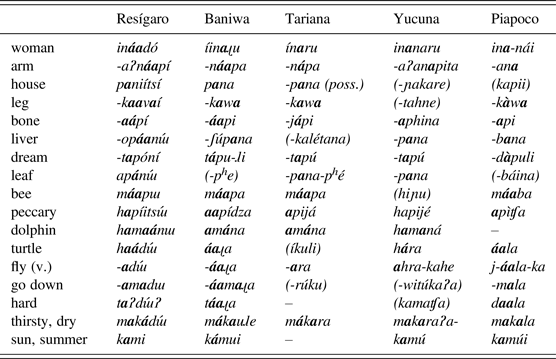
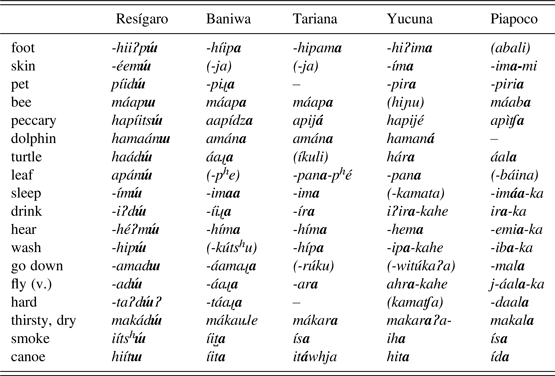
Since correspondence (2b) is attested only word-finally, where correspondence (2a) is never attested, both authors correctly infer the operation of a split in the history of Resígaro, reconstructing *a as the proto-segment underlying both (2a) and (2b). More extensive data exemplifying correspondences (2a) and (2b) are given in tables 3 and 4 (data on the other Arawakan languages shown here come from the following sources: de Klumpp Reference de Klumpp1995 for Piapoco; Schauer et al. Reference Schauer, Schauer, Yucuna and Yucuna2005 for Yucuna; Aikhenvald Reference Aikhenvald2001, Reference Aikhenvald2003 for Tariana and Ramirez Reference Ramirez2001a, Reference Ramirezb for Baniwa).Footnote 7
Evidence for correspondence (2a)

Evidence for correspondence (2b)

It must be borne in mind that these correspondences have been presented and identified in the published comparative literature, most obviously in Payne (Reference Payne1985, Reference Payne, Derbyshire and Pullum1991) and Ramirez (Reference Ramirez2001b). What is at stake here is not simply their existence but rather their diachronic interpretation and what this analysis implies for Resígaro historical phonology. This, I argue, has never been addressed in a thoroughly adequate manner.
Though no detailed discussion of the phonological developments behind these correspondences is found in any of these published works, Ramirez (Reference Ramirez2001b) presents a slightly more specific proposal than does Payne (Reference Payne1985, Reference Payne, Derbyshire and Pullum1991), whose main concern was to establish comparative and diachronic correspondences. Ramirez (Reference Ramirez2001b) offers a comparison of Resígaro and eight other Northern Arawakan languages that together make his proposed ‘Japurá-Colombia subgroup’, a branch of the Arawakan language family. The languages in question are Achagua, Piapoco, Baniwa-Curripaco, Mandawaka, Yucuna, Kaixana, Cabiyari and Warekena.Footnote 8 The segmental correspondences identified by Ramirez (Reference Ramirez2001b: 448) for these languages show two things. First, the back rounded vowel o of Resígaro regularly corresponds to a back rounded vowel u found in the other Japurá-Colombia languages (see cognate set in 1d above). Second, both Resígaro a and ɯ correspond to a in the other languages (see tables 3 and 4 above). Ramirez's (Reference Ramirez2001b: 464) interpretation of these findings is that the opposition between o and ɯ in Resígaro derives from a ‘phonological split’ to which the Proto-Japurá-Colombia vowel *a was subject. Though the diachronic correspondence *a > ɯ word-finally in Resígaro is solid, the proposed phonologization development is incorrect.
Ramirez's (Reference Ramirez2001b) proposal is, first of all, internally inconsistent: there is no loss of conditioning environment that could have led to the phonologization of this opposition. A comparison of the data in tables 3 and 4, and the plausible reconstruction of *a as the proto-segment underlying both correspondences, directly imply the existence of an original allophonic split for *a (see figure 2 below), with the later integration of the word-final allophones of *a with the phoneme *ɯ leading to the attested correspondence pattern. There is, however, no loss in the conditioning context that could lead to phonologization and, accordingly, the two correspondence sets in (2) are in complementary distribution and thus do not contrast.
Second, a limitation of both the existing accounts of the Resígaro split is that neither Payne (Reference Payne, Derbyshire and Pullum1991) nor Ramirez (Reference Ramirez2001b) addresses the implications of synchronic morphophonemic alternations involving a and ɯ. The nature of these alternations provides evidence against the hypothesis that the correspondences in (2) result from a secondary split. As seen in (3) below, both verbs (3a) and nouns (3b) show alternations between word-final ɯ and a when the word in question is followed by a suffix or by another word in a compound (see Allin Reference Allin1976: 117, fn.11; Seifart Reference Seifart2012a: 371, Reference Seifart2012b: 480). Note that, for verbs, the bare stem forms are attested, for instance, in the affirmative imperative and basic declarative forms (Allin Reference Allin1976: 139–140) and are, therefore, words – freely occurring forms – on their own.
(3) Synchronic alternation between a and ɯ
a. Verbs:Footnote 9
ímɯ́ ‘to sleep’ íma-kaá ‘to go to sleep’ (Allin Reference Allin1976: 107)
íɸɯ́ ‘to fear’ íɸa-kaá ‘to become frightened’ (Allin Reference Allin1976: 107)
hipɯ́ ‘to wash’ hipá-pʰaaßɯ́ ‘to wash oneself’ (Allin Reference Allin1976: 128)
em̥ɯ́ ‘to bite emaa-kátsí ‘a bite’ (Allin Reference Allin1976: 111)
b. Nouns:
maápɯ ‘bee’ maápa-ʤáʔ-n̥ɯ́ ‘only little bees’ (Allin Reference Allin1976: 152)
apánɯ ‘leaf’ apáná-ʔaamí ‘leaf’ (Allin Reference Allin1979: 385)
apáná-kobɯ ‘big leaf’ (Allin Reference Allin1976: 151)
-hiiʔpɯ́ ‘foot’ hiiʔpa-bábɯ́ ‘sock, stocking’ (Allin Reference Allin1976: 154)
hiiʔpá-gɯ́ ‘toe’ (Allin Reference Allin1976: 155)
haádɯ ‘turtles’ haáda-hí ‘turtle’ (Allin Reference Allin1976: 155)
ʤaánɯ́ ‘child’ ʤaána-ʤáʔ ‘little child’ (Allin Reference Allin1976: 163)
ʤaáná-kobɯ ‘big child’ (Allin Reference Allin1976: 163)
eémɯ́ ‘skin’ eéma-mííʔo ‘skin’ (Allin Reference Allin1976: 157)
maaʔmɯ́ ‘cassava maaʔma-ɯɯʔá ‘piece of cassava’ (Allin Reference Allin1976: 159)
Most of the forms showing alternating a ~ ɯ belong to the inherited Arawakan layer in the lexicon of Resígaro and one can show, with the help of comparative evidence such as that in tables 3 and 4, that a is the etymological vowel (see ‘skin’, ‘turtle’, ‘foot’, ‘leaf’, ‘bee’, ‘wash’, ‘sleep’); that is, in the a ~ ɯ alternations observed, a, the basic or etymological vowel, changes to ɯ.Footnote 10 In the absence of comparative evidence or the testimony of likely borrowing sources, simple internal reconstruction shows, for forms such as íɸɯ́ ~ íɸa ‘to fear’ and ʤaánɯ́ ~ ʤaáná ‘child’, that the allomorph with ɯ has the restricted, specific distributional pattern, being therefore likely non-etymological. These alternations are phonologically conditioned and are, for this reason, indicative of a primary split, not a secondary split or phonologization (see e.g. Hoenigswald Reference Hoenigswald, Polomé and Winger1992: 28; Fox Reference Fox1995: 157).Footnote 11
Summing up, the proposal that the split of *a in Resígaro was a secondary split (phonologization) is untenable for two reasons: first, there is no evidence for the loss of conditioning contexts, a necessary condition if a phonological split of *a yielding a and ɯ is postulated. Second, synchronic alternations resulting from the split of *a are phonologically conditioned, suggesting the operation of a simple primary split as the source of the partial merger of the word-final allophones of *a, which are regularly reflected as ɯ in this context. This primary split can be depicted in figure 1.
Primary split in Resígaro

The diagram in figure 1 is a standard representation for a process of primary split or allophone redistribution. One proto-phoneme, *a in this case, acts as the ‘donor phoneme’, being subject to a conditioned split whereby a subset of its positional allophones – here, the word-final allophone of *a – becomes an allophone of a different proto-phoneme, *ɯ, called the ‘receiving phoneme’.
Once the operation of a primary split is accepted as the most likely explanation for the Resígaro alternations in (3) and for the correspondence sets (2a) and (2b), comparative examination of the data reveals an interesting pattern, so far unacknowledged: while non-alternating a (i.e., a not in word-final context) goes back to *a, there is no Arawakan source for non-alternating ɯ (i.e., ɯ not in a word-final context).That is, all the cases of Resígaro ɯ seen so far – whether or not we happen to have evidence that they alternate synchronically with a – can be shown to be reflexes of *a. Therefore, one of the necessary components of a primary split, a previously existing receiving phoneme, ɯ in this case, cannot be recovered from the comparative data and cannot be assumed to exist in any direct ancestor of Resígaro.
A detailed examination of correspondences identified and developments proposed in the published literature supports the hypothesis that there is no other source for Resígaro ɯ within the Arawakan lexicon of Resígaro other than the split in question. In Payne's (Reference Payne, Derbyshire and Pullum1991: 465–481) compilation of all the reflexes of his PA vowels in the languages sampled for his comparative reconstruction, the only case where Resígaro ɯ appears as a reflex is as a development of PA *a.Footnote 12 Moreover, Payne (Reference Payne, Derbyshire and Pullum1991: 476) noted that the contrast between o and ɯ in Resígaro does not reflect a contrast that can be reconstructed at any discernible proto-language level. Of the five contrastive vowels – *e, *i, *a, *u, *ɨ – reconstructed by Ramirez (Reference Ramirez2001b: 448) in his ‘Proto-Japurá-Colombia’, only *a has Resígaro ɯ as its reflex. The aforementioned claim by Ramirez (Reference Ramirez2001b), that the split of *a into a and ɯ was responsible for the phonologization of ɯ as a contrastive segment of the Resígaro inventory amounts to a tacit recognition of the fact that no other proto-segment could be invoked as the source of this phoneme. This situation is illustrated by the comparative data amassed so far in this paper: note that all Resígaro vowels other than ɯ appear in the data, together with at least one instance of the relevant comparative correspondences. Resígaro ɯ appears only as a straightforward reflex of *a, there being, furthermore, no instances of non-word-final ɯ.
It is safe to assume, therefore, that the inherited vowel inventory of Resígaro was in all respects identical to its closest relatives, being composed of two front vowels i and e, a low vowel a and a back rounded vowel, – o in Resígaro – matching u in languages like Baniwa, Tariana and Piapoco. Since no evidence for the existence of ɯ before the primary split targeting *a can be found in the Arawakan stratum of the Resígaro lexicon, it is plausible to suppose that this segment entered the language as part of non-inherited material. The game-changing factor behind the emergence of ɯ could only have been the borrowing of morphemes from Bora.
4. Resígaro ɯ is a loan from Bora
The phonological inventory of vowels in Bora is given in table 5 (following Escobar Reference Escobar, González de Pérez and Rodríguez de Montes2000: 245; Seifart and Echeverri Reference Seifart and Echeverri2015: 281).
Bora vowel phonemes

One of the most striking aspects of the Bora vowel inventory is the presence of the contrast between a high central unrounded vowel ɨ and the back rounded vowel ɯ, which occur as non-contrastive variants of a single phoneme in many indigenous languages of South America. This contrast is absent from Bora's close relative, Muinane, and constitutes a recent innovation of the language: while Bora ɨ reflects Proto-Bora-Muinane *e, ɯ comes from *ɨ (see Seifart and Echeverri Reference Seifart and Echeverri2015: 287).Footnote 13
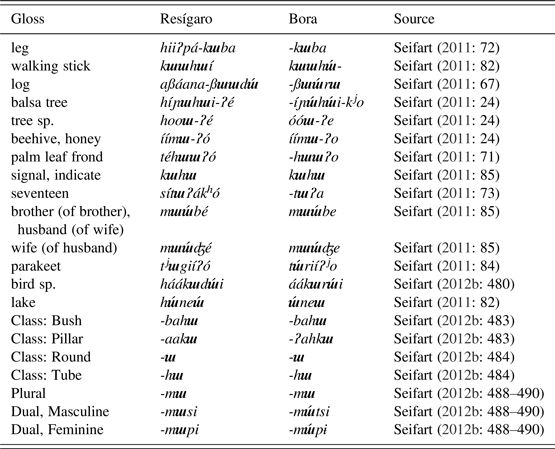
The high back unrounded vowel ɯ of Bora is regularly retained as ɯ in Resígaro. This is an important aspect of loanword adaptation in Resígaro which, perhaps for the reason that it is a case of maintenance, not a modification, has not been singled out for special attention (it is not noticed, for instance, in Seifart Reference Seifart2011: 13).Footnote 14 Table 6 offers a non-exhaustive set of Bora loans in Resígaro, along with their Bora sources, showing the maintenance of Bora ɯ as such in the language (corresponding vowels in boldface).
Non-alternating ɯ from Bora sources

In addition to showing the maintenance of Bora ɯ as ɯ in Resígaro, the data above complement the comparative Arawakan data discussed so far in an interesting manner: many of these Bora loans are the sole instances where Resígaro ɯ occurs in a context where it cannot alternate with a, as they occur in word-medial or word-initial position, while all cases of Resígaro ɯ in the Arawakan patrimonial layer of the vocabulary are word-final and can be shown to be reflexes of *a.
I propose, therefore, that Resígaro adopted ɯ as a loan phoneme from Bora and that this solves the apparent paradox raised by the lack of any source for ɯ in the language's inherited vocabulary. Once ɯ was a bona fide member of the Resígaro phonological vowel inventory, it could act as a ‘receiving phoneme’ in the primary split depicted in figure 1. As every primary split originates in contextual allophonic variation (Marchand Reference Marchand1956: 247; Hoenigswald Reference Hoenigswald1960: 91–93), the word-final merger of *a, inherited by Resígaro, and ɯ, which entered the language via contact with Bora, consisted in word-final allophones of *a becoming associated with the phoneme ɯ. Given the phonetic properties of a and ɯ, it is plausible that this partial merger was facilitated by the occurrence of higher or more centralized allophones of *a in word-final position, represented in (4) as *[ə].Footnote 15
(4) Pre-Resígaro allophony rule
*a → *[ə] / __#
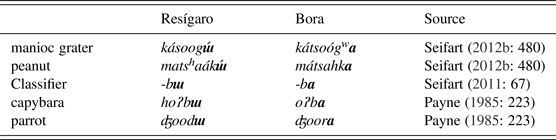
This allophonic rule was active in Resígaro before the entry of Bora morphemes into the language. Additional support for this hypothesis comes from descriptions of centralized realizations of a in word-final position in related languages, such as Baniwa (de Souza Reference de Souza2012: 95) and Yucuna, where, more generally, vowel contrasts tend to neutralize in this same context (Lemus Serrano Reference Lemus Serrano2016: 49, 56–57). Bora loans with word-final a in the source form also appear with ɯ in Resígaro (Seifart Reference Seifart2011: 13 for this generalization; table 7 for examples), thus showing that they entered the language before the merger between the word-final allophones of *a, that is, *[ǝ], and ɯ. Since the adoption of Bora morphemes (whether lexical or grammatical/functional) containing ɯ was plausibly a pre-condition for the adoption of ɯ as a phoneme in Resígaro – which was, in turn, a condition for word-final allophones of *a to merge with ɯ – this fact is compatible with the predicted relative chronology for the hypothesis advanced here.
Bora loans subject to the split of *a

Despite the overall phonetic similarity between ɨ and ɯ, both contrastive segments in Bora, these vowels were regularly kept apart in the adaptation of Bora loans in Resígaro. Bora loans whose source forms had ɨ appear with i in Resígaro (see e.g. Seifart Reference Seifart2011: 70: -hi < -hɨ ‘classifier, plank-like’; Seifart Reference Seifart2011: 73 -miiʔo < -mɨɨʔo ‘classifier, skin-like’; -pásí < -pahtsɨ), and Bora ɨ is never adapted as ɯ in Resígaro (see Seifart Reference Seifart2011: 13 for a general statement on the adaptation of Bora ɨ as i).
Based on the impossibility of deriving Resígaro ɯ from any proto-vowel present in past stages of the language (see section 3), it is plausible to suppose that, before the operation of the split in figure 1, ɯ had its distribution restricted to the stratum of Bora loan morphemes in Resígaro. However, as a consequence of the split of *a and the merger of its word-final allophones with ɯ, this borrowed phoneme was generalized, even if as a surface morphophonological alternant only, to inherited, Arawakan morphemes in the language. On the basis of the developments proposed here, it is possible to advance a linguistic stratigraphy for the lexicon of Resígaro, situating the entry of Bora loans in the language and the consequent adoption of ɯ from Bora within a frame provided by the historical phonology of the language's vowel system (see figure 2; the solid arrow indicates the time axis).
Chronology of the Resígaro developments

The first stage in (a) in figure 2 is, as discussed in section 3 and here, strongly supported by comparative evidence. The allophonic split *a is required by the nature of primary splits. Bora loans entering the language (stage b) were adapted in a way that ɯ was retained unchanged, arguably becoming part of the Resígaro vowel inventory (stage c). In the last stage, (d), the merge of word-final allophones of *a with ɯ took place, yielding the a ~ ɯ alternations still present in the language. In the next section I examine how the account proposed here compares to currently accepted models of contact-induced change in phonology.
5. Loan Phonology and contact explanations
It is often very difficult to show that language structure – say, certain phonological, morphological or syntactic patterns – as opposed to vocabulary items, owe their origin to language contact (see e.g. Thomason Reference Thomason2001: 91–94), whether the process is conceptualized as one of ‘interference’ (Thomason and Kaufman Reference Thomason and Terrence1988), ‘imposition’ (van Coetsem Reference van Coetsem1988) or borrowing (Winford Reference Winford and Hickey2010).Footnote 16 Within the domain of phonology, the borrowing of phonological elements such as a non-native phoneme is taken to be not only mediated by lexical borrowing but is also assumed to be a rare event in contact situations (Winford Reference Winford and Hickey2010: 175–177).
Most claims for the diffusion of phonological elements or patterns in language contact have the same basic structure, and are often invoked in discussions of language areas: Language X from family A is found surrounded by languages from family B. Some phonological patterns/elements are either unattested or only sporadically so in family A, and yet X happens to have them. Since the pattern in question is very common in family B, perhaps reconstructed to Proto-B, it is suggested that X developed this pattern under the influence of contact with the daughters of Proto-B. Proposals along these same broad lines exist for other Arawakan languages. In Yanesha’ (Amuesha), the presence of a three-vowel system and of retroflex consonants is often interpreted as a phonological consequence of contact with Quechua (in particular some Central Quechua varieties) from which Yanesha’ has adopted many loanwords. As discussed in Adelaar (Reference Adelaar, Aikhenvald and Dixon2007: 298–299), however, it has so far been difficult to present a compelling case for structural, including phonological, restructuring in Yanesha’ that can be unambiguously attributed to Quechua influence. Likewise, for Yawalapiti, spoken in central Brazil, the change *e > ɨ, which reintroduced ɨ in this language's segmental inventory after it was lost to an unconditional merger of *ɨ and *i, is described in Seki (Reference Seki, Dixon and Aikhenvald1999: 427) as possibly due to areal influences from other languages of the Upper Xingu region, all of which have ɨ as a phoneme. These and similar claims depend on assumptions about what is and what is not expected for ‘normal’ or purely internally-driven change in a language family, perhaps under some plausible yet non-explicit notion of drift.
Based on a more explicit line of reasoning, I was able to show here, by the detailed consideration of a development internal to the historical phonology of Resígaro, that there is no acceptable, purely internal way of deriving ɯ, a contrastive element of the language's vowel inventory, from the set of vowels reconstructed for previous stages of the language. Deriving ɯ from a secondary split of *a, as seems to have been at least implicitly accepted by researchers so far, is untenable, as the split in question was a simple allophonic redistribution that depended on the prior existence of ɯ in the language. The best general account for this phonological development is one that takes ɯ to be a loan phoneme from Bora, which only later would function as a recipient phoneme for the word-final allophones of *a. It is now necessary to ask whether the uncovering of a loan phoneme in Resígaro fits what is known – and what has been so far inferred on the basis of the linguistic effects of this contact – about the sociolinguistic events that caused the massive borrowing of morphological elements from Bora into Resígaro.
Employing the terminology of van Coetsem (Reference van Coetsem1988), adoption of ɯ as a phoneme by Resígaro speakers qualifies as a general instance of transfer of a Source Language (SL) feature to a Recipient Language (RL). A reasonable constraint on the transfer of phonemes is that it begins with the adoption of SL items that contain them (Matras Reference Matras, Matras and Sakel2007: 39). As seen in section 4, there are plenty of Bora loan morphemes in Resígaro that show ɯ. Moreover, the grammatical morphemes that make up the bulk of the Bora loans in Resígaro are fully integrated in the language, being productively used with native and non-native morphemes alike (Seifart Reference Seifart2011: 473). As noted by Matras (Reference Matras, Matras and Sakel2007: 37), languages often incorporate loanwords along with at least some of their original phonemes, phonemes that are new to the recipient system. In these cases, then, speakers of the RL strive for ‘authenticity’, that is, loans are integrated in a way that faithfully replicates the SL features. Finally, the fact that Bora loans in Resígaro are restricted to grammatical and closed-class morphemes, with very few open-class forms borrowed, does not make it implausible that the language has borrowed a phonological segment as well (see Thomason Reference Thomason2001: 69). Since grammatical borrowing in this case refers crucially to the replication of morpheme shapes (as well as their meanings) in a RL, that is, the borrowing of matter (or MAT-borrowing; see Sakel Reference Sakel, Matras and Sakel2007), it is not clear why phonemes from the SL, in particular where stable bilingualism is present, could not be replicated in the RL.
Of the social predictors for contact-induced change identified in Thomason (Reference Thomason2001: 66), intense and long-duration bilingualism, plus the fact that the RL is spoken by a subordinate group, are found in the case of the transfer of features from Bora (the SL) into Resígaro (the RL). As noted by Seifart (Reference Seifart2015: 98–100, 105–106), Resígaro speakers, newcomers in the Putumayo-Caquetá region, were eager to participate in the complex, multiethnic network of interaction among indigenous groups of the region and experienced a pressure to assimilate culturally. The area was already populated by Bora speakers (Seifart Reference Seifart2012b: 478) and the asymmetry in their relationship is reflected in the fact that, while Resígaros were widely bilingual in Bora, there is no evidence that Boras ever became bilingual in Resígaro (Seifart Reference Seifart2015: 106). Bora influence on Resígaro is likely not the result of imperfect learning in a shift scenario (van Coetsem's ‘imposition’), but rather of borrowing in a bilingual setting. The grammatical borrowing of Bora elements in Resígaro is, as argued in Seifart (Reference Seifart2011: 474), evidence of high SL (Bora) proficiency among RL (Resígaro) speakers (Seifart Reference Seifart2015: 106).
Given the existing body of knowledge on both the effects and the likely causes of the convergence attested between Resígaro and Bora (see section 2.1), I conclude that, though ɯ was not a native phoneme to speakers of Resígaro before the contact with Bora, the degree of bilingualism attained by Resígaro speakers is entirely consistent with the idea that they would have no problem in adopting ɯ into their own speech. This transfer was arguably initiated by the speakers of the RL, a process underlying many instances of ‘superstratum effects’ in language contact and fitting within van Coetsem's (Reference van Coetsem1988) concept of borrowing. The relatively marked character of a back unrounded vowel such as ɯ is not a problem for the hypothesis presented here. As Thomason (Reference Thomason and Hickey2010: 43–44) points out, the avoidance or loss of marked structures is a feature often found in language-contact situations involving imperfect learning only. Given that Resígaro-Bora contact involved stable bilingualism in a context of close and prolonged contact (Seifart Reference Seifart2011: 87–88), and assuming that bilingual speakers seek to harmonize the two (or more) systems that constitute their linguistic repertoire (Matras Reference Matras, Matras and Sakel2007: 36), there is no implausibility in a scenario where Resígaro speakers adopt a wholesale new phoneme from Bora, much as equally exotic (and marked) lateral fricatives were introduced in the Bantu speech of the Ma'a (see Thomason Reference Thomason and Hickey2010: 42–44).
6. Conclusion
I have shown here that Resígaro has added ɯ to its inherited vowel inventory after incorporating open- and closed-class morphemes from Bora. This would have been a necessary pre-condition for a diachronic split that merged word-final allophones of the inherited phoneme *a with ɯ. The findings reported here complement our knowledge on the linguistic effects of contact between Resígaro and Bora speakers, and further strengthen Seifart's (Reference Seifart2015) conclusion that Bora influence in Resígaro does not result from the latter's language obsolescent status, but from continued and prolonged bilingualism.