Introduction
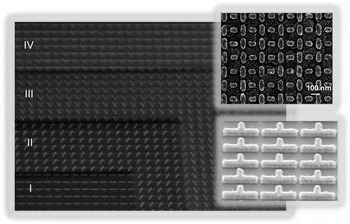
In the past 15 years, parallel advances in nanotechnology and in the understanding of complex wave–matter interactions have enabled a new designer matter paradigm based on metamaterials, which allows the control of electromagnetic and acoustic waves in unprecedented ways. Metamaterials are artificial materials with a bulk response—electromagnetic, acoustic, or mechanical—that is drastically different from that of their constituents used to synthesize them, and they have been explored by several groups worldwide for exciting opportunities in various areas of technology. Figure 1 shows some basic examples of optical metamaterials formed by nanoparticles that can provide strong interactions with light, despite being subwavelength. Reference Zhao, Belkin and Alù1–Reference Lee, Nookala, Gomez-Diaz, Tymchenko, Demmerle, Boehm, Amann, Alù and Belkin3 In this case, they exploit plasmonic resonances, which are collective excitations of electrons arising at the interface between metal and dielectrics or free space. Reference Maier4 We can engineer the collective response of these resonant particles by tailoring their geometry, orientation, alignment, and density throughout the different layers composing the metamaterial, in order to realize a bulk material with strong, localized light–matter interactions that can be homogenized and whose emergent properties are distinct from those of the constituent nanoparticles. Based on this paradigm, we can change the way in which light, sound, and other waves interact with materials, propagate through them, diffract, scatter, reflect, or refract.
Examples of optical metamaterials, Reference Zhao, Belkin and Alù1–Reference Lee, Nookala, Gomez-Diaz, Tymchenko, Demmerle, Boehm, Amann, Alù and Belkin3 formed by nanostructured arrays of plasmonic particles (gold or silver) in a glass substrate.

Early research on metamaterials Reference Engheta and Ziolkowski5 was driven by the opportunity to engineer unusual values of their constitutive parameters, such as a bulk index of refraction with a negative real part, which has been shown to enable the possibility of bending waves in unusual directions and realize flat lenses with no aberrations and superior resolutions, Reference Pendry6 or cloaking devices that reroute the impinging waves to hide a given region of space from the background. Reference Alù and Engheta7,Reference Pendry, Schurig and Smith8 These ideas have been inspiring researchers worldwide, but, so far, we have not yet fully seen the expected major impact on practical devices and technology.
There are a few reasons behind the slow transition of these exciting basic research advances into practical technology. Importantly, metamaterials exploit enhanced light–matter interactions in subwavelength resonant structures, also enhancing losses and complying with stringent limits on the overall bandwidth of operation. Metamaterials are typically time-invariant, and therefore lack reconfigurability. Their response is mostly limited to linear operations, since small volumes do not allow the buildup of significant nonlinear responses for reasonable input field levels. Finally, they are limited by symmetries. For instance, a small structure tends to respond in the same way if excited from opposite sides, and the time reversibility of wave propagation implies other important constraints on the overall response of these materials.
In our group, we have been exploring ways to endow the designer matter paradigm with new degrees of freedom that may challenge some of these limitations. For instance, we have explored hybrid metamaterials and metasurfaces that combine different phenomena over the same material platform, as in the case of optomechanics or acoustoelectric phenomena. We have also looked at systems with active or time-varying components, which, when combined with metamaterial concepts, can provide interesting opportunities to improve the response and functionality of compact metamaterial devices. The following examples illustrate how these concepts may significantly enhance the next generation of metamaterials and push the boundaries of the designer matter paradigm in a highly interdisciplinary framework.
Hybrid metasurfaces with large nonlinearities
In the context of hybrid metamaterials, we have recently explored the possibility of building planar ultrathin metasurfaces printed over a material substrate that can be engineered at the quantum level. In collaboration with colleagues at The University of Texas at Austin, we used multiquantum-well materials that support tailored intersubband transitions at the desired mid-infrared wavelength associated with strong nonlinear responses Reference Rosencher, Fiore, Vinter, Berger, Bois and Nagle9,Reference Khurgin10 to enable a hybrid material platform for metamaterials. When combined with plasmonic nanostructures, suitably tailored to couple and enhance the impinging radiation and to out-couple the nonlinear generated currents to free-space radiation, we can realize unprecedented levels of optical nonlinearities, localized in deeply subwavelength volumes. Reference Lee, Nookala, Gomez-Diaz, Tymchenko, Demmerle, Boehm, Amann, Alù and Belkin3,Reference Lee, Tymchenko, Argyropoulos, Chen, Lu, Demmerle, Boehm, Amann, Alù and Belkin11–Reference Tymchenko, Gomez-Diaz, Lee, Nookala, Belkin and Alù16 The metasurfaces are designed to support plasmonic resonances with overlapping field distributions that engage the intersubband transitions in the substrate, one at the fundamental pump frequency and the second one at the second harmonic frequency. Following this idea, we demonstrated a reflective surface 20× thinner than one wavelength at the fundamental frequency that can provide unprecedented levels of conversion efficiency at mid-infrared wavelengths, given the employed volume and the level of input power. These strong nonlinear interactions are localized within deeply subwavelength structures and are ideal candidates to extend the metamaterial concepts to tailor strong nonlinear interactions in various forms.
Nonreciprocal metamaterials
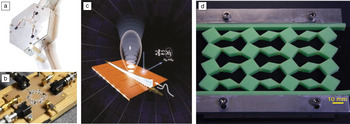
The introduction section briefly mentions how symmetries fundamentally limit the way in which linear and passive metamaterials respond to the impinging waves. Recently, we have been actively exploring ways of overcoming a few of these fundamental limits, and, in particular, we have been exploring the realization of magnet-free metamaterials that can break time-reversal symmetry (see Figure 2 ). Since the wave equation is symmetric under time reversal, we expect that if light or sound waves are allowed to travel from point A to B in a certain volume, they also can travel back from B to A with the same properties. In electromagnetics, we can build devices that break this transmission symmetry, such as isolators, gyrators, and circulators. These components are typically realized using special magnetically biased materials, which tend to be expensive and bulky and are not easily integrated into more complex systems. This approach to nonreciprocity relies on magneto-optical effects, which tend to be weak, and it cannot be extended to sound, since magnetoacoustic effects are even weaker.
Nonreciprocal metamaterial devices. (a) Circulator for sound, which uses mechanical motion in a resonant cavity to break reciprocity. Reference Fleury, Sounas, Sieck, Haberman and Alù17 (b) Circulator for radio waves, which uses a suitably tailored spatiotemporal traveling-wave modulation scheme to achieve a similar effect. Reference Estep, Sounas, Soric and Alù23 (c) Nonreciprocal antenna for free-space electromagnetic radiation, based on a traveling-wave modulation scheme. Reference Hadad, Soric and Alù25 (d) Nonreciprocal mechanical metamaterial based on nonlinearities to break reciprocity and time-reversal symmetry. Reference Coulais, Sounas and Alù27

In recent work, we have been looking at ways of breaking reciprocity in a compact footprint by combining metamaterial concepts with mechanical motion or time variations. Reference Fleury, Sounas, Sieck, Haberman and Alù17–Reference Hadad, Soric and Alù25 In order to realize this effect, we have been inspired by the way magnetized materials work. When they are not biased, these materials support degenerate energy levels; however, when we apply a magnetic bias, the degeneracy is broken—a phenomenon called Zeeman splitting, which is at the basis of the realization of the most common nonreciprocal devices. For our magnet-free metamaterial implementation, we considered an azimuthally symmetric acoustic cavity, whose dominant resonant modes, left-handed and right-handed, are also degenerate, and we found that the imposition of a weak angular momentum in the form of a slowly rotating fluid in the cavity can induce the analogue phenomenon for acoustics of Zeeman splitting, enabling under suitable conditions large nonreciprocity for acoustic waves in a compact device. Reference Fleury, Sounas, Sieck, Haberman and Alù17
In a proof-of-concept implementation (Figure 2a), we engineered a subwavelength circularly symmetric hollow cavity connected to three waveguides and loaded with three small fans that are capable of creating a small airflow in the cavity. As the fans are turned on, the resonant mode in the cavity is excited asymmetrically, and one can choose the air speed in such a way to align a node of the induced standing wave in the cavity to one of the waveguide output ports, realizing infinite isolation and full transmission to the other output port. Since the asymmetry in excitation is selected by the circulation of air, the transmission can be made highly nonreciprocal, and we measured an isolation level of 40 dB (i.e., a 10,000× smaller transmission in the backward direction compared to the forward one), achieved by imparting an air flow hundreds of times slower than the velocity of sound in air.
This subwavelength nonreciprocal device can also be used as a building block for a metamaterial. For instance, if several of these components are connected in a periodic hexagonal lattice, the acoustic propagation properties become very interesting. Around the frequency for which isolation is maximum, we find a finite range of frequencies over which signal propagation in the bulk of the lattice is forbidden, whereas the edges of the lattice support robust one-way propagation without reflections or scattering into the bulk. Reference Khanikaev, Fleury, Mousavi and Alù18 This is a functionality analogous to that of an electronic topological insulator, Reference Haldane and Raghu19 but here it is achieved for phonons, and it enables continuous frequency bands over which robust one-way sound propagation along the edge is enabled, independent of defects or other forms of disorder. In common with electronic topological insulators, these peculiar transport properties are characterized by strong robustness, stemming from the topology of the band diagram that characterizes these lattices. This supports continuous frequency bands over which robust isolation and reconfigurable one-way signal transport may be realized.
A related research direction is the pursuit of similar concepts in optics and nanophotonics. Photons travel much faster than phonons, and we cannot rely on mechanical biasing at the macroscopic level to realize these effects (even though optomechanical phenomena have been recently pursued to realize compact nonreciprocal devices Reference Fang, Luo, Metelmann, Matheny, Marquardt, Clerk and Painter20,Reference Ruesink, Miri, Alù and Verhagen21 ). To address this issue, we recently explored mimicking a form of angular momentum bias by applying a rotating spatiotemporal modulation wave to a ring resonator. Reference Sounas and Alù22,Reference Estep, Sounas, Soric and Alù23 Instead of circulating an air flow, we apply a modulation traveling wave around the resonator, with the similar effect of breaking symmetry. Starting from the degenerate modes of a circularly symmetric cavity without modulation, we can induce an effective form of Zeeman splitting, breaking the modal degeneracy and realizing compact, magnet-free nonreciprocal devices for photons (Figure 2b–c).
This concept can also be extended to realize topological metamaterials for electromagnetic waves and photons Reference Fleury, Khanikaev and Alù24 by connecting such modulated elements in periodic lattices. In addition, the idea of using a traveling modulation wave to break reciprocity can be applied to overcome reciprocity limitations associated with free-space radiation in open systems (Figure 2c). Reference Hadad, Soric and Alù25 For energy applications, reciprocity implies that a good absorber is also a good emitter. Similarly, a well-designed transmitting antenna is inherently prone to listen to its own echoes and reflections. Using suitably tailored spatiotemporally modulated metasurfaces, however, we can break reciprocity and realize nonreciprocal emitters that can transmit without receiving, or that absorb without having to reemit through thermal radiation a portion of the energy back toward the source.
The nonreciprocal metamaterials discussed so far are all based on external biases, in the form of mechanical motion or spatiotemporal modulations, but another interesting venue to break reciprocity is offered by nonlinear effects, which may enable fully passive isolators without requiring an external bias. In this case, the nonlinearity essentially self-biases the system using the signal traveling across the device. Recently, we have been working on realizing passive systems formed by pairs of nonlinear metasurfaces that can provide full isolation when excited from the left with a certain range of intensities, while they offer full transmission when excited with the same intensities from the opposite side. Similar concepts can again be extended to build optical topological metamaterials whose strong topological protection and robust signal transport for photons is triggered and self-supported by the signal itself traveling across the lattice. After a certain intensity threshold can be engineered and controlled as desired, the nonlinear metamaterial can experience a topological transition, supporting topologically protected modes that travel nonreciprocally. Reference Hadad, Khanikaev and Alù26 The metasurfaces discussed in the previous section may be well suited to realizing these effects in nanophotonic systems.
The concepts discussed in this section have interesting implications beyond electromagnetics and acoustics. Recently, we showed that breaking time-reversal symmetry and microscopic reversibility can also have relevance in statics. If a mechanical system is linear, the Maxwell–Betti theorem ensures that the transmission of displacement caused by a static force is necessarily symmetric between any two points in space. In other words, if pushing on one side of an object causes a displacement at the other side, we can expect the same displacement when we reverse force and observation points. However, similar to the electromagnetic structures previously discussed, suitably tailored nonlinearities combined with proper asymmetries can largely break this symmetry and realize topological mechanical metamaterials that, when pushed from one side to the other, offer different displacement transmission, even in the limit of very small input forces. Reference Coulais, Sounas and Alù27 Figure 2d shows a three-dimensional printed mechanical metamaterial with this unusual static response, which may form the basis for a new generation of microstructured metamaterials to realize, for example, gloves or covers that can be pushed from one side but isolated from the other.
Active metamaterials
Two of the holy grails that spurred early interest in the field of metamaterials, and the imagination of scientists and lay people all over the world, were mentioned in the Introduction. One is the idea of bending light using metamaterials in order to hide a given region of space, also referred to as cloaking. Reference Alù and Engheta7,Reference Pendry, Schurig and Smith8 The second one is the possibility of using negative refraction metamaterials to realize flat lenses with large resolutions and no aberrations. Reference Pendry6 Our interest in these metamaterial functionalities has recently inspired us to explore active approaches to metamaterials.
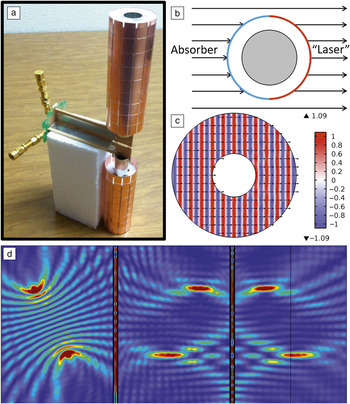
The cloaking functionality is based on a properly constructed metamaterial being able to suppress the entire scattered field of an object, independent of the excitation field. Reference Alù and Engheta7,Reference Pendry, Schurig and Smith8 In the past few years, we have applied this concept to build cloaked sensors and antennas (see Figure 3a) that can receive a signal without having to scatter or create shadows, with the opportunity of realizing near-field noninvasive sensing systems that do not perturb the environment they are measuring. Reference Alù and Engheta28,Reference Alù and Engheta29 Figure 3a shows an example of cloaked antenna operating at radio frequencies. It is formed by a conventional dipole antenna, commonly used to transmit and receive radio signals, cloaked by a properly patterned metasurface. The resulting cloaked antenna has the unusual property of being an efficient transmitter and receiver, but with a significantly reduced electromagnetic footprint, becoming effectively transparent to radio waves impinging on it. In turn, this property allows us to put another antenna close to the cloaked one without feeling its presence, with relevant applications especially in modern crowded wireless environments.
(a) Passive metasurface cloak around a dipole antenna to drastically reduce its scattering cross section, while preserving the possibility to transmit and receive radio signals. (b–c) Active metasurface based on parity-time symmetry to realize electromagnetic cloaks overcoming the bandwidth limitations of passive metamaterials. Reference Sounas, Fleury and Alù32 (d) A flat lens with no aberrations realized by pairing a passive and an active metasurface. Reference Fleury, Sounas and Alù34,Reference Monticone, Valagiannopoulos and Alù35

In recent studies, we found that cloaking suffers from a fundamental tradeoff between the bandwidth over which the phenomenon can be achieved, the overall amount of scattering reduction, and the size of the object to be cloaked compared to the wavelength. It can be proven, under the general assumptions of passivity and linearity of the system under analysis, that for a certain size of the object, a larger scattering reduction necessarily implies a narrower bandwidth, and the larger the object compared to the wavelength, the more stringent this bound becomes. Reference Monticone and Alù30,Reference Monticone and Alù31 Based on this bound, it is possible to prove that complete suppression of the scattering of an object with a passive cloak can happen only over a zero-frequency range (i.e., for a purely monochromatic signal). In practice, this result confirms and quantifies a problem that many scientists and engineers working on cloaking have been experiencing for years—whatever cloaking technique is used, as long as it is based on passive and linear metamaterials, the bandwidth shrinks, and sensitivity to imperfections increases as the electrical size of the object to be cloaked grows. For several applications, this result implies too severe restrictions that fundamentally limit the applicability and practical use.
One interesting possibility that we have been exploring to overcome this constraint consists of employing active metamaterial cloaks, which break the assumption of passivity. If we start with the problem of cloaking a circular metallic cylinder with a single ultrathin metasurface surrounding the cylinder, it turns out that the only valid configuration for the metasurface has a specific inhomogeneous impedance profile around the cylinder. Reference Sounas, Fleury and Alù32 On the left side, from which we assume that the object is illuminated, the surface should be absorptive, whereas on the opposite side, the surface should hold the time-reversed properties of the passive surface, for example, it should be an active surface with gain (i.e., a lasing surface), as sketched in Figure 3b. Essentially, this type of active-passive cloak works by absorbing the impinging energy from the left side, avoiding back reflections as in the case of a stealth surface. At the same time, it eliminates shadows and forward scattering, which would be expected from a passive absorbing surface, by covering the back portion of the object with the time-reversed copy of a stealth surface, which, through multiple scattering in the transient regime, enables the radiation of an exact replica of the impinging signal in the forward direction, eliminating the shadow, and therefore realizing an ideal zero-scattering system. Interestingly, this system can be made inherently stable, operating over much broader bandwidths than would be ultimately allowed by the passivity bounds previously discussed.
The process of building one of these systems began with a 1D version for acoustic waves. Reference Fleury, Sounas and Alù33 The geometry consisted of two loudspeakers placed in front of each other, one loaded with a passive circuit to realize an absorbing sensor for sound, the other one loaded with the time-reversed version of the same circuit, offering a negative resistance and gain. The passive side acts as a good absorber, implying that when sound excites the structure from the left, it is absorbed. One would expect large shadow behind the absorber, but the presence of the active loudspeaker at the back suppresses the shadow. Independent of the distance between the active and passive sides, the realized system provided zero reflection, full transmission, and strong absorption.
The amount of absorbed power measured at the passive loudspeaker is actually twice as large as the input power, and that is justified by the fact that the passive sensor entirely absorbs the impinging signal plus an exact replica sent backward by the active sensor. The synchronization between passive and active side, which enables this functionality independent of the amplitude and phase of the impinging signal, occurs during the transient regime, before the system reaches steady-state. During this transient, the absorber lets a portion of the signal through and, by multiple scattering, establishes the feedback necessary to feed the incoming signal to the active loudspeaker. Interestingly, as we make the distance between active and passive elements larger, the active element is required to send the signal with a larger phase advance, because it has to ensure that the replica arrives in phase with the impinging signal at the passive loudspeaker. This implies that the signal emerging from the active side is actually phase advanced, analogous to the one emerging from a negative-refractive material slab.
Two planar metasurfaces formed by arrays of these elements placed in front of each other, one with lossy elements and one with active elements, can, under certain conditions, realize the functionality of a planar slab with negative refraction. Reference Fleury, Sounas and Alù34 While in a conventional passive metamaterial negative refraction is supported by arrays of small resonators (see Figure 1) associated with unwanted loss and narrow bandwidths of operation, in this geometry, the suitable combination of gain and loss can replace the resonators and establish an overall loss-free negative refractive slab of arbitrary thickness. This configuration can be used to realize focusing in a planar, translationally invariant geometry, Reference Monticone, Valagiannopoulos and Alù35 similar to the negative index lens. Reference Pendry6 Figure 3c shows the optical field distribution induced by two sources placed on the left of the pair of metasurfaces. Independent of the distance between them, or of the position of the sources, the system in steady state will reproduce in the right-half space an image of the object placed on the left, realizing an absolute optical instrument without aberrations. This functionality may have interesting implications for the realization of low-loss aberration-free imaging systems.
Conclusions
This article provided an overview of recent efforts in enriching the field of designer matter and metamaterials by considering nonlinearities, multiphysics phenomena, moving media, time modulation, and active systems. These new tools provide exciting opportunities to push forward the dream of controlling, to a new degree, the electromagnetic, acoustic, or mechanical wavefront and realize highly counterintuitive phenomena. The inclusion of multiphysics phenomena in a highly interdisciplinary effort provides opportunities to go beyond some of the roadblocks of conventional metamaterials, such as bandwidth limitations and sensitivity to losses, opening new vistas in the journey toward making metamaterials and designer matter a new paradigm for practical technology and various applications of interest.
Acknowledgments
Thanks to all present and past group members and collaborators who have significantly contributed to these research directions. This work has been supported by the National Science Foundation, the US Department of Defense, the Simons Foundation, the Grangier Foundation, and the Welch Foundation Grant No. F-1802.

Andrea Alù is the Temple Foundation Endowed Professor at The University of Texas at Austin (UT Austin). He received his Laurea degree in 2001 and his PhD degree in 2007 from the University of Roma Tre, Italy, and joined UT Austin in 2009. His current research interests include metamaterials and plasmonics, electromagnetics, nano-optics, photonics, and acoustics. He is a Fellow of IEEE, OSA, APS, and SPIE. His awards include the International Commission for Optics Prize in Optics (2016), the National Science Foundation Alan T. Waterman Award (2015), the OSA Adolph Lomb Medal (2013), and the Union Radio-Scientifique Internationale Issac Koga Gold Medal (2011). Alù can be reached by phone at 512-471-5922 or by email at alu@mail.utexas.edu.