Introduction
Noise is often a constant part of everyday life. It plays an important role, allowing for awareness to sources of danger; it affects language and speech development, and is essential in social and occupational functioning.Reference Basner, Babisch, Davis, Brink, Clark and Janssen1 While normal noise levels allow for awareness of surroundings, and facilitate interaction and communication, abnormal and chronic noise exposure could have many detrimental health effects, which could be auditory or non-auditory, including annoyance, sleep disturbance, cognitive impairment in children, cardiovascular disease and noise-induced hearing loss.Reference Basner, Babisch, Davis, Brink, Clark and Janssen1–Reference Agrawal, Platz and Niparko3 Noise is so ubiquitous in our environment that it is a public health issue which needs to be addressed.Reference Alberti4 However, to effectively address noise from a public health perspective, it is critical that the population profile at greater risk of noise exposure be described, and that appropriate educational awareness and other interventions be targeted.
Two important sources of noise exposure are occupational and recreational noise exposure.Reference Johnson, Cooper, Stamper and Chertoff5 Work-related noise-induced hearing loss is the most common self-reported occupational illness or injury in the USA, with an estimated 30 million workers exposed to hazardous noise levels occupationally.Reference Chepesiuk6 In fact, about a quarter of hearing loss cases in the USA are related to lifetime occupational noise exposure.Reference Masterson, Themann, Luckhaupt, Li and Calvert7 Work-related hearing loss is a major occupational hazard, and has been shown to be most prevalent in industrial settings, such as construction, mining, agriculture, transportation and manufacturing industries.Reference Masterson, Bushnell, Themann and Morata2,Reference Chepesiuk6 –Reference Tak8 In addition to the industry workforce, airport workers, racetrack workers, musicians, military personnel and dentists are also prone to excess noise exposure and an increased risk of occupational hearing loss.Reference Basner, Babisch, Davis, Brink, Clark and Janssen1,Reference Myers, John, Kimball and Fruits9 There is even a possibility of some excessive noise exposure in otolaryngology, which requires further exploration.Reference Vaisbuch, Alyono, Kandathil, Wu, Fitzgerald and Jackler10
Besides occupational exposure, recreational noise exposure is also prevalent in the USA, and could be more insidious.Reference Ivory, Kane and Diaz11,Reference Bhatt, Lin and Bhattacharyya12 At least 100 million individuals are exposed to noise from traffic near their homes each year in the USA.Reference Chepesiuk6 Additionally, individuals who frequently engage in woodwork, power tool use and metalwork, and drivers of noisy vehicles or motorcycles, are exposed to higher noise levels and are at greater risk of developing hearing loss.Reference Bhatt, Lin and Bhattacharyya12–Reference McCombe14 Other common sources of social noise include nightclubs, concerts and personal music players.Reference Basner, Babisch, Davis, Brink, Clark and Janssen1,Reference Bhatt, Lin and Bhattacharyya12 With the increased use of personal music devices by young people, the proportion of overall noise exposure and subsequent risk of hearing loss due to recreational activities will likely increase.Reference Chepesiuk6,Reference Ivory, Kane and Diaz11,Reference Bhatt, Lin and Bhattacharyya12,Reference Carroll, Eichwald, Scinicariello, Hoffman, Deitchman and Radke15,Reference Le Prell, Spankovich, Lobarinas and Griffiths16
Another significant and contemporary source of noise exposure is firearm use.Reference Johnson, Cooper, Stamper and Chertoff5,Reference Ivory, Kane and Diaz11,Reference Bhatt, Lin and Bhattacharyya12 Firearm use is an important source of occupational noise for individuals such as those in the military.Reference Bhatt, Lin and Bhattacharyya12 It is also a source of noise exposure for those who use firearms recreationally, such as recreational hunters.Reference Ivory, Kane and Diaz11 The potential of firearms to remain a source of noise exposure in the USA is underscored by the fact that there are estimated to be over 300 million firearms in the USA, and about 1 in 3 households own a gun.Reference Bhatt, Lin and Bhattacharyya12 However, firearms are not only important sources of noise exposure; they are associated with acoustic trauma,Reference Rabinowitz17 hearing lossReference Hoffman, Dobie, Losonczy, Themann and Flamme18 and permanent hearing impairment.Reference Agrawal, Platz and Niparko3,Reference Cruickshanks, Dhar, Dinces, Fifer, Gonzalez and Heiss19
It is reasonable to assume that there may be sociodemographic variations in noise exposure due to different occupations and recreational interests. Given that sociodemographic factors are often being associated with disease prevalence, including risk of cardiovascular disease, hearing loss and other age-related conditions,Reference Cruickshanks, Dhar, Dinces, Fifer, Gonzalez and Heiss19,Reference Agrawal, Platz and Niparko20 it is imperative to examine their role in excess noise exposure. This study aimed to identify the population most at risk of noise exposure by evaluating the sociodemographic correlates associated with occupational, recreational and firearm noise exposure.
Materials and methods
Data source
Data were obtained from the National Health and Nutrition Examination Survey (‘NHANES’), conducted from 2011 to 2012 in the USA. The National Health and Nutrition Examination Survey examined demographic, socioeconomic and health-related information, and the sample is representative of the US population.21 The survey used a complex, multistage, stratified, cluster design. During the 2011–2012 cycle, the National Health and Nutrition Examination Survey oversampled Hispanic, non-Hispanic Asian and non-Hispanic Black individuals to produce nationally representative estimates. Additionally, they oversampled individuals who were at or below 130 per cent of the poverty index. The survey was administered by trained interviewers in the participants’ homes via a computer-assisted personal interview.Reference Hoffman, Dobie, Losonczy, Themann and Flamme18
As the National Health and Nutrition Examination Survey is publicly available with de-identified data, this study was exempt from consideration by the authors’ institutional review board.
Measures
We included participants aged 20–69 years, as those were the ages of participants queried about noise exposure. The three outcomes of interest were occupational (work) noise exposure, recreational (non-work) noise exposure and recurrent firearm use.
The NHANES defined occupational noise as being ‘exposed to loud sounds or noise 4 or more hours a day, several days a week…[loud] means so loud that [you] must speak in a raised voice to be heard’.
Recreational noise exposure was defined as ‘exposure to very loud noise or music for 10 or more hours a week…this is noise so loud that [you have to] shout to be understood or heard 3 feet away’. The examples of recreational noise exposure given were ‘power tools, lawn mowers, farm machinery, cars, trucks, motorcycles, motor boats or loud music’.
Firearms were listed as a separate category and not as an example of loud noise outside of work, although participants may have considered them to be an example of non-work noise exposure. In order to define recurrent firearm usage, we used a question asking how many rounds or shots from firearms the participant had fired. Recurrent firearm usage was defined as firing 1000 or more rounds; those who did not use firearms repeatedly either shot fewer than 1000 rounds or had never used firearms.22
Independent variables included sex (male or female), race or ethnicity (Hispanic, White, Black, Asian, other race or multiracial), marital status (married or partnered, widowed, divorced or separated, or never married), education (less than high school, high school graduate or General Educational Development test level, a college or associate degree, or college graduate or above), insurance status (yes or no), and age (20–29, 30–39, 40–49, 50–59 or 60–69 years).
Analysis
The proportion of participants with exposure to each noise type was compared to that of participants who did not have such noise exposure, for each independent variable, using chi-square tests. Percentages were weighted to adjust for complex survey design, non-response and post-stratification.23 Weighted multivariate binary logistic regression determined significant predictors of occupational noise exposure, recreational noise exposure and recurrent firearm usage among the independent variables listed, using adjusted odds ratios and 95 per cent confidence intervals (CIs).
Results
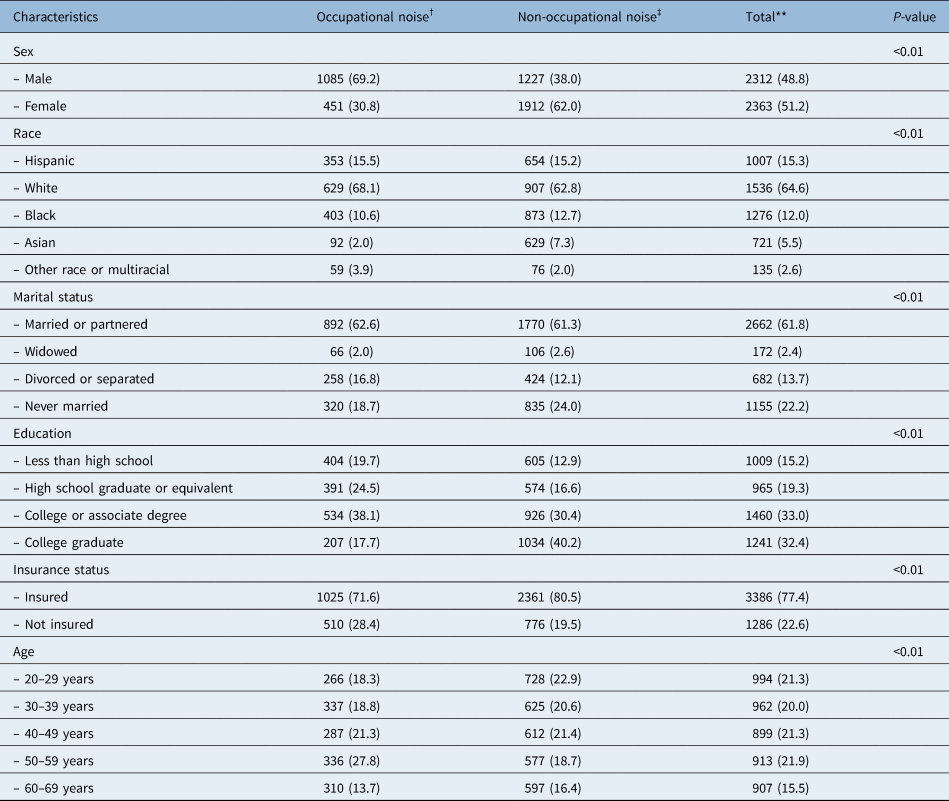
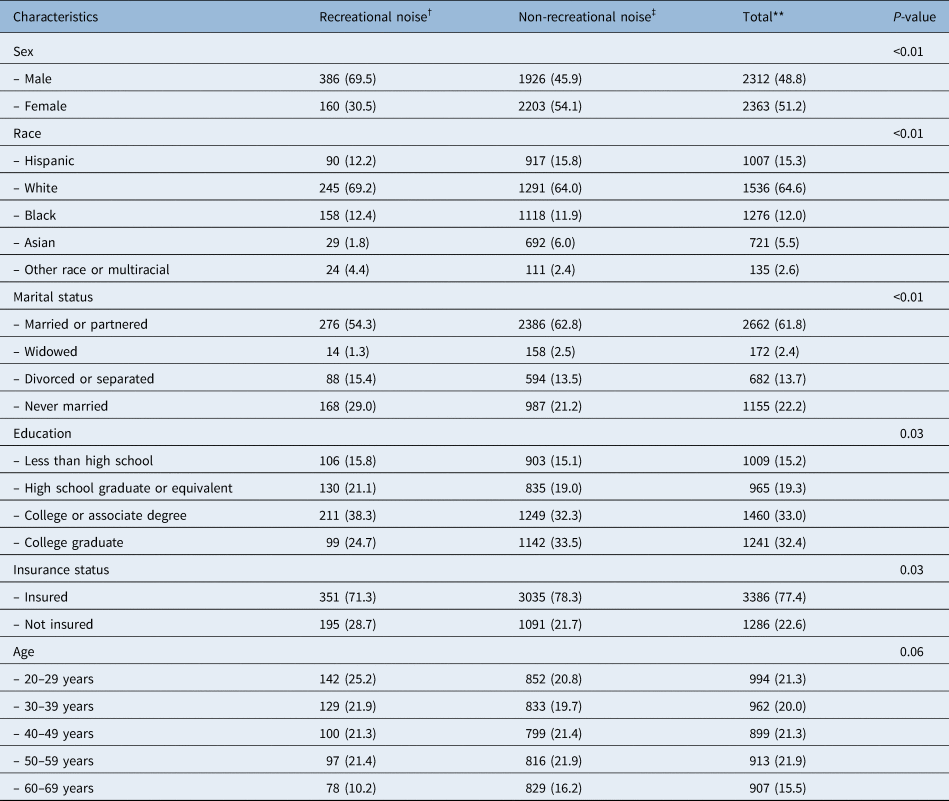
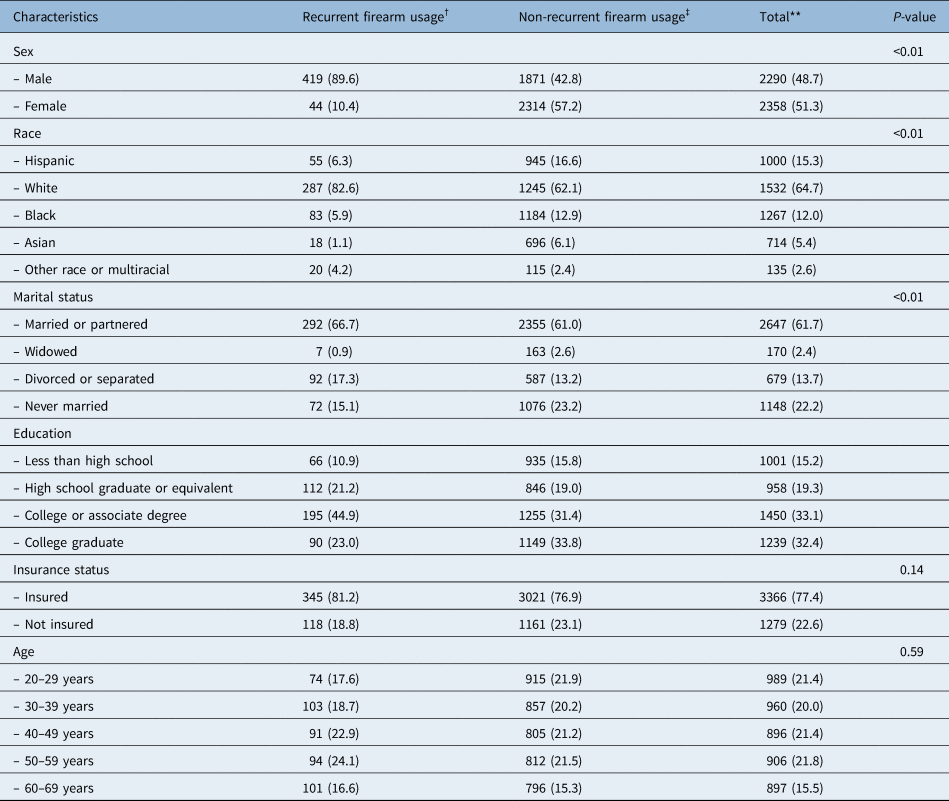
A total of 4675 participants aged 20–69 years were included in our analysis. Of these, 34 per cent had occupational (work) noise exposure, 12 per cent had recreational (non-work) noise exposure, and 13 per cent used firearms repeatedly. The majority of participants were female (51 per cent) and White (65 per cent) (Tables 1–3).
Demographic characteristics for work noise exposure*

Data represent numbers (and weighted percentages) of individuals, unless indicated otherwise.
* Based on National Health and Nutrition Examination Survey (‘NHANES’) 2011–2012 data.
† n = 1536;
‡ n = 3139;
** n = 4675
Demographic characteristics for non-work noise exposure*

Data represent numbers (and weighted percentages) of individuals, unless indicated otherwise.
* Based on National Health and Nutrition Examination Survey (‘NHANES’) 2011–2012 data.
† n = 546;
‡ n = 4129;
** n = 4675
Demographic characteristics for recurrent firearm usage*

Data represent numbers (and weighted percentages) of individuals, unless indicated otherwise.
* Based on National Health and Nutrition Examination Survey (‘NHANES’) 2011–2012 data.
† n = 4185;
‡ n = 463;
** n = 4648
Occupational noise exposure
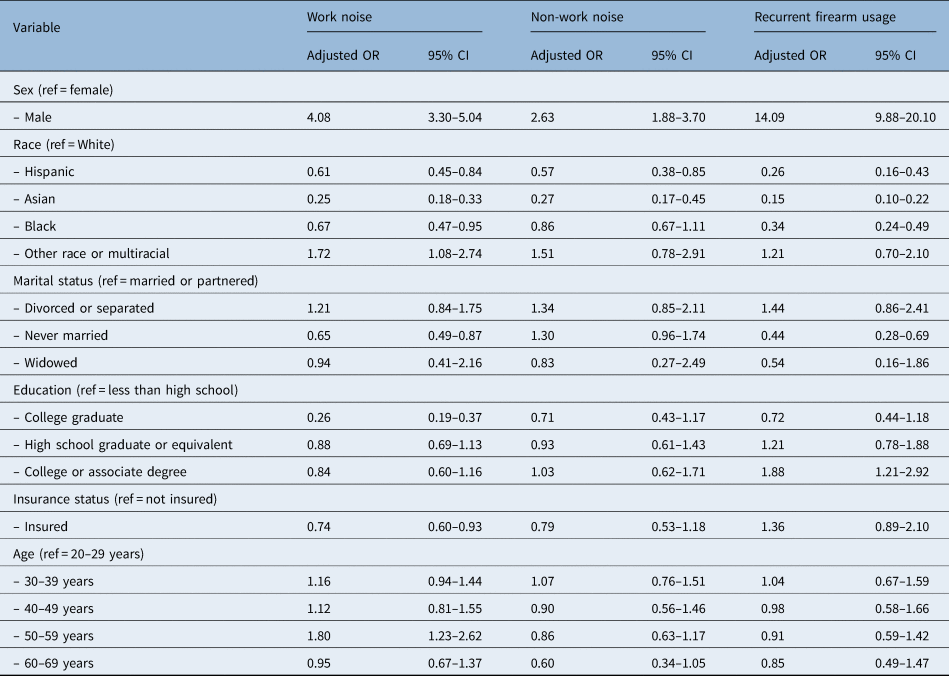
Males were four times more likely to have occupational (work) noise exposure than females (adjusted odds ratio = 4.08, 95 per cent CI = 3.30–5.04). Compared to Whites, Hispanics (adjusted odds ratio = 0.61, 95 per cent CI = 0.45–0.84), Asians (adjusted odds ratio = 0.25, 95 per cent CI = 0.18–0.33) and Blacks (adjusted odds ratio = 0.67, 95 per cent CI = 0.47–0.95) were less likely to have occupational noise exposure. However, other race or multiracial participants were 72 per cent more likely to have occupational noise exposure than Whites (adjusted odds ratio = 1.72, 95 per cent CI = 1.08–2.74).
Never-married participants were 35 per cent less likely to have occupational noise exposure than married or partnered participants (adjusted odds ratio = 0.65, 95 per cent CI = 0.49–0.87). Participants with a college education or above were 74 per cent less likely to have exposure to occupational noise than participants with less than a high school education (adjusted odds ratio = 0.26, 95 per cent CI = 0.19–0.37). Those with insurance were 26 per cent less likely to have occupational noise exposure than participants without insurance (adjusted odds ratio = 0.74, 95 per cent CI = 0.60–0.93). Compared with participants aged 20–29 years, those aged 50–59 years were 80 per cent more likely to have experienced occupational noise exposure (adjusted odds ratio = 1.80, 95 per cent CI = 1.23–2.62) (Table 4).
Weighted multivariate logistic regression models for work and non-work noise exposure, and recurrent firearm usage

OR = odds ratio; CI = confidence interval; ref = reference
Recreational noise exposure
Males were more than two times more likely to have recreational (non-work) noise exposure than females (adjusted odds ratio = 2.63, 95 per cent CI = 1.88–3.70). Compared to Whites, Hispanics (adjusted odds ratio = 0.57, 95 per cent CI = 0.38–0.85) and Asians (adjusted odds ratio = 0.27, 95 per cent CI = 0.17–0.45) were less likely to have exposure to recreational noise (Table 4).
Recurrent firearm usage
Males were 14 times more likely to use firearms repeatedly than females (adjusted odds ratio = 14.09, 95 per cent CI = 9.88–20.10). Compared to Whites, Hispanics (adjusted odds ratio = 0.26, 95 per cent CI = 0.16–0.43), Asians (adjusted odds ratio = 0.15, 95 per cent CI = 0.10–0.22) and Blacks (adjusted odds ratio = 0.34, 95 per cent CI = 0.24–0.49) were less likely to use firearms repeatedly.
Never-married participants were 56 per cent less likely to use firearms repeatedly than married or partnered participants (adjusted odds ratio = 0.44, 95 per cent CI = 0.28–0.69). Compared to participants with less than a high school education, those with a college or an associate degree were 88 per cent more likely to use firearms repeatedly (adjusted odds ratio = 1.88, 95 per cent CI = 1.21–2.92) (Table 4).
Discussion
In this study, we compared the demographics of patients who identified as having occupational (or work-related) noise exposure, as well as those who identified as having recreational and repeated firearm noise exposure. The key sociodemographic correlates we identified as being associated with a general increased risk of noise exposure included being White, male, with lower education attainment and a lack of insurance. While many of these risk factors have been previously identified as independent risk factors for hearing loss,Reference Hoffman, Dobie, Losonczy, Themann and Flamme18,Reference Cruickshanks, Dhar, Dinces, Fifer, Gonzalez and Heiss19,Reference Emmett and Francis24 our study suggests that these sociodemographic factors are also independently associated with occupational and non-occupational noise exposure.
Regarding occupation-specific risk factors, we found that there were independent associations between occupational (or work-related) noise and male sex, White race, low educational attainment and lack of health insurance. As the common industries associated with hearing loss are construction, mining and manufacturing,Reference Masterson, Bushnell, Themann and Morata2,Reference Masterson, Themann, Luckhaupt, Li and Calvert7 the findings suggest that these sociodemographic factors may be similar to those of workforce populations.
The area of occupational noise exposure provides a unique opportunity to implement preventative medicine. In a previous study, the main predictors of occupational hearing loss were inadequate use of hearing protection devices and duration of occupational exposure to noise.Reference Pelegrin, Canuet, Rodriguez and Morales25 The lack of use of adequate hearing protection devices is known to worsen the hearing of those exposed.Reference Kerr, McCullagh, Savik and Dvorak26 Increasing efforts to educate patients on appropriate hearing protection is necessary. Furthermore, populations at risk of noise exposure may benefit from prevention or early detection through lifelong surveillance. Thus, the at-risk sociodemographic group identified in this study may be candidates for annual audiometric examinations. This early intervention is relevant given the irreversible nature of hearing loss and its subtle onset.
Regarding recreation-related noise exposure, only male sex was shown to be associated with an increased risk, and those of Hispanic and Asian race were less likely to have higher noise exposure relative to those who identified as White. Although occupational noise exposure has decreased over the years,Reference Paul, Tzelepis, Walsh, Girgis, King and McKenzie27 social and recreational noise exposure has increased with the use of personal music players, and attendance at loud concerts and music festivals. Recreational noise exposure is an area where there is little use of hearing protection devices,Reference Nondahl, Cruickshanks, Dalton, Klein, Klein and Tweed28 and it is a type of noise exposure likely to continue to increase in prevalence. There is a need to increase awareness of the potential effects of the prolonged use of devices associated with recreational noise and exposure to loud music.Reference Basner, Babisch, Davis, Brink, Clark and Janssen1,Reference Le Prell, Spankovich, Lobarinas and Griffiths16
When evaluating participants who had excess noise exposure from repetitive firearm use, the most prominent risk factor was male sex. Other key factors included White race, being married or with a partner, and having a college or associate degree. While it has been documented that target shooters are known to be more compliant with hearing protection devices,Reference Nondahl, Cruickshanks, Dalton, Klein, Klein and Tweed28 this study did not focus on the specific form of firearm exposure and it is unclear what the overall use of hearing protection devices was. However, the threshold set for the definition of firearm noise exposure in this study (at least 1000 rounds fired) suggests that the sociodemographic group identified herein may benefit from increased awareness of potential noise exposure associated with firearm use. Additionally, with the contemporary nature of firearm use in the USA,Reference Ivory, Kane and Diaz11,Reference Bhatt, Lin and Bhattacharyya12 it is important that individuals are aware of the potential health consequences of firearm noise exposure when not using hearing protection devices.
Given the multitude of health concerns associated with noise exposure, it is imperative to focus on efforts to reduce noise exposure. Noise exposure can lead to sleep disturbance and an inability to adequately rest, which can have a significant impact on one's quality of life.Reference Seidman and Standring29 Noise-induced hearing loss is an important contributor to the epidemic of hearing loss in the USA. It is a self-reported health concern in almost half of all the US population aged over 70 years,Reference Zelaya, Lucas and Hoffman30 which makes it more common than diabetes and cancer.Reference Blackwell, Lucas and Clarke31
While this study focused on the adult population, one of the most devastating health effects of noise exposure in paediatrics is the negative impact on cognitive performance and learning outcomes.Reference Basner, Babisch, Davis, Brink, Clark and Janssen1 Yet, younger people are becoming more at risk of noise exposure, especially because of the frequent use and attachment to electronic and music devices.Reference Basner, Babisch, Davis, Brink, Clark and Janssen1,Reference Bhatt, Lin and Bhattacharyya12,Reference Le Prell, Spankovich, Lobarinas and Griffiths16 The culmination of these detrimental health effects further supports the need to increase efforts to educate on and prevent noise exposure. Specifically, for noise-induced hearing loss, the irreversible nature of the damage that occurs to cochlear hair cells with excessive noise exposure makes preventative measures the focus of current treatment.
Strengths and limitations
We used the National Health and Nutrition Examination Survey as our source of data collection. However, it is important to note that this is a cross-sectional estimate. Indicators of both noise exposure and symptoms of hearing loss were self-reported, which adds an element of subjectivity. Additionally, it relies on patients’ recollection, which may subject the study to reporting bias. It is possible that the questions asked were inadequate to assess the culmination of noise exposure they acquire during their lifetime.Reference Hoffman, Dobie, Losonczy, Themann and Flamme18
One of the strengths of the National Health and Nutrition Examination Survey dataset is the population-based sampling strategy. The survey utilised a complex, multistage, stratified, cluster design, which additionally oversampled specific subgroups to provide nationally representative information with generalisability. With over 4000 patients, there is strength in its sample size.Reference Hoffman, Dobie, Losonczy, Themann and Flamme18
• Chronic noise exposure is a major risk factor for hearing loss; this exposure might vary based on demographic factors
• In a weighted, nationally representative survey of adults in the USA, at least one in three respondents reported occupational noise exposure
• About 1 in 8 adult Americans may be exposed to noise from firearms of at least 1000 rounds
• Whites and males are significantly more likely to be exposed to both occupational and recurrent firearm noise in the USA
Public health implications
Our study highlights the high prevalence of occupational, recreational and firearm noise exposure. There are many public health implications associated with excess noise exposure. Hearing impairment, regardless of cause, has been associated with an increased risk of disability,Reference Chen, Betz, Yaffe, Ayonayon, Kritchevsky and Martin32 higher medical expenditureReference Huddle, Goman, Kernizan, Foley, Price and Frick33 and a poorer quality of life.Reference Dalton, Cruickshanks, Wiley, Klein, Klein and Tweed13 From an economic standpoint, it is estimated that 242 million dollars are spent annually on compensation for hearing loss in the USA.Reference Basner, Babisch, Davis, Brink, Clark and Janssen1
Firearm ownership is an important issue in the USA, and it is estimated that there are over 300 million firearms in the USA currently.Reference Bhatt, Lin and Bhattacharyya12 While the debate is ongoing regarding whether gun violence, control and safety is a public health issue,Reference Branas, Flescher, Formica, Galea, Hennig and Liller34–Reference Planty and Truman38 it is imperative to inform the public of the potential noise exposure associated with recurrent firearm use.Reference Rabinowitz17 Although noise exposure from firearms may never evoke gun safety debates such as those currently being discussed across the USA, it does have long-term health implications, that are preventable through protective measures.Reference Rabinowitz17,Reference Nondahl, Cruickshanks, Dalton, Klein, Klein and Tweed28 Additionally, physicians can help by screening individuals to determine excess noise exposure and by counselling patients on the detrimental effects of prolonged exposure.
Conclusion
There are sociodemographic correlates of occupational, recreational and firearm noise exposure among adults in the USA. This study indicates that Whites, males, those with low educational attainment and uninsured people are more likely to be exposed to different types of noise, and past research has found that these groups have an increased risk of hearing loss. The use of hearing protection should be emphasised for these groups. Future interventions for excessive noise exposure prevention may target those sociodemographic groups identified in our study that have greater risk of noise exposure.
Competing interests
None declared