


Introduction
The colonial state's meddling in the troubled marriage of LakshmiFootnote 1 and Narayen Ramchundur in mid-nineteenth century Ahmednagar outraged their Deccan Brahman community in Maharashtra and reverberated across British India and Britain. Their marriage fell apart when Narayen, scion of an influential Brahman family, converted to Christianity in April 1839. To win such a high caste apostate was an unprecedented event for the American Marathi Mission in Ahmednagar.Footnote 2 Narayen made ‘many and strenuous efforts’ to induce his wife to follow him in Christ.Footnote 3 This, Lakshmi would not do. She precipitously left their family home with their newborn son Ramchundra in tow.Footnote 4 Her flight set in motion a 12-year legal battle, punctuated by four interventions by local magistrates and three different court cases. Would the Brahman mother, Lakshmi, retain control over her son, and protect and preserve his and her own purity of caste? Or would the Christian convert father, schoolteacher, and evangelist, Narayen, secure what contemporaries called his ‘natural’ paternal rights to the custody and education of his son, despite his conversion to the religion of his colonial masters? These questions about caste and gender set in motion Lakshmi and Narayen's legal wrangling in 1839. The answers to them, however, had no impact on the court's final decision 12 years later.
What began in 1839 as a struggle between Lakshmi and Narayen over their son became swept up in a high stakes political and economic drama about Christianity, conscience, and private property in 1850–1851. Their case first entered into the judicial apparatus of British India when it came before a magistrate in 1839. In 1847, Narayen filed suit against Lakshmi to recover his son in a local court in Ahmednagar; the case eventually made its way to the appellate court, the Sudder Dewanny Adawlut, in Bombay in February 1851. The appellate court judges based their decision on a newly passed piece of legislation, introduced by the governor general, Lord Dalhousie: the Caste Disabilities Removal Act of 1850 (Act XXI; hereafter CDRA). This hotly contested measure stirred up widespread political protest. Its backers in Britain and India underscored its benevolent liberality and its challenge to caste by dubbing it the ‘Freedom of Conscience Act’. Others focused on its implications for property rights and called it the ‘Law of Hindu Inheritance’; still others highlighted its impact on questions of legal jurisdiction and referred to it as the ‘Lex Loci Act’ (literally, the ‘law of the country or place’).Footnote 5 These many names signal not only divergent motivations and interpretations of the Act by supporters and critics alike, but indicate the challenge of understanding its meanings and historical consequences. They point to the entanglement of worldly affairs about wealth with inward matters of moral self-regulation.Footnote 6 A Christian convert, so most in India had long insisted, could neither raise a Brahman child nor inherit Hindu family property. The new law changed this. It protected the ‘consciences’ of converts like Narayen from suffering any infringement of their civil and property rights—so-called ‘disabilities’—that until then had been the inevitable consequence of conversion and loss of caste.Footnote 7 The court's ruling in Narayen Ramchundur versus Luxmeebae became the precedent-setting test case of the CDRA. It linked Lakshmi and Narayen's dispute with contentious empire-wide debates about conversion, conscience, and inheritable Hindu property.
In Narayen Ramchundur versus Luxmeebae, the Bombay appellate judges violated the boundaries between two domains that the colonial state under East India Company governance had long promised—though often failed—to keep apart: a public sphere of secular governance of the economy under British colonial law and a private sphere of religious governance of the family grounded in Hindu personal law.Footnote 8 The latter was supposedly based on the interpretation and codification of ancient Hindu shastras (sacred texts). The CDRA joined a list of controversial measures—most notably the abolition of sati in 1829—in which the colonial state contravened Hindu personal law by interfering in family matters.Footnote 9
Only one scholar, legal historian Nancy Cassels, very briefly notes the case of Narayen Ramchundur versus Luxmeebae. While documenting widespread protest against the CDRA, she contends that Lakshmi and Narayen's case was a legal dead-end, proof of the Act's ‘never realized implications’.Footnote 10 I disagree. Their struggle was one of the innumerable ‘small affairs of sharp human interest’ that grew out of a global process of trying to use law to impose order on Britain's kaleidoscopically diverse and disorderly empire.Footnote 11 The case contributed to empire-wide debates and political mobilizations around ‘liberty of conscience’, while exposing British colonial ambivalence about secular governance and religious freedom. The court's decision in Narayen Ramchundur versus Luxmeebae marked a milestone in a colonial endeavour from the mid-1840s until the Uprising in 1857 to replace Brahmanical regulation of everyday life with what I call ‘governance by conscience’ in British India. As this article elucidates, governance by conscience refers both to how individual subjects were trained to call upon their consciences to govern their own ethical choices and behaviours, as well as missionaries’ and the colonial state's investment in policies and institutions like schools to promote the cultivation of Christian conscience.Footnote 12 During the violent summer of 1857, some condemned the CDRA and its use in deciding Narayen Ramchundur versus Luxmeebae as provocations for the traumatic disorder then threatening to dismantle Britain's Indian empire.Footnote 13
When Lakshmi and Narayen's troubles began in 1839–1840, no one could possibly have imagined that politicians, jurists, missionaries, and commentators would hail its resolution 12 years later as establishing so-called ‘Liberty of Conscience’ in British India. Lakshmi and Narayen's conflict became one flashpoint in what contemporaries in mid-nineteenth century Britain perceived as a cataclysmic crisis about the place of conscience in the relationship between religion and secularism, Church and state, family and school. I explain how and why this happened. Most Britons concurred that conscience was a moral faculty grounded in reason and Christian truths, whose painful ‘prick’ encouraged right action.Footnote 14 But there was never consensus about what liberty of conscience meant and how best to achieve it. It served many different masters in mid-nineteenth century India and Britain. In the controversies surrounding the CDRA, I analyse who claimed—and who did not claim—conscience as an ethical and political category.Footnote 15 I shift attention away from the much-debated matrix of religious toleration and Indian secularism toward a colonial genealogy of conscience.Footnote 16 Contextualizing debates about liberty of conscience in India against the backdrop of contemporary developments in Britain, especially Ireland, underscores the distinctiveness of British policy in India.
The archives of conscience in nineteenth-century British India and Great Britain are overwhelmingly by and about men—theologians and clergymen, politicians and policymakers, intellectuals and teachers, missionaries and military leaders. Women are strikingly absent from the records. But they were ubiquitous in civil court cases about family life: marriage, child custody, conversion, and property. Because the family is ‘a privileged exemplar of intersectionality’ where ‘distinctive social hierarchies … mutually construct one another’, it is a particularly generative site for my analysis.Footnote 17 Scholars have used court records about family disputes to put women back into narratives about law and colonialism.Footnote 18 Focusing on Narayen Ramchundur versus Luxmeebae makes it possible to hear Lakshmi's otherwise inaudible voice as a Brahman mother amid the din of hyper-masculine bellicose public debate. Her voice is mediated by the legal and missionary sources that quoted her and described her views. I have neither rescued her nor romanticized her agency. Her elite status as a Brahman explains why powerful literate members of the local Deccan community provided funding and helped her to navigate courts and the law. She did not pursue legal remedies on her own. I highlight the significance of her actions and those of the two most important women in her life: her mother-in-law Seetabai and her sister-in-law Radhabai. None of these women can be reduced to Hindu victims of colonial oppression and Indian patriarchy, even though both contributed to their tribulations.
This article highlights the coercive pedagogies of conscience that male converts like Narayen, abetted by missionaries and the colonial state, imposed on their recalcitrant Hindu wives.Footnote 19 I underscore this dimension of the story not to demonize the key actors in it, but to understand their fraught subject positions. Brahman male converts paid dearly for their choices and were ostracized from their natal communities and manipulated by their British masters. Male and female missionaries undertook arduous labour far from their homelands, which sometimes put them at odds with the colonial state and their adopted non-Christian neighbours. And the Brahman wives in this story cannily mobilized sources of power within their households and community. My analysis contributes to the scholarly endeavour to show just how central gender was in histories of caste in colonial India.Footnote 20
Narayen claimed the right to educate not only his son's conscience and those of his students in mission schools, but that of Lakshmi as well. This points to my doubled meaning of educating conscience. It refers to the spiritual project undertaken by missionaries and Christian convert husbands to guide their Hindu wives and children to Christian truths and the pedagogical project to educate pupils’ consciences through vernacular print culture, public evangelizing, and formal educational instruction. Household and classroom—and the colonial state's legislative and legal interventions into both—were twinned sites for training, disciplining, and moulding conscience.
The struggle between Lakshmi and Narayen coincided with the British colonial state's passage of legislation intended to educate Indian subjects and awaken their consciences. The two developments, I show, were connected. The CDRA was part of a bundle of mid-century reform measures that culminated with the Wood Despatch of 1854 in the creation of a system of government-aided schools in India. Much has been written about this Despatch.Footnote 21 My analysis emphasizes its connection with the CDRA as part of a set of policies linking religion and family with education. From the mid-1840s until the Uprising in 1857, Protestant missionaries and many British colonial officials, including the governor general Lord Dalhousie, saw educating Indian children as the most important pathway to Christianizing India.Footnote 22 These endeavours increasingly converged in the early 1850s and troubled the boundaries between secular and religious governance. Lakshmi and Narayen's custody battle and the court's ruling elucidate and were shaped by this convergence.
The first two sections of this article focus on Lakshmi and Narayen's contest as a family saga. The first section situates the struggle between wife and husband as a momentous event for them, their family, Christian missionaries, and their embattled Brahman community in the Deccan cities of Pune and Ahmednagar in Bombay Presidency. The local political, economic, and religious context of the Deccan explains why contemporaries cared so much about this particular family drama. The second section analyses the transformation of their struggle into a legal case and the different rationales used by courts. Together, these sections locate law and its effects in the turbulent socio-economic and religious world of the nineteenth-century Deccan. They invite readers to see Lakshmi and Narayen, their family troubles, and their court case through the eyes of each of the many stakeholders in the controversy—with one notable exception. No records make it possible even to hint at the meaning of this story for their son around whom it revolved.
The passage of the CDRA in April 1850 completely transformed the basis for the court's resolution of the case. The third and fourth sections of this article move far outside the courtroom and away from Lakshmi and Narayen. I track the tidal wave of political emotions unleashed by the CDRA in the third section and its close connection to policies about state-aided education in missionary schools across British India.Footnote 23 These centred not on child custody but instead on conscience, missionary education, and whether Christian converts could inherit private property from their Hindu parents. The fourth section teases out the contradictory meanings of the British policy of ‘non-interference’ and ‘neutrality’ in religious matters as religious instruction in state-aided schools in India was sanctioned by the Wood Despatch of 1854. Comparing the Indian story to parallel debates in Ireland and England illuminates the particularity of non-interference in British India. I conclude by returning to Lakshmi and Narayen and the place of their familial-legal struggle in competing assessments of the impact of state policies to educate and Christianize India on the Uprising of 1857–1858.
Post-colonial scholars like Uday Mehta have interrogated many key words of British liberalism—liberty, property, freedom—to disclose their ineluctable complicity with empire, while others like Andrew Sartori demonstrate their instrumental repurposing by South Asians in producing a distinctively Indian version of liberalism.Footnote 24 But historians of South Asia have mostly ignored conscience,Footnote 25 while most modern British historians have treated conscience imprecisely as a synonym for moral argument in politics and religiously inflected movements and campaigns led by Nonconformists.Footnote 26
This article offers what I call an ‘implicated history of conscience’, one that embeds conscience in the messy gendered, religious, caste, political, and regional dynamics that fuelled wars about its meanings and uses. Some of my informants acted upon their conviction that conscience was a universal attribute grounded in the unchanging enlightened truths of Christianity. I disrupt such a perspective by showing how historical circumstances produced competing understandings—and sometimes refusals—of Christian conscience. The article elucidates the work that contemporaries asked conscience to perform in advancing political and religious goals, and attends to those in British India who rejected conscience altogether as incompatible with their world view. My analysis accounts for the bias of official state and missionary archives without discounting the testimonies of my historical informants. I reckon with the blatant, perhaps even cynical, instrumentalization of conscience while acknowledging the sincerity with which some actors clung to it.Footnote 27
Gender, conversion, and custody in the Deccan, 1818–1851
Narayen's conversion to Christianity in the spring of 1839 raised urgent questions for him, Lakshmi, and their entire family. Would Lakshmi remain with Narayen as his wife and eventually join the miniscule community of native Christians in Ahmednagar? If she did not, what would happen to her and to their son? Would Narayen be free to marry another woman? The shifting fortunes and misfortunes of Lakshmi and Narayen were shaped not only by dramatic events in their family's history but by transformations of Deccan society and economy that were no less profound in the aftermath of British conquest in 1818 and the arrival of missionaries in Ahmednagar in 1831. What follows interweaves two histories, one about the particularities of a single family and the other about gender, caste, colonial governance, and missionary labour in the Deccan.
Narayen had been led to Christianity by his learned and spiritually restless younger brother, Haripunt. The brothers came from a once-wealthy ‘orthodox Hindu’ family and had been married as children to Brahman brides.Footnote 28 Their father Ramchandrapant Anantpunt Khisty was a banker (or engaged in some kind of moneylending) and was connected to the ruler of the Deccan, the peshwa Bajirao II. When their father's first wife Janakibai failed to produce an heir after several years of marriage, he took a second wife, Seetabai Naik. Narayen and Haripunt were her two sons. Narayen was not yet three years old when the East India Company vanquished Bajirao II in battle in November 1817 and took his lands in the decisive Third Anglo-Maratha War.Footnote 29 Haripunt was born three years later. The peshwa's defeat meant the family's loss of the financial benefits and prestige of his patronage, and they were forced to adapt to life under new colonial masters. This blow was compounded by the death of their father in 1822. The widowed Seetabai was left to manage the family's finances and preside over a household that included her two young sons, Narayen and Haripunt, and an unnamed daughter, along with her husband's first wife, Janakibai, who had eventually given birth to her own children.
For these daunting tasks, Seetabai proved ill-suited. Sources dating to the 1840s to 1880s snidely suggest that she squandered a ‘large property’ on lavish public displays and religious ceremonies meant to uphold the family's status in the eyes of their community.Footnote 30 Perhaps Seetabai did mismanage her financial affairs, but her challenges were exacerbated by the unsettling of long-standing economic, social, and religious relations inaugurated by the incorporation of the Maratha kingdom into Bombay Presidency under East India Company governance and the arrival of American Christian missionaries in Ahmednagar in 1831. This explains why the two brothers’ conversion mattered so much to—and incited such violent responses from—their already embattled Brahman community. Let me turn first to the impact of colonial conquest on economic and social relations in the Deccan before exploring tensions within and challenges to the Brahman community there.
From 1818 onwards, British officials sought control of the Deccan by surveying the population of its towns and villages, evaluating its agricultural and manufacturing productivity, and assessing and extracting revenue from hard-pressed ryots (peasant land cultivators). Unlike in Bengal, where the colonial state forged partnerships with great landowners, or zamindars, to extract tax money from cultivators, British officials in the Deccan imposed the ryotwari system. No less a champion of ‘freedom of conscience’ and faithful servant of the East India Company than John Stuart Mill explained how the ryotwari system was supposed to work:
every registered holder of land is recognised as its proprietor, and pays direct to Government. He [the ryot] is at liberty to sublet his property, or to transfer it by gift, sale, or mortgage. He cannot be ejected by Government so long as he pays the fixed assessment …The Ryot under this system is virtually a Proprietor on a simple and perfect title … and is irresponsible for the payment of his neighbours.Footnote 31
From the 1820s onwards, Sumit Guha observes, this system put an end to ‘assessing the villages as a whole’ in favour of imposing ‘individual assessments’ on each peasant proprietor.Footnote 32 The goal was to reimagine peasant cultivators as owners of private property over which they now had authority as free agents to make decisions about managing—and mismanaging—their affairs. The ryotwari system was part of broader British colonial endeavour, often vigorously contested and uneven in implementation, to define ryots in the Deccan as individual owners of private property.Footnote 33
In the districts surrounding Pune and Ahmednagar, ryots did control substantial plots of land, which supported joint Hindu households.Footnote 34 Most lacked reserves of capital to pay for seed, tools, and draught animals at the outset of the planting season. They regularly sought loans from vani (Marwari moneylenders) in their villages, which they expected to repay after the harvest. Borrowing money was a way of life for Deccan ryots, built into agrarian seasonal rhythms. So too were episodic droughts and crop failures, which sometimes plunged Deccan ryots into debt peonage. The creation of colonial civil courts in Bombay Presidency in 1827 transferred the locus of decision-making about debt repayment away from village elders (panchayats), deeply attuned to social dynamics in their community, to impersonal administrators. Creditors had traditionally extracted repayments using ritualized forms of moral pressure and shaming. This included hiring a person to engage in fasting (dharna) outside the door of defaulting ryot households. Civil courts, by contrast, used the force of law to sanction the dispossession of ryots.Footnote 35
On 27 July, 1840, ryot petitioners in the Deccan made it absolutely clear how they experienced Mill's celebrated ‘liberty’ to act as free, individual economic agents. ‘Under the present government, by the sale of our immovable property we are reduced to a starving condition in the same manner, as a tree when its roots are pulled out, dies.’Footnote 36 When ryots defaulted on their loans, vani creditors took over their lands. Sometimes erstwhile landowners became landless labourers; more often moneylenders increased their control over the profits of agricultural production. The result was the transfer of wealth away from peasant proprietors and the destabilization of traditional structures of authority within villages across the Deccan. The introduction of colonial administrative and legal reforms, the chief secretary to the Government of Bombay William Wedderburn confessed in 1884, had been nothing short of a ‘reckless subversion of old institutions’.Footnote 37 In The Subhedar's Son (1895), the Brahman Christian Marathi novelist Rev. Dinkar Shankar Sawarkar conjured the profound disruptions to Deccan society initiated by British conquest. (The Sawarkar and Khisty families had themselves been joined by marriage by the 1860s.) ‘When the Peshwa's country came under British rule, all the earlier land grants and fiefdoms, jagirs, and inams, were reshuffled … some people lost theirs entirely, others retrieved their property only partially.’Footnote 38
Officials like Colonel G. S. Anderson, Amhednuggar revenue and assessment Collector, acknowledged and deflected responsibility for unrest in the Deccan away from British misgovernment. He emphasized the rapacity of Marwari moneylenders and blamed the layered history of sovereignty and taxation in the Deccan.Footnote 39 Take, for example, the revenues for the village of Wuddalee, where Haripunt taught in a mission school for several years. They had been enjoyed in the early 1800s by Daood Alli Khan, a cavalry officer (Ressaldar) in the army of the Muslim ruler, the nizam. But the Hindu peshwa Bajirao II also retained an ‘amul or share’ of the revenue until his defeat and deposition. Anderson condemned the nizam's poor government for the village's long-term impoverishment, although did admit that ruinously high assessments during the first decades of British control had thrown ryots across the region into debt. British officials only introduced new, supposedly more rational, assessments over village revenues in the late 1840s and early 1850s. Far from bringing order, this had produced a short-term spike of imprisonments for debt.Footnote 40
The Ramchundur family drama took place amid ongoing efforts by the colonial state to consolidate its economic and political hold over the region by imposing individual ownership of land as private property, the better to extract resources from it. The individualizing economic logics that contributed to dispossessing Deccan ryots under the banner of ‘liberty’ coincided with efforts by the American Marathi missionaries to cultivate the individual consciences of their students, native teachers, and converts. By the late 1830s and early 1840s, this had proved to be a combustible combination of developments in Ahmednagar.
As the family's financial resources dwindled, Seetabai's two sons sought out the American-led Protestant Marathi Mission in Ahmednagar, where they took jobs as teachers. Educated men, especially Brahmans, with strong language skills in English, Marathi, and Sanskrit like Narayen and Haripunt were in high demand as translators for missionary publications and as low-level officials in the British colonial administration. Haripunt and Narayen were the first upper caste Hindus to join the branch of the American Protestant Marathi Mission established in Ahmednagar in 1831.
Missionaries were newcomers in Ahmednagar. The East India Company had ambivalently admitted them to British India in 1813 during negotiations in Parliament to renew the Company's Charter. In testimony before the House of Lords, the former governor general of Bengal, Warren Hastings, warned that missionary activities had fuelled widespread rumours, particularly among the ‘native infantry’ in Bengal, that the East India Company intended ‘to force our religion upon the consciences of the people in India’.Footnote 41 Colonial administrators and Utilitarian-minded reformers in the opening decades of the nineteenth century eyed missionaries’ proselytizing zeal and their expanding network of schools with suspicion as potential threats to public order. Leaders of the American Marathi Mission did their best to allay such fears and earn the trust of colonial officials in the Deccan.Footnote 42 We can glimpse the workings of this relationship between Ahmednagar's magistrate, Henry A. Harrison, and the American Marathi Mission in October 1838, six months before the brothers’ conversion. When British officials in Ahmednagar apprehended two enslaved girls purchased by the rajah of Travancore, Harrison immediately emancipated them and handed them over to the care of the American Marathi Mission.Footnote 43 In 1839, missionary Ebeneezer Burgess lauded the ‘extensive benevolent desires’ of the British, whose protection had been, he insisted, the sole reason why the local Brahman community in Ahmednagar had not ‘put the Padres [missionaries] out of the way very soon’ in the aftermath of the ‘excitement’ caused by conversion of ‘two Brahman young men’, Haripunt and Narayen.Footnote 44 These protests and close scrutiny of Lakshmi and Narayen's custody battle severely put to the test the alliance between local British magistrates and American missionaries.
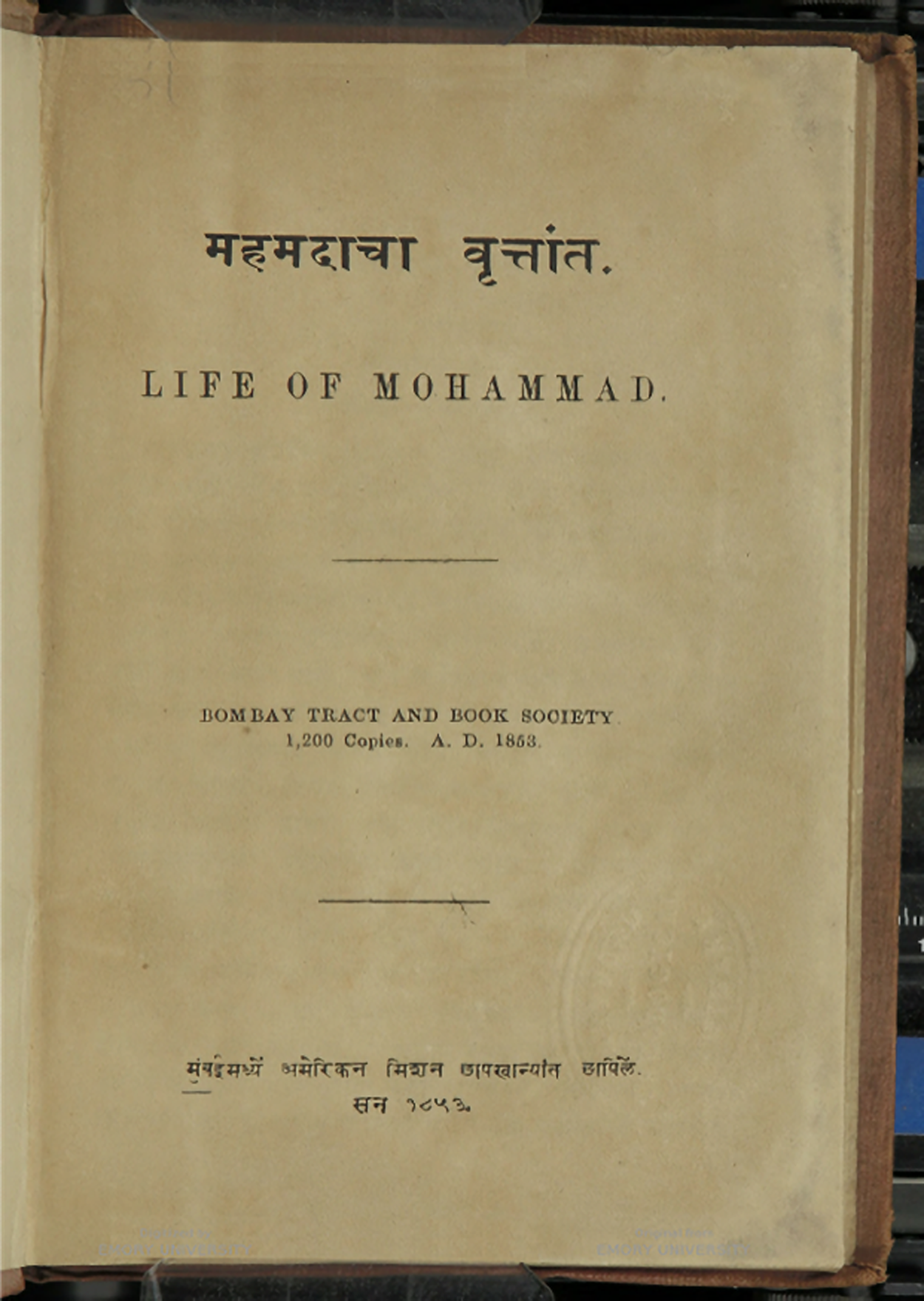
Initially hired as a translator of school textbooks, Haripunt became a teacher in May 1835 and then, after his baptism in February 1839, an evangelist (see Figure 2). A poet and translator of English and Sanskrit texts into Marathi, he was among the most influential ‘native’ Christians in mid-century western India. In 1853, he produced the Marathi translation of the Life of Mohammad by the ascetic so-called ‘White Saint of India’, Rev. George Bowen (see Figure 3).Footnote 45 After 1854, he served the Mission as an ordained minister. His conversion, followed immediately thereafter by Narayen's, was a watershed moment in the history of Christianity in the Deccan. In the early 1840s, the brothers evangelized together in the Deccan towns and villages surrounding Ahmednagar while continuing to teach ‘secular’ subjects like mathematics to children at the Mission's schools.Footnote 46
Ahmednagar Fort, the headquarters of the sultanate, was captured by the British during the second Anglo-Maratha War and in 1942 became an iconic site of imprisonment for Indian nationalists during the Quit India campaign. Source: Ahmednagar Fort, pen-and-ink wash by William Miller, 1831. Courtesy of the British Library.

Portrait of Hari [Haripunt] Ramchundur Khisty. Source: From Appaji Bapuji Yardi, A Short Memoir of the Rev. Hari Ramchandra Khisti (Bombay, 1883).

Frontispiece of Bowen's Life of Mohammad, translated by Haripunt. Neither the author's nor the translator's names appear anywhere in the book. Source: George Bowen, Life of Mohammad (Bombay, 1853), translated into Marathi by Haripant Ramchandra Khisty.
Their conversion in 1839 marked a radical break with their family's tradition of devout Brahmanism. It sent shock waves across the Deccan Brahman community which was already facing profound challenges to its power and authority. For several generations, the Ramchundurs had been based in the Deccan city of Ahmednagar. Earthen walls 12 feet high surrounded a city of approximately 35,000 mud brick flat-roofed dwellings in the 1840s that hugged the bank of the Sina River. Its sixteenth-century stone fort to the east of the city's centre was a reminder of its former military significance under various Muslim rulers (see Figure 1). But the so-called Wellington Tree just outside the fort also recalled the Maratha's defeat by the British under Arthur Wellesley's command in 1803 (see Figure 4). Their father, Ramchandrapant Anantpunt Khisty, moved the family to Pune, the capital of the once-mighty Maratha kingdom, to serve Bajirao II. The peshwas relied on members of a particular group of Chitpavan Brahmans, who established a near monopoly over civil and military administration; Deśastha Brahmans like members of the Khisty family retained paramount ritual authority.Footnote 47
Photograph from 1882 of the so-called Wellington Tree. Guidebooks to the region always mentioned this giant tamarind tree where Arthur Wellesley, Duke of Wellington, supposedly dined on 12 August 1803 during the Maratha War. The tree was part of a commemorative landscape of colonial conquest. Source: https://www.oldindianphotos.in/2016/05/wellington-tree-at-ahmednagar-fort.html

In its ongoing negotiations with its ostensible Mughal overlords, the leaders of the Maratha kingdom had cultivated the discursive ‘expression of corporate Hindu identity’ to solidify their claims for political and economic power.Footnote 48 The peshwa generously subsidized Brahman learning and authority. With over 250 temples at the time the Ramchundurs moved there, Pune teemed with Brahman priests—at least a thousand. These mostly Deśastha priests maintained strict control over daily ritual observances as well as major city-wide and regional holidays and festivals.Footnote 49 Religious institutions powered Pune's economy—one scholar estimates that they contributed around 15 per cent of the city's overall economic activity.Footnote 50
The peshwa's defeat and the absorption of his erstwhile dominions into the Bombay Presidency disturbed the delicate balance of power among different groups of Brahmans, and between Brahmans and members of non-Brahman elite castes. It fuelled the aspirations of ‘warrior Marathas’ to expand their religious authority. They claimed to belong to the elite Kshatriya varna, which itself contained hundreds of locally varied forms of ‘caste’ or jati. The Marathas asserted their descent from pure Rajput lineages as well as the right to be invested with the threads of the twice born (moonj) and participate in ceremonies using the sacred Vedas (Sanskrit religious texts of ancient India), heretofore reserved for Brahmans. In a public debate between Pune's Brahmans and non-Brahman Maratha elites in 1830, Marathas secured a resounding victory: public recognition of their right to claim Kshatriya status and enjoy these upper caste privileges.Footnote 51 This blow to Brahmanical authority in Pune emphatically did not resolve questions about who could—and could not—perform Vedic rituals in Maharashtra. But it captures tensions that remained fresh at the time Haripunt and Narayen began teaching at the Mission.
The British colonial state did not inaugurate these long-standing caste-related conflicts. But the British and missionary presence reshaped their meaning. Caste was ‘a highly involuted and politicized form of ethnic ranking shaped by the constant exercise of socio-economic power’. Far from timelessly immutable, it entwined with occupation and cultural ordering imposed by religiously informed concepts of ‘purity, pollution and danger’.Footnote 52 Despite—and no doubt also because of—these threats to Brahmanical authority in the former Maratha kingdom, Free Church Scots missionary J. Murray Mitchell characterized Pune in the 1840s and 1850s as the ‘headquarters of the ablest, most influential and most bigoted Brahmans in India’.Footnote 53 Long accustomed to exercising their administrative skills as agents of the peshwa, particular groups of Brahmans, notably Chitpavans, flocked to schools to master English and gain well-paid positions in government.Footnote 54 Proximity with and dependence upon their new colonial masters heightened the importance of preserving fragile ethnic-religious-occupational boundaries in Pune and Ahmednagar. The conversion of two Brahman brothers from an influential family threatened to altogether disrupt these boundaries.
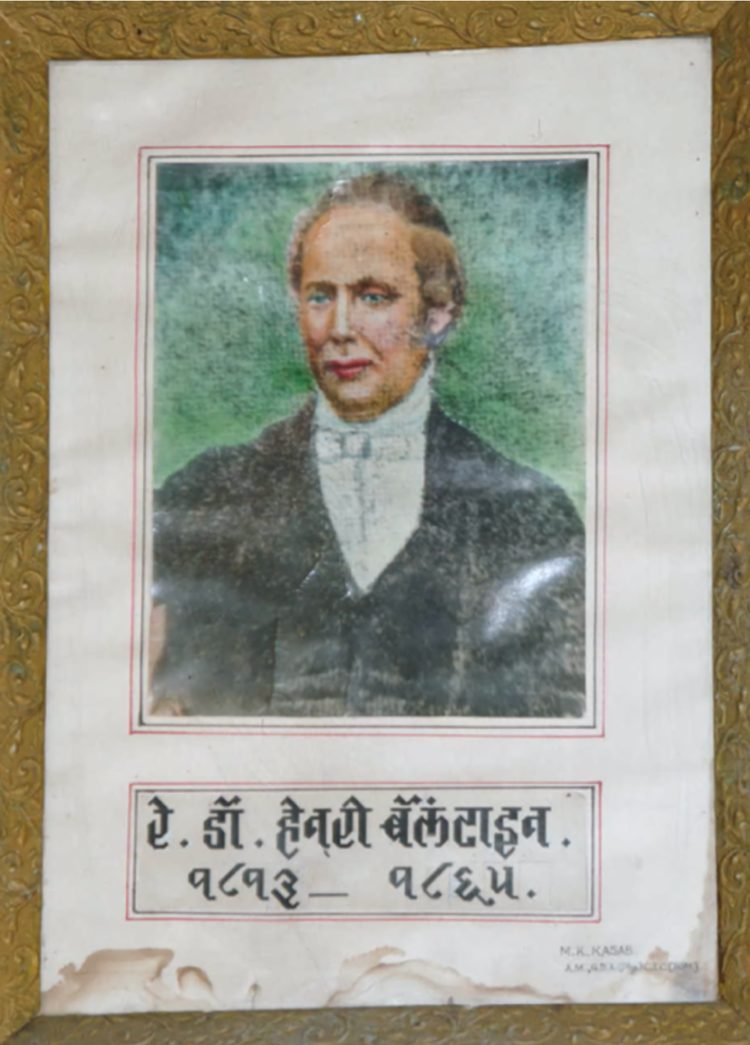
Where did Narayen and Haripunt fit in the religious, clan-family, and caste structures of Deccan society in Pune and Ahmednagar? What impact did the transformations set in motion by British conquest have on them and their family? We can be certain of one thing. Given their family's close links to the deposed peshwa, these changes must have hit them hard. The missionary who guided the brothers, Rev. Henry Ballantine (see Figure 5), provided valuable clues about the nature of the family's Brahmanism in describing their religious upbringing. Missionary sources like Ballantine's often flattened the diversity of beliefs and practices because they aimed to identify an irrational, unchanging, singular essence of Hinduism and Brahmanism. They rarely distinguished doxa from practice or caste as religious beliefs from caste as the ritual governance of daily life.
Handpainted photograph of Rev. Henry Ballantine by M. K. Kasab, n.d. Source: Ancestry.com.
With these caveats in mind, let us turn to Ballantine and his story about Narayen and Haripunt. He explained that Brahmans of the ‘highest rank’ in Ahmednagar were mostly ‘relations of their family’. ‘Their father,’ Ballantine noted,
was a rich banker, at first an inhabitant of Ahmednuggar, where the family has resided for several generations, and afterwards a resident at Poonah, where he was employed in the service of Bajeerow, the late peishwa. He was very learned in the Hindoo shastres, and strict in their performance of all the duties which they require…Narayan, the eldest son, was taught by his father every thing which a child could learn of the Hindoo-sacred books. He committed to memory many pages of Sanscrit poetry, and this he can now repeat for the most part without hesitation. He was taught the sacred music of the Hindoos, in all its varieties, and now sometimes sings for our amusement.Footnote 55
This is a story about the loving transmission of knowledge from a learned Brahman father to his son. It also reveals Ballantine's devaluation of Hindu ‘sacred’ music, which becomes mere ‘amusement’ to Christian ears.
To this portrait of generalized Brahman piety, Ballantine added one crucial fact. The family worshipped ‘Yek-nath’ (usually spelled Ek-Nath or Eknath), a sixteenth-century Deccan Deśastha ‘brahmin of great wealth and learning’ in Peythun (Paithan). Over time, Eknath had been exalted to the rank of a god and ‘become the principal deity of the place’. Eknath remained the Ramchundurs ‘Kool-daiwat’ (personal deity) ‘up [to] the present time’.Footnote 56 Fifty years later, Haripunt's daughter Krupabai repeated family lore that her paternal grandfather had used part of his wealth as a banker to establish a temple or shrine to Eknath.Footnote 57 My strong hunch is that she was mistaken in one very important detail. Krupabai's brother-in-law, Rev. Appaji Bapuji Yardi, penned A Short Memoir of the late Rev. Hari Ramchandra Khisti in 1883 in which he explained that Narayen and Haripunt's grandfather, Anantpunt, was a ‘saintly’ man of exceptional piety and ‘a disciple of St. Eknath’. Rather than endowing the temple—a very costly enterprise, which would have included the maintenance of priests and other retainers—Anantpunt received ‘the priest's rights of the Eknath Temple’ from the peshwas.Footnote 58 The temple was a source of income for the family based on the peshwa's patronage, not an expense.
The family's veneration of Eknath identifies them with a heterodox tradition within Brahmanism. Eknath asserted ‘the irrelevance of caste to proper devotion’ (bhakti). From 1700 onwards, hagiographies emerged around Eknath that he had mingled with Dalits (Untouchable jatis). He penned several Marathi drama-poems (bhārūḍs) explicitly about the social world and labours of Untouchables, including Mahārs. By the nineteenth century, Eknath had long been enshrined within a growing panoply of caste-rules-mocking ‘bhakti saints’.Footnote 59 The Calcutta Review admiringly explained that the saint ‘made no distinction between rich and poor, between Brahmin and a Shudra [a member of the lowest worker caste], but served all the same sort of food’.Footnote 60 Perhaps Eknath's caste-defiance provided a model for Haripunt and Narayen to renounce caste altogether and embrace Christian fellowship with the outcast poor of their community. After their conversions, the brothers, like Eknath before them, shared their meals with all, including Mahārs.
Several important points emerge from placing Narayen and Haripunt within their Deccan religious, caste, and political setting. The peshwas’ strategy of securing power by creating a patriarchal Brahmanical kingdom left all Brahmans, after British conquest, acutely sensitive to ritual transgressions, perceiving them as challenges to their socio-economic authority. Under British colonial rule, ritual privileges, caste boundaries, and jati were deeply contested within a heterogeneous and disputatious world of Deccan Brahmanism and Hinduism.Footnote 61 Narayen and Haripunt were people of considerable prestige and notable piety with powerful family connections to leading Brahmans in the erstwhile heartland of peshwa power: Pune and Ahmednagar. This made their conversions into portentous calamities for their communities. It also explains why their conversions meant so much for Christian missionaries. These were long-anticipated and hard-won spiritual conquests, celebrated for more than a century in histories of the American Marathi Mission. When missionary Louise Gleim Fisher compiled her typescript history of the American Marathi Mission in Ahmednagar in 1961, she opened it with a detailed account of Haripunt and Narayan's conversion.Footnote 62
At least one published Marathi language and four published English language accounts of their conversions survive, along with several fragmentary reports.Footnote 63 Each narrative is shadowed by anxieties about how to tell the story, especially the impact of the brothers’ conversion on their mother Seetabai and their wives Radhabai and Lakshmi. The Marathi account by Haripunt's son-in-law, Rev. Appaji Bapuji Yardi, was published for the Bombay Tract and Book Society—part of the vast print apparatus that sustained missionary projects. It was both a family history and a didactic text meant to inspire others to emulate Haripunt's Christian life. It includes extensive documentation, with direct citations from a wide range of legal and newspaper records, along with letters that Appaji solicited from those who knew Haripunt and Narayen.Footnote 64 Rev. Henry Ballantine penned the earliest contemporary account in several ‘letters’ and ‘reports’ as events unfolded between 1839 and 1841.Footnote 65 Narayen and Haripunt sent Ballantine their own stories about their path from orthodox Brahmanism to Protestant Christianity, but only Haripunt's was published in English translation in 1840. A close associate and fellow Brahman convert, Rev. Ramkrishnapunt Modak, produced a conversion narrative as part of his celebratory history of the Mission, first delivered as a speech in 1881, and frequently republished.Footnote 66 The last appeared in the form of a novel by Haripunt's daughter, Krupabai Satthianadhan in 1887.Footnote 67 What follows draws on these different accounts, while noting differences between them.
For the widowed Seetabai, the conversion of her two sons was a devastating humiliation. It stripped her of their financial support and undermined her authority within her own household.Footnote 68 Previous converts who joined the Marathi Mission had been poor and often disabled members of ‘low’ and ‘criminal’ subcastes, the Mahār and Mang, with little to lose and much to gain by conversion. The Marathi Mission gathered such people to Christ through the distribution of food and provision of medical services and, of course, schools.Footnote 69 They built their mission next door to the Poor House and depended on the traffic between them. For a highly educated Brahman intellectual like Haripunt to join in everyday Christian fellowship with Mahār and Mang people profoundly violated caste privilege and disgraced his community. Missionaries acknowledged that such a choice was ‘a hundred times worse than death’ for Brahmans.Footnote 70 A contemporary Bombay Brahman Christian convert recalled the vociferous execrations as a ‘pervert’ and ‘polluted wretch’ (Bāṭyā in Marathi) hurled at him whenever he appeared in public.Footnote 71 Being a Christian convert in the Deccan was not easy, especially for Brahmans. Members of an exceptionally small minority, they faced insults, social isolation, and sometimes everyday acts of verbal and physical abuse.Footnote 72 For colonial officials, hostility toward converts posed genuine threats to public order.
Haripunt's incredulous mother demanded a public examination of the sincerity of her son's religious convictions by learned Brahmans and the British magistrate. This strategy backfired and played into the hands of missionaries. It provided a public forum for testing whether Haripunt had arrived at a personal and inward transformation grounded in his new-found faith—not an outward and instrumental one motivated by desire to gain material advantages from his missionary employers. To the dismay of his mother and community, Haripunt readily passed this test. The English magistrate declared that he had become a Christian ‘of his own free will’. The magistrate's word choice made clear that Haripunt had exercised the intellectual and moral autonomy of an enlightened, liberal Christian man.Footnote 73
Here was a public inquiry meant to ferret out the invisible truths of Haripunt's conscience, an irrefutable confession of Christian faith. The magistrate's pronouncement was met by widespread riots and fuelled ‘a violent spirit which the police could not restrain’, Modak recalled.Footnote 74 In the eyes of missionaries, the Hindu mob enacted its own intemperate irrationality—added proof of the need to convert and make them fit moral subjects of a liberal empire. The British magistrate must have grappled with the inflammatory consequences of his decision to protect Haripunt and the Protestant missionaries in their godly labours. Such civil disturbances may well have chastened him to act with greater caution when adjudicating future conflicts between members of this influential family.
Narayen played a key role in the unfolding family drama that April 1839. He and his brother hatched a scheme to retrieve Haripunt's wife, Radhabai, from her brother's home in Satara and bring her to Haripunt and the Mission bungalow. The brothers forged a fraternal pact predicated upon preserving Haripunt's privileges as a husband. Narayen tricked Radhabai into leaving her brother's house; when she directly demanded to know if her husband had converted to Christianity, he answered evasively. She was terrified at the prospect of separation from the Brahman community, threatened to kill herself, and did not want to become a Christian. Undeterred, Narayen brought her to Haripunt and eventually into the Mission compound in Ahmednagar (see Figure 6). The was a disorienting and traumatic journey for Radhabai. On this much of her story, most sources concur.
This image of the Mission accompanied the publication of Modak's narrative about early Christian converts. Source: Mission Stories of Many Lands. A Book for Young People (Boston, 1894), p. 138.

Why did Narayen and Haripunt go to such lengths to gain control over Radhabai and bring her into the Mission compound? Asserting the traditional rights of Hindu patriarchy is only part of the answer. British colonial law gave Haripunt no legal way to divorce Radhabai. Hindu women did not need to divorce a Christian convert husband. According to Hindu personal law, as soon as her spouse became a Christian, he instantly became an outcast and was civilly ‘dead’ to her. Nor did Hindu men need divorce; they were free to take a second wife. Missionaries decried the cruel asymmetry that sanctioned the remarriage of the ‘non-renouncing party’ (the spouse who remained a Hindu or a Muslim), whereas the Christian convert was not ‘free at once to contract another’ ‘conjugal alliance’. The problem was especially acute when the non-Christian spouse, called the ‘unbelieving party’, was the wife. It was ‘often impossible’ to learn her ‘real mind’ because she was usually ‘confined’ in a relative's house, beyond the reach of British civil authority.Footnote 75 By physically bringing Radhabai inside the space of the Mission, Narayen and Haripunt knew that there was at least an opportunity to convince her to remain with him. Within the Mission's precincts, a British magistrate could interrogate her before witnesses and compel her to speak her ‘real mind’.
Renouncing Radhabai and remarrying a Christian woman was out of the question for Haripunt, determined as he was to organize his own family life around the Christian ideal of conjugal monogamy. The American Board of Commissioners for Foreign Missions which oversaw the Marathi Mission required its American male workers to arrive at their distant destinations with wives. Christian marriage and evangelism were inseparable. Mission wives worked alongside their husbands and assumed responsibility for their ‘separate sphere’ among native women and girls.Footnote 76 Take, for example, Rev. Henry Ballantine's own marriage. He and Elizabeth Darling, the daughter of a judge, wed on 5 May 1835 in Henniker, New Hampshire. Eleven days later, they sailed for Bombay. Missionary work was the crucible of their marriage and family life. Their love of Jesus was the foundation of their devotion to one another. Elizabeth's piety, achievements, and duties as mentor and mother, teacher and evangelist more than matched her husband's.Footnote 77
The expansive authority of missionary wives helps explain why the brothers’ immediately entrusted Radhabai to Mrs Ballantine's care when she first arrived at the Mission, at least according to Appaji's Memoir. Missionary wives—not Haripunt and Rev. Ballantine—initiated the two-year long process of developing Radhabai's conscience and directing her towards Christianity. We glimpse their gentle moral suasion in several sections devoted to Radhabai in the Memoir. ‘One can only imagine the difficulties Mrs. Ballantine and Mrs. Borges [Burgess] had in re-educating Radhabai,’ Appaji observes. ‘Radhabai is alive today to see what that transformation is.’Footnote 78 At some point in 1839 or 1840, they invited Radhabai for tea. A remarkable scene unfolded. One of them embraced Radhabai and declared that ‘she was like her sister’. Startled by this intimacy, Radhabai asked, ‘How could I be your sister? I am black and you are white. You and I dress differently.’
The ladies convinced Radhabai that one blood flowed through all bodies irrespective of skin color … Radhabai developed great affection for them. Even now, she says that those [missionary] ladies did more for her than for their own children.Footnote 79
It is tempting to dismiss this reconstructed dialogue as purely a wishful fantasy of missionaries, written four decades after Haripunt and Narayen's abduction of Radhabai. It articulates perfectly the claims of white Protestant Christian missionaries to enact radical spiritual equality across the racial divide and their deployment of the language of a universal family of humanity.Footnote 80 The phrase ‘even now, she says’ makes clear that Radhabai told Appaji this story. She read and approved his Memoir. Of course, Radhabai may well have embellished this scene. Perhaps she invented it altogether. After Haripunt's death, Radhabai supported herself as a Bible woman in Bombay. She may have rehearsed this story hundreds of times in her own missionary encounters with Hindu women. At the very least, the story points to an axis of cross-race sisterhood and solidarity between the wives of Hindu converts and the wives of Christian missionaries.Footnote 81
In the spring of 1839, Radhabai's most vigorous ally in the quest to secure her freedom from sequestration inside the Mission compound was her formidable mother-in-law, Seetabai. Infuriated by her sons’ disgraceful conduct, she demanded that they return her daughter-in-law to the family home in Pune. She sought help from the magistrate in Ahmednagar. According to the Christian convert, Rev. Modak, a petition was sent to the local magistrate, which contended that ‘these padres [missionaries] have now got Haripunt's wife also… and are going to use force to make her break her caste’.Footnote 82 The magistrate refused to release Radhabai from the Mission compound. Instead, he publicly questioned her inside the Mission to discern her will. His interrogation had at least two functions. The first was practical: to decide whether Radhabai would remain in the Mission or return to her Brahman family. The second was pedagogical and performative: to demonstrate the British colonial state's investment in the moral autonomy and conscience-driven choices of each individual, even a young Brahman wife.
Sources offer startlingly different accounts of this supposed moment of truth in her life. Appaji's reconstruction of the scene emphasized Radhabai's positive assertion of her own will as an expression of God's.
On Monday, the magistrate went to the Mission and asked in front of the townspeople if Radhabai was there of her own volition, or if she wanted to go stay with her mother-in-law. He asked her three times and three times Radhabai responded that she wanted to stay with her husband. Like Solomon says, ‘Man thinks, but God speaks’.Footnote 83
Rev. Modak, Narayen and Haripunt's closest colleague, narrated a messier story that invites reading against the grain of his own interpretive framework. He describes Radhabai's agonized confusion. He encourages us to imagine the young woman's disorientation at being thrust into the centre of an overheated contest between her Brahman community and her husband's Christian mentors, between Seetabai and her sons, between the dictates of her own faith and the magistrate's colonial ‘justice’.
In Modak's telling of the story, the magistrate's interrogation dissolves Radhabai's will while claiming to clarify it. At the outset, she remains resolute that she ‘would not consent to say to the Magistrate that she wished to live with her husband … to the last she declared that she would go to her mother-in-law and her caste-people’. But then the magistrate subtly shifted his question. Rather than asking whether she wished to remain with Haripunt, he asked, ‘whether she wished to leave her husband and go to her mother-in-law’. Then Radhabai replied, ‘I do not wish to leave my husband and go away.’Footnote 84 This negative assertion, extracted under duress, was not the same as affirming her desire to stay with him, much less an expression of her free will to remain sequestered within the Mission compound.
I do not doubt that Radhabai did wish to remain a dutiful Brahman wife with the Brahman man to whom she had been married as a very young child. This was what she had been taught her entire life. How could she have imagined any other future? In this very narrow sense, she did not wish ‘to leave my husband’. But to Seetabai's horror, Radhabai's reply was all that the magistrate needed and wanted to hear. Mobilizing the lexicon of Britain's benevolent liberal empire, he declared, without trace of irony, that Radhabai was at ‘liberty to remain with your husband according to your wish. Abide in peace’. When an incredulous Seetabai asked Radhabai why she had given so ‘unreasonable an answer’, Radhabai replied, ‘I intended to say that I wished to go to my mother-in-law and live, but how the contrary came out of my mouth I do not know. I am sorry for it.’Footnote 85
The public interrogation of wives as a colonial technology for extracting the truth about their ‘will’ had a long history in British India, most notoriously for determining whether a Hindu widow had consented to end her life as a sati. It performed its job only too well in compelling Radhabai to declare what passed for her free will. The magistrate's use of the word ‘liberty’ mirrors John Stuart Mill's defence of the ryot's ‘liberty’ to dispose of his private property.
The magistrate's decision implicated the colonial state in upholding Haripunt's conjugal right to Radhabai's body—including sex and procreation. The birth of the first of 14 children, their daughter Chimanabai, before Radhabai's eventual conversion to Christianity in 1841, makes clear that Haripunt had exercised his rights.Footnote 86 Radhabai quite literally became a crucial agent in the reproduction and expansion of the as-yet still small Christian community of the Deccan. What part Radhabai's own desire for her husband may—or may not—have played in her decision to stay with him remains outside and beyond the archive. But it is worth pausing to imagine the possibility of Radhabai as not only a victim of elite male sexual privilege and colonial law but as a sexual subject.Footnote 87 What motivated Modak, a Christian convert and evangelist, to write such an incriminating narrative? From his perspective and the Mission's, Radhabai's inexplicable change of heart testified to the wondrous workings of God's saving love, not the imposition of colonial authority on a wayward Brahman wife. The American Board of Overseas Missions reprinted his story for decades.
Because consent was such a crucial concept in the lexicon of late eighteenth- and early nineteenth-century liberal and humanitarian discourse, feminist and critical race theorists alike have interrogated its meaning in diverse, often incommensurate, historical contexts—from wife sales in Britain and sati in Bengal to sex between white masters and enslaved women in the United States. Radhabai's elite status as a Brahman wife bears no analogy to the dehumanizing conditions endured by enslaved Black women. But the rhetoric surrounding accounts of Radhabai's ‘will’ can be put into fruitful conversation with Saidiya Hartman's analysis of consent. Hartman interprets a series of legal decisions in the antebellum South, each predicated upon the impossibility that an enslaved woman could be raped by a white man. Consent, Hartman shows, codified sexualized violence against enslaved women in the antebellum United States through discourses of seduction, affection, and protection. White male violation of Black women was masked by the exculpatory fantasy, functioning as legal and cultural alibi, that enslaved women seduced their masters rather than were raped by them, that bonds of mutual affection rather than domination bound them together. Such rhetoric erected what Hartman calls a ‘family romance’. Radhabai's fleeting moment of coerced and confused consent, followed by her eventual conversion, likewise generated a ‘family romance’ about the joys of her Christian marriage and motherhood. Radhabai, her children, fellow native Christians, and missionaries never tired of retelling that story of joyful companionate conjugal love. It rested on the ‘elaboration of patriarchal power’ and the coercive force of Christianity on Radhabai as Brahman wife. It alchemized base domination into bonds of pure mutual affection.Footnote 88 Most stunningly, Radhabai then acted as chief witness to and advocate for the Christian benevolence of her abductors, who were nothing less than her husband and his brother.
I hope it is possible to acknowledge the gains of such an interpretation of consent in Radhabai's conversion narrative while also honouring the sincerity of her own grateful investment in becoming a Christian wife and mother. Coercion is both the negation and constitutive ground of her assertion of will. Radhabai's own understanding of the gendered power dynamics of this pivotal episode in her life probably changed over time. Her conversion and competing narratives about it transpired at the uneasy and shifting margins of freedom and domination.Footnote 89 What she certainly first experienced as violent and demeaning, she may well have come to see as emancipatory. Missionaries and Brahman male converts colluded with British colonial government officials in the name of Christian conscience. This is undeniable. At the same time, the archive produced about Radhabai's conversion provides a rare glimpse from the 1830s and 1840s into an elite-caste convert woman's deep commitment to her life as a Christian as well as the new forms of authority it conferred. Radhabai's story of conversion—like her sister-in-law Lakshmi's refusal to do so—cannot be reduced to the effects of colonial governmentality or resistance to it.
Haripunt's conversion and Radhabai's plight excited widespread disturbances in Ahmednagar. The Mission required military protection. The local Brahman community organized a retaliatory boycott of the Mission's schools. This prompted the closure of several and diminished enrolments. Once again, British colonial officials interfered in the increasingly public family drama of the two Christian convert brothers by deploying armed power to protect them and the Christian missionaries. In a surviving handwritten manuscript fragment from circa 1850, one of the Protestant missionaries there recalled the impact of the brothers’ conversion. ‘The people began to perceive that our schools and school books were designed to teach the Christian religion and parents were afraid to send their children any longer.’ The leading Brahmans of Ahmednagar declared that those who sent their children to the Mission schools would be ‘excommunicated’. At the same time, the controversy ensured that ‘the knowledge of Christian truth was greatly diffused’.Footnote 90 Seemingly private decisions by upper class, upper caste Hindus to convert to Christianity could, and did, have violent social consequences. The events surrounding Radhabai's abduction must have served as a powerful warning for her sister-in-law Lakshmi about the lengths to which Narayen and Haripunt would go to control their wives.
Many years later, Radhabai and Haripunt's daughter, Krupabai Satthianadhan, movingly narrated the dramatic events and inner psychological costs of her father's spiritual journey, her uncle Narayen's audacious abduction of her mother, and her mother's despair and eventual conversion to Christianity. She told this story in her famous autobiographical novel, Saguna. First serialized in the Madras Christian College Magazine in 1887–1888, it was later published in novel form in 1895 after her death at the age of 32.Footnote 91 This landmark novel, with its subtle anatomy of the agonistic inner life of Haripunt, Radhabai, and their distinctly ‘modern’ daughter, Saguna (a thinly fictionalized version of Krupabai herself), has attracted an immense amount of literary and historical study.Footnote 92 No one, however, has connected it to her uncle Narayen and his wife Lakshmi's closely linked conjugal dispute. Krupabai casts Narayen (called Vamanrao in the novel) as more devious and less pious than his younger brother as he skilfully enacts his subterfuge to deliver Radhabai to his brother. She narrates Radhabai's slow path to accepting Christianity, which begins with violent coerced confinement and resolute impassioned determination to maintain her caste purity within the confines of the Mission and ends with gentle conscientious choice and wifely submission. Conscience and its supposed antithetical other—compulsion—become part of single story, a single process.
Haripunt's daughter and Narayen's niece, Krupabai, transformed the drama of her father, mother, and uncle's conversion into a central plot line of Saguna, the first novel written in English by an Indian woman. Source: Portrait of Krupabai Satthianadhan from Sketches of Indian Christians (London, 1896), p. 46.

Saguna portrays Vamanrao's wife, called Kashi, as a ‘strong featured, obstinate-looking’ young girl, who is gratuitously cruel to Radhabai. ‘This girl,’ the narrator explains, ‘felt the galling chain of subjection, and took pleasure in rebelling against the settled order of things.’Footnote 93 Kashi embodies the colonial trope of ‘native mendacity’; deceit and lying come naturally to her.Footnote 94 She disappears from Krupabai's novel once she has performed her work as the evil foil to Radhabai's innocent purity. She, unlike Radhabai, never became a dutiful Christian wife. Kashi (Lakshmi) served no part in the novel's didactic narrative about the challenges and joys of becoming an emancipated modern Christian Indian woman.Footnote 95
Haripunt and Narayen's spiritual guide from 1836 onwards, Henry Ballantine, offered a precisely dated account of each brother's path to Jesus's saving love—as well as Seetabai and Lakshmi's determined opposition to them. Ballantine's ‘conversion narrative’ erased any suggestion of Radhabai's coercion and abduction and instead uses the liberal language of free will. Haripunt only wishes to be united with his wife, ‘if she would consent to come’.Footnote 96 His mother Seetabai spreads falsehoods that Radhabai had been brought to the Mission bungalow ‘by deceit and violence’ and gathers an angry mob of Brahmans to demand her freedom. In Ballantine's narrative, Narayen is a man of deep thought, considerable erudition, and serious convictions. The fresh convert follows the emancipatory light and logic of Christian truth.Footnote 97
Lakshmi emerges as a resolute, outspoken Hindu woman acting in concert with her mother-in-law to convince Haripunt and Narayen to remain attached to the faith of their fathers. Preventing Narayen from converting was, after all, the only way that Lakshmi could retain her own future authority within her domestic sphere as the wife of the older brother in the undivided household. In the face of Haripunt's refusal to worship his ancestral deities, ‘his mother and brother's wife, the only inmates of his house at that time, repeatedly abused him. They would ask him if he thought himself wiser than all his fathers, and if he was the only wise man in Nuggur? No one thought or acted as he did.’ When Narayen would not perform Hindu rituals before eating, Lakshmi ‘declared she would give him nothing to eat’.Footnote 98 And on 17 February 1839, after Narayen confessed his intention to join his brother in receiving baptism, Lakshmi took even more drastic measures. She asserted that she would leave him and refused to eat any food until he renewed those Brahmanical rituals and prayers ordering everyday life.
Missionaries’ conversion narratives regularly described gendered repertoires of Hindu women's resistance to Christianity that included the refusal to prepare and eat food and threats of self-inflicted bodily harm and death. Such behaviours betokened Hindu women's admirable loyalty to family as well as their unreasoning attachment to Hindu tradition, superstition, and barbarism. The pages of missionary newspapers in western India, such as the Marathi-English language Dnyanodaya (The Rise of Knowledge), first published in Ahmednagar and later moved to Bombay, chronicled the sufferings of Hindu women under the yoke of Hindu patriarchy as well as missionaries’ commitment to creating schools for girls.Footnote 99 The two were part of a long-standing multifaceted missionary assault on Hinduism that highlighted the oppression of Hindu women in marriage and the liberation that awaited those who became Christians, albeit under their husband's protective tutelage.
During this desperate struggle to preserve her family, Lakshmi was pregnant. Her condition must have sharpened the anguish of her disintegrating household. A petition later submitted by Narayen acknowledged that ‘Luxmee Baee, at the time he [Narayen] received baptism was in a state of pregnancy.’Footnote 100 By early April 1839, Lakshmi recognized the inevitability of Narayen's conversion and abruptly left Ahmednagar for Pune. The birth of Ramchundra made her story quite different from Radhabai's. This crucial fact Ballantine omitted from his narrative. Narayen immediately sought custody of their son. Perhaps fearing the renewal of civil unrest and violence, the British magistrate refused to take him away from his mother.Footnote 101
Lakshmi is a spectral presence who haunts Appaji Bapuiji's dramatic narration of the brothers’ conversions. His Memoir notes disturbing details about Seetabai's grief, including her threat to ‘jump into a well to commit suicide’. It reproduced a letter written by Mrs Harding, a missionary wife at the Marathi Mission, suggesting that Seetabai was so desperate that she ‘fed Narayanrao such poisonous feast food that he had had a vomiting spell’ which permanently weakened him. The Memoir quite frankly acknowledges Radhabai's initial outrage at her husband and Narayen's betrayal of her trust in bringing her to the Mission.Footnote 102 While Narayen is a key figure in the Memoir—and remains by Haripunt's side even during his fatal illness in 1863/4—Lakshmi is never named. Appaji did conjure the horrendous consequences of her decision. ‘Wouldn't it have been better,’ he remarked, ‘if Narayanrao's wife had the same fortune’ as Radhabai? ‘She however, spent her life as if like a widow! So be it. But those wives of men who had converted to Christianity and did not follow them had suffered so much that the description of their misfortune is beyond the scope of this book.’Footnote 103 This flickering of genuine empathy for ‘Narayanrao's wife’ is deflected by the interjection, ‘So be it’, which absolves the brothers and readers of responsibility for her misfortunes. It is framed by a narrative that insists that Radhabai converted of her ‘own volition’ and that Hindu wives like Lakshmi were ‘like slaves’ to their brutal mothers-in-law and husbands. Conversion is emancipation. Remaining a Hindu wife is slavery. Refusing to convert to Christianity is ‘suffering’ so awful it exceeds narration and the scope of the book.
This map marks the evangelizing sites and boundaries of the American Marathi Mission's own Christian ‘empire’ in western India, signalled by the phrase ‘area occupied by’. It also highlights the key sites of Lakshmi and Narayen's familial and legal struggle. Source: Report of the American Marathi Mission for 1886 (Bombay, 1887).

Competing accounts of Radhabai's interrogation and eventual conversion share one key feature: each emphasizes the colonial state's public investment in detaching her from her Brahman community under the banner of liberating her to speak as an individual moral agent. This coincided with the reorganization of land assessments under the ryotwari system that tried to transform peasant cultivators into individual economic actors, while missionaries emphasized conscience as an internal mechanism of right moral action within each person. Coercion, compulsion, and dispossession shadow these triumphal stories about individual conscience and economic liberty, and about the shaping of individual moral subjects and the production of their socio-economic world. By submitting to the will and wisdom of her Christian husband and eventually converting, Radhabai became the ideal object of missionary and liberal projects of paternalist moral reform. Lakshmi did not.
It is a testament to Lakshmi's strength and the support of her mother-in-law Seetabai Naik that she charted her own independent course. Let me be clear: Lakshmi had no good choices. Haripunt and Narayen's conversion shattered Seetabai's household where Lakshmi properly belonged. She withstood the persuasion—and disciplinary force—of her husband and his brother. This left her in a precarious social and economic position within Deccan Brahman society. But at least she could, and did, hold onto her son and status as a Brahman mother. Narayen's circumscribed choices call attention to the social vulnerability of the upper caste Christian male convert within colonialism. Ramkrishnapunt Modak tersely summed up Narayen's sacrifices for his Christian faith. He ‘lost his own wife and children. There was no one of his relatives of like mind to bring them to him, as he had brought the wife of his younger brother to him.’Footnote 104 Narayen forfeited his patriarchal privileges by becoming a husband without a wife, a father without children. Narayen's conversion, unlike Haripunt's, apparently occasioned no ‘disturbance whatever’. His protracted legal campaign to reclaim his son would.
Conscience in the courts
Lakshmi's flight and the local magistrate's decision to grant her custody of her son rankled Narayen and Henry Ballantine. They must have felt acutely the impossibility of Narayen's situation. Some missions in India turned a blind eye and sanctioned remarriage of converts in the absence of legal recourse to Hindu divorce, usually after a two- or three-year period of conjugal abandonment. The American Marathi Mission, at least in public, did not. Ballantine's regular report about the Mission on 29 January 1841 contrasted welcome developments in ‘Haripant's family’ with Narayen's stymied domestic prospects. Radhabai, who exhibited ‘great dissatisfaction on first coming here’, now ‘appeared very much changed’. She devoted an hour to Bible reading and participated in family worship every morning and evening, and ‘now feels under great obligations to God [Jesus] for bringing her home to her husband’.Footnote 105 This is, of course, a perversely providential interpretation of the much less exalted way in which the brothers first deceived and then sequestered her inside the Mission complex. It may also have been how Radhabai made sense of her life.
In the very next paragraph, Ballantine updated readers about Narayen's domestic misfortunes and his legal manoeuvring. ‘Narayan has not yet obtained his wife and children. The decision in the courts has been unfavourable; but we are making exertions by appealing to the highest court in the presidency to obtain a reversal.’Footnote 106 I have found no trace of these legal ‘exertions’ in 1840–1841. Narayen and Lakshmi's case did not come before that ‘highest court’ in Bombay until February 1851. What frustrated Ballantine and Narayen's plans to use colonial courts to reclaim Narayen's wife and child? Perhaps local courts and the appellate court in Bombay were unwilling to further inflame feelings in Ahmednagar by interfering in a dispute ostensibly governed by Hindu personal law. After all, colonial officials had already been compelled to resort to armed interventions on behalf of the Christian convert brothers more than once.
Matters appeared settled this way for the next six years until Lakshmi, her son, and her companion, Gunnesh Balkrishna Joshee, stopped in Ahmednagar, en route to the distant holy city of Benares. Narayen's initial petition to the local magistrate, Hugh Poyntz Malet, explained what had so fortuitously transpired on 30 May 1847, when he saw Lakshmi ‘just passing his house’ with their son. ‘All his efforts’ to claim his son, he wistfully explained to Malet, had heretofore been ‘unavailing’. Hindu personal law countenanced a mother's custody of her child until the age of seven, after which time a father's custodial rights had presumptive precedence in the event of the breakdown of the marriage. In 1847, Narayen and Lakshmi's son was eight, old enough to be removed from his mother's care. Narayen's benign description of what happened on the street must have effaced altogether Lakshmi's shock: he ‘went to her and took the boy and brought him to his house’.Footnote 107 The published court record suggests that Narayen's actions bordered on a forcible kidnapping, reminiscent of his abduction of his sister-in-law Radhabai. ‘He seized the opportunity… to take him from her.’Footnote 108 This was an extra-legal act of violence, a physical assertion of his long frustrated paternal power.
What Narayen did not explain to Malet was that he had remarried. Only one source mentions this fundamental change in Narayen's domestic life, almost as an apologetic aside: ‘The circumstance of the plaintiff having taken another wife since his conversion to Christianity does not in the opinion of the Court affect this case.’Footnote 109 The American Marathi Mission published dozens of articles and reports that described Narayen and Haripunt's evangelical labours and family life from 1839 until their deaths. Not one ever acknowledged Narayen's second wife. This must have been a pragmatic solution to the intractable problem caused by Lakshmi's refusal to convert. Narayen eventually did divorce and remarry but the Mission and family members chose not to publicize it. In his petition to Malet, Narayen repeatedly referred to Lakshmi as his ‘Hindoo’ ‘late wife’.Footnote 110 It seems likely that Lakshmi had remarried, to the man accompanying her to Ahmednagar in 1847, Gunnesh Balkrishna Joshee. Narayen initially named him as a co-defendant in the case; when he renounced all claims over their son, Narayen dropped him from the suit.
An undaunted Lakshmi rallied the support of friends and demanded the return of her son. The law, in the figure of the acting assistant magistrate and civil surgeon in Ahmednagar, Dr Francis Manisty, once again thwarted Narayen's will.Footnote 111 Without investigating the case, Manisty ‘ordered’ Narayen to ‘deliver’ the child ‘immediately’ to his mother and turned the matter over to the local shastree, the expert in sacred Hindu texts who consulted on all matters related to Hindu personal law. For Manisty, the dispute's resolution rested entirely on interpreting Hindu personal law. Not so for Narayen. It was ‘utterly unjust that he being a Christian man his case should be decided by according to the opinion of a Hindoo Shastree’. To underscore just how much Narayen's new faith saturated his self-presentation before the law, he referred to himself and signed his name ‘Narayen Ramchunder Christian’. Colonial civil and legal authorities faced the ongoing problem of deciding how and when to interfere in Hindu family life in defence of missionaries and the rights of Christian converts. Narayen explicitly challenged the colonial state to declare whether it was in any sense ‘Christian’ and to uphold his rights as a Christian father.Footnote 112 If, as Gauri Visnawathan has shown, legal decisions about Christian converts rendered by colonial courts after 1857 erased the convert's assertion to be a genuine Christian by restoring his rights as a Hindu father, Narayen and Haripunt made claims predicated on the authenticity of their inward conversion as Christians.
At this point, Narayen filed suit against Lakshmi in the local court in Ahmednagar to ‘recover possession of his child’. Each had legal representation: Narayen's advocates included the Christian convert and catechist at the Mission, Daji Jaganath, along with Apaji Govind. Lakshmi was represented by Gopalkrishna and Hari Jaradan, perhaps the proprietor of Ratnagiri's weekly Anglo-Marathi newspaper. Lakshmi explained what had led to the demise of her marriage as well as the legal basis for her custody claim. When she became pregnant, her husband was ‘a member of her caste’. But upon converting, he had ‘become an outcaste’ and forfeited his ‘civil rights’. Had she remained with him as his wife, she would have suffered the same social and religious death and bodily pollution that he had chosen for himself.Footnote 113 She had ‘nurtured the boy’ and performed their son's ‘moonj’ (Munjibandhan) by investing him with the sacrificial thread as a Brahman. This ceremony traditionally marked the beginning of a child's education. Lakshmi underscored her Brahmanical piety, although she clearly occupied an unusual situation as the former wife of a Christian convert travelling with another man. The British state did not legislatively guarantee a male Christian convert's right to dissolve his marriage to a Hindu woman until 1866 with the passage of the Act (XXI) for the Dissolution of Marriages of Native Converts to Christianity.Footnote 114
The resolution of the issues raised by the Ramchundurs’ dispute entailed balancing Hindu personal law and British civil law, abstract principles given the particularities of the case. The Bombay Times' coverage of the case in 1847 foregrounded the background of the local judge. A man later praised for his ‘almost despotic powers and zealous energy’, Charles Forjett was a mixed-race Anglo-Indian, without any formal legal training.Footnote 115 He rose from topographical surveyor, to translator, to head of the Pune police to ‘chief uncovenanted assistant judge’ by dint of ‘talent, industry and conduct’.Footnote 116 No doubt the notoriety of Haripunt and Narayen's conversions in 1839 explains why this first trial in 1847 excited ‘a great deal of sensation among the large Bhrminical [sic] population of the place’.Footnote 117 The Hindu legal scholar attached to Forjett's court, the shastree, advised Forjett that Narayen had committed Mahapathuk (sin in the highest degree). He cited lurid precedents that likened the immorality of conversion to committing impure acts such as having sexual intercourse with a menstruating woman. For such reasons, the shastree believed Lakshmi should retain custody of her son. Forjett disagreed. He concluded that Hindu sacred texts provided no clear guidance about the implications of conversion for the legal matter of child custody.Footnote 118
‘Conscience’ and ‘natural law’, two pillars of liberal legal thought, figured centrally in Forjett's language. He invoked a principle that British law had imported from Roman law and subsequently applied to British India: deciding a case lacking basis in extant laws and regulations on ‘justice, equity and good conscience alone’.Footnote 119 What this phrase meant had occasioned learned debate among colonial jurists. On 2 August 1845, at a meeting of the Legislative Council, the chief justice of the Supreme Court at Calcutta Sir Lawrence Peel and fellow judge Sir H. W. Seton had ruminated on this phrase in response to the governor general, Lord Hardinge's effort to protect the property rights of Christian converts. They warned that ‘good conscience’ ‘would be likely to give rise to misconception’. They anticipated difficulties determining the ‘sincerity of alleged religious scruples’ in adjudicating the disposition of property in cases of converts. They predicted—rightly—that such cases would ‘outrage’ religious feelings.Footnote 120 Economic and social opportunism, not genuine conscience, might well have motivated Hindu and Muslim converts, they feared. Deciding this in a court of law would be as difficult as it would be politically explosive.
Forjett evinced no interest in Narayen's conscientious religious convictions. Narayen, he concluded, ‘had committed no act that rendered him morally unfit for the natural exercise of the natural right of the father’. In restoring Narayen's ‘guardianship of the child’, he affirmed the universal power of patriarchy across all religious divides. Had Lakshmi become a Christian and Narayen remained a Hindu, his ‘natural right’ as father, Forjett insisted, would still have prevailed. That fathers possessed such patriarchal ‘natural rights’ to govern their children was the bedrock of family law in British civil and Hindu personal law. ‘No mother,’ Forjett proclaimed in his ruling, ‘by either English law or any other law, has any right of property in or guardianship over her children adverse to that of her husband. She owes them duties, such as protection, but the father has a paramount right of guardianship over them: this is a universal maxim of law.’ On this matter there were no disagreements in British and Hindu law. The abstract universalism of patriarchal authority rooted in ‘natural law’ overrides consideration of Hindu personal law and the absence of relevant British civil law. Forjett's editorial about his ruling included a prescient comment: he demanded that the government ‘ought now most assuredly’ provide a law to determine cases of conversion like the Ramchundurs.Footnote 121
Surprisingly, Forjett did not cite the 1843 case of the Bombay Parsi intellectual, Homazdji Pestonji, who moved in overlapping literary circles with Narayen and Haripunt.Footnote 122 Narayen's petition to Hugh Malet had. Pestonji's wife, like Lakshmi, claimed custody over their child, a girl called Bachu Bai, as soon as her husband became a Christian in 1839. She promptly remarried a Parsi merchant and denied her husband access to their daughter. Four years later, Homazdji filed a writ of habeas corpus with Bombay's highest court. It upheld Homazdji's paternal rights and returned Bachu Bai to him.Footnote 123 He immediately entrusted his daughter to the wife of the Scots missionary who had converted him. Mrs Murray Mitchell took Bachu Bai with her to Scotland for four years, to complete her education in Christian womanhood. Bachu Bai was ‘in mind and dress’ ‘quite like a little fellow-country-woman’, the wife of another Scots missionary, Mrs Colin McKenzie, gushed when she met her in April 1850.Footnote 124 Missionaries said nothing about the anguish that Bachu Bai's mother must have felt at her legal separation from her four-year-old daughter.
Lakshmi appealed Forjett's decision to the next higher court, the Zillah (or local divisional) judge of the civil court of Ahmednagar, J. W. Woodcock, a man ‘deeply versed in the peculiarities of Hindoo ecclesiastical law’. He overturned the decision in her favour. According to the ‘Shaster’ (shastra), the judge averred, ‘a Brahmin renouncing his religion becomes an outcast, and resigns and forfeits all of his civil rights, comprising the guardianship of his children lawfully begotten prior to such renunciation’. Conversion was an ‘irrevocable’ degradation; the apostate was ‘dead in law the same as though he were naturally dead’.Footnote 125 Caste and the dictates of religion, so Woodcock believed, overrode any presumptive ‘natural’ paternal rights to custody. The judge positioned himself as an ambivalent servant of Hindu laws that were, in his eyes, unjust and unenlightened. His ruling would be ‘repugnant’ to ‘the more enlightened part of the community’ ‘owing to its intolerance’. But the law, so he insisted, was absolutely clear. In becoming a Christian, Narayen relinquished his custodial rights as a father to raise his son according to his own religious convictions. Religion appeared to trump patriarchal power—at least for a brief moment. In simultaneously upholding the authority of Hindu personal law and condemning it as unenlightened and intolerant, Woodcock performed his own colonial ambivalence. He defended the legal rights of Hindus while declaring his strong preference for British values of rationality and toleration.
During the protracted three-year period of appeals of the Ramchundur case, British colonial law in India changed. The Caste Disabilities Removal Act of 1850 (Act XXI) (CDRA) established so-called ‘Liberty of Conscience’ in British India under Company rule and for decades thereafter.Footnote 126 This law did precisely what Forjett had demanded three years earlier. It also redressed the ‘intolerance’ of Hindu personal law that Woodcock had condemned. The CDRA protected persons like Narayen, who had renounced ‘communion’ with Hinduism, from forfeiture of civil rights or property. The new law stated that courts would no longer enforce any religiously imposed sanctions against converts and abridgement of their civil liberties.Footnote 127 Until that time in Bombay Presidency, only a Brahman father could raise and thus retain custody of a Brahman son. Only a Hindu son could perform the necessary religious rites and rituals honouring a dead Hindu father. This had long been the indisputable requirement for inheriting Hindu property. The CDRA abrogated these religious injunctions.
Narayen and Lakshmi's dispute became the first test case of the new law when Narayen appealed Woodcock's decision to the second highest court in India under Company governance: the Sudder Court in Bombay. This was no accident. Nor did Narayen act alone. Henry Ballantine oversaw the assembly of his appeal. Even more remarkably, Ballantine secured the services of Charles Forjett himself to help draft the petition seeking to overturn Woodcock's ruling. It is worth recalling that four years earlier Forjett had seen the Ramchundurs’ dispute as an opportunity to assert the colonial state's obligations to protect the consciences and property of Christian converts.Footnote 128 The case of Narayen Ramchundur versus Luxmeebae established a significant precedent for the law's application in intimate family matters about civil liberties, inheritance, and custody. But for Lakshmi's tenacity, her determination to hold onto to her son, assert her maternal power and her rights as a Brahman mother, and use magistrates and courts, the case would never have entered into Indian and British public and political life. Matters far beyond her control at the highest levels of state policy in converting, educating, and governing India intervened to change the course of her life—and that of her young son.
Education, conscience, and the CDRA
The CDRA, its reception by contemporaries, and interpretation by courts explain why the court's ruling in the Ramchundurs’ custody dispute came to be entangled with histories of caste, conscience, conversion, and state-funded education in British India. The origins of the Act can be traced to the governor generalship of Lord Hardinge (1844 to 1848). Hardinge, a former lord lieutenant of Ireland in the 1830s, envisioned what he called ‘The Liberty of Conscience Bill’ or ‘Lex Loci’ Bill as integral to the reform of law and British educational policy in India.Footnote 129 ‘It was the duty of the Government,’ Hardinge contended, ‘to give effect to a measure, which could rescue the Government of India from the inconsistency and cruelty of fostering and patronizing … public institutions for Native Education, whilst we refused to give protection to the pupils who … preferring truth to superstition, were liable to forfeit their property because they had changed their religion’.Footnote 130 He explicitly linked so-called ‘Liberty of Conscience’ for Indian converts to Christianity to the core of the CDRA with fundamental questions about education and property rights.
For Hardinge, protecting the ‘consciences’ of Indian converts to Christianity by removing harsh disabilities of the kind Narayen faced was the necessary starting point for bringing Christian truths to bear on Indian students in their schools and colleges. Hardinge's programme overlapped with leading Scottish missionaries and educators in India in the 1840s like Alexander Duff. As Gauri Viswanathan argues, Duff believed that the ‘guiding power of conscience was activated’ in students only after they had already been trained to receive ‘moral truths’. Instruction that appeared purely ‘secular’—in subjects such as history, geography, philosophy—revealed the falsity of ‘native systems of learning’ and became part of a sacralized pedagogy.Footnote 131 This was precisely how Henry Ballantine explained the process by which Narayen and Haripunt embraced Christ. They first studied algebra, geometry, natural philosophy, and natural history—and later taught these subjects as instructors in mission schools. Only then, imbued by ‘love to know the truth’, had the brothers, on their own, seen the incompatibility of the ‘Hindoo shastras’ with facts of secular learning.Footnote 132 Education was the pathway to awakening conscience among India's young men. Ballantine exhorted them into battle against the hegemony of caste. Caste was ‘absurd and injurious to the best welfare of the community’. It was the implacable foe of Christian conscience.Footnote 133
Educating Indians about ‘conscience’ was woven into the everyday pedagogy at the Marathi Mission in Ahmednagar. In their own mission classrooms, Haripunt and Narayen must have used the Marathi translation of Principles of Morality, a book prepared explicitly for ‘government’ and missionary schools. Its ‘Introduction’ explained that all people were capable of developing the ‘moral faculty’, the foundation of which was built on the ‘law of God’. Men submitted their actions to judgment by ‘conscience’, which produced emotions of either approval or disapprobation. Christian conscience was the internalized disciplinary mechanism meant to incite revulsion in their students at the absurdities and excesses of ‘Hindu’ festivals like Holi. Cultivating conscience made Hindu children into moral Christian men and women.Footnote 134
During the 1840s and early 1850s, the goals of Christian missionaries and Westernizing reformers in India increasingly overlapped, particularly in matters related to education.Footnote 135 Hardinge's reform measures were part of a flexible system of what Julia Stephens calls ‘secular conversion’, which purported to rigidly separate two distinct domains—one called ‘religion’, the other ‘secular’—while strategically muddying the boundaries between the two in the interest of promoting the Christianization of India.Footnote 136 How could missionaries hope to use schools to educate and uplift their pupils if the ultimate goal of such training—conversion to Christianity—entailed social and economic death for ‘native’ Christian converts within their Hindu communities?
Hardinge proposed an India-wide measure to protect the rights of Christian converts, the 1845 Lex Loci Bill.Footnote 137 An intense petitioning campaign led Hardinge to withdraw it. His successor, Lord Dalhousie, at the urging of the Bishop of Bombay, introduced a much-truncated version of the law to the Legislative Council.Footnote 138 As more high caste men like Haripunt and Narayen converted to Christianity in the 1840s, pressure mounted to clarify their legal claims over their children and their property. Until then the state had shown little interest in protecting the rights of landless and dispossessed non-caste groups (who later called themselves Dalits) and low caste Christian converts, whose labour produced tax revenues for the colonial state and upper caste households.Footnote 139 In late-October 1849, Dalhousie published that measure, which purported to bring freedom of conscience to India, under a new name: the CDRA. The Act was one piece in an empire-wide mosaic of mid-century liberal reform measures framed as benevolent gifts meant to enlighten and uplift heathen subjects. Left to complete Lord Hardinge's unfinished business, Dalhousie recognized just how momentous the Act was. ‘Several very large pieces of legislation,’ he explained on 16 April 1850, ‘which from the opposition and dislike to them have acquired the name of the Black Acts, have been kept to me.’ The Act codified ‘the eternal principles on which British law is founded’ and justified the cost of facing down the ‘outcry’ of ‘bigoted’ Hindus.Footnote 140
The brothers' fellow Brahman convert at the Mission, Rev. Modak, believed that the legal case of Narayen Ramchundur versus Luxmeebae had encouraged the colonial state to take action. In his 1881 account, ‘Civil Rights obtained from the English Government by our Christians as a Community’, he detailed the hardships endured by converts, who suffered ‘intrigues’ from ‘high caste men’ intent on blocking their employment opportunities. Modak hailed the passage of the CDRA as ‘An Act for the Preservation of the Civil and Natural Rights of any British subject who may change his Religion’. With pride, he observed that
It is my impression that this Act [CDRA] was passed as a result of a case that occurred in our Mission. Narayan Ramchandra, a Brahman convert, had an eight-year-old son, and we petitioned to the court that that Hindu mother might be required to deliver this child to the possession of his father …There was no law upon which to base a proper decision, and therefore the case was delayed for a long time. In the meantime some interested Judge had suggested to the Legislative Council the difficulty in the case, and the above-mentioned law was passed. Immediately afterwards the High Court decided the case, in accordance with this, in favour of the father.Footnote 141
There are many compelling reasons to trust Modak's account, quite apart from his intimate familiarity with the brothers. His use of the pronoun ‘we’ (‘we petitioned the court’) implies that he saw the struggle as not merely a private matter between husband and wife, but between the Mission as an institution, the apparatus of colonial justice, and the local Hindu community. He explains the substantial gap in time between the second legal decision in favour of Lakshmi and its overturning by the appellate court in Bombay four years later. His story also explains why so many in British India and Britain paid such close attention to the case. It was no mere coincidence that the newly passed CDRA decided the almost 12-year-old legal case. They were directly linked, so Modak contended.
The British press, Christian missionaries, state officials, and some Indian Christians celebrated the Act's protection of converts’ civil rights as ‘liberty of conscience’. What did this mean in mid-nineteenth century Britain? ‘Liberty of conscience’ in India unfolded against the overheated debate on this subject in England and Ireland. The re-establishment of the Catholic clerical hierarchy in England under papal legate Cardinal Wiseman fuelled fears about Catholic ‘aggression’ against the established church and royal supremacy.Footnote 142 The Protestant Archbishop of Dublin who served as one of Ireland's commissioners of education, Richard Whately, turned his attention to the consciences of Irish Catholics who had converted to the Church of Ireland.Footnote 143 Such male converts—and only men mattered—were subject to punitive cuts in wages or loss of their livelihoods. The use of economic sanctions to inhibit liberty of conscience in South and West Ireland prompted Whately to establish the Society for Protecting the Rights of Conscience in Ireland in 1850. Its object was to protect, ‘in the exercise of the Christian liberty, those converts from Romanism who have been deprived of all former means of earning a livelihood on account of their change of religion’. It made grants to ‘trustworthy individuals in each locality to enable them to provide employment’ to victimized converts. This was no handout or charity, but rather an attempt to provide honourable work for male converts in famine-scarred Ireland and encourage the ‘moral advantages of regular steady industry’.Footnote 144 The Society's goals harmonized with those of the CDRA and coincided precisely in time. Both sought to defend the consciences of male converts to Protestantism from the loss of their livelihoods within their overwhelmingly non-Protestant communities.
In the weeks before it became law in April 1850, contemporaries in Britain and across the British empire immediately grasped the high stakes of the CDRA. At their meeting in the centre of British global humanitarianism, Exeter Hall, the London Missionary Society anticipated the removal of ‘one of the most formidable barriers’ to their work of converting heathens in India and declared the proposed act a ‘law of essential justice and equity’.Footnote 145 The Natal Witness in South Africa hailed its ‘magnitude and importance’.Footnote 146 Calcutta missionaries celebrated the links between conscience and conversion in their letter to the governor general published in the weekly Calcutta Eastern Star in March 1850. By removing premiums and penalties for conversion, the Act ‘enables the convert who seeks admission to the Christian church, to obey the dictates of his conscience, free from the dread of forfeiture, while, at the same time, it leaves his relatives in possession of precisely the same property which they had before’. The sanctity of conscience was tethered tightly to the convert's right to private property.Footnote 147 Missionaries concluded that the proposed Act would liberate converts from the ‘sophistry’ and ‘oppression’ of Hindu law. This was, of course, precisely what Hardinge had in mind when he first contemplated such a piece of legislation as a way to buttress missionary education in India.
A few British officials in India refused to denigrate Hindu law. The British jurist of martial law and student of rebellion, Major William Hough, was a soldier and a former deputy judge advocate general in the East India Company's Bengal Army. His career in India spanned four decades. He criticized missionaries for miscasting Hindu law as oppressive rather than an appropriate effort to ‘regulate the morals and conduct of the Hindu people as a nation’. Hough rejected claims that the Bible should be introduced as a ‘class book’ in India because its ‘value’ for fitting Britons for ‘the various duties of life’ had been ‘established beyond all doubt’. He cited precedent in Ireland, where, he claimed, the education commissioners had banned the use of the Bible in ‘national schools’. Hough, like Lord Hardinge before him, connected the CDRA to its implications for Indian education. He clearly had followed the ongoing ‘conscience wars’ in Ireland over the use of the Bible during regular school hours in state-aided schools. From the mid-1820s onwards, Catholics denounced the use of the Bible as a school textbook as a covert Protestant strategy to enact a second Reformation in Ireland. A leading advocate of Catholic Emancipation for Ireland, Richard Lalor Shiel contended that allowing school children to read the Bible on their own would supply each boy ‘with the missile of controversy in order … to enable them to decide the controversy between Luther and St. Peter’.Footnote 148 Hough's reference to Irish educational precedents in his response to the CDRA reflected a broadly empire-wide mindset that informed the world view of many colonial policymakers. He connected developments in Scotland, Wales, and Ireland to those in India and England. His defence of Hindu morals was a distinctly minority stance among British commentators, however.Footnote 149
Most Indians condemned the Act as a dangerous and illegitimate interference in heretofore private religious matters. They did not welcome the CDRA's belated inclusion of Indians in the empire's community of rights-bearing persons who possessed consciences worthy of protection. The Hindoo Intelligencer, edited by leading Bengali bhadralok intellectual Kashiprasad Ghosh, commenced ‘a violent attack on the new law’.Footnote 150 This print assault on the law in the Intelligencer reflected an even more tumultuous well-organized campaign against the Act that spelled out its implications for affective relations between Indians and their British masters.
The most powerful attack on the proposed measure originated in Madras—no doubt because of the rapid growth of Madras's Christian community to circa 75,000 people, almost 80 per cent of the total, although still small, number of Christian converts in British India at mid-century. ‘Hindu memorialists’ in Madras Presidency angrily denounced the Act and exposed its ‘true reason’ to ‘aid the progress of Christian proselytism so quietly and covertly that the motive might appear different from what it really was’.Footnote 151 Their self-naming as ‘Hindu memorialists’ reflected their own opportunistic deployment of a unifying term often used by Christian missionaries to signify the ‘existence of an all-embracing religious system that was both the enemy and opposite of Christianity’.Footnote 152 They felt the inevitable impact of the Act on families such as the Ramchundurs. They declared,
This oppressive enactment will destroy the peace of families and jeopardize the harmony and welfare of the entire millions of the Hindu population for it goes directly to the encouragement of litigation between relatives and offers a premium for bickering and strife which will be stirred up by [the] arts and influence of missionary agents in enlarging their system of kidnapping young persons who they allure to the schools; and contrary to the wishes of their parents, secluded from their friends, teach them to despise the customs of their forefathers, while they are of an age too tender to form a correct judgment of their own…Footnote 153
Missionaries are framed as men who first ‘allure’ and then ‘kidnap’ innocent ‘young persons’.
The memorialists castigated the British colonial state for acting on expediency, not principle, and by so doing, behaving like the ‘worst of tyrants’ in history: those who kept the lower classes of Europe in slavery and serfdom in Russia and supporters of slavery in Brazil, Cuba, and the ‘Southern Provinces of the United States’. This rhetorical flourish punctured British claims to civilizational and moral superiority by likening Britain to barbarous outposts of intolerance and unfreedom. Far from accepting Britain's gift of ‘liberty of conscience’, the memorialists denounced the imposition of what they called ‘an abstract theory drawn from another country’.Footnote 154 They identified conscience's foreign provenance and its incompatibility with their faith, forefathers, and the harmony of Hindu families. In rejecting the discursive grammar of ‘abstract theory’, the Hindu memorialists of Madras ‘provincialized’ Christian conscience by refusing its universality.
As debate over the proposed Act heated up, British officials in India anxiously monitored ‘tone’: levels of affection and disaffection in the words and actions of their Indian subjects. The petition of ‘Hindoo inhabitants of Bengal, Behar and Orissa’, with over 3,000 signatures, beseeched the governor general to reconsider his views. ‘Your Memorialists will not conceal that from the moment that the proposed Act becomes a part of the Law applicable to Hindoos, that confidence which they have hitherto felt in the paternal character of their British rulers, will be most materially shaken—no outbreak of course is to be dreaded, but the active spirit of fervent loyalty to their Sovereign and of pride in the Rulers, will be changed into sullen submission to their Will and obedience to their power.’Footnote 155 This petition deftly mobilizes affection and disaffection—political emotions—as the grounds for making its case.Footnote 156 The anticipated retreat into ‘sullen submission’ is coupled with a reassurance that conceals a vague threat: there will be ‘no outbreak of course to be dreaded’. The memorialists slyly raise the spectre of a ‘dreaded’ outbreak by disavowing its possibility. The petition inscribes the British colonial state under Company rule—before passage of the CDRA—as acting the part of the good father who deserved the ‘fervent loyalty’ freely offered by Indians. The Act disturbs the peace in the happy family of grateful Indian subjects and benevolent British rulers.
The debate about the CDRA took place amid ongoing tensions among those who called themselves ‘Hindus’. Hinduism varied immensely in its regional expressions and practices, and in its syncretic relationship to other ‘religions’ and Western and Islamic rationality. Scholars continue to debate the use of the term ‘religion’ to describe this heterogeneity and the extent to which the unifying term ‘Hinduism’ was an Orientalist and colonial construct later mobilized by Hindu nationalists.Footnote 157 From the first decades of the century, leading Bengali Brahmans like Rammohun Roy had sought to marry Western learning and ‘global constitutional liberalism’ with Muslim rationalism and Hinduism.Footnote 158 Roy had famously championed the abolition of sati. As early as 1817, Roy linked his reforms and spiritual journey with what he called ‘the path which conscience and sincerity direct’.Footnote 159 Liberal Bengali modernizers like Roy put ‘conscience’ to good use in their efforts to remake Hinduism under British colonial governance and in conversation with British and transnational liberalism. By the 1840s, some associated with Roy had embraced a monotheistic form of Hinduism. They often critiqued orthodox polytheistic Hinduism with as much vehemence as Christian missionaries. Exposure to Western thought and education at government and missionary schools led some away from religion altogether.Footnote 160 Missionaries at the American Marathi Mission complained that ‘secular’ education propelled students to deism and unbelief. They compared ‘the old orthodox Hindus’ with the ‘self-conceited’ unbelievers among the ‘educated Native youth’ of Maharashtra. They blasted those who had freed themselves from the ‘restraints’ of religion as ‘bad’ men and citizens, intent to open the ‘floodgates of vice and wretchedness’.Footnote 161
‘Hindu memorialists’ in Madras and Bengal, much like ‘old orthodox Hindus’ in Pune and Bombay, had absolutely no use for ‘conscience’ as an ethical-political category.Footnote 162 Self-described ‘native’ Christians did. They positioned themselves as grateful rights-bearing citizens and subjects of a benevolent British empire. ‘They cannot help expressing their thanks,’ they opined, ‘for this proposal to extend the principles of toleration and liberty of conscience throughout the presidencies of this vast Empire …The security of the vast majority of Her Majesty's native subjects requires that the British Govt should continue, as it has hitherto done, to mitigate the rigor of the Hindu law by abrogating its unjust and barbarous clauses.’ Native Christians eagerly took this opportunity to use ‘liberty of conscience’ to bludgeon Hindu law for its caste-bound protection of invidious Brahmanical privileges. They reproduced the ‘secular’ logic of colonial governance by which ‘freedom of conscience’ was sanctified as a ‘universal principle’, even as conscience itself was spiritualized through its linkage to Christianity. Their memorial joined two rights rendered inviolable by the British state and the logic of liberalism: what Talal Asad identifies as the connection between the ‘sacred right to property’ and the ‘sanctity of conscience’.Footnote 163
Two months later, Allen's Indian Mail praised this Memorial while making explicit the deeper policy implications of and logic behind the CDRA. ‘Those who desire the conversion of the Hindus to be conducted in the safest and most effectual manner, by the instrumentality of education,’ it gushed, ‘will rejoice to see such a powerful body of argument against Hinduism put forward in a spirit so inoffensive, meek, and Christian-like.’ Protecting the property rights of Christian converts was closely bound to educating the consciences of Indian children in state-funded schools. Efficiency went hand in hand with salvation as the brute force of colonial rule asserted itself through the gloved-hand of ‘Christian-like’ meekness.Footnote 164
Neither disaffected ‘Hindoo petitioners’ nor the lower court ruling by the ‘expert in Hindoo ecclesiastical law’ had an impact on A. Bell, John Warden, and P. W. LeGeyt, the judges in the highest jurisdiction in Bombay Presidency, the Sudder Court. They had the last word about whose conscience deserved legal protection. Invoking the CDRA, they determined that Narayen was ‘entitled to all the natural rights and privileges of a parent’.Footnote 165 Once again, the court naturalized Narayen's rights as inalienable and unquestionable. Maternal rights are not mentioned because they have no basis in ‘nature’. The court dealt Lakshmi another cruel blow, although she was not physically present to receive it. The judges assigned to her the ‘costs’ of the judicial proceeding of Rs 1,000, but ‘being a pauper’ demanded their recovery from her ‘whenever she has property’. The Court ensured a bleak future for Lakshmi as punishment for her refusal to follow her husband, emancipate herself from Hindu superstition, and become his Christian wife. It exchanged her son for a debt that she was unlikely to repay or escape.
Narayen's supporters at the Marathi Mission extensively glossed and reprinted the entire legal decision in a multi-page Marathi and English article in their newspaper, Dnyanodaya (see Figure 9). Under the celebratory headline, ‘Important Decision: Liberty of Conscience in India’, the missionaries insisted that the ruling was ‘demanded by justice’ and ‘worthy of a paternal enlightened government’. Significantly, however, the Marathi translation of the article made no reference to the abstraction of ‘conscience’ at all. Instead, the Marathi headline trumpeted that no one would lose property and custodial rights—‘their claim’—because of ‘leaving their own religion’—converting, in other words (‘swadharma sodlyane konacha daava budat naahi’). The law, the missionaries insisted in the English-language article, was impartial in protecting the rights of members of all religions—Muslims, Hindus, and Christians alike—from persecution for the sake of their consciences.Footnote 166
Marathi- and English-language versions of the article about the final decision in the court case of Narayen Ramchundur versus Luxmeebae and the CDRA, published in the English-Marathi newspaper that Henry Ballantine helped to establish and edit in 1842. Source: Dnyanodaya, 15 May 1851.

Like the official court transcript, this article says nothing about what happened to Ramchundra.Footnote 167 A near contemporary court case decided by invoking the CDRA conveys the pain that such legally sanctioned violence inflicted on women like Lakshmi. In June 1851, a judge of the highest appellate court in Madras, Sir William Burton, removed 15-year-old Lutchmee Ummal from her father's protective custody and delivered her to her 21-year-old Christian convert husband, S[t]reenivassa Charry. For Burton, the ethico-legal issue was clear: civil law now overrode Hindu personal law and the exclusionary logics of caste. The CDRA was ‘the Great Charter’ of ‘religious freedom’ and ‘liberty of conscience’. To deny Streenivassa his rights as husband merely because he had converted was, Burton proclaimed, a ‘monstrous outrage’ against ‘the common feelings of our nature’. Citing recent precedents in English family law, Burton and the colonial state became Streenivassa's accomplice in the project of schooling his obdurate spouse in how to become a Christian wife. To underscore his impartiality, he insisted that he would compel a Christian wife to remain with her husband, even if he had converted from Christianity and become a Muslim.Footnote 168
The case and its aftermath were widely reported in Anglophone and vernacular newspapers across India and Britain. When Burton commanded Lutchmee to return to her husband, she ‘twitched’ the way ‘young girls do when offended’ and ‘positively refused to stir’ or take her husband's hand. His patience worn thin, Burton ordered the ‘European’ constable to physically carry her off. At this, her aunt ‘threw’ herself and beat her head on the pavement before running out of the courtroom and hurling herself into the sea. Riotous crowds threatened the security of the courthouse itself. The scene disturbed Burton but did not shake his confidence in his unimpeachable wisdom and benevolence. He congratulated himself for saving Lutchmee from the horrors of Brahman widowhood or, worse yet, prostitution.Footnote 169 Some contemporaries were appalled by Burton's attempt to ‘disguise the coercion of the Hindoo woman's conscience under the phrase services of the wife’.Footnote 170 Such courtroom scenes of violence were wholly ‘worthy’ and constitutive of the ‘paternal enlightened government’ of mid-nineteenth century British India. They must be reckoned for what they were: essential sites of gendered, disciplinary pedagogies of conscience.
How can we make sense of Burton's grotesque, seemingly perverse, delight in Lutchmee's twitching body? Priya Satia compellingly argues that British colonial officials, abetted by historian's writings about India, ‘managed’ their ‘guilty consciences’ about the use of violence by framing imperialism as a providential and benevolent story of rescuing abject ‘others’. ‘For the most part, Empire was not the work of villains,’ she explains, ‘but of people who believed they acted conscientiously.’Footnote 171 Burton's convictions may well have allowed him to produce a sincere, albeit blinkered, religious justification for inflicting great harm on people in the name of emancipating them.
Only one informant, once again Rev. Modak, broke the conspicuous silence surrounding what happened to Ramchundra after the court's ruling. Long after Narayen and Rev. Ballantine were dead, Modak casually disclosed the case's shocking denouement.
But in the meantime the mother [Luxmeebae] had removed the child to some distant place, and when the order came for his restoration to the father he could not be found. By this law the way was opened for the preservation of the civil and natural rights of our Christians…Footnote 172
This stunning detail transforms the case's meaning and the strategic silences surrounding aspects of it. Narayen did not personally benefit from the victory of Christian conscience over caste. In some ways, he was forced to play the fool's part in a legal drama that gave him a victory with none of its rewards and all of its costs.
Lakshmi evaded the law and the court's demand to pay costs of Rs 1,000. By absconding with their son, she single-handedly undermined Narayen's patriarchal rights and the juridical force of British colonial law. Missionaries, courts, and colonial officials had ample reasons to say nothing about what she had succeeded in doing. At the moment of triumphal protection of Narayen's so-called ‘liberty of conscience’, the recalcitrant Brahman wife Lakshmi had exposed the limits of British colonial power. Now an outlaw who had kidnapped her son, Lakshmi must have been deeply invested in her own disappearance. She could ill afford to leave behind any public traces of her existence—or her son's. On this point, British colonial officials, missionaries, the two brothers, and Lakshmi concurred: the less said about her the better. Silencing subaltern voices is one instrument of domination. Colonized subjects like Lakshmi could and sometimes did make such silences surrounding their lives serve their own needs. The local community that had enabled and supported Lakshmi's use of courts to assert her maternal claims no doubt were also accessories to—and quietly celebrated—her disappearance with her son Ramchundra.
For the British imperial state, Narayen Ramchundur versus Luxmeebae marked the triumph of the emancipatory rule of conscience over the tyranny of caste. The court breached decades of official policy that religious matters of this sort were best left in ‘native’ hands to be determined by Muslim and Hindu legal authorities. Newspapers in Britain and India debated the merits of the decision. ‘Liberty of conscience’ had finally come to India, so trumpeted the Brighton Gazette in its account of how the CDRA had determined the court's decision to grant Narayen Ramchundur custody over his son.Footnote 173 One of the oldest weekly papers in India and organ of the Baptist mission in Serampore, Friend of India, declared that the case would be ‘gratefully remembered as the first application in Bombay of the great law of religious freedom’.Footnote 174
Against widespread Hindu claims that converts were motivated by the prospect of material gain, the newspaper characterized Narayen as a man who had ‘proved his sincere faith in a new and excellent creed’. Press reports, like Narayen's own legal petitions, underscored that he filed suit and won his case as a Christian man. No one suggested that the CDRA had created the legal fiction that as a native Christian convert he had remained Hindu and thus retained his rights as a Hindu man. In restoring the Christian convert's ‘natural rights’ as a father and his property rights as a son, the Act rescued the British government of India from the ‘contempt and indignation of the civilized world in the middle of the Nineteenth century’.Footnote 175 The metropolitan British and Christian Indian press praised the liberality of British imperial rule in India. Bringing justice to Hindu converts restored Britain's self-respect as an enlightened Christian empire.
By October 1850, the Friend of India sounded an ominous warning about the new troubles stirred up by resolving the legislative struggle to extend ‘liberty of conscience’ to India. An anonymous letter writer, who signed his name ‘Madras Brahmin’, was fomenting a ‘treasonable conspiracy’. He demanded that Dalhousie immediately repeal the CDRA or face a ‘civil war’ in which Hindus would refuse to cultivate the soil, pay revenues, and defend the empire. His letter had inflamed Hindus across India and now, so the Friend of India lamented, ‘we are menaced by a rebellion at our own doors’.Footnote 176 The apparent solution to protecting the consciences and property rights of Hindu converts to Christianity—the CDRA—had produced new—and even more dangerous problems for the British colonial state: the widespread belief that it had now sanctioned missionaries’ enterprise to convert India and rip apart the fabric of Hindu family life.
The interference of ‘non-interference’
In the aftermath of the passage of the CDRA, one leading missionary, Rev. Joseph Mullens, located the Act within a tradition of justifiable godly interference in the superstitious idolatry of ‘heathens’ that began with the abolition of suttee, slavery, thuggee, human sacrifice, and infanticide, and culminated in ‘the securing of liberty of conscience for all’.Footnote 177 Mullens’ history of conscience in India requires some elaboration. His self-congratulatory rhetoric celebrating these measures as evidence of missionaries’ pursuit of the ‘disinterested advocacy of the claims of humanity’ must be set next to his florid Orientalist racism. He disdained Hinduism and Islam as irrational, false, and idolatrous. ‘Missions have gone far, during the last fifty years,’ he explained, ‘in developing a conscience amongst the natives, in whom it was in a deadly sleep.’Footnote 178
A paradox animates Mullens’ formulation of the ‘deadly sleep’ of conscience, which recapitulates how Britons made sense of India as an erstwhile highly civilized world that had fallen into centuries of decay under Mughal rule. Indians had the potential to enjoy the moral benefits of ‘awakened consciences’ and extricate themselves from their present degradation. Education, grounded in the use of vernacular translations of the Bible, was a vital pillar in how missionaries like Mullens proposed to make India Christian. In a very real sense, Indians did not, and could not, yet fully have ‘consciences’ in 1850 because the project of Christianization remained at best unfinished business. The claim that the CDRA had ‘secured’ liberty of conscience obscured the more troubling question of whether Hindu children had consciences sufficiently awakened to be worthy of state protection in schools.Footnote 179 The trope of the ‘sleeping conscience’ is structured by a deferral that made it possible to champion freedom of conscience for Indians while justifying imperial domination of them for their own moral benefit.
Missionary arguments about Hindu conscience were tautological. In theory, Hindus, like everyone else, had to possess consciences; liberalism was predicated on conscience as an abstract universal, albeit one that operated inwardly within individuals. But the only way for Hindus to prove that they had consciences was to disavow Hindu idolatry and superstition, and demonstrate their openness to the universal truths of Christianity.
Henry Ballantine elucidated how Christian education at the Mission awakened Narayen and Haripunt's consciences.Footnote 180 Ballantine sutured together his account of the ethical shaping of the brothers as individual subjects through the institutionalized pedagogy of the Mission. Out of respect for their free will, he had steadfastly refused to interfere with their spiritual and religious decision-making—even when their mother had abased herself and begged him to send them home to her. Haripunt, ‘without any interference of human agency’, chose to forsake idolatry. His conversion was the inward work of Jesus's love acting on his conscience, Ballantine insisted. Ballantine took no responsibility that the violence of conversion had on the ties binding husbands and wives, parents and children. This was ‘the operation of simple truth’ of Christianity.Footnote 181 Hinduism, with its ‘philosophy, ethics, superstitions, worship’, had a powerful hold on the people and was ‘wrought into the very texture of society’. But, Ballantine acknowledged, ‘the Hindoo has a conscience’ made manifest ‘here and there’ when the ‘truth and Spirit of God are waking it into action’.Footnote 182 The sociality of Hinduism, its ‘very texture’, constitutes the fertile ground upon which individualized Christian conscience could emerge from its slumber.
Ballantine's conception of individual free will and non-interference echoed the mid-century triumph of free trade with the Repeal of the Corn Laws in 1846. This marked the ascendancy of a liberal ideology of non-interference in the marketplace and labour relations in Britain and the empire. But what non-interference meant in practice varied greatly across the four nations of Great Britain and its empire. The famous Wood Despatch of 1854 served as the foundation for state-funded education in India from the mid-nineteenth until well into the twentieth century. Its author, former Whig chancellor of the exchequer Sir Charles Wood, had notoriously invoked principles of non-interference at the height of the Irish potato famine and had refused to ‘interfere’ in the free market by allowing cheap grain to feed Ireland's starving millions.Footnote 183 Wood's Despatch enshrined secular ‘non-interference’ in Indian religious affairs as state policy. It did so in ways that reinforced the core assumptions about whose conscience counted in the ruling in the Ramchundur case and the CDRA.
Wood, as president of the Board of Control, linked the CDRA to his vision of Christianity in educating India. Before Parliament on 3 June 1853, he could hardly contain or conceal his own ambivalence about what constituted non-interference in matters of religion and education. ‘It is perfectly well known,’ he began,
that the Government interfere in no respect with the religion of the natives, and carefully abstain, as a Government, from promoting conversions. No person is more convinced than I am that that is a wise and beneficial course, because I believe that if we attempted to do otherwise, we should unjustifiably shock the feelings of the people of India, and should only impede the progress of Christianity.
Of course, Wood had done nothing to assuage the ‘shock’ of feelings unleashed across India by the CDRA. ‘We do not interfere, and I think rightly, in the propagation of our religion among the natives,’ he sought to assure himself and Parliament. ‘But on the other hand,’ he continued,
I am bound to express my opinion that we have been perfectly right in taking care that those who profess Christianity shall incur no loss in consequence of doing so. Strong opinions have lately been expressed against the passing of the Act which prevents the forfeiture of the property of Hindoos on their becoming Christians; but I think that this Act is perfectly right, and that no change of faith to any religion professed in any part of the Queen's dominions should entail the forfeiture of property. I quite agree, therefore, in the propriety of passing that Act.Footnote 184
Wood emphasized Christian converts’ newly secured right to inherit property previously connected to joint Hindu households and turn it into wholly private Christian property. Propriety and property went hand in hand.
The Wood Despatch of 1854 ratified this line of thinking in enduringly consequential ways.Footnote 185 It called for imparting ‘a good secular education, any religious instruction which they [school officials and teachers] may impart being simply ignored’.Footnote 186 This meant several things. First, so-called ‘government schools’ entirely funded and run by the state did exclude all religious instruction from the curriculum. Second, the Despatch importantly extended education to ‘girls’ by creating schools for them across British India. The family was the most important arena that Christian convert husbands like Narayen and Haripunt had to educate their wives Lakshmi and Radhabai in Christian truths meant to liberate them from irrational Hindu superstitions. Now the colonial state funded public institutions to do such work for all girls. The terms of ‘non-interference’ in the Wood Despatch allowed missionaries to receive state aid for their schools while giving them a completely free hand to impose their religious teachings on students, regardless of the convictions and objections of their parents.
The Wood Despatch reflected British colonial officials’ belief that educating Indians required state partnerships with, and substantial financial assistance from, Christian missionaries across many denominations from many different countries. It was simply too costly, officials believed, to create a completely new system of secular government schools. The Despatch extended the policies that Hardinge had set in motion when he linked his first failed Liberty of Conscience Act (the Lex Loci Act) of 1845 with educational reform.Footnote 187 Non-interference meant leaving missionaries to educate their ‘heathen’ students according to missionaries’ own religious inclinations. Parents—Hindu, Muslim, Parsi, Sikh—chose to send their children to missionary schools and thus consented, so missionaries claimed, to proselytizing imperatives. The Wood Despatch accommodated missionaries’ insistence that educating Indians meant sharing Christian truths with them in the hopes of converting them. Under the leaky umbrella of ‘religious neutrality’, the Despatch sanctioned state aid in support of Christian missionary schools from 1854 onwards. Like the ruling in the Ramchundur case, the Despatch in practice offered special protection for one class of persons—Christians or would-be Christian converts.Footnote 188
The colonial state's funding of missionary schools in India without regulating their religious instruction was completely at odds with contemporary policies in Britain. Let me briefly explain those policies and provide a few examples of efforts to implement them. This comparative framework clarifies the distinctiveness of educational policy in British India. From the 1840s to 1860s, the Privy Council on Education in England mounted an aggressive campaign to compel all religiously based ‘voluntary schools’ in England and Wales—Anglican, Catholic, Methodist, and Presbyterian alike—to introduce ‘conscience clauses’ as part of their trust deeds in exchange for state support. Conscience clauses assumed various forms, but they all stipulated that a school receiving any form of state funding needed to guarantee that its teachers and staff would never require a student to receive religious instruction contrary to the conscientious convictions of that student or that student's parents. In practice, conscience clauses were ‘framed for the protection of a minority’ within any given community.Footnote 189
The conscience clause began its long life under cover of an obscure administrative regulation devised in the late 1840s by civil servants in Whitehall like Ralph Lingen, the feisty and formidable permanent secretary of the Committee of Council on Education for England and Wales from 1849–1869. Notorious for his scathing disdain of the moral turpitude of Welsh language education,Footnote 190 Lingen tied state funding of religiously based schools to incorporating a conscience clause into the school's deed of trust. Its many critics, especially among leaders of the Anglican National Society and other proponents of using the Bible as an essential ‘class text’ in primary school education, condemned the conscience clause as a stealth form of ‘government by bureaucrats’.Footnote 191 The sprawling archives of the National Society—organized into each of the hundreds of voluntary schools it supported in England and Wales—also include immense portfolios devoted to its failed campaigns against Lingen and the conscience clause. The archives of the Nonconformist British and Foreign School Society burst with its no less zealous efforts to demand the enforcement of conscience clauses. The furore over conscience clauses in parishes like Llanelly in Wales and Holy Trinity in Shoreditch, London, accentuates the complete absence of any discussion of them in British India during these years.Footnote 192 The few newspapers in India that mentioned the conscience clause in passing did so in reference to debates about it in Ireland and Britain during discussion of the wholesale reorganization of state-funded schools with the passage of the Forster Education Act of 1870.Footnote 193
In Ireland, Chief Secretary Edward Stanley published his Letter of 1831 that guaranteed the secular character of instruction in schools receiving state support across Ireland (with religious instruction generally to take place before or after official school hours.) It made inviolable the protection of the consciences of each Irish child, regardless of religious profession, from compulsory religious instruction as the foundation for the newly created national system of education.Footnote 194 In practice, the Stanley Letter incited—rather than stifled—unending disputes about the boundary between religious and secular education. Such conflicts kept Ireland's education commissioners and inspectors busy—and in eye of public controversies—for the rest of the century. State school inspectors zealously policed the boundaries between religious and secular instruction in every school that received state funds. Their surveillance provoked the ire of Catholic, Anglican, and Presbyterian leaders alike. Take, for example, the school inspector's November 1854 report on Booterstown and Blackrock Female National School in Dublin's southern suburbs. He disapprovingly observed ‘the practice of repeating mentally the Angelus Domini [‘Angelus Domini nuntiavit Mariæ’] every time the clock striking’, wearing visible ‘religious medals’ outside rather than under clothing, and ‘blessing themselves every hour’. All three practices violated specific Board regulations. He demanded that the Catholic school teacher and Catholic school patrons put an end to these practices. Such rigid enforcement policies infuriated the Vatican-trained Catholic Archbishop of Dublin, Paul Cullen, whose ecclesiastical archives abound with case files documenting assaults against everyday Catholicism in schools.Footnote 195
That protecting the consciences of Irish school children mattered, no one doubted. But attempts to do so seemed to dissatisfy everyone. Not interfering in religion in state-funded schools across Britain meant scrupulously protecting all students’ consciences from compulsory religious teaching and keeping instruction in secular subjects completely free from contamination by any given denomination's creeds, catechisms, and formularies. Non-interference in India after 1854 meant letting missionaries do as they wanted in their schools and essentially denying that the religious convictions and consciences of Indian children and their parents deserved or required state protection. Indian parents did not begin to demand ‘conscience clause’ protections for their children until the early 1880s as anti-colonial protest took shape under the banner of Indian nationalism. They only wrested conscience clauses from a reluctant colonial state after the First World War.Footnote 196
Just as the highest court of appeals in Bombay had interfered in the marriage and custody dispute of Lakshmi and Narayen, so too the colonial state selectively interfered in the religious lives of Hindus while reverentially reinforcing its own claim of principled non-interference. What does the history of Lakshmi, Narayen, and the CDRA suggest about the putative boundaries separating religious and secular domains in mid-century British India? This boundary mattered a great deal—but not because it ever described how Britons actually governed India. It provoked contemporaries—South Asians and Britons alike—to engage in heated and consequential disputes about its borders. Non-interference or ‘neutrality’ in religious matters was the widely shared lingua franca of politicians and officials across Britain and India. Its radically different meanings and policy implications for educating and protecting conscience reflect the extraordinary heterogeneity of local circumstances that informed the flexible exercise of imperial power.Footnote 197
Conclusions and aftermaths
British policies about the consciences of school children appeared to vary drastically by ‘latitudes’, one outraged Church of Ireland critic of the ‘conscience clause’ lamented in 1860.Footnote 198 If conscience depended upon immutable religious truths, how could rights of conscience appear to depend upon geographical location, political climate, and the needs and character of the people who laid claim to it or adjudicated it? Edmund Burke had anticipated something akin to this question in the late 1780s during his protracted campaign to make the empire moral by exposing Warren Hastings’ corrupt mismanagement of Bengal. As an attempt to ‘air’ what Priya Satia calls ‘the anxious conscience of empire’, Burke famously lambasted ‘geographical morality’ in the opening salvo of Hastings’ impeachment trial and demanded that Britons hold themselves to the same high moral standards at home and in India.Footnote 199
The history of conscience in British India can best be understood as structured by the unresolved tensions between two understandings of conscience itself. Missionaries and some colonial officials insisted that unchanging Christian truths informed how conscience guided moral action. This view presupposed that conscience always exists prior to and outside of history, sometimes as a not-yet-realized potential mechanism by which to cultivate the ethical subject. The dictates of conscience in India ought to have been no different from those in Britain. But this article has offered an implicated history of conscience that has shown how and why conscience was called into being, contested, mobilized, and refused by different actors under quite particular circumstances. Conscience claims were shaped by situational ethics determined by their efficacy in achieving particular political and pedagogical ends. Conscience may have been essential to forming the liberal moral subject and a healthy civil society, but educating conscience provoked exceptionally uncivil debates and expressions of political disaffection across Britain and its empire in the mid-nineteenth century.
In the 1840s and 1850s, self-named orthodox ‘Hindu’ critics of British colonial rule had absolutely no interest in mobilizing conscience to serve their political ends and arguments. Conscience was not just a useless foreign import, it was a dangerous one. In his Urdu-language essay on the ‘Causes of the Indian Revolt’ (written 1858, English translation, 1873), the celebrated legal scholar, British loyalist, and Islamic educational reformer Syed Ahmad Khan noted that Hindus were ‘indifferent’ to ‘speculative doctrine’, including ‘appeals to … conscience’.Footnote 200 Heir to a cosmopolitan Islamic tradition of akhlaq that incorporated ancient Greek and medieval Persian philosophical thought into everyday moral guidance, Syed Ahmad distinguished principle-based Islamic ethics from Hindu practices.Footnote 201 His declaration of Hindu ‘indifference’ to conscience belies the stakes of the debate. Self-described ‘Hindu’ memorialists recognized that the function of ‘conscience’ in the CDRA was to legitimize Christian converts’ right to inherit Hindu property and thereby turn it into Christian-owned private property. There was nothing ‘speculative’ about the social and economic consequences of imposing the gift of ‘liberty of conscience’ on British India. It did crucial intellectual, social, and economic work to advance the interests of Anglo-Protestant modernity.
‘Hindu memorialists’ against the CDRA made clear that what mattered most to them was ensuring that issues of religious practice, inheritance, child custody, and property, including those raised by Lakshmi and Narayen, remained governed by Hindu law. The brazen imposition of colonial civil law and British civilizing ambitions by the CDRA—and its application by Bombay's highest court in the Ramchundurs’ dispute—sparked widespread anger. By rejecting individual ‘conscience’ as a site and arbiter of universal truth, the ‘Hindu memorialists’ against the CDRA exposed the irresolvable tensions between and multiple ways in which people in Britain sought to educate conscience.
Lakshmi's refusal to follow her husband and become a Christian could, and should, be connected to the refusal by her Hindu defenders and critics of the CDRA to use their British masters’ language of conscience in protecting Hindu practices and property from interference by colonial legislators and judges. Control over Brahman wives like Lakshmi, I have argued, became a key battleground for their Christian convert husbands, so-called ‘orthodox Hindus’, Christian missionaries, and the British colonial state.
Hindu critics’ rejection of the CDRA's discourse of liberal reform came at a cost. It reinforced the view of many mid-nineteenth century Christians like Rev. Joseph Mullens that if Hindus had a conscience, it remained in a ‘deadly sleep’. The Scots missionary J. Murray Mitchell who evangelized in Ahmednagar and Pune in the 1840s and 1850s believed that ‘of that right of conscience, not one [Hindu] in a thousand has the slightest conception’.Footnote 202 ‘Native’ Christians, by contrast, readily embraced conscience. This helped distance them from the ‘barbarous superstitions’ of Hindus and retain control over children, inheritable land, and resources. They positioned themselves as intellectually and religiously enlightened persons. They eagerly used ‘conscience’ to condemn the interlocking impediments of caste and class privilege on the moral and social progress of India.
For missionaries and the British colonial state, the stakes of bringing freedom of conscience to India were high. Rev. Allen Hazen, Narayen and Henry Ballantine's colleague at the Marathi Mission in Ahmednagar, put it this way to native students in his 1856 lecture, ‘Freedom of conscience’. He conjured a Bunyanesque battle between the Christian pilgrim and his formidable enemies: ‘Gentlemen, the situation of yourselves and of the educated youth of India, is one of grave responsibilities. It is for you to carry forward the struggle with the giant Custom and with the giant Caste and with all their untold myrmidons. It is for you to assist in laying the foundations for a lasting freedom—of freedom of conscience. You are nearly alone. Your foes are many. But you have almighty truth on your side.’Footnote 203 Conscience, figured as the mighty sword of God's truth, slays caste. This was an epic struggle to liberate men's souls. But it was also a battle to replace caste and custom with conscience as the basis for governing individuals and society.
What, then, did contemporaries mean when they hailed the ruling of Bombay's Sudder Court in the case of Narayen Ramchundur versus Luxmeebae as a triumph for ‘liberty of conscience?’ They celebrated liberty of Christian conscience, and no other. If Lakshmi's refusal of Narayen's exhortation to convert set in motion this history, my telling of their story has also been shaped by a refusal, albeit of a different kind. I have refused to argue that conscience was merely—or only—an alibi for the real story here about coercion and private property; that Christian faith was merely—or only—a cover for state-sanctioned violence. Lakshmi and Narayen's struggle became historically significant because it unfolded within a tangled matrix of conscientious religious convictions, the pursuit of blatant economic self-interest around inheritable property, conflicting imperatives of colonial governance, efforts to shore up husbands’ rights of gendered patriarchy within marriage, and Brahman wives’ determination to preserve their domestic authority.
Missionaries and native Christians gained a powerful ally with Dalhousie's administration in the endeavour to remake India one soul at a time by awakening and protecting Christian conscience. The CDRA and the Wood Despatch were two legislative pillars of this project from the late 1840s to 1857 that I have called ‘governance by conscience’. No one knew this better than James Fitzjames Stephen. Few could match Stephen's knowledge of law and the inner contradictions of mid-nineteenth century liberalism in Britain and British India. As he returned home from his service in India in the early 1870s, he penned Liberty, Equality, Fraternity. Liberal universalism was a sham. It appealed to abstract first principles when wise and honest government demanded careful attention to historical particularities and a willingness to own—and make—moral judgements. The CDRA was nothing less than ‘coercion in favor of religious compulsion’ masquerading under ‘liberty of conscience’. Like the various competing narratives about Haripunt and Narayen's efforts to control and convert their wives, compulsion is the Janus-face of conscience, at once its other and its twin.
The Act's passage, Stephen contended, ‘utterly changed the legal position of one of the oldest and most widespread religions in the world’. It proved that the British empire in India governed ‘distinctly on the principle that no native religion is true’. Officials in British India had sincerely tried their best to ‘treat native religions with respect’, Stephen averred, and maintain ‘complete impartiality’ between different religions. They had failed. The discourse of secular non-interference veiled and justified the state's decision with the 1854 Wood Despatch to sanction missionaries’ coercive Christianizing in their schools. By making the CDRA into the law of British India, colonial officials had, ‘against their will’, put themselves at ‘the head of a revolution’.Footnote 204
The ruling in Narayen Ramchundur versus Luxmeebae ended the legal dispute between wife and husband. It did not resolve the conflicts and questions that Lakshmi's defence of her maternal claims as a Brahman mother had provoked. In the summer of 1857, as British commentators struggled to make sense of the traumatic violence of the Indian Uprising then unfolding, some saw the ruling in favour of the Christian convert Narayen as one of several legal cases that had inflamed religious feelings, stirred up rumours about mass conversion, and helped to ‘cause’ the great rebellion. ‘H.H.’, a correspondent to the Liverpool Daily Post, attributed ‘The Cause of the Indian Mutiny’ to British failure to make good on the promise ‘not to interfere with the religious prejudices of the natives of India’. The CDRA of 1850, H.H. contended, was a grievous ‘injustice’ and interference in Indian religious life. H.H. characterized the CDRA as a breach of trust and betrayal by Britain of its loyal Indian subjects. That Act, he explained, justified the Court's decision to grant the Christian convert ‘Narayun Ramchundur’ custody of his son in April 1851. And that ruling—along with a handful of others like it that soon followed—lay at the heart of ‘the Indian disasters’ still unfolding in the summer of 1857.Footnote 205 For H.H., the Uprising was an occasion to reflect on Britain's misgovernment of its Indian empire, its broken promise to keep its hands off religion.Footnote 206
Newspapers in Britain often framed the Uprising as an outrage perpetrated by ungrateful sepoys. ‘Mutinous’ sepoys had betrayed their benevolent British masters, whose sin was their over-tender regard for Hindu and Muslim prejudices. In letters penned during 1857–1858, Rev. Alexander Duff vented his horror at sepoys’ treachery. The ‘mutineers’ ‘had no scruples of conscience or of caste’ and reeked with ‘the gore of innocent women and children’. The only ‘loyal’ Indians during ‘the present terrible crisis’ were Native Christians, attached to evangelical churches. Such people acted ‘on principle and from conscience’. Here were the rewards of missionaries’ Christian pedagogies of conscience: fidelity to British rule at a time of insurrection. Duff hoped that the Uprising would encourage the policy of preferring those endowed with ‘an enlightened and healthy conscience in the discharge of duty’ rather than those of the highest caste who had filled up the rebels’ ranks. Put differently, he anticipated that in the aftermath of the Uprising, the colonial state would deepen its commitment to making conscience, not caste, the foundation of enlightened governance.Footnote 207 This did not happen. Caste, Nicholas Dirks shows, became more densely entangled with an ascendant colonial anthropology and British Orientalist discourse; it became more, not less, central to how Britain ruled India.Footnote 208 The loose alliance of actors—missionaries, native Christians, colonial officials, and administrators—who had sought and failed to replace caste with conscience from roughly the mid-1840s until 1857 faced altogether new challenges in bringing Christianity to India's millions. By the 1880s, Indian Nationalists themselves increasingly seized on conscience to lambast Britain's unconscionable misrule and missionaries’ hypocrisy in protecting Christians’ consciences and no others.
In 1877, Charles Forjett, the judge in the first trial in Ahmednagar in 1847 and adviser in the third trial in 1851, offered his own assessment of the causes of the ‘Sepoy Rebellion’, Our Real Danger in India. By the mid-1850s, he had become Bombay's celebrated maverick superintendent of police, renowned for donning incognito disguises to gather information about seditious activities in his city. His heavy-handed maintenance of public order in Bombay during the Uprising was legendary. An apologist for British colonial rule, Forjett praised Dalhousie's administration for its vindication of ‘the rights of humanity’, its ‘lofty humanitarianism’, and impartial justice.Footnote 209
Lakshmi and Narayen's case remained vivid in Forjett's memory as he narrated the impact of the CDRA on popular feelings. He explicitly connected his initial ruling in the case to defence of religious toleration and his ex-officio role as president of the committee of government vernacular schools in Ahmednagar. Freedom of conscience was inseparable from the proper education of Britain's Indian subjects. Forjett keenly felt the precedent-setting weight of Lakshmi and Narayen's dispute. His ‘Appendix A’ of Our Real Danger in India reproduced in its entirety the 1847 court ruling, Narayen's subsequent petition of appeal of 1850, and Rev. Ballantine's letter about the case.Footnote 210
Citing the CDRA, the judges in the Bombay appellate court undermined Hindu jurists’ claims to control the intimate domain of family relations and religious life. The ruling put ‘liberty of conscience’ and the rights of property before, above, and in place of caste in the governance of private behaviour and public morality. For the rule of Brahmanical caste enacted through everyday embodied practices, it substituted the inward disciplinary pedagogies of individual conscience. The judges in the colonial court tried to wrest the young boy Ramchundra away from his ‘orthodox’ Brahman mother and hand him to a Christian convert father he hardly knew. Lakshmi's disappearance with her son must have infuriated Narayen and the court, but it did not diminish some contemporaries’ insistence that the legal ruling was an affront worth fighting about. It became part of a constellation of grievances and injustices—political, economic, social, religious—that galvanized the single greatest challenge to British imperial governance in the nineteenth century: the Uprising of 1857–1858. It contributed to an empire-wide debate about how to educate conscience in Four Nations Britain and British India that linked together protecting the property rights of ‘native’ Christian converts with providing state-aid to missionary schools.
The court's ruling most immediately impacted on those family members whose conflicts underpinned the legal case of Narayen Ramchundur versus Luxmeebae. The decision shaped their lives even as their stories provoked and gained meaning from legislative and legal developments in British India and Britain. The court's ruling had profound consequences for Lakshmi. Her assertion of her claims as a Brahman mother and her rejection of her husband's Christian tutelage provided the grounds for the 12-year legal battle. She suffered the destruction of the material and familial foundations of her world. But she also achieved a very significant victory. By absconding with her son Ramchundra, she affirmed her rights as Brahman mother and defied British colonial law and authority. About her son, we know almost nothing. He entered the historical record as the ‘son' or ‘child’ of Lakshmi and Narayen, the object of their custody battle. What he thought, felt, and wanted for himself remain completely opaque. Appaji's Memoir never names him, or the legal case that remade his life. Lakshmi and Ramchundra have also been erased from the family tree that Narayen and Haripunt's descendants continue to assemble to record the genealogy of one of western India's most accomplished Christian families. Lakshmi exists only under the name Kashi that her husband's niece gave her in the novel Saguna. It would be unfair to blame them. Her disappearance from the family's history began in the mid-nineteenth century. There was no place for Lakshmi in Narayen and Haripunt's stories about their Christian witness to God's saving love. The brothers had compelling reasons to forget Lakshmi and their part in her misfortunes. But so too did British colonial officials. In evading the Bombay appellate court's injunction to hand over Ramchundra to Narayen, Lakshmi subverted his patriarchal claims and British colonial justice.
For Narayen and Henry Ballantine, the court's ruling marked the triumph of Christian truths and liberty of conscience while reaffirming the ‘natural’ rights of fathers as patriarchs. Narayen and his brother Haripunt remained active teachers, translators, and missionaries in the Deccan for the next few decades as they helped to forge a distinctly Marathi Christianity.Footnote 211 It is possible to reconstruct their postings to various village schools where they preached the gospel.Footnote 212 As Christians, they endured stonings and were denied the right to drink water from communal wells. We know that Narayen comforted his brother in his final days.
After Haripunt's death on 14 January 1864, his wife Radhabai became a Bible woman in Bombay.Footnote 213 Their children and grandchildren became prominent leaders of their Indian Christian community. Henry Ballantine died in 1865—after almost 30 years at the Mission. His wife Elizabeth died in Amherst, Massachusetts, in 1874, where she had returned to oversee her children's education at Amherst College and Mount Holyoke. This did not end the Ballantine family's remarkable devotion to Ahmednagar and its people. Four of their children and several grandchildren and great-grandchildren dedicated their working lives to the American Marathi Mission well into the twentieth century.Footnote 214
Haripunt and Narayen's mother Seetabai had supported her daughter-in-law Lakshmi, and mobilized their Brahman community in her failed effort to forestall her sons’ conversion. ‘For nearly thirty years,’ Rev. Lemuel Bissell reported on 12 March 1868, ‘she has nourished her Brahmin pride and kept aloof from her Christian sons.’ Seetabai eventually made peace with the court's ruling, her two sons, and their adopted religion. Or perhaps the exigencies of survival left her no other choice. I cannot say. As her health deteriorated, Seetabai moved into Narayen's house. At some point, she began to eat meals with him. On 22 February 1868, Rev. Bissel baptized her and she, like her sons three decades earlier, became a Christian. ‘Grace seems to have triumphed at last,’ he joyfully proclaimed.Footnote 215 She died later that year.
Seetabai's story deeply gratified missionaries. They contrasted her prideful fury in the 1830s and 1840s with the meekness of her acceptance of Christ. The end of her life, unlike Lakshmi's, entered the missionaries’ sprawling colonial archive documenting their godly labours. These archives of conscience in British India—like the conflicts that liberty of conscience incited—cannot be disentangled from the confiscatory violence of empire that legally transformed joint Hindu family property into private Christian property. But it is possible to use them, as I have, to critique those logics and tell alternative histories of Christian conscience that foreground its significance not just for its champions but for those who disavowed it.
Acknowledgements
This article has been inspired and enabled by the remarkable scholarship of my Rutgers’ colleagues, past and present. My greatest debt is to Indrani Chatterjee for her pioneering approach to family as a site of gendered power in South Asia and the critical brilliance of her commentary on earlier drafts of this article. I have leaned heavily on Sumit Guha's account of ‘caste’ and socio-economic power in western India; on Julia Stephens’ analysis of the colonial state, the construction of Muslim personal law, its impact on women and gender, and especially her analysis of the Lex Loci debates; and on Judith Surkis's work on gender, law, secularism, property, and colonial society in Algeria. Several of my former PhD students have taught me a great deal about ‘religion’ and gender in colonial South Asia, especially Kate Imy, Hilary Buxton, and Shikha Chakraborty. My thanks to Alison Hight, Dale Booth, Nick Sprenger, and Hilary Buxton for research assistance. For citations and productively bracing criticisms of earlier drafts of this article, I thank Tom Laqueur, Elizabeth Kolsky, Judith Surkis, Indrani Chatterjee, Barbara Metcalf, Lynn Lees, Deborah Cohen, Sonya Michel, Adele Lindenmeyr, Ramya Sreenivasan, Lauren Goodlad, Julia Stephens, Deepra Dandekar, Zak Leonard, Ross Forman, Leela Gandhi, Jon Keune, Sumit Guha, Chris Bischof, Matt Houlbrook, Pieter Judson, Belinda Davis, Deborah Valenze, Marjorie Levine-Clark, Simeon Koole, Tara Zahra, and Steve Pincus. Audiences at Rutgers, Christopher Newport University, the University of Chicago, NACBS, and the Delaware Valley British Studies seminar sharpened my arguments and ideas. I am indebted to Shreenivas Mate for his translation into English of the Marathi-language biography/memoir of Haripunt Ramchundur Khisty; and to Nikhil Bellarykar for translating the Modi trial transcripts and records of the legal case of Narayen Ramchundur versus Luxmeebae. I also benefited from immensely erudite, broad-ranging, and stimulating anonymous readers’ reports, some of whose insights and phrasing I have gratefully incorporated into this article.
Competing interests
None.



