Until the 1980s, the dominant approach to state–society relations in historical sociology was society centered, with Durkheimian, Marxist, and Weberian roots (Durkheim Reference Durkheim1992 [1957]: 42–54; Engels Reference Engels2010 [1884]: 194–217; Marx Reference Marx1988 [1871]: 54–57; Weber Reference Weber, Gerth and Wright Mills1958: 77–87; review in Held and Krieger Reference Held, Krieger, Bornstein, Held and Krieger1984: 1–21). However, starting with Skocpol's (Reference Skocpol1979) States and Social Revolutions, historical sociology took a neo-Weberian, state-centered turn. Since then, the emergent neo-Weberian consensus focuses squarely on the state as an organization, granting it an independent, front-and-center position (reviews in Barkey and Parikh Reference Barkey and Parikh1991: 524; Gorski Reference Gorski2003: 3–10; Manza and McCarthy Reference Manza and McCarthy2011: 158–61; Tilly Reference Tilly1992 [1990]: 5–16). It deploys Weber's (Reference Weber, Gerth and Wright Mills1958: 77–78) definition of the state in terms of organizational means—its bureaucratic and infrastructural capacities. Thus, states are analyzed as administrative and coercive organizations that are autonomous from socioeconomic interests and structures (e.g., Skocpol Reference Skocpol1979: 14). This state-centric focus is evident even in the most society-centered perspectives, such as Migdal's (Reference Migdal1988: 28–35, 40–41; Reference Migdal2001: 22), because they generally analyze social influences to understand the conditions under which states become powerful and autonomous.
During the last decade and a half, new interpretations of Weber, Gramsci, and Foucault, as well as the cultural turn in social science more generally, created an interest in the cultural process of the state that challenged this neo-Weberian consensus (see reviews in Carroll Reference Carroll2009: 560–73; Loveman Reference Loveman2005: 1653; Orloff Reference Orloff, Adams, Clemens and Orloff2005: 201–2; Steinmetz Reference Steinmetz and Steinmetz1999: 19–29). Gramsci (Reference Gramsci, Hoare and Smith1971: 12) pointed out that state control is often sustained through widespread, everyday cultural practices rooted in society (hegemony). Foucault's (Reference Foucault1979: 7–24; Reference Foucault and Gordon1980: 142) association between power and knowledge reinforces this view and points to broad cultural practices and discourses that sustain power (Gorski Reference Gorski2003: 166). However, despite delivering sharp criticisms of the institutionalist aspects of Weber's arguments, this work shares with the neo-Weberian consensus a conception of the state as an autonomous institution. For example, although Foucault (Reference Foucault, Burchell, Gordon and Miller1991: 103–4; 2007: 93–94) decentered the state by focusing on the diffuse nature of power and everyday practices of governmentality that sustain it (Carroll Reference Carroll2009: 561; Eyal and Buchholz Reference Eyal and Buchholz2010: 130; Murdoch and Ward Reference Murdoch and Ward1997: 311; Power Reference Power2011: 49; Rose et al. Reference Rose, O'Malley and Valverde2006: 86–87), like the neo-Weberians who focused on state–society relations, he also emphasized how state power is enhanced through its interaction with society (cf. Kerr Reference Kerr1999: 175). States often exploit cultural, religious, and scientific institutions in society to enhance their power (Carroll Reference Carroll2006: 168; Gorski Reference Gorski2003: 15–22; Loveman Reference Loveman2005: 1655). Thus, the overall thrust of this cultural work generally considers how society enhances state power, but it does not usually analyze how social power can work independently from this enhanced state power. Somewhat paradoxically, then, these cultural analyses of the state often further shifted the emphasis away from understanding social power toward understanding state power.
Sophisticated Marxists attempted to shift the focus of analysis away from the classic question of whether the state was autonomous or subordinate to society in general to ask instead under what social and historical conditions states might be autonomous or not (Anderson Reference Anderson1989: 15–42; Poulantzas Reference Poulantzas1978: 187–89; Therborn Reference Therborn2008: 34–36). But their line of inquiry was mostly ignored, and it was replaced by the neo-Weberian consensus that focuses squarely on the state and by cultural studies of the state that also emphasize, even if more subtly, the power of the state. Thus, in the study of state–society relations in historical sociology, two of the previously influential theoretical perspectives—the Marxist focus on patterns of production and class relations and the Durkheimian focus on groups and social cohesion—are out of favor, leaving the Weberian state-centered view transcendent.
The predominance of the state-centered view is particularly apparent in the “sociology of statistics.” This body of work developed as part of a larger attempt to specify the social and historical foundations of race and ethnicity. Official statistics, according to this view, stem from ongoing processes of social construction. This work put the discussion of race and ethnicity, and more generally social categorization, on very solid intellectual foundations (Fredrickson Reference Fredrickson2002: 51–95; Loveman Reference Loveman2005: 1657–64, Reference Loveman2007: 81–86, Reference Loveman2014: 3–42; Mora Reference Mora2014b: 10–14). However, this literature retains a strong, if often implicit, state-centered bias, because it overwhelmingly suggests that states are the primary social constructors of censuses (and by extension, race and ethnicity). Thus, like the neo-Weberian literature in general, it accords analytic privilege to state-centered processes (e.g., Anderson Reference Anderson1991 [1983]: 164–70; Appadurai Reference Appadurai1996: 125–26; Bourdieu Reference Bourdieu and Steinmetz1999: 61–63; Brubaker and Cooper Reference Brubaker and Cooper2000: 15–16; Cohn Reference Cohn and Cohn1987: 231; Desrosières Reference Desrosières1998: 324–27; Hacking Reference Hacking1990: 2–3; Hirschman Reference Hirschman1987: 566–69; Kertzer and Arel Reference Kertzer, Arel, Kertzer and Arel2002: 10–11; Loveman Reference Loveman2007: 86; Patriarca Reference Patriarca1996: 11–12; Schweber Reference Schweber2006: 26; Scott Reference Scott1998: 2; Starr Reference Starr, Alonso and Starr1987: 15, 53; Woolf Reference Wood1984: 89). Yet, these state influences are often posed heuristically without specifying them theoretically or examining them empirically in detail (e.g., Bourdieu Reference Bourdieu and Steinmetz1999: 61; Brubaker and Cooper Reference Brubaker and Cooper2000: 15–16; Patriarca Reference Patriarca1996: 11–12; Starr Reference Starr, Alonso and Starr1987: 15, 53; Woolf Reference Wood1984: 89). Furthermore, the power of official categories to shape lay categorization is often considered after they have been deployed in a state-directed census, and thus, it is assumed that the state was influential, but the categories’ origins are rarely examined in detail (e.g., Appadurai Reference Appadurai1996: 120; Bourdieu Reference Bourdieu and Steinmetz1999: 61; Brubaker and Cooper Reference Brubaker and Cooper2000: 15–16; Hacking Reference Hacking1990: 2–3; Hirschman Reference Hirschman1987: 567–69). However, this assumption usually excludes the examination of an important empirical possibility: if categories were widespread before a census, then their official use may have had little transformative effect on categorization. When their origins are explored, the categories are generally considered to be created by state actors (review in Mora Reference Mora2014a: 184). Social actors are most often examined in so far as they resist or respond to the state's information-gathering attempts (e.g., Brubaker and Cooper Reference Brubaker and Cooper2000: 15–16; Foucault Reference Foucault1978: 95; Kertzer and Arel Reference Kertzer, Arel, Kertzer and Arel2002: 6–7). Even the best and most detailed empirical works that consider social actors and social processes retain this state-centered emphasis by focusing on social actors’ response to state-initiated information gathering (Loveman Reference Loveman2007: 81–83; Mora Reference Mora2014a: 184). Thus, as in historical sociology more generally, the details of state–society relations are underspecified because the state-centered processes are emphasized (e.g., Appadurai Reference Appadurai1996: 117; Starr Reference Starr, Alonso and Starr1987: 15–23).
In contrast, an interactive view, most explicitly developed by Emigh (Reference Therborn2008: 203), insists that the information in censuses is socially constructed and stems from the interaction between states and societies: one party's use of knowledge or information necessitates a shift in the other's use. This interactive process can be “state centered”: government officials develop census categories and collect information through them, individuals adopt the states’ categories in response, and these categories then become widespread. In contrast, in a “society-centered” process, states simply respond to already widespread social categories, and thus, they collect information in response to the spread and development of knowledge in society.
To disentangle the influences of states and societies and to specify more clearly their interaction, we consider two dimensions of state and social processes of census gathering. First, we consider how the content of social categories, in relation to the census categories, changed over time, and second, we consider the influence of state and social actors on the census categories. Different combinations of these two dimensions correspond to state-centered and society-centered processes. For example, state actors may have intentionally or unintentionally created and introduced census categories. Such census categories may have been novel and not widely used before the census, but they may have become more common as they were deployed in it. In this scenario, the content of the census categories would have predated and shaped the content of the social categories. This combination of these two dimensions (i.e., change over time in the content of the categories and the influence of actors) corresponds to a state-centered process: categories are developed by state actors, censuses are then collected by using these categories, and these categories become widely used in social settings and consequently influence social reality. A state-centered view would highlight these processes. In contrast, in society-centered processes, social actors may have strongly influenced the content of census categories and their adoption. And, categories may have been widely used before they appeared in the census that then simply reflected common social usage. Thus, the content of the social categories would have predated and shaped the census categories. This possibility suggests a society-centered view: state actors did not strongly shape censuses but merely adopted already widespread social categories under pressure from social actors. For simplicity, we stated possibilities that correspond either to the state-centered or society-centered view. However, in reality, we expect to find combinations of these two dimensions that show how states and societies interact in the process of information gathering. To anticipate our empirical application, we will show that the US census categories’ contents were socially shaped, while state actors drove the adoption of the census per se. We assess these two dimensions in our two main empirical sections in the following text, starting with an analysis of the history of the categories’ content and continuing with an analysis of the actors who explicitly advocated for the adoption of the census.
Conceptualizing the First US Census
The lack of a developed argument about the exact connection between state and societal influences is particularly evident in relation to two dimensions of a central empirical puzzle concerning the US census: first, the uneven development of legal and racial categories in it, and second, whether these categories stem from social or state influences. We argue that this puzzle has not been explained in previous research.
Although the first few US censuses have been alternatively described as having either “racial” or “legal” categories, they are clearly asymmetrical mixtures of these characteristics and sex (cf. Anderson Reference Anderson, Perlmann and Waters2002: 272; Nobles Reference Nobles2000: 26; Snipp Reference Snipp2003: 565). The first census, for example, specifically asked for the enumeration of “white” males and females, but it did not specify the race or sex of “other free persons” or “slaves.” In contrast, contemporary censuses pose separate questions for race, sex, and legal status, which are now considered to be analytically distinct. Of course, the social meanings of these categories and the social practices of taking censuses dramatically changed over time, so it is perhaps unsurprising—though historically interesting—that the initial categories do not match contemporary ones. However, the initial census categories also contrast with the original justification for collecting census: the US Constitution, which mandates the census to determine the number of legislators in the House of Representatives, requires legal status but not race or sex. Furthermore, the original census legislation suggests that racial information should be collected, even though the final categories did not do so, and this inconsistency has not been explained (Anderson Reference Anderson, Perlmann and Waters2002: 272).
Nobles (Reference Nobles2000: 26–31) argued that race was enumerated because it was a salient social category that separated whites, who were full citizens, from blacks, who, even if free, were not. This is undoubtedly true and explains why some categories specified race when it was not required to determine political representation. But her explanation does not account for the categories’ asymmetry: if the categories were supposed to enumerate race explicitly, as Nobles suggested, then all of them should have had racial markers. Like Nobles, Anderson (Reference Anderson, Perlmann and Waters2002: 272) suggested that the classification was primarily racial but that Congress was interested in identifying whites by age and sex, not the rest of the population. She suggested that this demographic information, beyond what was needed to assess congressional apportionment, was used to assess military strength. Congress did not see the need to clarify the demographic characteristics of individuals in the category of “other free persons” (ibid.). Although her general explanation is plausible, she cannot explain why the categories distinguished between white women and other free persons who were counted for congressional apportionment, even though the separation of these two groups did not help determine military strength. Snipp (Reference Snipp2003: 565) suggested that the categories primarily specified legal and political status, not race; however, race was convenient shorthand for likely political and legal rights. Again, Snipp is undoubtedly correct, but he did not account for why only some categories specified race if it was used as a shorthand. In sum, none of these authors has a compelling account either of the mixed legal and racial categories of the US census or the discrepancy between the legislation and the final categories.
Furthermore, though state and social influences on these categories have been proposed, they have neither been examined in detail nor has their interaction been specified. Nobles (Reference Nobles2000: 25) argued that the early US censuses, from 1790 to 1840, reflected social thinking about race instead of shaping it. Thus, she pointed to society's predominant role shaping these censuses. Yet, more generally, Nobles (ibid.: 3, 25–26) stressed the state's role in the US census and argued that in other time periods it directly shaped racial thinking. Cohen (Reference Cohen1982: 150–74) and Anderson (Reference Anderson1988: 1–6) suggested both social and state influences on the US census, though neither examined racial categories in as much detail as Nobles nor proposed temporal arguments about when social or state influences predominated.
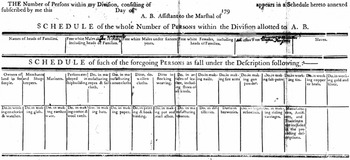
We examine here a previously undiscovered document (see figure 2) (US House of Representatives 1790b)—or at least we found no previous discussion of it—to shed some light on these census categories and the interaction of state and social influences. This document shows handwritten revisions to the demographic categories in the first census bill that are not discussed in previous accounts of its adoption (Anderson Reference Anderson1988: 14; Reference Anderson1994: 11–13; Clemence Reference Clemence1985: 358; Cohen Reference Cohen1982: 159–61; Davis Reference Davis and Daniels1972: 154–55; Halacy Reference Halacy1980: 32–33; Rossiter Reference Rossiter1909: 42–43; Scott Reference Scott1968: 14–15). With this document, we argue that the categories are best—though not perfectly—understood as racialized legal categories that specified citizenship rights that were socially coincidental with race and sex, not as racial or sex categories.Footnote 1
This argument has two parts. First, the categories were intended to capture legal status as a distinct analytic category but not race or sex. Second, legal status was racialized and gendered. To understand this racialization and gendering, we note that analytic categories of race and sex may, or may not, coincide with legal status. Where they coincide, they may do so formally (de jure) or substantively (de facto). They may coincide formally because laws explicitly differentiate between the legal rights of individuals of different sexes or races (such as apartheid or Jim Crow laws). They may coincide substantively because social and economic conditions imbue individuals of different races and genders with different access to legal rights (i.e., race and gender are socially coincidental with legal status), even though their legal rights are formally equal. These formal and substantive possibilities, as well as the continuum between them, are historically contingent. Thus, in this paper, we note how legal categories were racialized, that is, this process of creating legal rights that were socially coincidental with race and then captured in the categories in the first census. These rights also differed by gender, although during the period of time we consider, there was little change in legal status by sex or gender. The distinction between racial and legal categories is important: if we are correct, then the US census had a “race question” starting only in 1850, not in 1790 (cf. Anderson Reference Anderson, Perlmann and Waters2002: 272; James Reference James, Zuberi and Bonilla-Silva2008: 36; Nobles Reference Nobles2000: 26; Prewitt Reference Prewitt2013: 20).
To understand how the two dimensions of the state and social processes of census gathering we described in the preceding text—the origin of the content of the categories and the influence of state and social actors—created these racialized legal categories, we take a novel approach by considering the history starting before the collection of the first census. Our approach makes it possible to examine the content of social categories before the establishment of a census and the state and social actors’ actions and thus to understand how the categories in the census either reflected or altered these social categories. In contrast, most conventional histories start temporally close to the collection of the first census and trace its history forward. These conventional approaches generally privilege a state-centered view by methodological fiat. Because they begin with the census, they exaggerate the efficacy of state actors’ actions because they cannot place them in a longer historical and social context. By examining the history subsequent to the establishment of a census, it is easy to assume that census categories were transformative when they may have been previously widespread.
Thus, we consider the establishment of census categories, which has been relatively underresearched both in the United States and in general. These first US census categories are not only substantively interesting, but they are a strategic research site (Merton Reference Merton1987: 10–16). The first US census in 1790 was one of the first national censuses, so there were relatively few external influences on the US categories. Consequently, US state actors’ intentions and how, if at all, they were implemented can be disentangled from social influences with relative ease. We capitalize on this advantage by examining in detail a fairly long history starting before the 1790 census.
How Race Emerged as a Categorical Division
In this first empirical section, we examine the timing of the content of social categories of race and legal status, so that we can compare this content to that of the census categories in 1790 in the second empirical section. This comparison will show whether the census categories were relatively novel, as the state-centered perspective suggests, or whether they were already widespread, as the society-centered perspective suggests. We focus mostly on the eighteenth century, so that we can compare social and census categories around 1790. However, also we discuss (albeit in much less detail) some of changes in categories in the first half of the nineteenth century to highlight the characteristics of the social categories in 1790 in comparison to the later period of time.
While Europeans never considered Africans or Native Americans to be their equals, at the beginning of European colonization in the 1600s, many legal rights were descent blind in principle and relatively egalitarian in practice. However, these differences in descent eventually came to be understood as racial, and race became formally coincidental with legal rights (largely during the twentieth century with the widespread adoption of Jim Crow laws and the one-drop rule). Here, we trace this racialization of legal rights from about 1600 to the mid-1850s, showing how white males came to have virtually full citizenship rights while blacks came to have virtually none. Through this comparison to the previous and subsequent periods of time, we establish the social form of this racialization at the time of the 1790 census to show that the census categories largely corresponded to social ones. In contrast, the coincidence of gender with legal rights needs relatively little explanation: women's rights were relatively constant throughout this period, and they never achieved parity with men (Zagarri Reference Zagarri1998: 206).
The Colonial Context
By about 1850, race was a highly salient US social division, but it emerged slowly from a plethora of social differences. Settlement patterns had varied widely, so the colonies had their own religions, governments, constitutions, laws, languages, histories, and ethnic characters (Anderson Reference Anderson1991: 499; Commager Reference Commager1975: 160–64; Greene Reference Greene1982: 17–20, 24; Hawke Reference Hawke1988: 16–30; Petersen Reference Petersen, Alonso and Starr1987: 191–92). Colonists identified with their region, for example, as Virginians or Pennsylvanians, or with their home country as English or British, rather than as Americans (Greene Reference Greene1982: 22–25; Rozbicki Reference Rozbicki, Greene and Pole2000: 69).
In contrast, there was less economic diversity. Most inhabitants were farmers, and there was little industry (Alterman Reference Alterman1969: 178; Main Reference Main1965: 66; Nugent Reference Nugent1981: 63; Wood Reference Woolf, Perrot and Woolf1992: 312). The Southern colonies were organized around slavery and large plantation economies (tobacco was the main commercial crop) (Anderson Reference Anderson1991: 499; Greene Reference Greene1982: 26; Main Reference Main1965: 44, 54). The Northern ones consisted mostly of small owner-operated farms, though the New England terrain was relatively inhospitable to agriculture, so colonists had diversified somewhat into trade and small manufacture (Anderson Reference Anderson1991: 499; Main Reference Main1965: 42). Elites were large landowners and merchants; nonelites were smallholders, laborers, artisans, and small tradesmen (Jensen Reference Jensen1940: 9–10; Main Reference Main1965: 41–43, 219).
Many Revolutionary leaders were wealthy slave-holding plantation owners from Virginia (Morgan Reference Morgan1975: 375–76; Smedley Reference Smedley1999: 172; Wood Reference Woolf, Perrot and Woolf1992: 121–22). Like other colonial leaders and political leaders in Britain at the time, few were full-time, professional politicians, and most returned to their landholdings or other occupations whenever possible (Rakove Reference Rakove1979: xvii). Serving in assemblies was a public duty that accompanied elite status (Beeman Reference Beeman2009: 64–65; Wood Reference Woolf, Perrot and Woolf1992: 287–88). These leaders became formidable opponents of British colonial policies, and they developed an ideology of republicanism, personal independence, liberty, and distrust of authority—at least applied to whites—that became widespread among all social groups (Greene Reference Greene1982: 30–31; Morgan Reference Morgan1975: 376; Smedley Reference Smedley1999: 173; Wood Reference Woolf, Perrot and Woolf1992: 109, 171). Revolutionary leaders forged compromises between the conservative elites, who were fearful and suspicious of democracy and nonelites, and the radical masses, who had material grievances against the elites (Jensen Reference Jensen1940: 11–12, 16; Wood Reference Woolf, Perrot and Woolf1992: 27, 172). Elites formed cross-class alliances with small and aspiring landowners, who felt that their interests were closer to those of plantation owners than to those of poor blacks or slaves (Fields Reference Fields1990: 108–9; Morgan Reference Morgan1975: 364–69, 376–87; Reference Morgan1988: 168–69; Smedley Reference Smedley1999: 173). Most colonialists had been dominated by the elite, so they were sympathetic to the republican ideology of linking taxation to representation (Jensen Reference Jensen1940: 10; Morgan Reference Morgan1975: 364).
In the United States, differences in wealth and status were relatively small and unstable in comparison to European ones (Handlin and Handlin Reference Handlin and Handlin1982: 55–56; Main Reference Main1965: 221, 275; Wood Reference Woolf, Perrot and Woolf1992: 113). Most differences between whites in the United States were finely differentiated relationships between people, so they were highly relational, not categorical as between whites and blacks (Wood Reference Woolf, Perrot and Woolf1992: 24). Furthermore, westward expansion created at least the possibility of social mobility for everyone, except for slaves and displaced Native Americans (Main Reference Main1965: 193–96, 221, 280; Nugent Reference Nugent1981: 64–79). While slaves, who comprised about 20 percent of the population, were held in permanent bondage, perhaps as many as three-quarters of poor whites eventually became small property owners (Hawke Reference Hawke1988: 128; Main Reference Main1965: 271).
American racial ideology was closely and paradoxically connected with the rise of democracy and republican ideology. Masses of poor whites—widespread throughout Europe—who could form politically threatening mobs were largely absent from the United States (McDonald Reference McDonald1985: 100–101; Morgan Reference Morgan1975: 380; Reference Morgan1988: 168; Wood Reference Woolf, Perrot and Woolf1992: 122). Unfree labor was viable in societies that tolerated inequalities of civil and political status because everyone stood in a relation of inherited subordination to someone else (Fields Reference Fields1990: 114; cf. Smedley Reference Smedley1999: 96). But the American Revolution, based on men's supposedly innate rights to liberty, problematized slavery (Du Bois Reference Du Bois1935: 3). The concept of race, which in this context defined blacks as biologically inferior humans, eventually resolved this problem by explaining slavery as a result of innate differences (Fields Reference Fields1990: 114). Thus, white solidarity among ethnically different Europeans was fostered by definitions of self-interest and self-definition in opposition to black slaves and Native Americans (Rozbicki Reference Rozbicki, Greene and Pole2000: 69). Consequently, in the United States, the major social difference was not between social classes of European immigrants but between free and unfree, which over time became coincidental with race.
The Racialization of Legal Status
The racialization of slavery, however, was gradual (Smedley Reference Smedley1999: 98). In the first half of the seventeenth century, slavery was only partly racialized, and the difference between slavery and indentured servitude was smaller than in later years. Slavery was not confined to any particular race. Though within-race slavery was rare in Western Europe at the initiation of colonization, it existed in Eastern Europe, Africa, and the Americas (Blackburn Reference Blackburn1997: 83–84; Lovejoy Reference Lovejoy2012: 21; Snyder Reference Snyder2010: 4). In the United States, the poor, captured, and criminal of various groups, including Native Americans, English, Irish, and Scottish, were unfree laborers held in indentured servitude and slavery (Morgan Reference Morgan1975: 328–30; Smedley Reference Smedley1999: 96–97, 101–2; Stampp Reference Stampp1956: 16). Indentured servants could be bought and sold, gambled away, or won in lawsuits (Fields Reference Fields1990: 102). The conceptual status, treatment, and rights of African laborers and indentured servants were similar (Morgan Reference Morgan1975: 154–55). “Slave,” for example, sometimes referred to unfree laborers of European descent, and Africans sometimes purchased or won their freedom after a period of labor or conversion to Christianity (ibid.: 155, 331; Stampp Reference Stampp1956: 21). The first African slaves in Virginia came from Barbados, so they probably spoke some English while working alongside white indentured servants, reducing the social distance between them (Morgan Reference Morgan1975: 327; Stampp Reference Stampp1956: 21–22).
The incidence of indentured servitude, however, declined over time. In Virginia, indentured servants were more common than slaves in the first half of the seventeenth century, but as the mortality rate dropped, slave labor became more profitable than indentured labor (Fields Reference Fields1990: 104–5; Ford Reference Ford2009: 27; Morgan Reference Morgan1975: 297–98). Additionally, slave labor became preferred because freed indentured servants or semifree laborers had rising expectations and were thus more likely to rebel than slaves (Fields Reference Fields1990: 105; Morgan Reference Morgan1975: 309; Smedley Reference Smedley1999: 103–4).
The imposition of permanent chattel slavery on African descendants was a process that started to develop in the second half of the seventeenth century and continued into the nineteenth century. It consisted of laws and traditions that increasingly differentiated between servants of European descent and slaves of African descent (Hawke Reference Hawke1988: 127–28; Morgan Reference Morgan1975: 328–37; Smedley Reference Smedley1999: 98, 100; Stampp Reference Stampp1956: 22; Wiecek Reference Wiecek1977: 263–64). Laws began to specify that slaves were black, Indian, or mixed-race individuals and that they were presumed to be unfree unless they could prove otherwise (Wiecek Reference Wiecek1977: 263). Additionally, laws began to restrict the rights of both free and enslaved individuals of African, Native American, and mixed descent and separated them from the European immigrant population. Though colonial, state, and federal laws were different and sometimes contradictory, overall, they restricted the rights of nonwhites to vote, bear arms, engage in commerce, participate in politics and education, own property, and congregate in public (Du Bois Reference Du Bois1935: 6–8, 10; Litwack Reference Litwack1958: 261–62; Morgan Reference Morgan1975: 332–33; Smedley Reference Smedley1999: 94, 98–99; Smith Reference Smith1997: 65, 143; Wiecek Reference Wiecek1977: 267–69). They also limited manumission, imposed curfews, and restricted marriage and interracial sex (Morgan Reference Morgan1975: 331–37; Smedley Reference Smedley1999: 98–99). Although individuals of African descent had more rights in Northern states than in Southern ones, no Northern states granted them the same rights as those of European descent, and in all states, free blacks were treated as legally and socially inferior citizens (Higginbotham Reference Higginbotham1978: 98, 305–10).
Racial identity also emerged among African descendants because of slavery (Cornell Reference Cornell1990: 368; Fields Reference Fields1990: 114; Smedley Reference Smedley1999: 106). Africans came from diverse locations, cultures, and linguistic backgrounds (Cornell Reference Cornell1990: 376; Smedley Reference Smedley1999: 106–7). Some slavers put Africans from different tribes together on ships so that they could not communicate with each other, and when they arrived in the United States, they had few social characteristics in common except their classification as blacks and their enslavement (Hawke Reference Hawke1988: 129). The combination of ethnic mixing and racial subordination quickly created a new common and distinctive African American culture with similar kinship systems, religions, customary practices, and the use of English (Cornell Reference Cornell1990: 377).
Like blacks, Native Americans were racialized but through different processes (Sheehan Reference Sheehan1973: 101). Though Native Americans were originally more powerful than Europeans, they lost their advantage by the end of the seventeenth century (Nichols Reference Nichols1998: 60, 89). Nevertheless, Native Americans, unlike imported Africans and their descendants, could not suffice as the labor source for a white-owned, slave-based plantation economy. Unlike blacks living far from their homelands, Native Americans belonged to well-organized cultural groups with strong social identities that tried to recapture enslaved members (Smedley Reference Smedley1999: 104–5). They knew the territory well, so escape into the hinterlands was always possible (ibid.). In addition, Native Americans were quickly decimated by war and disease, so they were never a potentially large labor force (Nichols Reference Nichols1998: 58, 122; Smedley Reference Smedley1999: 104; Smith Reference Smith1997: 61). Some survivors, free or enslaved, remained within white settlements, but many moved westward to new communities with survivors of other tribes (Nichols Reference Nichols1998: 89, 103, 123).
Because massive enslavement was impossible, obtaining Native American land became the remaining concern of European settlers (Cornell Reference Cornell1990: 380–81; Sheehan Reference Sheehan1973: 167). Not surprisingly, US laws treated Native Americans inconsistently, though like blacks, they had fewer rights than whites (Nichols Reference Nichols1998: 82–83, 119–20; Smith Reference Smith1997: 60, 132, 215; Wallace Reference Wallace1993: 75). But unlike blacks, who were dealt with individually, Native Americans were viewed as citizens of sovereign but inferior nations (Jobe Reference Jobe2004: 68–69; Smith Reference Smith1997: 63, 106, 132). Thus, both the British and the US governments made treaties with Native American tribes, though they were usually shams or afterthoughts obtained through deception, bribery, or coercion to displace the Native Americans (Nichols Reference Nichols1998: 82, 150; Smith Reference Smith1997: 106, 108; Wallace Reference Wallace1993: 38). In addition to voluntary migration and treaties, Native Americans were moved westward through forced migration that culminated in the Indian Removal Act of 1830 (Nichols Reference Nichols1998: 163–64; Smith Reference Smith1997: 181–82, 235–36; Wallace Reference Wallace1993: 4–6, 52–56).
Racially, Native Americans were classified between whites and blacks (Sheehan Reference Sheehan1973: 24; Smith Reference Smith1997: 174). Most whites viewed them as savages but considered their inferiority a consequence of their cultural and social environment, not their biology, and suggested that they could be civilized and assimilated into white society (Nichols Reference Nichols1998: 148, 169, 178; Sheehan Reference Sheehan1973: 4–5, 42, 249–50; Smith Reference Smith1997: 61, 106, 108–9; Wallace Reference Wallace1993: 33–34). This possible “reform” of Native Americans paradoxically reinforced and ideologically justified forced removal policies (Nichols Reference Nichols1998: 179; Sheehan Reference Sheehan1973: 243; Wallace Reference Wallace1993: 33–41). Because Native Americans could in theory be like whites but in practice they attempted to retain their tribal cultures, they had to be relocated westward, where they could be civilized before being incorporated into white society (Nichols Reference Nichols1998: 178; Sheehan Reference Sheehan1973: 148; Smith Reference Smith1997: 181; Wallace Reference Wallace1993: 42, 65).
Thus, by the late 1700s, slavery was largely restricted to blacks, free blacks’ rights were curtailed, and Native Americans were largely eliminated from most white settlements. Racialization, however, was not complete. Enlightenment thought, especially influential around the American Revolution, suggested that observed social and cultural differences were environmental (Landsman Reference Landsman1997: 87–89; May Reference May1976: 134; Nobles Reference Nobles2000: 27; Smith Reference Smith1997: 105, 174). In addition, in contrast to the twentieth century, when the application of the “one-drop rule” was widely used to classify individuals with any amount of African ancestry as black, in the 1700s, mixed-race individuals of primarily European ancestry were legally white, or they formed a separate group between white and black (Davis Reference Davis1991: 5, 33–37, 55). Though British children's legal status followed their father's status, in the colonies, it followed their mother's (Wiecek Reference Wiecek1977: 262–63). Thus, children of mixed-raced slave mothers could be legally white but also slaves (e.g., Thomas Jefferson and Sally Hemings's children; Gordon-Reed Reference Gordon-Reed2008: 597–98). Finally, in the late 1700s and early 1800s, some factors limited slavery. All states began to ban foreign slave trade, and the Northern states began to restrict slavery, usually through gradual emancipation (Beeman Reference Beeman2009: 311–12; Robinson Reference Robinson1971: 24–36, 426–27; Smith Reference Smith1997: 104; Stampp Reference Stampp1956: 19–20, 25). Northerners slowly began to challenge slavery on moral grounds or because of economic, political, and other practical reasons, such as slave revolts, deterring new settlers, hindering economic growth, giving the South too much power, and undermining national defense (Finkelman Reference Finkelman1996: 31–32; Higginbotham Reference Higginbotham1978: 378). The need for slaves in the upper South decreased as agriculture shifted from tobacco to foodstuffs (Beeman Reference Beeman2009: 315; Ford Reference Ford2009: 27).
Nevertheless, at the same time, the demand for cotton for English and American factories and the development of efficient gins to process raw cotton made its production highly profitable with slave labor and thus spurred a huge growth in slavery in the lower South (Du Bois Reference Du Bois1935: 4–5; Ford Reference Ford2009: 95–96; Lakwete Reference Lakwete2003: viii–ix; Robinson Reference Robinson1971: 51, 429). Throughout the entire South, whites strove to maintain their supremacy and safety alongside an oppressive slave labor system and a free black population facing extensive discrimination. The states of the upper South hoped to reduce gradually the number of slaves and free blacks through manumission, dispersing slavery into newly admitted states, selling slaves to the lower South, and return migration to Africa (Ford Reference Ford2009: 6–7). In the lower South, however, an ideology gradually developed to justify slavery that construed racial differences as entirely biological, advocated for slaves’ paternalist treatment, and claimed whites’ equality despite vast class differences (DuBois Reference Du Bois1935: 5, 9; Ford Reference Ford2009: 508, 532). The racial ideology of small self-sufficient landowners, who formed the largest social group in the South and who did not usually own slaves, was more virulent than that of the planter aristocracy (Fields Reference Fields1990: 108–9; Genovese Reference Genovese1971: 111; Stampp Reference Stampp1956: 29). They combined hostility to black and northern labor with a fierce insistence on the equality of all whites based on democratic ideals (Fields Reference Fields1990: 109; Fredrickson Reference Fredrickson1971: 61; Saxton Reference Saxton1990: 67–72, 148). Gradually, theories of the white race's innate superiority replaced Enlightenment ideas (May Reference May1976: 134; Nobles Reference Nobles2000: 27; Smith Reference Smith1997: 174).
Free blacks challenged slavery's racial justification (Ford Reference Ford2009: 195). Starting at the end of the eighteenth century and during the first half of the nineteenth century, many states disenfranchised free blacks, legally reinforcing the connection between race and unfreedom (DuBois Reference Du Bois1935: 7–8; Ford Reference Ford2009: 9; Fredrickson Reference Fredrickson1971: 91; Smith Reference Smith1997: 179). Under Jacksonian democracy, white male suffrage and black disenfranchisement expanded simultaneously (Ford Reference Ford2009: 443–45; Fredrickson Reference Fredrickson1971: 90–91; Saxton Reference Saxton1990: 67–72). Though free white males were always presumptive citizens, free black males’ citizenship was ambiguous because they were taxed but were denied other rights that varied by state (Nobles Reference Nobles2000: 28–29; Smith Reference Smith1997: 179).
In sum, around 1850, race, not class, had become the most important determinant of legal rights in the United States (especially in contrast to Europe) (Ford Reference Ford2009: 509; Saxton Reference Saxton1990: 387–88). Rights were highly racialized: blacks, even if free, were assumed to be biologically inferior to whites, and slavery was restricted to blacks (Ford Reference Ford2009: 9). The emergence of race was a social process. Individuals of European and African descent came from diverse national origin and ethnic groups, so their skin color was often the most noticeable similarity within these groups and the most noticeable difference between European and African groups. These diverse African descendants were forcibly thrown together into slavery against their will, which, along with skin color, formed the most prominent features of their identity. European descendants differed by status and wealth, but in contrast to their European experience, these differences were downplayed by ideologies of equality and by the possibility of landholding. Poor whites, with little other than legal freedom to differentiate themselves from blacks, were particularly invested in the racial boundary, as their whiteness was their only advantage. Race thus emerged at the intersection of a democratic political system and a slaved-based plantation economy (Ford Reference Ford2009: 10). Native Americans and blacks were most similar in their marginalization (Smedley Reference Smedley1999: 99). Native Americans were culturally different from whites and blacks; they were more often from relatively egalitarian, seminomadic societies that were politically distinct from those of European immigrants. They became defined as racially distinct from whites in a different way from blacks. These three racial divisions consequently formed highly salient US social divisions.
At the end of the 1700s, blacks and Native Americans were defined as inferior, without the full rights of whites, but racial distinctions were not as sharp as they would later become. First, individuals who were free but not white retained some rights that were gradually eliminated over time. Second, individuals of Native American and mixed descent (European, African, and Native American) formed an inferior but ambiguous category between blacks and whites. Individuals of mixed European and African descent could be white if the fraction of their European descent was large enough. Some were free; some were slaves. This possibility was gradually eliminated during the nineteenth and twentieth centuries, as individuals with any African descent were increasingly classified as black. Those of Native American or mixed Native American and European descent could be white if they adopted the living style of European settlers. Native Americans who were members of tribes were viewed as citizens of sovereign nations; whites used this classification to justify war against them. Thus, Native Americans were assimilated, killed, or moved further westward out of the everyday consciousness of most Americans. As this middle category was gradually eliminated, the line between black and white became sharper.
In the 1790s, at the time of the Constitutional Convention that established the first US census, these middle categories still existed, so the racialization of rights took a particular form: whiteness, freedom, and full citizenship were synonymous. Blackness and slavery, however, did not have the same correspondence. Slavery was mostly, though not completely, confined to those whose skins appeared to be black or whose ancestry was unambiguously African. And, in this sense, slaves were black. However, the reverse was not true; free blacks had some, but not all, of the rights of whites. As we shall show, the censuses categories corresponded to these groups with racialized legal rights: white, slave, and an ambiguous middle category, while Native Americans living in tribes were explicitly excluded.
Politicians’ Hopes for the Census
This second section examines the influence of actors on the census. It will show how the actions of state actors had the most influence on the census categories but only when these categories resonated with already existing, widespread social categories. In the first part of this section, we examine the history of politicians’ attempts to collect censuses, primarily for taxation in the United States, because it illustrates how politicians acted in the context of the overall ideology of the importance of linking taxation and representation. In the next part of this section, we look explicitly at Madison's attempt to shape the first US census, as it is a clear example of a politician's explicit effort to shape census categories.
Historically, censuses were collected to assess taxes, because taxation was often based on a head count of adult males or an assessment of their property. The US census developed out of this tradition of resource assessment, but it emerged as a specific way to link taxation and political representation. In England/Britain and the American colonies during the seventeenth and eighteenth centuries, two separate ideas—that Parliament levied taxes and that it was a representative body—became intertwined, creating strong precedents that legislative bodies could levy taxes because they represented the people (Adams Reference Adams1980: 13; Morgan Reference Morgan1988: 52, 120, 140). Taxation without representation became a rallying point of the American colonists (Adams Reference Adams1980: 13).
Representation and taxation, however, had to be accomplished through existing political units, namely, the colonies, or later, the states, creating two practical problems (cf. Robinson Reference Robinson1971: 146). First, voting rights in a national legislative body had to be assigned to these units. Second, national taxes had to be collected by distributing a fixed sum among these units that would, in turn, levy taxes on their inhabitants (this tax “repartition” was a common practice at the time). These problems were difficult to solve because states had opposing intrinsic interests, even if their delegates did not always argue consistently for them (cf. Beeman Reference Beeman2009: 156–57; Robinson Reference Robinson1971: 177–79). In the abstract, populous states should favor proportional representation but equal taxation, while less populace states should favor the reverse. Furthermore, small states should favor geographically based representation, while large states should support demographically based representation (Zagarri Reference Zagarri1987: 5–7, 64, 66–67, 72–73). Similarly, slave states should favor counting slaves for representation but not taxation, while free states should favor the reverse (cf. Alterman Reference Alterman1969: 176; Einhorn Reference Einhorn2006: 112–13, 164).
Linking Taxation and Representation: Precedents in the Continental Congresses and Articles of Confederation
As early as 1754, Benjamin Franklin (Reference Franklin, Labaree, Bell, Boatfield and Fineman1962: 405, 407; Krüger Reference Krüger1991: 9) suggested using wealth, presumably proportional to population, to distribute representation in a colony-wide assembly. At the First Continental Congress in 1774, Patrick Henry, the Virginia delegate, proposed that the number of each colony's free inhabitants determine voting rights in the assembly, while Thomas Lynch of South Carolina suggested using property as well as population (Adams Reference Adams and Francis Adams1850: 367; Adams Reference Adams1980: 40; Alterman Reference Alterman1969: 167; Cassedy Reference Cassedy1969: 189; Ford Reference Ford1904: 14). Several delegates noted that they lacked sufficient information to implement these suggestions (Adams Reference Adams and Francis Adams1850: 367; Adams Reference Adams1980: 278–79; Ford Reference Ford1904: 25). Though Congress had population estimates for all the colonies except Georgia, the delegates considered them to be unreliable (Cassedy Reference Cassedy1969: 189). Samuel Ward of Rhode Island argued that each colony should have one vote by noting the precedent established by Virginia, where each county had two representatives in the state assembly, regardless of size (Adams Reference Adams and Francis Adams1850: 367; Adams Reference Adams1980: 40). The delegates settled on Ward's proposal but noted objections to it to prevent it from becoming precedential (Adams Reference Adams1980: 40; Alterman Reference Alterman1969: 168; Cassedy Reference Cassedy1969: 189; Ford Reference Ford1904: 25; Jensen Reference Jensen1940: 141; Rakove Reference Rakove1979: 141; cf. Adams 2011a: 318–19).
Once the Revolutionary War started in 1775, the Second Continental Congress reconvened with the pressing problem of funding the war (Adams Reference Adams1980: 279; Ford Reference Ford1905: 11; Morgan Reference Morgan1988: 263). Franklin suggested that male population between the ages of 16 and 60, determined by a triennial count, determine the distribution of the war expenses, taxation, and the number of delegates to a national assembly (Adams Reference Adams1980: 279–80; Alterman Reference Alterman1969: 182; Ford Reference Ford1905: 196–97; Jensen Reference Jensen1940: 141; Krüger Reference Krüger1991: 10–11). Instead, Congress agreed to distribute war costs according to the colonies’ total populations (including “negroes and mulattoes”) using existing estimates (except in Georgia) (Alterman Reference Alterman1969: 168; Cassedy Reference Cassedy1969: 192–93; Ford Reference Ford1905: 221–22; Rossiter Reference Rossiter1909: 3–4; Wright Reference Wright1900: 12). The colonies were supposed to provide more exact figures, and although Rhode Island and Massachusetts conducted censuses in 1776, the other colonies apparently never did (Alterman Reference Alterman1969: 168; Cassedy Reference Cassedy1969: 192–93; Ford Reference Ford1905: 222; Rossiter Reference Rossiter1909: 4).
The Declaration of Independence in July 1776 necessitated increased coordination among the states, initially constituted under the Articles of Confederation (Jensen Reference Jensen1940: 109). Small states objected to population-based representation because they feared domination by large states, while large states objected to equal representation for each state because they feared domination by the small states (Adams Reference Adams1980: 285–86; Adams Reference Adams and Wood2011b: 97–99; Alterman Reference Alterman1969: 181; Jensen Reference Jensen1940: 140–45). The small states won: each state received one vote (Ford Reference Ford1907: 778–82; Rakove Reference Rakove1979: 158–59, 179).
In the 1776 version of the Articles of Confederation, taxation was proportional to the number of states’ inhabitants (excluding untaxed Indians; as presumed citizens of sovereign nations they owed no US taxes [Jobe Reference Jobe2004: 68–69]), determined triennially (Adams Reference Adams1980: 281; Alterman Reference Alterman1969: 182; Ford Reference Ford1906: 548, 677–78). The original phrasing, specifying that the enumeration should distinguish “Inhabitants who are not slaves” from the rest of population, was changed to “white Inhabitants,” though apparently neither legal status nor race affected taxation (Ford Reference Ford1906: 548). States with large slave populations, however, did not want the number of slaves to affect taxation (Adams Reference Adams1980: 284; Adams Reference Adams and Wood2011b: 96–97; Alterman Reference Alterman1969: 181; Jensen Reference Jensen1940: 146). Samuel Chase of Maryland proposed that taxation be based only on the white population (Einhorn Reference Einhorn2006: 120–21; Jefferson Reference Jefferson1904: 47; Jensen Reference Jensen1940: 146; Morrow Reference Morrow1910: 383; Rakove Reference Rakove1979: 159). As a compromise, Benjamin Harrison of Virginia proposed that two slaves count as one free person (Jefferson Reference Jefferson1904: 47; Jensen Reference Jensen1940: 147; Krüger Reference Krüger1991: 12; Morrow Reference Morrow1910: 383). Furthermore, the Southern states supported taxation based on land values, which were lower in the South than in the North (Adams Reference Adams1980: 283; Ford Reference Ford1907: 801; Jensen Reference Jensen1940: 149). The Southern states won, and the final version of the Articles in 1777 adopted taxation based on land values (Alterman Reference Alterman1969: 182; Ford Reference Ford1907: 913–14; Jensen Reference Jensen1940: 149; Krüger Reference Krüger1991: 12; Morrow Reference Morrow1910: 385; Rakove Reference Rakove1979: 179; Wright Reference Wright1900: 12). By early 1783, however, no land valuation had been undertaken: states’ inputs were necessary to value land, but they could not make impartial assessments (Adams Reference Adams1980: 283; Alterman Reference Alterman1969: 182; Anderson Reference Anderson1988: 12; Einhorn Reference Einhorn2006: 124–25; Morrow Reference Morrow1910: 386–87).
Given the impossibility of using land values, an amendment of March 6, 1783, proposed that taxation be proportional to the total number of inhabitants, enumerated triennially, excluding “Indians not taxed” and persons “bound to servitude for life” between a range of unspecified ages (Fitzpatrick Reference Fitzpatrick1934: 102; Hunt Reference Hunt1922: 173–74; Krüger Reference Krüger1991: 13). The final version of this amendment on April 18, 1783, however, counted all inhabitants except untaxed Indians but enumerated slaves as three-fifths of a person (Einhorn Reference Einhorn2006: 142–43; Hunt Reference Hunt1922: 191, 260; Krüger Reference Krüger1991: 13). The wording combined racial and legal terms: taxation was proportional to “the whole number of white and other free citizens and inhabitants” and “three-fifths of all other persons” (Alterman Reference Alterman1969: 182; Hunt Reference Hunt1922: 260; Krüger Reference Krüger1991: 13–14; Wright Reference Wright1900: 12). The Constitution followed this wording, though applied it to both taxation and representation (Alterman Reference Alterman1969: 183). New Hampshire, Rhode Island, Connecticut, and Maryland had documented their population sizes, but other states’ figures had to be estimated (Cassedy Reference Cassedy1969: 212; Hunt Reference Hunt1922: 230–32; Madison Reference Madison and Gilpin1841: 431–32). Though Congress passed the amendment, the states never ratified it (Hunt Reference Hunt1922: 256–61; Morrow Reference Morrow1910: 387–88; Rakove Reference Rakove1979: 338). Though Rhode Island, Connecticut, New Jersey, and Maryland provided Congress with revised population figures, no state returned them in the requested format (Fitzpatrick Reference Fitzpatrick1934: 103–4).
Linking Taxation and Representation in the Constitution: How the Census Solved a Practical Problem
In May 1787, delegates from all states except Rhode Island, which never participated in the Constitutional Convention, met in Philadelphia, and they again debated taxation and representation (Beeman Reference Beeman2009: 16–17; Leitao Reference Leitao1996: 38; Morgan Reference Morgan1988: 266–67). The Virginia plan, by James Madison and Edmund Randolph, proposed a bicameral legislature with representation proportional to the states’ “free inhabitants,” but it was quickly amended to the number of “white and other free citizens and inhabitants” and indentured servants and to three-fifths of slaves, thereby adopting the taxation language from the amended Articles (Alterman Reference Alterman1969: 183; Farrand Reference Farrand1911: I: 20–22, 193; Krüger Reference Krüger1991: 14–16; Morgan Reference Morgan1988: 270–71; Morrow Reference Morrow1910: 388–89; Zagarri Reference Zagarri1987: 73). Although this proposal passed on June 11, the small states strongly opposed it, and on June 15, William Paterson of New Jersey offered a plan with a single-house legislative body with equal representation for each state as under the Articles but proposed that taxation be proportional to the number of “white and other free citizens,” indentured servants, and three-fifths of other persons, excluding untaxed Indians (Farrand Reference Farrand1911: I: 195–96, 242–45; Krüger Reference Krüger1991: 15–17; Zagarri Reference Zagarri1987: 73). On June 19, a vote favored the Virginia plan, but on July 2, when the delegates reconsidered equal representation in the upper house, the vote was tied (Farrand Reference Farrand1911: I: 313, 510; Krüger Reference Krüger1991: 17; Morrow Reference Morrow1910: 391; Zagarri Reference Zagarri1987: 73, 78, 152). A committee then proposed the “Great Compromise” creating a lower house with proportional representation and an upper house with equal representation, thereby reconciling large and small states’ interests (Alterman Reference Alterman1969: 184; Farrand Reference Farrand1911: I: 522–23; Krüger Reference Krüger1991: 17; Morgan Reference Morgan1988: 274; Morrow Reference Morrow1910: 392, 394; Zagarri Reference Zagarri1987: 79).
The delegates approved the creation of two houses on July 7 and then debated the specifics of counting people before the final vote on the Great Compromise on July 16 (Farrand Reference Farrand1911: I: 549, II: 15; Morrow Reference Morrow1910: 392; Stewart Reference Stewart2007: 114–26). The committee had proposed one delegate for each 40,000 inhabitants, and on July 10, population estimates, presumably from previous censuses, were presented (Cassedy Reference Cassedy1969: 212; Farrand Reference Farrand1911: I: 523, 572–74; Wright Reference Wright1900: 10–11; cf. Farrand Reference Farrand1911, I: 190, III: 253). Edmund Randolph of Virginia proposed that a regularly taken census apportion representation in the lower house (Farrand Reference Farrand1911: I: 564, 570–71, cf. Farrand Reference Farrand1911: I: 205). Many delegates favored apportionment based on wealth, over, or in addition to, population, but most considered it easier to count population than wealth (Alterman Reference Alterman1969: 184–85; Anderson Reference Anderson1988: 12; Farrand Reference Farrand1911: I: 557–62, 581–88, 593–96; Halacy Reference Halacy1980: 31–32; Krüger Reference Krüger1991: 18; Rossiter Reference Rossiter1909: 42).
The debates over counting the population reignited the controversy about counting slaves (Stewart Reference Stewart2007: 118). Many regarded the three-fifths clause, with precedents in the Articles and in previous debates, as a resolution: it could represent the de facto social condition that slaves could not live as full persons, the economic position that slave's wealth-producing capacity was roughly three-fifths of a free person, or a compromise between views of slaves as people and as property (Anderson Reference Anderson1988: 12; Beeman Reference Beeman2009: 154; Farrand Reference Farrand1911: I: 204–6, 561, 580–88; 591–97, 600–6; Hamilton et al. 1788; McKay Reference McKay1981: 1443; Nobles Reference Nobles2000: 26–27; Scott Reference Scott1968: 13; Stewart Reference Stewart2007: 119–24; cf. Finkelman Reference Finkelman1996: 9–10). Not surprisingly, then, Hugh Williamson of North Carolina added an amendment to the Great Compromise that slaves counted as three-fifths of a person for determining representation (Alterman Reference Alterman1969: 185; Farrand Reference Farrand1911: I: 575, 579; Morrow Reference Morrow1910: 392; Rossiter Reference Rossiter1909: 42). Gouverneur Morris of Pennsylvania proposed that taxation be proportional to representation, essentially extending the three-fifths rule to taxation (Alterman Reference Alterman1969: 186; Einhorn Reference Einhorn2006: 165; Farrand Reference Farrand1911: I: 589–92; Krüger Reference Krüger1991: 18; Morrow Reference Morrow1910: 393). Applying the same population-counting rules to representation and taxation helped assure accurate information because their reporting incentives were opposite (a larger population would increase taxation and representation; a smaller population would lower taxation and representation) (Anderson Reference Anderson1988:10; Cassedy Reference Cassedy1969: 213–14; Clemence Reference Clemence1985: 357; Hamilton et al. 1788; Wright Reference Wright1900: 13). Most politicians realized that without compromise, the country would split apart (Petersen Reference Petersen, Alonso and Starr1987: 192).
Thus, the final wording of this section of the Constitution was:
Representatives and direct Taxes shall be apportioned among the several States which may be included within this Union, according to their respective Numbers, which shall be determined by adding to the whole Number of free Persons, including those bound to Service for a Term of Years, and excluding Indians not taxed, three fifths of all other Persons. The actual enumeration shall be made within three Years after the first Meeting of the Congress of the United States, and within every subsequent Term of ten Years, in such Manner as they shall by Law direct (US Constitution, 1787: Art. 1, Sect. 2).
This section, then, referred only to legal status and dropped all references to the race of enumerated individuals (“Indians” remained racially marked but not enumerated), by mentioning only “free” and “other” persons (Fields Reference Fields1990: 99). The words “white and other” that had preceded “free” were deleted as superfluous (Farrand Reference Farrand1911: II: 350; Krüger Reference Krüger1991: 21). During the debates, the terms “black,” “Negro,” and “slave” were used interchangeably; the small number of free blacks did not affect legislative representation (Clemence Reference Clemence1985: 356; e.g., Farrand Reference Farrand1911: I: 204–8, 559–62, 578–88, 591–97, cf. Beeman Reference Beeman2009: 155; Farrand Reference Farrand1911: I: 83–84). Delegates, however, usually avoided explicit mention of slavery because of their discomfort with it (Beeman Reference Beeman2009: 214–15, 335; Einhorn Reference Einhorn2006: 118; Finkelman Reference Finkelman1996: 3; Lynd Reference Lynd1967: 159–60; Robinson Reference Robinson1971: 245; Smith Reference Smith1997: 133).
Though representation, taxation, and slavery had been hotly debated, the census was not controversial (Anderson Reference Anderson1988: 9). Colonial and state censuses set precedents for a national one. Colonial censuses had been common, and they generally collected information about age and sex, though age was recorded only in rough groupings (Wells Reference Wells1975: 40). The ages of 10 and 16 commonly separated children from adults in colonial censuses (Wells 2012b: 127). Sixteen was often the youngest age for paying taxes and serving in the military (Walsh Reference Walsh1981: 250; Wells Reference Wells1975: 40). Some censuses also enumerated convicts, servants, and clergy (Cassedy Reference Cassedy1969: 71). Virtually all censuses separated “whites” from “blacks,” “Negros,” and “slaves” (Wells Reference Wells1975: 38–39). The major distinction, however, was a legal one between the free and slaves (ibid.: 39). Initially, the few free blacks were occasionally recorded as white, but starting about 1750, censuses began to record free blacks or those of mixed race separately (ibid.). Many colonial censuses contained more information than the first US ones (Cohen Reference Cohen1982: 159; Wells Reference Wells, Anderson, Citro and Salvo2012a: 126). Colonial censuses, not surprisingly given their mercantilist emphasis on the power of the metropole, focused on white settlers, not Native Americans (though the latter were sometimes included) (Halacy Reference Halacy1980: 30; Wells Reference Wells1975: 39). The British generally considered Native Americans to be outside their legal jurisdiction (Wells Reference Wells1975: 39). States had also collected censuses. The questions in the Rhode Island census of 1774 were almost identical with those in 1790 US census (Alterman Reference Alterman1969: 175; Rossiter Reference Rossiter1909: 3). Several state legislatures apportioned their votes using population, including Pennsylvania in 1776 and New York in 1777 (Zagarri Reference Zagarri1987: 41–42, 70). The first national enumeration in 1790 went more quickly in the states that had already taken a census than elsewhere (Rossiter Reference Rossiter1909: 46; Scott Reference Scott1968: 16).
Thus, political decisions about the census were largely a strategic compromise. The state actors who established the US census were private citizens who saw political service as part of their duty as elites. From 1754 to 1790, these actors, both as private citizens and as politicians, who spanned political orientation and geographical location, repeatedly proposed censuses as a practical solution to the ideological goal of linking taxation and political representation. They were practical because they had been repeatedly collected in the colonies and states. Southern and Northern delegates generally held views that were consistent with their political interests of representing their states to gain advantages of increasing political representation and lowering taxation. These views were also consistent with their positions as private citizens, and in particular whether they owned slaves. However, neither Southern nor Northern delegates achieved all their goals. Most compromised to support the overall nation-building project. Thus, while state actors’ personal and political agendas certainly influenced the adoption of a census, it was not primarily an outcome of these specific agendas. Their decision to use a census stemmed from their overall ideological commitment to linking taxation and representation.
Debates over the Expansion of Information in the 1790 Census
Censuses often had broad roots in political arithmetic and the Enlightenment. American revolutionary leaders were familiar with Enlightenment government and science, and these ideas influenced the Declaration of Independence and the Constitution (Balinski and Young 2001: 6; Landsman Reference Landsman1997: 84–86; May Reference May1976: 97–101, 129–32, 161–67, 212–18, 278; Meyer Reference Meyer1976: 179–80, 182–88). However, the US census clause was largely driven by pragmatic political compromise, not philosophical or scientific considerations; consequently, there was little thought that it might provide systematic data beyond what was necessary for apportionment (Clemence Reference Clemence1985: 356–57; Wright Reference Wright1900: 13).
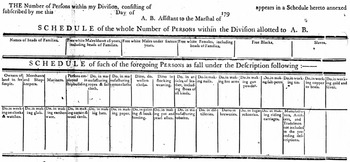
James Madison made one of the few, and largely unsuccessful, attempts to expand the censuses informationally. Thus, at that time, his efforts represented a divergence from the US tradition of using censuses to assess resources. He served on the subcommittee that wrote the enumeration bill, and for the schedule, he proposed five demographic categories based on age, legal status, sex, and race (i.e., “Free white Males above 16 years, including heads of Families,” “Free white Males under sixteen years,” “Free white females, including heads of Families,” “Free Blacks,” and “Slaves”) and 30 occupational categories (for males) (see figure 1; US House of Representatives 1790a) (Anderson Reference Anderson1994: 12–13; Cohen Reference Cohen1982: 159; Davis Reference Davis and Daniels1972: 155; Veit et al. Reference Veit, Bickford, Bowling and diGiacomantonio1995: 70, 73). The text of the bill, which gave a set of overall instructions, stated that the enumerators should distinguish “the ages, sexes, colours, conditions, and occupations” of US inhabitants (US House of Representatives 1790a). The extant debates do not reveal specifically why he proposed the demographic categories, but he argued that the occupational categories would provide the government with concrete information about agriculture, commerce, and manufacturing (Anderson Reference Anderson1988: 14; Clemence Reference Clemence1985: 358; Cohen Reference Cohen1982: 160–61; Davis Reference Davis and Daniels1972: 154–55; Halacy Reference Halacy1980: 32–33; Rossiter Reference Rossiter1909: 42; Scott Reference Scott1968: 14–15; US Congress 1834: 1115). More generally, Madison argued for the descriptive usefulness of the census, because the legislature could pass laws that reflected the “real situation” of their constituents based on knowledge from it (Halacy Reference Halacy1980: 32; US Congress 1834: 1146) and because it was “much wanted for the science of Political Economy” (Madison Reference Madison1867: 507). Though Madison's intent with respect to demographic categories is not fully recorded, we will show that they described legal rights that socially coincided with race, gender, and age.
Reproduction of the 1790 enumeration schedule without annotation. Source: US House of Representatives (1790a).

The separate category for slaves obviously fulfilled the requirement of apportionment. Most of these slaves were of African descent and were assumed to be black. A few were of mixed European, African, or Native American descent, but none had any appreciable rights, so their race was not coincidental with the absence of rights.
Madison's other categories delineated among individuals who counted as free persons for legislative representation but had differing legal and political rights. White men above the age of 16 were citizens, with the most legal rights. They could in principle serve in the military, be taxed, and vote (though in practice, the franchise and military service were generally based on property ownership or social status [Gundersen Reference Gundersen1987: 61–62; Keyssar Reference Keyssar2000: 24–25; Morgan Reference Morgan1988: 159–65; Zinn Reference Zinn1980: 77–78, 96]). White males under the age of 16 could be taxed, and they would attain the rights and responsibilities of other adult white males at age 16. White women had fewer rights than men, and they would never attain them as would white male youths. However, they could not be enslaved, and through marriage or family ties, they could attain a relatively high social status (they did not serve in the military). Women were sometimes excluded from taxation, though women who were heads of household paid taxes on male members of their households (Gundersen Reference Gundersen1987: 62). Only in New Jersey, between 1776 and 1807, did women have a constitutionally protected right to vote (like men's right to vote, it depended on property ownership) (ibid.: 66).
Madison's category of free blacks is the most difficult to interpret because it included men, women, and children who had different rights and because these rights were highly variable. The rights of free black adult men were probably the most ambiguous, because their freedom and gender granted them rights in principle that were not always honored in practice. They generally had fewer rights than white men. In principle, and sometimes in practice, they had more rights than white women. Black free women, like white free women, had few legal and political rights, but black women had lower social status. Black children had few rights.
Overall, then, Madison's categories correspond to sets of individuals’ rights, except that they do not differentiate among the rights of free black men, women, and children. Though we cannot completely explain why all free blacks were lumped into a single category, their numbers were small, and whites were probably relatively uninterested in specifying their few, ambiguous, and highly variable rights. Thus, although Madison's initial proposal included the explicit racial markers, black and white, and some identifiers for age and gender, he most likely intended for the categories to be legal, not racial, gender, or age categories, but because race, gender, and age were socially coincidental with these rights, his proposed categories were mixtures of legal, racial, gender, and age categories. This interpretation is consistent with Madison's general argument that census information had descriptive value. Furthermore, Madison was a delegate from Virginia, where slavery was legal, and he owned slaves (Beeman Reference Beeman2009: 309–10). Thus, he was invested in maintaining slavery both personally and politically, and he understood the social relationship between legal status and race. Furthermore, while his primary intention seems to have been the specification of legal categories in his proposal, it is also possible to speculate that the middle category and his use of the racial marker, black, may have been an attempt to narrow the definition of white.
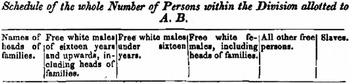
Madison's opponents argued that the Constitution authorized only an enumeration by legal status (Cohen Reference Cohen1982: 162; Herald of Freedom 1790: 146; Veit et al. Reference Veit, Bickford, Bowling and diGiacomantonio1995: 73). Nevertheless, Madison's proposal passed the House, but the Senate dropped his occupational categories, while essentially preserving his five demographic categories (Cohen Reference Cohen1982: 160; Davis Reference Davis and Daniels1972: 155; Rossiter Reference Rossiter1909: 43). Additionally, either the House or Senate revised the phrasing. Madison's wording of “Blacks” in the category “Free Blacks” was first changed in handwriting to “Negros and Mulattos” and then the entire category was changed, again in handwriting, to “all other Free Persons,” thereby eliminating the racial marker and creating the final wording of the schedule of 1790 census (see figure 2 and the detail of the handwriting in figure 3; US House of Representatives 1790b; US Congress Reference Peters1845a: 102). The reasons for these alterations are not transparent, as we cannot find debates related to them, though an amendment to the schedule on February 18, 1790 changed “Free Blacks” to “all other free persons” (De Pauw et al. Reference De Pauw, Bangs Bickford and Siegel Hauptman1972: 244). However, the revisers must have realized that the label “Free Blacks” did not necessarily describe the individuals not already classified as whites or slaves. These individuals could have been free blacks of African descent, but they also could have had African and European ancestors and therefore better described by the first revision, “Negroes and Mulattos.” Additionally, they could have had Native American ancestors (taxed Indians, living among white immigrants and settlers) or mixed Native American, European, and African ancestors. Thus, the final wording may have been changed to all other free persons, regardless of race, to include all these free individuals not explicitly classified as whites. Despite these changes in the schedule, however, the text of the bill specifying the more general instructions remained unchanged, specifying that enumerators should distinguish the “colours of free persons,” as in Madison's original proposal (US Congress Reference Peters1845a: 101; cf. Anderson 2002: 272).
Reproduction of the 1790 enumeration schedule with handwritten annotation.Source: US House of Representatives (1790b).

Detail of the handwritten annotation on the 1790 enumeration schedule Source: US House of Representatives (1790b).

Thus, although the final wording “all other free persons” had no explicit racial marker, it was derived from a racialized legal category and, in fact, had evolved from a racially marked legal category. It was probably intended to mark a legal distinction between free whites and free individuals of other races, thereby distinguishing among individuals who counted for determining legislative apportionment but had different rights. Madison's original proposal marked this category racially as black. However, this marking was not consistent with the social understanding of the category. Though most of these individuals might have been considered to be black later in history (e.g., according to the one-drop rule), the revisions show that this classification was not appropriate in 1790. The revisers first attempted to specify more clearly their understanding of the races of those in the middle category, but when they failed to find a concise term, they abandoned this effort at racial classification. They were probably primarily interested in preserving Madison's attempt to specify legal rights. This mismatched marking of race—the schedule marked “white” but not the race of other free or enslaved individuals, while the bill explicitly referenced race—continued in the 1800 and 1810 censuses (US Congress Reference Peters1845b: 11–12; Reference Peters1845c: 565–66; cf. Anderson Reference Anderson, Perlmann and Waters2002: 272).
The use of age also supports the idea that the categories described racialized legal rights. Age 16 commonly delimited between children and adults. In 1790, age information was collected only for white males. The intent then was to separate white males, who at the age of 16 would have the most extensive citizenship rights, from everyone else (cf. Nobles Reference Nobles2000: 28). Thus, the category of adult white males separated the most likely voters, workers, and soldiers from the rest of the population (Clemence Reference Clemence1985: 358; Cohen Reference Cohen1982: 159; Gauthier Reference Gauthier2002: 4; Rossiter Reference Rossiter1909: 43; Scott Reference Scott1968: 15; Wright Reference Wright1900: 13). It was also considered inappropriate to ask women their ages (Veit et al. Reference Veit, Bickford, Bowling and diGiacomantonio1995: 73).
The basic format of the 1790 census (see figure 4; US Congress 1845a) was used until 1850, when a fully nominative census recorded the race of all persons, both slave and free. In the censuses from 1790 to 1840, the race, sex, and age categories became increasingly differentiated and applied to more legal categories (Anderson Reference Anderson1988: 14, 18, 23; Halacy Reference Halacy1980: 33; Wright Reference Wright1900: 132–44). Racial markers were consistently applied to whites and inconsistently but increasingly applied to free individuals of African, Native American, or mixed descent, but they were never applied to slaves (cf. Anderson Reference Anderson2003: 32).
Reproduction of the final 1790 enumeration schedule Source: US Congress (Reference Peters1845a).

The adoption of Madison's demographic categories—albeit revised—stands in contrast to the outright rejection of his occupational categories. Though little evidence suggests why the occupational categories were not adopted in 1790, one legislator objected to them because most individuals practiced several occupations each year (US Congress 1834: 1146). His objection suggests that occupational categories were not widely recognized as socially relevant. In contrast, race was a primary social and political cleavage, even though apportionment depended upon legal, not racial, status (Nobles Reference Nobles2000: 27, 30). Because legal categories had been racialized, at the time of the Convention, race and legal status were highly coincidental, and Madison's categories were apparently intended to capture these degrees of rights among those entitled to full legislative representation. Thus, Madison's efforts to expand the census informationally were largely unsuccessful, and they succeeded only where they could be easily understood in terms of commonly used social categories and corresponded to relevant social differences.
Finally, though race was certainly discussed in the debates over the form of government, we found no evidence in them suggesting that state actors intended for the census to shape race or slavery or that the census was collecting information about race per se (cf. ibid.: 26). Politicians followed common social usage when discussing race, without engaging in explicit efforts to shape it. For example, in the debates over the Articles of Confederation and the Constitution, delegates discussed slavery and persons of African descent (or slave and black) as virtually synonymous, and the three-fifths rule was sometimes discussed explicitly in reference to “blacks” and “whites” (e.g., Farrand Reference Farrand1911: I: 83, 594). Blacks were never seen as equals to whites, even by those who opposed slavery (Higginbotham Reference Higginbotham1978: 309). Free individuals of African or mixed descent were rarely discussed because their small numbers did not affect representation or taxation, the main topics at hand. An explicit interest in race developed later and informed subsequent censuses (i.e., starting with the 1850 census).
Conclusions
We return to assessing the state-centered and society-centered views by considering the temporal changes in the content of the census and the roles of social and state actors. We begin with the first dimension. We showed that the language of the census categories corresponded to the prevailing social pattern of the racialization of legal rights. Around the time of the Constitutional Convention, legal status and race were connected in a historically specific way. If persons were white, they were free. Whiteness conferred a set of privileges and was thus its own category. It was impossible to be a “white slave.” Blackness and slavery were also connected but with the reverse logic: slaves were assumed to be black (though a few slaves were primarily of European descent, and some may have had Native American ancestors). However, there was a middle, ambiguous category: these individuals were free but not white. These nonwhites generally had fewer legal and political rights than whites, and most were of African, Native American, or mixed descent. The difficulties in linguistically specifying a racial term that described these individuals succinctly as a census category resulted in the “other free persons” label. The specification of the race of these individuals within this category beyond their designation as nonwhite—accomplished by the racial marker white that was attached to the other category—was not necessary to specify that they had fewer legal rights than whites.
Thus, as we argued, the censuses between 1790 and 1840 present asymmetrical racialized legal categories, which most likely stemmed from an attempt to capture primarily the legal difference between free and slave (required for legislative apportionment) and secondarily the legal differences among free individuals. However, these legal differences were largely coincidental with race in a historically specific way, so the categories were racialized and sometimes explicitly marked by race in accordance with this social usage. Differences in rights also correlated socially with gender and age, and these demographic characteristics were also asymmetrically recorded, again, mostly according to patterns of legal rights.
We showed that this specific racialization occurred temporally before the Constitutional Convention. The coincidence of whiteness and privilege and blackness and slavery developed in the late 1600s and 1700s and was largely in place before the Convention. The “one-drop rule,” however, classifying anyone with any amount of African ancestry as legally black, was a much later historical creation, so at the time of the first census, there was ample social space for the middle category of “other free persons” that did not necessarily exist later in history, and the individuals in this category were not necessarily considered to be black. Madison's original proposal was, in fact, altered to be more consistent with this prevailing social scheme of classification by eliminating the explicit racial marker of black in his early version.
Because legal status was central to apportionment, slave, free, and untaxed Native Americans were the primary social divisions represented in the census (Anderson Reference Anderson1988: 12). In principle, differences in legal status stemmed from race-blind principles, and they are not marked linguistically in the Constitution. Nevertheless, the legal categories of slave had been racialized as a status primarily of blacks, occasionally of Native Americans, but not generally of whites, before the Constitutional Convention. When the colonies were originally founded, race and slavery were correlated but not coincidental. As we showed, however, starting in the second half of the seventeenth century, they came to be coincidental, as the rights of those of European descent were expanded; the rights of those of African descent, including free blacks, were curtailed; and Native Americans were largely eliminated through death, removal, and assimilation. Social distinctions that were not racial in principle became so in practice over time. Because slavery became largely coterminous with race, free blacks became anomalies. Thus, while it was unnecessary to mark the category of slave racially because they were assumed to be black (or these individuals’ descents were irrelevant), the racial differentiation between white and free blacks was socially relevant. Whites were presumed to be free, but the legal category in the census was marked racially because whites had to be differentiated from other free persons with fewer rights, mostly free blacks and those of mixed European and African descent but also possibly Native Americans living among whites. The exact racial composition of these nonwhites was largely irrelevant for census purposes.
In principle, the unenumerated category of “untaxed Indians” also arose from race-neutral political theory: citizens of sovereign nations did not owe US taxes. However, “untaxed Indians” was a racialized—and explicitly marked racially—legal category in the Constitution that arose from contact between Native Americans and Europeans. Indeed, most Native Americans were not counted in these censuses; unless they lived among white settlers and paid taxes, they were considered to be members of sovereign nations excluded from citizenship and taxation (Gauthier Reference Gauthier2002: 6; Nobles Reference Nobles, Kertzer and Ariel2002: 50). Thus, the linguistic mixture of the census categories reflects the process of the racialization of the social distinctions and the social construction of race (cf. Fields Reference Fields1990: 107). However, the language of the census categories followed, not led, this process of racialization.
We turn now to the second dimension. We note that state, not social, actors had the most explicit roles in developing the census. State actors proposed the categories and developed the technology for the first US censuses, often based on precedents from previous colonial or state censuses. We found no evidence of the direct influence of nonstate actors on the census (e.g., explicit requests or lobbying for information gathering by strictly private citizens) during this time period, although the census was supported by a strong social culture of numeracy that created numerous nonstate actors who supported the collection of quantitative information (Cassedy Reference Cassedy1969: 91–205; Davis Reference Davis and Daniels1972: 166–68). Thus, these censuses were certainly state driven in this second dimension.
However, by considering in detail which census categories were adopted, we showed how, during this period of time, state and social forces interacted. In particular, we argued that the social patterns provided the available categories and context that the politicians who wrote the Constitution and the census categories could use. Politicians drew on and adapted these social categories within specific political settings and struggles.
To show how this particular form of interaction worked, we noted that state actors were not modern census bureaucrats, so they were not engaged in the specific task of creating categories as experts. Although they clearly pressed for a census as politicians, they were private citizens who temporarily held public offices and who saw political service as part of their duty as elites. Thus, the dividing line between their activities as private citizens and politicians was relatively porous.
Furthermore, as we showed, these state actors argued for their own interests, both as private citizens and as geographical representatives. However, they did not generally accomplish their specific political interests through the census, but they instead often compromised to achieve the overall ideological goal, widely shared throughout the population, of linking taxation to representation. For example, the “three-fifths” compromise in the census clause of the Constitution in its entirety was not in the interest of any particular block of politicians, but it instead was broadly supported because it strongly reflected the widely held ideological goal of linking representation and taxation. In the seventeenth and eighteenth centuries, this ideology formed in Britain and was transplanted and greatly amplified in the colonies. As with racial ideology, it united colonists who had little in common. Although the US census was rooted in the tradition of resource assessment, the addition of the function of legislative apportionment was unique to the United States.
Madison's specific proposal also illustrates how state actors did not always accomplish their specific goals but succeeded when they drew on preexisting social categories. Madison tried to reorient the census toward informational purposes, instead of just apportioning the vote. The racialized legal categories that he proposed, where none were required by the Constitution, were not inconsistent with his and his allies’ political agenda as Southern plantation owners of upholding slavery and their definition of white. However, there were many explicit objections to the expansion of the census along informational lines, as this seemed to contradict the point of the census to link taxation to representation. The social understanding of a census as a method of providing information seems to have been less widespread than the understanding of a census as a method to link taxation to representation. In addition, the legislators may not have understood the underlying logic of collecting information about occupation, as it was not a widespread social category. Thus, Madison was largely unsuccessful in his attempts to introduce these new categories. Madison, as well as other politicians, however, was embedded in a social setting where race was a central social division, so racialized legal categories were congruent with social discourse. Therefore, his specific suggestions were adopted only where they resonated with already existing social categories—in fact, his proposal was revised to be more consistent with these social categories. Because of Madison's proposal and the debates over it, the actual census categories were mixed combinations of race and legal status even though the Constitution never specified the collection of information about race. To illustrate this point, we considered a long historical trajectory; if we had started instead with the Constitutional Convention, we would have overemphasized the intentionality of these politicians’ actions by downplaying their historical continuity with their predecessors or misunderstood the temporal connection between the social and census categories.
We thus specified clearly how state and social influences combined to create the first US censuses, in comparison to previous accounts of the US and other censuses that were unable to specify this interaction in detail (Anderson Reference Anderson1988: 1–6; Appadurai Reference Appadurai1996: 117; Cohen Reference Cohen1982: 150–74; Nobles Reference Nobles2000: 3, 25–26; Starr Reference Starr, Alonso and Starr1987: 15–23). This particular form of interaction, that state actors introduced census categories only when they resonated with previously existed social categories, perhaps contrasts with the form of interaction in other time periods. For example, the multiracial category in the 2000 US census was seemingly introduced through the opposite form of state and social interaction: it resulted from intense lobbying by social actors, who requested changes that were largely congruent with preexisting state categories (e.g., to check “more than one” preexisting racial category; Nobles Reference Nobles2000: 129, 138). In contrast, the novel Hispanic panethnicity category in the US census in the mid-1980s stemmed from an explicitly negotiated compromise between state and nonstate actors (Mora Reference Mora2014a: 184). Finally, our evidence contradicts one of the central tenets of the state-centered view of information gathering in the sociology of statistics, that census categories, as they are used to collect information, become widespread and influence social categorization. In this case, the census categories reflected already existing and widespread social categories, and consequently, their adoption was unlikely to have had any broad transformative effect on social categorization. Our findings illustrate that it is important to examine empirically whether censuses influence social categories, not to assume their effects. These findings and conclusions, however, obviously need to be examined in other cases and with different methodologies and, in particular, one that can directly assess changes that occur after the adoption of census categories.
Our paper also has some implications for political sociology. Drawing on the specific example of the origins of the US census, it suggests that the question of the state's organizational autonomy needs to be carefully specified historically. While we would not countenance a return to the more naïve versions of society-centered political sociology that treat the state as an expression of societal needs, such as the maintenance of order in a class-divided society (Engels Reference Engels2010 [1884]: 208) or the crystallization of social norms (Durkheim Reference Durkheim1992 [1957]: 50), we do think that the organizational autonomy of the state from society must be treated as a variable, not a constant. In this sense, the tradition of structural Marxism, that demanded a specification of the conditions under which states might or might not be organizationally autonomous, retains considerable methodological value (Anderson Reference Anderson1989: 15–42; Poulantzas Reference Poulantzas1978: 187–89; Therborn Reference Therborn2008: 34–36). In particular, neither state-centric nor society-centric approaches to social life, and specifically to census categories, should be taken as general accounts. Instead, historically oriented sociology needs to understand the conditions that make either plausible as local accounts, as well as to understand how they interact. This interactive view may require the examination of a long historical trajectory to assess social and state influences adequately and to show how they work together in a temporal process.
During the period of time when this early US census was developed, for example, the state was clearly not autonomous from social forces in historically specific ways. As we showed by examining two dimensions of the process of collecting information (the content of the categories and the influence of actors), though state actors introduced the census, they could not successfully implement categories that did not resonate with social ones. The form of the interdependence between the state and society was rooted in the configuration of political organizations. These state actors were located in representative assemblies, where the particular political debates among them shaped the census outcomes. The prevailing schemes of social categorization intersected with these political forms in two ways. First, these state actors developed census categories in the context of their other legislative duties, not as experts embedded in a separate bureaucracy. Thus, the proposals for the census were subject to broad discussion among all the participants, not just among a select group of experts. Second, none of them was a modern career politician. Instead, all of them moved between public and private life in a relatively fluid way and brought their schemes of social categorization with them. Thus, Madison, as a politician, brought to the assembly the Enlightenment emphasis on using censuses informationally and a particular understanding of how race and political rights coincided that corresponded to his social location as a Virginian elite. However, these ideas did not widely resonate with the other politicians, who had a different social understanding of these issues. Thus, Madison was largely unsuccessful. However, in different time periods, the patterns of state and social influence, in these two dimensions or in other ones, as well as their interaction, would vary, depending on the form of the interdependence between state and society. More generally, then, the relative importance of state and social influences cannot be determined theoretically. Instead, the broader historical processes that shape which state or social influences are more important, as well as how they interact, must be considered. Thus, it is necessary to specify empirically which aspects of state and social influences come to predominate and how they interact. In sum, the state-centered and society-centered approaches are best understood as heuristics suggesting certain lines of inquiry whose fruitfulness will depend on the precise historical configuration under discussion.