I. Introduction
What we expect of constitutions depends on what we expect of democracies. Depending on our theory of democracy, we can plausibly have very different notions of how constitutions ought to be founded and how they ought to change. All over the world, constitutional processes have alternated between applications of two particular democratic theories. As a shorthand, I will call them Elite Deliberation and Participatory Democracy. Elite Deliberation for constitutional politics is probably best exemplified in the idea of a constitutional convention: a manageably small body of representatives who can deliberate about the appropriate design of institutions and the constraints they operate under. The American Founding offered the most prominent and successful case, inspiring many later ones, including the ill-fated convention that was supposed to provide a constitution for the European Union. Participatory Democracy can also play a role in constitutional politics. Many American states and many countries provide for constitutional changes via referendum. The rationale is that a referendum allows all voters subject to a constitution to approve it or approve changes to it. Sometimes the referendum proposals come from the people via initiatives; sometimes they come from legislatures (and hence from Elite Deliberation). But once a proposal has been made, and is to be approved via a mass referendum, completely different campaign dynamics determine the result, as any resident of California or some of the other western states will attest. All over the world, constitutional processes tend to involve one approach or the other, or some mixture of the two.
Neither of these two theories, nor the institutions that best express them, offer a credible role for deliberation by the people in constitutional processes. Constitutional conventions offer deliberation by elites or representatives. A similar point could be made about legislatures. Referenda offer a nondeliberative process for approval by the people in what are typically plebiscitary campaign processes. I believe an ideal theory of constitutional change would give the mass public a deliberative role. But the institutional requirements for doing so remain a matter of wide contention.
A Madisonian aspiration for “successive filtrations” of public opinion in manageably small select gatherings such as the 1787 Constitutional Convention, the ratifying conventions, the Senate, and even the Electoral College in its original form drove the original American constitutional design. Publius's theory, like that of John Stuart Mill a century later, was one of Elite Deliberation. But the “reflective” views of deliberating representatives can conflict with the “reflected” views of actual mass opinion. In the ratification of the U.S. Constitution, the battle was soon joined in one of the American states, between Elite Deliberation and direct mass consultation characteristic of Participatory Democracy: Rhode Island considered the issue of ratification by referendum rather than by the convention prescribed in the proposed constitution. Federalists objected on grounds of insufficient deliberation—there would not be a forum in which arguments offered could be answered and in which the same body could consider all the competing arguments on their merits at the same time and in the same place. A convention appeared to be the only known means of accomplishing that purpose. Even if all the population of Rhode Island were gathered on “some spacious plain,” no such deliberation would be practicable.Footnote 1 Federalists boycotted the referendum, and the Constitution was voted down. Only under threat of blockade and invasion by the neighboring states of Massachusetts and Connecticut did Rhode Island eventually relent and approve the proposed constitution through the required convention.
Many U.S. states now make constitutional changes by initiative and referendum—by an application of Participatory Democracy rather than Elite Deliberation. And a drama with parallels to the Rhode Island one has been playing out with respect to proposed constitutional changes in the European Union. The proposed “constitution” was voted down in referenda by the French and Dutch in 2005, and a revised version, called the Lisbon Treaty, was voted down by the Irish in a referendum in June 2008. For the Lisbon round, all the states but one used elite processes to approve, but the Irish were required by their constitution to take it to a vote of the people. Of course, no one has threatened to invade Ireland of late, but, like Rhode Island, the Irish were under enormous pressure from the other states to approve. Eventually, the Lisbon Treaty was approved by the Irish in a referendum in October 2009.
While a referendum embodies actual mass consent, it is not a deliberative instrument but rather one of plebiscitary mass democracy. The Irish referendum defeat of the Lisbon Treaty probably turned more on high gas prices than on the content of the proposal. California ballot propositions, such as Proposition 8 in 2008 changing the state constitution to ban gay marriage, involve typical referendum campaigns with television ads, mobilized constituencies, and a minimum of substantive public debate. We seem to face a forced choice between politically equal but relatively nondeliberative masses and politically unequal but relatively more deliberative elites. The famous “democratic deficit” in the European Union constitutional processes—the perceived distance between public preferences and elite decisions behind closed doors—is a measure of the gap between the two.
However, these two poles of elite deliberation and mass participation represent a truncated view of democratic possibilities. To place the normative options within a broader framework, let us distinguish four theories of democracy. Elsewhere I have argued that the complexity of possible democratic theories can usefully be boiled down to these four.Footnote 2 As I will discuss below, two of the four place great emphasis on deliberation. These two raise the issue of how, if at all, deliberation is to be incorporated into constitutional processes.
More broadly, my argument will be that there are both impediments and possible solutions to the core problem: how to incorporate public deliberation into the higher lawmaking of constitutional processes. First I will try to outline the issue and then discuss the impediments. At the end, I will suggest the outlines of a possible solution.
II. Four Democratic Theories
There is not one democratic theory, but many. In order to get a handle on the range of possible positions, it is useful to think of some core component principles—political equality, (mass) participation, deliberation, and avoiding the tyranny of the majority (which I will call non-tyranny). Three of these principles are internal to the design of democratic institutions, and one (non-tyranny) is about the effects of democratic decision, effects that have long worried critics of democracy. If we consider these four principles to be essential components of a democratic theory, then the variations in commitment to them provide a kind of rudimentary grammar that allows us to specify the range of alternative theories. In other words, we can get a handle on different democratic theories according to whether they accept or reject these component principles.
By political equality, I mean, roughly, the equal consideration of one's views as these would be counted in an index of voting power. These views can be tabulated in response to poll questions or in secret ballots in an actual voting process. Does the design of a decision process give each person a theoretically equal chance of being the decisive voter (or having the decisive opinion in achieving a majority)? Or, to take an obvious example, do voters in (less populous) Rhode Island have far more voting power than voters in (more populous) New York when it comes to selecting members of the U.S. Senate? By participation, I mean actions by voters or ordinary citizens intended to influence politics or policy or to influence the dialogue about them. By deliberation, I mean the weighing of reasons under good conditions in shared discussion about what should be done. The good conditions specify access to reasonably good information and to balanced discussion with others who are willing to participate conscientiously. This summary is a simplification, but it should do for now. By non-tyranny, I mean the avoidance of a policy that would impose severe deprivations when an alternative policy could have been chosen that would not have imposed severe deprivations on anyone.Footnote 3 Obviously, there are many interesting complexities with regard to the definition of severe deprivations, but the basic idea is that a democratic decision should not impose very severe losses on some when an alternative policy would not have imposed such losses on anyone. The idea is to rule out only some of the most egregious policy choices and leave the rest for democratic decision.
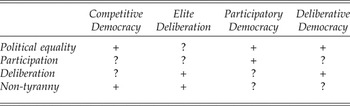
Four theories of democracy

Each of the four theories in the table above embraces an explicit commitment to two of the principles just mentioned. The commitment is signaled by a “+.” The theory is agnostic about the other two (the agnosticism is represented by a “?”). While there are obviously sixteen possible theories defined by acceptance or rejection of the four principles, I have argued elsewhere that the useful theories reduce to these four.Footnote 4 On the one hand, variations that aspire to more than two of these principles turn out to be utopian or vacuous, since they just paper-over hard choices that need to be faced in the typical patterns by which these principles conflict. We will look in detail at some of those conflicts when we discuss a trilemma of democratic reform in Section III below. On the other hand, those theories that aspire to less than two of these principles include elements of one of our four theories, but are less ambitious than necessary.
The four theories have all been influential. In some cases, I modify a familiar theory to make it more defensible, in order to get the strongest version of each theory.
By Competitive Democracy, I mean the notion of democracy championed by Joseph Schumpeter and more recently by Richard Posner.Footnote 5 On this view, democracy is not about collective will formation but is just a “competitive struggle for the people's vote,” to use Schumpeter's famous phrase. Legal guarantees, particularly constitutional ones, are designed to protect against the tyranny of the majority. Within that constraint, all we need are competitive elections. While Schumpeter did not even specify political equality in competitive elections, I have included it here, on the grounds that it makes the position more defensible than it would be if it allowed political inequality. The theory is agnostic about the other two principles (participation and deliberation). Some variants of this position avoid prizing participation, viewing it as a threat to stability or to elite decision-making. Better not to arouse the masses, as their passions might be dangerous and might motivate factions adverse to the rights of others, threatening the position's commitment to protect against the tyranny of the majority. Because of collective action problems and incentives for “rational ignorance” (to use Anthony Downs's famous phrase), little can be expected of ordinary citizens. This position makes that minimalism a virtue.Footnote 6
By Elite Deliberation, I mean the notion of indirect filtration championed by James Madison in his design for the U.S. Constitution. The Constitutional Convention, the state ratifying conventions, and the U.S. Senate were supposed to be small elite bodies that would consider the competing arguments. They would “refine and enlarge the public views by passing them through the medium of a chosen body of citizens,” as Madison said in Federalist No. 10 in discussing the role of representatives. Madison held that the public views of such a deliberative body “might better serve justice and the public good than would the views of the people themselves if convened for the purpose.”Footnote 7 A similar position was given further development in John Stuart Mill's Considerations on Representative Government, particularly in Mill's account of the “Congress of Opinions,” which was supposed to embody a microcosm of the nation's views “where those whose opinion is over-ruled feel satisfied that it is heard, and set aside not by a mere act of will, but for what are thought superior reasons” (prefiguring Jürgen Habermas's famous notion about being convinced only by the “forceless force of the better argument”).Footnote 8 This position, like the last one, avoids embracing mass participation as a value. The passions or interests that might motivate factions are best left unaroused. The American Founders, after all, had lived through Shays's Rebellion (an armed uprising of indebted farmers in Massachusetts in 1786–87) and had an image of unfiltered mass opinion as dangerous. If only the Athenians had had a Senate, they might not have killed Socrates.Footnote 9
By Participatory Democracy, I mean an emphasis on mass participation combined with political equality. While, of course, many proponents of Participatory Democracy would also like deliberation, the essential components of the position require participation (perhaps prized for its “educative function”)Footnote 10 and equality in considering the views offered or expressed in that participation (even if that expression is by secret ballot). Advocates of Participatory Democracy might also advocate voter handbooks, as did the Progressives, but the foremost priority is that people should participate, whether or not they become informed or discuss the issues.Footnote 11 Part of the problem with this position is that it is sometimes advocated based on a picture of small-scale decision-making such as that which occurs in a New England town meeting, in which discussion is facilitated, but then implemented in the social context of mass democracy. Another example is the California process of ballot initiatives, where essentially plebiscitary processes are employed for constitutional change.
By Deliberative Democracy, I mean a theory that attempts to combine deliberation by the people themselves with an equal consideration of the views that result (whether those views are counted in votes or in a tabulation of opinions, as in a poll). One method for implementing this twofold aspiration is the deliberative microcosm chosen by lot, a model whose essential idea goes back to ancient Athens. It was realized in institutions such as the Council of 500 (whose members were chosen by lot and met for a year, setting the agenda for the Assembly), the nomothetai (legislative commissions that were convened for a day to make the final decisions on some legislative proposals), the graphē paranomon (a procedure whereby a person could be prosecuted before a jury of five hundred chosen by lot for making an illegal proposal in the Assembly), and the citizen juries (which also typically had five hundred members chosen by lot and which had a purview far greater than modern juries).Footnote 12 Modern instances of something like this idea include the Citizens' Assemblies in British Columbia and Ontario and the Deliberative Polling (DP) research program I am involved in. Deliberative Polling administers a survey to a scientifically chosen random sample of the population and then engages that sample in extensive deliberation, either face to face or online, after which the same survey is administered again. Many Deliberative Polls have control groups and are full-fledged scientific experiments.Footnote 13 Some cases of DP have been involved in constitutional processes or have provided input to them in countries such as Australia and Denmark. I will return to uses of deliberative microcosms before referenda in Section VI.
It is worth noting that the deliberative microcosm is not the only method of realizing deliberative democracy that engages the people themselves. Another way to satisfy the combination of political equality and deliberation would be to engage the entire population with the deliberative discussions, followed by a voting or tabulation process. Bruce Ackerman and I have worked out an institutional design for achieving that aspiration, in a scheme called “Deliberation Day.”Footnote 14 I will return to that idea in Section VII.
III. The Trilemma of Democratic Reform
Under normal conditions, the three principles internal to the design of democratic institutions—political equality, mass participation, and deliberation—pose a trilemma. Serious efforts to realize any two will reliably run into clear roadblocks with respect to the third.
The major strategy of democratic reform since the American Founding has been to bring decisions more and more directly to the people. Election to the Senate was made the subject of popular vote rather than of decisions by the state legislatures; candidate selection was put increasingly in the hands of electorates in mass primaries rather than remaining in the hands of party elites; some substantive decisions were given over to ballot propositions rather than decisions by state legislatures and elected officials; the Electoral College has changed from an institution originally thought to require deliberative choice to a crude vote-counting mechanism in which those who decide independently can be prosecuted as “faithless electors.”
In all these cases, the strategy of reform has focused on combining political equality and mass participation. But by placing decisions that were once the province of elites into the hands of mass electorates, the social context that might make deliberation possible has been lost. Not that elites were always deliberative. In fact, problems of corruption and electoral calculations among elites often meant that substantive policy deliberation was lacking among representatives—leading to the very Progressive reforms that make the system more plebiscitary now. However, once decisions are placed directly into the hands of the mass public, ordinary citizens have little incentive to become seriously informed, and they have an increasingly vanishing context for citizen deliberation—that is, for weighing competing reasons for one policy solution or another in circumstances where citizens can be effectively motivated to become well informed. Hence, one option is political equality and mass participation without much deliberation. A second option is to get deliberation and some mass participation; but such deliberation, among self-selected groups who are especially motivated, will predictably violate our third principle, political equality. Self-selected microcosms of deliberators will, at their best, be like the League of Women Voters. They will be thoughtful and conscientious but far from representative of the broader population. Voluntary efforts to foster discussion are, of course, immensely useful from the standpoint of civic education. But they will inevitably be unrepresentative and, in that sense, violative of political equality. A third option, embracing political equality and deliberation, leaves out mass participation. Via a deliberative microcosm chosen by lot or random sampling, one can achieve both political equality and deliberation to a high degree. But the deliberations of such a representative microcosm hardly touch the value of mass participation. Once again, we can get only two of the three basic principles, and we face serious impediments against any real progress on the third.
IV. Ideal Theory and Second Best
Ideally, if one thought that the formation of public will was meaningful, then there would be a case for implementing all three principles in any process of higher lawmaking. Each principle contributes to a constitutional process adding up to the public's collective informed consent. Political equality means that the people's views are counted equally. Deliberation means that the public has arrived at considered judgments after it has weighed competing arguments. Participation is a kind of token for actual consent.
The problem, as we have seen with the trilemma, is that it is difficult to get all three principles satisfied simultaneously. If we get mass participation, we are unlikely to get deliberation because of the incentives for rational ignorance and disconnection characteristic of “audience democracy” in the large-scale nation-state.Footnote 15 We can achieve political equality and deliberation, but only for a microcosm—under the good conditions of balanced, face-to-face discussion required for deliberation. So if we get deliberation and political equality, we leave out mass participation. And if we pursue participation and deliberation, we get the distortions that result when only the interested and maybe the more advantaged citizens participate, thus sacrificing political equality. With the tool-kits of democratic reform that have been used since the Founding, running right through the Progressive era and the modern reforms of the presidential primary process since the 1970s (as well as parallel democratic reforms in most countries around the world), we cannot satisfy all three principles simultaneously.
Ideal theory plausibly specifies the full-scale realization of all three principles at the same time, in order to represent the considered judgments of the public will, counting all views equally, with actual mass consent. But if full-scale realization of all three at the same time is not feasible, what is the most plausible approach to second best? The common picture of the role of second best, popularized by Rawlsian theory, is that one should simply attempt, so far as possible, to approximate the ideal (even if one cannot fully realize it).
But there are two complexities here, one causal and one having to do with the definition of the ideal itself. The causal issues have been worked out in the economic “theory of the second best,” which states that if one factor is constrained (i.e., cannot be fully realized), then it may be less than optimal to try to achieve the maximum value of the other factors. At first it may seem counterintuitive that if we cannot maximize A, we shouldn't still try to maximize B and C. But it may be that when A is less than its full value, getting the full dose of B and C leads to an inferior result. Sometimes for example, if one is trying to make the economy more competitive, increasing competition in some industries may not be optimal if other industries are constrained not to be competitive.Footnote 16 But note that this is a causal issue. It has to do with what will achieve the best result on an underlying dimension, which is ultimately that of utility. All other issues are instrumental ones. And there is no dispute that maximizing utility is the goal even within the ordinal intrapersonal framework of modern welfare economics.Footnote 17
To the extent that we are confronted with a trilemma, we have a different situation, which I have characterized as “ideals without an ideal.” We have a plurality of competing principles, but they do not add up to a unified ideal that we can try to approach step by step. If we try to approximate it as best we can, we find, for example, that we have increased mass participation and political equality but to the detriment of deliberation (as with the rise of direct consultation and mass democracy). If we prize self-selected deliberation, increasing both participation and deliberation, then we sacrifice political equality, etc. We are faced with conflicts among valuable principles, and if we forthrightly pursue any two, we find we are stumped, or even set back significantly, on the third.
However, if instead of trying to approximate the ideal, we attempt to proxy it, we can do so with Deliberative Democracy as realized with the revived Athenian notion of the deliberative microcosm, whose members are chosen by lot or random sampling. Such efforts offer a representation of what the realization of all three principles would be like under good conditions. The deliberative microcosm offers a representation of what the entire public would think, if it were thinking and engaged under good conditions—if, in a word, it were deliberating. Or at least that is the potential of the research program in applied philosophy to which these efforts, including Deliberative Polling, contribute. In the language of social research, the project is meant to combine (1) internal validity, so that we know it is the good conditions of deliberation that are producing the opinions at the end of the process, and (2) external validity, so that we know the results are generalizable to the whole population. Such a project, if it maintains both internal and external validity of the relevant sorts, can speak credibly for “we the people.”
But what are good conditions for deliberation, or what is the sort of deliberation and/or discussion that we should be aspiring to achieve? To encapsulate issues I have pursued elsewhere, I would like to specify some criteria for quality in deliberation.Footnote 18
By deliberation, I mean the process by which individuals sincerely weigh the merits of competing arguments in discussions together. We can talk about the quality of a deliberative process in terms of five conditions:
(a) Information: the extent to which participants are given access to reasonably accurate information that they believe to be relevant to the issue.
(b) Substantive balance: the extent to which arguments offered by one side or from one perspective are answered by considerations offered by those who hold other perspectives.
(c) Diversity: the extent to which the major positions held by members of the public are represented by participants in the discussion.
(d) Conscientiousness: the extent to which participants sincerely weigh the merits of the arguments.
(e) Equal consideration: the extent to which arguments offered by all participants are considered on the merits, regardless of which participants offer them.
When the process of discussion realizes these five conditions to a high degree with a representative sample, then it provides a basis for inferring that the judgments of the sample are the considered judgments that members of the public would reach under good conditions for considering the issue. The research program I am involved in—Deliberative Polling—has been focused on how to accomplish this. It has looked empirically at the information gains from deliberation, at the substantive balance of the discussions, at the diversity of the small groups, at the degree to which people are participating sincerely (rather than strategically), and at the degree to which they consider the merits regardless of the social locations of the other participants. We have found that, when properly structured, a deliberative discussion among ordinary citizens can avoid distortions from small-group psychology such as polarization and domination by more privileged groups. We have also found that, in balanced discussions, ordinary citizens achieve high gains in information, and that it is these gains that drive changes of opinion.Footnote 19
V. Realizing Core Principles
The difficulty is that each of the three core principles—political equality, deliberation, and mass participation—serves a different normative function. Without political equality, there is a distorted picture of public opinion. Without deliberation, there is not a considered weighing of the arguments for one alternative or another. Without participation, there is no act of actual choice that can be taken as a token of mass consent. The situation is analogous to that of the voters of Rhode Island, who objected to the use of a convention to ratify the U.S. Constitution because such a convention would leave them out of the process; they thought that each person's liberty was at stake, and that this justified having an opportunity to vote. Likewise, citizens who were not chosen in a random microcosm would think they were left out if a final decision were left to the microcosm, without an opportunity for voting by the mass public. For these reasons, a fully developed ideal theory would include the realization of all three core principles. But second-best issues show that a proxy strategy at least gives us the punchline of what the public's considered judgments would be, under appropriately good conditions for thinking about the issue. But because the resulting views may not be the actual views of the public, there is the potential for a gap—a democratic deficit.
Two basic strategies suggest themselves for overcoming this deficit. First, there is the possibility of a connected sequence of decisions that together overcome the trilemma by first maximizing some principles and then maximizing others. An alternative to the sequential strategy is a new design, such as the one that Bruce Ackerman and I have proposed for Deliberation Day. As we will see, these two strategies offer some design synergies.
VI. Sequential Strategies
In his wide-ranging critique of the U.S. Constitution, Sanford Levinson charts many deficiencies in the U.S. system by the criteria stated here. Some are deficiencies in terms of political equality, some in terms of participation, and some in terms of deliberation. At the end of his book Our Undemocratic Constitution, Levinson proposes variants on a new constitutional convention to get us out of the “iron cage” of the current constitution, which is exceedingly difficult to amend. In thinking about democratic reform, he mentions three institutional strategies and endorses all three in combination: a Deliberative Poll, a referendum, and a convention. He does not, however, make a recommendation about the sequence in which these strategies might be employed or how they might relate to each other.Footnote 20
Looking at the issue as a matter of constitutional/political theory, without getting into issues of how any of these strategies might connect to an existing constitution, at whatever level, in the United States or elsewhere, there are, in theory, six possible sequences of the three institutions. Each has distinctive characteristics.
A. Convention—Deliberative Microcosm—Referendum
A version of this pattern occurred in Australia in preparation for the 1999 referendum on the Republic (whether Australia was going to continue as a constitutional monarchy or have a president as head of state). First, a “constitutional convention” was convened to write a referendum proposition for possibly changing Australia from a monarchy to a republic. This convention was composed primarily of political elites but also had some representation from “ordinary Australians.” Second, there was a national Deliberative Poll, a scientific sample of the entire country convened to deliberate about the question for three days in the Old Parliament House in Canberra. The process and the results of this DP were nationally televised. Third, there was a national referendum vote on the proposition to change the Australian Constitution from a monarchy to a republic with a president appointed by Parliament replacing the governor general.
Strikingly, the convention and the Deliberative Poll both came to the same conclusion, that the proposed constitutional change, to a republic with a president appointed indirectly by two thirds of the Parliament, was a good change. However, the referendum campaign was fiercely contested, with political advertising and some misleading sound bites about the supposed effects of making the change. As a result, despite large-scale publicity for the recommendations of both the convention and the DP, the referendum was defeated. Setting aside a substantive discussion of the merits, the weak link in this design appears to be the connection between the two deliberative phases (elite deliberation in the form of a convention; microcosmic deliberation in the form of the DP) and the mass participatory phase of the referendum voting. If the aspiration is for the deliberations to have an effect on the decision, it looks as if mere media coverage of deliberative results is not enough for those results to really impact a concluding referendum process. We will return to this linkage below.
B. Deliberative Microcosm—Convention—Referendum
To my knowledge, this pattern has not been actually realized. But one could imagine a Deliberative Poll testing out the issues and providing input to a representative body who would participate in a convention to formulate a proposed constitutional change to be ratified by the people. The legislature of the Virgin Islands proposed convening a DP to advise the constitutional convention that met to formulate its new constitution. However, funds were not found to conduct the DP, so the convention went ahead without systematic public input. But the proposal would have realized this pattern. In China, my research colleagues and I have used DPs to successfully provide input to a local People's Congress for budgetary decisions. If the people's representatives are to “refine and enlarge the public's views,” there is always the question of where they get those views from. If they get only “top of the head” opinion, or only intensely voiced views from organized interests, then they do not have input that is both thoughtful and representative. On something as momentous as a constitutional change, it might be useful to have a Deliberative Poll provide the public's considered judgments as an input to elite deliberation. Then the elites could formulate the actual proposal for constitutional change and submit the proposal for ratification by the people themselves. Once again, however, the likely weak link in the chain of causation is the connection between the deliberations of a representative group (whether a statistical microcosm or elected representatives) and the conclusions of the whole public in a referendum process. If this link could be strengthened beyond mere media coverage, then a powerful ideal process could be fashioned.
One difficulty with having the referendum at the beginning is that once the people have spoken in a referendum, it is difficult to imagine contravening their conclusion with some other democratic decision process. Of course, courts have set aside referenda on the grounds that other constitutional provisions have been violated, but that is not the same as having a microcosmic decision overrule a decision by the whole population (or at least all of those who turn out to vote). Such a scenario would involve one version of democracy, with limited participation, overruling another with maximal participation. Even if the subgroup in a convention or a deliberative microcosm is more deliberative, even if it is more representative, and even if the people in the broader population are misled by campaign tactics, it is the people themselves who speak in a referendum, however misguided they may be. A second limitation of this pattern is having a small group make the conclusive decision. Of course, that was the original pattern in the state ratifying conventions for the U.S. Constitution. It was approved not by referenda and not by state legislatures, but by state conventions. Still, that was the very challenge faced in Rhode Island, where critics said that every man's freedom was at stake so every man should be able to vote on the issue.
It is not completely implausible to have a decision actually made by a deliberative microcosm. In modern Greece, one of the country's two major parties used Deliberative Polling to actually select candidates instead of using a mass primary. This effort was greeted as a return of Athenian democracy to a part of Athens after a gap of 2,400 years.Footnote 21 But the candidate selected in this alternative to a mass primary, while he was nominated, still had to run in the general election. In ancient Athens, the nomothetai (legislative commissions chosen by lot) made the final decisions on some legislation. So there are precedents, lost in the dust of history, for a microcosm making the final decision.Footnote 22 Nevertheless, modern democratic norms of mass consent would suggest that once all the people vote, it is difficult to overrule their decision with a decision from a microcosm, no matter how representative or deliberative the latter might be.
C. Other possibilities
If the referendum is to be held last, then the only viable possibilities are the two we have already considered: “Convention—Deliberative Microcosm—Referendum” and “Deliberative Microcosm—Convention—Referendum.”
Consider the other four possibilities:
(1) Referendum—Deliberative Microcosm—Convention
(2) Referendum—Convention—Deliberative Microcosm
(3) Convention—Referendum—Deliberative Microcosm
(4) Deliberative Microcosm—Referendum—Convention
These patterns all have the referendum in some place other than the end. As I have noted, there is a strong presumption of finality if the great mass of the public are actually asked to consent to a constitutional change. It is hard to then lay that consent aside on the basis of deliberations in either a convention or a deliberative microcosm. Hence, it would seem that these four patterns, which share the characteristic that serious decisions come after the referendum vote, are not viable.
Thus, the referendum should be last in the process, and it should be preceded in order either by the convention and then the deliberative microcosm or by the deliberative microcosm and then the convention.
In the British Columbia Citizens' Assembly of 2004, the deliberative microcosm had the power to put a ballot proposition for constitutional change directly on the ballot, without further filtering by any elite deliberative body. This mandate was empowering to the group. While there are some serious questions about the research design for recruiting the microcosm, it was an instance of the basic idea of a random sample deliberating.Footnote 23 And its members showed an extraordinary, indeed an inspiring, willingness to devote a year to the process. While the process had some considerable success, it suffered from the same weak link found in the Australian project in 1999: despite considerable media coverage, deliberations by the representative microcosm did not carry the day in the referendum. Of course, in both British Columbia and Australia, the bar for success was set high—by supermajority requirements in Canada, and by the double majority requirement for constitutional change in Australia (a national majority of voters and a majority in a majority of the states). But both experiences dramatize the potential gap between the deliberative conclusions of a microcosm and the results of mass participation.
VII. Deliberation Day
In these various scenarios, the weak link is the causal connection between the deliberations of a representative group (whether Elite Deliberation in a convention or deliberation in a statistical microcosm) and the actual decision by the mass public in a referendum. In Deliberation Day (2004),Footnote 24 Bruce Ackerman and I offer a scenario for combining, if only briefly, serious deliberation, mass participation, and political equality. Our initial focus is a presidential election in the United States. However, the basic idea could be applied to any country where the people can be consulted in a constitutional process. It would be particularly applicable before a national referendum, which many countries employ, or even require, for constitutional changes. The discussion below is generic and not focused on any given country. Rather, it is focused on bringing the people—all of them—into a higher lawmaking process that is also deliberative.
This strategy is different from the sequential strategies outlined above. In Deliberation Day, there is a single proposed institution that attempts to realize all three principles at once—deliberation, political equality, and mass participation. The effort is costly and ambitious, in that it would require a national holiday and payment to millions of deliberators who would actually experience a day's discussions modeled closely on the Deliberative Poll, with alternating small-group sessions and plenary sessions with experts or representatives answering questions from the small groups, just as in the DP. One way to get a good representation of informed public opinion is to get a scientific sample to deliberate. Another way is to get the actual population—to get most people to actually participate. The basic idea is that such an experience would close the gap between “top of the head” opinion (the pre-deliberation views of most of the mass public) and deliberative mass opinion (as represented by the concluding views of the scientific sample in a Deliberative Poll). By inviting all voters to sites near them where they could experience daylong deliberations before an election or referendum, deliberations structured much like a DP, and by incentivizing participation through a reasonable stipend to ensure widespread participation, the project would produce something comparable to deliberative views on the question at issue for the whole society rather than for a microcosm.
On this view, Deliberation Day would strengthen the weak link between deliberative opinion in a microcosm and normally nondeliberative mass opinion in a referendum. To give the maximum deliberative input to a design culminating in a mass referendum, the latter could be preceded by both a DP and a convention, in either order (that is, “DP, convention, referendum” or “convention, DP, referendum”).
A clearly practical scenario would be to have a Deliberative Poll which would expose the way the mass public would deliberate about an issue, and which would clarify the trade-offs that were of greatest concern. Those concerns might then be the subject of a constitutional convention which would debate the referendum proposal in detail and formulate it for national decision. In preparation for a referendum vote, official committees would prepare briefing materials for national discussion (representing, respectively, the “yes” and “no” positions on the proposal). Those materials would then be the substance of a one-day national deliberation (or statewide deliberation, if it is a state constitution that is being changed), and then the entire population would go through a process akin to that experienced by the microcosm in a Deliberative Poll. Instead of the connection between deliberation and voting being provided by media coverage, it would be provided by the actual engagement of the mass public in a balanced process of discussing the issues—a process that would be decentralized in many small-group and plenary sessions on the model of the DP. The reason the effort is expensive is that to be effective it would require large-scale participation. Ackerman and I believe that a significant incentive (we have suggested $300) would motivate participation, when combined with the holiday.
VIII. Conclusion
The entire debate leading up to Deliberation Day would be altered, we believe, by the anticipation that on a given day the public would be much better informed about the issues. One cannot offer misleading or trivial arguments and expect to succeed if one knows that the public will soon see through them.
The aspiration is to combine three principles—political equality, deliberation, and mass participation—to a high degree in order to achieve, not just mass consent, but mass consent via something approaching the public's actual considered judgments. Constitutional processes are characterized as a form of “higher lawmaking.”Footnote 25 What makes the higher lawmaking higher? It can only be that it satisfies appropriate normative criteria to a higher degree than required in normal politics. In the view outlined here, the fundamental democratic criteria are the three principles already mentioned. While normally we cannot have all three, a transformation of the frontier of possibilities by a dramatically higher investment of resources in a new kind of institution (Deliberation Day) offers the prospect of evading the trilemma with a different kind of tool for public consultation.
While there are plausible arguments about the order of elite deliberations and deliberations by a microcosm, both have a contribution to make. Most importantly, the insertion of Deliberation Day would strengthen the connection between the deliberations of a representative body and the eventual result in a referendum by allowing a mass participatory version of deliberation to affect the votes of all the people. Now, one might ask, why should we even have the other phases of deliberation if Deliberation Day would be so effective? First, there is the question of how the agenda for a referendum is to be set. Here the current initiative process in many states is obviously defective. The initiative is a lobbying tool for organized interests to avoid legislative decision and to use constitutional changes to decisively alter decisions.Footnote 26 Much care must be taken in the deliberations that set up a public consultation. Some scenario of elite deliberation drawing on a representative microcosm (or having its views evaluated by a representative microcosm) in preparation for mass decision should be very helpful, both in framing the choice to be voted on and in framing the arguments around it.
Of course, the scenarios just described have ignored federalism and have treated a unitary electorate as the target population for deliberative democracy. The United States has no national referenda, and constitutional choices require ratification on a state-by-state basis. Still, there is the unused and perhaps dangerous clause about the convention route to constitutional change,Footnote 27 and it was Sanford Levinson's intention to build on that route which stimulated his proposal to attempt to combine the three institutions just described—a Deliberative Poll, a convention, and a referendum. It is worth noting, as Bruce Ackerman has pointed out in We the People, Footnote 28 that the original Constitutional Convention of 1787 was, strictly speaking, illegal in that it was supposed to simply revise the Articles of Confederation and not create a new constitution. So there may be circumstances where radical new experiments are required, though I am not claiming that we have reached that point yet, even if some of our eighteenth-century institutions are stifling (the Electoral College and the constitutional amendment process come to mind).
In any case, my account here is not offered with any particular constitution in mind; rather, my aim has been to sketch what might be called an ideal theory of higher lawmaking. If we were starting from scratch to determine, under favorable conditions, the most compelling scenario for constitutional change, how would such a system be designed for application in the large-scale nation-state? My proposal is meant as a contribution to democratic theory. The institutional design issues discussed here are meant to sketch how core democratic principles could be satisfied, if one wished to build an ideal theory for higher lawmaking into one's constitutional design. If “governments derive their just powers from the consent of the governed,” then the institutional design for soliciting collective informed consent is central to higher lawmaking.