


Introduction
The OCD treatment situation
Cognitive behaviour therapy (CBT) with exposure and response prevention (ERP) is the most effective psychological treatment for obsessive compulsive disorder (OCD) (Olatunji et al. Reference Olatunji, Davis, Powers and Smits2013), and it is recommended in expert guidelines as the treatment of choice (NICE, 2005).
However, only a small proportion of people who suffer from OCD receive treatment from a therapist specialized in ERP (Mancebo et al. Reference Mancebo, Eisen, Pinto, Greenberg, Dyck and Rasmussen2006). For example, one study found that 60% of OCD patients had received a treatment that did not meet minimal standards for adequate CBT (Stobie et al. Reference Stobie, Taylor, Quigley, Ewing and Salkovskis2007). Consequently, people who seek help for OCD often face the problem of long waiting lists for trained psychotherapists, which causes many OCD sufferers to remain untreated or inadequately treated (Baer & Minichiello, Reference Baer and Minichiello2008).
Among the barriers to successful implementation of CBT in healthcare services are lack of adequate training at the trainee level (Crits-Christoph et al. Reference Crits-Christoph, Frank, Chambless, Brody and Karp1995), and poor dissemination of CBT techniques (Shafran et al. Reference Shafran, Clark, Fairburn, Arntz, Barlow, Ehlers, Freeston, Garety, Hollon, Ost, Salkovskis, Williams and Wilson2009). Consequently, only a few therapists are specialized in delivering the ERP therapy for OCD, and many clinicians even have adverse attitudes towards this approach (Olatunji et al. Reference Olatunji, Deacon and Abramowitz2009).
Challenges encountered in the treatment of OCD also include problems with homework compliance, frequent relapse, difficulties in simulating the spontaneous nature of intrusive thoughts, and infrequent treatment sessions due to their costs (Lind et al. Reference Lind, Boschen and Morrisey2013). Treatment compliance, specifically non-compliance with homework, is frequently reported as the major reason for treatment failure in OCD sufferers (Taylor et al. Reference Taylor, Abramowitz and McKay2012). Individuals with OCD are often difficult to treat because the ritualistic behaviours are usually more frequent when patients are at home alone (Taylor et al. Reference Taylor, Abramowitz and McKay2012).
Furthermore, access to CBT is limited by job-related restrictions, geographical distance, limited mobility caused by OCD or the presence of a physical handicap (Herbst et al. Reference Herbst, Voderholzer, Stelzer, Knaevelsrud, Hertenstein, Schlegl, Nissen and Kulz2012). For instance, most clinicians with specialized CBT training work in speciality clinics usually located in major cities (Barlow et al. Reference Barlow, Levitt and Bufka1999).
In addition to restricted access to treatment, people with OCD have a very low rate of help-seeking behaviour, with one study suggesting that only 20% have sought help from a trained mental health professional (Leonard et al. Reference Leonard, Swedo and Lenane1993). In an observational study on a large sample of OCD patients, Mancebo and colleagues (Reference Mancebo, Eisen, Sibrava, Dyck and Rasmussen2011) found that one third of participants did not initiate CBT despite being recommended by mental health professionals, and they reported difficulty attending CBT as the main reason for non-adherence. Moreover, regarding the fact that patients tend to make contact with the medical supply system after an average of 10 years, social stigma seems to play a major role (Marques et al. Reference Marques, LeBlanc, Wegarden, Timpano, Jenike and Wilhelm2010).
The current shortcomings in the OCD treatment situation suggest the need for novel therapeutic strategies that could be integrated effectively into the daily routine of psychotherapy provision (Herbst et al. Reference Herbst, Voderholzer, Stelzer, Knaevelsrud, Hertenstein, Schlegl, Nissen and Kulz2012).
Computer-delivered cognitive behavioural treatments (CCBTs) for OCD
Rapid advances in technology are leading to a growing interest in cost-effective ways to deliver CBT based on technology, and in the past years researchers and clinicians have become increasingly interested in CCBTs (Spurgeon & Wright, Reference Spurgeon and Wright2010).
CCBTs have been defined as a family of interventions involving at least one of the evidence-based CBT components for OCD (psychoeducation, ERP, cognitive restructuring), delivered through devices such as stand-alone or web-linked computers, palmtops and personal digital assistants, telephone-interactive voice-response systems, gaming machines, CD-ROMs, DVDs, and cell phones (Marks et al. Reference Marks, Cavanagh and Gega2007). CBT lends itself very well to computer-delivered treatments, as it is typically highly structured and focused on specific behaviours and cognitive factors (Anderson et al. Reference Anderson, Jacobs and Rothbaum2004). CCBTs can be used as the primary intervention, with minimal therapist involvement, or as augmentation strategy to a therapist-delivered programme where the use of CCBTs supplements the work of the therapist, or as a low-intensity option for those patients who initially are reluctant to participate in face-to-face psychotherapy (Kaltenthaler & Cavanagh, Reference Kaltenthaler and Cavanagh2010).
In CCBTs the psychological support can be offered by telephone or email instead of face-to-face, but the time spent on CCBT systems by their users varies across systems, from a single 20-minute session to (more usually) several hours over some months of treatment, and patients access CCBTs from a wide variety of locations (Marks et al. Reference Marks, Cavanagh and Gega2007).
Some preliminary evidence suggests that CCBTs are time-efficient and cost-effective . CCBT options can greatly reduce the time needed by a clinician to deliver the treatment. For instance, in National Institute of Clinical Excellence recommended CCBT programmes, the amount of therapist time saved is estimated at about 80% (NICE, 2005).
CCBTs are a promising field as emerging evidence suggests that self-help programmes can be more effective when guided by a therapist (e.g. Palmquist et al. Reference Palmquist, Carlbring and Andersson2007; Spek et al. Reference Spek, Cuijpers, Nyklíček, Riper, Keyzer and Pop2007; Johansson & Andersson, Reference Johansson and Andersson2012). Since CCBTs were recently recommended as emerging strategies for enhancing the dissemination of empirically supported treatments, to evaluate whether CCBTs do work, has become an issue of great relevance also for OCD (American Psychological Association Practice Organization, 2010).
Some recent meta-analyses have been conducted integrating studies performed on CCBTs for different types of anxiety disorders. Overall, results indicated that CCBTs have moderate to large effects compared to a waiting-list control or placebo (e.g. Andrews et al. Reference Andrews, Cuijpers, Craske, McEvoy and Titov2010; Cuijpers et al. Reference Cuijpers, Donker, van Straten, Li and Andersson2010; Haug et al. Reference Haug, Nordgren, Öst and Havik2012). In addition, a meta-analysis showed that CCBTs may be as effective as face-to face CBT (Reger & Gahm, Reference Reger and Gahm2009).
In recent years, some reviews have been conducted on CCBTs for OCD specifically. Mataix-Cols & Marks (Reference Mataix-Cols and Marks2006) did a systematic search, and found that an interactive computer-aided self-help programme (BTSteps; e.g. Greist et al. Reference *Greist, Marks, Baer, Kobak, Wenzel, Hirsch, Mantle and Clary2002) was effective for OCD in two open studies and in a large multicentre randomized controlled trial (RCT). They also reported findings from a small RCT on compliance and outcome in which effects were enhanced by brief scheduled support from a clinician (Mataix-Cols & Marks, Reference Mataix-Cols and Marks2006). In addition, it was observed that a treatment consisting of brief ERP instructions delivered by a live therapist by phone and a vicarious ERP computer program were effective in small open studies (Mataix-Cols & Marks, Reference Mataix-Cols and Marks2006).
In a systematic review, Tumur and colleagues (Reference Tumur, Kalthenthaler, Ferriter, Beverley and Parry2007) identified two RCTs and two open trials on the BTSteps programme. In the largest RCT, effect sizes (ESs), calculated as Cohen's d, for BTSteps, face-to-face cognitive behaviour therapy (FCBT) and relaxation (RLX) were 0.84, 1.22, and 0.35, respectively. The smaller RCT found significantly better outcomes with brief scheduled support compared to brief on-demand phone support. The authors concluded that BTSteps was superior to RLX treatment, whereas it was as effective as FCBT for reducing the time spent in rituals and for improving general functioning (Tumur et al. Reference Tumur, Kalthenthaler, Ferriter, Beverley and Parry2007). FCBT was more effective than CCBT for all patients overall, although not in those who went on to start self-exposure (Tumur et al. Reference Tumur, Kalthenthaler, Ferriter, Beverley and Parry2007). The authors concluded that further research is required to evaluate which types of patients most benefit from CCBTs, underlining the importance of analysing the influence of socio-demographic and clinical variables (Tumur et al. Reference Tumur, Kalthenthaler, Ferriter, Beverley and Parry2007).
Lovell & Bee (Reference Lovell and Bee2011) conducted a review of evidence on interventions using health technologies in the treatment of OCD. The authors searched four electronic databases, and included any study design. In this review 13 studies were included, of which five used bibliotherapy, five computerized CBT, two telephone-delivered CBT, and one video-conference-based CBT for OCD. The authors highlighted that overall the studies had important methodological limitations, which prevented drawing conclusions about the effectiveness of these modalities of treatment delivery (Lovell & Bee, Reference Lovell and Bee2011).
Herbst and colleagues (Reference Herbst, Voderholzer, Stelzer, Knaevelsrud, Hertenstein, Schlegl, Nissen and Kulz2012) critically evaluated the current body of evidence on Telemental Health (TMH) applications for OCD in the most recent systematic review. They focused on studies that included the ERP component. Through computerized and manual searches 24 studies on different types of TMH applications were identified, of which seven trials evaluated bibliotherapy, 11 telephone-delivered CBT, three computer-aided CBT, one study evaluated online self-help group therapy, and two trials focused on video-conference-based treatments. The authors found that nearly all interventions led to a significant improvement in OCD symptoms and ESs ranged from 0.46 to 2.5, concluding that TMH applications appear to be a promising treatment for OCD patients. However, they also concluded that future studies are required to investigate the potential of treatment strategies in routine care (Herbst et al. Reference Herbst, Voderholzer, Stelzer, Knaevelsrud, Hertenstein, Schlegl, Nissen and Kulz2012).
In the context of routine care, clinicians’ attitudes towards CCBTs appear to be still largely neutral or even unfavourable (Stallard et al. Reference Stallard, Richardson and Velleman2010; Wells et al. Reference Wells, Mitchell, Finkelhor and Becker-Blease2007) despite the data emerging from clinical trials and Internet surveys suggest that these modalities of treatment delivery appear to be acceptable to clients (e.g. Craske et al. Reference Craske, Rose, Lang, Shaw Welch, Campbell-Sills, Sullivan, Sherbourne, Bystritsky, Stein and Roy-Byrne2009; Gun et al. Reference Gun, Titov and Andrews2011; Wootton et al. Reference Wootton, Titov, Dear, Spence and Kemp2011b). Therefore, knowledge on effectiveness of CCBTs seems to be an important issue for the dissemination and implementation of this novel treatment strategy in routine clinical practice (Shafran et al. Reference Shafran, Clark, Fairburn, Arntz, Barlow, Ehlers, Freeston, Garety, Hollon, Ost, Salkovskis, Williams and Wilson2009).
Rationale for the current study
Despite the growing amount of research based on systematic reviews, to our knowledge a meta-analysis on CCBTs for OCD does not exist to date. In addition, previous systematic reviews also included trials on telephone- or web-camera-delivered treatments (Lovell & Bee, Reference Lovell and Bee2011; Herbst et al. Reference Herbst, Voderholzer, Stelzer, Knaevelsrud, Hertenstein, Schlegl, Nissen and Kulz2012), but they did not focus on treatments delivered by computers specifically. Moreover, to our knowledge, the most recent systematic review (Herbst et al. Reference Herbst, Voderholzer, Stelzer, Knaevelsrud, Hertenstein, Schlegl, Nissen and Kulz2012) did not include more recently published trials on novel ways to deliver CCBTs, such as guided Internet-delivered CCBTs (Andersson et al. Reference *Andersson, Ljótsson, Hedman, Kaldo, Paxling, Andersson, Lindefors and Rück2011, Reference *Andersson, Enander, Andrén, Hedman, Ljótsson, Hursti, Bergström, Kaldo, Lindefors, Andersson and Rück2012; Wootton et al. Reference *Wootton, Titov, Dear, Spence, Andrews, Johnston and Solley2011a, Reference *Wootton, Dear, Johnston, Terides and Titov2013).
Objectives of the study
Starting from the shortcomings of face-to face CBT and the promising advantages of CCBTs, the objective of the current study was to summarize preliminary quantitative evidence on the effectiveness of CCBTs for OCD using meta-analytical techniques. Specifically, we investigated whether these treatment modalities could be associated to a significant pre-/post-treatment improvement, and whether they could be an effective strategy compared to control conditions (waiting list or active control groups) either on OCD or depression symptom outcomes at post-treatment and ≥1 month follow-up.
Method
Protocol of the meta-analysis
Objectives and methods of the current meta-analysis were specified in advance and reported in a protocol, which is available from the corresponding author upon request.
Eligibility criteria
Following the PICOS approach defined in the PRISMA guidelines (Moher et al. Reference Moher, Liberati, Tetzlaff and Altman2009), the criteria considered for inclusion of the studies involved characteristics related to the types of participants, types of interventions, types of comparators, types of outcomes, and types of studies and designs.
Types of participants. In the study samples, all the participants were required to have been assigned a primary OCD diagnosis according to a standardized classification system, such as the DSM (e.g. APA, 2000), or having scores higher than cut-off points on self-report measures for OCD symptoms with known reliability and validity. As participants’ age was not a restriction in the current meta-analysis, trials with children or adolescents (age <16 years) could be also included. Studies on primary compulsive hoarding were excluded, as the treatment for hoarding differs from CBT for OCD, and hoarding is a separate diagnosis in DSM-5 (Mataix-Cols et al. Reference Mataix-Cols, Frost, Pertusa, Clark, Saxena, Leckman, Stein, Matsunaga and Wilhem2010). Samples with comorbid general medical or psychiatric conditions were not excluded. However, in the sample all the patients were required to have a primary OCD diagnosis. Thus, studies with a mixed sample, including both patients with primary OCD and patients with other primary disorders (e.g. depression or anxiety disorders) were excluded.
Types of interventions. Studies were reviewed for inclusion if they evaluated the effects of CCBTs for OCD. CBT can be defined as a family of interventions, based on the assumption that emotional disorders are maintained by cognitive and behavioural factors, and that psychological treatment leads to changes in those factors through cognitive and behavioural techniques (Beck & Emery, Reference Beck and Emery2005). CCBTs were defined as any treatment involving at least one of the evidence-based CBT components for OCD (psychoeducation, ERP, cognitive restructuring), delivered through devices such as stand-alone or web-linked computers, palmtops, telephone-interactive voice-response systems, CD-ROMS, DVDs, and cell phones (Marks et al. Reference Marks, Cavanagh and Gega2007). Studies had to focus on CCBTs as the main intervention. Thus, studies were not included if CCBTs were used only as an augmentation strategy or adjuvant component in the context of weekly face-to-face traditional CBT sessions.
Types of comparators. RCTs were included if they compared CCBTs for OCD with a control condition (no treatment, wait-list) or with an active control condition (e.g. treatment as usual or attention/relaxation controls).
Types of outcomes. Only studies that reported outcomes on at least one validated measure of OCD symptoms were included, for example the Yale–Brown Obsessive Compulsive Scale (YBOCS; Goodman et al. Reference Goodman, Price, Rasmussen, Mazure, Fleischmann, Hill, Heninger and Charney1989). Studies were screened for inclusion if they reported sufficient information about the study results to allow ES calculation (see ‘Summary measures’ subsection below for ES calculation details). In cases where insufficient information was available from the paper, the study authors were contacted to ask for additional information. Where no further data were provided, studies were not included.
Types of studies and designs. Since research on CCBTs for OCD is an emerging field with a limited number of RCTs, studies involving at least pre-/post-test one-group designs were included. Case reports, case series, and N = 1 designs were excluded. Process studies were not excluded if providing statistical results on treatment effectiveness, thus allowing the calculation of ESs. Studies conducted on the same data of previously published trials also resulted in exclusion. No language restrictions were applied.
Information sources and search procedure
Several search strategies were used in order to identify studies for inclusion.
Electronic search. Studies were retrieved through online systematic literature searches, in which the key word ‘obsessive-compulsive disorder’ was combined with key words and text words indicative of computer-delivered treatments (computer, Internet, email, online treatment) and with words indicative of CBT (cognitive behaviour therapy, exposure with response prevention). According to Spek and colleagues (Reference Spek, Cuijpers, Nyklíček, Riper, Keyzer and Pop2007), literature dating from before 1990 was excluded as the rapid changes in computer and devices make it difficult to compare treatments dating before 1990 with the current treatments. In effect, the studies had to be conducted or published between January 1990 and November 2013.
To select studies that could meet the selection criteria, the following databases were consulted: PsycINFO, Science Direct, PubMed, and the Cochrane Library.
Corresponding authors. To request any further paper, either published or unpublished, some corresponding authors of the included studies were contacted.
Hand searching. Conference proceedings were hand searched for some international associations on CBT.
Reference lists. Reference lists of the included studies were examined. In addition, references were examined for 17 reviews previously published on computer-delivered or self-help treatments for anxiety disorders or OCD specifically (Mains & Scogin, Reference Mains and Scogin2003; Newman et al. Reference Newman, Erickson, Przeworki and Dzus2003, Reference Newman, Szkodny, Llera and Przeworski2011; Barlow et al. Reference Barlow, Ellard, Haisnworth, Jones and Fisher2005; Hirai & Clum, Reference Hirai and Clum2006; Mataix-Cols & Marks, Reference Mataix-Cols and Marks2006; Spek et al. Reference Spek, Cuijpers, Nyklíček, Riper, Keyzer and Pop2007; Tumur et al. Reference Tumur, Kalthenthaler, Ferriter, Beverley and Parry2007; Lack & Storch, Reference Lack and Storch2008; Reger & Gahm, Reference Reger and Gahm2009; Andrews et al. Reference Andrews, Cuijpers, Craske, McEvoy and Titov2010; Cuijpers et al. Reference Cuijpers, Donker, van Straten, Li and Andersson2010; Griffiths et al. Reference Griffiths, Farrer and Christensen2010; Herbst et al. Reference Herbst, Voderholzer, Stelzer, Knaevelsrud, Hertenstein, Schlegl, Nissen and Kulz2012; Kiluk et al. Reference Kiluk, Sugarman, Nich, Gibbons, Martino, Rounsaville and Carroll2011; Haug et al. Reference Haug, Nordgren, Öst and Havik2012; Lind et al. Reference Lind, Boschen and Morrisey2013).
Study selection
During the first two stages (rejection at title and at abstract), the titles and the abstracts of the papers identified through the systematic search, were read independently by two of the authors (A.P. and P.A.). Where there was not agreement on inclusion at these two stages, the paper was retained. Subsequently, the full text of the papers passing this screen was read independently by two of the reviewers (A.P. and P.A.). Despite no formal assessment of agreement being performed, any between-assessor discrepancy on a study's inclusion at this stage was resolved through discussion meetings with a third reviewer (D.D.).
Assessment of methodological quality and risk of bias
The methodological quality of the included RCTs was assessed using the Cochrane Collaboration's tool for risk of bias assessment (Higgins et al. Reference Higgins, Altman, Gøtzsche, Jüni, Moher, Oxman and Sterne2011). Two of the reviewers (A.P. and P.A.) conducted risk of bias assessments working independently. Each discrepancy was discussed and resolved in meetings. Each study was rated for risks of bias owing to selection bias (random sequence generation and allocation concealment), detection bias (blinding of outcome assessment), attrition bias (incomplete outcome data), reporting bias (selective reporting), and other biases. Risk of bias due to blinding and incomplete outcome data was assessed within each included study separately for different outcomes. Since for trials on efficacy of psychotherapy, blinding of participants can be critical, we did not use this item to assess quality of RCTs on CCBTs.
Risk of bias assessment was conducted within each included trial and across the included trials. According to guidelines provided by Higgins et al. (Reference Higgins, Altman, Gøtzsche, Jüni, Moher, Oxman and Sterne2011), each domain was rated as high, low, or unclear. For within-trial assessments, risk of bias was classified as low if it was regarded as low by the two independent reviewers for all the domains, as unclear if it was regarded as low or unclear for all the domains, and as high if it was regarded as high for one or more domains. For between-trial assessment risk, of bias was classified as low if most information was from trials at low risk of bias, as unclear if most information was from trials at low or unclear risk, and as high if the proportion of information from trials at high risk was sufficient to affect the interpretation of results (Higgins et al. Reference Higgins, Altman, Gøtzsche, Jüni, Moher, Oxman and Sterne2011).
Meta-analysis
Summary measures
As recommended by Morris & DeShon (Reference Morris and DeShon2002), ESs were calculated as standardized differences in means, based on the difference from pre- to post-test mean divided by the pre-test standard deviation (s.d.) in order to achieve comparable ESs derived from studies using different experimental designs. This method for ES calculation enabled us to compare the effects of treatments across studies regardless of the research design, as the ESs were scaled in the same metric. The advantage of this method for ES calculation is the possibility of obtaining information also from non-RCT studies. However, we should consider that ESs calculated following this method reflect within-group change, and do not partial-out effects of non-specific factors such as the maturation effects. Therefore, ESs might overestimate the actual effectiveness of treatments (Morris & DeShon, Reference Morris and DeShon2002).
The overall mean ES was calculated on OCD symptom and depression outcome measures. OCD symptom measures were used as primary outcomes, and depression measures were used as secondary measures of treatment effects. For all OCD symptom and depression outcome measures, higher scores indicated greater severity.
Subsequently, the mean ES was also calculated using only OCD symptom outcome measures. An ES of ≥0.80 can be assumed to be large, 0.50 moderate, and 0.20 small (Cohen, Reference Cohen1988). According to Hedges (Reference Hedges1981), Hedges’ correction for small sample bias was applied to all ES.
Synthesis of results
Data were independently extracted by two of the authors (A.P. and P.A.). Any disagreement was discussed through discussion meetings. Data were extracted calculating most ESs from pre- and post-treatment means, pre-treatment standard deviations, and sample sizes of the CCBT groups reported in the articles. When this information was not available, we used conversion methods suggested by Ray & Shadish (Reference Ray and Shadish1996).
As we expected noticeable heterogeneity across the included studies, ESs were computed using a random-effects model. Random-effects models assume that the included studies are drawn from populations of studies that systematically differ from each other. According to these models, the ESs derived from included studies differ not only because of the random error within studies (as in the fixed-effects model) but also because of true variation in ESs from one study to the other (Borenstein et al. Reference Borenstein, Hedges, Higgins and Rothstein2009).
The I 2 statistic was computed in order to test for homogeneity of ES. This statistic is an indicator of the heterogeneity of ES in percentages. A value of ≤25% indicates low heterogeneity, 50% moderate, and >75% high (Higgins et al. Reference Higgins, Thompson, Deeks and Altman2003). Heterogeneity was also analysed using the Q statistic (Hedges & Olkin, Reference Hedges and Olkin1985). A significant Q value indicates that the variability across ES is greater would have resulted from subject-level sampling error alone (Lipsey & Wilson, Reference Lipsey and Wilson2001).
For all analyses, alpha was set to 0.01.
Publication bias
The likelihood of publication bias was analysed using the fail-safe N method (Rosenthal & Rubin, Reference Rosenthal and Rubin1988). This method consists in calculating the number (N) of unpublished studies required to reduce the overall ES to a non-significant level assuming that the ES of such studies are equal to zero. As recommended by Rosenthal (Reference Rosenthal1991), this value was computed according to the following formula: N = k (kZ – 2.706)/2.706, where k is the number of studies included in the meta-analysis and Z is the mean derived form k studies.
The current meta-analysis was performed using the software Comprehensive Meta-Analysis version 2.0 (www.meta-analysis.com).
Results
Study selection
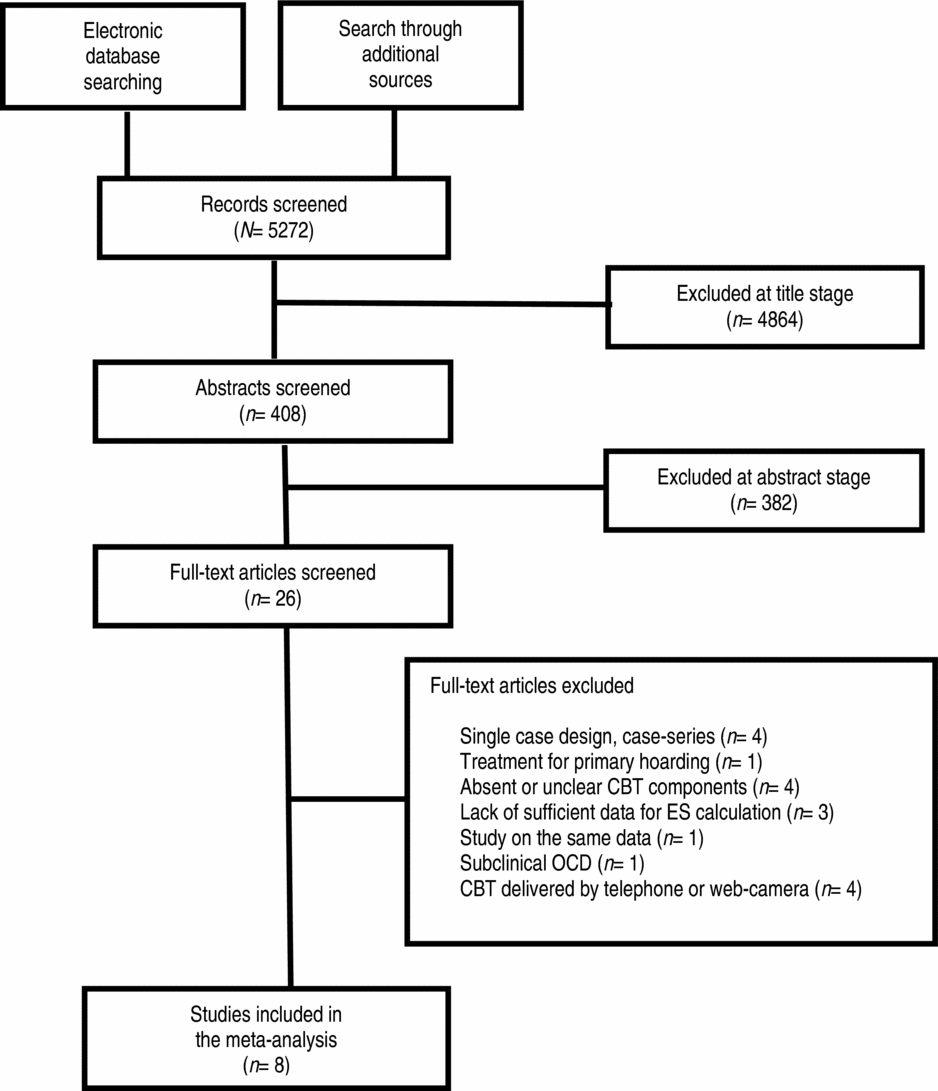
The electronic search and the search through additional sources produced 5272 records. Thirty full-text studies were screened for inclusion. Of those trials, four were excluded as they were based on single case or case-series designs (Lovell et al. Reference Lovell, Fullalove, Garvey and Brooker2000; Himle et al. Reference Himle, Fischer, Muroff, Van Etten, Lokers, Abelson and Hanna2006; Vogel et al. Reference Vogel, Launes, Moen, Solem, Hansen, Håland and Himle2012; Goetter et al. Reference Goetter, Herbert, Forman, Yuen, Gershkovicth, Glassman, Rabin and Goldstein2013). One study was excluded as the clinical sample included also participants with subclinical OCD (not meeting all the criteria for a diagnosis of OCD; Klein et al. Reference Klein, Meyer, Austin and Kyrios2011). One study was excluded as the clinical sample consisted of participants with a primary diagnosis of hoarding (Muroff et al. Reference Muroff, Steketee, Himle and Frost2010). One study was excluded as the OCD diagnosis was not based upon international classification systems or on assessment instruments for OCD of known psychometric properties (Moritz et al. Reference Moritz, Jelinek, Hauschildt and Naber2010). Four studies were excluded as they used computer-aided treatments other than well-established cognitive-behavioural components (Moritz et al. Reference Moritz, Jelinek, Klinge and Naber2007, Reference Moritz, Carrillo Aravena, Guczka, Schilling, Eichenberg, Raubart, Seebeck and Jelinek2011; Moritz & Jelinek, Reference Moritz and Jelinek2011; Moritz & Russu, Reference Moritz and Russu2012). Two studies were excluded as they did not provide sufficient data for ES calculations (Marks et al. Reference Marks, Baer, Greist, Park, Bachofen, Nakagawa, Wenzel, Parkin, Manzo, Dottl and Mantle1998; Nakagawa et al. Reference Nakagawa, Marks, Park, Bachofen, Baer, Dottl and Greist2000). One study (Kirkby et al. Reference Kirkby, Berrios, Daniels, Menzies, Clark and Romano2000) was excluded as it was a process study conducted on the same data of Clark et al.'s (Reference *Clark, Kirkby, Daniels and Marks1998) trial. Finally, four studies were excluded, as they evaluated CBT delivered via telephone (Taylor et al. Reference Taylor, Thordarson, Spring, Yeh, Corcoran, Eugster and Tisshaw2003; Lovell et al. Reference Lovell, Cox, Haddock, Jones, Raines, Garvey, Roberts and Hadley2006; Turner et al. Reference Turner, Heyman, Futh and Fullalove2009) or web-camera (Storch et al. Reference Storch, Caporino, Morgan, Lewin, Rojas, Brauer, Larson and Murphy2011).
After this selection, eight studies were included in the current meta-analysis by consensus of the two independent assessors. The PRISMA flow chart of the selection process is provided in Figure 1.
PRISMA flow chart of studies selection.

Study characteristics
All included studies were published in peer-reviewed journals. The included studies represented three countries: Sweden [two studies (16.70% of the included studies)], Australia [three (25.00%)], UK [two (16.70%)]; one multi-site study was conducted in the UK and USA (8.30%). Publication year ranged from 1998 to 2013. The total sample size was 392 individuals in the post-test. All the studies were conducted on adult samples. Four studies used a pre-/post-test one-group design, and four studies were based on randomized comparisons. The selected studies included eight CCBT conditions, one face-to-face CBT condition, one bibliotherapy condition, three control conditions (progressive relaxation or a waiting-list group). Overall, four studies evaluated Internet-delivered CBT, three studies evaluated BTSteps, and one study evaluated an interactive computer program. Treatment duration ranged from 3 to 17 weeks. Treatment outcome was measured in the eight studies by a broad range of instruments assessing OCD symptoms, depression, quality of life, work and social functioning. The YBOCS was the most commonly used instrument as it was used in all studies.
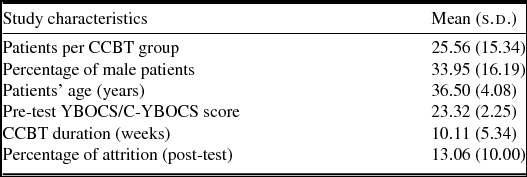
The mean number of patients was 25.56 (s.d. = 15.34), the mean percentage of male patients was 33.95 (s.d. = 16.19), and the mean age was 36.50 years (s.d. = 4.08). The mean percentage of attrition associated with CCBTs for OCD at post-treatment was 13.06 (s.d. = 10.00).
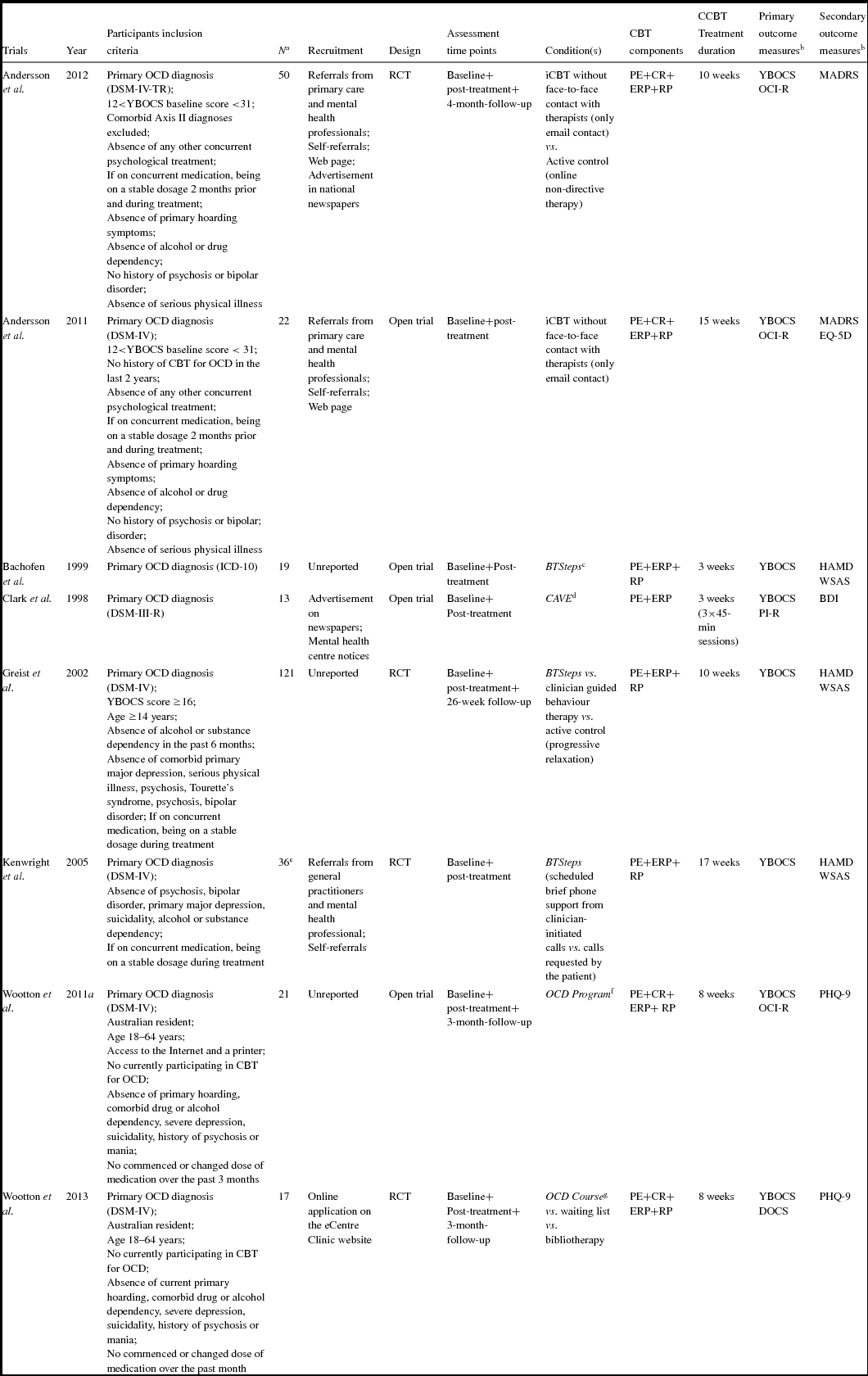
An overview of the eight included studies is provided in the Appendix. Descriptive characteristics of the included studies with regard to CCBT arms are presented in Table 1.
Descriptive characteristics of the included CCBT studies (n = 8)

CCBT, Computer-delivered cognitive behavioural treatment; YBOCS, Yale-Brown Obsessive Compulsive Scale; C-YBOCS Children's Yale-Brown Obsessive Compulsive Scale.
Assessment of methodological quality and risk of bias
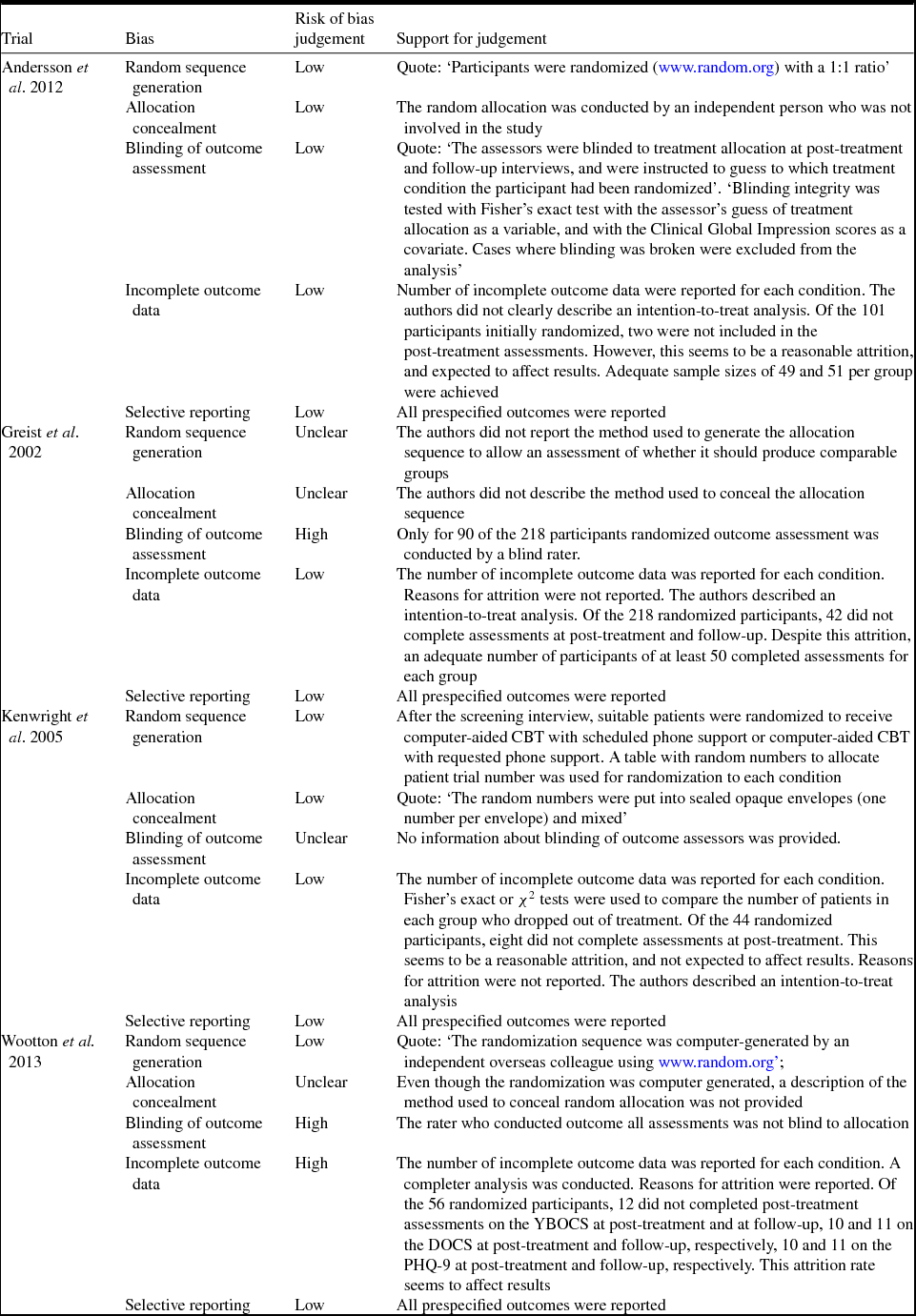
Within- and between-trial risk of bias was assessed using the Cochrane Collaboration's tool for risk of bias assessment. No RCTs were at high risk of bias for sequence generation; however, the method to generate randomization was unclear (not reported) in one trial (Greist et al. Reference *Greist, Marks, Baer, Kobak, Wenzel, Hirsch, Mantle and Clary2002). Risk of bias owing to allocation concealment was unclear in two trials (Greist et al. Reference *Greist, Marks, Baer, Kobak, Wenzel, Hirsch, Mantle and Clary2002; Wootton et al. Reference *Wootton, Dear, Johnston, Terides and Titov2013). Lack of blinding of assessors created a high risk of bias in two trials (Greist et al. Reference *Greist, Marks, Baer, Kobak, Wenzel, Hirsch, Mantle and Clary2002; Wootton et al. Reference *Wootton, Dear, Johnston, Terides and Titov2013). In addition, risk of bias owing to blinding of assessors was unclear in one trial (Kenwright et al. Reference *Kenwright, Marks, Graham, Franses and Mataix-Cols2005). There was a high risk of bias owing to incomplete outcome data reporting in one trial (Wootton et al. Reference *Wootton, Dear, Johnston, Terides and Titov2013). Finally, no trials were at high risk of bias owing to selective reporting. A summary of within-trial risk of bias assessments is provided in Table 2.
Cochrane Collaboration assessment of within-studies risk of bias for the four included randomized controlled trials
DOCS, Dimensional Obsessive-Compulsive Scale; PHQ-9, Patient Health Questionnaire-9; YBOCS, Yale–Brown Obsessive Compulsive Scale.
Overall, according to guidelines provided in Higgins et al. (Reference Higgins, Altman, Gøtzsche, Jüni, Moher, Oxman and Sterne2011), evidence on the comparison of CCBTs to control conditions on OCD symptom outcomes was judged as at high risk of bias, as two out of three trials were classified as being at high risk of bias (Greist et al. Reference *Greist, Marks, Baer, Kobak, Wenzel, Hirsch, Mantle and Clary2002; Wootton et al. Reference *Wootton, Dear, Johnston, Terides and Titov2013), and one trial at low risk of bias (Andersson et al. Reference *Andersson, Enander, Andrén, Hedman, Ljótsson, Hursti, Bergström, Kaldo, Lindefors, Andersson and Rück2012). Similarly, evidence on the comparison of CCBTs to control conditions on depression outcomes was judged as at high risk of bias, as two trials were classified as at high risk of bias (Greist et al. Reference *Greist, Marks, Baer, Kobak, Wenzel, Hirsch, Mantle and Clary2002; Wootton et al. Reference *Wootton, Dear, Johnston, Terides and Titov2013), and one trial at low risk of bias (Andersson et al. Reference *Andersson, Enander, Andrén, Hedman, Ljótsson, Hursti, Bergström, Kaldo, Lindefors, Andersson and Rück2012).
Synthesis of results
Improvement associated with CCBTs in OCD and depression symptom outcomes at post-treatment and follow-up
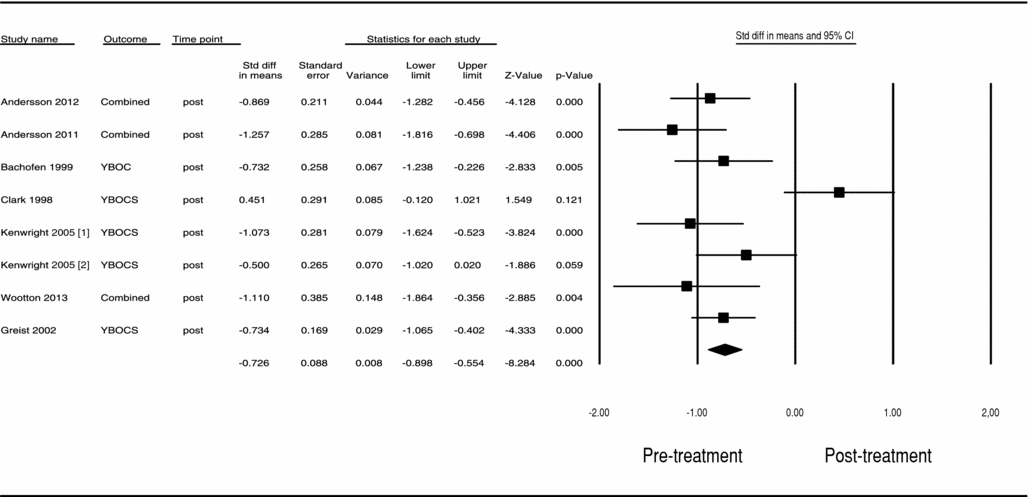
The post-treatment analysis included eight studies with 392 participants in the CCBT conditions. According to Cohen's recommendations (Cohen, Reference Cohen1988), the overall within-group weighted mean ES for OCD symptom outcomes was large at post-treatment [d = −0.72, k = 8, standard error (s.e.) = 0.16, 95% CI −1.04 to 0.39, p = 0.001]. These findings suggested that CCBTs were associated to a significant OCD symptom improvement from pre- to post-treatment. For this analysis a significant heterogeneity was observed (Q 7 = 23.52, p = 0.001, I 2 = 70.24). The classic fail-safe N resulted in 127.
The overall within-group weighted mean ES for depression symptom outcomes was non-significant and low in five studies (n = 321) at post-treatment (d = −0.49, k = 5, s.e. = 0.21, 95% CI -0.90 to 0.08, p = 0.020). These findings suggested that CCBTs were not associated with a significant OCD symptom improvement from pre- to post-treatment. For this analysis a significant heterogeneity was observed (Q 4 = 15.42, p = 0.004, I 2 = 74.07). The classic fail-safe N resulted in 19.
Weighted mean ES for follow-up OCD symptom outcomes was calculated for three studies with a total sample of 83 participants in the CCBT conditions. Analyses indicated that overall ES was large also at follow-up (d = −1.32, k = 3, s.e. = 0.41, 95% CI −2.13 to 0.50, p = 0.002).
The small number of studies including quality of life or social adjustment ratings as secondary outcomes precluded further analyses on the effects of CCBTs on these measures.
Studies and overall ESs on OCD symptom outcomes at post-treatment are presented in Figure 2.
Forest plot of within-group effect sizes on obsessive compulsive disorder symptoms outcomes at post-treatment. Kenwright (2005 [1]) is the computer-delivered cognitive behavioural treatment (CCBT) arm with scheduled phone support; Kenwright (2005 [2]) is the CCBT arm with calls requested by the patient.
Comparison of CCBT conditions with control conditions on OCD symptom outcomes at post-treatment
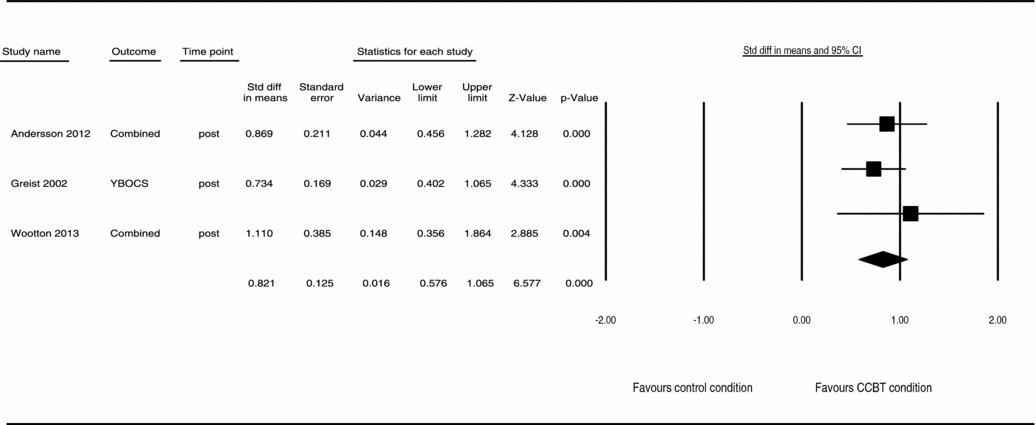
The post-treatment analysis on OCD symptom outcomes included three studies with 281 participants. According to Cohen's recommendations (Cohen, Reference Cohen1988), the overall weighted mean ES across the studies was large (d = 0.82, k = 3, s.e. = 0.12, 95% CI 0.57 to 1.06, p = 0.001), suggesting that there was a significant difference favouring CCBT conditions relative to control conditions on OCD symptom outcomes. For this analysis heterogeneity across the studies was low, as suggested by the Q statistic, which resulted in non-significance (Q 2 = 0.88, p = 0.64), and by the I 2 statistic, which resulted in a low value (I 2 = 0.00). The fail-safe N resulted in 31. The Forest plot of between-group ESs comparing CCBT vs. control conditions on OCD symptom outcomes at post-treatment is presented in Figure 3.
Forest plot of effect sizes comparing computer-delivered cognitive behavioural treatment (CCBT) conditions to control conditions on obsessive compulsive disorder symptom outcomes.
Comparison of CCBT conditions with control conditions on depression symptom outcomes at post-treatment
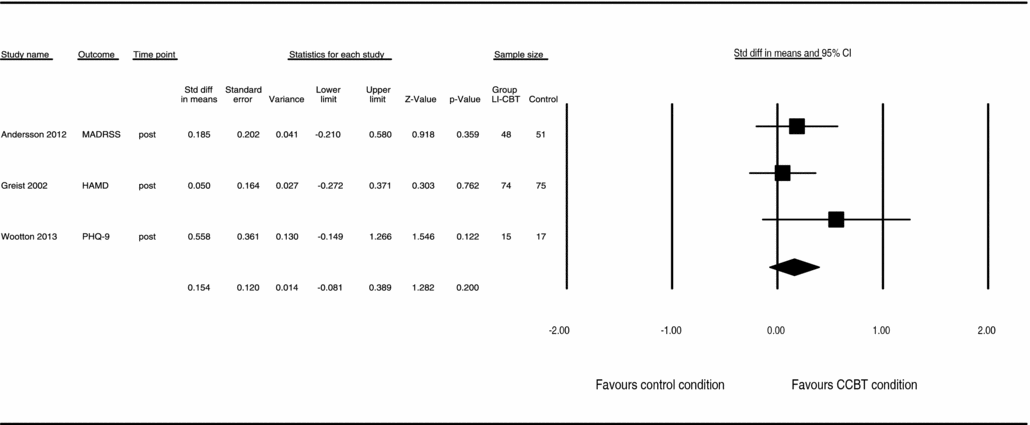
The post-treatment analysis on depression symptom outcomes included three studies (three ESs) with 281 participants. The overall weighted mean ES across the studies was low (d = 0.15, k = 3, s.e. = 0.12, 95% CI -0.08 to 0.38, p = 0.20), suggesting that there was a non-significant difference between CCBT conditions and control conditions on depression symptom outcomes at post-treatment. For this analysis heterogeneity across the studies was low, as suggested by the Q statistic, which resulted in non-significance (Q 2 = 1.63, p = 0.43), and by the resulting low I 2 value (I 2 = 0.00). The fail-safe N resulted in 0. The Forest plot of between-group ESs comparing CCBT vs. control conditions on depression symptom outcomes at post-treatment is presented in Figure 4.
Forest plot of effect sizes comparing computer-delivered cognitive behavioural treatment (CCBT) conditions to control conditions on depression symptom outcomes.
Discussion
Summary of evidence
The general aim of the current study was to summarize preliminary quantitative evidence on CCBTs for OCD using meta-analytical techniques.
The systematic search of the available literature identified eight studies that met inclusion criteria. Due to the small number of RCTs, the current meta-analysis was conducted integrating data from RCTs and pre-/post-trials.
One of the major problems in CCBT outcome research concerns lack of proper psychological diagnoses based on international classification systems (Marks et al. Reference Marks, Cuijpers, Cavanagh, van Straten, Gega and Andersson2009). Consequently, a strength of our work could be that studies were included only if OCD diagnoses were assigned according to classification or pre-treatment scores above the cut-off on validated self-report measures of OCD symptoms. Studies including patients with subclinical OCD were excluded.
A potential strength of our work is the inclusion of studies evaluating computer-delivered treatments involving evidence-based CBT components. To our knowledge, this is the first meta-analysis specifically focusing on computer-delivered CBT for OCD, since previous systematic reviews also integrated studies on non-CBT treatments (e.g. Herbst et al. Reference Herbst, Voderholzer, Stelzer, Knaevelsrud, Hertenstein, Schlegl, Nissen and Kulz2012). Since the most recent systematic review on CCBTs for OCD (Herbst et al. Reference Herbst, Voderholzer, Stelzer, Knaevelsrud, Hertenstein, Schlegl, Nissen and Kulz2012), the current meta-analysis included more recently published studies on novel ways to deliver CCBTs, such as Internet-delivered CCBTs (Andersson et al. Reference *Andersson, Ljótsson, Hedman, Kaldo, Paxling, Andersson, Lindefors and Rück2011, Reference *Andersson, Enander, Andrén, Hedman, Ljótsson, Hursti, Bergström, Kaldo, Lindefors, Andersson and Rück2012; Wootton et al. Reference *Wootton, Titov, Dear, Spence, Andrews, Johnston and Solley2011a, Reference *Wootton, Dear, Johnston, Terides and Titov2013). In addition, our study focused on computerized CBT, different from the most recent reviews, which also included studies on telephone- and web-camera-delivered CBT (Lovell & Bee, Reference Lovell and Bee2011; Herbst et al. Reference Herbst, Voderholzer, Stelzer, Knaevelsrud, Hertenstein, Schlegl, Nissen and Kulz2012).
The generalizability of the results found in our meta-analysis could be enhanced by the fact that the included studies were conducted in three different continents, and across the included studies patients were recruited from a number of settings, including primary, community, and specialist healthcare settings.
In the literature on CCBTs high attrition rates are highlighted as a point of criticism for this form of treatment delivery, particularly self-help CCBTs without therapist support (Andersson, Reference Andersson2009). In the current meta-analysis the mean attrition rate was 13.06% at post-treatment. These results appear consistent with attrition percentages found in a previous meta-analysis on self-help treatments for anxiety disorders (Hirai & Clum, Reference Hirai and Clum2006), but also appear comparable with the attrition rates observed in some previous research on face-to-face CBT for OCD (Abramowitz, Reference Abramowitz1996; Abramowitz et al. Reference Abramowitz, Whiteside and Deacon2005), suggesting that CCBTs could not be associated with higher premature discontinuation of treatment.
The present investigation provided initial quantitative evidence, and extended findings of previous systematic reviews (e.g. Herbst et al. Reference Herbst, Voderholzer, Stelzer, Knaevelsrud, Hertenstein, Schlegl, Nissen and Kulz2012), suggesting that CCBTs appear to be a promising form of treatment delivery for OCD. The overall ES derived on OCD symptom outcomes was large with all the included studies pointing in the same direction. The overall ES seemed to be comparable to ESs found in previous meta-analyses conducted on CCBTs for anxiety disorders in general (e.g. Spek et al. Reference Spek, Cuijpers, Nyklíček, Riper, Keyzer and Pop2007; Reger & Gahm, Reference Reger and Gahm2009).
The effects appeared to remain stable over time in the studies that included follow-up assessments as overall ESs were also large follow-up, and overall ES at immediate post-treatment and at follow-up did not seem to be significantly different from each other. These results provided preliminary evidence on the maintenance of gains of CCBTs extending previous findings from reviews, which highlighted that OCD improvement seems to persist beyond the end of CCBT (e.g. Herbst et al. Reference Herbst, Voderholzer, Stelzer, Knaevelsrud, Hertenstein, Schlegl, Nissen and Kulz2012; Tumur et al. Reference Tumur, Kalthenthaler, Ferriter, Beverley and Parry2007). Thus, overall our meta-analytical findings appear to support clinical recommendations (NICE, 2005; American Psychological Association Practice Organization, 2010) that CCBTs could be promising treatment strategies to improve access to CBT.
In our study, the effects of CCBTs on comorbid depression did not appear significantly greater compared to control conditions, since we found a low ES. This ES was lower than that reported in the meta-analysis performed by Olatunji et al. (Reference Olatunji, Davis, Powers and Smits2013) on face-to-face CBT for OCD, who found a medium ES of 0.51. These results suggest that CCBTs might not be a form to deliver treatment suitable for OCD patients with comorbid depression. It is generally established that depression in OCD is a consequence of functional impairment caused by time-consuming OCD rituals (Abramowitz et al. Reference Abramowitz, Storch, Keeley and Cordell2007), and persistence of depressive symptoms in individuals who suffer from OCD can interfere with quality of life or create vulnerability for relapses (Kugler et al. Reference Kugler, Lewin, Phares, Geffken, Murphy and Storch2013).
Limitations and future directions
Some important limitations of the current meta-analysis should be considered. First, because CCBT research for OCD is a relatively new field of investigation, the number of studies fulfilling inclusion criteria was small. Consequently, conclusions about effectiveness of CCBTs must be drawn with serious caution, and a greater number of studies is required.
The inclusion of pre-/post-trials in the meta-analysis is another important limitation. Future larger RCTs are crucial. In our meta-analysis ESs were calculated standardizing the pre- and post-treatment improvements for the CCBT group. Such ESs do not partial-out the action of non-specific factors, such as maturation, that could overestimate treatment effects (Morris & DeShon, Reference Morris and DeShon2002). Despite RCTs warranting more accurate internal validity with strict inclusion criteria, it is argued by some authors and practitioners that the results obtained are of limited relevance to ordinary clinical practice as in RCTs treatments are delivered by highly specialized therapists, and can include only highly motivated patients recruited through advertisements in academic settings, who are less likely to have comorbid psychological disorders (Hollon & Wampold, Reference Hollon and Wampold2009; Marks et al. Reference Marks, Cuijpers, Cavanagh, van Straten, Gega and Andersson2009; Hans & Hiller, Reference Hans and Hiller2013). This limitation could prevent researchers from concluding that treatments also work in naturalistic settings, thus precluding interpretations of findings for routine clinical practice since patients recruited in those designs could not be sufficiently representative of patients that are referrals from other than academic settings (e.g. general practitioners) (Marks et al. Reference Marks, Cuijpers, Cavanagh, van Straten, Gega and Andersson2009). To address this issue some authors have highlight the importance of non-randomized trials (Marks et al. Reference Marks, Cuijpers, Cavanagh, van Straten, Gega and Andersson2009; Hans & Hiller, Reference Hans and Hiller2013). However, an alternative strategy, more reliable in terms of internal validity, could be the use of modern pragmatic RCTs (Hotopf, Reference Hotopf2002), typically undertaken within routine healthcare settings. Thus, further pragmatic RCTs with high methodological quality are warranted, as overall in our meta-analysis two RCTs were judged to be at risk of bias.
Furthermore, the importance of further trials is related to the fact that in our meta-analysis findings could be considered at high risk of publication bias due to the low number of included studies.
Another limitation of our study concerns findings obtained on treatment gains maintenance, due to the limited number of studies including follow-up assessments. A greater number of studies including follow-up assessment is required. Future research should also use longer follow-up assessments as only two of the included studies involved 6-month follow-up measures.
Acceptability of CCBTs was also not addressed in the present meta-analysis because of the small number of included studies using patient satisfaction outcomes. Further research is recommended to examine whether CCBTs are acceptable therapeutic options for OCD patients, also investigating patient characteristics as predictors of treatment satisfaction.
Another issue concerns the fact that in many of the included studies some patients were on medication during CCBT. Nevertheless, in one study (Bachofen et al. Reference *Bachofen, Nakagawa, Marks, Park, Greist, Baer, Wenzel, Parkin and Dottl1999) not all participants using pharmacotherapy were on a stable dosage of medication. Therefore, it could be argued that the CCBT effectiveness might also be attributed to some extent to pharmacotherapy. Although controlling for concurrent medication use may improve the internal validity of a study, it is likely to decrease the external validity of a study as several patients with OCD are on medication at the time of seeking psychological help (Hollon & Wampold, Reference Hollon and Wampold2009).
The effect of therapist support as a moderator ingredient is a central point in the literature and previous research has found it to be a significant predictor of better outcome for anxiety and depressive problems (Andersson & Cuijpers, Reference Andersson and Cuijpers2009). In the current meta-analysis the amount of therapist contact could not be reliably coded as a moderator because of the low number of studies and the variability in study reporting formats and some lack of clarity in studies in reporting this information. In addition, in some studies there was heterogeneity within the CCBT groups on the amount of therapist contact. Only one of the studies meeting inclusion criteria in our meta-analysis focused on a CCBT without a therapist (Clark et al. Reference *Clark, Kirkby, Daniels and Marks1998). However, examination of therapist contact amount is a major challenge for future research as previous meta-analyses on CCBTs for other psychological problems evidenced that therapist support could moderate the positive effects of CCBTs (Andersson & Cuijpers, Reference Andersson and Cuijpers2009). Moreover, in the literature exclusively self-help CCBTs from initial referral to the end of follow-up are exceptional and associated with huge drop-out rates (Andersson, Reference Andersson2009) and only a small minority of visitors to free, unsupported CCBT websites go on to systematic self-help (Marks et al. Reference Marks, Cavanagh and Gega2007).
In the CCBT outcome research sources of referrals are of great importance (Andersson, Reference Andersson2009). Some research suggests that referrals from general practitioners and self-referrals tend to have greater compliance with CCBT protocols and consequently improve more than referrals from mental health professionals (Mataix-Cols et al. Reference Mataix-Cols, Cameron, Gega, Kenwright and Marks2006). Nevertheless, in RCTs patients are typically recruited through advertisements in academic settings and this strategy could produce clinical samples with highly motivated patients (Newman et al. Reference Newman, Szkodny, Llera and Przeworski2011). In the current meta-analysis the type of referral could not be analysed as a moderator because a small number of studies explicitly reported data about source of referrals to allow reliable subgroup analyses.
Further room for investigation on CCBTs also regards examination of therapeutic processes involved in symptom improvement. Some evidence suggests that self-help computer-assisted interventions can enhance improvement in medical illness and compliance to treatment through patient perceived autonomy support (Williams et al. Reference Williams, Lynch and Glasgow2007). It seems reasonable that one of the core therapeutic processes of CCBTs is empowerment perceived by the patient during treatment progress. Future research involving processes measures should examine whether CCBTs are associated with a greater perceived control and empowerment in symptom self-management.
Implications for policy-making and conclusions
In conclusion, findings from our meta-analysis suggest that CCBTs are a valid and promising alternative way of delivering CBT to target OCD. Given evidence found in the literature about cost-effectiveness of such treatment modalities, CCBTs could be effectively used in the context of public mental health services as a low-intensity treatment and also as a main intervention for patients with an OCD diagnosis.
Characteristics of the included trials on computer-delivered cognitive-behavioural treatments for obsessive-compulsive disorder (n = 8)
BDI, Beck Depression Inventory; CAVE, computer-aided vicarious exposure; CBT, cognitive-behavioural therapy; CDI, Children's Depression Inventory; ChOCI, Children's Obsessive Compulsive Inventory; CR, cognitive restructuring; C-YBOCS, Children's Yale–Brown Obsessive Compulsive Scale; DOCS, Dimensional Obsessive-Compulsive Scale; EQ-5D, Euroqol; ERP, exposure with response prevention; HAMD, Hamilton Rating Scale for Depression; iCBT, Internet-delivered cognitive-behavioural therapy; MADRS, Montgomery–Åsberg Depression Rating Scale; OCI-R Obsessive Compulsive Inventory – Revised; PE, psychoeducation; PHQ-9, Patient Health Questionnaire; PI-R, Padua Inventory – Revised; RCT, randomized controlled trial; RP, relapse prevention; WSAS, Work and Social Adjustment Scale; YBOCS, Yale–Brown Obsessive Compulsive Scale.
a The post-test sample size of the computer-delivered cognitive-behavioural treatment (CCBT) groups.
b Primary measures include obsessive compulsive symptom measures, reported secondary outcomes include only depression and quality of life measures.
cBTSteps is a 9-step, computer-driven interactive voice-response system that allows patients with OCD to telephone from home and progress through a self-spaced workbook. A more detailed description of the treatment is provided in Marks and colleagues (Reference Marks, Baer, Greist, Park, Bachofen, Nakagawa, Wenzel, Parkin, Manzo, Dottl and Mantle1998).
dCAVE is an interactive computer program to instruct vicarious exposure and response prevention (Clark et al. Reference *Clark, Kirkby, Daniels and Marks1998).
e The post-test sample size of the scheduled CCBT and the requested groups.
fOCD Program is an Internet-delivered CBT protocol comprising eight online lessons without face-to-face contact with therapists (only email and telephone contact) (Wotton et al. 2011).
gOCD Course is an Internet-delivered CBT protocol comprising eight online lessons and brief twice-weekly therapist contact (5–10 min per call) (Wootton et al. Reference *Wootton, Dear, Johnston, Terides and Titov2013).
Declaration of Interest
None.
(1) To examine limitations in CBT access for patients with OCD.
(2) To identify types of computer-delivered cognitive behavioural treatments (CCBTs)
(3) as alternative strategies to deliver evidence-based CBT for OCD.
(4) To examine and discuss initial quantitative evidence on effectiveness of CCBTs.
(5) To highlight limitations in the current research on the effectiveness of CCBTs for OCD.
(6) To identify future directions for research on CCBTs for OCD.



Comments
No Comments have been published for this article.