

The recent European debt crisis illustrates the political difficulty of fixed budget constraints. Many governments that once benefitted from inexpensive credit access suddenly faced large increases in borrowing costs. The absence of inexpensive credit forced governments to consider unpopular fiscal options, such as spending cuts and higher taxes. Predictably, incumbent losses followed these crisis-driven austerity policies in Europe.Footnote 1
While the political consequences of the Eurozone's crisis are suggestive of the credit market's salient influence on political survival, we have little systematic knowledge regarding how global credit markets impact democratic politics. Instead, most research on the topic explores how democratic institutions influence risk assessments, interest rates, and default.Footnote 2
The lack of attention to the relationship between credit and political survival in democracies is surprising for two reasons. First, researchers have assumed that there are political costs for democratic leaders who undermine their states’ creditworthiness.Footnote 3 This assumption underpins a robust empirical result, often labeled the “democratic advantage,” that shows democracies usually have better creditworthiness than non-democracies. Recent research, however, finds that non-democratic leaders are more sensitive to the costs of credit downgrades and low credit ratings,Footnote 4 raising the question of when, or even if, democratic leaders are vulnerable to changes in credit access. The second reason why the lack of attention to the relationship between credit and political survival in democracies is surprising is the long history of governments’ reliance on credit, which has only grown.Footnote 5 From 1970 to 2008, the mean debt burden of states belonging to the Organization for Cooperation and Development (OECD) increased from 32 percent of GDP to 59 percent of GDP and increased by 66 percent in non-OECD states.Footnote 6
This study explores how a democratic state's access to sovereign credit influences the political survival of incumbents. Considering the costs and benefits of sovereign borrowing, we argue that sovereign credit's effect on tenure is conditional on an incumbent's level of fiscal policy control. Incumbents that require opposition support to change fiscal policy have difficulty increasing revenue through taxes or spending cuts. In this scenario, credit alleviates the demand for these fiscal changes to generate revenue, providing the incumbent more resources with which to implement politically favorable policies. Incumbents with few fiscal policy constraints have less need to borrow because they can more easily redistribute government resources towards supporters and away from non-supporters. In addition, fiscal policy control also increases responsibility for economic outcomes. As a result, incumbents with full control of fiscal policy are more culpable for any loss of creditworthiness brought on by greater debt, and thus have a greater incentive to limit borrowing than incumbents that share political control and culpability.Footnote 7 Consequently, we expect that favorable access to sovereign credit aids the political survival of incumbents that share fiscal policy control and culpability more than incumbents with greater fiscal policy autonomy.
We test our argument with a survival analysis of incumbent party control. We find that higher credit ratings are associated with longer tenures when incumbents share fiscal control, which we measure as divided government. We provide further support by demonstrating that while divided governments are generally shorter tenured than unity governments, divided governments are only associated with shorter incumbent tenure in states with poor credit terms. Robustness checks suggest that our results are unlikely to be the product of an endogenous process nor confounded by broader institutional factors, budget rules, or other economic forces.
Our results have implications for several prominent literatures. First, we identify when sovereign credit is most likely used for political ends in democracies, consistent with Persson, Roland, and Tabellini (Reference Persson, Roland and Tabellini2007). We extend this logic to examine the political consequences of borrowing in different democratic contexts, identifying when democratic leaders are most vulnerable to the political costs of poor credit terms. Our findings help predict when the “democratic advantage” is most credible.Footnote 8 This is consistent with previous work that finds that democratic heterogeneity influences a government's ability to credibly commit to debt repayment.Footnote 9 Our findings also build on research demonstrating that globalization and, more specifically, global capital markets exert an important impact on domestic political competition.Footnote 10 Finally, our research supplements a substantial political economy literature examining the institutional influences of the size of public deficits, government spending, and government debt burdens,Footnote 11 and supports claims that divided or fractured ruling coalitions correlate with deficits, debt burdens, and poorer credit terms.Footnote 12
The political benefits and costs of foreign capital
What are the political benefits of sovereign credit? Sovereign credit's macroeconomic benefit is traditionally seen as facilitating tax and consumption smoothing by permitting states to run deficits when revenues are low and repay debts when revenues outpace spending. In the long run, smoothing decreases economic uncertainty and promotes growth.Footnote 13 This benefit is derived from a model which assumes policymakers are benevolent social planners that use borrowed funds to advance the country's aggregate welfare. Unsurprisingly, there is little evidence that incumbents behave as benevolent policymakers. Governments consistently fail to run surpluses to offset deficits, and deficits are far more common than surpluses in both size and frequency. For example, only four of twenty members of the Organization for Economic Cooperation and Development (OECD) ran a surplus in more than half of the years since 1960 and eleven countries ran deficits more than 80 percent of the time.Footnote 14 Regular electoral competition provides incentives for politicians to discount future debt in favor of contemporary fiscal resources. If retaining office motivates politicians and voters are retrospective, politicians have strong incentives to prioritize the next election over long term goals.Footnote 15
Voters fail to punish politicians for exploiting sovereign debt because citizens fail to equate current debt with future taxation. Individuals discount the future and hold less than perfect information of the budgeting process.Footnote 16 Part of this uncertainty stems from how fiscal burdens are heterogeneously distributed.Footnote 17 Since individuals are uncertain of future political control over the course of debt repayment, the future state of the economy, and their place in the economy, individuals have reason to value rewards today over the possible costs they may suffer when the debts are repaid.Footnote 18
If individuals have a limited ability to internalize, observe, or comprehend the future costs of contemporary sovereign borrowing, politicians have a freer hand to employ borrowed funds to support their own careers. Thus, budget deficits spawn from opportunistic politics.Footnote 19 Further, states’ abilities to secure sovereign credit should affect how well politicians can use budgetary processes to their political advantage. Generally, access to sovereign credit is associated with factors that influence leader survival, such as a lower risk of regime change, civil conflict, and state repression.Footnote 20 Further, leader time horizons are seen as a key factor in why non-democracies tend to have higher debt burdens.Footnote 21 A robust literature has emerged that connects institutions and the quality of governance to creditworthiness.Footnote 22 From this, research has also found important variance in creditworthiness within democracies.Footnote 23 Besides focusing exclusively on the domestic determinants of creditworthiness, other research focuses on how global credit liquidity affects budgetary processes.Footnote 24
While evidence indicates that sovereign debt can be beneficial to leaders, they do face variable constraints on the political use of sovereign borrowing. There is no indication that citizens completely discount future debt burdens. In addition, excessive borrowing can generate more immediate macroeconomic consequences. Creditors’ perceptions and assessments of a state's likelihood of debt repayment, in addition to global liquidity, determine a country's access to foreign capital. As creditors perceive a lower credit risk, governments can borrow more, borrow at lower rates, and borrow with longer maturities. This lowers interest payments and delays the urgency of repayment. States lacking creditors’ confidence find themselves excluded from credit markets or saddled with higher borrowing costs. Consequently, states that wish to maintain creditors’ confidence must abide by certain policies or adopt institutions that reassure creditors of repayment. A key component of creditor assessments includes a country's existing debt burden, since heavily indebted countries are more likely to confront liquidity problems and default on their loans.Footnote 25
The costs of excessive borrowing materializes in several ways that are likely to influence leaders’ political survival. High interest rates and a smaller pool of available capital remove policy options to manage the economy and increases economic volatility.Footnote 26 Higher borrowing costs also affect the private sector. Private debt has a tendency to become public debt through state intervention in the event of a crisis.Footnote 27 Creditors will likely require higher interest rates from domestic firms. Higher domestic interest rates depress growth, as investment and consumption fall. Political implications follow from these economic costs. Notably, poor economic growth is associated with lower support for incumbent politicians.Footnote 28 Further, constrained budgets limit incumbents’ abilities to spur the economy or reward supporters affected by low growth. Lastly, by increasing the risk of a financial or banking crisis with higher interest rates, leaders increase their own risk of removal.Footnote 29
Fiscal policy constraints, deficits, and debt
How and when does access to sovereign credit help democratic leaders’ political survival? To answer these questions, we consider the relative political benefits of credit in contrast to alternative fiscal options available to incumbents. We conceptualize fiscal governance as a stylized competition between two political entities each comprised of individual politicians: the incumbents and the opposition. Given this framework, our argument rests on some basic assumptions. We assume that incumbent and opposition politicians’ first priorities are to remain in power. However, politicians from each group also have an interest in either maintaining (incumbents) or achieving (opposition) political control of the government. Politicians remain in power by satisfying the demands of their constituents. If officials fail to satisfy constituents’ preferences, the risk of losing office increases.
We also assume that both politicians and their constituents discount the future at unspecified, but individual, rates. Given our interest in borrowing and expected repayment behavior, the utility functions of political actors over time are important considerations. Finally, we assume that fiscal policies, such as taxes and spending, are distributed heterogeneously across society. With these basic assumptions, we argue that government survival in democracies is a function of sovereign borrowing and the institutional fiscal power of opposition parties.
Opposition veto and fiscal policy implementation
The cooperation of multiple legislative actors imposes constraints on the budgeting process and prevents policy change.Footnote 30 The classic veto-player argument, as fully developed by Tsebelis (Reference Tsebelis2002), claims that as leaders require the consent of a greater number of actors with different preferences, policy change grows more difficult. As fewer and less polarized actors have a veto on policy proposal, the number of possible policy solutions grows and policy changes are more easily achieved. The logic applies to several policy outcomes. In regard to deficits and debts, a substantial body of empirical research, largely focusing on creditworthy industrialized economies, suggests that fragmented and divided governments generate larger government budgets, larger deficits, and more debt than unity governments.Footnote 31 The basic logic suggests that veto actors increase the number of satisfied preferences required for agreement. As a result, more veto actors should lead to higher deficits and increase the size of government.
There are many theoretical and empirical conceptualizations of veto players, with considerable disagreement on the proper approach.Footnote 32 We focus on the incumbent coalition's ability to implement fiscal policy change. If incumbents have unilateral control over fiscal policy, we expect that they can implement new fiscal policies that benefit their supporters with relative ease. If the incumbent needs the opposition's consent to implement new policies, more political interests need to be satisfied to change policy. As a result, policies that alter the distributive nature of existing policies will be more difficult to implement.Footnote 33
How does fiscal control impact political survival? Absent borrowing, fiscal transfers that occur through taxation, spending cuts, and, if available, monetary expansion. Each alternative has salient and immediate heterogeneous economic consequences on individual incomes. Ideally, incumbents are best served by disproportionately distributing burdens away from their supporters to increase their odds of remaining in office.Footnote 34 If the opposition has a veto over fiscal policy, the opposition will likely prefer the status quo and reject policy changes that disproportionately burden their supporters. Consequently, the incumbent must bargain with the opposition to change policy. The opposition will be punished if their supporters see income losses, so distributive rewards to incumbent supporters will be limited. Given that fiscal policy constraints make it less likely that incumbents can meet their constituents’ demands, constraints likely shorten incumbent tenure. Research supports the notion that governments that share policy control with many parties or face an opposition veto experience shorter tenures.Footnote 35
When sovereign borrowing relaxes fixed budget constraints, fiscally constrained incumbents can reward supporters without imposing immediate costs on non-supporters and thus reduce incentives for an opposition veto. The costs of borrowing are then pushed to the uncertain future, which represents a net benefit for supporters if they sufficiently discount the future. We assume that they do.
Even if the incumbent can facilitate fiscal benefits to their supporters without extracting from opposition supporters, the opposition has other incentives to veto budget proposals. Success of the incumbent party decreases the opposition's ability to gain more power. If opposition politicians would rather be the governing party or a larger voice in the governing party, they have incentives to block budgets that aid the survival of incumbents. If true, this would suggest that opposition parties may block incumbent efforts to use borrowed funds for electoral advantage and sovereign credit would then have little impact on political survival.
Borrowed funds, however, can be expanded to satisfy the demands of veto players. By increasing the size of the fiscal pie, it increases the probability that incumbent and opposition reach an agreement. Incumbents can purchase the wholesale support of the opposition or opt for the cheaper strategy of purchasing the support of key veto actors in the opposition. By facilitating fiscal transfers to key representatives, the cohesion of the opposition decreases. If some opposition members are able to use borrowed funds to improve their chances of remaining in office, they may undermine the goals of their party. Further, if the opposition's supporters sufficiently discount the future, they may punish the opposition for not delivering goods when offered by the incumbent government. Thus, opposition parties have a strong incentive to bargain rather than block policy outright when credit is available to the incumbent government. Absent the availability of sovereign borrowing, purchasing the support of the opposition is more difficult because the fiscal burden must be shouldered by some segment of society. If incumbents attempt to simultaneously buy off the opposition and extract fiscal transfers from the opposition, opposition politicians have less incentive to cooperate.
Thus far, our logic is consistent with the empirical evidence that divided and fractionalized governments are correlated with larger budget deficits, greater public spending, and larger debt burdens.Footnote 36 Yet, unconstrained incumbents may still prefer debt to current fiscal transfers. If debt is politically costless, imposing costs on future citizens may be preferable to imposing costs on any contemporary citizen, regardless of their political support and thus we should see little difference in the utility of credit. Next, we consider the potential costs of relying on sovereign credit and why governments with fiscal policy control gain less utility from borrowing.
Diffuse accountability and credit terms
While credit costs entail future payments of principal and interest, other economic costs can accrue sooner. If creditors, or rating agencies, perceive risk in a state's debt accumulation, creditors will demand a higher premium to offset this risk. For example, all three major credit rating agencies warned of a downgrade of Australia's AAA rating in 2016 over budget deficit and debt burden concerns.Footnote 37 The higher premiums increase the costs of financing existing debt, which can make it difficult for governments to avoid austerity measures in the near future. In addition, higher interest rates on government debt also increase the costs of borrowing in the private sector.Footnote 38 In sum, constituents may be hurt by a state's decreased creditworthiness because of increased demand for tax revenue, reduced public spending, declining value of holdings of government debts, and general increases in domestic interest rates.
If excessive sovereign borrowing diminishes creditworthiness, those citizens with a stake in creditworthiness will likely hold politicians accountable for the associated negative economic outcomes. However, individuals may have difficulty assigning responsibility. This is especially true for governments facing an opposition party in the legislative branch. In fact, the notion that veto players obfuscate responsibility for policy outcomes is a key finding of Tsebelis's (Reference Tsebelis2002) veto players model, and is consistent with the common pool budgeting literature.Footnote 39 Persson, Roland, and Tabellini (Reference Persson, Roland and Tabellini2007) argue that coalition governments should increase government spending because the individual parties in the coalition are not completely associated with the political costs of increased spending. This proposition has strong empirical support. Incumbents are not punished as severely for negative economic outcomes when responsibility is politically divided or ambiguous.Footnote 40
If shared governance means shared blame, constituents are less likely to punish incumbents that share power for poor outcomes associated with sovereign borrowing. These incumbents then should be more likely to risk the costs of higher debt burdens and also have a strong incentive to maximize the short-term benefits of sovereign borrowing. Conversely, incumbents that do not share power risk receiving blame for debt's negative externalities, but these unconstrained incumbents have other fiscal alternatives to reward supporters that further reduce the need to borrow.
Testable implications
While the inflows of sovereign credit or the accumulation of debt provides the resources to improve political survival, their presence does not help us observe the relationship we posit. If politicians do not need additional revenue to remain in power—such as fiscally unconstrained incumbents—we are less likely to observe borrowing. Further, even incumbents with less fiscal policy control may seek to minimize borrowing's externalities if they have high expectations of retaining power based on other factors. As a result, testing our argument by observing a correlation between debt flows and survival would pool incumbents that can borrow and do not, with incumbents that would borrow but are restricted by credit markets. Thus, examining variation in borrowed sums does not provide a useful test of our argument.
Given this challenge, we employ a country's creditworthiness to determining how international capital influences political survival. Creditworthiness reflects a state's access to credit, the cost of borrowing, and the length of time they can borrow. We make the assumption that if incumbents receive utility from borrowed funds and they have access to credit markets, they will borrow. As borrowing costs increase as a country's creditworthiness decreases, incumbents will experience increasingly prohibitive borrowing costs and a shrinking pool of available capital. Such incumbents, regardless of the utility they might receive from borrowed funds, will find it harder to deploy borrowed funds to retain power.
Consistent with our argument, creditworthiness's effect is conditioned by the incumbent's fiscal policy control. We conceptualize this concept as continuous, dependent on the institutional and political leverage of opposition. For convenience, however, we measure this concept by whether the incumbent party controls all legislative aspects of policy making or whether this control is divided. We expect that the divided government limits incumbents’ fiscal policy control, while non-divided, or unified governments, provide incumbents more fiscal policy control. From this, we derive our first hypothesis:
Hypothesis 1
Sovereign creditworthiness is more likely to extend incumbents’ tenure under divided government than under unified government.
As mentioned above, fiscal constraints imposed by the opposition make it more difficult for incumbents to remain in power.Footnote 41 However, if access to credit alleviates these constraints, the influence of divided government on incumbent government survival should be greatest where states have poor credit terms and decline as a state's access to credit improves. Consequently, we test the symmetric conditional relationship we proposed in the first hypothesis:
Hypothesis 2
The effect of unified governments on tenure will be greatest when states have poor creditworthiness and decline as a state's sovereign creditworthiness improves.
Divided governments are more likely to exploit credit, if available, for political survival purposes. These expectations are consistent with previous research that has found divided governments are associated with more spending or higher deficits.Footnote 42 Our analysis builds on this research with a focus on creditworthiness, a factor that explains a state's ability to spend or run deficits. Therefore, the variance in creditworthiness has political implications across divided governments. While divided governments generally have shorter tenures than unified governments, better credit access can help lengthen the political life of divided governments.
Credit markets have incentives to develop expectations about government behavior as it pertains to default risk. If credit markets and rating agencies anticipate that divided governments have incentives to increase spending and run deficits, then these governments may find it difficult to use credit for political survival purposes. In addition, divided governments’ tenures are more tenuous than unified governments. This suggests a more complicated, circuitous relationship between credit and tenure in divided government. However, we do not expect that this more complicated relationship threatens our inferences. We expect divided governments’ creditworthiness to vary and unified governments’ creditworthiness to vary, given leader characteristics,Footnote 43 regional contagion,Footnote 44 international organization membership,Footnote 45 and global credit liquidity.Footnote 46 If this type of variance explains political survival in divided government but not in unified governments, our theory is supported. However, to ensure that some possible endogenous process does not threaten our inferences, we do utilize an instrumental variable design, which we explain in more detail below.
Before we turn to the empirical analysis, we note that our expectations have interesting implications for the “democratic advantage” literature. That literature suggests the institutional constraints imposed on democratic leaders is one reason why democracies enjoy better access to credit. We expect, however, that democratic leaders facing fewer fiscal constraints will be more responsible with debt obligations given culpability concerns. This apparent contradiction is not necessarily at odds with the “democratic advantage,” as democratic leaders under unified governments may still face more constraints than the typical non-democracy. Nevertheless, our argument suggests the possibility of a non-monotonic relationship between constraints and credibility in the debt market, given that constraints diffuse accountability within democracies. This relationship between constraints and accountability within governments warrants further attention in future research.
Research design
Previous studies of political survival have generally predicted leader specific survival and spells. Instead, we follow Crespo-Tenorio, Jensen, and Rosas (Reference Crespo-Tenorio, Jensen and Rosas2014) and examine “ruling coalition” duration. We are interested in understanding the impact of sovereign borrowing on incumbent survival as it pertains to the incumbent coalition's policy. We are not interested in departures from office that stem from term limits, natural deaths, or other non-policy reasons. Second, the diversity of democratic institutions, specifically pre-determined presidential terms, pose difficulties in estimating a unified model of government duration. To minimize the biases that arise from these inconsistencies and also consider that elections to retain leadership of an incumbent party, if not the same leader, are fundamentally different than electing a new executive, we instead focus on the duration of the “incumbent coalition.”Footnote 47
The Change in Source of Leader Support (CHISOLS) dataset suits this purpose well as it codes changes in the source of leader support when an executive leaves office but is not followed by a member of the same party.Footnote 48 With this data, we construct spells starting and ending with a change in the executive party. For example, in the United States, a spell begins with the election of Republican Ronald Reagan following the Democratic administration of Jimmy Carter. The spell does not end until Republican George H.W. Bush loses to Democrat Bill Clinton.
The validity of the analysis depends on correctly mapping the economic conditions that occur during a coalition's tenure onto their continued tenure or a departure from office. While tenure is measured daily, other indicators are coded in yearly intervals. To be sure our measures do not use events in a year that happen post-departure to predict departure in that year, we lag our indicators of creditworthiness and other covariates by a year, and drop observations in which the coalition has been in office less than a year. Our unit of analysis is the “incumbent party year.”
Our central analysis employs Standard & Poor's (S&P) sovereign credit ratings. These letter-grade ratings are the product of S&P's assessment of the likelihood that a state's debts will be repaid. Following others, we convert the letter grades into a 17-value scale in which 0 represents a grade of speculative or junk rating of “C” and below, and 16 represents the strongest possible rating (AAA). While these ratings are currently a primary indicator for investors to judge the riskiness of sovereign bonds and loans, the ratings are less than ideal for cross-sectional time-series analysis. Collection of non-OECD states begins in the 1990's despite substantial borrowing by many developing countries in previous decades. This raises issues of selection bias that might influence our findings. Subsequently, we report additional estimates employing the Institutional Investor magazine country credit ratings (IIR). These ratings are the product of twice-yearly surveys with creditors at major investment banks and money market firms. The individual country scores are weighted in accordance with the investments at that firm. The measure spans from 0–100, with 100 representing the least risky country. The IIR measure spans from 1981 to the present and offers greater cross-sectional coverage over the entire period. It includes pariah states like North Korea, as well as small states that are active in capital markets but lack sufficient size to warrant a rating by a credit rating firm. Where the S&P ratings and IIR overlap they are highly correlated (0.96). As we demonstrate below, our central findings are similar using both indicators.Footnote 49
We define regimes as democratic based on the definition of Cheibub, Gandi, and Vreeland (Reference Cheibub, Gandi and Vreeland2010). Our sample includes incumbents from seventy-one democratic states from 1977–2007.Footnote 50 We employ the “Allhouse” variable from the Database of Political Institutions as our conditioning indicator of fiscal policy control.Footnote 51 The variable codes whether or not the executive's party has an absolute majority in the houses that have lawmaking powers.
Some political systems are more prone to circumstances where the executive's party has majorities in the legislative bodies. Table 1 indicates that parliamentary legislatures and proportional representation (PR) electoral rules are more likely to produce divided government. We take several steps to address any inferential problems that might result from this dynamic. First, we include binary indicators of parliamentary and proportional representation systems in our central model. We also estimate additional models on separate samples consisting of parliamentary political systems and states with proportional representation electoral rules. Lastly, we also conduct a robustness check, reported in the Supplementary Appendix, in which we exclude observations from countries that never experienced divided government in our sample. In each case, our central findings are consistent.
Divided Government Across Electoral Institutions

Our theoretical argument highlights the role of distributive politics in the survival of governments. A large literature suggests that economic conditions also influence national elections.Footnote 52 Since credit terms influence and are influenced by the state of the economy, it is essential that we control for economic growth to isolate the distributive impact of credit terms. For similar reasons, we also control for the size of the economy with lagged gross domestic product per capita. For both measures we use data compiled by Gleditsch (Reference Gleditsch2002).
Empirical analysis
We primarily employ a Cox proportional hazard model to estimate incumbent coalition tenure. The model's central benefit is that the baseline hazard is unspecified and thus it makes no assumptions regarding its functional form.Footnote 53 This is important given the lack of evidence to justify one functional form over another. We estimate the following model in our primary specification: h ij(t) = h 0(t)exp (X itjβ). Where h 0(t) is the baseline hazard and Xitjβ represents the covariates and their estimated coefficients for coalition j of country i at time t.Footnote 54
Cox proportional hazard models estimate the tenure and failure of each subject, which is incumbent coalitions in our analysis. Ideally, we want to infer within effects where switches from divided to unitary (or vice versa) impact our outcome. This would be akin to a fixed estimation approach in panel data. However, since our outcome is government failure, switching from one type of government to another is perfectly correlated to when the spell is over. We cannot know if a switch to unity would have changed the outcome for that particular incumbent coalition. Thus, our survival analysis focuses on the conditional effect of credit ratings and divided governments across groups. We have no reason to suspect that the theoretical effect would differ within units and between units. We attempt to approximate within effects in several ways, including sub-setting samples, shared frailty, and stratifying the model, which we discuss in more detail below.
Survival analysis results
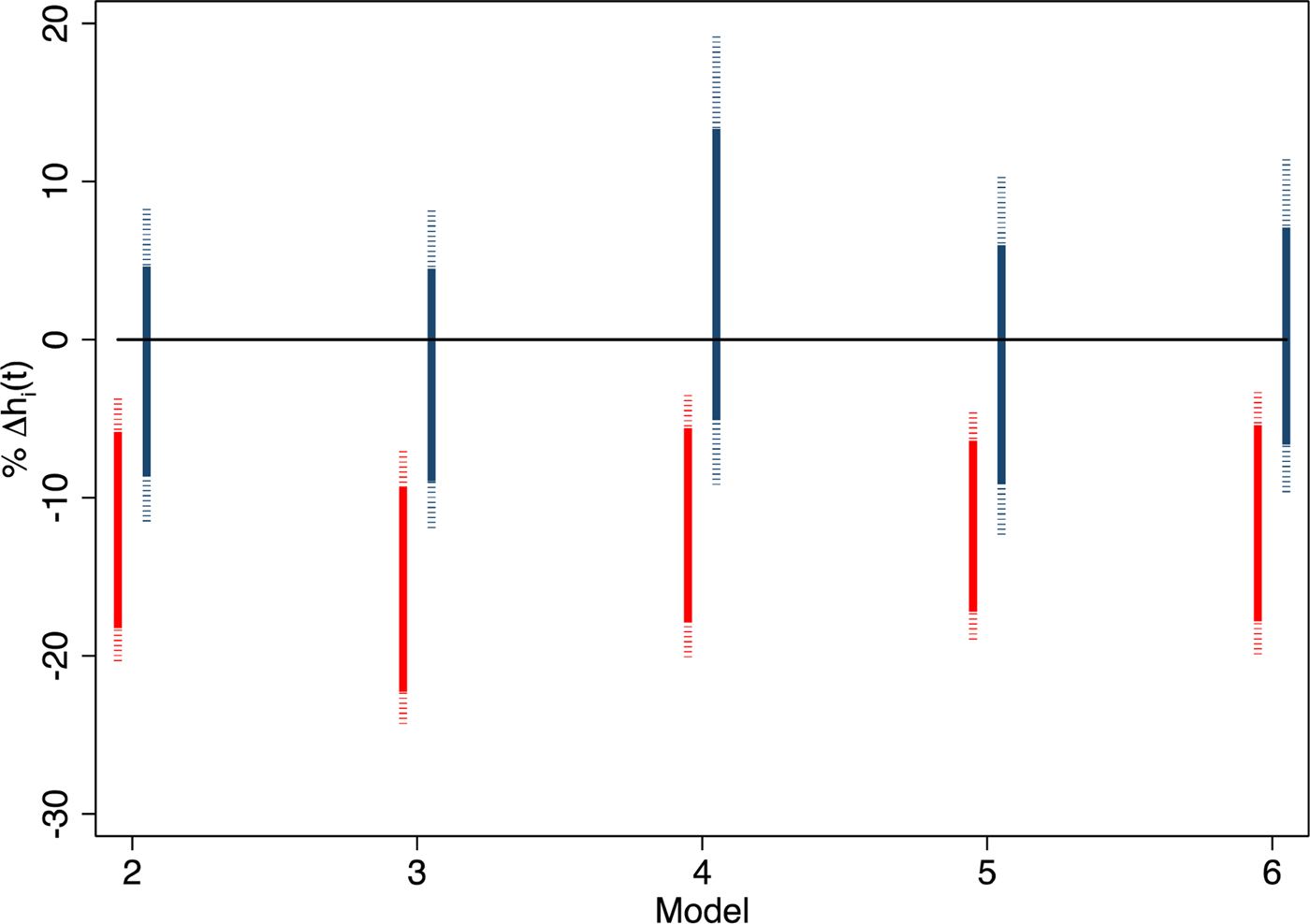
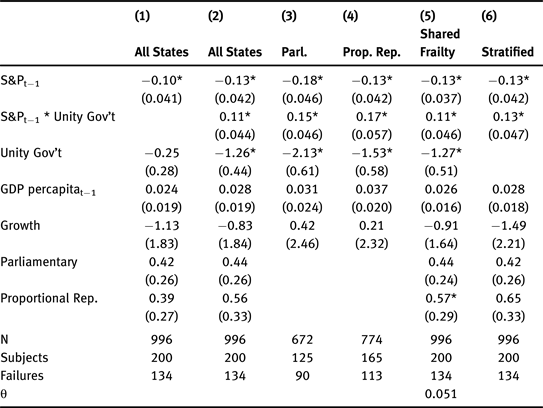
Table 2 presents the coefficients and standard errors of models estimating the duration of incumbent party survival. Model 1 indicates that S&P rating has a statistically significant and negative relationship with coalition failure unconditional on fiscal policy control. Model 2 indicates that the relationship between creditworthiness and survival is conditional on divided government. The significant and negative coefficient for S&Pt−1 indicates the effect when the incumbent party does not have control of the legislature. The interaction term (S&Pt−1 * Unity Gov't) is positive and significant, indicating that the negative effect is diminished under unity government. Figure 1 eases interpretation by plotting the 99 percent and 95 percent confidence intervals around the percent change in the hazard of coalition failure resulting from a one-unit increase in S&Pt−1 for each of the models reported in table 2. The figure indicates that creditworthiness only exhibits a statistically significant and negative relationship with tenure when an incumbent lacks a majority. Substantively, in these cases, a one-letter grade improvement in a country's credit rating corresponds with about a 12 percent reduction in the hazard of coalition failure.
First Difference of S&P Rating Under Divided and Unity Governments

Credit Rating, Divided Government & Survival

Standard errors in parentheses
* p < .05
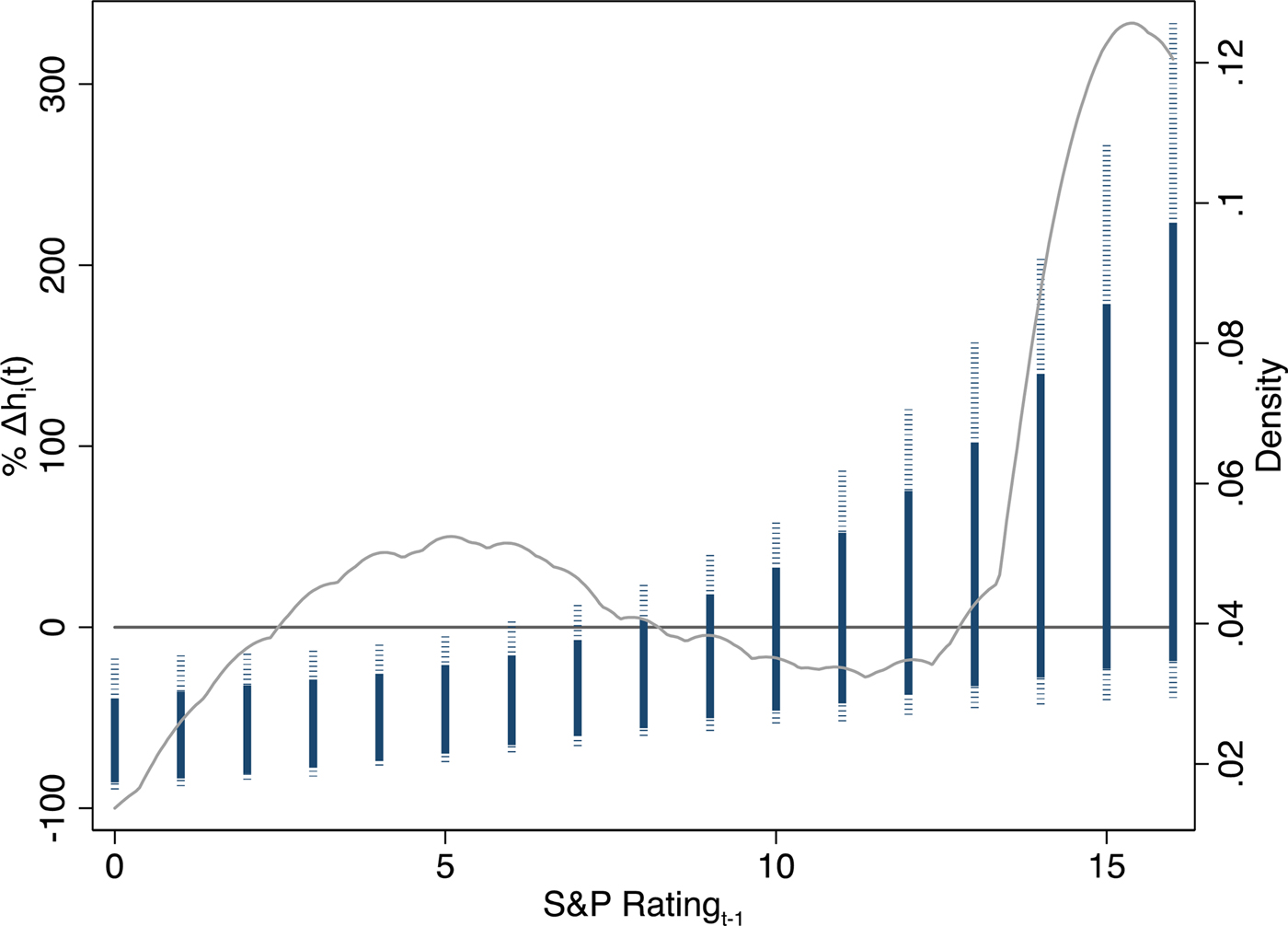
We also consider the symmetrical conditional effect by plotting the percent change in the hazard resulting from a change from divided to unity government across the range of S&P in figure 2. Again, the solid and dotted spikes indicate the 95 percent and 99 percent confidence intervals, respectively, around the mean percent change in the hazard. We see that the effect of our “conditioning” variable, unity government, is conditioned by creditworthiness. According to the estimates of model 2, unity government significantly decreases the hazard of coalition failure by about 67 percent when states have the lowest credit rating and that this effect becomes statistically insignificant at higher ratings. This is consistent with our theoretical expectations (Hypothesis 2) that creditworthiness alleviates obstacles imposed by opposition parties that make it difficult for incumbents to remain in office.
The First Difference of Unity Gov't Across S&P Rating (Model 2)

In models 3 and 4, we further address differences in electoral systems and restrict the sample to states with parliamentary systems and proportional representation, respectively. As reported in table 1, these subsets have the highest proportion of divided government. We find the same pattern in regards to the level of credit rating. In fact, the effect size appears to be stronger, as indicated in figure 1, among the sample of parliamentary systems. This gives us confidence that our findings are not the product of differences in legislative or electoral systems.Footnote 55
Our next model addresses country-level attributes that may cause some incumbent coalitions to leave office sooner than others and may also influence credit terms and the division of legislative power. We address this unobserved heterogeneity by incorporating a shared frailty parameter in model 5, which is analogous to estimating random-effects in a linear model.Footnote 56 The estimates and figure demonstrate the results are robust to the shared frailty parameter. This gives us greater confidence that our results are not driven by countries that have particularly short (or long) tenures that also have poor (or strong) credit ratings and unitary (or divided) government. Since the frailty parameter (θ) is insignificant, we do not estimate the parameter in the other models to avoid inefficient estimates.
Another concern is that the different hazard rates of divided and unity governments may bias our results. While we found no violations of the non-proportional hazard assumption, we address this concern further by stratifying our model by unity government. The raw data and the estimated baseline hazards indicate that unity governments have a substantively lower hazard of losing office than divided governments. Further, we demonstrated this relationship is conditional on credit ratings. Stratifying the model along this dimension will eliminate any effect the difference in the baseline hazards may exert on our estimates. The results are robust to this alternative specification.
The models presented thus far assume that the relationship between the executive and the legislature is exogenous to a state's credit terms. If poor or declining credit terms increase the probability that a unity government suffers losses that allow it to retain control of the executive but lose control of the legislature, this may obscure the relationship between credit and political survival. This is especially worrisome if this process systematically predicts how incumbents under unity government eventually lose office. However, subsequent analysis reveals that this process is not likely driving the results presented above. First, we found that credit rating did not have a significant relationship in a random-effects probit model estimating the presence of unity government. Further, we find that of the incumbents that at some point in their tenure experienced unity government and eventually lost office, only eleven of eighty-four transitioned to divided government during the course of their tenure. Of those eleven, four transitioned to divided government two years prior to losing office, and three transitioned four years prior to losing office. To demonstrate that our results are not driven by these cases, we excluded all incumbent spells in which unity governments lost legislative control during their tenure (11 spells, 151 observations). Our findings remain consistent with those presented above and give us confidence that our results are not the product of poor credit terms, increasing the probability of observing divided government.Footnote 57
Endogeneity
Previous studies have found that leader turnover, tenure, elections, and fractionalized governments increase uncertainty and contribute to higher borrowing costs.Footnote 58 Thus, a major concern with our analysis is that political changes can influence credit terms and thus reverse causality may bias our estimates. Alternatively, we may have omitted a variable that explains the interactive effect between divided government and credit ratings. We take several steps to demonstrate our results are not endogenous. First, we estimate our model with increasing lags of our credit rating variables. The results are consistent with those presented above for lags up until six years.
Next, we employ an instrumental variable approach. Our identification strategy exploits the considerable amount of sovereign credit risk variation that scholars attribute to external factors.Footnote 59 In particular, research suggests that diffusion and neighborhoods exert a strong influence on a state's individual credit rating. As Brooks, Cunha, and Mosley (Reference Brooks, Cunha and Mosley2015) explain, creditors confront “informational overload” when assessing sovereign risk and employ cognitive shortcuts, of which a country's neighborhood is one, to reduce the informational transaction costs associated with global lending. Consequently, we use the lagged regional average of IIR credit ratings to instrument a state's S&P ratings. Work by Gray (Reference Gray2013) demonstrates that creditors perceive a state that joins international institutions with highly creditworthy states as more creditworthy than economic fundamentals suggest. Thus, membership in notable IGOs affects credit terms independently of domestic electoral politics. Given this justification, we also employ binary indicators of membership in the Organization for Economic Cooperation and Development, European Union, International Monetary Fund, and World Trade Organization to predict S&Pt−1 in the first stage of our model. Our identification strategy rests on the assumption that a democratic leader's tenure does not influence the credit ratings of states in the region, nor does it influence a country's previous decision to join an international organization through pathways other than our included covariates like growth and GDP per capita.Footnote 60 Credit rating agencies face high transaction costs to acquire new information. Consequently, rating agencies use the creditworthiness of regional or IGO “peers” as informational shortcuts. This process explains the exogenous influence of peer effects on part of the credit rating variance, which is independent from the domestic determinants of creditworthiness. Previous research utilizes similar instrumental variables.Footnote 61
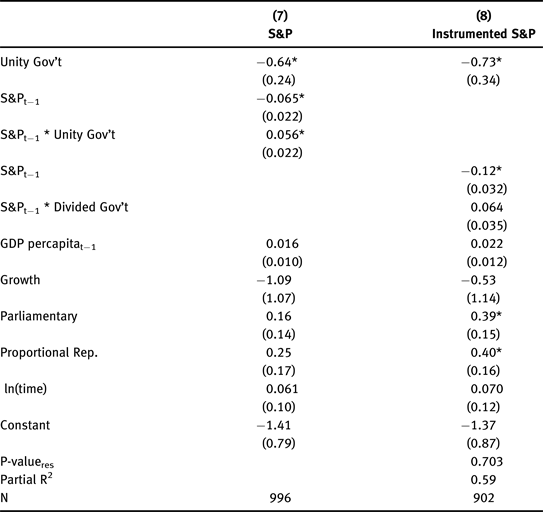
We are not aware of a method to employ an instrumental variable approach within the Cox model framework. Instead, we employ a random-effects probit estimating incumbent coalition failure and accounting for tenure by including the log of days in office on the right-hand side of the equation. Model 7 of table 3 demonstrates that the probit specification is consistent with the Cox model above with and without employing the instrumental variable.
Random Effects Probit Model While Instrumenting Credit Rating

Standard errors in parentheses
* p < .05
Further, diagnostics indicate the instruments are valid. At the bottom of table 3, we report that the partial R2 exceeds the 0.10 rule of thumb for correlation of the error and endogenous variable. Second, we report the p-value of the error of the first stage of the equation when included in the second stage. The high and insignificant p-value suggests that residuals are orthogonal to the dependent variable, satisfying the final condition for consistent and unbiased estimates.
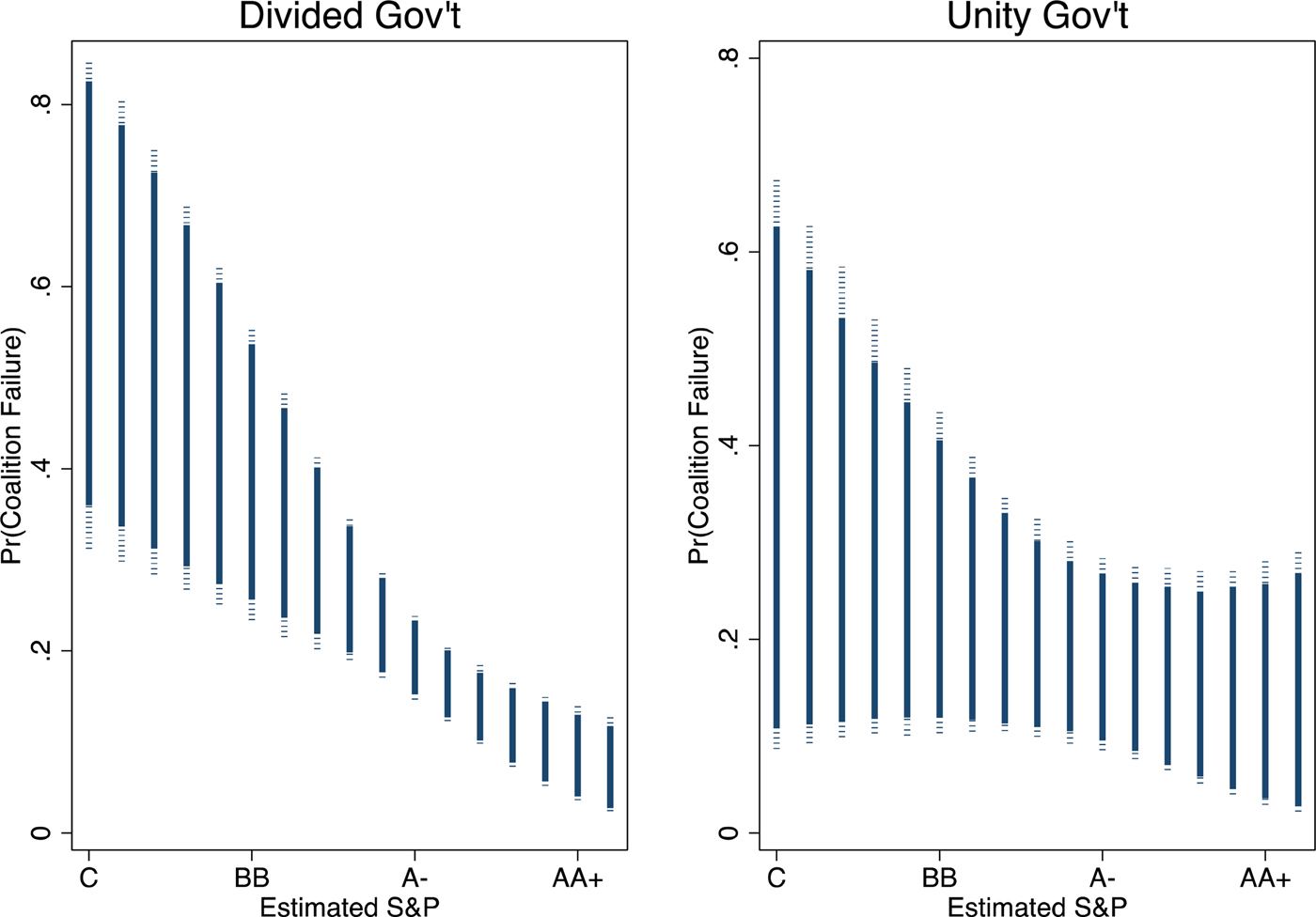
To assess the conditional hypothesis, figure 3 plots the confidence intervals around the predicted probability of failure across values of the instrumented S&P variable. The first panel confirms the significance of the relationship among divided governments. At various points, the confidence intervals at one point on the x-axis do not overlap with the confidence intervals at other points in either direction. This is not observed in the unity government panel. In all, this analysis provides further confidence that the results above are not generated by an endogenous relationship.
Predicted Probability Failure Across S&P\Rating in Divided and Unity

Alternative measure of creditworthiness
As we mentioned above, the S&P measure's coverage is limited in a way that might bias the sample towards highly creditworthy or politically stable democracies. To demonstrate the findings are not threatened by this possible selection bias, we present robustness checks using the IIR credit ratings discussed above. The measure increases the number of observations by 55 percent, including over ninety-two countries but limits the temporal scope to 1981–2007.
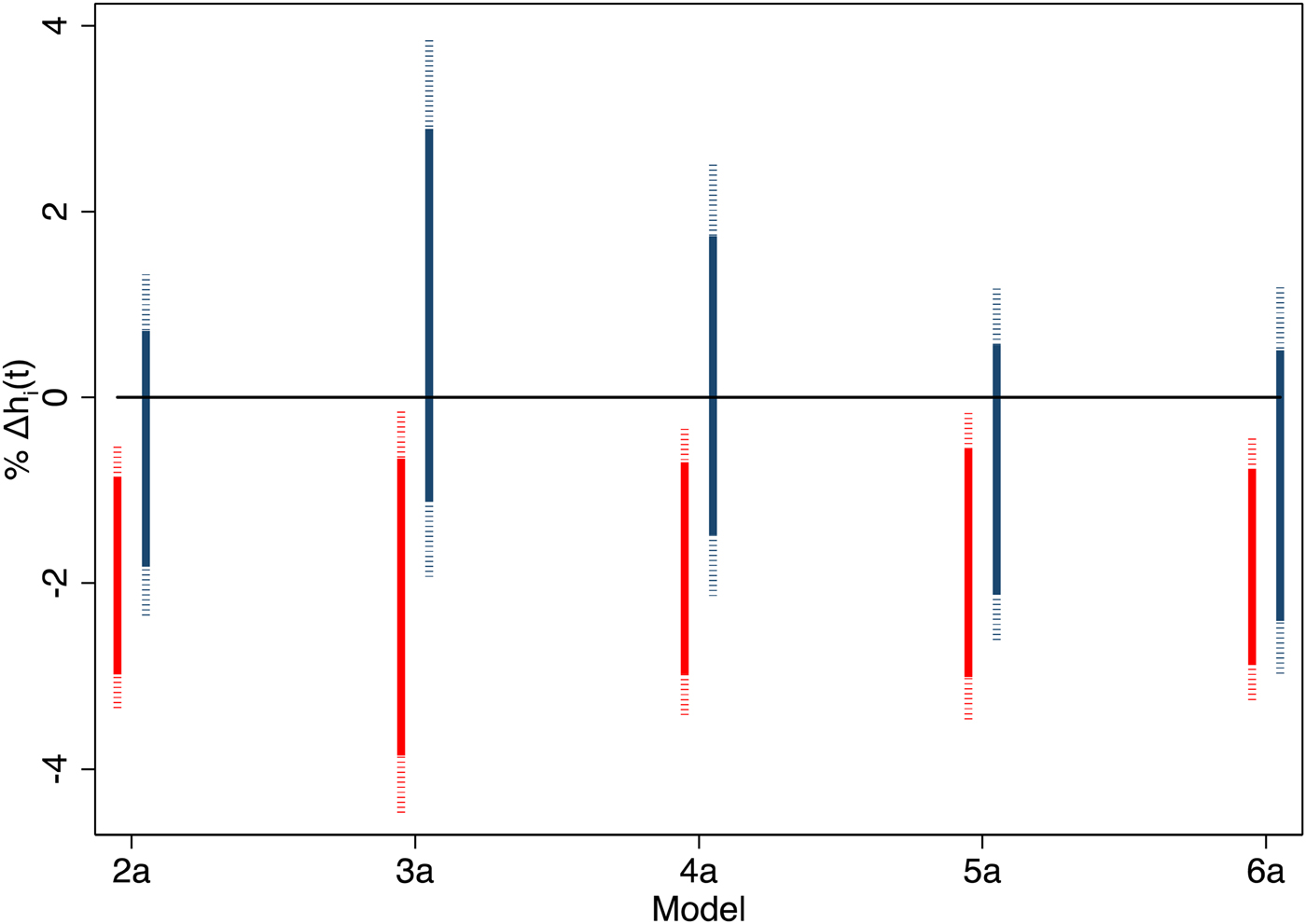
Figure 4 presented the first difference of IIR for both unity and divided government for five model specifications that are similar to those presented in table 2. The results are similar to those presented above and ameliorate concerns that our results are driven by the selection bias inherent in the S&P data.
First Difference of Institutional Investor Rating (IIR) Under Divided and

Additional confounders
Our preferred specifications included few control variables to avoid over-fitting. In addition, the instrumental variable models above lessen our concern that we are omitting confounding variables. However, we estimated additional Cox models including several potentially confounding variables to preempt concerns of confounding. We discuss the results here but present the tables in the Supplementary Appendix. We first examine several macroeconomic variables. These include inflation, budget balance, and debt burden (government debt/GDP). It is possible that the relationship between high credit ratings and political success reflect voters rewarding incumbents for policy competence. However, our central findings still hold up even when controlling for these economic outcomes, indicating credit terms’ impact on survival is independent of these measures. We were also concerned that rule of law may confound our relationship as more stable countries are less likely to experience breakdowns and also have better credit terms. We addressed this concern by controlling for judicial independence and find that our results remain robust.
Next, specific budget rules or institutions may prevent incumbents from abusing debt for political purposes,Footnote 62 and transparency might resolve issues regarding the clarity of responsibility that make abusing debt harder in unity governments.Footnote 63 We ran models which interacted with our binary indicator of unity government with S&P and, in separate models, transparency and the number of fiscal rules a country has adopted. We employ a measure of fiscal rules collected by the IMFFootnote 64 and data on the percentage of financial statistics reported to the IMF collected by Hollyer, Rosendorff, and Vreeland (Reference Hollyer, Rosendorff and Vreeland2014). Separate analyses indicate that favorable credit terms increase tenure among divided governments across the relevant values of both variables. Creditworthiness is insignificant for divided governments at all values of both variables.
Some studies have shown that right wing governments receive higher credit ratings because they can better commit to repay debts than left wing governments.Footnote 65 In a similar fashion to how we tested the impact of transparency and fiscal rules, we examine the impact of credit terms under unity and divided government across left and right governments. Our analysis indicates our hypothesized relationship holds up regardless of the incumbent's political orientation. This makes sense, as borrowing can be used to fund both spending and tax cuts.
Next, it is possible that the hypothesized relationship is driven by coalition politics. Bawn and Rosenbluth (Reference Bawn and Rosenbluth2006) and Persson, Roland, and Tabellini (Reference Persson, Roland and Tabellini2007) argue that large parties internalize more costs because they represent fewer groups and thus can bargain more efficiently than multiple parties. To demonstrate that we are not simply capturing this relationship with our measure of unified government, which is comprised of a large number of single-party majorities, we test if the effect of credit rating on incumbent survival is conditional on the number of parties in governmentFootnote 66 and then include this conditional relationship among our controls in an iteration of our main specification. We find that the effect of credit terms is constant across the number of parties in government. Our central results hold when controlling for a conditional relationship among the number of government parties and credit rating. Thus, we have some evidence to suggest that our research design is not picking up this alternative causal path.
Incumbent party vote share
We chose to examine coalition tenure in our primary analysis because it provides a useful metric to test our hypothesis across various types of political systems. Yet, the outcome has limited variance. It fails to directly measure the degree to which citizens were unsatisfied with incumbents. To demonstrate that the results are not a product of our choice of outcome, we now test our hypothesis on a more nuanced but cross-sectionally limited variable. We examine the relationship between credit ratings and the percent change in the incumbent party's vote in elections in twenty-three parliamentary democracies for which we have ratings data from 1975–2004.Footnote 67
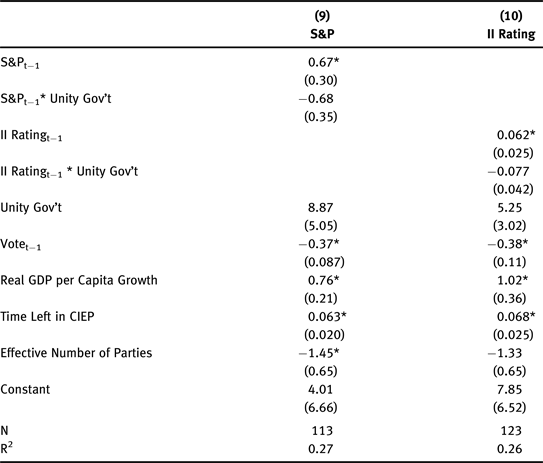
Table 4 presents the findings from two models predicting the percent change in the incumbent's vote share from the previous election to the current election employing either the S&P or IIR. In addition to the ratings, unity government, and their interaction terms, we control for the incumbent vote share in the previous election, growth, how early the election is, and the effective number of parties. Each model indicates that when unity government is equal to zero (an incumbent governs under divided government), a higher credit rating has a significant and positive relationship with the number of seats gained in an election. The interaction terms indicate that this effect is diminished and insignificant when an incumbent has political control of the legislature. This is consistent with the results above, predicting leader tenure and provides greater support for our primary hypothesis. However, in regard to our second hypothesis, we find that unity government has an insignificant impact on vote change across values of each credit rating variable.
Credit Rating, Divided Government & Incumbent Party Vote Change

Standard errors in parentheses
* p < .05
Conclusion
Sovereign credit markets are a fundamental source of revenue for modern governments. Considering sovereign credit's costs and benefits, we theorize that incumbent coalitions benefit politically from affordable access to sovereign credit, but only when fiscal control is diffuse. Our analysis of incumbent party duration in democracies is consistent with our primary expectations. We find that incumbent tenure is longer when states have higher credit ratings, though this relationship is only significant under divided government. Additional analysis indicates that this relationship is not likely a product of other institutional or economic factors, the endogenous influence of incumbent changes on credit ratings or model dependence.
If all governments have equal access to credit or operate under fixed budget constraints, our findings would be of little interest. However, sovereign credit terms exhibit significant temporal and cross-sectional variation. Beyond our evidence, recent and historical events demonstrate that variation in borrowing costs in times of crisis have clear political implications. We suspect most researchers appreciate this, however this realization has yet to significantly influence academic models of democratic politics. We have shown here that variation in creditworthiness has a substantively important impact on democratic political survival. Our findings are also suggestive of a broader relationship between credit and the actions that politicians take to secure their political survival. Consequently, our findings have broad implications for research on the relationship between government revenue, economic outcomes, and distributive democratic politics.
Supplementary material
To view supplementary material for this article, please visit https://doi.org/10.1017/bap.2018.2.