INTRODUCTION
The unsustainable trade in wild animals for meat, or ‘bushmeat’, is currently perceived as one of the most significant threats to wildlife populations in west/central African moist forests (Fa et al. Reference Fa, Currie and Meeuwig2003, Reference Fa, Albrechtsen, Brown, Macdonald and Service2006). Wild meat is an important source of animal protein for rural and urban peoples (Ntiamoa-Baidu Reference Ntiamoa-Baidu1997; Fa et al. Reference Fa, Ryan and Bell2005), and also a source of cash income for hunters, transporters and sellers.
Wilkie and Godoy (Reference Wilkie and Godoy2001) have suggested that demand for bushmeat depends on income elasticities, particularly in relation to price and availability of alternative meat sources (such as beef and chicken). Even assuming that consumers will shift to cheaper alternative protein regardless of taste preference, the crucial issue is still whether a sufficient volume of such meats is available. In Sub-Saharan Africa, agricultural productivity and hence the potential for countries in the region to supply alternative protein is severely compromised (Fa et al. Reference Fa, Currie and Meeuwig2003). This low agricultural output is likely to be due to poverty and stagnated or declining economies in the region.
No research in Africa has quantified volume of domestic and bushmeat protein available for a circumscribed human population. A reason may be that most areas where such triangulation might be done are geographically so extensive that data collection is not practicable. Here, we assess availability and consumption of animal protein within a discrete and manageable geographical unit, namely Bioko Island (Equatorial Guinea).
We used market surveys to estimate annual animal protein availability in Malabo city. From household studies, we assessed animal protein consumption per adult male equivalent (AME) and its relationship with household income. We used these results to assess dependence on either of the protein sources. Finally, we explored existing agricultural and commodity sectors on the island, and their potential for animal protein production and/or importation. We also examined whether the paradigm of providing sufficient and cheaply produced alternative meats to reduce demand for bushmeat is actually valid and applicable in Bioko's case. This is important, not just to protect the livelihoods of Bioko's inhabitants, but because the bushmeat trade seems certain to cause the extinction of a number of the island's endemic vertebrate species (Butynski & Koster Reference Butynski and Koster1994; Oates Reference Oates1996; Fa Reference Fa, Robinson and Bennett2000; Fa et al. Reference Fa, Garcia Yuste and Castelo2000; Hearn & Morra Reference Hearn and Morra2001).
METHODS
Study area
Bioko's rugged landscape (2017 km2) is characterized by deep valleys and dominated by two main volcanic massifs, the Caldera de Luba (2261 m) in the south-west, and Pico Basilé (3011 m) in the north. Vegetation is structured along altitudinal belts that include rainforest formations with montane elements at higher elevations (Juste & Fa Reference Juste and Fa1994). Climate is tropical equatorial with a definite rainy season (March–July); the southern part of the island receives >10 000 mm of rain annually, in contrast to a mean annual rainfall of 2000 mm in the north (Juste & Fa Reference Juste and Fa1994). Temperatures near sea level range from 17°C to 34°C.
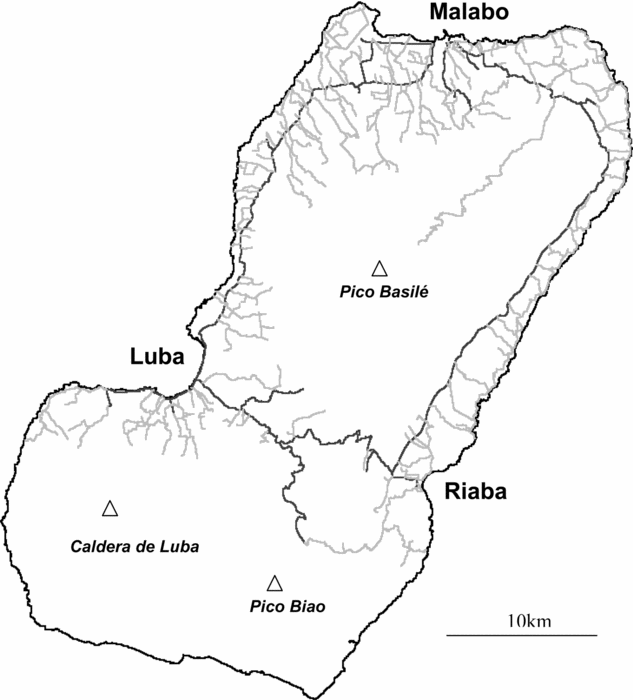
Bioko's human population is around 80 000 people, with around 60 000 in the island's capital and main city, Malabo. Most people live in the northern half of the island (Fa Reference Fa, Robinson and Bennett2000). There are few villages in the midlands or highlands, and approximately half of Bioko contains no permanent settlement (Fig. 1). Population density is high in the north (>100 inhabitants km−2), whereas there are <10 inhabitants km−2 in the south-west and south-east of the island. Two main ethnic groups inhabit Bioko; the Fang who originate from mainland Rio Muni, and the indigenous Bubi. The Fang are the politically-dominant group, and constitute the majority of the population in Malabo (Oficina Central del Censo 1997).
Map of Bioko Island showing main roads (light and dark grey lines), the study city, Malabo, and the towns of Luba and Riaba (both c. 7000 inhabitants).

Data collection
Animal protein availability
We gathered data on animal protein sources available to the Malabo population. Before the start of the study, we interviewed a number of Malabo residents to assess the presence of all sale points for bushmeat, fresh and frozen meats, fish and shellfish in the city. From these informants, we established that the main sources of animal protein in the city were the central Malabo market for bushmeat and fresh small livestock meats, beef (on the bone and different cuts) from a main butcher outside the central market, and fish from the fish market.
We employed a recorder (a local vendor) to document all transactions. A research assistant, also employed by the project, supervised and sometimes assisted in data collection. Record sheets were inspected bi-weekly by the project managers (Lise Albrechtsen or Brigid Barry).
Over a four-month period from December 2003 to March 2004 (86 market days including Saturdays and Sundays), we collected information on the number of bushmeat carcasses entering the main Malabo central market. Data collected for each carcass included species, age (juvenile or adult), sex, weight (collected at random), capture method, geographical origin and sale price (in CFA francs). For a subset of carcasses, additional information included price offered for the meat by the seller to the transporter and to the hunter.
Availability of fresh goat, pork, lamb, duck and chicken (including live birds), hereafter referred to as small livestock meats, was assessed by counting volume sold (as whole carcasses or pieces) in the central Malabo market. Most small livestock meats entered the market as whole carcasses, but pigs were often sold in parts (head, legs and intestines). Fresh beef (on the bone and different cuts) was also recorded. Daily amounts of small livestock meats and beef on sale were recorded during February–March 2004, for 44, and 35 market days, respectively (Monday–Saturday, there was no official market on Sundays).
The two main wholesalers (Santi and Martinez), who sold meat to market vendors, provided information about the amounts of frozen meats and fish imported on a monthly basis in kilograms.
Fresh sea fish (no freshwater fish were recorded) and shellfish were sold six days per week in the fish market. This market opened twice a day, with a small amount of stock being sold in the morning, but most sales occurring in the early evening when fishers returned with their catch. Shellfish were sold in bundles (7–8 individuals in each) or buckets (1.5–2 kg), usually in the early morning. We recorded volume and price of all fish and shellfish sold during 43 market days (Monday–Saturday) in February–March 2004.
Household meat consumption
Meat consumption data were collected using semi-structured interviews from a sample (n = 198) of Malabo households. Interviews were applied to randomly selected households from seven neighbourhoods, during December 2003–March 2004. Most households interviewed were Fang (n = 128), the remainder being Bubi (n = 45), Annobonese (n = 10) and from other ethnic groups (n = 15). The questionnaires were written in Spanish, and applied in Spanish and/or Fang.
To include homes away from the main streets, we selected houses at random by coin flipping and using a random number table. If the head of the household or the first wife were not available for interview, or if no interview was possible, we would toss the coin again to select another house to the left or right. All informants were open and relaxed, and their responses showed a high degree of consistency when subject to direct observation and cross-referenced to other informants.
We gathered information on all meats consumed by the sampled households, by a 24-hour recall of all items purchased the day before the interview intended for that day's main meals. We also recorded origin of the purchased items (market, neighbourhood, forest or other). We recorded income and household occupancy (number of women, men and children belonging to the household) for all sampled households. Occupancy of each household was converted into AMEs. A male person aged >10 years was 1 AME, females aged >20 years = 0.72 AME, females 10–19 years = 0.84 AME, and all children aged <9 years = 0.6 AME (Ministry of Agriculture/Michigan State University/USAid Research Team 1992). In this study, an average household contained 6.1 ± 2.2 AMEs. In the analyses, household size refers to the number of AMEs per household.
Although wealth is considered to be a key factor determining patterns of meat consumption (Wilkie & Godoy Reference Wilkie and Godoy2001), East et al. (Reference East, Kümpel, Milner-Gulland and Rowcliffe2005) showed that for a sample of households in Rio Muni wealth indicators (such as lighting and cooking facilities) were correlated with monthly income. Thus, in this study, we directly correlated income with meat consumption. Income categories were self-defined by the interviewed main earners. We allowed the interviewees to indicate their monthly income from 11 income categories. However, because of small sample sizes in some income categories, we collapsed the 11 income categories into six, ranging from 1 (income US$ 0–50 month−1) to 6 (income >US$ 251 month−1). Income distribution was log-normal, with a modal category of US$ 50–100 month−11 and with 70% of households earning US$ 0–150 month−1.
Data analyses
Animal protein availability
We estimated average daily volume of each meat type available in Malabo from data gathered during sample days. From these, we calculated annual availability by multiplying daily averages by 365 days for bushmeat (sold every day of the week), or by 313 days for small livestock meats (not available on Sundays).
Mass of bushmeat and small livestock meat (in kg) available per year was calculated by multiplying the estimated annual number of animals sold, by the average undressed weights of each species for bushmeat (Fa & Purvis Reference Fa and Purvis1997), small livestock (Payne Reference Payne1990), chickens (Kitalyi Reference Kitalyi1998), and actual recorded weights for fish. Dressed meat weights (the weight of an animal after eviscerating, removing the hide or skin, and/or otherwise preparing the animal's carcass for cutting and further processing) were taken as 60% of the original weight of an animal for bushmeat. Beef mass sold per year was obtained directly from weights registered during our study. Edible proportion for fish was taken from Holland et al. (Reference Holland, Brown and Buss1993), and for small livestock meats from Chan et al. (Reference Chan, Brown, Church and Buss1996) and Payne (Reference Payne1990).
Animal protein availability was calculated by multiplying the annual dressed meat mass for each meat type by their respective protein content (per 100 g of meat). Protein value of beef and small livestock meats (mutton, chicken or pork) is around 25 g protein per 100 g of meat (Wilson et al. Reference Wilson, Fisher and Garcia1979), and slightly higher (27.5 g per 100 g meat) for bushmeat (Ntiamoa-Baidu Reference Ntiamoa-Baidu1997). For fish, average protein was 18.8 g per 100 g (Holland et al. Reference Holland, Brown and Buss1993).
Household meat consumption
Volume of meats consumed was estimated as the average weight (in grams) per AME by meat type. Protein consumption per AME was derived by multiplying the weight consumed, by the protein value of each meat type.
RESULTS
Volume and animal protein availability
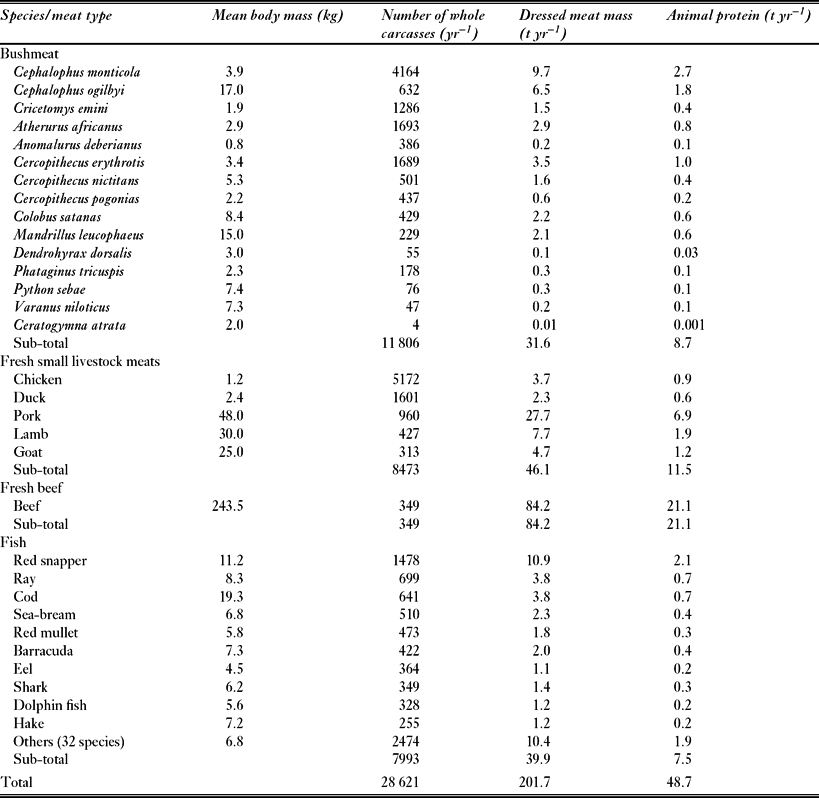
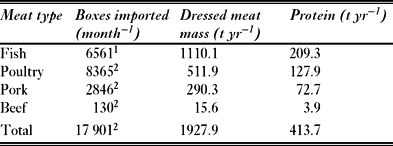
We estimated the volume of dressed meat produced in the island and sold in Malabo, to be 201.7 t yr−1 or 48.7 t of animal protein yr−1 (Table 1). Imported frozen meats (fish, poultry, pork and beef) represented another 1927.9 t of dressed meat yr−1, or 413.7 t protein yr−1 (Table 2). Thus, a grand total of 2129.6 t of dressed meats (462.4 t protein yr−1) per annum was available within Malabo.
Annual dressed meat mass and animal protein produced on island, and traded in Malabo.

Bushmeat from 16 species accounted for 31.6 t year−1 of dressed meat (8.7 t protein) or 15.7% of the total amount of meat on sale, with four species (blue duiker Cephalophus monticola, brush-tailed porcupine Atherurus africanus, russet-eared guenon Cercopithecus erythrotis and giant pouched rat Cricetomys emini) representing 73% of all carcasses sold (Table 1). Locally produced small livestock meats and beef amounted to 130.3 t yr−1 of dressed meat (32.6 t protein yr−1), with poultry (chicken and duck) being the most abundant and lamb the least available (Table 1). A total of 84.2 t yr−1 or 21.1 t protein yr−1 of Bioko beef was available. Of the imported frozen meats, over 83% of these were poultry (46%) and fish (37%), with beef representing only 0.7% of total imports (Table 2).
Volume of frozen dressed meats imported for direct sale and re-sale to Malabo (130 kg meat per box, 210 kg meat per box).

Fish (n = 41 species) contributed 39.9 t of dressed meat year−1 (7.5 t protein yr1), but an additional 0.8 tonne of dressed meat (0.2 t protein yr−1) was available from locally caught crabs, crayfish, sea snails and prawns.
Household meat consumption
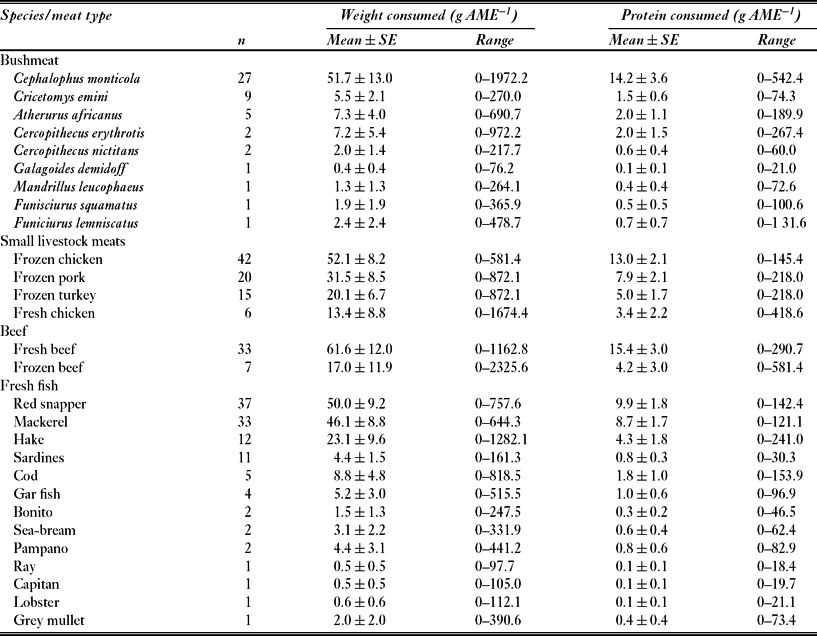
The vast majority (97%) of meat and fish consumed the day before by households was bought (76% in the Malabo market, 18% in the forest, 3% gift from neighbours or hunters). In our sample, fresh and frozen beef, chicken and pork were consumed as well as bushmeat and fresh fish (Table 3). Four primates were eaten, namely drill Mandrillus leucophaeus, and two guenons (Cercopithecus erythrotis, and the putty-nosed guenon C. nictitans), as well as the nocturnal Demidoff's galago Galagoides demidoff. Four rodents (Atherurus africanus, Cricetomys emini and two squirrel Funisciurus spp.) and one ungulate (blue duiker) were reported. The blue duiker was also the most consumed bushmeat species. A total of 14 fish species were eaten; the most commonly consumed being red snapper, mackerel and hake.
Mean (±SE) and range of weight and protein consumed (in grams per AME) according to the different meat sources reported in the household survey for Malabo inhabitants (n = number of households, out of a total of 198, in which the meat item was recorded as eaten).

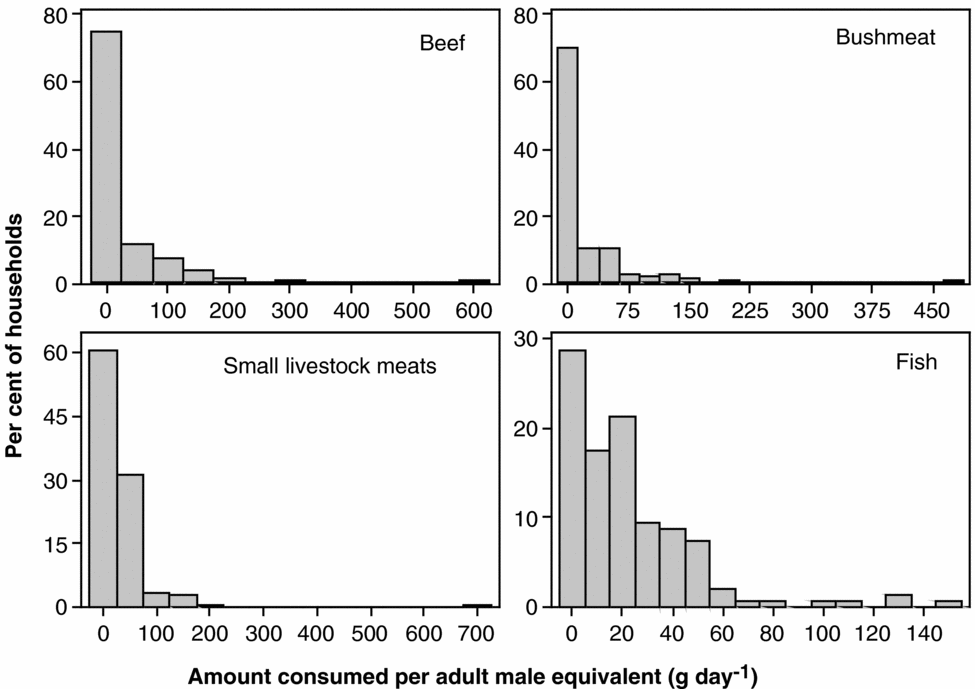
The amount of meat consumed by the subjects in our sample was significantly skewed in all types; the median value in all types was zero. An average of 78.8 ± 15.5 g AME day−1 of bushmeat (median 0 g) was eaten, compared with 116.3 ± 11.2 g AME day−1 of fish (median 87.4 g), and 121.0 ± 21.6 g AME day−1 (median 62.5 g) of small livestock meats (Fig. 2). In terms of protein, this amounted to 26.3 ± 5.5 g AME day−1 (median 0 g) for beef, 21.7 ± 4.3 g AME day−1 for bushmeat (median 0 g) and 30.3 ± 5.4 g AME day−1 for small livestock meats (median 15.6 g).
Protein consumption (g day−1) per adult male equivalent of beef, bushmeat, small livestock meats and fish consumed in Bioko households.

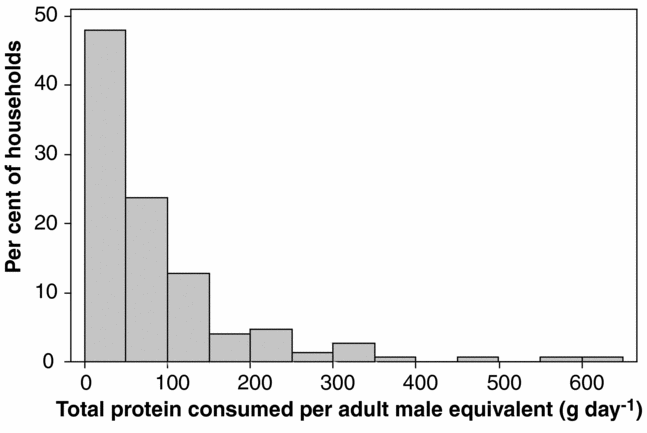
The average total amount consumed of all meats was 384.8 ± 34.9 g AME day−1 (median 220.6 g), or 91.3 g protein AME day−1 (median 52.2 g). However, almost half of all households consumed less than 50 g protein AME day−1 (Fig. 3). Beef on its own was reported to have been consumed by 6.7% of interviewed households, whereas only 2.7% of households ate bushmeat only the day before. In contrast, 23.5% and 20.1% of households solely consumed small livestock meats and fish, respectively. Household income did not explain consumption of beef (r 2 = 0.05; F 1, 36 = 2.6; p = 0.12) or fish (r 2 = 0.01; F 1, 107 = 0.7; p = 0.40), but was positively correlated with small livestock meats (r 2 = 0.07; F 1, 95 = 4.2; p = 0.04) and negatively with bushmeat (r 2 = −0.16; F 1, 40 = 5.8; p = 0.02). However, overall protein intake per AME was not related to income (r 2 = 0.002; F 1, 143 = 0.1; p = 0.73) but was significantly negatively correlated with household size (r 2 = 0.24; F 1, 145 = 22.7; p = 0.000); ethnic group appeared to have no effect.
Overall protein consumption (g day−1) per adult male equivalent of all meats and fish consumed in Bioko households.

DISCUSSION
This paper aimed to assess overall animal protein availability within the main city in Bioko Island, Malabo, and ask whether its inhabitants depended on the island's critically-endangered wildlife. Our study showed that the Malabo population primarily consumed domestic meats, only a small proportion being bushmeat. We also calculated that a minimum of just over 2100 t of meat/fish, or around 460 t of animal protein, were traded per annum and available for consumption in Malabo. This means that if we suppose an average recommended daily allowance (RDA) of 52 g protein day−1 were made available per person (FAO & WHO [Food and Agricultural Organization of the United Nations and World Health Organization] 1985; Fa et al. Reference Fa, Currie and Meeuwig2003) and if the main protein source were only animal, then 460 t of animal protein could only supply 24 000 adults, which is a mere 40% of the current Malabo population. In contrast, our household survey data showed that the median consumption rate was around 50 g protein AME day−1. At such a level, 953 t of animal protein would be consumed annually, but only half of this was accounted for by sales in the city.
The discrepancy between consumption and estimated availability in this study epitomises the debate over how to measure the extent of the relationship between food access and consumption. Efforts to estimate the extent to which food availability is linked to food access is hindered by a number of measurement problems, including estimating informal transactions, black market dealings and leaks across national borders (Hay Reference Hay1978). Moreover, such estimates of commercial food availability do not account for the great proportion of food in many African countries which is produced for home consumption, and thus ‘does not pass through commercial channels where it might be (easily) monitored’ (Poleman Reference Poleman, Johnson and Schuh1983). Such production for home consumption is by no means necessarily correlated with changes in commercial (market) food availability. One alternative to such surveys which directly estimate food intake is to calculate ‘household calorie availability,’ used in this study, by employing information on home food production, food purchases, food sales, gifts and changes in food stocks to estimate food intake. But the combination of errors in the estimates of each of these variables raises serious reliability concerns as well. Estimating the usual intake of a group is complicated by large variations in daily intake, between individuals and by season. Individuals also vary in their requirements for energy and nutrients. Twenty-four-hour recalls are the most widely used instrument to evaluate energy and nutrient intake. For most nutrients, an average of three or more 24-hour recalls on non-consecutive days produces a reasonably accurate estimate of intake for an individual, however because our study was aimed at ascertaining broad patterns of protein consumption and availability, we applied our questionnaire only once per household, but increased the number of households sampled (Nelson Reference Nelson, Margetts and Nelson1997). Given this, measurements of animal protein sold in Malabo may have been more accurate for estimating availability than merely extrapolating from the median consumption value from household surveys. Hence, consumption data become more valuable in assessing the profile of animal protein use and the relative importance of the different sources, whereas the availability information can be used to approximate food security in the city.
The effect of income on animal protein sources noted in this study is of significance. The use of household surveys in which respondents self-report their incomes (or expenditures as a proxy for income) has been the most common approach for monitoring income, but the reliability of income survey data has been seriously questioned. Such reliability problems may result from such as imperfect recall by respondents and imperfect communication with surveyors, but also from respondents being likely to engage in strategic behaviours (responses) if they perceive that such things as tax payments or eligibility for public assistance will be based on their survey answers or observed behaviours. The effect of such biases in our results is difficult to ascertain, however, our results show that bushmeat is relatively more important for poorer households and that small livestock meat consumption increases with income but fish and beef are unaffected. Such relationships are not dissimilar to findings by de Merode et al. (Reference de Merode, Homewood and Cowlishaw2004) and East et al. (Reference East, Kümpel, Milner-Gulland and Rowcliffe2005), but unlike those of Wilkie and Godoy (Reference Wilkie and Godoy2001) and Wilkie et al. (Reference Wilkie, Starkey, Abernethy, Nstame Effa, Telfer and Godoy2005) who show that more fish and beef are eaten as household income rises. The lack of effect of income on beef consumption could be affected by high price (see Reid et al. Reference Reid, Morra, Posa Bohome and Fernandez Sobrado2005) or taste preference. In fact, the East et al. (Reference East, Kümpel, Milner-Gulland and Rowcliffe2005) study that included meat preferences for inhabitants in Bata (also in Equatorial Guinea) showed that beef was one of the least preferred. Hence, higher income households may be choosing to eat more small livestock meats and less bushmeat and beef, whereas lower income households may rely more on bushmeat as their main source of protein, because of lower prices. The more expensive meats (such as primates like the drill) may be being consumed by wealthier households, while rodents and blue duiker may be the mainstay of poorer people.
Food insecurity and malnutrition have been primarily viewed at least until recently by policymakers as a food availability problem (Franklin & Harrell Reference Franklin and Harrell1985). And food availability, in turn, has often (and often mistakenly) been viewed as a food self-sufficiency problem, that is, a question of meeting domestic food needs with domestic food production. As a result, government food security strategies have often (at least implicitly) emphasized increasing national-level food availability through expanded domestic food production as the key means for addressing food and nutrition-insecurity problems (Kennedy & Bouis Reference Kennedy and Bouis1993).
Food availability is, of course, a prerequisite for food access, and domestic production is one means for achieving adequate availability. However, domestic production strategies are not necessarily the best means for ensuring availability, as many economists have shown that having some reliance on imports may be a less costly way of procuring domestic food needs. Moreover, increased food availability at national or regional levels by no means ensures increased household-level access to food. Numerous recent studies, in Africa and elsewhere, have shown that an adequate supply of food at the national level is no guarantee against hunger (Sen Reference Sen1983). In fact, widespread hunger is common even in some countries which produce surplus food for export; the World Bank observes that in some countries, 20–30% of a country's population may be consuming <80% of caloric requirements, even though national-level food availability is at or greater than 100% (Kennedy & Bouis Reference Kennedy and Bouis1993).
From supply figures calculated here, only a very small proportion of protein available in Malabo (7%) was produced in-country. Essentially, fish and bushmeat, and a limited proportion of small livestock meats (from surrounding villages), came directly from the island. But, can the island produce more animal protein? After independence in 1968, around 45% (38 800 ha) of the land cultivated during colonial times was left abandoned in Bioko (Butynski & Koster Reference Butynski and Koster1994). Presently, most of this land is still under secondary forest and scrub, but some revitalization is possible (Fondo Europeo de Desarrollo/Dwars, Heederik en Verhey 1989). If unused agricultural land area were dedicated to rearing small livestock animals, around 6208 tropical livestock units (TLUs) is possible, given 100 ha of pasture land can support 16 TLUs (i.e. cattle, sheep or goats; Livestock Environment & Development Initiative 1999). This amounts to 3800 cattle and > 2200 sheep and goats or 295 t of animal protein, but it is insufficient to supply the current and expected future population on the island. Although Bioko may increase its meat production, constraints in adequately maintaining livestock, ranging from lack of husbandry skills and veterinary backup, and complicated land tenure rights, insecure financial assets and poor infrastructure, may make it unrealistic (Bender Reference Bender1992). Thus, dependence on imports is a real possibility, especially given the country's relatively high income. However, even if imports were to be increased to meet theoretical demands of the population, access to these resources depends on people having the disposable income to buy the products; the skewed distribution in animal protein consumption reported in this study indicates disproportionate access related to income. The consequences of this are clearly indicated by 19% of children under five years in Equatorial Guinea suffering from stunting, an indicator of chronic malnutrition (United Nations Development Programme 2004).
Fa et al. (Reference Fa, Currie and Meeuwig2003) suggested the need to understand whether bushmeat is a necessity, or merely a commodity, in the different parts of Africa where it is consumed. Although it is likely to be a combination of both, it is important to understand the influence of each of these factors. In this paper, we have shown that at least for the island of Bioko there is not enough protein to supply all current and anticipated future needs of the population. And if economic conditions were to drop to previous levels, the threat to locally-produced sources of protein (namely bushmeat) could increase to devastating levels. With rare exceptions (for drought, war or famine conditions brought on by either), food must be available at adequate levels to meet minimum needs of most populations, even rural, and is often plentiful in urban areas. However, there are no guarantees that all segments of the population will have sufficient or timely access to these food supplies. It is crucial to resolve how the annual animal protein provided by wildlife can be covered by access to other meat types. Solutions to how bushmeat trade can be altered, reduced, controlled or stopped altogether from entering the Malabo market is complex. The chain from hunter to consumer involves several players, each of whom would require alternative employment options (Reid et al. Reference Reid, Morra, Posa Bohome and Fernandez Sobrado2005). These changes will only be possible when a system of compliance is in place. This compliance will only be acceptable when more realistic alternative livelihoods are provided, which must also include a strict control system to ensure recovery of the already heavily depleted animal populations on the island.
ACKNOWLEDGEMENTS
Support for this research was received from the Biological Diversity – Dynamics, Threats and Management Programme of the Norwegian Research Council and from the UK Government Darwin Initiative (Project No. 162/10/004). We thank the national conservation institute (INDEFOR) for all their help and assistance in executing the fieldwork and give special thanks to Crisantos Obama, Juan de la Puente, Pelagio Mangué Mbomio Mbengono, Joaquin Nvó Nvó, Antonio Joalin, Santiago Enseng and all the market vendors in Malabo.