Introduction
Haemonchus contortus is a blood-feeding gastrointestinal parasite of small ruminants, which is a global problem for animal health and livestock productivity (Peter & Chandrawathani, Reference Peter and Chandrawathani2005). Like other parasitic nematodes of livestock, it is controlled primarily by administration of anthelmintic drugs such as benzimidazoles and macrocyclic lactones. Resistance to anthelmintics is a widespread problem for parasite control, and reports of H. contortus resistant to multiple classes of anthelmintics are becoming increasingly common (Wolstenholme et al., Reference Wolstenholme, Fairweather, Prichard, von Samson-Himmelstjerna and Sangster2004; Howell et al., Reference Howell, Burke, Miller, Terrill, Valencia, Williams, Williamson, Zajac and Kaplan2008).
The molecular mechanisms underlying drug resistance in parasitic nematodes are still not fully understood. Changes to the drug target site are clearly associated with benzimidazole resistance, and may also play a role in resistance to other classes of anthelmintics (Hodgkinson et al., Reference Hodgkinson, Clark, Kaplan, Lake and Matthews2008; Fauvin et al., Reference Fauvin, Charvet, Issouf, Cortet, Cabaret and Neveu2010). However, as an additional or alternative explanation for parasite resistance to multiple drug classes, detoxification mechanisms have also been implicated, including the P-glycoproteins (P-gps) (Xu et al., Reference Xu, Molento, Blackhall, Ribeiro, Beech and Prichard1998; Molin & Mattsson, Reference Molin and Mattsson2008). P-gps are members of the ATP-binding cassette (ABC) family of efflux pumps known to remove hydrophobic xenobiotic molecules from cells, and are thought to be involved in protection against antiparasitic drugs in a range of species (Ouellette & Borst, Reference Ouellette and Borst1991; Bourguinat et al., Reference Bourguinat, Ardelli, Pion, Kamgno, Gardon, Duke, Boussinesq and Prichard2008). P-gps from H. contortus have previously been associated with resistance to both benzimidazoles and macrocyclic lactones (Blackhall et al., Reference Blackhall, Liu, Xu, Prichard and Beech1998, Reference Blackhall, Prichard and Beech2008).
Despite the apparently clear association between P-gps and resistance to antiparasitic drugs, there have been few attempts to completely describe the P-gp gene families of parasitic nematodes. A very comprehensive analysis of the Brugia malayi genes encoding P-gps and other ABC transporters was recently published by Ardelli et al. (Reference Ardelli, Stitt and Tompkins2010), and such studies will be invaluable for designing assays to assess changes in parasite P-gp expression associated with drug exposure and resistance. The genome sequence of the model nematode Caenorhabditis elegans contains 14 functional P-gp genes (pgp-1 to pgp-14), and this would make a logical starting point for searching for homologous genes in related nematode parasites (Kerboeuf et al., Reference Kerboeuf, Blackhall, Kaminsky and von Samson-Himmelstjerna2003a).
The aim of the work presented here was to search for homologues of the C. elegans P-gp genes in the genome sequence of H. contortus, and confirm their expression by polymerase chain reaction (PCR). This was used as a starting point in the development of a quantatitive real-time PCR assay that could be used to detect any changes in P-gp mRNA expression levels associated with drug resistance in H. contortus. Preliminary data are presented showing that no large changes in the expression of P-gp genes were found in an ivermectin resistant isolate of H. contortus selected over three generations using the protocol described by Coles et al. (Reference Coles, Rhodes and Wolstenholme2005), when compared to the drug-susceptible parent isolate.
Methods
Parasites
Haemonchus contortus L3s were supplied by Dr Gerald Coles, University of Bristol, UK, or Alison Donnan, Moredun Institute, Penicuik, Scotland, UK. Ivermectin-susceptible worms were the inbred ISE isolate, also described as MHco3 (Roos et al., Reference Roos, Otsen, Hoekstra, Veenstra and Lenstra2004; von Samson-Himmelstjerna et al., Reference von Samson-Himmelstjerna, Walsh, Donnan, Carriere, Jackson, Skuce, Rohn and Wolstenholme2009). Ivermectin-resistant worms (ISE-IVMR) were selected from ISE by in vivo ivermectin treatments with increasing doses over three generations, as described previously (Coles et al., Reference Coles, Rhodes and Wolstenholme2005). When a lamb was infected with the resistant isolate and treated with ivermectin at 0.2 mg/kg, fecal egg counts were reduced by only 24%.
Bioinformatics
Nucleotide sequences for the 14 P-gp mRNA transcripts from C. elegans were obtained from the GenBank database (http://www.ncbi.nlm.nih.gov/nucleotide). These sequences were each used to perform a TBLASTX search of the H. contortus genome sequence (http://www.sanger.ac.uk/cgi-bin/blast/submitblast/h_contortus, 26 August 2009 supercontigs). A reciprocal TBLASTX search was then performed, where the matching regions of H. contortus sequence were used to search the GenBank database, restricting the search to C. elegans sequences. This allowed identification of H. contortus sequence which was homologous to partial coding regions of the C. elegans P-gp genes.
Amplification of H. contortus P-gp cDNAs
RNA was extracted from L3 larvae of the ISE isolate using the Trizol reagent (Invitrogen, Carlsbad, California, USA) and cDNA synthesized using the Accuscript reverse transcriptase (Agilent, Santa Clara, California, USA) according to the manufacturer's instructions. P-gp cDNAs were amplified using GoTaq® DNA polymerase (Promega, Madison, Wisconsin, USA) and specific oligonucleotide primers. For actin, Hco-pgp-1, Hco-pgp-2 and Hco-pgp-12 the primers used in the amplification of the partial cDNAs were the same as those used in the quantitative real-time reactions. The other specific oligonucleotides used were:
Hco-pgp-3 (forward): GTATATACGAGCACGAATCTC;
Hco-pgp-3 (reverse): CCACACAAAGCATCGTAGTATCG;
Hco-pgp-4 (forward): CATTCATTTCACTTATCCGTC;
Hco-pgp-4 (reverse): GACTATATGTCCCTCGTCG;
Hco-pgp-9 (forward): GTGAAACGATAGCATTGGTG;
Hco-pgp-9 (reverse): GTAAACGATTGCACAAAGTT;
Hco-pgp-10 (forward): GATCGCGATAGCTCCAGCCG;
Hco-pgp-10 (reverse): TCATTTGCACGATCCGAATG;
Hco-pgp-11 (forward): CAACGCAGGAACGATCACCA;
Hco-pgp-11 (reverse): TGTCCGTTGCAAGCTGCGAC;
Hco-pgp-14 (forward): CCTCGACAGCCGATAATGAG;
Hco-pgp-14 (reverse): CCACTCCTAAGCCGAAACA.
Partial cDNAs were cloned into the pGEM-T easy vector (Promega) and sequenced (Genewiz Inc., South Plainfield, New Jersey, USA).
Quantitative real-time PCR
Primers were designed to amplify regions of the partial pgp sequences which would be an optimal amplicon size for quantitative PCR, and optimization was carried out to test each primer pair and ensure that only a single PCR product was amplified, with no primer–dimer formation, for each reaction. Primers based on the actin sequence (accession number DQ080917) were also designed, in order to amplify a control gene with no change in expression levels between the susceptible and resistant worm populations. Several candidate control mRNAs were evaluated for use as controls, including β-tubulin, glyceraldehyde 3-phosphate dehydrogenase (GAPDH), the heat-shock protein hsp-70 and a ribosomal protein, L9. We found that actin mRNA gave the most consistent amplification profiles and had expression levels most similar to the P-gp mRNAs when we amplified it from L3 larvae of several isolates of H. contortus (data not shown), but this may not be the most suitable control mRNA for comparing different life stages of the parasite. Primers were also designed to amplify a short region of PGP-A (accession number AF003908) for quantatitive PCR; this has previously been identified as a P-glycoprotein from H. contortus and is similar to C. elegans pgp-2 (Xu et al., Reference Xu, Molento, Blackhall, Ribeiro, Beech and Prichard1998).
RNA was extracted from approximately 500,000 H. contortus L3 larvae for each sample replicate. Three such samples were taken from each worm population, RNA extracted using Trizol reagent (Invitrogen), and cDNA synthesized using qScript cDNA Supermix from Quanta Biosciences (Gathersburg, Maryland, USA). Quantitative PCR (qPCR) was performed using PerfeCTa SYBR Green FastMix from Quanta Biosciences, and a Stratagene MX3000 thermal cycler (Agilent). Three technical replicates of each PCR reaction were run for each sample of cDNA.
Reaction efficiencies for each pair of qPCR primers were obtained by running qPCR reactions using serial dilutions of plasmids containing the cloned partial P-gp sequences. Dilutions of plasmids from 10− 2 to 10− 9 were used as templates for the reactions, which were performed in triplicate. Linear regression was performed using the GraphPad Prism software (GraphPad Software, La Jolla, California, USA) to fit a line to the data points. The efficiency of the reaction was defined as (10( − 1/slope)) − 1 (Pfaffl, Reference Pfaffl2001).
The difference in expression levels of P-gp mRNAs between drug-susceptible (ISE) H. contortus and the ivermectin-selected resistant parasite isolate was calculated according to the equation described by Pfaffl (Reference Pfaffl2001). The analysis was performed using the REST software from Qiagen (Valencia, California, USA).
Results
Reciprocal BLAST searches of the H. contortus genome sequence identified several regions with homology to C. elegans P-gp genes. These results are summarized in table 1. Unsurprisingly, these sequences frequently corresponded to the nucleotide binding domains, which are extremely well conserved. Attempts to confirm expression of the sequences found in the genome by PCR was not successful in all cases; this may be down to poor gene prediction or incorrect prediction of intron/exon boundaries, or may simply be due to differential expression of P-glycoproteins between different life stages of H. contortus (these studies were carried out on L3 larvae). However, convincing partial homologues of pgp-1, pgp-3, pgp-4, pgp-9, pgp-10, pgp-11, pgp-12 and pgp-14 were both predicted from the genome and their expression confirmed by PCR. A pgp-2 orthologue had been reported previously from H. contortus (Xu et al., Reference Xu, Molento, Blackhall, Ribeiro, Beech and Prichard1998) and named pgp-A. If the suggestion for parasitic nematode gene nomenclature of Beech et al. (Reference Beech, Wolstenholme, Neveu and Dent2010) is followed, this could be designated Hco-pgp-2.
Bioinformatics summary. The C. elegans sequences used to search the H. contortus genome sequences are shown, along with the best matches on the parasite genome, the portion of the polypeptide that the sequence corresponded to, whether or not a cDNA could be amplified from L3 mRNA and the results of the reciprocal BLAST search.

NBD, nucleotide binding domain; RT-PCR, real-time PCR.
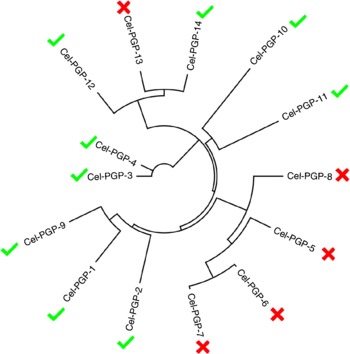
There are some notable differences between the P-gp gene families of H. contortus and C. elegans. These are summarized in fig. 1, which shows a tree of sequence similarity for the C. elegans P-gp genes, with the presence or absence of homologous genes in H. contortus indicated by ticks or crosses, respectively. While the majority of the C. elegans P-gp genes have potential orthologues in H. contortus, pgp-5, pgp-6, pgp-7, pgp-8 and pgp-13 are absent. The fact that pgp-5, pgp-6, pgp-7 and pgp-8 group together on the C. elegans sequence similarity tree suggests that these are relatively recent gene duplications, and the absence of this group in H. contortus suggests the parasite has either lost the ancestral gene, or that this gene evolved after the divergence of the rhabditoid and strongyloid nematodes. Conversely, whereas C. elegans has a single pgp-9 gene, the bioinformatic analysis (table 1) suggests that this gene may have been duplicated in H. contortus; however, the lack of PCR confirmation of more than one transcript means that the functional relevance of this apparent duplication is uncertain.
Putative P-glycoprotein gene sequences in Haemonchus contortus; a comparison with those of Caenorhabitis elegans. The 14 pgp genes of C. elegans are shown on a phylogenetic tree. Genes for which we found a putative orthologue in H. contortus are indicated by a green arrow; those for which no orthologue could be found are indicated by a red cross. (See online at http://journals.cambridge.org for a colour version of this figure).

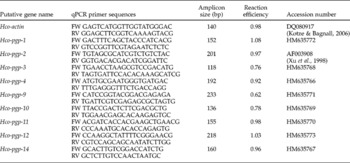
The sequences of the partial P-gp transcripts from H. contortus that were confirmed by PCR were deposited in the GenBank database; the accession numbers are shown in table 2. Real-time PCR primers were designed on the partial H. contortus P-gp cDNA sequences, and optimized to ensure that the dissociation curve gave a single clean peak corresponding to a single PCR product. The products were also run on an electrophoresis gel and viewed under UV illumination after ethidium bromide staining to ensure that only a single band, without any non-specific products or primer–dimers, was visible. Efficiency plots were produced for each primer pair by using serial dilutions of plasmids containing the partial P-gp cDNA clones as PCR template. The sequences of the primers used for the optimized assay, and the amplicon size and efficiency values for each primer pair, are shown in table 2.
Primers, amplicon size, reaction efficiencies and accession numbers for sequences used for quantatitive RT-PCR.

FW, forward; RV, reverse; RT-PCR, real-time PCR; qPCR, quantitative PCR.
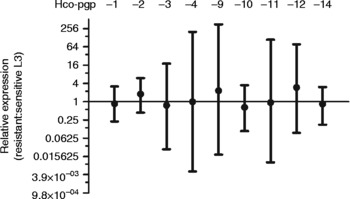
Overall, when analysed by the Pfaffl method (Pfaffl, Reference Pfaffl2001), the constitutive expression levels of the P-gp transcripts were not found to be significantly different between the ivermectin-sensitive and -resistant worms. The results of the data analysis, presented as relative expression levels (i.e. a ratio of expression level in susceptible worms to expression levels in resistant worms) is shown in fig. 2. One notable aspect of the data, however, was the large range of the expression levels detected for certain P-gp transcripts, especially that for Hco-pgp-9. This may suggest the potential for rapid changes in expression of certain P-gp genes in response to unmeasured environmental variables, such as changing conditions in laboratory cultures over time.
Relative expression of putative P-gp mRNAs in L3 larvae of an ivermectin-resistant isolate of H. contortus, compared to its drug-susceptible parent isolate, ISE. Three different samples of both isolates were tested, with three technical replicates carried out on each isolate. The levels of actin mRNA in both isolates were normalized to 1. None of the changes were statistically significant.

Discussion
It has previously been convincingly established that P-gps play a role in drug removal by nematodes. Increased expression of P-gps has been observed in ivermectin-resistant C. elegans, and inhibiting P-gp function in parasitic nematodes has been shown to increase their sensitivity to ivermectin (Bartley et al., Reference Bartley, McAllister, Bartley, Dupuy, Menez, Alvinerie, Jackson and Lespine2009; James & Davey, Reference James and Davey2009). Selection for certain P-gp alleles has been observed in parasitic nematodes displaying resistance to both benzimidazole and macrocyclic lactone anthelmintics (Blackhall et al., Reference Blackhall, Liu, Xu, Prichard and Beech1998; Bourguinat et al., Reference Bourguinat, Ardelli, Pion, Kamgno, Gardon, Duke, Boussinesq and Prichard2008). Therefore, the identification of P-gp transcripts and genes from parasitic nematodes is extremely important for increasing our knowledge of candidate resistance genes.
Identification of several P-gp-related sequences in the H. contortus genome, and confirmation of their expression by PCR, is an important first step towards being able to elucidate the potential role these genes may have in drug resistance. Especially encouraging is the finding that several of the H. contortus sequences show a high level of identity to C. elegans P-gp genes; we may be able to infer some functional information for the parasite genes from studies carried out on the model nematode. The lack of pgp-5, pgp-6, pgp-7 and pgp-8 in H. contortus can be explained by their location within a gene cluster on a single C. elegans chromosome; this is probably the result of a recent duplication of a single ancestral gene (Zhao et al., Reference Zhao, Sheps, Ling, Fang and Baillie2004). The loss of this ancestral gene from H. contortus may also be explained by some apparent redundancy in the C. elegans P-gp family; RNAi or gene deletions targeting this group of P-gp genes in C. elegans cause no apparent phenotypic changes (Maeda et al., Reference Maeda, Kohara, Yamamoto and Sugimoto2001; Kamath & Ahringer, Reference Kamath and Ahringer2003). The apparent absence of pgp-13 from H. contortus can also be explained by the fact that it arose in C. elegans from a recent tandem duplication of pgp-12 (Zhao et al., Reference Zhao, Sheps, Ling, Fang and Baillie2004).
The finding that P-gp mRNA levels in the ivermectin-resistant H. contortus isolate tested here did not differ significantly from the susceptible parent isolate is perhaps disappointing, but does not necessarily preclude P-gp involvement in this case of resistance. Only constitutive pgp mRNA levels were tested, and it is possible that exposure to ivermectin would have induced a facultative up-regulation of P-gps. Alternatively, differential expression throughout the life cycle could be a confounding factor; the experiments presented here were performed on L3 stage worms, whereas it is perhaps the parasite stages in the gut and faeces of the animal which would require most protection from ivermectin exposure. Unfortunately, only a very limited amount of frozen parasite material was available for this particular resistant isolate, which prevented further experimental work to test these possibilities. It has been reported that H. contortus eggs express P-gp on their surface (Kerboeuf et al., Reference Kerboeuf, Guegnard and Le Vern2003b; Riou et al., Reference Riou, Guegnard, Sizaret, Le Vern and Kerboeuf2010) and this might be an interesting alternative stage to examine. Prichard & Roulet (Reference Prichard and Roulet2007) described studies showing that at least three P-gp mRNAs were expressed at higher levels in ivermectin- or moxidectin-resistant isolates than in susceptible ones, and that higher expression of five P-gp mRNAs were induced by treatment of infected sheep with ivermectin; moxidectin treatment induced over-expression of two of these mRNAs. It is possible that the close genetic relationship between the susceptible and resistant isolates we examined here reduced the background genetic heterogeneity of H. contortus (Otsen et al., Reference Otsen, Plas, Lenstra, Roos and Hoekstra2000; Hunt et al., Reference Hunt, Knox, Le Jambre, McNally and Anderson2008), and that the mechanisms of resistance vary between isolates (Barnes et al., Reference Barnes, Dobson, Stein, Le Jambre and Lenane2001). Based on our experience with this study, the expression levels of P-gp mRNAs do seem to be quite variable between different samples of the same isolate, and it may be difficult to determine the true biological relevance of small, but ‘statistically significant’, changes in expression levels. On the other hand, ivermectin resistance is likely to be polygenic (Prichard & Roulet, Reference Prichard and Roulet2007), and thus could result from the interaction of several small changes in the expression of multiple genes.
In conclusion, we have successfully designed and optimized assays to assess changes in expression levels of P-gp mRNAs in H. contortus, which we intend to use to compare expression levels between many different isolates. It is hoped that the application of this assay to parasite isolates with varying resistance status may further elucidate the role of P-gps in drug resistance in H. contortus.
Acknowledgements
The authors would like to thank Dr Gerald Coles (University of Bristol, UK) for the supply of H. contortus L3. This work was supported in part by an award from the Veterinary Medicine Experiment Station, University of Georgia, USA.