1. INTRODUCTION
As a jurisdiction with a distinct political and legal system that is facing severe environmental challenges, China occupies a unique place in the global discussion on public interest litigation (PIL). Responding to environmental degradation in both urbanFootnote 1 and ruralFootnote 2 areas, China has formally recognized and implemented procedures that enable PIL in environmental matters. In contrast with traditional rights-based claims,Footnote 3 PIL is claimed to result in ‘objective and impartial lawsuits’, which lead to improvements in how environmental laws are enforced.Footnote 4 The implementation of this type of litigation in China is considered a major legal breakthrough towards promoting civil society participation and enhancing the enforcement of environmental law. Inspired by the ‘private attorney general’ theory identified in the United States (US),Footnote 5 these reforms open the door for China's judicial system to directly address public interest issues. In turn, this enables China's judiciary to contribute to sustainable development and trigger a court-centred environmental movement in China.
This innovative reform can be analyzed from many perspectives. In light of the fundamental difference between the parties initiating PIL and traditional rights-based litigation, this article focuses on which parties have been granted standing to sue in environmental PIL. Determining whether standing has been conferred on those who would seek to protect the public interest is of vital importance, because if it has not then the public interest in protecting the environment is unlikely to be vindicated. To this end, this article explores the relaxation of traditional standing rules in China, drawing on comparative experiences in Germany and the US. Section 2 reviews the evolution of standing requirements for environmental PIL and examines the doctrinal and pragmatic rationale underlying the shift towards more liberal standing rules. It also provides a general picture of relevant legal documents and disputes. This is followed by a detailed analysis in Sections 3 to 5 of the standing of administrative authorities, procuratorates,Footnote 6 and non-governmental organizations (NGOs). The article discusses the issues surrounding how standing has been granted to these bodies and organizations, and highlights the inherent overreach of granting standing to administrative authorities and procuratorates at the expense of NGOs. Conclusions and recommendations are provided in Section 6.
2. RELAXATION OF TRADITIONAL STANDING RULES: FROM PROTECTION OF INDIVIDUAL RIGHTS TO OBJECTIVE LEGALITY
2.1. The Rise of Objective Legality
Within the area of environmental litigation, there is tension between the focus on the rights of the plaintiff in determining standing and the broader public interest in the quality of the environment.Footnote 7 Traditionally, plaintiffs had to show that their own individual interests had been negatively affected by the action (or inaction) that was impacting upon the environment.Footnote 8 Without such a connection, plaintiffs would be unsuccessful in initiating judicial action.Footnote 9 This rights-based approach has been justified on the basis that political processes, rather than the courts, were better suited for defending the public interest in the environment.Footnote 10 In this way, the focus on individual rights was used to justify the restriction of PIL.Footnote 11
However, this focus on individual rights has been criticized for being unable to provide enough protection for environmental values that exceed the boundaries of individual rights.Footnote 12 Critics note that since environmental interests are under-represented in regulatory and political processes, judicial intervention should act to counterbalance the powerful interests that favour industrial development over environmental protection.Footnote 13 It is within this context that a move from ‘formalistic and individualistic justiciability doctrines’ of legal standing towards an ‘objective legality’ model is justified as a ‘natural adaptation of the legal system to more complex technologies and social realities’.Footnote 14
This development towards the ‘objective legality’ model is significant because it lies in stark contrast to the focus on the rights of the individual. Under the ‘objective legality’ model the legal power of the state is not restricted by the need to observe the rights of others but instead by the norms established by the law itself.Footnote 15 Consequently, under the ‘objective legality’ model the rules establishing standing have to be relaxed in order to accommodate this enhanced focus on legal norms.Footnote 16 This is significant in the context of environmental law, as the norms that are created focus on enhancing and improving the quality of the natural environment.
The ‘objective legality’ model has numerous advantages compared with the model that focuses on the private enforcement of individual rights. Underpinning the ‘individual rights’ model is the assumption that individuals will initiate litigation to protect their rights. This, however, does not account for countervailing considerations, such as the expense of litigation, which can have a dissuasive impact on the willingness of individuals to enforce their rights. These competing interests can be particularly impactive in environmental cases, where the damage inflicted on each individual affected by environmental harm may be small but the total damage inflicted on the environment is substantial.Footnote 17 By expanding the rules of standing to encapsulate those willing to litigate for the public interest, the ‘objective legality’ model enables them to hold those responsible to account. Further, the increased ability to initiate environmental litigation addresses gaps in the state's ability (or willingness) to enforce regulatory lawsFootnote 18 and acts to supplement the public enforcement of environmental law.Footnote 19 In this way, increasing the ability of the public to act as environmental protectors through judicial proceedings has had a positive effect on how the interests of the environment are protected.Footnote 20
This movement towards the ‘objective legality’ model can be identified in both the US and Germany. In the US, the shift towards this model occurred during the ‘environmental decade’ of the 1970s, epitomized by the judicial expansion of standing in Sierra Club v. Morton.Footnote 21 However, while there has been a shift towards the ‘objective legality’ model, the foundation of the US legal system is still rights based. Although the US Supreme Court has expanded the categories of injury for which standing can be established,Footnote 22 the basis for these categories (and, thus, for standing in PIL) is still rooted in the concepts of individual rights and the rights-based model.Footnote 23
In Germany, the move towards adopting the ‘objective legality’ model can be evidenced through the recognition of association suits. While many states in Germany had recognized association suits in the field of nature conservation during the 1980s,Footnote 24 these types of action were not recognized at the federal level until 2002.Footnote 25 While the movement towards the ‘objective legality’ model occurred later in Germany than it did in the US, there are clear parallels between the jurisdictions, although they are not identical. Because of underlying differences between the US and German legal systems, German law imposes much stricter threshold requirements on plaintiffs than does American law. While both individuals and organizations are allowed to bring citizen suits in the US, Germany grants standing only to certain recognized environmental organizations.Footnote 26 This is significant, as it indicates that the path towards adopting the ‘objective legality’ model is not uniform, and that different jurisdictions are likely to follow different paths in incorporating the model into their own legal systems.
It is within this context that China's shift towards the ‘objective legality’ model can be analyzed. Indeed, China is potentially uniquely suited to adopting this model as a result of the fundamental elements of its political ideology. Under China's socialist ideology, the public interest is considered to be the highest good, and individuals are encouraged to sacrifice their personal gains and suppress their personal needs to further public goals.Footnote 27 Although this emphasis on the public interest has been evolving since China's decentralization measures in the 1980s, it continues to dominate China's political and legal culture.
Within contemporary China, the public interest as it relates to environmental matters is personified by the government's policy of ‘building an ecological civilization’.Footnote 28 A vital element of this policy is the positive view of PIL as an important element of public participation,Footnote 29 which has empowered courts to hear environmental cases despite the control exerted by the Chinese government.Footnote 30 This approval of PIL is significant in holding Chinese public authorities to account, as the lack of judicial independence in China increases the difficulty of having such cases heard.Footnote 31 This is not to suggest that rights-based litigation has no role to play in enforcing China's environmental regulations; as demonstrated in the US and Germany, private litigation can play a large role in enforcing environmental regulations. Rather, the ‘objective legality’ model enshrined in China's current policy allows courts to play a greater role in environmental law enforcement. However, the implementation of the ‘objective legality’ model does not necessarily complement the traditional rights-based method of determining standing. Care must be taken in determining which specific individuals or bodies can initiate environmental litigation that is truly in the public interest. Without due control, PIL procedures could be used for personal gain, in turn undermining the public aims of the litigation process. Hence, the ‘objective legality’ model can act to complement the traditional rights-based model only if the laws that determine who can initiate such litigation are carefully crafted.
2.2. Evolution of Standing Rules in Environmental PIL in China
The current rules on standing in environmental cases in China are a result of both judicial interpretation and legislative enactment. Prior to the formal recognition of PIL in 2012, the Chinese judiciary had relaxed the requirements for standing in a small number of cases for plaintiffs who claimed to represent the public interest.Footnote 32 This was followed by China's civil society advocating reforms to the rules governing standing,Footnote 33 which led to the creation of the current legal framework for environmental PIL in China. Among these reforms, two pieces of legislation are of particular relevance: the Civil Procedure Law (revised in 2012), which grants standing to ‘relevant organizations and authorities prescribed by law’ with the aim of enhancing environmental protection,Footnote 34 and the Environmental Protection Law (revised in 2014), which set new threshold requirements for the standing of NGOs.Footnote 35
These legislative developments are not the sole instruments of reform for determining standing in environmental cases. The Supreme People's Court has issued three quasi-legislative documents, which have altered the traditional rules regarding standing:Footnote 36
• Judicial Interpretation on Environmental Public Interest Litigation (2015);
• Judicial Interpretation on Civil Procedure Law (2015); and
• Judicial Interpretation on Public Interest Litigation Cases Initiated by Procuratorates (2018).
Further, following efforts on the part of the Supreme People's Procuratorate, the Civil Procedure Law and Administrative Litigation LawFootnote 37 were amended in June 2017. The revisions expanded standing in environmental cases to enable procuratorates to challenge the legitimacy of administrative decisions in courts and initiate PIL for environmental purposes.
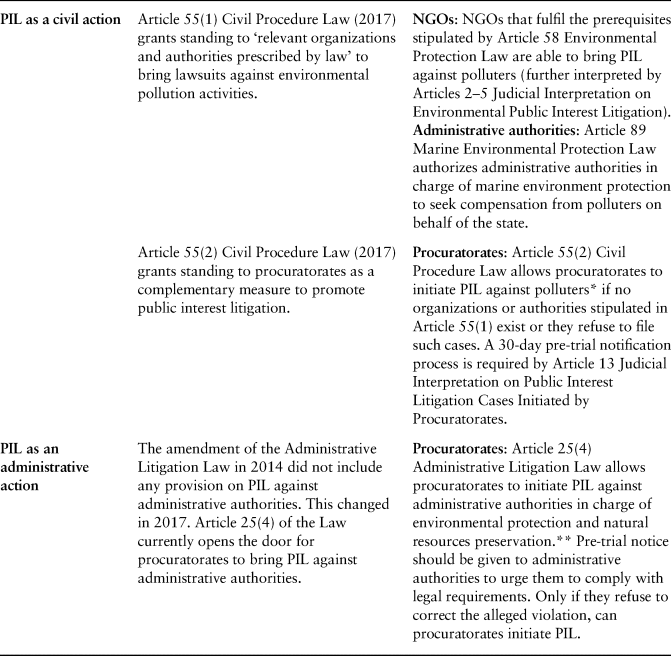
In order to clarify the current standing requirements for environmental PIL, Table 1 summarizes the state of play in China.
Standing Requirements for Environmental Public Interest Litigation in China

Notes
* Procuratorates are also allowed to bring PIL against private persons to protect consumer interests in the safety of food and pharmaceuticals.
** Procuratorates are also allowed to bring PIL against administrative authorities in charge of the protection of state-owned properties, the transfer of rights to use state-owned land, and the safety of food and pharmaceuticals.
3. STANDING OF ADMINISTRATIVE AUTHORITIES
Within its political structure, administrative authorities act as an executive branch of government, enforcing laws and implementing policy in China. While administrative authorities do not generally initiate judicial proceedings, they are explicitly granted standing under Article 89 of the Marine Environmental Protection Law (MEPL) where the public interest is jeopardized.Footnote 38 The standing of administrative authorities is not limited to the MEPL, however: judges have also granted administrative authorities standing under the Civil Procedure Law by way of somewhat controversial interpretations of individual rights, administrative powers and their relationship with the doctrine of standing.
Article 89 MEPL is viewed generally as a provision based on the ‘objective legality’ model of PIL. However, a closer examination of the statutory language in Article 89 suggests otherwise. It empowers administrative authorities to seek compensation on behalf of the state for damage to natural resources. This can be viewed alongside Article 9 of the Chinese Constitution, which confirms that these natural resources are mainly state-owned. Consequently, since administrative authorities in charge of protecting the marine environment are allowed to litigate only to protect the state's private ownership rights, litigation brought under Article 89 is generally inconsistent with the ‘objective legality’ model of PIL.Footnote 39 Similar issues can be identified in notices issued by the Supreme People's CourtFootnote 40 and the Reform Plan for the Compensation of Environmental DamageFootnote 41 promulgated by China's State Council.Footnote 42
Although administrative authorities sue on the state's behalf, current judicial practice considers them as the plaintiff, rather than the state. This can be problematic because environmental management in China often involves several administrative departments,Footnote 43 all of which can sue on behalf of the state under Article 89. As the current position on the distribution and management of financial compensation derived from PIL is unclear, bureaucratic infighting is likely to occur. Further, an administrative agency that initiates environmental litigation is considered, incorrectly, to be the equivalent of a distinct legal person when it is, in fact, an emanation of the state.Footnote 44 Therefore, the current design of the procedures under both Article 89 MEPL and the reforms initiated by the State Council undermine the core tenets of the ‘objective legality’ model.Footnote 45
A further justification for granting standing to administrative authorities is derived from their administrative responsibilities for the environment or natural resources. In Environmental Protection Bureau of Jiangyin v. Wenfeng Wang et al. (2013), the plaintiff's standing was recognized by the court on the basis of its administrative power to protect the natural environment within its jurisdiction.Footnote 46 This case was selected by the Supreme People's Court as one of nine typical environmental cases in China to which courts in China should refer when adjudicating similar cases.Footnote 47 The selection of this case as ‘typical’ is problematic because, contrary to the legal reasoning underpinning the case, the exercise of administrative powers does not necessarily provide standing to sue in Chinese civil proceedings. This gap in the court's legal reasoning highlights the strain that is being placed on the judicial system in recognizing the standing of administrative authorities in environmental litigation. A potential resolution of this issue would be to reform the current statutory framework to grant standing explicitly to administrative authorities in environmental litigation of this nature.
It is questionable, however, whether the move towards relaxing standing requirements for administrative authorities in environmental litigation is well conceived. One critical point to highlight is that, to a large extent, administrative authorities are already equipped with a variety of administrative powers to enforce environmental law.Footnote 48 Scholars such as Wang have noted that the primary reasons for the ineffective enforcement of laws by administrative authorities are abuse of administrative power, rent seeking, and ‘power-for-money’ deals.Footnote 49 Providing an additional enforcement mechanism for administrative authorities does not resolve these underlying issues. Instead, increased supervision and transparency of administrative authorities in their use of pre-existing enforcement mechanisms would be more appropriate for improving the enforcement of environmental regulations.
Furthermore, while administrative authorities are obliged to fulfil their executive responsibilities, they are not obliged to initiate litigation where the public interest in the environment is being harmed. To some extent, this can be viewed as positive as it allows the authority to explore other, less expensive and less confrontational, remedial options. However, it is not clear how administrative authorities determine whether or not to initiate PIL. This lack of transparency prevents them from being accountable for how they exercise their powers; it also provides the state with opportunities to manipulate litigation efforts under the banner of environmental protection.
Perhaps more critically, the state did not factor in the negative impact that granting standing to administrative authorities would have on the ability of NGOs to initiate legal proceedings. Indeed, in practice the fact that administrative authorities have been granted standing by the MEPL has been used to justify limitations on the standing of NGOs. This is particularly prevalent in cases relating to the marine environment, in which courts have held that, because administrative authorities have been granted standing explicitly under the MEPL, NGOs do not have standing under the more general provisions of the Environmental Protection Law.Footnote 50 However, decisions based on perceived conflicts between the MEPL and the Environmental Protection Law are flawed because this conflict is illusory. Unlike the Environmental Protection Law, Article 89 MEPL should not be considered as PIL since, as previously discussed, it does not fit the ‘objective legality’ model. Further, it must be noted that Article 89 MEPL does not prevent NGOs from having standing in matters relating to the marine environment: both administrative authorities and NGOs can validly have standing under Article 55(1) of the Civil Procedure Law.
This analysis considers the challenges that arise when administrative authorities are granted standing to initiate environmental PIL. It also raises a significant question: should China have granted standing to administrative authorities? In exploring this question, it is valuable to look towards Germany and how it deals with the matter in the context of its public authorities. In Germany, public authorities are not granted standing in association suits because such suits focus on the administrative acts and omissions of the public authorities tasked with enforcing environmental law and protecting the environment.Footnote 51 Hence, association suits in Germany are not intended to empower public authorities to act as environmental watchdogs. On the contrary, they are considered an important form of civil society participation and a tool for the public to exercise its right of access to justice.Footnote 52
By not granting standing to public authorities in association suits, Germany avoids the difficulties that China has encountered in granting standing to administrative authorities. While some of these issues arise as a result of failings within the statutory framework, addressing statutory failings does not fully integrate administrative authorities into the ‘objective legality’ model of PIL. Indeed, administrative authorities crowd out NGOs, whose litigation efforts truly embody the ‘objective legality’ model. In this way, in order to improve environmental law enforcement in China, the legislature should place administrative powers under tighter supervision instead of expanding such power through granting administrative authorities standing in environmental litigation. This focus on the supervision of administrative powers is reflected in the second group of bodies which have been granted standing to initiate environmental PIL in China: procuratorates.
4. STANDING OF PROCURATORATES
In China, the People's Procuratorates are constitutionally recognized as the state organs responsible for criminal prosecutions and ‘legal supervision’.Footnote 53 Nevertheless, before 2015 the rules regarding standing of procuratorates to initiate environmental litigation were unclear. While courts had granted standing to procuratorates on the basis of their duty to protect state-owned properties and resources from illegal activities,Footnote 54 this interpretation contradicted the narrow remit of their ‘legal supervision’ duties.Footnote 55 As a result of the uncertainty surrounding their standing, the Supreme People's Procuratorate has advocated the granting of standing to procuratorates in PIL since 2000. However, it was not until the revision of the Environmental Protection Law in 2014 that China started to act on these proposals. This was then followed by a pilot practice in 2015 of granting a limited number of procuratorates standing in environmental litigation.Footnote 56
By December 2016, 94 environmental PIL cases had been initiated by procuratorates in pilot areas.Footnote 57 Among them, 25 cases were against private persons and 68 cases were filed against administrative authorities.Footnote 58 Viewing this pilot scheme as a success, China granted standing to additional procuratorates under the Civil Procedure Law 2017 and the Administrative Litigation Law 2017. Granting standing to procuratorates in this way is novel in the global context: German public prosecutors have gradually withdrawn from involvement in civil proceedingsFootnote 59 and, while the US Department of Justice has similar enforcement powers, its role is more that of a litigation counsel rather than a plaintiff. Given the uniqueness of the Chinese situation, the potential environmental benefits of PIL by procuratorates merit further exploration.
While both the Civil Procedure Law and the Administrative Litigation Law give procuratorates standing to initiate environmental PIL, they differ in various substantive ways. Under the Civil Procedure Law, procuratorates may initiate PIL against polluters only if no other organizations or authorities mentioned in Article 55(1) of the Law exist, or if these organizations refuse to initiate PIL.Footnote 60 In order to identify whether organizations identified in Article 55(1) intend to initiate environmental litigation, the procuratorate must go through a 30-day pre-trial notification procedure.Footnote 61 This gives the organizations concerned a period of time in which to initiate legal action themselves, or to express their willingness to support the procuratorate as plaintiff. The notification requirement is significant, as it indicates that procuratorates are not intended to replace or overshadow environmental NGOs in enforcing environmental legislation.
In contrast to the Civil Procedure Law, the Administrative Litigation Law allows procuratorates a wider power to initiate PIL against administrative authorities in charge of environmental protection and preservation of natural resources.Footnote 62 While standing is granted only to initiate environmental litigation against administrative authorities under a particular set of circumstances, procuratorates do not need to consider whether any other relevant organization is interested in initiating PIL. Instead, procuratorates must submit a pre-trial prosecutorial notice to the administrative authority, urging it to comply with its legal duties. In this way, the Administrative Litigation Law does not engage with the issue of environmental NGO or civil society litigation, nor does it represent the ‘objective legality’ model.
Regardless of the differences between the Civil Procedure Law and the Administrative Litigation Law, they both marginalize the role of NGOs in environmental PIL by granting standing to procuratorates. This can be evidenced by the substantial gap between the number of environmental public interest cases brought by procuratorates and NGOs.Footnote 63 Moreover, although 700 NGOs claim to have standing in environmental PIL,Footnote 64 only 25 of them have actually filed such lawsuits in court during the past three years.Footnote 65
One reason for the marginalization of NGOs in environmental PIL is that procuratorates can undermine the pre-trial procedures enshrined in the Civil Procedure Law. The pre-trial procedure is intended to grant NGOs the opportunity to initiate their own PIL, but it also introduces additional legal obstacles and allows procuratorates to place political pressure on NGOs.Footnote 66 Critically, procuratorates, too, are vulnerable to political pressure: they are incentivized to initiate enforcement actions in the public interest in order to increase their rate of successful prosecutions.Footnote 67 This has the perverse consequence of the pre-trial procedure being used by procuratorates to dissuade NGOs from initiating PIL in order to inflate their own prosecution rate.Footnote 68
In addition, once procuratorates do initiate environmental PIL, NGOs become unable to initiate their own litigation as a result of the legal principle of res judicata.Footnote 69 Further barriers arise because of the nature of civil proceedings, which usually entail substantial litigation costs.Footnote 70 These are major obstacles for NGOs in China, as civil society within China has not had the opportunity to develop experience or gather economic and human resources.Footnote 71 Consequently, when compared with the resources and powers available to procuratorates, NGOs will often be portrayed as less able to protect the public interest. As a result, procuratorates are encouraged to initiate their own public interest proceedings,Footnote 72 overshadowing the role of NGOs and further inhibiting the growth of a Chinese civil society.Footnote 73
While the marginalization of NGOs in China undermines their role in the enforcement of environmental regulations, some academics have argued that this is a positive development.Footnote 74 This argument rests on the political and legal strength of procuratorates and their ability to enforce domestic environmental regulations. However, it ignores various fundamental problems when procuratorates take over the role of NGOs and civil society. Firstly, procuratorates in China have not yet gained independence from the executive branch. This is a significant problem, as administrative intervention or influence from the executive branch is almost unavoidable. Under such circumstances, it is reasonable to be concerned that the standing of procuratorates in civil proceedings could be manipulated as a new tool to invade individual rights or overlook particular instances of environmental damage. This contrasts with the independent status of NGOs, who are not subject to executive influence and can take independent strategic decisions about when and how to hold the state to account.
A second, connected issue is that the ability of procuratorates to initiate environmental PIL is not a ‘power’ that can be supervised under public law. Consequently, procuratorates cannot be held to account for their decision whether or not to initiate judicial proceedings in the public interest. This is problematic, as without accountability it is difficult to determine whether the decisions of the procuratorates truly serve the public interest in protecting the environment. A further exacerbating factor here is that the binding effect of unlawful administrative actions cannot be challenged via civil PIL. This is because Chinese courts are not competent to review the legality of administrative decisions through civil procedures. Consequently, administrative omissions can be ‘covered up’ by blaming polluters.Footnote 75
A final consideration is that, even when a procuratorate is successful in its PIL case, enforcement of the judgment still relies on the administration. For example, in Procuratorate of Xishan District, Wuxi City v. Huarong Li et al. (2009), the court ordered the responsible administrative authority to oversee the defendants’ remedial efforts to restore the environment to its original state.Footnote 76 This adds further complexity to the relationship between procuratorates and administrative authorities: because procuratorates may need to rely on administrative authorities to enforce the judgments of the court, they may become less willing to hold them to account in other instances. As a result, there is a risk that procuratorates will focus their PIL efforts on private individuals and overlook environmental harm caused by administrative authorities.Footnote 77 This risk is enhanced by the ‘judicial supervision’ powers of the procuratorates,Footnote 78 which enable them to call for reconsideration of their own cases. As a result, increased standing of procuratorates may lead to greater environmental governance problems in China,Footnote 79 to the detriment of the environment.
While the risks of procuratorates overshadowing NGOs and civil society in China are clear, comparisons with other legal systems indicate that this type of system can operate successfully. In the US, the EPA can refer cases to the Department of Justice in order for the latter to enforce legislation in the federal courts. However, a critical distinction is that, although the EPA does have these referral powers, the ‘majority of cases [it] brings are still dealt with in the administrative forum’.Footnote 80 Further distinguishing the US from China is the role of NGOs and civil society generally. In the US, the private enforcement of environmental law through citizen suits is a response to the fact that federal agencies are reluctant to effectively make use of the legal remedies available for damage caused to the environment.Footnote 81 Consequently, US citizen suits initiated by members of civil society act to supplement public enforcement in a way that is in direct contrast to Chinese PIL initiated by procuratorates. Such a comparison is valuable because China may be able to look towards the US as a model for reform.
However, any such reforms adopted by China from the US would necessitate surrendering space to civil society in the enforcement of environmental legislation. Such a requirement may hinder any reform efforts as policymakers in China may be reluctant to cede power to NGOs and civil society. One reason for this is that, compared with NGOs, procuratorates are considered to be better positioned to initiate environmental litigation. Such reasoning is problematically self-fulfilling: NGOs in China will be unable to develop and become effective litigants as a result of being overshadowed by procuratorates, thus further entrenching the role of the procuratorates.Footnote 82 Moreover, this reasoning does not address the lack of effective mechanisms to hold procuratorates to account for how they enforce environmental regulations via litigation. The unwillingness to foster NGO involvement not only limits the scope for PIL under existing Chinese law, but also stifles reform initiatives.
5. STANDING OF NGOs
NGOs in China have gone through significant changes over the last two decades. First appearing in 1994,Footnote 83 it was not until 2003 that the activities of Chinese environmental NGOs made an impact on both the public and the state.Footnote 84 The role of NGOs in China in highlighting the environmental effects of China's economic policies is significant, not only for their positive impact on environmental policy but because it contradicts the popular assumption that NGOs had no role in China's socialist government.Footnote 85 Notwithstanding this, there is evidence that China's political system has resulted in NGOs having to face unique legal issues in initiating PIL compared with other jurisdictions.
While environmental NGOs have had a positive impact on environmental awareness in China,Footnote 86 some academics have argued that NGOs are merely ‘self-appointed guardians’ of the public interest.Footnote 87 These arguments are based on traditional public law theories regarding legitimacy in representative democracy: because environmental NGOs are not elected they lack the democratic legitimacy to participate in environmental governance. This argument, however, has weakened as the values of deliberative democracy shape the expectations that citizens have of the state and its emanations. Indeed, deliberative democracy and civil society can engage individuals or groups who are not adequately represented by representative democracy and lack other outlets through which to participate.Footnote 88 Hence, although NGOs may fall short of being democratically representative, they do serve as advocates for groups who are denied standing under legal systems based on the protection of individual rights. Standing of NGOs in PIL is considered a valuable tool in holding administrative authorities to account in environmental matters. Further, as reflected in Germany, concerns over the lack of democratic legitimacy of NGOs can be resolved partly by ensuring open membership and granting NGO members full voting rights.Footnote 89
Another concern is that China does not have a sufficiently strong civil society to enforce environmental laws through PIL initiated by NGOs. In terms of environmental governance, civil society is the weakest pillar of China's political environment. Chinese civil society is significantly weaker than its German counterpart, where a mature civil society and active NGOs have substantially contributed to the development and success of association suits. This has led academics such as Chen to favour empowering procuratorates to initiate environmental litigation in the public interest.Footnote 90 However, such arguments fail to appreciate the degree to which civil society is already acting within the space granted to it and the effect that the actions of NGOs are having on environmental decision-making processes.Footnote 91 Examples of civil society acting on behalf of the public interest in China include campaigns to protect the Tibetan antelopeFootnote 92 and, notably, influencing the revision of the Environmental Protection Law of 2014.Footnote 93 The current political environment may have minimized the effectiveness of NGO interventions, but this does not undermine their potential value.
The current legal framework under which NGOs are granted standing in environmental litigation is complex, and is provided by various pieces of legislation. Under Article 55(1) of the Civil Procedure Law, standing is granted to ‘relevant organizations and authorities prescribed by law’. However, this provision is not explicit on whether standing of environmental NGOs should be subject to certain threshold requirements. This ambiguity has led to divergent judicial interpretations, with some courts declining to grant standing because they do not view the NGO as an environmental NGOFootnote 94 and other courts granting standing where the NGO was ‘relevant’ to environmental protection and it was legally registered.Footnote 95
Although many academics have favoured such a liberal interpretation of the rules on standing,Footnote 96 it contradicts the legislative intention of the Civil Procedure Law to impose restrictions in order to prevent vexatious litigation while not reducing the opportunities for competent NGOs to sue.Footnote 97 The resulting uncertainty was remedied by revisions made to the Environmental Protection Law in 2014, which set out three requirements that NGOs are required to meet in order to be granted standing. Under the Environmental Protection Law, NGOs must be registered with the state at the municipal level or above in accordance with law. They must also be specialized in environmental protection public interest activities, and have no record of administrative or punitive penalties for their activities in the past five consecutive years.Footnote 98 Further, the organization's charter must state that its aim is concerned predominantly with promoting the public interest.Footnote 99
While these requirements have been accepted and implemented in China, the legislative process in implementing these reforms was fraught. During the second draft of the Environmental Protection Law, the legislature wanted to restrict standing to a single established NGO,Footnote 100 in clear violation of the ‘objective legality’ model. Moreover, the initial registration requirements for NGOs precluded local organizations from being granted standing, which would have further limited the ability of environmental NGOs to hold the state to account. While the current requirements of the Environmental Protection Law for NGOs to be granted standing are less restrictive, the draft version of the Law is relevant because it indicates the unease of the state with ceding power to NGOs and civil society. Further, the controversies during the drafting process may explain residual obstacles to the standing of NGOs in environmental litigation.
The most significant obstacle to impede NGO standing to initiate PIL is the registry system. Not only does an NGO need to be registered with the Civil Affairs Department, but the operations of the NGO need to be supervised by another public authority in order for it to qualify for registration.Footnote 101 In practice, the latter requirement is often very difficult to meet. Administrative authorities usually lack incentives to take on such a supervisory responsibility and they do not trust grassroots organizations. Further, even if an NGO has managed to find a supervisory authority, the relationship can be easily terminated unilaterally by the authority. Under such circumstances, a large number of NGOs are unable to become registered, which creates not just legal and political risks but also makes it difficult for NGOs to establish credibility, engage in fund raising, and recruit better-trained personnel. This is particularly true for advocacy groups, support for which is often considered by authorities to be too politically sensitive.Footnote 102
A further issue that hinders the ability of NGOs to initiate environmental PIL is the requirement that they be engaged predominantly with promoting the public interest. This is surprising because, on the surface, this requirement appears to be more relaxed than corresponding conditions in other jurisdictions. Indeed, a literal interpretation of the requirements of China's Charter allows NGOs to initiate environmental PIL even if they are only partially engaged in environmental protection activities.Footnote 103 This is in stark contrast to Germany, where only NGOs that are predominantly and not temporarily engaged with environmental protection are granted standing in environmental association suits.
However, while the reforms introduced by the Environmental Protection Law seek to enable Chinese environmental NGOs to initiate PIL, these reforms have not achieved the desired results. One reason for this is the onerous conditions imposed by the Law itself. It states that environmental NGOs must be registered for five years before being granted standing,Footnote 104 which is significantly longer than the three-year requirement implemented in Germany.Footnote 105 Further, this longer time period has a greater impact in China where its civil society is less developed than in the case of its Western counterparts. This is evidenced in an academic analysis by He, which indicates that only a minority of grassroots NGOs can survive for the required five years.Footnote 106
Larger and more established environmental NGOs can also be inhibited by the requirements set by the Environmental Protection Law. Friends of Nature, one of the first environmental NGOs in China,Footnote 107 was challenged on its standing to initiate PIL.Footnote 108 Although Friends of Nature was registered as a branch of the International Academy of Chinese Culture in 1993, the environmental NGO did not register independently with the state as an environmental NGO until 18 June 2010.Footnote 109 It is on these grounds that the defendants argued that Friends of Nature failed to meet the five-year requirement at the time of filing the lawsuit in question (1 January 2015).Footnote 110 The court ruled that Friends of Nature did have the standing to initiate the litigation in the public interest, justifying its decision on the basis that the NGO had been engaged previously with environmental protection activities for more than five years.Footnote 111
Although this judgment was welcomed for enabling Friends of Nature, a well-established NGO,Footnote 112 to initiate environmental PIL, the court's interpretation of Article 58 is questionable. According to Article 19 of the Regulations on Registration and Administration of Social Organizations (1998), which applies to non-profit organizations, a branch office of a social organization does not possess a legal personality and should operate within the scope of authorization of the social organization. As such, Friends of Nature did not exist as a distinct legal entity until its official registration and any environmental activities it conducted should be attributed to the International Academy of Chinese Culture. This is not to criticize the court for arriving at this decision. Rather, this example illustrates the difficulties faced by environmental NGOs in complying with the Environmental Protection Law and further developing the role of civil society in China.
Further issues can be identified in the requirement of the Environmental Protection Law for the NGO to have no record of any administrative or punitive penalties for its activities during the past five consecutive years. As currently formulated, any administrative or punitive penalty is sufficient to bar an environmental NGO from initiating PIL; the nature and severity of the conduct giving rise to the penalty is irrelevant. In practice, this can lead to an NGO losing its ability to initiate PIL over minor violations of administrative law that are not connected with its professional standing.Footnote 113 This is problematic, as this requirement can be used to control NGOs that challenge public authorities and their actions. It is interesting to note that this issue is unique to China,Footnote 114 further highlighting the tensions between the state and the developing role of civil society in China.
Finally, under the Environmental Protection Law, NGOs that are registered at the county levelFootnote 115 do not have standing to initiate environmental PIL. This is problematic as it excludes the majority of environmental NGOs in China from initiating such litigation. Indeed, by 2009 over 60% of registered NGOs were registered at the county level.Footnote 116 It is important to note that the level at which NGOs are registered in China is not based on the merit of the work undertaken by the NGO but rather on the geographical scope of its activities. In fact, local environmental NGOs may be better suited to initiating PIL in some instances because they may be more familiar with the issues being contested. While larger environmental NGOs, such as Friends of Nature, cooperate with local NGOs,Footnote 117 this is not a sufficient substitute for county NGOs to initiate PIL by themselves. By excluding country NGOs from initiating such litigation it is unlikely that civil society in China will develop, further risking and undermining the effective enforcement of environmental regulations.
In analyzing China's attempts to grant environmental NGOs standing, the restrictive approach taken by the state is notable when contrasted against the expanded standing of administrative authorities and procuratorates. This is particularly prominent when the negative impact of this expansion on the ability of environmental NGOs to initiate environmental PIL is taken into account. As such, in attempting to shift towards the ‘objective legality’ model of PIL, China has failed to empower the groups most capable of safeguarding the norms set by environmental laws: environmental NGOs. To remedy this, China should focus on cultivating and enabling a culture that promotes the development of NGOs and strengthens their capacity to help to enforce environmental law through PIL. By doing so, China's shift towards adopting the ‘objective legality’ model would become more coherent and would help to improve the enforcement of environmental legislation and regulations in China.
6. CONCLUSIONS
China is in the process of transitioning its approach to environmental litigation to a strategy based on the ‘objective legality’ model. By adopting such a model, China is seeking to improve the enforcement of environmental law along the lines of jurisdictions such as Germany and the US. A critical element of the ‘objective legality’ model is the relaxation of the rules establishing standing in environmental PIL. Correspondingly, China has undergone various legal reforms to grant standing to administrative authorities, procuratorates, and environmental NGOs.
However, these reforms have not successfully incorporated the ‘objective legality’ model into China's enforcement of environmental regulations. While this article has identified various issues with China's legal reforms, the dominant issue which overshadows the shift towards the ‘objective legality’ model is the restrictions placed on civil society to initiate environmental PIL. By erecting procedural barriers for environmental NGOs to initiate such litigation and by expanding the powers of administrative authorities and procuratorates, China has reduced the power of civil society, contrary to the underlying principles of the ‘objective legality’ model. In this way, while China's reforms are intended to empower civil society, they actually weaken it, hindering its effectiveness at enforcing environmental legislation and undermining the shift towards the ‘objective legality’ model.
To remedy this fundamental issue China should revoke the standing it has granted to administrative authorities and procuratorates to enforce environmental law via PIL. Further, in order to enable civil society to fill the gap in enforcement left by these bodies, the state should also relax the requirements for granting standing to environmental NGOs to initiate PIL. By facilitating civil society participation in this way, China is more likely to successfully shift its approach to enforcing environmental law to the ‘objective legality’ model and improve the enforcement of environmental laws. However, such developments require the state to cede powers to civil society and NGOs. While this is something that the state has been traditionally reluctant to do, it is a necessary step in order to effectively incorporate the ‘objective legality’ model into its environmental law. If the state is unable to cede power and allow civil society to develop, it risks further undermining the role of civil society in China to the detriment of the public interest and the environment itself.