Introduction
Abortion service provision has changed noticeably in India with the adoption of the 2002 and 2003 amendments of the Medical Termination of Pregnancy (MTP) Act. These measures decentralized the process of approval of abortion facilities, rationalized the criteria for physical standards of abortion facilities, permitted medication abortion up to nine weeks’ gestation (Ministry of Health and Family Welfare, 2010) and allowed certified abortion providers to prescribe medication abortion outside of a registered facility provided the practitioner has access to emergency facilities. The introduction of improved manual vacuum aspiration techniques and medication abortion has also contributed to shifting the pattern of abortion service provision. A 2015 study designed to estimate abortion incidence observed that of the 15.6 million induced abortions that took place in India in 2015, 81% were medication abortions and 14% were surgical abortions, reflecting improved access to safe abortion services for women in general (Singh et al., Reference Singh, Shekhar, Acharya, Moore, Stillman and Pradhan2018). Evidence from studies in other countries too suggests that women and adolescents are increasingly obtaining medication abortion drugs through informal routes including online services, hotlines and drug sellers (Kapp et al., Reference Kapp, Blanchard, Coast, Ganatra, Harries and Footman2018; Footman et al., Reference Footman, Keenan, Reiss, Reichwein, Biswas and Church2018).
Few studies have explored the abortion experience of married young women aged 15–24, the assumptions being that once married, few young women would wish to terminate a pregnancy and that those seeking abortion are well-supported and have free access to services. The limited evidence currently available shows that these assumptions are untenable. A facility-based study of young abortion seekers attending clinics across Bihar and Jharkhand reported that almost one-third of young women seeking abortion were married (Jejeebhoy et al., Reference Jejeebhoy, Kalyanwala, Zavier, Kumar and Jha2010a). The recent National Family Health Survey shows that 24% of induced abortions (among the last pregnancies in the five years preceding the survey that ended in an induced abortion) occurred among married young women aged 15–24 (calculated using women data from the 2015–16 NFHS) (IIPS & ICF, 2017a). Other studies have reported that among married women abortion seekers, 28–58% constituted young women aged less than 25 years (Elul et al., Reference Elul, Barge, Verma, Kumar and Bracken2004; Jejeebhoy et al., Reference Jejeebhoy, Santhya and Acharya2010b; Zavier & Padmadas, Reference Zavier and Padmadas2012). Moreover, the abortion experiences among these married young women tended to be compromised and they tended to experience more constraints than older women in accessing safe abortion services. A study of young abortion seekers in Bihar and Jharkhand reported that 9% had delayed obtaining an abortion beyond 12 weeks of pregnancy, 17% were excluded from the decision to terminate the pregnancy and several had made unsuccessful attempts to terminate the pregnancy before arriving at the study clinic (18% had made one attempt, 4% had made two), largely using oral medication obtained from a chemist (11%). Studies – almost entirely facility-based –comparing the abortion experiences of young and adult women have reported that, compared with adult women, young women are less likely to be involved in abortion-related decision-making, and tend to delay seeking abortion into the second trimester (Ganatra, Reference Ganatra, Ramasubban and Jejeebhoy2000) and seek abortion services from untrained providers (Ganatra & Hirve, Reference Ganatra and Hirve2002). Young women have also been found to be more likely than adult women to experience abortion-related complications (Krishna, Reference Krishna1995). These findings highlight that abortion among married young women is not a rare event, and that these women lack both appropriate knowledge and agency to access services. Barring evidence from these limited studies, little is known about the abortion seeking experiences and needs of this group in India.
Moreover, although the recent changes in abortion service provision in India are likely to make a difference to the abortion experiences of married young women, just as in the case of women of reproductive ages in general, how these changes have modified abortion experiences among young women remains unanswered. Most of the available studies were conducted in the 1990s and early 2000s when medication abortion was either unavailable or not as widely available as it is currently, and had drawn on clinic-based samples.
This study aimed to fill these gaps. It probed, using data from a community-based study, the experiences of young married abortion seekers, including pre-abortion decision-making, abortion seeking and experiences of the procedure, and post-abortion complications and concerns.
Methods
Study setting
Data were drawn from a survey conducted among married young women aged 15–24 in two large states of India, Rajasthan and Uttar Pradesh, in 2015. The study was located in two districts in each state, namely Churu and Jodhpur in Rajasthan and Muzaffarnagar and Moradabad in Uttar Pradesh. Uttar Pradesh, with a population of 199.8 million, ranked first and Rajasthan, with a population of 68.5 million, ranked eighth among the states of India in terms of size of the population in 2011 (Office of the Registrar General & Census Commissioner, 2013). In both states, the child sex ratios were highly skewed towards males: 888 females and 902 females per 1000 males, respectively, in Rajasthan and Uttar Pradesh. Child marriage has persisted in both states: as many as 35% and 21% of women aged 20–24 in Rajasthan and Uttar Pradesh, respectively, were married before the age of 18 in 2015–16 (IIPS & ICF, 2017b, 2017c). Some 4–6% of girls aged 15–19 years had begun childbearing. As against the Maternal Mortality Ratio (MMR) of 130 deaths per 100,000 live births in India during 2014–16, the MMR was as high as 201 in Uttar Pradesh and 199 in Rajasthan (Office of the Registrar General, 2018). The unmet need for family planning is high in these states (12% and 18% in Rajasthan and Uttar Pradesh, respectively). Some 2–4% of last pregnancies in the five years preceding the interview among women in aged 15–49 ended in an induced abortion in these states (IIPS & ICF, 2017a).
Study design and participants
The data for the study were drawn from the baseline survey of an evaluation of a district-level model that sought to provide a continuum of care to married young women by strengthening the capacity of various cadres of health care providers. The Population Council conducted the evaluation and the survey was conducted from February to July 2015 in 100 primary sampling units (PSUs) across the four districts, selected using multi-stage systematic random sampling technique. The study was fielded both in urban (30 PSUs) and rural (70 PSUs) areas of the four districts. The PSU consisted of villages in rural areas and Census Enumeration Blocks (CEBs) in urban areas. The survey focused on young women aged 15–24 who were married, had a pregnancy or had delivered a child in the two years prior to the survey. Household listing was done to identify young women aged 15–24. Five teams, each comprising a mapper and a lister, were employed for the household listing exercise. The training for the household listing teams lasted 2 days and was conducted by Population Council staff. During household listing, the field team enumerated all households in the PSUs with 500 or fewer households. Primary sampling units with more than 500 households were segmented and those with fewer than 500 households were merged with adjacent villages/CEBs to get a minimum of 500 households.
Female interviewers were locally recruited by the Population Council for interviewing married young women. The Population Council staff conducted a 2 weeks training programme to familiarize trainees with study instruments, enable them to overcome their inhibitions about discussing sexual and reproductive health matters, and orient them on required action if a respondent was in distress or sought a referral. A total of 39 trainees participated in the training workshop, and 33 of these were selected to conduct the survey. These interviewers were graduates in science or the social sciences, were proficient in Hindi and had 3–4 years of experience in conducting field-based studies, several under the supervision of the principal investigators of this study. Moreover, to ensure data quality and adherence to ethical principles, Council staff provided on-going supervision and support to interviewers, and their observations were fed back to the interviewer on a regular basis.
Interviewers entrusted with the task of interviewing the eligible young women re-confirmed the eligibility of the young women identified by the listing team. They invited all young women who met the eligibility criteria to take part in the survey. A total of 5176 married young women were identified and invited for interview. Of these, 4952 were successfully interviewed, with a response rate of 96%.
A detailed questionnaire was prepared in English, translated into Hindi by Population Council staff and pre-tested. In addition to questions related to abortion experiences, the questionnaire probed the women’s background characteristics, knowledge about sexual and reproductive health matters, pregnancy history, uptake of pre-conception care, care seeking during pregnancy, delivery and the postpartum period, care seeking for their newborns, treatment seeking for maternal and newborn complications experienced, if any, and contacts with community health workers. It also included a contraceptive calendar that collected such details as fertility and contraceptive history, wanted status of pregnancies, decision-making about contraceptive adoption and reason for contraceptive discontinuation.
The contraceptive calendar data were used to identify women who had experienced an induced abortion in the two years prior to the interview. Those who had experienced an abortion were asked a range of questions exploring their experiences. They were asked about the months of gestation at which the abortion took place, the method used and the kinds of complications experienced. Information on abortion method relied on was collected by posing a series of questions to the respondents. Specifically, women were first asked: (1) whether they had tried to abort the pregnancy by taking herbs, ayurvedic remedies or inserting something into their vagina on their own or with the help of others (family, friends, untrained individual); (2) whether they had consumed pills bought from a medical shop without seeing a physician; and (3) whether they had succeeded in aborting the pregnancy using these methods. Women who reported that they did not try to abort their pregnancy on their own or with the help of others, and those who reported that they did not succeed in aborting their pregnancy by self-attempts, were further asked about the method by which they had finally got their pregnancy terminated. All those who reported that it had been conducted surgically were further probed about whether their abortion had been performed via manual vacuum aspiration (MVA) or dilation and curettage (D&C). Those who were not aware of differences between MVA and D&C were probed about whether, or for how long, they had been anaesthetized (typically, MVA is conducted with only local anaesthesia whereas D&C requires general anaesthesia), whether they had been told it would be a ‘bigger’ surgery (small procedure to denote MVA, big to denote D&C) and whether they were kept overnight at the facility (if ‘yes’, denoting D&C).
The survey also inquired about who had performed the abortion (doctor or others). Those who reported that they had used ‘abortion pills’ were asked whether they had been given these pills by a doctor or in a health facility, or been given a prescription to purchase the medication abortion by a doctor; if not, they were asked whether they or a family member had obtained the medication abortion directly from a drug seller without a prescription.
In addition, the survey probed about whether women had made previous unsuccessful attempts to terminate the pregnancy, and if so, the methods used (these could include home remedies, medication abortion taken incorrectly, or botched attempts at surgical abortion). Finally, the survey asked about whether complications had been experienced, and if so, the kinds of complications experienced.
Of the 4952 married young women aged 15–24 who participated in the survey, 3% reported an induced abortion during the two years prior to the survey (N = 166), and the findings presented in this paper focus on these women.
Descriptive statistics were used to describe the abortion experiences of young women. Independent samples t-test and Chi-squared test were used appropriately where necessary.
Results
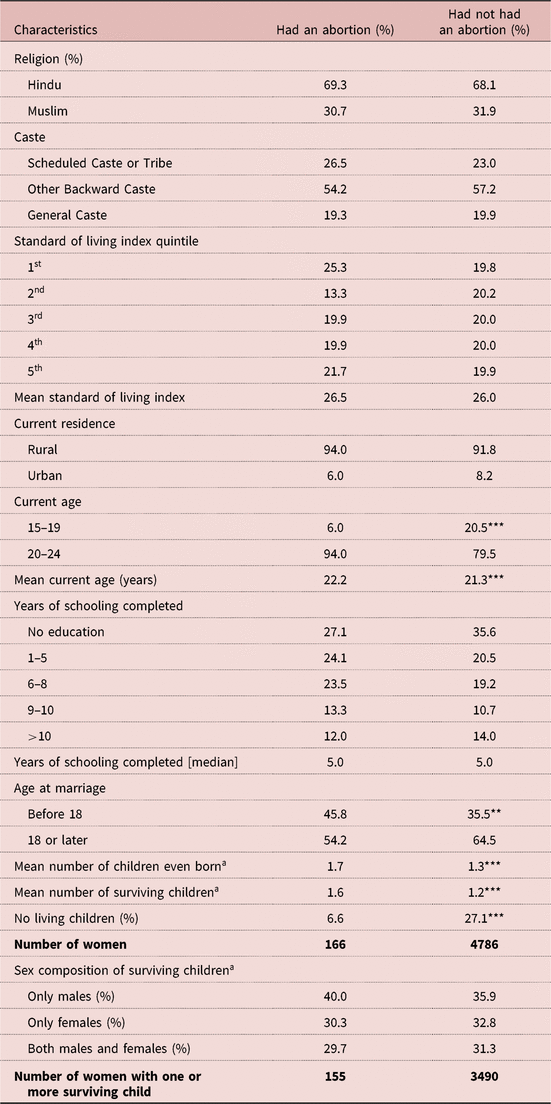
Table 1 describes the characteristics of young women who reported an induced abortion in the two years preceding the interview, as well as those who did not. Differences by religion, caste, household economic status and rural–urban residence were negligible: about two-thirds of each group were Hindu, and one-third were Muslim; about a quarter belonged to socially disadvantaged castes and tribes; about two-fifths belonged to the bottom two standard of living index quintiles; and the vast majority (92–94%) resided in rural areas.
Socio-demographic and reproductive health profile of married young women who had, and had not, experienced an induced abortion in the two years prior to interview, India, 2015

a Prior to abortion among those who experienced an abortion.
**p ≤ 0.01; ***p ≤ 0.001.
Those who had experienced an abortion were, on average, 22 years of age and a few (6%) were adolescents (15–19); other women tended, on average, to be slightly younger (mean age 21, and 21% aged 15–19). The median years of schooling successfully completed was just 5 years for both those with abortion experience and among other women. Marriage age varied widely, with those who had experienced an abortion being far more likely to have experienced child marriage than those who had not (46% versus 36% had married below the age of 18).
Young women who had experienced an abortion had on average given birth to 1.7 children and had 1.6 surviving children prior to the pregnancy that was terminated. In comparison, young women who had not experienced abortion had given births to significantly fewer children (1.3) and had significantly fewer children surviving at the time of survey (1.2). While just 6% of women who had undergone an abortion had no surviving children, more than a quarter of those who had not experienced an abortion had no children, suggesting that abortion rarely took place among women without at least one child.
Women who had at least one child were probed about the sex composition of surviving children (at the time of the abortion for women reporting an abortion). The findings suggest that at the time of their abortion, 40% had only male children, 30% had only female children and another 30% had both male and female children. The corresponding percentages among those women who did not experience an abortion were largely similar: 36%, 33% and 31%, respectively.
Nature of pre-abortion experiences
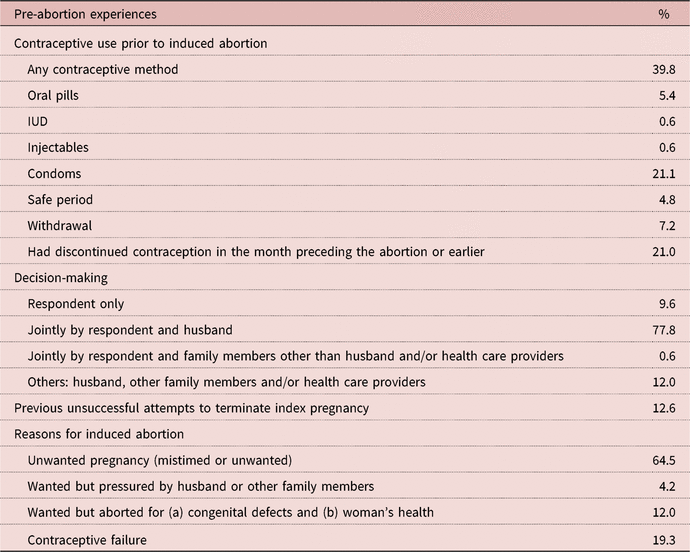
Table 2 summarizes young women’s pre-abortion experiences. The survey explored women’s contraceptive use at any time prior to the index pregnancy which was terminated – that is, at any time between marriage and abortion for those without any births, and at any time in the interval between the last birth and the abortion for those who had one or more births. Two-fifths of abortion seekers reported contraceptive use (40%) prior to the pregnancy that was terminated – mainly condoms (21%) and traditional methods (12%). In contrast, just 17% of women who had not experienced an abortion reported contraceptive use (not shown in the table). Several women (21%) had discontinued the method used in the month preceding the abortion or earlier.
Nature of pre-abortion experiences of married young women who experienced an abortion in the two years before interview (N = 166), India, 2015

Abortion-related decision-making was also probed. More than three-quarters of young women reported that they took the decision to terminate the pregnancy jointly with their husbands (78%). While one-tenth reported that they had made the decision independently – that is, without consulting their husband and family members – and somewhat more (12%) reported that they were not at all involved in the decision to terminate their pregnancy.
Twenty-one women (13% of all those who had undergone an abortion) had made at least one unsuccessful attempt to terminate the pregnancy that was subsequently successfully terminated. The methods that young women had used in previous unsuccessful attempts included mainly oral medications, most likely medication abortion that they had obtained from a drug seller without a physician’s prescription (ten women) and home-made concoctions or ayurvedic medicines (nine women).
Young women revealed the reasons for the pregnancy that they had terminated. The majority (65%) reported that they did not want another child or wished to delay their next pregnancy but had not practised contraception to prevent pregnancy. Contraceptive failure was reported by 20% of all women; that is, they reported that they had become pregnant while using a method, perhaps because they had used condoms or traditional methods irregularly. In addition, 16% of women reported they had terminated a wanted pregnancy because the woman herself had health problems, because of fetal abnormalities or because of pressure from husbands or in-laws.
The abortion experience
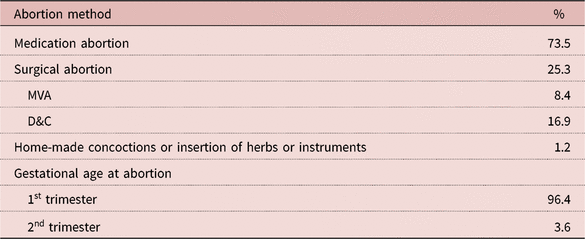
Table 3 shows that the majority of abortion seekers in the study relied on medication abortion for successfully terminating their pregnancy (74%). A quarter had undergone surgical abortion (25%): for 8% of abortion seekers, the method used was manual vacuum aspiration, and 17% terminated their pregnancy through dilation and curettage. Finally, 1% of abortion seekers (two women) reported that they had terminated their pregnancy with home-made concoctions or the insertion of herbs or instruments.
Method of abortion used for terminating pregnancy for women experiencing an abortion in the two years before interview (N = 166), India, 2015

MVA, manual vacuum aspiration; D&C, dilation and curettage.
Of the 21 women who had made previous unsuccessful attempts to terminate their pregnancy, thirteen subsequently terminated it using surgical methods (four using MVA and nine using D&C) and eight using medication abortion (two from a facility and six from a drug seller). All of those who had tried unsuccessfully to terminate their pregnancy with medication abortion drugs (ten) succeeded in terminating their pregnancy with surgical methods. Of those who had used home-made concoctions or had inserted herbs and instruments unsuccessfully (eleven), in contrast, the majority (eight) terminated their pregnancy with medication abortion (not shown in the table).
Almost all abortions were done in the first trimester itself (96%), and just 4% of young women had delayed their abortion to the second trimester.
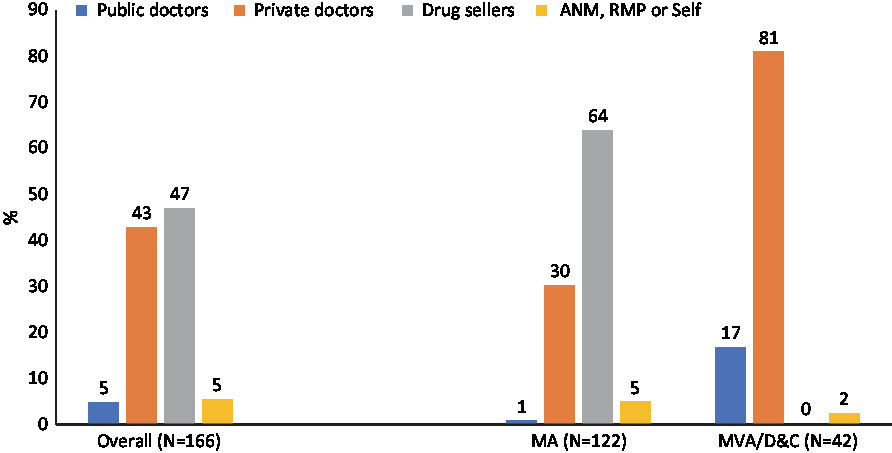
The findings also underscore the predominance of the private sector in the provision of abortion services in study settings (Fig. 1). Overall, 43% of abortion seekers had relied on doctors from private health facilities and 47% on drug sellers. Just 5% had sought abortion services from public health facilities, all from district hospitals (5%) and another 5% from auxiliary nurse midwives (ANMs), rural medical practitioners (RMPs) or had done it themselves. As evident from Fig. 1, the profile is different for women whose pregnancy was terminated by medication and surgical methods. Most young women whose pregnancy was terminated with medication abortion had obtained medication abortion drugs from a drug seller, and to a lesser extent an RMP or ANM, without a prescription (69%), or a doctor in a private facility (30%); hardly any had obtained the drugs from a nurse or doctor in a public health facility (1%). Of those who had undergone surgical abortion, 81% had obtained it from a private health facility, 17% from a public health facility and 2% from an ANM or RMP.
Final abortion method and provider for young women’s abortions. The overall sample included two women who terminated their pregnancy by using home-made concoctions or the insertion of herbs or instruments. MA, medical abortion; MVA, manual vacuum aspiration; D&C, dilation and curettage; ANM, auxiliary nurse midwife; RMP, rural medical practitioner; Self, abortion done by women themselves.

Self-reported abortion-related complications
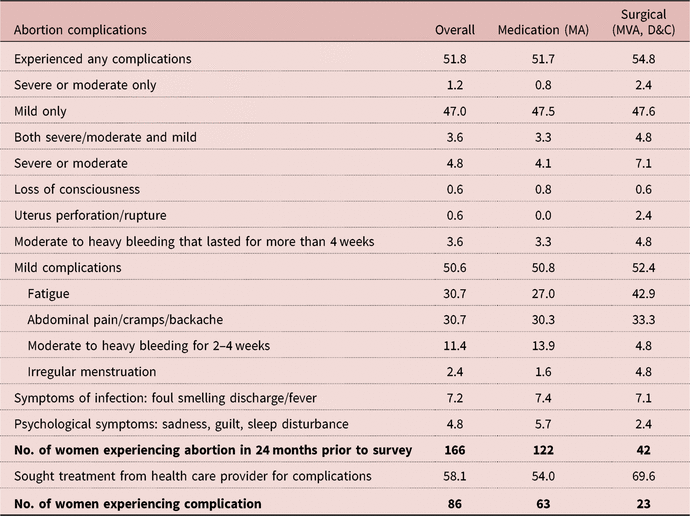
Women were asked if they had experienced any problem following their abortion, and Table 4 reports their responses by type of abortion method reported by all young women, including two who terminated their pregnancy using home-made concoctions or the insertion of herbs or instruments. These are self-reported complications attributed by young women to their abortion, and thus include general conditions such as fatigue, pain and moderate bleeding as well as serious complications such as prolonged bleeding, loss of consciousness and (probable) perforation.
Self-reported post-abortion complications and related treatment seeking, India, 2015

MA, medical abortion; MVA, manual vacuum aspiration; D&C, dilation and curettage.
Overall, half of all abortion seekers (52%) reported the experience of one or more complications following their abortion, with little variation by the abortion method employed.
Moderate to severe conditions, such as loss of consciousness, perforation of the uterus or any rupture, and persistent moderate to heavy bleeding for more than 4 weeks, were reported by 4% of those who underwent medication abortion and by 7% of those who underwent surgical abortion. Far more (51%) reported mild post-abortion morbidity, including, for example, 2 weeks of bleeding, fever, abdominal pain, cramps and backache and delay in resuming normal menstrual cycles, many of which are generally expected following abortion. The most frequently reported mild complications reported were fatigue (31%) and abdominal pains or cramps or backache (31%). Other complications were less frequently cited: for example, moderate to heavy bleeding that persisted for 2–4 weeks (11%), irregular menstrual cycles (2%) and psychological symptoms (5%) were more rarely reported.
Nearly three-fifths of women who experienced complications sought treatment from a health care provider (58%). While numbers are small, they suggest that similar proportions of those experiencing mild and moderate/severe complications had sought care (not shown in table).
Discussion
The paper extends the limited literature on abortion experiences among married young women – a population sub-group that is widely acknowledged to be at a considerable social and health disadvantage in India (Santhya & Jejeebhoy, Reference Santhya and Jejeebhoy2003, Reference Santhya, Jejeebhoy, Jejeebhoy, Kulkarni, Santhya and Mehrotra2014; Stillman et al., Reference Stillman, Jennifer, Singh, Moore and Kalyanwala2014). Unlike most previous studies, which were based on clinic-based samples, this study has drawn on a community-based sample of married young women and provides more detailed insights about abortion experiences as well as pre- and post-abortion experiences, and overcomes concerns of available facility-based studies about excluding women who successfully aborted by taking mifepristone and/or misoprostol obtained from a chemists shop, or who may have obtained an abortion from an untrained provider. The findings both reconfirm the shift over the last decade or so in abortion seeking patterns in India, and, at the same time, shed light on the characteristics and experiences of married young women seeking abortion in the country.
The study findings reiterate a shift from surgical to medication abortion – a finding also observed in a recent incidence study in India that estimated that 81% of abortions resulted from medication abortion (Singh et al., Reference Singh, Shekhar, Acharya, Moore, Stillman and Pradhan2018). The findings also show a shift towards drug sellers and other unqualified providers as sources of medication abortion without a prescription. Overall, moreover, there was a greater use of private sector providers, including drug sellers, among this sample of young women (almost 90%) and a far more limited use of public sector facilities than reported in national-level studies (20–24%) (IIPS & ICF, 2017a; Singh et al., Reference Singh, Shekhar, Acharya, Moore, Stillman and Pradhan2018). The finding that just a small proportion (4%) had undergone abortion in the second trimester of pregnancy supports that of a study of young abortion seekers in Bihar and Jharkhand which noted that 9% of married young women had done so (Jejeebhoy et al., Reference Jejeebhoy, Kalyanwala, Zavier, Kumar and Jha2010a). More than half (52%) of married young abortion seekers experienced a self-reported complication, and 5% had experienced a moderate or severe complication.
The findings point to individual-, family- and health system-level obstacles that young women may face in obtaining timely and safe abortion services in these settings. At the individual and family levels, young women’s lack of knowledge and limited agency and ability to exercise choice may prevent many from seeking abortion from safe providers and/or facilities on time. In the present study, one in eight young women (12%) did not participate in the decision to terminate their pregnancy at all – a percentage that is similar to that reported in an earlier study in Bihar and Jharkhand as well (17.5%) (Jejeebhoy et al., Reference Jejeebhoy, Kalyanwala, Zavier, Kumar and Jha2010a). Lack of awareness about contraceptive- and abortion-related options may have resulted in the finding that some 13% of young women who attempted to terminate their pregnancy failed and were thus forced to either repeat the procedure through another unauthorized provider or to seek termination from an authorized source, involving additional cost as well as days of gestation at abortion – a percentage that is only slightly lower than that reported in the study of adolescent abortion seekers in Bihar and Jharkhand (18%). It is also plausible many women themselves misperceive that abortion for any reason as illegal as a result of the Government of India’s strict measures to enforce the Pre-Conception and Pre-Natal Diagnostics Techniques (PCPNDT) Act of 2003, which prohibits the misuse of prenatal diagnostic tests for the purpose of sex determination. Other contextual factors have also been identified. For example, one study noted that among women of all ages, those living in remote areas and those belonging to the poorest households were more likely than others to have sought a second trimester abortion (Zavier et al., Reference Zavier, Jejeebhoy and Kalyanwala2012). The link of marital violence, and notably sexual violence in marriage, to unintended pregnancy and abortion has also been noted, as observed in a review of available evidence of the consequences of marital violence for women’s lives (Jejeebhoy et al., Reference Jejeebhoy, Santhya and Acharya2010b) and a recent analysis of the 2015–16 NFHS survey, which showed that pregnant young women whose pregnancy was unintended were significantly more likely than other women to have earlier experienced sexual violence perpetrated by their husbands (Raushan, Reference Raushan2019).
Notable health-system-level obstacles include the continued use of obsolete procedures by some providers, limited counselling of women seeking abortion, poor operationalization of abortion guidelines and non-availability or inadequate availability of abortion services in the public sector. As many as 17% of abortion seekers underwent dilation and curettage – a procedure rejected in medical practice (WHO, 2012) – to terminate their pregnancy. A recent abortion incidence study also reported that among surgical abortions taking place in public sector facilities, between a quarter and two-fifths continue to be performed using dilation and curettage or dilation and evacuation, indicating that these facilities are using methods that are outdated, and more likely to place women at risk of complications than other available methods (Singh et al., Reference Singh, Shekhar, Acharya, Moore, Stillman and Pradhan2018).
The study finding that several of the milder complications reported by abortion seekers are those that are expected after an abortion procedure (Ministry of Health and Family Welfare, 2010) may be a result of the lack of counselling about the abortion procedure and about what to expect post-procedure, and reflects women’s misinterpretation of the signs of a normal abortion process. A district-level study in Maharashtra and Rajasthan reported that relatively few women were counselled about post-abortion contraception (Jejeebhoy et al., Reference Jejeebhoy, Zavier, Acharya and Kalyanwala2011a; Reference Jejeebhoy, Zavier, Acharya and Kalyanwala2011b; Jejeebhoy et al., Reference Jejeebhoy, Zavier and Kalyanwala2010c).
The finding that almost 90% of women obtained abortion from the private sector may reflect the limited operationalization of the National Rural Health Mission Operational Guidelines. Although the Guidelines stipulate that MVA and MA should be provided at primary health centre level, and these, along with second trimester abortion and the management of post-abortion complications, should be available at all facilities from the Community Health Centre (CHC) level (those identified as first referral units) upwards (Ministry of Health and Family Welfare, 2010), adherence to these guidelines is uneven, and abortion services in the public health system at levels below the District Hospital in most states are unavailable. A recent sub-national study found that many public facilities do not offer abortion services, and that although medication abortion should be free in all public facilities, in several states, just 12–42% offer free medication abortion services and 28–53% offer free first trimester surgical abortion (Singh et al., Reference Singh, Shekhar, Acharya, Moore, Stillman and Pradhan2018; Moore et al., Reference Moore, Stillman, Shekhar, Kalyanwala, Acharya and Singh2019). Moreover, most PHCs and even some CHCs lack trained staff, necessary certification and/or the required equipment and supplies for providing safe abortions (Kalyanwala et al., Reference Kalyanwala, Zavier and Jejeebhoy2010). Inadequate provision of information to women about the law, including where and up until which gestational age abortion is provided, poor quality of care, lack of confidentiality and the frequent insistence by providers on concurrent family planning may also deter women from seeking abortion in public sector facilities (Stillman et al., Reference Stillman, Jennifer, Singh, Moore and Kalyanwala2014).
The study findings highlight the limitations of the current family planning programmes in India in ensuring access to effective family planning methods to young women. Just two in five abortion seekers had used contraception prior to the index pregnancy that was terminated, and even fewer young women who did not report an abortion – less than one-fifth – had practised contraception. Moreover, contraceptive use appeared to be sporadic and imperfect and unmet need for contraception was evident, with two-thirds of young women who had an abortion reporting a mistimed or unwanted pregnancy, and one-fifth reporting contraceptive failure. Several studies, including the most recent National Family Health Survey, have highlighted the huge unmet need for contraceptives for spacing and limiting among married young women (IIPS & ICF, 2017a; Santhya et al., Reference Santhya, Acharya, Pandey, Gupta, Rampal, Singh and Zavier2017a, Reference Santhya, Acharya, Pandey, Singh, Rampal, Zavier and Gupta2017b).
Study limitations
The limitations of the study are acknowledged. First, since the study focused only on married young women, a comparison of their situation and that of older women could not be made. Second, the complications were self-reported and because of the lack of appropriate counselling prior to the procedure many respondents may have identified a ‘normal’ outcome of abortion as a complication. Third, the study did not collect information about perceptions of the quality of care received and other service-related aspects. Finally, the analytical sample constituted 166 married young women only; however, community-based studies, including the nationally representative National Family Health Survey, have routinely observed that abortion seekers constitute a minority of all women surveyed. Data from the most recent National Family Health Survey, for example, show that just 1% of married young women aged 15–24 interviewed had reported an induced abortion in the two years preceding the interview (IIPS & ICF, 2017a), similar to the present finding, giving confidence that while small, this sample of abortion-seekers is representative of married young women in study settings more generally.
Policy and programme implications
The study findings call for improved attention to providing contraceptive counselling and services to married young women in India, and ensuring abortion services in public health facilities, including lower level facilities such as primary health centres and sub-centres. Better implementation is needed of the National Adolescent Health Programme (Rashtriya Kishor Swasthya Karyakram (RKSK)), which aims to improve the knowledge, attitude and behaviour of adolescents in relation to sexual and reproductive health matters at the facility, school and community levels.
The findings also call for measures to raise the awareness of young women in India about abortion options. As other studies in India have noted, women who obtain medication abortion drugs without a prescription may lack knowledge of the correct dosage or protocol and place themselves at risk of complications or incomplete abortions (Ganatra et al., Reference Ganatra, Manning and Pallipamulla2005; Ramachandar & Pelto, Reference Ramachandar and Pelto2004; Banerjee & Clark, Reference Banerjee and Clark2009; Jejeebhoy et al., Reference Jejeebhoy, Kalyanwala, Zavier, Kumar and Jha2010a; Kumar et al., Reference Kumar, Zavier, Kalyanwala and Jejeebhoy2013; Powell-Jackson et al., Reference Powell-Jackson, Acharya, Filippi and Ronsmans2015; Bhilwar et al., Reference Bhilwar, Lal, Sharma, Bhalla and Kumar2016); efforts are needed to equip them with this information. At the same time, there is widespread confusion about whether abortion is legally available and the location of available services, driving many women to seek abortion outside the public sector; young women, and communities more generally, must be far better informed about their right to seek abortion.
Also required are mechanisms to improve drug sellers’ knowledge and practices in providing medication abortion. Previous studies have observed that drug sellers may be unaware of correct dosages and possible side-effects and fail to counsel or convey information on these to their customers (Ganatra et al., Reference Ganatra, Manning and Pallipamulla2005).
Funding
The John D. and Catherine T. MacArthur Foundation (Grant No. 14-106701-000-INP) and Barr Foundation provided funding support for the study (Grant No. 5804).
Conflicts of Interest
The authors have no conflicts of interest to declare.
Ethical Approval
Free and informed consent was sought from survey participants before the beginning of the interview. The Institutional Review Board of the Population Council, New York, approved the study protocol.