Between 1873 and 1917, the numbers of Barbadian women committed to penal custody on an annual basis surpassed those of men. While women's per capita imprisonment rate was still somewhat below that of men for most of these years, given the wide margins by which women outnumbered men in the population and the labor force, these proportions were nevertheless unprecedented, not only in the British Caribbean but also in other parts of the world. Available figures for Jamaica and Trinidad over sections of the period hover around an 18–20 percent female proportion rate, while in Barbados the rate usually exceeded 50 percent.
To be more precise, during this forty-five-year period, women failed to surpass men in their yearly prison-going numbers for penal sentencesFootnote 1 only nine times, and only in one year did women make up less than 48 percent of the total. The latter was in 1876, the year of a large-scale “abortive revolution,”Footnote 2 when men who had taken part in the riots crowded the colony's jails, raising their annual prison-going quota to a rare 59 percent of the total. At the height of the Panama Canal labor migration (1905–1913), a predominantly male experience, the female proportion among penal committals in Barbados expanded to nearly two-thirds of the total, reflecting the dubious achievement of a higher overall female than male per capita rate of imprisonment during the exodus.Footnote 3 While imprisonment as a whole declined during the migration, it did so at a much higher rate for men than for women.
After 1917 (roughly, post-World War I), the pattern of relative female prominence began to change, as the penal trajectories of men and women diverged in a way that eventually put Barbados back into the “global” mainstream of gender-differentiated penal traditions. Graph 1 captures the unusual pattern of male and female penal imprisonment from 1875 to 1929.
Graph 1.

This paper was prompted in part by Barbados' atypical penal profile and in part by wider sociological and historical concerns. It seeks to explore the deeper structural reasons for the Barbadian difference as well as the historically specific circumstances of this particular fifty-plus-year penal trajectory (roughly, 1875–1929). The period covered here was a time of monumental change for the British West Indies, spanning the years of “bounty sugar” depression, local and global restructuring of the sugar industry and market, the great migration of workers bound for the Panama Canal construction zone and new plantation zones elsewhere in the circum-Caribbean region, World War I, and an aftermath of return and repatriation. According to official Isthmian Canal Commission reports, the island was by far the single most important source of formal labor recruits for construction of the Canal, dwarfing all other officially recorded sources and confirming Barbados in its decades-long status of being as much a labor-exporting economy as a sugar export economy.Footnote 4 Over the entire period, changes in the penal system of Barbados clearly mirrored the impact of these local and transnational shifts in political economy, labor demography, and colonial state policy.
In this paper I argue that we can gain key explanatory insights into the unusual levels and pattern of female imprisonment by examining Barbados' unique configuration of an inflexible and monopolistic plantation economy and fragmented, semi-feudal family wage system (in which women's participation was very high), coupled with the circumstances of and state responses to persistent and large-scale male labor migrations. Moreover, in the last ten or so years of the period under study, the demands of both industrial restructuring (or corporatization) and newly politicized returning workers and veterans, in combination with the material and social uplift made possible by remittances from Panama (“Panama money”), induced a shift in the moral economy and gendered modes of subjectivity of the working classes. This shift, as I will explain in my concluding section, led ultimately to a decline in female criminalization and incarceration, among other things.
My analysis is carried out within the frameworks of comparative political economy, specifically the plantation economy paradigm, and of race-class-gender relations within the context of this particular colonial experience. In positing a non-reductive relationship between plantation economy and penal policy, I deploy a notion of “system of re/production” that involves both the labor economy of goods production and human reproduction, and the “moral economy” of (institutionally and discursively mediated) race-class-gender-sexual roles and representations. Both of these “economies”—one material, the other ideational—form part of the core system of domination, as well as key sites of resistance. In this analysis I center the role of women as race-class-gender-sexual subjects in both economies. The state's criminalization and penalization of women, as well as Barbados' uniqueness in this regard, are presented from that perspective.
In addition to examining the state's (or, more broadly, the political economy's) extraordinary “structural” proclivity to prosecute and imprison women, I trace the impact of male migration on penal policy and trajectories, at least as broadly represented by rises and falls in prosecution and imprisonment rates. A surge in female imprisonment to the high levels that characterize most of the period under study took place precisely in 1873 and was sustained until 1917, after which the long-term decline began. The evidence that I will present suggests that this increase was a direct result of a tightening of law-and-order social controls in the wake of closely regulated concessions that eased longstanding emigration restrictions and prohibitions against foreign labor recruiters. High levels of male emigration induced the increased criminalization of so-called “abandoned” dependants. In the face of a grudgingly, or at least ambivalently, sanctioned male labor exodus, the state “stepped in” to exercise stricter patriarchal/ruling-class oversight of black working-class women and children (especially boys, as I have shown elsewhere).Footnote 5
This, then, is a study of the external conditions and circumstances of gendered penal trajectories; it is not an analysis of penal institutions or even penal policy per se. It is also more concerned with the criminalization and disciplining of women than with female criminality itself. As such, I explore the relationship between the system of re/production and the disciplinary regime, particularly with respect to Afro-Barbadian working-class women. In considering the shift in the re/productive and moral economies that took place in the post-World War I period, I draw on the sensibilities of Michel Foucault, in light of his keen insights into the evolution of “disciplinary regimes” and the ways in which they are insinuated in the production and transformation of embodied and psychic subjectivities.Footnote 6 That shift was clearly reflected within the prison system itself, echoing in specifically mediated ways the type of historic transition documented in Discipline and Punish. There was an incremental movement away from corporal punishment or physical applications, such as flogging, the treadmill, and shot drill (for adult men), as well as from weights and restraints, hair cropping, and stone-breaking, particularly for adult women. By the decade of the 1920s, punitive, corporeal justice was giving way to a new proactive penological emphasis on reform, rehabilitation, and vocational training for men, and a trend away from incarceration as a routine device for the “mass” or public disciplining of women.
There are precedents in the literature for interrogating differential levels of female criminality and criminalization, particularly with respect to British history. The usefulness of some of these is limited by their focus on serious offenses only or on prosecution rather than punishment or imprisonment, but they are worth mentioning nonetheless. Feeley and Little challenged the belief that “criminal activity is and always has been a male phenomenon … that women are marginal in the criminal process and that gender is invariant with respect to crime.” They presented evidence of relatively high proportions of female offenders in the early eighteenth century and “their steady decline to a low of under 10 percent toward the end of the nineteenth century.”Footnote 7 The high female proportions appear to have averaged about one-third of offenders, and in one year in their sample, 1735, the figure reached 45 percent.
D'Cruse and Jackson have recently challenged these figures as unrepresentative, since they were drawn from a limited London-based sample that might be considered atypical, and were derived from individual years selected at twenty-year intervals that were “not necessarily representative.”Footnote 8 While acknowledging that urban areas in England showed higher levels of female criminality than rural areas (and allowing for wartime surges in female rates), they nonetheless arrived at less-inflated alternative figures and low overall proportions. They see “women's declining presence in court” as “a phenomenon of the first half of the twentieth century,” and attribute the decline in summary offenses between 1890 and 1930 to “a drop in prosecutions for soliciting.” Zedner, also, points to a decline in gender-typed female prosecution and criminalization in England towards the end of the nineteenth century.Footnote 9
This brief survey provides some perspective for the Barbadian case. It shows that while there is some overlap in historical trends, including in the comparable impacts of war and mass male migration, the high female proportions for Barbados still hold up as rare. Perhaps most useful to us is the methodological insight these studies offer. In attempting to account for changes in the levels of female criminality, Feeley and Little examine two schools of social history, one emphasizing “shifts in the modes of production and their effects on women's roles and economic opportunities,” the other “shifts in social relations and sensibilities independent of economic conditions.”Footnote 10 The framework employed in this paper eschews such either/or options and assumes throughout a structured articulation between modes of re/production and modes of representation, discourse, and morality.
Plantation Economy and the Status of Working-Class Afro-Barbadian Women
Noting the higher levels of recidivism among prison-going Barbadian women than men, as well as a juvenile rate that rivaled the adult male rate, the Blue Book & Report for 1872 had a ready explanation: “These large proportions are easily accounted for by the condition and character of the abandoned lower class of females, and of deserted children and orphans, in a West Indian community.” The theme of abandonment and desertion had been a constant thread running through the administrative and legislative preoccupations and anxieties of the Barbadian authorities from the earliest years following full emancipation in 1838. There were two reasons for this theme: The first was a desire to stem the tide of migrating workers, especially male workers. The second was a felt need to absolve the central government and local authorities of any responsibility for the women and children left behind, and at the same time to criminalize those who allegedly abandoned them.Footnote 11 Moreover, by casting women in the role of literally abandoned or depraved and idle females, and children in the guise of delinquent orphans or larcenous vagrants, the government never had to acknowledge that the greater proportion of the agricultural and service labor in the colony was performed by women and children. And by holding the specter of the male breadwinner model over the heads of men, women, and children, while denying a male breadwinner wage to men or even an acknowledgement of their worker status to women and children (who were configured, rather, as deserted family dependants), the government provided itself with a foolproof rationale for severely disciplining a population so “naturally” inclined towards delinquency and criminality. Flogging and incarceration became routine devices in a rigid disciplinary regime designed to keep the lid on an entrapped “surplus” population that was bursting at the seams and liable to explode in a dangerous groundswell of pent-up anger. Women and girls escaped penal flogging—which had long been banned for females—but not routine apprehension, prosecution, conviction, and imprisonment.
Comparativist paradigms by founding proponents of the Caribbean “plantation economy” school, like Lloyd Best, Kari Levitt, and George Beckford, as well as those related to post-emancipation trajectories like that of American economic historian Stanley Engerman, have all established in different ways the classic variant represented by Barbados.Footnote 12 Barbados has been distinguished as the closest approximation to a “pure plantation economy.” This refers to an economy and race-class power structure overwhelmingly organized through the “total institution” of the plantation and the business and labor arrangements of a monocrop sugar export system, wholly dependent on colonially mediated metropolitan markets.Footnote 13 The island's economic structure embodied local private plantation monopoly of land and capital institutions and a captive and dependent wage labor force in the context of a high labor-to-land ratio. Barbados avoided, for various reasons, two alternative types of post-emancipation resolution that characterized the other major sugar-producing West Indian territories. The first, typified by Jamaica, was the systematic decline of sugar and the private sugar bourgeoisie, together with, among other things, the meteoric rise of a semi-independent, ex-slave peasantry. The second involved the restructuring and continued dominance of the sugar industry through the mediums of metropolitan corporate capital, technological modernization, and large-scale immigrant (Asian) contract labor. This was typified by Trinidad and British Guiana, the late entrants into Britain's diminishing early-nineteenth-century Caribbean sugar kingdom. These colonial-capitalist enclave economies have been differentiated as “closed” or “open” hinterlands (of the metropolitan-hinterland nexus); those in between have been characterized as mixed or intermediate.
In late-nineteenth- and early-twentieth-century Barbados, the great bulk of economic life continued to be contained within the plantation system, with “spaces of autonomy” being few and far between. Entrapment within the white minority-owned plantation system, with its highly incorporated race-class-gender regimes, had particular consequences for working-class women in Barbados. These regimes stood in contrast to those islands where large numbers of ex-slaves were able to escape the plantation and establish relatively independent communities based on modest black peasant patrimonies in which women's primary obligations were to the male household head and/or the family enterprise. Also notable is that those islands had a much smaller and less pervasive white residential hegemonic presence.
Even during slavery, women and children had had a special prominence in the plantation workforces of Barbados, that is, even in the context of the high deployment of enslaved women and children as field workers in Anglo-Caribbean slave systems in general. Noting Barbados' unusual reliance on female drivers and the early age at which a majority of slaves were put to work in the fields, Higman concluded, “The Barbadian system of large gangs of children supervised by female drivers was unique.”Footnote 14 This in part reflected sheer availability, since Barbados was the first major sugar island to attain demographic creolization—an excess of births over deaths, leading to a younger and predominantly female creole or native-born population. Over the long haul of slavery, the enslaved woman's role as first and foremost a “producer” rather than a “reproducer” was critical to the modalities of her deployment in the plantation economy. In the post-emancipation period the female predominance was exacerbated by uneven but persistent outflows of mostly male labor migrants.
With or without the sanction of the plantocracy, recruiting agents targeted “labor-surplus” Barbados as a most likely source of workers as new plantation systems and infrastructural projects were opened up around the circum-Caribbean region. The overwhelming demand was for male workers. Furthermore, in contrast to the experience in the more “open hinterlands,” women and children did and could not withdraw en masse from the plantation sector in the post-emancipation period because there were few alternative life-sustaining economies. There was also a general lack of alternative livelihoods such as might have been provided by the male-breadwinner family, state welfare, or church or private charity. Financially distressed but “deserving” white women were often the special and exclusive beneficiaries of government assistance and private charities, which had the specific objective of restoring them to their imagined former status in the society. By contrast, the colonial state neither protected nor subsidized black motherhood, or made provisions for a male family wage (however hetero/sexist a resolution this might have represented); instead, it persisted in sanctioning wages for women that were even lower than those of men, and sometimes those of boys. Within the sub-region, Barbados was marked by a unique cluster of features that included the highest female paid-worker rates in the English-speaking Caribbean, the highest infant mortality rates, the lowest wages, and the highest land values.
The plantation economy entailed not just tight control of labor but, more specifically, a family-wage economy in which men, women, and children were all incorporated, albeit differently, into seasonal sugar-production regimes. In this fragmented, family-wage economy, women experienced high levels of both labor force participation and childbearing, making them central to both the sugar-export and labor-export economies. Given the simultaneous implications of the re/production and moral economies, this dual centrality ensnared them in a contradictory discursive web that victimized them at every turn, in a classic no-win situation.
Since the days of slavery, black women have been caught up in a discourse of black immorality (blackness itself being seen as a mark of sin and guilt) and black nonentity (“social death,” at worst, or black ontological insignificance and dependency, at best). Therein lay the convenient paradox: black culpability coupled with black incapacity for full human agency and consciousness. For black women, this paradox was “doubled” by a parallel and intersecting discourse about femaleness and femininity as both dangerous and dependent. Worse still, if other women could be “saved” through the protection of the patriarch within the enclosed sanctity of the home and the purifying domestic roles of wifehood and motherhood, most Afro-Barbadian women were bereft of the means to such salvation. Not only did their work roles habitually locate them outside the home, but their homes lacked the requirements for moral redemption: the institution of legal marriage, in-wedlock childbearing, the sustained governing presence of a wise patriarch, and all of the essential decencies appropriate to the proper ritualistic devotions of conjugal and maternal labor. If anything, their unsanitary and close, overcrowded living quarters were considered natural laboratories for disease, impropriety, vice, and crime.
Moreover, women's actual situation as workers and breadwinners appeared to confound the limits of acceptable discourse, so that neither role was acknowledged, and indeed both were actively denied and besmirched: Afro-Barbadian women were repeatedly described as “idle” and as “abandoned” dependants. They were also castigated as unfit and uncaring mothers and as profligate and immoral characters. As Richardson has pointed out, black immorality was cited as the cause of most of the ills suffered by Afro-Barbadians, including “ill health and high infant death rates.”Footnote 15 From early on, this discourse hinged on the evils of illegitimacy and concubinage, with their paired protagonists, the transient or absent father and the promiscuous and negligent mother. Women were portrayed, in varying combinations, as both victim and perpetrator, as doubly abandoned: abandoned by men and devoid of morals. For example, while the numbers of arrests and convictions for prostitution comprised only a small percentage of women's encounters with the judicial system, they were often placed front and center of an inflated discourse about the moral abandon of working-class females. As part of the legacy of slavery, Afro-Caribbean women were stereotyped as “natural” prostitutes, and their practical adaptations to conditions of exclusion from elite familial institutions of honor and respectability were seen as illegitimate and, moreover, as predisposing them to criminality.
Caught between the unattainability or inaccessibility of elite institutions and the “illegitimacy” of their own institutional and cultural adaptations (combining consanguineous kinship with convenient permutations of consensual conjugality), they were deemed “guilty” before they entered the fray. All Afro-Caribbean communities were subject to the punishing hegemonic discourses of “illegitimacy” and “immorality,” but the efficacy of such discourses depended on the intensity of hegemonic exposure and incorporation, the relative existence of “spaces of autonomy,” and the relative permeability of such spaces. The Afro-Barbadian experience was distinguished by an acute lack of extra-plantation economic space and the permeability of the plantation tenantry's domestic space.
In the post-emancipation period, migration was increasingly criminalized, both legally and discursively, as an illicit escape hatch for men who were bent on abandoning their families and familial obligations. Women and children shared minoritarian status, and were seen in common as victims of adult male desertion. Having been abandoned by men, women were accused, in turn, of neglecting their children. Within this scenario, all were liable to criminalization in ways befitting their gender and generation: the unmanly and irresponsible adult absconder, the criminally inattentive mother, the scandalous street virago, the habitual petty thief, the incorrigible juvenile delinquent. By their highly audible and visible presence in the fields, streets, and other working-class commons, women were “equally” amenable to the disciplinary surveillance of the forces of law and order, which were themselves more extensive and institutionally entrenched in Barbados than in the rest of the Anglophone Caribbean.Footnote 16
Criminalization, penalization, and imprisonment also performed more obvious and routine functions of labor control. At the height of the plantation economy, fluctuations in the rate of imprisonment were closely tied to levels of employment, indicating that one function of imprisonment was to maintain a “labor reserve.” This manifested itself in the contexts of seasonality of sugar production and emigration, and also in the particular instance of the withdrawal of women from the labor force from the 1920s onwards. High levels of unemployment led to higher levels of crime and overcrowding of the island's prisons. Local authorities recognized that the crime rate followed a seasonal pattern, with “more crime in the period from September to January inclusive when there [was] less employment for the labouring population than during any other period of the year.” In these “out of crop” or pre-harvest months, “praedial larceny and petty thefts” were known to “largely increase.”Footnote 17 Conversely, lower levels of unemployment induced by high seasonal or “in-crop” employment and contractions of the labor force through migration or withdrawal were accompanied by declines in the rates and levels of imprisonment. The Barbados Herald of 17 April 1879 editorialized, “Crime in Barbados … seems to be regulated by a kind of natural law—shewing that crime is to some extent influenced by circumstances. Thus during the crop season, when labour is in demand and a large amount of money in the shape of wages is in circulation, the Calendar decreases; while it rises again to greater proportions when the demand for labour diminishes.”Footnote 18
The labor reserve function of imprisonment had a more directly exploitative component. As a conduit for draining off excess labor from the private plantation economy and transferring responsibility for their charge to the state, it also transferred labor power to the state public works. Moreover, it did so at a greatly reduced financial charge to the planter class—who controlled both the economy and the state—since the prisoners met a significant proportion of the costs of both their own upkeep and prison administration through their labor services and in-house goods production. In 1901, for example, the value of the prisoners' industrial labor was estimated at £2,647, half of the total cost (£5,286) of prison maintenance, including administration and staff salaries.Footnote 19 Furthermore, the “public works” on which male prisoners toiled largely benefited the privately owned plantation sector.
Other notable spikes in the level of imprisonment were accounted for by mass political or hunger riots, which, during the forty-five-year period 1873–1917, provided some of the few occasions on which the annual count of male prison-goers exceeded that of women. Although women did participate in mass riots, they did not do so to the same extent as men, and in any event they were seen as less liable politically: men were seen as the “real” authors of political dissent, and their independent political agency was considered a more direct and serious threat to the ruling-class male establishment.
Criminalization of Women in Comparative Anglophone-Caribbean Perspective
According to repeated Colonial Office lamentations, Barbados magistrates took far greater license in ordering the flogging of male juveniles than was the practice elsewhere in the British West Indies. They had the figures to back up their claim.Footnote 20 But how did Barbados' penchant for imprisoning women compare with the penal policies in other islands? Excessive rates of apprehension and prosecution of the laboring population were not peculiar to Barbados, but the system there did seem to generate consistently higher rates of convictions (relative to acquittals) and penal imprisonment. This denoted at least a greater intensity of prosecutorial vigilance, engagement, and “efficiency.” Throughout the entire period under study here, about three-quarters of those charged were convicted, with the majority being fined or committed temporarily to prison “in lieu of fine or surety.” Moreover, in none of the other territories did the female proportion among prison-goers remain so consistently high over such an extended period.
At the same time, it is important to note that, beyond the facts of conviction and imprisonment, Barbados shared with the other territories a strict gender differentiation in the types and applications of punitive measures they used. Indeed, a preoccupation with gender difference had been a feature of both pre-emancipation and post-emancipation ameliorative reform in all of the British West Indian territories. While much of this preoccupation was taken up with constructing and protecting the modesty of women, attention increasingly turned in the period studied here to the making of proper (subaltern) men. For most of the period, proactive reform measures specifically targeted boys and men, while women appear to have been the objects of more reactive social control mechanisms. Boa has concluded that the “lack of concern for girl convicts suggests that, in the eyes of the courts, they were already irreparably damaged.”Footnote 21
Very few published studies exist on the historical sociology of the penal system in the British West Indies after emancipation. The two most prominent full-length studies, David Trotman's on Trinidad and Diana Paton's on Jamaica, cover earlier time periods than that covered here, although there is some overlap with Trotman's study of nineteenth-century Trinidad.Footnote 22 In very different ways, both studies provoke comparative challenges: Trotman fails to provide any statistical or analytical gender breakdowns in his 1986 book—despite dozens of tables—and seems to presume the convict as an ethnically variable but otherwise homogeneous working-class male subject, with women configured predominantly as ethnic (African or Indian) victims or heroes that provided colorful narrative interest. His failure to explicitly consider gender either nominally or analytically is an unfortunate lacuna in an otherwise illuminating and pioneering book. Curiously, his earlier (and later republished) article, “Women and Crime in Late Nineteenth-Century Trinidad,” is neither referenced by him nor substantively integrated into his analysis, although it provides important clues to both the lack of gender breakdowns in his book and the position of women. He indicates in this article that gender breakdowns were simply unavailable for much of the data and he endeavors to make the best use of those few that were.
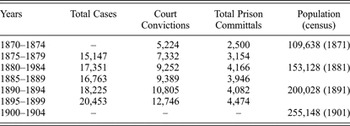
In contrast to those for Barbados, Trotman's Trinidad findings show (a) somewhat higher levels of police arrests and prosecutions, and (b) significantly lower levels of female imprisonment, limiting him to “only guess at the reasons for the smaller female prison population.” He conjectures: “Some magistrates may have felt that prison was the wrong environment for women, and would impose prison terms only where imprisonment was mandatory. Many women may have been in a better position than men to pay fines and avoid imprisonment.” By his calculation, “During the 1870s and 1890s, the female contingent of the prison population never exceeded 15% of total committals, 18% of penal imprisonments, or 12% of non-penal committals.”Footnote 23 He assures us, however, that these figures in no way signaled a proclivity towards secluded modesty or passivity on the part of Trinidadian women, and his portraits of the late-nineteenth-century jamette and urban female gangs confirm that this was not the case. The extraordinary overall numbers for Trinidad speak to a turbulent historical period when tens of thousands of ethnically diverse, predominantly male contract workers were being brought into the expanding frontier sugar economy, a large part of which was under foreign corporate control. As immigration leveled off, Trinidad's bloated penal profile shrank.
Paton, on the other hand, centers gender as a key variable in her more recent book, which examines pre- and post-emancipation Jamaica over several decades. Although her study ends eight years before the present one begins, her analysis indicates that there was already an important contrast between the situations in Jamaica and Barbados. She notes that throughout the 1840–1870 period in Jamaica, “the prison population was heavily male, with, on average, 13 percent of the prison population being female, a significant change from apprenticeship, when about 20 percent of prisoners were women.”Footnote 24 Her conclusion regarding the trajectory of the Jamaican penal tradition seems even more definitive: “By the 1850s, the archetypal criminal was so firmly male that no alternative harsh punishment for women was thought to be necessary to parallel the flogging of men.… In the discursive realm, women no longer figured in the debate about punishment.”Footnote 25 While limits to the scope of her project are understandable, by remaining on the narrow institutional and discursive terrain of carceral punishment, Paton misses a chance to follow women beyond the prison, through the connecting corridors of the wider disciplinary regime, and into other disciplinary spaces. That would have allowed her to consider all disciplinary instruments as part of a process of gendering that continually reconstituted and redefined both women/womanhood and men/manhood (including through a dialectic of absence/presence). The tendency to treat the disappearance of women from the prison at face value lessens the comparative value of her study.
In Barbados, the archetypal criminal was no less male. However, reality frequently intruded upon that vision, forcing harassed officials to turn their attentions (albeit dismissively) time and again to that ubiquitous and incorrigible class of female prisoners “drawn from the lowest dregs of society, convicted for disorderly conduct, indecent language, common assaults, solicitation &c., mostly in and around Bridgetown.”Footnote 26 The officials' outraged sensibilities of gender, race, and class induced them to invent their own archetypal female criminal, using this as a broad brush with which to paint all female prisoners. Given prevailing global-imperial norms of women as the “weaker” or less aggressive and morally superior sex, it is surprising that the Colonial Office did not make more of the high incidence of female imprisonment in Barbados, or question the apparent deviation from the norm represented by women making up the majority of those committed to penal imprisonment.
It is not that women were not periodically the object of (gendered) humanitarian attention and reform; at various points along the way, such attention and reform put an end to the flogging of women, to punishment by treadmill or shot-drill, to hair cropping, to stone-breaking, and to all outside labor. However, in Britain itself, rationalizations abounded during the Victorian era as to “why women committed less crime” (meriting far lower prison committals than men). In the second half of the nineteenth century, British women's crimes made up 17 percent of summary convictions, and women consistently comprised around a quarter of those committed to county and borough prisons, the destination of 98 percent of women sentenced to custody by the courts.Footnote 27 According to Zedner, in her historical study of women, crime, and custody in England, it was “perhaps, unsurprising that the Victorians had little difficulty in explaining the relatively low rate of female crime. Since they expected women to be morally superior to men, they expected their social conduct to be better too.”Footnote 28 She points out that “the view of most women as innately non-criminal” intensified towards the end of the century, as female crime appeared to decline. The epithets used to describe female criminals were particularly vicious since these women were seen to constitute an unspeakably hardened “fallen” minority, and one prominent criminologist claimed that whereas male criminals came from “all the lower strata of society,” female criminals came from “a debased class.”Footnote 29
In Barbados, this discourse of negative exceptionality (in speaking of crime that was largely unexceptional and victimless) was not typical, since working-class Afro-Barbadian female criminality was not seen as out of the ordinary. The presumed or projected models of “female moral superiority” arguments usually featured white women, brown middle-class women, and, particularly in other islands (like Jamaica), women of the small landholding classes. The comparative referent in this setting was not so much men as other race/color/class women, or women outside the plantation or urban working-class economies, whose post-emancipation life conditions enabled a restoration of their special gender-anointed moral character.
Since broad colonial penal principles and systems were fairly standard across the British West Indies and the agro-export plantation mode of production was to some degree common to all, variation in the economy-penalty interface depended more on local socio-demographic and political economic permutations, with their assorted configurations of race, class, and gender, and, therefore, “moral economies.” In his single-island focus, Trotman confines himself to the broad platform of “plantation economy,” without explicitly evoking the internal comparative dimensions proposed by members of the plantation-economy school (and again, like them, without operationalizing gender).Footnote 30 He submits, “An understanding of the rate and pattern of violence and theft in the nineteenth-century plantation society must first begin with an understanding of the plantation system as it operated in nineteenth-century Trinidad.” He further explains: “This study does not claim that without the plantation system there would have been no crime—rather, it sees crime as the mirror in which are reflected the problems of the plantation-influenced economy and society in post-emancipation Trinidad.”Footnote 31 It is clear from his important study, however, that conditions of large-scale labor immigration and indentureship—which were among key historical features of colonial plantation systems around the world—were central to the levels of criminalization sustained in Trinidad through the second half of the nineteenth century.
Nineteenth-century Trinidad was seething with hostile police and prosecutorial action targeting the working classes, but it was a very different place from nineteenth-century Barbados. In many ways the societies were opposites: Barbados had been a sugar plantation colony for two and a half centuries, and despite its remarkable, continued resiliency as a sugar-production machine, as part of a generally declining sugar empire, it was becoming an important exporter of labor to rising U.S. centers of economic activity (including sugar production) in the circum-Caribbean region. Late-nineteenth-century Trinidad was still a classic “open island hinterland,” just entering the world of colonial plantation economy and in the throes of an intensive labor-importing stage of that trajectory. While emigrating men left behind a predominantly female Afro-Barbadian population and workforce in the Caribbean's oldest and most enduring plantocratic regime, males had the numerical edge in the labor-importing, multiracial, expanding Trinidadian economic frontier. In the volatile and litigious conditions of mass immigrant contract labor, Trotman found an “indiscriminate use of confinement” by the authorities.Footnote 32 This steadily declined after 1880, signaling “the gradual abandonment of the prison as the major agency of social control.”Footnote 33 As in Barbados, a decline in the rate of imprisonment did not mean a decline in the rate of conviction; indeed, quite the opposite. However, in Barbados, the rate of imprisonment gradually increased towards the turn of the century, and up until 1919 it would have been premature to speak of an abandonment of the prison as, at least, a major agency of social control.
In Jamaica, the relative rate of imprisonment of women was also low. Moreover, compared to Trinidad and Barbados, the overall rates of arrests, prosecution, conviction, and imprisonment were low, too. A survey of criminal statistics provided in Jamaica's Blue Books for the twenty-five-year period 1890–1914 shows an average per capita conviction rate of a little over 2 percent,Footnote 34 compared to figures from Barbados which range from about 4.5 to over 7 percent.
Jamaican women's penal profile provides a further study in contrasts. For example, in the ten-year period 1895–1904, adult committals for penal imprisonment in Barbados averaged 3,288 persons a year (with 4,040 in 1902 alone), compared to an annual average of 4,188 adult offenders committed for both penal and non-penal imprisonment over the ten-year period 1900–1910 in Jamaica, with over four times the population of Barbados.Footnote 35 Even more startling, Barbadian female convicts averaged 1,704, or 52 percent, of the annual total during the ten-year, pre-Panama period from 1895–1904, in contrast to an annual average of 854 females comprising about 20 percent of all adult prison-goers in Jamaica in the first decade of the century.Footnote 36
Barbados remained an overwhelmingly wage labor-based economy, eventually effecting a transition from a servile (waged) plantation tenantry to a modern peripheral-capitalist proletariat. Jamaica's heterogeneous regional economies were distinguished by divergent (plantation/peasant) modes of production, peopled by what some nineteenth-century observers contrasted, approvingly or disapprovingly, as “estate Negroes” and “mountain Negroes.”Footnote 37 Holt estimates that, by the 1890s, peasant proprietors and their families may well have made up half the population of Jamaica, and that, by the 1930s, they probably comprised somewhere between 60 and 80 percent of the population.Footnote 38 In Barbados, plantation tenants vastly outnumbered small-scale black landowners, who made up an undetermined portion of the 8,500 small proprietors estimated to have acquired about 10,000 acres of land by 1891. By contrast, the 1891 census enumerated forty-five thousand agricultural laborers, most of them “located laborers” whose tenure of estate housing and subsistence plots was conditional on performance of labor service at below-market wages.
Jamaica's “dual economy” allocated different roles to women. In plantation-dominant parishes, women comprised half or more of the estate workforces, whereas in more or less independent peasant communities or enclaves they remained within the farm/household domestic enterprise, and only the most desperate households required their female members to work more than occasionally on nearby or distant estates. Under missionary influence and a restorationist, post-emancipation, masculinist dispensation, women of the middling peasantry or smallholder class had been offered a new contract of subordinate but protected wifehood and the sanctuary of proper conjugal domesticity. As “protected” women—though barely—they were not appropriate candidates for Her (and later His) Majesty's Prisons.
This point is not lost on Paton, who writes, “Women's withdrawal from the paid labor force perhaps also meant that planters were less concerned with controlling their behavior than that of men.”Footnote 39 This withdrawal was, of course, selective. In 1921, for example, a year of continued high emigration out of Jamaica, “eight of the twelve rural parishes reported more women than men claiming occupation as an agricultural labourer, notwithstanding a national sex ratio greater than 1,000.”Footnote 40 Jamaica presented a marked gender dimorphism in its intra- and inter-sectoral patterns, with a growing and heavily male-dominated, small-farmer economy and a plantation sector where women were still prominent, but which they were rapidly abandoning in favor of non-agricultural work. Barbados' hegemonic plantation labor system afforded few escape routes from the formal, codified, or “public” labor force into own-account familial or informal sub-economies.
Ultimately, a yawning gap separated the relatively strong, culturally and spatially autonomous village system in Jamaica (to which many plantation workers, too, could regularly retire) from the white-controlled vestry system of Barbados. The latter prompted one author to comment that a “rural black Barbadian ‘belonged’ to a particular parish just as he ‘belonged’ to a particular estate.”Footnote 41
Elsewhere, I have drawn a contrast between “the protected woman whose labor belonged to her husband and family and the unprotected woman whose labor belonged directly to her employer.”Footnote 42 This post-emancipation differentiation among non-elite women marked distinctions both within mixed plantation economies like Jamaica and between islands like Jamaica and Barbados, the closest prototype of a pure plantation economy. Afro-Barbadian women were the quintessential “unprotected” women, forming with their children the bulk of the unskilled and casual estate labor force, as well as the small informal sector workforce. This meant that working-class women “were largely ‘public’ creatures, moving and working ‘abroad,’ and subject to all the vicissitudes and official monitoring of public life, in the fields, the streets, and the semi-communal ‘yard’ (Afro-Caribbean residential compounds).”Footnote 43
This profile stood in contrast to that of non-elite women in “metropolitan” contexts as well. Writing in 1901, U.S. sociologist Frances Kellor attributed the low crime rate among women to lack of opportunity or exposure to public scrutiny. Zedner, drawing parallels with women in England, summarizes Kellor's arguments: “Confined for much of their time to the home and to childcare, women were simply denied the opportunity to commit many forms of crime. Their mobility was restricted, they spent little time in the public sphere, and they tended not to congregate in pubs or on the streets, as men did, enabling them to devise and commit crime. Those acts of deviance that women did commit often took place in the privacy of their own homes and so rarely reached the public scrutiny of the criminal justice system.”Footnote 44
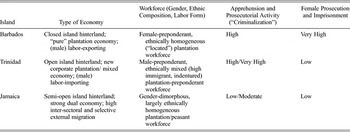
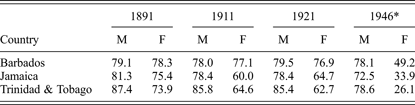
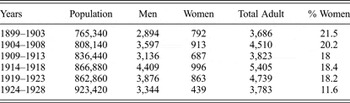
Evidently, Kellor did not have Afro-Barbadian women in mind when she offered her analysis,Footnote 45 and despite some resonance with other female Caribbean situations, neither was she representing women in peasant communities who had to contend with different kinds of economic and community “publics.” A comparative economy-labor-gender-penal typology characterizing Barbados, Jamaica, and Trinidad is presented in Tables 1–6.
Comparative Economic and Penal Profiles, 1875–1905.

General Worker Rate by Gender, 1891–1946.
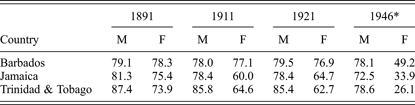
Source: Olive Senior, Working Miracles (Bloomington and Indianapolis: Indiana University Press, 1991): Table 6.1, 111. *Jamaica's census was taken in 1943; Jamaica and Barbados did not have a census in 1931.
Female Proportions of Working Population, 1891–1946.

Source: Senior, Working Miracles, Table 6.2, 124.
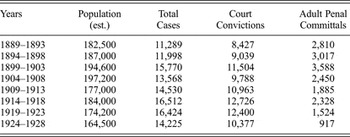
Charges, Convictions, and Penal Committals, Barbados, 1889–1928.

Source: Barbados Blue Books, 1892–1929; Colonial Reports, Barbados, 1901–1903 through 1928–1929.
Charges, Convictions, and Total Prison Committals, Trinidad, 1870–1899.

Source: Trotman, Crime in Trinidad, Table A.4, 280.
Total Adult Prison Committals by Gender, Jamaica, 1899–1928.

Source: Jamaica Blue Books, 1899–1900 through 1928 (Blue Book reporting switched to the calendar year from 1921).
The Impact of Male Labor Migration
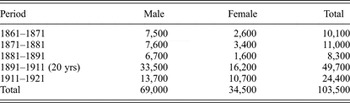
From the 1860s, emigration, of mostly males, took on a new dimension, although Barbadians had taken every opportunity to migrate after emancipation.Footnote 46 The ink was not yet dry on the emancipation proclamation before the legislature in Barbados began imposing restrictions on the freedom of movement of the workers, both domestically and internationally. They did so under the guises of thwarting the predatory intentions of rival employers and unscrupulous emigration agents, or of protecting women and children from abandonment by absconding mates and parents. Although the plantocracy's anti-emigration stance did not stop workers desperate to leave, a number of factors slowed emigration between 1846 and 1860, including Colonial Office disapproval of governments of labor-hungry West Indian colonies paying bounties for recruits from other colonies, and the ultimate success of Asian immigrant schemes in those colonies. According to Roberts, “apart from the movement to British Guiana and Trinidad which took place in the late 1830s and the early 1940s emigration from the island was largely confined to the years 1861–1921.”Footnote 47
Estimates of Net Emigration from Barbados, 1861–1921.

Source: Roberts, “Emigration from the Island of Barbados,” 275.
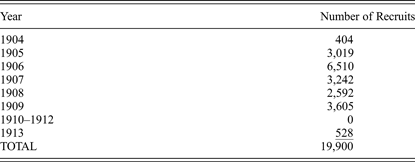
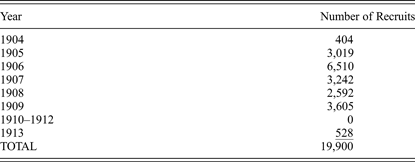
Isthmian Canal Commission Barbadian (Male) Recruits: 1904–1913.
Source: Richardson, Panama Money in Barbados, 123.
By the 1860s, the ruling class was forced to concede the workers' right to migrate and the need to relieve the mounting pressures of “overpopulation” and social disaffection, but they nonetheless retained a tight leash on the conditions of migration. Large-scale, but strictly monitored and controlled emigration was sanctioned by the passage of a number of acts culminating in the 1873 Act. Among other things, it established an Emigration Office under the administration of the Superintendent of Emigration, charged with “registering all migrants, supplying them with information … and controlling the activities of all emigration agents.”Footnote 48 This Act, under the guise of assisting would-be emigrants, attempted to place strict limits on a “free” market in labor and manage the terms of the inevitable and pressing outflow. It also expanded the government's reach into the lives of the working classes, and in some ways represented unwelcome interference with their ongoing and often preferred methods and terms of escape from the island. Moreover, actual government assistance for emigration, by an intention inherent in the wording of this and other acts, went predominantly to poor white men and women.Footnote 49
The first surge in female numbers among prison-goers to a proportion hovering around or above 50 percent of the total appeared precisely in 1873, presumably under conditions of expanded government monitoring of workers' movements and anxieties about vagrancy and, more generally, about the conduct of those left behind. This surge actually came in the midst of an emigration-induced decline in overall prison-going numbers, suggesting even more strongly that women were being targeted.
A brief retrospective places the scope of the surge in context. According to one source, in the twenty-year period 1840–1860, a total of 4,053 black and colored, and 57 white men were put in jail, in contrast to 1,777 black and colored, and 7 white women.Footnote 50 Women would therefore have comprised a little over 30 percent of prison-goers during this period. The overall numbers seem very low, and they almost certainly do not include returns from all the jails or district lock-ups in the colony. More reliable totals provided by Schomburgk, in his 1848 History of Barbados, show an average of 1,855 persons imprisoned per year over the five-year period 1841–1845, and females comprising 27 percent of this number, which combines penal and non-penal as well as adult and juvenile figures.Footnote 51 The next set of data available to me comes from the Blue Book & Report for 1872, which gives corresponding combined totals for the years 1870, 1871, and 1872 of 3,388, 3,139, and 2,767, respectively. In 1872, females made up 26 percent of the whole and 29 percent of adult totals, and an estimated 33 percent of adult penal totals. In 1873, the numbers show a startling shift, without any apparent change in methods of record keeping. While numbers of males imprisoned dropped from 2,047 in 1872 to 1,521 in 1873, the numbers of female committals increased from 720 to 1,213, at an almost exact count of the male decline. In 1873, women made up 44.3 percent of the combined adult totals, and 52.6 percent of adult penal totals. This increase marks the beginning of the sustained trend that characterizes the tract of late-nineteenth to early-twentieth-century Barbadian history examined in this paper.
Together, these data suggest that from 1873 women's committals to penal imprisonment increased from an estimated annual average of one-quarter to one-third of all such committals during the first thirty-five years following post-Apprenticeship emancipation in 1838, to over 50 percent, where it remained, more or less, until 1918. While the extent of the jump between 1872 and 1873 cannot be wholly explained with the evidence at hand, it would appear that the increase was closely associated with the expansion of institutionally mediated emigration and the spillover of this new level of surveillance into other areas of community life. As men “deserted” women, concerns were raised that women would abandon their maternal responsibilities and leave their children a charge on the state. Indeed, it might well prove fruitful to explore a possible place for increased female criminalization in the long list of grievances cited by the London Times as causing the rebellion of 1876, a mere three years later: “low and falling wages, insufficiency of education and social relief, oppression, taxation, stark poverty, rising vagrancy and destitution, high and rising infant mortality rates, social suffering and spiraling crime, and the general cruelty associated with the Contract Laws.”Footnote 52
The female majority among adult prison-goers needs to be qualified in three ways. First, the male-to-female sex ratio in the overall population was quite low, particularly in the relevant age categories. Despite their absolute majority, women's per capita rate of imprisonment typically fell somewhat below that of men (probably barring the years of the Panama exodus). In most years, the proportion of female prison-goers did not quite match up to the female representation in the population or, more pertinent, the labor force, although it often came within 5 percentage points. Second, women typically served shorter prison terms and had fewer non-penal committals (for debt, pre-trial custody, etc.) than did men, so that their higher prison-going figures did not translate into commensurate in-prison daily ratios. Before the migration, by daily averages, male inmates typically outnumbered women by more than 2 to 1; during the migration, the women's daily average increased to over half that of men. Third, the generational make-up of the male and female prison-bound populations differed significantly, with the male skewed towards the younger age cohorts of twenty and below, and the female skewed towards ages upwards of twenty years. Males predominated among juveniles, those under fourteen. These differentials mirrored, in part, age-specific sex ratios in the population at large.
While the initial surge in women's rates of imprisonment seems to have been triggered by conditions surrounding the combination of escalating levels of emigrationFootnote 53 and heightened official awareness and monitoring of the outflow, in subsequent years imprisonment levels rose during periods when emigration opportunities were at a lull.Footnote 54 During the peak years of the bounty sugar depression, the twenty-year period from 1884 to 1903, emigration once again slowed, and the rate of imprisonment remained at elevated levels. Systematically, 30 percent or more of those convicted were imprisoned during this period. Just around the turn of the century, males and females sustained almost equal, high rates of imprisonment, hovering around 2 percent of their respective populations.
Conversely, during periods of high emigration imprisonment declined in terms of both absolute and per capita numbers. During the great Panama migration most of the drop was accounted for by departing male workers. Twenty thousand Barbadian men were formally recruited by the Isthmian Canal Commission between 1904 and 1913, and another forty thousand men and women are estimated to have gone to the Canal Zone on their own recognizance, bringing the estimated total to sixty thousand.Footnote 55 Women comprised about one-third of the emigrants, but the impact of male departures was not just greater, but disproportionately so. In the six-year period from 1906–1911, the peak of the exodus, male committals to penal imprisonment amounted to a mere 56.9 percent of female committals. The departure of thousands of men lowered the rate of imprisonment especially for personal injury and property-related crimes with which men were more likely to be associated. Typically, women's crimes were considered less serious, their prison sentences or terms served rarely exceeded three months, and the range of other punishments inflicted upon them, either as an alternative to or as part of imprisonment, was less severe. During the migration, despite the conspicuous relative feminization of the ranks of prison-goers, women's absolute and per capita numbers declined, but not as significantly as those of men. The number of male juvenile whippings also went down.
In the early post-emancipation decades, the chief concern of the planters was to maintain a cheap and abundant labor force in a technologically backward production system. This was easily achieved by a combination of preemption of non-plantation livelihoods, restrictions on labor mobility, and an over-supply of labor. Imprisonment functioned to “hold” excess labor, and to discipline and curb actual and potential recalcitrants. Even before the onset of the Panama outflow, the authorities had been increasingly shifting men from purely punitive, non-economic hard labor within the prisons to productive public works labor. In 1897 and 1898, for example, the worst forms of punitive corporeal regimes, the treadmill and shot-drill, had been entirely suspended (though they remained officially in force), “as all available Prison labor was employed on Public Works by order of the Executive.”Footnote 56 During periods of high emigration, the authorities could ill afford to imprison the remaining men at the usual rate. The rate for women went down too, but nowhere to the same degree, as the need for social control of women—as presumed abandoned dependants and reluctantly acknowledged workers of last resortFootnote 57—went up. This was to change dramatically in the post-World War I period: as women moved from outside to inside work, and as the working class attained a measure of self-determination and self-uplift, state punitive disciplining of women was no longer deemed a matter of great social urgency.
That emigration provided a direct alternative to imprisonment for many men was evident in the drop of over 50 percent that occurred in the numbers of men committed to penal imprisonment during the Panama exodus, and the corresponding rise in their numbers when that outlet closed. Panama recruitment slowed down during a 1910–1912 moratorium (during which levels of criminality temporarily increased), but it resumed for a while in 1913 before the completion of the Canal in 1914. Male imprisonment and male juvenile whippings shot up again after its completion, by which time some return migration was already underway, and during World War I, a time of great distress in working-class communities.
Total committals to penal imprisonment dropped to an average of just under 2,000 a year for the seven-year period from 1907–1913, from an average of 3,200 during the fifteen-year period from 1891–1905. Using selected years as an indicator, the fluctuations are even more dramatic. In 1902, the total number of penal committals was 4,070. It dropped to 1,874 in 1907. By 1918, that number had climbed back up to 2,635, but by 1927, it had fallen steeply to 686. In those same years, female proportions of the totals were 53.7, 65.8, 49, and 38 percent, respectively. With the rapid increase of a largely stay-at-home population during the war years, there had been both a per capita and an absolute expansion in the number of arrests, prosecutions, and convictions. Sharp drops in numbers imprisoned occurred in 1919 and then again in 1927, with the declines among women being disproportionately large. In 1919, their numbers dropped by five hundred, or over 38 percent from the previous year, while the male numbers fell by 286, or about 21 percent. In 1925, the authorities observed that although the numbers had declined for men, the daily average was “still higher, however, than in the years 1907 to 1913, the lowest being 121 in the year 1911, while those for females are the lowest recorded during the past 30 years.”Footnote 58 In fact, they were the lowest on record in more than fifty years.
The post-World War I period ushered in a general lessening of the state's reliance on imprisonment as a regular disciplinary device. Around the turn of the century, nearly 2 percent of the Barbadian population was sent to prison on an annual basis to serve mostly short penal sentences, usually involving hard labor and physical restraints. By 1927 that figure had declined to about .5 percent, suggesting a slow advance of the hard-fought Afro-Barbadian struggle for rights and recognition. It also indicated a shift by the state to other strategies of governmentality and control, especially since the per capita conviction rate had shown little sign of abatement, and in fact had steadily increased, following the first onset of decline in imprisonment in the wake of the Panama exodus. By 1921, the Governor of the Prison was openly condemning the human waste and cruelty inherent in extended terms of unremitting and crushingly monotonous prison labor, and called for a shift from a costly punitive and labor-degrading strategy to one of rehabilitation and skill training.Footnote 59 He was referring exclusively to male prisoners, but by then the question of rehabilitating women did not matter as much since their numbers in the prison had dropped considerably.
Gender, Crime, and Imprisonment: Patterns and Trajectory
Thousands upon thousands of working-class Barbadians routinely faced the summary justice of police magistrates' courts, and had been locked up at one time or another. Enormous numbers came face to face with the authorities in one juridical capacity or another, as persons formally reported or accused, charged, convicted, and sentenced. From a population of under two hundred thousand, in 1903, 1904, and 1905, respectively, 16,479, 15,996, and 17,176 were reported to the police; 14,804, 14,110, and 14,750 were apprehended and charged; 10,510, 10,060, and 10,809 were convicted; and 3,391, 2,873, and 3,083 adults were committed to penal imprisonment, with significant additional numbers committed for non-penal imprisonment.Footnote 60 Formal charges criminally implicated between 7 and 10 percent of the Afro-Barbadian population each year (not counting those already convicted and serving out their sentences, or those whose charges had been dropped). Of those charged, the majority were convicted and received sentences that ranged from fines to imprisonment, and hundreds of boys and some men were summarily whipped or flogged in discharge of the whole or a part of their sentences.
Most of the charges against adults and juveniles involved what were deemed petty infractions of the law and fell into three categories: personal assault and injury offenses, “praedial larceny” and other offenses against property, and various offenses against public order and revenue ordinances (ranging from violations of the Contagious Diseases Act and non-payment of various fees, licenses, or fines, to public nuisance or disturbance of the peace charges). Women and juveniles formed a large proportion of offenders under the latter rubric, miscellaneously classified as “offences against the highway, health, and revenue acts” and other acts “relating to the Social Economy of the colony.” In common with findings for Britain and other British colonies in the West Indies, no across-the-board breakdowns of crime categories by gender were generated, although there are references to those breakdowns here and there in narrative reports, as well as random indicators. The only gender breakdowns available are by the gross categories of “magisterial” or summary convictions and “Chief Justice” or Superior Court convictions, of which men accounted for the largest share. Apart from such gendered felonies as “abortion,” “concealment of birth,” “rape,” and “murder of wife, reputed wife, or concubine” (which were usually single-digit statistics), the only gender-specific magistrates' court crimes that were enumerated were those relating to prostitution and the Contagious Diseases Act, and the counts show that few were tried for those.
The vast majority of crimes committed by Afro-Barbadians were considered lesser “police offences.” The two largest classes of lower-order offenses, including those meriting penal imprisonment, were infractions of the miscellaneous “revenue, highway, health and other acts relating to the social economy of the colony,” and of the Personal Injury Act. The majority of female offenders were convicted and imprisoned under those acts. The 1901–1902 annual report observed: “The principal offences by females are disorderly conduct, using abusive language, and so on to assaulting and beating. These offences are responsible for as much as 55.18 per cent of the annual crime of the female population, and are due in a great measure to overcrowding, lack of occupation, and the absence of any restraining influence.”Footnote 61
Three years later, the Governor was again observing: “Considering that this Prison is populated to a very large extent by a class of women, many of whom have repeated convictions recorded against them for highway offences, such as blackguarding, fighting, using indecent language on a highway etc., it is not to be wondered at that it is a difficult matter with them to hold their tongues.”Footnote 62 Men were more likely to be convicted for serious assaults and cases of “bodily injury” within the overall category of crimes against the person, as well as for crimes against property, ranging from petty praedial and chattel larceny to “malicious injuries to property” and breaches of the Masters and Servants Act. As a discrete and singular category, “offences against the person” constituted the largest category of crime. In the fourteen-year period from 1892–1905, 3,088 were found guilty of this, or 30.8 percent of the 10,029 average criminal convictions per year.Footnote 63 Women offenders figured among those statistics, but at the lesser end that involved field, street, domestic, and residential yard brawls, often with other women or with male domestic partners. In regard to sexual and domestic relations with men, women were far more often the abused than the abuser, but many women were capable of giving as good as they got. Disputes often came to blows in the impoverished conditions of the tenantries, where tiny one- or two-room tenement or “chattel” houses accommodated as many as ten or twelve people. Women's high level of labor force participation and economic self-reliance gave them an unshrinking and highly audible street presence. A heightened and colloquially stylized defensive posture, which invariably included a sharp tongue and sharper wit, kept them on the alert in the handling of daily slights and insults, sexual rivalries, social injustices, and competition for scarce resources. In their manner of settling scores by fighting, women were regarded as more excitable and less deliberate than men, and authorities saw this as the fount of a higher and in some ways more troublesome level of disputatiousness, but a less injurious sort of crime. Still, women were sometimes convicted of the more deliberate crimes of larceny and setting fires.
The largest number of offenses by women constituted breaches of the Highway Act and Health Act, which seemed especially geared to regulating the public comportment or street behavior of working-class women. Literally thousands of women, tagged as spitfires or prostitutes, were hauled before the magistrate every year for running afoul of this class of statutes. Several hundreds received jail sentences. The Highway Act was a catchall category under which presumed minors could be held to a strict regime of public discipline in the face of what was assumed to be grossly inadequate or non-existent family, patriarchal controls. Breaches of the Act constituted a grab-bag of petty infractions: “using obscene language on,” “making disturbance on,” “indecent exposure of person on.”Footnote 64 Those involving “disorderly” and “indecent” women were often associated with violations of the society's elite moral code and its gendered tenets of propriety and respectability. These crimes ranged from cursing and drunkenness in public to prostitution.
Prostitution, in particular, was rhetorically inflated in official discourse about female crime. Philippa Levine has pointed out that “prostitution was of huge importance in the maintenance of colonial order, and the greater part of interracial sexual connection between colonizer and colonized was a heterosexual prostitution in which white men purchased the sexual services of native women.”Footnote 65 The Barbados government passed the Contagious Diseases Act in 1868, one year after the Jamaicans and one year before the Trinidadians passed theirs.Footnote 66 The Act “was modeled on legislation instituted in England as a means of combating the spread of venereal diseases in towns where there were garrisons of unmarried soldiers and sailors.” It “required that women accused of being common prostitutes be registered, periodically examined for venereal disease, and if diseased, incarcerated in a certified hospital ward.”Footnote 67
Prostitution had been regulated in many parts of the British Empire especially from the second half of the nineteenth century onward in recognition of the de facto colonial market for sexual services it satisfied, particularly with respect to British soldiers and sailors in the colonies. The early regulation of prostitution had been carried out primarily for the protection of the latter group, but it also fulfilled the function of controlling and punishing women lacking in socially defined morals and respectability (while confirming middle- and upper-class ladies in their exclusive possession of those virtues). More generally, it criminalized or impugned the womanhood of all working-class Afro-Barbadian females. The numbers so charged were always quite small in proportion to the whole, but the image of “common prostitute” was nonetheless used as a broad-spectrum stamp with which to brand all working-class black women, especially those who refused to be submissive.
In nearly all of their roles women found themselves liable to prosecution under the highway, health, and revenue acts: as field workers, street vendors, matriarchal gatekeepers of semi-public residential “yards,” as well as providers of commercial sex services. While women made up a slight majority of agricultural workers, they also dominated the informal service economy in the urban areas. The vast majority of the 2,994 “hucksters, hawkers, and peddlers” in Barbados in 1876 were women.Footnote 68 The most common female occupation registered by the 1891 census for Bridgetown and St. Michael parish was that of “hawkers and pedlars.” There were 530 of them reported for Bridgetown alone and 974 more in the parish.Footnote 69 Market women, or “hucksters,” were expected to obtain a vending license and to wear an identifying badge as proof of registration and payment. This requirement made them the object of intense monitoring and constant harassment by police constables. The women always fought back, and Richardson has provided us with a colorful depiction of their grit and ingenuity in evading and outwitting the police: “When police accused a badgeless market woman and asked for her name and address, the woman cheerfully responded with false information, accompanied by smiles and nods from her associates. During the first half of 1902, of the 189 market women accused, police later located only 56. The remaining 133 had given to the police fictitious names and addresses within earshot of the others. Just as common, a huckster would register with police authorities and then give the badge to another person outside town so that one badge might serve ‘the whole family.’”Footnote 70
Women typically served shorter sentences than men, but they had higher rates of recidivism so that prison was essentially a routine, revolving-door experience for hundreds. For example, in 1903, 96 percent of prison sentences handed down to women were for one month or less, the corresponding figure for males being 84 percent.Footnote 71 In the two years from 1902–1903, fewer than 2 percent of women got prison sentences of more than three months, while a little over 8 percent of men were in that category.Footnote 72 In those two years, eighteen men received sentences of more than five years, while only one woman received the same. In looking at the daily average prison population per annum of males and females according to the length of sentence for the twenty-year period 1899–1918, we find that women significantly outnumbered men only at the one- to four-week sentence level. Up to the first decade of the new century, most were serving sentences ranging from one week to twenty-three months, in descending order of significance. Among male magisterial prisoners, between 1890 and 1910, the largest group was made up of those serving prison sentences of one to twenty-three months. Around 1912 (a year of drought and moratorium on Panama recruitment), both Superior Court convictions and magisterial sentences increased among men. After this period, largely coinciding with the ending of the Panama migration, the largest category of offenders within the daily prison population shifted for both men and women to those serving sentences of two years and upwards.Footnote 73 Considered in conjunction with the overall decline in female imprisonment, this provides support for the notion that imprisonment was becoming a more specialized penological project and losing its “mass,” everyday, disciplinary function.
High recidivism rates among women became increasingly evident towards the end of the 1870s. Again, Schomburgk's documentation allows us to place this record in some historical perspective and to understand the enormity of the shift that occurred in the second half (and particularly the last quarter) of the nineteenth century: “Of the 1763 prisoners who were committed in 1845, 1430 were committed for the first time, 210 males and seventy-three females for the second time, twenty-three males and six females for the third time, and seventeen males and four females for the fourth time, and even more.”Footnote 74 Conversely, in every single year between 1899 and 1917 women had higher, and sometimes much higher, recidivism rates than men. Not only were there more female re-committals, but during this period they also tended to re-offend more times than men. They significantly outnumbered them in the “thrice” and over category.Footnote 75 Between 1899 and 1914, they averaged a yearly recidivism rate of roughly 61 percent while men averaged around 56 percent. The six-year average rate at the end of 1917 was 66.38 percent for women and 55.73 percent for men.Footnote 76 In 1912 alone, nearly 70 percent of female prison-goers were repeat offenders, while only half of the men were.
The largest group of female offenders tended to be in the twenty-one to thirty-year-old age range, while the largest age group among males was the fourteen-to-twenty-year-olds. In addition, the female offender group of ages thirty-one to forty was always notably larger than the equivalent male group, indicating that the bulk of women committed to prison were in their prime reproductive years. Indeed, women were liable to be imprisoned while in various stages of pregnancy, and they were sometimes forced to give birth in jail. Others entered prison accompanied by breastfeeding infants whose lives were put at risk by prison conditions. Infant deaths, miscarriages, and stillbirths were an integral aspect of women's prison experiences. The figures also indicate that, for many women, the indignity of being locked up at intervals stretched out into a prolonged adult life experience.
Conclusion: Towards a New Disciplinary Regime
By 1919 it was already clear that imprisonment was losing its character as a mass disciplinary device to manage and control a “superabundant” working class. Within the prison system, this change was expressed in processes of institutional centralization, Euro-colonial scientific applications, and moral reform. The disciplinary regime of the prison shifted increasingly from one based on corporal punishment, “batch” social and political modes of oversight, and economic exploitation to one based on cellular organization and bureaucratically mediated forms of penalization and social rehabilitation. While this did not mean that prison was shedding its class-structured character, it was moving away from its heavy-handed class-instrumental function and becoming a more specialized venue for managing new, more precisely defined categories of anti-social and criminal behavior.
This shift was induced by both “external” political-economic and “internal” institutional factors, and also represented a contentious resolution between top-down policy and bottom-up self-reinscription. Between 1911 and 1921, the dominant mode of plantation production underwent a shift away from labor in favor of capital and from unskilled in favor of skilled labor. Industry rationalization and technological innovation, such as central milling, marked a growing transition from the “old-style family estate” to the “corporate plantation.”Footnote 77 Between 1911 and 1923, despite an exponential increase in output, the number of sugar factories in Barbados fell from 329 to 263, of steam mills from 109 to 85, and of windmills from 220 to 178.Footnote 78 Moreover, it was clear that the mass emigration of workers and industrial restructuring had exerted pressures on each other. The changing system of re/production brought together a more capital- and technology-intensive industry with a working class whose circuit of reproduction had undergone a degree of transnationalization, making available new resources for class uplift. Richardson devoted an entire book to the impact of “Panama money” (wage remittances) in Barbados and its role in helping to dissolve semi-feudal social relations.Footnote 79
The restructuring Barbadian economy, moving—in some ways precociously—toward post-plantation modernity, increasingly demanded a different mode of subjectivity from its laboring population: more sharply gender-differentiated to serve a more complex division of labor, and with an increased capacity for self-discipline (or internalized repression). With unprecedented border-crossing experiences inserted into class repertoires, the working classes harbored new demands, desires, and capacities of their own. In addition to embracing various forms of racial and class uplift, working-class leaders typically cast those in a masculinist, restorationist mold. Returning male workers and veterans of the war were demanding more respect and, ultimately, more power, evident in the elevated levels of home and small property ownership,Footnote 80 higher rates of marriage,Footnote 81 and the post-war establishment of the first significant anti-colonial nationalist and labor organizations.Footnote 82
In the wake of Panama and subsequent migrations, particularly to Cuba, female household-headship and single parenthood increased, and out-of-wedlock birth rates shot up.Footnote 83 But women also made certain moves of their own, partly pushed by force of circumstance and also aided by access to remittances and to the worker-initiated mutual-aid associations or “friendly societies” that were proliferating across the community.Footnote 84 Three changes stand out: increased migration, an occupational shift from outside to inside work,Footnote 85 and lower rates of childbearing. Barbadian women pioneered the latter within the Anglophone Caribbean.Footnote 86
In the decade 1911–1921, women accounted for nearly 44 percent of net migration, with the United States being their primary destination.Footnote 87 In 1923, the Barbadian authorities noted a “rush of emigration to the United States of America (New York), for which 2,535 passports were issued.”Footnote 88 Of those who left that year, 980 were classified as domestic servants, 339 as seamstresses, and 414 as artisans.Footnote 89 The large majority of working-class women in this particular migration stream can be partly accounted for by the rush to join relatives abroad in anticipation of the passage of the restrictive 1924 U.S. Immigration Act, but many would have been self-supporting women using migrant networks to seek better lives for themselves. This became increasingly urgent as women were displaced from actual and potential jobs by returning men, a contracting plantation labor force, and urbanization without industrialization.
Those who stayed were increasingly moving from country to town or suburb, and from outside to inside work, especially in other people's private, isolated households (although own-account dressmaking was the second largest occupational choice of urban women in the 1920s). They were leaving behind those arenas conducive to open enactments of class-gender conflict and public law-and-order monitoring. Inside work enforced a different kind of disciplinary regime more closely associated with the simmering pathologies and silent distresses of private, bourgeois, racialized patriarchy. Such occupations made women more amenable to the new values of thrift, self-help, and self-discipline that formed part of the self-mobilization of the working class during this period. The decades ahead would see a massive displacement of women from the cane-fields and, relatively speaking, from paid jobs. These changes involved a complex process of domestication and shifts in gendered subjectivity as women moved into domestic service and other gender-typed jobs, and housewifely roles, while ceding some of their places in the labor market to returning male workers and war veterans. Caribbean feminist historians have referred to this cross-class process, which occurred between the 1920s and the 1950s throughout the Anglophone Caribbean, as “housewifisation,” otherwise known as the hegemonic compulsion towards female respectability or bourgeois, heteronormative gender difference.Footnote 90 Feeley and Little found something similar in the shrinking of the range, complexity, and autonomy of women's economic roles throughout eighteenth- and nineteenth-century England, and the concomitant shift from public forms of social control, such as the courts and the prisons, to private, domestic, “civilizing processes.”Footnote 91
In Barbados, a key index of this incremental but fundamental shift in female subjectivity—this new moral economy among the working classes—was the decline in female criminalization and incarceration.Footnote 92 This decline signaled in part the rise of new expectations of and pressures on women. But this was also a time of rising expectations and self-making within advanced sections of the working class as a whole. The unrelenting frustration of these expectations would ultimately lead to mass rebellion in 1937, with mixed results for women in particular. In any event, what little evidence we have within the confines of this paper suggests that women did not give in to the forces of institutional compulsion without a struggle, even when that struggle took the form of making the most of limited tangible and creatively imagined opportunities and possibilities offered at the margins and in the fissures of the emerging disciplinary regime.