

1. Introduction
The increasing interconnectedness of national economies and the rising intensity of external impacts have made it topical to perceive economic security as a category of national security, which reflects the ability of a state to ensure the resilience of its economic system in an unstable environment. Such a research agenda is relevant due to the fact that the strategic documents of Latvia, Lithuania, Estonia, Finland and Poland contain different priorities for economic resilience, whereas in the scientific debate, the problem of a consistent interpretation of the goals, indicators and tools for ensuring economic security within a common framework of national resilience is still not resolved. This situation is also caused by the low comparability of the approaches to evaluating economic security and the limitations of existing methodological tools, which usually connect the strategic priorities with the instruments of economic policy, reducing the multidimensional nature of economic resilience. In this study, harmonisation refers to the analytical alignment of strategic objectives, indicator groups and implementation instruments according to their roles in short-term stabilisation, medium-term adaptation and long-term development. Overcoming these contradictions can serve as the basis for clarifying the content of economic security as a systemic category of strategic management and for forming a more harmonised view of the factors determining the resilience of states in the short, medium and long term.
The analysis of the economic security of the European Union (EU) countries has revealed an interconnection between the parameters of economic security and economic growth. According to Burak et al. (Reference Burak, Kromalcas and Bilinskienė2024), the specifics of this interconnection depend on the level and structure of national economies. The studies examining the influence of global turbulence note that the resilience of national security is determined not only by the macroeconomic situation but also by other structural elements of social resilience, which are summarised by Lyeonov et al. (Reference Lyeonov, Vysochyna, Śmiech and Rabe2024). This shows the multidimensional nature of economic security and the necessity of its interpretation as a component of national resilience in the conditions of a crisis.
Moreover, a number of interesting results were obtained in the energy component of economic security, which has gained special relevance in ensuring national sustainability. Pranevičienė (Reference Pranevičienė2024) showed that energy security is the result of the interplay between the legal and infrastructural determinants with geopolitical factors, which allowed for outlining the decrease in the critical dependencies and increase in the systemic compatibility of the energy networks as the strategic tasks. Karpavicius et al. (Reference Karpavicius, Balezentis and Streimikiene2025) justified the necessity for a multicomponent system of energy security indicators in the electricity sector, where, alongside the reliability of supply, affordability and diversification were of equal importance. In this regard, the state’s economic policy was considered a factor in shaping the risk profile and resilience pattern. The specific aspect of financial security at the micro level was studied by Pronoza et al. (Reference Pronoza, Kuzenko and Sablina2022), which proved that the efficiency of financial security management is increased by the strategic tools of resource stability maintenance and risk minimisation in conditions of uncertainty.
The scientific research underscores that energy security has a special place in the national security system and can affect the general perception of the security situation. However, according to the empirical results obtained by Mara et al. (Reference Mara, Nate, Stavytskyy and Kharlamova2022), this effect is contingent on a country and the empirical context. It is also pointed out that the relationship between energy and economic security is not always statistically robust, which requires a careful treatment of indicator data. Many efforts were devoted to the methods aimed at the formalisation of security parameter evaluation. In particular, the application of artificial intelligence techniques to define the threshold values of national security indicators suggested by Kharazishvili and Kwilinski (Reference Kharazishvili and Kwilinski2022) has widened the analytical opportunities. Such a technique allows for constructing the security-level scales and increases the comparability of the results in the cross-country analysis. Meanwhile, the studies that considered human potential as an aspect of national security have pointed out that the socio-institutional environment and human capital expand the borders of the economic security aspect. Such a statement is confirmed by the research of Afolabi and Raifu (Reference Afolabi and Raifu2025), in which the economic security is considered through the quality of institutions and human capital.
The research that focused on the impact of environmental fiscal policy upon the security concluded that the environmental taxes have an impact on environmental, energy and economic security, which results in a cumulative effect within the framework of sustainable development, as mentioned in the article by Streimikiene et al. (Reference Streimikiene, Samusevych, Bilan, Vysochyna and Sergi2022). This approach proves that the tax incentives with an environmental orientation not only serve a regulatory function but also change the structure of the economic behaviour and contribute to the resilience of the states in conditions of increased uncertainty. At the level of corporate financial systems, the focus has been on the risk management instruments. In such a context, the liquidity and solvency maintenance have been identified as a necessary condition for minimising the financial threats, whereas the application of the forecasting models increases the effectiveness of the managerial decisions during the crisis, as it is summarised in the study by Akash et al. (Reference Akash, Reza and Alam2024). The institutional security aspect of the economic security in the financial sector is represented by the regulatory framework of the integrated markets. In this framework, the stability of the market institutions is provided by the combination of competitive mechanisms, mature institutions and formal rules of interaction, as mentioned in the research by Novak et al. (Reference Novak, Pravdyvets, Chornyi, Sumbaieva, Akimova and Akimov2022). Simultaneously, the study that analyses security practices outside the European borders has associated the economic aspect of national security with regional cooperation and institutional support to the foreign policy. Such an approach explains the interconnection between economic and security interests by trade, innovation potential and partnership mechanisms within the region, as it is concluded in the article by Cuong and Tien (Reference Cuong and Tien2023).
Taken together, the reviewed literature reveals a theoretical gap: existing studies predominantly examine separate dimensions of economic security, such as energy risks, financial stability, human capital or fiscal instruments, but do not provide an integrated explanation of how strategic objectives, indicator groups and implementation instruments interact within the national security system. In particular, the relationship of these elements to the functions of stabilisation, adaptation and development remains insufficiently conceptualised, whereas comparative applications across economies with different levels of openness and economic policy models are limited. This unresolved theoretical problem justifies the development of a unified analytical framework that connects objectives, indicators and instruments within one system of economic security.
This study aimed to reveal the logic of harmonisation of the strategic goals, indicator system and tools for the implementation of economic security policy in the system of ensuring national security. To implement the aim of the research, the following objectives were set: to substantiate economic security as a structural element of national security and to systematise its functional relationship with the main components of security; to carry out a comparative analysis of the dominant goals of the economic security strategies of Latvia, Lithuania, Estonia, Finland and Poland, revealing the differences in the balance of priorities of stabilisation, adaptation and development; and to develop an indicator system for assessing economic security and to generalise the tools for implementing these strategies, according to their role in ensuring short-term stabilisation, medium-term adaptation and long-term development of the economic system.
2. Materials and methods
The research was performed with an applied analytical orientation and implemented in the form of a comparative analysis of economic security strategies in the system of ensuring national security, using some macroeconomic indicators for illustration. The time range of 2025 allowed for adjusting the current dynamics of economic policy and security transformations in the Baltic–Nordic region and Central Europe amid growing external challenges and structural imbalances. The object of research was the economic security strategies and policies of Latvia, Lithuania, Estonia, Finland and Poland as parts of the national security architecture. The choice of Latvia, Lithuania and Estonia was due to the openness of the economy and the high sensitivity to external influences, which makes the goals of stabilisation and adaptation of economic security especially relevant. The involvement of Finland and Poland allowed for the expansion of the comparative base by including economies of different scales and levels of institutional development, in which the development priorities of economic security are incorporated into the long-term structural transformation trajectory.
The information base of the study consists of publicly available strategic and analytical materials that contain information about the goals of economic security, indicator approaches and tools for the implementation of relevant strategies. The main array of sources is represented by documents of the strategic level that reflect the official vision of forming national resilience and security priorities. In particular, the National Security Concept of the Ministry of Defence of the Republic of Latvia (2016) was used to clarify the wording of strategic goals for economic security, provisions for the reduction of critical dependencies and tools for coordinating economic policy. The criteria for the inclusion of this document in the analysis were its official status and the presence of structured economic priorities within the national security framework. To generalise the logic of strategic goals and principles of integrating the economic dimension of security, the provisions of the National Security Strategy of the Republic of Lithuania (Resolution of the Seimas of the Republic of Lithuania No. IX-907 “National Security Strategy”, 2017) and government information of the Ministry of National Defence of the Republic of Lithuania (2025) on the draft updated strategy were analysed. These sources provided data on diversifying economic ties, protecting strategic sectors and approaches to indicator-based support of security decisions. Only those provisions that directly regulate the economic dimension of security were included in the analysis. A separate information block was formed on the basis of the National Security Concept of Estonia (Ministry of Defence of the Republic of Estonia, 2023) and official government messages about its approval according to the parliamentary procedure (Government of the Republic of Estonia, 2023). The following sources were used to determine the financial resilience, predictability of economic policy and coordination of institutions. The selection criterion for the latter was the availability of explicit economic mechanisms and priorities. To enhance the normative and strategic framework for societal security and resilience, the provisions of Finland’s Security Strategy for Society (Security Committee of Finland, 2025) were used, which allowed the systematisation of approaches to the incorporation of economic security into the model of long-term competitiveness and intersectoral cooperation. To represent approaches to the comprehensive planning of security in the context of strategic challenges, the National Security Strategy of the Republic of Poland (National Security Bureau of the Republic of Poland, 2020) and the analytical overview presented in the policy review of Torbicka (Reference Torbicka2025) were used. The provisions of these documents concerning the combination of economic growth with the preservation of sovereignty in economic decision-making and protection of key sectors were employed.
The strategic documents included in the comparison were adopted in different years and therefore reflect different political, economic and security contexts. To reduce the effect of this temporal asymmetry, the comparison was limited to functional categories that were identifiable across all documents, namely strategic priorities, indicator orientations and implementation mechanisms. Nevertheless, the time gap, particularly between the Latvian National Security Concept of 2016 and the documents adopted or updated in 2023–2025, may affect the relative salience and formulation of security threats and was therefore treated as a methodological limitation.
The comparability of the indicator approaches in the cross-country dimension was ensured through the use of European Commission (2024, 2025) documents on economic security and strategic autonomy, as well as Eurostat (2026) statistical materials. These sources provided data on the structure of foreign trade, the share of energy imports, investment volumes, public debt, budget balance and inflation. The selection criteria for these sources were their international recognition, methodological consistency and the possibility of cross-country comparison. Analytical summaries of the European Central Bank (2025) were used to represent financial stability and systemic risks. These materials provided data on macrofinancial imbalances and systemic risks. The energy component of economic security was further concretised using analytical materials from the Market Monitoring Report of the European Union Agency for the Cooperation of Energy Regulators (2026) and the provisions of the World Energy Outlook 2025 published by the International Energy Agency (2025). Indicators characterising the structure of energy consumption, the level of import dependence and the diversification of supply were borrowed from these sources. Comparability of the macroeconomic comparisons was provided by the use of World Development Indicators by the World Bank (2026) and macroeconomic evaluations from the OECD Economic Outlook by the Organisation for Economic Co-operation and Development (2025) that ensured the comparability of data on investment dynamics, rates of growth and financial stability. When full statistical information for 2025 was not available by the time the study was conducted, the latest official data for 2024 were used, which was explicitly indicated in the results. The collected data made it possible to juxtapose the strategic priorities of the considered states with the indicator arrays that characterised their energy dependence, structure of foreign trade, investment dynamics, financial stability, participation in regional value chains and digital and cybersecurity resilience.
The method of systems analysis was used to present economic security not as a set of individual economic indicators but as a structural element of national security that is formed through the interaction of several functional sub-systems. Within its framework, the interpretations of economic security were grouped into stabilisation, institution-oriented, risk-oriented and strategic governance interpretations. The indicated categories provide a differentiation of dominant focuses without the reduction of the economic security concept to the ideas of ‘stability’ or ‘risks’. This structure made it possible to systematise scientific interpretations based on their functional content and to provide analytical harmony between the theoretical framework and the following applied sections of the results. In the framework of the same method, the financial, energy, social and institutional components of national security were identified, as they directly influence resource potential, the stability of critical infrastructure, social predictability and the manageability of economic processes. The interaction of these components and economic security was characterised as mutually strengthening, functionally dependent, indirectly regulating and system-forming, which made it possible to show the diverse types of cause and effect and functional relations instead of presenting a formal list of policy directions.
Comparative analysis method was employed to compare the strategic goals of economic security in Latvia, Lithuania, Estonia, Finland and Poland, taking into account the differences in the scale of the economy, the level of openness and the model of economic policy. The comparison criteria were the hierarchy of strategic priorities; balance of stabilisation, adaptation and development orientation; vector of economic security in relation to financial, energy, investment and foreign trade policy; and the way of presentation of indicators and mechanisms of implementation of strategic decisions in strategic documents. In this analysis, categorical provisions of the strategies relating to state financial policy, energy policy, investment policy and foreign trade strategy were considered. The level of their formalisation or quantification was not analysed, which made it methodologically consistent with the subsequent presentation of results.
For the correctness of comparison, the goals were interpreted according to the dominant functional orientation as stabilisation–adaptation, adaptation–stabilisation, stabilisation with developmental elements, development–adaptation and development with stabilisation elements. In these compound categories, the first term indicates the primary functional orientation, and the second term indicates the supporting orientation. Thus, stabilisation–adaptation denotes strategies in which maintaining current equilibrium and manageability is primary and adjustment to external change is supportive, whereas adaptation–stabilisation denotes strategies in which diversification and structural adjustment are primary and stabilisation supports these changes. Such a classification was used because, in strategic documents, often there were mixed goals; what was important was not the formal enumeration of goals but the logic of dominance of a particular type of orientation within the general architecture of economic security. Further clustering of countries into groups of Baltic states and ‘Finland and Poland’ allowed distinguishing between a model in which the logic of vulnerability reduction is dominant and a model in which economic security is incorporated into the trajectory of long-term development.
An indicator-based approach was used to create a structured basis for evaluating economic security that is capable of reflecting its multidimensional nature without being reduced to a single integral parameter. The functional blocks of energy dependence, foreign trade structure, investment dynamics, financial stability, participation in regional economic value chains and digital and cybersecurity resilience were chosen because they embrace the main channels through which resilience and economic interdependence are formed under modern integration conditions.
A full quantitative assessment of each individual indicator was not conducted for the countries analysed. Instead, an indicator framework was developed that structures economic security according to functional blocks. In this context, the following analytical dimensions were identified: energy dependence, foreign trade structure, investment dynamics, financial stability, participation in regional economic value chains and digital and cybersecurity resilience. Each block was considered a categorical group of indicators characterising the corresponding dimension of economic resilience, without attempting to comprehensively measure all possible indicators. This made it possible to concentrate on the logic of the indicator-based structuring of economic security and to ensure methodological compliance with the nature of the results obtained.
These functional blocks enabled the identification of risks of critical dependence, vulnerability to external influences, reproductive and modernisation capabilities, the stability of the financial system and the structural position of a country in supranational value chains. A further specification of these groups of indicators in relation to the stabilisation, adaptation and development components of resilience was required to clarify how the same block of indicators can perform different functions depending on the time horizon of the analysis. This made it possible to move from a ‘list of indicators’ to an interpretation of their role as markers of short-term equilibrium, economic adjustability and the formation of long-term potential.
The typology method was used to systematise the mechanisms for implementing economic security strategies, proceeding from the fact that the practical implementation of strategic goals is carried out through different classes of tools, each possessing a specific logic of impact. Regulatory, institutional, financial and infrastructural mechanisms were highlighted as the main groups, which include the normative environment, managerial coordination, resource support and the material basis of resilience. The differentiation of the effects of these mechanisms in the time dimension, short-term stability, medium-term adaptation and long-term development, was used to demonstrate that the same tools can have different effects depending on the time frame: from the immediate weakening of systemic risks to the consolidation of structural transformations. This made it possible to harmonise the implementation tools with the general logic of national resilience, which is not implemented immediately, but as a sequence of managerial solutions along different time profiles.
The interpretation of the results was carried out within the framework of an integrative approach, which consisted of the harmonisation of strategic goals, the structure of indicators and implementation tools as interconnected components of national resilience. The analytical conclusions were formulated as a result of a comparative analysis of the qualitative characteristics of strategic priorities with the logic of measuring indicators and the functional purpose of implementation mechanisms in the context of various time horizons. This made it possible to represent economic security as a systemic category of strategic management and to substantiate its inclusion in the national security architecture in a comparative aspect among the countries under consideration.
3. Results
3.1. Economic security as a structural element of national security
It was found that the perception of economic security as an element of the national security system has undergone significant transformations under the influence of increasing economic complexity and the growing importance of strategic management. The content of economic security gradually goes beyond the framework of a narrow interpretation in the form of the stability of certain indicators of the economy and acquires the features of an integral category related to the state’s ability to provide sustainable development against the backdrop of multifactor risks. In this context, economic security is considered a process rather than a result and is included in the national security system and is characterised by long-term managerial decisions.
The synthesis of the researchers’ approaches shows that the evolution of the economic security interpretation occurred in the form of sequential superimposition of various analytical dimensions. Certain concepts focused on individual fragments of state resilience without denying previous interpretations, but enriching their essential content (Fischerkeller et al., Reference Fischerkeller, Goldman and Harknett2022; Khaustova et al., Reference Khaustova, Tirlea, Dandara, Trushkina and Birca2023; Organisation for Economic Co-operation and Development, 2025). As a result, a multidimensional understanding of economic security was formed, which includes the elements of stabilisation, institutional capacity, risk management and orientation of development.
For the systematisation of the results, the concepts of economic security interpretation were grouped according to the main direction of the analysis. Such generalisation allowed describing the functional mission of economic security in the national security system, as well as its transformation from a means of providing stability into a category of strategic governance. The results are summarised in Table 1, which demonstrates the main concepts of economic security interpretation without indicating countries or periods.
Concepts of economic security interpretation in the national security system

Table 1. Long description
The table consists of four columns: Concepts of economic security interpretation, Dominant emphasis, Key characteristic of economic security, and Functional role within the national security system.
* Row 1: Stabilisation concept. Emphasis is Economic stability. Characteristic is the capacity of the economic system to maintain equilibrium and continuity of reproduction processes. Functional role is preventing crisis imbalances and maintaining the basic conditions for state functioning.
* Row 2: Institution-oriented concept. Emphasis is Institutional capacity. Characteristic is the outcome of the effectiveness of state institutions and regulatory mechanisms. Functional role is ensuring the governability of economic processes and resilience of managerial decisions.
* Row 3: Risk-oriented concept. Emphasis is Risk resilience. Characteristic is the capacity of the economy to identify, minimise and neutralise threats. Functional role is reducing economic vulnerabilities and enhancing system adaptability.
* Row 4: Strategic governance concept. Emphasis is Strategic management. Characteristic is a systemic category integrated into long-term development planning. Functional role is creating conditions for sustainable development and the realisation of national priorities.
Source: Compiled by the author based on the Ministry of Defence of the Republic of Latvia (2016), Resolution of the Seimas of the Republic of Lithuania No. IX-907 “National Security Strategy” (2017), National Security Strategy of the Republic of Poland (2020), Ministry of Defence of the Republic of Estonia (2023), Government of the Republic of Estonia (2023), Khaustova et al. (Reference Khaustova, Tirlea, Dandara, Trushkina and Birca2023), European Commission (2024, 2025), Ministry of National Defence of the Republic of Lithuania (2025) and Security Committee of Finland (2025).
Note: The approaches in the table are presented in analytical sequence according to the dominant emphasis in the interpretation of economic security.
The concepts listed in Table 1 demonstrate the logic of complication of economic security interpretation in the national security system. At the initial stages, the focus on equilibrium maintenance of economic processes was gradually added by the understanding of the role of state institutions in ensuring economic system stability. Further development of concepts changed the focus towards the ability of the economy to withstand risks, which corresponds to the increasing uncertainty and multifactorial nature of threats. A combination of the aforementioned elements in the framework of the strategic governance concept formed the understanding of economic security as an element of long-term planning, which is directed towards the provision of national interests. In this case, economic security is a result of managing development and risks rather than a state.
Table 1 identifies the conceptual interpretations of economic security, whereas Table 2 translates the strategic governance interpretation into the functional relationships through which economic security operates within the wider national security system. The second typology therefore follows from the first: the conceptual shift towards strategic governance requires an examination of the financial, energy, social and institutional linkages that make this systemic role possible.
Structural linkages of economic security with other components of national security

Table 2. Long description
The table consists of four columns: Component of national security, Functional link with economic security, Nature of interaction, and Significance for the national security system.
• Row 1: Financial security. Functional link: Ensures the stability of financial flows and the economy’s resource base. Nature: Mutually reinforcing. Significance: Supports macroeconomic equilibrium and the implementation of strategic priorities.
• Row 2: Energy security. Functional link: Creates conditions for an uninterrupted energy supply to economic processes. Nature: Functionally dependent. Significance: Reduces production and infrastructure risks.
• Row 3: Social security. Functional link: Affects societal stability and the reproduction of human capital. Nature: Indirectly regulatory. Significance: Ensures social resilience and predictability of economic policy.
• Row 4: Institutional security. Functional link: Determines the effectiveness of regulatory and managerial mechanisms. Nature: System-forming. Significance: Ensures coherence and long-term resilience of economic security.
Source: Compiled by the author based on the Ministry of Defence of the Republic of Latvia (2016), National Security Strategy of the Republic of Poland (2020), Fischerkeller et al. (Reference Fischerkeller, Goldman and Harknett2022), Ministry of Defence of the Republic of Estonia (2023), European Commission (2024, 2025) and Security Committee of Finland (2025).
Note: The nature of interaction reflects the dominant functional role of each component in shaping economic security; the relative importance of the components varies according to the type of threat and the stage of crisis development.
A more detailed analysis showed that economic security is not an isolated element, as it is formed in the process of interaction with other components of national security, which determines its systemic nature. It was discovered that economic system stability and state governance efficiency mostly depend on the functional interconnections between the security components. These interconnections are complementary, but their relative importance is context-dependent rather than fixed. Under acute financial shocks, financial security may become the primary condition for maintaining liquidity and macroeconomic stability, whereas energy security may assume priority during supply disruptions; social and institutional security become more important when a prolonged crisis affects human capital or governance capacity (Ilyina, Reference Ilyina2024; Tyukhtenko and Makarenko, Reference Tyukhtenko and Makarenko2016). The synthesis of these findings made it possible to identify the key directions of functional interaction between economic security and the financial, energy, social and institutional components, which are systematised in Table 2.
The link structure displayed in Table 2 is evidence of the integrating function of economic security in the national security system. It determines resource provisioning for the implementation of economic and security solutions, the stability of which is the basis for the general resilience of the state. The continuity of economic processes and the minimisation of the risks of disruption to production and infrastructural processes ensure that energy security is functionally linked with economic security (Latipov et al., Reference Latipov, Komilova, Makhmudov, Berdiev, Moslemzadeh, Chulliyev, Murtazayev and Hamroyev2024; Szelag-Sikora et al., Reference Szelag-Sikora, Sikora, Oleksy-Gebczyk, Wietecha and Danielska2025). The influence of social security on economic stability is achieved through the mechanisms of reproduction of human capital and the minimisation of social risks. The consistency of management decisions and the stability of the normative-legal environment enable institutional security to perform a system-forming function in maintaining the long-term effectiveness of economic security.
The systematisation of the results made it possible to form a generalised view of economic security as a systemic category of strategic governance, incorporated into the national security system. In this aspect, economic security is not considered a set of fragmented measures but a result of the coordinated operation of economic processes, institutional mechanisms and strategic state priorities that ensure stability in conditions of change. This view of economic security as a structural element of the national security system provides an analytical framework for further analysis of its applied aspects. In this regard, the definition of target objectives of economic security is of particular importance, as it predetermines the vector of strategic solutions and serves as the basis for evaluating the effectiveness of state policy in this sphere.
3.2. Strategic objectives of economic security in the countries under study
In the strategic documents on economic security of Latvia, Lithuania, Estonia, Finland and Poland (Ministry of Defence of the Republic of Latvia, 2016; Resolution of the Seimas of the Republic of Lithuania No. IX-907 “National Security Strategy”, 2017; National Security Strategy of the Republic of Poland, 2020; Ministry of Defence of the Republic of Estonia, 2023; Government of the Republic of Estonia, 2023; Ministry of National Defence of the Republic of Lithuania, 2025; Security Committee of Finland, 2025), the objectives are set as a part of the national security system, which explains their close interrelation with other priorities of state security (Torbicka, Reference Torbicka2025). This approach is a consequence of the desire to unite the tasks of maintaining current economic resilience with the need to adapt the economic systems to changes in the external environment. In the framework of strategic priorities, there are traces of both stabilisation and developmental components, the proportion of which depends on the national context. This functional variation provides a consistent basis for comparing the objectives according to their dominant orientation.
Comparative analysis of the strategic objectives of economic security of the countries under consideration makes it possible to identify common and different priorities that depend on the scale of the economy, the degree of openness and the characteristics of national development models. In Latvia, Lithuania and Estonia, the stabilisation and adaptation objectives are clearly pronounced, which is explained by the need to minimise systemic risks in small open economies. In Finland and Poland, in addition to the aforementioned priorities, the developmental component of economic security is more clearly manifested, which is associated with long-term structural transformation objectives. The differences in the hierarchy of objectives form different logics of inclusion of economic security in the national security system as a whole.
To systematise the differences and to systematise the dominant strategic priorities, the objectives of economic security were classified according to their functional orientation. Such an approach makes it possible to more clearly outline which types of objectives form the logic of strategies in each of the analysed countries and how they are included in the general security context. The summarised comparison results are presented in Table 3, which shows the dominant strategic without an assessment of their effectiveness. This provides an analytical basis for further specification of targeted objectives in the economic security domain.
Comparative overview of the dominant strategic objectives of economic security by functional orientation

Table 3. Long description
The table consists of five columns and five rows of data.
* Row 1: Latvia. Orientation is Stabilisation-adaptation. Objectives include ensuring macroeconomic stability, reducing critical dependencies, and maintaining manageability. Logic focuses on preventing systemic risks for a small, open economy. Indicator: Government debt to G D P is approximately 48 percent (average 2025).
* Row 2: Lithuania. Orientation is Adaptation-stabilisation. Objectives include reducing vulnerabilities, diversifying links, and protecting key sectors. Logic integrates economic security into national resilience and security planning. Indicator: G D P annual growth is approximately plus 1.7 percent.
* Row 3: Estonia. Orientation is Stabilisation with development elements. Objectives include maintaining financial stability, policy predictability, and protecting core functions. Logic ensures continuity of economic functioning. Indicator: Low government debt at approximately 23 percent in Q 3, the lowest in the E U context.
* Row 4: Finland. Orientation is Development-adaptation. Objectives include supporting long-term competitiveness, structural resilience, and reducing strategic dependencies. Logic combines security with long-term development and institutional stability. Indicator: G D P growth below E U average in Q 3 2025 at approximately minus 0.3 percent quarterly.
* Row 5: Poland. Orientation is Development with stabilisation elements. Objectives include ensuring sustainable growth, protecting key sectors, and enhancing decision-making autonomy. Logic integrates security into development strategies to strengthen national capacity. Indicator: Gross fixed capital formation is approximately 17 percent (2024).
Source: Compiled by the author based on the Ministry of Defence of the Republic of Latvia (2016), Resolution of the Seimas of the Republic of Lithuania No. IX-907 “National Security Strategy” (2017), National Security Strategy of the Republic of Poland (2020), Ministry of Defence of the Republic of Estonia (2023), Government of the Republic of Estonia (2023), European Commission (2024, 2025), Ministry of National Defence of the Republic of Lithuania (2025), Security Committee of Finland (2025) and Eurostat (2026).
Note: GDP, gross domestic product. The functional orientation of objectives reflects the dominant emphasis of economic security strategies and does not preclude the presence of other types of objectives in national strategic documents. In compound labels, the first term indicates the primary orientation, and the second term indicates the supporting orientation.
The comparative overview shows that the dominant strategic objectives of economic security are determined by the national specifics of economic development and the degree of openness of the economy. The quantitative parameters in Table 3 corroborate this differentiation. In Latvia, for instance, the level of government debt in 2025 stood at approximately 48% of gross domestic product (GDP), which, combined with moderate growth dynamics and a highly open economy, justifies the emphasis on stabilisation–adaptation objectives. Estonia’s government debt is one of the lowest in the EU (about 23% of GDP), which points to a great potential for stabilisation and serves as a factor supporting the manageability of economic processes. In Lithuania, positive dynamics of real GDP (an estimated 1.7% in 2025) are in line with the country’s adaptation and stabilisation orientation and policy aimed at reducing external vulnerability by diversifying economic ties. The distinction is therefore one of priority: Latvia places immediate macroeconomic manageability and risk prevention first, whereas Lithuania places diversification and structural adjustment first, with stabilisation supporting that adaptive process.
In Finland and Poland, the developmental aspect of strategies is more prominent, and this is also reflected in the macroeconomic indicators. Poland has a relatively high level of gross fixed capital formation (about 17% of GDP according to the latest data), which is associated with the country’s orientation towards structural transformation and strengthening the national economic potential. In Finland, a simultaneous presence of developmental and adaptation aspects against the backdrop of restricted growth dynamics points to the priority of ensuring long-term competitiveness and institutional stability. At the same time, in all the countries under analysis, economic security is included in the national security system on the logic of risk prevention and maintaining resilience, which is reflected both in the strategic documents and in the parameters of fiscal and investment policy. Such differentiation of goals, confirmed both qualitatively and quantitatively, creates an analytical groundwork for the further concretisation of their content and evaluation of the efficiency of the policy pursued.
The comparative analysis of the strategic goals of economic security also reveals the differences in the hierarchy of the stabilisation, adaptation and development components in the countries under study. In the Baltic states, the priority is given to decreasing economic vulnerability and preserving the predictability of economic policy, which brings the goals of stabilisation and adaptation to the fore. In Finland and Poland, economic security is inscribed in a broader long-term development context, in which the development goals play a system-forming function. The differences are summarised in Table 4, which makes it possible to compare the orientation of goals regardless of the tools of implementation and quantitative indicators.
Differentiation of the emphasis of economic security objectives among the Baltic states, Finland and Poland

Table 4. Long description
The table consists of four columns and three rows of data.
Row 1: Country group is Baltic states (Latvia, Lithuania, Estonia). Predominant types of objectives are Stabilisation and adaptation. Balance of objectives: Stabilisation objectives dominate; adaptation objectives serve a supporting function; development objectives are limited. Dominant strategic logic: Protective-preventive orientation aimed at reducing systemic vulnerabilities and maintaining predictability in economic policy.
Row 2: Country group is Finland and Poland. Predominant types of objectives are Development with stabilisation elements. Balance of objectives: Development objectives dominate; stabilisation objectives provide baseline resilience; adaptation objectives are integrated into the development logic. Dominant strategic logic: Transformational orientation, in which economic security is combined with long-term structural development priorities.
Row 3: Comparative perspective. Predominant types of objectives: Different hierarchy of objectives. Balance of objectives: In the Baltic states—emphasis on stabilisation; in Finland and Poland—emphasis on development. Dominant strategic logic: Differentiation is driven by economic scale, degree of openness and national economic policy models.
Source: Compiled by the author based on the Ministry of Defence of the Republic of Latvia (2016), Resolution of the Seimas of the Republic of Lithuania No. IX-907 “National Security Strategy” (2017), National Security Strategy of the Republic of Poland (2020), Ministry of Defence of the Republic of Estonia (2023), Government of the Republic of Estonia (2023), European Commission (2024, 2025), Ministry of National Defence of the Republic of Lithuania (2025) and Security Committee of Finland (2025).
Note: Stabilisation objectives are aimed at maintaining current resilience; adaptation objectives respond to changes in the external environment; development objectives focus on building long-term economic capacity. The classification is analytical in nature.
The comparison of emphases presented in Table 4 shows the evident differentiation of strategic approaches to the definition of economic security objectives. For the Baltic states, the emphasis is on the objectives of stabilisation and adaptation, which is explained by the imperative of minimising risks in small open economies. In Latvia, this is expressed through the emphasis on macroeconomic stability and the decrease of critical dependence; in Lithuania, through the combination of diversification of economic relations and protection of strategic sectors; in Estonia, through the emphasis on financial stability and predictability of economic policy as a condition for the uninterrupted functioning of the economy. For Finland and Poland, the leading emphasis is on the development objectives, through integrating the economic security into the long-term trajectory of economic growth and structural change. In Finland, this is realised through the combination of ensuring competitiveness and decreasing strategic dependence; in Poland, through the developmental logic in the combination of ensuring sustainable economic growth, protection of strategic sectors, and increasing the autonomy of economic decisions.
Simultaneously, in all the country groups, there is a functional complementarity of different types of objectives, ensuring the coordination of economic security with the general system of national security. The synthesis of the economic security objectives of Latvia, Lithuania, Estonia, Finland and Poland shows the combination of common strategic guidelines and nationally defined priorities. The commonality is manifested in ensuring the stability of economic systems and reducing the structural vulnerability; the difference is formed by the specific configuration of the stabilisation, adaptation and development components in each state. This configuration serves as a logical basis for further detailing the conditions and mechanisms of implementation of economic security objectives.
3.3. Indicator-based assessment of economic security in the analysed countries
The need to apply an indicator-based approach to assessing economic security arises from the complex internal structure of this phenomenon and the multidirectional nature of the processes through which it manifests. Economic security is the outcome of a system of interconnected parameters that characterise the internal functioning of the economy and the external conditions for development (Babel et al., Reference Babel, Daian, Kelkar and Juels2023; Grytsenko, Reference Grytsenko2022; Liu et al., Reference Liu, Trevisan, Yang and Mascarenhas2022). In this context, the use of a unidimensional integrated index does not make it possible to determine the nature and sources of economic resilience, which indicates the need for a systematic organisation of the indicator system (Manikas et al., Reference Manikas, Ali and Sundarakani2023).
It was determined in the course of the research that the cognitive value of the economic security analysis is enhanced when the indicators are aggregated into functional blocks. This makes it possible to assign each indicator to a particular component of economic resilience and prevents the unrelated interpretation of the results obtained. The block organisation of indicators allows for a comprehensive analysis of the current state of the economy and its possible reaction to internal and external impacts. As a result, a harmonised analytical toolkit for evaluating economic security is configured.
The organisation of indicators into blocks allowed the identification of the key directions for ensuring economic resilience. It becomes possible to trace which groups of indicators describe stabilisation parameters, which describe adaptability and which describe potential for long-term development. The consolidated structure of the indicator system is presented in Table 5, where the functional blocks are correlated with their analytical destination and meaningful content. The systematisation presented earlier does not involve measurement and serves only to demonstrate the logic of the indicator-based approach. It lays the groundwork for the further harmonisation of the indicators with the components of economic resilience.
Consolidated system of economic security indicators by functional blocks

Table 5. Long description
The table consists of three columns: Functional block, Analytical purpose of indicators, and Aspect of economic security reflected.
* Row 1: Energy dependence. Purpose: Reflects the extent of the economy’s reliance on external energy sources and the level of diversification. Aspect: Resilience of the economic system to external energy shocks and structural constraints.
* Row 2: Foreign trade structure. Purpose: Assesses the concentration and diversification of external economic links. Aspect: Vulnerability of the economy to changes in external market conditions and trade restrictions.
* Row 3: Investment dynamics. Purpose: Captures the economy’s capacity to reproduce and modernise production potential. Aspect: Long-term developmental potential and adaptive capacity of the economy.
* Row 4: Financial stability. Purpose: Identifies macrofinancial imbalances and systemic risks. Aspect: Predictability and manageability of economic processes in the short term and the medium term.
* Row 5: Participation in regional economic chains. Purpose: Analyses the degree of integration of the economy into supranational production and trade networks. Aspect: Balance between the benefits of integration and the risks of external dependence.
* Row 6: Digital and cybersecurity resilience. Purpose: Assesses the continuity and security of digital infrastructure, exposure to cyber incidents, data protection capacity and the resilience of digitally enabled economic processes. Aspect: Operational continuity of critical economic functions and the capacity to absorb and recover from cyber disruptions.
Source: Compiled by the author based on Babel et al. (Reference Babel, Daian, Kelkar and Juels2023), European Commission (2024), European Central Bank (2025), International Energy Agency (2025), Organisation for Economic Co-operation and Development (2025), Eurostat (2026) and World Bank (2026).
Note: Functional blocks represent an analytical grouping of economic security indicators; the table is summarised and does not include quantitative values.
The systematisation of indicators proves that economic security is shaped at the point of intersection of several functional planes, each of which describes a particular component of the economy’s resilience. The indicators of the energy and foreign trade spheres characterise the economy’s dependence on the external environment and its reaction to exogenous impacts. Investment dynamics and financial stability are indicators of the internal conditions for reproduction, manageability and predictability of economic processes (Sinoimeri and Teta, Reference Sinoimeri and Teta2026; Teta and Xhafka, Reference Teta and Xhafka2024). Indicators of participation in regional economic chains outline the structural place of the economy in the integration space. Digital and cybersecurity indicators capture the continuity of digital infrastructure, exposure to cyber incidents and the capacity to protect data and digitally enabled economic processes. These blocks of indicators form an analytical model that will be used in the subsequent evaluation of the general level of economic security.
The synthesis of the analysis of indicators shows that the analytical completeness of the economic security assessment grows with the alignment of individual groups of indicators with the functional components of the economic system resilience. This makes it possible to move from recording the current state to an analysis of the formation mechanisms of the stabilisation, adaptation and development characteristics of the economy. It was found that the same groups of indicators may have different functions depending on the time and structural perspective of the analysis, which necessitates their alignment with the relevant resilience components. The consolidated scheme of this interconnection is presented in Table 6.
Relationship between groups of economic security indicators and components of economic system resilience

Table 6. Long description
The table consists of four columns and seven rows including the header.
Column headers from left to right are: Group of economic security indicators, Stabilisation component of resilience, Adaptation component of resilience, and Development component of resilience.
Row 1: Energy dependence. Stabilisation: Ensuring continuity of economic processes and reducing the risk of short-term disruptions. Adaptation: Enhancing the economy’s capacity to respond to changes in external supply conditions. Development: Creating prerequisites for the structural transformation of energy consumption.
Row 2: Foreign trade structure. Stabilisation: Maintaining the predictability of external economic links. Adaptation: Diversifying markets and reducing concentration risks. Development: Expanding opportunities for integration into global and regional markets.
Row 3: Investment dynamics. Stabilisation: Maintaining the baseline level of economic reproduction. Adaptation: Restructuring the economy in response to new challenges. Development: Building long-term production and technological capacity.
Row 4: Financial stability. Stabilisation: Preserving macrofinancial equilibrium and the manageability of economic processes. Adaptation: Strengthening the economy’s capacity to absorb financial shocks. Development: Creating financial conditions for sustainable economic growth.
Row 5: Participation in regional economic chains. Stabilisation: Reducing the risk of disruptions to production and trade links. Adaptation: Flexible repositioning within regional economic structures. Development: Anchoring the economy within value creation chains.
Row 6: Digital and cybersecurity resilience. Stabilisation: Maintaining the continuity of critical digital services and limiting immediate losses from cyber incidents. Adaptation: Strengthening cyber-response capacity and adjusting data-protection and digital-governance mechanisms. Development: Supporting secure digital transformation and long-term technological competitiveness.
Source: Compiled by the author based on Babel et al. (Reference Babel, Daian, Kelkar and Juels2023), European Commission (2024), European Central Bank (2025), International Energy Agency (2025), Organisation for Economic Co-operation and Development (2025) and Eurostat (2026).
Note: The stabilisation component reflects the economy’s capacity to maintain current equilibrium; the adaptation component indicates responsiveness to structural and external changes; the development component reflects the formation of long-term economic potential. The table is analytical and does not involve quantitative measurement.
The alignment of groups of indicators with resilience components presented in the table confirms the multifunctional nature of the indicator-based approach in the analysis of economic security. Energy and foreign trade indicators play a decisive role in the stabilisation dimension and, at the same time, contribute to the adaptation of the economy to the changes in the external environment (Kochanek et al., Reference Kochanek, Zaclona, Cembruch-Nowakowski, Janczura, Pietrucha, Herbut, Kotowski, Oleksy-Gebczyk, Guzdek and Majkrzak2025; Matyushenko et al., Reference Matyushenko, Shtal, Piddubna, Piddubnyi and Kvitka2018). Investment dynamics and financial stability bring together the parameters of short-term equilibrium and long-term development trajectory and form the internal basis of economic resilience. Indicators of participation in regional economic chains characterise the structural place of the economy and its ability to integrate into the value-added chain (Shtal et al., Reference Shtal, Uvarova and Ostapenko2018). In the group of countries under consideration, the functional significance of individual blocks of indicators differs. Digital and cybersecurity indicators have a cross-cutting role, as they support short-term operational continuity, medium-term adjustment of governance and protection mechanisms and long-term secure digital transformation.
For Latvia, Lithuania and Estonia, energy dependence and foreign trade structure indicators are more significant, which is caused by the high openness of their economies and sensitivity to changes in international supply chains. For Finland, the role of financial stability and integration indicators is more significant, which contributes to the institutional predictability of economic policy and long-term competitiveness. For Poland, the investment and integration indicators are more pronounced, which is due to the emphasis on structural growth and the growth of production potential. This confirms the validity of the application of a full set of indicators for the interpretation of economic security as a systemic phenomenon. Taken together, the indicator blocks translate strategic objectives into observable analytical dimensions. The next section therefore examines the mechanisms through which these objectives and indicator dimensions are converted into regulatory, institutional, financial and infrastructural action.
3.4. Mechanisms of the implementation of economic security and resilience strategies
The implementation of economic security strategies acquires practical value only if there are mechanisms that are capable of converting strategic goals into systemic management solutions. The research found that the structure of these mechanisms predetermines the real influence of strategies on economic security and the national security system as a whole. The functional heterogeneity of mechanisms has a different influence on economic processes, which necessitates their analytical differentiation in accordance with their functional role in ensuring stability, adaptability and development.
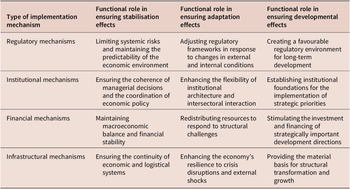
To generalise the findings of the research, the mechanisms of the implementation of economic security strategies were typologised according to their functional purpose. This made it possible to correlate specific groups of mechanisms with the effects generated in the economic system. It was defined that regulatory, institutional, financial and infrastructural mechanisms cannot be considered equivalent as they differently influence the processes of stabilisation, adaptation and development. The consolidated representation of this logic is presented in Table 7, which focuses on the functional role of mechanisms without employing quantitative parameters.
Typology of mechanisms for implementing economic security strategies and their functional roles

Table 7. Long description
The table consists of four columns and five rows including the header.
Column headers from left to right are: Type of implementation mechanism, Functional role in ensuring stabilisation effects, Functional role in ensuring adaptation effects, and Functional role in ensuring developmental effects.
Row 1: Regulatory mechanisms. Stabilisation: Limiting systemic risks and maintaining the predictability of the economic environment. Adaptation: Adjusting regulatory frameworks in response to changes in external and internal conditions. Developmental: Creating a favourable regulatory environment for long-term development.
Row 2: Institutional mechanisms. Stabilisation: Ensuring the coherence of managerial decisions and the coordination of economic policy. Adaptation: Enhancing the flexibility of institutional architecture and intersectoral interaction. Developmental: Establishing institutional foundations for the implementation of strategic priorities.
Row 3: Financial mechanisms. Stabilisation: Maintaining macroeconomic balance and financial stability. Adaptation: Redistributing resources to respond to structural challenges. Developmental: Stimulating the investment and financing of strategically important development directions.
Row 4: Infrastructural mechanisms. Stabilisation: Ensuring the continuity of economic and logistical systems. Adaptation: Enhancing the economy’s resilience to crisis disruptions and external shocks. Developmental: Providing the material basis for structural transformation and growth.
Source: Compiled by the author based on the Ministry of Defence of the Republic of Latvia (2016), Resolution of the Seimas of the Republic of Lithuania No. IX-907 “National Security Strategy” (2017), National Security Strategy of the Republic of Poland (2020), Ministry of Defence of the Republic of Estonia (2023), Government of the Republic of Estonia (2023), European Commission (2024), European Central Bank (2025), International Energy Agency (2025), Ministry of National Defence of the Republic of Lithuania (2025) and Security Committee of Finland (2025).
Note: Stabilisation effects relate to maintaining the current equilibrium of the economic system; adaptation effects relate to responding to changes in the external and internal environments; developmental effects relate to forming long-term economic potential. The classification is analytical in nature.
As follows from the proposed classification, no single mechanism is functioning in the national security system. The regulatory mechanisms ensure a certain predictability of economic development, but their stabilising effect can be realised only when the institutional mechanisms are effective. Financial mechanisms create the resource basis for the neutralisation of current risks and the implementation of long-term development goals (Ilyina, Reference Ilyina2022; Leshchenko, Reference Leshchenko2025). Infrastructural mechanisms determine the material component of security, which forms the ability of the economy to preserve its functional content in the long run. All of these point to the systemic character of the implementation of the economic security strategies, in which the effect is formed through the interaction of different groups of mechanisms.
The integrated analysis of the mechanisms for implementing economic security strategies has shown their differential effect in relation to the time aspect of economic security. In the course of the research, it was found that the same set of mechanisms may have a different effect depending on the time of influence and the nature of economic threats. This emphasises the cognitive significance of linking the mechanisms of implementation to the current, projected and prospective components of economic security. It gives the opportunity to trace the process of transformation of the economic policy instruments from the tools of operative reaction to the mechanisms for strategic increase of the economic potential. The results are summarised in Table 8.
Relationship between mechanisms for implementing economic security strategies and types of economic resilience

Table 8. Long description
The table consists of four columns and five rows including the header.
Column headers from left to right are: Mechanisms for implementing economic security strategies, Short-term stability, Medium-term adaptation, and Long-term development.
Row 1: Regulatory mechanisms. Short-term: Ensuring the predictability of the economic environment and limiting systemic risks. Medium-term: Adjusting regulatory frameworks in response to changes in economic conditions. Long-term: Creating a stable regulatory framework for strategic development.
Row 2: Institutional mechanisms. Short-term: Coordinating managerial decisions in crisis situations. Medium-term: Enhancing institutional capacity for intersectoral interaction. Long-term: Consolidating the institutional foundations of long-term economic policy.
Row 3: Financial mechanisms. Short-term: Maintaining macrofinancial balance and liquidity. Medium-term: Redistributing resources to respond to structural challenges. Long-term: Stimulating investment and financing strategic priorities.
Row 4: Infrastructural mechanisms. Short-term: Ensuring the continuity of critical economic systems. Medium-term: Increasing resilience to crisis disruptions and external shocks. Long-term: Providing the material basis for structural transformation and growth.
Source: Compiled by the author based on the Ministry of Defence of the Republic of Latvia (2016), Resolution of the Seimas of the Republic of Lithuania No. IX-907 “National Security Strategy” (2017), National Security Strategy of the Republic of Poland (2020), Grytsenko (Reference Grytsenko2022), Liu et al. (Reference Liu, Trevisan, Yang and Mascarenhas2022), Ministry of Defence of the Republic of Estonia (2023), Government of the Republic of Estonia (2023), European Commission (2024), European Central Bank (2025), International Energy Agency (2025), Ministry of National Defence of the Republic of Lithuania (2025) and Security Committee of Finland (2025).
Note: Short-term stability relates to maintaining the current equilibrium of the economic system; medium-term adaptation refers to the ability to respond to changes in the external and internal environments; long-term development concerns the formation of economic potential. The categorisation is analytical and does not involve quantitative measurement.
The coordination of the implementation mechanisms with the time components of security allows for a more accurate determination of their differential contribution to ensuring economic security. The regulatory and institutional mechanisms form the basis of current economic security, providing manageability of economic processes and decision-making predictability under crisis conditions (Shynkar et al., Reference Shynkar, Levchenko and Dudar2023; Yermekova et al., Reference Yermekova, Romanenko, Zhanibekova, Aitzhanova and Apakhayev2024). Simultaneously, they form the prerequisites for the adjustment of economic policy to the changed internal and external parameters. Financial instruments are capable of extending the space for manoeuvring at the medium-term horizon and possess both a reactive component and a resource for development. The infrastructural instruments define the long-term aspect of economic security and are directly related to the structural changes and reproduction of economic opportunities (Babenko et al., Reference Babenko, Chukurna, Niekrasova, Stanislavyk, Tyukhtenko, Lytvynenko and Davydko2023; Bezrukova et al., Reference Bezrukova, Huk, Chmil, Verbivska, Komchatnykh and Kozlovskyi2022).
Analysing the correspondence between implementation mechanisms and the temporal dimensions of economic resilience allows for the specification of directions for their optimisation within individual countries studied. In Latvia, with the stabilisation–adaptation strategy prevailing, the strengthening of the medium-term financial block is advisable through the elaboration of investment activity support instruments that do not lead to an increase in the debt burden. This would allow for a gradual move from a purely defensive logic to the elements of structural development. In Estonia, provided that significant fiscal opportunities have been preserved, a promising strategy is a more active use of infrastructural instruments as an impulse for long-term transformations, primarily through the development of technological sectors and deepening participation in regional value chains.
For Lithuania, with an adaptation–stabilisation orientation, optimisation of the economic security strategy may consist of clearer institutionalisation of instruments for diversifying external economic ties and improving the coordination of regulatory and financial instruments for the protection of strategic sectors. In Poland, where the developmental constituent prevails, the balancing of investment incentives with instruments minimising structural dependence is advisable, which will enable the combination of growth with greater sovereignty of economic decision-making. For Finland, a pertinent direction is the improvement of the flexibility of financial and regulatory instruments for innovation support during periods of reduced economic activity, which will ensure the preservation of long-term competitive advantages without compromising the macrofinancial stability.
4. Discussion
The data obtained testify that the economic security of Latvia, Lithuania, Estonia, Finland and Poland served as an integral part of ensuring national security and combined the tasks of stabilisation, adaptation and development. Comparative analysis of the strategic goals allowed concluding on the prevalence of the protective–preventive logic in the Baltic states and a more pronounced developmental constituent in Finland and Poland. The interpretation of the results of the indicator assessment confirmed the relevance of a comprehensive analysis through the energy, foreign trade, investment, financial, integration and digital and cybersecurity blocks, which reflected different aspects of economic security. The assessment of the mechanisms of implementation revealed that the implementation efficiency of the strategies was determined by the consistency of the regulatory, institutional, financial and infrastructural tools, as well as their ability to provide a harmonious transition from short-term stabilisation to long-term development.
The relevance of these findings is reinforced by the geopolitical conditions of 2025–2026. The continuation and expansion of EU sanctions against Russia affected trade, finance and energy-related transactions, increasing the strategic importance of diversification, regulatory coordination and supply-chain resilience. In February 2025, Estonia, Latvia and Lithuania completed the synchronisation of their electricity systems with the Continental European network after disconnecting from the Russian and Belarusian frequency area. This restructuring reduced a critical external dependence but simultaneously increased the importance of cross-border infrastructure, system flexibility and coordinated investment. These developments demonstrate that energy restructuring and sanctions-related adjustment operate across several dimensions of economic security rather than within a single sector, which supports the use of the stabilisation–adaptation–development framework for interpreting current strategic change (Council of the European Union, 2026; European Commission, 2025).
The conceptualisation of economic security as a component of national security is consistent with the concepts, where macrostabilisation is considered a necessary condition for the controllability of economic processes in crisis conditions. In the research by Akhyar and Rahmi (Reference Akhyar and Rahmi2024), economic security is represented by a system of macroeconomic indicators, with the leading role played by the economy’s ability to resist global impulses and preserve recovery processes. This is consistent with the findings regarding the interpretation of the objectives of stabilisation as a necessary basis for the formation of the adaptation and development effects of economic security.
The comparative analysis of the goals of economic security and logic of their inclusion in the national security system revealed that the strategic priorities depend on the structural parameters of the economy. In the article by Duan et al. (Reference Duan, Madasi, Khurshid and Ma2022), the industrial structure is proposed as a factor of economic security, where the difference in the branch structure explains the difference in the ability of the economy to resist external impulses. These results are consistent with the evidence of this study regarding the difference in the hierarchy of the components of stabilisation, adaptation and development in countries with various models of economic organisation and different levels of openness. The practical implementation of strategies of economic security showed that their efficiency is determined, first of all, by institutional and regulatory mechanisms, providing for the coordination of management decisions and prompt reaction to risks. Kalogiannidis et al. (Reference Kalogiannidis, Kalfas, Chatzitheodoridis and Lekkas2023) associated management practices and governance with the formation of resilience to crisis phenomena and ensuring long-term economic sustainability. These facts confirm the conclusion of the study about the systemic role of institutional mechanisms in harmonising short-term stabilisation with the medium-term adaptation and development goals.
The logic of building indicators for the evaluation that was used in the research suggests that financial stability and indicators of the foreign economic situation embrace the basic risk transmission channels typical for open economies. The research of Kang et al. (Reference Kang, Xin and Ma2024) notes that anomalies in the dynamics of international capital flows have an impact on the economic security of business entities, which is interpreted in the study as the risk of reducing the manageability of financial processes. This interpretation is in line with the results of this research, in which financial stability is treated as an indicator block that can embrace the stabilisation and adaptation potential of the economic system. The analytical generalisation of the mechanisms of economic security and the dynamics of their role in ensuring economic development indicate an increase in the importance of risks related to digital transformation and changes in business models. According to the results obtained by Alazzam et al. (Reference Alazzam, Tubishat, Savchenko, Pitel and Diuk2023), the development of electronic commerce implies the need for the development of new business models for ensuring the economic security of business entities under digital risks. The results of the study are in line with the conclusions of this research, in which the mechanisms for ensuring economic security are treated as a system that combines financial and institutional support with development priorities. A special emphasis is placed on the financial contours of resilience, which predetermine the possibility of preserving the manageability of financial processes in the context of a crisis. In the study by Rachmad (Reference Rachmad2024), the improvement of the level of economic resilience is associated with instruments of financial stability and trust in the financial system. The logic of this research is in line with the conclusions presented in this study, in which financial mechanisms are treated as a resource potential not only for short-term equilibrium but also for long-term development.
However, the findings should not be interpreted as establishing a universal or fixed relationship among the components of economic security. Mara et al. (Reference Mara, Nate, Stavytskyy and Kharlamova2022) showed that the relationship between energy security and broader national security is country- and context-dependent and is not always statistically robust. Moreover, the econometric approach of Liezina et al. (Reference Liezina, Lavruk, Matviienko, Ivanets, Tseluiko and Kuchai2023) and the artificial-intelligence-based threshold methodology of Kharazishvili and Kwilinski (Reference Kharazishvili and Kwilinski2022) demonstrate that indicator weights, thresholds and causal relationships can be tested quantitatively, whereas the present framework remains qualitative. These differences limit claims about the predictive capacity and universal weighting of the proposed indicator system, but they support its use as a comparative structuring framework.
The developed system of indicators can be used for comparative analysis of economic systems with a pronounced structural heterogeneity. Liezina et al. (Reference Liezina, Lavruk, Matviienko, Ivanets, Tseluiko and Kuchai2023) show that with the help of econometric modelling, it is possible to establish cause-and-effect relationships between the parameters of economic security and the characteristics of intersectoral complexes, which reflect the dependence of security on changes in sectoral ties. This reasoning is consistent with the results of this research, when investment dynamics and involvement in production chains are considered groups of indicators that comprehensively reflect the development and adaptation potential of economic resilience. Formalisation of the mechanisms of ensuring economic security proves the idea that the effect of long-term sustainability is, to a large extent, the result of an interconditional combination of infrastructural and institutional tools. Thus, in the research by Xue (Reference Xue2022), the provision of economic security is considered through the formation of tools to support the low carbon economy with the help of artificial neural network models, which demonstrates formalisation of managerial decisions in the security sphere. The results of this research correspond to this logic, where the sustainability effect of economic security is formed by a combination of institutional decisions, infrastructural modernisation and consistency of normative and legal provision.
The necessity of coordination of mechanisms of ensuring economic security is also found in the need to minimise the uncertainty of managerial decisions in complex systems. In the research by Fluchs et al. (Reference Fluchs, Drath and Fay2023), the improvement of the quality of project decisions in the security system is considered to be the result of standardisation and proper use of visual notations, which minimises the risk of errors in the implementation of projects. These results correspond to the conclusions of this research, where institutional mechanisms are considered one of the key factors in the coordination and preservation of manageability of economic policy on short- and medium-term horizons. The definition of economic security as an element of national security requires, for its conceptual design, the approaches in which economic security is considered in the framework of general security. In the research by Constantinescu (Reference Constantinescu2023), the ability of the economy to resist the influence of crises is connected with institutional and structural features that are necessary for security provision. The results of this research are in line with the results of this study, where economic security is considered an element of the national security system and includes the stabilisation, adaptation and development components.
The practical importance of economic security in this research is in the manageability of dependence and risks in the strategic spheres. According to the results of the study by McCaffrey and Poitiers (Reference McCaffrey and Poitiers2024), tools of economic security are summarised, which consist of decreasing key dependence, increasing independence of economic management and improving the sustainability of supply chains. These results are in line with this research, because the implementation mechanisms in it are considered a multilevel construct that simultaneously generates the effects of stabilisation, adaptation and development. Special attention is paid to regulatory security as a factor of ensuring the sustainability of economic policy in the conditions of crisis. In the study by Bayrakçeken (Reference Bayrakçeken2024), economic security is associated with the legal framework for financial security, and the regulatory potential is considered a condition for maintaining confidence, predictability and minimising systemic risks. This is in line with the present research results, in which the regulatory mechanisms are considered a basis for short-term stabilisation and a necessary condition for creating a long-term mode of economic sustainability.
The importance of the adaptation component of economic security is confirmed, which is expressed in the flexibility of management decisions and the ability to respond to external conditions. In the study by Britchenko (Reference Britchenko2025), the economic security of enterprises under political instability is determined by a combination of principles of strategic management, risk and crisis adaptation mechanisms. These results are in line with the results of this study, where institutional and financial mechanisms are considered instruments for providing the medium-term adaptation and transition to the trajectory of resilient development. Abrahams et al. (Reference Abrahams, Ewuga, Kaggwa, Uwaoma, Hassan and Dawodu2023) pointed out the need for strategic orientation of accounting, cybersecurity and data protection in the interests of financial security. The empirical evidence shows that the stabilisation effects are generated not only at the resource level but also at the institutional level by providing coherence of decision-making and minimising systemic risks. This conclusion is consistent with the research in which the interaction of financial and institutional mechanisms is considered a basis for ensuring the manageability of economic processes.
The theoretical contribution of this study lies in integrating three elements that are usually examined separately—strategic objectives, indicator blocks and implementation mechanisms—within a single functional framework of stabilisation, adaptation and development. Unlike sector-specific interpretations of economic security, the framework shows how the same indicator or policy instrument may perform different roles depending on the time horizon and crisis context, whereas the relative importance of security components remains contingent rather than fixed. Its comparative application to Latvia, Lithuania, Estonia, Finland and Poland demonstrates how the framework can distinguish protective–preventive and development-oriented strategic configurations without treating national strategies as directly equivalent. Accordingly, the article contributes an analytical structure for comparative research rather than only an empirical description of the five countries.
5. Conclusions
The approach proposed in the article gives a systematic explanation of economic security not as a set of isolated policy directions but as an integral category of national resilience, which is manifested in the form of stabilisation, adaptation and development. The methodological basis, which is developed in this research, makes it possible to compare the strategic priorities without vulgarising their content and without reducing the economic security to one dimensionality. No statistical tools were used in this research, as the results were presented in the form of structural types and functional correspondences.
The comparative analysis of the objectives of economic security showed the heterogeneity of the functional priorities within the sample, which was analysed. For Latvia, Lithuania and Estonia, the priority was given to the protective and preventive tasks, in which the stabilisation and adaptation components dominate, and which are aimed at minimising the economic vulnerability and ensuring the governability of open systems. For Finland and Poland, there is a more pronounced vector of development, in which the economic security is harmonised with the long-term tasks of improving the competitiveness, structural resilience and the expansion of autonomy in making economic decisions. This cluster allowed confirmation that the hierarchy of strategic goals is defined by the size of the economy, the degree of its inclusion into the external environment and the dominant models of economic policy, which made it possible to explain the observed differentiation without involving quantitative tools.
The systematisation of the indicator approach substantiated the estimation of economic security in the interrelated functional blocks: energy dependence, foreign trade structure, investment activity, financial stability, involvement in regional economic chains and digital and cybersecurity resilience. It is revealed that each block is a separate channel of formation of economic sustainability and gains different analytical significance in accordance with its compliance with the stabilisation, adaptation or development component. The results showed that in the Baltic states, the component of stabilisation is strengthened by a relatively moderate or low level of public debt (48% of GDP in Latvia and 23% of GDP in Estonia), whereas in Lithuania, the combination of stabilisation and adaptation goals is correlated with a positive dynamic of real GDP (1.7% in 2025). In Poland, the component of development is personified in the investment activity (gross fixed capital formation, 17% of GDP), whereas in Finland, the combination of development and stabilisation priorities is illustrated by the need for balancing in conditions of relatively modest dynamics of growth (−0.3% every quarter in 2025).
At the same time, the analysis of implementation mechanisms proved that the real efficiency of economic security strategies is defined not by separate instruments, but by their systemic interaction within the regulatory, institutional, financial and infrastructural frameworks. This fact confirmed that the maintenance of short-term balance, ensuring medium-term manoeuvrability and the creation of long-term capabilities are the interrelated effects of systemic interaction of economic policy mechanisms. The inclusion of quantitative parameters in the final interpretation enabled the concretisation of the differences between the countries and proved the compliance of the functional orientation of strategies with the actual macroeconomic parameters.
The study has several limitations. First, it relies on publicly available strategic and analytical materials that differ in publication year, level of detail and format; consequently, the documents reflect different political and economic contexts and are not fully temporally equivalent. Second, the proposed indicator blocks and the relative importance of their components were not verified through quantitative weighting, threshold estimation or sensitivity analysis. Third, the macroeconomic indicators were used illustratively, and the latest 2024 data were used where complete 2025 data were unavailable, which limits strict cross-country and temporal comparability. Therefore, the framework supports qualitative comparative interpretation but does not establish causal effects or rank the countries by an integral level of economic security. Further research should operationalise the indicator blocks using harmonised longitudinal data and test their weights and relationships statistically.