Introduction
In the early part of the current decade, member countries of the Food and Agriculture Organization of the United Nations (FAO) undertook a wide-scale effort to evaluate and report on the status of animal genetic resources (AnGR) within their respective countries. The information contained in the individual country reports was analysed and synthesized to yield the State of the World's Animal Genetic Resources for Food and Agriculture (SoW-AnGR – FAO, 2007b). The SoW-AnGR confirmed that the world is losing genetic diversity of AnGR at an alarming rate, and many breeds are at risk of extinction.
In an initial step to address this problem, the member countries negotiated and adopted the Global Plan of Action for Animal Genetic Resources (GPA, FAO, 2007a). The GPA is a rolling plan that outlines actions to be taken nationally and internationally to improve the management of the world's AnGR. The GPA comprises 23 Strategic Priorities, each assigned to one of four Strategic Priority Areas. One of these Strategic Priority Areas is the conservation of AnGR. Strategic Priority 10 of the GPA is to “Develop and implement regional and global long-term conservation strategies” (FAO, 2007a). Action 3 of this strategic priority is to “establish regional and global networks of gene banks for animal genetic resources and harmonize approaches to conservation in gene banks and to facilitating exchange”.
The first steps in undertaking this Strategic Priority Action and monitoring its implementation are to establish a baseline of current activities and to take note of any existing policies or regulations that may impact its achievement. Therefore, at its Fifth Session, the Intergovernmental Technical Working Group on AnGR of the Commission on Genetic Resources for Food and Agriculture “invited FAO to prepare a document on the current arrangements for existing regional storage systems, including existing health and other relevant regulations for the exchange of genetic materials among countries” (FAO, 2009). To that end, the FAO implemented over the Internet a voluntary survey of persons involved in the management of AnGR within their respective FAO member countries. The survey covered various topics regarding AnGR, with a primary focus on the operation of national and international gene banks for the conservation of AnGR. The objective of this study was to evaluate and interpret the results of this survey.
Materials and methods
Questionnaire
A questionnaire was developed consisting of 16 questions. The complete questionnaire is in Appendix 1. The questions were of several different types, addressing various topics. The first four questions requested personal information, including country and role in the management of national AnGR. Questions 5 and 6 addressed the respondents’ perception on importance and awareness of AnGR-related activities within their respective countries. Questions 7–10 dealt with ongoing and planned national activities in AnGR conservation, including gene banks. Questions 11–15 addressed various aspects of participation in multicountry gene banking activities, whereas Question 16 simply offered the respondents the opportunity to make general comments.
Because standard animal breeding terminology was used in the various questions, and AnGR professionals were targeted in the survey, for brevity, no specific definitions or clarification of phrases and terms such as “straightbreeding of local breeds” versus “well-managed use of exotic breeds” (Question 5) or “in situ” versus “ex situ–in vivo” conservation (Question 7) were given. Therefore, interpretation of the questionnaire assumed that all respondents interpreted these terms in the same way as each other and in the same way as the authors. The use of alternative definitions of such terms by respondents could have thus introduced a source of variability in the responses that was not accounted for in the analysis and interpretation of data.
The questions were of various structures, including multiple choice with single or multiple responses, assignment of ratings according to ordered categories, and indication of yes or no for multiple inquiries within tables. For several of the multiple-choice questions, “Other” was available as a potential response and users were asked to define “Other” if that response was chosen. Some questions regarded personal information and opinions, whereas others regarded national issues.
The questionnaire was made available over the Internet at SurveyMonkey.com (Portland, OR, USA) during the period from 15 to 25 January 2010. A general invitation to respond to the survey was sent to all users of the DAD-Net LIST server on AnGR operated by FAO. More than 1 000 persons are subscribed to DAD-Net. In addition, all FAO national coordinators (NCs) for AnGR were sent an invitation, although most, if not all, are DAD-Net members by default. Response to the survey was entirely voluntary and no password protection or other approach was used to restrict access to the questionnaire. No limit was placed on the number of respondents per country.
Data analysis
Some of the survey questions were on individual and personal aspects, whereas others regarded national issues. For those questions on national issues, only a single response was used per country, even for countries for which more than one response was received. Therefore, various procedures were used to obtain consensus response from the multiple responses from the same country.
For Questions 5 and 6, for which respondents provided numerical ratings regarding national importance and awareness, respectively, of AnGR-related activities, the data were evaluated by obtaining the means across countries. Therefore, when there were multiple respondents per country, a consensus response was obtained by calculating the mean of responses.
Questions 7 and 8 addressed the operation of AnGR conservation programmes within each country. For these questions, the consensus response was obtained by combining the individual responses. In other words, if a single person claimed that a given conservation programme existed (Question 7) or that a certain organization was operating a conservation programme (Question 8), then this information was assumed to be true, even if no other person cited the existence of these activities.
In general, Questions 9–13 and Question 15 primarily addressed national policies and plans regarding national and multinational gene banking of AnGR. For these questions, different approaches were taken depending on whether or not one of the respondents was the NC of a given country. If the NC responded, his or her response was taken as the final response, under the assumption that the NC would be fully informed on the country's policies and plans for the future. If none of the multiple responses were from the NC, then the consensus was the combination of response that (1) favoured the existence of a given AnGR-related entity, or (2) was “most favourable” for the national or multinational gene banking of AnGR. Question 10 is an example of the first of these cases; if any respondent indicated the existence of a certain obstacle to national gene banking of AnGR, then that obstacle was included in the consensus response. For Question 12, the second approach was applied; if anyone from a given country indicated willingness of the country to participate in multicountry gene banking, then that willingness was assumed to be genuine.
Statistical tests were applied in some instances to test for significant differences among responses, and the tests applied were exact tests, chi-square or analyses of variance, depending on the question.
Results
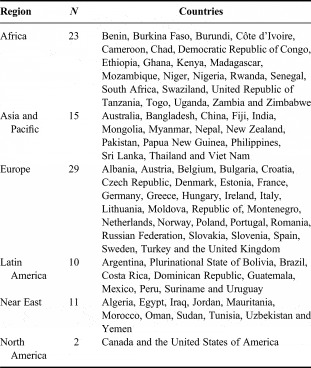
Completed questionnaires were obtained from 166 persons from 90 countries. Table 1 lists the countries by their respective region, according to FAO definitions. Europe was the region from which the most countries were represented. Denmark, Ethiopia and India were the countries from which the most responses were obtained (six each). Fifty of the respondents were NCs at the time of the survey. Several additional respondents identified themselves as NCs in the questionnaire.
Countries with persons that responded to the questionnaire.

Although standard animal breeding terminology was used in the various questions, no specific definitions of terms such as “straightbreeding” or “genetic improvement through well-managed use of exotic breeds” were provided.
Figure 1 has the distribution of persons according to their role in AnGR management within their respective countries. The majority (54 percent) of the persons responding were involved in teaching and research. This proportion was nearly twice as great as the next group, government officials, which comprised 28 percent of the total.
Distribution of the roles of the respondents in the management of AnGR within their respective countries.

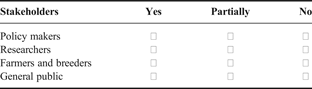
Table 2 summarizes the perceptions of the respondents regarding the level of understanding by local stakeholders about the importance of AnGR. Researchers were considered to understand AnGR issues in nearly half of the countries (44 percent) and a lack of understanding was noted in only 2 percent of the countries. These results are not surprising, given the large proportion of researchers and teachers among the respondents, and may be biased. In fact, 66 percent of researchers and teachers believed that researchers in their countries understood the importance of AnGR; this proportion was about 50 percent among non-researchers. Individuals from countries with multiple responses generally rated the knowledge of researchers higher than individuals from countries with a single response, which explains why the individual proportions (50 and 66 percent) are greater than the national proportions (44 percent). Policy-makers and farmers and breeders were considered to have a similar level of knowledge and the general public was considered to be the most poorly informed stakeholder group. In no country was the importance of AnGR considered to be well understood by the general public.
Proportions (percent) of countries for which different stakeholder groups were perceived to have various levels of understanding about the importance of animal genetics resources (AnGR).

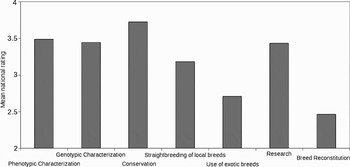
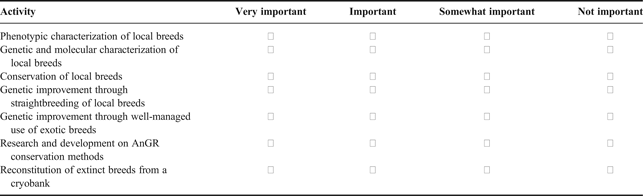
Figure 2 shows the relative importance of various AnGR activities in the countries from which responses were obtained (see Appendix 1, Question 5). The mean national rating was obtained by assigning responses to an ordered numerical scale with “Not important” = 1 and “Very important” = 4. Highly significant (p < 0.001) differences in the importance of various activities were observed.
Importance by country of various activities in the management of AnGR (greater values indicate increased importance).

Conservation of local breeds was considered the most important activity, whereas reconstitution of local breeds from a cryobank was the least important. Genetic improvement through straightbreeding of local breeds was considered more important than through the use of exotic breeds (p < 0.01). No significant difference was reported between the importance of genetic and phenotypic characterization (p = 0.64).
Additional analyses were undertaken across and within regions (no figure shown). The most variability across countries was for the importance of genetic improvement through crossbreeding and reconstitution of breeds from cryobanks. With respect to differences between regions, phenotypic characterization was considered significantly (p < 0.05) less important in North America than in any other region. Genetic improvement through the use of exotic breeds was considered by the respondents to be less important (p < 0.02) in North America and Europe than in any of the other regions.
One potential weakness of the question is that it may have created ambiguity with respect to some AnGR-related activities. For example, “upgrading” by the repeated use of exotic germplasm on locally present breeds is practised in many countries. The genetic improvement of the milk yield of local Holstein and/or Friesian populations in Europe by importation of germplasm from North American Holsteins has been important in the recent past and this practice could arguably be defined as either genetic improvement with exotic breeds or straightbreeding of local breeds, depending on whether the European and North American populations were considered to be distinct breeds or strains of the same breed. This example highlights the dilemma of distinctness where breeds have been moved across national boundaries and selected in a different environment and, possibly, for different traits or with different importance attached to the same traits. The Nellore in Brazil and Nellore/Ongole in India are another such instance.
In addition, the questionnaire did not address all AnGR-related activities. For example, the importance of crossbreeding existing local breeds with each other was not addressed. Crossbreeding of locally adapted purebreds is clearly widespread in beef and swine production in North America and other regions.
National conservation programmes
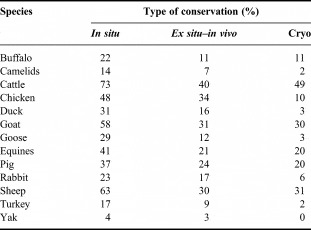
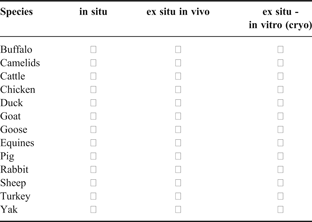
Table 3 shows the proportions of countries with different types of conservation programmes for the major livestock species. The questionnaire (Appendix 1) did not provide specific definitions for the different types of programmes, and so the results and discussion assume that respondents used a common set of definitions. For the record, in situ conservation was considered by the authors to mean the maintenance of AnGR in a sustainable manner in their natural production environments. Ex situ–in vivo conservation was assumed to refer to keeping live animals out of their natural production environment, such as in a government farm or breed rescue station. Cryoconservation was interpreted as storage of germplasm or other tissue in a gene bank.
Proportions (percent) of countries reporting different types of conservation programmes for the major species of livestock.

In spite of possible variability in interpretation, a few general trends are clear. First, in situ conservation programmes are the most common, with approximately twice as many in situ programmes either ex situ–in vivo programmes or cryoconservation programmes. The numbers of these latter two types of programmes are generally similar, except for poultry species, yaks and rabbits, for which ex situ–in vivo programmes are more numerous. Not surprisingly, in general, the more common species (e.g. cattle, sheep and goat) have more conservation programmes. Among the countries with responses, cryoconservation programmes are most common in North America, followed by Europe, and then Asia, the Near East, Africa and Latin America.
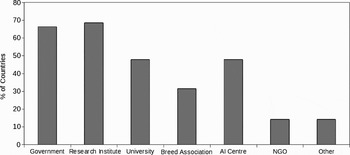
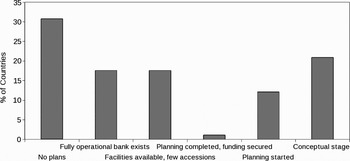
With respect to cryoconservation programmes in the various countries, Figure 3 shows the proportions of countries in which different agencies are engaged in the operation of cryoconservation programmes. The proportions do not add up to 100 percent, because some countries have multiple gene banks and because some of the categories overlap to some degree. Public institutions are the major operators of gene banks, directly through government agencies (66 percent), research institutions (68 percent) or universities (48 percent). Artificial insemination centres also play an important role in nearly half of the countries, and many such centres are government operated. In addition, in some countries, responsibilities may have been already assigned even if no cryoconservation programme is in operation. Figure 4 summarizes countries’ plans for the operation of gene banks within the next 5 years. More than 30 percent of countries have no gene bank and no plans to create one within the next 5 years. Fully operational national gene banks are present in only about 18 percent of the countries. An equal number have established gene banking facilities, but have only a small number of accessions. The remaining countries have recognized the need for a local gene bank and are at various stages of planning.
Proportions (percent) of countries in which various agencies are engaged in cryoconservation activities for AnGR.

Proportions (percent) of countries with various expectations with regard to plans for the operation of gene banks for AnGR within the next 5 years.

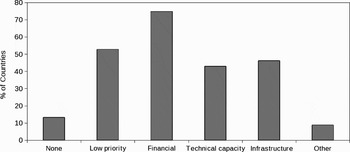
Various factors must be overcome in the establishment of gene banks, and these factors can also hinder the smooth operation of existing gene banks. Figure 5 shows the importance of several of these factors, according to the perception of those responding to the survey. Financial factors were by far the biggest constraint, being cited in about 75 percent of the countries. Low priority in the national livestock policy and lack of infrastructure and technical capacity were all cited by around 50 percent of respondents. With respect to specific regions, the least obstacles were encountered in North America, with only low national priority being cited in Canada. Obstacles were similar in Europe and Latin America and were cited less often than in the remaining regions. This latter trend was particularly true for infrastructure and technical capacity, as these obstacles were each cited by about 30 percent of respondents in these two regions, versus 50–70 percent in Africa, Asia and the Near East.
Proportions (percent) of countries facing various factors that hinder the establishment or operation of gene banks for AnGR.

Multinational cryoconservation programmes
According to the respondents in the survey, multinational backup storage systems for AnGR are essentially non-existent. Three countries reported to be the host of a multinational storage programme, the United States, Tunisia and Burkina Faso. Respondents from South Africa, Croatia and Slovakia reported that their countries contributed to a multinational system, but provided few details about the host country.
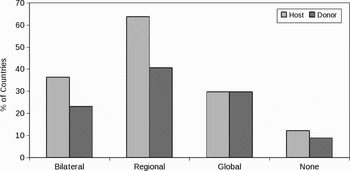
The paucity of multinational gene banks is not due to a lack of interest, at least according to the respondents to the questionnaire. Figure 6 shows the interest expressed in the different countries to participate in different types of gene banks, as either a host or a donor of genetic material. Among the possible scenarios, regional gene banks seem to be the preferred model. More than 60 percent of countries would be willing to host a regional gene bank and 40 percent would be willing to contribute. Bilateral and global gene banks were somewhat less appealing, with an interest to participate expressed in about 30 percent of the countries. Refusal to participate in any kind of multicountry gene banking was expressed by only about 10 percent of the countries.
Proportions (percent) of countries expressing interest in participating as either a donor or a host to various types of multicountry gene banks for AnGR.

Given that lack of interest is not a significant reason for a lack of multinational gene banks for AnGR, other factors must be responsible. Although the questionnaire did not address this issue in general, financial and logistical factors are surely among the constraints, given their importance with respect to the operation of national gene banks. International and national regulations are another important consideration. The influence of such regulations on the operation of gene banks is evaluated in depth in a companion paper in this special issue (Blackburn and Boettcher, Reference Blackburn and Boettcher2010), and so only a brief summary will be presented here. According to the respondents, more than 70 percent of countries have regulations on health and welfare of animals that would need to be considered for participation in multinational gene banking. About 40 percent of countries have legislation regarding the exchange of germplasm. In only about 25 percent of the countries were respondents unaware of any important regulations, but this percentage is likely to be an underestimation.
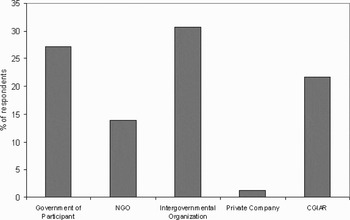
Assuming that the various obstacles could be overcome, the respondents expressed their preferences about the format and characteristics of a multinational gene bank for AnGR, as well as the conditions under which their respective countries would be willing to participate. With regard to a possible host of a multicountry gene bank, three types of hosts received considerable support (see Figure 7). The greatest number of respondents (31 percent) preferred that a multicountry gene bank be hosted by an intergovernmental organization, presumably for their neutrality and small likelihood to exploit the germplasm for commercial purposes. However, a similar proportion (27 percent) believed that the government of one of the participating countries would make the best host. The Consultative Group on International Agricultural Research was the host preferred by 22 percent of those responding, and although reasons were neither requested nor given, this preference is likely possibly due to their neutrality, technical capacity and past experience working with gene banks, particularly for plant genetic resources (e.g. Jackson, Reference Jackson1997; Gómez et al., Reference Gómez, Blair, Frankow-Lindberg and Gullberg2005). Much smaller proportions favoured NGOs or private companies as hosts.
Preferences (percent) of respondents with regard to the host of a hypothetical multicountry gene bank for AnGR.

The final question addressed the practical conditions under which countries would be willing and able to participate in a multicountry gene banking initiative. The first question dealt with the collection of the germplasm. A willingness and ability to collect the germplasm to be contributed to the multicountry bank was indicated for 77 percent of the countries, whereas the others would require assistance from outside in germplasm collection. The greatest level of willingness and capacity to collect germplasm was found in Europe, where the collection of national germplasm would be possible in 93 percent of countries (27 of 29). The differences among other regions were not significant (p > 0.10).
The second question regarded financial considerations. Not surprisingly, given the fact that lack of financial support was indicated as the most common obstacle for national gene banking, the proportion of respondents indicating willingness of their countries to pay for all costs of collecting and storing their animal germplasm in a multinational gene bank was somewhat low. Respondents from only 20 percent of countries indicated that their countries could fully support financially the participation in a collaborative gene-banking initiative. However, on the bright side, 57 percent of countries would be willing to share the costs associated with their participation. For only 23 percent of countries would outside funding be needed to support all activities. Despite the differences in the average economic status of countries in the different regions, no significant differences among regions were observed in terms of these financial considerations.
With respect to ownership of the germplasm deposited in a multinational gene bank, respondents from most countries (87 percent) expressed a desire for their countries to maintain at least partial ownership. Full ownership was considered a necessary condition for 34 percent of countries, whereas shared ownership was acceptable for 53 percent. No significant regional trends were observed.
There was no positive correlation between countries’ opinion on who should pay for the gene banking and who should own the banked genetic material. In fact, the opposite trend was observed. For example, among the countries that would be willing to support all part of the costs of germplasm collection and storage, only about 30 percent (22 of 69) considered it necessary to maintain full ownership and 12 percent were willing to relinquish all ownership. On the other hand, among the 21 countries that would not contribute financially to gene banking, 43 percent wanted to nevertheless keep full ownership of the genetic material and only one expressed willingness to release all rights to the germplasm.
Comments
Respondents were also allowed the opportunity to make general comments at the end of the questionnaire. Among the sentiments that were voiced multiple times was that there is a lack of capacity and resources in many developing countries, and so international cooperation on gene banking is necessary, whether it be in the form of establishing multinational gene banks or providing technical and financial assistance for the creation of national gene banks. Several other persons noted that national gene banks may be a logical first priority for many countries, given the complexity of organizing, financing and operating multicountry banks.
Conclusions
Several conclusions can be drawn from the evaluation that was undertaken in this study. A wide interest in gene banking of AnGR was expressed by the persons completing the questionnaire. However, the respondents were clearly a biased sample, with more knowledge than the average person about the importance of AnGR and likely a greater vested interest in support of activities dealing with their management and conservation. One problem is that policy-makers and the general public are less informed about the importance of AnGR. This lack of knowledge is likely contributing to obstacles that hinder the implementation of AnGR management activities, such as gene banking. For example, there is often insufficient funding for such activities, and management of AnGR is often not given high priority in national livestock and agricultural policies. If AnGR were considered more important by policy-makers and the general public, then perhaps more public funding would be made available to ensure their improved management. In many countries no national gene bank exists. Various agencies within the same countries have thus accepted the responsibility for operating their own independent banks.
With regard to multicountry gene banking, the respondents generally expressed interest in their country's participation in such an endeavour. Despite this fact, few multicountry gene banks for AnGR are actually operating. Among the probable reasons for the lack of such gene banks are restrictions imposed by national and international legislation and health and sanitary regulations and national policies on exchange of genetic resources. In addition, a lack of funding and differing opinions among countries on who should pay for collection of germplasm and on the ownership of stored material also impede the creation of multinational gene banks for AnGR.
Appendix 1. Questionnaire on the current arrangements for existing regional AnGR storage systems and regulations
1. Contact Information
• First name: ____________
• Last name: ____________
• Name of organization: ____________
• Email address: ____________
2. Please indicate your country ____________
3. Are you a National Coordinator for the management of animal genetic resources (AnGR)?
• Yes
• No
4. What is your role in AnGR management within your country? (Main occupation)
• Government Official
• Research and/or Teaching
• Industry
• Breeder
• NGO
• Other
5. Which activities do you consider most important for AnGR management in your country?
6. Do you think that the importance of AnGR conservation is well understood by the following stakeholders in your country?
7. Does your country have national conservation programmes for AnGR?
8. Which bodies are responsible for cryoconservation of AnGR in your country?
• Government
• Research institute
• University
• Breeders’ organization
• AI Centre
• NGO
• Other _______________________
9. Are there any plans to have a national gene bank for AnGR within the next 5 years?
• NO, not that I am aware of
• YES, our country already has a fully operational gene bank for AnGR
• YES, our country has established facilities for a gene bank, but no or few samples have been collected
• YES, all steps for preparation and funding are in place
• YES, formal planning is being undertaken
• YES, but planning is only at the conceptual stage
10. Which obstacles hinder the establishment and maintenance of a national gene bank for AnGR? (Multiple selection)
• No obstacles
• Lack of priority in national livestock policy
• Lack of financial resources
• Lack of technical capacity
• Lack of infrastructure
• Other______________________
11. Is your country a party to a multicountry back-up storage system for AnGR?
• NO, not that I am aware of
• YES, host of a multi-country back-up system
• YES, donor of germplasm
If yes, please indicate host and other countries involved
12. If not, is there a willingness to participate (as a host or donor) in a multicountry AnGR conservation programme?

13. Are there any national regulations for the exchange of AnGR that might be relevant for regional gene banking? (Multiple selection)
• NO
• YES, legislation on genetic material exchange
• YES, animal health and welfare related regulations
• YES, legally-binding contracts between gene banks and providers
• Other _______________________
14. Which would be your preferred host of a regional gene bank?
• Government of a participating country
• Non-commercial non-governmental organization
• Intergovernmental organization
• Private company
• Consultative Group on International Agricultural Research (CGIAR)
• Other______________________________
15. Which of the following sets of conditions would be acceptable for your country's participation as a germplasm donor in a regional gene bank for AnGR?
a. Collection of germplasm
• Donor county collects germplasm
• Host or other agency collects germplasm
b. Financial support for collection and storing
• Donor pays all costs
• Donor shares costs
• Donor pays no costs
c. Ownership of germplasm
• Donor country maintains full ownership
• Host obtains unconditional ownership
• Host has ownership, but Donor has the first rights to repurchase
• Donor and Host share ownership, with specified conditions
• Outside agency gains full or conditional ownership
16. Do you have any additional comments, ideas or suggestions? ____________________________