INTRODUCTION
The development of biotechnology and the commercialization of plant genetic resources (PGRs) over the last decades have fostered multi-level institutional transformation in seed sectors worldwide. There are a range of interests involved, expressed in and through international treaties and agreements, and this has led to some tension among competing interests (Louwaars, Reference Louwaars2007). At the national level, the opening up of the Chinese domestic seed market in 2001 and China's compliance with international agreements on entry into the global trading system have caused a series of institutional transformations in seed supply, accompanied by the expansion of the market share of transnational seed companies, the emergence of domestic commercial seed sectors and changes in the functions of public research institutes. An increasing number of public–private partnerships among various private and public actors in agricultural research and development (R&D) have been created over the past 10 years (Wang, Reference Wang2005; Zhu, Reference Zhu2010). However, the shift towards commercialization of the functions of the Chinese public breeding sector has led to a growing neglect of smallholder farmers’ interests, especially in relation to their requirements for suitable cultivars and quality seeds for less-favourable environments (Liu and Jiang, Reference Liu and Jiang2010).
The current situation in China's seed systems is complex. A variety of changes are impacting the relationships among key actors, situated at different levels, but not necessarily in concert. A multi-level perspective (MLP) on such complexity has been developed and used as an analytical tool in innovation studies (e.g. Geels and Schot, Reference Geels and Schot2007). It has not yet been applied to the analysis of seed systems in China. This paper explores the potential of a multi-level perspective to understand the seed system, particularly taking into account the tensions and opportunities for niche developments oriented towards smallholder farmers, which we examine through the case of participatory plant breeding (PPB). Within current institutional arrangements the further expansion of PPB is challenged by cultivar testing procedures and organizational arrangements between public institutes and market actors. These issues call for institutional innovation at the local level but also for changes in existing institutions at higher levels. The paper addresses these issues by integrating a multi-level perspective of institutional change (Geels, Reference Geels2006) into an analysis of the dynamics of system innovation in seed supply. System innovation refers to innovations that fundamentally change relationships and rules of the game within a set of activities considered as a system. The multi-level perspective distinguishes analytical and heuristic concepts to understand system innovations through introducing a hierarchy, from higher to lower, of institutional change at landscape, regime and niche levels. The relationship among the three levels can be understood as a nested hierarchy, meaning that niches are embedded within regimes and regimes are embedded within landscapes (Geels, Reference Geels2006). The distinction between the levels is made on the basis of the stability and structuration of relationships at each level (Deuten, Reference Deuten2003):
1. At niche levels, there is limited stability in rules and uncertainty about future directions. Change is created at the micro-level where radical novelties in technique, practice or organization emerge, and are carried and developed by small networks of dedicated actors, often outsiders and fringe actors in the local situation. Niches open a space for experimentation and learning.
2. Regimes are semi-coherent sets of inter-linked rules. These are more stable than niches, since the rules are shared among many different locations. Regimes offer greater structuration to local practices and socio-technical relationships (Raven, Reference Raven2004). Transitions occur when processes emerge either at niche or landscape level that catalyze change from one socio-technical regime to another (Geels and Schot, Reference Geels and Schot2007). Regimes provide stability by guiding perceptions and actions, while the niches act as incubators of radical novelties. The creative work in niches is often geared to the problems created by the existing dominant regimes; the niche actors typically hope that promising novelties are eventually used in or even replace the dominant regime. However, radical novelties may not ‘match’ the existing regime and do not easily break through. The nature and timings of the catalytic action thus becomes an important research question.
3. Landscapes refer to aspects of the wider exogenous environment that affect socio-technical development. They are beyond the direct influence of actors in the regime or at niche level and cannot be changed at will. The landscape level can be thought of in evolutionary terms as a dynamic selection environment that is linked to wider external developments in the natural and human worlds.
During a process of system innovation, actors in the dominant regime tend to resist change. The initiative for change starts in an isolated niche environment, usually a protected space created, for instance, by a project. Local initiatives compete with each other in a selection environment that includes the existing socio-technical regime, as well as the wider developments at the landscape level. Niche initiatives persist and grow only when changes are achieved at the regime level. Those that cannot influence the regime ultimately fail. The space for change can be enlarged when constraints caused by the dominant regime are modified, removed or transformed (Leeuwis and Aarts, Reference Leeuwis and Aarts2011). Changes in various dimensions of the regime, such as legal rules, norms and values, procedures and relationships among commercial and public organizations, over time may lead to structural change at the regime level. This paper takes the PPB project in southwest China as a model niche initiative that confronts and aspires to change regime-level constraints at a time when the institutional provisions governing seed supply at landscape level are themselves undergoing change.
METHODS
The data used in this study are drawn from 2000 onwards, a period in which fundamental change within the seed sector has occurred following China's entry into World Trade Organization (WTO) in 2001 and the implementation of the National Plant Variety Protection (PVP) Law, 1997, and the Seed Law, 2001. The PPB initiative was introduced in Guangxi in 2000 and subsequently extended to Yunnan and Guizhou. The niche-level data are based on PPB participant observation, project documentation and a questionnaire survey (Li et al., Reference Li, Lammerts van Bueren, Jiggins and Leeuwis2012a) applied from 2009–2010 to a sample of 162 farming households from 54 villages, 18 townships and 6 counties in Guangxi, Yunnan and Guizhou provinces. The survey covered local-level maize (Zea mays L.) seed supply, including maize hybrid adoption and varietal distribution in farmers’ fields. A follow-up tracer study identified the sources (breeder, seed producer and/or distributing agent) of the hybrids.
The higher level data are based on key informant interviews with 40 farmers, 8 public breeders, 10 PPB practitioners, 5 extensionists and 7 government officers at provincial and national levels. Relevant national and international agreements, seed regulations, seed enterprises, public institutes and PPB projects were also reviewed.
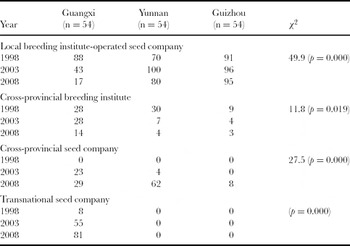
The data obtained from the survey were converted into percentages and a Chi-square test was carried out using SPSS 15.0 to establish differences in maize hybrid distribution among households (HH) in relation to the source of the hybrids (Table 2). The qualitative information from the interviews was transcribed and analysed in the following four steps (Table 3): (1) Open coding to identify ideas, themes and concerns; (2) identification of general categories and subcategories of advantages and disadvantages; (3) summarization of the interview using the categories, with subheadings and specific details or examples related by an interviewee and (4) calculation of frequencies of each category and/or subcategories and comparison of categories within and between interviews.
FINDINGS
The findings are presented in turn from each of the three levels, i.e. (a) the landscape settings around seed, including international agreements and treaties that have impacted the evolution of seed sector in China; (b) regime-level changes in China, including the evolution of domestic seed market, changes in national seed regulations, shifting functions of public research institutes and the development of commercial seed sector and (c) niche-level responses and motivations, including emerging partnerships among public institutes and commercial sectors, and the on-going PPB initiatives in the southwest. Section “Emergent Tensions Between Levels” focuses on the emergent tensions between these levels.
Landscape-level trends
Key informants in this study pointed to four major international treaties and agreements governing the global food and seed sectors that have impacted the evolution of seed sector in China:
The Trade-Related Intellectual Property Rights Agreement (TRIPS) under WTO was formulated in 1994. Article 27.3(b) of TRIPS states that ‘members shall provide for the protection of plant varieties either by patents or by an effective sui generis system or by any combination thereof’. The TRIPS does not define what ‘effective’ means, but it is commonly taken to imply legally defined intellectual property rights (IPRs) to protect Plant Breeders’ Rights (PBRs). Patents do not allow breeders’ exemptions (that allow free exchange of seeds for the purposes of breeding) and farmers’ privileges (that would allow farmers to save and reuse seeds), so more and more developing countries have chosen to develop a sui generis system to overcome described hurdles and allow farmers more freedoms, such as described in the older versions of International Union for the Protection of New Varieties of Plants 1978 (UPOV 1978).
Plant Variety Protection under UPOV (known under its original French designation) was introduced in 1961, creating a system of legal recognition and protection for named cultivars of plants among its member countries. The criteria for protection are novelty, distinctiveness, uniformity and stability (DUS). The standardization of DUS testing requires uniformity of a cultivar, and therefore the diversity within cultivars in commercial seed markets is reduced. In contrast to patent law, PVP can provide exemptions for both breeders, allowing them to use protected cultivars for further breeding, and farmers, allowing them to save seeds from their harvest. However, the 1991 revision of the 1978 version of UPOV expanded the scope for protection from ‘traded reproductive material’ to all materials, including the harvested product and the end product. The 1991 version has narrowed the so-called ‘farmers’ privilege’ to manage their on-farm saved seeds. Many developing countries therefore still enforce UPOV 1978 even though they are facing trade pressures to adopt the 1991 revisions into domestic law.
The Convention on Biological Diversity (CBD) has been ratified by nearly all countries. Its three objectives are as follows: The conservation of biological diversity, the sustainable use of components of biodiversity and the fair and equitable sharing of the benefits arising out of the utilization of genetic resources. Article 8(j) states that ‘subject to its national legislation, respect, preserve and maintain knowledge, innovations and practices of indigenous and local communities embodying traditional lifestyles relevant for the conservation and sustainable use of biological diversity. . . and encourage the equitable sharing of the benefits arising from the utilization of such knowledge, innovations and practices’ (Convention on Biological Diversity, 1992).
The CBD emphasizes the sovereign rights of states over their biological resources, and that the access to genetic resources and related traditional knowledge need to be provided upon mutually agreed terms (MAT), fair access and benefit-sharing (ABS) agreements and subject to prior informed consent (PIC) in order to respect and protect communities’ rights over their PGRs. The implementation of the CBD so far has focused primarily on protection against abuse instead of facilitating access and developing creative benefit-sharing mechanisms. The evidence indicates that the CBD has constrained access to and exchange of PGRs among countries (Falcon and Fowler, Reference Falcon and Fowler2002) while failing to protect farmers’ rights (FRs).
The International Treaty on Plant Genetic Resources for Food and Agriculture (ITPGRFA) was approved by the Food and Agriculture Organization (FAO) in 2001. It provides that ‘in the exercise of their sovereign rights over their PGRs for food and agriculture, states may mutually benefit from the creation of an effective multilateral system for facilitated access to a negotiated selection of these resources and for the fair and equitable sharing of the benefits arising from their use’ (ITPGRFA, 2004). It also recognizes the rights of farmers to ‘save, use, exchange and sell farm-saved seeds/propagating material’. In Article 9, farmers’ rights are defined as including (1) protection of traditional knowledge relevant to PGRFA; (2) the right to equitably participate in sharing benefits arising from the utilization of PGRFA and (3) the right to participate in making decisions at the national level on matters related to conservation and sustainable use of PGRFA.
These four landscape-level instruments for the governance of seeds are not in harmony; they set up powerful tensions that every country is forced to consider as national seed law and regulation evolves. At the same time, the process of institutional change in seed supply has accelerated greatly from the mid 1980s onwards with the growing power of plant breeders to manipulate PGRs and has resulted in a high degree of concentration in the ownership of IPRs in the form of PBRs (Srinivasan, Reference Srinivasan2003) and patent rights. On the other hand, the TRIPS agreement has accelerated significantly the spread of PVP systems across countries. Many developing countries that used to rely on public sector breeders at the national and international levels for the development of new cultivars (Evenson and Gollin, Reference Evenson and Gollin2003) are currently in the process of enacting PVP legislation to open up plant breeding and seed production to private and foreign investments (Srinivasan, Reference Srinivasan2003), even as they face an intense debate about the potential economic impacts of PVP on their agriculture and farmers (GRAIN, 2009).
The commercial seed industry over the last 40 years has consolidated worldwide (Howard, Reference Howard2009). This has had a number of impacts, including declining rates of farmer-saved replanting seed, as companies successfully convince a growing percentage of farmers to purchase their products year after year (Mascarenhas and Busch, Reference Mascarenhas and Busch2006); a shift in both public and private research towards the most profitable proprietary crops and cultivars and away from the improvement of cultivars that farmers can easily replant (Kloppenburg, Reference Kloppenburg2005); and a reduction in seed diversity, as companies reduce or remove less profitable lines from the seed lists of newly acquired subsidiaries (Volkening, Reference Volkening2006).
Regime-level change
Over the past three decades China has experienced a series of regime transitions, moving from a government-controlled, centrally planned seed development, supply and distribution system towards market-oriented seed provision. The transitions are presented here in relation to the regulatory framework, the public research institutes and the commercial seed sector.
Evolution of the domestic seed market
As one of the founder members, China signed the CBD in 1992; in 1999, China became a member of UPOV and adopted the provisions of the UPOV 1978 Act and at the end of 2001, China joined the WTO. The five-year transition period has ended, and the domestic seed market has gradually opened up to (trans)national commercial enterprises. China at the same time has realised the importance of ITPGRFA and has attended all working group meetings and negotiations through 2010.
The evolution of the domestic seed market under these obligations can be divided into following three stages:
1. Before 1995, the seed market of all crops was fully dominated and controlled by state-owned seed enterprises (SOEs).
2. From 1995 to 2000, National Seed Project was launched by the central government to prepare the transition from a planned economy to a market economy, by means of a series of market-oriented trainings, such as technical training on seed quality control and monitoring, and personnel training on market management.
3. In 2001, the government passed a new seed law, which allowed a commercial and competitive seed industry to evolve. By the end of 2009, there were more than 8700 seed companies operating in China. Most are small- or medium-sized enterprises; about 3000 are operated by the 450 public agricultural research institutes (Dong, Reference Dong2009).
National seed regulations
In order to comply with international agreements on the one hand and to support the development of domestic seed markets on the other, the Chinese government passed the Regulation on Plant New Variety Protection (the Regulation) (1997) and the national Seed Law (2001)
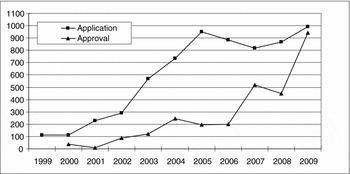
The Regulation brings the Chinese PVP law into line with UPOV 1978. The Regulation has had positive effects: It has helped to reshape the structure of breeding institutes and seed enterprises in China, encouraged commercial seed sectors and individuals to participate in breeding and seed multiplication and encouraged public research institutes to become competitors in the seed industry. Figure 1 shows the waves of application and approval of PBR from 1999 to 2009. The number of approvals lags behind the number of applications, partly because some applications have been rejected and others are in the process of testing.
The waves of application and approval of plant breeders’ rights in China from 1999 to 2009. (Source: MoA Database, 2010)

The Seed Law (2001) protects breeders’ benefits and opens up domestic seed market to private entities. It states that any company in compliance with the law can apply for a seed-breeding licence, or seed business licence, and can conduct seed production and management within the permitted region, i.e. the region designated by testing the value of a cultivar for cultivation and use (VCU). The certification system only applies to released varieties for which the breeder has to provide breeders’ seed. VCU testing admits to the market only those varieties that show ‘clear improvement’ compared with the existing varieties. The main purpose of the Seed Law is to regulate seed industry with regard to breeding and seed production, protect the legitimate rights and interests of plant breeders and seed producers and monitor and guarantee seed quality on the market.
The inter-related logic of these two institutional provisions means that the granting of a PBR does not automatically lead to the commercialization of a new variety, since it might still fail the VCU test; conversely, if a variety passes the VCU testing procedure and enters commercial production, it does not necessarily acquire exclusive market protection unless a PBR has been granted. The implementation of these two regulatory frameworks has provided incentives for public breeders and the commercial seed sector. They bring the Chinese seed sector into a global process that institutionalises intellectual property in plant breeding and commercial seed production.
Public research institutes
The public seed sector includes central and provincial-level agricultural research and crop-breeding institutes, academic institutions, specialist government agencies and international research centres. The national agricultural research system (NARS) was set up in 1957 after the establishment of the People's Republic of China in 1949. The opening of domestic seed market has stimulated both public research institutes and commercial seed enterprises. The value of professional breeders’ knowledge and expertise has attracted a price, as breeders’ rights became protected by new seed laws, and seed companies (operated by both public institutes and private agents) have to pay IPR transfer fees and/or royalties on released cultivars. Public institutes have come to see the commercialization of their work as a way to increase the revenue of the institutes, making them less dependent on state control and subsidy. However, key informants in the maize sector reported in this study that recent evaluation of the performance of the breeding institutes showed that the commercial value of released cultivars was not being recovered, and that only 30–40% of the cultivars released by the public maize research institutes have been commercialized. This implies that the public–private functional division has become blurred within the public sector, thereby compromising the efficiency of both breeding institutes and seed companies. Over the last two decades, the government has invested mainly in the development of hybrids and biotechnology research and varietal development, reducing its allocations to open-pollinated variety (OPV) improvement of maize and landraces for smallholder farmers under low-input conditions.
Commercial seed sector
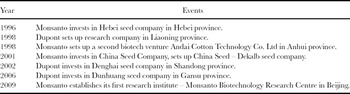
The commercial seed sector in China includes domestic and multinational seed companies (Table 1). It is estimated that the top four seed firms today control 56% of the global proprietary (e.g. brand-name) seed market (Howard, Reference Howard2009). Both big global players and regional seed companies view the Chinese seed market as a huge and lucrative opportunity. The domestic seed companies established after the changes in regulations in the late 1990s, as well as public sector organizations, initially viewed the external companies’ interest with trepidation. Among the 8700 seed companies in existence in 2009, about 3000 were operated by public institutes. Most were small- or medium-sized enterprises (Dong, Reference Dong2009) and only 95 of these had an integrated R&D capacity for seed development.
Penetration of transnational seed companies into China through collaboration with their local partners from 1996 to 2009.

Source: Compiled by this research.
In general, there are four types of seed enterprises: (1) Enterprises with breeding capacity, such as the seed companies operated by the public agricultural research institutes and specialized breeding companies; (2) enterprises focusing on seed production, operating in specific natural and climatic conditions, such as companies located in northwest China; (3) enterprises that target seed-related trade and (4) enterprises integrating capacities of the above three in breeding, seed production, extension and selling. The first works upstream of the seed industry through providing new varieties for other companies; the second usually contracts other seed companies or specialized farmer seed producers to carry out seed production; the third covers most of the SOEs supplying local seeds, and specialised trade companies. The fourth usually has strong R&D capacity and integrated marketing channels; this group includes most of the transnational companies and large-scale domestic companies.
Niche-level responses
This section presents two types of local-level innovation led by (a) seed agents and public–private partnerships, and (b) PPB.
Seed agents and public–private partnerships
The changing seed regulatory framework and the growing seed market has led to the emergence of commercial agents. Some of these have spun off from the public sector and others have been developed as joint ventures. Hybrid maize, as one of the most commercialized food crops, has attracted particular attention from commercial interests and can be used to exemplify these innovations.
As described in Li et al. (Reference Li, Leeuwis, Lammerts van Bueren, Song and Jiggins2012a) a rapid change in the supply of hybrid maize seed has occurred over the last 10 years in Guangxi, Yunnan and Guizhou, a karst mountain area with diverse micro-ecosystems, where maize is the staple food for farmers. The proportion of the area cultivated with hybrid varieties increased from 23% in 1998 to 79% in 2008. According to our survey findings, we distinguish four groups of companies that supply hybrid maize seeds to local farmers:
1. Local provincial or regional institutes and institute-owned seed companies: The rapid growth in the number of these relatively small companies indicates that the public agricultural research organizations are reorienting their functions towards the commercial seed market. Table 2 demonstrates that local institutes and their associated seed trade companies today play dominant roles in local seed markets, raising the danger of creating regional monopolies that restrict the penetration of cultivars developed elsewhere. However, the challenge of breeding cultivars adapted to the very diverse agro-ecosystems created by the mountainous landform favours the role of local companies.
2. Cross-provincial breeding institutes and universities: Before the opening up of seed market, they were the only centres for breeding and release of new cultivars. Today these organizations face competition from the emerging commercial sectors, and some have developed a commercial role in seed markets.
3. Cross-provincial seed companies. The opening up of the seed market provided opportunities and space for their development. In some cases they also produce the seed of cultivars released from public institutes, when accompanied by a PBR transfer payment.
4. Transnational seed companies. The penetration of transnational enterprises is one of the results of the development of domestic seed enterprises. According to current seed regulations, a transnational interested in major food crops must collaborate with a domestic enterprise in the form of a joint venture, taking no more than 49% of the shares. The penetration of a transnational into and expansion within the regions, however, is sometimes challenged by provincial legislation and regulations.
Maize hybrid distribution among households (HH) in relation to the source of hybrid maize in Guangxi, Yunnan and Guizhou from 1998 to 2008 (n = 162) (unit: %).

Source: Questionnaire survey (n = 162) in Guangxi, Guizhou and Yunnan, 2009–2010.
The data in Table 2 show that the hybrid maize market in Guangxi by 2003 was dominated by transnational companies, and that the commercial sector played a significant role in seed supply. Public agents from local or other provinces have gradually lost their market share. In Yunnan and Guizhou maize hybrid seed supply still heavily relies on the local provincial and regional research institutes. The commercial sector in Guizhou remains at an early stage of development. According to key informants, this is partly because the altitude in Yunnan and Guizhou ranges from 1500 to 3000 meters and local public research institutes play a more important role in seed provision for adaptation to such diver agro-climatic conditions and local pests and pathogens; Guangxi lies below 700 meters, which offers a greater market potential for more uniform cultivars of interest to companies from outside the region.
The PPB initiative – collaboration between public research institutes and farmers
PPB seeks innovations in local cultivar development and seed provision through systematic collaboration between the public sector breeders, farmers and communities (Morris and Bellon, Reference Morris and Bellon2004). Prior to the PPB project, a field study (Li et al., Reference Li, Lammerts van Bueren, Jiggins and Leeuwis2012a) demonstrated that poor farmers found it difficult to benefit from the seeds provided by formal breeders and the commercial seed market because of inadequate attention to the cultivar development needs of their diverse agro-ecosystems, and poor adaptation of the formally bred modern cultivars to local conditions. Local landraces on the other hand have been maintained for many years by farmers themselves through continuous selection by farmer breeders, based on their experience and farming knowledge. In order to strengthen the farmers’ seed system, the PPB initiative on maize was established in 2000, funded by the International Development and Research Centre (IDRC, Canada) (Song, Reference Song, Mathur and Pachico2003). It is the first PPB effort in China, seeking to orient varietal development towards small farmers, as well as farmers’ empowerment by means of the formal recognition of farmers’ IPR, and their contribution to PGRs’ conservation, and the development of a fair access and benefit-sharing mechanism (Ashby, Reference Ashby, Ceccarelli, Guimaraes and Weltzien2009).
The project in 2000 directly involved five women farmer groups, six villages, six township extension stations, two formal breeding institutes and one research institute. The participating farmers were encouraged to take part in a range of PPB research activities, including on-farm seed selection, small-scale seed production, adaptation experiments for hybrids and adaptation maintenance of landraces. Farmers participated in selection at different stages of the breeding cycle. Over the years the project has expanded to 16 farming villages in Guangxi, Yunnan and Guizhou through networking with provincial and regional breeding institutes and local communities. A collaborative partnership had been created among a number of institutes located at different levels in the public sector hierarchy, i.e. Guangxi Maize Research Institute (GMRI), the Institute of Crop Sciences under the Chinese Academy of Agricultural Sciences and a policy institute, i.e. Centre for Chinese Agricultural Policy under Chinese Academy of Sciences, and between these and farming communities in the three provinces. The breeders from the public institutes showed great interest in both local landraces and farmers’ seed selection processes.
Based on collective seed selection and mutual sharing of maize genetic resources and knowledge, the project by end-2010 has bred five maize varieties, i.e. Xinmo 1, Guinuo 2006, Zhongmo 1, Zhongmo 2 and Guisuzong. More than 100 landraces and new cultivars have been exchanged between farmers and researchers (Centre for Chinese Agricultural Policy (CCAP), 2009). Farmers’ preferences in seed selection, crossing and (re)combination of crop genetic resources favoured a number of traits in addition to productivity and market price, including taste, colour, early maturity, drought resistance and anti-lodging. Specific combinations of trait preferences were closely associated with specific ecological and cultural contexts in which farmers lived; these could not be fully satisfied by professional breeders working to meet national seed demands. In contrast, the modern cultivars selected by farmers through PVS have been shown to have adequate adaptation to the local environmental diversity, especially in relation to drought and other stresses. Besides maize, farmers had also adopted the methods they had learned through the project of other crops, such as rice, cassava and soybean. Of the five maize varieties developed jointly by the breeders and farmers, one was officially registered as a protected cultivar under the name of the GMRI breeders. The waxy hybrid, Guinuo 2006 spread since 2005 among local communities through small-scale seed production by farmer-owned seed enterprises.
Emergent tensions between levels
The commercially developed niches are driven by opportunities for market profit that have been opened up by the changes in policy and regulation, and they play an increasingly dominant role in seed provision. The domestic commercial seed sector has a strong focus on competitiveness and yield. However, smallholder farmers’ interests and the national interest in agro-biodiversity conservation are not fully addressed by the commercial seed market. PPB is a novelty that challenges the regime and the dominant actors by coupling global competition with the goals of conservation and the development of smallholder farmers’ livelihoods in disadvantaged areas. The following focuses on the role of the niche development of PPB in regime change as China seeks to balance commercial and public sector interests and smallholder farmers’ livelihoods.
As a radical novelty at niche level, PPB has encountered a number of tensions and mismatches with the existing regime:
Technical barriers to PPB products
The first PPB variety Xinmo 1, an open-pollinated cultivar performing well in the Guangxi region, failed at the VCU testing stage because it did not perform well in all the six regions demanded by the VCU protocols in force in 2005. Cultivars derived from any PPB process are unlikely to comply with the formal cultivar release criteria (Louwaars, Reference Louwaars2007). The existing seed regulations can recognize and release only those cultivars passing DUS and VCU testing. Cultivars or landraces selected by farmers, directly as the result of the breeding for adaptation to the agro-ecosystem, generally have the following four distinct features: (1) They are adapted to specific local circumstances; (2) they exhibit a considerable degree of genetic heterogeneity and therefore are more flexible and reactive to changing natural conditions; (3) they are inherently not stable and (4) they might or might not be regarded as distinct from each other (Visser, Reference Visser2002). One of the common issues worldwide is how farmer-selected varieties for low-input conditions can be tested under favourable conditions and complied to DUS criteria when their specific abiotic tolerance and cultural values are not valued and included in the testing protocol.
After Xinmo 1 was denied registration by the formal seed release system, the OPVs released by the PPB project subsequently were tested and cultivated only in local communities without official release. The waxy maize hybrid Guinuo 2006 was registered in 2004 under the name of the PPB breeder at GMRI. There is no regulation or institutional arrangement in place to support farmers as joint breeders that can be recognised by the cultivar registration system.
Hybrid seed production is more dependent on the services of public research institutes than improvement of OPVs and landraces. In the case of the hybrid Guinuo 2006, farmers received intensive support from GMRI, which provided parent seed for each season and regular technical training for on-farm hybrid seed production. Regarded so far by officials as a local experiment, such community-based seed production has been protected from IPR and market-related issues, such as PBR transfer agreements, payments for use of protected varieties, the commercial line restriction for non-commercial seed production and quality control of farmer-produced seeds.
In view of difficulties such as these (that have been reported by PPB practitioners from around the world), the existing cultivar testing system has come under increasing scrutiny (Ashby, Reference Ashby, Ceccarelli, Guimaraes and Weltzien2009; Morris and Bellon, Reference Morris and Bellon2004; Rey et al., Reference Rey, Fontaine, Osman and van Waes2008). Increased interest in maintaining diverse farmer-conserved cultivars has also pushed these technical issues onto the policy agenda (de Schutter, Reference de Schutter2009), and the pressures are growing for regime-level change in the DUS gold standard.
Organizational barriers to the PPB process
The project in the southwest has provided a protected space for niche-level experimentation and for protecting the public value in PGRs through collaboration between the public sector and farmers for the combined purposes of crop improvement, agro-biodiversity conservation and farmers’ empowerment. However, the scaling out of PPB is challenged by the priorities that public institutes set for themselves. When driven by market profit, both public and private research shifts towards the most profitable crops and proprietary varieties, and away from the improvement of varieties, such as open-pollinated varieties, that farmers can reproduce easily (Howard, Reference Howard2009; Kloppenburg, Reference Kloppenburg2005). Public institutes in China used to play an important role in fundamental research (e.g. pre-breeding research on germplasm) and public good research on minor crops and non-commercialized varieties, but over the transition period they have become profit-driven (S. Zhang, CAAS, personal communication, 2008). According to key informants, the performance of public breeders today is measured by the number of released varieties, published scientific articles and the commercial projects they have conducted. Their contribution to non-commercial activities, such as PPB, cannot be represented directly in this evaluation framework and this may discourage institute breeders who wish to be involved in PPB (W. Cheng, GMRI, personal communication, 2010). The shifting function of public sector has challenged their public good role in non-commercial research for smallholder farmers in less-favourable conditions.
Market barriers to PPB varieties
The key informants stressed that it is the DUS and VCU testing and approval criteria and procedures that have limited the promotion of farmer-selected seeds. The current seed legislation impedes the marketing of varieties that do not meet the requirements and therefore cannot be released for commercial sale. On the other hand, there is no provision in current VCU assessments for evaluating varieties for plant traits that add value to PPB varieties in the markets for which they are intended; these traits include both biotic and abiotic traits such as taste and colour. Therefore, the current seed law prohibits official marketing of farmer-selected heterogeneous populations in such a way that it has limited the seed exchange between farmers and/or markets. In addition, although China still implements the more permissive UPOV 1978 version, under UPOV 1991, farmers’ utilisation of their on-farm saved (protected) seeds for either home consumption or PPB experiments will become more restricted. Further, for the major food crops, it remains illegal in China to produce on-farm any seeds that have not been officially released. Farmers’ rights as seed entrepreneurs and breeders, i.e. to sell their seeds and to set up seed businesses, will continue to be restricted unless care is taken to define in the national law such phrases as ‘commercial’ seed production in ways that allow farmers to contribute to commercial seed flows.
Synthesis
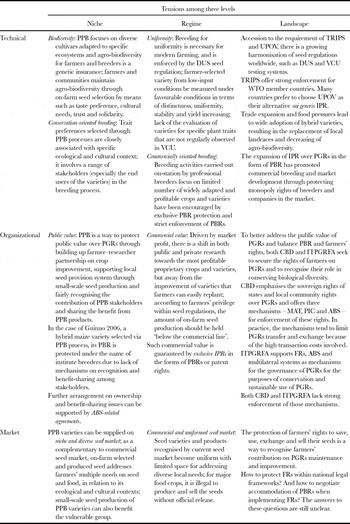
Participatory plant breeding practices have amplified the tensions within current institutional provisions, within and across levels. TRIPS and UPOV focus on protecting PBRs, and are trade-oriented, while CBD and ITPGRFA seek to secure t farmers’ rights over PGRs and to recognise their role in conserving biological diversity. Although there are distinctions within each of these frameworks, the basic distinction between these is the extent to which these are oriented to PBR or farmers’ rights. International discussions on the issues related to the incompatibility of these overlapping agreements are always controversial. However, the tensions may play a catalytic role in forcing regime-level change. From this perspective, the emphasis on farmers’ rights in CBD and ITPGRFA could be an opportunity for PPB-led innovation. Table 3, based on the key informant interviews, presents a synthesis of various points raised so far in this paper.
Emerging technical, organizational and market tensions in relation to niche, regime and landscape levels.

Source: This research, from key informant interviews, 2010.
DISCUSSION AND CONCLUSIONS
This study has explored changes in the seed sector from a multi-level perspective, analysed the innovations created by PPB at niche level in response to such changes and defined the opportunities for PPB in the changing configuration of seed regulation and policy. The findings help to define the opportunities for change at the niche and regime levels; these dynamics are discussed further.
Emerging opportunities at regime level
The current seed institutions are biased towards commercial sectors. They limit the space for non-commercial R&D directed towards conservation and livelihood of smallholder farmers. Nonetheless, there are options for regime change.
Technical options
Niche-level innovation in southwest China demonstrates that PPB varieties contribute to in-situ conservation of agro-biodiversity and crop improvement for smallholder farmers These contributions are not yet recognized and valued by the formal seed registration and release system. If a PPB variety fails the DUS test, a number of issues arise: whose PBR needs to be guaranteed, and in which way and how to conserve the variety within the public domain. A minimum requirement would be to establish a list of conservation varieties (Li et al., Reference Li, Jiggins and Lammerts van Bueren2008). China could also develop its own Conservation Varieties legislation for protection of conservation values and localized food preferences. Recent legislative developments at European level concerning seed production and marketing open a new way to safeguard biodiversity of interest in agriculture. Regulation for landrace conservation and use (EU Commission Directive 2008/62/EC 20, June 2008) has been commented upon by Lorenzetti and Negri (Reference Lorenzetti, Negri, Veteläinen, Negri and Maxted2009); these appear to exclude new or improved farmers’ varieties (Chable et al., Reference Chable, Thommens, Goldringer, Infante, Levillain and Lammerts van Bueren2009).
In most cases PPB varieties cannot meet the DUS and VCU requirements because the heterogeneous nature of on-farm selected varieties conflicts with the requirement for uniformity. A solution could be to develop a parallel variety registration system to list PPB and conservation varieties. The yield is a dominant feature in the VCU testing standards and this also limits the opportunity for local varieties that typically perform better on other traits. As failing the VCU test prevents entries into the commercial market, it has been proposed to take VCU out of the registration process and to leave quality judgments to localized procedures. For instance, the test could be used simply to provide market actors and farmers with information; in the United States, for instance, seed quality is monitored by market actors and consumers (Louwaars, Reference Louwaars2007). Within the European organic sector some countries are experimenting with testing protocols that integrate organic and low-input growing conditions and additional traits such as weed suppression. Austria has adopted a specific VCU system for organic farming systems. However, it is sometimes difficult to gain policy support for such models because of the question: Who will pay for extra costs? (Rey et al., Reference Rey, Fontaine, Osman and van Waes2008).
Organizational options
The publicly funded institutes’ involvement in the commercial seed market distorts competition. Their public responsibility for crop improvement for smallholder farmers and especially for crops that occupy a small area or are of minor importance to the national economy, and to pre-breeding research, need to be distinguished from their commercial activities. The commercial sector could also benefit from strengthened collaboration in pre-breeding research; the public institutes could provide specific stress-tolerance materials, for instance. Policy guidance for reform and development of the seed industry is under formulation by the State Council and the Chinese Ministry of Agriculture. Although the outcome is not yet known, the consolidation of the domestic seed industry and the separation of public institutes and the commercial seed industry seem likely to be central elements in the guidance.
The PPB initiative demonstrates the potential for creating mutually beneficial farmer–researcher partnerships serving local market, conservation and livelihood goals. Public researchers are playing important roles in on-farm experimentation and seed production in ways that balance farmers’ rights within the current seed regulation. For PPB varieties with values that do not meet DUS and VCU requirements, the collaboration secures mainly agro-biodiversity conservation and farmer empowerment benefits. For varieties with local or even national commercial value solutions to the ownership and benefit-sharing issues that arise are evolving. The PPB hybrid Guinuo 2006, for instance, was registered under the name of institute breeder. Subsequently the institute's breeders agreed to share the benefit informally through supporting community-based seed production. In Nepal a PPB variety that passes VCU testing can be kept within the public domain without applying for PBR protection, and farmers can participate in commercial seed production, as in the case of Jethobudho, a landrace rice improved through PPB and formally released for general cultivation under the national seed certification scheme (Gyawali et al., Reference Gyawali, Sthapit, Bhandari, Bajracharya, Shrestha, Upadhyay and Jarvis2010). In addition, access and benefit-sharing mechanisms (formalised, for instance, in contract law, see Li et al., Reference Li, Leeuwis, Lammerts van Bueren, Song and Jiggins2012b) are envisaged under CBD and ITGPRFA. However, the implementation and enforcement of ABS mechanisms depend on the framing of national legislation.
Market options
Concern about the loss of diversity in agriculture is forcing reconsideration of the need to allow farmers to increase genetic diversity on their farms, but current seed legislation worldwide impedes the marketing of non-uniform varieties and this limits access to diversified seeds. Options for market innovation are linked to technical considerations because varietal testing determines whether or not a variety can be commercialized. If the VCU system were to become non-compulsory or could take more criteria into consideration, this would help open a space for seed markets serving niche needs and more diverse end-uses. Farmers and their communities could generate more income by producing seed specialities with added value. A diversified seed market that consumers could recognize would also provide incentives for PPB practitioners to supply on-farm selected and produced seed. Niche markets (that in the Chinese case are not small, given the numbers who will remain based in smallholder farming for decades to come) can address local needs for speciality seeds and food, in relation to their specific ecological and cultural contexts. Vulnerable groups that have difficulties in accessing the commercial seed market would also benefit.
Potential for evolution at the landscape level
Trade-related pressure to comply with WTO and UPOV provisions has led to a growing harmonisation of seed regulations worldwide. The concentration of IPRs in PGRs has fostered the commercialization of those resources and the development of commercial seed sectors. IPR and seed regulation are evolving under WTO/UPOV as a form of business regulation that plays a powerful role in driving the direction of R&D and in shaping market structure through binding IPR-based market protection (Drahos, Reference Drahos2010). However, the trade-related aspects of IPR, in the form of PBRs and patent rights, tend to conflict with development-related policy priorities, especially in relation to the pubic interests served by plant breeding for agro-biodiversity conservation, crop improvement in less-favourable region. The actors within the system are engaged in a struggle over who will have power and control over the production and supply of food, and how the benefits and risks arising from different activities will be distributed (Tansey, Reference Tansey, Tansey and Rajotte2008).
At the country level, there is space for exceptions and protection and many countries, especially the developing countries, are exploring their sui generis options for balancing farmers’ rights and PBRs. What are the possibilities for China to develop a unique seed system that can drive action on the global stage? The seed system in China seems to be evolving towards a two-track framework. On the one hand, governed by international trade rules, the national seed system is experiencing industrialization and commercialization, drawing support from both public and private sectors. On the other hand, as a mega-biodiversity country, China is also striving to put in place policy support, regulation and practices for agro-biodiversity conservation to safeguard future breeding options and food security under climate change (Xue, Reference Xue2011). Since most of its PGRs are in the hands of smallholder farmers, Chinese policy makers recognise that exclusive IPRs will limit farmers’ access and reduce the potential for on-farm crop development. For the sake of both farmers’ interests and continuous conservation of agro-biodiversity, China so far maintains the provision of UPOV 1978 (Song, Reference Song2010). However, the concept of farmers’ rights does not resonate well in the Chinese context and legislation to protect their interests in PGRs, crop breeding and commercialization lags behind countries such as India. As public sector shifts its attention to commercial business, the national legal framework does not as yet recognise farmers as users and stewards of PGRs. The space for farmer organizations also is still underdeveloped, and, though numerous, smallholder farmers have weak capacity to express their needs in relation to seed markets and variety development. The PPB initiative provides a dynamic for change for a two-track evolution and this is being actively pursued in a series of policy workshops (Li et al., Reference Li, Leeuwis, Lammerts van Bueren, Song and Jiggins2012b).
OUTLOOK
This paper presents and analyses rapid evolution of seed sector in China. Special attention is paid to PPB as a radical novelty that offers a range of advantages in relation to needs such as those of smallholder farmers in the diverse agro-ecosystems of the southwest, biodiversity conservation and food security under unpredictable or adverse climate change. Although there are opportunities for ensuring that PPB becomes a permanent component in seed provision, further effort is required to stabilise this capacity in the evolving regime. Specifically, what is needed includes the following:
1. Amendment of existing seed regulations to accommodate varieties with heterogeneous characteristics.
2. Support to public research institutes’ role in breeding oriented to smallholder farmers and conservation.
3. Protection of public value created by PPB in relation to agro-biodiversity conservation and farmer empowerment through ABS-related agreements, clearly distinguished from the commercial value protected by exclusive IPRs.
4. Support to farmer-led seed production and marketing, as a complement to commercial markets, to widen farmers’ seed choices and respond to their multiple needs.