

Introduction
Major corporations are present in everyday life to a massive extent. In Western countries, communications from and interactions with, corporations occur many times a day. Corporations are so pervasive that some brand names have become genericized words (verbs in the most extreme cases)—Google, Hoover, Photoshop, Bic are a few examples. This overwhelming influence on everyday life, coupled with significant corporate financial firepower, has meant that corporate influence on politics has been a recurrent fear for over a century.
Contemporary accounts of business power tend to focus either on inputs into the formal political arena (lobbying, campaign contributions, the revolving door, etc.) or how, in a capitalist democracy, the market can constrain the state due to political reliance on a healthy economy. While these are both important, the larger picture is, and a substantial number of business power mechanisms of influence are, missed by both a disciplinary focus on the formal political arena, to the detriment of the economic and societal arenas, and by the use of a restricting conceptual language inherited from earlier debates. The big picture is further missed by a more limited consideration of the temporal element of different dimensions of power. For instance, Lukes's third dimension of power (ideational manipulation) involves a slow process of ideational sedimentation and so must be studied in a manner that reflects this sedimentation over time.
In an attempt to capture the bigger picture of corporate power, this article sketches a broader understanding of the means by which business is powerful, highlighting corporate-induced material change in society and the careful embedding of discourse as key, yet overlooked, longer-term mechanisms by which corporations can realize their interests. This article begins with a review of the literature on business power, focusing on oversights of this literature. Then, sketching the framework and methodology of this piece, the article combines Gaventa'sFootnote 1 reconceptualization of the three dimensions of power with the existing business power literature in a manner that corrects the oversights of the existing literature and provides an alternative conceptual language. The article then moves on to a case study of Corporate Average Fuel Economy (CAFE) standards by first outlining changes within the political arena and the role of conventional mechanisms of influence within these changes before showing how U.S. automaker-led material and ideational change fundamentally altered the political, societal, and economic reality on which policy was built. The power of the ‘Big Three’ American automobile corporations (General Motors, Ford and Chrysler) is then tested through an examination of the extent to which these corporations realized their interests (alongside how they went about realizing their interests) in the 2007 Energy Independence and Security Act's (EISA) reform of CAFE standards. In total, this article offers both a reassessment of the operation, extent and location of corporate power, and a framework and conceptual language for demonstrating and discussing corporate power, alongside a case study based on original empirical material.
Business Power Literature Review
How to understand the power of corporations and other large business actors within democratic societies was a major subject of debate for many decades. Traditionally, the literature either sought to characterize the way in which interest groups (including business) interact with the stateFootnote 2 or, more specifically, sought to understand the relationship between the state and business, and how business, or the business class, could broadly rule a nominally democratic state.Footnote 3 Nevertheless, business power, as a research topic went out of vogue and suffered from a lack of attention during the 1990s, in particular. As it started to re-emerge in the 2000s, one near universal feature of the disparate pieces was to note the paucity of contemporary research on the topic, which (increasingly ironically) served as a preface to the laying out of new research on the topic; as recently as 2013 Wilks characterized the literature as “a few oases in an arid landscape.”Footnote 4
Concern about business power has been bolstered by the Global Financial Crisis, which has seen an upsurge in business power literature, although with a tendency toward a consideration of the power of financial institutions. However, this new literature has three main conceptual problems that restrict empirical investigations of corporate power. The first problem has been developing a conceptual language that balances structure, agency, and ideas. The majority of the new literature has been focused on the idea of “structural power,” as a 2015 special issue of Business and Politics on the idea attests.Footnote 5 Structural power originally came from the work of Block, Miliband, and Poulantzas, finding its most prominent/mainstream expression in the work of Lindblom. It refers to the idea that politicians face automatic divestment and a sluggish economy if they take anti-business decisions, and thus politicians seek to act in the interests of business, without business actively needing to try to rule.Footnote 6 Reaching its apogee in the late 1970s and early 1980s, the idea declined in popularity for several reasons: partly because the idea was too deterministic, partly because it emerged around the time that business (in the United States, in particular) felt it was not getting its way and had politically-mobilized on a massive scale, and partly because of changes in the mainstream of interest group research.
Seeking to resuscitate a less powerful version of the idea, the contemporary literature has conceptualized structural power and its counterpart, instrumental power, in various ways.Footnote 7 For Culpepper and Reinke, “instrumental power comprises the various means, unrelated to the core functions of the firm, through which business influences politics…structural power, by contrast, inheres in the fact that firms are agents of economic activity in capitalist democracies.”Footnote 8 In this manner, business is viewed as operating like a powerful interest group that is also additionally advantaged by the dependence of the state on capital. Business can lose, however, when issues interest the public (when they become ‘high salience’ issues), as the electoral incentives for politicians shift toward paying more attention to public opinion and less to business interests.
Despite the growth of this stream of literature, the use of language in this new understanding of structural power is strange, relying on “infelicitous conceptual language inherited from past debates.”Footnote 9 Previously, structural power was both structural in the sense that it arose from the structure of the capitalist system, but also in the sense that it operated automatically and independent of being wielded; it was a “structure without agents,” to quote Lukes.Footnote 10 The former sense of structural power has remained, but the latter has been dropped in the aim to make structural power non-determinist.Footnote 11 However, doing so has left structural power searching for structures by which to define itself. Left with only the former sense of structural power, new conceptualizations of structural power are based on a separation between state and market, between public and private, or between political and economic, but not, as one would expect, on agency and structure. This linguistic ambiguity has led to debates about whether capital strikes (which are an explicitly political action undertaken using capabilities stemming from the structural position of business in a capitalist democracy) count as instrumental or structural powerFootnote 12 and a reification of what ultimately and historically is a normative (not analytical) line between public and private. Thus, the conceptual language of structural power has served to both clarify and to obscure our understanding of business power.
Moreover, the drive within this stream of literature to empirically prove the structural power of business has led to a primarily material understanding of power being utilized—where power is the product of material, informational, and incentive disparities. Similarly, the satisfaction of interests (the traditional test of power) is often treated as a binary, rather than multi-dimensional issue, which means such literature pays insufficient attention to the nature of political compromise, for one, but also misses the operation of power in policy implementation and societal reactions. Block and Piven echo these points, writing that “the exercise of [business] power is often surreptitious or at least subtle and indirect, and often operates with considerable and highly variable time lags…In short, there is a deep tension between analyzing Steven Lukes's ‘three faces of power’ and current criteria of methodological rigor.”Footnote 13
This problem of conceptual language also exists outside of the structural power literature. Using a Lukesian view of power,Footnote 14 Fuchs maps different business power literatures onto the three dimensions of power, and thus presents a tripartite framework of business power, considering “instrumental power” (lobbying and campaign contributions), “structural power” (capital mobility and private regulatory roles), and “discursive power” (the perceived legitimacy of actors, attempts to improve this legitimacy and the framing of topics). Johal, Moran and Williams also base their work on Lukes, while adding a Foucauldian fourth dimension to their framework. Their framework thus considers “the power of decision, the power of non-decision, the power of (narrative) hegemony, and the power of learned self-discipline which is capillary.”Footnote 15
Reconnecting the debate about power with the debate about business power is an important step that helps us avoid the infelicitous conceptual language of structural power, offers important theoretical elaboration, and corrects the strange oversight by Lindblom of LukesFootnote 16 considering the natural congruence of their ideas. However, while Lukes offered the seminal account of power within political science, there have been numerous debates following Lukes's initial publication that are not reflected in Fuchs's account and which serve to show a distinct conceptual unevenness in Johal, Moran and Williams's bricolage account. The issue of structure and agency has been central to criticisms of Lukes.Footnote 17 For Lukes, power is only in operation when exercised by an agent—hence Lukes's definition of the third dimension as “A may exercise power over B by getting him to do what he does not want to do, but he also exercises power over him by influencing, shaping or determining his very wants.”Footnote 18
For Johal et. al's account, the problem of conceptual unevenness stems from seeking to combine Lukes agency-centered framework of power, with Foucault's more mercurial view of power. As Gaventa notes, Foucault's “work marks a radical departure from previous modes of conceiving power and cannot be easily integrated with previous ideas, as power is diffuse rather than concentrated, embodied and enacted rather than possessed, discursive rather than purely coercive, and constitutes agents rather than being deployed by them.”Footnote 19 The essential problem, then, is combining an agency-centric power over view of power, with an agency-transcending power to view of power.Footnote 20 This bricolage problem ultimately overwhelms their attempts to add a Foucaldian dimension to their account of business power. While they make the proper overtures to a Foucaldian perspective—noting, for instance, “agency or intent had little to do with [capillary power use]”Footnote 21 —they resort to the language of agency, talking of how the financial industry tried to utilize, construct, and enlist capillary power in an effort to dominate. Thus, the conceptual addition to their framework collapses back into an agential understanding of power—where there is a wielder and conscious efforts, rather than dominator and dominated alike being conditioned by power.
The second conceptual issue with the business power literature concerns the question of where power operates, and consequently, where we should look for power. The early ideas that shaped the community power debates—between sociologist C. Wright Mills's power elite and political scientist Dahl's pluralist decision making—were implicitly shaped by this issue as much as the question that was more explicitly considered “what is power?” Dahl's position being that government institutions are the place to look for power, and Wright Mills looking more toward society.
The vast majority of political science research follows Dahl and assumes that decision-making within the political arena determines who gets what, when, and how. Yet, this assumption is problematic, not least for studies that seek to understand “who governs?” regarding corporations as they are (the premier) politico-economic actors. The divisions between public and private, and between state and market, are not analytical distinctions, but normative distinctions stemming from what Walzer termed the liberal “art of separation.”Footnote 22 It does not follow that because liberals wanted economics and politics to be separate that they are, or that power remains in the political realm. This assumption undermines empirical investigations of power by presupposing where power is operating and predetermining where the researcher will look for power.
This point has been picked up in various ways in the business power literature. Abdelal, in his exploration of the relationships between multinational energy corporations, notes that “politics are about much more than government policies. Not all political outcomes result from policy choices.”Footnote 23 Culpepper, too, expands his consideration of issues to include how firms organize their ownership. For Culpepper, this organization can constitute an “informal institution,” which he defines as “regularized rules or practices that are not established by lawmakers or regulators.”Footnote 24
However, even when the consideration of where power is operating is broadened, it tends to be broadened to include only the most measurable and formal ways in which the economic (or otherwise) operations of business alter politics. Such limited broadening of analysis is insufficient as business authority is endemic to capitalist democracy, with many important and inherently political decisions made by business. Reflecting this point, Lindblom noted that “businessmen [are] a kind of public official and exercise what, on a broad view of their role, are public functions.”Footnote 25
This point is crucially important for empirical studies of corporate power. The failure to recognize business authority as part of capitalist democracy can mean that the decisions that are taken off the agenda of government are also taken off the agenda of political research. Currently, when economic actions are considered in the political science literature, they are considered in terms of their effect on the political arena, not necessarily as political in themselves. The very idea of “structural power” is centered on the political arena impact of the possibility of business divestment as a response to unfavorable legislation, not on the wider political societal impacts of business authority. When combined with “current criteria of methodological rigor” the literature has assessed the power of a corporation based on the formal output of politics and policymaking, and failed to consider societal outcomes, alongside how outcomes and outputs interact.
The third conceptual issue with the business power literature, following from the second problem, is that the sociological element of business power is missing from current accounts.Footnote 26 That is to say, accounts of the interaction between business and society/individuals are lacking from political science explanations with their focus on business-government relations. This oversight hamstrings accounts of business power further as corporations and individuals interact and communicate on a constant basis, facilitating widespread societal change without recourse to the political arena. Moran notes this individual-corporate relationship:
The giant corporation is a dominant part of our lives….I shop weekly for groceries in the store of a giant retailing multinational (Tesco), buy most of my clothes from another (Marks and Spencer), drive a car produced by a Japanese giant (Toyota), buy books online from a U.S. giant (Amazon), download music from another (Apple), routinely use PC hardware produced by a multinational Japanese giant (Toshiba), and software developed by an American giant (Microsoft).Footnote 27
Further to these interactions with specific corporations through purchasing decisions, corporations play a major role in society by producing culture, advertising, and shaping the very environment they built. In fact, the twenty-first century is exceptional in the degree to which the mundane experiences of an individual's everyday life have been thought about and deliberated over by others; many of the sounds, smells, and visuals experienced daily have been created with the aim of increasing an individual corporation's sales and profits, with the ancillary long-term societal-wide effect of reshaping “the citizen” into “the consumer.” By being overly-focused on looking for power in the relationship between business and government, the business power literature ignores power relationships between businesses and other businesses, businesses and NGOs, and, most crucially, the relationship between businesses and consumers/citizens, all of which may impact on the running of society.
Overall, then, the business power literature's conceptual foundations require reconsideration. In particular, the concept of power needs to be focused upon, and questions have to be explicitly asked of where we think power is located and how we understand structure, agency, and ideas in relation to power. Accordingly, the next section seeks to build a framework of power that addresses these issues.
Theoretical Framework and Method
Similar to Fuchs, this article utilizes a three dimensional power framework that considers the decision-making, bias-mobilization and discursive/ideational elements of power, as well as how these forms of power interact. Departing from the above accounts, however, this framework relies on Gaventa'sFootnote 28 reformulation of Lukes and is somewhat divergent in its classification of different mechanisms of influence. In Gaventa's account “visible” (first dimensional) power is power that operates conspicuously and can normally follow from legal right or, perhaps, an implicit or explicit threat of coercion or punishment. Hidden (second dimensional) power concerns as Schattschneider argued, how “some issues are organized into politics while others are organized out”Footnote 29 —it is how the rules of the game and the agenda are set in such a manner that excludes pertinent or important choices/values and includes others. Finally, invisible power (third dimensional) serves to ideationally subordinate some concerns while super-ordinating others and manifests in the form of discourses that justify and normalize a state of affairs. Agency and structure can operate in each dimension of power, with visible power tending to be much more agential and invisible power more structural, which is where this framework departs from Lukes's actor-centric account. This difference with Lukes is clearest in the third dimension, as ‘“invisible power’ need not be limited to intentional acts of ‘thought control’ by the powerful, but can also be seen as self-reproducing social processes in which the thinking and behavior of the powerful and powerless alike are conditioned by pervasive norms.”Footnote 30 Figure 1 represents the forms of power and their interaction with agency and structure.Footnote 31
A diagrammatic representation of agency, structure, and different forms of business power.

When applied to studying corporate power, there are several readily-identifiable mechanisms of influence that can be classified according to these power categories: campaign contributions and lobbying (agential visible) and the dependence of the state on capital (structural visible); astroturf campaigns and the use of think tanks (agential hidden); the revolving door (structural hidden); and (broadly) the private sector as universally more efficient, the need for economic growth, and business leaders as economic experts (structural invisible).Footnote 32
It is worth noting that how mechanisms of influence are classified is an issue of their use, rather than being predetermined, and mechanisms are able to bridge categories. Campaign contributions, for instance, can be understood as agential visible power if they are conceived of as a quid pro quo relationship. Equally, if they are conceived of as establishing or reinforcing interpersonal relations then they would count as agential hidden power—not that it is in anyone's particular interest to make a hard and fast distinction in a situation in which the analyst feels that a particular mechanism of influence is working in more than one significant manner.
The power framework, then, is an abstract account of power intended to provide both a guide to investigating power and to furnish researchers with a new conceptual language for discussing power, which is a necessary step in correcting inherent oversights within contemporary literature—all of the studies mentioned above would fit within the framework and language provided here, yet the following case study would struggle to be both conducted and explained using the approaches explained above.
Applying this framework necessarily involves taking a historical approach, as agential invisible power accretes slowly, over time through repetition. Likewise, including business authority is necessarily historical because there are millions of business decisions everyday and which decisions are important and significantly governance-altering can only be judged in retrospect. So, the approach needs a longer term view and also needs to pay attention to power operating in arenas other than the political. Reflecting this concern, this article also discusses both the wording of legislation (the technical policy output) and its enactment within society (the actual policy outcome) as both go on to influence governance and later policy making.
The case is explored based on data from semi-structured interviews with a range of elites in Washington, D.C. and Michigan. Interviewees ranged from government officials (NHTSA, congressional staffers) and business executives (GM, Toyota, Chrysler) to think-tank/lobbying organization staff (Public Citizen, Competitive Enterprise Institute). The purpose of these interviews was to establish interviewee perspectives, to construct a narrative of the evolution of the case, and to interrogate the reasoning the elites deployed. Points from these interviews were also confirmed through use of extensive archival material and, where relevant, statistics.
A Short History of CAFE Standards
CAFE standards have been promoted for their capacity to reduce the U.S. reliance on imported oil and to improve the environment, both of which are longstanding issues that have occasionally been at the top of the U.S. political agenda —Jimmy Carter, the president most committed to energy reform, even declared oil consumption restraint “the moral equivalent of war” in 1977. CAFE standards have also long been a policy supported by the public, who see it as a way of increasing fuel economy without paying for itFootnote 33 and of reducing the huge amount of oil consumed by transport in the United States. The United States is, in fact, rather unique in its consumption of oil for transport. In 2006, for instance, the United States consumed 6.49 liters per capita per day (LCD) of transportation fuels. In comparison Japan consumed 2.18 LCD (33.6 percent of American consumption), the United Kingdom 2.84 LCD (43.7 percent) and Germany 2.37 LCD (36.4 percent). Even compared to similarly-developed countries that also have the disadvantages of low population density and large territorial areas U.S. consumption was gluttonous; with Australian consumption being 4.2 LCD (64.8 percent) and Canadian consumption being 4.82 LCD (74.3 percent).Footnote 34
However, since the costs of compliance are primarily born by the manufacturers, CAFE standards have faced longstanding opposition from auto manufacturers— particularly the Big Three U.S. automakers. This opposition has caused many problems for CAFE, as the automotive industry is both politically powerful and economically important. For instance, in 1979 GM was the largest private employer in the United States with 618,935 people.Footnote 35 While competition from smaller, more efficient, Japanese-made vehicles has massively eroded the position of the Big Three,Footnote 36 even now, the post-bailout and post-NAFTA (which has led to more automotive employment in Mexico) U.S. automotive industry as a whole claims to directly employ 1.55 million people and further impact 5.7 million jobs in the United States.Footnote 37
The industry has also been a major user of political money. Since 1990, the Big Three (and the Alliance of Automakers) have donated $29.4 million to congressional candidates' election campaigns, and, since 1998, have spent $463.1 million lobbying the U.S. Congress. In comparison, the three largest Japanese automakers (Toyota, Honda, and Nissan, and the Association of Global Automakers) spent $1.4 million on campaign contributions since 1990, and $144.7 million on lobbying since 1998.Footnote 38
CAFE standards were originally able to emerge in spite of the strength of the auto industry due to the OPEC oil embargo of 1973–74. The quadrupling of oil prices forced the issue of vehicle fuel economy normally in the domain of business governance, into the formal political arena. The political result was the 1975 Energy Policy and Conservation Act (EPCA), which set the original CAFE standards.Footnote 39 CAFE worked by requiring vehicle manufacturers to achieve a certain sales-weighted mean of the fuel economies within their product line. The sliding-scale penalty for manufacturer noncompliance was $5 for every 0.1 mpg below the standard, multiplied by the number of cars the manufacturer sells that year.Footnote 40
Under the EPCA, automobiles were divided into two categories that manufacturers had to meet different averages for—passenger cars (those with a gross vehicle weight rating of under 6,000lbs) and light trucks (with a gross vehicle weight rating of between 6,000 and 8,500lbs). The purpose of this distinction between passenger cars and light trucks was to separate between business and private-transportation use, and so to not inadvertently penalize small businesses that use light trucks.Footnote 41 In a further nod to business, weights above the light truck category were considered to be business-use vehicles and were totally exempt from CAFE. The EPCA also required reforms to passenger car standards to be passed by Congress, but allowed light truck standards to be reformed by executive action—allowing the president to make some reforms to CAFE standards. However, Congress, utilizing the power of the purse, could restrict NHTSA's (and the president's) ability to raise CAFE requirements, as it did in the years 1995–2001.
With oil prices high, CAFE was implemented without particular revision or protest for the first few model years. Such was its success that automakers even announced achieving a goal of 30 mpg by 1985.Footnote 42 However, the automakers reversed this position due to falling oil prices and started a long-standing policy of resisting CAFE standards, starting by successfully pushing the (unresisting) Reagan administration to scuttle attempts to further increase CAFE beyond the originally-mandated 27.5 mpg.Footnote 43 Nevertheless, by 1991 the original CAFE standards had been fully implemented and had increased the average on-the-road fuel economy from 11.9 mpg in 1973 to 16.9 mpg in 1991.Footnote 44 Put another way, efficiency had improved at a compound rate of 2 percent a year.Footnote 45 As such, it was estimated that CAFE saved 55 billion gallons of fuel in 1995 alone.Footnote 46
When the issue of CAFE reform returned to the political agenda in 1991, new proposed standards were met with overwhelming resistance from the Big Three, who spent millions lobbying against new standards and drew on support from the incumbent George H.W. Bush administration.Footnote 47 Having seen the defeat of CAFE reform under Bush, the Clinton Administration opted for a more co-operative relationship with the auto industry and started the Partnership for a Next Generation of Vehicles (PNGV), which was intended to utilize advanced technology to improve fuel efficiency technology so that mandates were not required. The short story of PNGV is that it failed to achieve its goals due to Big Three intransigence and a lack of set, legally-binding targets.Footnote 48
The failure of PNGV meant that, when George W. Bush came to power, CAFE reform was gaining traction as an issue once again. Yet, with oil prices low and with CAFE having been in a state of Congressional deadlock since 1990, there appeared little chance of reform, particularly as Bush decided to appoint a former CEO of the American Automobile Manufacturers Association and a former GM Vice President, Andrew Card, as his chief of staff.
In part, the opposition to CAFE reform within Congress was due to the partisan divide on the issue and Republican control over Congress. In addition, there was also a regional basis to opposition of CAFE standards that is reminiscent of structural power arguments, but on a smaller scale. Congressmen—particularly Representatives because of their much smaller constituencies—with auto plants in their districts were much more receptive to auto industry positions and more likely to push for the protection of, and to directly represent, auto industry interests.Footnote 49 For example, in a 2005 hearing on the issue of CAFE Standards, Rep. Russ Carnahan (D-MO) said that “Chrysler is an important employer to our region” and that “I urge everyone to pay particular attention to balancing the increase of CAFE standards while keeping our American auto companies strong and viable.”Footnote 50
This representation of auto interests, then, was not clandestine and could involve actively seeking membership of important committees with regards to auto interests/regulation. In fact, Rep. John Dingell (D-MI), who was both the father of the house and ranking member within (and from 2007–2009 Chairman of) the House Energy and Commerce Committee, was widely recognized as having protected the auto industry since being elected to office in 1955 and was been seen to do so very effectively.Footnote 51 As one corporate executive put it “he guides us very nicely, and when he helps us it's only because he can see that the help is a nudge, not a push, to keeping a strong auto industry, in the sense of jobs and economic interests” and that he helps the auto industry because he has “a strong constituency in auto jobs.”Footnote 52 Perhaps unsurprisingly, both Ford and GM were leading contributors to his 2004 election campaign.Footnote 53
However, concerns about environmental damage, decreasing total fuel economy, and oil import relianceFootnote 54 began to rear their head. Pressure grew throughout Bush's presidency as oil prices rose and the Senate repeatedly introduced CAFE reform amendments to bills. Also, at the state level, California started to push for change. In the 1990 Clean Air Act, California was the only state given the power, subject to Environmental Protection Agency (EPA) approval, to set regulations regarding auto emissions, with other states given the choice of either following federal regulations or of adopting California's regulations.Footnote 55 In 2003, California passed AB 1493, which required the California Air Resources Board (CARB) to promulgate new regulations for a range of automobile emissions including, crucially, CO2, which had not previously been subject to Clean Air regulations.Footnote 56 Because CO2 emissions and fuel economy are linked, California was, in effect, setting higher fuel economy requirements. An and SauerFootnote 57 calculate that CARB's regulations were equivalent to a 35.6 mpg by 2016 fuel economy standard.
Likewise, pressure was being exerted through the courts. The Clean Air Act had also empowered the Administrator of the EPA to regulate any air pollutant that he determined to be detrimental to public health or welfare. In 2003, the EPA had decided that its authority under the Clean Air Act was insufficiently clear to regulate on CO2 or climate change and that, regardless of authority, the EPA was the wrong body to regulate on such a matter. However, in an effort to force the EPA to regulate CO2 emissions, several states, cities, and organizations sued the EPA in Massachusetts v. Environmental Protection Agency. The Supreme Court found in favor of Massachusetts in 2007 and ruled that the EPA had both the authority and the legal duty to regulate CO2 emissions. In effect, then, the executive was now required to issue standards that regulated automobile CO2 emissions and, thus, to set fuel economy standards. The Massachusetts decision also had the knock-on effect of strengthening California's attempts to regulate CO2 emissions under the Clean Air Act by establishing precedent and by undermining the basis of the lawsuits that had been launched by the auto manufacturers to stop California's regulations.Footnote 58
In the 2006 mid-term elections, Democrats won a majority in both houses for the first time since 1995, allowing the debate on CAFE reform to reopen in both the House and Senate over policies that would eventually become the 2007 Energy Independence and Security Act (EISA). Relative to earlier periods, 2007 was also a prime time for CAFE reform: climate change was a much more accepted issue than previously, the price of oil was high (starting at $50 a barrel in January and ending at $85 in December), and the U.S. automakers, in no small part because of their reliance on the sale of gas guzzling vehicles and the shift in demand toward high-efficiency vehicles, were facing major financial difficulties.
Nevertheless, despite oppositional lobbying from the Big Three and claims made in the Senate that CAFE was “job-killing,” an appetite for change was in the air and in the end Congressional reformers were successful and the authority to alter the standards, as well as the wider structure of CAFE, was given in EISA. The headline take away from EISA was that CAFE standards would rise to a minimum of 35 mpg by MY2020 and would be set at the ‘maximum feasible’ after then. After decades of automaker resistance, then, EISA could be seen as the overcoming of corporate power. Yet, such analysis is far from the reality.
Material Change
While there were legislative battles over the standards from the 1980s onwards, substantial changes were occurring outside of the policy arena due to corporate visible power. Increasingly over the 1980s, and more significantly during the 1990s, the Big Three took the decision to massively promote and sell “Sports Utility Vehicles” (SUVs). While vehicles like SUVs have existed since around the 1930s, it was the 1980s that the SUV truly came of age, as it started to be promoted to urban consumers and started to take on features that lessened its appeal as a true off-road vehicle but increased its appeal to parents and “soccer moms.”Footnote 59 Importantly, SUVs blurred the boundary established in the EPCA between passenger cars and light trucks by bolting a passenger vehicle's interior onto a light truck chassis—meaning that private-transportation use vehicles were subject to standards meant for small businesses. As such, the Union of Concerned Scientists described it as a “loophole” that has “steadily eroded or undermined the baseline for CAFE standards.”Footnote 60 In effect, SUVs allowed the Big Three to get around the spirit and strictures of the EPCA's CAFE standards.
The reasons that the Big Three sought to increase sales of SUVs were because the Japanese auto-makers had a technological edge in the small car market and, more importantly, because SUVs had large profit margins (15–20 percent of sale price) that offset their low profit (3 percent or less), or even loss-leading, smaller cars.Footnote 61 Due to their sheer profitability, the Big Three expended significant efforts pushing the “cultural buttons”—particularly safety—of affluent American families and worked to associate SUVs with adventure, glamour, and power.Footnote 62 In fact, the very term SUV is about highlighting its sporty, outdoor nature. The pushing of these ideas about SUVs through advertising by automakers and auto dealerships cost $9 billion in the 1990–2001 period.Footnote 63
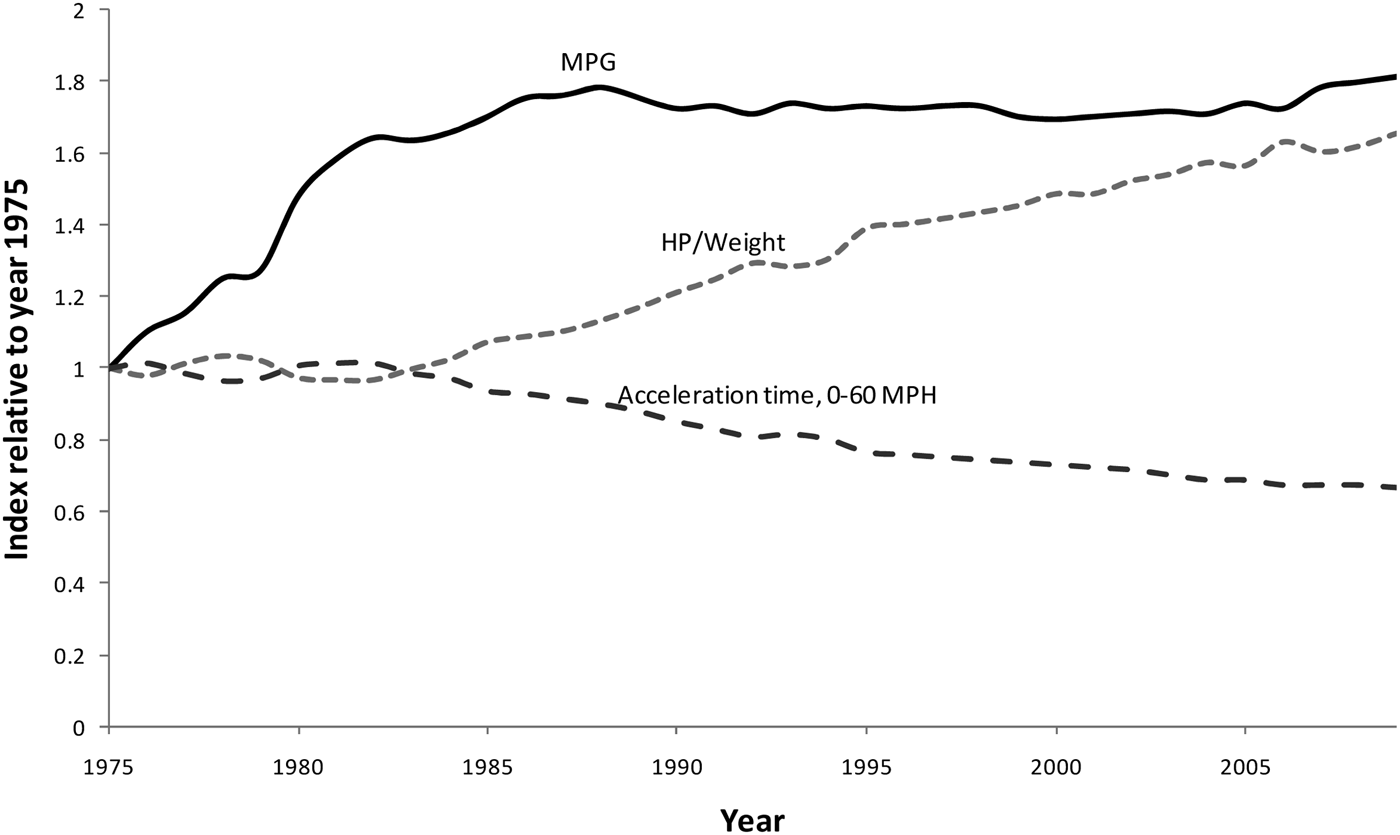
The consequence of this automaker-encouraged-shift was that the number of SUVs rapidly increased, with sales rising from 200,000 a year in 1975 to 3 million a year in 1999.Footnote 64 There was also an increase in non-CAFE 8,500 lb+ passenger vehicles—again a category intended for business vehicles. The result of this shift towards larger vehicles is that, after continual increases since CAFE was introduced, the on-road efficiency of the U.S. fleet began to decline as lower mpg vehicles displaced conventional passenger cars for personal transportation needs. It also saw the major U.S. auto manufacturers become dangerously reliant upon the continued sale of SUVs for their financial health.Footnote 65 From 1988 to 2008, Big Three sales of light trucks went from 38.6 percent of their total sales to 64.7 percent. In contrast, in 2008 38.3 percent of the three main Japanese companies' sales were light trucks (although Toyota's share was higher than the other two). In general, then, the Big Three were pursuing a policy of power, size, and speed, not efficiency. Reflecting this point, the change in the general trends of the average new automobile can be seen in Figure 2, where the impact of CAFE standards through the 1980s (and the lack of change in 1990s and 2000s) can clearly be seen.
MPG (efficiency), horsepower to weight ratio (power), and acceleration time (speed) of new U.S. vehicles since 1975.

Thus, over a long period of time, corporations took production and marketing decisions that materially changed the U.S. vehicle market, the stock of vehicles on American roads and, most importantly, the situation that policymakers would have to deal in putting forward new CAFE standards. These changes were political, in that they changed how society ran, and relied upon decision-making authority—corporate agential visible power—that was freely granted to business within a capitalist democracy.
Discursive Change
While lobbying certainly played a part in the defeat of attempts at CAFE reform, it was made far more effective by the deployment of two specific arguments that have since maintained an enduring appeal in the political battles over CAFE.Footnote 66 The first argument, drawing upon dominant and corporate-empowering neoliberal norms, is that the current market situation is representative of consumer choice and thus, in some ways, democratic. Americans, it was argued, want larger cars with high-performance attributes, as evidenced by the high rate of consumer purchase. CAFE, then, gets characterized as Washington ‘force-feeding’ smaller cars onto an “unwilling marketplace.”Footnote 67 Following this line of argument, no regulation is needed because if consumers wanted higher-mpg cars then they would purchase them and that the marketplace would solve the issue on its own.Footnote 68
The second argument concerned the safety of the policy. This argument is that the easiest way to improve the fuel efficiency of a car is to decrease weight and that a decrease in weight makes cars less safe. The argument, in its various formulations, is built around a few basic premises. First, that instead of improving new technology utilization, one of the main (and cheapest) ways in which automakers complied with CAFE standards was to reduce the weight of cars, which had resulted in a 500 lb average reduction in the weight of cars from 1978 to 1988.Footnote 69 Second, based on basic physics, the occupants of lighter cars are more likely to be injured in a crash as they have less mass to protect them and less space to “ride-down” the deceleration.Footnote 70 As such, CAFE standards, by encouraging the purchase of less-safe vehicles, were responsible for a number of deaths.Footnote 71 Put in a slightly more dramatic fashion by one interviewee, “CAFE is a blood for oil war, and you're fighting it with American civilians.”Footnote 72
Yet, beyond the limited empirical evidence supporting these theoretical arguments,Footnote 73 there are objections to these arguments, which, while well-known, have failed to undermine these arguments or stop their continued deployment in political/policy environments. The major weaknesses in the consumer choice argument come in its simplification of issues and the stripping of real life context in its line of argument. While consumer choice plays a role in the market, it cannot be imputed that consumer market choice represents consumer preferences. The reason for this disjunction is that, at an aggregate level, the market mechanism is a crude communication tool incapable of delivering detailed preference information from buyer to seller.Footnote 74 For example, a single Ford Focus has numerous attributes—color, styling, performance, size—and a consumer, liking one or a combination of these factors, could purchase it for any of these reasons. However, the very act of purchasing only gives the seller the information that the consumer prefers such a particular package of attributes put forward (at a certain price), but not, crucially, information about which attributes. This point has two consequences. First, sellers have only a limited capacity to make substantive changes to the market as the information about desired changes is not communicated. Second, if the capacity of buyers to influence the market is reduced, sellers must have a greater role in market decisions and cannot be assumed to be simply reacting to consumer demand—corporations have much greater autonomy in making marketplace decisions than is assumed. One interviewee from a U.S. auto company put the relationship to consumer desires as “we respond [to] and drive [consumer demand]…sometimes you have to introduce something the market is not necessarily asking for, and it begins to take hold.”Footnote 75
Furthermore, consumer preferences are influenced by a wide variety of things, not least of which is corporate advertising. Advertising “appears to be clear evidence that market elites want to manipulate mass (sic.) rather than simply respond to the preferences signaled by purchases.”Footnote 76 As John Hall (D-NY) said, the car industry spent millions to “advertise such ridiculous things as driving an SUV up to the top of a mountain and playing Frisbee across to another mountaintop, and then showing that this four-wheeler could do that and advertising power…power and speed.”Footnote 77 It is not, then, surprising that consumers either want, or are viewed to want, power and speed. For these reasons combined, the consumer choice argument is fatally flawed when applied to real life situations or when thinking of the market as a form of economic democracy. It did, however, serve the interests of the Big Three to effectively deny their agency in marketplace matters as it painted their objections to CAFE as consumer/citizen objections and their production decisions as consumer choices. In doing so, this discourse also ideationally protected Big Three moves to exploit the SUV loophole and materially alter the foundations of future CAFE changes—this discourse served to protect the visible power machinations of the Big Three in the marketplace.
There are also four problems with the argument about CAFE, down-weighting, and safety. First, the argument is fundamentally based upon the perspective of the person inside the car and not the traffic system as a whole. Larger cars, following exactly the same logic, are, in a collision, more likely to kill those outside of the vehicle due to their greater mass.Footnote 78 Thus, down-weighting may decrease safety for an individual car user, but increase safety for road-users. Second, the argument ignores issues of engineering on several counts. Lighter materials are not necessarily weaker (aluminum compared to steel) and cars are not all equal in their safety features or in their safety design. In fact, larger cars, such as SUVs, are at a substantially greater risk of other issues than head-on collisions. For example, SUVs are at a far greater risk of rolling over when cornering at high speeds, which is common and is the type of accident that has the greatest proportion of fatalities—rendering the feeling of safety in an SUV “illusionary.”Footnote 79 Third, reflecting the previous points, SUV occupants die slightly more often in accidents than car occupants and are three times more likely to kill other drivers.Footnote 80
Fourth, most interestingly, the provenance and foundations of the CAFE safety argument are highly dubious, with corporately-funded think tanks using this argument in their “vitriolic attack[s]” on CAFE standards.Footnote 81 In particular, the Competitive Enterprise Institute (CEI), a think tank whose major funders include GM, the Alliance of Auto Manufacturers, and Ford,Footnote 82 was instrumental in developing and pushing the argument. As a 1994 proposal from the CEI to the tobacco company Phillip MorrisFootnote 83 states:
CEI entered the CAFE debate in 1986, recognizing that economic arguments alone were failing to win the policy debate. CEI raised the argument that CAFE costs not only dollars but lives as well, because it restricts the production of larger more crashworthy cars.Footnote 84
The CEI persuaded Robert Crandall, an economist at the Brookings Institute, to research the issues.Footnote 85 In turn, Crandall persuaded John Graham, a professor of Public Health at Harvard University, to co-author a paper.Footnote 86
Announced by the CEI even prior to its actual publication,Footnote 87 the Journal of Law and Economics published “The Effect of Fuel Economy Standards on Automobile Safety” in 1989. The majority of this paper concerns a quantitative modeling of the impact of CAFE standards on vehicle weight; finding that, according to their model, the average weight of a MY1989 vehicle would be 500lbs less than it would have been in an unregulated market without CAFE. This 500lbs reduction, after being plugged in to the calculations of General Motors' Leonard Evans,Footnote 88 is said to produce “a 14 per cent increase in occupant fatality risk in 1989 cars.”Footnote 89 However, because this increase occurred within the context of greater vehicle safety overall and a reduction of traffic fatalities since the introduction of CAFE (i.e., there were fewer vehicle fatalities after CAFE) they argue that the reduction in fatalities “might have been more dramatic had CAFE not been in effect.”Footnote 90 Overall, they conclude, “we estimate that these 1989 model year cars will be responsible for 2,200–3,900 additional fatalities over the next ten years because of CAFE.”Footnote 91
Central claims of the Crandall-Graham paper, such as “analysts have shown that the ‘downsized’ vehicles of the late 1970s and early 1980s are less safe in crashes than the heavier cars they replaced,”Footnote 92 are referenced using other studies that were funded by industry players (in this case, the single reference for the above quote leads to a conference presentation by two people from the Insurance Industry for Highway Safety, which is funded by the U.S. auto insurance industry).Footnote 93 The CEI proposal, rightly, goes on to state that:
As the only peer-reviewed study on CAFE's safety effects, the Crandall-Graham study came to play a major role [in the] policy debate.Footnote 94
The creation of “academic” research supporting the safety argument has not only affected the policy debate but also subsequent academic research, with GoogleScholar putting the citations of the Crandall-Graham paper at 210. This influence on both the policy and academic debates has also been bolstered by others, most notably the (now) former GM engineer and CEI consultant Leonard Evans—who has worked extensively on the issue and, subsequently, who Public Citizen described as an “industry apologist.”Footnote 95
As such, both of these common arguments suffer severe weaknesses. Yet, despite these weaknesses, the arguments were widely deployed by think tanks and other groups. In particular, the Coalition for Vehicle Choice (CVC) emerged and fought vigorously against CAFE reform using these arguments. One advert for the CVC saw a larger car crushing a smaller car with a voice-over intoning “while smaller cars may save you gas, they could cost you something far more precious.”Footnote 96 Following the lead of the CVC, the Bush Senior Administration started calling a 1991 CAFE reform bill the “Highway Fatality Act” and the “National Highway Death Act.”Footnote 97 Yet, while claiming to be a broad-based grassroots coalition that represents millions of people, the CVC was set up by the PR firm E. Bruce Harrison on a $500,000 grant from the major auto companies and the National Auto Dealers Association; it was an astroturfFootnote 98 group representing industry interests.Footnote 99
While these arguments, bolstered by think tanks and the CVC, helped set the agenda in the short run, over the longer run they moved towards constituting manipulation of a more fundamental kind and became “notions or theses with which one argues but over which there is no argument.”Footnote 100 Over time, these arguments moved from being a short-run use of agential hidden power, through being agential invisible power, to finally increasingly becoming structural invisible power—they moved from focusing attention on certain issues and setting the agenda in the short-term, through being a discourse that automakers used in the medium-term, to constraining thought and having the issues as fundamental starting points of the debate in the long-term. This point is particularly applicable to the safety argument, as the consumer choice discourse already drew on some deep-seated societal ideas and, in general, worked to empower corporations outside of this particular policy area. Yet, this shift from hidden to invisible power was not automatic—it did not necessarily have to occur. Instead, as the following section details, supportive politicians and the automakers sought to embed the discourses within society—particularly within the political arena—in order to continue to protect the Big Three as they continued to make changes in the market. It was a structure that agents clearly erected.
Cementing the Discursive and Material Changes in the Bush Administrations
By 2001, the position of the Big Three was clear: They were against increases to the standards, unless it was in their wider interest. GM Vice President, Thomas Davis, set out the position of his company:
Any reform of CAFE would have to address the significant adverse consequences of the current system, including the disparate impact on domestic [and] foreign automakers…the adverse impact on driver and passenger safety; the opposition to natural market forces; the negative impact on the consumer's choice of vehicle…CAFE cannot be fixed by simply a simple shift in the formula. CAFE is determined primarily by what people choose to buy, and that choice reflects consumer needs.Footnote 101
Yet early on in the George W. Bush presidency, members of the Senate started pushing for CAFE reform; most notably with the McCain-Kerry amendment in 2002, which called for an increase to 36 mpg by 2015.Footnote 102 During Congressional debates on the McCain-Kerry amendment, opponents of CAFE claimed it would increase fatalities by the thousands and would restrict consumer choice, meaning that consumers couldn't get the vehicles—SUVs—that allow them to enjoy their lives. These arguments were supported by advertising campaigns, with the Coalition for Vehicle Choice urging New Hampshire voters to contact their Senator to protect “the endangered SUV and pickup.”
While the McCain-Kerry amendment was defeated, CAFE reform started to draw more attention and political support. As part of broader negotiations on CAFE, a Congressional request was made that the National Academy of Sciences (NAS), alongside the DOT, “recommend, but not to promulgate” new CAFE standards in a report that had to consider the effects of CAFE on “vehicle safety and on effects on employment in the automotive sector and to analyze potentially disparate effects of revised standards across the sector.”Footnote 103 This NAS/DOT report was further endorsed by the National Energy Policy Report (also nicknamed the “Cheney report”). While the Cheney report promoted higher CAFE standards, it stressed that CAFE standards should ensure they work without “negatively impacting the U.S. automotive industry” and required standards be set with due consideration to the then forthcoming NAS/DOT report and that they should be set “analytically and based on sound science.”Footnote 104
Due to both Congressional and Executive approval, the 2002 NAS/DOT study became central to the Bush-era debate on CAFE standards, and would later go on to effect the implementation of policy as well. There were numerous findings in this report, such as that the potential fuel efficiency gains since 1985 have been used by manufacturers to increase performance (which consumers “clearly favor”)Footnote 105 and that technologies exist that could substantially reduce fuel consumption in the fifteen years following 2002. However, one of the most politically-utilized parts of the NAS/DOT study, and reflecting the safety argument documented above, was the conclusion that CAFE “probably resulted in an additional 1,300 to 2,600 traffic fatalities in 1993.” However, all twelve members of the NAS research group were not in agreement and two members produced a minority opinion specifically concerning the safety implications of CAFE, arguing that:
The relationship between fuel economy and highway safety is complex, ambiguous, poorly understood, and not measurable by any known means at the present time. Improving fuel economy could be marginally harmful, beneficial, or have no impact on highway safety. The conclusions of the majority of the committee…are overly simplistic and at least partially incorrect.Footnote 106
Nevertheless, in light of the majority findings, the NAS/DOT report recommended that CAFE is raised,Footnote 107 but is also reformed in line with safety concerns so that the distinction between light truck and passenger car is changed to a sliding attribute-based standard.Footnote 108 That is to say, the distinction between the two vehicle categories would be changed to scale that works on a gradient based upon a certain vehicle characteristic “such as vehicle weight” (i.e., if weight was the attribute, heavier cars would need to have a lower mpg than lighter cars, regardless of class or category).Footnote 109
The study also notes that the 2001/2002 auto market was a “difficult environment for GM, Ford [and Chrysler]”Footnote 110 and, as compliance with the standards would be easier, trading of CAFE credits between manufacturers should be allowed—which would also give the manufacturers greater ability to specialize in the production of certain vehicle classes while fuel economy increases overall. The report was thus recommending that the financial difficulties that the Big Three faced due to their overspecialization in larger vehicles should determine the strength and flexibility of new CAFE standards. Reflecting their agreement with the report, the Alliance of Automobile Manufacturers noted that the NAS/DOT study “confirms the automobile industry's view of CAFE.”Footnote 111 The alignment with industry views is perhaps unsurprising considering that meetings informing the study were vastly weighted toward industry interests (even the astroturf Coalition for Vehicle Choice was including in some of the meetings).Footnote 112
The NAS report's conclusions about safety went on to be utilized as part of the fight against CAFE reforms in the mid-2000s, with Senator Levin (D-MI) saying:
The National Academy of Sciences said – not the American auto industry, not the insurance industry but the National Academy of Sciences – there would have been between 1,300 and 2,600 fewer crash deaths in 1993 had the average weight and size of the light-duty motor vehicle fleet in that year been that of the mid-1970s.Footnote 113
As such, in the debates leading up to the 2005 Energy Policy Act, provisions to increase and reform CAFE were rejected and the final bill did not change CAFE at all.Footnote 114
Throughout this period, as the safety argument became more embedded and with autostate politicians leading the charge against CAFE reform, SUVs and larger vehicle sales continued. From 2001–2007 lighter passenger cars lost ground to SUVs in the U.S. vehicle market. In 2001 passenger cars accounted for 64 percent of the total U.S. vehicle market, by 2007 the percentage had dropped to 55.1 percent.Footnote 115 At the same time, almost exactly mirroring the 9 percent change, truck SUVs went from 6.3 percent to 15.4 percent of the total vehicle market. The remaining vehicle categories, which kept relatively stable through the period, are car SUV (also known as crossovers), pickup trucks, and vans. Of all of these categories, truck SUVs have tended to have the lowest efficiency, meaning that there was a general decline of on-road fuel economy over this period.
So, in the years running up to EISA, and continuing the trends from before the Bush period, the Big Three—and their supporters—managed to defend themselves against CAFE reform in the political arena. At the same time, the Big Three (protected by the consumer choice discourse) worked to embed—both materially and culturally—SUVs and larger vehicles in U.S. society and also helped construct the safety argument as the established politico-scientific viewpoint.
Testing Power: Interest Representation in EISA
A number of mechanisms of influence have been identified in this article. Yet, following the identification of the mechanisms by which an actor can realize their interests, the real test of power is the realization of interests. While the automakers had been very successful in realizing their interests prior to CAFE reform, to what extent did the automakers—the Big Three in particular—realize their interests in EISA? As mentioned above, at a first pass, an analysis of EISA appears to be a defeat for the automakers in that the automakers would have been happiest with “no change at all”Footnote 116 as they wouldn't have to meet higher efficiency standards. However, the interests of auto manufacturers in general, and the interests of the Big Three U.S. manufacturers in particular, were of central concern during the formulation of EISA.
Firstly, with pressure from the White House, EISA narrowed (but was unable to eliminate) the capacity of California and other states to set their own independent fuel economy standards. Because of the Massachusetts decision, the EPA, under provisions of the Clean Air Act, was legally required to regulate CO2 emissions and was required to allow California to set its own standards. However, EISA mandated that NHTSA develop fuel economy standards in consultation with the EPA.Footnote 117 This move further strengthened Executive Order 13432 (the Bush Administration's response to Massachusetts), which required the Department of Energy, DOT (of which NHTSA is a part), and the EPA to co-ordinate their rule-making in the area of vehicle CO2 emissions. The advantages for the automakers of this move were two-fold. First, it kept the issue at federal level, where the automakers have traditionally been more powerful and more able to limit higher fuel economy standards. Second, more pragmatically, all of the automakers supported having to meet national regulations, rather than having to meet several different (and likely higher) state-level regulations.
Secondly, EISA moved to a curved attribute-based standard which allowed a terraced marketFootnote 118 with a no-backslide provision. Instead of operating just on a passenger car/light truck distinction, the fuel economy requirements of each vehicle would also be based on the size of the vehicle. So, for increases in the standards, NHTSA calculates a separate percentage increase for passenger cars and light trucks and then applies it to a footprint curve, with larger vehicles facing a lower absolute fuel economy target but the same percentage increase as the others in its class. In addition, instead of each of the automakers having to meet the fuel economy requirements across their individual fleet as in the EPCA, the fuel economy requirement is applied to the combined national fleet and each automaker only has to meet the requirements within the size-classes that they sell vehicles in.
This move to an attribute-based standard had a differentiated impact on the automakers as a whole, which also impacted on their support for change. The U.S. automakers, with their reliance on larger vehicles, faced lower standards as a result of the move and could further specialize in selling larger vehicles without having to also produce smaller vehicles to balance their CAFE numbers. The three manufacturers originally opposed CAFE increases, but got behind the attribute-based standard. Additionally, Toyota,Footnote 119 with its profitable and developing line of light trucks, joined the Big Three in opposition to new standards, and then supported the attribute standard—moves which drew ire from environmentalists that had previously lauded Toyota's green record. In contrast, Honda, like the majority of Asian-owned manufacturers, while supporting higher CAFE standards, “did not like the switch to attribute standards”Footnote 120 as they concentrated on relatively lighter and more fuel-efficient vehicles and would face higher fuel economy standards due to the change. In contrast, the U.S. automakers were happy, as “GM will not be penalized for making more SUVs and fewer small passenger vehicles than Toyota.”Footnote 121
So, exploiting a loophole in the original legislation, the Big Three manufactured, promoted and sold SUVs and minivans, pushing consumers to buy heavier and faster vehicles at the expense of efficiency. This move was actively supported by arguments that drew upon wider structural invisible power formations within the U.S. that held that consumer choice strongly determines the marketplace—making the market system akin to a democratic system—and, thus, government regulation of consumer choices constitutes an attack on freedom. In this respect, the visible power production decisions of corporations over several decades were not reversed because the hidden/invisible power consumer choice argument held that the production decisions simply reflected consumer demand. Essentially, in EISA, the eventual reform of CAFE standards internalized within the standards the decisions of the Big Three to exploit the “SUV loophole” in the twenty years prior.
Thirdly, the increase in standards represented “exceedingly modest,”Footnote 122 “not that aggressive”Footnote 123 changes. The modesty of these standards can be seen in a comparative context. U.S. standards were already significantly below fuel economy standards in similarly-developed countriesFootnote 124 and, if the 35 mpg by MY2020 provision included in EISA were achieved, U.S. standards would remain below what were currently achieved levels of fuel economy around the world; in 2007 European, Japanese, and Chinese standards were 43.3 mpg, 42.6 mpg and 35.8 mpg respectively.Footnote 125
The standards were watered down during Congressional negotiations. Initial legislation detailing CAFE increases called for a 40 mpg standard to be reached ten years after enactment.Footnote 126 As the legislation progressed, within the Senate a “compromise” of 35 mpg by 2020 and a 4 percent increase until MY2030 emerged.Footnote 127 However, in the final legislation (after the House had passed an energy bill containing no mention of CAFE) this requirement was further diluted by the stripping of the annual 4 percent improvement from MY2021 through to MY2030 and leaving it as the “maximum feasible” as understood by NHTSA. Put another way, an increase to 56 mpg by 2030 would have been required by law, but was instead left open and subject to later regulation.Footnote 128 So, while the end result was not as low as the 32–35 mpg by 2022 in the Big Three-supported Hill-Terry bill, it was significantly lower, and more flexible, than what was potentially on the table. Senator Debbie Stabenow (D-MI) noted the role of Michigan politicians in the resulting compromise, saying “I want to praise Congressman John Dingell and Senator Carl Levin for their great work in improving this legislation during House and Senate consideration.”Footnote 129 Structural power, then, played a role in securing Big Three interests in EISA, but on a very local scale as auto-state politicians viewed what's good for the auto companies as what's good for their state. An interviewee reflected this point “I wouldn't say [EISA] was partisan, because they did get a significant number of Republicans to vote for it. I think a lot of it comes down to where you're from and how much of a stake in the auto industry you had at the time.”Footnote 130
Beyond the intervention of auto-state politicians, one of the primary reasons for these modest standards was the acceptance of the safety argument as legitimate “scientific” discourse. While initially resisted in the early 1990s by proponents of CAFE increases, by 2002 the argument had become the accepted and official (in the form of the NAS/DOT report) science. By 2007 even the proponents of CAFE increases had to at least include a nod to the issue in proposed changes, with three potential CAFE bills from Senators Durbin, Lugar, and Obama (the former two being very longstanding proponents of CAFE reform) each containing a provision that would allow NHTSA to reduce the CAFE standard if the standard would have led to a reduction in safety.Footnote 131 The move to a terraced market was also justified by the safety argument, as a terraced market meant that smaller/lighter cars were not favored by the regulations (unlike, it was argued, the previous structure of CAFE) and so the logic of the argument did not apply in that a terraced market would not incentivize the production of smaller vehicles—an argument which was originally outlined in the 2002 NAS/DOT report. Furthermore, when it came to implementation by NHTSA, this idea was also present, with a senior NHTSA interviewee confirming NHTSA's view that “there are tradeoffs, obviously, between fuel economy and safety.”Footnote 132 In this way, what started as an attempt to change the terms of the debate became an accepted fact; corporate manipulations changed “common sense” (or “sound science,” another dubious discourse) over time. Hence, corporate hidden power transformed into agential corporate invisible power and served to limit potential increases in fuel efficiency for fear of jeopardizing safety.
Finally, EISA included compensatory measures for the U.S. auto industry. The main compensatory measure authorized by EISA were $25 billion worth of low-interest loans that were made available to the auto industry.Footnote 133 Viewed by many as a bailout, at the time these loans represented the “largest government subsidy for the auto industry since the [1980s] Chrysler bailout”Footnote 134 and were designed, by including a provision for the refurbishment of facilities over twenty years old, “to keep out [the] Japanese.Footnote 135 ” EISA also included grants for next-generation vehicle technology, for the domestic manufacture of hybrid vehicles, for research into improvements to battery technology and for the electrification of automobiles.
These compensatory measures were secured following further work led by Michigan Congressmen and also general lobbying from the auto companies.Footnote 136 During 2007, GM spent $14.2 million, Ford $7.1 million, and the Alliance of Automobile Manufacturers $12.8 millionFootnote 137 on lobbying in the United States.Footnote 138 A number of the lobbyists hired with this money had previously worked as staffers for still standing U.S. Congressmen and women; they had been through the revolving door. In total, and over all issue areas in 2007, fifty out of fifty-nine lobbyists used by Ford, and seventy out of one hundred and four lobbyists used by GM were classified as having passed through the revolving door by the Center for Responsive Politics. In contrast to the automakers lobbying, in the first six months of 2007 “the total spending for the Sierra Club, Public Citizen, the Union of Concerned Scientists, and other organizations that lobbied for tougher standards was…$917,108,Footnote 139 ” which includes money spent lobbying on other bills.
In essence, in 2007, after twenty-seven years of deferment, CAFE reform was “politically unstoppable”Footnote 140 because the political atmosphere had shifted due to a new Democrat majority, continually rising oil prices, and pressure from various political actors. However, the Big Three had managed to embed their interests into the material and ideational status quo during the period of deferment, which made substantial unfavorable change highly unlikely. It was further made unlikely by their lobbying push, supportive auto state politicians and use of astroturf groups. So, when reform eventually came, the changes were mitigated by the long-term interests of the Big Three in that a national standard was implemented, a terraced market was allowed, the standards were not as high as they could have been and compensatory measures were brought in specifically for U.S. automakers. Additionally, while not favored by the changes, major Japanese automakers were not significantly hurt. Due to their greater focus on smaller vehicles, they faced a higher CAFE number—estimated at 38 mpg for Honda (the most efficient), compared to 32 mpg for Chrysler (the least)Footnote 141 —but the lower overall standard limited the potential impact of this change. They also benefitted from the move to a national standard and were not harmed by being locked out of compensatory measures because they did not face the major financial difficulties the Big Three did. Japanese automakers also had a home government that could support them if needed.
Overall, while EISA was not their ideal outcome, in the face of staunch opposition, the Big Three were able to realize/continue to realize many of their core interests, and be compensated for changes to the status quo. Reflecting these points, Dave McCurdy, President and CEO of the Alliance of Automobile Manufacturers (and former Congressman), expressed the satisfaction of the auto industry with EISA in saying “we believe this tough, national fuel economy bill will be good for both consumers and energy security.Footnote 142 ” Similarly, an interviewee from one of the Big Three indicated that they had “quite” supported EISA, but added that “Do we support a fuel economy bill? No, we're not suicidal.”Footnote 143
However, while the U.S. automakers broadly realized their interests in EISA, it did come at the cost of losing a favorable legislative battleground in that EISA granted the Secretary of Transport (i.e., the president) the power to reform CAFE standards without further Congressional approval, which was the major sticking point of CAFE reform previously. While in itself the movement of the battleground may not have been majorly significant for the automakers, the Big Three faced a perfect storm shortly after EISA, elements of which had been brewing for a long time. The 2008 bailout of GM and Chrysler, which was caused by a combination of the over-reliance on light trucks, foreign competition, high oil prices, and a slackening of demand caused by the global financial crisis (sales hit a sixteen-year low in 2008, hitting the Big Three hardest) served to weaken the bargaining position of the automakers with the government and also undermined the usual assumption of corporate economic expertise that normally gave weight to their pronouncements of what the market wants.
This perfect storm weakened the U.S. automakers sufficiently that Obama was able to push forward a 54.5 mpg by 2025 standard. However, while significant, this change is much less significant than was made apparent in headlines. The actual standards are 40.1 mpg by 2021, followed by a new rule making (presented as a “mid-term review”) currently proposed as a standard of 49.6 mpg by 2025. The missing 5 mpg is caused by the conversion of EPA's greenhouse gas standards, which included the impact of reducing air conditioning leaks, to fuel economy standards. Furthermore, the fuel economy increase applied to the curve for passenger cars between 2017–2021 is 4.1 percent, but 2.9 percent for light trucks (i.e., the increase is greater for passenger cars than for light trucks, thereby primarily favoring the Big Three).Footnote 144
So, even in spite of situations heavily weakening the Big Three and the movement to a less-favorable battleground, new regulations made special provisions for them and appeared to hit harder than is the reality. Additionally, following the move to a terraced market in EISA, the overall realized fuel economy will fundamentally depend on the footprint of vehicles bought, which will likely depend on the price of oil. Should the price of oil stabilize at a relatively low price, we are likely to see an increase in footprint size and a decrease in realized fuel economy that, due to the changes documented above, are still in line with the CAFE standards. In other words, the outcome of the new standards is much more subject to automaker production decisions and (somewhat manufactured) market demands.
Conclusions
The story of CAFE reform is one of many traditional mechanisms of influence on the political arena—lobbying, structural power, and political skullduggery. Yet, focusing upon only these manifestations of corporate power—as the majority of interest group and business power literature does—leaves an incomplete account of the influence of the Big Three and gives a weaker understanding of the extent to which they were able to realize their interests in policy outputs and outcomes. Corporate material and discursive change played a crucial role in altering both the economic baseline and political reality in a manner that secured the interests of the Big Three when CAFE reform came in the form of EISA. In power terms, the long-term use of visible and hidden power managed to fundamentally alter the status quo and provide a structural, invisible power defense of the new societal/political structures, which were then absorbed in EISA and thereby legitimized in formal policy output.
In terms of the approach used in this article, the findings of this case study show two main benefits of this approach for understanding business power over narrower approaches focused on policy-making and the political arena. Firstly, this article folded in a discussion of changes in the economic sphere produced through corporate-consumer relations, explaining the changes as both political in and of themselves and as constituting important changes to how policy would be made. The approach, then, ensures that power is not judged on the extent to which the policy battle is won or lost, but on the longer term realization of interests; on societal outputs, rather than formal political outcomes. Secondly, the framework of this article provides a conceptual language—sorely missing from the contemporary literature—that does not privilege agency over structure, nor privilege a material/institutional understanding of power over a discursive account. It is an approach, in sum, that builds upon many important insights within both the power and the business power literatures and which takes the methodological consequences of such insights seriously, rather than following disciplinary cleavages and relying upon distortionary disciplinary assumptions about both how, and where, power operates that can obscure as much as they reveal.