Subclinical infection of the mammary gland is considered a main source of financial loss in the sheep and goat dairy industry owing to the low quality of the milk produced as well as the decreased milk production. It is important for the veterinary practitioner to have available a fast and reliable diagnostic test for the early and accurate detection of subclinical mastitis. Different methods, other than bacterial culture, have been suggested for the detection of subclinical mastitis, such as somatic cell count (SCC) and California mastitis test (CMT). SCC is a common method for the detection of subclinical intramammary infections (IMI) but should be combined with bacterial culture because other factors such as breed, parity, stage of lactation and oestrus contribute to significant variations in SCC in dairy sheep and goats (reviewed by Raynal-Ljutovac et al. Reference Raynal-Ljutovac, Pirisi, de Cremoux and Gonzalo2007; Christodoulopoulos et al. Reference Christodoulopoulos, Solomakos, Katsoulos, Minas and Kritas2008). CMT has been standardized for cow milk and is less accurate for sheep and goats. Furthermore, it is a subjective test and its capability to predict ovine IMI depends on the prevalence and the agents of IMI in the flock (Keisler et al. Reference Keisler, Andrew and Moffat1992).
It has been reported that the activities of lactate dehydrogenase (LDH) and alkaline phosphatase (ALP) in milk significantly increase in cases of subclinical IMI in dairy sheep (Batavani et al. Reference Batavani, Mortaz, Falahian and Dawoodi2003) and cows (Babaei et al. Reference Babaei, Mansouri-Najand, Molaei, Kheradmand and Sharifan2007) while the activity of aspartate aminotransferase (AST) is not significantly altered. In the study conducted on dairy cows, ALP activity in milk was identified as the most reliable indicator among the enzymes tested for the diagnosis of subclinical mastitis (Babaei et al. Reference Babaei, Mansouri-Najand, Molaei, Kheradmand and Sharifan2007). Activities of LDH, ALP and AST have not been evaluated during IMI infections in goats and have not been tested as indicators for the diagnosis of subclinical IMI in dairy sheep and goats. The objective of the present study was to investigate changes occurring in the activities of the enzymes LDH, ALP and AST in sheep and goat milk as a result of subclinical IMI, and to evaluate the use of these enzyme activities for the diagnosis of subclinical IMI in dairy sheep and goats.
Materials and Methods
Milk samples
A total of 206 samples of sheep milk and 162 samples of goat milk were obtained from equal udder halves. Only one udder half from each animal was sampled and no animal was sampled more than once in the study. Milk samples were collected before the morning milking. Animals were restrained in the milking parlour and the selected udder half was examined by palpation for the presence of swelling, oedema or pain. The teat end was scrubbed thoroughly using cotton wool soaked in 70% ethanol. The first three streaks were milked onto a black plastic disk and the milk was examined macroscopically for the presence of clots or changes in appearance. The teat end was disinfected again as described above and about 20 ml of milk was collected in two sterile tubes held horizontally. Both samples were transported as soon as possible, under cold conditions, to the laboratory for immediately testing. The first sample was used for bacteriological examination and the other one for the determination of milk enzymes.
Bacteriological examination
For the bacteriological determination, 10 μl of milk taken by a calibrated loop was streaked aseptically on blood agar (5% sheep blood) as well as on McConkey's agar. Both Petri dishes were incubated aerobically at 37°C for 48 h. Cultured bacteria were identified on the basis of Gram stain, colony morphology, type of haemolysis and from the results of biochemical tests including Voges-Poskauer, indole, oxidase, hippurate and aesculin hydrolysis, tube coagulase, catalase and CAMP tests. Additionally, all the milk samples were cultured for the presence of Mycoplasma spp. The analyses were conducted using PPLO medium (agar and broth). Twenty microlitres of milk was spread onto the surface of agar plates, and 40 μl was inoculated into a tube containing 2 ml of broth and incubated at 37°C for 48 h in a 5% CO2-enriched atmosphere. After incubation, 20 μl was spread onto agar plates and another 20 μl was inoculated into a new broth. Three successive passages from liquid to solid medium, and from liquid to liquid medium, were carried out and all plates were incubated in the same conditions over a period of 10 d and examined daily for the presence of mycoplasmas before considering the culture as negative. A milk sample was considered to be collected from an infected udder-half when it yielded at least one colony of a pathogen that could produce primary mammary infections or occasional causes of mastitis (Filioussis et al. Reference Filioussis, Christodoulopoulos, Thatcher, Petridou and Bourtzi-Chatzopoulou2007).
Biochemical analysis
Before the biochemical analysis all milk samples were centrifuged at 15 000 g at 4°C for 30 min; the milk serum (middle layer) was separated and transferred to plastic vials for the analysis. Milk serum activities of AST, LDH and ALP were determined spectrophotometrically using the enzymic kinetic methods of Thefeld et al. (Reference Thefeld, Hoffmeister, Busch, Koller and Vollmar1974), Witt & Trendelenburg (Reference Witt and Trendelenburg1982) and Schlebusch et al. (Reference Schlebusch, Rick, Lang and Knedel1974), respectively.
Experimental design
For each species, according to the results of the bacteriological and udder examination as well as of the appearance of the milk, the samples were divided into two groups: a no-infection group consisted of milk samples accrued from udder halves without clinical abnormalities, with apparently normal milk that was bacteriologically negative. A subclinical infection group consisted of milk samples obtained from udder halves without clinical abnormalities, with apparently normal milk that was bacteriologically positive. Finally, 109 sheep samples were assigned to the no-infection group and 97 to the subclinical infection group. Similarly, 108 goat samples were assigned to the no-infection group and 54 to the subclinical infection group.
Statistical analysis
The optimal cut-off value for the activity of each one of the enzymes evaluated, yielding the highest sum of diagnostic sensitivity (DSn) and diagnostic specificity (DSp), the area under the curve (AUC, an indicator of test accuracy) and its 95% confidence interval (CI) were determined by receiver operating characteristic (ROC) analysis using MedCalc Version 9.0 (Schoonjans et al. Reference Schoonjans, Zalata, Depuydt and Comhaize1995). The normality of the data was tested with the Kolmogorov-Smirnov test and Student's t test was run to determine the significance of the differences in the milk enzyme activities among groups. A significance level of P⩽0·05 was used for all comparisons.
Results
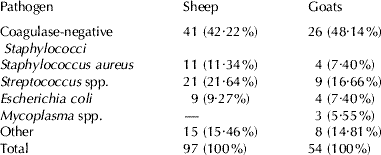
The bacteria isolated from the udder halves of the subclinical infection groups in sheep and goats are presented in Table 1. Milk serum activities of LDH, ALP and AST in sheep and goats are presented in Table 2. In both sheep and goats, the activities of these enzymes were significantly higher in the subclinical infection group than in the no-infection group (P<0·05).
Frequency of isolation of different types of microorganisms from subclinically infected udder-halves in sheep (n=97) and goats (n=54)

Mean values with se for milk serum lactate dehydrogenase (LDH), alkaline phosphatase (ALP) and aspartate aminotransferase (AST) activities (U/l) in milk samples obtained from uninfected (no-infection) and subclinically infected (subclinical infection) udder halves in dairy sheep and goats

a,b,c Values within a row and within a species with different superscript letters are different (P<0·05)
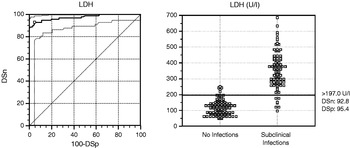
In sheep the optimum cut-off point for LDH activity for the diagnosis of subclinical IMI was determined at 197 U/l. The corresponding value of DSn and DSp for this cut-off point was 92·8% and 95·4%, respectively (AUC 0·975, 95% CI: 0·943–0·992; Fig. 1). The optimum cut-off point for ALP was determined at 2208 U/l, with DSn and DSp 76·3% and 51·4%, respectively (AUC 0·654, 95% CI: 0·584–0·718) and for AST at 21 U/l with DSn and DSp 88·7% and 79·8%, respectively (AUC 0·925, 95% CI: 0·880–0·957).
Receiver operating characteristic (ROC) analysis curve and dot diagram for lactae dehydrogenase (LDH) activity in milk serum from 109 milk samples obtained from sheep udder-halves without infection (no infections) and 97 milk samples obtained from subclinically infected udder-halves (subclinical infections). DSn is diagnostic sensitivity; DSp is diagnostic specificity.

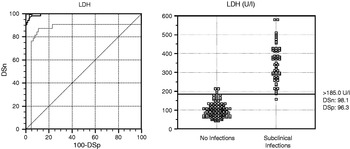
In goats the optimum cut-off point for LDH activity was determined at 185 U/l. Using this cut-off point, DSn and DSp was 98·2% and 96·3%, respectively (AUC 0·996, 95% CI: 0·970–0·999; Fig. 2). The optimum cut-off point for ALP was set at 149 U/l, with DSn and DSp 85·2% and 86·1%, respectively (AUC 0·886, 95% CI: 0·827–0·931), and for AST at 19 U/l with DSn and DSp 90·7% and 80·6%, respectively (AUC 0·942, 95% CI: 0·894–0·972).
Receiver operating characteristic (ROC) analysis curve and dot diagram for lactate dehydrogenase (LDH) activity in milk serum from 108 goat milk samples obtained from udder-halves without infection (no infections) and 54 goat milk samples obtained from subclinically infected udder-halves (subclinical infections). DSn is diagnostic sensitivity; DSp is diagnostic specificity.

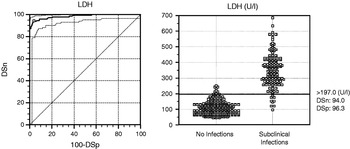
When sheep and goat milk sera were evaluated together, the optimum cut-off point for LDH activity for the detection of subclinical IMI was set at 197 U/l. DSn and DSp at this cut-off point was 94·0% and 96·3%, respectively (AUC 0·985, 95% CI: 0·966–0·994; Fig. 3). The optimum cut-off point for ALP was determined at 149 U/l, with DSn and DSp 95·3% and 42·9%, respectively (AUC 0·693, 95% CI: 0·643–0·740), and for AST at 21 U/l with DSn and DSp 85·3% and 83·4%, respectively (AUC 0·934, 95% CI: 0·903–0·957).
Receiver operating characteristic (ROC) analysis curve and dot diagram for lactate dehydrogenase (LDH) activity in milk serum from 217 sheep and goat milk samples obtained from udder-halves without infection (no infections) and 151 sheep and goat milk samples obtained from subclinically infected udder-halves (subclinical infections). DSn is diagnostic sensitivity; DSp is diagnostic specificity.

Discussion
The present study aimed to investigate changes occurring in the activities of the enzymes LDH, ALP and AST in sheep and goat milk as a result of subclinical IMI and to evaluate the use of these enzymes for the diagnosis of subclinical IMI in dairy sheep and goats. Few data are available for the origin of the enzymes in mastitic milk. Although the exact origin of increased ALP activity in mastitic milk has not yet been determined, Batavani et al. (Reference Batavani, Mortaz, Falahian and Dawoodi2003) suggested that LDH is probably liberated from udder parenchymal cells and from disintegrated leucocytes; AST is believed to be liberated from the damaged mammary glad secretory cells during the inflammation process (Batavani et al. Reference Batavani, Mortaz, Falahian and Dawoodi2003).
Evidence in the literature indicates a possible interdependence on the immune response between infected and non-infected udder halves or quarters in dairy goats (Maisi & Riipinen, Reference Maisi and Riipinen1988) and cows (Merle et al. Reference Merle, Schroder and Hamann2007). Although such a condition has not been established for sheep, it was decided to sample only one udder-half from each animal and to use only the bacteriological tests as the gold standard for the diagnosis of subclinical IMI in order to eliminate false results that could arise if the interdependence between udder-halves truly exists in these species.
In the present study, it was shown that subclinical IMI infections are associated with increased activities of all three enzymes in milk serum in both species. In accordance with these results, higher LDH and ALP activities in milk of subclinical mastitic udders than in normal milk have been reported in dairy sheep (Batavani et al. Reference Batavani, Mortaz, Falahian and Dawoodi2003) and cows (Babaei et al. Reference Babaei, Mansouri-Najand, Molaei, Kheradmand and Sharifan2007). In contrast, in a study in dairy sheep, milk AST activity was not significantly different between normal and subclinically infected udders (Batavani et al. Reference Batavani, Mortaz, Falahian and Dawoodi2003). However, the definition used for subclinical mastitis was different and the number of samples examined was smaller than in the present study.
When making clinical decisions, the fundamental question is whether the determination of LDH, ALP and AST activities in milk can reliably indicate the presence of subclinical IMI. According to the results of the ROC analysis in this study, LDH activity was identified as the most reliable indicator for the detection of subclinical IMI among the enzymes evaluated. Using the proposed cut-off points of 197 U/l for sheep, 185 U/l for goats and 197 U/l for both sheep and goats, the diagnostic sensitivities and the specificities were higher than 92%. Similar studies have not been conducted in either sheep or goats but in dairy cows ALP was shown to be a more sensitive and reliable indicator of subclinical mastitis than LDH; however, the specificity for ALP was low at the proposed thresholds (Babaei et al. Reference Babaei, Mansouri-Najand, Molaei, Kheradmand and Sharifan2007). High sensitivity and low specificity were observed for ALP in the present study as well when both sheep and goats milk sera were evaluated together, but when tested separately for each species the diagnostic sensitivities were less than 85% at the proposed cut-off points.
Until now, the detection of subclinical IMI has been based only on bacteriological examination of the milk. The present results provide the first evidence that the determination of LDH activity in milk serum is effective for the detection of subclinically infected udder halves in dairy sheep and goats. However, the proposed cut-off points refer to the laboratory method used in the present study and the establishment of appropriate thresholds is necessary when different methods are used.