We would like to begin this paper by acknowledging that we wrote it on Awabakal land. In 2010, the authors undertook a pilot project to examine the ways in which the discipline of English at the University of Newcastle could incorporate Indigenous knowledges and perspectives into its research and teaching practices. By developing best practice exemplars derived from national and international pedagogy, and then disseminating them to academic staff within the discipline to build capacity, the project aimed to open a space where Indigenous knowledges and experiences were acknowledged and respected, where Indigenous research and methodologies were supported and where staff and students could respond to the challenges of a post-Apology Australia. Extensive research into best practice in Indigenisation across the humanities was conducted, and two English courses were reconceptualised based on the findings. In this paper, we argue that the process of indigenising the discipline of English needs to first focus on different levels of Indigenisation, to second specifically link content material and approach with Indigenous ways of knowing and knowledges, and to cumulatively have an impact on the way both teachers and students see the world. That is, Indigenisation engages not only with course content and pedagogical approaches, but also with educational, professional and personal purposes. To do this, theoretical paradigms about knowledge legitimacy and cultural knowledge must be engaged to further and maintain staff dialogue about the need to indigenise our discipline, in theory and practice. Indigenisation is a complex process, one which potentially reinforces colonial practices and perspectives, and as such this paper argues that it can only be addressed through multiple, contingent approaches, specific to context.
While the attempts to indigenise the discipline were challenging and at times confrontational for the authors of this paper, writing up this process has also proven to be problematic at times. In Aboriginal ways of knowing, being and doing, caring for country is carried out according to the appropriate seasonal times. This paper attempts to articulate the climate in which our attempts to indigenise the discipline occurred and is occurring. In an effort to do so, we wrote this paper with a dual approach: it maintains a Western-framed structure but also draws from Payi Linda Ford Rak Mak Mak Marranunggu's (Reference Ford2010) Tyikim metaphorical methodology as outlined in Aboriginal Knowledge Narratives and Country: Marri Kunkimba Putj Putj Marrideyan. Our understanding of our current attempts to indigenise the discipline of English is framed by the metaphor ‘burning off’ of country. By ‘burning off’, the central pedagogical philosophy and purpose employed in our ‘indigenised’ mainstream English course is to clean up the landscape so that new, transformative possibilities might grow. This dual approach follows Martin Nakata's argument that there needs to be a reconceptualisation of the intersections between Indigenous and Western knowledge systems, a retheorising that allows for better ways to negotiate them:
To live on the land is to know and understand the tropical wetlands in all its seasons and moods. It sounds so simple. It's not simple! We have strived through many thousands of years in this country and its landscapes through our knowledge and the narratives we carry with us. Similarly for Tyikim people to survive in the ‘country and landscapes’ of Australian higher education we need to be able to draw on Tyikim cultural knowledge in order to create new meanings or understandings that resonate with what we already know and value. To put these Tyikim cultural elements of practice and theory into a Indigenous Higher Education context requires milityins who possess the cultural skills and knowledge of both Tyikim and Padacoot cultures and who are capable of ‘hunting and gathering’ across the interface.’ (Ford, Reference Ford2010, p. 27)
An interface that is currrently on fire, so to speak. We have attempted to set alight the ability of Western paradigms to strangle Indigenous growth, yet we do not know how the blaze will burn at this seasonal time. Nakata (Reference Nakata2006) believes sophisticated analysis, higher order skills and Indigenous scholarship are needed for ‘a negotiation of meanings and purposes between Indigenous and non-Indigenous contexts’ (Reference Nakata2006, p. 273). For Nakata, while this is risky and challenging because it signifies a new generation of knowledge, it is also generative because it creates knowledge landscapes that centre narratives of survival rather than narratives of cultural loss. He argues that ‘in formal education contexts, then, the consideration of Indigenous knowledge, standpoints or perspectives, at whatever level we want to consider them, should be primarily about bringing them into conversation with knowledge in the traditional disciplines in order to negotiate a new set of meanings and reinterpretation of meanings’ (Nakata, Reference Nakata2006, p. 273).
The catalyst for our project arose from the challenges one of the authors encountered when teaching a course on contemporary Australian literature. As an academic with Indigenous heritage, who had been trained in decolonising methodologies and pedagogies, a secondment from the Aboriginal school to the more mainstream English department meant the course was predominantly taken by non-Indigenous, White, Australian students who struggled with the centring of Indigenous texts and perspectives. As a result of the fierce, and at times, confrontational, student body, the academic asked to be removed from teaching the course. In an effort of support, the other author as the then Discipline Convenor for English undertook the project to indigenise the discipline with her, as a local response to what Alison Findlay identifies as ‘practices that continue to produce Indigenous academic “homelessness”’ (Reference Findlay2000, p. 312). The limited success of existing individual approaches to Indigenisation within the discipline indicated the need for a concerted approach, linked to sustainable solutions and implemented across the discipline. However, this was not without its problems, as the process of Indigenisation in English involved a shift in often entrenched perceptions and disciplinary practices for both staff and students. Hence, our pedagogical burn-off encompassed course content and assessment, staff and student perceptions and awareness of Indigenous peoples and knowledges, as well as a reconsideration of the assumptions underlying the discipline of English itself.
English emerged as an academic subject in the nineteenth century as a supplement to religion, and was seen not only to ‘delight and instruct’ in the early modern sense but also to operate as a moral force that used aesthetic values to build empathy, enlarge experience and inculcate the reader with middle-class values. Disseminated through institutions such as Mechanics Institutes rather than universities, it was established as a university discipline only after the World War I in the 1930s, where it newly obtained a cultural centrality. As Terry Eagleton comments:
English was an arena in which the most fundamental questions of human existence – what it meant to be a person, to engage in significant relationships with others, to live from the vital centre of the most essential values – were thrown into vivid relief and made the object of the most intensive scrutiny. (Eagleton, Reference Eagleton1983, p. 27)
The discipline was dominated in its first decades by the aesthetic values of new criticism, and incorporated from the 1960s onward a range of political and historical movements that sought to situate aestheticism in historical, political and social contexts. This tension between the aesthetic and historical, together with a residual impulse towards literature as a kind of crucible for heightened experience, all inform what a discipline of English imagines itself to do when it teaches English. The introduction of Indigenisation as a concept into this mix both speaks to some aspects of the discipline, particularly its foundational concepts interrogating the human and generating empathy, and challenges others. On one level, the discipline can lend itself to Indigenous knowledges and perspectives through the inclusion of Indigenous texts and the discussion of related historical events as textual context. Yet it is also ‘deeply implicated in forms of internal and external colonization’ (Findlay, Reference Findlay2000, p. 167). Findlay calls to ‘always indigenise’ because the humanities are integral to processes of decolonization and argues that the discipline of English needs to centre ‘new alliances between English literary studies and Indigenous studies’ (Reference Findlay2000, p. 367). The intersection between literary studies and colonization, the links between imperialism and the teaching of English (Graff, Reference Graff2008; McGee, Reference McGee, McCarthy and Crichlow1993; Viswanathan, Reference Viswanathan1989) continue to be recognised as ‘an unconscious aspect of our education’ (Willinsky, Reference Willinsky, Barrell, Hammett, Mayher and Pradl2004, p. 3). However, Srivastava argues that ‘the often-unquestioned and rarely contested hierarchies and relations of power in the university or college’ (Reference Srivastava1995, p. 12–13) means that study of literature needs to be challenged and reconceptualised further. For us, this is where Indigenisation continues to be worked through and negotiated, so that the ‘Western academic mind-set of catering for cultural difference within the established mainstream curricula; a curricula mediated into existence through imperialistic and colonising ideological forces’ (Ford, Reference Ford2010, p. 90) does not once again appropriate Indigenous knowledges and ways of knowing. Instead, our hope is to burn off the landscape of knowledge to allow fresh growth, a reinterpretation and new sets of meanings.
As part of this process, our strategies in this project were to survey Indigenisation practices across the sector, to map the ways in which Indigenisation was already at work in our discipline, to consider if these practices were sufficient to constitute meaningful Indigenisation, and to devise new ways of indigenising that might work to transform our ideas of Indigenisation in the discipline of English. All this was part of our burning off: a controlled clearing away of long-held disciplinary assumptions to allow the fresh shoots of a new, indigenised discipline to emerge.
Preparing for the Burn-off: National Strategies of Indigenisation
Our first step in this project was to survey the approaches of others to the challenge of Indigenisation across disciplines at a national level, employing Baktygul Ismailova's definition of indigenisation as ‘a political, social and cultural process, which emerges as a response to long-term domination, neglect and denigration’ (Reference Ismailova2004, p. 247). The majority of responses to Indigenisation in an Australian context identify a problem of mindset within their disciplines: an inherent assumption of whiteness whereby Western culture is perceived to be normative. For some critics, identifying this assumption is the starting point of their indigenising processes. Janet Ransley and Elena Marchetti note that in relation to the Australian legal system, while a position of authority for an underlying whiteness is claimed within legal institutions, it is not ‘seen’ by those claiming it (Reference Ransley and Marchetti2001, p. 142). Noting that a range of international precedents available in an American context provide specific strategies for addressing an entrenched and systemic institutional ‘whiteness’, Ransley and Marchetti suggest a new inclusive approach be adopted by the Australian legal system. In a related approach in the discipline of visual arts, Sonia Smallacombe investigates disciplinary appropriation practices to show the specific ways in which such inclusiveness is acquired matter. She argues that the visual arts appropriate certain aspects of Indigenous culture as a way of reinforcing a seemingly inclusive Australian national identity, but one predicated from the outset by its underlying whiteness (2000, p. 154). If the knowledge of Indigenous cultures (rather than Indigenous knowledges) is sought as an add-on to Western knowledges, the result is an aestheticisation of Indigenous Australia, where only certain aspects of that culture are acceptable to the Western viewpoint or Australian nation (2000, p. 155). Within this disciplinary framework, fixed constructions of Indigenous culture were generated by the academy for non-Aboriginal Australians, and rarely included Aboriginal voices or a diversity of Indigenous experiences (2000, p. 156). Smallacombe rejects the focus on fitting Indigenous knowledges into Western conceptual frameworks, and advocates ‘that our systems and concepts should guide the debate’ (2000, p. 161).
A second group of critics focus on the impact of leaving an underlying whiteness unexamined within disciplines for Indigenous students. Christopher Sonn, Brian Bishop and Ross Humphries undertook a qualitative study at Curtin University of Technology of the experience of 34 Indigenous students in mainstream higher education. Three core themes emerged as having a negative impact on their participation: relocation and settlement to attend a course, overt racism and, finally, a form of subtle racism perceived to derive from cultural insensitivity (Reference Sonn, Bishop and Humphries2000, pp. 8–13). Perhaps surprisingly, participants were most likely to perceive disciplines in the social sciences as ‘insensitive and ethnocentric’ (Reference Sonn, Bishop and Humphries2000, p. 11). The researchers found that terms such as ‘cultural sensitivity’ were in fact part of the problem, as in an Australian context such phrases were predicated on an unquestioned assumption that the dominant perspective and culture was White (Reference Sonn, Bishop and Humphries2000, p. 12). Sonn, Bishop and Humphries advocate an embrace of cultural diversity, including acknowledging Indigenous diversity, as a means of replacing a superficial approach to Indigenisation characterised as ‘cultural sensitivity’ with one that recognises the depths of cultural difference (Reference Sonn, Bishop and Humphries2000, pp. 15–6). The mainstream in particular is seen to need to detect and change hidden structures of exclusion, as it is these mainstream norms and the invisible structures maintaining social inequality that impact most on Indigenous students’ ability to participate in tertiary education (Sonn, Bishop and Humphries, Reference Sonn, Bishop and Humphries2000, p. 12). In sharp contrast, a 2005 report on Indigenous legal education initiatives at UNSW does not specify such cultural alienation as a problem for Indigenous students, although it identifies a general alienation that might be addressed through recruiting a larger cohort of Indigenous law students (Brennan et al., 2004, p. 27). Instead, it concentrates on a set of practical strategies to increase Indigenous students’ chances of admission to law programs, including a prelaw program and different admission criteria. It also provides the means to support those students in the first year of their enrolment, with targeted subjects for Indigenous students and peer-mentoring, pastoral care and book loan schemes.
While much of the literature in the national context identifies the problem of hidden dominant group biases and can record its impact, some examples do exist where Indigenisation strategies have been embedded within specific disciplinary frameworks in order to begin to implement widespread social change within the academy. At Queensland University of Technology, Hart and Moore (Reference Hart and Moore2005) piloted embedding Indigenous content in two Australian studies units, underpinned by Homi Bhabha's ideas of hybridity and the ‘third space’, including a teaching approach that encouraged students to reflect upon their own identity and their views of society, culture and ethnicity from an Indigenous perspective. Their project involved collaboration between an Indigenous and a non-Indigenous academics, reflecting Worby's recommendation that such collaboration produces ‘two overlapping Indigenous and non-Indigenous realities, authoritatively represented . . .at work at one and the same time’ (Reference Hart and Moore2005, p. 4). This process drew on earlier work by Paul Meredith, where Maori/Pakeha relations in New Zealand were rethought by replacing an us–them dualism with a ‘mutual sense of both/and’ (Reference Hart and Moore2005, p. 4). Such attitudinal change is difficult to assess, and an early evaluation using a graded examination question produced a level of compliant responses that Hart and Moore as lecturers felt did not reflect students’ actual views. They reported that Indigenous content was seen to be ‘just. . .about political correctness,’ its forceful delivery was seen to discourage students from making up their own minds; course content and the name of the course were seen to be out of alignment; and students felt that they could not debate points without ‘fear of politically correct labelling as a racist’ (Reference Hart and Moore2005, p. 7).
In the field of social work, Bhabha's concept of a third space has also been used to generate dialogue between Indigenous and non-Indigenous practitioners: a place where new understandings are still in process, where ‘you are no longer in the space you were but haven't yet arrived at a new state’ (Lynn, Reference Lynn2001, p. 904). Lynn argues that focusing on Indigenous helping practices opens up the possibilities for social work practitioners to ‘think differently, see the world differently and even feel differently’ (Reference Lynn2001, p. 906). She does not promote the appropriation of Indigenous knowledges by the dominant social work centre but argues that these ways are a knowledge in themselves, through which practitioners might reconsider the value base of Western social work practice (Reference Lynn2001, p. 911). A team in Social Work at James Cook University also undertook an action research project in 2001 to indigenise the curriculum, with the primary aim of moving away from Western, Eurocentric approaches to teaching and learning in social work education towards one where Indigenous Australians ‘are more visible’ (2005, p. 179). This project aimed to go beyond the academy drawing attention to issues of colonization for Indigenous people globally, identified as a form of modelling reconciliation. Instead, it wanted to generate practical intervention by developing a curriculum ‘sensitive to Indigenous students’ prior cultural learning’ that included Indigenous knowledges (2005, p. 181). This was achieved through deploying Indigenous content such as the use of Indigenous examples, perspectives and practices, changing presentation methods to involve more storytelling, considering Indigenous students’ prior ways of knowing in field placements, changing assessment materials and inviting Indigenous guest lecturers to speak (Gair, Miles, & Thomson, Reference Gair, Miles and Thomson2005, pp. 182–3). All of these strategies were seen to be effective to some extent, although student response ranged from appreciation to hostility (Reference Gair, Miles and Thomson2005, p. 184) and peers questioned the legitimacy of non-Indigenous academics to indigenise. Similarly, Fiona Nicoll's strategies of using critical whiteness theory in the Gender Studies subject ‘Gender, Race and Australian Identities’ at the University of Sydney, while successful overall, received some hostile responses from its mixed cohort, including a ‘defiant form of White subjectivity’ that identified a kind of ‘reverse racism’ at work in the course. Nicoll's suggests that the only way to ‘disarticulate whiteness from a reductive kind of identity politics’ is to focus on the processes through which all individuals, of any background and including the teacher, conceptualise and value White sovereignty within a pedagogical space (2004, paras. 16–17).
It was evident that these projects, which all had attempted to move from theorisations of Indigenisation to its practice within specific disciplines, had been only partially successful. A complex mix of strategies was available to us, but none of these strategies had produced the kind of disciplinary regeneration that we were seeking to embed in a non-indigenised context at our own university. We turned to a pilot study in what the Indigenous side of this exchange might look like in the field of pedagogy, undertaken by Soenke Biermann and Marcelle Townsend-Cross. They identified a lack of engagement with Indigenous pedagogical concepts, and emphasised that Indigenous pedagogy cannot be universal but must be grounded in local articulations. They provide an outline of the complexity and sophistication of Indigenous knowledges in this context, drawing from discourses of Indigenous education developed through a focus on mainstream education for Indigenous students and implemented through a variety of ‘Indigenous learning styles.’ For Biermann and Townsend-Cross, pedagogical space is important, exemplified by field trips, being outside the classroom and using talking circles to physically emphasise non-hierarchical structures. Their contingent and reflective pedagogy is not just restricted to the content of teaching, but to a care of the student as a whole person. It is a teaching process that they argue ‘sits within the confines of academia while at the same time subverting it’ (Biermann and Townsend-Cross, Reference Biermann and Townsend-Cross2008, p. 151). Significant for our project in this analysis is the way in which local Indigenous pedagogical concepts might intersect with Western pedagogical developments, such as an increased emphasis on self-reflection, peer mentoring, experiential learning and holistic development. The strategies outlined by Biermann and Townsend-Cross are claimed to have a significant ‘remedial potential’ for all learners (Reference Biermann and Townsend-Cross2008, p. 152) and provide material examples of how Indigenous knowledges and systems might lead pedagogical enquiry.
In common with most other commentators in the field, Rhonda Hagan and Henk Huijser reject the idea of simply adding on Indigenous content or knowledge while maintaining the dominance of a White cultural framework. Such an approach does not produce change as it ‘keeps the centre firmly in place, and keeps Indigenous issues marginalized as “warm and fuzzy oddities”’(Reference Hagan and Huijser2008, n.p.). For Hagan and Huijser, the ultimate goal of indigenising the curriculum is social transformation, defined as closing the gap between Indigenous and non-Indigenous Australians across the whole social spectrum and as a process within which universities can play a key role. They advocate a whole-of-institution approach, which can be advocated from below but needs support from the top in terms of resources and a commitment to the objectives of Indigenisation, and they caution against a reliance on individual champions. By focusing on the sciences, they also target disciplines where strategies of Indigenisation are not immediately obvious; indeed, this is where their focus on cultural change is located. They challenge the idea that science is ‘“just science” rather than a particular way of looking at the world that is informed by cultural values’(Reference Hagan and Huijser2008, n.p.). In Huijser's view, indigenising the science curriculum would involve following three steps: first to employ a critical pedagogy to question the role of science in both contemporary and historical contexts; second to question what is meant by science and how this relates to Indigenous practices; and third to question the legacy of science, past and present. Kathleen Butler and Anne Young at the University of Newcastle also argue for the Indigenisation of the curriculum as a whole of university responsibility. This is translated as four separate processes: first, the need to define and clarify the intent of Indigenisation in a discipline-specific and meaningful way; second, to encourage and communicate innovation in indigenising the curriculum; third, to capacity-build staff knowledge and resources; and fourth, to implement Indigenisation by promoting and celebrating good practice (Reference Butler and Young2009, n.p.). In response to an audit of Indigenous content across the five Faculties of the University that revealed a range of different approaches, Butler and Young recommend a flexible and dynamic approach to Indigenisation, which maintains disciplinary distinctiveness. They specifically warn against a generic course for all students:
As such, a generic course for all students is a less viable option when compared with embedding content and cultural competencies in discipline and industry-specific areas. (Butler and Young, Reference Butler and Young2009, n.p)
This is in line with best practice in international curriculum development that rejects ‘bolt-on’ approaches to teaching generic skills in favour of embedded approaches within disciplinary frameworks, arguing that if generic skills are to be taught effectively their relevance within specific disciplinary frameworks must be demonstrated (Monroe, Reference Monroe2002, p. 15; Ochsner and Fowler, Reference Ochsner and Fowler2004, p. 119). Despite this caveat, however, Butler and Young highlight three possible options in the Indigenisation process: double degree programs combining the Bachelor of Aboriginal Studies with other programs, the pervasive inclusion of Indigenous content across courses and, perhaps surprisingly, ‘the inclusion of a subject to develop students’ Indigenous-related competencies in degree programs’ (Reference Butler and Young2009, n.p.)
In summary, the literature on Indigenisation strategies within a national context contains some self-identified examples of good practice and a range of strategies to avoid in the Indigenisation process. The inclusion of Indigenous material and knowledges within disciplines is advocated, but must be done carefully: not as a simple supplement to mainstream disciplinary practice but as a way of creating, in Homi Babha's third space, a reassessment of disciplinary frameworks and their concealed debts to White hegemony. Maintaining the hidden whiteness of disciplines has a real and negative impact upon Indigenous students, and Hart and Moore would argue, restricts fields themselves that claim some degree of incorporation of experiences other than White and male. While compelling in theory, however, in practice this is a difficult and perhaps unsatisfying process and one not easily understood, appreciated or adopted by staff.
The literature suggests three main fields of innovation if Indigenisation is to take place effectively in an embedded way, centring on who teaches, how teaching takes place and who is taught. The first site of innovation concerns the teacher. The literature suggests that collaboration between Indigenous and non-Indigenous academics to be a model of good practice. It also advocates facilitating Indigenous and non-Indigenous collaboration through recruiting more Indigenous staff and providing pathways for collaboration. The second concerns the way in which Indigenous content is taught. Overwhelmingly, the literature advocates using Indigenous knowledges to challenge the hidden whiteness that underwrites disciplinary structures. Here Hagan and Huijser provide a clear framework, in which English needs to examine its role as a discipline in contemporary and historical contexts, and the way in which its structures might relate to Indigenous knowledges and practices. It also needs to consider the role Indigenous pedagogy might have in leading this reassessment of its disciplinary emphases and in implementing change by finding a productive third space where non-Indigenous and Indigenous knowledges and pedagogies might meet. In this process, the difficult notion of defining Indigenous knowledges and pedagogies without generalising, essentialising or marginalising is a core task. Finally, the literature is concerned with who is taught, highlighting both problems and strategies for increasing Indigenous students’ engagement with the discipline, approaches that might also be productively applied to non-Indigenous students’ experience of the discipline.
Lighting the Flame: Consultation with Colleagues
Armed with our research into Indigenisation practices in the sector, we next sought to engage our discipline as a whole in the process of Indigenisation. We circulated our research as a paper to discipline members, then held a workshop to discuss the ways in which Indigenisation might be implemented at the University of Newcastle. Drawing on the work of Maori researcher and professor, Smith (Reference Smith1999), we suggested that what was needed were multilevel and counterhegemonic processes of Indigenisation, processes that are inevitably political, difficult and involve cognitive and affective dimensions of Indigenisation (for all staff and students). We asked our colleagues to consider, at a classroom and pedagogical level, the realities for the racialized teacher (Bannerji, Reference Bannerji2000), both within the classroom and within the academy (Monture-Angus, Reference Monture-Angus1999; Srivastava, Reference Srivastava1995) as well as for the Indigenous students that formed a small percentage of our cohort. In addition, alongside the work we detailed in an Australian context, we stressed that pedagogical practice had been a significant focus of international pushes to indigenise disciplines, with the aim of radicalizing changes in curriculum and in thinking.
The response from our colleagues, in a discipline of eight, was divided. Half the respondents, although open to the concept of Indigenisation, could not see how, practically, courses on European literature of the early modern period or the eighteenth and nineteenth centuries could be indigenised in ways that were meaningfully connected to a national project of Indigenisation. The exception to this was through the use of postcolonial reading practices, frameworks that would prepare students to understand the politics of race and representation more broadly. The other half of the discipline, working in creative writing and teaching Australian literature of the twentieth and twenty-first centuries, were satisfied with the existing levels of Indigenisation within the discipline. Typically, these courses included at least one example of Indigenous writing, or addressed race through the writings of non-European writers more generally. This response came as a surprise, and to test these claims that Indigenisation had in fact happened within our discipline, we undertook a mapping project of the discipline's annual offerings to estimate what percentage of courses within the discipline were indigenised. The results were not encouraging. We assessed all the courses taught within the discipline across the two semesters of 2010 through their course outlines, on a sliding scale of 0–3, estimating the engagement level of that course with ‘Indigenisation’ at the time. A score of 0 indicated no engagement, a score of 1 meant that information about matters relating to Indigenisation was provided, a score of 2 meant that students were provided with skills in this area and a score of 3 indicated an intensive engagement with Indigenisation, in any form. Despite the discipline's confidence regarding its engagement with Indigenisation, this survey found that of the 19 courses available 17 rated as 0, 1 was rated 3 (Indigenous Australia in Literature), and 1 was rated 1 (Postcolonial Literature). These findings were presented at a second workshop, alongside a presentation by Dr Kathleen Butler on the University's Indigenisation agenda. However, the discipline struggled to find ways in which to reconceptualise any of its current teaching practices to allow Indigenous and non-Indigenous pedagogies and knowledges to meet. As Alice Healy-Ingram has recently argued, the position of the White middle-class academic in an Indigenous pedagogical space is a difficult one to negotiate, requiring a derogation of academic ‘authority’ and expertise, a repositioning of the self as an ‘open reader’ and a radical reconceptualization of conventional literary critical responses (pp. 70–1). It became clear that if we were to reshape our discipline according to national best practice, we would have to model Indigenisation in courses that we had designed. That is, we had to begin the burn-off ourselves.
Burning Off: Two Courses
We made two beginnings in our approach to indigenising the English discipline, involving two courses co-ordinated and taught by the discipline's only academic with Indigenous heritage. The first approach focused on a literature course solely devoted to Indigenous literature and voices, and built around published, public Indigenous texts. At the core of this course design was the notion of interconnectivity and Senior Law Man Uncle Bill Neidjie's Story About Feeling (Neidjie & Taylor, Reference Neidjie and Taylor1989). This Indigenous literature course has a much smaller student enrolment with an average (based on five years of running the course once a year) of 18 students. This course is explicitly seen and represented as an Indigenous content course so for this subject all of the texts used are connected with Indigenous ways of knowing, being and doing because the students enrol with this awareness. Inclusion of this course within annual course offerings that are otherwise almost wholly committed to non-Indigenous literature is an example of the first layer of burning open to disciplines. Here, Western approaches to the discipline remain intact in courses dealing with non-Indigenous content and students are invited to make comparison between the texts and approaches used in the Indigenous literature course and those deployed in other courses in the discipline.
Our second approach was more radical and more difficult, but ultimately was more productive. It involved transforming the course structure, pedagogical approach and assessment of a large enrolment course on children's literature, taken by a mixed cohort of Arts and Education students, Indigenous and non-Indigenous. While the course objectives identify an acknowledgement and inclusion of Indigenous knowledges, its main aim is to examine the role and influence of children's literature in general. Both courses were formed with a focus on layering knowledge, using Langton's (Reference Langton1993) notion of intersubjective dialogue as a pedagogical basis where literature becomes the space for students to engage with Indigenous-non-Indigenous dialogues, and assessments that link abstract concepts with student paradigms and purposes. Our focus in this paper is on the second course in children's literature, as it exemplifies the type of approaches that might be used in the discipline of English to indigenise courses with mixed content, or courses that might first appear as not an ‘obvious’ place for Indigenisation to take place.
In 2012, the children's literature course was completely overhauled to be taught again in 2013. This course had undergone many transformations since the academic took it over after being seconded from the Aboriginal Studies unit to the English department. Initial attempts to ‘indigenise’ mostly involved adding Indigenous content: specifically Indigenous children's literature and critical readings by Indigenous voices. These changes were met with fierce disapproval from the student body. From then on, the course was reconfigured annually to accommodate student dissatisfaction while also trying to retain some semblance of Indigenous knowledges. In 2012, the course was completely redesigned with a stronger understanding from the co-ordinator of how she wanted to indigenise without alienating the mostly non-Indigenous student cohort and without misappropriating Indigenous knowledges. The basis to do this came from her understanding of Country and knowledge as layered and her belief that the rhetoric for Indigenisation should be to learn from Indigenous ways of knowing and not about the ‘Aborigines’.
There is nothing very new or radical about learning through country as a mode of education. Some of this approach to learning predates formal western education institutions in Australia. Much has been written about customary Aboriginal modes of teaching and learning, which relies to a great extent upon the experiential practice of watching and doing. The quintessential westernised version of this Aboriginal learning style would be a scene whereby a young man or woman is taken out on country hunting or gathering and, through a combination of direction and osmosis, key learning for survival is imparted. Of course, such simplicity is partly a product of a well-honed western gaze, whereby the purity of the noble savage is at the fore. Such versions of learning usually ignore the complexities of Aboriginal cosmology, deny the rigour and formality of ceremonial teachings that underpin the action taking place, and trivialise or essentialise the ongoing and deeply abiding connection between knowledge and country held so dear to Aboriginal peoples (Fogarty, Reference Fogarty, Altman and Kerins2012, p. 88).
Since it is physically impossible to take students out onto country, and the lecturer does not have a right to know the country on which the university is built, since it is not always appropriate for outsiders to a place to have access to that place (both the physical terrain and the metaphysical knowledge attached to it), and since there is only so much knowledge that can be appropriately shared in 13 weeks, the course was designed around a metaphorical vision of country. Kuokkanen (Reference Kuokkanen2007) argues that universities need to appreciate the gift of Indigenous epistemes and enter into respectful, reciprocal, collective and decolonised negotiations. In Reshaping the University: Responsibility, Indigenous epistemes and the Logic of the Gift (2007), she uses the allegory of her homeland river, arguing for a ‘new relationship’ (p. 2) with the academy by mainstreaming ‘indigenous philosophies and worldviews’ (p. 2). Her notion of the gift, drawing from Derrida, involves extending it to Indigenous knowledges and worldviews. ‘The logic of the gift foregrounds a new relationship — one that is characterised by reciprocity and by a call for responsibility to the “other”’ (p. 2). The notion of the gift stems from relations of respect with the land and are ‘characterised by the perception that the natural environment is a living entity which gives its gifts and abundance to people provided that they observe certain responsibilities and provided that those people treat it with respect and gratitude’ (2007, p. 32). She believes that ‘White people’ would benefit from Indigenous epistemes and that we all have a responsibility to interact with mutual respect. She calls for subverting the existing academy structures, ‘a conceptual rather than merely content-based inclusion of non-Western intellectual traditions’ (Kuokkanen, Reference Kuokkanen2003, p. 274).
With an image of the different layers of knowledge apparent in country, but only available to be read by those with the rights to read it, the course was planned to work from the most top, superficial, outside layer, (starting in Week 1 with the introductory class) down to the deepest layer of understanding the lecturer felt she could appropriately share (this final class held in Week 13 was centred on Indigenous ecological theories and understandings). Each week, the students had a required children's picturebooks to be used as a text for the class discussion. There were only two weeks specifically allocated to books with obvious Indigenous content and voices. The remainder of the texts were picked to cover a broad range of topics and social justice issues such as gender inequality, LGBT themes, heteronormativity, topics relating to people with disabilities, young adult voices and experiences of trauma.
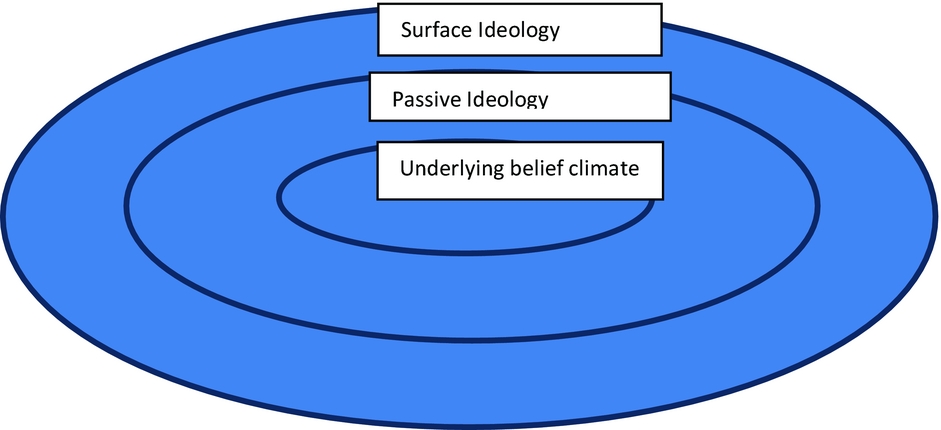
Children's literature significantly contributes to how a (child) reader understands the world and constructs a worldview. To encourage students to look past their nostalgic relationship with the idea of a children's book, the course began by examining Hollindale's (Reference Hollindale and Hunt1992) three levels of ideology apparent in children's books: surface ideology, passive ideology and the underlying climate of belief. Surface ideology refers to the explicit point, moral, of the story which is made apparent through representations whether social, political, national or economic. Passive ideology is what is revealed by the text that were not intentional; that is, the writer's own assumptions about society, gender or race. The underlying climate of belief in the text exposes the ways of thinking and behaving that are inscribed in the picturebook or that frame the worldview the text aligns itself with. By starting with the concept of ideology, students in the course have to immediately begin to complicate their reading of children's books so that what they initially think is a simple children's story, by the end of the seminar, becomes a more nuanced and complex reading revealing what discourses and structures have influenced, shaped and received both the written and visual narratives. This understanding that there are layers of ideology (explicit, implicit and underlying) is used each week in discussions of different children's picturebooks and is presented to the student as in Figure 1.
Hollindale's three levels of ideology.
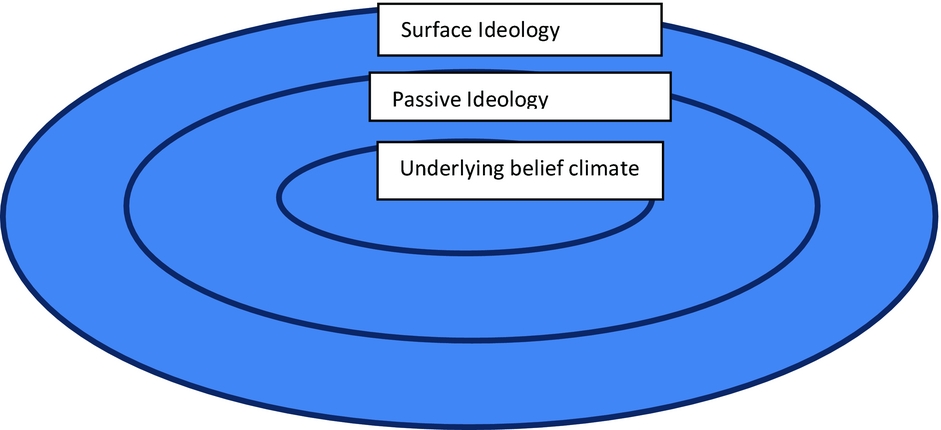
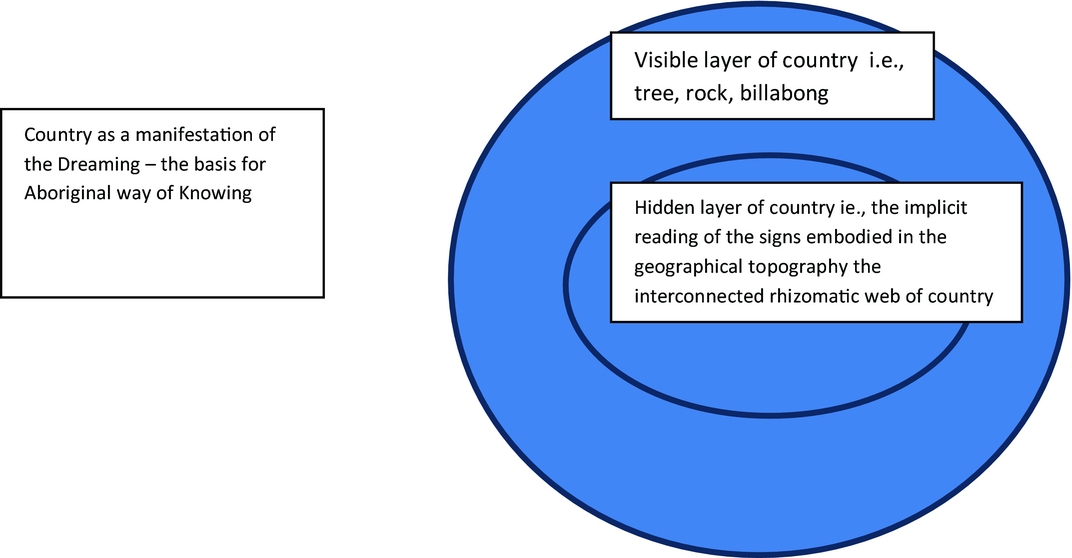
Each week, children's literature is examined to reveal the underlying values and beliefs that shape the way it is told. For example, after the week devoted to heteronormative representations and those that challenge heteronormative notions of the world, the students carry this with them in their other readings of children's books, so that even in the week devoted to young adult voices they can spot the heteronormative ideals that underline the passive and surface ideologies. The idea is that their knowledge, and ownership of that knowledge, accumulates each week so that by the end of the course they can read a simple children's story to reveal what normative ideas and purposes shape its representation of the world. A burning off of the top layers, if you will, to expose the seeds of growth beneath. Using both national and international children's picturebooks allows students to examine ideological implications from a distance and then from a more local stance. A topic-related scholarly reading is attached to each seminar topic, as well as a specific children's book, so that the students can apply their understanding of the scholarly criticism to their reading of the picturebook. For instance, in Week 4 the focus is on rereading ability and disability in children's literature using the picturebook Two Mates (2012) by Melanie Prewett (which happens to have Indigenous characters but is predominantly about how a child in a wheelchair with spina bifida can do whatever able-bodied boys can do) and a scholarly article about disability in primary-aged children's literature. The pedagogical purpose here is to ensure that abstract concepts and/or theoretical ideas can be grasped by applying them together in class to real life, relevant experiences and texts. In the second-half of the semester, the students do study an obviously Indigenous text, McDonald's and Pryor's (Reference McDonald and Pryor1998) My Girragundji. By this time, the students are comfortable discussing different worldviews and ways of accessing or challenging normative ideals. Crucially, then, they are aware that Western epistemology and dominant paradigms are only one way of living in the world. For the seminar on Indigenous Australian texts, the class revisits the planned structuring of the course as based on Hollindale's three levels of ideology in children's literature and the lecturer's understanding of Country being layered with knowledge (Figure 2).
Layers of knowledge embedded in country.
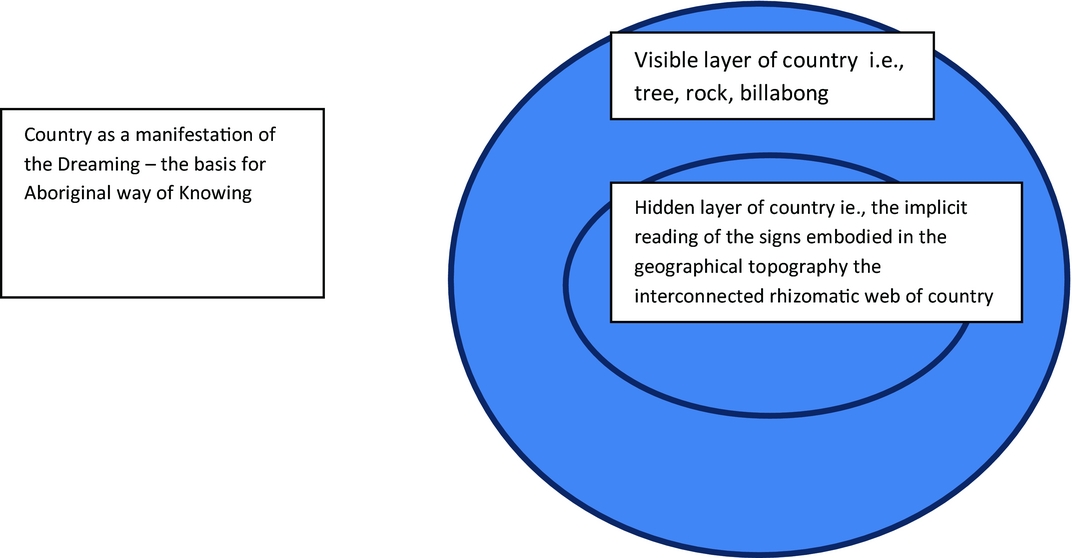
The visible layer of country is like the picturebook itself — what can be seen, touched, tasted, felt, read. This layer initially appears easy to read. The hidden layer of country is visible when unearthed, such as the roots of a tree. This layer resembles Hollindale's second level of ideology, passive, because it shapes the surface icon. So the roots are the source of life that shape the tree that is visible above ground. The invisible layer of country represents knowledge that is apparent in country to those that know that country, for example, the blossoming of a certain tree reveals the appropriate time to go fishing or conduct responsibilities to look after Country. It is understanding that this layer of knowledge exists in country that allows us to read the surface icon, i.e., the trunk, branches and leaves of the tree, more deeply. In the final weeks of the course, in an effort to self-consciously present the lecturer's structuring of the course and pedagogical approach, the theoretical approach to the texts is that of an ecological perspective and this is explained to the students using a specific Indigenous Australian picturebook alongside a scholarly reading on ecofeminism with an explicitly stated social justice purpose.
The course was designed under the umbrella of Indigenisation by centring knowledge that the Indigenous lecturer felt was not a misappropriation of Indigenous knowledges. Christie argues that ‘[W]hen Aboriginal knowledge is uncritically absorbed into the machine of Western science and humanities, a violence is done to it, it is misrepresented, and its owners are marginalised from the process’ (2006, p. 79). Once the burn-off had taken place, the landscape was surveyed to note what was left standing and who would be traversing across her, that is, mostly non-Indigenous mainstream students enrolling in a course not explicitly seen as including Indigenous peoples and knowledges. Regrowth was nurtured and watered according to an underlying belief in social justice. Based on Payi Linda Ford's approach to conducting Indigenist research, the course was redesigned to not be vague but as transparent and relevant to the student as possible, to specifically link abstract concepts to tangible stories, experiences and discussions, to employ different theoretical paradigms to take the student on a ‘learning journey’ and to have an impact on the way a student sees the world, their knowledge landscapes, and their role in it, while always being aware of the layers of knowledge embedded in country around us.
Surveying the Burn-Off: Conclusions
It is our experience and belief that current calls for Indigenisation do not adequately consider and address how staff within a discipline or academic grouping can destabilise its potential recolonising power. While there was a hopeful rhetoric of establishing a dialogic relationship with Indigenous ways of knowing, knowledges, communities and students, in our experience, it was very difficult for staff to move away from Western concepts, minds and approaches, where colonial paradigms built on the invisibility of non-Aboriginality continue to position Indigenous knowledges and ways of knowing as ‘other’. This produced the surprising result that even when a minimal amount of Indigenisation was taking place within our discipline, it was perceived as already sufficiently in place, and the presentation of evidence to the contrary produced changes in pedagogical practice only in the courses that we designed ourselves. The course models that we produced, however, prove that indigenising the discipline of English is not impossible. Rather that it is a long-term, dynamic and powerful process that needs space, time and appropriate knowledge; knowledge to begin the burn-off and allow fresh ground for a new narrative.
About the Authors
Dr Brooke Collins-Gearing has Murri heritage and comes from Kamilaroi country in north-west New South Wales. Her teaching and research interests centre on integrating Aboriginal ways of knowing into undergraduate and postgraduate studies particularly through the listening to stories of and from Country in Children's fiction and Aboriginal literature.
Associate Professor Rosalind Smith's primary field of research is Renaissance literature, specialising in women's poetry, and the relationships between genre, politics and history in the period. Her secondary field is in true crime writing in Australia, examining a neglected but increasingly central popular genre and its relationship to constructions of Australian nationalism.