The global burden of sexually transmitted infections (STIs) to health and development is often overlooked as a public health priority. Sexually transmitted infections are among the world's most common diseases, with annual incidence only being exceeded by diarrhoeal diseases, malaria and lower respiratory tract infections (Centers for Disease Control and Prevention, 2008). Globally, more than 330 million new cases of STI are being reported every year. Of these, over 80% are believed to occur in developing countries (Mohammad, Reference Mohammad2005). Although most STIs are relatively easy to cure, people who have an STI often delay seeking appropriate care making prognosis poor. This is especially relevant in tribal populations living in inaccessible areas. They represent an underprivileged group of society, often with poor access to health care delivery systems. Moreover, they are often in a transition phase with drastic changes taking place in various aspects of their lives, such as increased exposure to an urban lifestyle due to migration to cities and increased contact with other people due to development. This changing way of life makes them vulnerable to diseases like STIs. An understanding of the prevalence of STIs among tribal populations, and of their awareness, perceptions and health-care-seeking behaviours related to STIs, is therefore important if STI control programmes are to be effective in tribal areas.
In the central Indian state of Madhya Pradesh, the tribal population accounts for about a quarter of the total state population. The various tribes living in the state have been categorized into 46 ethnic groups. ‘Gond’ is one of these groups. A previous study (Rao et al., Reference Rao, Anvikar, Savargaonkar, Bhat, Yadav, Tiwary and Abbad2009) conducted by the Regional Medical Research Centre for Tribals (RMRCT), Jabalpur, among the Gond ethnic group suggests that there is a significant proportion of people with STIs. In view of this, a need was felt to explore their knowledge and health-seeking behaviour related to STIs. Therefore, this study was conducted amongst the Gond tribal population of Madhya Pradesh in the villages of Jabalpur district covered in an earlier STI prevalence study (Rao et al., Reference Rao, Anvikar, Savargaonkar, Bhat, Yadav, Tiwary and Abbad2009). A systematic random sample of nine villages was selected. A total of 200 married men and women aged 15–49 years were included in the study, which accounts for nearly 10% of the sample size of the earlier study, to obtain a quick understanding of knowledge, attitude, behaviour and practices (KABP) among the Gond tribal community of this area. A pre-designed interview schedule was administered in the study area. Ethical approval was obtained from the Institutional Ethics Committee of the RMRCT, Jabalpur.
The mean age of the respondents was 31.76±8.91 years (minimum 17 years; maximum 49 years). The majority of the respondents (153; 77%) were males while only 47 (23%) were females. About forty-three per cent of the respondents were illiterate. Most of them were either agriculture labourers or construction workers. The mean age at marriage was 18 years for males and 17 years for females.
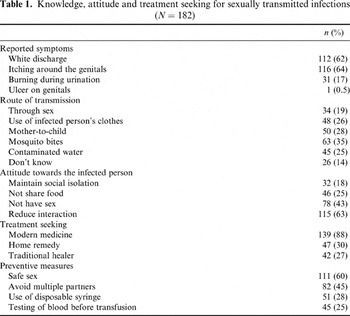
Of the 200 respondents interviewed, 182 (91%) were aware of some sexually transmitted diseases. Table 1 shows their knowledge and attitude towards STIs. Most of them mentioned white discharge from the genitals and itching around the genitals as the commonest symptoms of STI. Seventeen per cent of respondents mentioned a burning sensation during urination as a symptom of STI. Regarding routes of transmission, the sexual route was mentioned by only 34 respondents (19%). The other routes mentioned were mother-to-child transmission, mosquito bites, use of an infected person's clothes and contaminated water. Twenty-six respondents (14%) were not aware of any route of transmission.
Knowledge, attitude and treatment seeking for sexually transmitted infections (N=182)

Information on attitudes towards infected people showed varied responses. Thirty-two respondents (18%) reported that there is a need to maintain social isolation from an infected person. The respondents also gave multiple responses that stigmatized those suffering from STIs, such as not sharing food, not having sex and reducing interaction.
Regarding STI treatment, most of the respondents (85%) believe that there is some treatment. Though the majority believe that modern medicine is best for treating STIs, a little more than a quarter also prefer traditional healers and almost one-third take recourse to home remedies. The majority of the respondents (73%) believe that STIs are curable with proper treatment. Eleven per cent of respondents consider them non-curable, while a few had no idea about the cure for STIs. Regarding preventive measures against STIs, the majority of responses refer to the practice of safer sex. The other responses include avoiding multiple sex partners, use of disposable syringes and testing of blood before transfusion.
Forty-two respondents (23%) reported that they had an infection during the last 6 months preceding the survey. Thirty-three of these approached a government health facility or traditional healer for some kind of treatment, while eight resorted to a home remedy.
There are very few community-based KABP studies available on STIs in India, particularly among tribal populations. The present study points to the fact that although 91% of the respondents were aware of STIs, their awareness remained, by and large, confined to a very limited set of STIs and their symptoms. A good number of respondents had misconceptions about the routes of transmission of STIs. The study also highlighted their unfavourable attitude towards infected persons and thus calls for health education through a needs-based behaviour change communication (BCC) strategy. Though 88% of the respondents felt modern medicine was the best remedy for STIs, only a few of them availed themselves of medical treatment when suffering from a STI. The reasons cited for not availing themselves of treatment were shame, economic factors, inaccessibility and inconvenient health facilities opening times. In view of these, measures need to be taken to make services more readily accessible to the community, especially in view of people's perception of the ease of access to traditional healers. Not getting relief as a result of an earlier treatment made them frustrated and deterred them from seeking further treatment. Such treatment-seeking behaviours were similar to those seen in other studies (Voeten et al., Reference Voeten, O'Hara, Kusimba, Otido, Ndinya-Achola and Bwayo2004; Lewis et al., Reference Lewis, Garnett, Nyamukapa, Donnelly, Mason and Gregson2005). It was also observed that traditional healers/practitioners were also preferred for STI treatment. The reasons stated for this preference were easier availability of traditional healers in the village and convenient timings. Further, they were more comfortable discussing STIs with traditional healers than with outsiders. Therefore, capacity building of these traditional healers/practitioners would be a good strategy to reach this community with timely and appropriate treatment. This would also help the practitioners take appropriate action regarding treatment. Practitioners could also function as a link between the health services and the community, educating the community on various aspects of STIs and also monitoring treatment at the village level. A good number of the respondents remained unaware of the different preventive measures against STIs and these could be educated using the BCC strategy.
Vast numbers of people in India are severely disadvantaged in terms of income, education, power structures and gender (Thappa & Kaimal, Reference Thappa and Kaimal2007). This study observed that the higher a person's education, the better their awareness and lower the reported infections. Also, better awareness came with higher income, though the association was not found to be significant (χ2=6.490, p>0.05). The study also showed that awareness among men was higher than among women (94% vs. 83%) (χ2=5.662, p<0.05). The reported STI rate was also significantly lower (16.3% vs. 45.5%) among men than women (χ2=16.205, p<0.001). The BCC strategy should therefore place more emphasis on women's risk of STIs. As women are more likely to get infected by their regular partners, involvement of men in such programmes is also important.
The study highlights the need to generate STI awareness among the tribal population of the region. Special attention should be given to the encouragement of effective communication between providers and clients, partner treatment and improving access to, and utilization of, government reproductive health services under the Reproductive and Child Health (RCH) programme. The sexual behaviour of the population, in particular, needs to be studied in detail, and the cultural practices prevalent among the tribe, reflecting their emic views, need to be identified and studied. In the absence of such ethno-behavioural studies on STIs among the tribe, this study may act as a future reference and baseline.
The limitations of the study need to be considered. As the study was done in a small sample of a wider tribal population, the findings may be useful in a given socio-cultural context but may not have a high level of generalization. However, this in itself is an important issue for designing specific interventions in this area.
Acknowledgments
The authors acknowledge the Indian Council of Medical Research for funding this study and the Director, Regional Medical Research Centre for Tribals, Jabalpur, for providing the facility. Sincere thanks are due to Dr D. C. Jain for review of the literature and to the field staff for data collection.