

Job interviews are one of the most common tools used by organisations to make hiring decisions (Carless, Reference Carless2007; Posthuma, Morgeson, & Campion, Reference Posthuma, Morgeson and Campion2002). They involve a structured social interaction that encourages the job applicant to attempt to persuade the interviewer of their suitability for the job (Barrick, Shaffer, & DeGrassi, Reference Barrick, Shaffer and DeGrassi2009; Marcus, Reference Marcus2009). While interviewees are often expected to present a positive view of themselves, more extreme forms of faking such as lying about work experiences, personal characteristics, skills, and qualifications pose a major challenge for effective selection (Birkeland, Manson, Kisamore, Brannick, & Smith, Reference Birkeland, Manson, Kisamore, Brannick and Smith2006; Robson, Jones, & Abraham, Reference Robson, Jones and Abraham2007; Rothstein & Goffin, Reference Rothstein and Goffin2006). When job applicants fake, they can deprive more capable, but honest, applicants of a job, and they prevent organisations from hiring the best applicants. Thus, to assist organisations in using job interviews effectively, it is important to form a theoretical model of the factors that influence individual differences in job interview faking.
Existing theories of job applicant faking propose that individual differences in faking are driven by a combination of general personal characteristics and beliefs specific to the selection context (e.g., Griffith & Peterson, Reference Griffith and Peterson2011; McFarland & Ryan, Reference McFarland and Ryan2000; Snell, Sydell, & Lueke, Reference Snell, Sydell and Lueke1999). Common personal characteristics include the Big Five personality traits such as extraversion, neuroticism and conscientiousness, along with integrity and self-monitoring (McFarland & Ryan, Reference McFarland and Ryan2006; Mueller-Hanson, Heggestad, & Thornton, Reference Mueller-Hanson, Heggestad and Thornton2006; Snell et al., Reference Snell, Sydell and Lueke1999). For instance, people who are conscientious may be less likely to fake, and people who see life as a social performance may be more likely to fake. One framework for categorising behaviour-specific beliefs is provided by the theory of planned behaviour. This general theory has been adapted to job applicant faking and states that applicants are more likely to intend to fake when they have positive attitudes to faking, believe that important others perceive faking as acceptable, and believe that they can fake successfully (McFarland & Ryan, Reference McFarland and Ryan2006; Mueller-Hanson et al., Reference Mueller-Hanson, Heggestad and Thornton2006).
Despite these theoretical developments, several gaps in the literature remain. First, although some studies have studied interview faking (e.g., Ingold, Kleinmann, König, & Melchers, Reference Ingold, Kleinmann, König and Melchers2014), most have focused on personality test faking (e.g., Birkeland et al., Reference Birkeland, Manson, Kisamore, Brannick and Smith2006; Griffith, Chmielowski, & Yoshita, Reference Griffith, Chmielowski and Yoshita2007; Hogan, Barrett, & Hogan, Reference Hogan, Barrett and Hogan2007; Rees & Metcalfe, Reference Rees and Metcalfe2003; Robie, Tuzinski, & Bly, Reference Robie, Tuzinski and Bly2006; Viswesvaran & Ones, Reference Viswesvaran and Ones1999). In particular, theoretical work linking personality and domain-specific beliefs has largely focused on faking personality tests rather than job interviews. Second, further work is required to examine the degree to which the effect of personality traits on interview faking is explained by domain-specific beliefs. Third, several previous studies applying the theory of planned behaviour to understand applicant faking have relied on student samples that may limit the generalisability of findings to industry settings. Thus, this study aimed to adapt a measure of the theory of planned behaviour suited to understanding job interview faking. It then sought to test a combined model of personality and the theory of planned behaviour on job interview faking using a large non-student sample.
Faking Job Interviews
Faking a job interview occurs when job applicants intentionally try to create a false impression with the purpose of being perceived more favourably by the hiring organisation. For example, a candidate may claim to have performed duties in a previous role that they never actually performed. However, there is a wide spectrum of strategies, including positive spin, unconscious representations and omissions, that applicants can use to positively represent themselves (Roulin, Bangerter, & Levashina, Reference Roulin, Bangerter and Levashina2014).
Several theories of applicant faking have been proposed (McFarland & Ryan, Reference McFarland and Ryan2006; Mueller-Hanson et al., Reference Mueller-Hanson, Heggestad and Thornton2006; Snell et al., Reference Snell, Sydell and Lueke1999). In line with the broader literature, these theories have focused on faking personality tests rather than job interviews. Each theory identifies features of the applicant and the situation that influence the degree of faking observed. Theories agree that faking is influenced by the applicant's ability, opportunity, and motivation to fake (Goffin & Boyd, Reference Goffin and Boyd2009; Levashina & Campion, Reference Levashina and Campion2006; McFarland & Ryan, Reference McFarland and Ryan2000; Snell et al., Reference Snell, Sydell and Lueke1999). So, for example, strong social skills (ability), use of difficult-to-verify interview questions (opportunity), and a strong desire by the applicant to get the job (motivation) should lead to higher levels of applicant faking.
In relation to characteristics of the applicant, each theory identifies both domain-specific and general predictors of faking (McFarland & Ryan, Reference McFarland and Ryan2006; Mueller-Hanson et al., Reference Mueller-Hanson, Heggestad and Thornton2006; Snell et al., Reference Snell, Sydell and Lueke1999). Domain-specific personal characteristics refer to specific beliefs and intentions about acting and faking in a selection context. For example, an applicant who sees faking job interviews as a normal part of the social exchange may be more likely to fake. In contrast, general personal characteristics include a range of variables, including personality, values, integrity, demographics, and social skills. Such characteristics apply to a broad range of settings. So, for example, a person who has integrity and lacks skills in lying would be less likely to fake in a range of settings. Extending Snell et al.’s (Reference Snell, Sydell and Lueke1999) seminal model, McFarland and Ryan (Reference McFarland and Ryan2006) proposed an integrated model of faking incorporating dispositional influences on faking, as well as domain-specific factors such as intentions, ability, motivation, and opportunity to fake. However, given the model's complexity, many of the relationships remained untested. Building on their earlier model, McFarland and Ryan incorporated a model of domain-specific predictors of faking based on the theory of planned behaviour.
The Theory of Planned Behaviour
The theory of planned behaviour (Fishbein & Ajzen, Reference Fishbein and Ajzen1975) asserts that the three main determinants of behavioural intentions are attitudes, subjective norms, and perceived behavioural control. For a given behaviour, attitudes represent the degree to which an individual evaluates the behaviour favourably. Positive attitudes to faking a job interview may be informed by beliefs that faking is reasonable, effective, and beneficial. Subjective norms represent an individual's beliefs about whether important others would consider the individual favourably for engaging in the behaviour. Thus, candidates would have positive subjective norms if they felt that family and friends would think positively about them if they were to fake a job interview. Perceived behavioural control represents the degree to which an individual believes they can effectively perform the behaviour. Thus, interviewees would perceive greater control if they think they can effectively tell lies without getting caught and that those lies would be effective in forming a positive impression in the interviewer. The theory predicts that positive attitudes about the behaviour, beliefs that others think the behaviour is acceptable, and a perception of control over the behaviour cause a person to have intentions to engage in the behaviour, which in combination with objective control causes actual behaviour (Ajzen, Reference Ajzen1991). Originally conceived as a general model of behaviour, this model has since been applied to dishonest behaviour, including cheating (e.g., Beck & Ajzen, Reference Beck and Ajzen1991; Stone, Jawahar, & Kisamore, Reference Stone, Jawahar and Kisamore2010) and job applicant faking (McFarland & Ryan, Reference McFarland and Ryan2000; Mueller-Hanson et al., Reference Mueller-Hanson, Heggestad and Thornton2006).
McFarland and Ryan (Reference McFarland and Ryan2006) created a measure of the theory of planned behaviour focused on job applicant faking. In their first study using a large undergraduate sample they found that attitudes, subjective norms, and perceived behavioural control explained 45% of variance in intention to fake. The measure of attitudes was the strongest predictor, followed by perceived behavioural control, and then subjective norms. In their second study they found that intention to fake was positively correlated with faking behaviour operationalised as the difference between personality measured under honest and job applicant role-play conditions. Their findings were consistent with more general research on the theory of planned behaviour, which supports the link between intentions and behaviour (Ajzen, 1985; Beck & Ajzen, Reference Beck and Ajzen1991). Overall, the theory of planned behaviour provides a domain-specific socio-cognitive explanation of the causes of applicant faking. However, further research is needed to clarify how dispositional factors should be integrated into the theory of planned behaviour.
Personality and Self-Monitoring
Ajzen (Reference Ajzen1991, Reference Ajzen2005) proposed that the effect of personality on intention will be mostly mediated by attitudes, subjective norms, and perceived behavioural control. He proposed the compatibility principle, whereby personal characteristics and behaviours are compatible to the extent that they are consistent in target, action, context, and time. Theory and empirical evidence supports the claim that where the personal characteristic and behaviour are consistent, the statistical association between the two variables will be larger. Thus, when predicting intentions to fake job interviews, personality and self-monitoring are general whereas attitudes, subjective norms, and perceived behavioural control are specific. Thus, the greater generality of personality and self-monitoring should lead to smaller correlations with intentions and behaviour than the domain-specific beliefs represented by the theory of planned behaviour.
Ajzen (Reference Ajzen2005) proposed that the relationship between personality and the theory of planned behaviour is an empirical question that will vary based on the target behaviour. While a few studies in other contexts have examined this (e.g., exercise and academic misconduct; Courneya, Bobick, & Schinke, Reference Courneya, Bobick and Schinke1999; Stone et al., Reference Stone, Jawahar and Kisamore2010), only a few studies have simultaneously examined the effect of personality and domain-specific beliefs in the context of job applicant faking. Mueller-Hanson et al. (Reference Mueller-Hanson, Heggestad and Thornton2006) examined the effect of neuroticism, conscientiousness, self-monitoring, and a measure adapted from the theory of planned behaviour, although they did not test mediational pathways. McFarland and Ryan (Reference McFarland and Ryan2006) also reported correlations between personality and theory of planned behaviour measures in a study of personality test faking in a job applicant role-play. Prominent dispositional variables across these studies include conscientiousness, neuroticism, extraversion, and self-monitoring. These traits were the focus of the current study.
Conscientiousness represents a tendency to be achievement striving, rule-abiding, and to show self-discipline (Costa & McCrae, Reference Costa, McCrae, Storandt and VandenBos1989; Judge, Higgins, Thoresen, & Barrick, Reference Judge, Higgins, Thoresen and Barrick1999). Meta-analyses suggest that conscientiousness is the strongest Big Five personality predictor of job performance (Barrick & Mount, Reference Barrick and Mount1991). Given the rule-abiding aspects, higher conscientiousness may lead to negative attitudes to faking. The appealing nature of conscientious applicants may also means that such applicants have less need to fake.
Neuroticism represents a tendency to experience negative emotions, including anxiety, stress, and depression. Some researchers have found that neuroticism is associated with greater sensitivity to punishment (Carver & White, Reference Carver and White1994). If this is true, then fear of being caught faking might reduce the incidence of faking. Alternatively, high neuroticism has been conceptualised as a form of impaired emotional regulation (Joormann & Gotlib, Reference Joormann and Gotlib2010) or as a tendency to view the world more negatively. For instance, if a person projects motivations of self-interest onto other applicants or views the interviewer with distrust, then they are more likely to see faking as normatively appropriate and have a more positive attitude to faking. In terms of empirical research, McFarland and Ryan (Reference McFarland and Ryan2006) found a negative correlation between faking and conscientiousness and a positive correlation between neuroticism and faking. Mueller-Hanson et al. (Reference Mueller-Hanson, Heggestad and Thornton2006) suggest that this may be because such traits are both related to an integrity factor.
Extraversion represents a tendency to be sociable, active, and positive. It can also reflect a sensitivity to reward (Carver & White, Reference Carver and White1994) or a desire for social attention (Ashton, Lee, & Paunonen, Reference Ashton, Lee and Paunonen2002). If extraverts are truly more sensitive to rewards, then they may be more inclined to fake in a job interview. Extraverted individuals often aim to present a positive perception of themselves to gain acceptance from others. Research also suggests they may be more likely to engage in lying (Kashy & DePaulo, Reference Kashy and DePaulo1996; Levashina & Campion, Reference Levashina and Campion2006). Notably, Weiss and Feldman (Reference Weiss and Feldman2006) found a correlation of .30 between extraversion and number of lies told in an a job interview. Thus, such an effect may operate through more positive attitudes to faking. It may also be that extraverts are more capable of faking in the interview context, thereby leading to greater perceived behavioural control.
Self-monitoring is a meta-trait that represents an ability and willingness to adjust behaviour to meet the expectations of others (Barrick, Parks, & Mount, Reference Barrick, Parks and Mount2005). Research has shown that high self-monitors are able to adjust their behaviours during selection to present themselves more favourably to assessors than low self-monitors (Ellingson & McFarland, Reference Ellingson and McFarland2011; McFarland & Ryan, Reference McFarland and Ryan2006). Thus, given the nature of self-monitoring, it should predict both positive attitudes to faking and higher levels of perceived behavioural control.
The Current Study
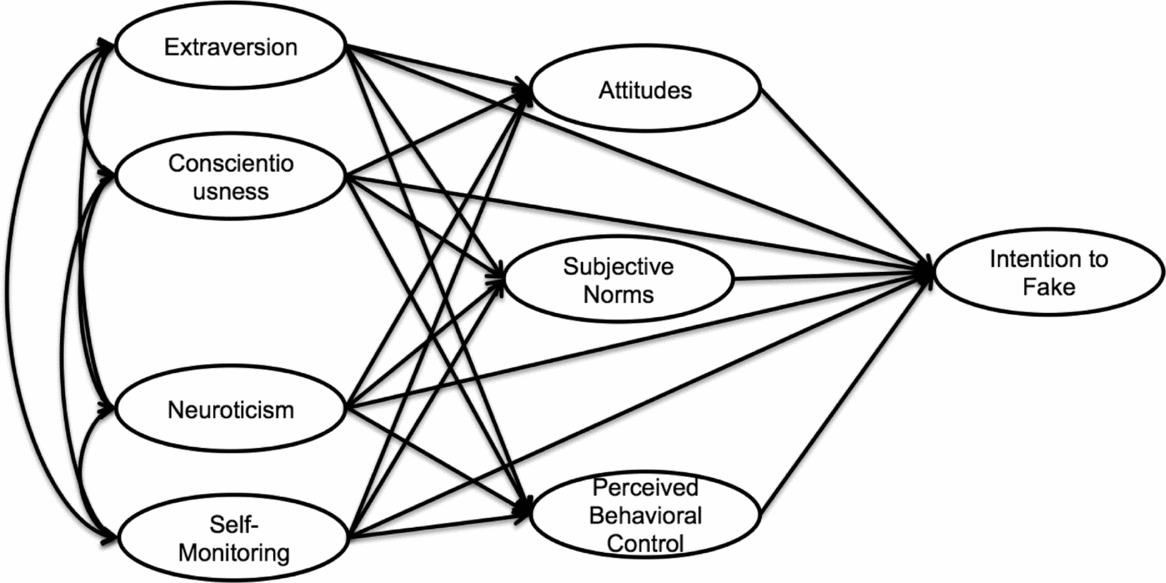
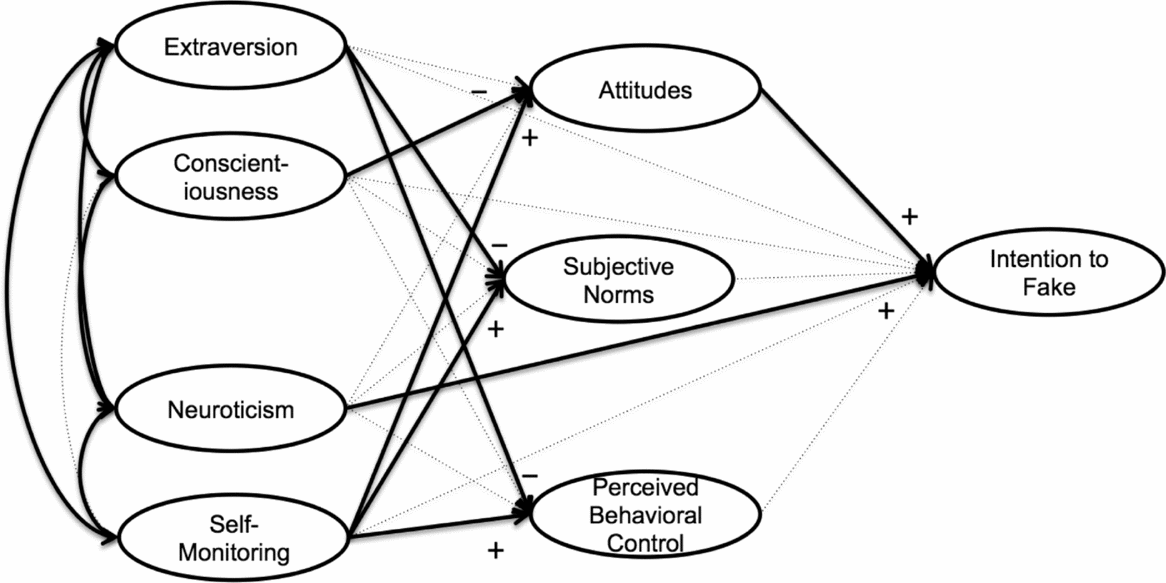
While previous research has examined the effect of personality and domain-specific beliefs on faking personality tests, very little research has examined these relationships in the context of faking job interviews. Furthermore, existing research has often relied on student samples that may effect generalisability to the organisational setting and has not examined whether the effect of personality is mediated by domain-specific beliefs. The present study aimed to address this gap by testing a model of intentions to fake job interviews that combines general personality traits with domain-specific predictors from the theory of planned behaviour, that is, attitudes, subjective norms, and perceived behavioural control (see Figure 1). To test this model we first adapted McFarland and Ryan's (Reference McFarland and Ryan2006) measure of personality test faking so that it would be applicable to faking job interviews. We then administered this measure along with measures of general personality traits (i.e., conscientiousness, extraversion, neuroticism, and self-monitoring) to a mostly Australian adult community sample. We used structural equation modelling to examine: (a) the relative importance of different personality traits in predicting attitudes, subjective norms, and perceived behavioural control; and (b) the size of indirect effects of personality traits on intentions mediated by attitudes, subjective norms, and perceived behavioural control.
Integrated model of dispositional and theory of planned behaviour variables on intention to fake job interviews.

Method
Participants and Procedure
The study was completed by 313 participants (71% female). Ages ranged from 18 to 65 years (M = 33.3, SD = 12.1). Participants were required to be over 18 years of age and have previously been employed. The sample was well educated, with 81.2% having a bachelor's degree or higher. Participants worked in a range of industries, with a large proportion working in white collar areas including retail (17.6%), education (13.4%) health (12.5%), management (9.9%), finance (7.3%), and information technology (4.5%). Most participants resided in Australia and were recruited using direct emails and social networking websites, including Facebook and LinkedIn.
The survey was administered online. To encourage honest responding, the plain language statement stated that no identifying information would be recorded. After reading the plain language statement, participants first completed demographics followed by the NEO-FFI, the Revised Self-Monitoring Scale, the BIDR, and finally the Theory of Planned Behaviour Inventory for Interview Faking.
Materials
NEO — Five-Factor Inventory (NEO-FFI)
The NEO-FFI is designed to measure the Big Five factors of personality (Costa & MacCrae, Reference Costa and MacCrae1992). For the purpose of this study, only neuroticism, extraversion, and conscientiousness factors were measured. Each factor consisted of 12 items measured on a 5-point scale ranging from 1 (strongly disagree) to 5 (strongly agree). Scale scores were the item mean after relevant items had been reversed.
Revised Self-Monitoring Scale
Initially developed by Snyder (Reference Snyder1974) and revised by Snyder and Gangestad (Reference Snyder and Gangestad1986), the scale aims to measure the degree to which an individual engages in self-monitoring. The scale is composed of 18 items on a 2-point scale (0 = false, 1 = true), where the scale score is the mean item score after item reversal.
Balanced Inventory of Desirable Responding (BIDR)
This 40-item test consists of two scales: self-deception and impression management (Paulhus, Reference Paulhus, Robinson, Shaver and Wrightsman1991). Each item was on a 7-point scale from 1 (strongly disagree) to 7 (strongly agree). Two items were excluded due to concerns that they might cause offence to participants. Each scale was scored as the number of items after reversal that were rated 6 or 7, times a multiplier to ensure that the scale was on the same scale as the original 40-item version of the test. The scales were used as an additional check for whether participants appeared to be answering honestly.
Theory of Planned Behaviour Inventory for Interview Faking
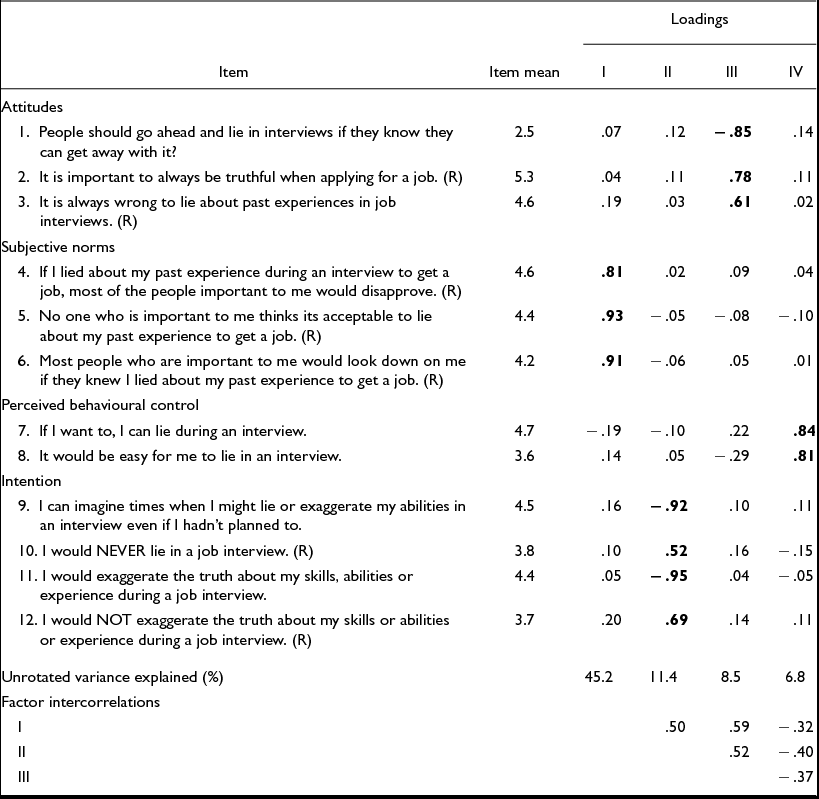
The inventory was composed of four scales: (1) attitudes: belief that faking job interviews is a good thing; (2) subjective norms: belief that people important to the participant would approve of the participant faking a job interview; (3) perceived behavioural control: belief that the participant would be able to fake a job interview; and (4) intentions: intention to fake job interviews in the future. Items were adapted from McFarland and Ryan's (Reference McFarland and Ryan2006) general theory of planned behaviour measure for faking selection tests. The adaptation process involved several steps. First, subjective norms, perceived behavioural control, and intention items were modified, replacing the words ‘selection test’ with ‘job interview’. Second, items were further adapted to be consistent with job interview faking or omitted if not relevant. Third, new attitude items were created focused on attitudes to job interviews. Fourth, once data was collected, exploratory factor analysis was performed on the initial set of items. Based on these analyses, the final test contained three attitude, three norm, two perceived behavioural control, and four intention items. Items were rated on a 7-point scale from 1 (strongly disagree) to 7 (strongly agree). The exploratory factor analysis, the final measure, and reliabilities for the four scales are reported in the results.
Data Analytic Approach
In order to test the proposed hypotheses, we first checked the honesty levels in the sample. We then refined our Theory of Planned Behaviour Inventory using principal component analysis. To test hypotheses about bivariate relationships, we calculated bivariate correlations. To estimate direct effects, indirect effects, and overall fit of the proposed model, we performed structural equation modelling.
Results
Honesty Check
The present study asked potentially sensitive questions about faking job interviews. Although anonymity was the main strategy for eliciting honest responses, scores on the BIDR were examined for any evidence of excessive response distortion at the group level. The self-deception mean was 5.06 (SD = 3.36) and the impression management mean was 4.90 (SD = 3.15). Paulhus (Reference Paulhus, Robinson, Shaver and Wrightsman1991) reports several normative means for the BIDR. In particular, a college sample had means of 7.20 (SD = 3.20) for self-deception and 4.60 (SD = 3.20) for impression management. Based on a one-sample t test, participants in the current study were lower on self-deception (p < .001) and not significantly different on impression management (p = .10) relative to this normative college sample. This provides some evidence that participants provided honest responses on the theory of planned behaviour items.
Development of the Theory of Planned Behaviour Inventory for Interview Faking
A principal components analysis (PCA) with Promax rotation was performed on theory of planned behaviour items. An oblique rotation was chosen because the scales are theorised to correlate, and PCA was chosen due to the small number of items measuring perceived behavioural control. In line with theory, four components were extracted. Table 1 shows item means and factor loadings for retained items for the measure. Item means suggest that a reasonable proportion of participants perceived they could fake (perceived behavioural control) and would fake (intention) in a job interview. Loadings were fairly clean with no cross-loadings above .30.
Means and Factor Loadings for Retained Theory of Planned Behaviour Items
Note: The letter R in parentheses (R) indicates that the item should be reversed. Factor loadings greater than .30 are in bold. All item means are on a 1–7 scale.
Descriptive Statistics and Correlations
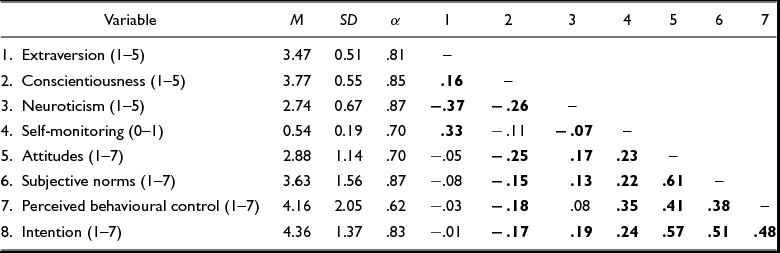
Table 2 shows means, standard deviations, reliabilities, and intercorrelations for the main variables in the study. As predicted, attitudes, subjective norms, and perceived behavioural control were all strongly correlated with intentions. Conscientiousness, neuroticism, and self-monitoring were moderately correlated with intentions, but extraversion was not. Self-monitoring was the most consistent and largest predictor of theory of planned behaviour variables. Notably, the correlation between self-monitoring and perceived behavioural control was the largest cross-correlation between dispositional and theory of planned behaviour variables.
Descriptive Statistics, Cronbach's Alpha, and Intercorrelations for Personality, Self-Monitoring, and the Theory of Planned Behaviour
Note: N = 313; α is Cronbach's alpha; Significant correlations are bolded (.05 significance level, two-tailed).
Structural Equation Modeling
To estimate the proposed model of faking intentions, SPSS Amos 21 using maximum likelihood was used. The model was specified with the dispositional variables of extraversion, neuroticism, conscientiousness, and self-monitoring all allowed to correlate. All dispositional variables were allowed to predict attitudes, subjective norms, and perceived behavioural control; and all variables were allowed to predict intention. Residuals of attitudes, subjective norms, and perceived behavioural control were allowed to correlate. For latent theory of planned behaviour variables, the individual test items were used as the indicator variables. Loadings for the two perceived behavioural control items were constrained to be equal to ensure model identification. For dispositional variables, item parcels (for discussion, see Little, Cunningham, Shahar, & Widaman, Reference Little, Cunningham, Shahar and Widaman2002) were generated so that there were three indicators for each dispositional variable. Indicators were formed by taking the mean of an equal number of items; so, for example, extraversion indicator 1 was the mean after reversal of extraversion items 1 to 4, indicator 2 was the mean of items 5 to 8, and indicator 3 was the mean of items 9 to 12. To estimate overall model fit we report the comparative fit index (CFI), RMSEA, and standardised RMR (SRMR). Hu and Bentler (Reference Hu and Bentler1999) proposed that the following represents good model fit: CFI > .95, RMSEA < .06, and SRMR < .08.
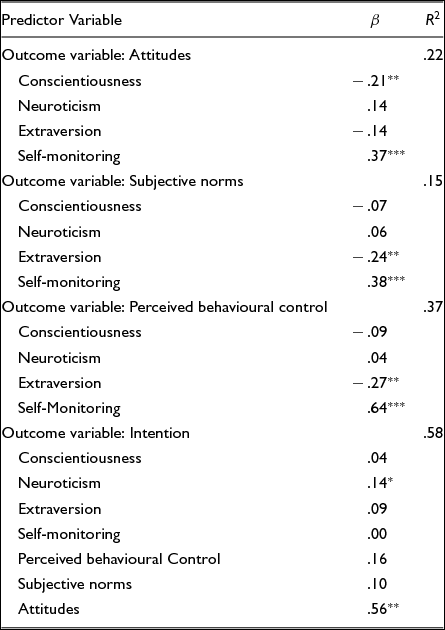
The overall model displayed a good fit to the data, χ2(df = 225, N = 313) = 431.2, p > .05; CFI = .94; RMSEA = .054 [90% CI .045–.062]; SRMR = .055. Table 3 shows standardised coefficients and squared multiple correlations for dispositional variables predicting subjective norms, attitudes, and perceived behavioural control, and all variables predicting intentions. Figure 2 shows direction of effects and whether they were statistically significant. Dispositional variables strongly predicted attitudes, subjective norms, and perceived behavioural control, although perceived behavioural control was the best predicted, due mostly to the strong correlation with self-monitoring. In relation to prediction of perceived behavioural control and subjective norms, self-monitoring appeared to be having a suppression effect on extraversion. The regression coefficient was more positive for self-monitoring and more negative for extraversion than the corresponding correlations. In particular, the above model was re-run, excluding conscientiousness, neuroticism, and self-monitoring, one at a time. This analysis showed that it was the inclusion of self-monitoring that altered the extraversion coefficient.
SEM Standardised Coefficients and Squared Multiple Correlations Predicting Attitudes, Subjective Norms, Perceived Behavioural Control, and Intention to Fake Job Interviews
Note: N = 313; *p < .05, **p < .01, ***p < .001.
Model of dispositional and theory of planned behaviour variables on intention to fake job interviews where all lines were included in structural equation model. Significant paths are bolded. Plus symbols indicate that the bolded path was positive, and minus symbols indicate that the bolded path was negative.
Greater conscientiousness predicted more negative attitudes. Overall, intention was predicted well by dispositional and theory of planned behaviour variables. However, when the model was fit with just theory of planned behaviour variables as predictors, 57% of variance was explained, with standardised coefficients of .09 for subjective norms (p > .05), .16 for perceived behavioural control (p = .05), and .58 for attitudes (p < .001). So, most of the prediction of intentions was achieved through theory of planned behaviour variables directly, and attitudes in particular.
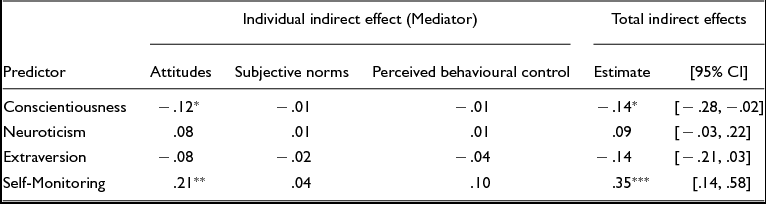
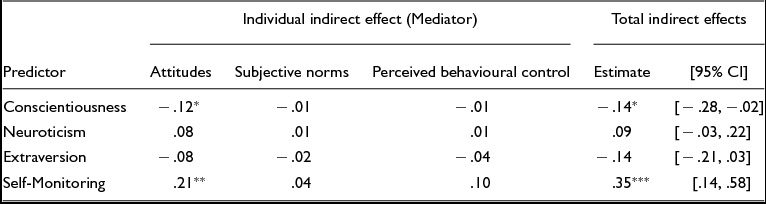
To further examine the indirect effects of dispositions on faking intention, individual and total indirect effects were obtained (see Table 4). Confidence intervals and p values were obtained for standardised total indirect effects estimated using bias-corrected confidence intervals with 10,000 bootstrapped iterations. Individual indirect effects were computed using the Sobel test. Both self-monitoring and conscientiousness had significant total indirect effects on intention, although self-monitoring was clearly the larger of the two. The conscientiousness indirect effect operated through attitudes. Although the indirect effect of self-monitoring also mostly operated through attitudes, there was a marginally significant (p = .09) indirect effect through perceived behavioural control.
The Standardised Individual and Total Indirect Effects of Personality and Self-Monitoring Through Attitudes, Subjective Norms, and Perceived Behavioural Control on Intention to Fake Job Interviews
Note: N = 313; *p < .05, **p < .01, ***p < .001.
Interaction Effects
In response to a reviewer suggestion, we performed a post hoc analysis to examine interaction effects between dispositional and the three theory of planned behaviour predictors on intentions (for a review, see Ajzen, Reference Ajzen2005). Research in the exercise domain have identified such moderators (Rhodes, Courneya, & Hayduk, Reference Rhodes, Courneya and Hayduk2002; Rhodes, Courneya, & Jones, Reference Rhodes, Courneya and Jones2005), suggesting, for example, that people lower in extraversion and higher in neuroticism have a stronger relationship between subjective norms and intention. We ran six separate multiple regression models to test for moderator effects. Each regression model included one dispositional or response style variable (i.e., extraversion, neuroticism, conscientiousness, self monitoring, impression management, social desirability) and attitudes, subjective norms, and perceived behavioural control. Each model included the four main effects and the three two-way interactions generated by crossing the distal or response variable with the three theory of planned behaviour predictors. All variables were centred to remove multicollinearity between the interaction and main effect terms. Of the 18 interactions examined, two were statistically significant at the .05 level, and none were significant at the Bonferroni corrected level: that is, .05/18 = .0028. Specifically, using the .05 alpha, greater self-monitoring was related to a reduction in the effect of perceived behavioural control on intentions (p = .004), and greater levels of extraversion was related to an increase in the effect of subjective norms on intention (p = .01).
Discussion
The present study aimed to test a model of dispositional predictors of intention to fake job interviews, mediated by domain-specific predictors based on the theory of planned behaviour, with the goal of extending the limited empirical evidence for previously proposed models of job interview faking. Consistent with the compatibility principle (Ajzen, Reference Ajzen2005), the domain-specific measures of attitudes, subjective norms, and perceived behavioural control correlated strongly with intention, while general dispositional factors correlated more modestly with intention. Dispositional factors were good predictors of attitudes, subjective norms, and perceived behavioural control. This translated into several prominent indirect effects; most notably, attitudes mediated the effect of self-monitoring on intentions. Several interesting patterns also emerged in the prediction of intention, attitudes, subjective norms, and perceived behavioural control.
Theory of Planned Behaviour
Consistent with the results from McFarland and Ryan (Reference McFarland and Ryan2006), attitudes correlated more strongly with intention than did perceived behavioural control or subjective norms. The greater role of attitudes was amplified in the model coefficients predicting intentions. There are several possible explanations for this result. Attitudes provide an overall evaluation of a behaviour and may be more important than the opinions of others. In particular, family, friends and peers will not necessarily know when a individual fakes a job interview, potentially reducing the relevance of subjective norms. Similarly, perceptions of ability to fake, partially indexed by perceived behavioural control, may not be absolute: a person can try to fake, but whether they are successful is often beyond their control.
The correlations between attitudes, subjective norms, and perceived behavioural control also suggest the existence of either a latent global factor or causal interrelationships. Just as self-monitoring incorporates both a willingness and an ability to alter behaviour to meet the needs of context (Snyder, Reference Snyder1974), positive attitudes to faking were correlated with belief in the ability to fake. Control beliefs may be influenced by whether moral and utility constraints would prevent the person from faking. Similarly, subjective norms may cause attitudes through a process of internalisation (O'Reilly & Chatman, Reference O'Reilly and Chatman1986). In addition, normative perceptions are measured, and people may project their own morality onto others when rating what others think. Finally, there may also be homophily effects (McPherson, Smith-Lovin, & Cook, Reference McPherson, Smith-Lovin and Cook2001) whereby individuals associate with people with similar views to themselves, which could influence the correlation between subjective norms and attitudes.
Personality and Self-Monitoring
Attitudes, subjective norms, and perceived behavioural control were all moderately well predicted by dispositional variables. The proportion of variance explained by dispositional variables was much greater for perceived behavioural control than for either attitudes or subjective norms, and attitudes was substantially better explained than subjective norms. The stronger prediction of perceived behavioural control seems to be largely driven by a very strong association between self-monitoring and perceived behavioural control. Although self-monitoring reflects both a positive attitude and an ability to alter self-presentation (Snyder, Reference Snyder1974), the ability component may have the greater effect on correlations with theory of planned behaviour variables. The weaker prediction of subjective norms may be due to subjective norms ostensibly being a property of others rather than the individual, even if, as discussed above, it would be artificial to interpret subjective and objective norms as independent of the individual.
Lower conscientiousness and higher neuroticism were also associated with attitudes, subjective norms, and perceived behavioural control, although the neuroticism–perceived behavioural control relationship was not significant. Within the structural equation model, conscientiousness was a good predictor of less positive attitudes to faking. This result is consistent with previous research showing that conscientiousness is associated with lower levels of counterproductive work behaviour (Berry, Ones, & Sackett, Reference Berry, Ones and Sackett2007), and the theory that conscientiousness embodies attitudes, beliefs, and behaviours about rule-abiding behaviour (Ford & Richardson, Reference Ford and Richardson1994).
Interestingly, no support was found for a positive relationship between extraversion and any theory of planned behaviour variable. Although at the bivariate level there was almost no correlation, in the predictive models, extraversion predicted more negative subjective norms about faking and lower perceived behavioural control. This finding arguably does not support predictions from reward sensitivity theory (Carver & White, Reference Carver and White1994). The finding also differs from previous research that has shown links between extraversion and faking behaviour in both broad behavioural faking and during job interview settings (Courneya et al., Reference Courneya, Bobick and Schinke1999; Weiss & Feldman, Reference Weiss and Feldman2006). The negative coefficient for extraversion predicting subjective norms and perceived behavioural control appears to be related to the inclusion of self-monitoring, which overlaps with extraversion both theoretically and empirically. A residualised version of extraversion controlling for self-monitoring may be more focused on positivity and less on social manipulation.
Practical Implications
The results have several implications for applied practice. First, the lens of dispositional individual differences helps to flag applicants who are more likely to engage in faking behaviour. Although we do not recommend using self-monitoring to filter out applicants from the selection process, or at least not without evidence for predictive validity, self-monitoring, and to a lesser extent personality, could be used to flag participants who are more likely to fake in job interviews. Second, interviewers could be instructed to be mindful of personality traits associated with ability and willingness to fake. Although challenges still remain regarding how to identify such traits in an interview setting, an awareness of dispositions to fake may encourage interviewers to be mindful of faking and consider strategies for corroborating responses for flagged participants or engage in question strategies to make faking more difficult.
Limitations, Future Research, and Conclusion
The present study had several limitations that should be noted. First, it did not measure actual interview faking behaviour. We encourage future researchers to apply the proposed model to research where applicant interview behaviour is measured either in real-world or simulated settings. Second, although there is a strong rationale for the causal processes proposed, the data is cross-sectional and non-experimental, which limits the confidence that can be placed in a causal interpretation. Third, all scales were measured using self-report instruments that may inflate correlations, particularly if general individual differences in response distortion were present. Nonetheless, theory of planned behaviour is subjectively defined, and self-reported personality is typically conceptualised as an individual's perception of their own personality. Fourth, while we assessed socially desirable responding using the BIDR and used an anonymous survey, it still possible that not all participants were honest in reporting their willingness to fake job interviews. Fifth, an anonymous reviewer pointed out that our measure of subjective norms does not contain any items measuring the applicant's perceptions of the norms of other candidates for the job. Thus, it may be useful to refine the measure to include perceptions of norms of applicant behaviour. Such norms may more directly inform the applicant's perception of the social contract operating in the selection setting than would the opinion of colleagues, friends, and family.
Despite these limitations, the findings of this study make several contributions to the existing literature on job interview faking. This study is one of only a few to have tested a model of faking that incorporates both the theory of planned behaviour and dispositional predictors of faking. The study is also the first, to our knowledge, to use a non-student sample and have a specific focus on intention to fake job interviews. The present results supported an integrated model of faking, extending McFarland and Ryan's (Reference McFarland and Ryan2006) model by integrating dispositional predictors of faking intention into a mediational model. This supports past theoretical propositions of the factors that influence faking and adds to the existing literature by highlighting the relative strength of several indirect effects.