INTRODUCTION
Both children and adults can make errors when naming everyday objects. In a recent study, Gershkoff-Stowe (Reference Gershkoff-Stowe2002) demonstrated that very young children are particularly prone to making errors during a period of rapid vocabulary growth, at around the age of 1 ; 6. She suggests that at this stage, there is a general fragility to the word retrieval system with strong competition from other lexical items, especially for less familiar words. Interestingly, Gershkoff-Stowe (Reference Gershkoff-Stowe2002) found that errors related to earlier responses at above-chance rates. Perseverative errors have also been found to occur at above-chance levels in normal adults during a speeded object naming task (Vitkovitch & Humphreys, Reference Vitkovitch and Humphreys1991). These types of errors are of interest, because they can reveal something about the activation levels of previously named objects. The study reported below compares the perseverative errors made by two groups of children differing in age.
Gershkoff-Stowe (Reference Gershkoff-Stowe2002) found that the majority of perseverative errors made by children of age two and under related to the immediately preceding response (Lag 1). Above-chance errors also occurred at Lags 3 and 4, and at Lag 12 in one study at least, though few perseverative errors were made after this lag. By contrast, in a speeded object naming study, Vitkovitch, Kirby & Tyrrell (Reference Vitkovitch, Kirby and Tyrrell1996) found that the incidence of Lag 1 errors was below-chance for adults (negative error priming). Above-chance perseverative errors (positive error priming) emerged only after a Lag of about 3 or 4, peaking at about a Lag of 11. For example, when naming a sequence of animals such as zebra, camel, lion, horse, donkey, etc., Vitkovitch et al. found that adults might misname the donkey as zebra (Lag 4), but not as horse (Lag 1). The results of Gershkoff-Stowe suggest that young children for this example would be most likely to misname the donkey as horse (Lag 1).
In the present object naming study, we focused on the Lag 1 results of young children. We used a similar method and the stimuli used by Vitkovitch et al. (Reference Vitkovitch, Kirby and Tyrrell1996) in their study of adults. In that study, a sequence of thirty animals was presented randomly within a single session and adults were asked to try and name them before an auditory deadline. Target errors were simply analyzed as a function of lag between error and original response, but the method has the advantage of allowing a relatively controlled testing environment. In the studies by Gershkoff-Stowe, parents were asked to teach their children the names of objects over several sessions. Inevitably such sessions are somewhat uncontrolled and can involve unanticipated events. Confirmation of Lag 1 errors using different methodology would therefore be useful, and this was the main aim of the experiment.
Gershkoff-Stowe (Reference Gershkoff-Stowe2002) did not comment in detail on the activation levels of previously named objects, except to note that the high activation levels which cause the interference from very recently named objects were short-lived. However, Vitkovitch et al. (Reference Vitkovitch, Kirby and Tyrrell1996) interpreted the patterns of perseverative errors for adults in terms of the concepts of inhibition and excitation. Object naming in adults has been shown to be vulnerable to semantic competition at the stage of retrieving lexical representations (e.g. Wheeldon & Monsell, Reference Wheeldon and Monsell1994; Levelt, Roelofs & Meyer, Reference Levelt, Roelofs and Meyer1999). To explain the pattern of error priming, Vitkovitch et al. argued that the representations of the object immediately preceding the target errors were inhibited (suppressed). However, the inhibitory influence was relatively short-lived, and over time or intervening trials, it dissipated to reveal strong competition as a result of residual activation remaining in the representations (or connections) of earlier named objects. This interpretation of the adult perseverative errors was consistent with earlier work on the retrieval of answers to arithmetic problems (Campbell & Clark, Reference Campbell and Clark1989).
The marked incidence of Lag 1 errors in young children suggests the possibility that processes of inhibition have not yet developed, at least with respect to naming a series of objects. Gershkoff-Stowe (Reference Gershkoff-Stowe2002) found a decrease in perseverative errors across the age groups she tested, and suggested that this was due to strengthened retrieval processes for specific target words, or a more general strengthening of the lexical retrieval system as a whole. She argued that the data across the two age groups were not consistent with the development of inhibitory processes. Nevertheless, if the interpretation of the adult data (Campbell & Clark, Reference Campbell and Clark1989; Vitkovitch et al., Reference Vitkovitch, Kirby and Tyrrell1996) is correct, inhibitory processes directed at a recently named stimulus must develop over time, and may become evident in older children.
There is a literature concerning the inefficient nature of inhibitory processes in young children (see Harnishfeger (Reference Harnishfeger, Dempster and Brainerd1995) for a brief review). Harnishfeger (Reference Harnishfeger, Dempster and Brainerd1995) concludes that for a number of cognitive tasks, the inhibitory processes of children become more efficient and consistent between about the ages of six to ten (though see Zellner & Bauml (Reference Zellner and Bauml2005) for data suggesting intact retrieval inhibition in episodic recall in young children). The nature of the proposed inhibitory mechanism in the adult object naming study is unclear, although it could represent a process specific to language production, to prevent repetition of a very recent response (see Vitkovitch & Rutter, Reference Vitkovitch and Rutter2000). Conceivably, any such inhibitory process may be linked to the emergence of more fluent conversation as children become older. A second aim of the present study, therefore, was to explore the possible development of inhibitory processes relevant to sequential object naming. The pattern of perseverative errors for two different age groups of children was therefore contrasted.
Pilot work established that British children of nursery school age (ages 3 to 4 years) could carry out the task of naming the thirty animals used by Vitkovitch et al. (Reference Vitkovitch, Kirby and Tyrrell1996) when the task was presented in the form of a card game. No deadline was used for these young children, although speed was emphasized during the card game by encouraging children to respond as soon as they could after each card was turned over and by attempting to keep intervals between response and the next card brief. Nursery school children are on average two years older than the older children tested by Gershkoff-Stowe (Reference Gershkoff-Stowe2002). We considered it unlikely that inhibitory processes would become proficient within that space of time, and therefore we anticipated that the incidence of Lag 1 errors relative to longer lag errors would be high for this group.
We also tested a group of Year 2 children (average age 6 ; 9). If inhibitory processes are beginning to develop at around the age of seven, then we would expect a difference in the incidence of Lag 1 errors specifically across the two age groups (referred to as ‘Younger’ and ‘Older’ groups). The data of the older children should also begin to resemble the adult data; the incidence of errors relating to the immediately preceding response should be lower than the incidence of errors relating to longer lags.
METHOD
Participants
The children were recruited from a primary school in London. There were 40 children attending the nursery (17 males, 23 females; mean age 3 ; 11, range 3 ; 0 to 4 ; 10). There were also 40 Year 2 children (12 males, 28 females; mean age 6 ; 9, range 6 ; 2 to 7 ; 3). All children had English as a first language. Parental consent was obtained.
Design and stimuli
Age of child (Younger group, Older group) represented the only manipulated variable. The study involved presenting a random sequence of 30 related objects and asking children to name them as quickly as possible. The dependent variable was the number of errors relating to earlier trials (‘lag’ or ‘perseverative’ errors), although other errors were also noted. As in the study by Vitkovitch et al. (Reference Vitkovitch, Kirby and Tyrrell1996), the 30 pictures of four-legged animals from the Snodgrass & Vanderwart (Reference Snodgrass and Vanderwart1980) set were presented as stimuli. They were pasted individually on small cards.
Procedure
Each child was invited to play the ‘animal name game’ if they wished to. They were presented with the stimuli, one at a time, and in a different random order. The children were asked to try and name the animal as soon as the card was turned over by the experimenter, and as quickly as they could. Emphasis was placed on speed rather than accuracy. Children were reminded that they could stop and leave the game at any point.
Children received a practice session of five birds first, and any queries were answered. The 30 pictures of four-legged animals were then presented one at a time, in a regulated manner as far as possible. The experimenter noted any incorrect responses on a sheet prepared beforehand with the random order of trials. No corrections were given during the session.
RESULTS
The majority of participants made a number of errors, and only one child made no errors at all. The mean number of naming errors for the Younger group was 7·03, and for the Older group, 4·03. This difference was significant (t(78)=4·51, p<0·001).
Types of errors
With the exception of the nil/don't know responses and the use of one or two descriptive or superordinate terms (e.g. stink for skunk, animal for fox), all errors referred to the names of other animals. There were no unrelated responses. The errors were categorized into those that matched other animals within the list of 30, and those that referred to animals not within the list (other animals). Table 1 gives the percentage error rate for these two types of errors and for don't know/nil responses.

NOTE: Different types of error responses presented as a percentage of the total number of trials.
The Younger group have a higher error rate for each type of error. For both groups, the majority of errors referred to animals within the list, which are likely to represent the most frequent four-legged animals. There was a relatively high incidence of naming failures for the Younger children; they were more likely to give a don't know/nil response than refer to animals outside of the given list.
Random re-orderings of error data
In order to assess whether error priming was evident for both groups, we examined the incidence of errors which matched previous trials (lag errors). We compared the observed participant data with random re-orderings of the data (see also Campbell & Clark, Reference Campbell and Clark1989; Vitkovitch & Rutter, Reference Vitkovitch and Rutter2000). For each participant, the position of errors (and failures to retrieve) within the sequence of 30 trials was held constant, so that the number of matching opportunities for any particular lag was preserved (e.g. an error at trial 5 provides a matching opportunity for lags 1–4 only). The non-error trials were then randomized around the error trials. For each error, the software searched through earlier trials to see if the error corresponded to an animal previously presented, noting the lag when successful. A match probability for each lag for each participant was produced (e.g. number of Lag 1 matches, divided by the number of errors which provide an opportunity for a match at Lag 1). This was done for both the original participant data, and for the random data (based on 50 randomizations).
The random re-orderings provided control (‘expected’ match probability) data for each lag (and across all lags) for each participant, under conditions of no error priming. It is possible to assess whether participants' data deviate from randomly generated data and thus infer the presence or absence of competition (positive error priming) from earlier trials. Occasionally, a child repeated an error (e.g. said fox incorrectly on more than one trial). These repeated errors (10% or less of error trials) were included in the total error estimates for the assessment of positive error priming across all lags (see next section). However, when considering individual lag data, repeated lag errors were excluded from estimates as it is unclear how to calculate the lag (see also Vitkovitch & Rutter, Reference Vitkovitch and Rutter2000).
Positive error priming
The mean observed match rate (across Lags 1–29) was 41·78% (SD=20·82) for the Younger children, and the expected rate was 34·18% (SD=11·74). For the Older children, the mean observed match rate was 42·53% (SD=25·99) and the expected rate was 38·31% (SD=23·29). The data were analyzed using ANOVA, with one between- and one within-participant factor (observed versus expected match rate). The main effect of Match Rate was significant (F(1, 78)=10·39, p=0·002). There was no effect of Group, and no interaction between Group and Match Rate (F values <1). There was therefore a significant positive error priming effect for both groups of children.
Error priming as a function of lag
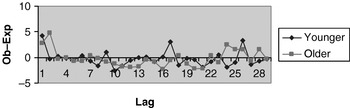
Figure 1 shows data for each of Lags 1–29 for the Younger and Older children, averaged over participants. Gershkoff-Stowe (Reference Gershkoff-Stowe2002) commented on above-chance perseverative error rates for Lags 1, 3, 4 and also 12, and so data for these lags are referred to below. Because there are fewer matching opportunities for the longer lags, the data for each lag are presented as the deviations of observed percentage match rates from expected percentage match rate (observed minus expected), averaged over participants.
Observed minus expected percentage match rate (ob–exp) for Lags 1–29 for the Younger and Older children.

As predicted, there is a high incidence of Lag 1 errors for the Younger group relative to other lag errors. The Older group show average deviations above chance for both Lags 1 and 2. Following Campbell (Reference Campbell1991) and Vitkovitch & Rutter (Reference Vitkovitch and Rutter2000), the Z statistic was used to compare the mean observed match rate against the mean expected match rate for a specific lag (collapsed across participants, with alpha=0·05). This provided a test of the null hypothesis that the observed match rate was sampled from a population of randomly generated match rates. For the Younger group, positive error priming was evident at Lag 1 (Z=4·7, standard deviation for expected rates=0·90) but not at Lag 2 (Z=0·30, SD=0·92)Footnote 1. For the Older group, positive error priming was evident for both Lags 1 (Z=2·01, SD=1·39) and 2 (Z=2·49, SD=1·86). As Figure 1 shows, for both groups, the observed match rate drops to around chance levels for Lags 3 onwards (Z values <1 for Lags 3, 4 and 12). Although there is the occasional larger deviation from chance (e.g. Lag 26 for the Younger group), the differences between observed and expected match rates were not significant (Z=1·54, SD=2·18). Note that these results using the expected match rates from the random re-orderings were confirmed using the binomial model. This procedure involves taking only the errors which refer to animals within the list. For any error, under the null hypothesis of no error priming, there is a 0·0345 (1/29) probability that a match will be found on another trial. Using standard errors based on the binomial model (for further details, see Campbell & Clark, Reference Campbell and Clark1989; Vitkovitch et al., Reference Vitkovitch, Kirby and Tyrrell1996; Kerlinger, Reference Kerlinger1964), positive error priming was evident at Lag 1 for the Younger children, and Lags 1 and 2 for the Older children.
Given that a relatively small proportion of individuals contribute errors to individual lags, the chi-square statistic was used to make comparisons across groups for the short lags. For each group, and for a specific lag, the number of children who either did or did not make an error was noted. For the planned comparison of Lag 1 errors, the proportion of children who made Lag 1 errors was higher for the Younger group (38% of children) as compared to the Older group (18% of children) (χ2=4·01, df=1, p=0·045). There was no difference across groups in the proportion of children making errors relating to Lag 2 (or for Lags 3, 4 and 12; χ2<2, p>0·05; proportion of children making errors 15% or less).
As noted above, for the Younger group, Figure 1 shows that only the Lag 1 errors are clearly above-chance, with approaching half the group contributing errors to this lag. A post-hoc by-participant analysis of the Lag 1 and 2 deviations from chance (observed minus expected rate for each lag for each participant) was significant for the Younger group (t(39)=2·67, p=0·011). The same analysis (confirmed also with non-parametric statistics) was not significant for the Older group (t(39)=0·16, p=0·831; 18% and 15% (different) children contributing to errors at each lag).
Repeated perseverations
We observed that some children repeated the same error several times A post-hoc chi-square analysis of the number of children who either did or did not repeat errors across the two groups revealed a higher incidence in the Younger group (χ2=14·53, p<0·001).
DISCUSSION
The initial by-participants analysis of match rate across Lags 1–29 indicated positive error priming for both groups. In line with the results of Gershkoff-Stowe (Reference Gershkoff-Stowe2002), the lag-by-lag data show that the majority of perseverative errors related to the most recent object naming trials, though for the Older group, a relatively small number of children (18% and 15%) contributed to the above-chance Lags 1 and 2 error rate. Unlike Gershkoff-Stowe, perseverations at Lag 12 were not above-chance. Although Figure 1 shows one or two noticeably above-chance errors relating to longer lags (e.g. Lag 26), these were not significantly so. It is difficult to interpret these unpredicted and isolated data points. Gershkoff-Stowe also reported some incidence of positive error priming from longer lags (e.g. beyond Lag 30) for some of the object stimuli she used. She suggested that this interference may occur from more highly familiar words.
The point of interest for the present study was the incidence of Lag 1 errors. Gershkoff-Stowe (Reference Gershkoff-Stowe2002) found that for both under twos and two-year-olds, errors relating to a Lag of 1 were the most prevalent perseverative response. This was also the case for the Younger children in the current study; the Lag 1 observed match rate was significantly higher than the Lag 1 expected rate, but the Lag 2 match rate was not. A by-participant comparison of deviations from chance for Lag 1 and Lag 2 indicated that the Lag 1 deviations were significantly higher for these young children. Therefore the present study has confirmed the Lag 1 results of Gershkoff-Stowe (Reference Gershkoff-Stowe2002) using different methodology, and with children of average age four.
A second concern of the present study was to examine the incidence of Lag 1 errors across two age groups, and to explore the possible development of an inhibitory process during sequential naming. This interest arose from a study of adult perseverative errors. The adult data contrast with the data from the children. For adults, the incidence of Lag 1 errors during object naming was found to be below-chance (negative error priming), and positive error priming did not emerge until about Lag 4, peaking at around Lag 11 or 12 (Vitkovitch et al., Reference Vitkovitch, Kirby and Tyrrell1996). We suggested that the adult negative error priming was the result of inhibitory processes operating on the most recent response, and that the positive error priming reflected interference due to increased activation levels in earlier responses once the temporary inhibition had dissipated.
Applying the metaphor of activation levels to the children's data, it would appear that for the Younger children, the representations of the most recent response are the most highly activated, and would seem to provide a strong source of lexical competition for a target object. There was also evidence for repeated errors in the Younger group in particular, suggesting competition as a result of an accumulation of activation for particular responses (see also Gershkoff-Stowe, Reference Gershkoff-Stowe2002). These kinds of repeated errors can occur in some adults (Vitkovitch et al., Reference Vitkovitch, Kirby and Tyrrell1996). In contrast to the adult data though, and in agreement with Gershkoff-Stowe (Reference Gershkoff-Stowe2002), increased activation from having just named an object may be relatively short-lived. The data from the Younger children can be interpreted without reference to the suppression of activation in the most recent responses. Is there any evidence that inhibitory processes become evident by the age of six or seven?
Compared to the Younger children, there was a significant reduction in the proportion of Older children demonstrating Lag 1 errors. This was not the case for Lag 2 (note that any reduction in opportunities for Lag 2 relative to Lag 1 errors was equivalent across groups). Could this reduction be due to an inhibitory process? This interpretation of the results would be more convincing if the incidence of Lag 1 errors for the Older children was below-chance, as in the adult data (Vitkovitch et al., Reference Vitkovitch, Kirby and Tyrrell1996), and if positive error priming first emerged at a later lag. Although there is a slight reduction in the Lag 1 match rate relative to Lag 2 for the Older group, a statistical comparison of the deviations from chance for these two lags did not differ significantly. Thus the data from the Older children do not fit comfortably with an emerging inhibitory process.
An alternative interpretation of reduced Lag 1 interference in older children is that retrieval processes for individual target words are strengthened or that there is a general increase in efficiency for the whole system. Gershkoff-Stowe (Reference Gershkoff-Stowe2002) favoured this explanation for the reduction in perseverative errors for the older group of two-year-olds in her study. The overall reduction in all types of errors (see Table 1) in the present study is at least consistent with this. The incidence of both Lag 1 and Lag 2 errors for some of the Older children may reflect the beginnings of longer lasting activation following a single object naming trial, although still less stable than adults, for whom longer lag interference is consistently evident. While on balance the data for the Older children are consistent with an increase in strength of representations for objects, the development of strengthened lexical representations and the development of inhibitory processes are not mutually exclusive. We do not rule out the possibility that any reduction in Lag 1 errors for Older relative to Younger children might reflect the beginnings of inhibitory influences, and further work is required to follow up these preliminary results.
We have interpreted the data in terms of the activation levels of the representations of the objects named, and contrasted the absence of negative error priming and the short-lived nature of the positive error priming effect with the adult data. There are two relevant issues. Gershkoff-Stowe (Reference Gershkoff-Stowe2002) has highlighted the importance of considering speaking rate when interpreting changes in the incidence of perseverative errors across groups of different ages; a slower speaking rate would lead to longer intervals between trials, and so activation in representations used for earlier trials is more likely to have decayed. Although we aimed to keep the methodology of the children's study as similar as possible to the study by Vitkovitch et al. (Reference Vitkovitch, Kirby and Tyrrell1996; see Introduction), the objects themselves were likely to be less familiar to the youngsters and the children may have decreased their speaking rate accordingly (see Gershkoff-Stowe, Reference Gershkoff-Stowe2002). It is also the case that inevitably with very young children there are unexpected events, such as occasional interjections between trials, and they are less likely than older children and adults to adhere to the speeded nature of the task throughout the session. Therefore, despite attempts to keep the response stimulus interval brief, a number of intervals between trials may have been longer than those used in the original adult study, which used intervals of 7 or 4 seconds, following Campbell & Clark (Reference Campbell and Clark1989).
Interestingly, in a later study with adults in which the interval between related stimuli was increased to as much as 16 seconds (Vitkovitch & Rutter, Reference Vitkovitch and Rutter2000), we found that Lag 1 errors became the most frequent response. We interpreted this as an indication that the inhibitory influences that were apparent in the original short interval study (Vitkovitch et al., Reference Vitkovitch, Kirby and Tyrrell1996) had dissipated over the longer 16 seconds, exposing the most recent response as the most highly activated. Perhaps for the Younger group of children in the current study, the intervals between stimuli, while not 16 seconds, were too long to expose a brief inhibitory capability and long lag positive error priming. By contrast, a slightly faster speaking rate in the Older group of children could expose any such rudimentary inhibitory influence, and could account for Lag 2 errors; activation in these earlier object representations may not have decayed.
We think it unlikely that differences in speaking rate can account entirely for differences between adults' and children's data and between the two groups of children. Even with a 16-second interval between trials, positive error priming at long lags (e.g. Lags 6–12) was above-chance for the adults (Vitkovitch & Rutter, Reference Vitkovitch and Rutter2000). It is at least reasonable to expect developmental differences in the stability of activation and the efficiency of a lexical retrieval system, and the general reduction in error rate in the Older group of children relative to the Younger group of children does fit with a gain in efficiency of lexical retrieval. However, subsequent studies of developmental changes in lexical retrieval, competition effects and decay rates would benefit from the control and manipulation of the time between successive stimuli using computerized presentation, which may be possible with the older children at least.
The second issue we raise is whether the Lag 1 errors could reflect a strategic process rather than a genuinely competitive lexical process. Children on occasion may simply repeat the most recent responses in order to provide the experimenter with an answer when they do not know a name. This could account for the high incidence of Lag 1 responses in the Younger group. However, as we have noted, the Lag 1 data for the Younger group resemble the results of Gershskoff-Stowe (Reference Gershkoff-Stowe2002), and in her second study, parents report that children knew all the objects in one set of materials. Furthermore, a very recent study by Gershkoff-Stowe, Connell & Smith (Reference Gershkoff-Stowe, Connell and Smith2006), published since collection of the current data, is relevant. Gershkoff-Stowe et al. used a priming paradigm to elicit perseverative target naming errors in two- and four-year-olds, manipulating the familiarity of target objects. They provided evidence from the error data that the representations of visually similar primes competed with target representations, and that a competitive lexical retrieval process, akin to that evident in adults, was in place for both known and unknown objects. In the current study, the animal stimuli shared visual features and therefore it seems reasonable to argue that, rather than reflecting a strategic response, Lag 1 errors are due to a competitive lexical process, based on re-activation of visually similar representations on viewing the target.
To summarize, the current experiment confirms that when naming a sequence of objects, the errors of young children frequently relate to the immediately preceding trial. Our study has extended the Lag 1 findings of Gershkoff-Stowe (Reference Gershkoff-Stowe2002) to four-year-olds. Unlike four-year-olds, seven-year-olds do not show a specific increase in Lag 1 errors relative to Lag 2 errors. For both groups of children, positive error priming appears to be mainly limited to short lags, suggesting short-lived competition from earlier named objects. Relative to four-year-olds, there is some preliminary evidence for a reduction in the proportion of seven-year-olds making Lag 1 errors. This could be due to an immature inhibitory process or strengthened lexical retrieval processes. The data do contrast with the clearer evidence for excitatory and inhibitory processes in adults, and further work is required to track the patterns of perseverative errors across different age groups.