I. INTRODUCTION
High damping (internal friction) materials are widely used to reduce vibration and noise in modern industries and transportation. Among all commercial metallic materials, pure magnesium and its alloy exhibit excellent damping capacity; as such, these materials have been extensively studied. Reference Ding, Wu, Zeng, Peng, Yuan and Lin1 However, Mg alloys with high damping capacity are characterized by limited applications because of poor mechanical properties. Reference Wang, Wu, Gao, Lu, Qin, Yang and Pan2 Thus, novel Mg alloys simultaneously exhibiting excellent comprehensive damping and mechanical properties should be investigated.
In the existing research, Mg–RE–Zn alloys have been largely reported to exhibit particular phase structure and excellent mechanical properties. Reference Shao, Yang and Ma3,Reference Hagihara, Kinoshita, Sugino, Yamasaki, Kawamura, Yasuda and Umakoshi4 Three kinds of ternary equilibrium Mg–Zn–Y phases, namely, I-phase (Mg3YZn6), the W-phase (Mg3Y2Zn3), and the X-phase (Mg12YZn), are found to in this alloy system by adjusting Y/Zn atomic ratio. Reference Lee, Kim, Kim, Lim and Kim5,Reference Luo, Tang, Pan, Song and Wang6 The influences of I-phase on the mechanical properties and damping capacity of Mg–Zn–Y alloy system have been widely reported. Reference Somekawa, Watanabe and Mukai7,Reference Ma, Dong, Yan, Chen, Li, Pan, Ling and Fan8 Furthermore, Feng et al. Reference Feng, Yang and Chang9 investigated the effects of W-phase on damping and mechanical properties of Mg–Zn–Y–Nd–Zr alloys. However, the effects of X-phase [long-period stacking ordered (LPSO) phase] on the damping behavior and mechanical properties of Mg–Zn–Y alloy have been rarely explored. In recent study, the LPSO phase or X-phase can effectively and simultaneously improve the damping and mechanical properties of Mg alloy, this breaks the contradiction between damping capacities and mechanical properties. Reference Wang, Lu, Wei, Huang and Pan10 In addition, Zhang et al. Reference Zhang, Liu, Hu, Li, Le, Bao, Zhu and Cui11 found that the phase constituents are α-Mg and LPSO phase (Mg12YZn) when the mole ratio of Y to Zn is approximately 1.32 in Mg–Zn–Zr–Y alloys. Over the past decade, Mg97Zn1Y2 (at.%) alloy with LPSO phase has been extensively investigated; this alloy exhibits excellent mechanical properties, with yield strength (YS) of >600 MPa and an elongation of 5% at room temperature. Reference Kawamura, Hayashi, Inoue and Masumoto12 The alloy with Y/Zn atomic ratio of 2/1 is one of the most investigated Mg–Zn–Y alloys with an LPSO phase so far. In previous research, Mg–Ni–Y alloys with an LPSO phase exhibited a high damping capacity (Q−1 > 0.1) at strains exceeding 1 × 10⁻³ when Y/Ni atom ratio is 3/2. Reference Qin, Wang, Chen, Lu and Pan13 Nevertheless, to date, the effects of LPSO phase with different Y/Zn atomic ratios on Mg–Zn–Y alloys have not been systematically investigated. Therefore, this study aimed to enhance the understanding of the damping and mechanical properties of Mg–Zn–Y alloys with LPSO phase at different Y/Zn atomic ratios.
In this study, three kinds of Mg–Zn–Y alloys with the LPSO phase structure at different Y/Zn atomic ratios were prepared. The damping behavior and mechanical properties of as-cast and as-extruded Mg–Zn–Y alloys have been discussed in depth. This study is aimed to develop a magnesium alloy with the excellent comprehensive damping and mechanical properties.
II. EXPERIMENTAL PROCEDURES
Mg–Zn–Y alloys with different Y/Zn atomic ratios (2/1, 3/2, or 4/3) were prepared from commercially pure Mg (99.99 wt%), pure Zn (99.99 wt%), and Mg–24.43 wt% Y master alloy. Experimental alloys were stored in a steel crucible (Φ89 mm × 250 mm), which were melted in a resistance furnace and protected by an Ar atmosphere. Table I lists the actual chemical compositions of the studied alloy ingots analyzed using an XRF-800 CCDE X-ray fluorescence spectrometer (Shimadzu, Kyoto, Japan). The ingots were homogenized at 500 °C for 10 h followed by the air cooling. Next, the alloy ingots were extruded at 400 °C with an extrusion ratio of 25 and a speed of 5 mm/s after the ingots were heated to 350 °C for 1 h. Extrusion was conducted using a XJ-500 horizontal extrusion machine (Weite Machinery, Wuxi, China).
Chemical compositions of Mg–Zn–Y alloys.

An Axiovert40MAT optical metallographic microscope (Carl Zeiss, Jena, Germany) and a TESCAN VEGAII scanning electron microscope (SEM; Brno, Czech Republic) equipped with an INCA Energy 350 energy dispersive X-ray spectrometer (EDS) were used to investigate the microstructure of the experimental alloys. The compositions of the phases were analyzed through Rigaku D/max 2500PC X-ray diffraction (XRD; Tokyo, Japan) with Cu Kα radiation. The type and structure of alloy phase were further investigated in detail by using a Zeiss Libra Transmission Electron Microscope (TEM; Carl Zeiss, Jena, Germany) 200FE at an accelerating voltage of 200 kV. The room temperature mechanical properties of the studied alloys were measured by a NEW SANSI CMT-5105 computer-controlled electronic universal tester (MTS Systems Corp., Eden Prairie, Minnesota). The damping capacities of specimens were machined to the dimensions of Φ2 mm × 30 mm by using an electric spark cutter. Damping capacity was deduced from internal friction measurements performed in a high-amplitude torsion pendulum (MFP-1000; Institute of Solid State Physics, Chinese Academy of Sciences, Hefei, China). Tests were performed at strain amplitudes (ε) ranging from 1 × 10⁻⁵ to 3 × 10⁻³ at room temperature with a vibration frequency (f) of 1 Hz to determine the dependence of damping capacity on strain. Temperature-dependent damping tests were performed with the following parameters: the strain amplitude was 3 × 10⁻⁴, the frequency was set to 1 Hz, the temperature range was about 25 °C to 400 °C and the heating rate was 3 °C/min.
III. RESULTS AND DISCUSSION
A. Microstructures of Mg–Zn–Y alloys
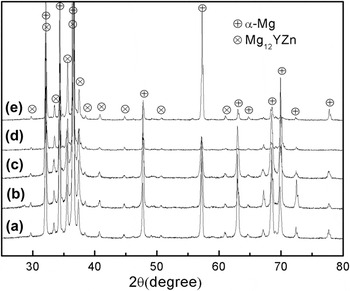
Figure 1 shows the XRD patterns of the as-cast experimental alloys. It is observed from Fig. 1 that the five Mg–Zn–Y alloys are mainly composed of α-Mg and Mg12YZn phases, which have been reported in detail in Luo et al. Reference Luo, Tang, Pan, Song and Wang6 Figure 1 also illustrates that the second phase is the LPSO (Mg12YZn) phase rather than W-phase or I-phase regardless of Y/Zn atomic ratio in these alloys. This result differs from that in others studies, which showed that the phase constituent of Mg–Zn–Y alloys closely depends on Y/Zn ratio of alloys. Reference Zhang, Liu, Hu, Li, Le, Bao, Zhu and Cui11,Reference Huang, Liang, Chen and Han14 In addition, the formation mechanism of LPSO in the present Mg–Zn–Y alloys is possibly attributed to that unit cell is composed of six close-packed planes of the magnesium crystal with a stacking sequence is significantly enriched by Zn and Y. Reference Zhu, Morton and Nie16
XRD patterns of the as-cast Mg–Zn–Y alloys: (a) alloy 1; (b) alloy 2; (c) alloy 3; (d) alloy 4; and (e) alloy 5.

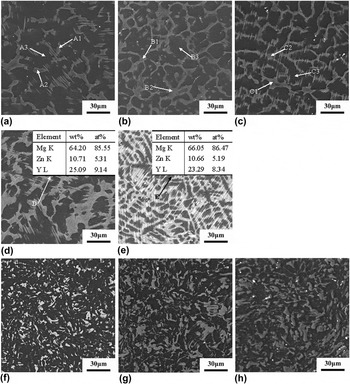
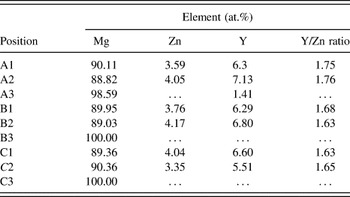
The SEM microstructures of the as-cast Mg–Zn–Y alloys are shown in Figs. 2(a)–2(e). From the images it can be seen that the five alloys are mainly composed of a matrix of equiaxed dendrites of α-Mg and secondary phases. Combined with XRD results, the main intermetallic compound in Figs. 2(a)–2(e) is identified as the LPSO phase. It is also shown that the dendrite sizes of the first three alloys orderly decrease as the formation of the LPSO phase increases. This result indicated that different Y/Zn atomic ratios greatly affect the morphological characteristics of α-Mg matrix. Furthermore, the microstructural morphological characteristics of the as-cast alloys are almost similar at different Y/Zn atomic ratios. This finding may be mainly attributed to the formation of the same LPSO phase in the five alloys. Thus, this paper mainly investigated the alloy1, alloy 2, and alloy 3. The actual volume fraction of the LPSO phase of alloys 1, 2, and 3 are roughly 17.51, 21.83, and 22.94%, respectively by using image processing software from microstructure of the alloys. Figures 2(f)–2(h) display the SEM microstructures of the as-extruded Mg–Zn–Y alloys. It suggests that the original block and the lamellar LPSO phase have been destroyed and uniformly distributed in the α-Mg matrix. In addition, grain sizes of as-extruded alloys are considerably smaller than those of their corresponding as-cast alloys. This result illustrates that dynamic recrystallization occurs during hot extrusion. Reference Inoue, Kawamura and Matsushita15 The EDS results of corresponding positions in Figs. 2(a)–2(c) are shown in Table II. In Fig. 2(a), points A1 and A2 correspond to the Mg12YZn phase, and point A3 corresponds to the α-Mg matrix. EDS did not identify specific phases in Figs. 2(b) and 2(c), the compound phases are consistent with the XRD results. To sum up, phase compositions in as-cast alloys are identified as α-Mg and LPSO phase from Figs. 1 and 2, and Table II.
Microstructures of as-cast alloys: (a) alloy 1; (b) alloy 2; (c) alloy 3; (d) alloy 4; (e) alloy 5 and as-extruded alloys: (f) alloy 1; (g) alloy 2; (h) alloy 3.

EDS results of the corresponding positions in Figs. 2(a)–2(c).

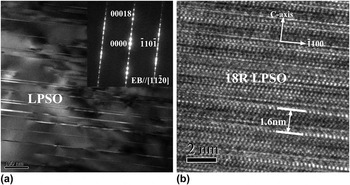
To further investigate the LPSO phase structure with different Y/Zn atomic ratios, it is necessary to detect whether the LPSO phase exhibits unique morphological characteristics and type in as-cast Mg–Zn–Y alloys. The bright-field TEM image of the as-cast alloy 2 and the corresponding selected area electron diffraction (SAED) patterns recorded along the
 $\left[ {11\overline 2 0} \right]$
direction of the selected region are shown in Fig. 3(a). It can be found that there is only one LPSO phase structure. Moreover, the SAED pattern shows periodic extra weak spots at positions n/6, where n is an integer, so the LPSO phase is identified as the 18R phase. The corresponding high resolution electron microscopy (HREM) image in Fig. 3(b) shows a period fringe spacing of 1.6 nm. This 18R structure is adequately discussed in Mg–Zn–Y alloy, reported by Zhu et al.
Reference Zhu, Morton and Nie16
In addition, several research results show that the LPSO phase structure of 18R-type is existed in the cast Mg–Zn–Y alloy with a Y/Zn atomic ratio of 2/1 or 4/3.
Reference Zhang, Liu, Hu, Li, Le, Bao, Zhu and Cui11,Reference Tang, Wu, Tang, Wang, Peng and Ding17
Therefore, as-cast Mg–Zn–Y alloys with different Y/Zn (2/1, 3/2 or 4/3) atomic ratios exhibit the same stable type of LPSO phase structure, i.e. 18R-type.
(a) TEM image and (b) the corresponding HREM image of as-cast alloy 2.

B. Mechanical properties of Mg–Zn–Y alloys
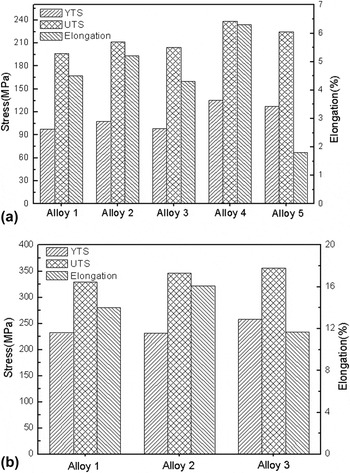
The comparison results of the mechanical properties of the as-cast Mg–Zn–Y alloys with different Y/Zn atomic ratios are demonstrated in Fig. 4(a). It clearly indicates that the as-cast alloys with 3/2 atomic ratio yields the highest mechanical properties, and the other cast alloys cannot be distinguished. And the mechanical properties of the alloy with 3/2 ratio increases as increasing the amount of the LPSO phase. The tensile properties of as-extruded Mg–Zn–Y alloys at room temperature are shown in Fig. 4(b). It can be followed that the as-extruded alloy with 3/2 atomic ratio exhibits good comprehensive mechanical performances, particularly YS, ultimate tensile strength (UTS), and elongation of 233 MPa, 346 MPa, and 16.1%, respectively. And then, in the three studied alloys with a decreasing Y/Zn atomic ratio, its volume fraction of the LPSO phase and tensile strength increase. The YS and UTS of the as-extruded MgZn1.5Y2 are raised to 258 and 356 MPa, respectively, but its elongation decrease to 11.7%. Among the alloys, the extruded alloy with 2/1 atomic ratio exhibits the weakest tensile properties.
Mechanical properties of Mg–Zn–Y alloys with different Y/Zn atomic ratio: (a) as-cast and (b) as-extruded.

It is clarified in Fig. 4(a) that the mechanical properties of the three as-cast Mg–Zn–Y alloys are not evidently different because these alloys exhibit similar microstructures and display the same type of LPSO phase structure. Compared with the mechanical properties of as-cast alloys, the mechanical properties in as-extruded alloys in Fig. 4(b) are remarkably enhanced. According to the Hall–Petch relation, Reference Zhang, Wang, Du, Liu and Li18 the YS can be enhanced through grain refinement. The existence of the LPSO phase strongly enhances the refinement of Mg matrix grains after extrusion; these fine grains are contributed to improve mechanical properties. In addition, LPSO phases with plate-like shapes are aligned and distributed along the extrusion direction, which could be considered to the fiber strengthening in composite materials. Such LPSO phases likely hinder the movement of dislocations and enhance the strength of the studied alloys. Among the mechanical properties of the three as-extruded alloys, the strength increases is possibly attributed to the volume fraction of the LPSO phase increases, which is usually regarded as second-phase strengthening. What's more, a further change in Y/Zn atomic ratio results in a decrease in elongation owing to the suppression of the dislocation movement.
C. Damping capacities of Mg–Zn–Y alloys
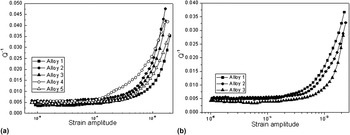
The damping capacities of as-cast Mg–Zn–Y alloys as a function of varying strain amplitudes from 6 × 10⁻⁶ to 3 × 10⁻³ are shown in Fig. 5(a). It is apparent that damping capacities depending on strain amplitude can be divided into two parts. In the first part at low strain amplitude, strain amplitude slightly affects damping value, and the damping capacities of the studied alloys are very low. However, in the second part, the damping capacities of alloys strongly depend on strain amplitude; as strain amplitude exceeds a critical value, damping capacity rapidly increases. Through calculating the average damping value near the turning point of the curve, the corresponding critical strain values of as-cast alloys 2, 3, and 1 are 6 × 10⁻⁴, 7 × 10⁻⁴, and 9 × 10⁻⁴, respectively. Among the studied alloys, the alloys with 3/2 (Y/Zn) atomic ratio yields the highest damping capacity in low and high strain amplitude stages [Fig. 5(a)]; the alloy with 2/1 atomic ratio exhibits the least damping capacity. Additionally, the alloys with 4/3 atomic ratio presents moderate damping capacity. Figure 5(b) illustrates the strain amplitude-dependent damping capacities of as-extruded Mg–Zn–Y alloys at room temperature. This result suggests that damping capacities of as-extruded alloys differ from those of as-cast alloys [Fig. 5(a)]. The alloy with 2/1 atomic ratio exhibits the highest damping capacity in a high-strain amplitude stage; by contrast, the alloy with 3/2 atomic ratio displays a slightly more efficient damping capacity than other alloys in a low-strain amplitude stage. Meanwhile, the alloy with 4/3 atomic ratio presents the lowest damping value in low- and high-strain amplitude stages.
Strain amplitude-dependent damping capacities of Mg–Zn–Y alloys at room temperature: (a) as-cast and (b) as-extruded (f = 1 Hz).

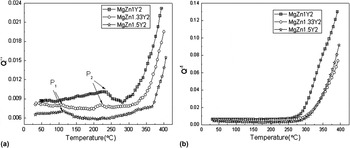
Figure 6 shows the relationship between damping capacities and temperature of as-cast and as-extruded Mg–Zn–Y alloys measured at a constant strain of 3 × 10⁻⁴, a heating rate of 3 °C/min, and a vibration frequency of 1 Hz. Figure 6(a) indicates that the presence of a damping peak P in alloy 1 and alloy 3 at 235 and 112 °C, respectively. Two damping peaks are found in the alloy with 3/2 atomic ratio at 108 and 220 °C. These peaks have been commonly observed in Mg alloys with high damping capacities. Reference Hu, Wu and Zheng19 According to some related studies, Reference Hu, Wu, Zheng, Gan and Wang20–Reference Chowdhury, Mari and Schaller22 when the temperature of damping peak is about 100 °C, it is generally called the dislocation peak (P 1). When the temperature of damping peak is approximately 200 °C, it is named the grain boundary peak (P 2). Hence, the damping peak of the as-cast alloy with 2/1 atomic ratio is the grain boundary peak, the damping peak of the as-cast alloy with 4/3 atomic ratio is the dislocation peak, and the alloy with 3/2 atomic ratio is characterized as a dislocation peak and grain boundary peak. As can been seen in Fig. 6(a), when temperature is lower than 325 °C, the damping capacities of these Mg–Zn–Y alloys are independent of the temperature, and damping values decrease as Y/Zn atomic ratio decreases. When temperature is higher than 325 °C, the damping capacities of the experimented alloys rapidly increase as temperature increases. Figure 6(b) suggests that the damping capacities of the as-extruded alloys are almost the same, and no damping peaks are detected when temperature is lower than 300 °C. When temperature is higher than 300 °C, the damping value monotonically increases as temperature increases; these as-extruded alloys also possess a high damping background.
Temperature-dependent damping capacities of Mg–Zn–Y alloys at ε = 3 × 10⁻⁴ and f = 1 Hz: (a) as-cast and (b) as-extruded.

Damping capacities of as-extruded alloys are lower than those of as-cast alloys [Figs. 5(a) and 5(b)]. Figures 6(a) and 6(b) illustrates that as-extruded Mg–Zn–Y alloys exist a high damping background and do not contain damping peaks, while the as-cast Mg–Zn–Y alloys contain damping peaks.
In general, many factors, including the interactions between dislocations and point defects (impurity atoms, vacancies, and second-phase particles, among others), contribute to damping capacities of Mg and its alloy. Studies on Mg alloys have shown that dislocation damping is the main damping mechanism. Reference Wan, Wang, Wang and Yang23,Reference Jun24 According to the classic Granato–Lücke (G–L) model, Reference Granato and Lucke25,Reference Granato and Lucke26 the damping (Q−1) can be described as follows:
 $${Q^{ - 1}}\left( \varepsilon \right) = Q_{\rm{0}}^{ - 1} + Q_{\rm{h}}^{ - 1}\left( \varepsilon \right)\quad ,$$
 $$Q_{\rm{0}}^{ - 1}\sim\rho L_{\rm{C}}^4\quad ,$$
 $$Q_{\rm{h}}^{ - 1} = {{{C_1}} \over \varepsilon }\exp \left( { - {{{C_2}} \over \varepsilon }} \right)\quad ,$$
 $${C_1} = {{\rho {F_{\rm{B}}}L_{\rm{N}}^3} \over {6bEL_{\rm{C}}^2}},\quad {C_2} = {{{F_{\rm{B}}}} \over {bE{L_{\rm{C}}}}}\quad ,$$
where
 $Q_0^{ - 1}$
and
 $Q_{\rm{h}}^{ - 1}$
are strain-amplitude independent damping and dependent damping, respectively; ρ and L
C are the dislocation density and the average distance between weak pining points, respectively; F
B, L
N, E, and b are the binding force between dislocations and solute atoms, the average distance between strong pining points, the elastic modulus, and the Burgers vector, respectively. Then, F
B/bE slightly changes as Y/Zn atomic ratio decreases due to the unique phase composition and similar grain sizes in alloys. Hence, Eq. (3) can be altered and simplified as follows:
 $${\rm{ln}}\left( {\varepsilon Q_{\rm{h}}^{ - 1}} \right) = {\rm{ln}}{C_1} - {{{C_2}} \over \varepsilon }\quad ,$$
 $${C_1}\sim{{\rho L_{\rm{N}}^3} \over {L_{\rm{C}}^2}},\quad {C_2}\sim{1 \over {{L_{\rm{C}}}}}\quad .$$
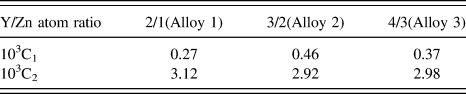
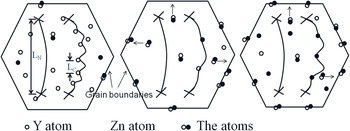
The values of the parameters of Mg–Zn–Y alloys according to Eq. (5) are shown in Table III. It suggests obviously that the as-cast alloy with 3/2 atomic ratio owns a higher value of C1 and a lower value of C2 than other alloys. Meanwhile, C2 is related to the weak points mainly influenced by solid solution atoms from Eq. (6). Hence, the as-cast alloy with 3/2 atomic ratio possesses the fewest amounts of solid solution atoms. As illustrated in Fig. 7, the number of Y atoms decreases and the number of Zn atoms increases in a matrix with decreasing Y/Zn atomic ratios. Moreover, the alloy with 3/2 atomic ratio relatively contains the fewest solute atoms and the largest L C because Y and Zn atoms are combined and placed in proximity to grain boundaries. Combined with the TEM images, as-cast Mg–Zn–Y alloys with different Y/Zn atomic ratio are composed of the same type of LPSO phase structure. Therefore, it can be assumed that the impurity atoms are possibly the main factor affecting the damping capacity of the studied alloys. As discussed above, it is demonstrated in Fig. 5(a) that the as-cast alloy with 3/2 atomic ratio exhibits the better damping value in low- and high-strain amplitude stages because of a larger L C value, a higher value of C1 and a lower value of C2 than other alloys. In addition, the effect of LPSO phase on damping capacities of Mg–Zn–Y alloys may be explained by the following aspects. For one thing, the formation of LPSO phase of Mg–Zn–Y alloys cause a decrease in the amount of solute atoms and add to the interaction between the dislocation and point obstacles, which maybe induce friction in releasing additional energy, thereby contributing positive effects on the internal friction of the alloys. For another, the difference of thermal expansion coefficient between LPSO phase and α-Mg matrix may cause the generation of long and parallel dislocations from our previous study. Reference Wang, Lu, Wei, Huang and Pan10 These long dislocations are likely to move in response to stress and thus play a key role in energy dissipation in the damping process. What's more, the LPSO phase, which also maybe resembles a rough fiber, shows more interfaces with the matrix and moves back and forth more easily to comply with the vibration stress. The previous studies Reference Wang, Lu, Wei, Huang and Pan10,Reference Qin, Wang, Chen, Lu and Pan13 show that the LPSO phase structure is also conducive to damping capacities, which can explain the damping capacity of the alloy with 4/3 atomic ratio is close to that of alloy 2 due to the slightly increase of the content of LPSO phase. Moreover, the lower damping capacity of as-extruded alloys is attributed to the dislocation tangles formed during extrusion. From Fig. 5(b), the as-extruded alloy 1 exhibited the highest internal friction at the high-strain amplitude stage possibly due to the fewest strong pinning points by grain boundaries and second phase.
Values of the parameters of Mg–Zn–Y alloys with different Y/Zn atomic ratios.

Schematic illustration of the solid solution atoms distribution in Mg–Zn–Y alloys with different Y/Zn atomic ratios: (a) 2/1; (b) 3/2; and (c) 4/3.

The damping peaks of the as-cast Mg–Zn–Y alloys as shown in Fig. 6(a) are similar to those detected in other as-cast Mg alloys. Reference Hu, Zhang, Zheng and Wu27 The grain boundary peak of the as-cast alloy with 2/1 atomic ratio is attributed to the aggregation of fewer atoms at grain boundaries that alloy easy sliding at a low vibration strain of 3 × 10⁻⁴ at this temperature. The dislocation peak of the as-cast alloy with 4/3 atomic ratio is attributed to the free movement of dislocations in α-Mg phase while the more second phase aggregates at grain boundaries and make them difficult to slide. The as-cast alloy with 3/2 atomic ratio displays P1 and P2 damping peaks due to few solid solution atoms in Mg matrix and grain boundaries. This result is well coincided with previously discussed findings. Damping peaks in as-extruded alloys from Fig. 6(b) are not observed possibly due to the following two reasons. On the one hand, the severely broken LPSO phase structure impedes the movement of dislocation after extrusion, which suppressing the appearance of peak P1. On the other hand, the obvious reduction of grain size after extrusion greatly deteriorates the slipping of grain boundary, which hampering the appearance of P2 peak.
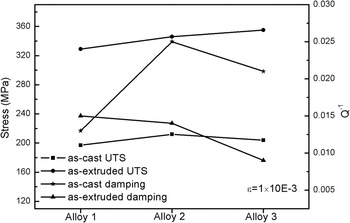
The comprehensive comparison results of the damping capacities and mechanical properties of alloys prepared at different Y/Zn atomic ratio is demonstrated in Fig. 8. It suggests that the studied alloy with 3/2 atomic ratio exhibits excellent comprehensive properties both in as-cast and as-extruded states, which possesses a UTS of 346 MPa and still remains a certain damping capacity (Q−1 > 0.01) in extrusion. Indeed, the usually contradiction of damping capacities and mechanical properties is possibly addressed. This result may be attributed to the following reasons. On the one hand, the alloy with 3/2 atomic ratio contains less solute atoms, which shows excellent internal friction according to G–L theory. On the other hand, the alloy with 3/2 ratio has the middle content of LPSO phase, the strength increases is possibly attributed to the volume fraction of the LPSO phase increases, which is usually regarded as second-phase strengthening. The elongation of alloys decreases owing to the increase of LPSO phase contents suppress the dislocation movement. So the alloy with 3/2 ratio exhibited good comprehensive mechanical properties. In addition, the formation of LPSO phase of Mg–Zn–Y alloys cause a decrease in the amount of solute atoms and add to the interaction between the dislocation and point obstacles, which maybe induce friction in releasing additional energy, thereby contributing positive effects on the internal friction of the alloys. And the alloy with 3/2 ratio possesses near volume fraction of the LPSO phase of the alloy with 4/3 alloy, which shows the close strength. Consequently, the studied alloy with 3/2 atomic ratio exhibited excellent comprehensive damping and mechanical properties. However, the two other alloys exhibit relatively poor comprehensive performances. To sum up, tailoring of the Y/Zn atomic ratios in Mg–Zn–Y alloys may be an important approach for obtaining the balanced optimization of damping and mechanical properties. It is potentially hoped that the results will contribute to the basis of high strength and high damping structural material designs of magnesium alloys for antivibration and noise-reduction applications.
Comprehensive performances of Mg–Zn–Y alloys with different Y/Zn atomic ratios.

IV. CONCLUSIONS
In summary, the damping and mechanical properties of as-cast and as-extruded Mg–Zn–Y alloys with an LPSO structure at different Y/Zn atomic ratios have been investigated. Three main conclusions can be drawn as follows:
-
(1) The investigated Mg–Zn–Y alloys are mainly composed of α-Mg and Mg12YZn phases regardless of Y/Zn atomic ratio. As-cast Mg–Zn–Y alloys with different Y/Zn (2/1, 3/2, or 4/3) atomic ratios exhibit the same stable type of LPSO phase structure, i.e. 18R-type.
-
(2) Among the studied alloys, the alloy with 3/2 (Y/Zn) atomic ratio yields the highest damping capacity both in low and high strain amplitude stages. Two damping peaks (P 1 and P 2) are detected in the Mg–Zn–Y alloy with 3/2 atomic ratio at approximately 108 and 220 °C, respectively. These results may be mainly attributed to the few solute atoms in Mg matrix and grain boundaries.
-
(3) Extrusion significantly improves the mechanical properties of Mg–Zn–Y alloys. This improvement is mainly attributed to dynamic recrystallization and dispersion strengthening. Then, the studied alloy with 3/2 atomic ratio exhibits excellent comprehensive properties in as-cast and as-extruded states, which displays a UTS of 346 MPa and maintains a certain damping capacity (Q−1 > 0.01) in extrusion.
ACKNOWLEDGMENTS
The authors are grateful for the financial support from the State Key Laboratory of Mechanical Transmission—Chongqing University (Grant No. SKLMT-ZZKT-2012 MS), the National Natural Science Foundation Commission of China (Grant No. 51271206), and the foundation support of the Key Laboratory of Science and Technology on High Energy Laser, CAEP.