




No CrossRef data available.
Article contents
Maternal depressive symptoms and child sleep: Models of mutual influence over time
Published online by Cambridge University Press: 10 February 2006
Abstract
The aim of the research was to test hypotheses concerning the associations between maternal depressive symptoms and child sleep using longitudinal data to examine possible predictive pathways. Data from the National Institute of Child Health and Human Development Study of Early Child Care with 1222 children studied from 1 to 36 months of age were analyzed to examine: effects on trajectories over time, and phase-specific effects over three defined age periods (6 to 15, 15 to 24, and 24 to 36 months). Child sleep was found to influence maternal depressive symptoms only for the 15- to 24-month age period, where, contrary to expectation, longer duration of child awakenings predicted decreased maternal depressive symptoms. Maternal depressive symptoms were found to predict an increased frequency of child awakenings across the 15- to 24-month age period only. In contrast, maternal depressive symptoms were found to significantly predict increased duration of child awakenings both for the 3-year trajectory and across the 15- to 24- and 24- to 36-month age periods. Additional research is needed to clarify the mechanisms by which maternal depressive symptoms predict increased duration of child awakenings.
This study was conducted by the NICHD Early Child Care Research Network supported by NICHD through a cooperative agreement that calls for scientific collaboration between the grantees and the NICHD staff. This research was also supported by NIMH Scientist Award for Clinicians MH01532, NIMH R01 MH065938, and National Association for Research in Schizophrenia and Depression grants to the first author (S.L.W.).
Information
- Type
- Research Article
- Information
- Copyright
- © 2006 Cambridge University Press
How a child sleeps not only influences family life, but also can shape other aspects of the child's development. Inadequate sleep has been shown to result in alterations of affect and attention (Dahl, 1996). Children's sleep differences have also been associated with cognitive, language, and behavior problem outcomes (Dearing, McCartney, Marshall, & Warner, 2001; Gregory & O'Connor, 2002).
Previous research has identified associations between maternal depressive symptoms and child sleep. Newborn and 1-month infants of depressed mothers have been found to show more indeterminate sleep than controls (Jones et al., 1998; Jones, Field, Fox, Lundy, & Davalos, 1997). More bedtime problems and daytime sleepiness have been identified in 2- to 4-year-old children of parents with depressive symptoms and/or anxiety than in children of parents without psychopathology (Seifer, Sameroff, Dickstein, Hayden, & Schiller, 1996; Yamada & Dawson, 1997). A number of other studies have reported significant associations between maternal depressive symptoms and child sleep difficulties (Gelman & King, 2001; Hiscock & Wake, 2001; Lozoff, Wolf, & Davis, 1985; Richman, 1981; Stoléru, Nottelmann, Belmont, & Ronsaville, 1997; Van Tassel, 1985; Zuckerman, Stevenson, & Bailey, 1987).
Although significant associations between maternal depressive symptoms and child sleep have been identified, the possible predictive pathways have not been clarified. Two hypotheses have been proposed: child sleep disturbances could contribute to maternal depressive symptoms, or maternal depressive symptoms could contribute to child sleep disturbances (Gelman & King, 2001; Hiscock & Wake, 2001). Previous research has not provided definitive support for either of these two hypotheses.
In support of the first hypothesis, two uncontrolled studies found significant reductions in maternal depression after treatment of children's sleep problems (Armstrong, Van Haeringen, Dadds, & Cash, 1998; Leeson, Barbour, Ray, & Warr, 1994). Similarly, in a controlled intervention trial with a longer follow-up period, Hiscock and Wake (2002) reported significant reductions in both maternal depression and infant sleep problems 2 months after administering a treatment for child sleep problems. After 4 months, only a reduction in maternal depression was evident (Hiscock & Wake, 2002).
In terms of the second hypothesis, researchers have suggested that maternal depression might contribute to child sleep problems through biological or social mechanisms (Gelman & King, 2001; Seifer et al., 1996). Mothers with depression have been described as displaying different types of parenting behaviors with their children than parents without psychopathology (Cicchetti & Toth, 1995; Field, 1995; Weinberg & Tronick, 1998b). For example, depressed mothers have been seen to spend less time positively interacting with their children and to show more inconsistent and ineffective child management strategies than nondepressed parents (Cicchetti & Toth, 1995; Field, 1995; Zahn-Waxler, Iannotti, Cummings, & Denham, 1990). Moreover, disturbances in parent–child relationships have been shown to play a role in the development of sleep disorders for some children (Goodlin-Jones & Anders, 2001). Thus, maternal depressive symptoms could contribute to later child sleep problems through differential parenting behaviors focused on sleep-related activities.
Researchers have also speculated that a common biological diathesis could underlie both depression and sleep difficulties (Seifer et al., 1996), causing both to occur together. Thus, the relation between maternal depressive symptoms and child sleep difficulties could be coincidental and not causal.
The primary aim of this research was to examine the relations of maternal depressive symptoms and child sleep across time to test whether child sleep difficulties could be contributing to the maternal depressive symptoms or whether maternal depressive symptoms could be contributing to child sleep difficulties. The plan was thus to conduct analyses that simultaneously predicted maternal depressive symptoms and child sleep outcomes from earlier maternal depressive symptoms and child sleep outcomes, in order to control for the other variables. Analyses were conducted over time to examine possible predictive pathways. Two different time-based approaches were planned: one to examine changes in trajectories over the first 3 years of life (“trajectory model”), and one to study phase-specific effects over defined 9–12 month time periods (“phase-specific model”).
For the trajectory model, it was hypothesized that if the mother had elevated depressive symptoms early in the child's life, this could result in greater sleep problems for the child not only at that time, but could also affect the trajectory of sleep problems throughout toddlerhood. The modeling simultaneously tested the other possibility that early infant sleep problems led to a trajectory of elevated maternal depressive symptom levels throughout the child's first 3 years of life.
In the phase-specific approach, the focus was instead on three phase-specific age periods to examine whether the effects of sleep problems and maternal depressive symptoms diverged across differing age epochs. The first phase-specific age period, 6 to 15 months, has been described as a time for increasing biological regulation, development of harmonious dyadic interactions, and formation of an effective attachment relationship (Sroufe & Rutter, 1984). The second phase-specific age period, 15 to 24 months, has been portrayed as a time of exploration, experimentation, and mastery of the object world for the child, in addition to the beginning of individuation and autonomy (Sroufe & Rutter, 1984). The third phase-specific age period, 24 to 36 months, has been described as a time of increasing autonomy, self-awareness, sociability, and self-regulation for the child (DeHart, Sroufe, & Cooper, 2000; Lewis & Volkmar, 1990). This phase-specific approach was taken because previous research had shown that children's sleep patterns could be influenced by developmental changes (Scher, 1996; Scher, Amir, & Tirosh, 2000; Scher & Ratson, 1998). Research has also shown that children go through several periods of sleep consolidation. After an initial period of sleep consolidation that occurs by 12 months of age, 50% of infants who have already learned to settle begin to show nighttime awakenings (Moore & Ucko, 1957; Sadeh & Anders, 1993). An additional transition occurs at 24 months of age (Moore & Ucko, 1957; Sadeh & Anders, 1993). Identifying phase-specific influences could clarify predictive pathways and focus the development of interventions. Therefore, analyses were conducted separately for the different age periods. Thus, the analyses examined whether worse child sleep at the beginning of the period would predict greater maternal depressive symptoms at the end of the period, for each phase-specific age period. The hypothesis that greater maternal depressive symptoms at the beginning of the period would predict worse child sleep at the end of the period was also simultaneously tested for each phase-specific age period.
Methods
Participants
Analyses were conducted using data from the National Institute of Child Health and Human Development Study of Early Child Care, a longitudinal study that followed a large cohort of children from 31 hospitals near 10 sites since the time of their birth in 1991 (NICHD Early Childcare Research Network, 1993). Sites included Little Rock, AR; Orange County, CA; Lawrence and Topeka, KS; Boston, MA; Philadelphia, PA; Pittsburgh, PA; Charlottesville, VA; Morgantown and Hickory, NC; Seattle, WA; and Madison, WI. Potential participants were selected from among 8,986 mothers giving birth during specified 24-hr sampling periods. Of these, the following groups were excluded: mothers younger than 18 years of age, families who anticipated moving, infants who were multiple births or were hospitalized for more than 7 days following birth or who had obvious disabilities, mothers who did not speak English, and mothers with known substance-abuse problems, leaving 5,416 agreeing to be contacted. A conditional constrained random sampling plan (NICHD Early Childcare Research Network, 1993; Knoke, personal communication, October 15, 2002) was used to select the final participants by attempting to enroll a minimum of 10% single parent households, 10% mothers with less than a high school education, and 10% ethnic minority mothers at each site. From this subset, 1,364 families (58% of those contacted) were enrolled in the study when the infants reached 1 month of age. Among those who were eligible for the study 22% refused at one stage or another. For the present analyses, 142 of the participants were excluded because of missing data for the maternal depressive symptom and child sleep variables, resulting in a final sample size of 1,222.
The children were 51% male with the following racial distribution: American Indian, Eskimo, and Aleut (0.4%); Asian or Pacific Islander (1.5%); Black or African American (11.6%); White or Caucasian (81.9%); and other (4.6%). Six percent were Hispanic. When the children were 1 month old, the mothers averaged 28 years of age (SD = 5 years) and 10% were working outside the home. Forty-four percent of the children were firstborn. Eighty-seven percent of the mothers were married or living with their partners. In terms of maternal education, 8% had not completed high school, 55% had attended some college, and 37% had completed college. Thirty-six percent of the mothers were managers or professionals and 43% were technicians, in sales, or clerical workers. Total family income after the child's birth was $39,078 (SD = $34,009). The 142 participants excluded because of missing data were more likely to be Black or African American (24%, p < .01), younger (mean age = 25, p < .01), and to have a lower average income ($26,298, p < .01), and less likely to be married and living with their partners (54%, p < .01), and to have completed college (12%, p < .01).
Measures and procedures
Data for these analyses were collected from the time the child was 1 month of age through 36 months of age. When the child was 1 month of age, basic demographic information was collected during a home visit, and mothers completed a questionnaire concerning maternal depressive symptoms. Mothers also completed a questionnaire concerning maternal depressive symptoms and answered questions concerning the children's sleep during home visits when the children reached 6, 15, 24, and 36 months of age.
Maternal depressive symptoms
Maternal depressive symptoms were measured with the Center for Epidemiological Studies Depression Scale (CES-D) when the infants were 1, 6, 15, 24, and 36 months of age. The CES-D has been widely used and validated as a measure of depressive symptoms for nonclinical samples (Radloff, 1977).
Child sleep
The sleep variables utilized included the frequency of child awakenings (number of child awakenings per week) and the duration of child awakenings. Frequency and duration of awakenings have been used as primary variables in the classification of child sleep disorders by several different researchers (Gaylor, Goodlin-Jones, & Anders, 2001; Lozoff et al., 1985; Richman, 1981; Zuckerman et al., 1987). Previous research has suggested that such variables might be reported accurately by parents, although parents have tended to underreport awakenings (Barr, Kramer, Boisjoly, McVey-White, & Pless, 1988; Sadeh, 1996). During the home visits, mothers were asked: “In the last week has baby wakened you at night?” If the mother responded affirmatively, she was asked: “On how many nights in the last week?” This was the information used for number of awakenings in the past week. If the mother reported no awakenings, a zero was scored. The mother was also asked: “On average, for about how long would you say baby was up each time baby awakened?” This was the information used for average length of awakenings and was only available for the children who had awakenings (n = 624).
Data analyses
Trajectory models
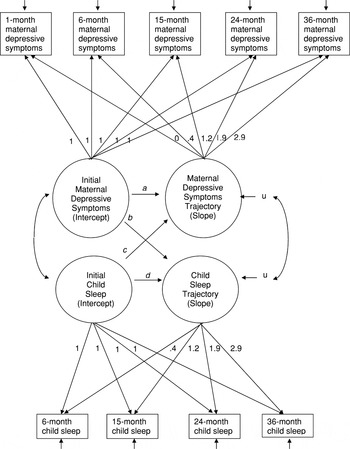
For the purpose of examining trends over the period from 1 to 36 months, parallel process latent growth curve modeling (Cheong, MacKinnon, & Khoo, 2003) was utilized. These models use latent variables to represent the initial levels of variables as well as the trajectories over time and the assumed causal connections among them (Singer & Willett, 2003). The structural equation model predicting maternal depressive symptoms and child sleep trajectories over time is shown in Figure 1. Coefficients for slope latent variables were based on the child's age, corresponding to the number of years after the child's first month, for each wave of data (at 0, .42, 1.17, 1.92, and 2.92 years after month 1). Intercept coefficients were fixed at 1 across all ages. Therefore, the intercept latent variable estimated the level of the variable at 1 month after birth, taking into account the entire trajectories. Two parallel growth curve models were estimated; one for each of the child sleep variables. Baseline models were estimated allowing the two intercept and two slope variables to intercorrelate to examine whether there were significant correlations among the latent variables. Then, specified models were tested, regressing the slope of each variable on the intercept of the other to test the primary hypotheses. The main study hypotheses for the trajectory models tested the significance of the parameters labeled b and c in Figure 1, to determine whether child sleep predicted maternal depressive symptoms (c in Figure 1) or whether maternal depressive symptoms predicted child sleep (b in Figure 1) across time.

The structural equation model predicting maternal depressive symptoms and child sleep trajectories over time.
Phase-specific models
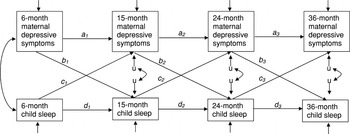
Although the trajectory models examined linear change over the entire 3 years of the study, autoregressive cross-lag regression models (Curran & Bollen, 2001) were used to examine shorter term effects across adjacent time periods. To investigate these phase-specific effects, analyses were conducted separately for each age period (examining predictions from 6 to 15, 15 to 24, and 24 to 36 months). For each analysis, the impact of earlier maternal depressive symptoms on later child sleep and the impact of earlier child sleep on later maternal depressive symptoms were simultaneously tested, controlling for the effects of earlier maternal depressive symptoms on later maternal depressive symptoms and earlier child sleep on later child sleep. These models were specified and estimated within a structural equation modeling framework. Figure 2 provides a summary of all the phase-specific models. Note that the analyses were conducted separately for each consecutive pair of lags. The disturbance terms (u in Figure 2) were allowed to correlate under the assumption that the outcomes could have causes in common distinct from earlier depressive symptoms and sleep patterns. The main study hypotheses for the phase-specific models tested the significance of parameters b1, b2, b3, c1, c2, and c3 in Figure 2 to determine whether child sleep predicted maternal depressive symptoms (c1, c2, and c3 in Figure 2) or whether maternal depressive symptoms predicted child sleep (b1, b2, and b3 in Figure 2) across time.

A summary of the phase-specific models. Note that these analyses were conducted separately for each consecutive pair of lags.
Estimation and significance testing
Both sets of analyses were conducted with the SAS System's 8.2 CALIS procedure using the maximum likelihood method of parameter estimation and the default of listwise deletion for missing data. The intercept and slope for the growth curve models were latent variables but the variables for the SEM phase-specific models were manifest variables. Natural logarithmic transformations were used to normalize all of the variables. These transformations moved the data toward more symmetric, normally distributed distributions, although some skewness was still evident. Two sets of analyses were conducted: one for the number of awakenings per week, and one for the average duration of awakenings. Significance tests were conducted by testing the chi-square difference between the full model and a model constraining the path being tested to 0.
Results
Descriptive information
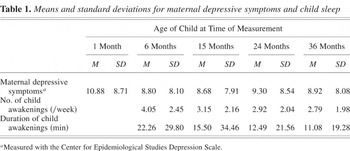
The raw means and standard deviations for the maternal depressive symptoms and child sleep variables are presented in Table 1. The mean level of maternal depressive symptoms was higher during the child's first month of life but was fairly constant thereafter except for a smaller elevation when the child was 24 months of age. Eighteen to 27% of the mothers demonstrated higher levels of depressive symptoms, displaying scores of 16 or higher on the CES-D (Radloff, 1977; 1 month = 27%, 6 months = 18%, 15 months = 18%, 24 months = 20%, 36 months = 18%). As expected, on average, children showed less frequent awakenings and shorter duration of awakenings over the first few years of life.
Means and standard deviations for maternal depressive symptoms and child sleep

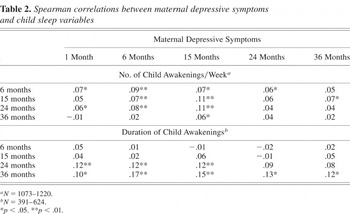
Spearman correlations were used to examine the intercorrelations for each of the raw variables across time. Maternal depressive symptoms showed an average correlation of .54 between successive time points, while child sleep showed smaller average correlations over time (.25 for number of awakenings, .26 for duration of awakenings). Correlations between the maternal depressive symptom and child sleep variables are shown in Table 2.
Spearman correlations between maternal depressive symptoms and child sleep variables

Trajectory model
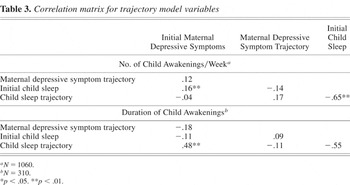
Table 3 shows the baseline model results, displaying the estimated correlations among the latent variables used in the growth curve modeling. For number of awakenings per week, the initial level of maternal depressive symptoms was not significantly correlated with maternal depressive symptom trajectory but the initial level of child sleep was significantly correlated with child sleep trajectory. Consistent with previous research, the initial level of maternal depressive symptoms was significantly correlated with the initial number of child awakenings per week. However, there were no significant correlations between the initial number of child awakenings per week and maternal depressive symptom trajectory or between initial maternal depressive symptoms and number of child awakenings per week trajectory. For duration of awakenings, the initial level of maternal depressive symptoms was again not significantly correlated with maternal depressive symptom trajectory and the initial level of child sleep was not significantly correlated with child sleep trajectory. Although the correlation between initial child sleep and child sleep trajectory was high (r = −.55), the standard error associated with this correlation was .36, leading to a nonsignificant result. In contrast to previous research, the initial level of maternal depressive symptoms was not significantly correlated with the initial duration of child awakenings. In addition, the initial duration of child awakenings was not significantly correlated with maternal depressive symptoms trajectory. However, initial maternal depressive symptoms were significantly correlated with the trajectory for duration of child awakenings.
Correlation matrix for trajectory model variables

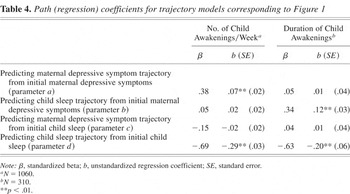
Next, the specific trajectory model hypotheses were tested with parallel growth curve models that regressed the latent slope for each variable on both its own latent intercept and on the latent intercept of the other variable as illustrated in Figure 1. These models for both sleep variables displayed adequate fit by normed fit index (NFI) and root mean square error of approximation (RMSEA) criteria for (number of awakenings: NFI = .98, RMSEA = .03; duration of awakenings: NFI = .96, RMSEA = .02). Table 4 shows the parameter estimates corresponding to the letters in Figure 1. The initial number of child awakenings per week did not significantly predict the trajectory of maternal depressive symptoms (parameter c). Similarly, the initial level of maternal depressive symptoms did not significantly predict the trajectory of number of child awakenings per week (parameter b). For those that woke, the initial duration of child awakenings did not significantly predict the trajectory of maternal depressive symptoms (parameter c). In contrast, as hypothesized, the initial level of maternal depressive symptoms did significantly predict the trajectory for duration of child awakenings (parameter b).
Path (regression) coefficients for trajectory models corresponding to Figure 1

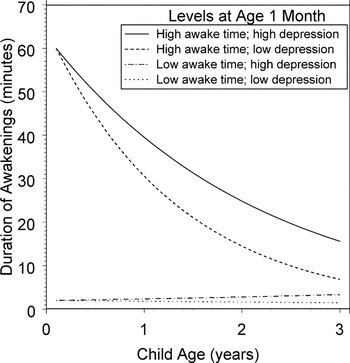
To illustrate the magnitude of the association of maternal depressive symptoms with duration of child awakenings over time, four trajectories of duration of child awakenings over time were plotted for children with low and high initial levels of duration of awakenings and for mothers with low and high initial levels of depressive symptoms (see Figure 3). For both variables, the “low” values corresponded to the 5th percentile and the “high” values corresponded to the 95th percentile. These trajectories represented expected averages based on the model equations. For example, the solid line shows the expected average awake time from 1 month to 3 years for a child who was initially awake for about 60 min per awakening and whose mother had a depressive symptom score in the 95th percentile. The dashed line just under it shows the average awake time trajectory expected for a child with the identical initial awake time but with a mother with a depressive symptom score at the 5th percentile. Predicted values were converted from the log scale to the original measurement scale, resulting in curvilinear trend lines. All lines showed a downward trend over time, reflecting developmental changes in duration of awakenings from early infancy to 3 years of age. For children who initially showed high duration of awakenings, high initial levels of maternal depressive symptoms predicted approximately nine more minutes of awakening by 3 years of age. In contrast, for children who initially showed low duration of awakenings, maternal depressive symptoms appeared to have a smaller association with duration of child awakenings at 3 years of age (2 min). In relative terms, children of high depressive symptom mothers were awake more than twice as long (a ratio of 2.3:1) at 3 years of age than children of low depressive symptom mothers, regardless of initial awake time.

An illustration of trajectory modeling results for the duration of child awakenings.
Phase-specific models
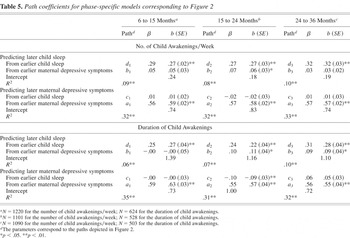
The results from the phase-specific SEM analyses are presented in Table 5. Because these were “just-identified” models, without latent variables, no relevant goodness of fit statistics were available. At no age did earlier number of child awakenings significantly predict later maternal depressive symptoms. In contrast, higher levels of earlier maternal depressive symptoms significantly predicted a greater number of child awakenings between 15 and 24 months of age.
Path coefficients for phase-specific models corresponding to Figure 2

For those that awoke, a greater duration of child awakenings at 15 months was found to significantly predict lower levels of maternal depressive symptoms at 24 months of age, a finding opposite to that predicted. As predicted, higher levels of earlier maternal depressive symptoms significantly predicted greater duration of child awakenings from 15 to 24 and 24 to 36 months of age.
Discussion
The major result of this research was that higher maternal depressive symptoms were found to predict an increased duration of child awakenings. An increased duration of child awakenings was not found to predict maternal depressive symptoms, and consistent findings were not identified in either direction for frequency of child awakenings. These results suggested that child awakenings were unlikely to contribute to maternal depressive symptoms but that maternal depressive symptoms could contribute to the duration of child awakenings across time. Previous research had not been able to fully test these hypotheses due to a lack of longitudinal data over multiple time points.
The effects of maternal depressive symptoms on children's sleep were thus different for duration of awakenings and frequency of awakenings. Maternal depressive symptoms when the child was 1 month of age significantly predicted a shift in the trajectory of duration of child awakenings over time such that the children displayed an overall worsening in sleep across the 3-year period, compared to children of mothers with fewer depressive symptoms. Thus, the effect of early maternal depressive symptoms on children's sleep appeared to be long lasting. In terms of the magnitude of the effect, the statistical model predicted that children of higher depressive symptom mothers (95th percentile) would be awake more than twice as long at 3 years of age than children of lower depressive symptom mothers (5th percentile). When examined at specific periods using cross-lag models, higher levels of maternal depressive symptoms at 15 and 24 months predicted greater duration of child awakenings at 24 and 36 months, respectively. In contrast, for frequency of awakenings, maternal depressive symptoms predicted an increased frequency of child awakenings only for the 15- to 24-month epoch. The two sleep variables thus demonstrated divergent results, highlighting their differences.
Although both frequency and duration of awakenings have been used to measure child sleep, these two symptoms have been considered to be influenced by differing processes. Frequency of awakenings has been thought to be most influenced by difficulties with sleep-maintaining processes, and/or factors that promote sleep-offset processes. In contrast, duration of awakenings has been thought to be most influenced by difficulties with (reinitiating) sleep-onset processes and/or factors that promote wake-maintaining processes. When characterizing sleep in young children, individual attention has been given to each of these processes (Gaylor et al., 2001). In addition, frequency and duration of awakenings have demonstrated divergent trajectories over the course of development (Klerman, Davis, Duffy, Dijk, & Kronauer, 2004).
The findings concerning duration of awakenings were strongest across the 15- to 24- and 24- to 36-month age epochs. These age periods have been described as times of increasing autonomy, self-awareness, and self-regulation for the child (DeHart et al., 2000; Lewis & Volkmar, 1990; Sroufe & Rutter, 1984), and could represent an important time of sleep consolidation (Moore & Ucko, 1957; Sadeh & Anders, 1993). Anders and colleagues have studied the self-regulation of internal states of arousal and falling asleep across early development, referring to an increasing ability to self-regulate during the nighttime hours as “self-soothing” (Anders & Keener, 1985; Goodlin-Jones, Burnham, Gaylor, & Anders, 2001). These researchers have described the process by which the child learns to self-sooth as involving a shift over the course of development from externally imposed calming and activating strategies to self-control strategies resulting, in part, from social interactions with the mother (Goodlin-Jones et al., 2001). Toddlers with mothers who had more depressive symptoms might have shown longer durations of awakenings because of diminished capacity to self-soothe or return to sleep. The more troubled sleep could be indicative of more general difficulties in terms of regulatory capacities in toddlers of parents with more depressive symptoms.
The longer duration of awakenings for children of mothers with more depressive symptoms could also be clinically meaningful. Although criteria for sleep disorders in young children have not been definitively established, a recent paper by Anders and Dahl (in press) has proposed that awakenings of 10 min or more for 3-year-old children would signify a sleep perturbation if the episodes occurred frequently enough. In the data reported here, the expected duration of awakenings for the 3-year-old children of highly depressed mothers would be more than 10 min, this would suggest that children of mothers with more depressive symptoms could be more likely to meet the criteria for sleep disorders.
Furthermore, the findings that maternal depressive symptoms at 1 month predicted a shift in the trajectory of child sleep and that maternal depressive symptoms at 15 and 24 months predicted more troubled sleep at 24 and 36 months, respectively, could be important for the development of interventions. Identifying and treating mothers with depressive symptoms could influence the children's sleep over long periods of time. Moreover, rather than treating children's sleep to reduce maternal depressive symptoms, as some previous studies have done, these findings suggest that treating maternal depressive symptoms directly might be beneficial both for reducing the maternal depressive symptoms and for improving the children's sleep. Certainly, the precise interventions depend, however, on the specific mechanisms involved in the associations between maternal depressive symptoms and children's sleep.
The prediction of duration of child awakenings from maternal depressive symptoms could result from a variety of influences. Children who had mothers with more depressive symptoms could have more difficulty with basic biological regulation of sleep and arousal, as such children have been shown to display a number of biological differences compared to children of mothers with less depressed symptoms, including lower vagal tone, right frontal EEG asymmetry, and higher norepinephrine levels (Field, 1995). Children with more depressed mothers could also have more difficulty with the regulation of affect, which could impact their ability to self-soothe. Dahl (1996) has described the close association between emotional and sleep regulation through which unregulated emotions interfere with sleep. Children with depressed mothers have been described as showing more irritability and difficulty self-soothing (Field, 1995; Zuckerman, Bauchner, Parker, & Cabral, 1990), which could contribute to increased problems settling to sleep.
Children who had mothers with more depressed symptoms might also have experienced less consistent maternal support of self-soothing strategies. Research concerning children with depressed mothers has described how depressed mothers behave in a more withdrawn or intrusive fashion with their children (Field, 1995; Weinberg & Tronick, 1998a). Such behaviors could interfere with the external calming strategies and thus not facilitate the development of internal self-soothing strategies. Goodlin-Jones and Anders (2001) have described a transactional sleep model that suggests that sleep and waking state organization in the first 3 years of life depend largely on the relationship context in which it develops. They have explained how transitions between sleep and waking occur many times each night, providing regular opportunities for homeostatic (hunger, temperature, dryness) and social/affective (separation, reunion, comfort, security) regulation. When the bedtime and nighttime interactions are consistent, predictable, and supportive, the mother and infant form a relationship that fosters biological and social regulation. Failure to develop consistent, predictable and supportive patterns of interaction surrounding sleep could lead to subsequent sleep–wake dysregulation. Dahl has also described how feelings of safety are essential for promoting sleep (Dahl, 1996). Erratic or nonsupportive parental behavior could also contribute to less feelings of safety and thus interfere with settling to sleep.
Depressed mothers, when compared with nondepressed mothers, have also been described as more inconsistent and ineffective in child management and discipline, trying to avoid conflict by accommodating to the child's demands (Cicchetti & Toth, 1995; Zahn-Waxler et al., 1990). Such behaviors could also be evident during interactions concerning sleep. Anders and colleagues have reported that self-soothers are more likely to have been put to bed awake than nonself-soothers (Goodlin-Jones et al., 2001). Depressed mothers could be less likely to put their children to bed awake, perhaps in an attempt to avoid conflict. When children awaken during the night, depressed parents could also have more difficulty implementing common sleep procedures such as controlled crying or systematic ignoring (Gelman & King, 2001; Green, 1990; Rickert & Johnson, 1988), thus contributing to sleep difficulties.
Research has also suggested that depressed mothers tend to reside in adverse circumstances, often experiencing more marital conflict and less support (Cicchetti & Toth, 1995; Downey & Coyne, 1990). Seifer et al. (1996) have reported that better overall family functioning measured by interviews and direct observations is related to fewer bedtime problems. Thus, the impact of maternal depressive symptoms on child sleep in terms of behavioral management of the sleep could be influenced by the social context. It is thus possible that the maternal depression could be a proxy or correlate for other factors associated with sleep problems in children such as temperament differences, infant health problems or family stress (Sadeh & Anders, 1993).
The finding that increased duration of child awakenings predicted decreased maternal depressive symptoms across the 15- to 24-month period, although contrary to the hypotheses, was not completely inexplicable. Sleep deprivation has been used as a treatment for major depression (Giedke & Schwarzler, 2002). Although much of the literature concerning maternal depressive symptoms and child sleep has focused on the negative aspects of awakenings for mothers, it is conceivable that the longer awakenings could have caused the mother with depressive symptoms to experience significant sleep deprivation. Such significant sleep deprivation could then have provided some treatment for the mother's depressive symptoms. Because the study did not include measurement of maternal sleep, such speculations could not be tested. Moreover, because this result was found in only one analysis, it could have been a chance finding.
Limitations of the research included the fact that the measures were not optimal. It would have been better to have conducted more comprehensive diagnostic assessments of the mothers and to have used more questions, sleep logs, actigraphy, videotaping, or EEG to measure sleep in the children. The weaker measures could have contributed to weaker findings. Although maternal depressive symptoms predicted the trajectory of duration of child awakenings at a p < .01 level, the prediction was only at the p < .05 level for the phase-specific findings. The smaller effect sizes might have resulted from the lack of optimal measures and thus could represent lower bound estimates. Another issue that could account for the smaller effect sizes is the time-lag period that was used. If a shorter time period had been used for the phase-specific models (e.g., 2–3 months), the effect sizes could have been stronger. Further research is needed concerning the optimal time periods for such investigations.
An additional limitation was the fact that mothers reported on both their own depressive symptoms and on the child sleep, so the reports of sleep could have been biased. There is some evidence in the data that such a bias did not account for the findings. If mothers with higher levels of depressive symptoms tended to report longer duration of child awakenings, maternal depressive symptoms and duration of child awakenings would show strong relations concurrently and across time, whether maternal depressive symptoms were being used to predict duration of child awakenings or visa versa. However, the results of this paper were that maternal depressive symptoms predicted child duration of awakenings across time but that child duration of awakenings did not predict maternal depressive symptoms across time. Moreover, the concurrent relations between maternal depressive symptoms and child sleep were not strong or consistent (see Table 2). Although these results suggested that bias was less likely in these analyses, bias could still be present, representing an important limitation.
There were additional limitations concerning the sample. Although every attempt was made to recruit a representative sample, the participants differed from the original sample (e.g., less likely to be Black or African American, more likely to have completed college, more likely to have a higher average income), and thus the results might not generalize to the entire population. The sample also did not show high levels of depressive symptoms and the children were not recruited based on having sleep problems; including higher risk families, mothers with diagnosed depressive symptoms, and children with diagnosed sleep problems could further clarify the predictive pathways.
Furthermore, the statistical models utilized were complex. Even though the samples were large, there could have been some instability in the estimates. For example, the standard error for the correlation between initial duration of child sleep and the duration of child sleep trajectory was large. An additional limitation of the causal modeling was that it could not identify third variable effects. For example, an unmeasured variable such as environmental noise or irregularity of day–night schedules could have accounted for the result that higher maternal depressive symptoms were found to predict longer duration of child awakenings.
Previous research has shown that children who show sleep problems in early childhood continue to show sleep problems later (Gregory & O'Connor, 2002; Zuckerman et al., 1987). Sleep difficulties could also shape affect, attention, cognitive and language development (Dahl, 1996; Dearing et al., 2001) and have been found to forecast behavior problems (Gregory & O'Connor, 2002). Thus, the effects of maternal depressive symptoms on child sleep could be significant. Moreover, the fact that early maternal depressive symptoms predicted child sleep problems over a long period of time suggests that addressing the predictive mechanisms could have an important and long-lasting impact on children's sleep. Further research is needed to determine the precise mechanisms by which maternal depressive symptoms predicted increased duration of child awakenings. Such information could clarify the best approaches for intervention strategies.
References
REFERENCES
Anders, T. F., &
Dahl, R. E.
(in press).
Classifying sleep disorders in infants and toddlers. In
W. E. Narrow,
M. B. First, &
D. A. Regier (Eds.),
Age and gender considerations in psychiatric diagnosis: A research
agenda for DSM-V.
Washington, DC:
American Psychiatric Association.
Anders, T. F., &
Keener, M.
(1985).
Developmental course of nighttime sleep–wake patterns in
full-term and premature infants during the first year of life.
Sleep Disorders,
8,
173–192.Google Scholar
Armstrong, K. L.,
Van Haeringen, A. R.,
Dadds, M. R., &
Cash, R.
(1998).
Sleep deprivation or postnatal depression in later infancy:
Separating the chicken from the egg.
Journal of Paediatric Child Health,
34,
260–262.CrossRefGoogle Scholar
Barr, R. G.,
Kramer, M. S.,
Boisjoly, C.,
McVey-White, L., &
Pless, I. B.
(1988).
Parental diary of infant cry and fuss behavior.
Archives of Disease in Childhood,
63,
380–387.CrossRefGoogle Scholar
Cheong, J.,
MacKinnon, D. P., &
Khoo, S. T.
(2003).
Investigation of mediational processes using parallel process latent
growth curve modeling.
Structural Equation Modeling,
10,
238–262.CrossRefGoogle Scholar
Cicchetti, D., &
Toth, S. L.
(1995).
Developmental psychopathology and disorders of affect. In
C. D. &
D. J. Cohen (Eds.),
Developmental psychopathology: Vol. 2. Risk, disorder, and
adaptation (pp.
369–420).
New York:
Wiley.
Curran, P. J., &
Bollen, K. A.
(2001).
The best of both worlds: Combining autoregressive and latent curve
models. In
L. M. Collins &
A. G. Sayer (Eds.),
New methods for the analysis of change (pp.
107–135).
Washington, DC:
American Psychological Association.
Dahl, R. E.
(1996).
The regulation of sleep and arousal: Development and
psychopathology.
Development and Psychopathology,
8,
3–27.CrossRefGoogle Scholar
Dearing, E.,
McCartney, K.,
Marshall, N. L., &
Warner, R. M.
(2001).
Parental reports of children's sleep and wakefulness:
Longitudinal associations with cognitive and language outcomes.
Infant Behavior and Development,
24,
151–170.CrossRefGoogle Scholar
DeHart, G. B.,
Sroufe, L. A., &
Cooper, R. G.
(2000).
Child development: It's nature and course.
Boston:
McGraw–Hill.
Downey, G., &
Coyne, J. C.
(1990).
Children of depressed parents: An integrative review.
Psychological Bulletin,
180,
50–76.CrossRefGoogle Scholar
Field, T.
(1995).
Infants of depressed mothers.
Infant Behavior and Development,
18,
1–13.CrossRefGoogle Scholar
Gaylor, E. E.,
Goodlin-Jones, B. L., &
Anders, T. F.
(2001).
Classification of young children's sleep problems: A pilot
study.
Journal of the American Academy of Child and Adolescent
Psychiatry,
40,
61–67.CrossRefGoogle Scholar
Gelman, V. S., &
King, N. J.
(2001).
Wellbeing of mothers with children exhibiting sleep
disturbances.
Australian Journal of Psychology,
53,
18–22.CrossRefGoogle Scholar
Giedke, H., &
Schwarzler, F.
(2002).
Therapeutic use of sleep deprivation in depression.
Sleep Medicine Reviews,
6,
361–377.CrossRefGoogle Scholar
Goodlin-Jones, B. L., &
Anders, T. F.
(2001).
Relationship disturbances and parent–child therapy.
Child and Adolescent Psychiatric Clinics of North America,
10,
487–499.Google Scholar
Goodlin-Jones, B. L.,
Burnham, M. M.,
Gaylor, E. E., &
Anders, T.
(2001).
Night waking, sleep–wake organization, and self-soothing in
the first year of life.
Journal of Developmental and Behavioral Pediatrics,
22,
226–233.CrossRefGoogle Scholar
Green, C.
(1990).
Toddler taming: The guide to your child from one to four.
Sydney:
Doubleday.
Gregory, A. M., &
O'Connor, T. G.
(2002).
Sleep problems in childhood: A longitudinal study of developmental
change and association with behavioral problems.
Journal of the American Academy of Child and Adolescent
Psychiatry,
41,
964–971.CrossRefGoogle Scholar
Hiscock, H., &
Wake, M.
(2001).
Infant sleep problems and postnatal depression: A community-based
sample.
Pediatrics,
107,
1317–1322.CrossRefGoogle Scholar
Hiscock, H., &
Wake, M.
(2002).
Radomised controlled trial of behavioural infant sleep intervention
to improve infant sleep and maternal mood.
British Medical Journal,
324,
1062–1067.CrossRefGoogle Scholar
Jones, N. A.,
Field, T.,
Fox, N. A.,
Davalos, M.,
Lundy, B., &
Hart, S.
(1998).
Newborns of mothers with depressive symptoms are physiologically
less developed.
Infant Behavior and Development,
21,
537–541.CrossRefGoogle Scholar
Jones, N. A.,
Field, T.,
Fox, N. A.,
Lundy, B., &
Davalos, M.
(1997).
EEG activation in 1-month-old infants of depressed mothers.
Development and Psychopathology,
9,
491–505.CrossRefGoogle Scholar
Klerman, E. B.,
Davis, J. B.,
Duffy, J. F.,
Dijk, D.-J., &
Kronauer, R. E.
(2004).
Older people awaken more frequently but fall back asleep at the same
rate as younger people.
Sleep,
27,
793–798.CrossRefGoogle Scholar
Leeson, R.,
Barbour, J.,
Ray, K. L., &
Warr, R.
(1994).
Management of infant sleep problems in a residential unit.
Child Care Health Development,
20,
89–100.CrossRefGoogle Scholar
Lewis, M., &
Volkmar, F. R.
(1990).
Clinical aspects of child and adolescent development.
Philadelphia, PA:
Lea & Febiger.
Lozoff, B.,
Wolf, A. W., &
Davis, N. S.
(1985).
Sleep problems seen in pediatric practice.
Pediatrics,
75,
477–483.Google Scholar
Moore, T., &
Ucko, L.
(1957).
Night waking in early infancy, Part 1.
Archives of Disease in Childhood,
32,
333–342.CrossRefGoogle Scholar
NICHD Early Childcare Research Network.
(1993).
The NICHD Study of Early Child Care: A comprehensive longitudinal
study of young children's lives
(ERIC Document Reproduction Services No. ED 353 0870).
Washington, DC:
Author.
Radloff, L. S.
(1977).
The CES-D scale: A self-report depression scale for research in the
general population.
Applied Psychological Measurement,
1,
385–401.CrossRefGoogle Scholar
Richman, N.
(1981).
A community survey of characteristics of one- to two-year-olds with
sleep disruptions.
Journal of the American Academy of Child and Adolescent
Psychiatry,
20,
281–291.CrossRefGoogle Scholar
Rickert, V. I., &
Johnson, C. M.
(1988).
Reducing nocturnal awakenings and crying episodes in infants and
young children: A comparison between scheduled awakenings and systematic
ignoring.
Pediatrics,
81,
203–212.Google Scholar
Sadeh, A.
(1996).
Evaluating night wakings in sleep-disturbed infants: A
methodological study of parental reports and actigraphy.
Sleep,
19,
757–762.CrossRefGoogle Scholar
Sadeh, A., &
Anders, T. F.
(1993).
Infant sleep problems: Origins, assessment, interventions.
Infant Mental Health Journal,
14,
17–34.3.0.CO;2-Q>CrossRefGoogle Scholar
Scher, A.
(1996).
The onset of upright locomotion and night wakings.
Perceptual and Motor Skills,
83,
1122.CrossRefGoogle Scholar
Scher, A.,
Amir, T., &
Tirosh, E.
(2000).
Object concept and sleep regulation.
Perceptual and Motor Skills,
91,
402–404.CrossRefGoogle Scholar
Scher, A., &
Ratson, M.
(1998).
Motor development and sleep problems among 9-month-olds.
Perceptual and Motor Skills,
87,
1218.CrossRefGoogle Scholar
Seifer, R.,
Sameroff, A. J.,
Dickstein, S.,
Hayden, L., &
Schiller, M.
(1996).
Parental psychopathology and sleep variation in children.
Sleep Disorders,
5,
715–727.Google Scholar
Singer, J. D., &
Willett, J. B.
(2003).
Applied Longitudinal Data Analysis.
New York:
Oxford University Press.CrossRef
Sroufe, A. L., &
Rutter, M.
(1984).
The domain of developmental psychopathology.
Child Development,
55,
17–29.CrossRefGoogle Scholar
Stoléru, S.,
Nottelmann, E. D.,
Belmont, B., &
Ronsaville, D.
(1997).
Sleep problems in children of affectively ill mothers.
Journal of Child Psychology and Psychiatry and Allied
Disciplines,
38,
831–841.CrossRefGoogle Scholar
Van Tassel, E. B.
(1985).
The relative influence of child and environmental characteristics on
sleep disturbances in the first and second years of life.
Journal of Developmental and Behavioral Pediatrics,
6,
81–86.Google Scholar
Weinberg, M. K., &
Tronick, E.
(1998a).
Emotional characteristics of infants associated with maternal
depression and anxiety.
Pediatrics,
102,
1298–1304.Google Scholar
Weinberg, M. K., &
Tronick, E. Z.
(1998b).
The impact of maternal psychiatric illness on infant
development.
Journal of Clinical Psychiatry,
52(Suppl. 2),
53–61.Google Scholar
Yamada, E. M., &
Dawson, G.
(1997).
Parental report of preschool sleep behavior: A longitudinal study of
children of depressed mothers.
Poster presented at the 1997 Biennial Meeting of the Society for
Research in Child Development, Washington, DC.
Zahn-Waxler, C.,
Iannotti, R. J.,
Cummings, E. M., &
Denham, S.
(1990).
Antecedents of problem behaviors in children of depressed
mothers.
Development and Psychopathology,
2,
271–291.CrossRefGoogle Scholar
Zuckerman, B.,
Bauchner, H.,
Parker, S., &
Cabral, H.
(1990).
Maternal depressive symptoms during pregnancy, and newborn
irritability.
Development and Behavioral Pediatrics,
11,
190–194.Google Scholar
Zuckerman, B.,
Stevenson, J., &
Bailey, V.
(1987).
Sleep problems in early childhood: Continuities, predictive factors,
and behavioral correlates.
Pediatrics,
80,
664–671.Google Scholar
The structural equation model predicting maternal depressive symptoms and child sleep trajectories over time.
A summary of the phase-specific models. Note that these analyses were conducted separately for each consecutive pair of lags.
Means and standard deviations for maternal depressive symptoms and child sleep
Spearman correlations between maternal depressive symptoms and child sleep variables
Correlation matrix for trajectory model variables
Path (regression) coefficients for trajectory models corresponding to Figure 1
An illustration of trajectory modeling results for the duration of child awakenings.
Path coefficients for phase-specific models corresponding to Figure 2
 You have
Access
- 71
- Cited by