Operas tell stories, and each does so uniquely, through the distinctive textual and musical actions of its characters. Despite this simple framework, however, and the efforts that librettists and composers expend on the intricate details through which they seek to convey their work's meaning, those stories are often neither simply told nor straightforwardly comprehended. If the enormous interpretive literature on canonical opera reveals how understanding even familiar works challenges us to discover cultural values that could form the basis of a shared understanding, the challenge is still more acute with works like those I discuss in this article: historically (or quasi-historically) based works with no continuous performance history, dealing with what appear to be stock archetypes of aboriginal Otherness and set by obscure composers whose musical vocabulary will strike many listeners as familiar, even clichéd. Given such a roster of transgressions against expectations of musical or representational originality, such works can easily be overlooked or dismissed without further consideration.
To move beyond this too-easy dismissal requires a more nuanced interpretive approach. Recognizing the presence of conventions and clichés of both dramatic and musical expression in these early Canadian works is indeed crucial, but I will argue that the deployment of those clichés must be understood not as simplistic repetition of the already familiar, but rather as a representation of contemporary social thought presented in a distinct historical and intertextual environment, an environment in which the works, their creators, and their audiences all participated. Indeed, as a unique form of ethnographic writing, staged dramatic music that engages with familiar stereotypes of native Americans provides a particularly rich field of intertextual relationships. By considering these works in the context of their larger historical stories – including the roles of their apparently stereotyped characters and their musical clichés – we are better positioned to comprehend both the works themselves and the social and political relations within which they originated, relations that they quite literally enact.
At issue are identity and belonging (that is, in political terms, citizenship) for First Nations Peoples in two early Canadian staged dramatic musical works: Arthur A. Clappé and Frederick Augustus Dixon's Canada's Welcome from 1879 and Joseph Vézina, Alex Villandray and Louis Fleur's Le fétiche from 1912.Footnote 1 These works from across the turn of the century at once exemplify a fascination for the exotic ‘Other within’ of indigenous peoples and illuminate traces of social and cultural tolerance, albeit from the perspective of a self-assured dominant culture. The extent of play with First Nations cultural traditions in each reveals their creators’ intentions to move beyond straightforward entertainment and to engage with storytelling and historical settings that underscore a belief in the civilizing power of colonization. Interpretations of the word ‘civilizing’, of course, changed over time: as we will see, late nineteenth-century Canadian rhetoric framed citizenship for indigenous peoples as an indicator of settler tolerance, and presumed that it required the assimilation of natives into settler culture; only later in Canadian history, after World War II, did this rhetoric change.Footnote 2
Perceiving the continued tension between the governing voices of the English and French and the other citizens of Canada requires an understanding of these changing values, representations and negotiations, and it is precisely the relations among those voices that close intertextual listening to staged historical works like this can reveal. In searching for meaning in this dynamic way, then, I believe we may also discover Ruth Solie's ‘legible traces of the unsaid’Footnote 3 – in this case, an implicit expression of the extent of colonizers’ qualified tolerance for First Nations Peoples and Others that is apparent in represented traces of differing beliefs, described places of ritual practices and spaces in which evolving engagement with settler communities is evident. Following Solie's lead, I seek to discover how such traces in these works align with ‘the unspoken information about music and musical experience that is most central to a culture’.Footnote 4 Doing so is particularly crucial when considering apparently conventionalized representations of the ‘Indian’.Footnote 5 Stereotypical representation is comprehensible precisely because it aligns with and reinforces underlying assumptions, so it is particularly easy to overlook that it too is open to variable interpretation. If we are to understand the contribution of the conventional to the unspoken and central, rather than to the painfully obvious – the unnuanced label of ‘Indian’ – we will need to maintain our insistence that the conventionalized too takes on specific and shifting meanings when we listen with heightened awareness of the varied materials whose interrelationships make up both the works themselves and the society in which they existed.
The places these works both inhabited and constituted were of course fundamentally shaped by the processes of colonization and the intercultural contacts they brought about. Attitudes towards indigenous people in the long nineteenth century were mixed, and largely romanticized; few urban citizens in eastern and central Canada would have had any personal contact with indigenous peoples, and their knowledge would have been gained primarily from journalistic descriptions, oral histories and unrecorded myths. For the new citizens of Canada in the late nineteenth century, evidence of First Nations lifeways came from the South as well as the West of the continent, and many of the stories were decidedly negative, reflecting political views of the native Other more than they did actual or even current practices. Protected by the shield of government in the East, citizens in the new Dominion of Canada believed in the civilization of indigenous communities through assimilation to a common nation (theirs), insisting that ‘Other’ communities accept the presumed superiority of their education, religious beliefs and general way of life. Enfranchisement was the only acceptable option in these years.
Colonizing the ‘Other within’ was integral to nation building in Canada in the years immediately following Confederation; establishing power and authority over inhabitants, building sustainable communities and managing issues of identity and citizenship on a national level were also foundational issues for early legislation around First Nations Peoples. Prime Minister John A. Macdonald's federal policies in the 1870s, recommending ‘the peaceful settlement of the western Indians on reserves’Footnote 6 seemed a promising ideal that developed out of the growing awareness that First Nations’ traditional subsistence practices and trade routes would obstruct the federal goal of a transnational railway. Early land reserve options were taken up by few First Nations Peoples, and as more land was needed to attract and accommodate an expanded plan for settlement in the western provinces, First Nations Peoples were eventually forced to make a choice: assimilate or move to government controlled reserves. Forfeiture of their unique lifeways (and in the case of the Métis in parts of the West, their distinct political status) was required in exchange for the privileges of full citizenship. The term ‘Other within’ therefore carries a unique meaning for Canada's Aboriginal Peoples in the late nineteenth and early twentieth century: they were ‘counted’ as citizens for political and social purposes, but were required to live separately from the rest of society if they refused enfranchisement. The degree of disenfranchisement and restriction of rights is suggested by Miller, Lerchs and Moore in their interpretation of Canada's evolving legislation. With respect to the 1876 Indian Act and its ongoing amendments in the years following Confederation, they indicate the contemporary reality that only total assimilation was acceptable:
the Canadian policy of enfranchisement for individual Indians who had ‘advanced’ to acceptable levels of civilization closely mirrored the policies of imperial powers … that [the granting of citizenship required that] a given individual has advanced to a higher level of civilization, had left tribal practices behind, and was now worthy of a standing that more closely approached that of the citizens of the imperial power.Footnote 7
As Miller, Lerchs and Moore indicate, without such agreement, the ‘Other within’ would be subjected to physical, social and political marginalization, through placement on reserves and further restrictions on their cultural practices and freedoms.
In addition to this national-colonial context of displacement, assimilation and nation building, staged dramatic works had their own history of presenting the intercultural. Fascination with the native Other was common in colonial encounters from the sixteenth through the nineteenth centuries, and was particularly appealing to artists in the New World aspiring to cultural distinctiveness. Canadian staged dramatic music in the early years following Confederation in 1867, largely a hybrid of high- and low-brow Western European genres and made up of predominantly English and French voices,Footnote 8 occasionally catered to such attractions by including specific stories, characters and ideologies of First Nations Peoples. Not unlike the exoticist practices of contemporary Western European art music composition, the trope of First Nations cosmologies in these works has tended to obscure the destructive effects of colonialism through artistic interpretations that disguise assimilation as tolerance.Footnote 9 What the two musical exemplars considered here further reveal, however, are the more subtle lines of marginalization drawn in racialized behaviours towards indigenous peoples. On the surface, the noble savage and the indigène sauvage are evident, but what is ‘unspoken’ (following Solie) are the acts of appropriation that marginalize and attempt to erase difference through intercultural assimilation: ‘going native’ on the one hand, and neutralizing difference through similarity on the other. Because these processes occur within established musical-dramatic genres, they allow us to observe the mapping of colonizer fantasies and First Nations realities onto contemporary styles of presentation in text and music.
Against this already multi-layered background, the interaction between colonizers and natives in each work examined here reflects a unique contemporary perspective on indigenous identity and rights. Both are essentially works of historical fiction, with Dixon's text imagining a symbolic interaction between English and native communities in the (then) recent past of Canada's Confederation in 1867, and Villandray and Fleur's recalling an actual event of a more distant past in an encounter at the turn of the eighteenth century. In both, colonizers are dominant. However, where Dixon's natives give up their rights freely and merge seamlessly into the new English-Canadian society and culture of the young nation, Villandray and Fleur's negotiate a non-aggressive counter-stance – a peaceful co-existence with their neighbours in New France in exchange for guaranteed hunting territories, thus ‘secur[ing] by diplomacy what they could not, at least for the present, secure by military might’.Footnote 10 As we will see, the musical settings for these texts enact intercultural exchanges that reflect contemporary English and French perspectives. First Nations stereotypes in these works lose some of their distinctiveness when placed within a largely Western operatic style. Nonetheless, in combination with specific texts and contrasted against such ‘less colourful’ music, even subtle effects can be heard as revealing contemporary attitudes towards the Other.Footnote 11
Aboriginal people were not the only Other targeted for such treatment. Contemporary values that exalted the dominant British culture also made French Canadians their target, as well as blacks, Jews, Chinese and nearly every other immigrant group. Pundits similarly poked fun at their own, ridiculing British dandies, the feisty Irish, the old, the young, the poor, the rich and, just as often, themselves. Thus, a contemporary political periodical such as Grip magazine could succeed in promoting a pointedly British message against the ruling Conservative government while satirizing minority communities. The cartoon ‘A Startling Affair in London’ by J.W. Bengough that appeared in Grip on 11 July 1880 in connection with Prime Minister Macdonald's inexorable drive to settle Western Canada is a clear example.Footnote 12 In this image, subtitled ‘A promising young woman offered for sale to this highest bidder’, Bengough depicts a young, demure native woman (perhaps a princess, given her attire) standing quietly on a platform labelled ‘Government Policy’ while Prime Minister MacDonald auctions her off, waving the ‘Charter [of the] Canadian Pacific Railway – Change for a Big Monopoly’ above the heads of buyers who are obviously depicted as Jewish merchants. A notice on the wall describes the event: ‘To be Sold! The People of the North West’. As journalist Carman Cumming writes about this image in the collection Sketches from a Young Country, ‘it does not take a semiotics scholar to find to find in the portrayal a sense of sympathy to Natives, combined with hostility to Jews, capitalists, imperialists – and Tories’.Footnote 13 The ‘sympathy to Natives’ Cumming describes is exposed uncomfortably between a tacit acknowledgement of the hereditary claims of First Nations Peoples in the territory and a more sinister reading of them as giving in to the colonial power, willing – or at best doomed – to be sold for the greater good of a developing nation. This conventional but nuanced visual image draws us into the world of the first of the two works considered here: Clappé and Dixon's masque, Canada's Welcome.
Canada's Welcome
For decades following Confederation in 1867, British presence in Canada was based on the performance of power through ritual, ceremony and the upholding of social and political etiquette. The majority of Canada's political leaders in these early years consistently enacted British customs in their politics, their practices and their daily activities. Understandably, popular social entertainments and cultural diversions of the time also reflected British tastes in content (both textual and musical) and intent.Footnote 14 It is within this environment that Canada's Welcome: A Masque appeared in 1879. Commissioned for the arrival from Britain of the new and fourth Governor General of Canada, the Marquess of Lorne and his wife, Princess Louise (Queen Victoria's daughter), the masque gives voice to the young Dominion of Canada in a unified statement of support for the motherland and overtly reflects presumed English hegemony in its colony. Onstage characters, including an Indian Chief, characters named Winter and Canada, and seven characters named for Canadian provinces, welcome the distinguished audience by describing in text and music the multinational diversity of Canada's founding peoples, and by highlighting distinctive elements of their cultural pasts as contributions towards a new, unified national voice.Footnote 15
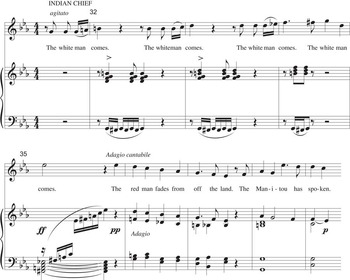
To emphasize the authority of the colonizer's position, Clappé and Dixon open the drama with the voices of Canada's wilderness: an offstage Chorus of Invisible Spirits describes the beauty of the land around them; the Indian Chief stands in view of the audience, listening but not participating in their song. Their music, in a four-part homophonic texture and ABA periodic structure, supports their invitation to ‘awaken’ a new day to the pristine environment in which native voices are already distant. Dressed ‘in the full war dress of his tribe’, the Indian Chief then sings of the native spirit of the Manitou who has called his people from traditional lifeways into this new Canadian nation. Resigning himself to assimilation into the Canadian way, he sings: ‘The Manitou has spoken. Woods and lakes, farewell!’ Clappé's musical setting of the first part of the Indian Chief's solo as a recitative in C minor favours the presentation of text as narrative, yet subverts the possibility for a distinct musical character within Western operatic lyricism. The drama of this section lies in its simple and clear use of materials: beginning with the text ‘The iron plough drives back the thronging buffalo. With waving corn the prairie mocks the Indian foot’, it builds to a forte in a second statement of the opening melody. Against the text ‘The White man comes’, Clappé introduces an agitated rhythm and ascending three-note motive repeated in sequence, resolving in the next phrase with a step-wise descending melody (‘the red man fades’) to the tonic E flat (see Ex. 1).
Canada's Welcome, Recitative (Indian Chief), bars 31–39

The word ‘farewell’ in the recitative is specifically inflected with (melo)drama, first building to the upper range of the Chief's tessitura (in bar 44), but stated with a muted dynamic that seems to weaken his resolve. His final ‘farewell’ in bars 25–26 at the end of the strophic aria that follows the recitative is, however, made stronger by the setting of ‘The Great Voice wills it. I will obey’, that he sings before it, in which his melody lands resolutely on the tonic C (now major). Additionally, the declamatory narrative of the recitative marks him lightly with features that in this context can be heard as stereotypically ‘native’ giving way to the civilized: accented rhythmic figurations accompanied by a static, drum-like alternation of G and F♯ in the bass between his utterances are replaced by a functional bass with clear part writing, and its minor tonality modulates to major, as the declamatory recitative is followed by the stricter form and more lyrical style of aria. Combined, these reflect the sounds of assimilation and evolution into an acceptable Western European dramatic format. Privileging a unified nation over its aboriginal inhabitants by setting the Indian Chief's texts in an overtly Western lyrical musical style (diatonic and largely triadic), Clappé's music disguises the tragic effects of colonization and a negative interpretation of the Chief's tale of the ‘dawn that brings us death’, in which he portends a world in which ‘The white man comes – The red man fades from the land’.
For dramas such as this, the association of native peoples with nature binds the Edenic myth of paradise with the cultural myth of Aboriginal basic goodness, bypassing the question of the potential for civilization to destroy and instead appropriating goodness for its own benefit. And so, with the silencing of actual First Nations voices, Canada enters, ‘robed as an Indian maiden’, naïve and natural in her demeanour and singing ‘a simple song’. Canada resumes the description of a peaceful beauty across the land described in the opening chorus, and concludes: ‘I see my figure in each stream, and something tells me it is fair’.Footnote 16 In her reflection are presumed traces of indigenous heritage, while the word ‘fair’ here seems to imply white, gentle and just. Canada sings of nature as the location of indigenous spirituality and of her own beauty within it. Her text is set as a Romanza, in two similar melodic sections and without the even the passing markers of ethnicity heard in the Indian Chief's music. Clappé thus constructs a contemporary musical Canada that saw the Indian Chief as worthy of inclusion, yet safely contained; by transforming a potentially threatening Other into a gentle and musically familiar representative of the nation as a whole, his Canada character provides an example of the power of location and objects, as Locke notes, to ‘reinforce one's own sense of being safely situated in “the West”‘.Footnote 17
An abrupt change of action follows, as a chorus of Backwoodsmen enters the pastoral scene singing ‘in praise of the life of the pioneer’: ‘Strong and ready, firm and steady, Through the world we'll cut our way, Looking to the bright tomorrow; Who can think of cares today?’. Following this, at Canada's bidding, the provinces arrive ‘dressed in the costumes of those nations whose people have hewn down her forests and built up her cities’, an opportunity for Clappé to insert a majestic processional march titled ‘Pageant Music’.
References to storytelling and historical events are evident throughout the texts of the provinces’ songs, symbols of a young nation in control of its people and resources. Quebec's allusions to the historic battles of the New World (‘Was there blood? …'Twas bravely shed’); British Columbia's resource-rich tale of ‘the white man strong and bold, Seeking for the yellow gold’, a more recent reference to the gold rushes of the 1850s and 1860s; and, representing the nation's seat of power, Ontario's description of its presumed superiority in areas of commerce, art, knowledge, science and religion all assume a degree of social and political literacy in the audience. Emblematic dress further distinguishes and marks these individuals: Quebec ‘as one of the old French noblesse, having embroidered on her robes the fleurs du lys [representing France] and lions [representing England] of her escutcheon’; British Columbia enters as a miner, dressed in flannel shirt and boots, and carrying the tools of the trade: a pickaxe, revolver and a bag of gold; and Ontario is robed in white, ‘with the cross of St. George, and green maple leaves; her head-dress of autumnal maple leaves and corn, emblematic of her agricultural wealth’. In all, symbols, suggestions and recognizable icons and references in the text set with familiar sounding music present a successfully achieved colonial project.
The other provinces are no less distinct in their costuming and texts. Prince Edward Island, dressed as a ‘sturdy farmer’ sings of ‘the thistle, rose and maple leaf’ and ‘the shamrock’, in a text that joins the province's settlers of Scottish, English and Irish descent to the new nation. As the seat of the Charlottetown Conference in 1864 – one of three conferences that led to the founding of the Dominion in 1867 – Prince Edward Island felt a particularly strong responsibility to the nation, and warns: ‘Who dares to touch the friend I love, Must meddle first with me’. New Brunswick appears with ‘water lilies in her hair’ to sing of fresh-water fishing, Manitoba is dressed ‘as a trapper and hunter’, and Nova Scotia ‘as a fisherman’. The nation's infamous season of winter merits its own character who, ‘clad in blanket coats and tuques, with snow shoes’, sings of icicles, frost and snow, toboggans and sleds, and describes the potential for romance in winter activities and the ever-present hope of spring. Once all characters have told their tale, the cast is joined by soldiers of the Governor General's Foot Guards (Clappé was their Band Director), at which point Canada sings:
Leaving courtly phrase to others,
We are simple, but we're true;
Canada has one heart only,
And that heart she gives to you.
In addition to the variance in their dress and heritages, distinctions are evident in Clappé's musical settings of a French-style gavotte in E major for Quebec, an aristocratic strophic waltz in A major for Ontario, a triplet figuration in the duet with Manitoba and Nova Scotia that evokes ‘waves of the prairie or waves of the sea’ and the dotted rhythms of Prince Edward Island's ‘sailor's ditty’.Footnote 18 There is, however, an overarching similarity of style, texture and instrumentation among these characters, along with limited changes in tempo that are perhaps the result of writing for non-professionals, as most of the performers were drawn from Ottawa's amateur musical community. Nonetheless, continuing in the historical tradition of the masque as allegory, the symbolism of a young country (albeit dressed as the as-yet-uncivilized native) overseeing the successful unification of diverse interests and cultures into a new nation could not have been lost on the invited audience.
The descriptions of Canada's recognized citizens in the work form a familiar, hierarchical image of British cultural superiority that most of the audience at the performance would have found – as the reviewer of the performance in the Ottawa Free Press did – ‘characteristic and correct’.Footnote 19 Although none would likely have considered unsettling the stereotypical portrayal of British Columbian prospectors, Nova Scotian sailors or Prince Edward Island farmers, some might have applauded the clever characterization of the young Dominion as a humble Indian maiden. She represents not simply a romanticizing of nature, but more significantly, Canada's past as well as her assimilated present. She is young, naïve and beautiful, and possesses an alluring sensuality that would capture the imagination of the audience, all the while conveying the superiority of British musical styles and ideologies. The very colonizers who accomplish the transformation are figured collectively as the gentle offspring of the indigenous peoples who fade away and are assimilated as this new land arises through the colonizers’ labours. It would therefore have come as no surprise that the final choral number of the masque involved the whole cast in the singing of God Save the Queen. Thus the Governor General's words on arriving in Ottawa a short time prior to this event might well resonate here: ‘it is to no foreign country that we come, but that we have only crossed the sea to find ourselves among our own people … ‘.Footnote 20 Those familiar people, however, find a new, idealized beginning in an identity that maintains the imagined character of the inhabitants they have replaced.
Le fétiche (The Fetish)
Vézina, Villandray and Fleur's Le fétiche appeared more than 30 years later, in 1912. And, while Clappé and Dixon's work might now be interesting primarily as an historical example of upper class ceremonial entertainment, Vézina's exemplifies the evolution of Canadian culture through a more mature use of materials and intertextual relationships. In the years between these works, Canadian society and politics changed in important ways, as did levels of political tolerance for First Nations Peoples. Voluntary enfranchisement remained prominent in federal directives in this period as a means of encouraging ‘individual responsibility’ to the Canadian nation rather than to native communities, and so further restrictions were imposed on those peoples in the intervening years. These included the curtailment of cultural activities by legislation that banned Potlatch dances (1884), tribal dances (1890) and ultimately all public festivals, celebrations and public costuming (1894 and 1901). Further, lands left open around existing reserves – and indeed, even some of the reserves themselves – were reduced in size and their prior protection in the Indian Act altered to allow government-approved acquisition by expropriation, especially when ‘warranted’ by the increasingly important Western settlement by new Canadians beginning in 1906.Footnote 21 In music as in literature, these changes had a significant impact; as cultural anthropologist Eva Mackey avers, ‘as settlement increased, Canadian historical writing began to place Native peoples in a more restricted role. Negative stereotypes began to appear, with greater emphasis given to scalping, torture, massacres, and sexual promiscuity’.Footnote 22 In a nation determined to institute a single unified citizenry, the uncooperative or (in some cases) dangerous Other must be controlled at any cost, for the good of all society and the respectability of government policy.
The portrayal of Indian lifestyles in Villandray and Fleur's libretto for the opéra-comique Le fétiche might be regarded as a reflection of such contemporary public opinion and private conceit, with the proliferation in the early twentieth century of the attitudes Mackey describes as reflecting a more sinister undertone for public tolerance of native communities. The story in this opéra-comique, based on historical events involving the Iroquois and the people of New France near Lake Champlain that led up to the infamous 1701 treaties in Montreal, describes the resolution of a long-standing Iroquois–French dispute over hunting rights and land claims, while offering place for a critique of contemporary Canadian society over 200 years later.
Despite its portrayal of the Iroquois as aggressive and vengeful – as revealed in references to scalping, kidnapping and fetishizing of white women – the drama that unfolds in Le fétiche is noticeably more even-handed in its description of the two cultures than previous works had been. In fact, at the central moment of kidnapping in the first act the audience discovers that it is a jealous young French friend – Lucienne – who betrays the French Governor's daughter Gaëtane to the trapper Pied-Léger of the Iroquois Wolf Tribe, handing her over to their most-feared Other. Importantly (and uniquely among early Canadian staged works) the two acts are split between the French fortress on Lake Champlain in Act 1 and the Wolf Tribe's encampment on the opposite shore in Act 2, this equality of setting in itself a bold departure that allows for extended focus on native lifeways. Principle characters are also split between the two communities: in New France, the French Governor (the Count of Issy) and his daughter Gaëtane; Gaëtane's friend Lucienne; Edgar of Pousse-Rocher (literally, Edgar of Rickshaw Rock), a soldier in the Governor's army, their bodyguard and the object of Lucienne's desire; the soldiers Gaston du Val (Gaëtane's beloved) and Michel Verdier; and the French trapper Jean-Pierre Pérusse. In the Iroquois Wolf Tribe, Tecumseh,Footnote 23 Bison-Borgne (Blind Bison), Pied-Léger (Light Foot) and Saika are the principal characters. Included in the action is also a chorus that represents (variously) soldiers, inhabitants of Quebec, and members of the Iroquois Wolf Tribe.
Further exposing their divided sympathies in the drama, Villandray and Fleur exploit two of the characters, the trappers Pérusse (French) and Pied-Léger (Iroquois), for their common practices and reciprocal roles in the two communities. In the drama they serve as intermediaries between the two camps and as catalysts for and agents in central dramatic moments, including the kidnapping discussed above. Within a bond of mutual respect, Pérusse and Pied-Léger nonetheless act independently and distinctively. Out of fear and respect for his people and their traditions, Pied-Léger kidnaps Gaëtane to satisfy the Manitou and thereby improve his tribe's hunting success; and ultimately, she is rescued by the French Pérusse, who uses his entrepreneurial skills successfully to mediate a resolution of the conflict over hunting territories that preceded her kidnapping. By emphasizing the human qualities evident in both individuals (as representatives of their respective communities), the librettists are able to craft a resolution that bypasses the assumed hierarchy of colonial superiority.
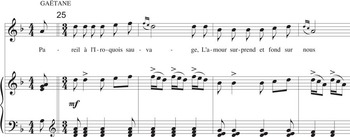
In keeping with the tradition of the French opéra-comique, Vézina has set this historical fiction as a number opera with spoken dialogue.Footnote 24 In both acts, the articulation of identity is achieved through mostly familiar melodic, rhythmic and harmonic signifiers of essentialized difference, principally without departing from the largely triadic harmonies and homophonic texture of Western opera. Within these privileged techniques and textures, however, Vézina incorporates small- and large-scale musical suggestions of the native Other, using repetitive rhythms in melody and accompaniment that are often heavily accented on the first beat of each bar (perhaps mimicking the beat of a drum), open fifths in the accompaniment, ‘wailing’ melodies and text-based vocables, and the occasionally irregular articulation of duple and triple metres. Gaëtane evokes this conceit when she conjures up a native ‘enemy’ in her songs, assuring Lucienne glibly in bars 25–27 that, ‘Like a savage Iroquois, Love takes you by surprise’ (Act 1 Scene 4; see Example 2). In this musical moment, Vézina interrupts her predominantly major, lyrical, melodie-like expression with a brief, minor, accented and repetitive rhythmic motive that suggests the sonic presence of a generic native (Ex. 2).
Le fétiche, Act 1 Scene 4: ‘Rondeau d'amour’ (Gaëtane), bars 24–28

The specificity of this example and the more extensive use of such rhetorical gestures across the work suggest that Vézina was considerably more concerned with distinguishing First Nations characters musically than Clappé was, revealing in a more complex expression of intercultural relations an important musical development in the early Canadian relationship to First Nations People. Additionally, traditional lifeways and assumed habits of the Iroquois are described and enacted by the communities on both sides of the lake.
The story opens in opéra-comique style, with a grand celebration scene in which the French habitation of New France commemorates May Day and during which the Count of Issy offers toasts to France and to New France. To the inhabitants he issues a public warning of the dangers of the wilderness, advising his men to protect their women and children ‘against the hatchet and the Indian club’. But in a private conversation later, he reminds the soldier Michel to be generous to their native comrades, as befitting a ‘civilized nation’. Characterizing the colonizer as the benevolent protector in this way sets a tone for the drama that presages the final negotiation, in which the French inhabitants’ fear of savagery is dispelled by a supposed act of native generosity, which not ironically comes about only through the intervention of the colonizers. According to Mackey, in such portrayals we may also find a political motivation on the part of the creators to construct an image of Canadian citizens ‘as gentle, tolerant, just and impartial.’Footnote 25
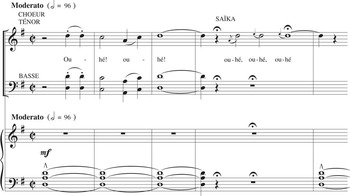
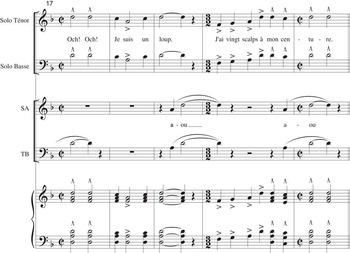
Vézina's use of linguistic (especially phonetic) and cultural markers to identify the Iroquois is more extensively dramatized in the second act, ‘Chez les Loups’ (Wolf Camp; literally, the Home of the Wolves) where he also consistently genders the native male and female through contrasts in melody and rhythm. Two of the most notable examples of this are heard in ‘Ou-hé-Ou-hé’ (Act 2 Scene 1) and ‘La chanson du scalp’ (‘Scalping Song’) (Act 2 Scene 3). In the first scene, tenors and basses set the stage with a repeated rhythmic motive to the chant ‘Ou-hé, ou-hé!’, and are interrupted briefly by Saika intoning an inflected D to the same chant text. She concludes the scene with a short cadenza within the boundary of the chant's D minor harmony (see Ex. 3a and b).
Le fétiche Act 2 Scene 1: ‘Ou-hé! Ou-hé!’ (TB Chorus and Saïka), bars 1–5

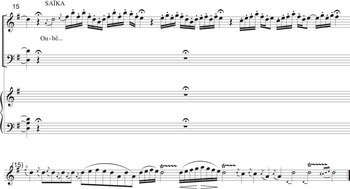
Le fétiche Act 2 Scene 1: ‘Ou-hé! Ou-hé!’ (Saïka) bar 15

Although beginning in D minor and incorporating irregular metres, the familiar rhythmic accents and unison voices of Iroquois hunters in the ‘Scalping Song’ do not emphasize the terror of this savage act, but instead capture the energetic and celebratory mood of hunters bragging of their success.
Le fétiche Act 2 Scene 3: ‘Chanson du scalp’ (TB Soloists, SATB Chorus), bars 17–21

The text here underscores Iroquois behaviour at its most aggressive and frightening to contemporary society: they are shown to be bloodthirsty, fearless warriors without pity or mercy. Vézina, however, concludes their song with a return to Saika's emotional and lyrical melody expressed in an elaborate and extensive cadenza that incorporates similar trills, grace notes, and triadic gestures of her first solo in bars 4–5, but is this time situated firmly in the key of A major (see Example 3, bar 15). The clear contrasts between musical materials here afford listeners another space in which to consider perspectives on natives as dangerous, or not. Additionally, if we hear here, as Locke does in Saint-Saëns’ Samson et Dalila, that ‘woman is to nature and love as man is to civilization and war’,Footnote 26 we might question whether Vézina's adherence to the ‘standard Romantic paradigm’ is effective in establishing an Other in the image of Self, or does his use of such familiar melodic and stylistic materials (aggressive and male-dominated collectives versus an individualized, lyrical and passionate woman) mean that they are Other only by virtue of which actions they present? Aggressive males are familiar enough, but scalping clearly marks these individuals as uncivilized.
Another striking feature in these two numbers is their presentation on stage, for while Bison-Borgne and three hunters sing the ‘Scalping Song’ and mimic its violent action, others on stage are directed to sit (women) or stand (men) and watch, and to mark time by singing ‘high-pitched cries’ (women) and ‘gutteral sounds’ (men). Considering this work in the context of late nineteenth-century colonial historical writing, depicting savage behaviour on stage may have been intended as audacious, but presenting it in such a performative manner actually disempowers the Iroquois. Similar to Dixon and Clappé's silencing of the native voice, the description rather than enactment of fetishistic behaviour in this scene may be interpreted as overtly hegemonic: representing the performance of savage acts on stage in this way (rather than staging a dramatic scalping scene) deflates their potential to incite fear, such that the ritual itself seems less fierce or, in the case of the ‘Scalping Song’, even comical, and contributes to a more level playing field through story-telling. The Others, though different, are not terrifyingly so.
In contrast to the public re-enactment of the scalping ritual in Scene 3, the legend of the hunting fetish is relayed in private in Act 2 Scene 6 as an historical narrative, by Pied-Léger and in the presence of Saika. Alternating pairs of textual and musical couplets provide a dramatic setting for Pied-Léger's monologue, in which he describes how the legend began: the great Chief Télah, driven by desire, went on a rampage and was killed in his sleep with his own axe, by the white woman he had kidnapped. Télah's spirit, Pied-Léger reports, now anxiously roams the plains, without access to traditional hunting grounds, and when he nears the forest to check his traps, the Manitou responds in anger with thunder and fire. On calm evenings, Pied-Léger states, Télah is heard warning his brothers to love their own (native) women and not to be distracted by ‘les bras blancs [qui] étouffent le Bonheur!’ (white arms [that] stifle happiness). The legend instructs Iroquois that when hunting and fishing fail, a fetish must be created by capturing a white woman at the full moon and making her head into a totem. Pied-Léger had already revealed part of the legend and the fetish to Lucienne when he captured Gaëtane (Act 1 Scene 9); holding her in his tent now, he believes, has thus only partially assuaged the Manitou. But Pied-Léger has no plans to kill Gaëtane. In a surprising evolution of traditional practice, his intentions are revealed as not to fulfil the final stage of the fetishistic ritual (totemizing), but to use her (alive) to negotiate an exchange with the Elders for Saika. In such a moment, Pied-Léger reveals his affinity for Western values and further undermines his community's beliefs. Gaëtane knows nothing of her captor's compromise and continues to fear for her life based on her own beliefs in the savagery of her captors. What Saika knows we are not certain, although her duet with Gaëtane that follows suggests that she is aware of Pied-Léger's intentions.
Saika's distinct musical and textual character throughout the opera is much less aggressive than that of the Iroquois hunters. In her duet with Gaëtane in this Act, she reveals an unexpected compassion for her captive that reflects a more civilized Other. Saika empathizes with Gaëtane as a woman in a different but still difficult situation. ‘The Indian loves you, Fetish’, she consoles, her melodies step-wise and in regular rhythm. Without accompaniment, she sings that ‘the Indian is not deceitful’ in a descending melodic gesture; ‘the Indian does not want you to die’. At the close of the duet, the two women's voices come together in a unison melody but with distinct texts: Gaëtane expresses her fear of being killed and Saika worries about the danger to her and her people if Gaëtane escapes.
As noted above, because of the French trapper Pérusse's skilful negotiation with the Iroquois Elders Tecumseh and Bison-Borgne, Gaëtane is released unharmed, along with Gaston, who was also captured (Act 2 Scene 10), and the Iroquois are permitted to resume their hunting on traditional lands. But this is not the end of the drama, for when a jealous Edgar rushes in intending to shoot the young lovers (he is in love with Gaëtane), he is killed by an Iroquois. Despairing at the loss of her beloved Edgar, Lucienne asks for Gaëtane's forgiveness as the scene closes. Although this final encounter thus retains the unapologetically savage native, Villandray and Fleur's story places that savage in a more acceptable social position, responding in kind to an outburst of French savagery. Musically, Vézina brings back a refrain of the music from Gaëtane's ‘Rondeau d'Amour’ (Act 1 Scene 4) with the text altered to suit the close of the narrative. As Gaëtane is reunited with her father in the final scene, the chorus sings of the inevitability of death that, like love, strikes all humans.
While colonial writing frequently latched onto Indian superstition as an object of derision, and the colonizers’ mission to convert them was a common trope, the ritual practices enacted and described in Le Fétiche both empower and disarm the Iroquois. The threat of actual ritual fetishizing had passed by 1912, but the native spirituality in which this drama is situated provided a place for a new approach to the intercultural encounters of French and First Nations Peoples, one that sheds light on the uncertain status of the Other within contemporary society. Villandray and Fleur's interactive text and Vézina's engagement with nuanced yet distinct features of musical characterization within his art music setting similarly frame the perceived savagery of First Nations Peoples, their rituals and traditions within a contemporary political agenda that favoured Canada's governing cultures. Both text and music present the governing French society as open to consideration of at least certain aspects of native lifeways. These include performative aspects of Iroquois history and traditions, the power of witness in solidifying place and power – such as occurs in the Scalping Song and Pied-Léger's telling of the Fetish legend – and the value of consensus and community. Although racial essentialism is evident in Vézina, Villandray and Fleur's representations of First Nations in this work, the capacity for both fairness and aggression that they are presented as sharing with the colonizers, ensured resonance within a contemporary society that French Canadians no longer uncontestedly ruled and modelled cross-cultural cooperation in nation building. In modifying the text to tame the savage native, however, Vézina, Villandray and Fleur have effectively rewritten the history of settler–native contact in eighteenth-century New France, evoking Iroquois power and reinstating native agency into the framework of the previously perceived dominant French-Canadian society, potentially unsettling the early twentieth-century social arena. A contemporary performance review in Le Soleil noted that ‘the music is original and characteristic’, and emphasized its ‘pleasant cohesiveness’.Footnote 27 The unique musical qualities of the Iroquois, represented within a familiar opéra-comique style and format, then, were rendered acceptable to contemporary audiences.
Conclusion
The role of the conventional is by no means the same in these two works, but its presence in each is undeniable, manifested in familiar sonic markers and a romanticized and colonial perspective that depicts First Nations Peoples as culturally primitive and in need of civilizing influence. Because Canada's Welcome represents the assimilated Indian as the nation itself, it is not surprising that it largely bypasses opportunities for distinctive musical characterization of First Nations characters; Clappé indeed reserves his most nuanced representations for the European immigrants on stage, defining them in terms of their varied heritages, while indigenous peoples are presented as resigned and complicit. Vézina, by contrast, distinguishes two musical styles: his French characters employ grand operatic expression and his Iroquois are presented as distinct characters with the aid of those familiar timbral, rhythmic and modal stereotypes of native traditional music, but still within the context of a Western art music tradition. In both works, though, conventional gestures largely reinforce the overt expressions of Otherness carried by the verbal texts and the complex of intertextual relationships those texts suggest.
This apparently predictable combination of elements, however, produces an unanticipated effect when the action of the works is considered in relation to the civilizing mission of colonial societies. That mission provided a framework through which not only political leaders but also cultural creators could relocate, revise and reassess the history and cultural representation of indigenous peoples as noble (following Rousseau's noble savage) or hostile (the savage native), as they deemed appropriate or useful at any point in time.Footnote 28 In both works, the intercultural encounter of settler and native is represented primarily through the tropes of fairness and tolerance exhibited by the ‘more civilized’ settler. That musical-dramatic encounter thus also humanizes the native as an ‘Other within’, allowing, even if unintentionally, for acts of agency by all citizens. This humanization opens spaces in which to question the ‘Otherness’ of First Nations Peoples and to (re)consider their right to citizenship in the young nation.
Recognizing the tensions in these relationships suggests a reality quite different from that told in the historical texts written by colonizing peoples. Nonetheless, as Locke suggests, the textual and musical presence of Others in relation to a Western ‘us’ works in multiple ways, (usually) to the benefit of the colonizer – and those ways are not confined to simple ‘appropriation’ of materials.Footnote 29 To be sure, they employ stereotypes of native Canadians, both cultural and musical, but the varied ways in which they do so allow us to trace the complexities of a changing set of ideologies and enacted relationships that reveal nobility and savagery not as polar opposites that constituted contradictory generalizations about the Other within, but as traits that could be located within a single Indian and across a divided and inconsistent Canadian. All, however, these works assure us, are redeemable through the civilizing force of European civilization.