

Introduction
The question of financial industry lobbying has come into sharp focus in recent years, with the 2008 financial crisis acting as a particular turning point for scholarly research. Taking stock of research in the political economy of finance and financial regulation, Helleiner and Pagliari (Reference Helleiner and Pagliari2011, 173) point out that many of our pre-crisis assumptions about financial industry power and lobbying have been proven untenable by the crisis. Chief among these was the assumption that when the financial industry lobbies, it does so mainly as a cohesive group representing largely uniform preferences that stem from shared concerns about regulation.Footnote 1 Recent research has gone a considerable distance in providing a more nuanced picture of financial industry lobbying. Scholars have tested assumptions about the ability of finance to act as cohesive group,Footnote 2 and have shown that financial industry lobbying involves a greater plurality of actors than previously expected, including NGOs and consumer protection groups,Footnote 3 a variety of private sector actors,Footnote 4 as well as an array of different types of financial industry actors.Footnote 5 Critically, the policy areas of financial regulation turn out to be a very diverse lobbying arena wherein “sharp divisions […] among different parts of the private finance sector” make having unified lobbying aims and preferences more the exception than the rule.Footnote 6
This analysis seeks to contribute to this post-crisis research agenda by examining the determinants of financial industry actors’ regulatory preferences. Why do certain financial industry actors prefer less stringent financial regulations while others prefer more stringent regulations? Relatedly, what are the conditions under which preferences diverge? These are admittedly huge questions. We only take on a small piece of them here, but emphasize that they are important, not least because they speak to larger debates about financial industry lobbying influence, power, and regulatory capture.Footnote 7 In particular, understanding why industry actors have converging or diverging preferences sheds light on a key puzzle of financial industry lobbying, namely why finance, despite its central position, especially in highly financialized economies and immense lobbying firepower, sometimes loses lobbying battles.Footnote 8 Digging deeper into the empirical evidence on preferences means that we can better understand these conditions and enhance the larger research program effort underway to make sense of financial industry power and its contingency. The literature on neo-pluralism and business conflict suggests that there are a variety of axes of potential conflict between business actors in particular,Footnote 9 such as between firm sizes, and national–international dimensions of organizational scale. Other scholarship frequently draws from theories of national institutionalism to model the notion that national financial systems are a powerful force that conditions financial industry preferences.Footnote 10
A central contention is that institutional features of national banking sectors account significantly for preferences, as expressed, for example, in states’ economic diplomacy as they confront regional (EU) or global (BCBS) policymaking. This is because of the historical embeddedness of banks and other financial intermediaries within a given national political economy.Footnote 11 These and other explanations for preferences are completely plausible, and we do not seek to evaluate them but rather extend the range of factors that may condition preferences. We seek to include a range of explanations for preferences with a view to evaluating those that have been relatively neglected in existing scholarship: the role of network ties. Some scholarship, albeit not on finance in particular, has begun to do this.Footnote 12
Adopting insights from social network analysis, we investigate the mutual dependence of preferences over financial regulation. In other words, how an organization is connected to other organizations through network ties may help explain its regulatory preferences. We thus investigate whether preferences are shaped through a process of “social influence”—the effect that social network structures have on the beliefs, norms, attitudes, behaviors, and preferences of network participants.Footnote 13
The empirical focus of this analysis is financial industry lobbying in the context of the European Union (EU), and in particular six critical pieces of EU financial regulation that have come to form the backbone of the EU's post-crisis financial regulatory architecture. This serves as an ideal setting for our analysis in that these regulatory reforms occurred in three different sub-sectors of finance (in banking, insurance, and securities) and over a relatively short time period (2008 to 2011). We assess indicators of preferences drawn from nearly nine hundred comment letters sent to the European Commission during the consultation stage of these six pieces of legislation, which provide insight into the preferences of financial industry actors. We find a range of evidence that supports the social influence hypothesis. As network ties become more distant, regulatory preferences diverge; groups embedded in the same location in the network are associated with convergent preferences; and those that are more embedded in the overall network have convergent preferences.
Our analysis marks an important advance on existing studies. First, while building on existing studies of financial industry lobbying in the EU,Footnote 14 ours is the first study to use social network analysis to explain the regulatory preferences of financial industry actors. Existing research that does use social network analysis in the context of financial industry lobbying does so with different aims. For instance, recent efforts seek to explain when industry actors collaborate in the first place,Footnote 15 to examine the linkages between industry and regulatory actors,Footnote 16 to map out the social network structure of bank lobbying to assess industry influence over regulatory outcomes,Footnote 17 or to describe the network structure and systemic volatility of the global system of financial integration.Footnote 18
Explaining financial industry lobbying preferences
Existing research provides some clues into why financial firms have certain regulatory preferences. First, there is a pervasive strand of research examining how firms’ regulatory preferences are driven by concerns about their own financial performance, especially relative to other firms. According to some accounts, financial service providers prefer less stringent regulations, especially when it comes to capital requirements. Even “a tiny percentage of reduction in capital requirements can represent a windfall of billions of dollars”Footnote 19 for financial service providers. Equally, small increases in capital requirements can reduce a firm's earning potential. It is no surprise that scholars have come to expect a race to the bottom, or so-called “trading down” on financial regulation. At the same time, however, concerns over international competitiveness also shape industry actors’ regulatory preferences. Loath to see international competitors operating under less stringent regulations, financial firms can also express preferences for more stringent regulation. Rather than a race to the bottom, regulatory patterns show a race to the top. Indeed, a competition-driven race to the top was evinced in the Basel I Accord, where US regulators and financial industry actors supported more stringent banking regulations in an effort to create an even playing field with their Japanese competitors.Footnote 20 A similar set of instances occurred in the Basel II Accord, whereby a minority of banks with a competitive advantage in particular risk management techniques sought to make Basel II capital requirements more stringent, not less.Footnote 21 In addition to arguments about finance's preference for less or more regulatory stringency, there is strong evidence that industry actors prefer the status quo. Presumably, powerful industry actors already operate under their ideal regulatory conditions (i.e., regulations already reflect industry preferences) and hence spend their lobbying energies protecting the current regulatory framework. Seminal research from the broader interest group literature shows how the defense of the status quo is not only the most common position taken by private-sector actors but that defending the status quo reflects the entrenched structural power of these same actors.Footnote 22
Preferences for more or less stringency or for retaining the status quo are not (entirely) inherent to an organization but rather can result from the adaptational pressures organizations encounter in the face of regulatory change.Footnote 23 Harmonizing rules at the global level, integrating at the regional level, or even the re-regulation of finance nationally generates differential outcomes for industry actors and hence differential adjustment costs. Those facing lower adjustment costs prefer the proposed regulatory changes, while those facing high costs oppose it.
Can we say anything concrete about interest group preferences? The broader interest group literature does provide some guidance. For many scholars, the permanent characteristics of interest groups (i.e., the type of interests represented by the group) are determinant of lobbying success,Footnote 24 the choice of lobbying strategies,Footnote 25 and the choice of lobbying venue.Footnote 26 Others use group type as a proxy for group resources (i.e., financial resources and staff).Footnote 27 Permanent group characteristics are also used, to a limited extent, to predict group preferences. The central point is the distinction between so-called diffuse interest groups (likes NGOs and consumer groups) and specific interest groups (like business associations and firms).Footnote 28 Diffuse groups represent the interests of broad segments of society,Footnote 29 are often open to all citizens,Footnote 30 and, hence, lack a well delineated and concentrated constituency.Footnote 31 In short, diffuse interest groups have diffuse preferences that tend to turn on “general principles like equity, social justice, and environmental protection.”Footnote 32 By contrast, some interest groups have well-circumscribed and concentrated constituencies representing socio-economic interests within specific economic industries.Footnote 33 As such, specific interests aggregate and articulate specific preferences, most often in the form of expert and technical information about policy proposals.Footnote 34 Of course, these linkages between group type and preferences are tenuous at best. In fact, this research does more to carefully and systemically differentiate interest groups based on what and “who” they represent than to say anything definitive about their preferences.
Examining group type provides an admittedly tenuous starting point for understanding preferences. But the problem, we argue, goes even deeper. Specifically, scholars working from a standard social scientific perspective assume that the preferences of one actor have no influence over the preferences of another. This is a pervasive issue in political science,Footnote 35 reflected in the notion of “unconditional choice”Footnote 36 that defies our everyday intuition: that actors’ preferences are informed by those around them, and are not made in complete isolation. This tendency translates directly into how we think about—or at least model—firm preferences: firms’ regulatory preferences are assumed to exist in a vacuum. In this article, we argue that this way of thinking about preferences does not paint a complete or realistic picture of how firms (or groups or individuals, for that matter) operate.Footnote 37 To relax assumptions about the independent nature of preferences, we adopt insights from social network analysis that firms’ preferences are conditionally dependent, and that a firm's ties with other firms can explain why some firms have the regulatory preferences they do. To this end, we explain financial industry preferences as a partial function of their network ties.
Social influence, network ties, and preferences
The starting point for this analysis is the idea that the connections, or ties, between individuals and groups can shape and change their preferences. In other words, network ties are, in their own right, consequential.Footnote 38 The basic idea is that actors connected through network ties tend to, by virtue of their iterated interactions, become similar over time, in particular, with regards to shared behaviors, habits, norms, beliefs, and preferences.Footnote 39
A large literature has developed around social influence exerted through interpersonal ties. In this view, ties are able to circulate resources among network members. Resources can be both material and ideationalFootnote 40 and can shape an individual's existing attitudes, behaviors, and preferences. In short, the circulatory effects of ties facilitate social influence. Particular attention has been given to how individuals’ network ties determine levels of individual political engagement, whether in terms of political participationFootnote 41 or inciting collective actionFootnote 42 and social movements.Footnote 43 Studies of political participation and collective action demonstrate how network ties circulate a steady “supply of political expertise” to network members. “[K]nowledgeable political discussants provide access to information that helps people recognise and reject dissonant political views, develop confidence in their attitudes, and avoid attitudinal ambivalence, thereby making participation more likely.”Footnote 44 In short, ties shape how individuals think, allowing them to update and change their policy preferences, consider new information, and weigh it against existing attitudes (Gould Reference Gould1993, 183). Related studies demonstrate how network ties also facilitate so-called “behavioral spread” among network members and lead to preference convergence.Footnote 45
Social influence also functions at the group level. For instance, scholars have examined social influence in the context of how firms are connected through “interlocking directorates.”Footnote 46 The main thrust of this literature is to map out and assess evidence for a tightly knit and highly coordinated transnational business elite (or a global capitalist class) observed in how firms are linked by their board members. For our purposes, the central insight of this literature is related to how social influence circulates within and among firms through these interlocking directorate ties. As Heemskerk et al. (Reference Heemskerk, Fennema and Carroll2016, 70) explain, these same network ties allow well-positioned firms to “reproduce existing beliefs and ideas, as well as to disseminate new ones” to other firms. Scholars have also found that firms with ties organized through interlocking directorates are better able to “build consensus” and enforce conformity with linked firms.Footnote 47 Some firms enjoy a brokerage position within a network that sees them acting as the sole link between different clusters of firms within the network. For Burt (Reference Burt1992), this amounts to “structural holes” within a network, where only very well-positioned brokers can bridge these holes. Critically, these well positioned firms can strategically exploit these holes in order to spread specific beliefs, ideas, and preferences. Traag (Reference Traag2016) finds support for these social influence effects in a slightly different context, namely that individuals sitting on the same interlocking boards tend to donate to similar candidates. Murray (Reference Murray2014) has found evidence that corporate actors socializing through transnational organizational networks coordinate activity within US political races.
Social influence and financial industry lobbying
Our focus in this analysis is how social influence operates within networks of private sector actors engaged in lobbying to shape financial regulation. In particular, to what extent do network factors influence financial organizations’ regulatory preferences? To answer this question, we focus on financial industry firms’ membership ties through lobbying associations. A wide range of such business associations exist, such as the International Swaps and Derivatives Association (ISDA) and the Association of Financial Markets in Europe (AFME), to name two prominent ones. While recent studies observe a rise in “firm lobbying” in more general terms,Footnote 48 lobbying associations continue to play a pivotal role in linking firms together and can enhance any given firm's lobbying power. Associations can pool lobbying resources, including financial, influential, and reputational resources;Footnote 49 moderate conflict among members; coordinate lobbying strategies; and form a consensus position on policy issues. Coalitions of industry actors send strong signals to policymakers about industry unity and where the bulk of support lies on a given policy issue.Footnote 50 Unity among members and even across multiple associations has been shown to enhance lobbying power.Footnote 51
Associations are major players in the lobbying of regulators,Footnote 52 as not only do they aggregate resources and expertise but they signal relative unity in the lobbying process. Crucially, however, they do not simply represent the interests of their members to policymakers. They are not just aggregation machines, but rather translators and deliberative forums. Associations, like interlocking directorates, facilitate repeated interactions among members where information, ideas, beliefs, and norms are exchanged, and through which consensus is built and conformity is enforced. Equally, associations are also club-like, to speak with Tsingou (Reference Tsingou2015), insofar as members can be united through “common and mutually reinforcing interests” and where membership often results in a type of elite socialization.Footnote 53 Importantly, interest group scholars have long acknowledged that associations actively work to socialize members through the provision of so-called solidarity goods. As Clark and Wilson (Reference Clark and Wilson1961, 134) explain, these are intangible rewards that “derive mainly from the act of associating and include such rewards as socialising, congeniality, the sense of group membership and identification, the status resulting from membership, fun, and conviviality, the maintenance of social distinctions.” Solidarity goods, in other words, generate a shared sense of purpose and belonging among members, and they may facilitate social influence within association-based networks.
Drawing together insights about social influence and membership ties described above, we can hypothesize about organizations’ regulatory preferences. Ties within and through associations likely function as a means to circulate information, ideas, and norms among network members. This possibility means that on top of firms’ “autonomous” preferences toward a given regulatory policy, there may also be a “socially influenced” component as well, as firms influence one another. Such social influence can thus potentially be observed in the “ideational convergence” of regulatory preferences among actors within a network structure.Footnote 54 These relationships can be complex. While members of a given association are linked to one another through common membership, members on one association are also indirectly linked to other associations, and thus to other members, namely through the associational memberships of other members. Indeed, firms are often members of multiple associations, and some associations are even members of other associations. The central point here is that links between organizations are not always direct and can be indirect, and thus social influence is a function of an organization's broader environment or social context.Footnote 55 We can conjecture, on this basis, that the preferences of an organization will be informed by those closest to them within this complex organizational network. This would have observable implications related to the location of a given organization, vis-à-vis others, in the network. We would expect that as ties become more distant between organizations, social influence should diminish, and hence we expect less preference convergence between those two organizations. Organizations close to one another should have more similar preferences than those further away.Footnote 56
Research design
We evaluate our “social influence” hypothesis in the context of financial industry lobbying in the EU and specifically with regard to the EU's regulatory response to the 2008 financial crisis. Indeed, the EU engaged in a major overhaul of its existing regulatory framework across all three sub-sectors of finance. In banking, the CRR and CRDIV saw the EU adopt (and adapt) the new Basel III rules for banks. Solvency II and IOPR II imposed more stringent regulation on insurance providers and occupational pension funds. Finally, MiFID II and AIFMD introduced new statutory rules for those working in securities markets, broadened the financial instruments that could be regulated, and, for the first time, regulated hedge funds. Given the scope of these regulatory efforts, financial service providers were faced with a unique opportunity to shape the new EU rules, see their preferences reflected in EU directives and regulation, and would have therefore been highly motivated to engage in lobbying activities.
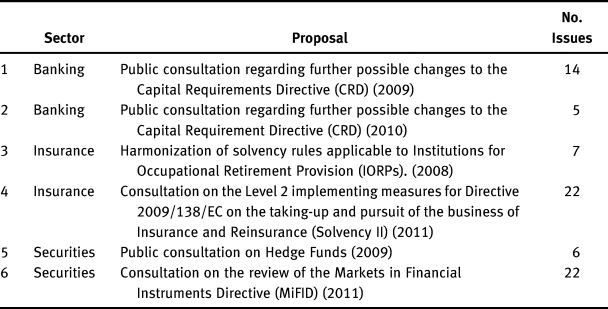
This context allows us to assess lobbying that occurred via consultations on European Commission legislative proposals. Our selection is based on two factors: first, it captures the most important post-crisis legislation in each segment of the financial sector and forming the new backbone of financial regulation in the EU; and second, it allows us to include proposals for which the Commission held a consultation. This ensures directly observable lobbying activity expressed as specific lobbying demands on specific aspects or “issues” of a legislative proposal. This approach has several advantages. First, it establishes a population of interest groups that lobbied on proposed EU legislation. Hence, we know which organizations lobbied on each proposal as well as their precise lobbying demands. Using consultations to establish lobbying populations, to observe lobbying behavior, and to examine lobbying demands is a now well-established method in the existing literature.Footnote 57 Similarly, examining lobbying demands on discrete issues that form part of the overall proposal has also be used with great success in current studies.Footnote 58 A central insight of this approach is that a great deal of lobbying takes place at the issue level rather than the level of the proposal as a whole. Each legislative proposal comprises multiple issues, and interest groups weigh in on the issues that matter most to them rather than on the proposal as a whole. In the context of this study, policy issues largely follow the European Commission's tendency to formulate consultation documents in terms of policy questions. Only issues that could be coded in terms of more or less stringency were included. Open questions, for instance, were excluded. A full overview of issues and coding can be found in the Appendix.
Table 1 provides an overview of the legislative proposals examined in this analysis as well as the number of issues for each proposal. We should point out that lobbying through public consultations only represents one way that lobby groups seek to influence policymaking outcomes. There are many other lobbying venues and access points open to interest groups. Nevertheless, consultations have taken on new significance and meaning for financial industry lobbying in the post-crisis period (Young, Reference Young2013).
European Commission Legislative Proposals in Banking, Insurance, and Securities

There was a very broad array of organizations that responded to these consultations. There are 284 different organizations that were coded in terms of stringency preference responding to these consultations. One hundred and twenty (4 percent) of these were associations, and 164 (58 percent) were individual firms.
Dependent variable
The basis for measuring our dependent variable is the expressed regulatory preferences of organizations that lobbied in at least one of the six consultations mentioned above. Expressed regulatory preferences are measured in terms of the specific lobbying demands made by organizations in the consultation process. These demands were coded for each discrete issue and capture differences in terms of an organization's preferred regulatory outcome. Demands were coded in four categories: 1 = support for the EC proposal; 2 = demand for a less stringent approach compared to the proposal; 3 = demand for a more stringent approach compared to the proposal; 4 = unable to code (the interest group weighs in on an issue, but the demand is ambiguous). Inter-coder reliability tests, which saw three coders implementing the same coding procedures on different sub-samples of the dataset, resulted in a Krippendorf's alpha coefficient of 0.88, well within an acceptable range of reliability. An overview of the coding can be found in the Appendix. For this variable, which we call Stringency Preference, we took the average level of regulatory stringency demanded for each issue in each Commission proposal to create a stringency index, calibrated from 0 (argues consistently for regulatory proposals to have lower stringency) to 1 (argues consistently for regulatory proposals to have higher stringency).
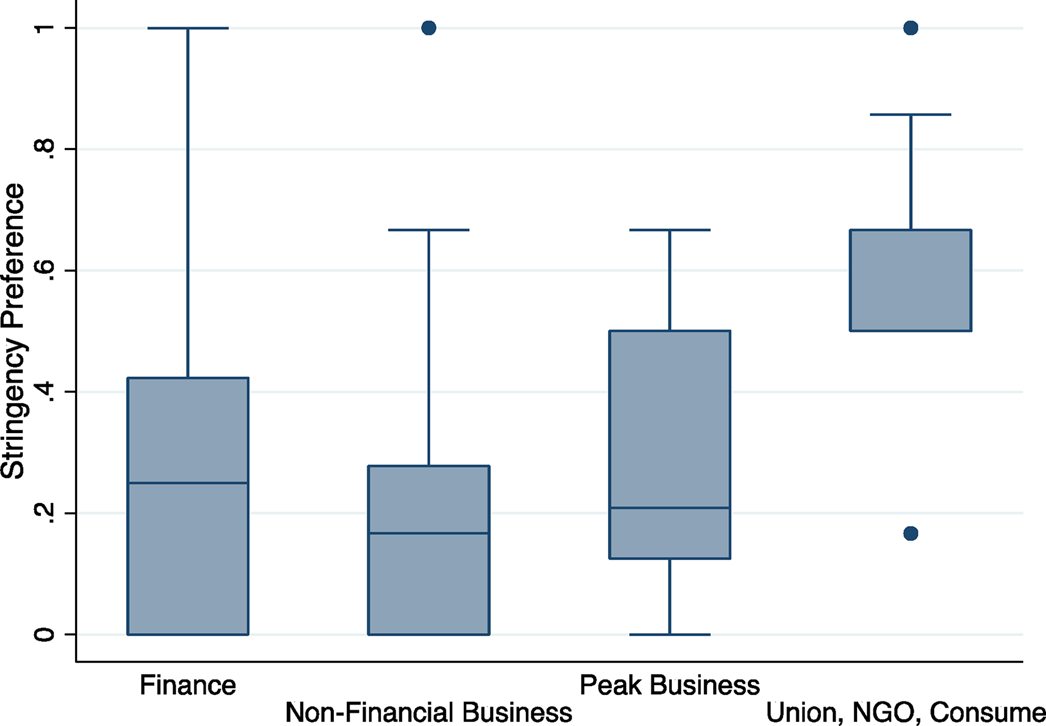
We can look at the distribution of Stringency Preference (plotted on the y-axis) across different types of interest groups (plotted along the x-axis; see below for details about how these categories were coded), via a boxplot visualization, reported in figure 1. Unions, NGOs, and consumer groups want more stringency than all the other groups. Financial organizations are keen to argue for less stringency in regulatory proposals, though there is a range of these views. In line with existing scholarship on the role of nonfinancial business lobbying in this space,Footnote 59 nonfinancial businesses also prefer less stringency in regulatory proposals they weigh in on. Peak business, interestingly, offers more of a moderate position to these different extremes, but still is mostly on the side of “less stringency,” like the other business organizations in the data.
Boxplot Distribution of Stringency Preferences

To test the social influence hypothesis, we assess expressed regulatory preferences measured in terms of Preference Distance between dyadic pairs of organizations. This assesses the extent to which there are differences between one organization's lobbying demands and another organization's demands. Again, we took the average level of regulatory stringency demanded for each issue in each Commission proposal. We normalized these differences to range between 0 and 1, with the mean value being 0.215 and standard deviation at 0.182.
Key explanatory variable
Our key explanatory variable is drawn from how a given organization is located within a large network of membership ties that we call a “membership socialization network.” This network is composed of ties between organizations representing meaningful organizational links mediated through associational memberships. Doing this requires several steps. First, we identified all associations in our population of organizations that lobbied on at least one of the six EC proposals. Second, we collected membership lists for each of these associations.Footnote 60 Some of these lists were found online but, in most cases, the individual association was contacted directly in order to obtain these lists. A total of 289 lists were obtained consisting of more than 33,000 individual members. While some organizations are only members of one association, many others are members of several associations. Each node on this network is thus either a member (usually, but not exclusively a firm) or an association. Firms are connected to other firms only through associations, though some associations are members of some other associations.
All models attempt to represent an underlying reality for the task at hand, and network models are no different: we are trying to capture the interdependent web of relationships that exist between actors. What travels along these ties is likely to be a variety of things, from communication among and between members, and also a common cultural understanding regarding what one policy proposal might “mean” and how potentially to respond to it, including signals about appropriate or expected reaction. The notion that associational ties facilitate preference formation itself is of course not trivial in this context. Yet it does challenge the notion that we can understand preferences at the organizational level alone. We might add in this context that a variety of different kinds of ties are possible other than organizational ties—such as the extensive ties on interlocking directorates, referenced above. Our data are limited to associational ties and all conclusions are limited to an equivalent extent.
To derive explanatory variables from this network we pursue three measurement strategies. First, we measure how far away any one organization is from another. This variable of Network Distance is measured as a count of the number of hops (“degrees of separation”), in minimal distance terms, between one organization and the other in the large network of organizational-membership ties, an approach that has been used elsewhere.Footnote 61 The reasoning here is that, as network distance increases, a given pair of organizations are more “socially distant” to one another, and thus things like information, cultural cues, and other signals are less likely to be shared. Because our dyadic data are organized around organizations’ memberships in associations, this means that the first “hop” for all organizations is an association in which they are a member. For this reason (and because of the selection/endogeneity issues discussed below), we included a second indicator that is based on whether or not two organizations are members of the same association. Including this (binary) variable in our analysis helps us to differentiate the selection effect (or joining an association because you share the same general preferences of its members) from the broader socialization effect in which you are influenced by other organizations’ connections that you do not share.
Our second variable conceptualizes network embeddedness on a more meso-level scale. The variable In the Core measures whether or not a given organization is found to be occupying a position of being prominently embedded within the network, such that it is part of the “core” of the network rather than its periphery. Core-periphery structures are widely recognized as one of the key meso-level structures of networks. Identifying a core of a network means finding a group of nodes that are densely connected with one another, and that therefore govern the overall behavior of the network and a periphery that does not have these properties. A number of different techniques can be used for identifying core-periphery structures within networks,Footnote 62 however, we opt for a method that has recently been deployed to the study of economic elites, as this is closer to the other kinds of networks that have been used for other core-periphery analyses, such as the world wide web, transportation networks, or networks of proteins or cells, for example.Footnote 63
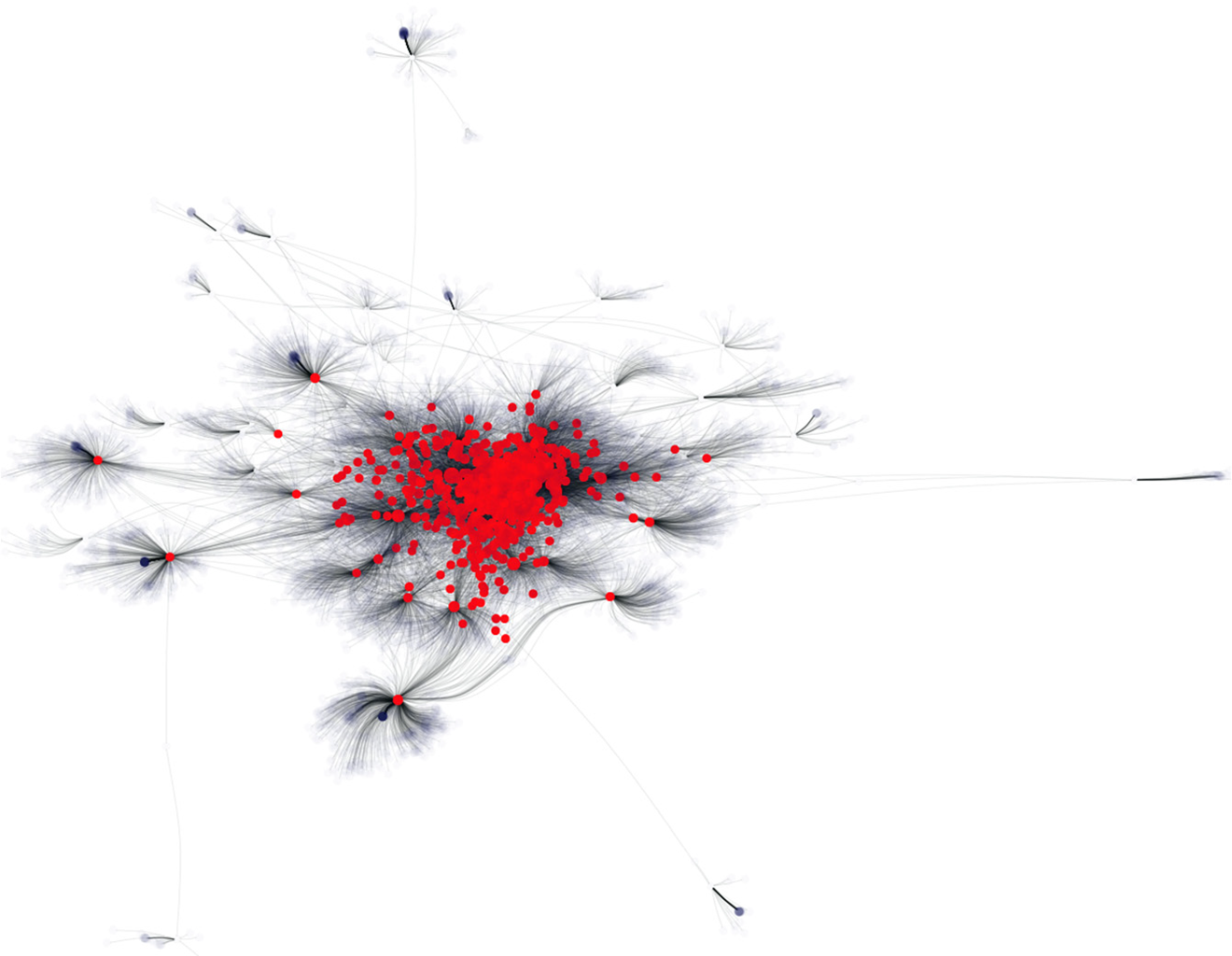
We use the technique of Larsen and Ellersgaard (Reference Grau Larsen and Ellersgaard2017) to define a core based on minimal distance paths from each node to each other node, generating a “coreness” score.Footnote 64 We take those organizations as being one standard deviation above the mean of this score of “coreness” to indicate being in the core, which we record as a 1, and 0 for not being in the core and thus in the periphery. Figure 2 provides a visualization of the entire network, with a central “core” in the center, highlighted in red. While the visualization suggests that the core is a substantive proportion of all nodes, it is actually only 5.31 percent of all nodes.
Socialization Network, with “Core” Highlighted in Red

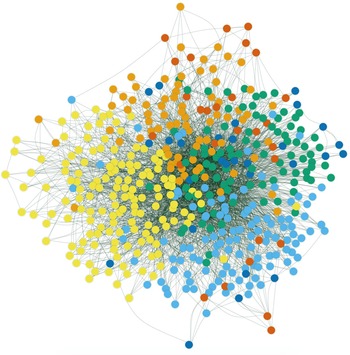
Our third variable derived from the network is a measure of “communities” nested within the network. We did this through a method within network analysis called “community detection.” Nodes—in this case, organizations—in the same community are more cohesively connected to one another than those in different communities.Footnote 65 Specifically, we deployed a community detection algorithm known as the Louvain method, which is particularly well suited for community detection in large networks.Footnote 66 The Louvain algorithm has a unique but intuitive way of generating community structure. It first looks for “small” communities by optimizing modularity locally. It then aggregates nodes belonging to the same given community and builds a new network whose nodes are those the communities themselves. It does this repeatedly throughout the network until a maximum level of modularity is reached and a hierarchy of community is obtained, and until there is no redundant information left within the network.Footnote 67 Communities detected using this specific method have been used within political economy scholarship for a variety of purposes when larger networks are concerned.Footnote 68 Within our organizational socialization network we detected thirty-seven distinct communities using this method. These communities are not the same as associational membership. We used the community detection data to generate the variable In Same Community, which takes on a 1 when two organizations are in the same community and 0 otherwise. Figure 3 visualizes what community detection looks like, for a subset of the “core” described and visualized above (the full network is too complex to visualize meaningfully). Within this sub-set of the network, there are six communities, visualized by different colors. As the above discussion should make clear, these communities are discovered algorithmically; we did not place actors in these communities based on their attributes. What these communities represent are sub-components of the network that are more bound to one another than their neighbors. They can be conceived of as adjacent spaces that emerge through the associational interactions of different actors in the network.
Core Component of the Network, with Communities Detected

Causal assumptions
We are cognizant of the limitations of these data for ascertaining “clean” causal estimations. Our data is limited in a number of ways mentioned above. For example, if we had a longer period of time and exploited the temporal variation in our data, this might allow us a more precise causal estimation of how our explanatory mechanism (socialization through network embeddedness) affects preferences. The associational membership changes would also, ideally, be exogenous in that it is somehow unrelated to regulatory preferences (or at least not to preferences pertaining to the consultation responses being measured).
It is important to emphasize how we understand potential causal processes to be operating, given that the data we are working with is observational data composed of an organizational network on the one hand, and expressed regulatory preferences on the other. Our hypothesis would be supported if there is positive evidence that the organizational network affects regulatory preferences. But we also must consider the possibility that causation works in the opposite direction. In other words, it is possible that preferences might be endogenous to the membership socialization network itself. To consider this analytically, imagine two causal narratives that are possible with our data.
A first causal narrative (see (a) below) would state that some earlier state of preferences (Pt-1) led the organizational network (ONt) to look the way it does in the first place. Firms forge relationships by their self-selection with one another into associations. As such, our inferential strategy is fundamentally backward, because an effect cannot produce a cause. A second causal narrative (see (b) below) would work differently: the organizational network, forged at an earlier time (ONT-1), informs the regulatory preferences (Pti) of actors within it, because associations channel and mediate the preferences of firms that inhabit the network.
(a) Pt-1 → ONt
(b) ONt-1 → Pti
(c) Pt-1 → ONt-1 → ONt → Pti
(d) Pt-1 + ODC → ONt-1 → ONt → Pti
A more likely scenario is that both are going on at the same time, as indicated by (c) above. Pt-1 is different than Pti in that Pt-1 reflects general preferences, presumably across a range of issues that would induce an organization to join an association as a member, while Pti is a preference on a specific regulatory policy at a later point in time. It is Pti that we are trying to model in our analysis. What (c) indicates is that while some general prior preferences Pt-1 may have helped forge the associational ties that go into ONt-1, as those membership ties persist, they generate a new state of the same network, ON, which then (we hypothesize) informs preferences on specific regulatory policies, Pti. As such, the concerns of preferences being endogenous to the network is true in some very general sense, but is likely to be less severe given that Pti ≠ Pt-1. Moreover, as (d) above indicates, it is not only general preferences that go into ONt-1 but rather a variety of other decisions and circumstances (ODC) as well. Organizations do not only join associations on the basis of the exact fit of their preferences but also for other reasons, related to obtaining information, and the strategic choice that it is better to be on the inside of a collective body than on the outside of it. Inasmuch as joining an association might be partly related to preferences at a given time, those preferences could also change over time.
To put this into simpler terms, while reverse causality cannot be eliminated, it is likely to be minimized, for two reasons conveyed in the causal narratives outlined above. First, the regulatory preferences of firms at an earlier (Pt-1) phase that may have informed joining particular associations are not necessarily the same preferences as at the point in time in which we are observing them (Pti). Second, there are multiple things that likely went into the formation of the organizational network in the first place, aside from regulatory preferences. While regulatory preferences may play a role, so too would other attributes of firms related to the utility of joining versus not joining an association (ODC). Consequently, estimating the relationship between an organization's location within the organizational network (ON) on that organization's preferences (Pti) is feasible notwithstanding some measure of unknown endogeneity. What is key for such estimation of Pti is to have quality control variables which allow us to separate out the net effect of ON on Pti versus other factors that condition Pt i.
Control variables
We include a number of control variables in our analysis in order to improve our modelling estimation. There are three main groups of control variables. First, we coded the country in which an organization has its headquarters. We included additional categories for EU-level associations (e.g., the European Banking Federation) and transnational associations (e.g., the International Swaps and Derivatives Association). The dyadic variant is Same Country (a dummy variable capturing whether or not two organizations are from the same country).
Second, we include a variable to assess whether a given pair of actors lobbying are from different “levels” of coordination and policy focus, and therefore may be at a higher level of potential preference divergence. What this means concretely is that when a given pair were two national-level actors or were two international actors, we coded 0; however, in the case of one national-level actor and one international actor, we coded 1. This is motivated by previous research that finds that the national–international axis is one important source of business conflict.Footnote 69 This is likely to be especially true for EU-level regulation such as the consultations that we are working with in this study, and thus we include the dummy variable National-International Dislocation to indicate that one actor in a given dyad is from a different “level” than another.
Third, we coded a number of control variables related to organization type. To this end, we have coded every actor in our dataset based on several coding schemes. First, we coded for organizational type by using the well-established method of coding according to the International Standard Industrial Classification Scheme (ISIC rev.4), a United Nations system for classifying diverse economic-sector activities.Footnote 70 From this coding we created dummy variables for Financial Organization and Nonfinancial Businesses, and we distinguish between Associations, Peak Business Associations, and Financial Associations, as well as other groups. We also generated a category for Unions, NGOs & Consumer Groups, for which we generated a variable, “Unlikely pair”, to control for the likely preference conflict that might exist when an NGO and financial firm are compared in terms of preferences. However, we found (consistent with existing scholarship) that these only exist in two consultations. Because our regressions include consultation fixed-effects, we thus excluded this variable. Insofar as we are working with dyadic data (i.e., pairs of organizations), these classifications end up being reduced to the catch-all variable Same Organization Type (which asks whether the two organizations in a dyadic pair are the same type of organization or not).
Analysis
As mentioned above, our outcome of interest is not simply expressed stringency preferences, but rather Preference Divergence, or the difference between two organizations’ preferences, on the same consultation. The data thus have to be reconfigured as a series of dyadic pairs between organizations, which we approach through regression analysis.Footnote 71 Since the dependent variable for these models is calibrated as a proportion, we used a generalized linear model with a logit link, as recommended by best practices within the interest groups literature.Footnote 72 Our models were specified to include consultation fixed effects, to address any effects unique to a given consultation and to provide estimates across consultations. Consultation number 6, which was by far the largest in the series that we utilized, operates as the base category in these regressions.
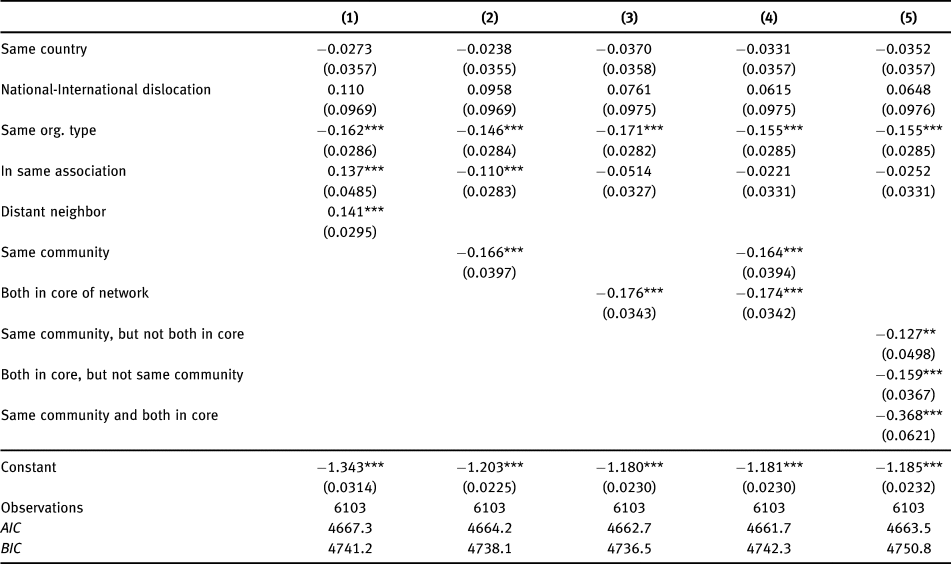
To test our hypothesis, we ran regressions on these dyadic data, with preference divergence as the outcome of interest and controlling for a range of conditions related to organizational pairings for each dyad. Results are presented in table 2 below. Each of our models examines our hypothesis from different angles, using different explanatory variables and interactions. Model 1 uses the variable “distant neighbor” to indicate a dyad wherein two organizations, not in the same association, are at least four or more “hops” away from one another in the organizational network. Our results indicate that, when conditioning on other factors such as country, organizational type, and national–international dynamics, when organizations are further away from one another, they are more likely to be in preference disagreement.
Regression Results

Notes: Robust standard errors in parentheses, Consultation FE omitted, * p < 0.10, ** p < 0.05, *** p < 0.01.
Model 2 keeps the control variable of being in the same association, but adds the variable for whether or not a pairing of organizations are in the same sub-community of the network, as determined by the community detection algorithm described above. We find that, conditional on other factors in the regression, this measure of social embeddedness is negatively associated with preference disagreement. Note that these models “control for” or “condition on” being in the same association, to ensure that our network variables are not simply proxying for an organization's election into the organizational network on the basis of shared group preferences (see our discussion of causal assumptions above).
Model 3 includes a variable for whether or not a pair of organizations are both in the richly embedded “core” of the network. The negative and statistically significant coefficient suggests that these pairings of more socially embedded organizations are less likely to be in preference disagreement than organizations in the “periphery” of the network, and thus subject to less mutual socialization and information flows. Model 4 simply combines the latter two variables, and finds that the results for community and for core are not conditional on one another.
Finally, model 5 includes combinatorial terms that indicate the three logical combinations (the base situation is not in the core, not in the same community) for whether the pair of organizations are both in the same community, both in the core, or in one of each. We find that each of these structural situations are negatively associated with preference disagreement compared to the base situation, which is supportive of our hypothesis. More supportive, however, is that a pair being both in the core and in the same community has the largest coefficient and is also statistically significant.
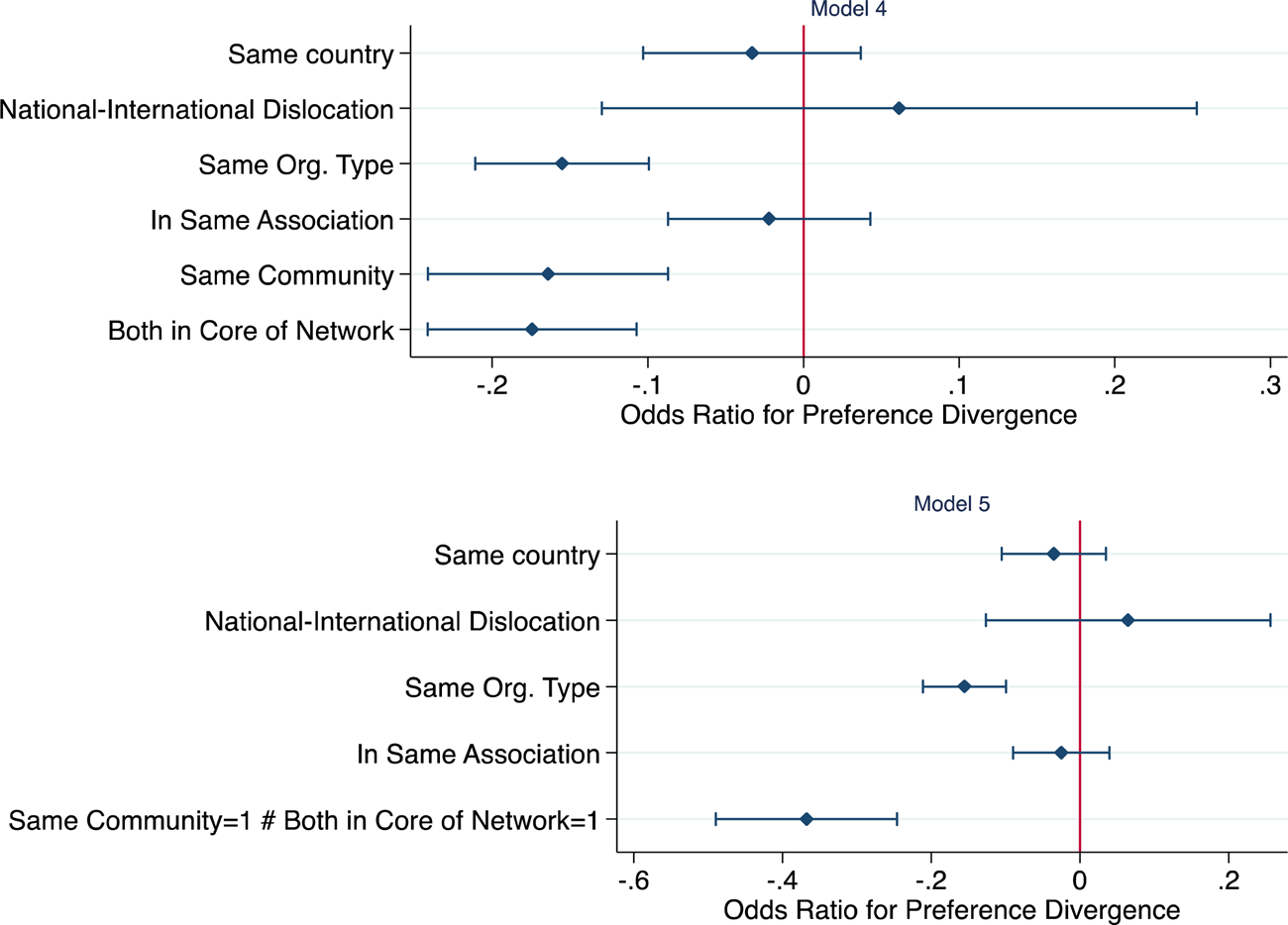
Overall, our results provide supporting evidence for our central hypothesis. While we cannot rule out the potential for reverse causality completely, we do have logical reasons for its minimization (as argued above), and we are able to control for selection into associations through the In Same Association variable. These results are, to the best of our knowledge, the furthest that existing scholarship has gone with respect to explaining whether or not business-associational ties condition preferences of organizations lobbying over financial regulation. In Figure 4 below, we illustrate our results, via a coefficients plot, that gives a sense of magnitudes and the range of estimated effects, specifically for models 4 and 5 in table 1 above.
Coefficient Plot

Because our measures of network embeddedness are executed as dummy variables in the regression, we can compare the net effect of these variables relatively easily to other variables in the regression. For example, it is instructive that organizational type—two organizations both being banks, or two organizations both being securities firms, for example—has a negative association with the preference divergence outcome. And yet the estimated effect magnitude is about the same as the effect magnitude for being in the same community within the network. The fact that this latter estimated effect already controls for being in the same association makes our finding with respect to community membership striking. These results suggest to us that socialization within the network might matter equally as much as more conventional factors.
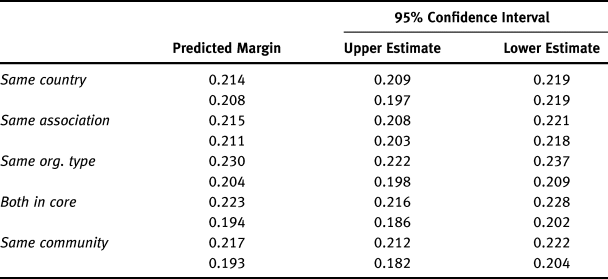
Table 3 below gives a comparative sense of these magnitudes. Because the substantive magnitude of odds ratios is difficult to interpret, we converted the regression estimates of each of the main variables in model 5 above into a series of margin estimates. Thus the effect of being in the same country, as table 3 below illustrates, lowers the preference divergence from 21.4 percent average level to 20.7 percent, with 95 percent confidence bounds ranging above and below both figures. This is a modest effect indeed, but so too are the marginal effects, measured in terms of magnitudes, of each of our main variables (though one should keep in mind that all estimates are in the 0.20s, as the mean level of preference divergence is 0.215).
Marginal Effects Estimates

The magnitude of effects we estimate from network structures are thus modest. We are not aware of existing analyses that examine effects of firm preferences such as these. And yet a lot of existing political economy scholarship tends to take seriously the stance that individual country memberships of organizations matter, and build elaborate theories based on such jurisdictional factors. In studies of the political economy of financial regulation within the EU, such stances are even more ubiquitous,Footnote 73 given the cross-country variation that researchers are able to account for within the Europe. Our findings suggest that effects that inform preferences outside of country jurisdiction, organizational type and situational context (e.g., pre/post-crisis) may also be at work, such as the ones we have estimated through the use of these simple social embeddedness measures.
Conclusion
Our analysis focuses on the factors that shape financial industry lobbying preferences about regulatory stringency. Some existing studies assume that firms’ preferences are somehow formed in a vacuum and without any influence from the myriad connections these firms enjoy with their industry confreres. Our starting point in this analysis is adopting a social network approach to understanding how preferences are shaped. In particular, we have investigated the mutual dependence of financial industry preferences about regulatory stringency: the idea that how an organization is connected to other organizations through network ties shapes its own preferences.
Drawing on a unique dataset of financial industry lobbying across six EU financial regulatory proposals, we find evidence supporting the hypothesis that associational ties among organizations may be informing their preferences for regulation. Using a range of indicators, we find statistical evidence that an organizations’ stringency preferences are a function of that organization's location in the network of ties generated through associations. While we cannot address causal estimation in this study, we have argued that this kind of association is more plausibly explained by network ties transmitting information that shapes preferences than is the notion that preferences shape network ties. Moreover, it is a persistent association across a range of different measurements of how an organizations’ location within the network may inform their preferences.
While our study has taken a step forward in terms of applying network science to the study of financial industry lobbying preferences, there are important avenues for future research that could build directly on this study. One obvious approach would to expand the study. Are these network effects the same in other sectors? What kind of variation can be observed across, say, firms operating in the energy sector, or those in retail? Our results may also be sensitive to the highly salient nature of the regulations and directives studied above. Controlling for saliency either across policies (e.g., looking at news media mentions of a proposal) or issues (e.g., looking at the importance different actors accord each issue) may impact the network effects. There are also promising avenues for future research that focus on finance. Specifically, future work could also examine the extent to which these network effects are observable at the national level (e.g., both domestic and international financial industry actors lobbying at the level of the UK government) or the international level (e.g., the Basel Committee, IOSCO, and IAIS). In the second example, we might expect these network effects to be diminished (at least relative to the current study) due to the broader remit of these agencies and the more international character of the financial services industry seeking access.
One important research design choice made in this analysis was to examine regulatory preferences in terms of regulatory stringency—more stringent regulation, less stringent regulation, or supporting the level of stringency proposed by the European Commission—and then to average these out into a single score per consultation. Assessing preferences in this way is useful because it allows for a general measure; yet it may nevertheless wash out important regulatory preferences and similarities that are also observable through lobbying demands measured in other ways. Our analysis of stringency preferences is ideal for examining network effects: such preferences are relatively straightforward, and we could expect such information or social cues about regulatory stringency to flow relatively easily through network ties. In future research, it would be interesting to see how more complex preferences and even ideas about financial regulation flow through network ties.
Supplementary material
To view supplementary material for this article, please visit https://doi.org/10.1017/bap.2019.33.