To follow a visual image through a certain period of its history is, among other things, an exercise in recounting its production and reception. When the image is a scientific one, its production and reception take on important epistemic qualities – how is it justified and what does it justify? In following a visual image, moreover, one might track how it was reproduced, copied, printed, re-copied, converted, translated and interpreted within the relevant array of published material. At the same time, following the image into its pre-published phases is also of immense interest and relevance to both the production and the reception of the image, especially when the image is the result of long and detailed observations made of a target object. Already, we have multiplied the visual image many-fold, and are thus no longer bound to one and the same image, but many which stem from the first as, if I may indulge a metaphor, either roots or branches. With so many different images, we will also have many different concomitant uses for each within their respective contexts; some, for instance, will purport to be mimetic depictions, others will not.
An attempt will be made in the following at plotting out some paths one may trace in the history of an astronomical image. I will try to emphasize the nature of pre-published and preliminary astronomical sketches and their integral relationship to the act of observation. The image I have selected to begin with is the first drawing made of the very first nebula observed and recognized as a ‘spiral nebula’.Footnote 1 This was first observed and sketched using the giant telescope of William Parsons (the third Earl of Rosse) in the spring of 1845. I will give the details of the history of this image and related others, a task which becomes all the more pertinent when one considers the novel, mysterious and difficult nature of these nebulous astronomical objects. It all becomes further complicated when one considers that, along with large instruments and associated techniques, it was primarily the act of drawing that formed the front line in the struggle to understand what was apparently seen.
In light of such considerations we begin to see the extreme ‘fragility of astronomical language and representation’ that Simon Schaffer rightly stresses, especially the associated fragility of authority, and of the claims of the authors, technology and material productions involved. Indeed, the ‘detailed pictures of the nebular heavens … concerned many different constituencies’, and as a result no one public picture of a nebula was controlled or determined by some one dominant authority of theory, political interest, social or religious agenda. The instability of the object of nebular research was reflected in the instability of the spaces of image production and image reception. These instabilities will certainly be exhibited here in this paper. Keeping Schaffer's important conclusions in the mind's forefront, I attempt a much narrower task of detailing how astronomical images of a nebula purportedly contributed to our astronomical knowledge of the ‘Great Spiral’ and other nebulae, and how the ‘procedures’ involved in the production of images were also inextricably connected to the practice of scientific observation.Footnote 2
It is clear that the history of an image, including its array of preliminaries and offshoots, may overlap with the biography of a scientific object. When one additionally considers how those involved actually regarded the images used, some significant connections emerge between the two histories. In the case of the image of the spiral nebula such connections are especially revealing. After outlining some of the basic issues of nebular research prevalent at the time, and a brief description of the extraordinary discovery of the spiral nebula by Lord Rosse, I will then follow some of the specific uses made of the image, and consider ways in which it and related others were regarded at the time. First, a brief discussion of the first publication of the original image in John Pringle Nichol's work will be presented, followed by an outline of how two more standard images of the spiral nebula came to be published and produced within the Rosse project. Using certain procedures, the members of the Rosse project utilized various sorts of images in conjunction with descriptions to produce some standard scientific image of the object based on a series of what I shall call ‘working images’. These are sketches, drawings, scribbles, schematic outlines, markers and other visual figures, which often played an intimate part in the astronomical observation of nebulae, not only because the working images pointed to alternative speculative directions and hypotheses, and helped to direct, arrange and track the nightly activity of observation, but also because they contributed to the production of the final finished and standard image. Once the finished standard image was finally drawn, it was then engraved for publication. Such an engraving, John Ruskin reminds us, is
essentially the cutting into a solid substance for the sake of making your ideas as permanent as possible, – graven with an iron pen in the Rock forever. Permanence, you observe, is the object, not multiplicability; – that is quite an accidental, sometimes not even a desirable, attribute of engraving.Footnote 3
Since most scientists primarily relied on these standard final printed images for their speculations, hypotheses and theoretical explanations, one may immediately begin to see that this meant also a permanence or stabilization of the appearance of the object – the two histories (of image and object) overlap just at this point.
In our case, however, we must lighten Ruskin's claim by emphasizing that, despite the complexity and problems involved, multiplicity was surely desired in the context of a ‘collective empiricism’, which so plainly characterized astronomical research at the time. Although the Rosse project continued to produce more than one standard scientific image of the spiral nebula, each somewhat different from the other, yet fit to act as a proxy and standard, Ruskin's statement about permanence still rings true for our case – at least, that is, if we stress that the engravings made the ‘ideas as permanent as possible’. In fact, the images produced in the procedures of observation by the hand were used to further perceive something not only by the eye, but also by the mind. In other words, we will examine ways in which those engaged in nebular research used an image to perceive an idea or conception of something, and to communicate and preserve that idea in the image. We see this in the case of Rosse's proposal that the spiral form be taken as one of the fundamental ‘normal forms’ in the morphology and classification of the nebulae. I will also instance the case of George Bond, for whom conception acted as an aid to his own peculiar procedures and observations of the supposed spiral form in the great nebula in Orion. I conclude with Wilhelm Tempel's rejection of the spiral form and conception altogether. Consequently, I will be moving in this paper from the image as used in a concrete, individuating manner, to a more conceptual function, when finally generalization, abstraction and fantasy, according to Tempel, are no longer quite distinguishable.
Among some of the other aspects we will encounter in tracing the history of the image, already alluded to above, is a heuristic division that will be made between images of the nebulae as they operate within the ‘public’ sphere of published results and ‘the domain of interiority’ (the notebooks, observing books, record books and so on of the Rosse project) and the ‘public’ sphere of published results;Footnote 4 that is, a domain in which the private and pre-published sphere of a particular nebular research project in which writing, sketching, measuring and calculating occur in preparatory, exploratory and preliminary ways. As a result of this kind of focus, a few significant features will be brought into relief. First, I will be at pains to show that within this domain of interiority there is a certain class of visual images, namely working images, which function in ways that are significantly different from final printed public figures of the nebulae. It will be made clear that such working images ought to be considered alongside a particular dynamic and conventional medium in which they operate, or what I call the procedure. Both these aspects – the element and its arranged movement – unfold in roughly a cumulative manner within a series of record books of Rosse's nebular research programme, in which a novel, ‘numerically resistant’, recalcitrant, and ambiguous object is stabilized, identified, standardized and produced for future use.Footnote 5
Finally, to demarcate this study a little further it might be advantageous to contrast it with the important work of Alex Soojung-Kim Pang, who expertly deals with astronomical representations and their production. He calls for a closer look at scientific ‘visual representations’ themselves, emphasizing that ‘drawing materials, like instruments, are chosen on certain criteria, and may close off some lines of inquiry. The choice of watercolor or oil, pencil or ink, drawing or camera is neither arbitrary nor meaningless’.Footnote 6 In many ways, the following essay will only help to establish and explore this claim further. Two aspects, however, make the following more specific than Pang's work on visual representations. The first is my special concentration on hand drawings made, rather than on the many different mechanical means of producing images. This concentration may seem strange, especially in light of mid- to late nineteenth-century photography, but it was a practice alive and well in nebular research, and one normally neglected. The second aspect is that even though, at least in the case of the Rosse project, the materials used for the drawings may not have always been uniform – each assistant seemed to have had his own personal preferences with regard to what materials were used and how – there was nevertheless a factor of control induced by the objectives and procedures in which these sketches advanced. In fact, while Pang emphasizes ‘instructions’ given to the artists, whether from over his shoulder or as a list of requirements, my focus will be rather on the ‘procedures’, or conventions laid out in the observational practice of a nebular research project over some period of time so as to achieve some level of accuracy, precision and synthesis between different levels of research, descriptions, drawings and calculations, in order finally to accommodate a kind of extrapolation from the data so arranged and processed.
These differences in our work reflect a more general dissimilarity. Overall, Pang is much more interested in revealing multiple technical and epistemological challenges posed by the entire ‘reproduction process’, and how some practitioners actually surmounted these challenges by ‘controlling the problems in copying and circulating field-produced images’.Footnote 7 In contrast, my attention in this paper will be particularly focused on the working images and their contribution to the practice of observation, and to the physical and theoretical knowledge of the nebulae. It is thereby that I hope to pin down the epistemic status of the working images and their relation to other kinds of images produced. It is impossible to ignore the broader reproduction process, and not very prudent to do so either, so I will engage specific elements of the process. But this engagement will be mainly used to contrast how the images are used within the procedures, to exhibit the process of stabilization rather than circulation, and to instance the assortment of different techniques, methods and materials to choose from within the procedures.
Nineteenth-century nebular research
Along with the dramatic increase in ‘space-penetrating powers’ of Sir William Herschel's reflecting telescopes came the steady rise of interest in nebular research. At first, considered a bit eccentric, Herschel's interest in such research was certainly tied to the fact that he could actually see these celestial objects like no one else could. By 1789 he had put into print his renewed belief that the nebulae must be made up of a ‘self-luminous’ nebulous material.Footnote 8 Considering himself to be engaged in ‘the natural history of the heavens’, he made hundreds of drawings of these objects and arranged them into a series that was meant to present their development visually from one kind to another.Footnote 9 Not only, that is, were the drawings used, as in other areas of natural history, for morphological purposes, but from tactfully arranged drawings of nebulae, Herschel tried to make plausible the idea that over vast epochs the nebulae were experiencing gradual physical condensation of their material towards their central regions, thus notoriously suggesting the hypothesis that clusters of stars may be formed out of imponderable material found in the nebulae.Footnote 10
Sir John F.W. Herschel continued and further developed nebular research, not only by re-observing his father's entire nebulae and cluster catalogues for the northern hemisphere, but also by establishing a catalogue for the southern hemisphere as well. Like his father, John's work on the nebulae included the recordings of position and direction of the objects in the heavens and hundreds of drawings. The purpose of these drawings was directed by some of his father's key questions in nebular research, such as speculations concerning their physical nature, morphology and mechanics, and particularly the related issue of resolvability; that is, the determination of whether or not the nebulae were constituted of many stars (very small and/or very distant) or of ‘a self-luminous nebulous matter, of a vaporous or gaseous nature’.Footnote 11 Aside from the advances in precision that John Herschel brought to recording the observations of the nebulae, he also demanded much more in the execution of the drawings made, as is well exhibited by his meticulous draughtsmanship and the ‘working skeletons’ which he utilized in his drawings of the nebula in Orion and the Magellanic Clouds.Footnote 12
One important reason for such a demand in drawing well was the quest to establish some numerical expression and mechanical explanation for the nebulae, specifically through the determination of change or directed motion. This determination was to be made by the execution of accurate and ‘very exact and faithful representations’.Footnote 13 In order to establish change, and thereby motion, exact relative measurements between conspicuous features of the nebula were to be made so that if changes were not observable to an astronomer at one moment in time, by comparing many drawings made it may be determinable by future astronomers. Once change in the nebular structure could even be properly hinted at, especially change with a particular direction, this would open the door for the application of classical mechanics to a mysterious and exigent heavenly body. In fact, at this time nebular research was still struggling to describe numerically the phenomena in a more robust fashion, and as such, the nebula eluded typical scientific comprehension and description. As the Astronomer Royal put it when referring to John Herschel's 1833 representations of the nebulae, ‘Let it not be supposed that I am overrating the value of these drawings. The peculiarities which they represent cannot be described by words or by numerical expressions.’Footnote 14
Not only was numerical expression, therefore, lacking, but even verbal or written descriptions of the nebulae seemed to be, however useful, also insufficient. Dr Thomas R. Robinson, the director of the Armagh Observatory and a long-time associate of the Rosse project from its inception, expressed this insufficiency in a late and retrospective letter to the fourth Earl of Rosse, stating that
from mere comparison of Herschel's & D'Arrest's descriptions, it is not very easy to make out what each saw – & the others did not see. In fact if a man who had never seen a Nebula were to draw it from the very best description he would very probably produce something utterly unlike in reality.Footnote 15
In the spring of 1825, John Herschel wrote to his Aunt Caroline, with regard to some of his early observations of the nebulae, enthusing that ‘these curious objects I shall now take into my especial charge – nobody else can see them’.Footnote 16 Indeed, up to the early 1840s nebular observation was still only accessible to those very few with large, expensive, and difficult-to-construct telescopes. Despite this exclusivity, Herschel sent out a plea to astronomers, reminding them that, as observations were increasing, speculation was still seriously wanted, and that astronomers ought not ‘to err on the side of excessive caution, and unphilosophical timidity’.Footnote 17 Considering the exclusivity of nebular research at the time and the insufficient application of qualitative and quantitative descriptions to the nebulae, such a plea depended largely on the drawings made by the Herschels and others.
Lord Rosse's ‘epoch-making discovery’
At the very beginning of 1845, the third Earl of Rosse completed the construction of the largest telescope in the world.Footnote 18 Built in the backyard of his noble family's castle in the Midlands of Ireland, this was a giant telescope with a speculum mirror six feet (seventy-two inches) in diameter, and a focal length of fifty-three feet. This was indeed an ingenious feat of engineering, overcoming many of the most difficult problems besetting reflecting telescopes since the time of Newton, such as and especially the casting and polishing of large and brittle specula. Despite its huge proportions, Rosse assured his readers that ‘the instrument is completely under the dominion of the observer’.Footnote 19 At the outset, its primary purpose was to decide the question of resolvability, along with a re-examination of many of the more extraordinary and peculiar nebulae and star clusters recorded in John Herschel's 1833 catalogue of the northern hemisphere.Footnote 20
Sometime in April 1845, not even a couple of months into the first employment of the ‘Leviathan’, as the telescope was called by some, Rosse made an ‘epoch-making discovery’.Footnote 21 Pointing the telescope to the object h1622 of John Herschel's catalogue, or more commonly known as M51 (or Messier 51), Rosse saw something he was not at all expecting. In Herschel's catalogue this object was described as a ring that at some point divided into two branches (see Figure 1), which suggested to Herschel an analogy to our own Milky Way: ‘Can it, then, be’, asked Herschel in reference to M51, ‘that we have here a brother-system bearing a real physical resemblance and strong analogy of structure to our own?’Footnote 22
M51 as engraved for John Herschel's 1833 catalogue by James Basire.

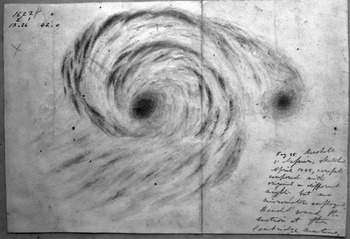
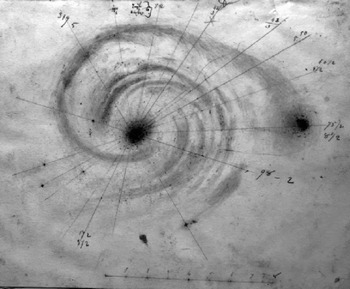
Most probably having this description and Herschel's printed engraving close to hand while observing, Rosse must have been quite surprised at what he eventually saw. If we compare Herschel's image of M51 (Figure 1) to the drawing made by Rosse of the same object (Figure 2) in the spring of 1845, we get a good sense as to why he might have been so surprised and proceeded to immediately draw this object in a roughly final form. As we shall see, this kind of immediacy was rare in the later conventional procedures established for the Rosse project, where, rather, it was normal for many drawings over a period of years to be made of the same object, before a composite and/or a selection was made to be then engraved and published. But as we shall see, even this 1845 image of the ‘Great Spiral’, as the object was also called, had its own procedure, and was not by any means a simple one-time and instant recording of what was seen in that very moment – a mere recording of some sense-data, if you will. What is even more unusual is that this original drawing was never published by Rosse himself. Rather, he straightaway publicly displayed it at the Cambridge meeting of the British Association for the Advancement of Science in June 1845.Footnote 23 Soon thereafter, it was engraved and published, for the first time, not for a scientific journal, but for a popular work by John Pringle Nichol, entitled Thoughts on Some Important Points Relating to the System of the World (1846).
Rosse's sketch of the ‘Great Spiral’ passed around at the June 1845 BAAS meeting (courtesy of Birr Castle Archives, L-binder, p. 561).

Herschel's reaction at seeing Rosse's sketch at the meeting was one of ‘strong feelings’, and he even went on to draw for the audience the form M51 took in his own telescope. The radical contrast between the two illustrations must, he declared, ‘greatly modify, if not totally change’ former opinions, such as any belief in a ‘brother-system’. And finally, ‘he felt a delight he could not express when he contemplated the achievements likely to be performed by this splendid telescope’.Footnote 24 Thus did the most important nebular researcher at the time give his heart-filled blessings to the future of the new telescope. Another report recounts that at the meeting Rosse went on to demonstrate the manner in which he drew the nebula. It consisted in a two-step procedure: the first required the use of the smaller three-foot telescope to lay down some exact measurements in order to scale the drawing, and then, in the second step, the six-foot telescope was used to fill in the details of the nebula. But because the ‘Monster’ telescope was not equatorially mounted, like the smaller one, Rosse ‘could not lay these smaller portions down with rigorous accuracy; yet as he had repeatedly gone over them, and verified them with much care, though by estimation, he did not think the drawing would be found to need much future correction’.Footnote 25 This was not the last image to have been made of the object, and as we shall see, in the following decades a series of different drawings were made within the framework of the Rosse project. Figure 3 is a photograph showing both steps in the procedure described. As one can see, the drawing quite closely resembles the one in Figure 2 (I have reduced the size of the images), and using a straight edge there are lines connecting the conspicuous features of the nebula, such as stars, thick or bright nebulosity, and the smaller companion's nucleus, to the central larger one. These measurements also helped to make the drawing relatively proportional. Whether truly earlier than Figure 2 or not, Figure 3 nevertheless clearly exhibits an image with a process, all with a markedly different purpose than mere depiction, namely as a preliminary.Footnote 26
A preparatory sketch made before the sketch of Figure 2 (Birr Castle Archives, L-binder, p. 581).

Little is actually known of the details of this momentous discovery.Footnote 27 We know only that on 11 February 1845, both Sir James South and Thomas R. Robinson accompanied Rosse on the very first observations of the heavens using the newly constructed six-foot. Due to bad weather, an omen that lasted throughout the career of this Irish telescope, the observers saw very little. It was only between 4 and 13 March that fine weather finally graced their observations. It was on 5 March that, among other objects, M51 was purportedly first observed. Strangely enough, records published by South and Robinson of that night's observation give no notice or allusion to the peculiar spiral form of this nebula. ‘This suggests’, explain Bailey, Butler and McFarland,
that both Robinson and South may have seen spirality in M51, together with Rosse, possibly as early as 5th March 1845. However, with their attention focused on the resolvability of the nebula, it is conceivable that none of the three [Rosse, South or Robinson] would have found the spiral arrangement worthy of note.Footnote 28
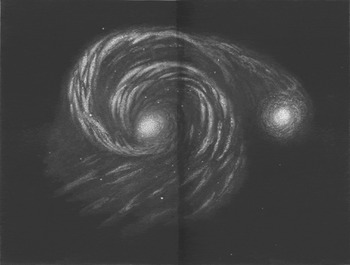
Attention focused elsewhere – that is, they failed to notice its form, or if they did, it was not ‘worthy of note’; but the latter is quite unlikely, considering the radical novelty of this form. As we shall see below, sometimes it was through a series of working images that the observer was better equipped to make out what he saw, without which even spiral-like properties may be overlooked. We also do not know who exactly drew these fine images. Having seen some of Robinson's attempts at delineating nebulae, I would venture to say it must have been either South or Rosse himself who drew this spiral form. Since Rosse had already had some previous practice in drawing nebulae using his three-foot telescope, it is most likely that the earl himself drew these sketches.Footnote 29 It is therefore odd to find that Alexander von Humboldt, in an English edition of his Cosmos, attributes the drawing passed around at the Cambridge meeting to John P. Nichol.Footnote 30 This is not surprising, though, because it was the mezzotint of the Great Spiral in Nichol's book that presented this form for the very first time to the public at large (see Figure 4).
A mezzotint engraving of Rosse's original, in John Pringle Nichol's Thoughts on Some Important Points Relating to the System of the World (1846).

J.P. Nichol's 1846 ‘interpreted’ reproduction
When looking at Figure 4 one immediately notices that it is the ‘positive’ image of the original drawn by Rosse in Figure 2. In the Preface, Nichol notes,
The remarkable Spiral Nebula is now published for the first time, through [Rosse's] kindness; and I am glad to state, that – aided by willing and ingenious artists – my rather venturous attempt to represent these masses of stars in the light in which they appear – viz: white on a dark ground, has been considered by his Lordship to be successful.Footnote 31
Even though Rosse may have deemed the positive image successful, he was himself never to publish a positive image.Footnote 32 Rather, throughout the project under the third Earl of Rosse, which lasted nearly thirty years, sketches and engravings were published only as negatives. At the outset of the project, however, this decision may not have simply been a unanimous one for the Rosse team. It seems that the first two assistants of the Rosse project may not have seen eye to eye as to the proper mode of representation.
After the spiral nebula was discovered, the Great Famine hit Ireland and research had to be delayed until the beginning of 1848. By this time, Rosse was elected the president of the Royal Society in London, and thus he hired assistants to do the majority of the observing in his stead. Beginning with Rev. W.H. Rambaut and George Johnston Stoney, who both arrived in 1848, Rosse hired four other assistants until his death. After Rambaut left in 1849–1850 for the Armagh Observatory, to become an assistant to his uncle T.R. Robinson, the earl hired George Stoney's brother, Bindon Blood Stoney, and the two worked together as assistants until 1852.
When in 1862 Rosse sent a freshly published paper on the nebulae to George Stoney, the latter made it a point to encourage the negative image in his response:
thank you for the copy of your paper which [you have] kindly sent me. The engravings look exceedingly well & it is plain that some at least of them are infinitely the best representations which have yet [been] published of the real appearances of Nebula. I much prefer the black on a white ground both as suggesting with much less harshness the fainter [areas] and Delicate details, and as [being] freer from defects in printing.Footnote 33
John Herschel, in a letter to Rosse about the very same paper, agreed with Stoney.Footnote 34 In contrast, Rambaut wrote later in life, in a retrospective letter to the fourth Earl of Rosse, that ‘I wish it were possible that the Nebulae could be figured light on a dark ground’.Footnote 35 As some of the records at the Armagh Observatory show, Rambaut actually seemed to have preferred white chalk on dark background in his early drawings of the nebulae.Footnote 36
By the late 1860s, George Stokes could write to Lord Oxmantown (Laurence Parsons's title before becoming the fourth Earl of Rosse) with regard to the publication of the drawings of the nebulae, ‘We are so used to interpret negatives that I don't think the necessity of having to mark that interpretation [is required].’Footnote 37 It might have been precisely this further ‘interpretation’ from the negative to the positive image that Rosse wanted to avoid. But it seems there were other reasons for the preference for the negative image, not only at the observing gallery but also in the publications. For one, there might have just been the practical reason that it would have been harder to draw a nebula on a dark ground in the middle of the night, with very little light. Another reason for this preference, already alluded to by Stoney, was that gradation and the levels of light and dark could be better controlled using a dark stylus on a white background, and it provided for a wider range of fine gradations than would be available for white chalk.
For astronomers at the time, one of the most significant aspects of the nebulae, which required careful representation in the drawings, was their characteristic shades, regions of darkness, condensations of brightness, and fine gradations of the light.Footnote 38 A proper and relatively well-balanced representation of all these features in a drawing was difficult to achieve, especially due to other relatively bright objects in the sky and to the use of lamplight to see what one drew and wrote during observations.Footnote 39 However fraught with difficulties, the best approximate representation of such aspects of light and dark was still a crucial part of nebular research, because, among other things, any sort of change in these distinctly conspicuous aspects was to be tracked and noted in order to assess possible motion or condensation.Footnote 40
Others, however, considered the use of the negative image in nebular research as having serious drawbacks. In an otherwise glowing review of Rosse's 1861 catalogue of nebulae and clusters, the reviewer concluded that ‘it must be a matter of regret that the drawings are made black upon white, the reverse of Nature, instead of white upon a black ground, which would have given a more truthful idea of the Nebulae’.Footnote 41 Also concerned with the engravings of nebulae, Charles Piazzi Smyth, after reviewing a few instances of both negative and positive prints, recommended that ‘the great desideratum is a faithful imitation … The further desiderata appear to be, a positive representation, in which lights shall be represented naturally by lights; secondly, the adoption of such means for producing shade as shall not be visible to the naked eye.’Footnote 42 For these desiderata, Smyth judged the mezzotint to be the best reproduction technique for the sketches made of the nebulae – a recommendation that was made in 1846, but rarely, if ever, heeded. Rather, what remained the dominant practice in printing the drawings of the nebulae was the technique of stippling into a copper or steel plate, which produced negative prints.Footnote 43
An interesting thing about Nichol's ‘more truthful’ mezzotint of the Great Spiral was the way in which he employed it in order to answer the question: ‘how far can we rely that the telescope yields an absolute revelation of these forms, – to what extent are we safe in speaking of what is apparent, as if it were real?’ Indeed the security of these assumptions seemed to have been jeopardized by the ‘metamorphosis’ that took place from Herschel's representation of the M51 to Rosse's depiction of the same. This alteration was so fundamental that it momentarily overshadowed the question of resolution – the main question of nebular research at the time. ‘I do not insist on the mere fact of its resolution’, said Nichol,
for, although in one sense nothing can be more memorable than the conversion of these dim streaks of light into burning and rolling orbs, even a feat so grand and triumphant, in regard of the science and art of Man, has an attraction infinitely less than the transforming of a shape apparently simple, into one so strange and complex that there is nothing to which we can liken it, save a scroll gradually unwinding, or the evolutions of a gigantic shell!
In answer to the question posed, then, Nichol suggested that we be ‘warned by the changes undergone by the forms’, and thereby ‘avoid the hazard of generalising on the ground of what is apparent only, and not real or essential’. Rather, ‘by a cautious and reverential criticism, enough of stability may still be discovered’.Footnote 44 The challenge seems to have then shifted to the search for ‘real’ invariant forms of the nebulae. As we shall see, this shift also occurred in the Rosse project, and in both cases it was due mainly to the discovery of the spiral character of M51. Indeed, for Nichol one invariant feature of the Great Spiral remained its partial resemblance to our own galaxy.Footnote 45
The images within the Rosse project
The development of the scientific image within the Rosse project was a complex interplay between what was seen through the telescope and what one's hand drew on paper, where one had to continually account for variations in what one saw in the same object on different nights. This amounted to finding a procedure that would narrow down, suggest, select and thereby visually and conceptually stabilize the object, or at least the image of it. I wish to stress the fact that in the Rosse project there initially was no set of prior rule-governed practices in their approach to sketching, interpreting, exploring, visualizing and describing the objects under observation.Footnote 46 Rather, it seems, there were certain broad conventions in place, especially from public descriptions given of procedures used by previous nebular researchers, like the Herschels, and also particular conventions established over the years within the Rosse project itself. These more particular conventions came to be established, by and large, on the basis of what was efficacious in securing the objects under consideration. In general, even though I am interested here in the procedures of the Rosse project, each distinct nebular research project presumably also had an approach peculiar to itself, yet informed by the procedures and conventions of others in the observation of the nebulae. We will, for instance, briefly touch in the next section on George Bond's procedures of observation, which supposedly revealed to him the spiral structure of the great nebula in Orion. One distinguishing feature of the Rosse procedures that ought to be mentioned here and noted is that it seemed to have been inspired by the conventions of accounting or book-keeping, where objects are labelled, inventoried, tracked and moved from one register book to another, representing different stages in formulation and processing, before coming to some final estimate, approximation or tally.
Within Rosse's project, a sketch would go through different stages before something like a finished final drawing would be made to be transferred to the copper plate, and thus for publication. While in one of the galleries of the telescope the observer would have a small ‘observing book’, which would be the first place where a drawing, a description and an object's position would be recorded, this would not always be done immediately, though – in some cases the drawings were completed later by memory. These are quite small books, and the tiny sketches found therein reflect these dimensions – it is not uncommon to find four or five tiny sketches made of some nebulae on one and the same page.Footnote 47 The small dimensions of the page, and the sketches on them, presumably helped the observer to capture the object quickly (but not too quickly), before it disappeared from the telescope's field of view, and aided in gaining greater control over what was drawn.
The lamplight used, in order to see what was being written or drawn into the observing book, was to be very dim so it might interfere as little as possible with what the observer saw through the eyepiece. But techniques varied. On the one hand, in light of the fact that the proportion and shape of a nebula, even in a simple sketch, were supposed to be approximated, the observer most probably shifted between looking through the eyepiece of the telescope and looking at what he drew on the page, therefore requiring the eye to readjust from the dim lamplight to the light of the nebula as seen through the eyepiece. As may be evident in breaks in some of the lines used to draw a nebula, not only did the eye have to readjust, but so did the hand in its use of the stylus. On the other hand, the mere outline of a nebula might be traced out, in which case, one or two continuous lines were required, indicating that the pen or pencil was not lifted from the page, and perhaps the eye also did not have to leave the lens. In either case, however, the use of memory was actively employed.
In one and the same observing book, scattered throughout, there are in many cases more than one drawing made of the very same object. At some point the assistants would normally collect all the information gathered in the observing books of the same object over a period of some time, and copy it into a ledger under the object's respective label, numerically arranged according to John Herschel's catalogues and their right ascensions. There are two of these ledgers, one was used in Rosse's office and the other in the Observatory. Both were supposed to contain exactly the same information and drawings, although this was not always the case. Despite important differences, generally speaking, copying sketches from the observing books into the ledgers is just as much a tracing of the object as when the object is traced from the eyepiece. By this stage, therefore, we normally have one target object traced at least three times, and often even more.Footnote 48
With a single extended gaze, one could readily scan, on a folio-sized page of a ledger, the various stages in the development of the object within a certain period of the project. After discussions with the assistants, comparing the various images made of an object, and after selecting either, in some cases, the best sketch as a whole, or, in others, some of the most significant features found in different sketches, a final finished drawing would be made. These polished drawings were corrected and completed in light of the information acquired by tracing and retracing the sketches, the descriptions and measurements made of the object over a successive period of time, and were checked and rechecked with the object as seen through either the three-foot telescope, or the six-foot, or both, using different lens pieces, focal planes, and fields of view. Typical of preparatory works meant to be transferred, these final drawings are mostly done in some combination of pastel, chalk and sometimes ink, on separate pieces of stiff off-white paper of varying sizes, which are found pasted in a large album labelled ‘Astronomical Drawings’. Even at this concluding stage, in the Final Album of finished sketches one often finds multiple drawings of the same object, indicating that still some level of procedure was continued.
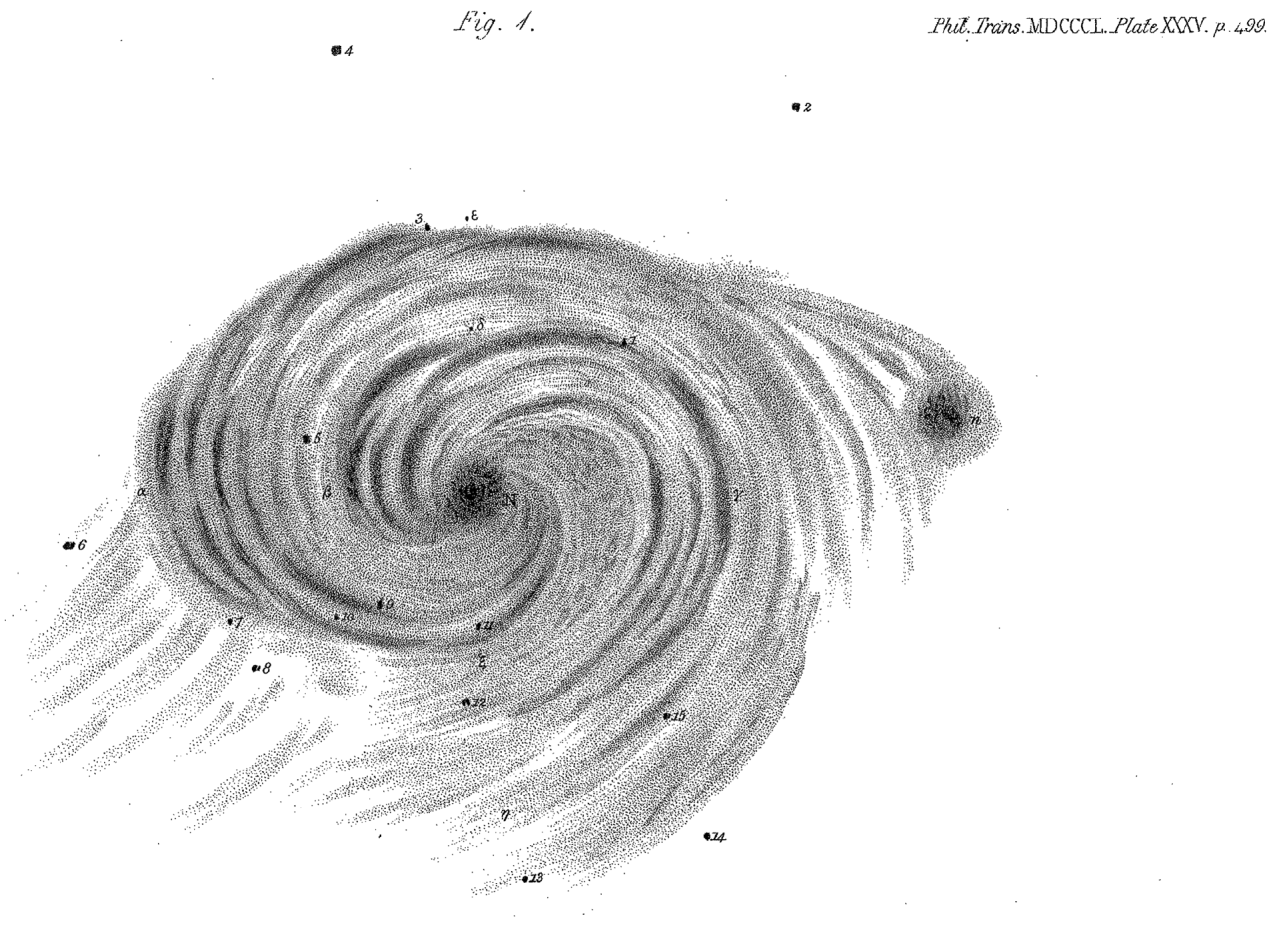
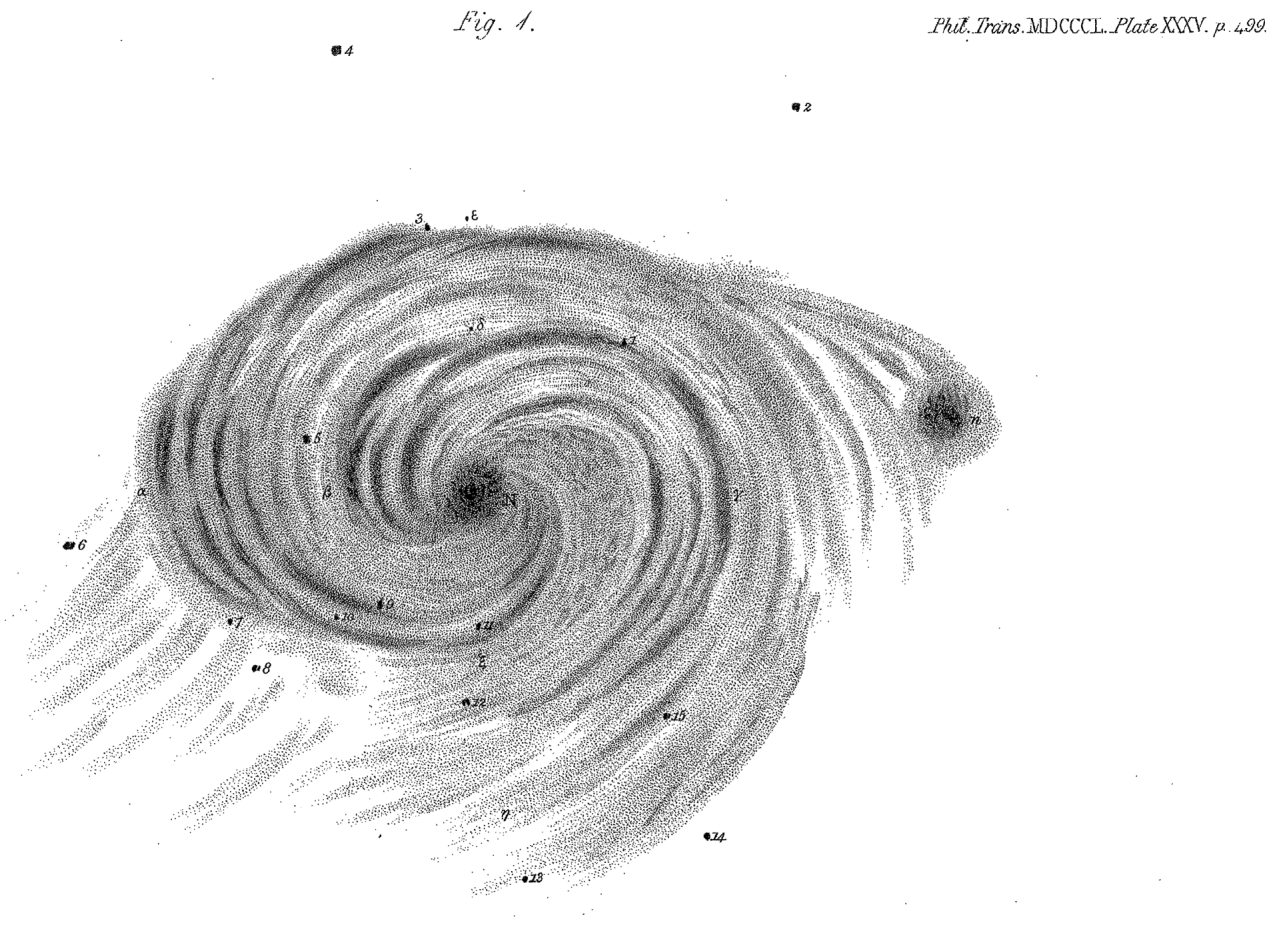
The first image of M51 by the Rosse project was not published until 1850 (Figure 5), and thereby presented in the first publication of observations made with the giant telescope. It was George Stoney who made detailed measurements of the stars relative to the large nucleus of the spiral, and it was Rosse who drew the final drawing. The numbers and the Greek letters seen in the figure correspond to a given list of measurements, which were made in the spring of 1849 and the spring of 1850. The numbers correspond to stars, and the Greek letters to points on two imaginary lines, horizontal and vertical, which intersect at the principle nucleus of the object. Rosse emphasized, however, that these measurements are ‘but the roughest approximations … the only measurements nebulosity admits of’. Among the many factors creating difficulties in observing the Great Spiral was a ‘very feeble lamp-light’, which occasionally forced the draughtsman to mark the boundaries of the object much more strongly than they were seen, and that when the eye was so affected it would also make it difficult to correctly estimate the exact location and intensity of the principle nucleus.Footnote 49
First engraving of M51 by the Rosse team. Philosophical Transactions, 1850.
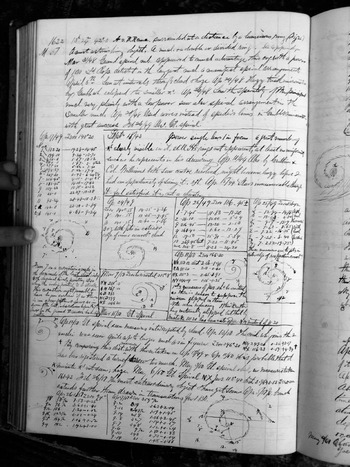
However, for the purposes of measurement, marking the boundaries in this decisive manner was sometimes of some significance, as we see George Stoney doing in Figure 6. Here we have a page from the one of the ledgers displaying in one place a couple of years of Stoney's work with regard to M51.Footnote 50 On the right-hand side, it shows the spiral arms or ‘convolutions’ clearly marked with, and the two nuclei (of the principle and of the smaller companion) are represented simply as circles, with no regard to relative size. These outlines help the observer make the measurements required, but do not necessarily aid in informing him what exactly is being measured – do the lines represent the middle of the spiral arm, or the inner of the convolution, or its outer edge? Indeed, another kind of representation is needed for such information, and this is exactly what we see on the left-hand side of Figure 6, namely outlines with ‘hairy’ curved lines. These drawings give us the impression of the density involved in these thick, massy spiral arms, but more importantly, the lines are used to represent the demarcation of the outer edges of the convolution, which are important to placing the points signified by the Greek letters, and thus not only for identifying the centre of the principle nucleus, but also for measuring the relative distances of the stars involved. These ‘well-marked boundaries’, moreover, facilitated the crucial identification of stars as either on the outside or on the inside of these nebulous masses. But even then, if the stars apparently fell on the inside of the nebulae, there was no guarantee that the observer was not being fooled by a star between the observer and the nebula. This was a crucial difference, for if a star was found to be properly intermixed within the nebulosity, Rosse urged that we could then possibly determine its parallax distance from the Earth and use it to also identify the distance of the nebula, so urgently sought.Footnote 51
A page from Ledger 1, with G.J. Stoney's observation notes on M51 (courtesy of Birr Castle Archives).

Even for measurements of the ‘roughest approximation’, the bare bones of the sketch may have to include decisive, clean and present lines, as seen in George Stoney's outlines. Yet in this ledger there are also variations in the extent of the lines, their number, structure and connections. The outline itself, therefore, had to be made out over a period of time, indicating, of course, that the outline of the object was not so readily available in the telescopic object. In fact, the outlines are an artificial aid, and are tools used in becoming familiar with the object, especially in aiding the observers not only with what might be seen, but also, eventually, with what ought to be seen (as in the final placement of the stars in the final drawing). In other words, despite the fact that the outline is hardly in the object, it nevertheless directs the observer and others to attend to certain features, such as the placement of the stars, the principle nucleus, and the overall proportion and shape of the object.
By June 1850, when the paper was first received by the Royal Society of London, the object had been observed twenty-eight times since the completion of the six-foot reflector. Figure 7 is one complete page from the second ledger, which contains a duplicate of Stoney's records of M51 from the first ledger, partially given in Figure 6. It is immediately apparent that this was no exact copy; the arrangement and order of the sketches, for instance, have been altered, and it is done, I believe, in Lord Rosse's hand. The entry begins with observations made on 3 March 1848, and the page ends with observations from 27 April 1851 – in fact, the observations were continued immediately after the publication of the 1850 paper. One also notices eight drawings made of the object varying not only in size, but also in function. Moreover, there are at least two drawings at the bottom left-hand corner, which seem to explore two possible structural variations in the object. One indicates that one of the two spiral arms connects directly to the second smaller nucleus, while the other indicates that the same arm splits to meet with the smaller part. Both variations, however, are separately redrawn to give their respective measurements. It is also surprising to note that there are no sketches made on this page of the ledger that resemble the published illustration, especially when this page spans the relevant period.
A page from Ledger 2 (courtesy of Birr Castle Archives, page from Ledger L-6.1).

When Stoney received the proof copy of the 1850 article, including the proofs of the engravings, he seems to have been a little agitated. In a long letter, which was rewritten after the first version was lost in the mail, he enumerated the errors that required correction in the proof. ‘With respect to the Engravings’, Stoney wrote to Rosse,
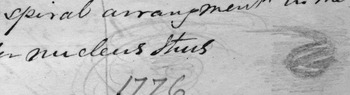
a spiral arrangement of the two nuclei of the ‘Great Spiral’ is mentioned on p. 510 but is not represented in the figure. That of the lesser nucleus I have not seen, but that of the greater I have; it is very remarkable & forms a continuation of the outer of the 2 great coils of the nebula.Footnote 52
What is at issue here is the spirality of the two nuclei of the object, rather than the object as a whole. The spirality of the larger nucleus was first observed by Rosse on 3 March 1848, and then only a month later the spirality of both nuclei was seen. But as Stoney's letter indicates, the spirality of the smaller nucleus remained a dubious matter – he had never seen it. Whatever the case may have been with the smaller nucleus, Stoney thought that one ought to have a figure which corresponded to its description, but in this case, according to Stoney, we do not. Either the written mention should be corrected or erased, or the engraving ought to be remedied; Stoney opted for the latter – the description facilitated the formulation of the figure.Footnote 53 The letter, though, was a full five months too late for anything to be done. Expecting that this might have been the fault of the engraver, however, when one checks the final polished pencil drawing made for the engraver to transfer to copper plate one is surprised to find no distinct and obvious spirality in even the larger nucleus.
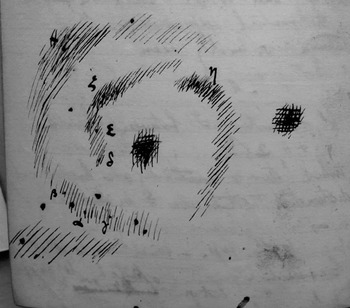
It was on 26 April 1848 that the spirality of the smaller nucleus of the outer companion was first seen. The entry in the observing book contains this record: ‘after a little gazing made out a spiral arrangement in the smaller nucleus thus’, at which point there follows a rough sketch shown in Figure 8.Footnote 54 Individual attention is given to this smaller magnified nucleus. It is detached from the rest of the nebula and given a pencil ground of one tone, to make available three tones to the draughtsman so that more details could be made out. What seems to have been revealed or at least suspected through this process was a ‘spiral arrangement’ in the shape of a Z. This sketch is not copied into the ledger, however, and thus not carried over into a process of further tracings. It is not until observations are resumed after the publication of the 1850 article that one notices that the observers begin to seriously focus their efforts on the spirality of the smaller nucleus. This occurs by way of a handful of tiny drawings of only the smaller nucleus, detached from the rest of the nebula. On 14 April 1852 the entry reads, ‘The 2nd nucleus is I think spiral but the present speculum will not verify this.’ Two days later the observer claims, ‘I again thought there was a spiral arrangement in the outer nucleus’, and this time there is another sketch made of only the small nucleus with a sharper inward spiral towards the centre (the accompanying sketch is shown in Figure 9). About three years later, on 17 March 1855, after B. Stoney had already left and R. Mitchell took over as assistant, the observer now claimed, ‘I have no doubt of a spiral arrangement about the outer nucleus.’Footnote 55 And then finally, the ‘belief of spirality’ in the smaller nucleus is ‘confirmed’ the following month. Along with a preceding ‘branch extending further than drawn in transactions for 1850’, what began as mere ‘suspicions’ with regard to certain features of the object turn gradually into characteristic features. This transformation occurs in the interplay between both the drawings and the written components. The accompanying sketches tend to depict what requires further observation and confirmation, what is over a period of time ‘suspected’, ‘thought’, ‘made out’, ‘believed’ and ‘confirmed’ to be the case, and various possibilities with regard to the object's nature and properties. As skeletons of structure or measurement, or for the tracking of open possibilities, the sketches act as tools for observation, and it is in part this aspect of the sketches which I take to be essential to their being working images within the Rosse project – tools, it must be made clear, for both thought and observation.Footnote 56 The drawings were in constant contact with the telescopic object, sometimes the object confirming aspects of the drawing, while other times the drawing individuating and substantiating features of the object; that is, the sketches were also used to see with. We should also note not only a significant dynamic between the descriptions, the objects and the drawings, but also a relationship between the sketches themselves. These sketches not only secured some kind of continuity of research between assistants, even after a few years of lapse, but they also helped to successively confirm, and thus sharpen and define, aspects of an object.
Three-toned relief in the observing book (Birr Castle Archives L-1/1).

A sharp inward spiral of the companion nucleus in the ledger (Birr Castle Archives, L-2/1).

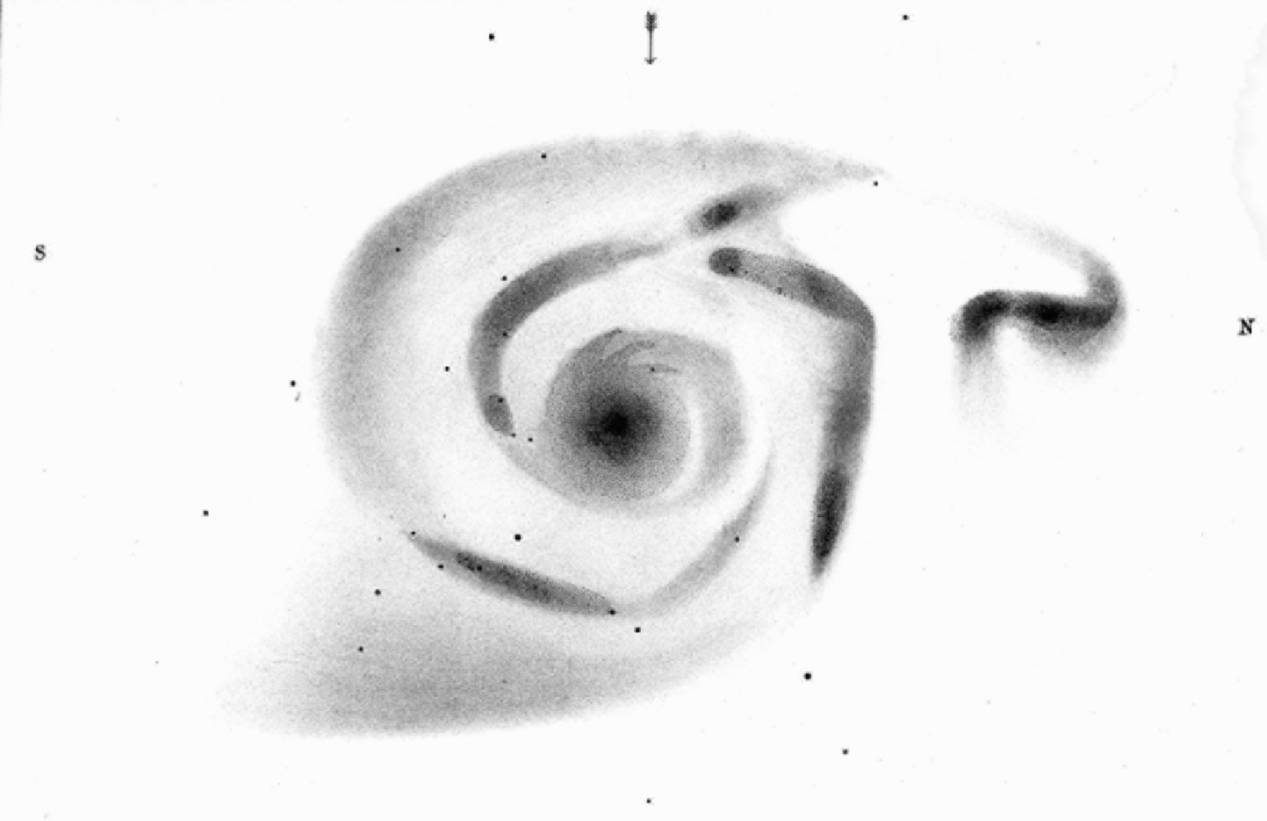
When in 1861 Rosse published the record of observations, he also published a tiny sketch of only a dissected part of M51, namely its smaller nucleus. Strangely, unlike the other couple of thousand objects recorded, this one was embedded into a record with no date, and stated only that the object was ‘Carefully observed since the drawing published in the “Transactions” for 1850. The outer nucleus unquestionably spiral with a twist to the left; thus’, at which point there is inserted into the text a tiny wood-engraving of the smaller nucleus.Footnote 57 Only three years after this publication, and five years after the last assistant had already left, Samuel Hunter, an assistant hired particularly for his training as an artist, completed another standard image of this object as a whole (Figure 10) on 6 May 1864 (but there are indications in the observing books that he changed his mind a couple of times as to its completion). One thing that stands out in both Hunter's entries and in the printed lithograph of the Great Spiral is his observation made on 18 April 1860, that in the smaller companion he noticed a sideways S-shaped nucleus, which is distinctly conspicuous in the lithograph (see Figure 10). To be sure, this had its own series of working images that constituted the confirmation of an S-shaped smaller nucleus.
Fourth Earl of Rosse, Observations of Nebulae and Clusters of Stars Made with the Six-Foot and Three-Foot Reflectors by Birr Castle, from the year 1848 up to the year 1878, Dublin: Royal Dublin Society, 1880, Plate IV – lithograph of Hunter's final drawing.

Praised by Rosse for his ability to depict and notice fine variations and gradations in light, we find in Hunter's observing books many sketches made of M51, which stand out as light skeletons, as they may be called (Figure 11).Footnote 58 Hunter's technique of bringing out the shape through a rough delineation of the light of the object seemed to have conceded the conventional nature of the enterprise by the cross-hatched representations, which did not require the use of the stump, allowing him to thereby ‘risk’ lines – lines which did not bound or enclose as in the outlines, but which expanded and shrank.Footnote 59 This technique is conducive to speed and composition, and to the placement of the patches of light and dark (by omission) in the object on the page without giving depth where none may actually be seen in the telescope. Rather, the schematic ink lines in these cross-hatchings attempt to capture the density of the light patches without being oriented by the nebula's direction; that is, these lines have their own direction, unlike Stoney's outlines, which have lines that tend to follow the movement and direction of the nebula. And even though ‘eye-measurements’ are given, they were roughly acquired without the use of the micrometer, and used primarily to make the final sketch proportional.Footnote 60 Published twenty-six years after its completion, this drawing (Figure 10) was to be the last standard illustration of the Great Spiral to be published by the Rosse project.Footnote 61
Ink sketch in Hunter's observing book.

Much fainter than any other printed version of the same object, this one by Hunter demonstrates other differences, such as the elongation of arms made out to be more angular than in prior images. Especially when seen in the context of the history of the four standard Rosse images,Footnote 62 there is, beginning with the confident, thick and lush 1845 image of the Great Spiral, a distinct tendency towards faintness. But while familiarity with the object is increased over time and the gaze prolonged, the result may yet only be the stark acknowledgement of the ungraspable and unapproachable nature of the object. The object only grows more elusive.Footnote 63 What is peculiar, moreover, is that in Hunter's lithograph we finally have a standard image that attempts to represent the spirality of the principle nucleus, so long ago noted, but never depicted in any other drawing of the Great Spiral. The way in which the spirality of the principle nucleus is illustrated by Hunter, however, as three spiked fingers indicating the rightward direction of the spiral, overwhelms one with its artificiality – but the idea of the spiral in the principle nucleus is finally imparted to the viewer, even if the speculated idea of internal movement is as well.Footnote 64
What ought to be clear by now is the importance of working images and their movements within the different levels of research and corresponding record books, a related emphasis on using them as data-points and tools that aid in the interpretation, exploration and finally qualitative extrapolation of the final image. Even when a realistic drawing is made of the object in an observing book, it only momentarily captures an object's on-the-spot impression at the time of observation, rather than purporting to be an instance of some final and standard drawing worthy of being printed as a record of a scientific object. This is not all, however. For, on the one hand, the instant sketches found in the observing books are sometimes used by the observer to familiarize and get used to the object's features, to narrow down its appearance, to guide future observation and draw attention to peculiarities, or to act as an aid to memory. While, on the other hand, the standard finished final drawings are made after years of various levels of procedure, which include initial and preparatory sketches, scribbles of parts of the object, light skeletons, outlines, schematic structures, lined marks meant to aid in measurement and so on – not to mention the descriptions, calculations and reductions that go along, and the various stages of confirmation or invalidation.
Already by 1850 fourteen other objects had been identified by the Rosse team as spirals, and two years later the total went up to nearly forty more spiral nebulae. One may rest assured that these, too, were identified using an array of different techniques, including those procedures employing working images. Rosse says as much: ‘The details of faint nebulae with curved or spiral branches have usually been made out by degrees, not only on successive nights, but often in successive years.’Footnote 65 We may take this to mean that, along with techniques of other sorts, those used for picturing the spirals were also used in making out what they saw. As more of these spiral nebulae were made out, some of them with the help of a series of sketches, what emerged was a potent conceptual category under which many nebulae, apparently of varying shapes and sizes, could be classified. Rosse characterized the spirality of an object as ‘a curvilinear arrangement not consisting of regular re-entering curves’.Footnote 66 Armed with this ‘habit’, the Rosse team shifted their focus and began a more fundamental project than the resolution of the nebulae into either stars or nebulous matter.Footnote 67 ‘Very soon after’, Rosse recalled, ‘the spiral form arrangement was detected … our attention was then directed to the form of nebulae, the question of resolvability being a secondary object.’ Even though still noted and commented on in the observations over the years, ‘the question of resolvability, therefore,’ continued Rosse, ‘must remain to be taken up separately, when the finest instrumental means are available’.Footnote 68 Nichol, as mentioned, had earlier already hinted at this shift in focus.
In a presidential address given to the Royal Society, Rosse further expanded on the search for ‘normal forms’ among the nebulae:
It is highly probable that the objects we see are presented to us in every variety of position [in the drawings made of them], that they often differ in form merely because we see them in a different aspect, and that if all were similarly placed as to the line of sight, a few normal forms would represent the whole. If this is the case, had we a sufficient number of accurate sketches, it is probable that out of the apparent confusion we should succeed in extracting the normal forms.Footnote 69
Elongated, spherical and elliptically shaped nebulae, along with ones with halos and rings, might not only be seen from our present situated ‘line of sight’, here on Earth lying in diverse positions, but as the case M51 showed, differences in the distance of the object also resulted in apparent differences in detail. The extraction of the normal forms of the nebulae, therefore, would have to include sketches and measurements as ‘numerous as possible’, so that, if arranged according to the degrees of difference in form and detail, due to both position and distance, they might give us information as to how to hypothetically arrange them according to one and the same line of sight. However, Rosse claimed there was enough evidence to suggest that, in the main, nebulae were much closer than astronomers had previously thought, and that, therefore, variations in the distance of the objects could now be contained within a certain range – attempting to preclude, thereby, any further surprises in appearance similar to the one instanced by M51. Whatever the case, the Rosse team had now a new powerful conceptual tool, namely the spiral form as one of the most fundamental of these normal forms.
Attached to the back cover of a ledger, one finds an extensive note written for 28 September 1852 and entitled ‘Abstract of work done, in respect to the examination of Nebulae, by the Earl of Rosse's 6-feet speculum, from the commencement of its employment, to February 1852. Taken from the Ledger records of Observation by a Visitor’. Who this visitor might have been is not clear, but the abstract lists to date the ledger's total number of observations, sketches, ‘highly finished drawings’, measurements and newly found nebulae, and displays a serious knowledge of astronomy.Footnote 70 In the section ‘Remarks’ the visitor goes on to conclude,
Amid this interesting revelation of the distant heavens – the most remarkable Configuration, as a class, as well as the most novel and important – is the Spiral – or what we might designate ‘the Rossean Configuration.’ Of this Configuration, the drawings and elaborations of which are amongst the leading fruits of observations with the great speculum … And it seems more than probable that very many others, especially of the annular & planetary kinds [of nebulae] will … be resolved into the like configuration.Footnote 71
What this note suggests, therefore, is the priority of ‘resolving’ some of the most remarkable nebulae no longer simply into either nebulous self-luminous fluid or stars, but into the Rossean Configuration – the spiral form. In the image of the Great Spiral, then, we have an instance of a characteristic: ‘although an individual object is depicted … it is made to stand for a whole class of similar objects’.Footnote 72 If one were to use the image of the Great Spiral as a sort of visual justification for the claim that motion may be present in such a system, and if the Rossean Configuration is one of these normal forms into which many nebulae may be resolved, then we would have an extremely powerful way of subsuming these numerically resistant nebulae under classical mechanics; or, as Rosse put it, that a ‘fulcrum will thus be obtained, by which the powers of analysis may be brought to bear upon the laws which govern these mysterious systems’.Footnote 73
Spirals abound or unfound: the image as a conception
The image of the Great Spiral was only the beginning; many more images of spiral nebulae were emerging from within the procedures of observation of not only the Rosse project,Footnote 74 but others as well, such as William Lassell's. In particular, between the 1860s and the 1880s there was a considerable proliferation of images of the spiral formation, not only in the sense of pictorial illustrations, but also in the sense of conception – the spiral formation became a definite category of what one may perceive with both the eye and the mind.Footnote 75 By the middle of the nineteenth century the agreement between the two (the eye and the mind) was not something one could any longer simply rely on; in some cases one outdid the other. At times the mind was seen as having perceived more than what actually met the eye, or the eye failed to be convinced by mere conceptions of the mind. In such cases of suspicion it was sometimes the activities of the hand that were called for as they acted within respective procedures of observation, in order to adjudicate between the two. In this section I hope to get clearer on these rough allusions by briefly considering two cases. One is the case of George Bond (1825–1865), the astronomer and director of the Harvard College Observatory; and the second is that of Wilhelm Tempel (1821–1889). The first exemplifies the excesses of procedure that overemployed sketches to actively see with, while the second case illustrates an opposing procedure of attempted passivity.
Continuing where his father had left off, George Bond succeeded William Cranch Bond (1789–1859) at the Harvard College Observatory. One of the main objects of research, for both the Bonds, was the ever-mysterious and intriguing nebula in Orion. Due to its distinct irregularity in form and its unique appearance, this nebula had been suspected, at least since the time of William Herschel, of being the key to the determination of whether or not a self-luminous nebulous fluid existed in the nebulae.Footnote 76 By 1846 Rosse, however, had sent a letter to Nichol stating the successful resolution of the nebula in Orion into stars, thus for a short time putting to rest the belief in the existence of nebulous matter. Apparently unaware of this public letter to Nichol, George Bond's father also claimed to have resolved the nebula in Orion, and produced an exquisite illustration of the nebula years before the Rosse team could.Footnote 77
Once again, the primary task in understanding this nebula was the production of exact and detailed drawings. In executing his own drawings of the nebula in Orion, George Bond made painstaking measurements of many of the more conspicuous stars, and by the end of 1858 he had plotted out nearly 262 stars of only a small area of the nebula onto paper. In the following year, this same area of the nebula was then further divided into four charts on a dark ground so that the ‘nebulosity’ could be traced in chalk and white watercolour. The four charts were recombined and the single drawing of the area was then compared with the nebula as seen through the telescope and corrected accordingly. Into the third year of this procedure, Bond was for the first time ‘presented’ with the ‘whirl’-, ‘wisp’-, and ‘spiral’-like character of the nebula in Orion. These began to appear as he traced the ‘fainter convolutions’ through the darker spaces, and were actually further ‘defined by two independent processes’ that seemed to have made clearer the relevant interrelations between light and dark: first, a sketch made with white chalk in the positive so that the brighter parts could be managed and formed, and then again in the negative, which was done in order to give controlled contours to the appearance of depth in the darker regions. Notice that this procedure is in part the opposite of Hunter's, where, as noted above, it was the brighter parts that were controlled and manipulated by dark pen on white ground. Extending this procedure to other parts of the nebulae, and by paying attention in a new way, Bond began to notice the spiral-like character in many other parts of the nebula, and thereby thought he had successfully ‘resolved’ the apparent nebulosity into spirals, wisps, and ‘wreaths’. Having collected about twenty of these spirals in the great nebula in Orion, he concluded that it ‘may, in fact, be properly classed among “spiral nebulae”, under the definition given by their first discoverer, Lord Rosse; including in the term all objects in which a curvilinear arrangement, not consisting of regular re-entering curves, may be detected.’Footnote 78 What was for Rosse a ‘habit’ within the observational procedures is now for Bond a ‘definition’. Yet, using his own distinct procedures, Bond was able to ‘define’ and ‘trace’ the apparent spiral character of the nebula, which had never before been characterized by this feature.
Prior to Bond's ‘discovery’ there were about nineteen other astronomers (from William Herschel onwards) who published drawings of the nebula in Orion. None of them ever made any mention of the spiral gestalt, not even in the drawings and descriptions given after Rosse's discovery of the spiral nebulae. Bond, however, suggested that even if no notice were made of these features, ‘indications of their presence … are imperfectly suggested’ in some specific areas in the drawings of the same by William Lassell and John Herschel. In fact, terms like ‘wisp’ and ‘convolution’ were used earlier by Herschel in his descriptions of the nebula in Orion, but Bond here appropriates these terms and newly regards them as indications of spirality.
A little uneasy, Bond spends the next half of the paper attempting to explain why ‘the existence of this feature in the great nebula of Orion should have hitherto escaped notice’. Bond seems to have been convinced that this was just another instance, as ‘so often occurred in the history of astronomical discovery’, of fainter details being overlooked, the chief example being, of course, the Great Spiral. Even though this object had been ‘subjected to careful examination and description by both the Herschels; neither their drawings nor descriptions furnished the slightest intimation of a spiral structure’. The common idea that the discovery of the spiral structure by Rosse was essentially due to the application of a much more powerful reflector to the same object never held any water, according to Bond, because even a refractor with a fifteen-inch aperture (like his own Harvard College Observatory telescope) could ‘exhibit the appearance in question’, and the Herschels had used a reflector with an eighteen-inch aperture. Nor were ‘the earlier observations and delineations’, precluded Bond,
in any proper sense erroneous. So if it was not simply the application of more powerful reflecting telescopes to the object that brought out distinguishing features of the object, and if it was not some sort of error on the part of the observers, what could it be?
Bond's answer is instructive: the observations ‘were simply made at a great disadvantage in the absence of a clear conception of the general plan of structure presented in the object’.Footnote 79 The discovery of the Great Spiral, and, perhaps more importantly, the image of a spiral form, provided this conception and general plan of structure for dozens of other nebulae that hitherto had never been so seen. Bond goes as far as to claim that ‘the eye cannot unravel without the aid of some clue to their mutual relations and significance, and partly also to the faintness of some of the details, which are, nevertheless, very essential features in a correct apprehension of its structure’.Footnote 80 The correct apprehension of the structure of nebulae was thus conditioned on certain conceptions and ideas that acted as clues in aid to difficult astronomical observations. What is even more, after Bond, is that both the fourth Earl of Rosse and William Lassell seem to have confirmed, at least in part, the spiral character in certain regions of the nebula.Footnote 81
Ten years later, and despite the fact that others were beginning to confirm this spiral gestalt introduced by Bond into the nebula in Orion, Father Angelo Secchi (1818–1878), the director of the observatory of the Roman College, expressed serious doubts about Bond's discovery. This he did in a most amicable manner, but the message was clear: Bond was negatively infected with preconceived notions that distorted the results of his observations. Secchi explained that
the author states that it cost him much labor to trace these spiral convolutions in the midst of the Labyrinth of the nebulous mass. If we should sincerely express our opinion, however, we believe that this preconceived idea of reducing the nebula of Orion to nebulous spirals, applying to it the principle of Rosse, may have slightly forced the observer's judgment inducing him to give prominence to certain traits which, perhaps, have not all the strength that they show in the drawing. The reticulation in the region H, G, F, K, of our polygon [in the nebula], is certainly very confused, and a preconceived idea can easily distort the fancy.Footnote 82
I take this passage from a translation of it given by Holden in his splendid Monograph of the Central Parts of the Nebula in Orion (1882). What might be interesting to note is that Holden, from among all the drawings of the nebula in Orion available to him, choose to print George Bond's engraving as his frontispiece, adding that it is ‘to my eye, the most satisfactory representation of any celestial object which has yet been produced’. The supposed spirality displayed in parts of the nebula was in fact also seen by Holden as late as 6 March 1876, at Washington Observatory, using a twenty-six-inch refractor.Footnote 83
Bond's observations occurred between 1857 and 1860, much before the rough application of photographic technologies to the nebulae by Henry Draper in 1880. Prior to this application it is common to find observers of the nebulae using ‘clues’, ‘suggestions’, and ‘preconceived’ notions, albeit often in conscious, ordered and cautious ways, in order to make out what they saw.Footnote 84 But it was also easy to go too far in this kind of application. It was precisely for similar reasons, advanced by Secchi for his rejection of Bond's ‘system’, that Tempel went on to reject the spiral form in M51, and in other apparently spiral nebulae. We are thus confronted in both these cases with not only a double-edged sword, but also a case of a gestalt form.
From 1874 until his death a few years later, Tempel was the director and chief astronomer at the Arcetri Observatory in Florence. In an 1877 article published in the Astronomische Nachrichten, with a summary of the contents given in English for the Observatory,Footnote 85 Tempel claimed that the spiral form detected in a number of nebulae was a mere ‘creature of phantasy.’ This was for two reasons. The first was based on an optical effect that larger telescopes, such as Rosse's, were supposedly prone to. As artefacts, consequently, ‘a big part must be left out’ of Rosse's researches into the spiral nebulae. The second reason for rejecting the spiral form was directly a result of his examination of the drawings made by himself and others of supposed spiral nebulae. Tempel's expert examination of the drawings made revealed, according to him, an unmistakable ‘intention in the sketches and the descriptions to give the nebulae this form’. And the sketches represent the same object in ways so different and diverse that one is left with the conclusion that ‘the spiral form does not exist in the skies’.Footnote 86
At this time the chief astronomer at Rosse's telescope was Johan Louis Emil Dreyer (at Parsonstown from 1874 to 1878), who was busy putting together material for the project's latest catalogue that collected observations from its inception to the year 1878. Among the material to be published was Hunter's 1864 drawing of the Great Spiral. It was Dreyer who responded to Tempel's rejection, which turned into a brief but poignant exchange.Footnote 87 Dreyer seems to have been a little annoyed and wrote,
M. Tempel supposes that the spiral shapes are only creations of phantasy, in which a desire of giving all nebulae this shape is perceptible. This does not look as if M. Tempel believes much in the good faith of the observers with the 6-foot telescope; and it seems strange to see a man who has never seen any nebula through this powerful instrument so confidently express his opinion as to the work done with it.
Fair or not, Dreyer took Tempel's attack to be an ad hominem one, but, more pointedly, he went on to write that if Tempel
cannot recognize the spirality of M 51=h 1622, this only proves (if a proof is necessary) that his 11-inch is inferior not only to the 6-foot and to Mr. Lassell's 4-foot, but also to the Pulkowa refractor, in which latter the spiral form ‘is very distinctly seen’.Footnote 88
In other words, Tempel's rejection of the existence of the spiral character of M51 and of other nebulae was insufficiently supported not only by the drawings and reports available to him, but also by a telescope with little power compared to the telescopes of other nebular researchers who had confirmed, measured and drawn spiral nebulae, including M51.
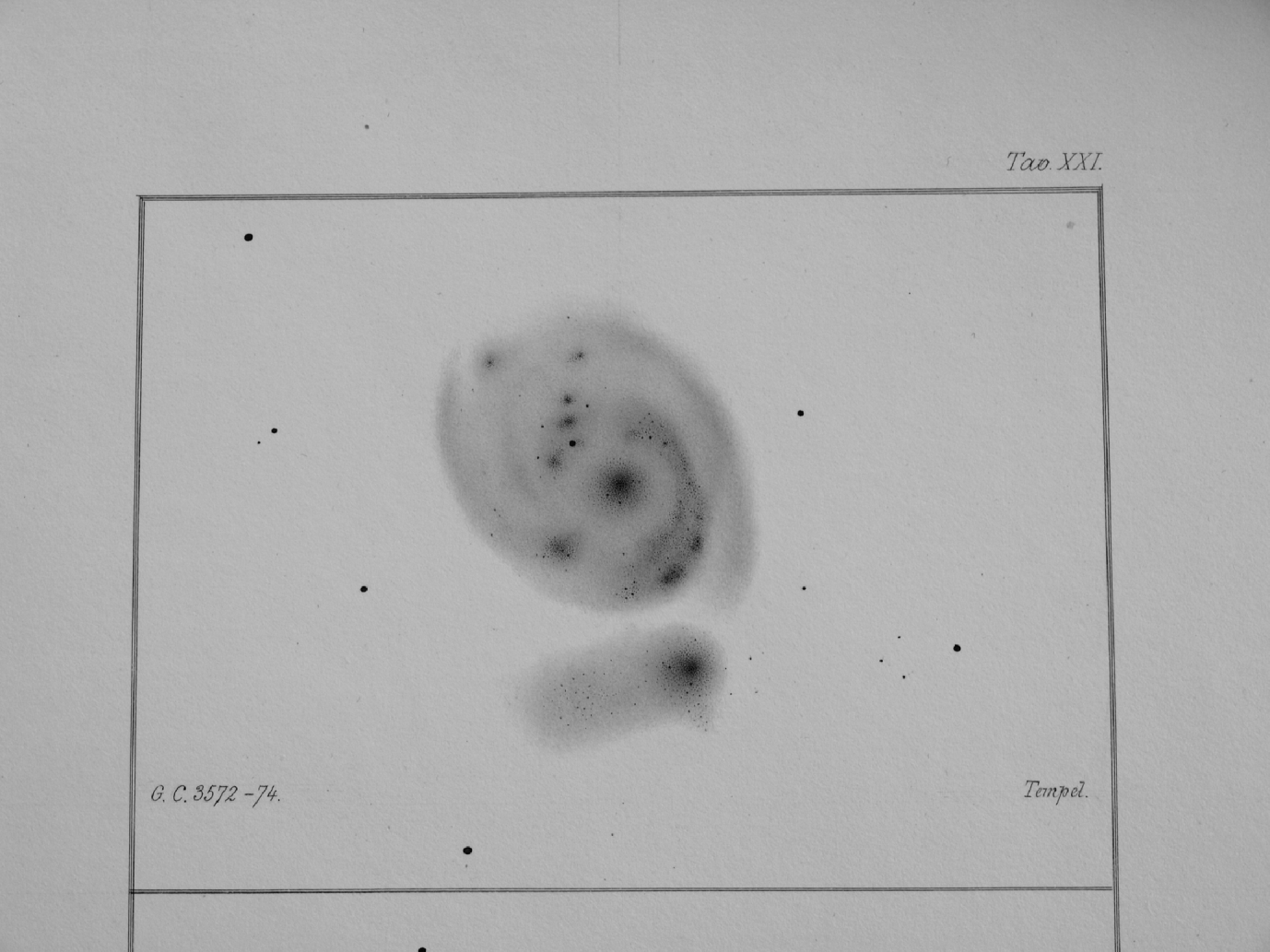
It must be made clear that what is at issue is not the existence of the object, but of the property of spirality as an essential individuating feature of the object. The Great Spiral was found and even drawn by Tempel, but it was this particular property that was not confirmed by his drawings, re-observations and examinations of the object, even though, as he says in the unpublished notes to his lithograph of M51 (Figure 12), ‘even with the best will/intention it is impossible to make out a spiral form out of the surrounding nebular masses’.Footnote 89 Curiously, moreover, in his reply to Dreyer, Tempel makes no direct attempt to defend his refractor's capabilities, rather he focuses on giving a two-prong reply. The first is simply that some of the same astronomers using the same instruments had been wrong before in detecting not only key features, but even objects themselves. And second, he provides a critique of the drawings exhibited by astronomers. We will see that the two prongs of the response are related, particularly in their emphasis on further qualifications required when speaking about the power of instruments and how we see thereby.
Unpublished lithograph of M51 by Wilhelm Tempel (courtesy of the Library of the Arcetri Astrophysical Observatory, Florence).

Beginning with the first prong, Tempel seems to have learned a hard but valuable lesson when he discovered a new nebula on 19 October 1859, the ‘Merope nebula’. When he discovered it, many of the distinguished nebular researchers at the time could not confirm Tempel's discovery, even though all had telescopes with power either equal to or greater than Tempel's. Tempel goes on to ask,
is it not singular that it [Merope] should now be seen with all instruments, while at the time of its discovery I was overwhelmed with reproaches by D'Arrest because he was unable to see it with his 11-inch telescope, and Dr. Dreyer also failed to find it with Rosse's?Footnote 90
In another place he recounts the troubled history of this nebula, and points out the important optical solution to its final acceptance by astronomers: ‘But all ambiguity has been since cleared up, for on fitting the large telescopes with eye-pieces of a low magnifying power the nebula becomes distinctly visible, and is shown by them with an image equal in clearness to that given by the smaller instruments.’Footnote 91 This case, then, certainly made a strong impression on Tempel's subsequent ideas with regard to the sheer power and size of telescopes, especially in that issues of observational veracity, therefore, should not be settled merely on one overpowering another, but also on the techniques employed in aiding observations.Footnote 92 It is no wonder, then, that Tempel makes no special remarks in defense of his refractor, because he thought smaller telescopes should not be underestimated, and that even those of equivalent power may not equally exhibit features of the same object in the same way. And having experienced ‘for sixteen long years’ a four-inch refractor and then later an eleven-inch, Tempels says it ‘gave me data for logically estimating what, and how much more, might be visible with telescopes of 15, 26, and 72 inches’.
This brings us to the second prong of Tempel's response, which focused on the drawings involved. Tempel wrote that he was willing to send Dreyer a ‘series of [his] best drawings’ compared and arranged with other existing drawings of the same object done by him and others. ‘Unfortunately’, he continued, ‘my criticism cannot be conveyed in words alone, but requires ocular demonstration, for which reason I should much desire to see my drawings published.’Footnote 93 Tempel's drawing of the ‘Great Spiral’ was never published. I include a lithograph made by Tempel, found in the archives at Arcetri Observatory (Figure 12).Footnote 94 I am guessing that the ‘ocular demonstration’ would have involved, at the least, a detailed account of where other drawings of the spiral nebulae had gone wrong, and why his drawings and procedures might have been superior. In other words, Tempel must have had some way, or at least he thought he did, to distinguish printed sketches infected with conception from those which simply registered what the observer saw. To be sure, this was warranted, Tempel felt, because
had Rosse written volumes on the nebulae, I should not have a word to object to his view; but as he has made and published such a number of drawings of them, it is my right and my duty, both as an astronomer and as an old and practiced lithographer, to express my opinion freely on them, whilst I am ready to add to these observations my own impressions of the nebulae as seen through a good reflector, leaving every one free to form his own conclusions.Footnote 95
All in all, Tempel seems to be asking, why are the drawings, criticized by means of sufficient optical power and the expertise of a draughtsman, not enough to disconfirm the existence of an aspect of a nebula? And if it is enough, then the power of the instrument should not matter, absolutely or as much as seeing and drawing what you see well. Indeed, the enthusiastic reliance on an instrument's size is misplaced, according to Tempel, because
there exist so many published drawings, made by such a number of astronomers and with telescopes of such various sizes, that I was speedily supplied with a fundamental axiom for my criticism, viz. that the great discrepancies between these singular figures cannot have their cause in the different instruments employed, but in the art of seeing and in the power of copying faithfully. Just as the human memory is less cultivated and exercised, owing to the mass of literature accumulated in the course of centuries, so that art of seeing truly is now being lost by the variety of instruments and artificial aids to vision.Footnote 96
In the case of the spiral gestalt, in particular, this mistaken feature might have been due to ‘artificial aids to vision’, which from the context included not only preconceived notions or ideas, such as spirality, but also the use of working images in the procedures of observation. In fact, copying faithfully what one saw meant for Tempel that the drawing simply register all that it could, and that its importance lay not in being an aid in some step-wise stabilization of an object. Such active participation in the act of observation, as instanced by the working images used by Rosse and Bond, is exactly what Tempel seems to have been against. Many proponents of ‘mechanical objectivity’ at the time, however, who might have agreed with Tempel's rejection of the role played by conception in observation, would have certainly been quite puzzled by his implicit suggestion that conception, too, was just another artificial aid like automated recording devices and photography.Footnote 97 But once we have understood the role played by the spiral conception, as in the case of Bond, we begin to see what Tempel might have had in mind.
Similar to a Rorschach image, Tempel observed that ‘if one uses his imagination or fantasy, one can see all kinds of figures in it [M51]’.Footnote 98 This nearly echoes Father Secchi's remark against Bond's application of the conception of spirality to the nebula in Orion. But while Secchi's criticism of Bond was essentially correct, Tempel's rejection of the spiral form was soon confirmed to have been seriously misguided, particularly by the application of photography in 1889 to M51 by the amateur celestial photographer Isaac Roberts.Footnote 99 I do not wish to suggest that the aid of conception had no limits within observation before this period, only that prior to a certain point, such erroneous applications as Bond's only went to demonstrate that further caution was required, and not that such aid was to be abandoned altogether. Moreover, the successful application of new photographic technologies to the nebulae, rather than dealing a death-blow to the use of drawings in astronomy, only seemed to make it more desirable for some, as long as ‘any tendency to idealize … be anxiously kept in check’. As Margaret Huggins suggested in 1882, the photographical reproductions of the drawings of nebulae could not ‘be altogether trusted’ and, despite photography's recent successes, ‘there can be little question that, excellent as is the work that may be done by photography, there must always remain a large field for astronomical drawing’.Footnote 100
This, however, did not exactly turn out to be the case, not only because direct human perception of an object through optical telescopes was less and less relied on for astronomical information, but also because there seemed to be some surprise on the part of prominent astronomers at the end of the nineteenth century as to just how widely dissimilar the hundreds of drawings made of the very same object over the last century really were proving to be – the ensuing epistemic distrust of drawing as an important scientific technique was certainly only exacerbated when contrasted to the application of photography to the celestial objects.Footnote 101 If the dissimilarities in the drawings of the very same object were never really successfully used to prove actual change in the object, the rapid accumulation of divergent depictions of the same object, then, seemed to justify doubts as to their effectiveness. It is precisely this kind of doubt that arose in Wilhelm Tempel's repudiation of the spiral form.Footnote 102
Bond used the general conception of spirality in order to individuate specific features of other nebulae, and used the conception explicitly as an aid in his procedures of observation. Secchi rightly thought that this was, on the part of Bond, an inappropriate application of the conception. It was Tempel who went as far as to reject the conception of spirality, and its instantiation even in the ‘Great Spiral’. It is precisely here, in the affirmation or rejection of an instantiation and/or application of a conception that issues of existence, identity and classification arise. In fact, we may conclude that the function of working images within a particular procedure may not only assist in making out characteristic features of an object, direct observation and attention, and contribute to the finalization of some standard image, but also may assist in the application or the discovery of an instantiation of a some potent scientific conception.
Finally, one may conclude that while the attempt to stabilize such nebulous objects was in the main secured by some final visual representation printed and published, a much less worked out, clear and stable image is given within the procedures of the observing books and ledgers of the Rosse project. Working images were used in attempts to progressively stabilize what was seen in the object, to indicate what might be seen (thereby directing attention to particular features for further observation), and to the final consolidation of what should be seen. While working images, within the respective procedures, helped to articulate the barely visible details, aspects, boundaries and so on which were at each step confirmed or not in relation to the telescopic objects, descriptions, calculations and other working images, the printed final image, on the other hand, tended to operate as if the apparent were real.