





Ordinary kindness is a universal, easily recognised human behaviour that we accept is fundamental to caring for others. Our wish to succour others is so strong that it is an important motivator in public service performance, including healthcare. Reference Zubair, Khan and Mukaram1 Despite this, healthcare is replete with examples of its failure. This Special Issue explores delivering kindness and compassion in healthcare; here, I discuss the current policy of promoting kindness as an institutional principle in healthcare from three perspectives. I introduce the concept of regulatory culture as an environment through which kindness may be disseminated and prioritised. I next discuss ‘intelligent kindness’, which has been expanded into a theory of health services management Reference Ballatt, Campling and Maloney2,Reference Campling3 that claims to be able to restore our ailing welfare state to effective, if not perfect functionality. I then use a case study approach to explore potential risks, benefits and derive recommendations.
Regulatory culture
The concept of regulatory culture, which emphasises the need for an organisational ethical culture above and beyond compliance, was first adopted in the financial sector. Reference Davies4 Health, however, took a different path, hoping that regulation responsive to risk assessment would also reduce the overall regulatory burden. Reference Baldwin5 Despite strenuous efforts this approach failed, as evidenced in the Francis Inquiry, Reference Francis6 which identified:
‘Above all… an insidious negative culture involving a tolerance of poor standards and a disengagement from managerial and leadership responsibilities’ (pp. 3).
The adoption and implementation of a regulatory culture thus became an imperative. It is intended to replace the piecemeal and reactive approach implicit in risk management with one of creating a network of shared understandings that shape behaviour appropriately. Reference Meidinger7 As used by the General Medical Council, ‘kindness’ seems to fit the bill admirably, Reference Sokol8 particularly as intelligent kindness embeds it, suitably qualified, in a managerial system that has gained significant traction in health services management.
Intelligent kindness as health services management
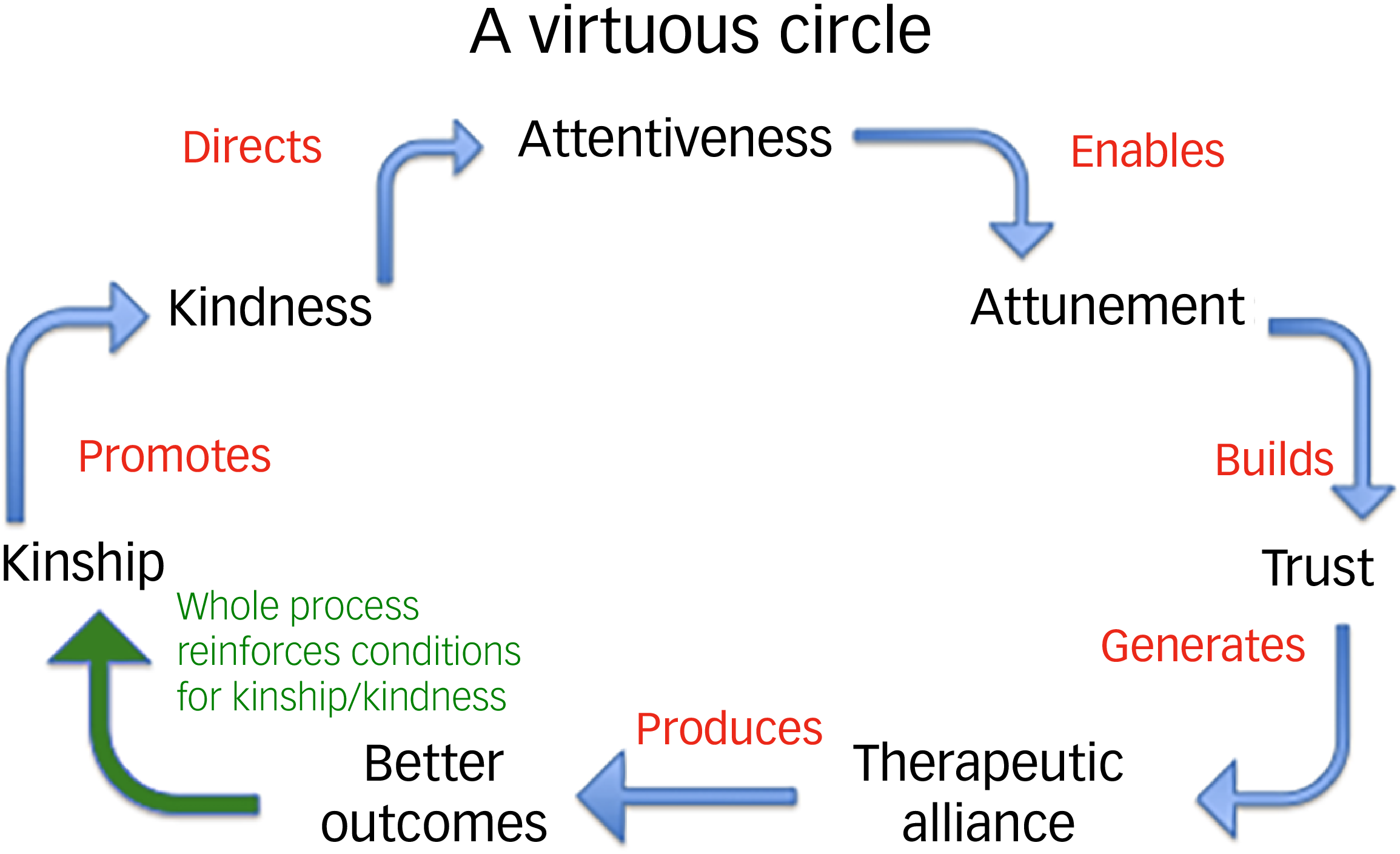
Campling Reference Campling9 provides a helpful diagrammatic summary, reproduced in Fig. 1.
A diagrammatic summary of intelligent kindness as health services management.

Although it can be understood in its everyday sense of ‘bringing into harmony’, attunement here also has a more technical meaning, referring to the patterning of intimate relationships (especially the mother–child bond). In this form, it was once believed to provide a biological basis to attachment relationships as an expression of mirror neurone activity, Reference Gallese, Eagle and Migone10 but more recent research suggests that these neurones only work in low-level mimicry, rather than supporting relationships. Reference Heyes and Catmur11 Irrespective of this challenge to its construct validity, the model offers what might be called an ‘emotional audit cycle’, designed to review, correct and improve significant deviation from kindness in management and service delivery, when indicated either directly through feelings or indirectly though outcomes. Both attunement and ‘therapeutic alliance’ point to the psychodynamic structure that underpins the model. Psychodynamic modelling may be contested from many standpoints with or without changing Campling’s conclusions, but from a regulatory standpoint, it is essential that any such model scales to organisations. To do this, it must make three strong assumptions.
The first is psychic determinism. Put simply, it assumes human behaviour is always intentional, meaningful and interpretable, although the intentions that form it may be unconscious, requiring some form of analysis to expose them. The second is that psychodynamic interpretations are scale-free. This means that, with the necessary things changed, the same psychodynamic process operates across the scope of the model, from individual practitioners to the whole welfare state. Object relations, like all psychodynamic theories, foreground the family. In its third assumption, as described, the model enlarges this to ‘kin’ and uses etymology to segue from the care and commitment usually shown to family, and accounted for psychodynamically, to kindness. However, kinship has its academic roots in anthropology, a discipline distinct from psychoanalysis.
Case studies can be useful to test assumptions, and one is presented below.
The Liverpool Care Pathway
This account is heavily indebted to the magisterial analysis by Seymour and Clarke. Reference Seymour and Clarke12 The Liverpool Care Pathway (LCP) tried to bring the principles of palliative care for dying patients from hospice to hospital practice, and the compassion that is supposed to be delivered in hospice care closely resembles the goals and intent behind intelligent kindness. Despite this, it collapsed amid accusations of poor care and even state-sanctioned murder. Rather than reiterating their account, key findings and their implications for intelligent kindness are grouped by topic below.
Philosophy and ideology
Kindness is both a virtue and a principle. Whichever definition is preferred, the term is no more than a placeholder in ethical discourse, unless qualified by reference to the agents and circumstances expressing it. Reference Beauchamp and Childress13,Reference Hursthouse, Pettigrove, Zalta and Nodelman14 The situational flexibility implicit definitions allow Reference Sokol8 inevitably create uncertainty. The LCP and intelligent kindness Reference Campling9 (pp. 87–97) possess similar delivery structures, so both can be regarded as examples of ‘boundary objects’, Reference Star and Griesemer15 which can translate knowledge between different domains, but with the price of enabling different, and possibly incompatible definitions across them. So, far from being scale-free, organisational principles may be radically redefined by scaling, and policies live or die by their ideology, not effectiveness. Reference DeLeon16 At the local level, the LCP progressively lost its pathway facilitators, who had the key role of ensuring palliative care capability (thus including its ideology and ethical framework) was disseminated among staff using the LCP. At the national level, the LCP’s status as a boundary object eventually made it a lightning rod for competing ideologies around end-of life care, such as the ‘pro-life’ movement and even, in the USA, those opposing the Affordable Care Act. Intelligent kindness applies a psychopathological (‘perversion’) approach to attempts to disrupt its policies and procedures, so failures in kindness may be framed as expressions of mental distress Reference Ballatt, Campling and Maloney2 , which leaves no space to consider the impact of opposing but equally moral principles, and thus undermines the dialectic proposed by Beauchamp and Childress Reference Beauchamp and Childress13 as a solution to resolving such incompatibilities.
Society and institutions
It is commonly believed that the LCP failed because it failed to engage or consult families, but these were core components of the model, Reference Jack, Gambles, Murphy and Ellershaw17 and lack of consultation was not an issue while it was deployed in hospice care. Multiple streams theory is helpful in situating policies in society. It argues that problems, the policies designed to address them and the politics that enable the policies form multiple streams, each requiring its own level of analysis. Reference Winkel and Leipold18 In this model, policy entrepreneurs who seek to take advantage of favourable political circumstances (‘policy windows’, defined as structures of opportunity) to promote their own favoured policies, are key policy enablers. Both the rise and fall of the LCP can be attributed to different groups of these. The first policy entrepreneurs were in the health service and academia, and their authority enabled them to persuade the UK Government that the LCP solved a problem around end-of-life care. However, their influence in the non-academic press was limited by countervailing press opinion and personal testimony, reflecting the expansion and transformation of meaning of the LCP from a focused programme to a metaphor for all end-of-life care. As discussed above, the needs of the LCP also required policy entrepreneurs at the local level to ensure that its specific policies were not crowded out by others, but the need for these was not understood until too late. As its weaknesses became publicised, other policy entrepreneurs saw opportunities to promote their own incompatible structures of opportunity, leading to LCP’s UK demise. When belated randomised controlled trials were conducted, little difference was found between the LCP and other end-of-life policies, supporting both the importance of implementation (and thus the low-level pathway facilitators as policy entrepreneurs) and DeLeon’s foregrounding of ideology, not evidence, as the political driver of policy. Reference DeLeon16
Behind the description above lies the fundamentally self-serving nature of public or private organisations. The moral basis of this can be situated in virtue ethics. Reference Fernando and Moore19 Individuals express virtue (including kindness) through practices and give rise to goods through striving for excellence in them. However, to survive, these practices need to be hosted, giving rise to a practice–institution admixture. Thus, although the institutions contain a moral project, a tension arises between internal goods (the excellence of the practices) and external goods (the success of the institution). The latter, although theoretically only justified in the context of promoting the intended practices, also inevitably engage other policies and politics, but cannot simply be disregarded if incompatible. Thus, organisations cannot serve those they intend without first serving themselves. Alone, practitioner altruism cannot overcome this. Reference Niskanen20 They will, inevitably, know less about the needs of those they wish to serve than the necessary requirements of their own roles. There will thus be less random error in judgements made about the organisation than judgements made about individual clients, and thus self-serving decisions, marginalised across the whole organisation, will dominate. Although there are external limiters to this, especially publication of reliable information to legislatures, Reference Makris21 the LCP was unable to provide reliable and differentiated information outside specific academic sites, and so was vulnerable to dismantling in the interests of competing organisational goals, e.g. by the loss of its internal policy advocates (entrepreneurs).
It seems unlikely that intelligent kindness could survive as a management model without being embedded in a supportive policy and administration framework, for which kindness, however intelligently provided, seems insufficient.
Psychology and anthropology
As observed above, kinship is a much broader concept than family, and Dunbar Reference Dunbar22 has argued that our processing of this is limited by our cognitive capacity, leading to segmentation into nested groups who are engaged differently; an example of satisficing, where our ability to process limits what we can achieve. Reference Tamarit, Cuesta, Dunbar and Sánchez23 Although its biological basis has been challenged, Reference Lindenfors, Wartel and Lind24 human communications do pattern themselves approximately according to Dunbar’s predictions; in particular, his most intimate circle maximum of 5 and his outer circle maximum of 150. Reference Mac Carron, Kaski and Dunbar25 It seems plausible that this accounted for some of the gap between the academic studies and family accounts of the LCP in practice, that did so much to discredit it. What it meant to care and be kind differed between family and staff, and Dunbar’s number predicts that family-type caring can easily break down with increasing cognitive load, as might come with reduced resources and enlarged caseload. The idea of family is not infinitely extensible, even when translated to ‘kin’.
Although our decisions might seem determined in retrospect, prospectively, we must make them under conditions of uncertainty. The LCP is a good example, as only 50% of hospital deaths are correctly predicted, which led to considerable uncertainty in when it should be applied. Kindness should be universally applied, but discerning what is kind in any situation can be difficult, as people may not express themselves clearly and may interpret the same message differently. Decision-making research suggests that two key dimensions are the time available to make a decision (a proxy for cognitive processing) and prior biases, with the biases being reinforced by time pressure. Reference Teoh, Yao, Cunningham and Hutcherson26 So, although kindness might be inculcated as a social good, appropriate cognitive and economic resources will be needed to ensure its effective application, and intrapsychic dynamic processes will not entirely account for its failure.
Discussion
The rise and fall of the LCP occurred before regulatory culture was adopted in the National Health Service, and it is easy to see how regulation based on risk management would not be able to cope with the challenges the LCP faced. Recognition of the need for regulatory culture has created a policy window, which the policy entrepreneurs driving intelligent kindness may exploit. Although the case study just presented does not support the assumptions underpinning the model, it does suggest a list of ‘ingredients for success’ that, appropriately applied, might protect intelligent kindness from the fate of LCP. I list these below.
Distinguish between providing and enabling kindness
It seems psychologically impossible to infuse kindness uniformly throughout the welfare state. Instead, we need to distinguish between providing kindness (at the interface with patients) and enabling kindness (among non-patient-facing bureaucrats).
Train staff to be effective bureaucrats as well as professionals
Even front-line staff are also ‘street-level’ bureacrats Reference Baviskar and Winter27 with policies to implement, so procedures and training could be introduced that assist them. This would enable them to negotiate effectively with both patients and mangers. However, issues like time and caseload will need careful consideration to ensure the cognitions that ensure kind delivery are not overwhelmed.
Establish and maintain front-line policy entrepreneurs
The LCP failure brought out the importance of having low-level, as well as high-level, policy entrepreneurs to drive intelligent kindness. It will be essential to maintain these past the introductory period, so countervailing policies can be identified and resisted.
Establish and maintain a research and evaluation programme
Data cannot trump ideology. However, some data, such as randomised controlled trials and administrative data, are also policy instruments that can be deployed effectively in a policy’s defence, while the policy window is open. The LCP had insufficient data to identify the importance of proper implementation, or convince professionals when doubts arose or politicians made anxious by the threat of scandal. Any roll-out of intelligent kindness should be coupled to a research programme that proactively identifies and answers concerns.
Retain control over what intelligent kindness means and expresses
Finally, as a boundary object, it will be essential for intelligent kindness policy entrepreneurs to retain control of its definitions and application. For example, we have seen that any attempt to use kindness to improve delivery without managing the relationship between kindness and resourcing risks failure. In such a context, the term ‘perversion’, irrespective of its technical meaning, could become as disastrous a headline as the Daily Mail’s ‘Liverpool Killing Pathway’.
Acknowledgement
Artificial intelligence was not used in the drafting or composition of this manuscript.
About the author
David M. Foreman is a consultant and affiliate at the Institute of Psychiatry, Psychology & Neuroscience, King’s College London, UK.
Funding
This paper received no specific grant from any funding agency, commercial or not-for-profit sectors.
Declaration of interest
D.M.F. is Culture Editor of the BJPsych Bulletin and Editor of a Special Issue on intelligent kindness.
Ethical standards
As the article only uses secondary sources to illustrate an argument, patient participation was not sought.

 Open access


eLetters
No eLetters have been published for this article.