The purpose of this paper is to reflect critically on some of Bryan Magee's recent assertions regarding the relative importance of different types of clarity in texts and the relationship between language and cognition.Footnote 1 In part using text analysis of three well-known philosophers, I will argue that while achieving clarity at the sentence level is less important than clarity of one's ideas, language is nevertheless a valuable tool in shaping and sharpening one's cognition.
It may seem inappropriate for a linguist to be commenting on what philosophers do. Certainly, disciplinary conventions constrain the way we think and write, even more so for new members who have yet to prove themselves and so must follow the rules of communication more strictly (for example, information structure, use of technical terms, use of personal pronouns, etc.). So linguists (and even different kinds of linguists) write and speak in ways different from philosophers. As I have argued elsewhere,Footnote 2 what is considered acceptable, what is considered clear language in one discourse community is often far from acceptable or clear in another. For example, experts from the field of organizational behavior identify abstract language and nominalization with clarity and precision, contrary to how these features are seen by other disciplines. Familiarity with a type of text and the type of language therein determines, to a large degree, how clear it is to the reader. And indeed, one's ability to write clearly and effectively in one context does not necessarily translate to another. Ask a linguist to present her work in a journal read primarily by philosophers, and she may fail to communicate clearly according to their standards. But despite the title of his paper, Clarity in Philosophy, Magee uses examples beyond this field and argues that his principles regarding clarity apply to every type of discourse. And so they are worth examining by members of various discourse communities.
Let's look first at a summary of three of his main points.
1. Maximal clarity is achieved by attending to it at all levels, presentational and discursive, though presentational is primary.
2. Before one puts pen to paper, one must grasp the presentational structure as a whole. ‘This means thinking it through to the bottom, to the point where one has a complete grasp of its presentational structure’.Footnote 3 Magee gives the example of Bertrand Russell, who describes the writing of his ideas as beginning after the production of ideas. Magee concedes that translating ideas to the page is more difficult for most than for Russell, but the process of thinking through one's ideas and writing them down are distinct stages.
3. The process in 2 ideally takes place in self-isolation.
The first point counters much of the literature on clarity and so is worth our close attention. Magee identifies different types of clarity, arguing that priority be given to the level of clarity in presentational or content structure. He reasons that while a clear text is important as it can allow one's ideas to be understood and circulated more widely, clarity in writing is not necessary in order to be a good thinker. While good philosophers are likely to be clear at the level of discursive (linguistic) structure, this is tertiary. Magee further divides discursive clarity into overall text structure and sentence-level clarity, though his primary interest is in contrasting presentational clarity with discursive clarity at the sentence level since sentence level clarity seems to receive the most praise. Consider Nicholas Joll's model of default clarity,Footnote 4 which identifies four desirable elements of clarity in philosophy, only one of which, rigor, moves beyond the sentence level. Rigor enjoins hypotaxis and a logically valid argument but appears second in the model, after explication of terms, and Joll doesn't prioritize any element above another.
Magee uses multiple well-known philosophers to illustrate the primacy of presentational clarity. He offers Kant's Critique of Pure Reason as an example of poor sentence level clarity but excellent presentational clarity. Magee contrasts this with the work of Bertrand Russell, widely regarded as a model of clarity at all levels, and with that of Wittgenstein, whose work, in Magee's opinion, achieves sentence-level but not discursive clarity.Footnote 5 While Magee does not clarify exactly what he means by ‘lucid’ sentences, Nicholas Joll's model helps flesh this out. Note Joll's accusation that ‘an increasing amount of Western philosophy, whether Analytical, Continental, or otherwise, is jargonistic and verbose and yields imprecise, unrigorous texts’.Footnote 6 The implication seems to be that those texts which avoid overuse of technical terms and embrace short sentences can achieve discursive clarity. Other means of achieving clarity identified among philosophers include avoiding long words where short words will do and using personal pronouns to differentiate others' arguments from one's own.
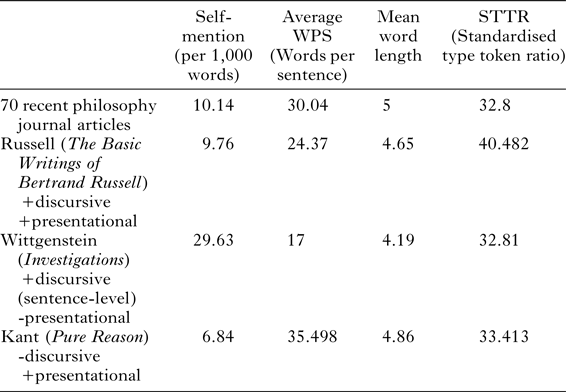
While we could most certainly add to this list of textual features which aid clarity, these four features are among the most commonly identified in the literature on clarity (and philosophical clarity, in particular) and offer us a good starting place. Using a corpus tool which identifies frequencies of features within a text, we can see the extent to which Magee's argument holds true for the philosophers he selects (see Table 1). Self-mention refers to use of personal pronouns, such as I, me, mine, myself. Average words per sentence (WPS) refers to length of sentence. Mean word length is self explanatory and helps understand how much a writer relies on long, technical words. Finally, standardized type token ratio (STTR) is a way of measuring a text's lexical variety. If the STTR is high, for example, in relation to other texts, the text uses a wider range of vocabulary and is likely to be relying more heavily on synonyms and technical terms rather than choosing one word and sticking with it. A text which displays discursive clarity (as defined in philosophy) would likely have a high frequency of self-mention, a low average WPS, a low mean word length, and a low STTR. For purposes of comparison, I have also included in Table 1 the results from a 70-article corpus of recent philosophy journal articles from 5 leading journals, identified by a Professor of Philosophy in the UK as analytic.
Features of sentence-level clarity in philosophical texts

With regard to the first three textual features, all three writers behave as Magee might expect. Russell's and Wittgenstein's texts use self-mention frequently (Wittgenstein to an extraordinary level!), limit their words per sentence, and tend to use shorter words, contributing to greater discursive clarity. Kant's writing is more verbose, uses fewer personal pronouns, and has a higher mean word length, all of which limit discursive clarity.Footnote 7 For STTR, the results are unexpected. Russell's text, the clearest according to Magee, has the highest amount of lexical variation. However, taken with the mean word length, we may tentatively conclude that this is not due to overuse of long words. With regard to the higher mean word length in the corpus of recent journal articles, perhaps Joll was right that philosophical writing is becoming more verbose. But this is a matter for another paper.
Our textual analysis has upheld Magee's point that a philosopher does not need to conform to discursive clarity at the sentence-level in order to be considered a great philosopher. Kant's arguably verbose texts are still highly regarded by many for their ideas. On the other hand, the textual analysis has confirmed that Wittgenstein's sentences are significantly more clearly written than Kant's. I will leave it to the reader to decide if Magee is correct about Wittgenstein's presentational clarity. The question I will now turn to is whether or not it necessarily follows that the production of the written text, however clearly composed, is subordinate to that of the presentational structure. I contend that Magee's views on writing and cognition do not stand up to scrutiny. Points 2 and 3, presented at the start of this paper, are problematic, for several reasons. First, they are founded on a faulty view of writing, one based on the idea that you must first know what you are going to say before you write. Have the outline in your mind, plan beforehand, keep in control of your thoughts before they wander out of control. Peter Elbow summarizes this view as follows: ‘When a man perfectly understands himself, appropriate diction will generally be at his command either in writing or speaking’.Footnote 8 Contrary to this view, there is much evidence from psychology and from research on composition that communication, in its various forms, helps to shape and sharpen thought. For instance, work by Huub van der Bergh and Gert RijlaarsdamFootnote 9 has shown that the probability of generating ideas increases during writing. The more one writes, the more his ideas develop. Through this meeting of cognition and language, the writer purifies his ideas. BerthoffFootnote 10 calls this meeting the process of making sense of the world, the essence of thinking. Zina O'Leary writes of ‘the need to see writing as part and parcel of the research journey rather than just an account of that journey’.Footnote 11 John Bean discusses what he calls the ‘brouillon stage’, ‘a writing process that begins as a journey into disorder, a making of chaos, out of which one eventually forges an essay’.Footnote 12 Meaning is what you end up with, after you begin writing and rewriting. ‘Think of writing then not as a way to transmit a message but as a way to grow and cook a message’.Footnote 13
One could argue, based on Magee's examples of skilled thinkers and writers, that only novices rely on language to formulate ideas. However, for many disciplinary expert writers, presentational structure is very rarely formed completely before writing begins. Instead, each draft drives the development of ideas. While notwithstanding the usefulness of brilliant models like Russell, people think and write in different ways. Some, referred to as Mozartians by Ronald Kellogg,Footnote 14 may take a linear approach, beginning with an extended period of reading and thinking before writing ideas down. This is the type of thinker and writer that Magee idealizes. However, others work in a recursive manner, using the page as an external extension of their mind, where they can list ideas, move them around, delete and add to them, all the while thinking and reading and rereading. Kellogg calls these Beethovians. For both types of writers (and there are no doubt many more kinds), the act of writing down offers the mind a visualization, a physical shape to its ideas, which further stimulates the thinker and allows him to see new paths or holes in the existing path.
Regarding point 3, writing and thinking processes are constrained by external factors, as Magee comments on with some disapproval. Magee's description of the ideal creative person in isolation who insists on his own needs over those of his family and friends doesn't mesh with the more egalitarian society we enjoy today, where both men and women share responsibility for home and family. For example, while parents living together may take it in turns to carve out a space to think and write, practically speaking these times are often interrupted. A female colleague raising a child on her own speaks about waking in the night and scribbling thoughts on a pad, using every opportunity to record them. Certainly, many creative people and thinkers would love to have limitless space to reflect on, write down, and formulate new ideas. This is not the issue. Rather, most Mozartian writers don't have that space and so rely on aids such as writing, articulating one's thoughts to a colleague or spouse, and scribbling in the middle of the night. Views which elevate pre-verbal cognition and disregard the value that writing has in recording, tracking, and developing one's thoughts, particularly in the midst of the stops and starts of a chaotic life, are unhelpful to modern academics.
Magee's picture of the isolated thinker also overlooks the collaborative nature of thinking and writing. I once sat under a Theology professor who began with a single thought in his class, which he wrote at the centre of the blackboard. He encouraged us then to begin unpacking, rephrasing, defending, and challenging this thought, which he then developed by adding ideas to the board, erasing some as we defeated them. We thought through our arguments using language, both oral and written, arriving at our presentational structure only at the end of the class. The thoughts and language of the group intersected. As Fulwiler writes,
The words give concrete form to thought and so make it more real. This…helps to translate everyday information and experience into understanding and action. We carry on conversations with friends in order to explain things to ourselves. We discuss the theme of Hamlet with a colleague to remind ourselves of what the play is about…In short, the intersection between articulate speech and internal symbolization produces shaped thought.Footnote 15
This is one of the most important benefits of sharing ideas at conferences, for example. The worst speakers are often those who talk as if to themselves and ignore the comments and questions from the audience or simply leave no time for them. Magee emphasizes the importance of writing ‘with close attention to others’,Footnote 16 but this seems limited to, first, the writer's subjective understanding of that reader, and second, communication of the already formed message. He overlooks the direct involvement of those readers in both the formulation and writing down of one's ideas. A similar difference can be seen in the classic –etic vs. –emic approach to field research, the former involving primarily the perspective of the observer, the latter involving that of the subject's. In short, the isolated thinker cannot understand his audience and get their much needed feedback unless he comes out of isolation.
One could argue that while Magee does at times generalize to a larger audience, his views on the relationship between writing and thinking reflect the unique task of the philosopher. This task typically involves thinking critically about problems, not reading and collating relevant findings from existing research to build one's argument, as is common in many other disciplines (including mine). I have even encountered the view within philosophy that writing is distasteful, ‘an unfortunate necessity’,Footnote 17 a distorted version of a purer truth that exists in nonverbal form. Magee does not seem to share this negative view, as he articulates a fondness for beauty in texts. A highly experienced thinker and writer, he offers some useful advice regarding how to write clearly and aesthetically satisfying texts for one's audience, noting, ‘Writers who care passionately about clarity will care passionately about tertiary clarity, and will be involved in a struggle with language aimed at lucidity of verbal expression’.Footnote 18 Nevertheless, separating thought and language, a view confined not just to philosophy historically but to much of academia, has links to a positivist perspective wherein language is inferior, an afterthought to cognition. What I have tried to show here is that putting thoughts to words can itself be a form of inquiry, whatever the discipline, whilst acknowledging that the particular choice of words is less important than the ideas themselves.