


The median voter model is among the most influential approaches in the positive political analysis of Supreme Court decision making (Martin, Quinn, and Epstein 2005). Increasingly, the “median justice,” “pivotal justice,” or “swing justice” is thought to wield disproportionate influence over the outcomes of the Court's policymaking process, perhaps even the power to dictate those outcomes. Moreover, the prominence of the median justice extends well beyond the political science accounts, appearing more and more frequently in legal scholarship and even journalistic accounts of the Court. In spite of the increasing prominence of median justice models, however, we still do not have a sound theoretical foundation for the median voter result as a model of the Court. This raises a fundamental question: what is the theoretical justification for the median justice as an approximation of the Court as an institution?
There are, in fact, good reasons to doubt the applicability of the median voter result to the Supreme Court. The result relies heavily on two rather aggressive assumptions, neither of which clearly fits the Supreme Court context. The first is the assumption that Supreme Court decision making takes place in a one-dimensional policy space. That is, the justices are restricted to choose a policy along a single issue dimension and cannot write opinions that address multiple issues simultaneously. The second is the assumption that justices face only binary choices over alternative policies. That is, the justices may face a choice of whether to reverse or affirm a lower court or whether to endorse a majority opinion or a single alternative opinion, but never face a simultaneous choice among three or more competing opinion proposals. In short, the (often implicit) assumption is that the Supreme Court has some exogenous institutional mechanism that limits consideration of alternatives to a single dimension and pairs alternative opinions into a binary agenda.1
In fact, each of these assumptions is analogous to an assumption in the literature on the United States Congress, where arguments about structure-induced stability are now nearly 30 years old (e.g., Shepsle 1979; Shepsle and Weingast 1981).
The twin assumptions of unidimensionality and binary comparisons of alternatives have considerable analytical advantages. Together, these assumptions produce tractable models and stable, predictable outcomes. The assumptions preclude cycling over alternatives or “chaos” results of the type identified in Arrow 1963 and McKelvey 1976. In contrast, relaxing these assumptions leads to social intransitivity (in the case of unidimensionality) and loss of the median voter result (in the case of binary comparison of alternatives). As a result, virtually all strategic models of Supreme Court decision making restrict their assumptions to unidimensional policy spaces (e.g., Hammond, Bonneau, and Sheehan 2005; Segal 1997) or to treat the Court as a unitary actor in a single- or multidimensional space (e.g., Gely and Spiller 1990; Rogers 2001; Spiller and Spitzer 1992).
The appropriateness for these assumptions, however, still has not been clearly justified from a theoretical perspective. The assumption of unidimensional policy spaces is typically based on empirical regularities in the voting patterns of specific justices rather than on a theory about the Court as an institution. The assumption of binary comparisons of alternatives is usually not even expliticly mentioned, as most authors do not seem to acknowledge the potential for multiple simultaneous opinions. In both cases, part of the reason for the assumption is that strategic maneuvering causes the median voter model to break down. But the political science literature on strategic behavior suggests that the addition of alternatives and dimensions is one of the most important potential tools for manipulating the outcome of a political situation (e.g., Riker 1986). Thus, without a coherent theoretical account supporting these assumptions, we not only have little confidence in a model's results but also assume away much of what the strategic account strives to explain.
In this paper, we develop a theoretical model of the Supreme Court that supports median-voter results without imposing the artificial structure of unidimensional policy spaces or binary comparisons of policy alternatives. In particular, we focus on the Supreme Court's unusual practice of “part-by-part voting,” an institution that allows justices to vote for “parts” of an opinion without voting for the opinion as a whole. This important institutional feature, which has not previously appeared in models of judicial decision making, is an institutional solution to the problem of multidimensionality in the Supreme Court. By incorporating this feature, our model formally establishes what most strategic models of the Supreme Court simply assume—that with the assumption of separable preferences, the modern Supreme Court's decision making often can be reasonably approximated by the issue-by-issue median of the justices.
INSTITUTIONAL BACKGROUND, NOTATION, AND ASSUMPTIONS
The starting point for our analysis is largely the same as that for the strategic model of Supreme Court decision making—that the justices are primarily interested in setting legal policy, not necessarily in making decisions solely on the basis of “legal” considerations (Epstein and Knight 1998; Maltzman, Spriggs, and Wahlbeck 2000). We assume, as does the strategic model, that the Court makes legal policy primarily through its opinions rather than through its judgments in individual cases. We agree with the strategic approach that the “opinions matter” (Maltzman, Spriggs, and Wahlbeck), and that the justices seek to craft opinions for the Court that reflect the justices' policy preferences (Maltzman, Spriggs, and Wahlbeck, 17, 93). Further, although our approach is intended to parallel the strategic model in that the justices primarily have preferences over legal policy, we note that our model is sufficiently general to extend to any “issue” over which the justices have differing preferences, not merely substantive policy. Thus, although we focus on “policy” to parallel the strategic literature on the Supreme Court, our model would also apply to preferences over legal issues in the more traditional sense.
The key difference between our model and previous models of the Court is that we relax two confining assumptions that typically underlie other models. The first is the assumption that Supreme Court policymaking takes place in a single-dimensional issue space. In most theoretical work, this unidimensional policy space is interpreted as a left-right ideological dimension, and justified on the basis of empirical studies suggesting that a single dimension can account for a significant proportion of the Court's voting outcomes (e.g., Grofman and Brazill 2002). There are significant problems, however, with this justification of a unidimensional policy space. First, although a single dimension may explain much of the variance in voting, there is always a significant residuum not explained, and it only takes one additional dimension to completely destabilize a unidimensional model. Second, and perhaps most importantly, relying on the empirical finding of unidimensionality amounts to little more than observing that the Plott (1967) conditions are satisfied for some specific group of justices, which means the empirical justification is potentially credible as a model of a particular group of justices, but not of the Supreme Court as an institution.
The second assumption we relax is the restriction of the “agenda” of the Court to binary comparisons of policy alternatives. This assumption takes several forms, but in many cases (especially in empirical work), scholars model the Court's binary affirm/reverse decision rather than the opinion that the Court adopts. More recent work has advanced the the literature by explicitly formalizing and modeling the opinion-writing process (e.g., Hammond, Bonneau, and Sheehan 2005, 93), but even in this work the assumption is maintained that only one alternative can be offered at a time. The problem with this approach is that although it is true that the Chief Justice (or the Senior Associate Justice) has the right to assign (or propose) the initial majority opinion in a given case, once the original draft is circulated, any justice is free to propose an opinion at any time, even when two or more alternatives are already under consideration along the same policy dimension. Thus, in contrast to members of Congress, the justices may face a simultaneous voting choice over many, not just two, competing policy alternatives.
The combination of unidimensionality and binary comparison of alternatives has the felicitous effect of leading to stable outcomes and analytical tractability. These restrictions, however, essentially amount to implicitly imposing a particular institutional structure on the Court that was largely imported from the scholarship on the U.S. Congress. In fact, these assumptions resemble rather closely the “institutional arrangements” that Shepsle (1979) identified as contributing to “structure-induced equilibrium” in legislative bodies. As suggested previously, the problem with applying those assumptions to the Supreme Court is that, unlike in Congress, there is no evidence that the Court uses a “committee system,” “jurisdictional arrangement,” or “amendment control rule” to structure the justices' alternatives. The result is that, as many authors have pointed out, the Court potentially faces the problems of instability and cycling, just like any other pure majority rule institution (e.g., Easterbrook 1982).
The Institution of Part-By-Part Voting
In this article, we argue that the solution to the multidimensional dilemma of the Court is found in a previously unstudied but critically important institutional feature of the modern Court's opinion voting procedure. In each case, the justices must make a decision about what opinions the justices will “join” or agree to. When a justice joins an opinion, the justice indicates assent to the rationale of that opinion, which is equivalent to “voting” for the policy point expressed in the opinion. An opinion commanding the assent of a majority of the justices becomes law. So far, this is not substantially different from the standard strategic model of the Court.
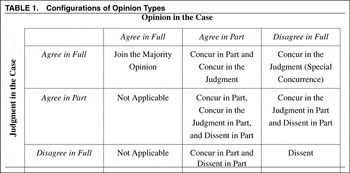
The justices' choices, however, are not limited to joining one of two alternative opinions, as is assumed in most models of the Court. In fact, the justices actually have a rather wide range of options on opinion voting in individual cases, corresponding to any logical combination with respect to the judgment in the case and the opinion in the case. The principal choices, in decreasing order of agreement with the majority's reasoning, are (1) join the majority opinion; (2) join the majority opinion and write a regular concurrence; (3) concur in part and concur in the judgment; (4) concur in part and dissent in part; (5) concur in part, concur in the judgment in part, and dissent in part; (6) concur in the judgment; (7) concur in the judgment in part, and dissent in part; or (8) dissent. The possibilities are illustrated in Table 1.

The alternatives in the table suggest a number of options beyond simply joining a majority opinion or joining a dissenting opinion. First, justices who are dissatisfied with the opinions offered by the majority and dissent can write opinions of their own. A justice in the majority on the disposition in the case (e.g., reverse or affirm) can write a “special concurrence,” which is denoted “concurring in the judgment” in reported opinions. A justice in the minority on the disposition in the case can write a separate dissenting opinion, even if other dissenting opinions have already been written. This possibility of a “special concurrence” or multiple dissenting opinions means that choices over policy are not necessarily binary, as assumed in other models of the Court. A justice offered a choice between two unpalatable alternatives can offer her own opinion at any time, potentially splitting the majority coalition. Indeed, these separate opinions can then become the “Opinion of the Court” if they attract at least four other votes.
Second, the justices need not decide to accept or reject other justices' opinions in their entirety. The justices have the option of “concurring in part,” joining only specified portions of an opinion while disagreeing with the remainder. This institutional feature allows a justice to vote for the aspects of a proposed opinion the justice agrees with, but not the aspects of the opinion the justice disagrees with, a practice we refer to as “part-by-part voting” (following Delson 2001). These parts, which are typically demarcated in outline-style numbers and letters, allow justices to join, for example, all of an opinion except “Part II,” “Part III-A,” or “footnote 4.” Indeed, justices may exclude certain specified portions of an opinion, even when those portions are not separated out into parts, as when Justice Scalia sometimes joins an opinion excepting all portions discussing “legislative history.”2
The example of Scalia's treatment of legislative history also shows that justices can vote part-by-part with respect to “procedural” or “interpretive” issues, not merely substantive issues. Even if the portion of an opinion a justice disagrees with is not separated out into a separate textual “part,” the justice can exclude that portion of the opinion by describing what he or she disagrees with. An illustrative example is the syllabus from Adarand Constructors v. Pena 1995, in which Justice O'Connor's opinion was the opinion of the Court “except insofar as it might be inconsistent with the views expressed in the concurrence of Scalia.”
For example, in Lorillard Tobacco v. Reilly 2001, the syllabus of the decision reports the following fractured pattern agreement for Justice O'Connor's opinion, “O'Connor, J., delivered the opinion of the Court, Parts I, II-C, and II-D of which were unanimous; Parts III-A, III-C, and III-D of which were joined by Rehnquist, C. J., and Scalia, Kennedy, Souter, and Thomas, JJ.”
We conceive of this part-by-part voting opinion voting of the Supreme Court in terms of a spatial model. Each opinion constitutes a point in multidimensional policy space over which the justices vote. In contrast to the standard setup with majority voting over binary alternatives, part-by-part voting allows the justices to accept or reject individual dimensions of each opinion proposal. In effect, by joining an opinion or a part of an opinion, the justice “votes” for the proposed point along each policy dimension in the opinion (or part of opinion) he or she joined. This means that when an opinion point has d dimensions, each justice has 2d possible votes with respect to that opinion. The justices are able to vote separately (but simultaneously) on each dimension by joining only those parts of each opinion they agree with.
The operation of part-by-part voting is similar in many respects to the issue-by-issue voting literature in political science (e.g., Kramer 1972; Shepsle 1979), but the details differ in an important way. In the issue-by-issue voting previously identified in the literature, a some exogenous institutional feature (such as a committee system in Congress) limits proposals and voting to a single dimension. Not only can the voting body vote separately on different dimensions, but also the body is required to do so. This requires some institutional device that disaggregates multidimensional policies into sequential votes on different dimensions one-by-one. In contrast, in part-by-part voting, the justices can vote separately on each dimension, but they are not required to do so. In fact, the justices vote simultaneously over all dimensions and may make proposals that change multiple dimensions simultaneously. Thus, there is no exogenously determined sequence of votes and the proposals (here, opinions) are not restricted to a single dimension.
The institution of part-by-part voting has attracted almost no systematic scholarly attention in either the legal or the political science literatures, with the exception of an insightful student law review note (Delson 2001). Most strategic models of the Court ignore the possibility of more than two opinions, much less the possibility of part-by-part voting. And even those scholars who discuss the possibility of multiple opinions typically portray the justices as having only four exhaustive choices, such as “join the majority opinion, join or author a regular concurrence, join or author a special concurrence, or join or author a dissent” (Wahlbeck, Spriggs, and Maltzman 1999, 490). Although this institution has not received much attention, we believe part-by-part voting is indispensable to understanding the decision making of the modern Supreme Court. Indeed, we argue that the institution of part-by-part voting is the very feature that, under reasonable assumptions, allows predictable, majoritarian outcomes on each issue even in a multidimensional policy space.
Notation and Assumptions
We now introduce some of the assumptions and notation we use in the text of this article, although we leave most of the formalization and proofs for interested readers in the Appendix. We assume a set of justices with convex, separable preferences over the d-dimensional Euclidean policy space
. The assumption of separable preferences is important in this model, so we pause to describe it. Informally, the assumption means that a justice's policy preferences on one dimension does not depend on the choice of policy along other dimensions. This means, for example, that a justice's ideal policy with respect to one issue does not change when the justice anticipates the Court will adopt a new policy on some other issue.
The assumption of separable preferences is a common (though typically implicit) feature in many multidimensional spatial models. This assumption is particularly apt in the context of legal decision making at the Supreme Court level, where justices set legal policy at the apex of a hierarchy of lower courts. Although many judges probably do have non-separable preferences over legal conclusions in individual cases (e.g., a lower court preferring not to find jurisdiction to hear a case because the court disagrees with the plaintiff on substantive issues), the preferences of Supreme Court justices over legal policy is much more likely to be separable across issues. This is because each policy issue decided will likely arise in many future cases in conjunction with a variety of other issues in the future, so Supreme Court justices are highly cognizant of the influence of their opinions over many future cases. Thus, the fortuitous combination of policy dimensions in particular cases is unlikely to influence preference over those issues. Still, there may be some issue combinations for which separable preferences are not reasonable, and we point out some possible examples later in this article.
We further assume that each justice has perfect and complete information about the preferences of the other justices, the structure of the game, and so forth. The game begins with nature selecting a policy-making opportunity that involves policy issues in a d-dimensional subset of the policy space. The d issues in the case are determined exogenously, for example, by the issues and cases for which certiorari was granted in a previous stage of the game. In the next section, we illustrate part-by-part voting by maintaining the assumption of an exogenous agenda for pairwise comparisons of alternatives in a multidimensional space. The justices vote sincerely over the alternatives under part-by-part voting, producing a result essentially equivalent to issue-by-issue voting. Thereafter, however, we relax the assumption of a binary amendment agenda and consider the justices' strategic behavior in a more unstructured environment. We thus show that when part-by-part voting is fully endogenized, the Court still reaches a majoritarian equilibrium in a multidimensional issue space.
ILLUSTRATION: NONSTRATEGIC PART-BY-PART VOTING WITH BINARY ALTERNATIVES
We first illustrate part-by-part voting by relaxing the unidimensionality restriction on the policy space while maintaining sincere pairwise voting over binary policy alternatives. For ease of exposition, consider the case where there are three voters (denoted J1, J2, and J3) in a two-dimensional space with Euclidean preferences (circular indifference contours). For this situation, Figure 1 depicts a standard configuration of preferences where no Condorcet winner exists. That is, for any point in the space, there is some other point that two of the three voters prefer to the original point. This is true even for the issue-by-issue median of the voters, denoted here by xmed. Observe that the point y defeats xmed in a pairwise vote, since J2 and J3 prefer y to xmed. In addition, the point z then defeats y in a pairwise vote, since J1 and J2 prefer z to y. But then we come full cycle, since xmed, the issue-by-issue median that was defeated in the first vote, would defeat z in a pairwise comparison. Thus, the social preference order over these three alternatives (and indeed over the whole policy space) is intransitive (McKelvey 1976).

Preference Configuration with No Condorcet winner
We next consider the case of part-by-part voting as we operationalize that concept in this article. Again consider the same three voters (whom we now call justices) with the same ideal points as above in the same two-dimensional policy space. Suppose the current opinion proposal (which may be thought of as the initial majority opinion or a status quo point as in Hammond, Bonneau, and Sheehan 2005) were located at xmed, and either J2 or J3 wrote an opinion corresponding to point y. Both J2 and J3 prefer the point y to xmed, as in the discussion above of regular majority voting. However, J2 would prefer an option where the horizontal dimension of xmed remains constant, and the vertical dimension takes its value at y. In contrast, J3 prefers an option where the vertical dimension of xmed remains constant, and the horizontal dimension takes its value at y. J1 does not prefer either part of opinion y to xmed. The result is as follows. J1 will not vote for either part of y, but rather will continue to vote for xmed. J2 will vote for the part of y that moves along the vertical dimension but not the part of y that moves along the horizontal dimension. J3 will vote for the part of y that moves along the horizontal dimension, but not the part of y that moves along the vertical dimension. The result is that xmed remains the majority outcome with two votes for the horizontal portion of xmed and two votes for the vertical portion of xmed.
The illustration above is a simplified version of how part-by-part voting works, but it leads to a general result for sincere voting over an agenda of binary alternatives. For any configuration of separable preferences, the issue-by-issue median will defeat any other point in the policy space under part-by-part voting.4
Note that these results do not generally hold when preferences are not separable. To appreciate the contrast between separable and non-separable preferences in contexts like that in Figure 1, see Ordeshook 1986, 243–66.
Illustration 1. If justices have convex, separable preferences over the issues in the policy space and always vote sincerely, the median along each issue dimension will defeat any other point in the policy space in part-by-part voting.
Illustration 2. Thus, the issue-by-issue median occupies a status in part-by-part voting similar to that of a Condorcet winner in pure majority rule. This fact implies a second result:
Illustration 3. Given the assumptions of the first result 1, if the issue-by-issue median is included in any agenda, the outcome of voting over the agenda will be the issue-by-issue median.
The results introduced above are not new, but an application of existing results intended to illustrate how part-by-part voting extricates the Court from the instability of pure majority rule with sincere voting. In this illustration, even if some agenda setter were empowered to pair opinion alternatives in an agenda but provided that the justices were not limited in their ability to make proposals, the outcome would converge on the issue-by-issue median. The key contribution of part-by-part voting in this illustration is that no credible “bundling” of issues across dimensions is possible. In the next section, we show that this same result occurs with strategic voting, even without a restriction to binary comparisons of alternatives.
STRATEGIC PART-BY-PART VOTING
In this part, we relax both the constraint of unidimensionality and that of binary comparison of alternatives to model Supreme Court policymaking in a fully strategic multidimensional environment. First, the Supreme Court is a collegial body and apparently has few formal rules. In particular, there is no restriction on which justices may propose independent alternatives (such as special concurrences or dissents), and there is no amendment rule for considering these alternatives. Second, the justices may (and do) communicate and coordinate in writing opinions, and our model should be consistent with this feature of the Court. Thus, we develop a relatively simple model that has a minimal institutional structure and allows for communication and coordination among the justices. We allow any justice to propose an opinion along any or all dimensions of the policy space, and we allow justices to freely communicate and make nonbinding commitments on how to vote.
Coalition-Proof Nash Equilibrium
Our model, as is the case with virtually any voting model, has multiple Nash equilibria, including many that are Pareto dominated. Obviously, many Nash equilibria (e.g., one where all voters unanimously vote for a Pareto-dominated outcome) seem implausible, particularly where the voters can communicate and coordinate their strategies, as can the justices in the Supreme Court. Thus, we adopt an equilibrium refinement—coalition proof Nash equilibrium (Bernheim, Peleg, and Whinston 1987)—that captures these aspects of free communication and coordination. The concept of coalition-proof Nash equilibrium is particularly well suited to the Supreme Court's collegial environment, as this solution concept is explicitly designed “for strategic environments in which players can freely discuss their strategies, but cannot make binding commitments” (Bernheim and Whinston 1987, 13).5
We do not consider the case where justices were allowed to make binding commitments in this model. However, we note that if justices could make binding commitments (e.g., through a reputation mechanism or repeat play), the two most basic results of our model would still hold. The justices would reach a stable policy outcome (through their commitment mechanism), and agenda control would be irrelevant to the policy outcome.
Coalition-proof Nash equilibrium is an equilibrium refinement that requires equilibrium strategies to have the property that no subset of the players can deviate from the equilibrium strategy profile in a self-enforcing manner. This means that coalition-proof strategy profiles, as well as any self-enforcing deviations from noncoalition proof strategies, have the property that the members of the coalitions have incentives not to defect from those strategies. In other words, no subset of the players in the game can deviate from the equilibrium in such a way that they all improve their position, without provoking a self-enforcing deviation by some subset of the subset. The definition is therefore a recursive one that tests each sub-coalition, each sub-sub-coalition, and so on, for incentives to defect from the purported equilibrium strategy.
An alternative equilibrium concept that allows for communication and coalition formation is a “strong equilibrium.” Like coalition-proof Nash equilibria, strong equilibria have the advantage over Nash equilibria of allowing coalitions of players to coordinate on a deviation that will make them all better off. However, in a multidimensional setting, strong equilibria only exist under very special configurations of preferences along the lines of (Plott 1967). Unlike a strong equilibrium, a coalition-proof Nash equilibrium tests coalitional deviations for their own self-enforcing character. As a noncooperative game theory refinement, a coalition-proof Nash equilibrium is “designed to capture the notion of an efficient self-enforcing agreement for environments with unlimited, but nonbinding, pre-play communication” (Bernheim, Peleg, and Whinston 1987). We believe this equilibrium concept is uniquely suited for the Supreme Court's decision-making process, and captures much of what other models leave out: communication and coalitions in a noncooperative game-theoretic environment.
Majority Opinions, Plurality Opinions, and the Status Quo Policy
The fact that our model allows multiple policy proposals along a single issue dimension raises the possibility of plurality (or perhaps more accurately for the reasons discussed next, “nonmajority”) opinions. As is common in the literature, we assume that if a particular point along a given dimension receives a majority of the votes (i.e.,
or more), that point becomes the policy of the Court along that dimension. However, in the event that no policy point along a given dimension receives a majority of the votes (i.e.,
or fewer), there is no clear consensus in the literature on what policy prevails, and in fact, virtually no discussion of the matter. The absence of guidance is probably at least in part attributable to the assumption of binary comparisons of alternatives. If one assumes away the possibility of plurality opinions by restricting the Court to binary comparisons, there is no need to grapple with plurality decisions.
The phenomenon of plurality decisions is, however, reasonably common in the Supreme Court, so we devote some time in this section to our assumptions about what happens when there is no clear majority on some dimension. Although a variety of reactions to plurality opinions seem possible, two candidates in particular immediately present themselves. The first possibility is that the plurality position—the policy point with the largest number of votes—becomes the Court's policy. One problem with this interpretation is that sometimes there are ties among plurality opinions (e.g., a 3-3 or 4-4 vote), necessitating some further tie-breaking rule for that circumstance. A second possibility is that the relevant legal actors may treat the decision as setting no precedent at all; that is, some exogenous status quo point would prevail. The “status quo” alternative was at least arguably the formal rule in the federal courts at one time (United States v. Pink 1942) and has been incorporated in some models of the Court (e.g., Hammond, Bonneau, and Sheehan 2005).
In our view, however, neither of these options withstands scrutiny from either a doctrinal perspective or a strategic perspective. From a doctrinal perspective, the Supreme Court rejected the view that nonmajority opinions do not set precedent in the case of Marks v. United States (1977). In that case, the Court wrote that “[w]hen a fragmented court decides a case and no single rationale explaining the result enjoys the assent of five Justices, ‘the holding of the Court may be viewed as that position taken by those Members who concurred in the judgments on the narrowest grounds',” (Marks v. United States, 193). The Supreme Court in Marks specifically rejected the status quo approach—the argument that because no opinion in the prior case “commanded the assent of more than three Justices” that it “never became the law” (Marks v. United States, 192). The Court's decision in Marks also rejected the plurality approach, emphasizing that it is the “narrowest grounds” that prevails, not the grounds with the largest number of votes. Indeed, in several cases since Marks, both the lower Courts and the Supreme Court have interpreted an opinion with a single vote as the narrowest grounds of the Court, even when other opinions had more votes.6
See, for example, O'Dell v. Netherland 1997, which interpreted the Court's holding in Gardner v. Florida 1977 as Justice White's opinion, even though no other justices joined that opinion and another opinion had three votes.
These two options (the plurality and the status quo) also fail from the strategic perspective, which is the paradigm within which we are working. The reason is that strategic, forward-looking lower courts grappling with a fractured Supreme Court decision would more likely view that position that no majority of the justices could agree to reverse as the Court's policy on this dimension. That is, to the extent that the Court can be said to have a single policy along a dimension, that policy should be the policy point the Supreme Court would be least likely to overturn in a subsequent case along that dimensison. The plurality opinion might be such a position, but it also might not, as a majority of justices may disagree with a plurality decision, even along a single dimension. The status quo is certainly not such a position, except in the special case where the status quo lies precisely at the median of the justices' ideal points along the dimension. Thus, since rational lower courts trying to avoid reversal in a strategic model should adopt roughly what Kornhauser and Sager (1993) term the “predictive approach,” the plurality and the status quo are not plausible candidates for the Court's policy when no policy receives a majority of the votes.
We therefore adopt an assumption that follows directly from the strategic model of the court system and is largely consistent with Marks's “narrowest grounds” doctrinal position. Our assumption is that the lower courts, potential litigants, and other consumers of the law regard as the policy set in a plurality decision the point along a particular dimension that the Supreme Court would not reverse in a hypothetical unidimensional case involving that dimension alone. Thus, our default outcome along a particular dimension in a plurality decision is the opinion that receives the median vote when the opinions in the decision are lined up in order ideologically along the dimension (i.e., not necessarily the median of the justices' ideal points). The assumption makes sense because the median of the votes along that dimension would constitute the lower courts' “best guess” about what policy point the justices could least likely muster a five-vote majority to overturn. In fact, the opinion receiving the median vote is always the majority opinion if a majority opinion exists, so in a sense this assumption is not a “special rule” for plurality decisions, but merely a generalization of majority rule. We believe this strategic “predictive” approach has the benefit of not only being consistent with the strategic incentives of rational lower courts but also being similar (if not identical) to the Court's “narrowest grounds” doctrinal position (Kornhauser and Sager 1993). We believe that our assumption here, although certainly not free from doubt, is considerably better than the two primary alternatives discussed earlier.
The Strategic Part-by-Part Voting Game
With these assumptions, our strategic part-by-part voting model proceeds as follows. The justices have a policy-making opportunity (e.g., a case or several cases decided around the same time) in d-dimensional Euclidean space. The justices can freely discuss their strategies, write opinions, and make preliminary votes over the opinions, but in keeping with the noncooperative game, cannot make binding contracts. Each justice chooses a policy point in d-dimensional space that constitutes his or her “opinion” or “vote” in the case. This captures the fact that any justice may write an opinion (i.e., some exogenously identified justice does not need to have proposed the policy point) and those justices who do not write opinions along a particular dimension may vote for any policy point along that dimension. To reiterate, under part-by-part voting the justices may “pick and choose” which opinions they choose to vote for along various dimensions; they are not required to vote for or against the entirety of any particular opinion.
The concept of coalition-proof Nash equilibrium is designed to capture the relatively unstructured bargaining process in the Supreme Court. Justices may join opinions, write new opinions, or switch their votes at any time until the justices have “finalized” their votes. The strategic game ends when all justices have finalized their opinions and votes, although this time need not be the same for all justices. There is obviously some outer limit for finalizing votes as the decision is eventually announced in open Court. The concept of coalition-proof Nash equilibrium, however, allows us to leave the process by which the justices “finalize” votes completely arbitrary; they may finalize their votes one by one or may all finalize their votes at the same time. The key is that under coalition-proof Nash equilibrium, each player can “sign off” on his or her vote knowing that the remaining players cannot deviate from the equilibrium in a self-enforcing way.
We first examine the special case where opinion writing and defecting from strategy profiles is costless, which allows a very straightforward proof of a unique coalition-proof outcome. In this case, there is no technical distinction between writing an opinion and voting for an opinion, except that “voting” for an opinion along a particular dimension involves choosing a point that at least one other justice has already chosen. In the costless strategic policymaking game, the following two propositions characterize the unique coalition-proof outcome:
Proposition 3. If a strategy profile is coalition-proof and opinion writing is costless, then the policy outcome is the issue-by-issue median of the justices.
Proposition 4. There exists a coalition-proof strategy profile whose outcome is the issue-by-issue median.
Thus, as in the as in the case of sincere voting with binary alternatives, the unique outcome in strategic voting with costless opinion writing is the issue-by-issue median of the justices. The combination of the part-by-part voting procedure, together with the default rule in plurality cases, means that justices are not strategically disadvantaged by simply voting for their own ideal points. In fact, the equilibrium where each justice votes for his or her own ideal point is a weakly dominant strategy in this version of the game.7
We would like to acknowledge Dimitri Landa and Ken Shotts for drawing our attention to the weakly dominant strategy in the special case of costless voting.
We next examine the more general case where opinion writing and coalition defection can be costly. It seems clear that in many cases there may be costs to the justices writing their own opinions “seriatim.” Multiple opinions are costly, more difficult to interpret, and arguably undermine the Court's authority. In addition, producing separate opinions and defecting from coalitions may impose interpersonal or reputational costs among the justices. Thus, in the next two propositions, we describe the set of equilibrium outcomes where coalition defection is costly for the justices. The assumption here (detailed more formally in the Appendix) is that the justices in a defecting coalition incur costs when they deviate to a new policy point along a given dimension. By a “new” policy point, we mean a point that no other justice is currently proposing, thus requiring a new separate opinion. The cost of defection can be thought of as “friction” in the coalition-proof equilibrium concept, so that deviating to a new policy point by writing a new opinion carries costs for the deviating justices. With costly opinion deviations, the coalition-proof equilibrium outcomes are as follows:
Proposition 5. If a strategy profile is coalition-proof and opinion-writing is costly, then the policy outcome along each dimension lies within a fixed distance, u−1(−c) (as defined in the Appendix), of the median of the justices along that dimension, with the distance decreasing to zero as the cost of opinion-writing decreases to zero.
Proposition 6. There exists a coalition-proof strategy profile whose outcome is the issue-by-issue median.
The introduction of costly opinion writing, therefore, means that the set of coalition-proof outcomes is not necessarily a unique point, but rather a “hypercube” around the issue-by-issue median of the justices. The cost of opinion writing or “joining by part” determines the size of the possible outcome set. As the cost or “friction” of writing separately increases, the size of the cube increases, making more equilibrium outcomes possible. As the friction decreases, the size of the cube decreases, ultimately converging on a single point for costless opinion writing, as in Propositions 3 and 4. Thus, although the set of equilibrium outcomes is centered on the issue-by-issue median, the distance of the exact equilibrium outcome is directly related to the friction of writing separate opinions, producing an interesting comparative static prediction.
Finally, we note that although our model makes relatively crisp predictions about the outcomes the Supreme Court will reach in equilibrium, it says considerably less about which justices vote for or propose specific opinions. In the special case of costless opinion writing, there are many coalition-proof voting equilibria, including a weakly dominant equilibrium where each justice votes for his or her ideal point, which seems a natural prediction in that context. In the more general model with costly voting, there is only one opinion in equilibrium that all justices unanimously endorse. The actual practice of the Court is likely somewhere in the middle, depending on the costs of opinion writing and the individual benefits of “principled” sincere expression. Although our analysis argues that the Court is majoritarian along each issue, we do not always see 5 to 4 decisions in the Supreme Court because along many issue dimensions six or more justices may have the same ideal point, and because when the costs of opinion writing are high relative to the expressive benefits of writing separately, justices may “go along to get along.”
DISCUSSION
The prospect of social intransitivity, cycling, or chaos in collective decision making is a problem that all collective choice institutions must confront, and the Supreme Court is no exception. In this paper, we have identified specific institutional features that have evolved in the Supreme Court to promote stable, predictable outcomes. In the remainder of this paper, we expand on these results in three ways. First, we explain in intuitive terms the mechanism by which part-by-part voting creates stability in the Court's outcomes. Second, we examine some empirical implications of our theory, particularly in the context of opinion assignment. Finally, we expand on how the implications of our model fit into the study of judicial politics more generally.
Part-by-Part Voting as an Intuitive Solution to Instability
The institution of part-by-part voting is an intuitive solution to the problem of social intransitivity. The reason part-by-part voting solves the social intransitivity problem in the Supreme Court is that it allows justices to “unbundle” a policy proposal into its component parts. In other words, unlike voting on a bill in a legislature, justices are not required to take the “bad” with the “good.” In majority voting over binary choices, the “bad” part of the “winning” alternative is what sets that alternative up to be defeated later, but part-by-part voting allows a justice to reject the “bad” and avoid setting up the cycle. The ability to approve or disapprove of policy dimensions individually through part-by-part voting mean that justices cannot be forced to “compromise” across issues as when they face binary choices over multidimensional alternatives. Because instability and cycling results in majority voting invariably involve compromises across dimensions, part-by-part voting evades the cycling problem by undermining the basic premise of binary choice over multidimensional options.
Applications: Agenda Setting and Opinion Assignment
The implications of agenda control for influencing collective choice outcomes are among the central questions in positive political science. In the context of the Supreme Court, the main form of agenda control is the right to assign on write the (initial) majority opinion. In the Supreme Court, the Chief Justice assigns the task of writing the majority opinion when he or she is in the majority and the senior Associate Justice assigns the task when the Chief Justice is in the minority. The political science literature, as well as the journalistic accounts of the Court, commonly suppose or conclude that the Chief Justice (and the senior Associate Justice when the Chief is in the minority) will assign opinions to ideological allies.8
One notable recent exception is Hammond, Bonneau, and Sheehan 2005, which concludes that under certain conditions rational opinion assigners will not assign opinions to the most ideologically proximate justice.
Our model suggests, however, that the ability of opinion authors and opinion assigners to manipulate outcomes is limited (or, perhaps more accurately, “bounded”). Although it may be true that the opinion author (and therefore the opinion assigner) “occupies an agenda setting position” (Maltzman, Spriggs, and Wahlbeck 2000, 15) at least with respect to the initial opinion proposal, the degree of agenda control depends critically on the cost of writing separate opinions. In the costless opinion-writing version of the model, the unique coalition-proof Nash equilibrium is independent of the initial opinion proposal, so the right to assign (or write) the initial position has no influence on the outcome. The absence of agenda influence also means that there are few reasons for strategic voting in the justices' conference to manipulate the assignment of the majority opinion, or for strategically changing votes on the judgment after the conference.
In the costly opinion-writing version of the model, there is not a single coalition-proof equilibrium outcome, but a set of outcomes centered around the issue-by-issue median. Furthermore, outcomes converge on the issue-by-issue median as the cost of writing separate opinions falls. The clear comparative static implication of this model is that in environments with relatively low costs of separate opinion writing (perhaps, e.g., in the modern Court), opinion authors and assigners should have little influence over the ultimate policy adopted. In contrast, in environments with relatively high costs of separate opinion writing (e.g., in historical Courts), opinion authors and assigners have comparatively greater influence over the ultimate policy adopted. In the modern Court, we believe the costs of separate opinion writing are sufficiently low that opinion authorship and opinion assignment offer only modest agenda power in most cases. This means that the agenda rights of the Chief Justice and senior Associate Justice offer limited opportunities for manipulating outcomes or trading issues. This suggests that the Court is largely majoritarian, and it is majoritarian on an issue-by-issue basis.
The recent empirical studies that have considered the issue of opinion assignment are consistent with this hypothesis. Most studies have found only very weak effects of ideology on opinion assignment (Brenner 1982, 47–56; Maltzman, Spriggs, and Wahlbeck, 2000). When the Chief Justice assigns opinions, recent studies’ results suggest that the ideological component of opinion assignment is overwhelmed by “contextual factors” such as equity of assignment, legal expertise, workload, and the “end of term” opinion crunch (Maltzman, Spriggs, and Wahlbeck, 47–56). When the senior Associate Justice assigns opinions, ideological considerations are virtually nonexistent, and dwarfed by the effect of self-assignment (Maltzman, Spriggs, and Wahlbeck, 48). These results hold up under the Burger Court (Maltzman, Spriggs, and Wahlbeck) and the Rehnquist Court (Maltzman and Wahlbeck 1996). In short, our model provides a plausible \emph{theoretical} explanation for the seemingly surprising conclusion reached by empirical researchers: that “organizational needs” explain more than ideology in opinion assignment (Maltzman and Wahlbeck).
Further Implications and Relation to the Literature
The right to control the agenda is often a powerful (and in multidimensional settings, sometimes an all-powerful) tool (McKelvey 1976). Those with influence over the agenda can affect the outcome of a policymaking process, and therefore the agenda control rights in an institution are often important features in modeling policy outcomes. The problem in the Supreme Court context is that if the Court has any rules for comparing alternatives, we do not know what they are. Without this information, explaining outcomes in the Supreme Court would be very difficult in a multidimensional environment, because even with socially transitive preferences, if a single player controls the agenda, we may have “anything can happen” chaos results of McKelvey. Moreover, if someone does have agenda power, the other voters might try to deceive the agenda setter about their true preferences. In the judicial context, where lower courts rely on predictions of the Supreme Court's behavior to make decisions, the possibility for such misrepresentation is obviously a problem.
The stability induced by part-by-part voting, therefore, is an important feature not just for the study of the Court's decision-making process specifically, but for the functioning of the judicial system generally. Our model suggests that the institutional features of the Court, particularly part-by-part voting and the “narrowest grounds” rule, help to minimize the potential for strategic manipulation of the agenda or policy alternatives in the Court's decision making. This result suggests that incentives for misrepresentation of preferences among the justices are attenuated in the Supreme Court. Indeed, the outcomes adopted by forward-thinking justices in our model are consistent with the outcomes that “sincere” justices would adopt in their interaction with one another, although incentives may remain for strategic behavior with other branches of government. Thus, to a greater extent than has been previously realized, sincere and “strategic” models of Supreme Court decision-making may ultimately converge on similar behavioral predictions, at least in terms of the interaction among the justices (as opposed to interaction with other branches of government).
The fact that our model predicts strategically sincere behavior, however, does not mean that other institutional features of the Court are irrelevant. In fact, we would argue that our model allows for a larger role for the briefs, oral arguments, conference discussions, and bargaining among the justices than other strategic models do. The coalition-proof Nash equilibrium solution concept, when combined with the proposal process that allows all justices to participate at any point in the opinion-writing process, means that nothing is final until the justices decide to “sign off” on the final votes and opinions. Thus, we need not commit to the assumption that the justices have perfect information and fixed preferences over legal policy alternatives at the outset of a case, as would be necessary, for example, in a model where an agenda setter like the Chief Justice played an important role in policy formation. In addition, the fact that we need not assume preferences are fully formed and known at the outset of a case suggests the possibility of an explicit role for role for legal argumentation, deliberation, and learning. Although we do not incorporate these processes in this model, our approach suggests an important (indeed, heightened) role for the growing body of work that examines these processes (e.g., Johnson, Wahlbeck, and Spriggs 2006).
The prediction of stable outcomes centered on the issue-by-issue median of the justices also has important implications for another active area of research on judicial agenda-setting: the Court's decision on whether to grant or deny certiorari. Although our model takes the certiorari decision as exogenous, it has important implications for the strategic character of the certiorari decision. Our model suggests that if justices know each other's preferences on particular issues in the certiorari stage, they can predict the likely policy outcomes if certiorari is granted, a major focus of the strategic literature on certiorari (as cataloged, e.g., in Maltzman, Spriggs, and Wahlbeck 1999, 53). Thus, our model provides a theoretical foundation for strategic models of certiorari, showing the median voter result at the opinion writing stage rather than assuming that result.
CONCLUSION
The central predictions of this model are that Supreme Court policy outcomes will fall within a region around the issue-by-issue median of the justices' ideal points and that this region will converge on the issue-by-issue median as the cost of writing opinions falls. We believe these predictions have important implications for theoretical and empirical work on the Supreme Court. First, we provide theoretical support for the median voter model that has become one of the most prominent approaches to analyzing the Court. Second, we suggest that in the modern Court, agenda control, opinion assignment, conference voting, and similar possible tools of strategic manipulation should have limited significance in explaining the Court's policy outcomes. Third, we suggest that principled or “sincere” behavior by the justices in the “intra-Court” game is not necessarily strategically naive as some strategic decision-making models have suggested.
We acknowledge, however, that the assumptions that underlie our model, although reasonable for most issue areas in the modern Supreme Court, may not apply to all issue combinations across all historical Courts. We therefore explore here some interesting applications of our framework in cases or historical periods where the assumptions of the model may not hold. The model's assumption of separable preferences, for example, may not apply to all issue combinations. One example where separable preferences might not hold is the “hierarchical” relationship of justiciability doctrines relative to substantive policy issues. 9
We are grateful to an anonymous referee for the suggestion of a relationship between the “hierarchical” structure of issues and the assumption of separable preferences.
The model's assumption about the institution of part-by-part voting (and its costs) are also amenable to interesting extensions, particularly in the analysis of historical Courts. The very practice of part-by-part voting evolved relatively slowly into its modern institutionalized form. Although the Court in its early years used “seriatim” opinion writing—in a sense, the most extreme form of part-by-part voting—Chief Justice Marshall's practice of unanimous opinion writing introduced early in the nineteenth century for the most part held sway throughout that century (O'Brien 1999, 92–95). The unanimity of the nineteenth century gradually unraveled, however, eventually giving way to more separate opinions in the 1930s and 1940s (O'Orien 2005, 281–82) and ultimately the practice of part-by-part voting. Although “concurring in part” occurred occasionally during the nineteenth century (e.g., Selvester v. United States 1898), the practice of part-by-part voting only became a regular phenomenon in the second half of the twentieth century. As a result, we might wonder how norms, institutions, and preferences translated into outcomes in historical Courts where part-by-part voting was less frequent and the potential for agenda power was possibly greater.
Our model suggests an approach to analyzing this question that holds potential for illuminating the decision-making processes in historical Courts. As noted earlier, part-by-part voting requires separate opinions, and writing separate opinions may impose costs. In an era where justices had limited resources (e.g., fewer law clerks) and faced technological obstacles to writing, modifying, and negotiating opinions (e.g., the absence of word processing and other electronic resources), it is not surprising that the costs of part-by-part voting might have been higher. Furthermore, scholars have produced evidence that historical Courts faced a “norm of consensus” that was higher than the modern Court (Epstein, Segal, and Spaeth 2001). Such norms could impose reputational costs on justices who engaged in part-by-part voting, further increasing the costs of the practice. As our model predicts, when costs of part-by-part voting grow, the set of equilibrium outcomes also grows, which in turn increases the potential for agenda control. This may suggest why Chief Justices and Senior Associate Justices might have an interest in establishing or maintaining “norms of consensus.”
We believe these extensions to our model hold promise for explaining not only Supreme Court policy outcomes in the context of the part-by-part voting of the modern Court, but also the historical evolution of the Court's institutional structure. In particular, we hope that scholars will take up further research on the development of part-by-part voting, and especially its relationship to historical trends in norms, institutions, technological innovations, and changes in the Court's resources and judicial ideology over time. This model provides some analytical structure for addressing these institutional questions.
APPENDIX
Proofs
Notation
- N denotes the number of justices, where N is assumed to be odd.
- D denotes the number of dimensions.
- Subscripts denote dimensions.
- Superscripts denote justices.
- [ell ] denotes an ideal point (e.g., [ell ]i denotes the ideal point of justice i and denotes the ideal point of justice i along dimension j).
- If σ is a strategy profile, then σi denotes the vote of justice i and denotes the vote of justice i along dimension j, where . Generally, σ, τ, ξ, and θ denote strategy profiles.
- c denotes the cost of writing a new opinion on one dimension, incurred when deviating to a position that was not the position of any justice prior to the deviation.
- g(·) denotes the function mapping strategy profiles to outcomes, defined below.
Game
- A policy-making opportunity consists of D dimensions.
- Each justice simultaneously chooses a vote, σi, consisting of a D-dimensional vector of positions along each dimension where and, thus, .
- The outcome, g(σ), is a D-dimensional vector such that

- That is, if there is a majority opinion along dimension j, then it is the outcome. If there is no majority opinion, the median opinion is the outcome.
- 4. Justice i receives utility from strategy profile σ


Equilibrium Concept Translated into the notation of this game, a Coalition-Proof Nash equilibrium (originally defined in Bernheim, Peleg, and Whinston 1987) is defined as follows:
Definition 7. Coalition-Proof Nash equilibrium
- In a single player (N=1) game Γ, σ is a Coalition-Proof Nash equilibrium if and only if σ maximizes U1(·).
- Let N>1 and assume that Coalition-Proof Nash equilibrium has been defined for games of fewer than N players.
- For any game Γ with N players, σ is self-enforcing if, for all J⊆{1, …, N}, σJ is a Coalition-Proof Nash Equilibrium in the game Γ|σ−J.
- For any game with N players, σ is a Coalition-Proof Nash Equilibrium if it is self-enforcing and if there does not exist another self-enforcing strategy vector τ such that V i(τ)>U i(σ) for all i=1, …, N.
- A subgame, Γ|σ−J is defined as a game played by the players in set J with outcome under strategy τ defined as where if i∈J and if i∉J and the utility functions, V i(·), are defined as for all i∈J.
For the purposes of adding a cost to opinion writing, we define a modified version of this equilibrium concept in which changing a vote is costly, as described in Definition 8 below.
Definition 8. Coalition-Proof Nash equilibrium with deviation costs
- A Coalition-Proof Nash equilibrium with deviation costs follows an identical definition to a Coalition-Proof Nash equilibrium except for the following modification:
- A subgame, Γ|σ−J is defined as a game played by the players in set J with outcome under strategy τ defined as where if i∈J and if i∉J and the utility functions, V i(·), are defined as

for all i∈J.
Thus, if a player changes strategy in a subgame, Γ|σ−J, to an opinion that has not already been written, the player incurs cost c and continues to incur cost c in all subgames of Γ|σ−J. Note that a Coalition-Proof Nash equilibrium is a special case of a Coalition-Proof Nash equilibrium with deviation costs where c=0.
For the sake of simplicity, we also introduce the following terms:
Definition 9. If σ is a strategy of game Γ and τ is a strategy of game Γ|σ−J for some subset of players, J, then τ is a deviation from σ.
Definition 10. If σ is a strategy of game Γ and τ is a strategy of game Γ|σ−J for some subset of players, J, then τ is a self-improving if V i(τ)>U i(σ) for all i∈J.
Assumptions
- For all j∈{1, …, D}, uj(·) is a strictly decreasing, concave function with uj(0)=0. Thus, justices have symmetric, single-peaked preferences which are identical up to a location shift.
- c≥0. Thus, the cost to opinion writing cannot be negative.
- The number of justices, N, is odd.
Notes
- For notational convenience, if τ is a strategy profile in the subgame Γ|σ−J, then τi=σi for all i∉J. That is, τi refers to the vote of player i even if this vote is fixed under this subgame.
- Unless otherwise noted, all uses of the terms “self-enforcing” and “self-improving” occur in the context of a Coalition-Proof Nash equilibrium with deviation costs (which includes Coalition-Proof Nash equilibria if c=0, but does not require that c=0).
Proofs
Lemma 11. Let N>1. A strategy σ to game Γ is a Coalition-Proof Nash equilibrium with deviation costs if and only if, for all subcoalitions, J, there is no self-enforcing, self-improving deviation from σ.
Proof. (Necessity) Assume there is a subcoalition, J, and a self-enforcing, self-improving deviation, τ, from σ. By part 2(b) of the definition, σJ is not a Coalition-Proof Nash equilibrium to Γ|σ−J. Therefore, by part 2(a) of the definition, σ is not a self-enforcing strategy to Γ. Therefore, by part 2(b), σ is not a Coalition-Proof Nash equilibrium. Therefore, if σ is a Coalition-Proof Nash equilibrium, there is no self-enforcing, self-improving deviation from σ.
(Sufficiency) Assume σ is a Coalition-Proof Nash equilibrium. By part 2(b) of the definition, σ is self-enforcing. Take any coalition, J. Thus, by part 2(a), σJ is a Coalition-Proof Nash equilibrium to Γ|σ−J. So, by part 2(b), there is no self-enforcing, self-improving alternative to σJ. Therefore, there is no self-enforcing, self-improving deviation from σ.
Therefore, a strategy σ to game Γ is a Coalition-Proof Nash equilibrium if and only if, for all subcoalitions, J, there is no self-enforcing, self-improving deviation from σ.
Lemma 12. Let σ be a strategy profile. Then,
. \end{lem} \begin{proof} If
(i.e., there is no majority opinion along dimension j), by the rules of the game,
. If
(i.e., there is a majority opinion along dimension j), then take any such v. Since
,
and
. So, by definition,
(and, thus, v is unique). So, by the rules of the game,
.
Therefore, in all cases,
.
Lemma 13. Let σ be a strategy profile. Assume there is a deviation, τ, from σ by a coalition, K, that is self-improving along one dimension (i.e.,
for all i∈K and some j∈{1, …, D}). Then there is a self-enforcing, self-improving deviation from σ.
Proof. Consider the smallest coalition that can change the outcome along one dimension to an outcome that is preferred by all members of the coalition. Let M be the size of this coalition. This proof proceeds by strong induction.
(Basis Case)
Assume M=1. Let k be the single justice in this coalition. Consider the subgame, Γ|σ−k, of deviations from σ played by k alone. By assumption, τ is self-improving along one dimension. Let ξ be a deviation such that
if
and
otherwise. So,
for all j∈{1, …, D} and
for some j∈{1, …, D} . Thus, Vk(ξ)>Vk(σ). Since σk does not maximize Vk within this subgame, σk is not a Coalition-Proof Nash Equilibrium for this subgame. Therefore, σ is not self-enforcing and a self-enforcing, self-improving deviation by k exists.
(Inductive Hypothesis)
Assume this lemma is true when the size of the coalition, |K|, is less than M.
(Inductive Step)
Case I: There exists a coalition of size strictly less than M that can deviate from σ in a self-enforcing, self-improving way.
Take any such coalition with minimal size, R. Let η be this deviation by this coalition of R justices. Take any q such that g(η)q≠g(σ)q. Note that since η is self-improving, g(η)≠g(σ) and so there must be some q such that g(η)q≠g(σ)q. There must exist some subset [empty ]≠V⊂R such that
for all i∈V and V can achieve a preferred outcome by deviating to
for all i∈V as, otherwise, η would either be self-improving for all members of R or R\V would be able to achieve a preferred outcome, contradicting the assumption that R is the minimal coalition that can do so. Thus, V can deviate from η in a self-improving way and |V|<M. So, by the inductive hypothesis, there is a self-enforcing, self-improving deviation from η. Therefore, η is not self-improving and self-enforcing. So, no self-enforcing, self-improving deviation by a coalition of size less than M is possible.
Case II: There does not exist a coalition of size strictly less than M that can deviate from σ in a self-enforcing, self-improving way.
Assume, without loss of generality, that this coalition is the first M justices. Let ξ=(ξ1, …, ξM|σM+1, …, σN) where

That is, along each dimension on which the coalition can change the outcome in a self-improving way, players in the coalition vote for the ideal point of the coalition member who is closest to the outcome under σ. Along all other dimensions, they retain their previous votes. Since this achieves the nearest achievable point to the ideal point of the closest member to the outcome under σ, it must increase the utility of this coalition member even with deviation cost c if any point can do so. Since all other members of the coalition must thus have ideal points farther from the outcome under σ and up(·) is a decreasing, concave function, it follows that all other members of the coalition prefer this outcome with deviation cost c to the outcome under σ. Since
and, by assumption,
, it follows that ∀i∈{1, …, M}, V i(ξ)>U i(σ).
Let
be the set of all dimensions along which the coalition can change the outcome to an outcome that is preferred by all members of the coalition and Pc={1, …D}\P be the set of all other dimensions. Since this coalition is the smallest coalition that can change the outcome to an outcome that is preferred by all members of the coalition along any dimension, no subcoalition could have changed the outcome to an outcome that is preferred by all members of the subcoalition along any dimension. Since
, no subcoalition can deviate from ξ in such a way that the outcome along any dimension in Pc changes to an outcome that is preferred by all members of the subcoalition.
Assume a subcoalition of the first M justices can deviate from ξ to strategy θ that is self-enforcing and self-improving. Let k be a member of this subcoalition. Thus, even if justice k does not incur a cost c in this deviation,

Therefore, there exists a j such that
and, thus,
. Take any such j. Since no subcoalition can deviate from ξ in a self-improving way along any dimension in Pc, j∉Pc. So, j∈P. Thus, it must be the case that
. Since
,
.
Consider the deviation
from σ involving only the subcoalition in θ where
for all i in the subcoalition. Since this deviation is from σ and not from ξ, all other votes are fixed at their values under σ.
Let
. Assume, without loss of generality, that [ell ]<g(σ)j. Since |[ell ]−g(σ)j|>|[ell ]−g(ξ)j|, g(ξ)j<g(σ)j. Since
, g(θ)j<g(σ)j. As
or
,
implies
and
implies
. Thus,
and |{i∈{1, …,
. So,
g(θ)j)<σ. Since
,
. Since θ is self-improving,
. Therefore,
. Since
,
, and preferences are concave,
. So,
is self-improving.
Since, by assumption, no self-improving deviation from σ by a coalition of fewer than M members can be self-enforcing and θ is a self-enforcing deviation by a subset of the coalition in ξ, it must be the case that the coalition in θ is the same as the coalition in ξ. So,
is self-enforcing if and only if θ is self-enforcing. If
is self-enforcing, then a self-enforcing, self-improving deviation from σ exists. If
is not self-enforcing, then θ is not self-enforcing. So, if
is not self-enforcing, no self-enforcing, self-improving deviation from ξ exists. Thus, if
is not self-enforcing, ξ is a self-enforcing deviation from σ. Since ξ is also self-improving, a self-improving deviation from σ exists.
Thus, in all cases, a self-enforcing, self-improving deviation from σ exists.
(Conclusion)
Therefore, by induction, a self-enforcing, self-improving deviation from σ exists.
Theorem 14. If σ is a strategy profile such that
, then σ is not a Coalition-Proof Nash Equilibrium with deviation costs.
Proof Assume σ=(σ1, …, σN) is a Coalition-Proof Nash Equilibrium where
.
Along dimension p, consider
(or more) justices (
such that
or
. Consider the deviation τ=(τ1, …, τN), where

in which
justices who prefer the median along dimension p to the outcome under σ deviate to the median along dimension p. By the triangle inequality,
. Since up is a concave, strictly decreasing function,
. Since
and up is strictly decreasing,
. Thus, it must be the case that,
,

Therefore, all members of the coalition prefer the outcome under τ to the outcome under σ. Thus, there exists a coalition that can change the outcome along one dimension to an outcome that is preferred by all members of the coalition.
Thus, by Lemma 13, there is a self-enforcing, self-improving deviation from σ. Therefore, by Lemma 11, σ is not a Coalition-Proof Nash equilibrium with deviation costs.
Theorem 15. Let σ be a strategy such that
for all i∈{1, …, N} and j∈{1, …, D}. Then, σ is a Coalition-Proof Nash Equilibrium with deviation costs.
Proof. Assume that σ is not a Coalition-Proof Nash equilibrium with deviation costs. Thus, there exists a τ which is a self-enforcing, self-improving deviation from σ involving a coalition, L. Take any j∈{1, …, D}, such that g(τ)j≠g(σ)j. Assume, without loss of generality, that g(σ)j<g(τ)j.
Consider the subcoalition
. Let ξ be the deviation from τ by K where, for all i∈K,

That is,
is the vote of justice i along dimension x even if i∉K and, thus, the vote of justice i is fixed within this subgame. Since i∈K implies
and i∉L implies
,
implies
. Since
,
. Since N is odd,
. Thus,
. So, g(τ)j=g(σ)j. Since K⊆L⊂{1, …N}, there exists an i∉K such that
. Thus, no member of K incurs cost c under ξ. Since, for all i∈K,
,
.
Thus, ξ is a deviation from τ that is self-improving along dimension j. So, by Lemma 13, there is a self-enforcing, self-improving deviation from τ. This contradicts the assumption that τ is self-enforcing. Therefore, by Lemma 11, σ is a Coalition-Proof Nash equilibrium with deviation costs.
Corollary 16. Assume c=0. Then,
- If a strategy profile, σ, is a Coalition-Proof Nash Equilibrium, then for all j∈{1, …, D}.
- There exists a Coalition-Proof Nash equilibrium.
Note. Assumptions of symmetric, concave utility functions and identical utility functions up to transposition are unnecessary in this case as the previous proofs hold when c=0 without these assumptions.
Proof. (1) Let σ be a Coalition-Proof Nash equilibrium. From Theorem 14,
. Therefore,
.
(2) From Theorem 15, the strategy profile, σ, where
for all i∈{1, …, N} and j∈{1, …, D}, is a Coalition-Proof Nash equilibrium.
Therefore, σ is a Coalition-Proof Nash equilibrium if and only if
.
An earlier version of this paper was presented at the 2006 Annual Meetings of the Midwest Political Science Association. We would like to thank Thomas Hammond, Keith Krehbiel, Dimitri Landa, Kenneth Shepsle, Ken Shotts, and Pamela Corley for helpful comments on earlier drafts. Of course, all errors remain our own.




Comments
No Comments have been published for this article.