Introduction
One of the most consistent findings in the literature on the impact of TBI on family care givers is that the best predictors of outcome are not the physical and cognitive consequences of brain injury, but the social, emotional and behavioural changes that are often referred to collectively, by families, clinicians and researchers alike, as ‘personality change’ (Anderson, Parmenter, & Mok, Reference Anderson, Parmenter and Mok2002; Brooks, Campsie, Symington, Beattie, & McKinlay, Reference Brooks, Campsie, Symington, Beattie and McKinlay1986; Brooks & McKinlay, Reference Brooks and McKinlay1983; Knight, Devereux, & Godfrey, Reference Knight, Devereux and Godfrey1998; Kreutzer, Gervasio, & Camplair, Reference Kreutzer, Gervasio and Camplair1994; Marsh, Kersel, Havill, & Sleigh, Reference Marsh, Kersel, Havill and Sleigh1998; Ponsford, Olver, Ponsford, & Nelms, Reference Ponsford, Olver, Ponsford and Nelms2003; Thomsen, Reference Thomsen1984; Weddell & Leggett, Reference Weddell and Leggett2006; Wells, Dywan, & Dumas, Reference Wells, Dywan and Dumas2005). Some of the social, emotional and behavioural changes identified as being particularly challenging for the family include aggression, irritability and mood swings (Marsh et al., Reference Marsh, Kersel, Havill and Sleigh1998; Wood, Liossi, & Wood, Reference Wood2005), a lack of motivation and interest (Marsh et al., Reference Marsh, Kersel, Havill and Sleigh1998), disinhibited and socially inappropriate behaviour (Thomsen, Reference Thomsen1984) and changes in expressed affection and emotional responsiveness (Burridge, Williams, Yates, Harris, & Ward, Reference Burridge, Williams, Yates, Harris and Ward2007; Gosling & Oddy, Reference Gosling and Oddy1999; Peters et al., Reference Peters, Stambrook, Moore, Zubek, Dubo and Blumenschein1992; Wells et al., Reference Wells, Dywan and Dumas2005). These changes have been highlighted as major contributors to an increased sense of burden and reduced emotional wellbeing in the family carer following TBI (Brooks & McKinlay, Reference Brooks and McKinlay1983; Knight et al., Reference Knight, Devereux and Godfrey1998; Kreutzer et al., Reference Kreutzer, Gervasio and Camplair1994; Marsh et al., Reference Marsh, Kersel, Havill and Sleigh1998; Ponsford et al., Reference Ponsford, Olver, Ponsford and Nelms2003; Riley, Reference Riley2007; Wells et al., Reference Wells, Dywan and Dumas2005) and, in cases where the carer is a spouse or partner, to the high rates of relationship dissatisfaction and breakdown (Blais & Boisvert, Reference Blais and Boisvert2005; Hammond, Davis, Whitside, Philbrick, & Hirsch, Reference Hammond, Davis, Whiteside, Philbrick and Hirsch2011; Peters, Stambrook, Moore, & Esses, Reference Peters, Stambrook, Moore and Esses1990; Thomsen, Reference Thomsen1984; Wood et al., Reference Wood, Liossi and Wood2005).
Given the significance of these outcomes, it is important to understand what makes these changes so troubling for spouses/partners. Why do they cause such distress and how do they undermine the relationship? Although these questions have rarely been investigated in a systematic way, previous literature contains some suggestions. For instance, some of the behavioural changes (e.g., aggression) may be unpredictable and difficult to control and this may act as a source of stress (Connolly & Dowd, Reference Connolly and O’Dowd2001; Wood et al., Reference Wood, Liossi and Wood2005). In terms of the relationship, it may be hard to maintain feelings of love and affection for someone who has become emotionally volatile and/or who shows little interest and few emotions in return (Godwin, Chappell, & Kreutzer, Reference Godwin, Chappell and Kreutzer2014; Hammond et al., Reference Hammond, Davis, Whiteside, Philbrick and Hirsch2011; Wood, Reference Wood2005).
To explore these issues further, a qualitative approach that focuses on the phenomenology of the experience of the changes may be useful. Understanding how partners experience the changes may further our understanding of the impact they have on emotional wellbeing and the quality of the relationship. However, as highlighted by Braine (Reference Braine2011), although there are numerous qualitative studies of various aspects of the family experience after brain injury, very few have focused specifically on family experience of changes in the person with the brain injury. To address this gap in research, Braine (Reference Braine2011) explored one mother's and four wives’ experiences of cognitive, behavioural and emotional changes. Aggression, emotional volatility, apathy, memory difficulties and disinhibited behaviour were particularly upsetting for the relatives. Fear, embarrassment, frustration and sadness were common reactions. The unpredictability of some of the behaviours also gave rise to a sense of bewilderment, lack of control and helplessness. The participants also described major role changes within the relationship, how the relationship was under strain and how it had changed to one akin to that between a care giver and a care recipient. Although the study makes a useful contribution, there was little investigation of what emotional reactions are elicited by particular changes (e.g., what reactions were elicited by apathy), or of how changes in the relationship were related to changes in the person with the brain injury (beyond making a connection between cognitive deficits and the necessity of role change). Moreover, the focus was on cognitive, behavioural and emotional changes and there was no investigation of the impact of changes in social functioning (i.e., the ability to engage in positive social interactions – McDonald, Reference McDonald2003) on the relationship and on the emotional wellbeing of the family member even though there are indications in other research that these can have a damaging impact (Burridge et al., Reference Burridge, Williams, Yates, Harris and Ward2007; Gosling & Oddy, Reference Gosling and Oddy1999; Peters et al., Reference Peters, Stambrook, Moore, Zubek, Dubo and Blumenschein1992; Wells et al., Reference Wells, Dywan and Dumas2005).
The present study aimed to explore how social, behavioural and emotional changes are experienced by partners of persons with TBI. Its purpose was to explore the emotional impact of these changes, and what impact they have on the relationship. Whereas Braine (Reference Braine2011) also focused on cognitive difficulties, the present study did not include these because of the research finding, described earlier, that they are less important in predicting outcome for family members. Also, in contrast to Braine, the present study incorporated a focus on changes in social functioning, on a more detailed exploration of what emotional reactions were elicited by each particular change, and on exploring the connections between personality change and changes within the relationship.
Method
Ethics
The study was granted ethical approval by the U.K.'s National Research Ethics Service.
Method
IPA is concerned with understanding the lived experiences of individuals and the meanings individuals make of their experiences (Brocki & Wearden, Reference Brocki and Wearden2006; Smith, Flowers, & Larkin, Reference Smith, Flowers and Larkin2009) and as such was considered highly suited to the aims of the study.
Participants
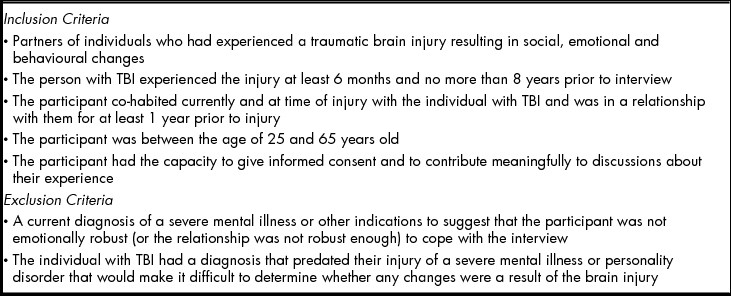
Participants were identified through an outpatient brain injury service provided by the National Health Service (a government-funded organisation which is the main provider of health care in the UK and which provides most of that care without charge) and local branches of Headway (a non-governmental organisation for individuals affected by brain injury and their families which charges a relatively small fee for its services). A local collaborator identified potential participants based on the set of inclusion/exclusion criteria listed in Table 1.
Participant Inclusion Criteria

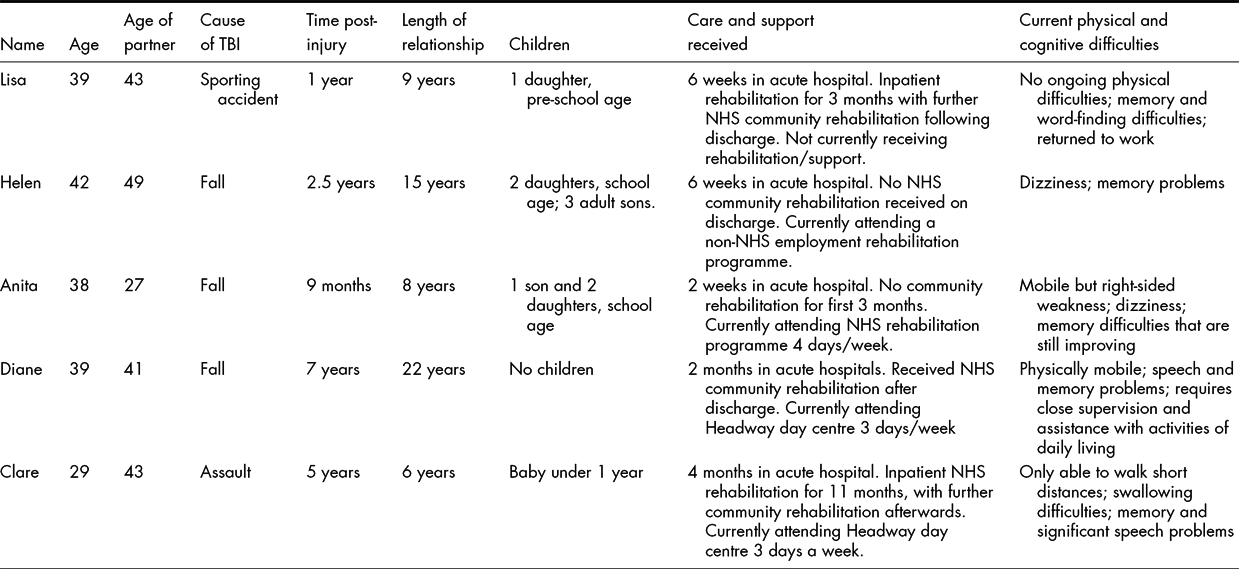
Staying true to IPA's idiographic emphasis, the aim was to recruit a small, relatively homogenous group of participants (Smith et al. Reference Smith, Flowers and Larkin2009). Nine potential participants were identified by local collaborators. Two of these did not clearly satisfy the inclusion/exclusion criteria, and two declined to take part without giving a reason for this. The remaining five took part and completed the study (i.e., none withdrew). Five was considered an adequate number for an IPA study (Smith et al. Reference Smith, Flowers and Larkin2009). All five were female partners of men who had experienced a TBI. Characteristics of participants, the injured partner and their circumstances are presented in Table 2. Although no medical data were obtained, participants’ descriptions of the circumstances of the injury and the early care received are suggestive of a moderate/severe injury (see Table 2). All but one of the injured partners were currently receiving rehabilitation and/or support from one or more service (NHS services, Headway or a non-governmental organisation providing vocational training for people with brain injury). NHS services and Headway provide a range of activities and therapies focusing on physical, social, emotional and cognitive difficulties, and on community reintegration. Compared to the services provided by Headway, NHS input is more likely to be time-limited and to involve input from rehabilitation professionals.
Characteristics of Participants and Their Partner
Interviews
Participants were interviewed on two separate occasions to facilitate collection of data with richness and breadth (Polkinghorne, Reference Polkinghorne2005). Interviews were held one to three weeks apart in quiet and private venues agreed in collaboration with participants. Each interview ranged from 51 to 66 minutes in length. Interviews were recorded and later transcribed.
In keeping with the ethos of the phenomenological approach, interviews were conducted flexibly, being as much as possible led by the participant, but using an interview schedule as a guide to ensure areas of interest were covered. Efforts were made to use open and non-directive questioning, with prompts used to encourage elaboration and clarification (Willig, Reference Willig2008).
All participants were first asked to explain what happened to their partner, which was thought likely to be a well-rehearsed story that would help participants feel at ease. Broadly, questions in the first interview tended to take a more descriptive and narrative slant and focused on descriptions of the person with the TBI and the relationship before and after the injury, with participants being invited to indicate and elaborate on the changes that they found most difficult; while the second interview had a more evaluative focus and focused on the emotional and relational impact of these changes.
Analysis
Interview transcripts were analysed by the first author guided by the IPA framework described by Smith et al. (Reference Smith, Flowers and Larkin2009). In general, this involved ‘moving from the particular to the shared, and from the descriptive to the interpretative’ (p.79). Each case was analysed in detail in turn. This involved reading and re-reading of the interview transcript. The first readings attempted to remain as open as possible to participants’ concerns. Comments and text not relevant to the focus of the study were gradually shelved and not developed further. Throughout the process of reading and re-reading the transcript, comments were made on copies of the transcript, with later readings moving from descriptive comments to more conceptual ideas as the researcher gained familiarity with the complete transcript. Possible emerging themes were gradually identified and noted on transcripts. This was a dynamic process that involved returning to earlier parts of the transcript, as later text gave way to new possible meanings.
The next stage involved clustering and organising themes emerging from the data. As part of this process, the researcher moved continually between comments, themes and transcripts to help keep themes grounded in the meanings of participants. At the case level, groupings of themes remained elastic, recognising alternative ways of organising and labelling themes.
This process was repeated for each case. Following case level analysis, patterns across cases were examined, looking for convergence and divergence. Themes considered less relevant to the focus of the study were dropped at this stage. Theme selection was influenced by a wish to encapsulate something of as many participants’ experiences as possible, whilst highlighting potentially interesting divergences. As the final structure was produced, the transcripts were revisited to identify extracts relating to each theme from different participants to ensure that themes reflected participants’ concerns and meanings.
Credibility
IPA, like other qualitative approaches, acknowledges the biases the researcher brings to the process of data collection and analysis (Willig, Reference Willig2008). In an effort to reduce this bias, both authors were involved in an iterative process of discussing and reviewing the conduct of the interviews and the outcomes of the analysis, focusing, in the latter case, on the coherence of the themes and whether they were adequately grounded in the interview transcripts. Quotations are also presented throughout the results section to give the reader confidence that themes are grounded in the interview data. Reflexivity was supported by the first author keeping a research diary throughout the interview and analysis process, noting thoughts, impressions and ideas about possible pre-conceptions. A written summary of the themes (with all identifying information removed) was sent to three other women whose partners had experienced personality changes after TBI, and they were invited to comment on the clarity and plausibility of the themes and whether they matched their own experiences. All three highlighted particular content that resonated with their own experience and identified their experiences as broadly matching the experiences of Diane, Helen, Anita and Lisa. None reported a close match with the experiences of Clare but one person commented that she knew others whose experience was closer to Clare's than her own.
Results
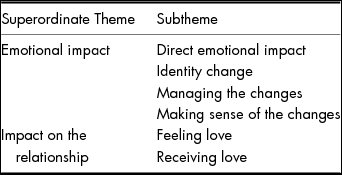
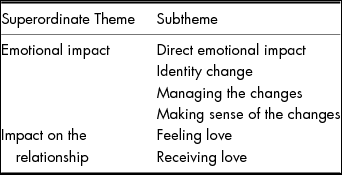
The themes are displayed in Table 3. ‘Emotional impact’ describes the direct emotional impact of the social, emotional and behavioural changes, together with the participants’ attempts to understand and manage those changes. ‘Impact on the relationship’ describes the impact of the changes on the relationship. Diane, Helen and Anita described similar experiences of struggling to cope with changes in their partners since the brain injury, whereas Clare seemed to cope more effectively. Lisa's experience had connections with both Clare's and the other three participants’ accounts.
Main Themes
Emotional Impact
Participants spoke about the direct emotional impact of some of the social, emotional and behavioural changes (‘direct emotional impact’). They also described their efforts to understand (‘identity change’ and ‘making sense of the changes’) and manage (‘managing the changes’) the changes, and these attempts to make sense of, and deal with, the changes also had an emotional impact.
Direct emotional impact
As noted earlier, participants were invited to identify and elaborate on those changes that they found most difficult. These fell into three broad categories: Aggression; controlling behaviours and the lack of positive behaviours and interactions.
With the exception of Clare, all participants reported increased irritability and aggression in their partners. In the case of Diane, Lisa and Anita, the aggression was physical as well as verbal. Fear of the aggression had made these three participants highly sensitive to the possibility of triggering an outburst, and they each used the phrase ‘treading on egg shells’ to describe their state of heightened vigilance. Each of the three felt uneasy in their partner's presence, as Anita's statement illustrates: ‘I’m constantly stressed out when I’m in the house with him, constantly. It's like my heart's coming out of my chest, beating that fast’. Diane described herself as a ‘nervous wreck’ and gave a vivid description of why she felt so stressed:
I’m talking to myself in my head. I’m thinking ‘Oh god, don't do anything wrong Diane, because he’ll go mad at you’. So everything I do, I’m literally like - I think I’m a bag of nerves. I can feel myself like getting all worked up and thinking ‘Oh, don't upset him’. (Diane)
Anita and Diane had, in the past, blamed themselves for the violence. Diane explained, ‘I sort of convinced myself, it was me. ‘Oh perhaps I upset him. Perhaps if I didn't do that, he wouldn't have been – he wouldn't have hit me for that reason’. So yeah I sort of blamed myself’. Diane also described a sense of shame about the violence that had led her to keep it a secret, as Diane explained ‘I never told anybody [that he was physically violent towards her]. I kept it a secret. Because I was embarrassed. I was very embarrassed’.
Anita, Diane and Lisa highlighted the difficulty of living with their partner's need to control others in the household. This need for control showed itself in the form of such things as wanting to know all the time what others are doing, having strict standards (e.g., about cleanliness, tidiness and how others are dressed) and requiring things to be done in particular ways (e.g., Anita's partner became angered by how his mother-in-law was hanging out the washing to dry). These participants tended to go along with their partner's wishes because the likely consequences of non-conformity were abuse, violence or moodiness. The experience of constant control and conformity was stressful. Lisa described a state of constant vigilance: ‘I feel I have to look at what I am doing all of the time.’ Anita stated, ‘The controlling literally wears me into the ground. The amount of phone calls I get. I’ve got to do this. I’ve got to do that. And it's wearing me out to be honest’. Diane felt totally controlled by her partner:
Because I think, ‘well why can't I just not do that on that day, and I could do something else’. But I can’t, I have to do, I have to work round [partner] basically. He's in control of everything I do. So that's what's really, really difficult. (Diane)
The third category of change highlighted as particularly difficult by the participants was the lack of positive behaviours and interactions. A particularly upsetting aspect of this was the lack of feelings and behaviours characteristic of a loving partner (e.g., expressions of affection). This aspect is described in more detail under the theme of ‘receiving love’. Other aspects described as upsetting by the participants included passivity, lack of initiative and spontaneity, lack of sense of humour (or humour that had become puerile), lack of warmth towards others, lack of conversation, egocentricity and lack of consideration for others, social withdrawal and the lack of positive interactions with the children in the household. The emotional impact of these changes varied, although a sense of sadness and loss was dominant. Helen described her anger and frustration over her partner's lack of conversation; and she found it ‘really heart-breaking, really really heart-breaking’ that her children had learnt not to seek affection from their father because he was so unresponsive to them. A sense of loss and sadness for what had gone was felt by some of the participants. Doing things as a family had been a central part of Lisa's life before the injury, and she was saddened by her partner's reluctance to join in any more. Anita similarly felt the loss of her partner as a loving father, as well as his sense of humour: ‘You know I miss his sense of humour. I miss the laugh and jokes we used to have. I miss everything. I miss him being the lovely dad to my kids.’ Helen expressed sadness at the loss of her partner's spontaneity: ‘It's like that spontaneity, that's all gone. That's just – that's not there anymore. And I really miss that’.
Changes in her partner described by Clare included passivity, a lack of concern about practical issues, and social disinhibition. Her descriptions of these changes were not accompanied by the strong negative emotions evident in the accounts given by the other participants. For example, referring to her partner's passivity and the role she now had in planning and organising activities for him, she remarked ‘It's not fun but it's just part of life’. Alone among the participants, Clare also perceived some of the personality changes as beneficial, describing how her partner had become less opinionated, judgmental and argumentative.
Identity change
With the exception of Clare, all the participants considered their partners to be fundamentally changed as people by their injury. Diane remarked, ‘He's not the person he was before. Definitely not’; and Helen that ‘It was like I brought a completely different person home’. Anita described the experience most poignantly: ‘I lost my husband the day he had the accident because [partner's name] is not my husband’. Lisa also commented on her partner being different, although her way of describing this was less categorical than the others: ‘There have been so many changes with him it is. It is like living with someone different’.
In the case of Diane, Helen and Anita, this sense of identity change was accompanied by a negative emotional response to the ‘new’ person (described later under the theme ‘feeling love’) and a sense of loss for the ‘old’ person. Helen expressed this sense of loss most clearly.
It's really strange because I can look at photos of him before his accident and I’ll cry. It's like – it's like he's died. It's like I’m grieving. You know I’ll look at a photo and I’ll say, ‘I really miss you’. (Helen)
In contrast to the other participants, Clare expressed a strong sense of continuity in her partner's identity despite the changes. She stated, ‘as himself he's still himself’. Her description of her partner focused on his core characteristics being the same, but expressed in a different way. For example, pre-morbidly he enjoyed drinking and partying. Clare perceived his underlying desire to have fun as being the same, but expressed in a different way:
He's very childlike in the way that he does enjoy a good time; [he] likes to play games with them [his nieces], likes to watch DVDs and music and have dance parties. So he's very fun loving still, just doesn't go out clubbing [laughs]. (Clare)
Consistent with her sense of continuity of the person, Clare's account did not contain any expressions of loss or grief for the person that her partner had once been.
Making sense of the changes
Participants’ attempts to make sense of the changes were often accompanied by negative emotions. Bewilderment over why their partner was behaving in the way that they did was associated with a strong sense of frustration and helplessness. For example, Helen could not understand why her partner could spend hours on the computer, yet if she asked him to do an activity with her ‘his heart wouldn't be in it’. She stated, ‘And it's really strange because I think why – why if can you do that there, can't you apply the same power with us. It's just not there. Again it's frustrating’. Similarly, Diane could not understand the inconsistency associated with her partner's aggressive behaviour: ‘And I’m confused. I’ll say [to doctor], ‘Well how come sometimes he does it one time but then he doesn't do it another? How can that work?’ and ‘You just think, why are you being so horrible? You know, so I don't know, I don't know’. Reflecting on her puzzlement over her husband's reluctance to go out places as a family, Lisa commented ‘I don't know. I don't know if he feels that people know that he has got an injury. I don't know. I really, really don't know’.
Reflection on the degree to which the partner was in control of his own behaviour could also be a source of uncertainty and confusion. In different parts of her interviews, Diane expressed seemingly inconsistent explanations of his violence.
You think sometimes, ‘Does he do it and he actually knows that he's done it, even though he says he doesn’t?’ (Diane)
[His violence is] not his fault and it's not him from before. . .the violence is through his head injury. (Diane)
Beliefs that their partner lacked control over the behaviour were accompanied in some cases by anxiety and a sense of hopelessness about future improvement. Lisa commented on her partner's stated lack of control over the outbursts of temper: ‘Scary really, actually. He says that he – he said when he's in the moods that he feels that he can't stop.’ For Anita, the lack of control was associated with pessimism about future change:
They [a clinician] are saying he's got to do it himself. That doesn't sound too hopeful. Because he just can't help it. You know, he's not doing it to be horrible, he literally can't help it. I see him with his hands over his head and he just can't help it. (Anita)
Clare struggled less than the other participants in understanding the changes, and, in some cases, had come up with explanations that had negated some of their emotional impact. She used her sense of his pre-morbid identity to explain several changes. For example, as already described, his childishness was viewed as an exaggeration of his persisting desire for fun. His passivity was understood as an exaggeration of his easy-going character (‘He just isn't a fighter’); and his social disinhibition was seen as an expression of his enduring self: ‘He is – he now – it's terrible – he makes fun of people with disabilities that he sees on the street. [. . . .]but that – I don't think that's an effect of his brain injury, I think that's just him being himself.’ Recourse to an explanation in terms of the brain injury did occur when the change was inconsistent with his pre-morbid self. At first, Clare found her partner's insensitivity to her feelings very difficult. However, she later came to the conclusion that this was not because he did not care about her, but because he now lacked the ability to recognise when she was upset. This made it easier to deal with:
It was really hard at first when he didn't – he wouldn't realise I was upset and I would have to tell him. But once the realisation came that he cared – he just wasn't able to recognise it anymore – it made things a lot easier. (Clare)
Managing the changes
For all the participants apart from Clare, efforts to manage difficult behaviours had generally been unsuccessful and these failures gave rise to a sense of frustration and helplessness. For example, Lisa struggled to persuade her partner to join in family activities or trips out as a family, and was disheartened by her lack of success: ‘I’ve tried to encourage – just the two of us. You know I’ve said – You know, my mum has [daughter] and – it's very, very difficult’. About her partner's aggressive outbursts, she commented ‘I just - I didn't know what to do. I didn't know how to handle it. I didn't know who to turn to’ and ‘I try and deal with it in different ways and it still doesn't end up to be the right way’. Similarly, Helen felt she was ‘fighting a no-win battle’ which she gave up at times: ‘All the time I’m getting frustrated - so it’ll get to the point where I’ll think - sod it, just forget it’.
As described earlier, Anita, Diane and Lisa tended to go along with their partner's controlling behaviour because the likely consequences of non-conformity were abuse, violence or moodiness. However, this too could have a negative emotional impact. For Diane and Anita, it made them feel like their life was controlled by their partners, engendering feelings of anger and resentment. As Anita explained, ‘That's what I can't brush off - the fact that he's took control of my life. And I have to do it all for an easy life. I have to do it’.
At other times, some participants felt their only option was to escape the situation or to take time away from their partner, but this could lead to worry and guilt about the potential consequences of this. For example, Anita stated, ‘But then I worry because obviously there's the safety part of him being here, if he leaves the gas on or anything like that. So it's a very hard life - it really is’.
Possibly based on her better understanding of the changes, Clare seemed to have greater success in managing the changes, and this seemed to lessen their emotional impact. For example, based on her idea that his apparent insensitivity to her feelings was due to difficulties recognising her feelings rather than to indifference (see under ‘making sense of the changes’), Clare had successfully improved her partner's ability to identify cues about how she was feeling and this had helped reduce the emotional distress caused by what had seemed, at first, to be indifference to her feelings.
I think at least I’m lucky because he does listen when I explain things and tell him, you know, he's got to watch for these cues [to what she is feeling]. He does make a big point of it [laughs]. (Clare)
Impact on the Relationship
Diane, Helen and Anita disclosed in the interviews that they had thought about ending the relationship, and reflected on the reasons why they stayed. For all three, the relationship with their partner had fundamentally changed and was experienced as akin to that between a carer and a care recipient, rather than that between a wife and a husband. Diane remarked, ‘I would say, it's more like I’m a carer. . . it's not like a husband and wife’; and Helen similarly commented, ‘I’m more a nurse, a housemaid, more than his girlfriend, more than his partner’. Anita described the change in more dramatic terms, ‘I lost my husband the day he had the accident because [partner] is not my husband; he's just somebody I have to care for now’. In contrast, Lisa did not experience her relationship as fundamentally altered in this way: ‘I still love him as a husband. You know, he is still my best friend’. However, she frequently spoke of a distance that had come between them: ‘We’re not very close at all. We know kind of - We are in separate rooms - so we haven't got a closeness at all [sighs]’. In contrast to the other participants, Clare described a close relationship with her partner that, if anything, had become even closer since the brain injury. Clare had given birth to a daughter since the injury and they had decided to marry.
[Interviewer: So how would you describe your relationship now?] It's good. It's just as much fun, especially now with [daughter]. It is, it just feels so much different, the, so lovely. We could spend our life lying in bed with [daughter], giggling at her, playing with her. It's easy. (Clare)
To some extent, the change in the relationship experienced by Diane, Helen and Anita appeared to stem from the fact that they had assumed greater responsibility for running the household and providing help and support to their partners. However, their relationships, together with that of Lisa’s, appear to have also been undermined by difficulties in feeling love towards their partner because of the personality changes, and the lack of love and care expressed by their partners. These issues are explored in the themes of ‘giving love’ and ‘receiving love’ respectively.
Feeling love
Diane, Helen and Anita described how their love for their partner had been undermined by the personality changes: Their partner had been replaced by a different person, they actively disliked this new person and they were unable to love the new person in the same way as before. Anita described her partner as ‘horrible, horrible, nasty, evil . . . disgusting’ and stated, ‘Although I still love him, I love him as my husband. I don't love the person he is now. I don't even like him - he's so horrible to us’. She also remarked, ‘The care's still there, but the love's took a real beating’. The love she felt for her partner had been replaced by a sense of care, consistent with her experience of the relationship as one of care giver and care recipient. Similarly, Diane described her partner as ‘really, really horrible’ and that ‘he's just not a nice person at all’. She had been challenged by her mother-in-law about her feelings for her partner: ‘[Mother-in-law] said ‘Don't you love him?’ That's what she - and I said, ‘Yeah, course I still love him because obviously I am still with him’ I said, but it's a different sort of love.’ Helen described a similar process, although recently she had begun to feel more positively towards her partner after he had admitted that his behaviour towards her was unacceptable:
It was like I brought a completely different person home. I’ve sort – I’ve sort of had to get to learn to love a different [partner's name]. In the early days, I don't think I’d have said I loved him. I think to be honest I think I really felt sorry for him. There wasn't really much love there. Because everything that I loved about [partner's name] wasn't there anymore and I didn't like the person that he’d become. (Helen)
So it's – I feel – I feel that we are moving forward now and I’ve started – I’ve started to love him again but I’d do anything to have the old [partner's name] back. I would sell my soul to the devil to have him back. I absolutely would. (Helen)
When asked, Diane, Helen and Anita all struggled to say anything positive about their partner's personality as it was now. By contrast, Lisa was readily able to highlight some positives: She was certain that her partner ‘adored’ her and her daughter; she described him as a ‘great father’; and she greatly admired the determination he had shown in making progress in his rehabilitation and in returning to work. Perhaps, because of being able to experience these positives, Lisa did not describe disliking her partner as a person (as opposed to disliking some of what he did) in the way that Diane, Helen and Anita did. She was also clear that she still loved him, and did not feel the need to qualify what she meant by that in the way that the other three did: It was the same kind of love as before. However, she did experience a distance between herself and her partner. She perceived that her partner contributed to this distance (described under the ‘receiving love’ theme), but she acknowledged that she also contributed: ‘I know I’ve put this bridge – not bridge, I suppose this distance between us - to not let him get so close. And I know it frustrates him. . . . But I just can’t, I can’t, I just can’t. ’ She attributed this to the radical change in his personality. Although she did not actively dislike the new person in the way that Diane, Helen and Anita did, it was difficult to have the same level of feeling as before for someone who was experienced as so different. Sexual intimacy with this new person was particularly difficult to countenance.
Because I think there have been so many changes with him it is. It is like living with someone different and getting to know someone different and that's what I’ve found difficult [long pause]. I have found it really, really difficult. And that I know is me. You know, the – I suppose the intimacy is – is definitely me – it is not him. (Lisa)
Lisa also attributed her reluctance to get too close to an anxiety that attempts to get closer might fail; an anxiety that was based on her experiences (described earlier) of failed attempts to re-engage her partner in family activities
It's me that's preventing the closeness. I don't know. I think I’m – I think I’m a bit scared really that – I suppose I’m scared of getting hurt in many respects, of getting so far and then being knocked back. Not knocked back but feeling disappointment because that’s, that's how it's been the last few months. (Lisa)
Lisa and Anita also highlighted aggression as a change that undermined their loving feelings towards their partner, explaining that it was difficult to switch off the hurt engendered by the aggression in favour of loving feelings.
The moods have had such an impact that they’re the ones that have put wedges between us really. So it kind of – it has had a massive impact on the whole of it really. And, you know, when he does eventually say sorry or he admits that, you know, there was - that what he did was wrong, sometimes, it's not too late, that's wrong - but it's too late in my head. (Lisa)
In between his violent outbursts and his verbal abuse, he still wants a lot of love. I can't give that. No way can you be treated like that one minute and switch your feelings off and cuddle somebody the next. (Anita)
Receiving love
Participants highlighted the negative impact on the relationship created by the partner's difficulties in responding and behaving in ways that characterised them as a loving partner prior to the TBI. Reductions in shared enjoyment contributed to a sense of distance and separation. Diane and Helen both struggled to identify enjoyable activities that they did with their partner. Anita missed her partner's humour which had been so important to their relationship before the injury:
That's how we got on, because we always took the mick out of each other, we’d got that banter. We’d got the sarcasm there and we used to always take the mick out of each other and end up laughing about it. Can't do none of that now. (Anita)
For Lisa, the time spent together as a couple and as a family was one of the most important aspects of their relationship, but now her partner was reluctant to go out anywhere as a couple or a family and Lisa found this lack of motivation and engagement created distance in the relationship: ‘We don't go out as a unit. It's me and [daughter's name]. So yeah it has because I feel that, again, has put that distance between us.’ Again, though, Lisa's experience was less extreme than that of Helen, Diane and Anita in that she was able to identify enjoyable times they shared.
We still laugh together, which is important. It's not all bad times. We still have our good times and you know, if we can still find stuff that we – You know, [daughter's name] makes us laugh all the time and we share that together and so that is great. (Lisa)
Helen and Diane were upset by their partner's apparent coldness and indifference towards them. Helen remarked, ‘If he [partner] was to go out now, he’d come back in [and] he wouldn't even acknowledge me [sighs]’. She reflected on how much she missed affection from him: ‘I can be in the shopping centre and see two people walking down the road hand in hand and I just think – you just – I miss it’. Diane became very upset during one of the interviews when reflecting on the fact that ‘he never shows me any feelings’. She felt that her partner was only ever affectionate towards her when he wanted physical intimacy, but she was unwilling to respond: ‘That's the only time he's very passionate like or - to me - but then I think, no – I sort of – I do I am quite pushy, pushy away because I feel that ‘you’re not loving to me any other times so why are you loving to me now?’
Lisa's and Anita's partners were more expressive of their feelings. As described earlier, Anita felt unable to reciprocate. In the case of Lisa's partner, although he stated his love verbally, Lisa was unconvinced of the strength of his feelings and felt that her partner was putting a distance between them, perhaps because other things took priority in his mind.
Even though he adores [daughter's name], he adores both of us, he adores the both of us. That he just – It's like he's got this wedge between us and that he doesn't – He's finding it difficult to – I don't know. (Lisa)
Even though he [partner's name] says that we’re [referring to Lisa and their daughter] his number one, but I do feel that we’re always on the – we’re always secondary to the – to the needs that he - that he needs to acquire in his little, his little list that needs to be done [referring to his obsessive behaviours]. (Lisa)
Another change that Diane and Lisa found difficult was their partner's unwillingness or inability to recognise and respond to the participant's own emotional state. Diane stated, ‘He doesn't understand that perhaps I get a bit down sometimes and I haven't got no one to talk to.’ Lisa remarked, ‘He's not aware of if I’m feeling tired or if I’ve, I’ve not been very well. Nothing. He doesn't – He's very – He doesn't show any empathy at all, sympathy or anything.’
As described earlier, Clare had also found her partner's lack of responsiveness to her own emotions difficult in the earlier stages of his recovery, but they had worked together to improve this. Now Clare experienced the positive returns from the relationship so missed by the other participants, such as shared enjoyment and her partner's expressions of love and care.
We know exactly how to make each other laugh, what looks, what things, how to drive each other slightly nuts, and then apologise for it, like those. It's just really, it is just so nice and easy right now. (Clare)
She perceived her partner as being ‘always willing to do anything I ask him to’ and ‘really supportive, really loving’. Even when he was not able to provide her with what she needed, her perception was that he was, at least, trying to do so and this was important to her as an expression of how much he cared for her.
In marked contrast to other participants, Clare perceived some of the changes in their relationship as positive. She described her partner, prior to the injury, as a ‘real commitment-phobe’ who did not believe in marriage. Following the injury, he was more focused on making a success of their life together: ‘Now where he is much more, yeah, just involved with his family. I mean he cared – sounds wrong to say he didn't care about me – but now he's just more focused on building a life together.’
Discussion
The aim of the present study was to explore partners’ experiences of social, emotional and behavioural changes following TBI in terms of their emotional impact and their effect on the couple relationship. It was hoped that this might shed some light on why these changes are so strongly associated with reduced emotional wellbeing and lower levels of relationship quality and satisfaction. As noted by Braine (Reference Braine2011), qualitative studies that have focused specifically on the partner's experience of personality change are rare. The present study expanded on Braine's own study by incorporating a focus on changes in social functioning, on a more detailed exploration of what emotional reactions were elicited by particular changes, and on exploring the connections between perceived changes to the person and changes within the relationship.
Participants described a number of reactions to the changes that might be expected to contribute to reduced emotional wellbeing. Aggression was associated with fear and stress and, for some participants, self-blame and shame; controlling behaviours were similarly stressful to live with; and participants described a sense of sadness and loss in relation to the disappearance of positive attributes such as affection and emotional sensitivity. Attempts to make sense of, and deal with, the changes also had an emotional impact that would, in turn, be expected to contribute to reduced emotional wellbeing. Difficulties in understanding and managing the behaviours were associated with feelings of bewilderment, frustration and helplessness. Conforming to controlling demands was associated with anger and resentment at having one's life taken over in this way, whilst escape from their partner and their behaviour was accompanied by worry and guilt about the potential consequences of leaving their partner alone. Believing that the partner had no control over his behaviour was associated with fear, and pessimism about future improvement. Diane, Helen and Anita perceived that their partner was no longer the same person as before, and this was associated with a sense of loss and grief for the pre-injury person.
In terms of the impact on the relationship, Diane, Helen and Anita had all considered whether to end the relationship, and all three experienced the relationship as one between care giver and care recipient rather than between wife and husband. For all three, their partner had been replaced by a new person; they actively disliked this new person; and they felt unable to love the new person in the same way as the old person, although they still loved the person in the sense that they cared about him. Although Lisa did not express any active dislike of her husband as a person (as opposed to the things that he did), the radical changes to his personality, and the consequent sense of being with a different person, made it difficult for her to feel close to him. For both Anita and Lisa, their own emotional reaction to their partner's aggression was incompatible with more loving feelings. For Diane, Helen, Anita and Lisa, the relationship was also undermined by a reduction in shared enjoyment, although the reduction for Lisa was not total. The relationships of Helen and Diane were corroded by their partner's apparent coldness and indifference. Anita's partner was more affectionate and Lisa's verbally expressed his love, but Anita could not reciprocate because of her difficulty in forgiving her partner's negative behaviours, and Lisa felt that her partner's love for her had been compromised in a way that she could not fully explain. Lisa and Diane also highlighted the damaging impact on the relationship of their partner's unwillingness or inability to recognise and respond to their (Lisa's and Diane’s) emotional state.
Clare's experience of personality changes was different from the other participants. She was less distressed by them. In part, this may have been due to her greater success in understanding and managing the changes. The perception that he was still the same person as before protected her from feelings of loss for the pre-morbid person, and was associated with a less perplexing understanding of the changes: Several changes were seen as altered expressions of her partner's pre-morbid characteristics, rather than as alien and incomprehensible. Alone amongst the participants, Clare was also able to interpret some of the changes in a positive way (e.g., that her partner had become less opinionated). She was also unique in feeling that the relationship had become stronger since the injury, and she expressed no uncertainty about her love for her partner. She perceived that her partner was more committed to the relationship than previously. She enjoyed their time together as a couple. She experienced her partner as supportive and loving. Responses that were apparently inconsistent with this experience were interpreted as her partner's difficulty in perceiving her emotional state, rather than as a lack of love; and they had worked together to improve his ability to identify how she was feeling.
There are overlaps between these findings and other literature about family carers in acquired brain injury (‘acquired brain injury’ is a broader term that encompasses injuries arising from other causes, such as encephalitis, as well as TBI). Braine (Reference Braine2011) explored family experiences of changes in people with acquired brain injury (of unspecified aetiology), and reported similar findings to the present study in terms of some of the changes highlighted as particularly upsetting (aggression, emotional volatility and apathy) and the associated emotional reactions (fear, shame and, in relation to the diminishment of positive attributes, a sense of loss). One overlap of particular interest is that participants in both studies described a sense of bewilderment arising from difficulties in understanding the changes, and an associated sense of helplessness when trying to deal with the changes. Consistent with this, Riley (Reference Riley2007), in a quantitative study of family carers in TBI, found that carer beliefs about their ability to deal with the impact of behavioural changes were negatively correlated with a measure of perceived stress. This study also found that beliefs that the person with the TBI was not in control of the behaviours were positively correlated with stress. This is consistent with the fear Lisa reported in the present study when reflecting on her partner's apparent lack of control over his temper outbursts.
Another point of similarity between the present study and Braine (Reference Braine2011) is that, although most of the participants in Braine's study described the strain placed on the relationship by the changes, one of the participants spoke about how their relationship had been strengthened by the injury. Other studies have also found that some participants reported strengthening of the relationship after the injury, although this is less common than deterioration (Gill, Sander, Robins, Mazzei, & Struchen, Reference Gill, Sander, Robins, Mazzei and Struchen2011; Gosling & Oddy, Reference Gosling and Oddy1999). Post-traumatic growth in family carers and family relationships (as opposed to growth in the person with the brain injury) is a neglected topic that merits further investigation (Braine, Reference Braine2011).
The experience that the person with the TBI has become a different person, has been reported in other studies (Braine, Reference Braine2011; Gosling & Oddy, Reference Gosling and Oddy1999; McKinlay & Brooks, Reference McKinlay and Brooks1984; Oddy, Reference Oddy, Chamberlain, Neumann and Tennant1995; Wood, Reference Wood2005). As in the present study, it has been associated with a reduced wish for intimacy and closeness with the injured spouse (Gill et al., Reference Gill, Sander, Robins, Mazzei and Struchen2011) and a sense of loss for the person as was (Braine, Reference Braine2011; Hammond et al., Reference Hammond, Davis, Whiteside, Philbrick and Hirsch2011; Ruston, Reference Ruston2007). It has also been specifically implicated in marital separation (Thomsen, Reference Thomsen1984). With respect to the impact of changes on the relationship, the experience that the relationship has changed from one of spousal partners to one of a care giver and care recipient has been noted by others (Braine, Reference Braine2011; Gill et al., Reference Gill, Sander, Robins, Mazzei and Struchen2011; Gosling & Oddy, Reference Gosling and Oddy1999). The loss of love and affection by many spousal carers has also been noted (Gill et al., Reference Gill, Sander, Robins, Mazzei and Struchen2011; Gosling & Oddy, Reference Gosling and Oddy1999; Hammond et al., Reference Hammond, Davis, Whiteside, Philbrick and Hirsch2011). As in the present study, the absence of expressed affection and other responses characteristic of a loving partner have been reported to have a particularly corrosive effect on the couple relationship (Gill et al., Reference Gill, Sander, Robins, Mazzei and Struchen2011; Gosling & Oddy, Reference Gosling and Oddy1999; Peters et al., Reference Peters, Stambrook, Moore and Esses1990; Wells et al., Reference Wells, Dywan and Dumas2005).
Although these earlier studies report many of the experiences described in the present findings, the experiences were not the central focus of these studies and consequently the connections between the experiences reported in the present paper have generally been absent. For example, the accounts of Diane, Helen and Anita connect their different experiences in a way that has not previously been reported. They experienced their partner as having been replaced by a new person; they actively disliked this new person; they felt unable to love the new person in the same way as the old person; and their love became defined in terms of a caring relationship, rather than a spousal relationship. This more detailed and integrated account of the experiences of partners should enable clinicians to be more effective in supporting relationships after brain injury.
The accounts of the participants in the present study share many similarities with the literature on couple relationships following dementia and might be understood using the framework of ‘relationship continuity’ that arose from this literature (Chesla, Martinson, & Muwaswes, Reference Chesla, Martinson and Muwaswes1994). The concept of relationship continuity describes whether the relationship is experienced as a continuation of the pre-morbid relationship (continuity) or is redefined in some other way (discontinuity); whether the person is viewed as continuous with the pre-morbid person (continuity) or as being radically changed (discontinuity); whether feelings of love and affection persist (continuity) or have been replaced by more ambivalent feelings (discontinuity); whether there is a continuing sense of being a couple (continuity) or the spouse feels alone in facing the situation (discontinuity); and whether there is (discontinuity) or is not (continuity) a sense of loss and grief for the pre-morbid person and their pre-morbid relationship and life together (Riley et al., Reference Riley, Fisher, Hagger, Elliott, Le Serve and Oyebode2013). Within this framework, Clare and (to a lesser extent) Lisa would be towards the continuous end of the spectrum, with the other three participants more towards the discontinuous end.
Perceptions of continuity and discontinuity within the relationship have been linked in the dementia literature to differences in how spousal carers cope with the challenges of their role. The fact that Clare, who perceived continuity, also appeared less troubled by the changes to her partner is consistent with the association previously reported between continuity and a milder emotional reaction to challenging behaviour (Murray & Livingston, Reference Murray and Livingston1998; Walters, Oyebode, & Riley, Reference Walters, Oyebode and Riley2010). Within the context of a continuous loving relationship, difficult behaviours may be more readily tolerated than when they occur within what is experienced as a new and different relationship in which mutual love is not clearly present. Continuity has also been associated in the dementia literature with how spouses understand and manage challenging behaviour. Those who perceive continuity appear more likely to make use of their knowledge of the person as an individual to understand and deal with the behaviour, resulting in a more individualised and person-centred approach (Chesla et al., Reference Chesla, Martinson and Muwaswes1994; Walters et al., Reference Walters, Oyebode and Riley2010). Clare similarly tried to understand the changes in terms of her ongoing sense of her partner's identity, and this may have contributed to diminishing their emotional impact on her. Her partner-centred understanding of the changes was also associated with an effective way of managing some of them: Consistent with her continuity-related perception that he still loved her, his lack of emotional sensitivity was interpreted as evidence of a deficit in emotion recognition rather than indifference, and this led her to work effectively with her partner on his ability to recognise her emotional state. By contrast, because the other participants perceived less continuity, they had no familiar framework within which to understand their partner. This may have contributed to their sense of bewilderment about the behaviour, to a lack of a clear person-centred formulation of why the behaviour was occurring, and to a consequent difficulty in managing the changes effectively.
Limitations
It is not possible to generalise the findings of the present study to all family members or even all spouses’ experiences of social, emotional and behavioural changes after TBI. It should be noted that participants were all younger female partners of men with more severe TBI still with their partners, and it is possible that their experiences are not representative of male spouses (Hammond et al., Reference Hammond, Davis, Whiteside, Philbrick and Hirsch2011), older spouses (Layman, Dijkers, & Ashman, Reference Layman, Dijkers and Ashman2005), spouses of partners with milder TBI, or spouses whose relationship has broken down. The study also sought to recruit people who had experience of ‘personality changes’ in their partner, and their experience are unlikely to be representative of those without such experience.
Furthermore, the present findings do not provide a comprehensive account of the experiences of personality change even amongst those matching the demographic profile of the participants in this study. The sample is too small to justify such a conclusion. It has been suggested that sample size in qualitative research should be determined by ‘data saturation’; that is, that one should continue to interview more participants until no new themes emerge (Francis et al., Reference Francis, Johnston, Robertson, Glidewell, Entwistle, Eccles and Grimshaw2010). However, the accumulation of large amounts of data that may be involved in reaching data saturation is inconsistent with the importance IPA places on providing a detailed account of the individual case and of differences between cases (Smith et al., Reference Smith, Flowers and Larkin2009). There are also practical limitations on collecting such large amounts of data. Even though only five participants took part, the present study involved 10 interviews and the transcription and analysis of about 10 hours of data.
The methodology of the study did not allow exploration of many other potential explanations of the differences in the experiences of the participants. It is possible Clare's experience of the changes was different because changes in her partner were less marked; because he was not aggressive; because he was willing to acknowledge and deal with the changes; because their pre-morbid relationship was shorter than the others (Table 2); and/or because the time post-injury was longer than the others except for Diane (Table 2). The participants’ own personality (McKinlay & Brooks, Reference McKinlay and Brooks1984) and coping resources (Harris, Godfrey, Partridge & Knight, Reference Harris, Godfrey, Partridge and Knight2001; Minnes, Graffi, Nolte, Carlson, & Harrick, Reference Minnes, Graffi, Nolte, Carlson and Harrick2000) may also have influenced how they responded to changes in their partner. Indeed, Clare described herself as ‘naturally very optimistic’. The developmental aspects of some of the accounts were also not explored. Clare had found her partner's lack of sensitivity very upsetting until she came to an understanding of what was going on and did something about it. Also, Helen felt there had been a turning point just before the interviews when her partner apologised for his treatment of her, and this had given her hope that she could start to love him again.
Implications
Spousal/partner relationships should be a central focus of rehabilitation (Bowen, Yeates, & Palmer, Reference Bowen, Yeates and Palmer2010). They are intrinsically valuable to those involved, but they may also have an impact on the general psychological wellbeing of both parties (e.g., Anderson et al., Reference Anderson, Parmenter and Mok2002) and on the rehabilitation outcomes for the person with the ABI because of the important role the spouse plays in helping the person achieve those outcomes (e.g., Sander et al., Reference Sander, Caroselli, High, Becker, Neese and Scheibel2002). Clinicians should seek to understand rehabilitation issues from a relationship perspective and should provide support to foster strong and healthy relationships (Bowen et al., Reference Bowen, Yeates and Palmer2010).
The present study suggests a number of areas that merit further investigation as potential targets for intervention when supporting couples after a TBI. First, the partners of all the participants in this study had difficulty with some of the emotions and behaviours characteristic of a loving partner, such as showing sensitivity and empathy in response to the other's emotional state, showing that one cares for the other, being affectionate, sharing humour, wanting to be with the other, and sharing enjoyment. The absence of these responses was particularly upsetting to the participants, and was highlighted as something that was particularly undermining of the relationship. Deficits in engaging in the positive aspects of social interaction have often been overlooked in rehabilitation, with the focus being more on the curtailment of socially unacceptable behaviour (McDonald, Reference McDonald2003; McDonald et al., Reference McDonald, Anderson, Ponsford, Tate, Togher, Morgan and Murdoch2012). More emphasis is needed on the assessment and development of the ability to make a positive contribution in social contexts. In the context of supporting a spousal relationship, clinicians need to consider how love was expressed within that particular relationship and whether it is possible to support the person with the TBI to re-develop those expressions or to find alternatives.
In supporting spouses/partners to deal with difficult changes, a focus on helping them to develop a clear understanding of those changes may be important. A lack of understanding was associated in the present study with a sense of bewilderment and helplessness; and feeling helpless may contribute to the stress that some of the behaviours may engender (Riley, Reference Riley2007). One particular source of bewilderment was whether challenging behaviours were under the control of their partner. Thinking that the behaviour was not under the partner's control was associated with pessimism about future improvement and increased stress. A better understanding may be achieved by encouraging spouses/partners to try to understand the changes, as Clare did, in the context of their pre-morbid knowledge of their partner. Behavioural and other personality changes are not a simple function of the brain injury, but are the product of a complex interaction of factors that include the pre-morbid personality of the individual (Yeates, Gracey, & McGrath, Reference Yeates, Gracey and McGrath2008). Because of their pre-morbid history, spouses are in a particularly good position to try to understand how the changes may relate to ongoing characteristics of their partner.
Encouraging spouses to think about the changes as being partly a product of the pre-morbid personality of their partner could constitute part of a wider effort to encourage the spouse to consider how, despite the changes, their partner and their relationship have some continuity with the pre-morbid situation. A sense of discontinuity was associated in the present study with difficulties in understanding and managing the changes, a sense of loss, negative reactions to the ‘new’ person, barriers to love and intimacy, and a questioning of one's commitment to the relationship. The possibility that encouraging a greater sense of continuity might help reduce these negative outcomes merits further investigation.
Acknowledgements
The authors would like to thank the participants who shared their stories of life with the injured person after brain injury. This study would not have been possible without their generosity and openness in talking about their struggles and offering their reflections on such an emotive and personal experience.
Financial Support
This research received no specific grant from any funding agency, commercial or not-for-profit sectors.
Conflict of Interest
None.
Ethical Standards
The authors assert that all procedures contributing to this work comply with the ethical standards of the relevant national and institutional committees on human experimentation and with the Helsinki Declaration of 1975, as revised in 2008.