It has been demonstrated that in the study of frugivorous bats, placing plastic sheets below the mist nets is very useful for obtaining faeces containing seeds, relative to the method of placing bats in cotton bags (Galindo-González et al. Reference GALINDO-GONZÁLEZ, VÁZQUEZ-DOMÍNGUEZ, SALDAÑA-VÁZQUEZ and HERNÁNDEZ-MONTERO2009), which leads us to suspect that the use of this technique with frugivorous birds might yield equally useful results. The relative usefulness of the two techniques has not been tested to date and there are only two studies in which plastic sheets have been used with frugivorous birds (Hernández-Ladrón de Guevara et al. Reference HERNÁNDEZ-LADRÓN DE GUEVARA, ROJAS-SOTO, LÓPEZ-BARRERA, PUEBLA-OLIVARES and DÍAZ-CASTELAZO2012, Roldán & Varela Reference ROLDÁN and VARELA1999), though these authors did not indicate whether this method was more effective, relative to cotton bags, for obtaining seeds. Thus, the objective of this study is to determine whether plant species richness and the number of seeds obtained using plastic sheets are different from those obtained using cotton bags.
The study was done in the municipalities of Ixhuacan de los Reyes and Tlalnelhuayocan, both of which lie within the upper part of the La Antigua River basin (19°32ʹ30ʹʹ–19°21ʹ30ʹʹN, 97°7ʹ30ʹʹ–96°58ʹ00ʹʹW), in the state of Veracruz, Mexico, at a mean altitude of 1560 m asl. Land use in the region includes pastures (37%), urban areas (18%), secondary forest (17%) and cloud forest (17%) (Williams-Linera Reference WILLIAMS-LINERA2007). The natural vegetation is mostly comprised of cloud-forest remnants that predominate along river margins and are immersed in a matrix of pastures.
Eight 9 × 3-m mist nets were used to capture the birds. Four were hung in riparian vegetation following the course of the river, and the other four were hung in adjacent pastures. The nets were open from 06h00h to 13h00 and from 16h00 to 18h00, when the birds are most active. Over the course of a year we visited the study sites 16 times (August 2011–June 2012) spending 2–3 d in each of the two habitat types, for a cumulative netting effort of 4860 m2 h (Straube & Bianconi Reference STRAUBE and BIANCONI2002).
Two techniques were used to collect the seeds dispersed by birds: plastic sheets and cotton bags. The plastic-sheet technique consists of placing a transparent sheet of plastic on the ground beneath the net to collect the faeces defecated by the birds when they get caught in the net. The sheet is 1 m wide and runs the length of the mist net (Galindo-González et al. Reference GALINDO-GONZÁLEZ, VÁZQUEZ-DOMÍNGUEZ, SALDAÑA-VÁZQUEZ and HERNÁNDEZ-MONTERO2009). When a bird gets caught it usually defecates directly into the ground in a straight line, so it is easy to associate the bird with its faecal sample. In order to reduce the likelihood of catching two birds close together in the net and to avoid mixing up their faecal samples, every 30 min the nets and the plastic sheets were checked for faeces. Faeces with seeds were placed in paper envelopes and labelled with the capture number for later analysis. Each bird captured was placed in a cotton bag where it was left for at least for 10 min, given that digestion in birds lasts from 40–50 min (Levey Reference LEVEY, Estrada and Fleming1986). Birds were identified using field guides (Howell & Webb Reference HOWELL and WEBB1995) and then freed where they had been caught; the bags examined to see if they contained faeces with seeds. In the laboratory, faecal samples were examined under a stereomicroscope to check for seeds and the latter were identified to the finest taxonomic level possible using our reference collection.
To compare the number of seeds and species richness of plants recorded with the two methods, we used the G test for Goodness of Fit (Sokal & Rohlf Reference SOKAL and ROHLF1995). This test compares two observed proportions against the expected proportions under the null hypothesis that each is equal to 0.5. The efficacy of both methods in collecting faecal samples was evaluated using the non-parametric Wilcoxon test. The analyses were run with the statistical package R Project for Statistical Computing (http://www.r-project.org) version 3.0.1.
In total, 141 birds belonging to 40 species were caught. Of these 41.8% were insectivores, 29% frugivores, 24.8% nectarivores and 4% belonged to other guilds (carnivores, granivores and omnivores). A total of 84 faecal samples were obtained, only 20 with seeds (Table 1). There were no significant differences in the number of faecal samples obtained using the plastic sheets and the cotton bags (W = 81.0, P = 0.620). Of the samples with no seeds, 30 were from 15 birds that left faeces both on the plastic sheet and in the cotton bag. Of all the faecal samples with seeds, 65% were obtained from the plastic sheets, though these were not significantly different (W = 76.5, P = 0.795), from the cotton bags.
Number of faecal samples with and without seeds, comparing two different collecting techniques (a plastic sheet under the mist-net and a cotton bag). Number (No.) and percentage (in parentheses) are given. Cotton + Plastic represents samples obtained using both collecting techniques, i.e. faeces from the same bird deposited in the cotton bag and dropped on the plastic sheet. No significant differences in number of faecal samples between the plastic sheet and cotton bag methods were found.

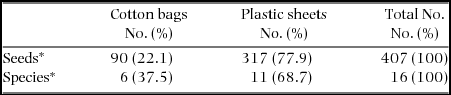
A total of 407 seeds belonging to 16 plant species were collected: 317 belonging to 11 plant species from the plastic sheets and 90 from six plant species from the cotton bags (Table 2). Both the number of seeds and plant species richness were significantly greater using the plastic sheet method than for the cotton bags (G = 112, df = 1, P < 0.001, G = 14.4, df = 1, P < 0.001, respectively). Of all the plant species recorded, only one species (Oreopanax liebmannii Marchal) was collected by both of the techniques, dispersed by Catharus mexicanus (Bonaparte, 1856). On a few occasions some bird droppings contained seeds from more than one plant species.
Number of seeds and species collected using two different techniques (a plastic sheet under the mist-net and a cotton bag). Number (No.) and percentage (in parentheses) are given. The total for species reflects the fact that one species was shared between the two methods. The * indicates significant differences (P < 0.001) between the plastic sheet and cotton bag methods.
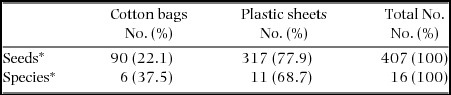
Although there were no significant differences between techniques in the number of faecal samples collected from frugivorous birds, the plastic sheet technique collected notably more seeds and greater plant species richness. That is, if the plastic sheets had not been used, plant species richness and the number of seeds collected would have been less than half: of all the seeds collected (407) only 22% (90 seeds) and of the total species richness (16) only 7.5% (6 species) would have been collected using the cotton bags (Table 2). These results suggest that, in contrast to what has been observed for frugivorous bats (Galindo-González et al. Reference GALINDO-GONZÁLEZ, VÁZQUEZ-DOMÍNGUEZ, SALDAÑA-VÁZQUEZ and HERNÁNDEZ-MONTERO2009), for birds the two collection methods are complementary. Only 6.2% of the species were shared by the two faecal capture methods, in contrast to 93.7% of the plant species that were exclusive to either one method or the other; 10 plant species were exclusive to the plastic sheets, and five to the cotton bags. The difference between the two methods in the composition of plant species dispersed by birds can be attributed to the size of the birds captured. Large birds have a slower intestinal transit time compared with small birds (Levey Reference LEVEY, Estrada and Fleming1986). Thus, it is less likely for a large bird to defecate on the plastic sheets than it is for a small bird, because captured birds may have had a recent or late intake, relative to the capture time. This can modify the amount of seeds deposited, independently of size of bird or method used. In our study both large (Turdus grayi Bonaparte, 1838, 88 g) and small birds (Sialia sialis Linnaeus, 1758, 28 g) dropped seeds on the plastic sheets or cotton bags independently of their weight, but not in both methods. Because of this, to obtain a proper representation of the diet of frugivorous birds, the use of both techniques together is highly recommended.
Additionally, the use of plastic sheets offers several advantages over the cotton bags. Digestion in frugivorous birds lasts from 5 to 40 min (Levey Reference LEVEY, Estrada and Fleming1986), so if birds are not released from the net and placed in the bags before this amount of time has elapsed, we are leaving valuable information on the forest floor. If there is a lapse of 20–40 min between one check of the net and the next, the use of the plastic sheets guarantees that the faeces of the captured birds will not be lost. Considering that in studies focused on assessing plant-bird interactions it is essential to get as much information as possible, it is useful to examine the success rates of the collection methods. From the 41 frugivorous birds captured, 20 samples with seeds were obtained, i.e. 48.8% were a total success, and 65% of these were obtained from the plastic sheets and 35% from the cotton bags. In a study of bats, the percentages were similar: 56.7% and 23%, respectively (Galindo-González et al. Reference GALINDO-GONZÁLEZ, VÁZQUEZ-DOMÍNGUEZ, SALDAÑA-VÁZQUEZ and HERNÁNDEZ-MONTERO2009). For observed plant species richness, the numbers are also similar: 68.8% was obtained from the plastic sheets and 37.5% from the cotton bags.
One aspect of the plastic sheet technique that has been criticized is the possibility of confusing the origin of a faecal sample when two or more dispersers are caught close together in the net or when one is above the other (Galindo-González et al. Reference GALINDO-GONZÁLEZ, VÁZQUEZ-DOMÍNGUEZ, SALDAÑA-VÁZQUEZ and HERNÁNDEZ-MONTERO2009). This was not a problem in our study as at no time were two birds caught in the net too close to each other, so we had no difficulty knowing which had produced which faeces. In environments where birds or bats are caught with greater frequency, if it is not possible to determine the origin of the samples, they would have to be left out of analyses where it is important to know the identity of the disperser. However, if birds are being studied as a group, i.e. as the dispersal vectors for a certain plant species, the identity of the bird species is of no importance. Furthermore, with plastic sheets under the nets, the researcher can release a captured bird immediately, and thus reduce the stress caused by handling (Galindo-González et al. Reference GALINDO-GONZÁLEZ, VÁZQUEZ-DOMÍNGUEZ, SALDAÑA-VÁZQUEZ and HERNÁNDEZ-MONTERO2009). Also, it is possible that birds detect the plastic sheets under the nets and this may modify the chance of capture. In order to reduce this effect, we selected transparent sheets of plastic; however we did not test bird captures between nets with transparent plastic sheets versus nets without plastic. Camouflage fabric could be used in order to avoid reflections of plastic or conspicuous colours.
In a study of seed dispersal by birds in a cloud forest in the same region, 17 species of plants were reported (Hernández-Ladrón de Guevara et al. Reference HERNÁNDEZ-LADRÓN DE GUEVARA, ROJAS-SOTO, LÓPEZ-BARRERA, PUEBLA-OLIVARES and DÍAZ-CASTELAZO2012), similar to the number we report (16 species). Roldán & Varela (Reference ROLDÁN and VARELA1999), using a variant of the plastic-sheet method we used, placed plastic sheets beneath isolated trees and reported greater plant species richness in faeces obtained on the plastic sheets compared with those recorded from cotton bags. A significant increase in faecal sample abundance, the number of seeds and plant species richness dispersed by bats has been reported using the plastic-sheet method (Galindo-González et al. Reference GALINDO-GONZÁLEZ, VÁZQUEZ-DOMÍNGUEZ, SALDAÑA-VÁZQUEZ and HERNÁNDEZ-MONTERO2009).
Thus, we strongly recommend that plastic sheets be used, together with cotton bags, in order to obtain the seeds dispersed by birds. To conclude, the simultaneous use of the two methods allows a more complete picture to be obtained of the diet of frugivorous birds and the seeds they disperse, and of bird-plant interactions; all of which are indispensable for analysing and understanding the ecological balance of ecosystems.
ACKNOWLEDGEMENTS
We are grateful to D. Vázquez-Balbuena, A. Tobón and P. García for their help in the field, and to J. Laborde-Dovalí, G. Castillo-Campos and A. Xicohténcatl for their help identifying the seeds. O.A.H-D was awarded a graduate studies scholarship by CONACyT (No. 250335), and a SNI-UV scholarship by the Universidad Veracruzana. The Instituto de Ecología, A.C. provided the equipment and materials necessary for sampling in the field. INBIOTECA provided logistical support while this manuscript was being prepared.