During the Cold War, it was common for societies on either side of the great divide to be described in dichotomous terms set by the rivalry between capitalism and socialism. Since its end, historians have been attending to what these societies had in common with each other, or where they dovetailed (Booker and Juraga Reference Booker and Juraga2002; Vowinckel, Payk, and Lindenberger Reference Vowinckel, Payk and Lindenberger2012). In East Asia, this revisionism is apparent in treatments of the PRC and ROC (mainland China and Taiwan), states governed by single-party authoritarian regimes with a strong shared history (Kirby Reference Kirby and Kirby2004; G. T. Wang Reference Wang2006, 121–54; cf. Wu Reference Wu1994). Terrain shared by Mao's China and the Liberal Democratic Party's Japan has less often been identified, or has even been patently ignored (Shiraishi and Hau Reference Shiraishi, Hau, Yangwen, Hong and Szonyi2010, 32). The two countries were by definition on different sides of an experiment that featured “the productionism of the Soviet and Chinese models” on one side of the divide and “the consumerism of the West,” specifically the “US, Europe, and Japan,” on the other (Marks Reference Marks2007, 176). Although Japan is often treated as a special case among capitalist liberal democracies, and in post–Cold War contexts as an East Asian rather than a Western economy, there are certainly grounds for thinking about it in association with the United States for the peri-bellum decades (Iriye Reference Iriye1992, 110). The two countries were first rivals in the Pacific and then allies, the one pursuing the other's economic achievements to a point where, by the end of the Cold War, it was close to matching them.
These historical parallels and connections may have been among the factors underpinning the methodology adopted by Andrew Gordon in Fabricating Consumers: The Sewing Machine in Modern Japan (Reference Gordon2012), an engaging study of the manufacture and use of the domestic sewing machine in Japan written in light of the American experience. The United States is not the only other country Gordon mentions. Britain and Germany, countries on the same side of the Cold War and like the United States historically prominent as sites of sewing machine production and use, also make an appearance in the book. But nearby China, which was to succeed Japan as the world's largest manufacturer of sewing machines, is largely overlooked. One of the reasons for this discrimination must lie in the “consumers” of the book's title, graphically depicted in images of happy Japanese housewives with sewing machines that resonate with advertisements in 1950s American magazines. The gendered citizen consumer, encapsulated in the figure of the housewife and well documented by Gordon for Japan, has become a stock character in studies of Cold War culture (Pence Reference Pence, Chatriot, Chessel and Hilton2006; Reid Reference Reid, Balina and Dobrenko2011, 133), representing the free market economies in much the same way as the girl on a tractor was used to symbolize the command economies on the other side of the Cold War trenches. Even taking into account Karl Gerth's (Reference Gerth2013) careful excavation of consumer-oriented advertisements in the early PRC, it would seem difficult to find much in China that would render it comparable to Japan in the realm of commercial culture in the third quarter of the twentieth century.
Yet the story Gordon tells is about production as well as consumption, and here there was indeed common ground between Japan and China. The starting points for postwar development of the sewing machine industry in the two countries were very different, but the rates of growth in the third quarter of the twentieth century were almost equally impressive. In Japan, 134,000 machines were manufactured in 1947, 166,000 in 1948, and more than a million by 1951. In 1969, output “peaked at 4.3 million” (Gordon Reference Gordon2012, 153–54). China went from a total of 4,500 machines in 1949 to 3,567,000 in 1975 (“Dangdai Zhongguo” Congshu Bianjibu Reference Congshu1985–86, 328–29). As might be expected, Chinese production expanded rapidly in the Reform Era, doubling from 4,860,000 to 9,350,000 units between 1978 and 1984 (Guojia Tongju Reference Guojia1985, 110, 153–55), but the base line established by the beginning of the Reform Era was already quite high. Martin King Whyte found not much difference in domestic distribution between 1975 and 1980, indicating that the initial turnaround was an effect of economic reform in first half of the seventies: it began in Mao's China, not Deng's. By the beginning of the Reform Era in 1980, there was already a sewing machine in two out of every three households in forty-four Chinese cities sampled by the State Statistical Bureau (Whyte Reference Whyte1985, 93).
In the 1950s, different meanings were associated with the proliferation of machines in the two countries. A typical Japanese testimonial for the benefits of using the mishin unfolds as follows: Kawaguchi Kinuko worked in a dress-shop before the war and now wants to try home-based work. Her husband, a factory worker, objects, but has a change of heart when he sees how much she earns from making blouses for her neighbors. He brings home orders from his workmates for shirts. She develops her fashion skills by reading, and sets her sights on opening a shop: “Her husband is so impressed he has started to come home early to help out with the housework.” The thread of the story winds its way through the intricacies of domestic life: the husband's initial opposition and eventual conversion to the wife's leverage of her sewing skills for commercial advantage are central points in the narrative. She not only makes money: she also effects a progressive transformation in husband-wife relations. She does so without actually leaving the home, but the latter possibility seems to be on the horizon (Gordon Reference Gordon2012, 176).
A Chinese counterpart to Kinuko can be found in the figure of Zhang Cuihua 张翠华, heroine of a play called The Sewing Machine that was staged in 1958, at the beginning of the Great Leap Forward. The play opens at daybreak with Cuihua at her machine, putting the finishing touches to a pair of trousers. She has been up sewing all night, too excited to sleep after having attended a meeting about the “three big changes” of the day: collectivization of production, collectivization of daily life, and collective child care. Her mother-in-law, who shortly appears on stage with baby in arms, is opposed to all these changes. She rightly senses their implications: the sewing machine will be turned over to a collective production unit, and her grandson will end up in a child-care center. Seeking to rein in her daughter-in-law's revolutionary enthusiasm, she surreptitiously sends the sewing machine off to a dealer, telling Cuihua that she has given it to her daughter. A distressed Cuihua is quickly consoled when her husband arrives home and approves his wife's down-payment on another sewing machine. Lo and behold, the second-hand machine that she subsequently purchases from the dealer turns out to be her own! The mother-in-law, exposed and embarrassed, capitulates, and sees the light: sending the child to crèche seems after all a very good idea, and likewise committing the sewing machine to the collective. As it happens, the collective has nowhere to set up its sewing business, and hapless mother-in-law has also to agree, cheerfully, to her home being used as a factory during the day (Xiong Reference Xiong1958).
The two stories could readily be assigned to separate categories of Cold War ideology: the Japanese testimonial features an emphasis on family solidarity and cooperation, individual initiative, and the economic advantage of the family unit, while the Chinese propaganda play extols extra-familial social ties, “the collective,” a rejection of the work-for-profit ethic (especially profit for the individual or family), and cooperation for the greater social good. Yet the overlap is considerable. First, the narratives share a basic premise: women on both sides of the East China Sea engaged in home-based production of clothing, whether hand-sewn or machine-made. Second, the wage-earning, productive capacity of the machine-sewing wife-mother figure is recognized. Whether in socialist China or in capitalist Japan, the author takes for granted that the reader will understand the equivalence between clothes manufacture by women and household income. Third, the gender structure of the family as economic unit is the same. The dialogue between husband and wife in the two instances differs, but the narrative in each case depends on the husband's support of the wife's initiative. Both socialist and capitalist logic lead to the identification of the wife/mother figure as producer and to a progressive relationship between husband and wife as crucial to social and economic progress.
The overlap in themes and significations in these two stories demonstrates in small the inadequacy of simple Cold War categorizations of consumerism and productionism to account for social and economic change in Japan and China in the third quarter of the twentieth century. In Japan, economic growth based on commodity production was attended by a “profound ambivalence” towards consumption (Garon and McLachlan Reference Garon, McLachlan, Garon and McLachlan2006, 4). Postwar society in Japan was marked by a certain nihilism, a sense “of the collapse of the social order externally and of spiritual decay internally,” in the words of Keiji Nishitani (Reference Nishitani, Parkes and Ahara1990, 3–4). To nihilism was conjoined on the one hand a commitment to growth and the production of prosperity (O'Bryan Reference O'Bryan2009), and on the other searches for meaning in community and the family. Consumption, defined as the purchase of household goods, rose in the 1950s, but then so did savings (Partner Reference Partner1999, 184). The Housewives Association was urged to look beyond and indeed away from consumption to life goals that were spiritual rather than material (Garon Reference Garon1998, 186). Women's groups on right and left reacted against the industrial machine, openly attacking the cult of productivity (seisansei shijōshugi 生産性至上主義) (Uno Reference Uno and Gordon1993, 313).
Were sewing machines principally items of consumption or more importantly tools for production on the part of Japanese women? Gordon's analysis suggests the former, but Ronald Dore, in a famous fieldwork study conducted in the 1950s, found that the sewing machine was little used for leisure activity, and appears not to have been regarded as a luxury item (unlike an ice-box, for instance, or an electric fan): rather, it was “primarily a means of economizing on clothing expenditure” (Dore Reference Dore1958, 85). The conclusion to be drawn is that women were spending all those hours at the machine because they were making clothes for the family, or for the market, or both. Gordon documents exactly this while stressing an apparent teleological endpoint of the process: leisure use or even mere possession of the machine. There was, he finds, a gradual move “away from the sewing machine as an economizing tool of the wage-earning, producing wife and towards the mishin as the indispensable tool of the happy bride and an instrument allowing a female consumer to fabricate a fashionable, good life” (Gordon Reference Gordon2012, 176). In the balance of this analysis can be sensed the weight of historical tendencies to view the housewife as a (non-producing) consumer, spending the money earned by her working husband. In nineteenth-century France, as Judith Coffin (Reference Coffin1996) has pointed out, the sociology of consumption linked leisure and consumption, assigned them to the home, and declared women the major performers in what were essentially passive roles in the economy. This is consistent with a view of “sewing machines for home-use [as] durable consumer goods, while industrial sewing machines are capital goods,” to quote Hirohisa Kohama (Reference Kohama2007, 205). Yet as long as domestic sewing machines were being used to make money, or even simply to save money, the line between the two categories must be blurred. Under both circumstances, the categorization of the Japanese housewife as the definitive consumer seems problematic. Looked at from a perspective supplied by J. K. Galbraith, to the extent that a consumer economy was developing in Japan in the 1950s, the most significant role played by women in its development was surely a service role (Galbraith Reference Galbraith1974, 33; cf. Horioka Reference Horioka and Gordon1993; Tachi Reference Tachi, Ozaki and Komiya1966, 24).
Compared to China in this period, or to the Soviet Union, Japan did of course look like a consumer's paradise. The terms “consumers” and “consumption,” suggestive of market mechanisms, had a place in socialist regimes. China had consumer cooperatives, organizations with a hoary revolutionary heritage and manifestations in both Nationalist and Communist China (Fitzgerald Reference Fitzgerald1997; Perry Reference Perry2012). In the People's Republic, these cooperatives were meant to facilitate access to necessities of daily life: fuel, rice, oil, salt, vegetables, soap, towels, toothbrush, toothpaste, matches, cigarettes, and medicines. It can be seen from this list, taken from a report on the workers’ consumer co-op at the Shanghai No. 9 Cotton Textiles Factory (SMA 1963), that consumption (xiaofei) need not mean luxury consumption but simply what was acquired through purchase. Yet the term had a reserve of negative associations. In 1958, the country as a whole was being urged to take a turn that would “turn consumers into producers, and turn consumer towns into producing towns” (Yue and Xu Reference Yue and Xu1958). Within this framework, plainly, being a producer was much more important than being a consumer.
In this context, was a domestic sewing machine to be considered a consumer or a “capital” (i.e., a productive) item? Was it a luxury good, to be purchased by families as a sign of the prosperity achievable under socialism, or was it a component in the industrialization drive that was aiming to replace manual work in China with machines? As might be expected, the emphasis in the industry was very much on production, but just as a strong productivity ethic remained visible in Japan even while economic growth, advertising, and fashion lent weight to the impression of a burgeoning consumerism, so too in China, a history of advertising, fashion, and brand competition evident in the early development of the sewing machine industry left its mark on the industry as it took off in the decidedly productionist 1950s.
It is worth noting that these were more than simply parallel developments: merely to plot the trajectories of the two national industries side by side would be to obscure their shared terrain. In the opening pages of his book, Gordon notes the historical role played by China in Japanese cultural and economic change, before the advent of the Black Ships. Although it then quickly disappears from the book, China did not of course disappear from the Japanese horizon. In the decades when Singer was expanding into East Asia, a greater Japanese empire was taking shape. The quiet activities of Japanese women plying their needles and the manufacture and retail of Japanese sewing machines and their parts were alike involved with the making and maintenance of this empire. In 1937, women on the streets of cities in Japan were to be seen sewing senninbari, a thousand stitches for each white belt to protect the soldier going to the front—in this case the China front (Igarashi Reference Igarashi2000, 239). In Manchukuo in 1945, fully given over to the Japanese war effort, students “day after day … had only meager meals and worked at sewing machines” (Gibney Reference Gibney2007, 110). After the war, to paraphrase John Dower (Reference Dower and Large1998, 67), swords were turned into plowshares, and sewing machines were produced by factories that had been constructed to make machine guns. The sewing machines, like the guns, were destined for China. In 1947, Shanghai accounted for nearly the entire export of Japanese sewing machines. The following year, Japanese manufacturers were complaining that “exports to China, our greatest consumer, are being hampered by the unsettled [political] conditions…” (Oriental Economist 1949, 63). Despite the “unsettled” conditions, exports continued after the Communist victory, with sewing machines listed among approved imports in Sino-Japanese Trade Agreements of the 1950s (People's China 1953), and reported to be in high demand (Pakenham Reference Pakenham1953). After a freeze in relations in the late fifties, contact between the two countries resumed, and by 1965 Japan was China's top trading partner.
Japan is famously Janus-faced: if one face is turned towards the United States, or the West more broadly, the other is turned towards Asia, and particularly China. This other “Other” is a silent one in Gordon's account, its story waiting to be told. The role of Singer in the global history of sewing machines makes the United States a natural point of reference in any local history of this industry. Considered from an East Asian regional perspective, however, a different interpretation and a slightly different story of sewing machines seem possible.
*
In Japan, the sewing machine is called a mishin ミシン. In China the term is translated literally as fengrenji (sewing machine), but a variety of other words are or have been used, with variations across space and time. Dung Kai-cheung (Reference Dung2005, 123) comments on exactly this fact from the perspective of a Cantonese speaker:
I don't know why “clothing vehicles” (yiche 衣车, or in Cantonese jice) are generally Singer products. “Clothing vehicles” are properly termed “sewing machines,” but in our dialect they are called “garment vehicles.” Apart from the fact they have wheels to move [the cloth] forward, this might be because early machines were driven by a pedal.… When Chinese first encountered the sewing machine, they called it an iron tailor (tiecaifeng 铁裁缝).
As this passage indicates, the term Singer, in Chinese Shengjia, has a high level of recognition in China and, as in the West, is a byword for sewing machine. “Clothing vehicle,” or corresponding forms depending on dialect area, is widely used in south China. In Shanghai and its hinterland, the colloquial term is or was “Western machine” (yangji 洋机) (Cheng and He Reference Cheng and He2005, 86; Qian Reference Qian2003, 153). “Iron tailor,” as Dung states, was in use very early in the documented history of the sewing machine in China. A young Zhang Deyi (1847–1918) had his first glimpse of a sewing machine in 1866, when he was visiting the home of General Charles Gordon, and described it as an “iron tailor” (Cheng and He Reference Cheng and He2005, 86).
In Japan, it is widely believed that the first sewing machine was introduced by a young man who brought one back for his mother in 1859 (Gordon Reference Gordon2012, 14). In China, such a deliciously Mencian moment has yet to be established. The nearest approximation is the story of late Qing high official Li Hongzhang visiting the Singer factory in Glasgow in 1896 and taking a machine back to present to the Empress Dowager (Finnane Reference Finnane2008, 116). By this time, as Zang Deyi's memoir shows, sewing machines had a history of at least thirty years in China. Standard accounts vary in their claims of first arrival, from industrial machines introduced in the 1870s by Mustard and Co. (otherwise associated with the tobacco trade) (Shanghai difangzhi 2011) to a New Home domestic machine imported in 1890 (“Dangdai Zhongguo” Congshu Bianjibu Reference Congshu1985–86, 225).Footnote 1 But these are rather late dates. In Canton and Hong Kong there must already have been a number of sewing machines in the 1860s, for according to Gordon (Reference Gordon2012, 17–18) it was tailors from these parts who introduced them to Japan. The first machines were probably brought to China by foreigners such as General Gordon, or else sent to them from abroad: hence the Wheeler and Wilson machine sent to the Protestant Episcopal Mission of Shanghai in 1867 (Hale and Godey Reference Hale and Godey1867, 374), and a Grover and Baker brought to Beijing in 1869 (Bonney Reference Bonney1875, 2:514).
As in Japan, take-up of the technology was steady but slow. Gordon (Reference Gordon2012, 186) argues for a close relationship between Western attire and the use of the sewing machine. Early advocates of the sewing machine in China agreed: from the simple premise that “the men of China will never become Christians till they wear shirts,” it followed that the sewing machine was absolutely essential to China because “such a multitude of men” could never be appropriately clothed without it (Hale and Godey Reference Hale and Godey1867, 374). The relationship between the dress-style and the use of the machine appears to have been syntagmatic, with the adoption of Western dress strongly indicating adoption of the equally Western sewing machine. In 1912–13, the first two years of the Republic, a fad for Western clothing was to be observed in Chinese cities, and there was simultaneously “a marked increase in imports of sewing machines to China” (J. H. Arnold Reference Arnold1919, 511).
Again as in Japan, Singer emerged as the dominant supplier of sewing machines in China in the early decades of the twentieth century. Its global ambitions were evident at the 1893 Chicago World's Fair, when it distributed postcards of Singer sewing machines in various international contexts, including China (see figure 1). An early rival, in Southeast Asia as well as in China (Khoo Reference Khoo2006, 95), was the German company Gritzner (later taken over by Pfaff). Gritzner manufactured sock-making as well as sewing machines,Footnote 2 ran sewing schools, and advertised its wares aggressively in the Chinese press in the years leading up to World War I (Tan Reference Tan2004). A growing number of machines in Shanghai and Guangzhou gave rise to side industries in workshops that could manufacture small parts and supply repair services. From these evolved the early local sewing machine manufacturers, such as the short-lived Shengmei 胜美, founded in 1928; Ruan Yaoji 阮耀基 Sewing Machine Co., opened in 1936 on premises originally used for making sock-knitting machines; Xiechang 协昌 (Yah Chong); and—in Guangzhou—Huanan 华南 (“Dangdai Zhongguo” Congshu Bianjibu Reference Congshu1985–86, 225; Shanghai difangzhi 2011). Singer competed successfully with these local entrepreneurs: in Chinese accounts it stands accused of dumping, among other tactics, to block their penetration of its market (Huanan 1959, 3). In China, as elsewhere, it advertised itself as affordable through sale on payment plans, and it sold a variety of machines: sock-making, leather-working, portable, and fold-away styles (see figure 2). It retained an office on Nanjing Road, Shanghai, until at least 1954, along with a sewing school on Huaihai Middle Road (formerly Avenue Joffre) (SMA 1954).
Singer advertising card, “China,” Chicago World's Fair, 1893. Author's collection.

Catalog listing of a portable Singer 24 sewing machine with optional cover. The cost was $67.00, or $70.00 with cover included (Shengjia, n.d.).

In China the early machine makers typically produced the shell of the machine and sourced the parts elsewhere, so that production took place through a network of small manufacturers and suppliers. Overall, there was a lack of standardization and precision, and production was slow. In all China, from around 198 businesses, large and small, less than five thousand machines were produced in 1949 (“Dangdai Zhongguo” Congshu Bianjibu Reference Congshu1985–86, 228). This low baseline meant that despite impressive rates of growth in the 1950s, the total number of machines per head of population was still relatively small by the end of the decade. Sewing machines are highly durable: most of those produced at any time in the twentieth century were probably still operative in the 1950s. To machines made in China must be added foreign brands, including Japanese brands, imported prior to 1949, or even in the 1950s. The total machine stock also included an unknown number from the Soviet Union and Eastern Europe. Brands appearing on Chinese collectors’ sites now include Kohler (East Germany); Gritzner R (vibrating shuttle style, for family use); and Csepel, supposed by a collector to be of Soviet origin but actually Hungarian (Bodnár Reference Bodnár2001, 88; He Reference He2013). Nationwide, there can have been only a few million machines in operation by the beginning of the Great Leap Forward. In Japan, household ownership of sewing machines stood at 75 percent in the middle of the 1950s (Gordon Reference Gordon2012, 154). In Beijing, by contrast, there were sewing machines in 4 percent of urban households and 3 percent of rural households in 1955. Many of these may have been in home-based dressmaking or tailoring businesses. But numbers rose steadily over the next decade and reportedly stood at nearly 30 percent of urban households in the Beijing municipality and close to 20 percent of rural households on the eve of the Cultural Revolution (Zhu and Zhang Reference Zhu and Zhang2005, 33, 36).
Despite the differences in scale, the circumstances of production and use did not vary as sharply as might be imagined. First, as in Japan so too in China—sewing schools sprang up in the 1950s. How many, and how long they lasted, is difficult to say, but in 1952 in Beijing there were twenty large-scale vocational schools, run under the auspices of the Culture and Education Bureau. Hundreds of graduates emerged each month from these institutions, with an estimated 20 to 30 percent skilled enough to go into business (Finnane Reference Finnane2011). In Tianjin, the Minde Part-time Vocational School, founded on March 8 (Women's Day) in 1949, had produced 700 graduates by 1952 (Sun Reference Sun1951). In places like Tianjin, Shanghai, and Beijing, there were an unknown number of private sewing schools, teaching materials for which went through multiple editions (e.g., Fu Reference Fu1954; Tang Reference Tang1953; Wang Guizhang Reference Wang1950). The schools provided women, and some men, with skills in production that they could turn to use in an economic environment that was not favorable to some older professions and lines of trade.
These schools were serviceable, too, in drawing women out of the home and into the workforce, turning them from consumers and “parasites” into contributors to society and the economy. This aim, unambiguously articulated during the New Democracy period, would seem to indicate a sociopolitical environment in China antipathetic to the production of anything like the “professional housewife” that emerged in Japan. In practice, the shifting parameters of state discourse on women in socialist society allowed a socialist variant of the housewife category. At critical junctures in the cycle of economic planning between 1949 and 1964, as Song Shaopeng has shown, housework was valorized as productive. The “five goods” campaign of 1956 set goals of service and self-improvement for women that were consistent with the ethos of Japanese housewifery: “maintain good harmony in the family and give mutual assistance, organize a good domestic life, give children a good education, encourage their dear ones to do good work and study well, and push themselves to obtain good results in their studies” (Song Reference Song and Leutner2007, 53).
“Organizing a good domestic life” (jiating shenghuo anpai hao 家庭生活安排好) meant the provision of clothing, among other things. Gordon (Reference Gordon2012) pays particular attention to the place of sewing in Japanese life, the prominence of which he explains by reference to both tradition (notably the tradition of female handicrafts) and modernity (the popularization of Western dress in the postwar era). The former predisposed Japanese women to spend hours at home sewing, while the latter predisposed them to use machines for the purpose, Western fashions being more efficiently produced by the sewing machine than by hand. That there were parallels with China hardly needs stating. The classic “women's work” (nügong 女工, nühong 女红) of China was needlework, a practice widely observed and described by commentators on Chinese society over the centuries. Skills in needlework were what women besought of the Weaving Maid on the Double Seventh festival (Buckhardt Reference Burkhardt2013, 32–33), and what they sought to display to their future in-laws prior to their marriage. In the early nineteenth century, Karl Gutzlaff found Chinese women almost always to be “sewing, weaving, embroidering…” (Gutzlaff Reference Gutzlaff1838, 1:508). In the early twentieth century, the new schools set up for girls by the late Qing reformers included instruction in needlework at both the elementary and teaching training levels (Zheng Reference Zheng, Peterson, Hayhoe and Yongling2001, 201). If a woman was from a moneyed family, she used her needle for embroidery. If she was poor, she used it to sew clothes. Gail Hershatter has evocatively recounted the experience of sewing as recalled by rural women in 1950s Shaanxi: sewing was their constant companion—they took it out to the fields, to meetings, to bed, even to the toilet (Hershatter Reference Hershatter2011, 191–92). Across the Taiwan Strait, the state-sponsored “women's movement” was “synonymous with ‘women's work,’ such as sewing uniforms for soldiers” (Tsui Reference Tsui, Chun-chieh and Zürcher1993, 210).
At first glance, the products of sewing in 1950s China look very different from what was coming off the sewing machines of Japanese housewives, but the technical shift from untailored to tailored garments in the two countries was comparable. In rural China, there was indeed not much change in everyday wear: as had apparently always been the case, pants were cut the same back and front while jackets had no shoulder seams. Cutting was simple and sewing minimized. For townspeople, however, there were major changes, not all at once but gradually, from the long gown and qipao to various sorts of trousers, jackets, shirts, ties, blouses, and skirts. Western and socialist styles flourished side by side for a while before the socialist won out: Sun Yat-sen suit, Lenin coat, Youth coat, Cadre suit, People's suit (also known as “construction suit”—jianshezhuang 建设装), Michurin shirt, and Russian-style frock (bulaji 布拉吉). These garments were regarded by outsiders, and generally by the Chinese themselves, as distinctively Chinese with some Russian inflections. It can easily be overlooked that, like standard Western clothes, they were essentially tailored garments that in Chinese eyes were generically Western. One “Western” tailoring guide put out in Beijing in 1951 contained only such garments (Fu Reference Fu1951). Pants were shaped, shoulders fitted, pockets inset or patched but anyway incorporated into the garment as features that defined it stylistically as Western.
Skills in the cutting, assembling, and machine-sewing of such garments were basic to the training offered in sewing schools, and bring us to the heart of the question of why sewing schools flourished in East Asia at a time of vestimentary transformation. The manuals produced by and for the schools show what was technically particular about the new vestimentary regime. In the correspondence course operated by King Fair Sewing School in Shanghai, the regular sewing class included an introduction to machine accessories, how to button-hole, and how to make different sorts of pockets. Button-holing, with its requirement for a concentrated double-row of stitches, was peculiar to Western dressmaking and was greatly facilitated by the use of a sewing machine. Pockets, too, were exogenous elements in the Chinese wardrobe. Patch pockets such as those characterized the Sun Yat-sen suit were technologically simple apart from shaping the flaps, but inset pockets such as those used for military uniforms and Youth coats (school uniforms) posed a challenge that was again more easily met with a sewing machine.
In the cutting class, students were introduced to the basic principles of cutting and making patterns, and received instructions for the creation of a basic clothing range for the New China: Lenin coat, Western suit coat, singlet (vest), Western suit trousers, qipao, short overcoat, children's clothing, and workers’ clothing (dungarees). Cutting the cloth for these garments was a more precise and demanding task than cutting cloth for a long gown or Chinese-style jacket—much as these latter garments would be cut with great skill by a good tailor. Having grown up in homes where their clothes had been made by tailors, or where home-sewing had been of garments in the Chinese style, women of the New China can only in rare cases have imbibed knowledge of how to scale up patterns, take measurements, or use a treadle machine. In this respect, they were different from women in the West, who were likely to have been exposed to dress-making in the family home from childhood, but they were quite like their counterparts in Japan. Skill acquisition was surely a major factor in the proliferation of sewing schools in post-1949 China and their popularity in postwar Japan (cf. Gordon Reference Gordon2012, 223).
Among private operators of Chinese sewing schools in the early fifties, it is probable that a number had been trained in Japan. Lin Zhengbao 林正苞 was one. Founder of a sewing school called the Meilin Tailoring and Embroidering Training School (Meilin Caijian Fengxiu Xuexiao 梅林裁剪缝绣学校), Lin showed in his self-promotion the confused mix of status markers available to citizens of the PRC in the 1950s, before the anti-rightist movement. On the one hand, he used language and expressed sentiments appropriate to the circumstances of New China, addressing readers of his Guide to Tailoring as “dear comrades,” and hailing the virtues of labor, production, and women's independence. On the other hand, he had no qualms about revealing his links with Japan, so recently at war with China. His diplomas from the Tokyo Western Clothing School—one for gentlemen's wear and one for women's and children's—were displayed in the opening section of the manual. He had graduated in 1942, in the middle of the war (Lin Reference Lin1954). Clearly, any resentment of Japan arising from the war was at this stage balanced by the prestige of possessing Japanese know-how. Wang Guizhang 王圭璋, who ran the King Fair Sewing School, may have had equivalent training. Her graduating photo, published in the King Fair Sewing Guide, was taken in 1941 (Wang Guizhang Reference Wang1950). Sun Po 孙颇, the head teacher at the Tianjin Minde school, trained in Yantai, which was dominated by Japanese interests since the Treaty of Versailles and fully occupied by Japan during the war (Sun Reference Sun1951).
Regionally, Japan was a significant agent in technology transfer, its leadership role enhanced by its colonial powers. In a short story published in 1918, Korean artist and writer Na Hye-sŏk wrote of her eponymous heroine that she had learned to sew Western shirts through a machine-sewing school run by a Japanese woman. She made sketches from Japanese materials, and jotted down measurements, acting as a cultural broker for the transmission of modern sewing skills from Japan to Korea, and from Japanese into Korean (Na Reference Na and Yung-Hee2010, 32–33). Such a scenario is equally well imagined in China (Ji and Chen Reference Ji and Chen2003). Among the many Japanese publications remaining in China from the prewar years are copies of a sewing supplement to the May 1936 edition of Fujin kurabu—the “Ladies Club” magazine (Sechiyama Reference Sechiyama and Smith2013, 91–92). The author Sugino Yoshiko 杉野芳子 (1892–1978) was the founder in 1926 of the Dressmaking College for Women in Tokyo. She did not design the supplement for a Chinese readership, but the price of overseas postage provided on the inside cover shows that it was meant for overseas as well as domestic distribution. With a Janome sewing machine featured inside the front cover and the Dressmaking College for Women advertised inside the back, this magazine, even while delivering in a “teach yourself” mode, epitomized the cultural complex described by Gordon (Reference Gordon2012) for a later date: sewing machines, Western dress, and sewing schools. Publications from the 1950s by the same author were also to be found in China (or at least can be found there now), as well as pattern books from Hong Kong and Southeast Asia. It would seem, in short, that some of the information about fashion and dressmaking that shaped attitudes in Japan and other parts of the former Japanese empire continued to trickle into China long after the construction of the bamboo curtain.
*
But for just how long? In a carefully documented discussion of advertising in the early decades of the PRC, Karl Gerth (Reference Gerth2013) is at pains to point out the continuities in advertising (and more broadly consumer culture) from the Nationalist to the Communist era, and likewise the international context of advertising in the PRC. Advertising within the sewing machine industry and the textiles and apparel trades by and large bears out his observations for the early fifties. The King Fair Instructions for Sewing and Stitching, the first edition of which appeared in December 1949, offers an illustration. The manual opens with an advertisement for a sewing machine, in a style not too different from that illustrated by Gordon for Japan in the same period (see figure 3). The machine is Butterfly brand, known at the time as Invincible (the word for invincible, wudi 无敌, being a homonym for the word for butterfly in Shanghai dialect). The maker was Xiechang, known both locally and internationally as Yah Chong, the foremost manufacturer of machines in China at the time and probably the supplier of machines to this sewing school (one for each student). The young woman shown at the machine is dressed fashionably in Chinese style, with high heels, bare or stockinged legs, and a 1940s haircut. She is making a child's dress (see figure 3). Here surely is the figure of the housewife as machinist, entirely comparable to the Japanese model.
Advertisement for Yah Chong's Butterfly (“Invincible”) sewing machine. A ten-year guarantee is offered on the machine, which is advertised as having both sewing and embroidery capacities (Wang Guizhang Reference Wang1950).

Published within a very short time of the fall of Shanghai to Communist forces, this manual shows all the signs of an industry in transition from the Nationalist to the Communist era. On the one hand, it was a product of private enterprise in a commercialized social context. Not only was the Butterfly sewing machine advertised; so too, in another full-page advertisement, were fabrics: Twin Cats Brand (Shuangmaopai 双猫牌) and Wee Lass Brand (Xiaonanpai 小囡牌) serge—“available from every woolen fabrics outlet.” The manual was also in itself an advertisement for the sewing school. Wang Guizhang's photo, in graduation dress complete with mortar board, establishes her credentials as a teacher. Photos of students outside the school and inside the classroom suggest a proper environment for women to learn sewing. Technical specifications for the Yah Chong machine, set out within the manual, include a pressure foot to make ruffles, a significant decorative element in modern dress and one well-integrated into the fashion cycle (cf. Life 1967, 87). Piping, binding, French seams, and pinking were among other techniques on offer. In due course, such items were to disappear from sewing manuals published in China, but for the time being they were being integrated into the material fabric of life in the New China.
At the same time, Wang Guizhang was apparently well aware of what was required for and by New China, and so too were the advertisers who bought space in her book. Serge, a technically advanced and fashionably foreign-sounding fabric, might, like ruffles, sound out of place in the New Chinese wardrobe, but the advertisement made it clear that such was not the case. It could be used to make a Western suit, or a Western-style skirt and jacket, but it was equally appropriate for the working man's dungarees, the bureaucrat's Sun Yat-sen suit, the sailor's pants, and the schoolboy's uniform. This pure wool material, proclaimed the ad, was suitable for clothing the masses. The text was nicely calibrated to align the mission of the school with the mission of the State: “Production in our country at the present time has already became a most important and glorious matter. No matter whether male or female, young or old, knowledgeable or ignorant, rich or poor, the responsibility and duty to produce is the same” (Wang Guizhang Reference Wang1950, 1).
This combination of New China ideology and pre-1949 commercial culture is visible in quite a different product: a sewing machine user's manual written by Comrade Liu Huishan, a worker in the Tianjin Leather Products Factory. According to the preface, Comrade Liu wrote the booklet on the basis of his own experience, and it was the more valuable for being a rare example of something written by a worker, using everyday language instead of technical vocabulary. It owed something, too, to the inspiration of Soviet works, such as Equipment for Machine-Made Shoes. Comrade Liu begins his exposition with a historical overview, describing the hand-operated (as opposed to treadle) machines of early times, and the great developments achieved by the working class in achieving a diversity of styles. Among them was the 34 K, capable of operating at 750 rotations at minimum with a maximum stitch-length of 8 millimeters, useful for making military requirements, including boots, saddles, cannon covers, bullet holders, belts, and so on (Liu Reference Liu1952, 27). The reader is taken into a world of nuts and bolts. Yet all this is packaged in a familiar way. The publisher was Commercial Press, one of the leading private publishers in China, and attention was paid to the aesthetics of book production. Different fonts with different levels of prominence are used for the names of the work, the series, the author, and the press (see figure 4). A well-executed drawing of a sewing machine advertises the contents of the book, against an art-deco background design in green stripes. The drawing shows a domestic sewing machine in front of a window. Trees can be seen through the window panes, and a curtain of printed cloth is shown with folds gently lifting, as if by a breeze. Under the zipper foot is a small embroidered doily. Here, then, is a certain idea of the sewing machine: it was associated with domestic use, luxury consumption, and female labor in the home.
Front cover of a 1952 sewing machine repair manual (Liu Reference Liu1952).

It is not clear from Gerth's (Reference Gerth2013) survey how far into the fifties and sixties advertisements continued to be in a modern, libidinous consumerist style, but the ads he shows are recognizably in a style from before 1949, and indeed mostly date from 1949. An advertisement such as that for the Butterfly sewing machine (see figure 3), generically similar to examples shown by Gerth for the refrigerator (1951) and skin cream (1949), was likely to have been a reprint or adaptation of an ad used in pre-Communist media. After 1949, technical and material resources for advertising were gradually depleted. This is plain from the afterlife of the image used for the Butterfly advertisement. The same image was used in a number of editions of manuals by Wang Guizhang between 1949 and 1951. In 1951, the figure of the woman at the sewing machine also appears in crude copy on the cover of a manual for Western tailoring by Beijing tailor Fu Yingfei 傅英飞 (see figure 5). Fu Yingfei may have felt the expectations of the socialist order more keenly than his Shanghai counterpart: he has adapted the figure to proletarian mold, in simple shirt, as opposed to qipao, and flat shoes rather than heels. But the original had another lease of life: in 1955, it was used for the front cover of a sewing machine user's manual for the Peony brand sewing machine, a state-private joint enterprise in Tianjin. By this time, the hairstyle of the sewer was clearly out of date: pattern books of the mid-fifties show the global trend of a short bob with a wave. The factory may have chosen such a cover, apparently designed in the first instance to advertise another brand in another city, because of a lack of skills in marketing and graphic design for this style of advertisement.
Front cover of a primer for how to sew “Western” (i.e., tailored) garments, prepared and printed by the teacher at the New Life Western tailoring vocational school in Xidan, Beijing. The Yah Chong advertisement appears to be the model, but the woman has changed clothes from qipao to plain shirt-style top, and from high heels to flat: altogether a more proletarian look (Fu Reference Fu1951).

As we shall see, this is not because marketing, and more particularly brand identification, were matters of no moment in the command economy, but it is worth noting the long-term trend away from the seductive advertising of bourgeois society. Wang Guizhang was a prolific producer of sewing and dressmaking manuals: between 1949 and 1959 she was responsible for at least half a dozen titles, some of which went through many printings. Advertisements are not carried in her later publications, but the diversity of dress styles presented in pattern books of 1956, in the midst of a national “dress pretty” (daban piaoliang 打扮漂亮) campaign (Finnane Reference Finnane and Yu Chien2003), are consistent with contemporary world fashions and were designed to stimulate consumer appetites. This campaign marked one of the many turns in political temper in the first decade of the Communist era. In the late fifties, with the anti-rightist movement, the inauguration of the hukou system, and the launch of the Great Leap Forward, the socialist project in China assumed an increasingly grave aspect. The last reprint of any of Wang Guizhang's many “how to” books occurred in 1959, and her name disappears with it. She may have fallen victim to the anti-rightist movement. After the excesses of the Great Leap Forward, there was a period of economic readjustment nationwide, but the commercial culture of the transitional period, evident in publications of the early fifties, had been vitiated.
In its place was a new culture, a socialist culture, supported by appropriate state institutions. The China Advertising Company was established in 1956, with a Shanghai branch that subsequently shifted from state to municipal ownership. The nature of advertisements changed, and so did the discourse. As specialists in the area pointed out, there was a difference between capitalist and socialist advertising. The former was merely for profit. The latter was to serve the people, and was moreover “a reflection of production and construction.” Nonetheless, advertising—primarily through newspapers and magazines—was built into the commodities supply system. The word itself disappeared during the Cultural Revolution, falling victim to associations with capitalism, but it was replaced by “commercial arts,” which were institutionally embedded in foreign trade organs (Zhu Reference Zhu2009, 87–88).
In these years, the sewing machine industry slowly expanded. As articulated in a 1955 sewing machine user's manual: “In 1953 the fatherland's large scale economic construction began, the happiness and lives of the broad masses took another leap forward, women all actively rushed toward the high tide of production, the countryside was reforming its backward manual work, for these reasons the sewing machine business [was] developing in leaps and bounds day by day…” (Tianjinshi Dierwu Jindongzian 1955–56).
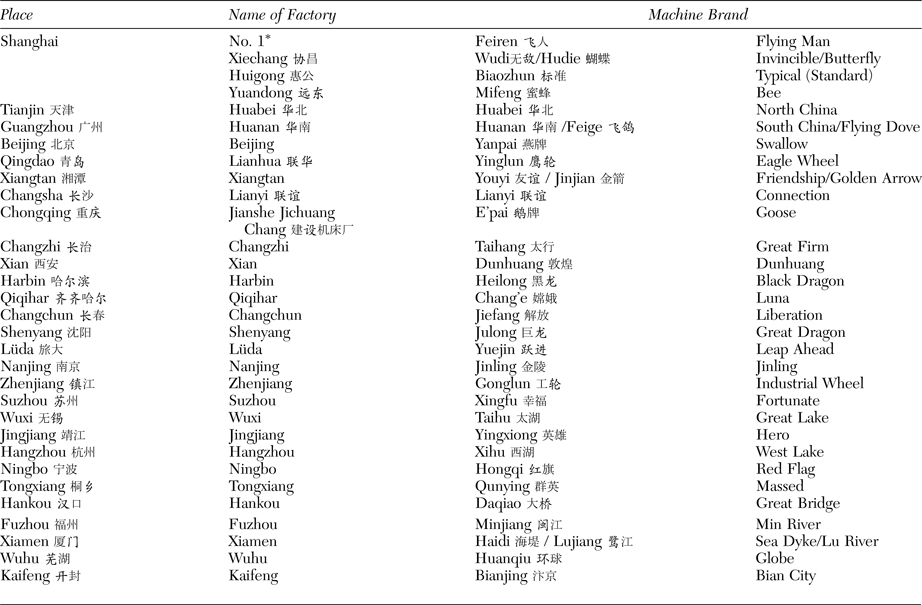
By 1964, there were thirty-one factories nationwide, in twenty-eight cities (see table 1). Most of these produced a standard domestic sewing machine, but two factories in Shanghai and one in Guangzhou produced a range of industrial machines (the G series) as well as a diversity of domestic machines. Table 1 reveals something interesting about the development of the provincial factories. First, the name of the factory or state-owned company was a place-defined administrative name, signifying the complete identification of territorial administrative structure with industry management. In Shanghai, the old sewing machine companies mostly survived in name. In the capital and the provinces, however, the factories were mostly known just by place name: the Beijing factory, the Xi'an factory, the Fuzhou factory, and so on. Yet the responsible parties in each place were attuned to the importance of brand names. Although they were never able to compete with names such as Shanghai's Butterfly or Canton's Huanan, they gave their sewing machines meaningful and memorable names. Occasionally these were simply evocative older place names—Jinling in Nanjing, Bianjiang in Kaifeng. Sometimes very contemporary socialist names were used: Red Flag, Hero, Liberation, Leap Forward. A third option was the use of poetic, symbolic, or mythical birds and beasts: Flying Dove, Goose Brand, Swallow Brand, Black Dragon, Great Dragon, or (later) Panda (see figure 6). The most prosaic were plain topographical references, such as Min River for Fuzhou machines and Lu River for Xiamen machines, but on the whole there was a striking avoidance of simply using the place name as the brand name.
Panda brand sewing machine of the early 1970s. The panda logo (right) is displayed on the front of the machine. The machine is emblazoned on its rear side with words in the calligraphy of Mao Zedong (his name appended): “serve the people” (left). Photo by the author, Yangzhou, 2015.

Sewing machine brand names, factory names, and sites of factories, 1964 (Wang Qianli Reference Wang1964, 9–10).
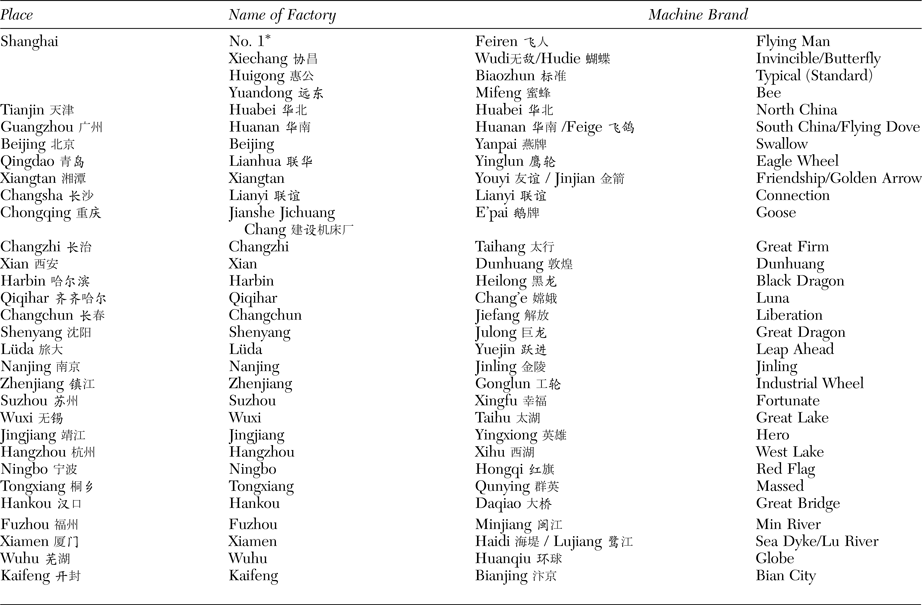
* Originally the Ruan Yaoji Sewing Machine Co. The name was changed in 1954.
Along with brand names came logos, or recognizable symbols for the machines. These can be seen in the making in sewing machine user and repair manuals produced in the middle of the 1950s, as socialist transformation brought existing companies under state control as so-called joint enterprises. An examination of the contents of the manual for the Tianjin Municipal Public-Private Joint Enterprise North China Sewing Machine Factory shows that it serves in part as an advertising brochure: customers are advised that they should negotiate purchase with the nearest department store, and that sole supply rights are vested in the Tianjin Department Store Purchase and Supply Station. Readers are informed that apart from the standard sewing machine for making clothes, the factory produces specialized machines for making shoe soles and paper bags, and that it also has a “Leap Forward Model Sewing Machine” (Yuejinxing fengrenji 跃进型缝纫机)—rather in advance of the Great Leap Forward of 1958. The four opening pages of the text proper, each with a photograph of a machine, all carry the logo in red, as though to impress the reader with the brand (Tianjinshi Dierwu Jindongzian 1955–56).
The logo is very similar to a number of others employed within the industry at this stage: a roundel with the upper part of the circle in a cog design and the lower of wheat. A variation of the design was used by Fu Yingfei for the front cover of his pattern book (see figure 5), but where Fu Yingfei has the figure of a machinist in the center of the roundel, the Tianjin sewing machine has the characters for 5.1 (i.e., May 1, International Workers’ Day). Comparable are the logos for the Everlasting brand from Nanjing, with the word “Everlasting” in the middle; the Shanghai Municipal Sewing Industry logo, with a sewing machine in the center; and the Huanan, with something rather like Tiananmen in the middle. In the context of the socialist state, these logos were plainly unexceptionable. They were modeled on the national crest, designed by a Tsinghua University team in 1949. That the factories desired recognition for these logos is plain: readers were alerted to them within the pages of the manuals. Equally obvious is the trend towards homogeneity. This was socialist brand identification, appropriate to a command economy.
At whom was such advertising directed? Barry Richman, in China in the mid-sixties, observed that advertising in China was more informative than persuasive, and directed more at wholesale and retail organizations than at the consumer (Richman Reference Richman1969, 883). These characteristics were consistent with the limited choice available to consumers in any one place, and the dependence of enterprises on state-owned wholesalers and retailers to relieve them of their products. But exports provided an important incentive to maintain and develop communications about commodities. During the Cultural Revolution, when the word “advertising” fell victim to its associations with capitalism, it was replaced by the term “commercial arts,” institutionally embedded in foreign trade organs (Zhu Reference Zhu2009, 87–88). Shanghai was the leader in this domain, producing industrial commercial designs not only for Shanghai products such as Feiyue but also for Flying Dove machines, which were a key export from Guangzhou. While advertising for mass consumption had ceased to be evident by the early seventies, it is observable that within the sewing machine industry there was an evolving sense of how to present technical information, probably again informed by foreign trade requirements. The coarsely printed sewing machine manuals of the 1950s were replaced by neat, small format booklets on good paper, which might well feature calls to “serve the people” but were for the most part cleaner and crisper than their predecessors in the fifties. They provided the model for user manuals through to the early nineties.
*
In the 1970s, the mishin phenomenon through which Japan had passed in the 1950s hit China. The introduction of coupons for sewing machine sales in 1972 indicates growing demand, or at least capacity to purchase, at that time. The coupons, like the machines, were made available through department stores: for the popular Feiyue machines they were initially issued in the proportion of one for every eighty people in Shanghai per year, with further numbers being issued to other administrative areas for mainly industrial purposes. According to former factory director Chen Guoyou 陈国有, the coupon cost 50 to 60 yuan, and the machine between 130 and 140 yuan, depending on type (Shanghai mingpai jiyi 2014). For a woman in a handicraft cooperative at the time, this might be half a year's pay. For rural women, who lived largely outside the cash economy, it was mostly beyond reach until the Reform Era. Under such circumstances, women in the towns of China saved up and queued for their machines. “The sewing machine in our home is not much younger than I am,” writes Jiaoyue 皎月, born in Henan circa 1976. Her father had vowed that he would buy one for her mother when they had saved enough money, to save her spending every night sewing clothes and shoes. He bought a Huanan machine, and she made a cover to keep it from being soiled or damaged. Years later Jiaoyue woke with a start one night, with the “da-da” (哒哒) sound of the machine echoing in her ears (Jiaoyue 2012). For her cohort, “da-da” is no doubt part of a collective memory.
In these years, China first challenged and then surpassed Japan in units of sewing machines produced per annum. By 1984, an estimated 9,350,000 machines were being produced annually, an increasing number for export (Guojia tongju Reference Guojia1985, 153–55). At the same time, the gap between the two countries in standards of design and industry innovation made the limits of forced industrialization in the early decades of the PRC evident. A user's guide to sewing machines published in 1983 shows pictures of sewing machines ensconced in homes with television sets and pictures on the wall, and flowers in vases, evoking the modest prosperity that was emerging as a legitimate aim in Reform Era China (Huang Reference Huang1983). The instructions on transport and assembly, however, show the primitive state of the infrastructure, comparable to the situation in New York a century earlier, where out-workers in the garment industry had to “hire a pushcart at a quarter, get the machine into the pushcart, trundle the load up to [the destination point], drag the machine up three or four flights of stairs, put it together, oil it, clean it, [and] supply all sorts of gadgets and tools, including needles” (Green Reference Green1997, 37).
A sense of picking up the threads dropped in the 1950s is well conveyed by the case of Zhang Bingcheng 张秉诚, author of a 1953 manual on sewing machine use. The quality of this early publication is unusually good for the period. Produced in small hardback format, like a prayer-book, it bears the title and an image of a sewing machine embossed in gold on the front cover and the spine. Its 206 pages include a chapter index, with title and subtitle, and an index of important points, with sixty-four entries. The text is in question-and-answer form. The technical drawings are detailed, and an illustrated appendix of parts is included. The machine stands shown in the appendix often show the Singer brand name, which had yet to become unmentionable. The author had set up a little sewing school in 1949, and in the preface described himself as “boldly” producing the book as a resource for teaching and work (Zhang Reference Zhang1953). Zhang Bingcheng fell victim to the Cultural Revolution, but in the Reform Era set about rebuilding his 1950s enterprise, founding a second sewing school in 1981, a third in 1998, and subsequently a small factory, with turnover in 2009 of up to 300,000 renminbi (Beijing chengren jiaoyu 1984, 27; Bejingshi 2010; cf. Schneider Reference Schneider2011, 202). Such energy and enterprise, allowed lease at an earlier stage, would surely have produced a mishin phenomenon in China rather sooner than was the case.
By the 1990s, China had become the world's major producer and exporter of sewing machines, emulating Japan's earlier achievements occasionally with Japanese help, via joint-enterprise arrangements. In 1999, with the first mass export of Feiyue machines to Japan, “the long sustained one-way trade in Japanese sewing machine imports was concluded” (Xu Reference Xu2002, 215). But like Japan, China was moving on from the era of a machine in every dowry. Mass production meant that ready-to-wear clothing was fast becoming cheaper than homemade clothing could possibly be, and family sewing machines in increasing numbers were left to gather dust.
Conclusion
The sewing machine has deservedly attracted attention from historians. It stood at the heart of innovative and globally influential practices in manufacture and distribution in the United States. These practices included formation of combinations to manage patents and the mass deployment of credit purchase to allow a sewing machine into every home (Friedman Reference Friedman2009; Hounshell Reference Hounshell1984). It transformed both commercial and home-based sewing, allowing the mass production of clothing in unprecedented quantities with consequences apparent in the fantastic scale of textile and clothing waste (Y. Wang Reference Wang2006). Within the home, it became the focus of economic, social, aesthetic, and emotional concerns. It was a piece of domestic furniture and at the same time one of the very few machines to which women in a large number of societies were exposed as a matter of course, and on which they developed skills of not only sewing but also machine maintenance. For these various reasons, the history of the industry in different national contexts has much to reveal about differences and similarities between working environments, material cultures, gender relations, and economic and social change.
Research on the sewing machine in non-Western societies has been undertaken in a variety of national contexts (D. Arnold Reference Arnold2013; Finnane Reference Finnane2008; Kupferschmidt Reference Kupferschmidt2004), but Gordon (Reference Gordon2012) is the first to have written about it at length. His point of departure was provided by a statistical report on Japanese households in the early fifties, which showed that married women daily spent more than two hours sewing. From a Chinese perspective, this figure is unsurprising. More hours again would have been spent per day by many women in China seeking to clothe their families. Asked about the family sewing machine in 2014, a native of Anhui now living in the West replied that his mother never had one. She had a spinning wheel. In that household, the women spun, wove, and sewed the clothes up to the time he left home, in the early eighties. His mother had no time to make his shoes: his sister made them, two pairs a year. He walked barefoot to school in the summer so as not to wear them out. An exact contemporary from Shanghai replied to the same question that he had grown up to the sound of the sewing machine. His family, former bankers, was forced to buy one after losing its servants.Footnote 3 In Japan, people were less subject than were Chinese to the winds of political fortune in the fifties and sixties, but there can be little doubt that in the first decade and a half of the postwar era, women were making the clothes worn by the family. The emphasis on children's clothing in pattern books is consistent with this conclusion. It was only in the 1960s, as Gordon (Reference Gordon2012, 207–8) shows, that “bridal-track” students came to dominate the ranks of students in sewing schools, and it was in that same decade, as he further notes (213), that the family sewing machine ceased to be in constant use.
A remarkable feature of the sewing machine's history is its appearance in and disappearance from the home in advanced economies. In Western countries, the sewing machine enjoyed pride of place among home appliances for around a century. In Japan and China, its reign was much shorter—about two decades in Japan (Gordon Reference Gordon2012, 154), and probably the same in China. In this respect, the sewing machine was different from some other appliances in modern homes: refrigerators; televisions; radios; or even gramophones, which have direct descendants in the form of sound systems. While the technology has by no means been superseded, the sewing machine as a household item has been rendered redundant by the altered circumstances of clothing production. Its limitations as an index to the consumer character of a society seem clear: surely this has been a tool of production as much as an item of consumption. In the Japanese context, its omission not only from the list of luxury items identified by Dore (Reference Dore1958; noted above) but also from the cornucopia of goods in a 1959 cartoon by Nasu Ryōsuke 那须良輔 (Gordon Reference Gordon2012, 183) prompts the question of how prominent advertisements were for sewing machines in any one period, relative to advertisements for other goods.
The manufacture and supply of sewing machines in both Japan and China took place in international contexts that variously enabled and constrained the industry's development. In the case of Japan, the dramatic reduction of the China market in the 1950s meant a turn towards Southeast Asia for export destinations. In the case of China, protection from Japanese imports allowed breathing room for local industry. In both China and Japan, the legacies of empire are observable, inviting consideration of regional reservoirs of knowledge about Asia and its markets, including familiarity with routes, understanding of local cultures, and interpersonal connections.
There was some resentment in postwar Japan about the loss of empire, which “meant that she was deprived of major sources” for survival and was forced to depend simply on those available “in the narrow territory left to her” (Oriental Economist 1949, 1). Support for the sewing machine industry by the Ministry of International Trade and Industry in the 1950s is difficult to separate from this sentiment. On the Chinese side, the Nagasaki Flag Incident of 1958 led to a suspension of bilateral trade and a multifaceted international kerfuffle involving Taiwan and Southeast Asia, during which Japan's war record in Southeast Asia was aired (Hsiao Reference Hsiao1977, 41–50). Overt popular criticism of Japan was by and large kept under control in mainland China during the Mao years but bubbled to the surface in the 1980s as a flood of Japanese imports led to charges of a second Japanese invasion—an “economic invasion.”
Such historical references and perspectives coexisted with the tensions inherent in the Cold War world order. In the 1950s, these tensions were often marked. Yet this was a decade close to what preceded it: the war of the immediate past combined with the intensity of the present struggle to produce common elements in what Charles Maier has called the “psychosocial order” of the postwar decades. Maier identifies these: “a capacity for deferred gratification”; an “extraordinary public cohesion” around the rebuilding of industry and urban centers; “commitment to reconstituting traditional family and gender roles”; and “an unavowed determination to repress the memory of wartime violence and occupation, complicity, and even betrayal” (Maier Reference Maier, Leffler and Westad2010, 49). Maier was writing of the world at large. To different degrees, and taking into account the structural effects of the Communist program to liberate women, his conclusions are supported by the political mood and the economic program in both China and Japan. The figure of the housewife at her sewing machine in postwar Japan embodies this psychosocial order; but she had much in common with the socialist wife and mother in 1950s China (Evans Reference Evans1997, 122, 133; Freeman Reference Freeman2011, 128–29).
Acknowledgments
Research for this article was supported by a grant from the Australian Research Council. I thank Bick-har Yeung, Lo-pei Neale, and Wei Ying of Baillieu Library, University of Melbourne, for help with resources for the research. Thanks are due also to Dr. Anne Peirson-Smith, CUHK, for inviting me to present a keynote address at the conference “Fashion in Faction: Style Stories and Transglobal Narratives,” City University of Hong Kong, June 12–14, 2014. That address provided the foundations of this article.