Dispersal is a fundamental aspect of the life history of plants and understanding seed dissemination mechanisms is critical to understanding plant community structure and distribution. Despite being difficult to observe, some peculiar dispersal mechanisms, such as seed adherence to the beaks of birds, pellets containing undigested seeds, and even muddy feet of birds, have long been noted by naturalists (Darwin Reference Darwin1859), while others have almost completely eluded their attention. Caliochory (sensu Warren et al. Reference Warren, Love and Bradford2017), or seed dispersal by birds as nest material, is one of those non-canonical mechanisms, first described by the eminent botanist Henry Ridley (Ridley Reference Ridley1930) nearly a century ago. Nest-mediated seed dispersal has been reported for several bird species, but its effectiveness and importance remain unclear. Here we describe for the first time a form of caliochory that raises new questions about the role of Darwin’s finches in structuring plant communities in the Galápagos Islands.
Darwin’s finches in the genus Geospiza obtain much of their food by crushing fruits and have therefore traditionally been regarded as seed predators. However, recent studies challenge this assumption, suggesting that effective seed dispersal by these iconic species is more common than previously thought (Guerrero & Tye Reference Guerrero and Tye2009). Mechanisms of seed dispersal by Darwin’s finches reported in the literature fall into two categories: seed discarding prior to fruit consumption, and defecation of undigested viable seeds, sometimes far away from the feeding site (Guerrero & Tye Reference Guerrero and Tye2009). Based on the observations in this study, we propose nest building as a third, previously overlooked, seed dispersal mechanism by Darwin’s finches.
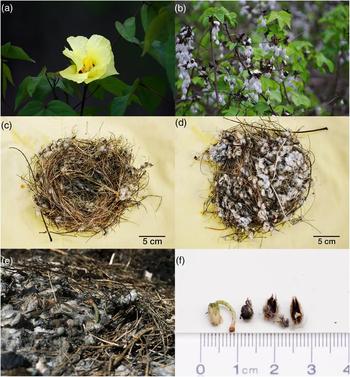
On 23 February 2018, after 3 d of intense rainfall, an old small ground finch (Geospiza fuliginosa) nest fell from an ornamental flame tree (Delonix regia) located in an urban area on Santa Cruz Island (Galápagos, Ecuador). Later, on 13 March 2018, another finch nest fell from a papaya tree (Carica papaya) in the small town of Floreana Island during a severe storm but, unlike the previous one, this nest was still under construction by a pair of medium ground finches (Geospiza fortis; Figure S1). Darwin’s finches use a range of natural and anthropogenic material to build their nests (e.g. grass, plastic strands and ribbons) and typically use cotton-like materials to line them (Orr Reference Orr1945; a video can be seen at: https://youtu.be/I29JZaAeNBA). Finches in urban areas usually incorporate synthetic cotton into their nests (85% of nests analysed by Knutie et al. Reference Knutie, McNew, Bartlow, Vargas and Clayton2014). However, the two nests we found lacked synthetic cotton, but contained numerous (≤ 250 counting only the seeds at the top and bottom surface of the nest) seeds of Darwin’s cotton (Gossypium darwinii), a shrub endemic to the Galápagos Islands (Figure 1a, b).
Flower of Gossypium darwinii (a). Seeds of G. darwinii on Floreana Island (b). Top view of the old finch nest found on the ground on Santa Cruz Island (c). Same nest but view from below, showing the higher concentration of cotton seeds at the bottom of the nest (d). Seedling of Darwin’s cotton after our germination experiment with the planted nest (e). Detail of the seedling collected from the nest after 10 days of germination (f).

Darwin’s cotton occurs on 13 of the islands of the archipelago in both urban and non-urban environments and, unlike its endemic congener Gossypium klotzschianum, produces numerous seeds covered by well-developed cotton balls that facilitate their dispersal on the wind (McMullen Reference McMullen1999, Sliwinska & Bewley Reference Stephens, Rick and Bowman2014). Darwin’s cotton is widely available as a source of nest material for the finches, so the plant could in turn receive seed-dispersal services, provided that nest-building birds collect not only the cotton balls, but also the attached seeds (Rohwer et al. Reference Rohwer, Pauw and Martin2017). Darwin’s finches generally occur in large numbers and, importantly, their need for building material is great. Finches are not only capable of breeding multiple times under good conditions, but also males often build one or more nests and tear it down before breeding (Orr Reference Orr1945). Moreover, they occasionally move material from one nest to another, so it is likely that large numbers of cotton seeds are inadvertently transported by the finches every season.
Darwin’s finches are opportunistic breeders that strongly depend on rainfall (Grant & Boag Reference Grant and Boag1980) and, as suggested by this study, dispersal of cotton seeds as nest material might be directly facilitated by rainfall as well. Finches build domed – sometimes open – nests in cactus and trees, usually exposed to rain (Orr Reference Orr1945). Bird nests often break down during rainy periods, so the seeds typically fall to the ground after intense rainfall (Dean et al. Reference Dean, Milton and Siegfried1990). Nest collapse during the rainy season could improve the effectiveness of dispersal in dry and nutrient-poor environments for several reasons. First, cotton seeds would reach the soil surface under favourable conditions for germination. Second, the moisture retained in the nest material would further improve the germination conditions for a relatively long time. Caliochory might additionally increase the chance of germination, as fallen seeds not incorporated into nests may be at greater risk of predation by insects and rodents before the arrival of the rains (Dean & Milton Reference Dean and Milton1991). Lastly, seeds incorporated into finch nests might benefit from the combination of decomposing organic material of the nest itself and nutrients in the form of either bird droppings or protein-rich feather sheaths that remain in the nest after the chicks have fledged (Dean & Milton Reference Dean and Milton1991, Fedriani et al. Reference Fedriani, Garrote, Delgado and Penteriani2015).
However, for effective dispersal to occur seeds should be able to remain viable in nests for relatively long periods of time (Dean & Milton Reference Dean and Milton1991, Warren et al. Reference Warren, Love and Bradford2017). To examine this possibility, we transferred the old nest we found on Santa Cruz Island – initially on tarmac – to a small area of top soil about 1.5 m away from the original location. Before collecting the nest, we noted that it had landed on the ground on the bottom surface, precisely where the majority of the cotton seeds concentrated (Figure 1c, d). Neither the soil composition nor the original structure or position of the nest were modified to simulate the germination conditions experienced by seeds in a naturally fallen nest. Examination of the nest after only 72 h revealed that three of the seeds closest to the soil surface had successfully germinated (i.e. the radicule was visible), thereby confirming the long-term viability of at least a small fraction of the seeds found in finch nests, as well as the convenience of the deposition conditions (Figure 1e, f). However, given the small sample size, additional analyses of seed number and germination rate in a larger number of nests are needed to determine the actual importance of caliochory in the dissemination of cotton seeds.
Lack (Reference Lack1947) already noted the use of cotton seeds as nest lining by finches, but the importance of nest building and subsequent collapse for seed dispersal has been largely underappreciated, as implicit in the statement of Stephens & Rick (Reference Warren, Love and Bradford1966) that ‘a method of dispersal which would transport seeds rather widely but leave them suspended well above the soil surface for an indefinite period would not seem to be highly efficient’.
Caliochory is not unique to Darwin’s finches (reviewed in Warren et al. Reference Warren, Love and Bradford2017) and there is evidence to suggest that it is an important, albeit supplemental, dissemination mechanism in plants with cottony seed coverings adapted for wind dispersal (Dean et al. Reference Dean, Milton and Siegfried1990, Sliwinska & Bewley Reference Stephens, Rick and Bowman2014). Darwin’s cotton is one of those plants primarily dispersed by wind (Hutchinson et al. Reference Hutchinson, Silow and Stephens1947, Stephens & Rick Reference Warren, Love and Bradford1966), although nest-building birds might influence seed movement independently of the wind and thus influence its fine-scale distribution. Bird-dispersed seeds could reach different and/or more suitable microsites for germination and establishment than those on the wind, but a comparative study tracing the fate of seeds spread by birds and other means is required to confirm this hypothesis. Estimates of the foraging distances or the home-range size for small or medium ground finches would also be desirable to assess the magnitude of seed dispersal distances by this mechanism. Future research combining mechanistic dispersal models and empirical data on bird occurrence and distribution, and local wind dynamics should ideally be conducted to elucidate the relative role of biotic and abiotic vectors in the dispersal success of Darwin’s cotton (Damschen et al. Reference Damschen, Baker, Bohrer, Nathan, Orrock, Turner, Brudvig, Haddad, Levey and JJ2014).
In conclusion, nest collapse after rainfall could potentially increase the germination rates of viable seeds present in bird nests. Darwin’s finches can thus act as additional dispersal agents for cotton seeds and, possibly also, other fluffy seeds incorporated into nests (see Orr Reference Orr1945 for some examples). Further research to understand the actual implications of nest building for the dynamics of island plant populations is still needed, especially because of the potential role of birds in the spread of non-native species across the Galápagos Islands.
Supplementary material
The supplementary material for this article can be found at https://doi.org/10.1017/S0266467418000378
Author ORCIDs
Carlos Camacho https://orcid.org/0000-0002-9704-5816. Marc-Olivier Beausoleil https://orcid.org/0000-0003-3717-3223
Acknowledgements
Prof. Carlos M. Herrera, Sofía Carvajal-Endara, Daniel Reyes Corral, Benjamin J. Allard and two anonymous referees made valuable comments on a first draft. Jaime A. Chaves, the Charles Darwin Research Station (CDRS) and the Galápagos National Park kindly provided logistic support.
Financial support
We thank Andrew P. Hendry for financial support for this project. MOB received financial support from the National Geographic Society through the grant WW-170ER-17 and from the Fonds de Recherche du Québec — Nature et Technologies (FRQNT). CC was supported by the Spanish MINECO through the grant SVP-2013-067686.