Introduction
Hyperactivity of the hypothalamic-pituitary-adrenal (HPA) axis is one of the most consistent neuroendocrine abnormalities in major depressive disorder (MDD). Specifically, patients with MDD show increased concentrations of cortisol in the plasma, urine and cerebrospinal fluid (CSF) and an exaggerated cortisol response to adrenocorticotrophic hormone (ACTH) (Reference Holsboer and Barden1–Reference Nemeroff3). The corticosteroid receptor hypothesis has been proposed for the pathogenesis of MDD, which focuses on impaired corticosteroid receptor signalling, leading to a reduced negative feedback of cortisol, an increased production of corticotropin-releasing hormone (CRH) and hypercortisolism Reference Holsboer(2).
Interestingly, cortisol and CRH affect the serotonin (5-HT) system Reference Holsboer and Barden(1,Reference De Kloet, Vreugdenhil, Oitzl and Joels4). During the stress response, glucocorticoids (GCs) stimulate all these features of 5-HT transmission Reference Meijer and De Kloet(5). Conversely, 5-HT transmission is impaired and noradrenergic transmission in the hippocampus is suppressed during chronic psychosocial stress and hypercortisolism, which is similar to the series of events evident during depression Reference Wolkowitz, Reus, Manfredi, Ingbar, Brizendine and Weingartner(6). This makes the GC receptor (GR) a prime candidate gene for associations with susceptibility for MDD. Moreover, initial studies of GR antagonist mifepristone and other HPA-axis-targeting agents in affective disorder have been encouraging Reference Porter and Gallagher(7).
The human gene coding for the GR is referred to as nuclear receptor subfamily 3, Group C, Member 1 (NR3C1). It has been reported that the following polymorphisms of the GC receptor gene alter GC sensitivity (Reference van Rossum, Koper and van Den Beld8–Reference van Rossum and Lamberts11); N363S: +1088A>G, ER22/23EK: +68G>A, Bcl1: −646C>G, and TthIII1: +3807C>T polymorphisms. The Bcl1 polymorphism involves a Bcl1 restriction site in intron 2 and is a C-to-G nucleotide change that appears 646 base pairs (bp) downstream from exon 2 (Bcl1). The TthIII1 polymorphism was identified as the location of a C-to-T nucleotide change that appears 3807 bp upstream of the start of GR mRNA. The N363S polymorphism is exon 2, which results in an amino-acid change from asparagine (N) to serine (S). The ER22/23EK polymorphism, also located in exon 2, consists of two linked nucleotide changes in codons 22 and 23 (GAG AGG to GAA AAG). The ER23EK polymorphism consists of two linked point mutations in codon 22 [silent mutations changing codon 22 from GAG to GAA, coding for glutamic acid (E)] and in codon 23 [changes from AGG to AAG, resulting in an amino-acid change from arginine (R) to lysine (K) Reference Koper, Stolk and De Lange(12).
The GR polymorphisms affect GC sensitivity, which is associated with cortisol feedback effects. The degree of cortisol feedback is closely related to the development of depression and may also be affected by antidepressants Reference Pariante, Thomas, Lovestone, Makoff and Kerwin(13). Therefore, we hypothesised that the above four GR polymorphisms are associated with the susceptibility to MDD and predict the response to treatment with citalopram.
Material and methods
Subjects
The subjects in our previous studies Reference Choi, Kang, Lim, Oh and Lee(14,Reference Ham, Lee and Paik15) were included in the present study. This study was performed on patients aged 18–65 years diagnosed with MDD who visited Korea University Anam Hospital between March 2003 and December 2005. Each patient was diagnosed with MDD by psychiatrists using the Structured Clinical Interview for Diagnostic and Statistical Manual-IV Axis I Disorders – Korean version (SCID) Reference Han and Hong(16). Patients with a minimum baseline score of 17 on the 21-item Hamilton Depression Scale (HAMD) were eligible for inclusion in this study Reference Hamilton(17). None of the included patients had another psychiatric axis I diagnosis, such as anxiety disorder, bipolar disorder, or alcohol or drug dependency, or neurological diseases such as stroke, epilepsy or chronic diseases (other than controlled diabetes and hypertension) that might have impeded their psychological evaluation.
Of the 138 patients that were registered, 96 patients who took the experimental drug at least once and who had at least one efficacy measurement were classified as the intention-to-treat (ITT) group. Of 96 ITT patients, the genotypes of only 84 patients were successfully analysed. At first week, all subjects succeeded to follow-up. Seventy-seven subjects at second week, 73 subjects at fourth week and 65 subjects at eighth week remained. The symptoms and severity of depressive disorder were evaluated by the HAMD at baseline and after weeks 1, 2, 4 and 8. Participants showing a reduction in the HAMD score of more than 50% relative to baseline were defined as responders, with the other participants designated as non-responders Reference Frank, Prien and Jarrett(18).
Before entry into the study, a 2-week washout was performed on those patients who were being treated with different drugs. During the study period, the patients self-administered 20 mg of the antidepressant citalopram daily as the starting dose, with a daily dose of 20–60 mg applied at 1, 2, 4 and 8 weeks at the discretion of the investigators according to clinical situation of each patient. After 1 week, the investigators were permitted to increase the dosage, if the patient’s symptoms were not responding and the patient was tolerable at the dosage, or to maintain the same regimen, if the patient’s symptoms were improved and the patient was tolerable at the dosage. If not tolerable at the dosage, in contrast, the dosage was decreased. Dose escalations were based on clinical response and tolerance of side-effects.
Among the various types of antidepressants, citalopram is well tolerated, with the most common side-effects being gastrointestinal and including nausea, diarrhoea and dry mouth. Citalopram is the most highly selective serotonin reuptake inhibitor, with little or no affinity for a variety of receptor types. For this reason, we chose citalopram as a study drug.
Benzodiazepine was allowed as a coprescribed drug. This study was approved by the Ethics Committee of Korea University Anam hospital and a patient consent form for the genetics study (by the Ministry of Health and Welfare) was prepared.
One hundred and five control subjects consisted of randomly selected healthy individuals of Korean origins who visited the Korea University Anam hospital for regular health screenings. Subjects with a history of depressive disorder or psychotropic medication history were excluded from the control group by applying the Structured Clinical Interview for SCID. Control subjects were excluded if they had any familial psychiatric history, or if they had scores of ≥10 on the Beck Depression Inventory Reference Beck, Ward, Mendelson, Mock and Erbaugh(19). Subjects in the control group also signed consent forms for participation in the genetics study (published by the Ministry of Health and Welfare of Korea).
Genotyping
ER22/23EK polymorphism. DNA was extracted from the peripheral blood and a polymerase chain reaction (PCR) was performed with the sense primer 5′-GATTCGGAGTTAACTAAAAG-3′ and the antisense primer 5′-ATCCCAGGTCATTTCCCATC-3′. The amplification mixture contained 1 μl of DNA, 3 μl of 10× PCR buffer, 2.5 μl of 2.5 mM dNTP, 1 μl of each primer, 6 μl of 5× Gcaqture solution, 15.4 μl of distilled water and 0.1 μl of Taq polymerase (5 U/μl; iNtRON Biotechnology, Seoul, Korea). Samples were amplified using a PCR thermal cycler (Takara, Kyoto, Japan) for an initial 5 min at 95°C followed by 35 cycles of 30 s at 95°C, 30 s at 58°C, and 30 s at 72°C. After a final 7 min at 72°C, the reaction was terminated at 4°C. The amplified DNA was digested with the restriction endonuclease Mnl I (New England Biolabs, Ipswich, MA, USA) at 37°C for 2 h. Fragments were electrophoresed in 3% agarose gels and stained with ethidium bromide. The wild type consisted of 163- and 142-bp fragments and homozygous EK22/23EK consisted of 177- and 163-bp fragments.
N363S polymorphism. A PCR was performed with the sense primer 5′-AGTACCTCTGGAGGACAGAT-3′ and the antisense primer 5′-GTCCATTCTTAAGAAACAGG-3′. Samples were amplified using a PCR thermal cycler (Takara) for an initial 5 min at 94°C followed by 35 cycles of 30 s at 94°C, 30 s at 50°C, and 30 s at 72°C. After a final 7 min at 72°C, the reaction was terminated at 4°C. The PCR products were digested with Tsp509 I (New England Biolabs) at 65°C for 2 h. Fragments were electrophoresed in 3% agarose gels and stained with ethidium bromide. The wild type consisted of 113-, 95- and 9-bp fragments and the homozygous mutant consisted of 122- and 95-bp fragments.
Bcl1 polymorphism. A PCR was performed with the sense primer 5′-AGAGCCCTATTCTTCAAACTG-3′ and the antisense primer 5′-GAGAAATTCACCCCTACCAAC-3′. Samples were amplified using a PCR thermal cycler (Takara) for an initial 5 min at 95°C followed by 35 cycles of 30 s at 95°C, 30 s at 58°C, and 30 s at 72°C. After a final 7 min at 72°C, the reaction was terminated at 4°C. The amplified DNA was digested with the restriction endonuclease Bcl1 (New England Biolabs), which cuts at the 646C site downstream of exon 2. Fragments were electrophoresed in 3% agarose gels and stained with ethidium bromide. The 418C allele consisted of 151- and 257-bp fragments and the 418G allele consisted of a 418-bp fragment.
Tth111i polymorphism. A PCR was performed with the sense primer 5′-GGCCACAACAATAACCCAGT-3′ and the antisense primer 5′-TGAAAGTGTTTTATGCACAGTATCC-3′. Samples were amplified using a PCR thermal cycler (Takara) for an initial 5 min at 95°C followed by 35 cycles of 30 s at 95°C, 30 s at 61.8°C, and 30 s at 72°C. After a final 7 min at 72°C, the reaction was terminated at 4°C. The amplified DNA was digested with the restriction endonuclease Tth1111 (New England Biolabs), which cuts at the 3807C site upstream of the GR mRNA start. Fragments were electrophoresed in 3% agarose gels and stained with ethidium bromide. The 3807C allele consisted of 167- and 170-bp fragments and the 3807T allele consisted of a 337-bp fragment.
Statistical analysis
A last-observation-carried-forward technique for missing data was used to analyse efficacy in the ITT group, which included all patients who received medication at least once and who had at least one efficacy or safety measurement taken. The presence of Hardy-Weinberg equilibrium and genotype differences was examined using the chi-squared test for categorical variables and Student’s t-test or one-way ANOVA for continuous variables. Repeated-measures ANOVAs were performed for each weekly HAMD score. A probability value of p < 0.05 was considered statistically significant. Probability values were corrected by multiplying the number of comparisons made (Bonferroni correction).
Results
Demographic data of the subjects
The gender distribution did not differ significantly between control subjects (40 males/66 females) and MDD patients (26 males/70 females) (p = 0.12). There was no significant difference in the age distribution between control subjects and the MDD patients (49.1 ± 16.3 years, mean ± SD in MDD patients and 52.3 ± 10.8 years in control subjects, p= 0.10).
Genetic predisposition to MDD
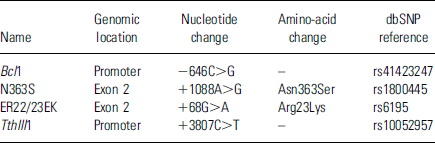
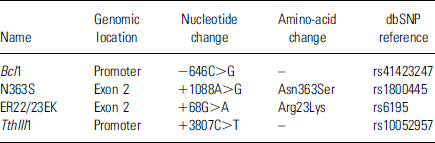
Table 1 shows the genomic location, nomenclature and single nucleotide polymorphism (SNP) reference of four genetic variants in NR3C1. Our subjects carried no N363S polymorphisms (all GG, with no G/A or A/A), no ER22/23EK polymorphisms (all A/A, with no G/A or G/G), and three types of Bcl1 and Tth1111 genetic polymorphisms. The genotype distributions of Bcl1 polymorphism conformed to Hardy-Weinberg equilibrium in both normal controls and MDD patients (p = 0.06 and 0.26, respectively) and the results of the Tth1111 polymorphism were within the equilibrium in these two groups (p = 0.92 and 0.73, respectively).
Location, nomenclature, and single nucleotide polymorphism (SNP) reference of four genetic variants in NR3C1
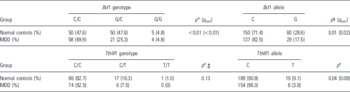
The Bcl1 genotype distributions differed significantly between control subjects and MDD patients (Table 2). The C/C genotype and C allele of Bcl1 polymorphism were more frequent in MDD patients than in normal controls (p < 0.01 and p = 0.01, respectively). After Bonferroni correction, the association remained statistically significant. Although the C allele of Tth1111 polymorphism was more frequent in MDD patients than in normal controls (p = 0.04), this difference lost significance after applying Bonferroni correction.
Genotype distributions and allele frequencies in normal control subjects and MDD patients

* Comparison of genotype frequencies between MDD and normal control group.
† Comparison of allele frequencies between MDD and normal control group.
‡ Genotype comparisons are made by Fisher’s exact test.
p corr indicates p-value after Bonferroni correction.
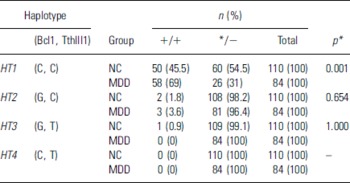
Haplotype analysis was shown in Table 3. The distribution of the haplotype was significantly different between MDD patients and normal controls (p = 0.001). The haplotype carrying the C allele of Bcl1 and C allele of Tth1111 was more frequent in MDD patients than in normal controls.
Haplotype analysis of GR polymorphisms

NC, normal control.
* Obtained using chi-squared test and Fisher’s exact test.
Prediction of responses and clinical variables according to GR polymorphisms
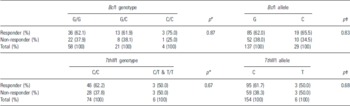
The genotype distributions did not differ significantly between responders and non-responders (Table 4). The age at onset, duration of illness and number of previous episodes neither differed among the genotype in MDD patients (Table 3). The HAMD scores at baseline and 8 weeks did not differ significantly with the genotype in MDD patients (Table 5). When HAMD baseline scores were included to analysis as covariate, there was no significant difference in HAMD score at 8 weeks according to genotypes (both Bcl1 and Tth1111 polymorphism, data not shown).
The prediction of response according to the GR polymorphisms in MDD patients

* Comparison of genotype frequencies between responder and non-responder group.
† Comparison of allele frequencies between responder and non-responder group.
Responder group is defined as those patients who show more than or equal to a 50% relative decrease of HAMD score at week 8 compared with that at baseline.
Clinical characteristics according to the GR polymorphisms in MDD patients

* Data represent mean ± SD.Genotype comparisons are made by ANOVA
† Kruskal-Wallis test.
With a repeated-measures ANOVA for HAMD scores from baseline to week 8 against the Bcl1 and Tth1111 polymorphism, we observed a significant effect of the change in HAMD score over the 8 weeks of treatment and no genotype effect of the Bcl1 and Tth1111 polymorphism on change in HAMD score (data not shown).
When baseline HAMD scores were included to analysis as a covariate, there was no significant difference in HAMD scores at 8 weeks between the Bcl1 or Tth1111 genotypes (data not shown).
Discussion
This study was designed to identify the role of GR polymorphisms on the genetic predisposition to MDD and on the therapeutic response to antidepressant. We showed that the C/C genotype and C allele in the Bcl1 polymorphism are more frequent in MDD patients than in normal controls. G allele of Bcl1 polymorphism has been reported to be associated with hypersensitivity to GCs, as indicated by an increased response to the ACTH- and cortisol-suppressive effects of low-dose dexamethasone Reference van Rossum, Koper and van Den Beld(8). In other words, the C allele of Bcl1 polymorphism is more GC-resistant than G allele. Increased GR resistance has generally been described as one of the endocrine hallmarks of depression, which forms part of a vicious circle of HPA-axis dysregulation leading to an upregulation of central CRH Reference Holsboer(2). In line with the result of this study, C allele, which is more GC-resistant, could induce the development of depression. Conversely, van Rossum et al. reported that the frequency of the Bcl1 G/G genotype was significantly higher in MDD patients than in normal controls Reference van Rossum, Binder and Majer(20), explaining their result by the tissue specific effect of Bcl1 polymorphism. Contrary to the action in the hypothalamus, GC increases CRH expression in limbic regions such as the amygdala Reference Reul and Holsboer(21,Reference Schulkin, Gold and McEwen22). G allele of Bcl1 polymorphism which is more GC-sensitive might thus have an increased positive GC feedback effect on CRH in the limbic system, resulting in an increased production of CRH, and increased CRH in limbic regions has been linked to depression-like symptoms Reference Holsboer(2,Reference Reul and Holsboer21).
We found few T/T genotypes in the TthIII1 polymorphism and no N363S and ER22/23EK polymorphisms. While the C allele in the TthIII1 polymorphism was more frequent in MDD patients than in control subjects (p = 0.04), this difference lost significance after Bonferroni correction. Rosmond et al. Reference Rosmond, Chagnon and Holm(23) showed that the Tth1111 polymorphism was associated with increased diurnal cortisol levels. However, another study found no differences in cortisol levels between the TthIII1 genotypes before and after dexamethasone suppression test Reference van Rossum and Lamberts(11), and no interactions with N363S or Bcl1. However, all carriers of the ER22/23EK polymorphism carried the TthIII1 T variant. The cortisol response to 1 mg of dexamethasone was significantly lower in carriers of both TthIII1 CT/TT and ER22/23EK polymorphisms than in the two other groups (TthIII1 CC and ER22/23ER, and TthIII1 CT/TT and ER22/23ER). In other words, this haplotype is associated with a higher resistance to GC. The TthIII1 polymorphism might be functionally relevant only in combination with ER22/23EK. In the present study, the TthIII1 polymorphism existed without the ER22/23EK variant being present, in contrast with it being reported that the ER22/23EK polymorphism is without exception linked to the TthIII1 T polymorphism Reference van Rossum and Lamberts(11). Therefore, the absence of a ER22/23EK polymorphism could be responsible for the absence of an association between MDD and TthIII1 polymorphism in this study.
The ER22/23EK polymorphism was shown to be associated with a higher resistance to GCs Reference van Rossum, Koper and Huizenga(9) and an increased risk of developing MDD Reference van Rossum, Binder and Majer(20,Reference Brouwer, Appelhof and van Rossum24). It has been shown that the N363S polymorphism is associated with hypersensitivity to GCs Reference Huizenga, Koper and De Lange(10). We did not find these polymorphisms in our Korean population and hence are unable to comment on the association between these polymorphisms and MDD.
We did not identify a relation between GR polymorphisms and the therapeutic response to citalopram in the present study. It has been reported that ACTH levels are higher in carriers of the Bcl1 polymorphism than in non-carriers (from the dexamethasone/CRH test), with a trend towards decreases in HAMD scores being smaller in carriers than in non-carriers Reference van West, van Den Eede and Del-Favero(25). Also, ER22/23EK carriers showed a significantly faster clinical response to antidepressant therapy Reference van Rossum, Binder and Majer(20). It was proposed that antidepressants can inhibit steroid transporters localised on the endothelial cells of the blood-brain barrier(or blood-CSF barriers) and in neurons in humans, such as the multidrug resistance p-glycoprotein, thus increasing the access of cortisol to the brain and the GC-mediated negative feedback effects on the HPA axis. Enhanced cortisol effects in the brain might maximise the therapeutic effects of antidepressants Reference Pariante, Thomas, Lovestone, Makoff and Kerwin(13).
At baseline, the symptomatology (as quantified by HAMD scores), age at onset, duration of illness and number of previous episodes did not differ from the GR polymorphisms in this study. Similarly, van Rossum et al. found no association of GR polymorphisms with clinical characteristics Reference van Rossum, Binder and Majer(20). High HPA-axis activity has been related to the risk of relapse in MDD Reference Ribeiro, Tandon, Grunhaus and Greden(26,Reference Zobel, Nickel, Sonntag, Uhr, Holsboer and Ising27). Furthermore, previous depressive episodes and HPA-axis hyperactivity might permanently alter the reactivity of the axis because the activation of the GR has been shown to change the methylation pattern of specific genes Reference Kress, Thomassin and Grange(28). In the present study the number of previous episodes did not vary with the GR polymorphism.
The value for linkage disequilibrium is D′ = 0.815, r 2 = 0.159. The linkage disequilibrium was not found between these two polymorphisms.
This study was subject to several limitations. First, although Korean subjects are highly genetically homogeneous, the small number of subjects included represents a one limitation. Larger number of subjects are needed to investigate the role of GR polymorphism in MDD. Second, treatment periods (5.97 ± 2.98 weeks, mean ± SD) were various in this study. Third, the same dosage of citalopram was not prescribed to each patient and the plasma levels of citalopram were not measured in this study. Because pharmacokinetic activities are different among the patients, it is not possible that the same dosage of antidepressant could be prescribed to each patient in clinical settings. It could be better that dose escalations would be based on clinical response and tolerance of side-effects. Moreover, a previous study Reference Arias, Catalan, Gasto, Gutierrez and Fananas(29) reported the absence of any significant relationships between citalopram plasma levels and clinical responses in clinically depressed patients. Fourth, because the plasma levels of cortisol and ACTH were not measured, it is not possible to investigate the functional role of GR polymorphism. Fifth, T/T genotypes in the TthIII1 polymorphism were present at below 1% and hence this polymorphism could not be considered to be a single-nucleotide polymorphism in our Korean population. In contrast, the distributions of the C/C, CT and TT genotypes have been reported at 39.7, 44.5 and 15.8%, respectively, in Caucasians Reference van Rossum and Lamberts(11). Our Korean subjects carried no N363S or ER22/23EK genetic polymorphisms. These results cannot be generalised because of genotype distributions varying with ethnicity. Finally, the relatively small sample limits the generalisability of our findings. Our sample provided power greater than 0.67 at p < 0.05 to detect effects of the size we observed in our sample. This indicates that our sample provides a moderate power, considering that a power cut-off of 0.5 and an α-value <0.05 are often used. Notwithstanding the above limitations, this is the first study to examine the possible association between GR polymorphisms and MDD in a Korean population.
Elucidating the role of GR polymorphisms in MDD requires further studies applying a biochemical approach and involving a larger number of subjects to decrease the risk for false positives of this study.
Acknowledgements
This study was supported by a grant from the Korea Health 21 R&D Project, Ministry of Health and Welfare, Republic of Korea (03-PJ10-PG13-GD01-0002).