Introduction
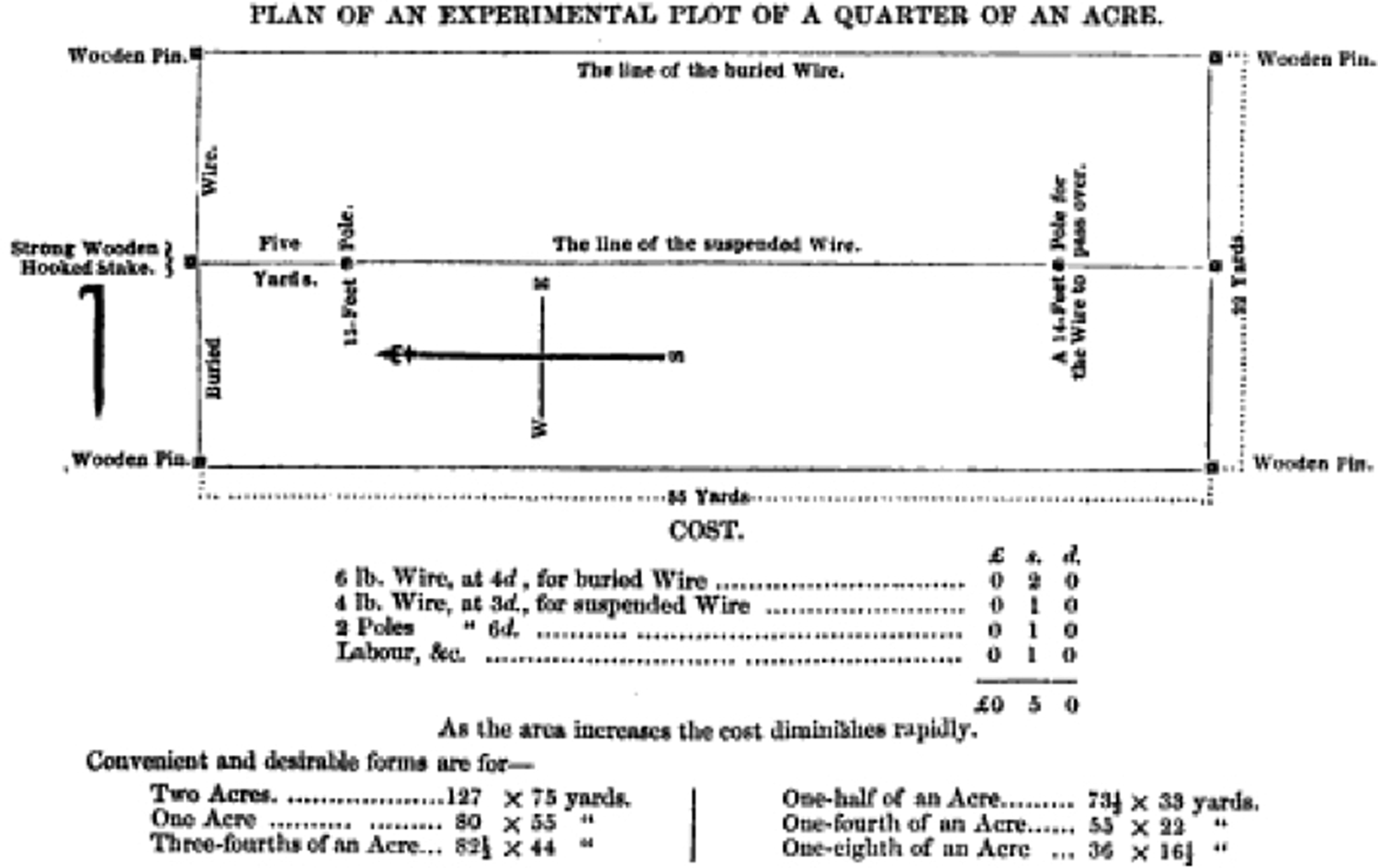
In 1846, during the outbreak of Phytophthora infestans (potato blight) in Ireland that caused the Great Famine, the former director of the Botanical Gardens of Dublin, Ninian Niven, decided to try and electrify a field of potatoes.Footnote 1 The idea wasn't his own, precisely – in 1845 there was widespread interest in the agricultural press in Robert Dewey Forster's methods for harnessing the electrical currents of the atmosphere to encourage plant growth, and Niven himself believed that, just like water or sunlight, electrical current was a factor in the growth of plants that could be controlled through adopting experimental methods (Figure 1).Footnote 2 Niven was also deeply familiar with cultivation methods for the potato: he had spent a decade at the botanic gardens working to improve potato varieties on an area of land dedicated to such experiments.Footnote 3 The idea that the disease could be eliminated by altering cultivation practices was supported by decades of evidence accumulated in agricultural journals. Niven viewed the agricultural press as a key record for understanding the nature of potato blight and its potential causes. As he argued during the failures of 1846, ‘we are not without resources, neither may it be unimportant to trace up the remarkable workings of some of the diseases that have followed in the cultivation of the potato up to the present time’.Footnote 4 In his treatise on the ‘potato epidemic’ Niven included accounts of cultivation practices and farmer's anecdotes from the failures of previous years, but he included no comment on ‘the dissecting-knife and microscope of the acute physiologist, the crucible and the analyses of the investigating chemist’, for these ‘have all, hitherto, been used in vain’.Footnote 5 In 1846, for the botanist Niven and for many others, diseases in cultivated plants were to be understood through their cultivation.
‘An illustration produced by Robert Forster of his method for introducing electrical currents into cultivated fields’, in John Joseph Mechi, A Series of Letters on Agricultural Improvement: With an Appendix, London: Longman, Brown, Green, and Longmans, 1845, p. 89.

The appearance of Phytophthora infestans revolutionized the science of plant pathology – Anne Libert in Belgium, Francis Camille Montagne in France and Miles Berkeley in England all argued that fungi played a causal role in the outbreak of the disease, and arguments that diseases in the potato were caused by degeneration or poor cultivation gradually lost support.Footnote 6 The microscope and the dissecting knife proved important to understanding blight, but this narrative obscures a vast and decentralized research project that had dominated the agricultural sciences for many decades, namely the project to stabilize the varieties of potato cultivated in Britain and Ireland in order to ensure a year-round supply to their growing populations. Cultivation methods are crucial to the plant and life sciences, and without adequate structures to collect and diffuse cultivation knowledge, the exploitation, study and use of plants grinds to a halt.Footnote 7 But because cultivation knowledge is often in the hands of figures outside scientific networks, its centrality only emerges when things go wrong. Recent historiography has drawn this fact out: using efforts to establish tea plantations in the United States as a case study, Courtney Fullilove has shown that, by assuming that ‘seeds were effective substitutes for agronomic knowledge’, cultivators found themselves lacking the knowledge and labour approaches in order to successfully cultivate tea in America.Footnote 8 The collection, organization and diffusion of data were integral to horticulture and agriculture just as they were to natural history. As Staffan Müller-Wille has argued in the case of natural history, it was ‘an information science, that is, a science whose primary aim consists in the storage, organization, and mobilization of knowledge’.Footnote 9 Horticulture, like natural history, was an information science, and cultivation methods had been respected as important knowledge by multiple actors within the plant trade, medicine, physiology and agriculture.Footnote 10 Cultivation provided the means by which natural-history practices were intertwined with state and civic projects, particularly during periods where war, disease or poor weather threatened food security. The development of these knowledge communities and practices is understood to have played a crucial role in providing a means of producing knowledge of the natural world.Footnote 11 The pressure to understand and compile data on cultivation of the potato was driven by war, population growth, crop failures and climate instability – while it only ever existed in print editions of journals like the Gardener's Magazine, editors and agriculturists worked in the early nineteenth century to collect all the variations in practice that existed in Britain and Ireland, in the hopes that relations to crop failures, the appearance of disease and higher yields would emerge.
In this article, I show that the appearance of diseases that attacked potato plants in Britain and Ireland led to a widespread drive to compile and gather data on cultivation. The diffusion of these data, I argue, reinforced and popularized a specific way of viewing diseases in cultivated plants. The ubiquity and widespread cultivation of the potato makes it an ideal case through which to examine popular understandings of the differences between disasters and ailments that are the product of nature, and those that are the product of human culture. In the century leading up to 1845, the potato had gone from being perceived as a foreign plant to a staple crop of Europe.Footnote 12 Emma Spary has even referred to the French First Republic as the ‘Potato Republic’, given the root's significance to the republican philosophy and cause.Footnote 13 Its journey was complex: the introduction of potatoes to an agricultural region is regularly understood to be caused by shortages in staple crops.Footnote 14 David Gentilcore has documented the cultivation of the potato in Italy, showing that repeated harvest failures – particularly in 1816 – led to the increased cultivation of the potato. Around the same time, Austria decreed that all those renting public lands must use some of it to cultivate potatoes.Footnote 15 But as Rebecca Earle and Spary have separately shown, the increased cultivation of the potato was by no means limited to situations where shortages and failures were endemic. The potato had popularity in itself – while it unquestionably became increasingly a means of sole subsistence for the poor in many countries, it also became a ubiquitous feature of European diets.Footnote 16 Malthus, deeply sceptical of potato cultivation at times, praised it in other contexts, noting in his discussion of recent improvements in Norway, ‘Almost everywhere the cultivation of potatoes has succeeded, and they are growing more and more into general use, though in the distant parts of the country they are not yet relished by the common people.’Footnote 17 In Britain, technological changes in harvesting, the enclosure of common lands and rising unemployment at the close of the eighteenth century led to the introduction of potato grounds and allotments as a state response to poverty.Footnote 18 Almost everyone in Britain and Ireland had an immediate interest in cultivation methods for the potato plant, and with that interest came a pressing need to comprehend whether the diseases and ailments that plagued the plants arose from nature or from their own practices.
Drawing on archival records of the Agricultural Board and on gardening, horticultural and agricultural magazines published in the early decades of the nineteenth century, this paper argues that the debates and investigations into plant diseases in the late eighteenth and early nineteenth centuries can help us to understand how agriculturists, scientists and the wider public distinguished between natural disasters and those caused by culture, industry and agriculture. While the actors considered here did not have concepts of ‘ecology’ or ‘environment’ at their disposal, the lasting damages that agricultural practices could inflict upon plants and countryside were not only widely understood, but also probed and investigated. This movement involved a sustained and crucial involvement of the public in Britain and Ireland: citizens not only produced knowledge, but had a hand in determining the shape of the scientific theories on disease that emerged in the agricultural press, and they were also, ultimately, the ones who would put agricultural science into practice.Footnote 19
‘Curl’ and the drive for data
The urgency behind compiling the cultivation methods used to grow potatoes in Britain was driven by the proliferation of diseases that attacked the plant – of these, the most prominent and feared was the curl. The ‘curl’, or ‘curl'd tops’, as it was first known in Britain, was most likely a complex of potato viruses identified today as Y and X.Footnote 20 Redcliffe Salaman traced the first reference to curl back to a treatise on agriculture published in 1751.Footnote 21 In his extensive studies of the impact of the disease, Salaman stresses that the disease was so damaging (up to 75 per cent of a crop could be lost), that by 1775 some were questioning whether the cultivation of the potato should be abandoned in the north of England.Footnote 22 Failures in Britain and Ireland due to curl in 1780 motivated William Raley to write a treatise in which he set all the blame for the disease upon poor cultivation methods. To quote:
Thus people, unskilled in the cultivation of the earth, and the vegetation of plants, &c. begun with many strange and erroneous methods of setting Potatoes of all kinds, whether sound or unsound, just as they came to hand, and thought no more about it, until they found their succeeding crops were not according to their expectation, and then they said that the Potatoes were in a state of natural degeneration, instead of truly saying the fault was in themselves.Footnote 23
In 1784, Ilford Market Gardens abandoned the popular ‘red-nosed kidney’ variety due to failures.Footnote 24 In 1790, three papers were delivered at the meeting of the Society for the Encouragement of Arts, Manufactures, and Commerce on the causes of curl. Two of the papers blamed degeneration, while a third, by William Hollins, blamed over-ripe seed. Hollins would later bring his own seed potatoes to meetings, with certificates, declaring them free of the disease.Footnote 25 Still others suspected that the curl was tied to the fact that the potato was naturally suited to cultivation at high altitudes. Writing on the curl, John Naismith observed in 1792 that ‘it has been confined to low-lying lands, and has not yet reached any place in this part of the country, which lies more than 350 feet above the level of the sea’.Footnote 26 Others shared the idea that some regions were simply unsuited to cultivating the potato. There were failures in 1800 and 1801 in Britain and Ireland due to curl, leading to starvation in Ireland.Footnote 27 The impact of curl was frequent enough that agriculturists in Britain remained focused on its causes.
In 1793, pressed by the belief that the revolution in France had been caused by food shortages, Prime Minister William Pitt agreed to the creation of a Board of Agriculture that would undertake statistical and scientific investigations into Britain's ability to feed itself.Footnote 28 The voluntary society had a wide variety of participants – its numbers included the chemist Humphry Davy, the horticulturist Thomas Andrew Knight and the agriculturist Arthur Young – and occasional visits from Joseph Banks, then president of the Royal Society.Footnote 29 Subject to internal divisions, debate and also some confusion over its status as a voluntary society, the Board of Agriculture nonetheless was the first institution in Britain to work to compile testimonies related to the incidence of curl and dry rot in potato crops and also to compile and publish reports on cultivation methods. In 1794 and 1795, unusually poor weather led to crop failures throughout the country, and while potato crops suffered, the damage done to the wheat crop drew intense scrutiny towards the suitability of potatoes as a solution for maintaining stable food prices.Footnote 30 Data were incredibly valuable: the state had no statistics on its own food production, nor was it clear how many people lived in Britain or whether the population was rising or falling.Footnote 31 The MP John Sinclair (then president of the board) designated the increased cultivation of the potato as the main safeguard against wheat failure and famine in 1795.Footnote 32 Sinclair gathered and compiled much of these data himself, inviting communications on ‘the result of any experiments which may have been tried in regard to any particular connected with either the cultivation or the use of this valuable root’.Footnote 33
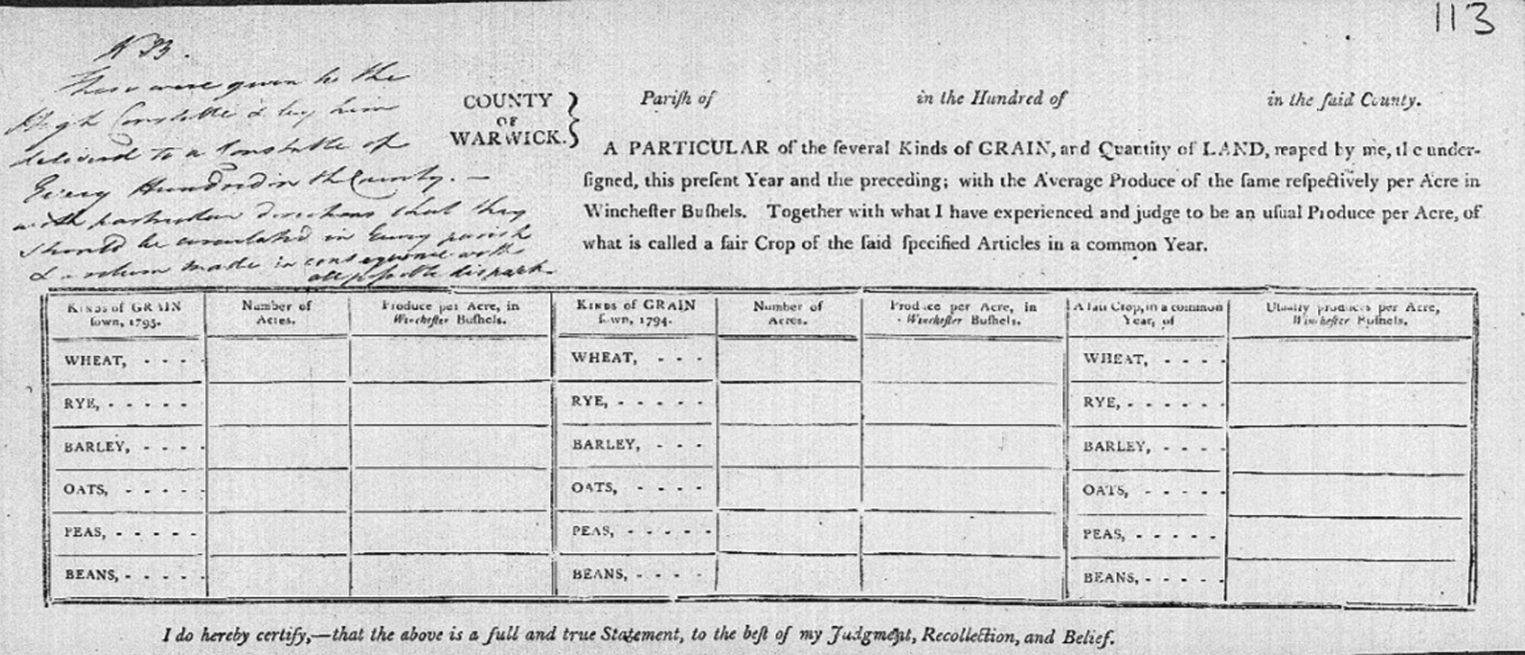
While the board hoped to compile the best methods for potato cultivation, its immediate aim was merely to get a sense of how much food the country produced. The collection of data depended on the willingness of parishes and magistrates to respond to questionnaires. The citizen contribution seemed to be limited to gentlemen, local ministers and trusted friends of the board, but in practice it immediately became apparent that the cooperation and help of smallhold farmers, if at one remove, would be necessary. The result was a profoundly varied and diverse set of responses, some including detailed statistics on yields, while others included philosophical and speculative reflections on the causes of crop failures. Some respondents had even printed their own forms of the collection of data in their area (Figure 2).Footnote 34 But the questionnaire raised as many questions as it ever provided answers. Some refused to return any information on ‘the fallacious data of the present moment’.Footnote 35 Others returned figures ‘by conjecture’.Footnote 36 In one area, the farmers held a meeting before reporting where it was ‘unanimously agreed’ to omit figures on oats – no explanation was provided.Footnote 37 In other areas, the data were incomplete because ‘the principal growers of grain within this parish did not attend the vestry’.Footnote 38 Some felt that farmers could only be expected to falsify data, ‘his interest is so materially concerned to make the scarcity appear greater than perhaps it is’.Footnote 39 Other respondents stressed that they had improved the data returned by speaking with fewer farmers, and contacting only ‘the most respectable and intelligent’.Footnote 40 Others feared political grounds for misreporting data. As one commented of the farmers in his area, ‘half of them being Republicans at heart’.Footnote 41 The fears of republicanism in rural areas had credence; the French tricolour was later observed in some of the rural food riots of the 1820s and 1830s.Footnote 42 The collection of data was also tied to fear. One magistrate recounted being confronted by a mob over bread prices, writing that ‘they told me it was agreed, before they came from home, not to take any step till they had first heard what I could do for them’.Footnote 43
‘The form devised and printed in Warwick that was used to aid efforts to gather agricultural data in 1795’, Papers of the Home Office: Domestic Correspondence, George III, 1782–1820, held at the National Archives, Kew, HO 42/36/113.

The threat of violence was very real and was linked to rapid shifts that rural economies were undergoing at the end of the eighteenth century. In the 1790s, Britain witnessed a spike in rural population growth, contributing to the popularity of the so-called ‘Speenhamland system’ – a supplement to the poor rates that placed a burden on farmers not employing labourers, resulting in lower wages and falling productivity.Footnote 44 Despite modest rises in labourers' wages during the wars years between 1793 and 1815, on the whole, real wages fell in Britain between 1760 and 1834.Footnote 45 The fall in wages was not the only pressure being placed on the poor at this time. Between 1750 and 1850, Britain saw 25 per cent of its cultivated area enclosed by Parliamentary Acts – the majority of these Acts occurred between 1793 and 1815, crippling small farmers.Footnote 46 The Board of Agriculture was seeking to compile data on agricultural production at a time when those citizens who could provide the data were, in places, on the brink of revolt. The (usually wealthy) correspondents with the board still depended upon communication with poorer farmers to provide the desired data, and these were connections fraught with political tension.
The first circular of 1795 did not ask for information on potatoes, but some respondents still included data or observations in their reports. The Duke of Portland reported an increase in potatoes between 1794 and 1795 of 180,000 – but the unit of measurement was unclear (the secretary underlining the figure with a question mark).Footnote 47 Thomas Whiteheade from Preston reported that while the corn crop had failed, ‘Potatoes are very good’.Footnote 48 Others shared the positive reports on potato crops in 1794 and 1795.Footnote 49 The 1795 report produced from the data included twenty communications of experiments from agriculturists and scientists, as well as an official guide divided into fourteen chapters on cultivation. In the search for what caused curl, the board followed farmers in blaming cultivation practices. On the subject of the curl, the board learned that the ‘distemper’ of the potato was unknown at altitudes of four hundred feet and above in West Lothian, but that seed potatoes brought from this district to lower altitudes and the south became affected.Footnote 50 For a plant that was believed by many to have originated in the highlands of Peru, growing it at low altitudes seemed a likely cause of such disease.Footnote 51 The authority trusted by the board (Mr Somerville) suspected that the curl was caused by the use of lime and ash-dung, noting that districts that did not utilize such practices seemed unaffected.Footnote 52 Led by practices in northern England, the board determined that the curl was largely caused by forcing plants taken from sets that had been improperly manured. Geography guided their deductions. The curl was never found in moss or peat land; it had not affected Yorkshire or ‘the mountains of Radnor and Montgomery’.Footnote 53 Out of these details, the board hoped it had set forward a potential pathway to controlling or mitigating the distemper. But the domestic sphere wasn't viewed as having the final word. In 1797, the board began to fund the translation of papers on potatoes from France and Germany for the consumption of its members.Footnote 54
The board wanted data on potato cultivation with the aim of understanding their potential and current responses to climate, but initial efforts to collect meaningful data were mixed. In 1800, a circular was distributed again in order ‘to Obtain a body of Evidence the most authentic’ on agricultural production during the bad year.Footnote 55 Unlike the circular of 1795, the 1800 circular requested that bushels of potatoes harvested be included in the returned data.Footnote 56 Price-fixing riots occurred throughout England from 1794 until 1801; having accurate data was no longer a question of understanding what Britain was producing, but also a means of repudiating allegations that the government was overlooking profiteering.Footnote 57 Numerous responses indicated that potato cultivation had greatly increased, although yields were mixed.Footnote 58 The rising prices of bread and corn, as in 1795, increased dependence on potatoes, but the board's effort to measure the production of potatoes by price was naive; as one farmer explained in response, ‘few potatoes are grown in this district for sale’.Footnote 59 Others made similar observations: ‘potatoes are only produced on small parcels … the crop hath generally failed’.Footnote 60 Another farmer called potatoes ‘a failing crop’, remarking that they were ‘not much cultivated here’.Footnote 61 Few provided actual data; one farmer reported that he had harvested 500 bushels of potatoes in good years but had averaged 350 to 400 in 1800 (including no mention of acreage).Footnote 62 ‘Our crop of potatoes will be small’, a correspondent from Gloucester warned.Footnote 63 Another commented merely, ‘Potatoes – very few grown, very indifferent – much injured by the weather’.Footnote 64 The failures also caused interest in switching to different staples. ‘There has been no attempt, as yet, immediately in this neighbourhood, to substitute on any general plan, rice, barley, or oats for wheat. But it is now in contemplation.’Footnote 65 Instead of data, the Home Office sometimes received arguments and essays. A respondent from Dover omitted any calculations of crops, but observed, ‘Had the present scarcity been owing to an increase of population, it would have been gradual.’Footnote 66 The scarcities were viewed, instead, as having been caused by new practices and cultivation methods, which were regarded as producing ‘one fourth less … than under the old method’.Footnote 67 Such responses show that while the board sought mere numbers on agricultural yields, the farmers who responded viewed cultivation methods as making those numbers intelligible and meaningful.
Seeds, cultivation and early varieties
The board did not seek to compile differences on cultivation practices across the country, but they did take a keen interest in how different regions tried to adjust their methods in order to eliminate the disease. And while most practices focused on the ripeness of the seed potatoes used, other regions sought to avoid the disease through cultivating new varieties. In their survey of West Lothian in 1795, the board reported they had learned that many farmers raised potatoes from the apple, ‘which requires two years to accomplish’. The practice was adopted due to the ‘disease of curling’, for which there was no cure known ‘but that of changing the seed’.Footnote 68 Cultivating new varieties from the ‘apple’, or from seeds, was also crucial to developing so-called ‘early varieties’, or potato varieties that could be grown for harvesting in the spring. With the government increasingly interested in viewing the potato as a substitute for wheat, the cultivation of early varieties became politically important. But not all agriculturists believed that ‘early varieties’ even existed, as an exchange between the board and the House of Commons in 1801 reveals. After the crop failures in Britain and Ireland in 1800, the board established a subcommittee that very winter which would be charged with purchasing eyes and sets of potatoes to conduct research into the best varieties.Footnote 69 The public, confused by the price rises that came right after the harvest, suspected that hoarding and price fixing were to blame.Footnote 70 Immediate actions were viewed as necessary in order to avoid riots. Shortly after the formation of the committee, Parliament requested that the board work immediately to accumulate a supply of cuttings for early-variety potatoes to relieve potential shortages that spring. But the board was unwilling to meet the request:
Resolved that this committee cannot recommend to the Board to submit to the Com. Of the House of Commons the offering of any Premiums for the Cuttings of what are called Early Potatoes, this committee believing that a sufficient quantity, to be a considerable object in the national consumption, cannot by any means be procured by general cultivation.Footnote 71
In other words, the members of the board were sceptical of the stability or existence of a true variety of ‘early’ potatoes. When the House of Commons pressed the board to advise immediate planting of potatoes, the board refused, fearing that doing so would endanger next year's wheat crop.Footnote 72 But the board was not united in its position. Thomas Andrew Knight, who would in the next decade become president of the Horticultural Society of London, believed in the possibility of breeding early varieties, and he would use the publications and the network of the society to dominate approaches to the cultivation of potatoes in the first two decades of the nineteenth century.
For those who believed that true early varieties were tenable and stable, it was still expensive and time-consuming to attempt the development of such varieties by seed. For the farmer interested in joining the movement to cultivate new varieties in the 1800s, A Treatise on the Culture of Potatoes warned that ‘it takes full three years to form an adequate judgment of Potatoes raised from seed, and, after all, if one in ten succeed so as to be worth preserving, it is as much as can be reasonably expected’.Footnote 73 Raising new varieties was limited to farmers with the means to invest in such projects, but a patriotic service was attached to such ideas. Among the farmers who began to compete for fame as producing the best new varieties that would prove free from the curl, one in particular, Thomas Andrew Knight, utilized the newly established Horticultural Society of London to promote both the inevitability of degeneration in potato varieties and the superiority of his new breeds.
The Horticultural Society of London, founded in 1804, was small – it boasted a few dozen members and would not succeed in publishing the papers from its meetings until 1818. But Knight, becoming president of the society in 1811, viewed it as a means through which he could educate the public in his ideas on plant physiology and thereby justify the adoption of his own varieties. Knight argued that curl was a product of the prolonged cultivation of the plant, and that the symptoms of curl were in fact inherent in the potato plant and even signs of quality.Footnote 74 The danger lay in artificially propagating potatoes year after year by harvesting and then replanting seed potatoes. This practice meant that there was, in fact, just one aged potato plant being grown throughout many parts of the country, growing older and more feeble by the year.Footnote 75 Knight first issued this warning, as it concerned the practice of propagating fruit trees by grafting, in 1795.Footnote 76 But potato cultivation appeared to Knight to suffer from the same flaw as propagation by grafting – there were no new individuals created one year from the next. As Knight argued, ‘The fact that every variety of potatoe when it has been long propagated from parts of its tuberous roots becomes less productive is, I believe, unquestionable.’Footnote 77 How long could such an individual plant endure? Popular belief during Knight's lifetime was that three to four years after being bred from seed were peak years for a variety, which would be largely exhausted after fourteen years of cultivation.Footnote 78 Agriculturists regularly attributed the decline in cultivation of some varieties to their age. As a farmer in Ireland commented in 1834, ‘The black potato, which about twenty years since possessed more good qualities than any other which we have ever seen, is now so far degenerated as to be seldom seen.’ When Scotland saw devastating failures in 1837 (discussed below), the secretary of the Highland and Agricultural Society of Scotland, Charles Gordon, sent a questionnaire to its members asking ‘whether the plant be weakened or worn out, and whether it is expedient to cultivate it more by means of the apple, and less from the root, than has of late been in use’.Footnote 79
The continued attacks of curl and the urgent need for early varieties provided all the motivation necessary for Knight to argue that the cultivation of new varieties, rather than investigating the practices used by farmers across the country, was the sole means of addressing the problems facing the nation. Following Malthus, Knight conceived of economic value as coextensive with the state's production of its own food. By improving plants, an increase of wealth could be obtained, ‘without any increased expense or labour’. An increase in the productivity of a variety would have the same financial benefit as the farming of poor or barely usable land, with immediate and obvious benefits to the state. In 1810, Knight reckoned that an acre of potatoes provided the same amount of food as forty acres of pasture.Footnote 80 The economic aspect was a point of contentious debate. One of the most common proposals during this period to avoid revolution and unrest in Britain was ‘to provide the poor with land’. Arthur Young had advocated such a policy even before the war.Footnote 81
The desire to expand the farming of waste lands was embodied in Pitt's calls for ‘home colonisation’, speculative schemes that hoped to reclaim waste land and settle Britain's poor there.Footnote 82 Knight shared these concerns but promised instead a greater return from land already in use. Cultivation practices were important, but for Knight the practices to imitate were those used on his own farm, in the production of new varieties. On his side was the president of the Royal Society, Joseph Banks, who envisioned Knight's new potato varieties being freely distributed to all members of the society.Footnote 83 Knight himself would regularly communicate varieties that he had bred himself with the aim of supplying the farmer with a reliable mix of seed stock for year-round cultivation, always working to produce genuine early varieties.Footnote 84 Over the years, Knight produced over twenty such varieties, all of which were distributed through the society. The continued production of such varieties – which were ascribed numbers instead of names – implies that Knight was never convinced that any of these were genuinely trustworthy early varieties, but alongside the production of these seeds, the society was also developing a means of testing them.
Breeding new early varieties was particularly difficult, because Knight believed as a rule that early varieties of the potato ‘never afford seeds, nor even blossoms; and that the only method of propagating them is by dividing their tuberous roots’.Footnote 85 The opinion was popular and long-lasting – William Cobbett affirmed the same opinion in 1830.Footnote 86 This condemned most existing early varieties to degeneration within Knight's system, as to divide the roots would be to populate one's field, year after year, with the same ageing individual plant. Seed from early varieties, being unavailable in Knight's experience, meant that new early varieties must always be developed from breeding with late varieties, making the search for new varieties all the more difficult. One solution lay in importing early varieties from Peru, where many believed that the potato must exist in a far superior state. By the 1820s, the society had established an experimental garden. A bad frost that destroyed early crops of potatoes throughout Britain in 1821 deeply troubled the society, but it placed great hopes on the promise of new varieties being both developed by Knight and imported from abroad.Footnote 87 In 1822, it was able to acquire a specimen of the much-sought-after Lima (or golden) potato from Peru. The arrival of the root promised not only the highest-quality potato described in any travels, but also the possibility of producing new varieties that would not demonstrate the tendency to curl. The potato, however, clearly did not live up to expectations, with the society commenting,
It is a late kind, and an indifferent bearer, when grown in a strong soil, but tolerably productive in a lighter. Though very good, this anxiously expected root has not turned out of such extraordinary excellence for the table as was anticipated, nor answered the expectations which the extravagant accounts of travellers in South America had induced us to form of it.Footnote 88
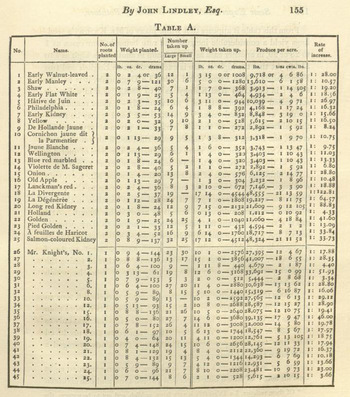
The Lima was never circulated by the society; the aim in the 1820s remained to provide early varieties.Footnote 89 Knight boasted tremendous yields of his own new varieties in the pages of the Transactions, leading to accusations from the editor of the Gardener's Magazine (discussed below) that he was inventing figures. The result of the charge was the first experiment that the society had ever conducted to gauge whether or not Knight's early varieties were indeed earlier or better than the older varieties used in Britain. Conducted by John Lindley in 1831, twenty of Knight's varieties were tested against established varieties, producing a table of results that showed that a few decent varieties had been developed by Knight, but also that the promise of confronting disease and the demand for early varieties by breeding had not produced a quick fix for the country (see Figure 3).Footnote 90
‘The table produced by John Lindley, showing the results from the Horticultural Society's experimental farm which sought to compare the yields produced by Knight's varieties (26–45) with established varieties’, in John Lindley, ‘The Result of some Experiments on the Growth of Potatoes, tried in the Garden of the Society in the year 1831’, Transactions of the Horticultural Society of London (1835) 2(1), pp. 153–161, 155.

Collecting and diffusing experiments: citizens, gardens and data
Knight represented a sole point of (aristocratic) authority. By the late 1820s, Knight's attempts to control the direction of agricultural practice through the Transactions had been undone by the emergence of editors and agriculturists who believed that farmers and gardeners already possessed the knowledge needed to stabilize the cultivation of potato plants – all that was needed was structures and networks to compile and diffuse this knowledge. When the gardener and editor John Loudon introduced the Gardener's Magazine in 1826, he was explicit in his opposition to Knight and the Horticultural Society's approaches:
A magazine has this great advantage over collections of papers in what are called Transactions, that it admits of controversial discussion, which the latter do not; and therefore false doctrine, once admitted into such collections, stands there as true. In this respect, the Transactions of societies, in their present form, and in their present manner of publication, are behind the age. Fortunately the bulk and expense of these works prevent them from being generally read.Footnote 91
Materially, the Gardener's Magazine was profoundly different from the Transactions. Sarah Dewis has pointed to the price as a means of gauging the different approach taken by Loudon. The Transactions cost £1 1s 6d for the public, and the rate for members was largely similar. It enjoyed a circulation of around two thousand copies, but these were printed at irregular intervals. The Gardener's Magazine aimed to provide a cheap, accessible library for practitioners. Shifting in format during its early years, it gradually evolved into a monthly journal of fifty pages priced at one shilling and sixpence.Footnote 92 The paper technologies utilized in the production of journals like the Gardener's Magazine constituted a radical shift in organizing cultivation knowledge. Crucially, the Gardener's Magazine and similar publications lent authority to a diverse class of actors: gardeners. As Clare Hickman has observed, gardeners came from diverse backgrounds, wielded academic and practical authority, and played an increasingly crucial role in knowledge networks that spanned botanical gardens, universities, farms and estates.Footnote 93 Where Knight and Banks had both hoped to establish a system whereby new varieties were developed on farms of members of the society and then distributed, Loudon remained focused on compiling and diffusing cultivation practices from those who owned land and also those merely employed to work it. He maintained that Knight's reported yields on his new varieties were impossible because Knight disclosed few details about the cultivation methods he employed.Footnote 94 In practice, Loudon regarded good varieties of plants as useless without knowledge of the cultivation practices and provenance. Observing specimens of an early variety cultivated by a farmer in Penzance at a horticultural meeting, Loudon lamented that there was no accompanying information on ‘what circumstances of culture, locality, or variety’ had been employed.Footnote 95 Without such knowledge, Loudon viewed the specimens as incomplete and of no use to his readers.
The crises that drove interest in cultivation data in the 1790s did not disappear with the cessation of war with France in 1815. The end of the Napoleonic wars witnessed new economic problems and a rise in farmworkers taking part in generalized riots over wages and food prices.Footnote 96 There were several significant failures brought on by disease in Scotland, Ireland and England. Local failures were common.Footnote 97 Outside England, there was starvation and famine. Scotland saw blight and widespread failures in 1833, and again in 1835, 1836 and 1837.Footnote 98 Ireland saw failures in 1816–1818, 1822 and 1831.Footnote 99 The 1820s were characterized by a prolonged agricultural depression, and 1830 saw the occurrence of the Swing Riots, with widespread machine breaking throughout the country, including a quarter of all the threshing machines in Wiltshire. Within rural areas, protests against the stagnation in wages and rising food prices took many forms: ‘arson, animal maiming, and … sheep stealing’ all occurred at regular intervals throughout the country.Footnote 100 Thus the emergence of journals like the Gardener's Magazine (1826) and later its imitator the Irish Farmer's and Gardener's Magazine (1833) were accompanied by the threat of rural revolt and by continued failures in potato crops, many of them severe, placing renewed pressure on the belief that adopting a scientific perspective was essential to avoiding disaster. As one observer commented in the case of the Scottish failures of 1835, ‘The extraordinary state of the potato crop merits notice from the naturalist as well as the farmer. In some fields there is not one single plant.’Footnote 101 What, precisely, would the naturalist deduce? The author of the article ruled out climate and poor weather – improper cultivation methods, he argued, were the cause of the appearance of disease. Such views were not only common, but integral to the motivations and rationale behind collecting and diffusing cultivation methods in journals like Loudon's.
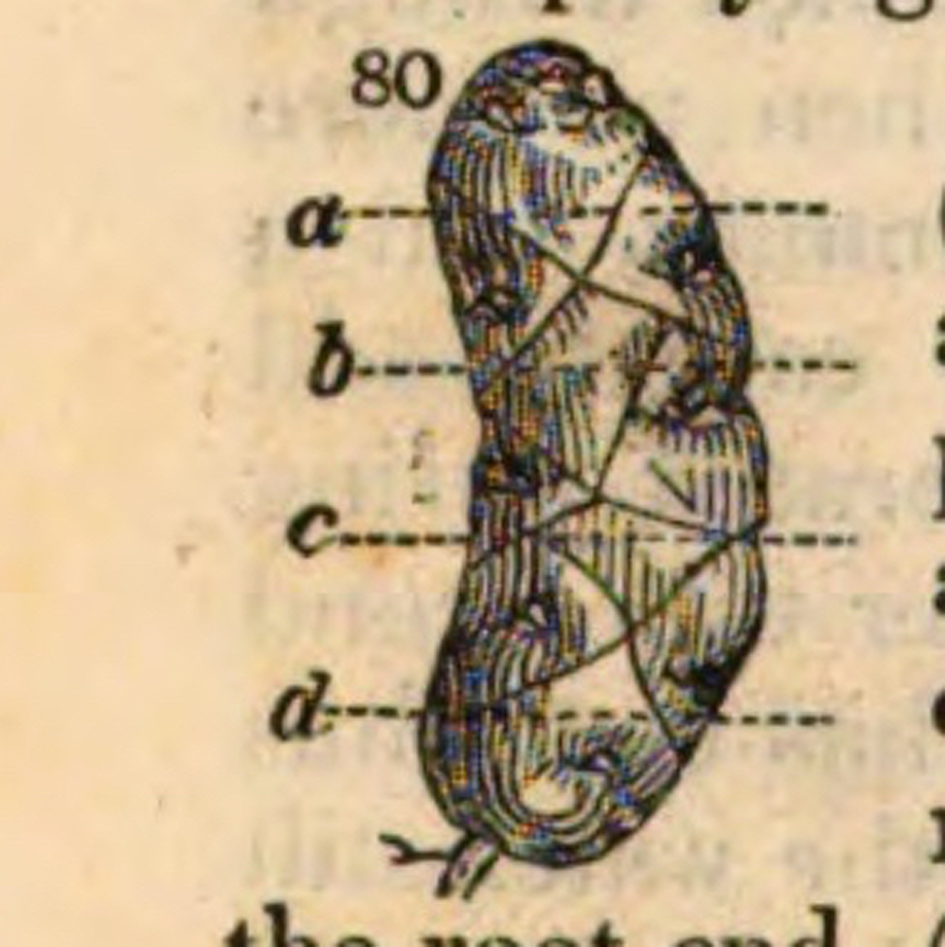
From 1826 until the final issue in 1843, the Gardener's Magazine included regular communications on cultivation methods that were either blamed for causing curl or advertised as ensuring its absence. The dangers of failure with early crops were particularly high, and communications on how to cultivate potatoes successfully in the colder months were highly valued by Loudon. In the first year, Loudon included a communication from a farmer in Lancashire who advanced a theory on the eyes that remained significant for many decades: ‘It is well known in Lancashire’, the farmer R.W. explained, ‘that different eyes germinate and give their produce, or become ripe at times varying very materially, say several weeks, from each other’.Footnote 102 Communicating an illustration of the theory (Figure 4), the farmer explained that in Lancashire, the eyes from section a of the potato were soonest ripe, and could be used to grow an early crop – but the eyes from c and d would grow several weeks later, and were also more prone to disease. The positioning of eyes remained under suspicion, and became a regular feature for which the appearance of curl could be blamed. As one gardener advised in 1832, ‘Generally, at the root end of the potato … there is an eye, which, cut by itself, mostly produces a curl.’Footnote 103 Explanations like this reinforced suspicion that failures and disease were evidence of a misstep in cultivation practice on the part of the farmer. Cutting practices were, at the same time, connected intimately with the appearance of disease. ‘I am of opinion that in nine cases out of every ten the disease [dry rot] will be found to have commenced on or near the part of the tuber that had been attached to the stalk’, wrote an Irish farmer after the failures of 1833.Footnote 104 Cut the seed potato one way, and an early variety was produced; but cut another way, dry rot and curl would attack the plant. Loudon's efforts to collect and diffuse experiments were working – farmers were reading his publication and not only communicating their methods, but also explaining how their approaches differed from or matched those of other correspondents.
‘An illustration submitted by the farmer R.W. to demonstrate the position of eyes on the potato that would produce an early variety (and those that should be avoided)’, R.W., ‘Culture of early potatoes in Lancashire’, Gardener's Magazine (1826) 1(2), pp. 405–406.

The stakes were much higher with the potato failures of 1831–1833 in Ireland than they were when such failures occurred in England. Where the English Poor Law encouraged movement towards wage labour, in Ireland, where no such law existed, land provided the sole security.Footnote 105 Inspired by Loudon's magazine, both Catholic and Protestant members of the RDS, led by the reverend and agriculturist William Hickey, established the Irish Farmer's and Gardener's Magazine in 1833, with the aim of addressing the failures.Footnote 106 The RDS was, at that time, a ‘relatively non-sectarian and non-political body’. Once the leading institution for education and agricultural development in Ireland, by 1800 its contributions to agriculture no longer stretched far beyond the boundaries of Glasnevin's botanical garden.Footnote 107 Still, Glasnevin, alongside Edinburgh, was an important site of botanical science in the late eighteenth century, and the gardeners who operated these gardens held authority in both academic and agricultural networks.Footnote 108 While small, the society was growing during these years – in the 1830s its membership grew from roughly three hundred to seven hundred.Footnote 109 Its funding from the British government may have been dwindling, but its importance and its ability to communicate to both Protestant and Catholic farmers gave it importance.
Within the pages of the Irish Farmer's and Gardener's Magazine, the scrutiny fell upon seed potatoes and the cultivation methods of others. As in England and Scotland, it was common for parishes in Ireland to import potatoes ‘in order to change the seed, as it is called’.Footnote 110 Drawing on the British Farmer's Magazine, Hickey warned his readers that practices abroad were potentially producing seed potatoes that would inevitably fail. In the neighbourhood of Liverpool, sea-tang was used instead of manure; a practice that, Hickey suggested, could be linked to the failures witnessed in Ireland.Footnote 111 Over thirty such communications and observations featured in the first two issues alone. Alongside fears that improper cultivation methods were causing degeneration in the potato, those with access to scientific instruments also contributed experiments and theories to the press. One farmer reported observing ‘small white particles, like eggs’, when putting potatoes from a failed crop under the microscope. For the contributor, the experiment suggested that there were airborne animalcules that could attack potatoes.Footnote 112 And yet such attention to insects did not rule out the opinion, held by many, that insects only appeared once a plant was ill – ‘the appearance of insects on the leaves of trees, &.c, is the symptom of incipient disease’, as one farmer wrote.Footnote 113 Suggestions that the disease could have natural causes, or arise from factors largely outside the farmer's control, were often dismissed in this way.
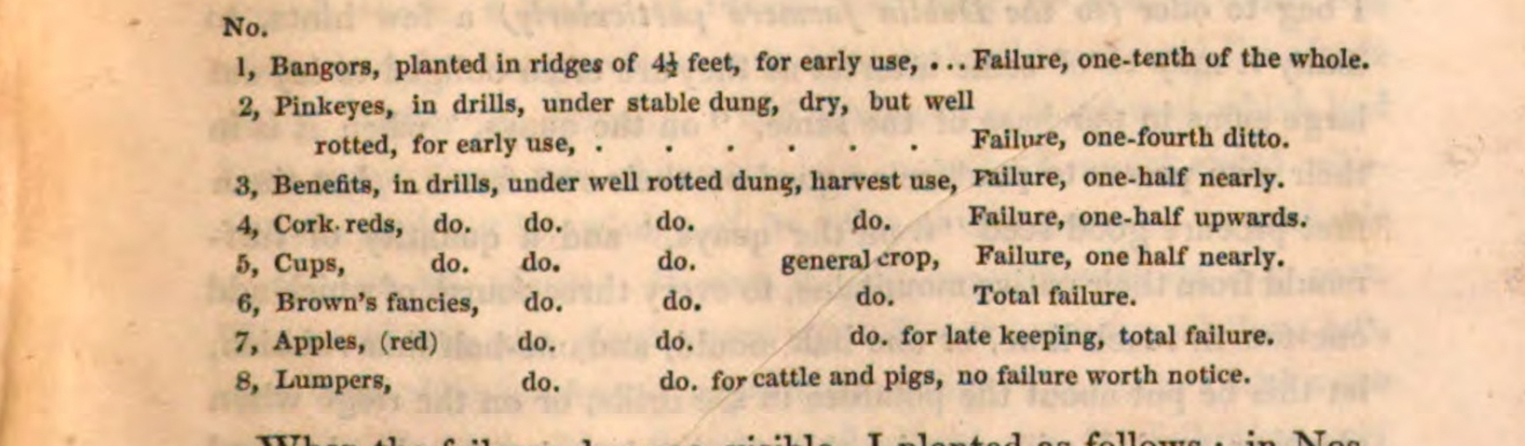
Because there were seldom any clear external causes, the minute differences in cultivation practice from farm to farm were increasingly scrutinized and regarded as the cause of disease and failure. Speculation included a focus on ‘unripeness’ in the 1832 crop, fermentation in the potato store, the use of dung, contact with saltwater, ‘animalculae found in and about the rotted silt’ – commenters traced the life of the seed potato from its harvesting to its planting in the hopes of identifying stages that could be meaningfully linked to the appearance of curl in the mature plant.Footnote 114 Failure provoked scrutiny of particular varieties. Practice shifted in Ireland during these years; far fewer farmers risked cutting their seed potatoes, and the relative absence of disease reinforced beliefs that cutting led to deterioration and degeneracy in the plants.Footnote 115 One farmer attested that Bangor potatoes must be planted when the top shoot appears, otherwise weaker shoots will grow in its place, producing a weaker plant; but for the Pinkeye variety, these multiple shoots were desirable and important to developing a strong plant.Footnote 116 Maintaining the same cultivation methods, farmers measured the degree of failure between various varieties, submitting tables that represented the inclination towards the curl as represented across different varieties (Figure 5). Small experiments like this – and the production of tables – allowed agriculturists to test many of the anecdotal pieces of advice that floated through the guides and manuals on cultivation. In this way, periodicals encouraged not only cultures of experimentation, but also closer attention to fine distinctions in cultivation methods, the very kinds which increasingly were identified as the causes of disease.
‘A table produced by a farmer in Ireland demonstrating the relative failures of different varieties due to curl’, E.C., ‘On the potato’, Irish Farmer's and Gardener's Magazine and Register (1834) 1(4), pp. 298–301, 299.

A similar case to Ireland can be seen a few years later in Scotland. While curl commanded the most attention, once journals began to collect and compile data on potato cultivation, an array of other diseases and conditions became known. After the failures in Scotland in 1837, the agricultural press provided an unprecedented means of information gathering. Never before had so many farmers and agriculturists communicated their observations and experiences. Compiling these data for the Highland Horticultural Society, Charles Gordon, the secretary of the society, commented,
A great mass of valuable information has been communicated, and the opinions of practical men residing many miles apart, are now to be arranged in juxta-position, so as mutually to confirm and illustrate each other; their joint influence, being the result of no common understanding, and suggested by no previous intercourse, ought, therefore, to induce attention to their counsels.Footnote 117
Gordon's report compiled the communications of thirty-seven farmers in Scotland. The report drew almost universal agreement on the age-old question of cutting. Summarizing the communications, Gordon explained, ‘The entire potato has not been known to fail … The cut potato, exposed or planted, is frequently known to rot.’Footnote 118 Gordon found that one-third of the cultivators believed that cultivated varieties were degenerating with age, with only one-sixth insisting that varieties do not deteriorate over time. Still, the entire report traced the probable causes of curl and dry rot to differences in cultivation: the only potential causes of the diseases considered in the report are the period of planting, the period of lifting (ripe or unripe seed), preserving and storing seed potatoes, soil density and preparation of ground, the use of dung, cutting or planting whole, and the question of exhausted varieties. One farmer believed that curl had been introduced by cultivation from seed, and that it was a product of improper plant breeding.Footnote 119 In either case, crop failures were now veritable mines of information and data: farmers could be relied upon to communicate their practices and methods to journals and societies. The editors and secretaries of these societies were also now compiling these observations and experiments, seeking to uncover common experiences and errors in cultivation that might be linked to the appearance of disease. However naive, the belief on Gordon's part that these farmers had ‘no common understanding’ gave the reports a greater degree of authenticity. There was no danger of suggestion or bias.
Alongside fears of being overwhelmed by data, there were also fears that the strategies adopted in response to curl could undo the practices that farmers relied upon to identify and develop varieties. The severity of the failures in Scotland renewed discussion of breeding new varieties. The Highlands Agricultural Society decided to hold a competition in 1837 to reward any farmer who could uncover means to increase the preservation of potatoes. The agriculturist Mackenzie criticized the competition, remarking that all the known varieties decayed. The proper competition ought to ‘offer one [a prize] for raising new varieties, and producing one or more with as many as possible of the qualities which a potato is desired to possess’.Footnote 120 While the dangers of relying on one sole variety were known, so too were farmers aware of the dangers of losing control over the promised traits and attributes of the plants that they relied upon. Farmers began to fear that the multiplying crises would lead to an increased effort to breed new varieties from seed, thus filling the markets with ‘a heterogeneous assemblage of potatoes, from which it will be difficult to select any required valuable kind’.Footnote 121
In early 1843, reports began to emerge from Cornwall of a new disease that halted all growth in potatoes above the soil level.Footnote 122 The editors of the newly established Gardener's Chronicle (edited by John Lindley) called for experimentation with ammonia for those affected.Footnote 123 Shortly after the initial report was published, the Probus Farmers’ Club in Cornwall met to discuss the disease. Investigations revealed that in Penzance the disease had destroyed over one-third of the crop, and that local farmers referred to the disease as ‘bobbin-joans’. For agriculturists familiar with the approaches that had developed in these journals over the last two decades, attention focused on whether or not bobbin-joans could be ascribed ‘to the soil or the seed’.Footnote 124 But the climate was not unusual that year, and farmers next season determined to test the soil by experimentation. Seed potatoes were taken from a field where bobbin-joans appeared and planted in an unaffected field: there were failures. The same farmer took fresh seed and planted it in an affected field – noting that these grew without any signs of illness.Footnote 125 Was this symptomatic of poor cultivation, or was it a sign of degeneration in the variety? John Lindley himself commented on the disease, ‘When potatoes degenerate, they produce tubers of bad quality, but not Bobbin-joans.’Footnote 126 Still, attention focused on how seed potatoes were selected and preserved in Cornwall. One agriculturist commented,
I have also noticed similar results and much absolute failure when the seed Potatoes have been exhausted of their natural moisture, by improper modes of keeping, by fermentation in the Potato-house, and by being suffered to exhaust their strength by premature growths, &c. Whether any of these causes operate to the production of ‘Bobbin Joans’ in Cornwall, I cannot say.Footnote 127
For Charles Lemon, suspicion came to rest on seed potatoes having been stored when damp, and prone to fermentation. Debates over the causes of bobbin-joans continued within the Probus Farmers’ Club, but its members were split over the possibility of degeneration and the potential impact of poor seed preservation and cultivation methods.Footnote 128
The appearance of potato blight in 1845 led to a quick loss of interest in the contained outbreak of bobbin-joans. But precedents were needed to understand the new disease attacking crops in Ireland and Scotland, and bobbin-joans was recalled as an example pointing towards the dangers of seed selection. During the bobbin-joans outbreak in Cornwall, as the editors of the Gardener's Chronicle observed, farmers had continued to use the surviving potatoes from sets affected by the disease. These proved to carry the illness somehow, leading the editors to declare, ‘We now, therefore, warn the public that diseased sets will produce a diseased crop. Not a shadow of doubt remains upon that point.’Footnote 129 The Farmer's Magazine in 1846 warned, ‘The Produce of Diseased Potatoes will be Diseased’, and cautioned farmers that it would be rash to regard sets that were unaffected by bobbin-joans as also free of the disease: ‘great doubts exist as to the fitness for seed of apparently sound potatoes from diseased districts’.Footnote 130 Even healthy-looking seed could prove diseased; there was no art of observation that could detect the incipient failure.Footnote 131 At the Farmer's Club in the autumn of 1846, the veterinarian William Karkeek claimed that he had been studying bobbin-joans for several years in his region. In that time, he had noted that potatoes left in the ground by accident were never infected – could it not potentially be the case that ‘digging up potatoes in the autumn, and keeping them half the year in pits and other places, foreign to the natural habits of the plants’, was the cause of both bobbin-joans and the murrain? Suspicious that ‘fungi and insects’ could be credible causes of any disease, Karkeek reiterated the power of heredity at work in the human, animal and vegetable realms.Footnote 132 Somewhere, in the artificial practices that cultivators used to propagate the plant, lurked the origins of the diseases that ruined crops and threatened famine.
Conclusion
As diseases like the curl progressed through the country, all cultivation became potential sites for experimentation. A field unaffected by disease was an object of interest and scrutiny: a field ruined by disease brought the farmer's practice and methods under minute examination. As I argue here, the majority of agriculturists and farmers who communicated to journals and societies believed that the diseases that afflicted potatoes were themselves products of poor cultivation methods: reform in practice would serve as the principle means of avoiding any disaster. In this way, generations of farmers and cultivators invested in their work a patriotic service. Reforming cultivation practices would improve the variety cultivated, and mitigate the appearance of diseases in the future. The appearance of potato blight interrupted this citizen-led project by adding complexity to the relationship perceived to obtain between disease and cultivation. In its universal destruction, it proved impossible to attach blame to any practice in the fine detail as so many farmers had done with curl and dry rot. ‘Fungi and insects’, causal agents rejected by figures like Karkeek, became more important after 1846 in understanding the origins and causes of disease. More work needs to be done to understand how relationships between cultivation methods and disease were understood in the decades following the appearance of potato blight. This article, in exploring cultures of experimentation on potatoes and fears of disaster in the decades leading up to the famine, has attempted to show not only that this moment in agricultural history is crucial to the role played by data production and collection in botany and the agricultural sciences, but also that these sources provide new ways of assessing how the public in the early nineteenth century understood the impacts of agriculture and the art of cultivation upon nature.