1 Introduction
State spaces occur, rather unconnectedly, in dynamical systems theory and in logic. The state space of a dynamical system is the set of states that the system might be in. In logic, models for intensional logics—like modal, temporal or truthmaker logics—are built on a set of so-called states or possible worlds. These states are, roughly, possibilities that are important to take into account when reasoning. The general concept behind these two notions of state space is that a state space is a set of entities (representing possibilities) that contain information (about these possibilities).
We aim to provide a unified treatment of state spaces understood in this way: We use domain theory to describe the general structure of the information that they contain. Then we show that the well-understood and well-behaved logic hype is a sound and complete logic for reasoning about information in these state spaces.
This unified perspective on state spaces will be fruitful for both areas: On the one hand, we will get insights about the logic from the informational view on state spaces. For example, this way we will see that in hype models compatibility distributes over fusion and that the infinite DeMorgan Laws are satisfied. On the other hand, we will obtain a logic governing dynamical systems. It provides an answer to the question: What are the fundamental laws for reasoning about the behavior of a dynamical system?
There are various takes on this question starting from different perspectives on (subclasses of) dynamical systems: For example, dynamic topological logic (Kremer & Mints, Reference Kremer, Mints, Aiello, Pratt-Hartmann and van Benthem2007), modal or first-order fixed point logics, nonmonotonic logics (Leitgeb, Reference Leitgeb2005), co-algebraically, or with an applied category theory approach (Schultz, Spivak, & Vasilakopoulou, Reference Schultz, Spivak and Vasilakopoulou2020). The approach developed here takes as basic the information that is contained in a state or trajectory of a dynamical system. For example, the information contained in one state might imply some of the information contained in another state (conditional on some further information). The logic behind this describes the most general structural properties of information in state spaces. Part of the very general motivation for exploring such logics stems from the ubiquitous use of dynamical systems that have received comparatively little covering from a logical perspective. For the special case of neural networks, another such general motivation is to investigate the information processing of neural nets—this is in line with the explainable artificial intelligence research project.
The paper is structured as follows. In §2, we use domain theory to motivate and describe the information structure of state spaces. In §3, we recap the so-called hype models of Leitgeb (Reference Leitgeb2019) and show that these models satisfy the infinite DeMorgan laws. In §4, we prove a correspondence between information structures and hype models: roughly, the former induce the latter and the latter can be represented as being induced by the former. This shows that information structures are sound and complete with respect to the logic hype. Thus, we have found an informational logic for state spaces. In §5, we apply the framework to investigate various notions of information fusion. We provide well-motivated conditions for when a state space can be closed under information fusion (i.e., adding new states that are the informational fusion of old states). To increase readability, we move long proofs to an appendix.
2 Information structures
We use domain theory to motivate and describe the information structure of state spaces.
Background domain theory
In the late 1960s, Dana Scott started to develop domain theory (Scott, Reference Scott1970). This theory deals with partial orders that can be regarded as “information orderings”: the elements of the partial order represent pieces of information (or partial results of computations). To describe the information structures that we will use, we start by recapping some notions from domain theory (see, e.g., Abramsky & Jung, Reference Abramsky, Jung, Abramsky, Gabbay and Maibaum1994 or Gierz et al., Reference Gierz, Hofmann, Keimel, Lawson, Mislove and Scott2003).
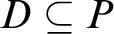
Given a partial order P, a subset
 $D \subseteq P$
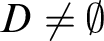
is directed if
 $D \neq \emptyset $
and any two elements of D have an upper bound in D. A partial order P is a directed-complete partial order (dcpo) if every directed subset D of P has a least upper bound
 $\bigvee D$
. One then often says that D converges to
 $\bigvee D$
. Given a dcpo P and
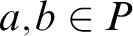 $a,b \in P$
, we say a is way below b (
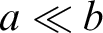 $a \ll b$
) if any directed set D that converges to (or beyond) b must explicitly go above a: if
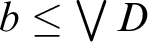 $b \leq \bigvee D$
, then there is a
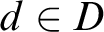 $d \in D$
such that
 $a \leq d$
. (The relation
 $\ll $
is also called order of approximation and elements
 $a \in P$
with
 $a \ll a$
are called compact or finite.) Write
 . Intuitively,
 $a \ll b$
means that the much simpler a approximates the complicated b. A basis B of a dcpo P is a subset of P such that for all
 $a \in P$
,
 contains a directed subset with supremum a. A dcpo P is continuous if it has a basis, that is, all elements can be obtained as limits of basic or ‘simple’ elements. (A dcpo P is algebraic if it has a basis of compact elements.) A continuous dcpo is called a domain (though the exact meaning of ‘domain’ can vary: sometimes demanding more or less but usually requiring being a dcpo).
A subset C of a dcpo P is called Scott closed if C is a downsetFootnote
1
and closed under suprema of directed subsets. A subset U is Scott open iff U is an upset and if it contains the supremum of a directed set
 $D \subseteq P$
, then U already contains an element of D. Write
 $C(P)$
and
 $O(P)$
for the Scott closed and opens sets of P, respectively. The topological space
 $(P , O(P))$
is a
 $T_0$
-space, not necessarily sober, and it is Hausdorff iff the order on P is trivial. We will make use of the following result. (It is also discussed in Ho & Zhao, Reference Ho and Zhao2009 and Ho et al., Reference Ho, Goubault-Larrecq, Jung and Xi2018.)
Theorem 2.1 (Lawson, Reference Lawson1979 and Hoffmann, Reference Hoffmann, Banaschewski and Hoffmann1981)
A lattice L is completely distributive completeFootnote
2
iff there is a continuous dcpo P such that L is isomorphic to
 $C(P)$
.Footnote
3
The category-theoretic version of this result states that the category of continuous domains and the category of completely distributive lattices are dually equivalent via the ‘open-set’-functor and the ‘points’-functor (Abramsky & Jung, Reference Abramsky, Jung, Abramsky, Gabbay and Maibaum1994, theorem 7.2.28).
States, domains and information
We assume to be given a state space in the general sense, that is, a nonempty set S of entities of which it makes sense to say that they contain some information. These states could be, for example, states of a dynamical system, sequences of observations about a system, states of knowledge about the world, partial possible situations, and so on. We will consider concrete examples below, but for now we can remain general about what exactly these states are.
As mentioned, domains are motivated as reconstructing the structure of collections of pieces of information. Thus, we think of the collection of all the pieces of information of all the states in S as forming a continuous dcpo P. The continuity of the domain says that any piece of information can be approximated by (or, is the limit of) “simple” pieces of information. For the time being, we assume that this is essential for pieces of information. Finally, we regard Scott closed sets of P as positive information and Scott open sets as negative information. The motivation for this is as follows (just heuristics, no formal argument).
Why is positive information a Scott closed set? The (positive) information contained in a state s is a collection C of pieces of information. Loosely speaking, C is what s “asserts” or “affirms” (though, the pieces of information don’t need to be expressible in a language). This collection should be downwards closed: if the piece of information i is in C and j is contained in i, then also
 $j \in C$
. Moreover, as we will argue next, C should be closed under suprema of directed subsets. Indeed, with limits of directed subsets, domain theory proved to provide a fruitful reconstruction of the general concept of computation: abstract enough to be independent of concrete implementations, but still concrete enough to capture the essential features and intuitions. Thus, the collection C of pieces of information affirmed by a state should be closed under suprema of directed subsets: whatever piece of information that can be computed, deduced, or obtained from only pieces of information in C should already be in C, since it hence also is an information asserted by s.Footnote
4
Why is negative information a Scott open set? The negative information contained in a state s is, loosely speaking, the collection U of those pieces of information that the state “denies” or “refutes” (again, these pieces need not be linguistically expressible). This collection should be upwards closed: if the piece of information i is refuted by s, then all stronger versions
 $j \geq i$
of it are refuted, too. Moreover, U should be inaccessible by directed joins: if one refutes the limit
 $\bigvee D$
of an approximation, then one shows that, at some point
 $d \in D$
, the approximation moves in the wrong direction, whence one already refutes d. In other words, if one refutes the limit
 $\bigvee D$
of a computation, then one shows that one of the resources
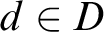 $d \in D$
which one used had to be false.
Much more could be said about the motivation for modeling positive and negative information of a state in this way—especially if we look at concrete instances of such states. However, to keep to the point, we will take this as a prima facie plausible reconstruction of information in states and move to investigating this framework. (Though, in §5.1 we will say more on this, and, more generally, also see, e.g., Smyth, Reference Smyth1983 and Vickers, Reference Vickers1989 for a ‘logical’ perspective on topological notions.) After all, much of the motivation for a reconstruction comes from the fruitfulness of its application.
Information assignment
The idea of having states that contain positive and negative information can formally be spelled out as follows.
Definition 2.2 (Information assignment)
Given a nonempty set S, an information assignment to S is a pair
 $(P , \iota )$
where P is a continuous dcpo and
 $\iota $
is a pair of functions
 $(\iota _+ , \iota _-)$
with
 $\iota _+ : S \to C(P) $
and
 $\iota _- : S \to O(P)$
such that
-
(i)
 $\iota $
is injective: for all
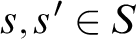
$s, s' \in S$
, if
$\iota _+ (s) = \iota _+ (s')$
and
$\iota _- (s) = \iota _- (s')$
, then
$s = s'$
.
-
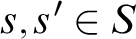
(ii) For all
$s \in S$
, there is a
$s^* \in S$
such that
$$ \begin{align*} \iota_+ (s^*) &:= \big\{ i \in P : i \not\in \iota_- (s) \big\} \\ \iota_- (s^*) &:= \big\{ i \in P : i \not\in \iota_+ (s) \big\}. \end{align*} $$





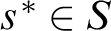

(Note that, if
 $s^*$
exists, it has to be unique.) We also say that
 $\iota $
is a P-information assignment to S. We write
 $\iota _{\pm } (s) = \ldots $
if both equations
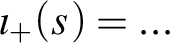 $\iota _+(s) = \ldots $
and
 $\iota _- = \ldots $
hold.
Condition (i) demands that the notion of information reconstructed here is very “fine-grained”: if there is absolutely no difference in the information of two states, then two states are (regarded to be) the same. Condition (ii) is a condition on the state space: It should be rich enough such that for every state s there also is a state
 $s^*$
which affirms exactly what s doesn’t deny and denies exactly what s doesn’t affirm. In other words, for any state s, the state space should contain the “informational completion”
 $s^*$
of s.
As a first simple example, we can consider the dynamical system of a classical particle moving on a line as described by classical mechanics.
Example 2.3 (Position and momentum space)
A state of the system consists of the position and momentum of the particle, whence the state space is
 $\mathbb {R}^2$
(or an appropriate subset thereof). A piece of information is the information that the system is in a certain area of the state space (i.e., that the position and momentum of the particle is within a certain range). Thus, we model a piece of information as a cube
 $[p, p'] \times [q , q'] \subseteq \mathbb {R}^2$
and the collection P of such cubes indeed forms a continuous domain under the reverse inclusion ordering. Thus, the positive information contained in a state
 $s = (p , q)$
is
 $\iota _+ (s) = {\downarrow } ( [p,p] \times [q,q] ) = \{ i \in P : s \in i \}$
which is indeed Scott closed. The negative information is
 $\iota _- (s) = \big (\iota _+(s) \big )^c = \{ i \in P : s \not \in i \}$
which is Scott open. The information contained in a state is a complete description of the particle, thus,
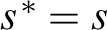 $s^* = s$
.
We will consider more examples in due course.
Information theoretic operations
The information assignment
 $\iota $
induces a partial join function on S:
 $s \circ _{\iota } s' $
is defined as the
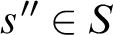
 $s''$
, if it exists, that contains exactly the information contained in s plus the information contained in
 $s'$
. Moreover,
 $\iota $
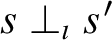
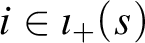
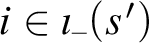
also induces a notion of incompatibility on S: two states are incompatible iff they disagree on a piece of information. Finally,
 $\iota $
induces a star-mapping: for
 $s \in S$
,
 $s^{*_{\iota }}$
is the informational completion of s. To summarize, we have defined the following.
Definition 2.4 (
$\circ _{\iota } , \perp _{\iota } , ^{*_{\iota }}$
)

Let S be a nonempty set, P a continuous dcpo, and
 $\iota $
a P-information assignment to S. Define
-
(i)
$\circ _{\iota } : \subseteq S \times S \to S$
,
$s \circ _{\iota } s'$
is the unique
$s''$
, if it exists, such that
$\iota _{\pm } (s'') = \iota _{\pm } (s) \cup \iota _{\pm } (s')$
. -
(ii)
$\perp _{\iota } \subseteq S \times S$
is defined by:
$s \perp _{\iota } s'$
iff there is an
$i \in P$
such that (
$i \in \iota _+ (s) $
and
$i \in \iota _- (s') $
) or (
$i \in \iota _- (s) $
and
$i \in \iota _+ (s') $
). -
(iii)
$\cdot ^{*_{\iota }} : S \to S$
,
$s^{*_{\iota }}$
is the unique
$s^*$
of condition (ii) of the definition of an information assignment. -
(iv)
$\leq _{\iota }$
is the partial order induced by
$\circ _{\iota }$
:
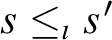
$s \leq _{\iota } s'$
iff
$s \circ _{\iota } s'$
exists and
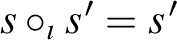
$s \circ _{\iota } s' = s'$
.








One might be tempted to additionally demand of information assignments that information fusion always is total, that is, that the set of states is closed under information fusion. However, the position-momentum space example above shows that this is not always possible: any state was informationally complete, so no further information could be fused to it without becoming inconsistent (and the state space didn’t include an inconsistent state). Nonetheless, one might wonder how to obtain information assignments where this (and stronger forms of) information fusion is possible. We will do this in §5.
Here are some basics facts about the induced information structure.
Lemma 2.5 (Induced information structure)
Let S be a nonempty set and
 $\iota $
an information assignment to S. Then
-
(i)
$\circ _{\iota }$
is reflexive (for all
$s \in S$
,
$s \circ _{\iota } s$
exists and equals s
) and commutative (for all
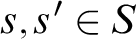
$s,s' \in S$
, if
$s \circ _{\iota } s'$
exits, then
$s' \circ _{\iota } s$
exists and equals
$s \circ _{\iota } s'$
). -
(ii)
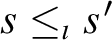
$s \leq _{\iota } s'$
iff
$ \iota _+ (s) \subseteq \iota _+ (s')$
and
$\iota _- (s) \subseteq \iota _- (s')$
.






Proof. Immediate. □
Note that, in (i), there is no reason to expect
 $\circ _{\iota }$
to be associative (that is a subtlety that will become relevant below). Also note that (ii) shows that
 $\leq _{\iota }$
is the superposition of two preorders: The positive information preorder
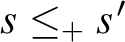 $s \leq _+ s'$
given by
 $\iota _+ (s) \subseteq \iota _+(s')$
and the negative information preorder
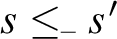 $s \leq _- s'$
given by
 $\iota _- (s) \subseteq \iota _-(s')$
. This is reminiscent of the following example.Footnote
5
Example 2.6 (Dunn’s aboutness interpretation of fde)
One may compare our information assignments to the ‘aboutness interpretation’ of the logic fde due to Dunn (Reference Dunn1966, Reference Dunn1971, Reference Dunn, Omori and Wansing2019).
Footnote
6
There, in short, an interpretation I over a set X (‘the universe of discourse’) maps each propositional atom p to a ‘proposition surrogate’
 $(A^+ , A^-)$
which is a pair of subsets of X. Intuitively,
 $A^+$
is the set of topics that p gives information about and
 $A^-$
is the set of topics
 $\neg p$
gives information about. Then I is inductively extended to Boolean formulas: If
 $I(\varphi ) = (A^+ , A^-)$
and
 $I(\psi ) = (B^+ , B^-)$
, then
 $I (\neg \varphi ) = (A^- , A^+)$
,
 $I (\varphi \wedge \psi ) = ( A^+ \cup B^+ , A^- \cap B^-)$
, and
 $I (\varphi \vee \psi ) = ( A^+ \cap B^+ , A^- \cup B^-)$
. And
 $\varphi $
entails
 $\psi $
, if
 $B^+ \subseteq A^+$
and
 $A^- \subseteq B^-$
. Then
 $\varphi $
implies
 $\psi $
in the logic fde iff
 $\varphi $
entails
 $\psi $
in every interpretation over any universe of discourse.
Thus, in our terminology, we may view the set of Boolean formulas as a state space and an interpretation I over universe of discourse X as an information assignment: We view
 $P := X$
as a continuous domain under the discrete order (i.e.,
 $x \leq y$
iff
 $x = y$
), whence the Scott-topology is the discrete topology on X. And, for a state
 $s = \varphi $
with
 $I (\varphi ) = (A^+ , A^-)$
, we define
 $\iota _+ (s) = A^+$
and
 $\iota _- (s) = A^-$
.
This is not quite an information assignment: for this, two modifications are needed. First, to satisfy clause (ii), we add an a unary operator C which is interpreted as ‘topical completion’: if
 $I (\varphi ) = (A^+ , A^-)$
, then
 $I (C \varphi ) := ( X \setminus A^- , X \setminus A^+ )$
.Footnote
7
We define
 $S_0$
to be the set of formulas built from the propositional atoms using the operators
 $\neg , \wedge , \vee , C$
. Second, to satisfy clause (i), we define the equivalence relation
 $\equiv _I$
on
 $S_0$
by
 $\varphi \equiv _I \psi $
iff
 $I (\varphi ) = I ( \psi )$
. We define
 $S := S_0 / \equiv _I$
. As above, let P be X with the discrete order and define
 $\iota $
as follows: for
 $s = [\varphi ] \in S$
, let
 $\iota _+ (s) := A^+$
and
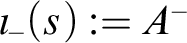 $\iota _- (s) := A^-$
where
 $I (\varphi ) = (A^+ , A^-)$
. Then
 $(P , \iota )$
is an information assignment where, for
 $s = [\varphi ]$
, we have
 $s^* = [C \varphi ]$
.
On a version of this idea, which is used to represent de Morgan lattices (Dunn, Reference Dunn1967, Reference Dunn, Omori and Wansing2019), one defines
 $\wedge $
and
 $\vee $
componentwise:
 $(A^+ , A^-) \wedge (B^+ , B^-) = (A^+ \cap B^+ , A^- \cap B^-)$
and similarly for
 $\vee $
. We can then still build an information assignment
 $(P , \iota )$
as before for which we have, for
 $s = [\varphi ]$
and
 $s' = [\psi ]$
, that
 $s \circ _{\iota } s' = [\varphi \vee \psi ]$
and
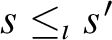 $s \leq _{\iota } s'$
iff
 $A^+ \subseteq B^+$
and
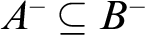 $A^- \subseteq B^-$
where
 $I (\varphi ) = (A^+ , A^-)$
and
 $I (\psi ) = (B^+ , B^-)$
. In fact,
 $(S , \leq _{\iota })$
is a distributive lattice.
Thus, we may regard our information assignment as a refinement or generalization of the aboutness (or de Morgan) interpretation: we also take into account the mereology of the ‘topics’ of the universe of discourse P. The fact that the aboutness interpretation is sound and complete with respect to the logic fde is then analogous to our result below that our information structure interpretation is sound and complete with respect to the logic hype.
High-level information
We have said that the information described by
 $\iota $
is very fine-grained and not necessarily expressible in a language. Thus, in a sense,
 $\iota $
describes the “low-level” information contained in a state. We will now describe an assignment of information that is expressible in a language and high-level.
Let
 $\mathcal {L}$
be the language built from the propositional variables
 $p_1 , p _2 , p_3 , \ldots $
using the connectives
 $\neg , \wedge , \vee , \to , \top $
. We use v as a variable for literals and
 $\overline {v}$
is the complement of the literal v.Footnote
8
Given a set S, a valuation is a function
 $V : S \to \mathcal {P}(\{p_1 , \overline {p_1}, p_2, \overline {p_2}, \ldots \})$
. The valuation assigns every state
 $s \in S$
a set of literals which intuitively describes which atomic sentences are made true and/or made false at the state.
Of course, the high-level and low-level information should be related. In the ideal case, the high-level information “arises from” the low-level information. One straightforward way to spell this out is given by the next definition.
Definition 2.7 (High-level info supervenes on low-level info)
Let S be a nonempty set,
 $(P,\iota )$
an information assignment to S, and
 $V : S \to \mathcal {P}(\{p_1 , \overline {p_1}, p_2, \overline {p_2}, \ldots \})$
a valuation (in the propositional language
 $\mathcal {L}$
). We say the high-level information V supervenes on the low level information
 $\iota $
, if for all
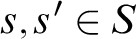 $s,s' \in S$
,
-
(i)
$V(s) \cup V(s') \subseteq V(s \circ _{\iota } s' )$
whenever
$s \circ _{\iota } s'$
exists. -
(ii) If there is a literal v such that
$v \in V(s)$
and
$\overline {v} \in V(s')$
, then there is
$i \in P$
such that (
$i \in \iota _+ (s) $
and
$i \in \iota _- (s') $
) or (
$i \in \iota _- (s) $
and
$i \in \iota _+ (s') $
). -
(iii)
$V(s^{*_{\iota }}) = \{ \overline {v} : v \not \in V(s) \}$
.


Condition (i) says that if we put together the low-level information of two states, we won’t lose any high-level information. (Though, it might be that there is some low-level information in the two states that individually is not expressible in the language yet, but if put together it becomes salient enough to be describable.) Condition (ii) says that a high-level incompatibility only occurs if there also is a low-level incompatibility. Condition (iii) says that, not only on the low-level but also on the high-level,
 $s^*$
asserts what s doesn’t deny and denies what s doesn’t assert.Footnote
9
Summary information structure
Let’s summarize the definitions so far and then sketch an example.
Definition 2.8 (Information structure)
Let S be a set. The information structure
 $\mathfrak {I}$
of the set S is a tuple
 $(S, P, \iota , V)$
where P is a continuous dcpo,
 $\iota = (\iota _+ , \iota _-)$
is a P-information assignment to S, and V a valuation that supervenes on
 $\iota $
.
Note that, as mentioned, we don’t assume anything about the set of states S except that it makes sense to speak of information contained in the states in S. Yet, for concrete S, we might make use of its additional structure, as we can see in the following example.
Example 2.9 (Trajectory space)
We show how a well-motivated modification of the space of trajectories of a discrete dynamical system can be given an information assignment. We will only sketch the example; for more details see Hornischer (Reference Hornischer, Sedlár and Blicha2019). The example invites a much more general treatment, but that would require another paper.
Let X be a countable set and
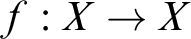 $f : X \to X$
an aperiodic and well-founded function.Footnote
10
So we can regard
 $(X,f)$
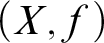
as a discrete dynamical system: X is the state space and f describes the dynamics. Let T be the set of finite or infinite trajectories of
 $(X,f)$
, that is, finite or infinite sequences
 $x_0 , x_1 , \ldots $
in X such that
 $x_{i+1} = f (x_i)$
. We take two trajectories to exhibit the same behavior if they eventually take the same path through the state space:
 $t \equiv t'$
iff there is
 $i,j \geq 0$
such that, for all
 $n \geq 0$
,
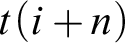 $t (i + n)$
is defined iff
 $t'(j + n)$
is defined, in which case they are equal. Thus, we can regard the equivalence classes as the possible ‘behaviors’ of
 $(X,f)$
, and the quotient
 $\mathbb {T} := T / \equiv $
is naturally ordered by:
 $[t] \leq [t']$
iff for all
 $t_0 \in [t]$
there is
 $t_1 \in [t']$
such that
 $t_1$
extends
 $t_0$
as a sequence (‘behavior
 $[t]$
can be extended to behavior
 $[t']$
’). One can then show that both
 $(\mathbb {T} , \leq )$
and the order dual
 $(\mathbb {T} , \geq )$
are algebraic domains.
In
 $(\mathbb {T} , \leq )$
, the finite behaviors (i.e.,
 $[t]$
with finite trajectory t
) are compact. The infinite or ‘limit’ behaviors (i.e.,
 $[t]$
with t infinite) are noncompact and maximal: they are the limit of finite behaviors. To reason about these limits, it is also important to know from where they were reached. Thus, we mirror
 $\mathbb {T}$
at the infinite behaviors: We think of a mirror image of a finite nonempty behavior
 $[t]$
as the limit behavior
 $[\overline {t}]$
reached from the finite behavior
 $[t]$
(where
 $\overline {t}$
is the infinite trajectory extending t
). Formally, we define
 $P := \big \{ ([t] , [ \overline {t} ] ) , ([\overline {t}] , [t]) : t \text { trajectory} \big \}$
.Footnote
11
And for
 $\tau , \tau ' \in P$
, we define
 $\tau \leq \tau '$
iff
-
(i)
$\tau = ([t] , [ \overline {t} ] )$
and
$\tau ' = ([t'] , [ \overline {t'} ] )$
and
$[t] \leq [t']$
, or -
(ii)
$\tau = ([ \overline {t} ] , [t] )$
and
$\tau ' = ([ \overline {t'} ] , [t'] )$
and
$[t'] \leq [t]$
, or -
(iii)
$\tau = ( [t] , [ \overline {t} ])$
and
$\tau ' = ([ \overline {t'} ] , [t'] )$
and
$[t] \leq [\overline {t'} ]$
.


One can then show that
 $(P , \leq )$
is an algebraic domain. Moreover,
 $(P , \leq )$
is an involution poset by
 $([t] , [ \overline {t} ] )^* := ([ \overline {t} ] , [t] )$
and
 $([ \overline {t} ] , [t] )^* := ([t] , [ \overline {t} ] )$
.Footnote
12
Intuitively, any information that is not already ruled out by
 $\tau $
is in
 ${\tau }^{*}$
. Indeed, we can define the following information assignment on the state space
 $S := P$
of possible behaviors of
 $(X,f)$
:
 $\iota _+ : P \to C (P)$
by
 $\iota _+ (\tau ) = {\downarrow } \tau $
and
 $\iota _- : P \to O (P)$
by
 $\iota _- (\tau ) = \big ( {\downarrow } {\tau }^{*} \big )^c$
.
Note how in this example the information structure is closely linked to the dynamics of the system.
3 HYPE models
We recap the definition of hype models, show various facts about them that we will need later on, and we prove that these models satisfy the infinite DeMorgan laws.
Definition of HYPE models
We will work with hype models for the propositional language
 $\mathcal {L}$
with connectives
 $\bot , \wedge , \vee , \neg , \to $
. (Hype models also exist for first-order languages.)
Definition 3.10 (Hype model, Leitgeb, Reference Leitgeb2019)
A
hype model
 $\mathfrak {M}$
(for
 $\mathcal {L}$
) is a quadrupel
 $( S , V , \circ , \perp )$
such that
-
(0) S is a nonempty set (the set of states ).
-
(1) V is a function (the valuation ) from S to the power set of literals of
$\mathcal {L}$
. -
(2)
$\circ $
is a partial binary function from
$S \times S$
to S (
fusion
) such that-
(a) (Monotonicity). Either
$s \circ s'$
is undefined, or
$s \circ s'$
is defined and
$V(s \circ s') \supseteq V(s) \cup V(s')$
. -
(b) (Reflexivity).
$s \circ s$
is defined and
$s \circ s = s$
. -
(c) (Commutativity). If
$s \circ s'$
is defined, then
$s' \circ s$
is defined and
$s \circ s' = s' \circ s$
. -
(d) If
$(s \circ s')\circ s''$
is defined, then
$s \circ \big ( (s \circ s' ) \circ s'' \big )$
is defined and the two are equal.
-
-
(3)
$\perp $
is a binary symmetric relation on S (
incompatibility
) such that-
(a) If there is a literal v such that
$v \in V(s)$
and
$\overline {v} \in V(s')$
, then
$s \bot s'$
. -
(b) If
$s \perp s'$
and both
$s \circ s''$
and
$s' \circ s'''$
are defined, then
$s \circ s'' \perp s' \circ s'''$
.
-
-
(4) For every
$s \in S$
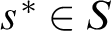
there is a unique
$s^* \in S$
(the star image of s
) such that-
(a)
$V(s^*) = \{ \bar {v} : v \not \in V(s) \}$
. -
(b)
$s^{**} = s$
. -
(c)
$s \not \perp s^*$
. -
(d) If
$s \not \perp s'$
, then
$s' \circ s^*$
is defined and
$s' \circ s^* = s^*$
. (So
$s^*$
is the “largest” state having the previous compatibility property with respect to s.)
-







Formula satisfaction and logical consequence in hype models is defined as follows.
Definition 3.11 (Satisfaction and consequence, Leitgeb, Reference Leitgeb2019)
Let s be a state of a hype model
 $\mathfrak {M}$
. We recursively define
 $s \models \varphi $
:
-
(1)
$s \models v$
iff
$v \in V(s)$
(where v is a literal). -
(2)
$s \models \neg \varphi $
iff for all
$s'$
, if
$s' \models \varphi $
, then
$s \perp s'$
. -
(3)
$s \models \varphi \wedge \psi $
iff
$s \models \varphi $
and
$s \models \psi $
. -
(4)
$s \models \varphi \vee \psi $
iff
$s \models \varphi $
or
$s \models \psi $
. -
(5)
$s \models \varphi \to \psi $
iff for all
$s'$
, if
$s' \models \varphi $
and
$s \circ s'$
is defined, then
$s \circ s' \models \psi $
.


Given a set
 $\Gamma $
of formulas and a formula
 $\psi $
,
 $\Gamma \models \psi $
iff for all hype models
 $\mathfrak {M}$
and states s of
 $\mathfrak {M}$
, if
 $s \models \varphi $
for all
 $\varphi \in \Gamma $
, then
 $s \models \psi $
.
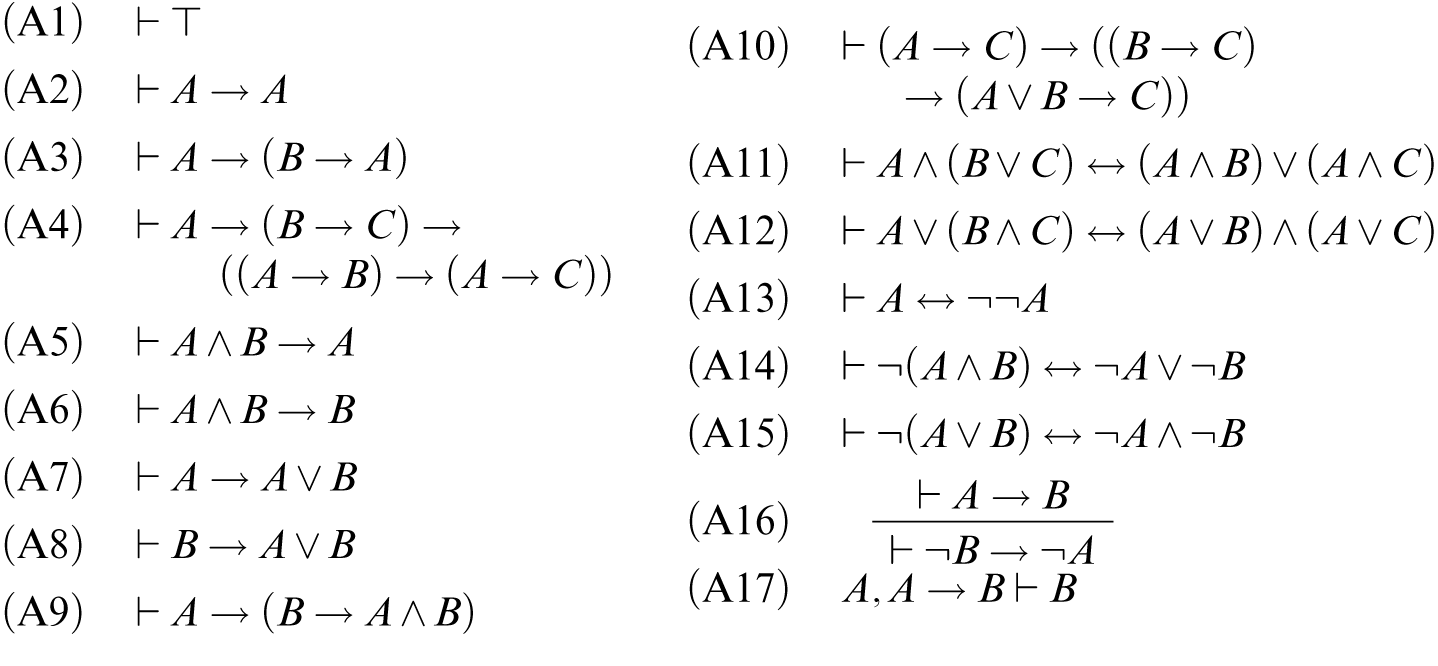
Leitgeb (Reference Leitgeb2019) provides a sound and complete logic for hype models with this semantics. We will refer to this logic as hype which we repeat for convenience in Figure 1. The logic hype is well-understood and well-behaved. It not only is sound and complete (via a canonical model construction) with respect to the hype models, it also has the deduction theorem, the finite model property, and is decidable. Moreover, it contains first-degree entailment, conservatively extends intuitionistic logic, and the structures of hype models are well-known from ordinary mathematics. (For all these results see Leitgeb, Reference Leitgeb2019.)
The system hype as presented by Leitgeb (Reference Leitgeb2019).

Facts about HYPE models
Conditions 3(b–d) are just enough to show that the join function defines a partial order (Leitgeb, Reference Leitgeb2019):
Definition 3.12 (
$\leq $
)

Given a hype model
 $( S , V , \circ , \perp )$
, define for all
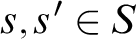 $s,s' \in S$
 $$ \begin{align*} s \leq s' :\Leftrightarrow \big(s \circ s' \text{ exists and } s \circ s' = s' \big). \end{align*} $$
We write
 $\bigvee _{\leq }$
for the least upper bound, if it exists, with respect to
 $\leq $
. We drop the subscript
 $\leq $
if it is clear from context.
Lemma 3.13 (Facts about hype models)
Let
 $\mathfrak {M} = (S, V, \circ , \perp )$
be a hype model. Then
-
(i)
$s \leq s'$
iff
${s'}^{*} \leq s^*$
. -
(ii)
$s^* = \bigvee \big \{ s' : s' \not \perp s \big \}$
. -
(iii)
$s \perp s'$
iff
$s \not \leq {s'}^{*}$
. -
(iv) If
$s^* = s$
for all states, then
$s \leq s'$
iff
$s = s'$
. If, moreover,
$s ,s' \leq s \circ s'$
whenever
$s \circ s'$
is defined, then
$\mathfrak {M}$
is a classical model (so the states act like classical models).


Proof. (i). The left to right direction is the property of being antitone that the star mapping is observed to have by Leitgeb (Reference Leitgeb2019). The other direction follows since
 $s^{**} = s$
.
(ii). By definition,
 $s^*$
is an upper bound of
 $\{ s' : s' \not \perp s\}$
and since
 $s^*$
is in this set, it is the least upper bound.
(iii). (
 $\Rightarrow $
). Assume for contradiction that
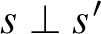 $s \perp s'$
and
 $s \leq {s'}^{*}$
. Then, since
 $\perp $
is isotone,
 ${s'}^{*} \perp s'$
, which is a contradiction to condition (4c) on hype models.
(
 $\Leftarrow $
). Assume
 $s \not \leq {s'}^{*}$
, then either
 $s \circ {s'}^{*}$
is not defined or defined but not equal to
 ${s'}^{*}$
. This is precisely the negation of the consequence of condition 4(d). So by its contraposition,
 $s \perp s'$
.
(iv). Assume
 $s^* = s$
for all states. For the nontrivial direction, assume
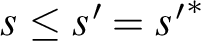 $s \leq s' = {s'}^{*}$
, so
 $s \not \perp s'$
, so
 $s' \leq s^* = s$
, so
 $s = s'$
. Under the additional assumption, if
 $s \circ s'$
is defined, then
 $s = s \circ s' = s'$
and the truth-conditions for the connectives become equivalent to those of classical logic (Leitgeb, Reference Leitgeb2019). □
In an earlier definition of hype models, condition 3(d) was stronger: it demanded
 $\circ $
to be associative up to definedness. Formally:
Definition 3.14 (Associative hype model)
A hype model
 $( S , V , \circ , \perp )$
is associative if for all
 $s , s' , s'' \in S$
the following are equivalent (where
 $\mathrm{dom} (\circ )$
is the domain of the partial function
 $\circ $
)
-
(1)
$(s , s') \in \mathrm{dom} (\circ )$
and
$(s \circ s' , s'') \in \mathrm{dom} (\circ )$
-
(2)
$(s' , s'') \in \mathrm{dom} (\circ )$
and
$(s , s' \circ s'') \in \mathrm{dom} (\circ )$


and in both cases
 $(s \circ s') \circ s'' = s \circ ( s' \circ s'')$
.Footnote
13
We will mostly deal with associative hype models. But, as far as the logic is concerned, this is not a restriction: completeness was already obtained for the earlier version of hype models. Formally:
Theorem 3.15 (Associative hype models are sound and complete)
The class of associative hype models is sound and complete with respect to the logic hype.
Proof. (Sketch)
Leitgeb (Reference Leitgeb2019) shows that the class of hype models is sound and complete with respect to the logic hype. Completeness is shown by a canonical model construction and fusion in that canonical model is associative up to definedness. Thus, if
 $\Gamma \not \vdash \varphi $
, the canonical model is an associative hype model witnessing
 $\Gamma \not \vDash \varphi $
. □
One advantage of associative hype models is that fusion and least upper bound go well together.
Lemma 3.16 (Fusion and order)
Let
 $( S , V , \circ , \perp )$
be an associative hype model. Then for all
 $s , s' \in S$
, if
 $s \circ s'$
exists, then
 $$ \begin{align*} s \circ s' = \bigvee \{ s , s' \}. \end{align*} $$
Proof. Assume
 $s \circ s'$
exists. We show that
 $s \circ s'$
is an
 $\leq $
-upper bound of
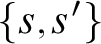 $\{s , s'\}$
. Since
 $s \circ s = s$
always exists,
 $(s,s) \in \mathrm{dom} (\circ )$
and
 $(s \circ s , s') \in \mathrm{dom} (\circ )$
. Since S is associative,
 $(s,s') \in \mathrm{dom} (\circ )$
and
 $(s , s \circ s') \in \mathrm{dom} (\circ )$
and
 $s \circ (s \circ s') = (s \circ s) \circ s' = s \circ s'$
, whence
 $s \leq s \circ s'$
. Similarly
 $s' \leq s \circ s'$
.
Next we show
 $s \circ s'$
is the least
 $\leq $
-upper bound of
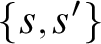 $\{s , s' \}$
. Assume
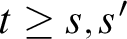 $t \geq s ,s'$
and show
 $t \geq s \circ s'$
. By assumption,
 $t \circ s$
and
 $t \circ s'$
both exist and equal t. Hence
 $(t , s) \in \mathrm{dom} (\circ )$
and
 $(t \circ s') = (t \circ s , s') \in \mathrm{dom} (\circ )$
. Since S is associative,
 $(s , s') \in \mathrm{dom} (\circ )$
and
 $(t , s \circ s') \in \mathrm{dom} (\circ )$
and
 $t = t \circ s' = (t \circ s) \circ s' = t \circ (s \circ s')$
. Hence
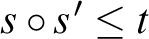 $s \circ s' \leq t$
, as wanted. □
Infinite DeMorgan laws
As a first application of an informational perspective on hype models, we show that the star mapping of a hype model satisfies the infinite DeMorgan laws.
Lemma 3.17 (Information assignment to hype models)
Let
 $(S,V, \circ , \perp )$
be an associative hype model. Then there is a continuous dcpo P and an injective function
 $\iota _+ : S \to C(P)$
that preserves
 $\circ $
and all existing arbitrary
 $\bigvee _{\leq }$
joins in S. Moreover, for
 $\iota _- : S \to O(P)$
defined by
 $\iota _- (s) := \big ( \iota _+(s^*) \big )^c$
(which is open as a complement of a closed set) we have
-
(1)
$(\iota _+ , \iota _-)$
is an information assignment. -
(2)
$\iota _- (s) = \big \{ i \in P : \not \exists D \subseteq \bigcup _{s' \not \perp s} \iota _+(s') \text { directed and } i = \bigvee _P D \big \}$
. -
(3) For all
$s , s' \in S$
,
$s \perp s'$
iff
$\iota _+ (s) \cap \iota _- (s') \neq \emptyset $
.


Proof. Consider the completely distributive complete lattice
 $L := \mathcal {P}(S)$
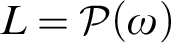
and the arbitrary
 $\bigvee _{\leq }$
-join preserving injective function
 $f : S \to L, ~ s \mapsto ({\uparrow } s)^c$
. By Theorem 2.1, there is a continuous dcpo P such that L is isomorphic to
 $C(P)$
, say via isomorphism g. Define
 $\iota _+ (s) := g \big (\kern1.2pt f (s) \big )$
. By construction,
 $\iota _+$
preserves existing arbitrary
 $\bigvee _{\leq }$
- joins. Moreover,
 $\iota _+$
preserves
 $\circ $
, since if
 $s \circ s'$
exists, it equals, by Lemma 3.16,
 $\bigvee _{\leq } \{s , s'\}$
whose
 $\iota _+$
-image is
 $\iota _+ (s) \cup \iota _+(s')$
.
Concerning (1),
 $(\iota _+ , \iota _-)$
clearly is injective since
 $\iota _+$
already is injective. Moreover, by definition and since
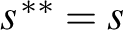 $s^{**} = s$
, we have
 $$ \begin{align*} \iota_+ (s^*) = \big( \iota_- (s) \big)^c \text{ and } \iota_- (s^*) = \big( \iota_+ (s^{**}) \big)^c = \big( \iota_+ (s) \big)^c. \end{align*} $$
Hence
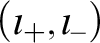 $(\iota _+ , \iota _-)$
is an information assignment.
Concerning (2), we have by Lemma 3.13 and since
 $\iota _+$
preserves existing
 $\bigvee _{\leq }$
-joins that
 $$ \begin{align*} \iota_+ (s^*) = \iota_+ \big( {\bigvee}_{\leq} \{ s' : s' \not\perp s \} \big) = \mathsf{Cl} \big( \bigcup_{s' \not\perp s} \iota_+(s') \big). \end{align*} $$
It is a basic fact that the closure
 $\mathsf {Cl} (A)$
(in the Scott topology) of a downset A in a continuous domain is
 $\{ \bigvee D : D \subset A \text { directed} \}$
(e.g., Abramsky & Jung, Reference Abramsky, Jung, Abramsky, Gabbay and Maibaum1994, sec. 2, ex. 33). Hence
 $\iota _- (s) = \big ( \iota _+(s^*) \big )^c$
is the set of
 $i \in P$
that cannot be reached by a directed subset of
 $\bigcup _{s' \not \perp s} \iota _+(s')$
.
Concerning (3), for (
 $\Rightarrow $
) we argue by contraposition. Assume
 $\iota _+ (s) \cap \iota _-(s') = \emptyset $
. Then, by definition,
 $\iota _+ (s) \cap \big ( \iota _+ ({s'}^{*}) \big )^c = \emptyset $
, so
 $\iota _+ (s) \subseteq \iota _+({s'}^{*})$
. Hence, by definition of
 $\iota _+$
as
 $g \circ f$
, we have
 $(\uparrow {} s )^c = f(s) \subseteq f({s'}^{*}) = (\uparrow {} {s'}^{*} )^c $
, so
 $s \leq {s'}^{*}$
. By Lemma 3.13,
 $s \not \perp s'$
.
(
 $\Leftarrow $
). Assume for contraction that there is an
 $i \in \iota _+ (s) \cap \iota _- (s')$
but
 $s \not \perp s'$
. Then
 $\{ i \} \subseteq \iota _+ (s) \subseteq \bigcup _{t' \not \perp s'} \iota _+(t')$
is directed and
 $i = \bigvee \{ i \}$
. Hence
 $i \not \in \iota _- (s')$
, contradiction. □
Theorem 3.18 (Compatibility distributes over fusion)
Let
 $(S,V, \circ , \perp )$
be an associative hype model. Then for all
 $s \in S$
and
 $T \subseteq S$
such that
 $\bigvee {}_{\leq } T$
exists, we have
 $$ \begin{align*} s \not\perp \bigvee T \text{ iff } \forall s' \in T : s \not\perp s'. \end{align*} $$
In particular, for all
 $t , s, s' \in S$
, if
 $s \circ s'$
exists, then
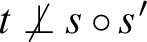 $t \not \perp s \circ s'$
iff
 $t \not \perp s$
and
 $t \not \perp s'$
.
Proof. (
 $\Rightarrow $
). By contraposition. If there is
 $s' \in T$
such that
 $s' \perp s$
, then
 $s' \leq \bigvee T$
, whence, since
 $\perp $
is isotone,
 $\bigvee T \perp s$
.
(
 $\Leftarrow $
). Assume for contradiction that
 $\forall s' \in T : s \not \perp s'$
and
 $\bigvee T \not \perp s$
. Let P and
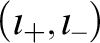 $(\iota _+, \iota _-)$
be as in Lemma 3.17. Then, by (3) of the lemma, there is
 $i \in \iota _+ ( \bigvee T ) \cap \iota _- ( s )$
. Since
 $\iota _+$
preserves arbitrary
 $\leq $
-joins,
 $i \in \mathsf {Cl} \big ( \bigcup _{t \in T} \iota _+ (t) \big )$
. Again, since P is a continuous dcpo, this means that
 $i = \bigvee D$
for a directed
 $D \subseteq \bigcup _{t \in T} \iota _+ (t)$
. But since by assumption
 $T \subseteq \{s' : s' \not \perp s \}$
, D is also a directed subset of
 $\bigcup _{s' \not \perp s} \iota _+ (s')$
with
 $i = \bigvee D$
. Hence, by (2) of the lemma,
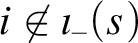 $i \not \in \iota _-(s)$
, contradiction.
The “in particular” part follows by Lemma 3.16: If
 $s \circ s'$
exists, it is
 $\bigvee \{ s, s' \}$
, whence
 $t \not \perp s \circ s'$
implies
 $t \not \perp s$
and
 $t \not \perp s'$
. The other direction again follows since
 $\perp $
is isotone with respect to
 $\circ $
. □
Theorem 3.19 (Infinite DeMorgan)
Let
 $(S,V, \circ , \perp )$
be an associative hype model. For all
 $T \subseteq S$
,
-
(a) if
$\bigvee T$
exists, then
$\bigwedge \{s^* : s \in T \}$
exists and
$(\bigvee T)^* = \bigwedge \{s^* : s \in T \}$
. -
(b) If
$\bigvee \{s^* : s \in T \}$
exists, then
$\bigwedge T$
exists and
$(\bigwedge T)^* = \bigvee \{s^* : s \in T \}$
.


Proof. (a). Assume
 $\bigvee T$
exists. Since S is a hype model,
 $(\bigvee T)^*$
exists, whence it suffices to show that it is the biggest lower bound of
 $T^* := \{ s^* : s \in T \}$
.
We first show that
 $(\bigvee T)^*$
is a lower bound of
 $T^*$
. Indeed, in hype models we have, by property 4c,
 $\bigvee T \not \perp (\bigvee T)^*$
. By Theorem 3.18, for all
 $s \in T$
,
 $s \not \perp (\bigvee T)^*$
, which implies, by property 4(d),
 $(\bigvee T)^* \leq s^*$
. Next we show that
 $(\bigvee T)^*$
is the biggest lower bound. Assume t is a lower bound of
 $T^*$
. Then we have for all
 $s \in T$
,
 $t \leq s^*$
, that is, by Lemma 3.13,
 $t \not \perp s$
. By Theorem 3.18,
 $t \not \perp \bigvee T$
. By Lemma 3.13,
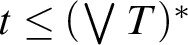 $t \leq ( \bigvee T)^*$
.
(b). Assume
 $\bigvee T^*$
exists. Then, by (a),
 $\bigwedge \{ s^{**} : s^* \in T^* \} = \bigwedge T $
exists and
 $\bigwedge \{ s^{**} : s^* \in T^* \} = (\bigvee T^* )^*$
. Hence
 $(\bigwedge T)^* = \bigvee T^*$
. □
Before continuing, a comment on a recent study of hype (published after the submission of this paper) by Odintsov & Wansing (Reference Odintsov and Wansing2020). Among others, they obtain another, simpler semantics for the logic hype. Instead of hype models, they define models
 $\mathcal {M}$
over involutive star i-frames: An involutive star i-frame is a triple
 $\mathcal {W} = (W,\leq ,*)$
where W is a nonempty set partially ordered by
 $\leq $
and
 $* : W \to W$
is an involution.Footnote
14
A model over
 $\mathcal {W}$
is a pair
 $\mathcal {M} = (\mathcal {W} , v)$
where v is a function assigning each proposition variable p an upset of W (i.e., a subset of W closed under
 $\leq $
). These models can interpret the propositional language
 $\mathcal {L}$
of hype (negation uses
 $*$
and implication uses
 $\leq $
) and the logic hype is characterized by the class of all involutive star i-frames.
Here is a connection with the present work. Every information assignment
 $(P , \iota )$
to a nonempty set S induces the involutive i-frame
 $(S , \leq _{\iota } , *_{\iota })$
. And every involutive i-frame
 $(W,\leq ,*)$
is induced by some information assignment
 $(P,\iota )$
to W, that is,
 $(W,\leq ,*) = (W , \leq _{\iota } , *_{\iota })$
.Footnote
15
Thus, instead of the idea of a valuation function describing the high-level information supervening on the low-level information, we can consider a valuation function v assigning every propositional variable a
 $\leq _{\iota }$
-closed subset of S. Then we not only have a representation theorem for hype models using information structures, but we also have a representation theorem for models over involutive star i-frames.
4 Correspondence between information structures and HYPE models
We show that information structures induce hype models on the underlying state space. Conversely, we prove that, roughly, hype models can be represented as induced by an information structure. We conclude that the logic hype is a sound and complete logic for reasoning about information in state spaces.
Theorem 4.20 Information structures induce hype models
Let S be a nonempty set (the “state space”). Let
 $\mathfrak {I} = (S,P,\iota ,V)$
be an information structure of S. Then
 $\mathfrak {M} := (S , V , \circ _{\iota } , \bot _{\iota })$
is a hype model.
Proof. See appendix. □
(As mentioned before, note that we don’t claim that
 $\mathfrak {M}$
is associative.) Thus, one way to understand the logic of information structures of state spaces is to understand the class of hype models that they induce. So let’s give them a name.
Definition 4.21 (Informational hype model)
Let
 $\mathfrak {M} = (S,V,\circ ,\bot )$
be a hype model. We call
 $\mathfrak {M}$
informational if there is an information structure
 $(S,P,\iota ,V)$
such that
 $\mathfrak {M} = (S,V,\circ _{\iota } , \perp _{\iota })$
.
Thus, our next question is: which hype models are informational? In Lemma 3.17, we have already seen that for any associative hype model we can always find an information assignment on which
 $\perp = \perp _{\iota }$
, however, it is not clear that
 $\circ = \circ _{\iota }$
. Still, this suggests that the subclass of informational hype models is rather large. In fact, as we show now, any associative hype model is induced by an information structure except for a subtle difference between information fusion and supremum that stems from the possible lack of associativity in the hype model induced by an information structure.
Theorem 4.22 (Representation theorem)
Let
 $\mathfrak {M} = (S, V , \circ , \perp )$
be an associative hype model. Then there is an information structure
 $(S , P , \iota , V)$
(so, in particular, V supervenes on
 $\iota $
) generating the hype model
 $\mathfrak {M}_{\iota } = (S,V,\circ _{\iota } , \perp _{\iota })$
such that
-
(0) Both
$\iota _+$
and
$\iota _-$
are injective and
$\leq $
-monotone. -
(1) Incompatibility is informational incompatibility:
$\perp = \perp _{\iota }$
. -
(2) Fusion is informational supremum: for all
$s,s' \in S$
,
$s \circ s' = \bigvee {} _{\leq _{\iota }} \{ s , s'\}$
(i.e., one exists iff the other exists, and in both cases they are the same). -
(3) Mereology is informational containment:
$s \leq s'$
iff
$s \leq _{\iota } s'$
. -
(4)
$\mathfrak {M}$
and
$\mathfrak {M}_{\iota }$
are equivalent: For all formulas
$\varphi $
and
$s \in S$
,
$\mathfrak {M} , s \models \varphi $
iff
$\mathfrak {M}_{\iota } , s \models \varphi $
.


Proof. See appendix. □
We leave it to future work to extend this correspondence into a full-fledged category-theoretic correspondence (for which one first needs to define appropriate notions of morphisms to turn hype models and information structures into categories).
We have noted that the associative hype models are complete with respect to hype (Theorem 3.15). Since an associative hype model is equivalent to its informational representation, we get the following corollary.
Corollary 4.23. The class of informational hype models is sound and complete with respect to the logic hype.
Thus, we have found a sound and complete logic for reasoning about information in state spaces. To see an application of using hype to reason about a dynamical system, let’s go back to the trajectory space example.
Example 4.24 (Continuation of Example 2.9)
A valuation V of the state space P of possible behaviors of the dynamical system
 $(X,f)$
supervenes on the information assignment
 $\iota $
if and only if V is monotone (for all
 $\tau , \tau ' \in P$
, if
 $\tau \leq \tau '$
, then
 $V (\tau ) \subseteq V(\tau ')$
) and, for all
 $\tau \in P$
,
 $V ({\tau }^{*}) = \{ \overline {v} : v \not \in V (\tau ) \}$
.
If V is such a valuation supervening on
 $\iota $
, then
 $(P , V , \circ _{\iota } , \perp _{\iota })$
is a hype model. What can the logic express? For example, a ‘finite’ trajectory
 $\tau = ( [t] , [\overline {t}] )$
makes
 $\neg \varphi $
true iff
 $\varphi $
is false in the ‘limit’
 ${\tau }^{*} = ( [\overline {t}] , [t] )$
. If a finite trajectory
 $\tau = ( [t] , [\overline {t}] )$
makes
 $\varphi \to \psi $
true, then, roughly, for any other finite trajectory
 $\tau ' = ( [t'] , [\overline {t'}] ) $
that eventually merges with
 $[t]$
, if
 $\tau ' \models \varphi $
, then, at the point of merger
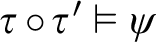 $\tau \circ \tau ' \models \psi $
. Being able to express such a feature of the dynamics of the system shows that the logic has quite a high expressive power (while still being decidable).
5 Information fusion
We use the framework and the results obtained so far to investigate information fusion. We provide well-motivated conditions for when a state space can be closed under information fusion.
In §2, we have seen that, in general, we cannot require information structures to have a total fusion function. However, it is natural and often required that any collection of information states can be fused into a new state, even if this results in an incoherent state. These new and possibly incoherent states are then regarded as theoretical objects obtained by completing the state space under the operation “fusion”.Footnote 16
In this section, we will consider how this extension of the state space can be achieved. More precisely, in §5.1, we collect notions of information fusion and argue for two of them as being the generic ones. In §—S5.2 and 5.3, we provide two properties and two model constructions, respectively. In §5.4, we show how these can be used to close a state space under information fusion.
5.1 Notions of information fusion
We collect several notions of information fusion and motivate why to consider (i) and (iii) below as the generic ones.
Given an information assignment
 $\iota = (\iota _+ , \iota _-)$
to S, we call
 $\iota $
:
-
(i) poset complete, if
$(S, \leq _{\iota } )$
is a complete partial order, that is, for any
$T \subseteq S$
there is a state
$s''$
that is the least upper bound of T with respect to the information containment ordering. -
(ii) total, if for all
$s , s' \in S$
, there is a
$s'' \in S$
such that
$\iota _{\pm } (s'') = \iota _{\pm }(s) \cup \iota _{\pm }(s')$
. -
(iii) join-complete, if for all
$T_0 , T \subseteq S$
with
$T_0$
being finite, there is a
$s'' \in S$
such that
$\iota _+ (s'') = \mathsf {Cl} \bigcup _{t \in T} \iota _+ (t)$
and
$\iota _- (s'') = \bigcup _{t \in T_0} \iota _- (t)$
. (Recall,
$\mathsf {Cl} A$
is the topological closure of A.) -
(iv) diagonally complete, if for all
$T \subseteq S$
, there is a
$s'' \in S$
such that
$\iota _+ (s'') = \mathsf {Cl} \bigcup _{s \in T} \iota _+ (s)$
and
$\iota _- (s'') = \bigcup _{s \in T} \iota _- (s)$
. -
(v) complete, if for all
$T, T' \subseteq S$
, there is a
$s'' \in S$
such that
$\iota _+ (s'') = \mathsf {Cl} \bigcup _{s \in T} \iota _+ (s)$
and
$\iota _- (s'') = \bigcup _{s \in T'} \iota _- (s)$
.








Three comments. First, the logical relationship is as follows: (v) implies (iii) and (iv); (iv) implies (i) and (ii); (iii) implies (ii). Second, note that the difference between (i) and (ii)–(v) is the following. In (i) we demand a state to exists that is minimal in containing the information of the states to be fused. In the other notions we demand, in various forms, that the information in that minimal state is actually the fusion of the information in the states to be fused. Note that this subtle distinction is not available if one only works with a poset of states and not with an information assignment. Accordingly, we will speak of poset fusion and assignment fusion. Third, closely related to the notions of fusion are the notions of substructure of
 $ C(P) \times O(P) $
that the image of the information assignment constitutes. For example, if
 $\iota (S) \subseteq C(P) \times O(P)$
is a sub-join-semi-lattice, then
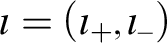 $\iota = (\iota _+ , \iota _-)$
is total. If
 $\iota (S)$
is a complete sublattice of
 $C(P) \times O(P)$
, then
 $\iota $
is diagonally complete. If
 $\iota $
is surjective,
 $\iota $
is complete.
What notion of information fusion is the correct one very much depends on the particular state space. Still, we motivate why to consider (i) as the generic poset fusion and (iii) as the generic assignment fusion.
We have mentioned at the beginning of this section that it is intuitive and often required that any collection of information states can be fused into a new state. Reflecting the difference between poset- and assignment fusion, the weak reading of this is (i) and the strong reading is (iv). Hence a state space that is closed under information fusion should at least satisfy (i). Though, we will argue next that the strong reading is too strong. That is, we will argue that as far as assignment fusion is concerned, there is an asymmetry between positive and negative information: In general, we can plausibly expect that the informational fusion of the positive information of arbitrarily many states is again possessed by some state. However, for negative information we should only expect this for finitely many states. As a consequence, (iii) is the generic assignment fusion.
To argue for this asymmetry between positive and negative information, we will first discuss two rough and intuitive ways of categorizing various notions of fusion.
One distinction between notions of fusions concerns whether (positive) information and fusion is understood conjunctively or disjunctively.
The conjunctive way to understand that a piece of information i is part of the positive information of a state s is that i obtains at s or that s has or makes-true the property i. Dually, if i is among the negative information of s, i is a property that the state falsifies. Thus, states are assumed to be given, and pieces of information are properties of states (that is, sets of states). This is in line with the classic view that information containment is just the dual of implication: the information in p is contained in the information in q iff q implies p. On this view, it is natural to interpret information fusion as conjunction:
 $s''$
is the state having all the properties that the states in
 $T \subseteq S$
have.Footnote
17
, Footnote
18
The disjunctive way to understand that a piece of information i is part of the positive information of a state s is as follows. The states are regarded as stages of a process of, say, recognizing an object in a messy collection of data or assessing a situation. The positive information of a state is a collection of hypotheses about how the object might look like or what the correct evaluation of the situation is. Dually, the negative information is a collection of hypotheses about what the object or situation is not. On this view, it is natural to interpret information fusion as disjunction:
 $s''$
contains all the hypotheses that are contained in one of the states to be fused.Footnote
19
Another distinction between notions of fusions concerns whether or not the positive and negative information of a state are dependent on each other. This could range from fully dependent (one determining the other) to entirely independent. If the latter is the case, both positive and negative information of a state are just some unrelated collections of properties or hypotheses, which suggests that they behave structurally similarly, whence a symmetric notion of fusion seems appropriate (unlike join-complete fusion). However, in many concrete examples it is natural to assume that the positive information of a state has some implications for the negative information and vice versa.
Let’s now show how the fact that positive and negative information are related motivates the asymmetry between positive and negative information.
Concerning the disjunctive case, if
 $\iota _+ (s)$
are all the hypotheses entertained about the object or situation at state s, a natural choice for
 $\iota _-(s)$
is as the set of hypotheses that are already falsified at state s. Thus, negative information has a conjunctive reading (all the hypotheses in
 $\iota _-(s)$
are falsified) and positive information has a disjunctive reading (one conjectures that some hypothesis in
 $\iota _+(s)$
is true). If we assume that information can be phrased as affirmative assertion (true iff affirmable), then only finite negative but arbitrary positive information can be fused (see, e.g., Vickers, Reference Vickers1989).
Concerning the conjunctive case, we will consider the following example. It provides a state space with an information assignment understanding information conjunctively and where the positive and negative information determine each other. The informational fusion of the positive information of (essentially) arbitrarily many states is again possessed by some state, but for negative information this is only true for finitely many states.
Example 5.25 (State space of open sets)
We consider a set S of open sets of some topological space X as state space and an information assignment
 $(P , \iota )$
to S that allows for (directed) fusion of positive information but only finite fusion of negative information.
Let X be a spectral space (a topological space that is homeomorphic to the spectrum of a commutative ring or, equivalently, to the spectrum of a bounded distributive lattice). In fact, for this example it will be enough that X is a topological space with a basis of compact open sets.
We obtain the domain P as follows. We write
 $f : X \rightharpoonup X$
for a partial function on X and
 $\mathrm{dom} (\,f)$
for the domain of f. As usual, f is continuous, if for all open U,
 $f^{-1} U$
is open. Define
 $P := \{\kern1.2pt f : X \rightharpoonup X : f \text { continuous} \}$
ordered by extension:
 $f \leq g$
iff
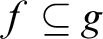 $f \subseteq g$
(considering the functions as sets of pairs). One can then show that D is an algebraic domain.Footnote
20
The compact elements are those
 $f \in D$
with
 $\mathrm{dom} (\,f)$
compact-open. This generalizes the well-known example that the set of partial functions on the positive integers ordered by extension forms an algebraic domain (equip
 $X := \mathbb {N}$
with the discrete topology).
Let
 $S \subseteq O(X)$
be a filter (a nonempty upset closed under meets). Considering such subsets of opens as state space is motivated by the fact that they can be regarded as ‘models’ in a general sense. According to the usual ‘logical’ interpretation of Stone duality, prime filters are models: If L is the Lindenbaum–Tarski algebra of a distributive logic (using the connectives
 $\bot , \top , \wedge , \vee $
), a model is a lattice homomorphism
 $M : L \to 2$
which, in turn, corresponds to the prime filter
 $M^{-1} (1)$
. Generalizing, if X is the spectrum of a distributive lattice L, we may view a prime filter
 $S \subseteq O(X) \cong L$
as a model.
One can then define
 $\iota _+ : S \to C(P)$
and
 $\iota _- : S \to O(P)$
by
 $$ \begin{align*} \iota_+ ( U ) := \{\kern1.2pt f \in D : \mathrm{dom} (\,f) \subseteq U \} ~~ \text{ and } ~~ \iota_- (s) := \big( \iota_+ (s) \big)^c. \end{align*} $$
and show that
 $(P,\iota )$
is an information assignment such that
-
(i) For
$T \subseteq S \subseteq $
-directedFootnote
21
, we have
$s'' := \bigcup T \in S$
and
$\iota _+ (s'') = \mathsf {Cl} \bigcup _{t \in T} \iota _+ (t)$
. -
(ii) For
$T_0 \subseteq S$
finite, we have
$s'' := \bigcap T_0 \in S$
and
$\iota _- (s'') = \bigcup _{t \in T_0} \iota _- (t)$
. -
(iii) If S is a nonprincipal filterFootnote 22 , then for
$T := S \subseteq S$
, there cannot be
$s'' \in S$
with
$\iota _- (s'') = \bigcup _{t \in T} \iota _- (t)$
.





It’s worth putting this example into perspective by realizing that
 $\iota _+$
is a presheaf. After all, the general motivation of (pre)sheaves is that they assign information to the open sets of a space. A paradigm example of a sheaf assigns to each open subset U of X the ring of continuous real-valued functions on U. This is usually applied to rather well-behaved geometric spaces X like manifolds. But in case of, e.g., a spectral space X, we can give this a domain-theoretic twist: For
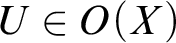 $U \in O(X)$
, define
 $F (U) := \iota _+ (U) = \{\kern1.2pt f \in D : \mathrm{dom} (\,f) \subseteq U \}$
, and, for open
 $V \subseteq U$
, define the restriction morphism
 $\mathsf {res}_{V,U} : F(U) \to F(V)$
by function restriction. Then F is a presheaf on X with values in the category of dcpos and Scott-continuous functions (which is cocomplete so stalks can be defined). We leave it to future work to further explore this perspective.
Another example may be obtained from considering the set S of computably enumerable sets of natural numbers as state space. Ignoring matters of effectiveness (e.g., by working in an effective background theory), S is closed under arbitrary union (by running in parallel the Turing machines enumerating the sets) but only under finite intersection.
To summarize, there are many notions of fusion found in various state spaces (from none to complete). Poset complete and join-complete fusion can be motivated as being the generic ones. Thus, we will focus on closing a state space under these two notions of fusion. The overview of the construction is the following:
-
1. Start with a state space and an information assignment and consider the induced hype model
$\mathfrak {M}$
. Alternatively, start with an associative hype model and consider its informational representation (so it makes sense to speak of information fusion). -
2. On this informational understanding, it is natural to demand
$\mathfrak {M}$
to have a certain groundedness property (see §5.2). -
3. If it does, we can form the Dedekind–MacNeille completion
$\mathfrak {M}'$
of
$\mathfrak {M}$
, which extends
$\mathfrak {M}$
by exactly the states needed to make it poset complete (see §5.3). -
4. Again, on an informational understanding, it is natural to demand
$\mathfrak {M}'$
to have a certain separation property (see §5.2). -
5. If it does, we can form the skew model
$\mathfrak {M}''$
of
$\mathfrak {M}'$
, which extends
$\mathfrak {M}'$
by the states needed to make it join-complete while remaining poset complete (see §5.3 and Theorem 5.37). -
6. Thus,
$\mathfrak {M}''$
is the closure of
$\mathfrak {M}$
under the two generic kinds of information fusion.


We will now do this in detail.
5.2 Structural properties of HYPE models
We describe two properties of hype models each defining a subclass of hype models. On an informational understanding of states (which is justified by the representation Theorem 4.22), it is well-motivated to demand hype models to have these properties.
Groundedness property
Roughly, the groundedness property states that if all states of a set T make a literal true, this has to have a reason, that is, there has to be a state that makes this literal true and that is informationally contained in all states of T. The formal statement of the property is slightly weaker:
Definition 5.26 (Groundedness property)
Given a hype model
 $\mathfrak {M} = (S, \circ , \perp ,\\ V)$
, we say that
 $\mathfrak {M}$
has the groundedness property (or is grounded
) if for any set
 $A \subseteq S$
, if all upper bounds of A make a literal v true, then there is a lower bound of all these upper bounds that makes v true.
Note that if A has a least upper bound, this is trivially satisfied. To elaborate on the motivation: Any upper bound of A collects the information that is in A (and possibly more). If all these upper bounds contain information making v true, this should somehow be in A. For example, the relevant information could be part of a state of (or below) A or could be in a fusion of some states of A. All this is the case if the information is in a state that is a lower bound of the upper bounds of A. This state making v true is the reason why all the upper bounds make v true.
Separation property
Roughly, the separation property states that if two states differ, there is a “simple” state that accounts for this. Let’s first state this formally and then motivate it.
Definition 5.27 (Meet-prime separation property)
Let
 $(S,\leq )$
be a poset. An element
 $a \in S$
is meet-prime if for all
 $s,s' \in S$
such that
 $s \wedge s'$
exists,
 $$ \begin{align*} \text{if } s \wedge s' \leq a \text{, then } s \leq a \text{ or } s' \leq a. \end{align*} $$
We say that
 $(S, \leq )$
has the meet-prime separation property if for all
 $s,s' \in S$
,
 $$ \begin{align*} \text{if } s \not\leq s' \text{, then there is meet-prime } a \in S: s \not\leq a \text{ and } s' \leq a. \end{align*} $$
A hype model is said to have the meet-prime separation property if the underlying poset of states
 $(S,\leq )$
has this separation property.
Using the representation theorem to represent states by the information that they contain, we can understand meet-prime states as informationally prime states: whenever a meet-prime state a contains the information (exactly) shared by two states s and
 $s'$
, then the reason for this is that a already contains the information of (at least) one of the states. So a is, in a sense, indecomposable or complete, whence a has a simple information structure.
Thus, the separation property says that state difference is tracked by the simple (informationally prime) states: If two states s and
 $s'$
are not identical, then one is not below the other, say
 $s \not \leq s'$
, and the separation property ensures that we can find a prime state a that contains
 $s'$
but still doesn’t contain s.Footnote
23
In other words, if
 $s \neq s'$
, we find a “simple” reason for this.
This separation property is well-known from pointless topology:
Proposition 5.28. Let
 $(S,\leq )$
be a join-complete partial order that has the meet-prime separation property. Then
 $(S,\leq )$
is a spatial locale (i.e., the poset of opens of some topological space).
Proof. We show that S is a locale. Since a join-complete partial order in fact already is complete, it remains to show that
 $(S,\leq )$
satisfies the infinite distributive law
 $x \wedge \bigvee Y = \bigvee _{y \in Y} x \wedge y$
. The
 $\geq $
direction is standard, so assume for contradiction that
 $\leq $
wouldn’t hold. Then, by the separation property, there is a meet-prime
 $a \in S$
such that
 $x \wedge \bigvee Y \not \leq a$
and
 $\bigvee _{y \in Y} x \wedge y \leq a$
. By the former,
 $x \not \leq a$
. By the latter, for all
 $y \in Y$
,
 $x \wedge y \leq a$
. Since a is meet-prime,
 $x \leq a$
or
 $y \leq a$
. Since
 $x \not \leq a$
,
 $y \leq a$
. Hence a is an upper bound of Y, so
 $\bigvee Y \leq a$
. This is a contradiction to
 $x \wedge \bigvee Y \not \leq a$
.
Since meet-prime elements of a locale can equivalently be regarded as completely prime filters (or frame homomorphisms into the 2-point frame, or as principal prime ideals), the separation property is equivalent to the property of a locale being spatial (Johnstone, Reference Johnstone1982, chap. 2). □
An important feature of a poset with the meet-prime separation property is the following embedding property.
Theorem 5.29 (Meet-prime separation and embeddability)
Let
 $(S,\leq )$
be a poset with the meet-prime separation property. Then there is a completely distributive complete lattice L and an injective function
 $f : S \to L$
such that f is an order embedding (
 $a \leq b$
iff
 $f(a) \leq f(b)$
) and preserves existing finite meets and arbitrary joins.
Proof. See appendix. □
Since, by Theorem 2.1, L is isomorphic to
 $C(P)$
for some continuous dcpo P, this theorem allows for information assignments with strong preservation properties.
5.3 Closure properties of the class of HYPE models
If one defines a class of mathematical structures, it is important to check under which model constructions this class is closed. Here we consider two such constructions.
Dedekind-MacNeille completion
Given a hype model, it is natural to ask: is there a smallest hype model that contains the original model and where the containment ordering is complete? Informationally speaking, is there a way to add exactly those new states that are needed such that for any set of states A there is a state
 $s''$
that is the least upper bound of A in the information containment order? We will answer this question positively thus: If a hype model is grounded, we can take the Dedekind–MacNeille completion of its underlying poset (which is its smallest completion) and naturally build a hype model on this completion.
To state this formally, we recall the Dedekind–MacNeille completion of a poset
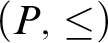 $(P, \leq )$
.Footnote
24
Given a subset
 $A \subseteq P$
, define
 $\Uparrow A$
to be the set of upper bounds of A and
 $\Downarrow A$
to be the set of lower bounds of A. The Dedekind–MacNeille completion P is the set
 $\mathsf {DM}(P) := \{ A \subseteq S : A = \Downarrow \Uparrow A \} $
ordered by inclusion. This is the smallest completion of P:
 $\mathsf {DM}(P)$
is a complete lattice containing P (via the embedding
 $p \mapsto {\downarrow } p := \{q \in P : q \,{\leq}\, p \}$
) and any complete lattice containing P will contain
 $\mathsf {DM}(P)$
.
Definition 5.30 (Dedekind–MacNeille model)
Let
 $\mathfrak {M} = (S, V , \circ , \perp )$
be a hype model. Define the Dedekind–MacNeille or DM model
 $\mathsf {DM} (\mathfrak {M}) := (S' , V' , \circ ' , \perp ')$
as follows:
-
(i)
$S' := \mathsf {DM}( S ) = \{ A \subseteq S : A = \Downarrow \Uparrow A \} $
-
(ii)
$V'(A) := \bigcup _{a \in A} V (a)$
-
(iii)
$A \circ ' B := \Downarrow \Uparrow (A \cup B)$
-
(iv)
$A \perp ' B :\Leftrightarrow \exists a \in A \exists b \in B : a \perp b$
-
(v)
$(A^{*'} = \Downarrow \{ a^* : a \in A \})$





For any hype model
 $\mathfrak {M}$
,
 $\mathsf {DM}(\mathfrak {M})$
is almost a hype model: only
 $V(A^*) \supseteq \{ \overline {v} : v \not \in V(A) \}$
is not guaranteed. It is, if
 $\mathfrak {M}$
is grounded.
Proposition 5.31 (DM model is a hype model)
If
 $\mathfrak {M}$
is a grounded hype model, then
 $\mathsf {DM} (\mathfrak {M})$
is an associative hype model.
Proof. See appendix. □
Note that by the representation theorem and since
 $\mathsf {DM} (\mathfrak {M})$
is associative, there is an information assignment to
 $\mathsf {DM} (\mathfrak {M})$
.
How is truth in
 $\mathcal {M}$
related to truth
 $\mathsf {DM}(\mathfrak {M})$
? A partial answer is the following observation.
Proposition 5.32 (DM-completion preserves
$\to $
-free formulas)

Fix a grounded hype model
 $\mathfrak {M}$
and its Dedekind–MacNeille completion
 $\mathsf {DM}(\mathfrak {M})$
. Then for all
 $\to $
-free formulas
 $\varphi $
, we have for all states
 $s \in \mathfrak {M}$
that
 $$ \begin{align*} \mathfrak{M} , s \models \varphi ~ ~ \text{ iff } ~ ~ \mathsf{DM}(\mathfrak{M}) , {\downarrow} s \models \varphi. \end{align*} $$
Proof. By induction on
 $\varphi $
. For literals, conjunctions and disjunctions this is straightforward. For negation, we first show that
 $({\downarrow } a )^* = {\downarrow } (a^*)$
. Indeed, we have
 $$ \begin{align*} b \in {\downarrow} (a^*) &\Leftrightarrow b \leq a^* \Leftrightarrow a \leq b^* \Leftrightarrow \forall c \in {\downarrow} a : c \leq b^* \\ &\Leftrightarrow b \in \Downarrow \{ c^* : c \in {\downarrow} a \} \Leftrightarrow b \in ({\downarrow} a)^*. \end{align*} $$
Hence we have
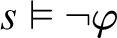 $s \models \neg \varphi $
iff (Leitgeb, Reference Leitgeb2019)
 $s^* \not \models \varphi $
iff (by induction hypothesis)
 ${\downarrow } (s^*) \not \models \varphi $
iff (above claim)
 $({\downarrow } s )^* \not \models \varphi $
iff (Leitgeb, Reference Leitgeb2019)
 ${\downarrow } s \models \neg \varphi $
. □
Skew model
Given a hype model with state space S, we construct a hype model on
 $S \times S$
that, in a way, reverses
 $\perp $
and
 $\cdot ^*$
. We mention how to think of the new model (similar to a fiber bundle), and show that truth in the old model is closely related to truth in the new model.
Definition 5.33 (Reversed product or skew model)
Let
 $\mathfrak {M} = (S, V , \circ , \perp )$
be a hype model. Define the reversed product or skew model
 $\mathfrak {M} \otimes \mathfrak {M} := (S' , V' , \circ ' , \perp ')$
as follows:
-
(i)
$S' := S \times S$
-
(ii)
$V'(s,t) := V (s) \cap V(t)$
-
(iii)
$(s , t) \circ ' (s' , t' ) := (s \circ s' , t \circ t')$
whenever
$s \circ s'$
and
$t \circ t'$
are defined -
(iv)
$(s , t ) \perp ' (s' , t') :\Leftrightarrow s \perp t' \text { or } t \perp s'$
-
(v)
$((s,t)^* = (t^* , s^*))$




Although
 $\mathfrak {M} \otimes \mathfrak {M}$
is built on the product
 $S \times S$
, it is not the product model because of the twist or reversal of
 $\perp $
and
 $\cdot ^*$
. Rather, the idea is to take the original model
 $\mathfrak {M}$
and replace every state s with a copy of the state space S. That is, we replace a state with a “fiber” or “cluster” of states. Accordingly, an element
 $(s,t)$
of
 $\mathfrak {M} \otimes \mathfrak {M}$
is not to be thought of as an element of the product
 $S \times S$
but rather as point t in fiber s.
Comparing this model construction to existing ones, fiber spaces from topology immediately come to mind. Picturesquely speaking, they consist of a base space and out of every point b of the base space grows a fiber such that the points in the neighborhood of b and their fibers look like a product space although globally the base space with its fibers is not a product.Footnote
25
In our setting, the original model
 $\mathfrak {M}$
would be the base space and a fiber out of a point s of
 $\mathfrak {M}$
is
 $\{(s , t) : t \in S \}$
. We leave it as an open question how a nontrivial topology would look like that satisfies the additional topological condition of a fiber bundle.Footnote
26
Proposition 5.34 (Reversed product is a hype model)
If
 $\mathfrak {M}$
is a hype model, then
 $\mathfrak {M} \otimes \mathfrak {M}$
is a hype model.
Proof. See appendix. □
In the remainder of this subsection, we want to show that truth in
 $\mathfrak {M} \otimes \mathfrak {M}$
is closely related to truth in
 $\mathfrak {M}$
. Similarly to the Dedekind–MacNeille completions, we note that states in
 $\mathfrak {M}$
and the diagonal states of
 $\mathfrak {M} \otimes \mathfrak {M}$
agree on
 $\to $
-free formulas.
Proposition 5.35 (Reversed product and
$\to $
-free formulas)

Let
 $\mathfrak {M}$
be a hype model. Then for all
 $\to $
-free formulas
 $\varphi $
, we have for all states s in
 $\mathfrak {M}$
that
 $$ \begin{align*} \mathfrak{M} , s \models \varphi ~ ~ \text{ iff } ~ ~ \mathfrak{M} \otimes \mathfrak{M} , (s,s) \models \varphi. \end{align*} $$
Proof. Immediate by induction on
 $\varphi $
(for negation again use that
 $s \models \neg \varphi $
iff
 $s^* \not \models \varphi $
). □
We would also like to know how formulas containing
 $\to $
behave in
 $\mathfrak {M}$
and
 $\mathfrak {M} \otimes \mathfrak {M}$
. For this we need two definitions. First, a hype model
 $\mathfrak {M}$
is exact, if for all
 $s,s' \in \mathfrak {M}$
,
 $V(s \circ s') = V(s) \cup V(s')$
(rather than just
 $\supseteq $
).Footnote
27
Second, a hype model
 $\mathfrak {M}$
is a distributive lattice, if the state space S of
 $\mathfrak {M}$
with the order induced by
 $\circ $
is a distributive lattice.
Proposition 5.36 (Reversed product and
$\neg $
-free formulas)

Let
 $\mathfrak {M} $
be a hype model that is exact and a distributive lattice. Let
 $\varphi $
be a formula where
 $\neg $
only occurs in literals. Then for all states s and t in
 $\mathfrak {M}$
,
 $$ \begin{align*} \mathfrak{M} \otimes \mathfrak{M} , (s,t) \models \varphi ~ ~ \text{ iff } ~ ~ \mathfrak{M} , s \wedge t \models \varphi. \end{align*} $$
In particular,
 $(s,s) \models \varphi $
iff
 $s \models \varphi $
. Moreover,
 $$ \begin{align*} \mathfrak{M} \otimes \mathfrak{M} , (s,t) \models \neg \varphi ~ ~ \text{ iff } ~ ~ \mathfrak{M} , s \vee t \models \neg \varphi. \end{align*} $$
Proof. By induction on
 $\varphi $
. For
 $\varphi = v$
, it suffices to show
 $V(s \wedge t) = V(s) \cap V(t)$
. Indeed, by the DeMorgan laws in hype models (Theorem 3.19), we have, since
 $s^* \circ t^*$
is defined (S is a lattice), that
 $s \wedge t = (s^* \circ t^*)^*$
. Hence, since
 $\mathfrak {M}$
is exact,
 $$ \begin{align*} V\big( s \wedge t \big) &= V \big( ( s^* \circ t^* )^* \big) \\ &= \big\{ \overline{v} : v \not\in V(s^* \circ t^*) \big\} \\ &= \big\{ \overline{v} : v \not\in V(s^*) \cup V(t^*) \big\} \\ &= \big\{ \overline{v} : v \not\in V(s^*) \big\} \cap \big\{ \overline{v} : v \not\in V(t^*) \big\} \\ &= V(s^{* *}) \cap V(t^{* *}) = V(s) \cap V(t). \end{align*} $$
Again,
 $\wedge $
and
 $\vee $
are immediate by induction hypothesis.
For
 $\varphi \to \psi $
, we show
 $(s,t) \models \varphi \to \psi $
iff
 $s \wedge t \models \varphi \to \psi $
.
(
 $\Rightarrow $
). Assume
 $(s,t) \models \varphi \to \psi $
. Let
 $s'' \models \varphi $
. We have to show
 $s'' \circ (s \wedge t) \models \psi $
. Indeed, by induction hypothesis,
 $(s'' , s'') \models \varphi $
. Since
 $(s,t) \models \varphi \to \psi $
, we have
 $(s'' , s'') \circ ' (s,t) = (s'' \circ s , s'' \circ t) \models \psi $
. By induction hypothesis and distributivity,
 $ (s'' \circ s) \wedge ( s'' \circ t) = s'' \circ (s \wedge t) \,{\models}\, \psi $
.
(
 $\Leftarrow $
). Assume
 $s \wedge t \models \varphi \to \psi $
. Let
 $(s' , t') \models \varphi $
. We have to show
 $(s',t') \circ ' (s , t) \models \psi $
. Indeed, by induction hypothesis,
 $s' \wedge t' \models \varphi $
. Since
 $s \wedge t \models \varphi \to \psi $
,
 $(s' \wedge t') \circ (s \wedge t) \models \psi $
. By distributivity,
 $$ \begin{align*} (s' \wedge t') \circ (s \wedge t) = \big( (s' \wedge t') \circ s \big) \wedge \big( (s' \wedge t') \circ t \big) \leq (s' \circ s) \wedge (t' \circ t). \end{align*} $$
It is a basic fact that
 $\models $
is monotone (Leitgeb, Reference Leitgeb2019), that is, in any hype model, if
 $s \models \varphi $
and
 $s \leq s'$
, then
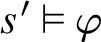 $s' \models \varphi $
. Hence
 $(s' \circ s) \wedge (t' \circ t) \models \psi $
. By induction hypothesis,
 $(s' \circ s , t' \circ t) = (s',t') \circ ' (s , t) \models \psi $
.
For the “moreover” part, we have now shown that
 $(t^* , s^*) \not \models \varphi $
iff
 $t^* \wedge s^* \not \models \varphi $
. By the lemma “
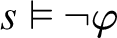 $s \models \neg \varphi $
iff
 $s^* \not \models \varphi $
” we hence have
 $$ \begin{align*} (t^* , s^*)^* \models \neg \varphi \text{ iff } (t^* \wedge s^*)^* \models \neg \varphi. \end{align*} $$
The claim follows by applying
 $(t^* , s^*)^* = (s,t)$
on the left-hand side and
 $(t^* \wedge s^*)^* = s \circ t$
(Theorem 3.19) on the right-hand side. □
5.4 Closing under information fusion
We have said that, given an informational hype model, we would like to build an extension with an information assignment that is poset complete and join-complete.
Poset completeness is achieved by the Dedekind–MacNeille completion. Join-completeness is achieved via the next theorem.
Theorem 5.37 (Obtaining join-complete information fusion)
Let
 $\mathfrak {M}$
be a complete hype modelFootnote
28
with the meet-prime separation property. Then the skew model
 $\mathfrak {M} \otimes \mathfrak {M}$
is a complete hype model that has an information assignment
 $(\iota _+ , \iota _-)$
that is join-complete and
 $\iota _+$
preserves arbitrary joins and
 $\iota _-$
preserves finite joins.
Proof. Write
 $\mathfrak {M} = ( S , V , \circ , \perp ) $
. We start by constructing
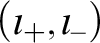 $(\iota _+ , \iota _-)$
. By Theorem 5.29, we use the separation property to find a frame order embedding of S into a completely distributive complete lattice which in turn is isomorphic to
 $C(P)$
for some continuous domain by Theorem 2.1. Hence we have an injective function
 $f : S \to C(P)$
preserving arbitrary joins and finite meets. We define
 $$ \begin{align*} \begin{array}{c@{\qquad}c} \iota_+ : S \times S \to C(P) & \iota_- : S \times S \to O(P) \\ (s,t) \mapsto f(s) & (s,t) \mapsto \big(\kern1.2pt f(t^*) \big)^c. \end{array}\end{align*} $$
(Note that
 $\iota _-$
is well-defined, since
 $\iota _-(s,t)$
is the complement of a Scott-closed set and hence open.) We need to show:
-
(1)
$\mathfrak {M} \otimes \mathfrak {M}$
is complete (as partial order). -
(2)
$(\iota _+ , \iota _-)$
is injective. -
(3)
$\iota _+ \big ( (s,t)^* \big ) = \big ( \iota _- (s,t) \big )^c$
and
$\iota _- \big ( (s,t)^* \big ) = \big ( \iota _+ (s,t) \big )^c$
. -
(4)
$(\iota _+ , \iota _-)$
is join-complete. -
(5)
$\iota _+$
preserves arbitrary joins, and
$\iota _-$
preserves finite joins.


Ad (1). By definition,
 $(s,t) \leq (s' , t')$
iff
 $s \leq s'$
and
 $t \leq t'$
. Hence, given
 $A \times B \subseteq \mathfrak {M} \otimes \mathfrak {M}$
,
 $(\bigvee A , \bigvee B)$
is the least upper bound of
 $A \times B$
.
Ad (2). Immediate, since f is injective.
Ad (3). We have
 $$ \begin{align*} \iota_+ \big( (s,t)^* \big) &= \iota_+ (t^* , s^* ) = f(t^*) = \big(\kern1.2pt f(t^*)^c \big)^c = \big( \iota_- (s,t) \big)^c \\ \iota_- \big( (s,t)^* \big) &= \iota_- (t^* , s^* ) = \big(\kern1.2pt f(s^{**}) \big)^c = \big(\kern1.2pt f(s) \big)^c = \big( \iota_+ (s,t) \big)^c. \end{align*} $$
Ad (4). Let
 $A \times B , A_0 \times B_0 \subseteq \mathfrak {M} \otimes \mathfrak {M}$
where
 $A_0 \times B_0$
is finite. Since
 $\mathfrak {M}$
is complete (as partial order), we can choose
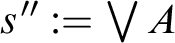 $s'' := \bigvee A$
and
 $t'' := \bigvee B_0$
. Then we have
 $$ \begin{align*} \iota_+ (s'', t'') = f(\bigvee A) = \mathsf{Cl} \bigcup\limits_{s \in A} f(s) = \mathsf{Cl} \bigcup\limits_{(s , t) \in A \times B} \iota_+ (s,t). \end{align*} $$
Moreover, we have
 $$ \begin{align*} \iota_- (s'', t'') &= \big(\kern1.2pt f \big( (\bigvee B_0)^* \big) \big)^c \overset{{Theorem}~{3.19.}}{=} \big(\kern1.2pt f \big( \bigwedge \{ t^* : t \in B_0 \} \big) \big)^c \\[3pt] &= \big( \bigcap \big\{\kern1.2pt f(t^*) : t \in B_0 \big\} \big)^c = \bigcup\limits_{t \in B_0} \big(\kern1.2pt f(t^*) \big)^c \\[3pt] &= \bigcup\limits_{(s , t) \in A_0 \times B_0} \iota_- (s,t). \end{align*} $$
Ad (5). Using this reasoning, we have for
 $A \times B , A_0 \times B_0 \subseteq \mathfrak {M} \otimes \mathfrak {M}$
with
 $A_0 \times B_0$
finite, that
 $$ \begin{align*} \iota_+ \big( \bigvee A \times B \big) &= \iota_+ \big( \bigvee A , \bigvee B \big) = \mathsf{Cl} \bigcup\limits_{(a , b) \in A \times B} \iota_+ (a,b) \\ \iota_- \big( \bigvee A_0 \times B_0 \big) &= \iota_- \big( \bigvee A_0 , \bigvee B_0 \big) = \bigcup\limits_{(a , b) \in A_0 \times B_0} \iota_+ (a,b), \end{align*} $$
as needed. □
Thus, the procedure outlined at the end of §5.1 does indeed yield a way of closing a state space under the two generic kinds of fusion.
6 Conclusion
Let’s conclude with a summary and some open questions. In the first half, we have seen the domain-theoretic information structure of state spaces. These subsume a wide range of examples. These information structures are in correspondence with hype models, whence the logic hype is a sound and complete logic to reason about information in state spaces. In the second half, we have looked at ways to close a state space under appropriate information fusion. We have motivated two kinds of fusion as the generic ones. We have provided the groundedness and separation properties together with the Dedekind–MacNeille completion and the skew product that allowed us to obtain the required closure under fusion.
As far as future research is concerned, we have already mentioned, for example, further investigating the trajectory domain and the presheaf on spectral spaces, or extending the correspondence between information structures and hype models into a full-fledged category-theoretic correspondence. Moreover, since hype is also developed as first-order logic, it is natural to explore the first-order informational setting as well. Also, one could consider more dimensions of information other than just positive and negative (e.g., verified, some evidence, merely conjectured, some counter-evidence, falsified).Footnote
29
Then one should look for respective representation theorems and see whether they can be reduced to the two-dimensional setting. And one could consider how domain-theoretic operations applied to the domain of pieces of information (product, sum, function space, bilimits, domain equations, etc.) translate to the logical setting. Furthermore, Leitgeb (Reference Leitgeb2019) applies hype to semantic paradoxes by providing a hype model whose states may be thought of as the fixed points of four-valued semantics for type-free truth. What can the informational perspective due to the representation theorem add? How do fixed points relate to domain-theoretic fixed points? Does this construction transfer to other fixed point constructions? For example, information assignments map each state to an element of
 $C(P) \times O(P)$
. Lattices of this form are called topological bilattices. Fitting (Reference Fitting1988) uses assignments into them to provide a fixed point semantics for logic programming. Since computation in a neural network is a fixed point procedure as well, how does this help to understand information processing of neural networks? Finally, one intention of hype is to provide a background system for hyperintensional operators (Leitgeb, Reference Leitgeb2019), thus it would be interesting to add further operators to the language of hype that can express additional structure of specific (kinds of) state spaces. For example, for state spaces of dynamical systems, one could consider the operator ‘in the next state
 $\varphi $
holds’ or ‘it is plausible that the system will evolve into a state where
 $\varphi $
holds’.
A Correspondence
We prove Theorems 4.20 and 4.22 that establish a correspondence between information structures and hype models.
Theorem 4.20
Let S be a nonempty set. Let
 $\mathfrak {I} = (S,P,\iota ,V)$
be an information structure of S. Then
 $\mathfrak {M} := (S , V , \circ _{\iota } , \bot _{\iota })$
is a hype model.
Proof. We check the conditions (0)–(4), where (0) and (1) are trivially satisfied. Since V supervenes on
 $\iota $
, the (a)-conditions are satisfied by definition. The remaining conditions are dealt with as follows.
Conditions (2)(b–d) and (3)(b) are readily checked, so it remains (4)(b–d). (b) We have, since
 $(\iota _+ , \iota _-)$
is an information assignment,
 $$ \begin{align*} \iota_{\pm} (s^{*_{\iota} *_{\iota}}) = \big( \iota_\mp (s^{*_{\iota} } ) \big)^c = \big( \big( \iota_{\pm} (s) \big)^c \big)^c = \iota_{\pm} (s), \end{align*} $$
so, since
 $\iota $
is injective,
 $s^{*_{\iota } *_{\iota }} = s$
. (c) We have
 $$ \begin{align*} \emptyset = \iota_{\pm} (s) \cap \big( \iota_{\pm} (s) \big)^c = \iota_{\pm} (s) \cap \iota_\mp (s^{*_{\iota}}), \end{align*} $$
so, by definition,
 $s \not \perp _{\iota } s^{*_{\iota }}$
. (d) Assume
 $s \not \perp _{\iota } s'$
. Show
 $s' \circ _{\iota } s^{*_{\iota }}$
is defined and equals
 $s^{*_{\iota }}$
. For this it suffices to show
 $\iota _{\pm } ( s^{*_{\iota }} ) = \iota _{\pm } (s') \cup \iota _{\pm } (s^{*_{\iota }})$
. Indeed, by definition of
 $s \not \perp _{\iota } s'$
we have
 $$ \begin{align*} \emptyset &= \iota_+ (s) \cap \iota_- (s') = \big( \iota_- (s^{*_{\iota}}) \big)^c \cap \iota_- (s') \\ \emptyset &= \iota_- (s) \cap \iota_+ (s') = \big( \iota_+ (s^{*_{\iota}}) \big)^c \cap \iota_+ (s'), \end{align*} $$
so
 $\iota _{\pm } (s') \subseteq \iota _{\pm } ( s^{*_{\iota }})$
and the claim follows. □
Theorem 4.22
Let
 $\mathfrak {M} = (S, V , \circ , \perp )$
be an associative hype model. Then there is an information structure
 $(S , P , \iota , V)$
generating the hype model
 $\mathfrak {M}_{\iota } = (S,V,\circ _{\iota } , \perp _{\iota } )$
such that
-
(0) Both
$\iota _+$
and
$\iota _-$
are injective and
$\leq $
-monotone. -
(1) Incompatibility is informational incompatibility:
$\perp = \perp _{\iota }$
. -
(2) Fusion is informational supremum: for all
$s,s' \in S$
,
$s \circ s' = \bigvee {} _{\leq _{\iota }} \{ s , s'\}$
(i.e., one exists iff the other exists, and in both cases they are the same). -
(3) Mereology is informational containment:
$s \leq s'$
iff
$s \leq _{\iota } s'$
. -
(4)
$\mathfrak {M}$
and
$\mathfrak {M}_{\iota }$
are equivalent:
$\mathfrak {M} , s \models \varphi $
iff
$\mathfrak {M}_{\iota } , s \models \varphi $
.


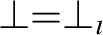


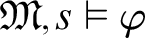

Proof. Since
 $(S , \leq )$
is a partial order, it is well-known that the set of its order ideals
 $P := \mathrm {Idl}(S)$
forms a continuous dcpo under the set-inclusion order (in fact P even is algebraic). Define
 $\iota _+ : S \to C(P)$
by
 $$ \begin{align*} \iota_+ (s) := {\downarrow}_{\subseteq} {\downarrow}_{\leq} s \end{align*} $$
which clearly is a Scott closed set. Define
 $\iota _- : S \to O(P)$
by
 $\iota _-(s) := \big ( \iota _+ (s^*) \big )^c$
. Since
 $\iota _+$
is easily seen to be injective, also
 $\iota _-$
and
 $(\iota _+ , \iota _-)$
are injective, and by definition
 $\iota _{\pm } (s^*) = \big ( \iota _\mp (s) \big )^c$
, so
 $(\iota _+ , \iota _-)$
is an information assignment. We show that V supervenes on
 $(\iota _+ , \iota _-)$
by a sequence of claims.
-
C1 For all
$s,s' \in S$
,
$s \leq s'$
iff
$\iota _+ (s) \subseteq \iota _+ (s')$
. -
Because: For (
$\Leftarrow $
), assume
$\iota _+ (s) \subseteq \iota _+ (s')$
. Then
${\downarrow }_{\leq } s \in {\downarrow }_{\subseteq } {\downarrow }_{\leq } s \subseteq {\downarrow }_{\subseteq } {\downarrow }_{\leq } s'$
so
$s \in {\downarrow }_{\leq } s \subseteq {\downarrow }_{\leq } s'$
, so
$s \leq s'$
. For (
$\Rightarrow $
), assume
$s \leq s'$
and let
$A \in {\downarrow }_{\subseteq } {\downarrow }_{\leq } s$
and show
$A \in {\downarrow }_{\subseteq } {\downarrow }_{\leq } s'$
. Indeed, by assumption
$A \subseteq {\downarrow }_{\leq } s \subseteq {\downarrow }_{\leq } s'$
(since
$\leq $
is transitive), whence
$A \in {\downarrow }_{\subseteq } {\downarrow }_{\leq } s'$
. -
C2 For all
$s,s' \in S$
,
$\iota _+ (s) \subseteq \iota _+ (s')$
iff
$\iota _- (s) \subseteq \iota _- (s')$
. -
Because: By claim 1,
$\iota _+ (s) \subseteq \iota _+ (s')$
iff
$s \leq s'$
iff
${s'}^{*} \leq s^*$
iff
$\iota _+ ({s'}^{*}) \subseteq \iota _+ (s^*)$
iff
$\iota _+ (s^*)^c = \iota _-(s) \subseteq \iota _-(s') = \iota _+ ({s'}^{*})$
. -
C3 For all
$s,s' \in S$
,
$s \leq s'$
iff
$\iota _{\pm } (s) \subseteq \iota _{\pm } (s')$
. -
Because: Immediate from claim 1 and 2.
-
C4 For all
$s,s' \in S$
,
$s \leq s'$
iff
$s \leq _{\iota } s'$
. -
Because: By definition of
$\circ _{\iota }$
,
$s \leq _{\iota } s'$
iff
$\iota _{\pm } (s) \subseteq \iota _{\pm } (s')$
and the claim follows by claim 3. -
C5 For all
$s,s' \in S$
,
$s \perp s'$
iff
$s \perp _{\iota } s'$
. -
Because: We have
$s \not \perp _{\iota } s'$
iff
$\iota _+ (s) \cap \iota _- (s') = \emptyset $
and
$\iota _- (s) \cap \iota _+ (s') = \emptyset $
iff (by definition of
$\iota _-$
)
$\iota _+ (s) \subseteq \iota _+ ({s'}^{*})$
and
$\iota _- (s) \subseteq \iota _- ({s'}^{*})$
iff (by claim 3)
$s \leq {s'}^{*}$
iff (by Lemma 3.13)
$s \not \perp s'$
. -
C6 V supervenes on
$(\iota _+ , \iota _-)$
. -
Because: Clearly,
$* = *_{\iota }$
and by the previous claim 5
$\perp = \perp _{\iota }$
, so, since V is an assignment of a hype model, clauses (ii) and (iii) of the definition of “V supervenes on
$\iota $
” are satisfied (see Definition 2.7). For clause (i), assume for contradiction that
$s'' := s \circ _{\iota } s'$
exists but there is a literal v such that
$v \in V(s) \cup V(s')$
but
$v \not \in V(s'')$
. Without loss of generality,
$v \in V(s)$
. By the latter,
$\overline {v} \in V({s''}^{*})$
, so
$s \perp {s''}^{*}$
. However, so
$$ \begin{align*} \iota_{\pm} (s) \cap \iota_\mp({s''}^{*}) &= \iota_{\pm} (s) \cap \big( \iota_{\pm}(s'') \big)^c \\ &= \iota_{\pm} (s) \cap \big( \iota_{\pm} (s) \cup \iota_{\pm} (s') \big)^c = \emptyset, \end{align*} $$
$s \not \perp _{\iota } {s''}^{*}$
, whence, by claim 5,
$s \not \perp {s''}^{*}$
, contradiction.


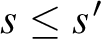





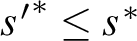


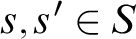


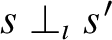


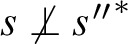
Thus, we have our model
 $\mathfrak {M}_{\iota }$
and we claim it has the required properties (0)–(4). We already have (1) and (3) by claims 5 and 4, respectively.
Concerning (0), it is immediate that
 $\iota _+$
and
 $\iota _-$
are injective and they are, by claims 1 and 2,
 $\leq $
-monotone.
Concerning (2), assume
 $s \circ s'$
exists, then, by Lemma 3.16,
 $s \circ s' = \bigvee _{\leq } \{s , s'\}$
and by claim 4
 $\leq = \leq _{\iota }$
, so
 $\bigvee _{\leq _{\iota }} \{s , s'\}$
exists and equals
 $s \circ s'$
.
Conversely, assume
 $\bigvee _{\leq _{\iota }} \{s , s'\}$
exists and show that
 $s \circ s'$
exists and the two are equal. Again, by claim 4,
 $s'' := \bigvee _{\leq } \{s , s'\} = \bigvee _{\leq _{\iota }} \{s , s'\}$
exists, so
 $s \circ s''$
and
 $s' \circ s''$
exist and equal
 $s''$
. Hence
 $(s' , s'') \in \mathrm{dom} (\circ )$
and
 $(s , s' \circ s'') \in \mathrm{dom} (\circ )$
. Since
 $\circ $
is associative,
 $s \circ s'$
exists, and, by Lemma 3.16,
 $s \circ s' = \bigvee _{\leq } \{s , s'\} = \bigvee _{\leq _{\iota }} \{s , s'\}$
.
Concerning (4), we show the claim by induction on
 $\varphi $
. The steps where
 $\varphi $
is atomic, a disjunction, or a conjunction are trivial. If
 $\varphi $
is a negation we use that
 $\perp = \perp _{\iota }$
. For the conditional we have to show that the following two are equivalent:
-
(a) For all
$s'$
, if
$\mathfrak {M} , s' \models \varphi $
and
$s \circ s'$
is defined, then
$\mathfrak {M} , s \circ s' \models \psi $
. -
(b) For all
$s'$
, if
$\mathfrak {M}_{\iota } , s' \models \varphi $
and
$s \circ _{\iota } s'$
is defined, then
$\mathfrak {M}_{\iota } , s \circ _{\iota } s' \models \psi $
.



(a)
 $\Rightarrow $
(b). Let
 $\mathfrak {M}_{\iota } , s' \models \varphi $
and
 $s \circ _{\iota } s'$
be defined. Since
 $\iota _{\pm } (s), \iota _{\pm } (s') \subseteq \iota _{\pm } (s \circ s')$
, we have
 $s , s' \leq _{\iota } s \circ _{\iota } s'$
. Since in hype models formula satisfaction is monotone under
 $\leq $
,
 $\mathfrak {M}_{\iota } , s \circ _{\iota } s' \models \varphi $
. By induction hypothesis,
 $\mathfrak {M} , s \circ _{\iota } s' \models \varphi $
. Since
 $\circ $
is reflexive,
 $(s \circ _{\iota } s') \circ (s \circ _{\iota } s') = (s \circ _{\iota } s')$
is defined and the assumption implies
 $\mathfrak {M} , (s \circ _{\iota } s') \circ (s \circ _{\iota } s') \models \psi $
. By induction hypothesis,
 $\mathfrak {M}_{\iota } , s \circ _{\iota } s' \models \psi $
.
(b)
 $\Rightarrow $
(a). Let
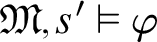 $\mathfrak {M} , s' \models \varphi $
and
 $s \circ s'$
be defined. Since, by Lemma 3.16,
 $s \circ s' = \bigvee _{\leq } \{s , s'\}$
, we have
 $s , s' \leq s \circ s'$
. By monotonicity,
 $\mathfrak {M} , s \circ s' \models \varphi $
. By induction hypothesis,
 $\mathfrak {M}_{\iota } , s \circ s' \models \varphi $
. By reflexivity of
 $\circ _{\iota }$
and the assumption,
 $\mathfrak {M}_{\iota } , ( s \circ s') \circ _{\iota } ( s \circ s') \models \psi $
. By induction hypothesis,
 $\mathfrak {M} , s \circ s' \models \psi $
. □
B Separation and embeddability
We characterize embeddability with separation by completely prime filters and obtain the embeddability Theorem 5.29 as a corollary.
We start with some terminology. Given a poset
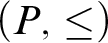 $(P,\leq )$
, a subset
 $F \subseteq P$
is a filter if F is an upset and for all
 $a,b \in F$
, if
 $a \wedge b$
exists, then
 $a \wedge b \in F$
. A filter F is prime, if for all
 $a,b \in P$
, if
 $a \vee b$
exists and is in F, then
 $a \in F$
or
 $b \in F$
. And F is completely prime if this also holds for arbitrary joins. We say that P has the completely prime filter separation property if for all
 $a,b \in P$
, if
 $a \not \leq b$
, there is a completely prime filter
 $F \subseteq P$
such that
 $a \in F$
and
 $b \not \in F$
. If x is a meet-prime element,
 $({\downarrow } x)^c$
is a completely prime filter, so we have the following.
Lemma 2.38. If a poset P has the meet-prime separation property, it has the completely prime filter separation property.
We say a poset P is frame order embeddable into a poset Q if there is a function
 $f : P \to Q$
such that
-
(i) f is an order embedding: for all
$a,b \in P$
,
$a \leq b$
iff
$f(a) \leq f(b)$
, and -
(ii) f preserves all existing arbitrary joins and finite meets.


We now want to use the completely prime filter separation property to characterize when a poset is frame order embeddable into a completely distributive complete lattice (Theorem 2.41 below). Using Lemma 2.38, we obtain Theorem 5.29 as corollary.
We first collect two results needed for the proof. The first is a basic one.
Lemma 2.39 (Preimage of filters)
Let P and Q be posets and let
 $f : P \to Q$
preserve all existing arbitrary joins and finite meets. Then, if
 $G \subseteq Q$
is a completely prime filter of Q,
 $F := f^{-1}(G)$
is a completely prime filter of P.
The second is a fundamental characterization of completely distributive complete lattices originally due to Raney. For the version below, see Gierz et al. (Reference Gierz, Hofmann, Keimel, Lawson, Mislove and Scott2003, IV-3.32, p. 303 f.) or Moresco (Reference Moresco1987).
Lemma 2.40. Completely distributive complete lattices are exactly those posets that are isomorphic to a subset of some cube (that is, a lattice
 $\prod _I [0,1]$
where
 $[0,1]$
is the unit interval and I some index set) which is closed under arbitrary joins and arbitrary meets.
Now we can show the promised result. In a way, both the statement and the proof is a generalization of a theorem due to Van Alten (Reference Van Alten2016, theorem 3.1).
Theorem 2.41 (Frame order embeddings and filter separation)
Let
 $(S,\leq )$
be a poset. Then S is frame order embeddable into a completely distributive complete lattice L iff S has the completely prime filter separation property.
Proof. (
 $\Rightarrow $
). Let
 $f : S \to L$
be a frame order embedding into a completely distributive complete lattice L. Let
 $a \not \leq b$
and show that we can separate a and b by a completely prime filter.
By Lemma 2.40, there is, in particular, a frame order embedding
 $h : L \to \prod _{i \in I} [0,1]$
(for some index set I). Since
 $a \not \leq _S b$
we have, qua order embeddings,
 $h(\,f(a)) \not \leq _{\prod } h(\,f(b))$
. By the definition of the product, there is
 $i \in I$
such that
 $r := \pi _i \big ( h(\,f(a)) \big ) \not \leq _{[0,1]} \pi _i \big ( h(\,f(b))(i) \big ) =: s $
, where
 $\pi _i$
is the projection of
 $\prod _{i \in I} [0,1]$
to the i-th copy
 $[0,1]$
.
Note that, since
 $[0,1]$
is a chain,
 $r> s$
. Hence there is an
 $\epsilon> 0$
such that
 $r - \epsilon> s$
. The half-open interval
 $G := (r - \epsilon , 1] $
is a completely prime filter of
 $[0,1]$
that contains r but not s. We want to apply Lemma 2.39 to get the filter G to S.
Indeed, by definition of the product,
 $\pi _i : \prod _{i \in I} [0,1] \to [0,1]$
preserves arbitrary joins and meets. Hence
 $\pi _i \circ h \circ f : S \to [0,1]$
satisfies the conditions of Lemma 2.39, whence
 $F := \{ s \in S : \pi _i \circ h \circ f (s) \in G \}$
is a completely prime filter of S. Moreover,
 $\pi _i \circ h \circ f (a) = r \in G$
and
 $\pi _i \circ h \circ f (b) = s \not \in G$
, so
 $a \in F$
and
 $b \not \in F$
, whence F also separates a and b.
(
 $\Leftarrow $
). Let
 $CPF(S)$
be the set of completely prime filters of S and define
 $L := \prod _{F \in CPF(S)} \boldsymbol {2}$
where
 $\boldsymbol {2} = \{0,1\}$
is the two element chain. Now, L is a completely distributive complete lattice since it is a subset of
 $\prod _{F \in CPF(S)} [0,1]$
closed under arbitrary joins and arbitrary meets (Lemma 2.40). Hence it remains to find a frame order embedding
 $h : S \to L$
.
Given
 $F \in CPF(S)$
, define
 $\chi _F : S \to \boldsymbol {2}$
by
 $\chi _F(a) = 1$
if
 $a \in F$
and
 $= 0$
otherwise. Define
 $h : S \to \prod _{F \in CPF(S)} \boldsymbol {2}$
by
 $h(a) (F) = \chi _F(a)$
. We need to show: (i) h preserves arbitrary joins and finite meets, and (ii) h is an order-embedding.
Ad (i). We have, by definition of the product,
 $h( \bigvee A) = \bigvee _{a \in A} h(a)$
iff for all
 $F \in CPF(S)$
,
 $h( \bigvee A)(F) = \bigvee _{a \in A} h(a)(F)$
, iff for all
 $F \in CPF(S)$
,
 $\chi _F ( \bigvee A) = \bigvee _{a \in A} \chi _F(a)$
. And similarly for the meets. Hence it suffices to show that
 $\chi _F$
preserves arbitrary joins and finite meets which is straightforward since F is a completely prime filter.
Ad (ii). We show
 $a \leq b$
iff
 $h(a) \leq h(b)$
. Indeed, if
 $a \leq b$
, then, since h preserves finite joins,
 $h(a) \leq h(b)$
. Conversely, if
 $a \not \leq b$
, then, by the separation assumption, there is a
 $F \in CPF(S)$
such that
 $a \in F$
and
 $b \not \in F$
. Hence
 $h(a)(F) = \chi _F (a) = 1 \not \leq 0 = \chi _F(b) = h(b)(F)$
, whence
 $h(a) \not \leq h(b)$
. □
C Model constructions
We show that the model constructions do indeed yield a hype model again (under appropriate assumptions).
Proposition 5.31.
If
 $\mathfrak {M}$
is a grounded hype model, then
 $\mathsf {DM} (\mathfrak {M})$
is an associative hype model.
Proof. Since the conditions (0) and (1) of hype models are trivially satisfied, we need to check (2)–(4).
(2)(a) If
 $v \in V(A) \cup V(B)$
, then
 $v \in V(a)$
for some
 $a \in A$
or
 $v \in V(b)$
for some
 $b \in B$
. Without loss of generality, assume the former. Then, since
 $X \subseteq \Downarrow \Uparrow X$
,
 $a \in A \cup B \subseteq \Downarrow \Uparrow (A \cup B)$
, so
 $v \in V(a) \subseteq \bigcup _{s \in \Downarrow \Uparrow (A \cup B) } V(s) = V(A \circ ' B)$
.
(2)(b)–(d) This follows since
 $S'$
is a lattice, and hence associative.
(3)(a)–(b) This is straightforward using that the corresponding properties hold in the original model.
(4) We claim that for
 $A \in S'$
we can choose
 $A^* := \Downarrow \{ a^* : a \in A \}$
which is in
 $S'$
since
 $\Downarrow X = \Downarrow \Uparrow \Downarrow X$
.
(a) We need to show
 $V'(A^*) = \{ \overline {v} : v \not \in V'(A) \}$
. We have
 $$ \begin{align*} V'(A^*) = \bigcup\limits_{b \in \Downarrow \{a^* : a \in A \} } V(b) =\text{\footnotemark} \bigcup\limits_{b^* \in \Uparrow A } V(b) = \bigcup\limits_{c \in \Uparrow A } V(c^*). \end{align*} $$
Hence
 $\overline {v} \in V'(A^*)$
iff
 $\exists b \in \Uparrow A : \overline {v} \in V(b^*)$
iff
 $$ \begin{align} \exists b \in \Uparrow A : v \not\in V(b). \end{align} $$
Moreover,
 $\overline {v} \in \{ \overline {v} : v \not \in V'(A) \}$
iff
 $v \not \in V'(A) = \bigcup _{a \in A} V(a)$
iff
 $$ \begin{align} \forall a \in A : v \not\in V(a). \end{align} $$
So it suffices to show that (C.1) and (C.2) are equivalent.
(C.1)
 $\Rightarrow $
(C.2). Let
 $b \in \Uparrow A$
with
 $v \not \in V(b)$
. Assume for contradiction that there is
 $a \in A$
with
 $v \in V(a)$
. Then, since b is an upper bound,
 $a \leq b$
, and since valuations are monotone,
 $V(a) \subseteq V(b)$
, so
 $v \in V(b)$
, contradiction.
(C.2)
 $\Rightarrow $
(C.1). By contraposition: Assume that for all
 $b \in \Uparrow A$
,
 $v \in V(b)$
. Since
 $\mathfrak {M}$
is grounded, there is a lower bound c of
 $\Uparrow A$
with
 $v \in V(c)$
. Since
 $A = \Downarrow \Uparrow A$
,
 $c \in A$
, whence (C.2) is false.
(b) We need to show
 $A^{**} = A$
. Indeed, we have
 $$ \begin{align*} b \in A^{**} &\Leftrightarrow b \in \Downarrow \{ a^* : a \in A^* \} \Leftrightarrow b^* \in \Uparrow A^* \\ &\Leftrightarrow \forall c: \text{if } c \in \Downarrow \{ a^* : a \in A \} \text{, then } c \leq b^* \\ &\Leftrightarrow \forall c: \text{if } c^* \in \Uparrow A \text{, then } b \leq c^* \\ &\Leftrightarrow \forall d: \text{if } d \in \Uparrow A \text{, then } b \leq d \\ &\Leftrightarrow b \in \Downarrow \Uparrow A = A. \end{align*} $$
(c) We need to show
 $A^* \not \perp ' A$
. If not, there is
 $b \in A^*$
and
 $a \in A$
such that
 $b \perp a$
. Since
 $b \in A^* = \Downarrow \{ a^* : a \in A \}$
,
 $b^*$
is an upper bound of A. Since
 $a \in A = \Downarrow \Uparrow A$
, a is a lower bound of upper bounds of A. Hence
 $a \leq b^*$
, whence, by Lemma 3.13,
 $b \not \perp a$
, contradiction.
(d) We show that
 $A^* = \bigvee _{A' \not \perp ' A} A'$
. For this it suffices to show
 $\bigcup _{A' \not \perp ' A} A' = \Downarrow \{ a^* : a \in A \}$
. Indeed, we have that
 $b \in \bigcup _{A' \not \perp A'} A' $
iff
 $$ \begin{align} \exists A' \in S' : b \in A' \quad\text{and}\quad \forall a' \in A' \forall a \in A : a' \not\perp a. \end{align} $$
It suffices to show that this is equivalent to
 $$ \begin{align} \forall a \in A : b \not\perp a, \end{align} $$
since then, by Lemma 3.13,
 $b \leq a^*$
for any
 $a \in A$
, as needed.
That (C.3) implies (C.4) is trivial, and for the other direction we claim that we can choose
 $A' := \Downarrow \{ b \} \in S'$
. Indeed, we have
 $b \in A'$
, and if
 $a' \in A'$
and
 $a \in A$
, then
 $a' \leq b$
and
 $b \not \perp a$
, so also
 $a' \not \perp a$
. □
Proposition 5.34. If
 $\mathfrak {M}$
is a hype model, then
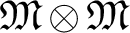 $\mathfrak {M} \otimes \mathfrak {M}$
is a hype model.
Proof. Since the conditions (0) and (1) of hype models are trivially satisfied, we need to check (2)–(4).
(2)(a) Since for all
 $s \in S$
,
 $V(s) \subseteq V(s \circ s')$
, if
 $s \circ s'$
is defined, we have
 $$ \begin{align*} V'(s,t) \cup V'(s',t') =& \big( V(s) \cap V(t) \big) \cup \big( V(s') \cap V(t') \big) \\ \subseteq V(s \circ s') \cap V(t \circ t') =& V'( s \circ s' , t \circ t' ) = V'\big( (s,t) \circ' (s',t') \big), \end{align*} $$
if
 $(s,t) \circ ' (s',t')$
is defined, that is,
 $s \circ s'$
and
 $t \circ t'$
are defined.
(b)–(d) This is readily checked due to the pointwise definition of
 $\circ '$
.
(3)(a–b) This is straightforward.
(4) We claim that we can choose
 $(s,t)^* = (t^* , s^*) \in S'$
. (a). We have
 $$ \begin{align*} V'\big( (s,t)^* \big) &= V' (t^* , s^*) = V (t^*) \cap V( s^*) = \{ \overline{v} : v \in V(t) \} \cap \{ \overline{v} : v \in V(s) \} \\ &= \{ \overline{v} : v \in V(s) \cap V(t) \} = \{ \overline{v} : v \in V'(s,t) \}. \end{align*} $$
(b) We have
 $(s,t)^{* * } = (t^* , s^*)^* = (s^{* *} , t^{* *} ) = (s,t)$
.
(c) If
 $(s,t) \perp (s,t)^*$
(
 $=(t^*,s^*)$
), then
 $s \perp s^*$
or
 $t \perp t^*$
, which can’t be.
(d) Assume
 $(s,t) \not \perp (s',t')$
. Show that
 $(s' , t') \circ ' (s,t)^*$
is defined and
 $(s' , t') \circ ' (s,t)^* = (s,t)^*$
. Since
 $(s,t) \not \perp (s',t')$
,
 $s \not \perp t'$
and
 $t \not \perp s'$
. Hence
 $t' \circ s^*$
is defined and equals
 $s^*$
, and
 $s' \circ t^*$
is defined and equals
 $t^*$
. Hence
 $(s' \circ t^* , t' \circ s^*) = (s' , t') \circ ' (t^* , s^*)$
is defined and equals
 $(t^* , s^*) = (s,t)^*$
. □
7 Acknowledgments
For inspiring discussions and comments, I’m grateful to Franz Berto, Michiel van Lambalgen, the audience of Logica 2018, and an anonymous referee. This work is part of the research programme “Foundations of Analogical Thinking” with project number 322-20-017, which is financed by the Netherlands Organisation for Scientific Research (NWO).