


Introduction
While efficacy studies have shown that disorder specific CBTs (cognitive behavioural therapies) are efficacious for a wide range of common mental health problems (e.g. Butler et al., Reference Butler, Chapman, Forman and Beck2006; Sighvatsson et al., Reference Sighvatsson, Kristjánsdóttir, Sigurðsson and Sigurðsson2011), it is also apparent that these treatments share many common features (e.g. Beck, Reference Beck2005; Harvey et al., Reference Harvey, Watkins, Mansell and Shafran2004). Based on these similarities, transdiagnostic CBT (TCBT) has been increasingly deployed. Such approaches typically use similar principles for CBT treatment to those identified in disorder specific treatment manuals (Barlow et al., Reference Barlow, Farchione, Fairholme, Ellard, Boisseau, Allen and Ehrenreich-May2011; Harvey et al., Reference Harvey, Watkins, Mansell and Shafran2004; McEvoy et al., Reference McEvoy, Nathan and Norton2009) in ways that allows them to be deployed across a range of diagnostic groups.
Most TCBT efficacy studies have focused on a relatively narrow range of diagnoses, such as eating disorders (e.g. Fairburn et al., Reference Fairburn, Cooper, Doll, O'Connor, Bohn, Hawker and Palmer2009) and group therapy for various anxiety disorders (e.g. Arch et al., Reference Arch, Ayers, Baker, Almklov, Dean and Craske2013; Norton, Reference Norton2012). Reported results have been promising (e.g. Arch et al., Reference Arch, Ayers, Baker, Almklov, Dean and Craske2013; Fairburn et al., Reference Fairburn, Cooper, Doll, O'Connor, Bohn, Hawker and Palmer2009; Norton and Philipp, Reference Norton and Philipp2008; Norton and Barrera, Reference Norton and Barrera2012; Schmidt et al., Reference Schmidt, Buckner, Pusser, Woolaway-Bickel and Preston2012; Riccardi et al., Reference Riccardi, Korte and Schmidt2017; Schröder et al., Reference Schröder, Jelinek and Mortiz2017). TCBT across depression and the range of anxiety disorders is less widely described. To our knowledge results from a few transdiagnostic treatment programmes including both anxiety and depression have been reported (e.g. Barlow et al., Reference Barlow, Farchione, Fairholme, Ellard, Boisseau, Allen and Ehrenreich-May2011; Farchione et al., Reference Farchione, Fairholme, Ellard, Boisseau, Thompson-Hollands, Carl, Gallagher and Barlow2012; Manning et al., Reference Manning, Hooke, Tannenbaum, Blythe and Clarke1994; Hook and Page, Reference Hooke and Page2002; McEvoy and Nathan, Reference McEvoy and Nathan2007; Wuthrich and Rapee, Reference Wuthrich and Rapee2013; Ejeby et al., Reference Ejeby, Savitskij, Öst, Ekbom, Brandt, Ramnerö, Marie and Backlund2014; Kristjansdóttir et al., Reference Kristjánsdóttir, Salkovskis, Sigurðsson, Sigurðsson, Agnarsdóttir and Sigurðsson2016; Gros et al., Reference Gros, Szafranski and Shead2017).
Although studies indicate that such TCBTs reduce generic symptoms (Kristjánsdóttir et al., Reference Kristjánsdóttir, Salkovskis, Sigurðsson, Sigurðsson, Agnarsdóttir and Sigurðsson2016; McEvoy et al., Reference McEvoy, Nathan and Norton2009), impact on disorder specific symptoms is not usually reported. Typically, TCBT studies use generic instruments to measure treatment outcomes, but these do not necessarily mirror significant changes in disorder specific measures. It may be that such treatments reduce reported levels of general distress, but not disorder specific symptoms. Therefore, the real test of efficacy of TCBT across diagnoses is whether disorder specific symptoms decrease following treatment, i.e. rituals in obsessive compulsive disorder (OCD), or panic attacks in panic disorder (PD), in line with more general measures of distress. If general distress decreases following treatment, but disorder specific symptoms show lesser decrease, this may well indicate a need for further treatment focused on disorder specific factors.
Norton and Barrera (Reference Norton and Barrera2012), who examined specific effects of transdiagnostic treatment, randomized patients with PD, generalized anxiety disorder (GAD) and social phobia (SP) to either transdiagnostic group therapy for anxiety disorders or disorders specific CBT group treatment. Symptom specific measurements showed that the effects of the transdiagnostic treatment and the disorder specific treatment were similar using non-inferiority methodology (Norton and Barrera, Reference Norton and Barrera2012). However, there is a problem in the design; the authors compared the specific measures regardless of diagnosis; that is, patients who did not have panic disorder completed specific panic measures. This means that the study was not a fair test of the effects of the transdiagnostic treatment on symptom characteristic of the specific disorders. The numbers for each specific diagnosis across the two treatments were too small to allow the more appropriate comparisons to be carried out. Farchione et al. (Reference Farchione, Fairholme, Ellard, Boisseau, Thompson-Hollands, Carl, Gallagher and Barlow2012) on the other hand directly examined the effects of transdiagnostic individual treatment on disorder specific symptoms. The patients were diagnosed with GAD, SP, PD and OCD. Effect sizes for general and disorder specific symptoms were similar (very large) with the exception of SP symptoms. It should be noted that there were only seven to eight patients in each diagnostic group and the results may reflect type II error due to lack of statistical power. Titov et al. (Reference Titov, Andrews, Johnston, Robinson and Spence2010) also directly examined the effects of an internet TCBT programme for anxiety disorders on disorder specific symptoms. Not all diagnostic groups showed improvement on disorder specific measures, but significant differences appeared between the treatment group and waitlist controls for patients with PD at post-treatment. Treatment group participants, with a main diagnosis of SP and GAD, did not show significant reductions in their disorder specific scores relative to controls. Despite these discouraging results, effect sizes for disorder specific symptoms in the treatment group were in the medium range on GAD and SP symptoms and in the large range for PD symptoms. Again, sample size issues may have confounded the results.
Titov et al. (Reference Titov, Dear, Staples, Terides, Karin and Sheehan2015) studied the outcome of internet TCBT for major depressive disorder (MDD) and found significant improvements in symptoms of MDD, measured with the PHQ-9 post-treatment. Ito et al. (Reference Ito, Horikoshi, Kato, Oe, Fujisato and Nakjima2016) examined the effects of individual TCBT on depressive symptoms among participants with MDD as principal diagnosis. There was no significant change in depression symptoms pre- and post-treatment measured with the GRID – Hamilton Depression Rating Scale. Only nine participants were diagnosed with MDD as a principal diagnosis so the results may reflect type II error due to lack of statistical power.
The present study was designed to evaluate the outcome of a TCBGT previously found to be effective on both general and disorder specific symptom measures across a range of diagnoses including both anxiety and depressive disorders. An important feature of the study was that we analysed specific symptoms only in those patients who were diagnosed with that particular disorder.
Method
Design
For patients with a range of common mental health problems, measures of general psychopathology and disorder specific symptoms were used before and after the TGCBT; the measures were standardized, allowing for comparisons across diagnostic groups on both types of measures.
Participants and setting
In total, 233 participants attended the treatment during the research period: 192 women (82.4%) and 41 men (17.6%). The mean age was 37.4 years (SD = 13.29, range 18–77 years).
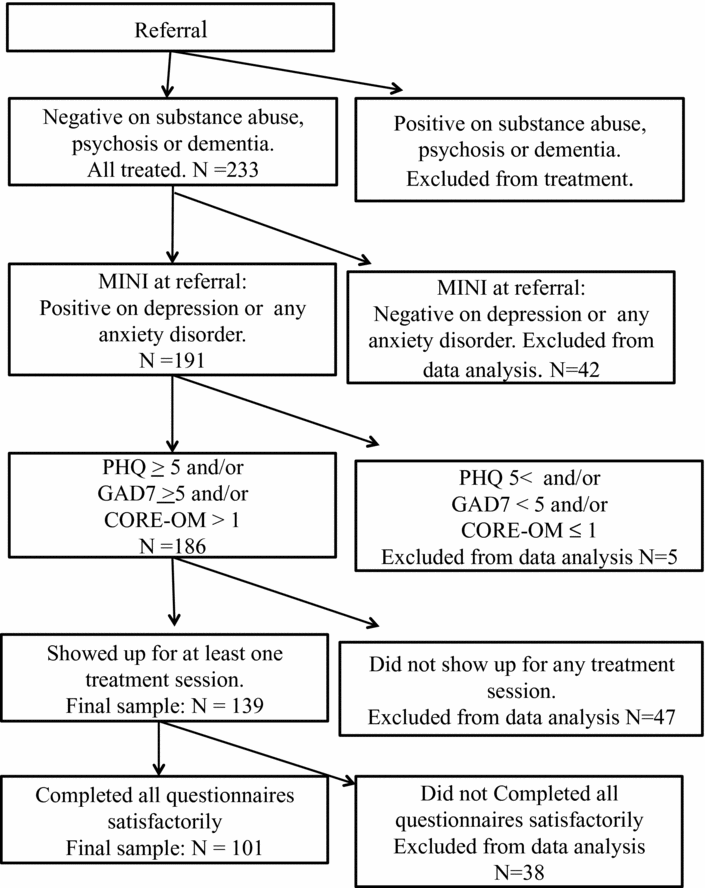
To be included in the study, participants had to meet diagnostic criteria for one or more depression and/or anxiety disorders according to the MINI-International Neuropsychiatric Interview (MINI; Sheehan et al., Reference Sheehan, Lecrubier, Sheehan, Amorim, Janavs and Weiller1998) (see description below) and to have scores above cut-off on at least one of the following instruments: The Patient Health Questionnaire-9 (cut-off: >5) (PHQ-9; Pálsdóttir, Reference Pálsdóttir2007; Spitzer et al., Reference Spitzer, Kroenke and Williams2001), Generalized Anxiety Disorder -7 (cut-off: >5) (GAD-7; Ingólfsdóttir, Kristjánsdóttir, Sigurðsson and Sigurðsson, manuscript in preparation; Spitzer et al., Reference Spitzer, Kroenke, Williams and Löwe2006), and the Clinical Outcomes in Routine Evaluation-Outcome Measure (cut-off: >1) (CORE-OM; Evans et al., Reference Evans, Connell, Barkham, Margison, McGrath and Mellor-Clark2002; Kristjánsdóttir et al., Reference Kristjánsdóttir, Sigurðsson, Salkovskis, Ólason, Sigurðsson, Evans, Gylfadóttir and Sigurðsson2015). In total, 186 participants met the inclusion criteria and of those 139 (75%) attended at least one treatment session and 101 filled out all the questionnaires. All subsequent intention-to-treat analyses were based on this number (Fig. 1). Of these 101 patients, 86 were women (85.1%) and 15 were men (14.9%). The mean age of the 101 participants was 38.6 years (SD = 11.0, range 18–69 years), for men 38.8 years (SD = 12.2) and for women 38.6 years (SD = 12.0). The majority, or 57.3%, were receiving psychotropic drugs. Over half (60%; n = 61) of the participants met diagnostic criteria for depression, 20 for PD, 37 for SP and 58 for GAD. Most of the participants had GAD as a main diagnosis (42), depression was the main diagnosis for 37 participants, PD for 12 and SP for 10 participants. Participants with OCD and PTSD as main diagnoses were not targeted in this study because of low numbers in the sample (n < 10). The average number of diagnoses per participant was 2.6 disorders (SD = 1.4, range 1–7 disorders).
Flow chart describing the sample studied. PHQ-9, Patient Health Questionnaire-9; GAD-7, Generalized Anxiety Disorder-7; CORE-OM, Clinical Outcomes in Routine Evaluation-Outcome Measure; MINI, MINI-International Neuropsychiatric Interview; N, number.

Measures
The participants were diagnosed with the MINI (Sheehan et al., Reference Sheehan, Lecrubier, Sheehan, Amorim, Janavs and Weiller1998), a short structured diagnostic interview of mental disorders that employs the diagnostic criteria of the Diagnostic and Statistical Manual of Mental Disorders-fourth edition (DSM-IV) and the International Statistical Classification of Diseases and Health Related Problems-10th revision (ICD-10). The Icelandic version of the MINI has not yet been extensively studied although one preliminary study gives some support to its validity (Sigurðsson, Reference Sigurðsson2008), but the English version has shown good psychometrics properties (Lecrubier et al., Reference Lecrubier, Sheehan, Weiler, Amorim, Bonora and Harnett1997).
Two primary outcome measures were pre-defined to test changes in general psychopathology, PHQ-9 (Pálsdóttir, Reference Pálsdóttir2007; Spitzer et al., Reference Spitzer, Kroenke and Williams2001) and the GAD-7 (Ingólfsdóttir, Kristjánsdóttir, Sigurðsson and Sigurðsson, manuscript in preparation; Spitzer et al., Reference Spitzer, Kroenke, Williams and Löwe2006). PHQ-9 and the GAD-7 were administered to all participants during an intake interview and in all therapy sessions. Five specific outcome measures were pre-defined to test changes in disorder specific symptoms. Each of these five measures were administered according to the patients’ main diagnosis. The Panic Rating Scale (PRS; Clark et al., Reference Clark, Salkovskis, Hackmann, Middleton, Anastasiades and Gelder1994) was administered to those who had PD as the main diagnosis, the Penn State Worry Questionnaire (PSWQ; Jónsdóttir and Smári, Reference Jónsdóttir and Smári2000; Meyer et al., Reference Meyer, Miller, Metsger and Borkovec1990) for participants with GAD as the main diagnosis, and the Liebowitz Social Phobia Scale (LSPS; Liebowitz, Reference Liebowitz1987) for patients with SP as the main diagnosis. The PHQ-9 was used as a disorder specific measure for participants with depression as the main diagnosis.
All the measures used in this study have acceptable or good psychometric properties (Clark et al., Reference Clark, Salkovskis, Hackmann, Middleton, Anastasiades and Gelder1994; Evans et al., Reference Evans, Connell, Barkham, Margison, McGrath and Mellor-Clark2002; Liebowitz, Reference Liebowitz1987; Meyer et al., Reference Meyer, Miller, Metsger and Borkovec1990; Spitzer et al., Reference Spitzer, Kroenke and Williams2001, Reference Spitzer, Kroenke, Williams and Löwe2006), including the the Icelandic versions of the PHQ-9, the GAD -7, the PSWQ and the CORE-OM (PHQ-9: Pálsdóttir, Reference Pálsdóttir2007; GAD-7: Ingólfsdóttir, Kristjánsdóttir, Sigurðsson and Sigurðsson, manuscript in preparation; CORE-OM: Kristjánsdóttir et al., Reference Kristjánsdóttir, Sigurðsson, Salkovskis, Ólason, Sigurðsson, Evans, Gylfadóttir and Sigurðsson2015; PSWQ: Jónsdóttir and Smári, Reference Jónsdóttir and Smári2000). Cronbach's alpha in this study ranged from .82 to .93. The psychometric properties of the Icelandic versions of the PRS and the LSPS are not known.
Procedure
Transdiagnostic cognitive behavioural group therapy (TCBGT) was offered at nine primary health care centres in the Capital area of Iceland. All referrals came from general practitioners (GPs). As this was an effectiveness study, criteria for referral were kept very practical: patients being over 18 years of age and showing signs of emotional problems (especially depression and anxiety) based on the GP's clinical evaluation. Exclusion criteria for admission to treatment, as evaluated by a GP or a clinical psychologist administering the MINI, were the following: (1) obvious signs of dementia or another generalized cognitive impairment, (2) presence of psychotic symptoms, and (3) current self-reported substance abuse.
All the patients referred to the therapy groups were thoroughly assessed by a clinical psychologist at an intake interview, with the MINI and the psychological scales administered. If a patient fulfilled the MINI criteria for more than two mental disorders the interviewer gave him/her a main diagnosis based on two pre-defined questions, and if needed, a further clinical evaluation.
Permission for the study was obtained from the National Bioethics Committee in Iceland (VSNb2005090003/03-15) and it was approved by the Icelandic Data Protection Authority (S2602/2005).
Intervention
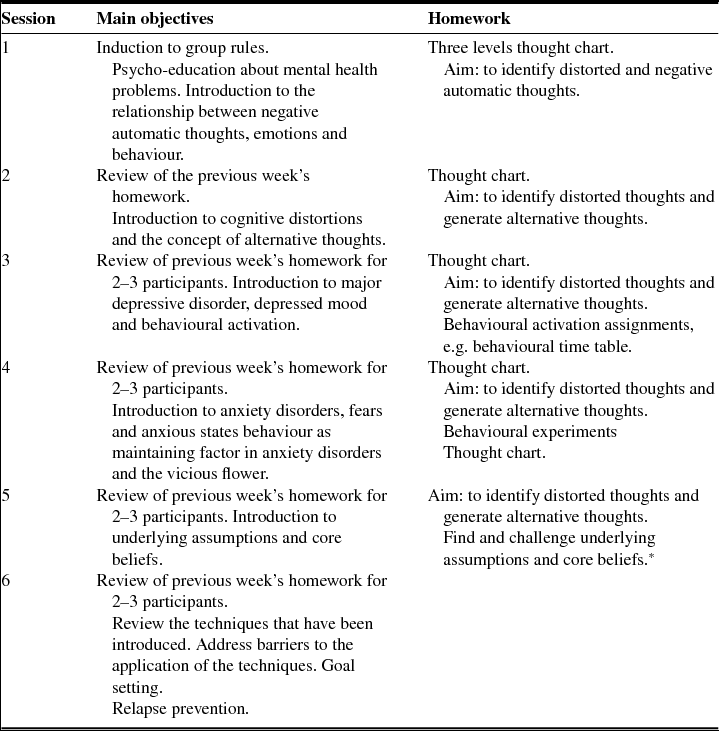
The main goal in the development of the Icelandic TBCGT was to include components that the range of disorder specific treatment protocols had in common. These components included psycho-education to help patients to understand the processes involved in maintaining their problems, the relationship between thoughts and emotions as well as cognitive restructuring within session work, supplemented by specific homework assignments. Therapy sessions lasted two hours once a week for 6 weeks in a group format.
The treatment, described in Table 1, was co-delivered by two qualified clinical psychologists in each primary care setting. They received training in delivering the treatment and were supervised by the authors of the treatment and the first author of this paper on a peer group basis once a week to ensure treatment fidelity. Mean group size was 10.2 patients (SD = 3.5, range 7–18). The group sizes were mainly dependent on the facilities of each primary care setting.
The treatment's main objectives and homework assignments

*Core beliefs and assumptions are not dealt with in depth, but the concept was introduced in order to provide the participants with basic understanding of why they have their problems.
Statistical analysis
Overview: The main (primary) analysis involved the calculation of transformed (standardized) data to ensure that they were comparable across different measures; these data were then analysed in an Omnibus mixed model ANOVA, divided into general and specific measures. Secondary analyses examining theoretically derived subsets of the data were also carried out as detailed below. In order to see if comorbidity and group size (>10 vs <10) affected the results the primary analysis was carried out with these varibles included as between subject factors. These variables had no impact on the pattern of results (all relevant interaction effects were non-significant) and were therefore excluded from the final analysis reported in this paper.
In order to evaluate treatment effects on disorder specific symptoms, effect sizes were calculated for all raw scores for the various diagnoses. Effect sizes were calculated with the formula d = (M pre – M post)/σpooled.
To compare the treatment effects on general and disorder specific symptoms raw scores on all measures were converted to Z-scores. Six analyses were carried out using a mixed model ANOVA. The first analysis was 4×2×3 repeated measures intention-to-treat (ITT) ANOVA to assess changes in disorder specific and general symptoms as measured by the GAD-7, the PHQ-9 and the specific measures combined. Diagnostic group based on main diagnostic (depression, GAD, PD and SP) was the grouping variable, general symptoms (PHQ-9 and GAD-7) and disorder specific symptoms (specific measures combined) were the first within-subjects’ factor (in order to find out if patients responded differently on general and specific measures) and the pre–post comparison the second within-subjects factor. The second analysis was 4×2 repeated measures ITT ANOVA to assess the efficacy of specific measures of individual disorders. Diagnostic group (depression, GAD, PD and SP) was the grouping variable and the pre–post comparison was the within-subjects factor. Standardized scores on generic and disorder specific measures were pooled to form a single variable. Analyses three to six were 2×3 repeated measures ITT ANOVAs to assess the specific and generic treatment effects, where each group defined by their main diagnosis was analysed separately. The pre–post comparison was the first within-subjects factor and the general symptoms (PHQ-9 and GAD-7) and the relevant specific measure were the second within-subjects’ factor.
Results
Outcome measures
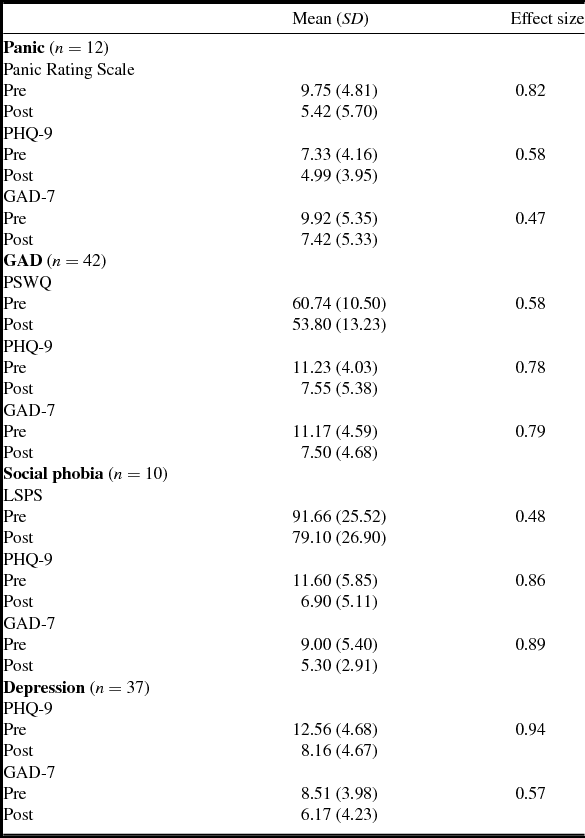
Table 2 shows descriptive statistics (raw scores) and effect sizes for the general and the disorder specific measures for the corresponding main diagnoses. The diagnostic groups scored significantly lower on all measures after treatment than before.
Descriptive statistics and effect sizes in each diagnostic group

PHQ-9, Patient Health Questionnaire-9; GAD-7, Generalized Anxiety Disorder-7; GAD, Generalized Anxiety Disorder; PSWQ, Penn State Worry Questionnaire; LSPS, Liebowitz Social Phobia Scale; n, number; SD, standard deviation.
General measures
As can been seen in Table 2, participants who were diagnosed with depression as a main diagnosis scored higher on the PHQ-9 pre-treatment (12.56) than those who were diagnosed with anxiety disorder as a main diagnosis (PD: 7.33; GAD: 11.23; SP: 11.60). Participants who were diagnosed with GAD as a main diagnosis scored higher on the GAD-7 pre-treatment (11.17) than those who were diagnosed with other disorders as a main diagnosis (PD: 9.92; depression: 8.51; SP: 9.00). Participants who were diagnosed with SP as main diagnosis scored lowest on the GAD-7 post-treatment, but those who were diagnosed with PD as main diagnosis scored lowest on the PHQ-9 at post-treatment.
Effect sizes
As shown in Table 2, effect sizes (ES) for the GAD-7 in the diagnostic groups ranged from 0.47 (PD) to 0.89 (SP) (mean ES: 0.68) and for the PHQ-9 from 0.58 (PD) to 0.94 (depression) (mean ES: 0.74). Effect sizes for the disorder specific measures ranged from 0.48 (SP) to 0.94 (depression). Overall mean of effect sizes was 0.71.
Standardized change: comparison between disorder specific measures
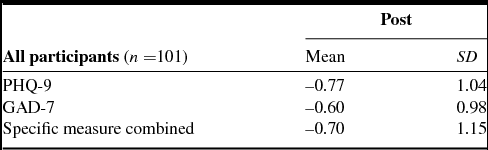
Table 3 shows standardized changes in the combined disorder specific measures compared with the general measures, the PHQ-9 and the GAD-7 (PHQ-9 was not included in the disorder specific measures to ensure independence of the group comparison).
Standardized change: comparison between measures

PHQ-9, Patient Health Questionnaire-9; GAD-7, Generalized Anxiety Disorder-7; n, number; SD, standard deviation.
As shown in Table 3, changes between generic (PHQ-9 and GAD-7) and specific measures combined are similar (0.60–0.77). The main effects of time (F [1,97] = 41.54, p < 0.05) are significant and the treatment seems to work equally for general symptoms and disorder symptoms, as seen by non-significant interaction of time and measure (F [1,63] = 1.85, p = 0.17). The third-order interaction was not significant (F [6,194] = 1.83, p = 0.1), indicating that the standardized change scores did not differ in any of the diagnostic groups.
We acknowledge that the GAD-7 was designed to be a disorder specific measure of generalized anxiety disorder and may therefore be problematic as a generic measure for anxiety. Still, it has been used elsewhere as a generic measure (e.g. Clark et al., Reference Clark, Layard, Smithies, Richards, Suckling and Wright2009). However, to make sure that it is a generic measure and the PSWQ not redundant as a disorder specific measure, Pearson correlations between the GAD-7 and the disorder specific anxiety measures were calculated. The GAD-7 correlated more strongly to the PRS (.73) than to the PSWQ (.57), but less strongly to the LSPS (.32), giving some support for its use as a generic measure.
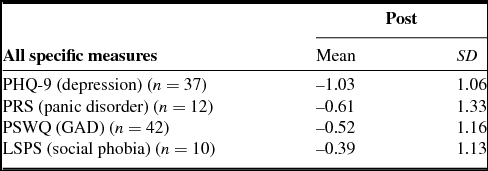
In Table 4, the individual groups that have the main diagnosis of depression, SP, PD and GAD, as measured with the corresponding disorder specific measures, are compared.
Standardized change: comparison between pre- and post-treatment scores on the specific measures

PHQ-9, Patient Health Questionnaire-9; PRS, Panic Rating Scale; PSWQ, Penn State Worry Questionnaire; LSPS, Liebowitz Social Phobia Scale; n, number; SD, standard deviation.
Table 4 indicates that the effects for the specific anxiety symptoms may be somewhat smaller than for specific depressive symptoms, although the anxiety groups seem to respond similarly to each other. The effect of time is significant (F [1,97]=30.1, p < 0.001) and the interaction between time and measure do not achieve significance (F [3,97] = 2.33, p = 0.08).
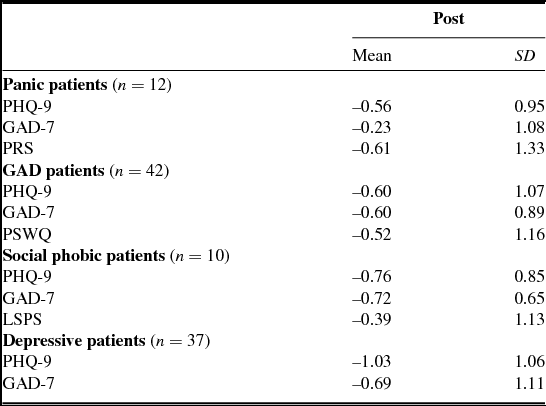
Table 5 shows the effects of the treatment for the different measures on participants with different main diagnoses.
Standardized change: different measures on participants with different main diagnosis

PHQ-9, Patient Health Questionnaire-9; GAD-7, Generalized Anxiety Disorder-7; PRS, Panic Rating Scale; PSWQ, Penn State Worry Questionnaire; LSPS, Liebowitz Social Phobia Scale; n, number; SD, standard deviation.
Panic disorder
Descriptive statistics indicate that depressive symptoms and symptoms specific to PD changed somewhat more than the general anxiety symptoms. However, the main effect of time was not significant (F [1,11] = 4.53, p = 0.06).
Social phobia
The main effect of time was significant (F [1,9] = 12.27, p < 0.01) indicating positive responding to treatment. The interaction between measure and repeats was not significant (F [2,18] = 1.99, p = 0.11).
General anxiety disorder
Table 5 shows that participants with GAD as the main diagnosis responded equally well on all the measures, suggesting both specific and general treatment effects. The main effect of time was significant (F [1,41] = 35.42, p < 0.01) while the interaction between measure and time was not (F [2,1,71] = 0.37, p = 0.69).
Depression
Table 5 shows that participants with depression as main diagnosis responded well on both measures (the general measure for depression was the same as the disorder specific measure). The main effect of time was significant (F [1,36] = 25.41, p < 0.001), but the interaction between the depression measure and time failed to reach significance (F [1,1,36] = 3.43, p = 0.07).
Discussion
The present study aimed to test the effects of transdiagnostic group CBT on disorder specific as well as general symptoms among patients experiencing PD, SP and GAD. In line with previous studies (e.g. Hook and Page, Reference Hooke and Page2002; Manning et al., Reference Manning, Hooke, Tannenbaum, Blythe and Clarke1994; McEvoy and Nathan, Reference McEvoy and Nathan2007), there was evidence of improvements in general measures, and we were able to demonstrate that the treatment also significantly reduced disorder specific symptoms and that these changes were not different from those observed in general symptoms. Although we consider the results to show both general and disorder specific changes, the use of the PHQ-9 as a measure of general psychopathology as well as a specific depression measure could be regarded problematic. This being so, a more cautious interpretation would be that for those with PD, SP and GAD as main diagnoses, we have clearly shown disorder specific changes, as well as changes in depressive symptoms. For those with primary diagnosis of MDD, we have clearly shown disorder specific changes in depressive symptoms, as well as changes in worries. This is mostly in line with Farchione et al. (Reference Farchione, Fairholme, Ellard, Boisseau, Thompson-Hollands, Carl, Gallagher and Barlow2012), who found no difference between general and disorder specific treatment change in patients diagnosed with GAD, PD and OCD, although SP fared somewhat worse on disorder specific outcome measures. In contrast, Titov et al. (Reference Titov, Andrews, Johnston, Robinson and Spence2010) found that patients with SP and GAD improved no better than controls. It is important to consider that Farchione et al. (Reference Farchione, Fairholme, Ellard, Boisseau, Thompson-Hollands, Carl, Gallagher and Barlow2012) and Titov et al. (Reference Titov, Andrews, Johnston, Robinson and Spence2010) did not use the same treatment manual as the one used in this study, so their findings cannot be directly compared with the findings described in this paper.
Indirect comparison with disorder specific CBT
Sighvatsson et al. (Reference Sighvatsson, Kristjánsdóttir, Sigurðsson and Sigurðsson2011) reviewed efficacy studies of CBT and found out that effect sizes for depression range from 0.82 to 0.89, compared with 0.94 in the current study. Anxiety disorders in the current study fare somewhat worse in this comparison and are generally close to the lower end of the ranges in Sighvatsson et al. (0.82 compared with a range from 0.57 to 1.44 in PD, 0.48 compared with 0.29–2.30 in SP, and 0.58 compared with 0.29–3.29 in GAD). These comparisons indicate, as with previous findings, that this treatment protocol generally works better and more reliably for depressive symptoms than for anxiety symptoms (Kristjánsdóttir et al., Reference Kristjánsdóttir, Salkovskis, Sigurðsson, Sigurðsson, Agnarsdóttir and Sigurðsson2016).
However, interpretations of these comparisons are not straightforward as the studies cited in Sighvatson et al. vary with respect to a number of factors, e.g. measures used and their sensitivity to change, inclusion (exclusion) criteria for participation, length of intervention and whether the effect sizes are standardized or unstandardized. It is also worth noting that all the studies cited in Sighvatsson et al. were on disorder specific individually delivered treatments, and some of them showed lower effect sizes than the current psycho-educational transdiagnostic group therapy, that included only six 2-h sessions. Ecological validity is furthermore apparent from the natural settings in primary care and the fairly open intake criteria. The treatment seems to work in real clinical settings and for a heterogenous group of patients, i.e. outside strict experimental control in laboratory settings.
General implications of the results are both practical and theoretical. The practical implications concern the feasibility of using the same protocols to treat a wide range of emotional disorders and the limits of its applicability may not have been reached. Further studies should examine if diagnosis specific symptoms of other disorders are equally responsive to the transdiagnostic approach. To clarify, given the evidence that this transdiagnostic treatment seems to be similarly effective across disorders, the results could have theoretical implications not addressed in this paper, namely that similar CBT treatment mechanisms could be the active ingredients for various mood and anxiety disorders and even fears stemming from delusional beliefs in psychosis, a research field that is highly understudied (Kazdin, Reference Kazdin2007). This research group has started this work and results concerning the matter will hopefully be published in the future. These findings also raise theoretical questions regarding the validity of strict diagnostic categories. If many or all emotional disorders respond to the same type of treatment, it may indicate that they are not as separate as the diagnostic manuals (DSM and ICD) assume.
There are several limitations to the current study, particularly the low statistical power in two of the diagnostic groups; only 10 of the participants were in the SP group and only 12 in the PD group. In addition, OCD and PTSD were not targeted in this study because of low prevalence in the sample (n < 10). The psychometric properties of the Icelandic versions of the PRS and the LSPS are not known, but both measures were translated according to approved standards. It should also be noted that significant gender imbalance was present, as 83% of the participants were women. Such gender imbalance is typical in studies of effectiveness of CBT in primary care, e.g. Ejeby et al. (Reference Ejeby, Savitskij, Öst, Ekbom, Brandt, Ramnerö, Marie and Backlund2014) (81%) and Serfaty et al. (Reference Serfaty, Haworth, Blanchard, Buszewicz, Murad and King2009) (80%). Future research should therefore aim at replicating the current study, but increase the power of the disorder groups as well as targeting less prevalent diagnostic groups such as OCD or PTSD, and study the effects of TCBGT on disorder specific symptoms in those groups using non-inferior design.
Acknowledgements
The authors are grateful to the participants for their time and patience and the psychologists who ran the treatment groups and administered the psychological instruments.
Ethical statements: The authors assert that all procedures contributing to this work comply with the ethical standards of the relevant national and institutional committees on human experimentation and with the Helsinki Declaration of 1975, and its most recent revision.
Conflicts of interest: The authors of this paper have no conflicts of interest with respect to this publication.
Financial support: Landspitali – The National University Hospital of Iceland research fund and Wyeth research fund.



Comments
No Comments have been published for this article.