INTRODUCTION
Within the field of pragmatics, a large body of experimental research has been devoted to implicatures. The majority of this research has focused on the category of conversational implicatures. A conversational implicature is “a component of speaker meaning that constitutes an aspect of what is meant in a speaker's utterance without being part of what is said” (Horn, Reference Horn, Horn and Ward2004, p. 3). A widely investigated subtype of conversational implicatures is the scalar implicature. The scalar implicature arising from a sentence like some children are naughty is that ‘some but not all children are naughty’. In contrast to this pragmatic interpretation, this utterance can also be interpreted logically: ‘some and perhaps all children are naughty’. However, the general assumption is that, whenever a weaker term (e.g. the quantifier some) is used, a stronger term from the same scale (e.g. all) does not hold, or that the speaker does not know whether it holds, because otherwise they would be underinformative. This interpretation can be applied to a range of different scales (e.g. <always, often, sometimes>, <three, two, one>, etc.).
In this paper, however, we will focus on the other category of implicatures, conventional implicatures, which have received much less attention in the literature. Unlike conversational implicatures, conventional implicatures are related to the conventional meaning of words. A typical example is that but conventionally implies a contrast. In an utterance such as he is short, but he is healthy, the use of but suggests that there is a contrast between ‘short’ and ‘healthy’, even though this contrast is not explicitly expressed.
Grice (Reference Grice1989) introduced the concept ‘conventional implicature’ to describe conventional aspects of meaning that are not truth-conditional. For example:
- (1)
a. He is short but he is healthy.
b. He is short and he is healthy.
Truth-conditionally, (1a) and (1b) have the same meaning. However, but is not a truth-conditional connector because but provides an additional meaning to the utterance in (1a). It suggests that there is a contrast between the first and the second clause. This additional feature of but is what Grice describes as a conventional implicature. However, within the context of relevance theory, Blakemore (Reference Blakemore2002) proposed a procedural analysis of but, which can be summarized as follows:
To say that but means denial is to say that it encodes a constraint that triggers an inferential route involving contradicting and eliminating an assumption that is manifest in the context. (in Hall, Reference Hall2004, p. 220)
Thus, according to Blakemore, but encodes a specific procedure. This procedural analysis conflicts with Grice's conceptual analysis in which but encodes the concept ‘contrast’.
The experiment discussed in this paper focuses on the conventional implicature induced by the conjunction but. This work builds on Janssens and Schaeken (Reference Janssens and Schaeken2013), but focuses on children instead of adults. Janssens and Schaeken (Reference Janssens and Schaeken2013) investigated ‘p but q’ utterances constructed as distancing-contrastive connections. In a distancing contrast, but connects two parts of a complex speech act (Van Belle & Devroy, Reference Van Belle and Devroy1992) and the second part is disassociated from the first part, without denying what the latter expresses (Haeseryn, Romijn, Geerts, De Rooij & van den Toorn, Reference Haeseryn, Romijn, Geerts, de Rooij and van den Toorn1997). In the ‘p but q’ construction, the speaker endorses that p is true (Van Belle, Reference Van Belle2003). However, because but is used, the possible inference from p is cancelled in favour of the conclusion stemming from q. The but construction indicates that the q-argument should be considered more relevant than the inference made from p. For example:
(2) I really like chocolate, but it's almost dinner time.
In a context where someone is offered a piece of chocolate, the two arguments of (2) lead to opposite conclusions. The first part (p) of this sentence elicits the conclusion that the speaker will eat the piece of chocolate, whereas the q-argument yields the opposite conclusion, i.e. that the speaker will not eat the chocolate. In this construction, but not only indicates that there is a contrast between the two arguments, it also provides more weight to the q-argument. The conclusion from the q-argument is therefore the pragmatic conclusion that follows from but. In other words, by uttering (2) the pragmatic conclusion is that the speaker will not eat the chocolate. Note that when the arguments are reversed (i.e. it's almost dinner time, but I really like chocolate), the opposite conclusion will follow, i.e. that the speaker will eat the chocolate.
The conclusion that follows from the ‘p but q’ construction can be introduced by words like so or nevertheless. These two words elicit opposite conclusions. When the word so follows a ‘p argumentative but q’ utterance, it introduces the expected conclusion from q (e.g. I really like chocolate, but it's almost dinner time. So I won't eat chocolate.). In contrast, Lepère (Reference Lepère2008) argued that, according to Van Belle (Reference Van Belle2003), the word nevertheless,Footnote 1 used as a conjunctive adverb, reverses the argumentative orientation of a ‘p argumentative but q’ sentence. It overrules the conclusion from q and redirects the reader towards the conclusion implied by p (e.g. I really like chocolate, but it's almost dinner time. Nevertheless, I will eat chocolate.). Note that the argumentative strength of but, so, and nevertheless should be considered separate from the content of the arguments, which they are supposed to take precedence over (Van Belle, Reference Van Belle2003).
Janssens and Schaeken (Reference Janssens and Schaeken2013) presented adult participants with short stories, each ending with a ‘p but q’ sentence. The p- and q-arguments were either sensible or irrelevant and always led to opposite conclusions. For instance, ‘I really like chocolate’ and ‘it's almost dinner time’ are both sensible arguments (for eating and not eating chocolate, respectively). However, in this context – in which someone is offered a piece of chocolate – ‘I have blonde hair’ would be an example of an irrelevant argument. An irrelevant argument has no relation with the story and in no way indicates which conclusion should follow. Such irrelevant arguments were included in order to investigate whether people might be influenced by the content of the arguments rather than the structure of the sentence (i.e. the pragmatic meaning of but).
After participants read the ‘p but q’ sentence, they were asked to indicate the appropriate conclusion introduced by so (‘so conclusion from p’ or ‘so conclusion from q’) for one half of the stories, and the one introduced by nevertheless (‘nevertheless conclusion from p’ or ‘nevertheless conclusion from q’) for the other half. The ‘appropriate’ pragmatic conclusion introduced by so is the one stemming from the q-argument, while for nevertheless this is the one from the p-argument. The results showed that, in general, people do make the inference induced by but. This was clear from the items with two sensible arguments for which the so-conclusion was asked (82% pragmatic answers). In contrast, for the nevertheless-conclusions, the expected conclusions from p were given in only 48% of the cases. This could indicate that the meaning of nevertheless does not give as much precedence to the p-argument as was expected. On the other hand, this latter finding could also be explained by the fact that the inference stemming from nevertheless is opposite to the one from but. In a ‘p but q’ construction, but leads the reader towards the conclusion from q, but nevertheless overrules this conclusion in favour of the conclusion from p. This understandably requires more effort than a so-conclusion, which explains why the number of appropriate answers was lower for nevertheless.
The content of the arguments was also found to play an important role. Whenever an irrelevant argument was combined with a sensible argument, most participants favoured the conclusion from the sensible argument, regardless of the conventional meaning of but, so, or nevertheless. The importance of the content was confirmed in a second experiment in which participants were asked to justify their answer. As expected, whenever their conclusion was not the pragmatic one, participants mostly explained this by referring to the content of the arguments.
This paper investigates whether the pragmatic meaning of but, combined with so and nevertheless, is also clear to children. In conversational implicature research, it has been shown that children are less able to make pragmatic inferences than adults. For example, Noveck (Reference Noveck2001) found that 89% of the seven- to eight-year-olds in his study agreed with statements such as some giraffes have long necks, compared to only 41% of the adults. Similarly, with respect to propositional connectives, Braine and Rumain (Reference Braine and Rumain1981) presented evidence that deductively competent seven- and nine-year-old children favour a logical interpretation of or (‘p or q and perhaps both’) over an implicit one (‘p or q but not both’). Adults given the same task were equivocal, although they tended to favour exclusive interpretations (Braine & Rumain, Reference Braine and Rumain1981). Such observations that children are less able to make pragmatic inferences than adults have led to further research into factors that enhance children's pragmatic competence. For example, in an experiment with five-year-old children, Papafragou and Musolino (Reference Papafragou and Musolino2003) found that a training session prior to the presentation of the test sentences in order to enhance the children's awareness of pragmatic anomalies caused the number of pragmatic answers to increase.
For conventional implicatures, we also expect that children are less able to make pragmatic inferences than adults. This is because there is a certain similarity between conversational implicatures and the conventional implicatures investigated in our experiment. A specific feature of conventional implicatures – in contrast with conversational implicatures – is that they are not cancellable. However, but sentences seem to carry two implicatures. First, there is the implicature that but creates a contrast between p and q (e.g. he is short, but he is healthy), which indeed seems to be a classic, non-cancellable conventional implicature. However, this is not the case for the second implicature, i.e. that but provides more weight to the q-argument (e.g. I really like chocolate, but it's almost dinner time). The use of nevertheless, for example, can lead to a cancellation of this implicature as it provides more weight to the p-argument in a ‘p but q’ utterance. Accordingly, the conventional implicatures that we investigate in this paper may not be purely conventional, but they share certain features with conversational implicatures. That is why we expect similar results for the conventional implicature task with but, i.e. that children are less able to make these pragmatic inferences.
The typical pragmatic development in children for conversational implicatures is often explained by the fact that drawing the implicature requires effort and children have less cognitive resources available than adults. Cognitive effort in adults has been tested by De Neys and Schaeken (Reference De Neys and Schaeken2007), among others, who found that burdening working memory (WM) with a secondary task decreases pragmatic processing. Together with other observations (e.g. Bott & Noveck, Reference Bott and Noveck2004; Noveck & Posada, Reference Noveck and Posada2003), this was taken as evidence that scalar implicature processing is effortful. Since the conventional implicatures we investigate in this paper have certain properties in common with conversational implicatures (i.e. they are cancellable), we also examined whether WM plays a role in processing these implicatures. In addition to testing children's understanding of the pragmatic meaning of but, so, and nevertheless, we also measured whether a higher WM span corresponds with a better understanding of the pragmatic meaning of but, so, and nevertheless.
Adults had been found to clearly grasp the pragmatic meaning of but. However, they also proved to be influenced by the content of the arguments, in spite of their pragmatic competence. For this reason, it is plausible to expect that children will definitely show great sensitivity to the content of the arguments in ‘p but q’ constructions. This expectation is based on the similarity between conversational implicatures and the conventional implicatures focused on in this paper, but this expectation can also be deduced from the findings of Schaeken, Sevenants, and Madruga (Reference Schaeken, Sevenants and Madruga2011), who observed a clear effect of content in children. For nine- to thirteen-year-old children, who were given a reasoning task with unless, abstract problems proved to be much more difficult to grasp than concrete problems. The concrete, meaningful problems were about daily life situations that could easily be imagined in a realistic context (e.g. you will have to go to bed early, unless you make no more mistakes) whereas the abstract problems concerned cards with letters on one side and numbers on the other side (e.g. there is a ‘2’, unless there is not an ‘A’). This suggests that for children to be able to reason with unless, they need to be presented with a meaningful context that is imaginable in real life. Children seem to need meaning to reason. We therefore expect the children in our experiment to be greatly influenced by the type of sentence, and more specifically by the content of the arguments. We expect that when children see an argument that they judge as a very strong argument in its context, the content of the arguments will often prevail over the conventional meaning of but, so, and nevertheless. In particular, the combination of sensible arguments with irrelevant arguments is likely to make a difference. Furthermore, the interaction between the type of argument (sensible or irrelevant) and the type of conclusion (so or nevertheless) observed in adults can also be expected in children. We expect the irrelevant arguments to facilitate the so-conclusions in the ‘irrelevant but sensible’ contexts, and the nevertheless-conclusions in the ‘sensible but irrelevant’ contexts. Moreover, since adults were found to have great difficulty with nevertheless, we expect these conclusions to be especially difficult for children.
METHOD
Participants
A total of 86 children (39 boys and 47 girls) between eight and twelve years old, with a mean age of 10;6, participated in this study. They were selected from two different schools in Belgium and were all native Dutch speakers.
Working memory task
In order to relate the results of the implicature task to the children's WM span, we measured WM by means of a Listening Span task (Daneman & Carpenter, Reference Daneman and Carpenter1980). In the Listening Span task, the children heard the experimenter read utterances aloud and were asked to write down whether these utterances were true or false. In addition, they had to remember the last word of every utterance and write these words down in the correct order at the end of each trial. They started with three trials with a listening span of one utterance. The span length was increased by one utterance whenever the children wrote the words down in the correct order in at least two of the three trials. Every increase of the listening span was announced by the experimenter in order to reduce the effect of attentional factors. Whenever at least two out of three trials were written down incorrectly, the Listening Span task was terminated. A trial was scored as correct when all the words of this trial were written down in the correct order. The total score was the sum of all correct trials.
Implicature task
The implicature task consisted of eighteen context stories that were adopted from Janssens and Schaeken (Reference Janssens and Schaeken2013). Each of the stories described a person in doubt about something. For example:
It's Christmas. The ‘De Corte’ family bought a Christmas tree and want to decorate it. Mom is in doubt whether to let her youngest daughter Sarah help.
After the short story, the person in doubt gives two contrastive arguments separated by but. For example:
Mom thinks: “Sarah likes decorating the tree, but she is very clumsy.”
The arguments were either sensible or irrelevant. In the example above, both arguments are sensible. These sensible arguments have an argumentative orientation determined by either a positive or negative value that we ascribe to its content, which is referred to as the ‘axiological value’ by Anscombre and Ducrot (Reference Anscombre and Ducrot1977). A positive argument (e.g. Sarah likes decorating the tree) is an argument of which the axiological value is oriented towards a positive conclusion (e.g. ‘Sarah can help’), while a negative argument (e.g. she is very clumsy) elicits a negative conclusion (e.g. ‘Sarah cannot help’).
The irrelevant arguments have no positive or negative axiological value, i.e. they are not oriented towards a positive or negative conclusion. An example of an irrelevant argument in this context is the following:
Mom thinks: “Sarah is very clumsy, but she is wearing pink pyjamas.”
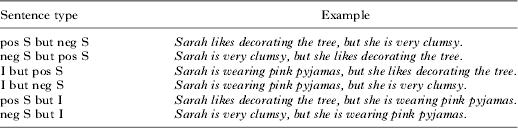
In total, there were six combinations of arguments: ‘positive sensible but negative sensible’, ‘negative sensible but positive sensible’, ‘irrelevant but positive sensible’, ‘irrelevant but negative sensible’, ‘positive sensible but irrelevant’, and ‘negative sensible but irrelevant’. There was no ‘irrelevant but irrelevant’ combination because if both arguments are unrelated to the context of the story, there is no way to know what the conclusion should be. See Table 1 for an example from the Christmas story of every sentence type.
Example of each sentence type
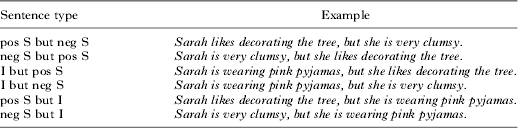
notes: pos = positive; neg = negative; S = sensible; I = irrelevant.
After participants read the ‘p but q’ construction, they were asked to choose the appropriate conclusion. For half the stories, they had to choose the appropriate conclusion introduced by so, and for the other half of the stories the appropriate conclusion introduced by nevertheless. For example:
1. “So Sarah can help.”
2. “So Sarah cannot help.”
or:
1. “Nevertheless Sarah can help.”
2. “Nevertheless Sarah cannot help.”
The appropriate pragmatic conclusion with so is the conclusion that follows from the q-argument, whereas the expected appropriate conclusion with nevertheless is the conclusion resulting from the p-argument.
Procedure
First, the Listening Span task was conducted with groups of five or six children at the same time. This task was performed in their classroom at school. In order to familiarize the children with the task, they were given three training trials, followed by the real task. Then, all children completed the implicature task. This was an individual written task which all children performed simultaneously in their classroom at school. Each participant answered three items from each argument combination, with half the items consisting of so questions and the other half of nevertheless questions.
RESULTS
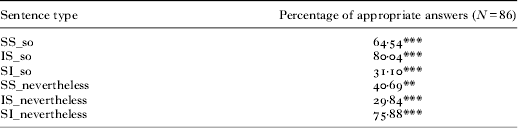
In order to analyze whether children made the correct inferences, we made no distinction between positive and negative arguments. There is no reason to expect that one would be more difficult than the other, as was confirmed by the finding that separate analyses did not present any significant differences. Therefore, for our analyses, we collapsed the items to the combinations: ‘sensible but sensible’, ‘irrelevant but sensible’, and ‘sensible but irrelevant’. Since children always had a one out of two chance of giving the expected answer, we also analyzed whether their performance differed significantly from chance level. The results, displayed in Table 2, show that performance on each sentence type differed significantly from chance level. Performance on the sentence types ‘sensible but sensible, so’, ‘irrelevant but sensible, so’ and ‘sensible but irrelevant, nevertheless’ was significantly above chance level and performance on all other sentence types was significantly below chance level (‘sensible but irrelevant, so’, ‘sensible but sensible, nevertheless’, and ‘irrelevant but sensible, nevertheless’).
Percentages of appropriate so- and nevertheless-conclusions for each sentence type
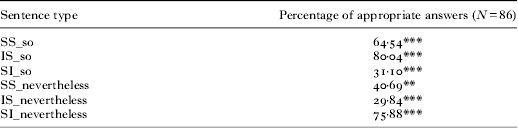
notes: I = irrelevant; S = sensible; * p < ·05, ** p < ·01, *** p < ·001.
Since participants were nested in different age groups and the dependent variable was binary, a generalized linear mixed model (also known as multilevel or hierarchical linear modelling) with a logit link function was used to analyze the data (see, e.g. Baayen, Davidson & Bates, Reference Baayen, Davidson and Bates2008; Bates, Maechler & Bolker, Reference Bates, Maechler and Bolker2011; or Jaeger, Reference Jaeger2008). The model fitting procedure was implemented in R using the lmer() function from the lme4 package. The model was made increasingly complex until model fit no longer increased, which was assessed using the Bayesian Information Criterion (BIC). The final model includes an effect of sentence type, but no main effects of age or WM capacity, nor interactions of these variables with sentence type.
In addition, we analyzed correlations between WM span and performance on the six sentence type categories. All correlations were non-significant, with no correlation above ·096.
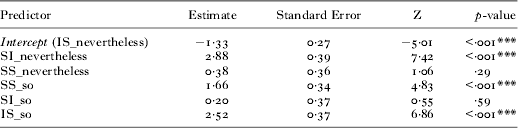
Table 3 displays an overview of the final model. The ‘irrelevant but sensible, nevertheless’ sentences are presented as the intercept with which all other sentence types are compared. We found that performance on these sentences did not differ significantly from ‘sensible but irrelevant, so’ nor from ‘sensible but sensible, nevertheless’. The performance on all other sentence types did, however, differ significantly from ‘irrelevant but sensible, nevertheless’.
Parameter estimates for the model with sentence type as a predictor
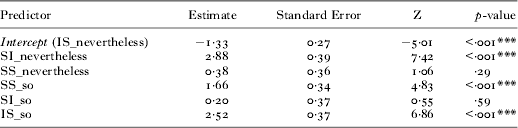
notes: I = irrelevant; S = sensible; * p < ·05, ** p < ·01, *** p < ·001.
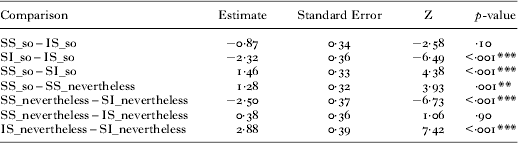
Table 4 shows further pairwise comparisons for the different levels of sentence type. These were obtained by applying the multcomp package's glht() function on the final model. The reported p values were adjusted for multiple comparisons using the single-step method. For the so-conclusions, the best results were obtained for the ‘irrelevant but sensible’ sentences. Performance on these sentences did not differ significantly from the ‘sensible but sensible, so’ sentences, but both sentence types did differ significantly from the ‘sensible but irrelevant, so’ sentences. For the nevertheless-conclusions, performance was very good on the ‘sensible but irrelevant’ sentences and the number of appropriate answers differed significantly from ‘sensible but sensible, nevertheless’ and ‘irrelevant but sensible, nevertheless’. Finally, when we compare performance on so-conclusions with nevertheless-conclusions, the children assessed so-conclusions significantly more accurately than nevertheless-conclusions when presented with two sensible arguments.
Pairwise comparisons for the different sentence types
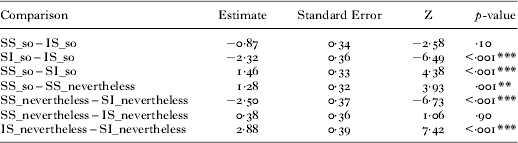
notes: I = irrelevant; S = sensible; * p < ·05, ** p < ·01, *** p < ·001.
GENERAL DISCUSSION
The aim of this paper was to determine whether children make the conventional implicature induced by but in ‘p but q’ constructions combined with so and nevertheless. While this had already been investigated in adults, no data were available on children's abilities to make these inferences. A group of eight- to twelve-year-old children took part in our experiment. Furthermore, we wanted to address the question whether conventional implicature production is affected by WM span. Given their similarities with conversational implicatures, we examined whether processing these implicatures is effortful. To that end, we measured WM span by means of a Listening Span task.
The data were analyzed using a generalized linear mixed model, which showed that there was a significant main effect of sentence type, but no significant main effect of age or WM,Footnote 2 nor any interaction between the two. When analyzing how the children performed compared to chance (see Table 2), we see that all results differed significantly from chance level. The children performed significantly below chance level on most of the sentences with nevertheless. Only the ‘sensible but irrelevant, nevertheless’ sentences were answered fairly accurately. This is because the appropriate answer for these items corresponds with the sensible argument, while the irrelevant argument can be ignored. On the ‘sensible but irrelevant, so’ sentences, children also scored significantly lower than chance level. In this case following the sensible argument (and ignoring the irrelevant one) does not yield the appropriate answer. Given that all results differed significantly from chance level, we can conclude that children purposefully chose the inappropriate answer because they believed it to be the appropriate one, not because they were guessing. The results above chance level performance suggest that the meaning of but was fairly clear to the children, but they had difficulty grasping the meaning of nevertheless. This explains why they mostly chose the conclusion from q, to which they were directed by but, and not the appropriate conclusion from p. Moreover, this suggests that the content of the arguments is a very important factor, explaining the poor performance on ‘sensible but irrelevant, so’ and ‘irrelevant but sensible, nevertheless’.
In general, our results showed that children are able to make the inference induced by but to a certain extent, but the percentages are rather low. Compared with the results obtained by Janssens and Schaeken (Reference Janssens and Schaeken2013), the percentages of pragmatic answers in children, given the exact same task, were clearly lower than in adults. This suggests that children's pragmatic understanding of but is not yet fully developed. Since even adults were found to be influenced by the content of the arguments, these results also indicate that this has even more of an impact on children. By comparing the performance on the different sentence types, this was made very clear. In the ‘p but q’ constructions that contained an irrelevant argument, children mainly based their answers on the sensible argument, irrespective of the conventional meaning of but, so, or nevertheless. However, not only the irrelevant situations provided evidence that children are sensitive to content. Whenever two sensible arguments were presented and the so-conclusion was asked, children only provided 65% pragmatic answers (compared to 82% for the adults). This seems to indicate that their answer is often based on the argument they themselves deem most plausible and not necessarily on the q-argument.
Another parallel with the results of the adults is that the percentage of expected nevertheless-conclusions from the p-argument (following two sensible arguments) is very low: only 41%. As was argued in Janssens and Schaeken (Reference Janssens and Schaeken2013), this could indicate that the assumed meaning of nevertheless, as reversing the expected conclusion from but, might not be correct. However, these results might also be explained by the additional effort required to make the correct interpretation. Since nevertheless requires the reader to first make the inference from but, and then overrule this inference to draw the conclusion from the p-argument, it seems likely that this whole process might be more effortful than simply drawing the so-conclusion.
In order to determine whether processing the conventional implicature with but is effortful, we related the results of the implicature task to a WM test. Surprisingly, we found no effect of WM span, nor an effect of age. We expected these factors to play a significant role based on the similarity of this specific conventional implicature with conversational implicatures. It is important to mention that the absence of a WM effect cannot be attributed to the WM task. The WM scores ranged between 4 and 15 with a standard deviation of 2·52. This means that there was enough variability to identify a possible effect. The lack of an effect of WM (or age) may suggest that, in contrast to conversational implicatures, processing this implicature happens automatically and requires no WM. However, before drawing such a strong conclusion, we have to keep in mind that the effect of WM for conversational implicatures, although significant, is only small (see, e.g. De Neys & Schaeken, Reference De Neys and Schaeken2007). WM involvement must be small in order to ensure smooth communication. Furthermore, when Dieussaert, Verkerk, Gillard, and Schaeken (Reference Dieussaert, Verkerk, Gillard and Schaeken2011) found an effect of WM, this was only observed in participants with a lower WM capacity: burdening WM while performing a conversational implicature task had no effect on participants with a high WM capacity. Finally, while a significant effect of WM was observed in adults, Janssens and Schaeken (Reference Janssens and Schaeken2012) found no significant WM effect on children's understanding of conversational implicatures.
Taking these considerations together, we must be cautious in making strong claims about the role of WM in conventional implicature processing. Moreover, the results obtained in this study reveal that children's understanding of the pragmatic meaning of but, so, and nevertheless is not optimal yet and is still strongly determined by the content of the arguments. This could indicate that the investigated age group may have been too young (i.e. insufficiently capable of this task) to reveal significant differences based on age or WM. Therefore, it might be better to focus on older age groups in future experiments, or to make a direct comparison between children and adults. Furthermore, a different approach might be considered to investigate the role of WM. As in De Neys and Schaeken (Reference De Neys and Schaeken2007), a double task design could be used, in which WM is burdened with a secondary task while performing the implicature task. A decrease of pragmatic answers under WM load would indicate that conventional implicature processing does require WM involvement.
In sum, this study's main conclusion is that children's pragmatic understanding of but is not yet fully developed. Although they do seem to grasp its meaning to a certain extent, the content of the arguments has a very strong influence on their answers. Whenever one of the arguments is clearly more plausible than the other, the meaning of but seems to be of no importance.