Congenital cardiac disease is the most common congenital defect found in neonates. Advances in care for neonates with complex congenital cardiac disease have resulted in an increase in survivors and a growing population of infants with morbidities related to surgery, post-operative care, and any residual anatomic or haemodynamic abnormalities. An important issue in these neonates is poor nutritional status and early growth failure. This is especially true for infants with functionally univentricular physiologyReference Varan, Tokel and Yilmaz1–Reference Cameron, Rosenthal and Olson5 who have undergone palliative surgery. Feeding difficulties have been documented in this population and are most likely a contributing factor to poor weight gain following surgical intervention.Reference Schwalbe-Terilli, Hartman and Nagle6–Reference Skinner, Halstead, Rubinstein, Atz, Andrews and Bradley14 In addition to nutritional intake and feeding challenges, there are other factors that may affect weight change in the immediate post-operative period. These factors include disease severity, intra-operative care, for example, cardiac support times, post-operative therapy such as duration of mechanical ventilation, complications such as infections, residual anatomic or haemodynamic cardiac abnormalities, for example, atrioventricular valve regurgitation, and length of hospitalisation.
Several studies have shown deficiencies in long-term growth and cognition in children who have experienced growth failure early in life.Reference Black, Dubowitz, Krishnakumar and Starr15, Reference Dykman, Casey, Ackerman and McPherson16 Early growth failure results in sub-optimal somatic growth and poor brain growth, which have implications for impaired development of executive functions and lower school achievement.Reference Black, Dubowitz, Krishnakumar and Starr15, Reference Bhoomika, Shobini and Chandramouli17 In addition, an increased incidence of attention deficits with aggressive behaviour,Reference Dykman, Casey, Ackerman and McPherson16 and a heightened risk of emotional, social, and cognitive developmentReference Argyle18 have been linked to poor growth early in life.
To date, much of the available literature on weight change in the post-operative period has been based on retrospective chart reviews.Reference Schwalbe-Terilli, Hartman and Nagle6–Reference Einarson and Arthur8, Reference Imms10–Reference Skinner, Halstead, Rubinstein, Atz, Andrews and Bradley14, Reference Braudis, Curley and Beaupre19–Reference McElhinney, Hedrick and Bush22 The growth data for this investigation originate from a prospective cohort study assessing growth, feeding behaviour, and energy balance in neonates who had undergone surgical intervention for complex congenital cardiac disease compared with healthy, age-matched infants. The primary aim of this study was to identify the pattern of weight change in infants with a functionally univentricular heart from the time of surgical intervention to hospital discharge, illustrate the prevalence of growth failure, and explore factors that predict poor weight gain in this population. Our secondary aim was to investigate differences in weight change for infants with primary univentricular physiology and other diagnoses resulting in functionally univentricular physiology following surgical intervention.
Materials and methods
Study design
This is a prospective cohort study on growth from birth to hospital discharge of neonates who underwent univentricular palliation.
Study population
The study was approved by the Institutional Review Board of The Children’s Hospital of Philadelphia, Philadelphia, Pennsylvania. Neonates were enrolled in a prospective cohort study examining growth in children with congenital cardiac disease who underwent univentricular palliation between March, 2003 and May, 2007. Eligibility included a post-menstrual age greater than 36 weeks and discharge to home after surgical intervention. Neonates with multiple congenital, facial and/or complex gastrointestinal anomalies, chromosomal abnormalities, congenital or acquired neurological insult and/or birth weight less than 2500 grams were excluded since these factors are known to be associated with poor growth. Gastro-oesophageal reflux or vocal cord dysfunction did not necessitate exclusion.
Data collection
Demographic data were collected from the medical record and by parental interview. Growth data were collected by daily chart review. Weight at birth, weight before surgical intervention, and weight at discharge were recorded. Surgical weight was the weight obtained within 24 hours before surgery by the Cardiac Intensive Care Unit nursing staff following the established nursing protocol and using an infant scale (Scaletronix, model no. 4802, Carol Stream, Illinois, United States of America) accurate to 1 gram, plus or minus 0.02 gram. Hospital discharge weight was the average of three weights obtained during the 7 days immediately preceding hospital discharge using the same scale and protocol.
Pre- and post-operative echocardiograms were reviewed to categorise neonates into functionally univentricular and biventricular physiology groups for the larger prospective cohort study. Patients categorised as having functionally univentricular physiology on a pre-discharge echocardiogram were included in this study. Pre-discharge echocardiogram reports were also evaluated by one investigator (Marino) for the presence of moderate or greater systemic ventricular dysfunction, moderate or greater systemic atrioventricular valve regurgitation, moderate or greater neoaortic or aortic insufficiency, aortic arch obstruction – peak instantaneous pressure gradient exceeding 20 millimetres of mercury – systemic ventricular outflow tract obstruction – peak instantaneous pressure gradient equal to or exceeding 20 millimetres of mercury – obstruction of pulmonary venous return, presence of a restrictive atrial communication – mean gradient exceeding 3 millimetres of mercury – and to confirm functionally univentricular physiologic group categorisation. Surgical notes were examined to obtain intra-operative cardiac support times – cardiopulmonary bypass time, aortic cross-clamp time, and duration of deep hypothermic circulatory arrest – for each participant. Bedside charts were reviewed daily for details of the post-operative course including duration of post-operative mechanical ventilation, need for post-operative cardiac catheterisation during hospitalisation, diagnosis of infection, placement of an additional post-operative central venous catheter – other than the line placed intraoperatively – occurrence of respiratory and/or cardiac arrest, need for extracorporeal membrane oxygenation, and hospital length of stay. Infection was characterised by a positive-gram stain – respiratory, urine, blood, or wound sites – with the presence of white blood cells and/or a positive culture in combination with the patient’s clinical course. In addition, Aristotle Basic Complexity Score and Risk Adjustment for Congenital Heart Surgery-1 CategoryReference Jenkins23–Reference Derby, Kolcz, Kerins, Duncan, Quezada and Pizarro25 scores were documented for each participant to estimate the surgical complexity and risk of mortality, respectively. Mode of enteral feeding before surgery and at the time of hospital discharge was recorded; trophic feeds were not included. Mode of feeding is described as oral, oral plus device-assisted or device-only administration. Feeding devices include nasogastric tube, gastric tube, or combined gastric and jejunal tube. Time to initiation of enteral feeding of daily nutritional intake and kilocalories per kilogram body weight per day were not calculated as collection of these data was not protocol in the larger study. The targeted clinical caloric intake was between 100 and 120 kilocalories per kilogram body weight per day.Reference Schwalbe-Terilli, Hartman and Nagle6
Statistical analysis
Statistical analysis was performed using SAS 9.2 software (SAS Institute Inc., Cary, North Carolina, United States of America). Data analyses included both descriptive and inferential statistical techniques. Descriptive analysis using means, medians, standard deviations, minimum and maximum values for continuous variables, and frequency distributions for categorical variables were used. The Shapiro–Wilk test was used to assess normality of the continuous variables.
The primary study outcome was to assess the change in weight from the time of surgical intervention to hospital discharge. All weights were converted to weight-for age z-score using the World Health Organization reference standards; subsequent analyses were performed using the weight-for-age z-score. The World Health Organization reference standards reflect the expected pattern of growth in healthy, breast-fed neonates thriving in an optimal environment. Using the World Health Organization reference standards, a z-score of “0” represents the 50th percentile of weight-for-age and a z-score of “minus 2” is approximately the 3rd percentile. Weight change was defined as weight-for-age z-score at hospital discharge minus weight-for-age z-score at surgery and was calculated for each patient. Histograms and box plots were generated to visually demonstrate the weight-for-age z-score distribution at birth, surgery, and hospital discharge.
The sample was evaluated as three distinct diagnostic subgroups: hypoplastic left heart syndrome, tricuspid atresia, and other diagnoses. Demographic and clinical comparisons were assessed using chi-square for categorical variables and analysis of variance for continuous variables if the data demonstrated a normal distribution. Kruskal–Wallis tests were used if the data were not normally distributed. Pearson or Spearman’s rho correlation coefficients, Kruskal–Wallis or Wilcoxon rank-sum tests were used, as appropriate, to assess associations between each potential risk factor and change in weight-for-age z-score from surgery to discharge. Regression coefficients with a 95% confidence interval and a measure of overall fit (R2) were computed. Residual analyses were produced to verify that the data met the regression assumptions. Assessment of the possibly high collinearity among the predictors was tested by using the Variance Inflation Factor Index. The experiment-wise error rate was held at the 0.05 level and the tests were two-sided. Variables with a p-value less than 0.10 in the bivariate analysis were included into a multivariable linear regression model.
Results
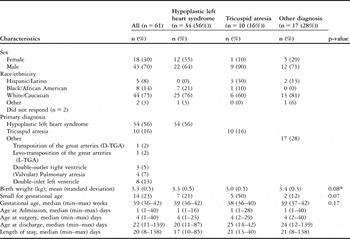
We enrolled 61 neonates with post-operative functionally univentricular hearts in the study. Table 1 delineates the demographic and clinical characteristics for the entire cohort and specific diagnostic subgroups. Of the sample, 70% were male and 75% were Caucasian. The most common diagnoses were hypoplastic left heart syndrome (56%), tricuspid atresia (16%), and double inlet left ventricle (13%). Despite a mean birth weight of 3.3 kilograms, 23% of the study sample across all diagnostic groups met the definition for small for gestational age and were classified as such.Reference Oken, Kleinman, Rich-Edwards and Gillman26 Of those neonates with a primary diagnosis of tricuspid atresia, 50% were small for gestational age; however, they met study weight and gestational age inclusion criteria and were therefore included in the analysis. No significant differences were noted in gender, ethnicity, race, birth weight, small for gestational age percentages, gestational age, age at admission, age at surgery, hospital length of stay, and age at discharge across the three diagnostic subgroups. The median age at surgery for the entire cohort was 4 days with a range from 1 to 40 days. The median hospital length of stay was 20 days with a range from 8 to 138 days, with 25% of these neonates hospitalised for greater than 30 days.
Demographic and clinical characteristics (n = 61)Footnote *.

Max = maximum; Min = minimum
* Comparison between three diagnostic groups
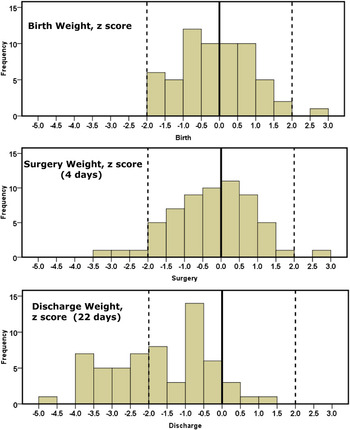
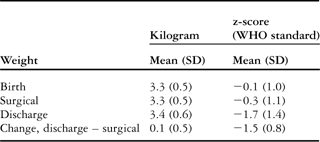
The mean discharge weight was 3.4 kilograms plus or minus 0.6, which was not significantly higher than the mean birth weight or the weight at surgery where the mean weight was 3.3 kilograms plus or minus 0.5 (p-value not significant). Both the mean weight-for-age z-score at hospital discharge, minus 1.7 plus or minus 1.4, and the mean change in weight-for-age z-score from surgery to discharge minus 1.5 plus or minus 0.8, were significantly lower than 0, with the p-value equal to 0.01 for both outcomes. The histograms in Figure 1 depict the weight-for-age z-score at birth, surgery, and hospital discharge for the study sample. At birth, the weight-for-age z-score showed a normal distribution, without a weight-for-age z-score less than minus 2.0. At surgery, 5% of the study sample had a weight-for-age z-score less than minus 2.0. At the time of discharge, only 8% of the study sample had a discharge weight-for-age z-score greater than 0, while 41% had a weight-for-age z-score less than minus 2.0. However, if growth patterns were typical, for healthy neonates, 50% of the infants would have had a weight-for-age z-score greater than zero (Table 2).
Distribution of weight-for-age z-score at birth, surgery, and hospital discharge.

Pre- and post-operative weight (n = 61).

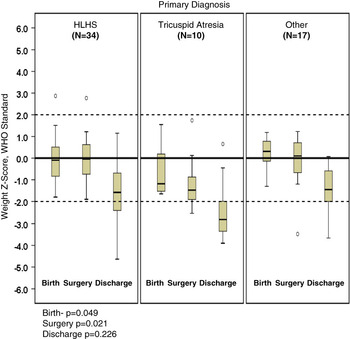
Box plots of weight-for-age z-score at birth, surgery, and hospital discharge stratified by diagnosis are shown in Figure 2. Those neonates with a diagnosis of tricuspid atresia had a significantly lower weight-for-age z-score at birth (p-value equal to 0.05) and at surgery (p-value equal to 0.02) than neonates in the other two diagnostic groups. At hospital discharge, the weight-for-age z-score was less than minus 2.0 in 41% of neonates with hypoplastic left heart syndrome, 70% with tricuspid atresia, and 24% in all other diagnoses (p-value equal to 0.22).
Box plots of weight z-score by primary diagnosis.

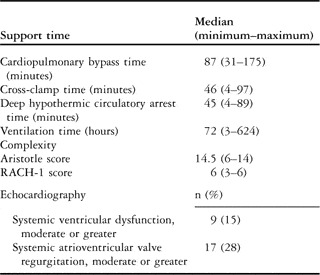
Table 3 delineates the intra-operative support times, post-operative ventilation time, the Aristotle Basic Complexity Score and Risk Adjustment for Congenital Heart Surgery-1 Category complexity scores, and pre-discharge echocardiographic characteristics of the study sample. The median Aristotle Basic Complexity Score and Risk Adjustment for Congenital Heart Surgery-1 Category scores were, respectively, 14.5 – with a range from 6 to 14.5 – and 6 – with a range from 3 to 6. The median duration of post-operative mechanical ventilation was 3 with a range from 3 to 624 hours. Of the study sample, 15% had moderate or greater systemic ventricular dysfunction, with 28% exhibiting moderate or greater systemic atrioventricular valve regurgitation.
Intra-operative and post-operative characteristics (n = 61).

RACH-1 = Risk Adjustment for Congenital Heart Surgery-1 Category
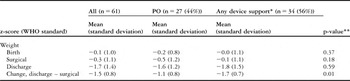
The weight-for-age z-score at birth, surgery, and discharge and the change in weight-for-age z-score by mode of feeding at hospital discharge are depicted in Table 4. Analysis of oral feeding versus device-assisted or full device feeding at hospital discharge revealed that 44% were exclusively oral fed, 33% were fed by combined oral and nasogastric tube, and 13% were exclusively nasogastric tube fed. The study included 10% of neonates who had a gastric and/or jejunal tube placed as the sole mode of feeding at hospital discharge. Only 18% of neonates received any nutrient intake before surgical intervention, and of these only two were orally fed before surgery. On average, the weight-for-age z-score from surgery to hospital discharge decreased by minus 1.5 in the study sample, irrespective of the mode of feeding. There was a significant difference (p-value less than 0.01) for the change in weight-for-age z-score from surgery to hospital discharge between neonates who were tube fed, minus 1.7, plus or minus 0.7, compared to those who were exclusively oral fed, minus 1.1, plus or minus 0.8.
Pre- and post-operative weight with method of feeding.

*Devices include: nasogastric, n = 8 (13%); oral plus Nasogastric, n = 20 (33%); gastrostomy; jejunostomy; n = 6 (10%)
**p-value between infants being feed orally versus device support
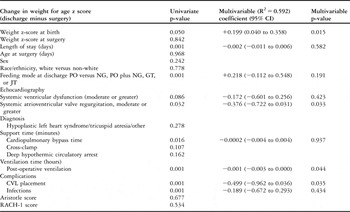
Bivariate analysis for predictors of change in weight-for-age z-score from surgery to hospital discharge is presented in Table 5. Multivariate analysis demonstrated that neonates with lower weight-for-age z-score at birth, moderate or greater systemic atrioventricular valve regurgitation, prolonged post-operative mechanical ventilation, and additional central venous line placement following surgery had a greater decrease in weight-for-age z-score from surgery to hospital discharge. Combined, these variables were associated with close to 60% of the variance in weight-for-age z-score change from surgery to hospital discharge in our study sample.
Univariate and multivariate analyses (n = 61).

CVL = central venous line; GT = gastrostomy; JT = jejunostomy; NG = nasogastric; PO = oral; RACH-1 = Risk Adjustment for Congenital Heart Surgery-1 Category
Discussion
In this cohort of neonates who underwent surgery for complex congenital cardiac disease resulting in univentricular physiology, we identified a high rate of growth failure at hospital discharge. The most notable finding in our study was that a majority of neonates with functionally univentricular hearts in this cohort had a significant decrease in weight-for-age z-score from surgery to hospital discharge. At the time of hospital discharge, over one-third of the study sample had a weight-for-age z-score below minus 2.0 standard deviations, which is below the 3rd percentile for weight-for-age using the World Health Organization reference standards. No specific univentricular diagnostic subgroup was more predictive of poor weight gain over another. Neonates with haemodynamically significant atrioventricular valve regurgitation and a more complex post-operative course were more likely to have decreased post-operative weight gain. Feeding device support was insufficient to ensure adequate weight gain during the immediate post-operative hospitalisation. Our results are consistent with previous studies that have reported a high prevalence of growth failure in neonates with complex congenital cardiac disease following surgical intervention.Reference Davis, Davis and Cotman7, Reference Kelleher, Laussen, Teixeira-Pinto and Duggan12, Reference Menon and Poskitt27, Reference Vogt, Manlhiot, Van Arsdell, Russell, Mital and McCrindle28 In our study, the mean change in weight-for-age z-score from surgery to discharge was minus 1.5 plus or minus 0.8. We assessed the change in weight-for-age z-score between surgery and hospital discharge, as a change in weight may be the best indicator of nutritional intake and growth status during this time of expected rapid weight gain in neonates. Following the expected initial physiologic weight loss, a healthy neonate is expected to gain between 20 and 30 grams per day.Reference Behrman29 It is not expected for healthy neonates to have a decrease in weight-for-age z-score of more than 1 standard deviation in the 18–21 days after birth. The pattern of weight gain in our study population was far below this standard norm.
We hypothesised that disease complexity manifested by longer intra-operative support times and/or higher disease complexity scores, which are associated with higher surgical difficulty and increased risk of mortality and morbidity, would in part explain poor growth. However, neither the intra-operative cardiac support times nor the Aristotle Basic Complexity Score or the Risk Adjustment for Congenital Heart Surgery-1 Category scores were statistically significant in their association with change in weight-for-age z-score between surgery and hospital discharge.
Similar to the findings reported by Kelleher et al,Reference Kelleher, Laussen, Teixeira-Pinto and Duggan12 at hospital discharge, 44% of neonates in our study were on full oral feeds, compared to 56% who required device-assisted or device-only support for nutritional intake. For those neonates on full oral feeds, the mean discharge weight-for-age z-score was minus 1.1 plus or minus 0.8 as compared to minus 1.7 plus or minus 0.7 for those with feeding device support. In a comparative cohort from our institution, in the same unit, studied during the time frame of our study, Schwalbe-Terilli et alReference Schwalbe-Terilli, Hartman and Nagle6 reported a median daily caloric intake of 93 kilocalories per kilogram per day, with a range from 43 to 142 kilocalories per kilogram per day. They found that a caloric intake of 100 kilocalories per kilogram per day was achieved for only 48.4% of patient days and that of 120 kilocalories per kilogram per day for only 20% of patient days. Likewise, Boctor et alReference Boctor, Pillo-Blocka and McCrindle9 reported a minus 11 grams per day with a range from minus 145 to 84 grams per day deficit in weight change in their similar cohort of 24 neonates post-cardiac surgery. We speculate that the methods of feeding and/or timing of the initiation of feeding augmentation in our study population were insufficient to ensure adequate nutritional intake for optimal weight gain.Reference Jenkins, Gauvreau, Newburger, Spray, Moller and Iezzoni30
Despite the growth between surgery and hospital discharge being not typical for the neonates exclusively on oral feedings, their weight-for-age z-score pattern was significantly better than that for those neonates who required device support. Our data suggest that this finding may be related to the “oral only” fed neonates experiencing shorter intra-operative cardiac support times, minimal haemodynamic alterations, and fewer complications during the post-operative period.
In our cohort, neonates who were able to meet nutritional goals on full oral intake by hospital discharge may have had fewer medical problems, had feeding offered earlier in their hospitalisation, with fewer feeding challenges. Such factors may be individual and medical team specific and difficult to isolate. Conversely, neonates with less favourable haemodynamics and a more complicated post-operative course were more likely to experience feeding difficulty and less than optimal weight gain, despite feeding device support. By multivariate analysis, lower weight-for-age z-score at birth, presence of moderate or severe post-operative atrioventricular valve regurgitation, prolonged post-operative mechanical ventilation, and placement of an additional central venous line in the Cardiac Intensive Care Unit were associated with 60% of the variance. The need for prolonged mechanical ventilation has been found to inhibit gut motility and decrease oral feeding ability causing reduced enteral intake, poor weight gain, and extended hospitalisation.Reference Jadcherla, Vijayapal and Leuthner31, Reference Kogon, Ramaswamy and Todd32 These findings suggest more severe illness and a more complex post-operative course.
Growth failure is well recognised in hypoplastic left heart syndrome.Reference Kelleher, Laussen, Teixeira-Pinto and Duggan12 However, neonates with other functionally univentricular diagnoses have not been studied. Neonates with diagnoses other than hypoplastic left heart syndrome resulting in functionally univentricular physiology may contribute to the poor weight-for-age z-score noted in our population. In this study, neonates with tricuspid atresia were identified and analysed as a separate group as they comprised 16% of the study sample. The neonates with tricuspid atresia were noted to have significantly lower weight-for-age z-scores at birth (p-value equal to 0.05) and at surgery (p-value equal to 0.02) than neonates with hypoplastic left heart syndrome and other functionally univentricular diagnoses. It was an unexpected finding that infants with tricuspid atresia would have the lowest median weight-for-age z-score at hospital discharge (less than minus 2.5 standard deviations). It was also an unanticipated finding that neonates with the diagnosis of tricuspid atresia would be more likely to be small for gestational age at birth, and have the greatest risk for growth failure as compared to neonates with hypoplastic left heart syndrome and other functionally univentricular diagnoses. Further studies are required to identify factors that result in poor weight gain in neonates with tricuspid atresia.
Study limitations
Our study had several limitations. First, our results only included infants who were discharged to home. Second, we did not measure nutrient intake or nutritional biomarkers. Third, we did not have data that would allow us to statistically control for diuretics or other medications that have an effect on fluid balance or cardiac function and may confound weight-for-age z-score at hospital discharge. The use of these medications suggests an alteration in cardiac haemodynamics and may reflect severity of illness.
Conclusion
Functionally univentricular cardiac physiology places neonates at significant risk of growth failure. Our data suggest that the use of feeding device support alone did not prevent or successfully treat growth failure in the immediate post-operative period for this high-risk population. Post-operatively, a multidisciplinary approach to nutritional management with attention to daily nutrient intake, and early assessment of the need for oral feeding augmentation may help promote optimal weight gain in the neonatal period. Improving weight gain in this high-risk population will address a difficult issue that has the potential to improve patient outcomes.
Acknowledgements
The research team would like to acknowledge Gil Wernovsky, MD, Judy Verger, PhD, RN, and the medical, nursing, and ancillary staff of the Cardiac Intensive Care Unit, the Clinical Translational Research Center and the Nutrition and Growth Laboratory at The Children’s Hospital of Philadelphia for their assistance with this study. They also acknowledge Jeffrey Anderson, MD, MPH, for his assistance in the categorisation of the echocardiographic and physiologic data. This project was supported by the National Institutes of Health, National Institute of Nursing Research, and the National Center for Research Resources. The content is solely the responsibility of the authors and does not necessarily represent the official views of the National Center for Research Resources or the National Institutes of Health.