Introduction
It is projected that the number of people living with dementia worldwide will increase exponentially from 35.6 million in 2010 to 115.4 million by 2050. In many countries, an informal caring system of family caregivers remains the cornerstone of support and care for persons with dementia, with the caregiving role often assumed by spouses and adult children (Sun et al., Reference Sun, Ong and Burnette2012). Family caregivers are vulnerable to the psychological, physical, financial, and social strain that is associated with caregiving (Sorensen et al., Reference Sorensen, Duberstein, Gill and Pinquart2006). There is thus a need for valid assessment tools that can reliably measure burden among family caregivers.
The Zarit Burden Interview (ZBI) is a 22-item questionnaire with good reliability and validity that is recognized as the most widely used instrument for assessment of subjective burden among family caregivers (Zarit et al., Reference Zarit, Reever and Bach-Perterson1980). Initially, the ZBI was utilized in a uni-dimensional fashion that classified caregivers into different degrees of burden based upon clinically relevant cut-offs of the total score (Rankin et al., Reference Rankin, Haut, Keefover and Franzen1994). There is increasing appreciation that burden is a multidimensional construct that is beyond what a global score can capture (Ankri et al., Reference Ankri, Andrieu, Beaufils, Grand and Henrard2005). Different domains of the ZBI need to be considered in order to adequately reflect the complex experience of caregiver burden.
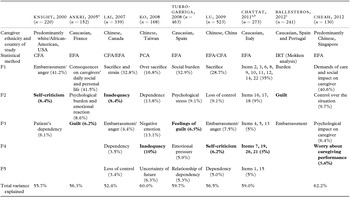
The factor structure of the ZBI has been extensively studied. Traditionally, based upon the seminal work of Whitlatch and colleagues in 1991, personal strain (how personally stressful the experience is) and role strain (stress due to role conflict or overload) were described as the only dimensions of burden measured by the ZBI (Whitlatch et al., Reference Whitlatch, Zarit and von Eye1991; Bedard et al., Reference Bedard, Molloy, Squire, Dubois, Lever and O'Donnell2001). Recent studies that examined the factor structure of the 22-item ZBI challenged this assumption by describing multidimensionality beyond the dual-factor structure (Knight et al., Reference Knight, Fox and Chou2000; Ankri et al., Reference Ankri, Andrieu, Beaufils, Grand and Henrard2005; Lai, Reference Lai2007; Ko et al., Reference Ko, Yip, Liu and Huang2008; Turró-Garriga et al., Reference Turró-Garriga, Soler-Cors, Garre-Olmo, López-Pousa, Vilalta-Franch and Monserrat-Vila2008; Lu et al., Reference Lu, Wang, Yang and Feng2009; Chattat et al., Reference Chattat2011; Ballesteros et al., Reference Ballesteros, Santos, González-Fraile, Muñoz-Hermoso, Domínguez-Panchón and Martín-Carrasco2012; Table 1). These studies also consistently highlighted a distinct dimension of burden describing caregiver concerns about doing more (item 20) and doing a better job (item 21). The common denominator underlying these studies is that they describe a negative aspect of caregiving that arises from self-appraisal of caregiver performance (Lawton et al., Reference Lawton, Kleban, Moss, Rovine and Glicksman1989). This dimension has been variously termed worry about one's performance as a caregiver, ranging from milder degrees of inadequacy and worry, through to more severe elements of self-criticism and guilt. Earlier studies suggest a possible relationship with adult children caregivers who are less involved in daily care, and a peaking of scores in the mild stage (Ankri et al., Reference Ankri, Andrieu, Beaufils, Grand and Henrard2005; Cheah et al., Reference Cheah, Han, Chong, Anthony and Lim2012). Otherwise, this factor has not been explicitly examined in relation to other factors and total burden in a systematic manner.
Summary of studies of 22-item ZBI that reported items 20 and 21 as a distinct factor

aIncludes other items besides 20 and 21. Ankri (Reference Ankri, Andrieu, Beaufils, Grand and Henrard2005): items 15 and 16; Chattat (Reference Chattat2011): items 7 and 19.
bFactors not named in original paper; specific items of each factor listed.
cVariance of each factor not stated in original paper.
Note. In brackets: explained variance (%); in bold: factors containing items 20 and 21. CFA = confirmatory factor analysis; EFA = exploratory factor analysis; IRT = item response theory; PCA: principal component analysis.
We earlier reported a four-factor structure for the ZBI among family caregivers in a predominantly Chinese multiethnic Asian population (Cheah et al., Reference Cheah, Han, Chong, Anthony and Lim2012). Using the Leggett framework that was derived from the short-version ZBI (Leggett et al., Reference Leggett, Zarit, Taylor and Galvin2011), we postulated that there are three key underlying dimensions, namely role strain (factors 1 and 2), personal strain (factor 3), and worry about caregiving performance (WaP; factor 4), which comprises items 20 and 21. WaP may be germane to many Chinese societies, where esteemed Confucian values of filial piety and a strong sense of obligation to care for family members may result in more complicated feelings associated with caregiving, such as self-criticism and inadequacy (Lai, Reference Lai2007; Ko et al., Reference Ko, Yip, Liu and Huang2008; Lu et al., Reference Lu, Wang, Yang and Feng2009). This provided the impetus for the present study, which aims to compare WaP with the other three factors as well as role and personal strains (Whitlatch et al., Reference Whitlatch, Zarit and von Eye1991) among caregivers of persons with mild cognitive impairment (MCI) or mild-to-moderate dementia. We performed multi-faceted analyses comprising internal consistency, inter-factor correlation, item-to-total ratio (ITR) across the severity spectrum of cognitive impairment, predictors of burden, and interaction effect on total ZBI score.
Methods
Study design and participants
This is a cross-sectional study of 130 consecutive dyads of community-dwelling older adults with cognitive complaints and their primary family caregiver presenting for the first time to the Cognition and Memory Disorder Service of the Tan Tock Seng Hospital, Singapore, from 1st June to 31st December 2009. The study was approved by the institutional review board of the National Healthcare Group.
We included patients aged ≥55 years with a Clinical Dementia Rating (CDR; Morris, Reference Morris1993) global score of >0 and with a diagnosis of MCI or dementia. Patients with no dementia or who were residing in an assisted living facility or nursing home were excluded. We interviewed the primary caregiver, defined as the family member who was most involved in the provision of day-to-day care and who was familiar with the patient's medical and social condition. We excluded the following categories of caregivers: (1) non-completion of the 22-item ZBI questionnaire; (2) non-family members (e.g. domestic helper, friend); (3) inability to converse fluently in English or Chinese; and (4) previously been counseled on dementia care prior to the interview. Over the six-month time frame, 190 caregiver-patient dyads presenting for the first time to the memory clinic fulfilled inclusion criteria. Of these, 60 (32%) were excluded, yielding a final sample of 130 caregiver-patient dyads.
Assessment
All patients underwent standardized clinical assessment by a consultant geriatrician and a nurse clinician; relevant blood investigations; neuroimaging; and where relevant, neuropsychological assessment. Details concerning the evaluative approach at the memory clinic have been previously published (Lim et al., Reference Lim, Chin, Lam, Lim and Sahadevan2005). Dementia was diagnosed using the Diagnostic and Statistical Manual of Mental Disorders, Fourth Edition (DSM-IV) criteria, and MCI using the revised Petersen criteria as previously described (Chan et al., Reference Chan, Tay and Chong2011). The severity of cognitive impairment was staged using the locally validated Clinical Dementia Rating (CDR) scale (Morris, Reference Morris1993; Lim et al., Reference Lim, Chin, Lam, Lim and Sahadevan2005). A CDR of 0 indicates no cognitive impairment; CDR 0.5 designates either MCI or very mild dementia; CDRs 1, 2, and 3 indicate mild, moderate, and severe dementia, respectively. A consensus meeting was conducted after results from clinical, neuropsychological, blood, and neuroradiological evaluations were available to determine the diagnosis, etiology, and staging of cognitive impairment using multi-disciplinary inputs from the physician, nurse clinicians, and psychologist.
Measurements and instruments
Data collected on the sociodemographic characteristics of patients and caregivers include age, gender, ethnicity, level of education, family relationship, living with or apart from the patient, and contact time denoted as hours per week. Cognitive assessment was based on the Chinese Mini-Mental State Examination (CMMSE), which has been locally validated (Sahadevan et al., Reference Sahadevan, Lim, Tan and Chan2000). Modifications to suit the cultural context of Singapore include omitting the question on season and combining two questions on patient's town and country into a single question, thus yielding a total score of 28.
Functional evaluation comprised Barthel's index for basic activities of daily living (BADL; Collin et al., Reference Collin, Wade, Davies and Horne1988) and Lawton and Brody's scale for instrumental activities of daily living (IADL; Lawton and Brody, Reference Lawton and Brody1969). The Barthel BADL measures ten basic self-care functions and is scored from 0 to 100, while the Lawton IADL ranges from 0 to 23 in the assessment of more complex functions such as housekeeping, shopping, handling finances, and meal preparation. For both scales, lower scores indicate greater dependency. The Neuropsychiatric Inventory Questionnaire (NPI-Q) is a caregiver-informant interview covering 12 neuropsychiatric symptom domains in terms of severity and caregiver distress (Kaufer et al., Reference Kaufer2000). In our study, only the response in terms of severity, ranging from mild to severe (1–3), was extracted for analysis.
The ZBI is a self-report 22-item instrument to assess caregiver's perceived burden that is scored for each item on a 5-point Likert scale (0 = “never” to 4 = “nearly always”) to give a total score ranging from 0 to 88, with higher scores indicating greater burden (Zarit et al., Reference Zarit, Reever and Bach-Perterson1980). For caregivers who were unable to read or understand English, a validated Chinese version was used (Chan et al., Reference Chan, Lam and Chiu2005). We recently reported that factor analysis yielded a four-factor structure that accounted for 62.2% of the variance with good internal consistency (Cheah et al., Reference Cheah, Han, Chong, Anthony and Lim2012). Factor 1, representing demands of care and social impact on caregiver (items 1, 2, 3, 4, 7, 8, 11, 12, and 14), explained 40.6% of the total variance. Factor 2 referred to degree of confidence or control over the situation (items 13, 15, 16, 17, and 18) and explained 9.7% of the variance. Factor 3 grouped together questions representing the psychological impact on caregiver (items 5, 6, 9, 10, 19, and 22) and explained 6.4% of the variance. Lastly, factor 4 described WaP (item 20: “Do you feel you should be doing more for your relative?” and item 21: “Do you feel you could do a better job in caring for your relative?”), accounting for 5.6% of the variance. In comparison, the two-factor structure reported by Whitlatch and colleagues in 1991 comprised personal strain (items 1, 4, 5, 8, 9, 14, 16, 17, 18, 19, 20, and 21) and role strain (items 2, 3, 6, 11, 12, and 13).
Statistical analysis
We performed descriptive and analytical statistics using SPSS (version 17.0; SPSS, Inc., Chicago, Ill., USA). The level of significance was set at 0.05 for all hypothesis contrasts. We compared WaP with total ZBI score, the other three derived factors, as well as personal and role strains. First, we compared internal consistency using Cronbach's α. Next, we compared correlations between the total ZBI score and the different dimensions using Pearson's r coefficient. Because the original definition of personal strain incorporated items 20 and 21 (Whitlatch et al., Reference Whitlatch, Zarit and von Eye1991), we repeated the correlational analysis without these items. Third, we studied the trend of ITR for each dimension across disease severity as measured by CDR. As each dimension is comprised of different number of items, ITR gives a more accurate representation of the magnitude of burden endorsed within each dimension compared with mean scores (Cheah et al., Reference Cheah, Han, Chong, Anthony and Lim2012). ITR was calculated using the ratio of total item score within the individual dimension to the maximum possible score of that dimension.
We then performed multiple regression analyses to compare predictors of the different factors. Care recipient factors that had a significant univariate relationship with the total ZBI score (CDR global score, BADL, IADL, NPI-Q, and CMMSE) or caregiver characteristics that were deemed to be significant based upon the results of our earlier study (age, gender, education, whether living with patient, and family relationship) were considered as covariates (Cheah et al., Reference Cheah, Han, Chong, Anthony and Lim2012). To allow for uniform comparison between the different models, we first performed tests of multicollinearity to determine the optimal combination of variables. We finally selected four care recipient and four caregiver variables; CDR global score and relationship with care recipient were excluded due to consistent multicollinearity with these two variables across models.
Lastly, we conducted two-way between-groups analyses of variance (two-way ANOVA) to compare the individual impact of each factor as well as the interaction between factor 4 and the other three factors on total ZBI score. To facilitate comparison, scores in each factor were dichotomized into high (≥75 percentile) and low (<75 percentile) categories. The 75 percentile cut-offs were 14.25, 3.00, 7.25, and 4.25 for factors 1 to 4, respectively. We determine the significance of individual main and interaction effects at the p < 0.05 level and measured effect size using partial eta squared (η 2). Small, medium, and large effect sizes are indicated by partial η 2 of 0.01, 0.06, and 0.138, respectively (Tabachnick and Fidell, Reference Tabachnick and Fidell2007).
Results
Characteristics of caregivers and care recipients
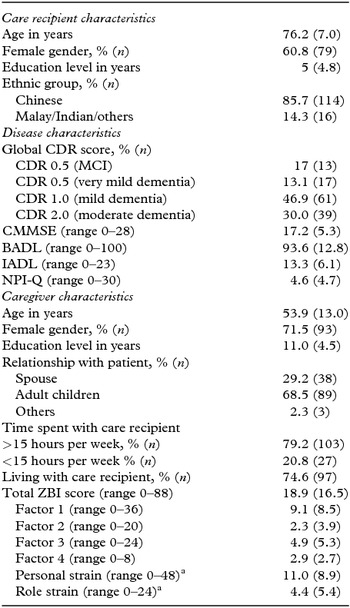
Our final sample comprised 130 caregiver–patient dyads (Table 2). Caregivers were mainly ethnic Chinese (85.7%) and females (71.5%), with a mean age of 53.9 years (SD = 13.0) and mean formal education of 11 years (SD = 4.5). The majority were adult children (68.5%), followed by spouses (29.2%). The mean age of patients was 76.2 years (SD = 7.0) and the majority were females (60.8%). About half were rated as patients having mild dementia (CDR 1) and 30% as patients having moderate dementia (CDR 2). The mean CMMSE, BADL, IADL, and NPI-Q scores were 17.2 (SD = 5.3), 93.6 (SD = 12.8), 13.3 (SD = 6.1), and 4.6 (SD = 4.7), respectively. Total ZBI score ranged from 0 to 71 (mean (SD) = 18.9 (16.5)), and mean item score was 0.874. The mean factor scores are: F1, 9.1 (SD = 8.5); F2, 2.3 (SD = 3.9); F3, 4.9 (SD = 5.3); F4, 2.9 (2.7); role strain, 11.0 (SD = 8.9), and personal strain, 4.4 (SD = 5.4).
Sample characteristics (n = 130)

a Items loaded to simulate Whitlatch (Reference Whitlatch, Zarit and von Eye1991): personal strain (12 items) and role strain (6 items).
Note. Mean (SD) unless otherwise stated. BADL = Barthel's Index of Basic Activities of Daily Living; CMMSE = Chinese Mini-Mental State Examination; CDR = Clinical Dementia Rating; IADL = Lawton's and Brody's Scale for Instrumental Activities of Daily Living; NPI-Q = Neuropsychiatric Inventory Questionnaire; ZBI = Zarit Burden Interview.
Reliability and inter-factor correlation
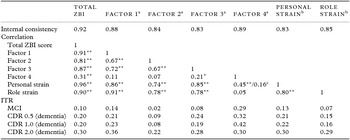
The 22-item ZBI scale demonstrated good internal consistency (Cronbach's α = 0.919; Table 3). Cronbach's α coefficient increased to 0.923 if item 20 was deleted from the scale, and to 0.930 if both items 20 and 21 were deleted. The individual factors also demonstrated good internal consistency (Cronbach's α range: 0.83–0.89), with factor 4 having the highest Cronbach's α coefficient.
Internal consistency, inter-factor correlation, and item-to-total ratio across severity of cognitive impairment

aItems loaded in accordance with factor loading in Cheah (Reference Cheah, Han, Chong, Anthony and Lim2012): factor 1, demands of care and social impact on caregiver (9 items); factor 2, confidence or control over the situation (role strain; 5 items); factor 3, psychological impact on caregiver (personal strain; 6 items); factor 4, worry about caregiving performance (2 items).
bItems loaded to simulate factor loading in Whitlatch (Reference Whitlatch, Zarit and von Eye1991): personal strain (12 items) and role strain (6 items).
cCorrelation with exclusion of items 20 and 21 from personal strain (p = 0.07).
*p < 0.05; **p < 0.01.
Note. CDR = Clinical Dementia Rating; ITR = item to total ratio; MCI = mild cognitive impairment; ZBI = Zarit Burden Interview.
Total ZBI score was strongly correlated with factors 1 to 3, personal strain, and role strain, but only moderately correlated with factor 4 (r = 0.31, p < 0.01). Factor 4 was poorly correlated with factors 1 to 3 (range of r = 0.07–0.21, p > 0.05, except for factor 3) and with role strain (r = 0.05, p > 0.05). Although factor 4 was significantly correlated with personal strain (r = 0.45, p < 0.01), this relationship became weaker and non-significant after excluding items 20 and 21 (r = 0.16, p = 0.07).
Item to total ratio by disease severity
Similar to total ZBI, factors 1 to 3 as well as personal and role strains displayed a general trend of increased ITR across the severity of cognitive impairment (Table 3). ITR was low in MCI, increased by two- to four folds in CDR 0.5 and 1 dementia, before peaking at CDR 2. In contrast, factor 4 was highly endorsed at the MCI stage (ITR = 0.29, compared to 0.02–0.14 for the other factors), peaked at CDR 1 (0.42) and then dipped to 0.30 at CDR 2.
Predictors of burden
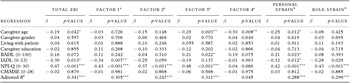
All multiple regression models were significant at the p < 0.001 level (range of R 2 = 0.247–0.341) except for factor 4 (R 2 = 0.045, F (8,118) = 1.74, p > 0.05) (Table 4). Significant predictors of total ZBI score, factors 1 to 3, as well as personal and role strains were: caregiver age, physical function (IADL or BADL), and NPI-Q. In contrast, only younger caregiver age contributed significantly to factor 4 (β = −0.29, p = 0.003); with every increase in one year in age, factor 4 score decreased by 0.06 (95% CI: −0.11 to −0.02). There was a trend for BADL (β = 0.19, p = 0.075), but otherwise, the other caregiver and care recipient characteristics did not predict factor 4.
Regression of different factors on caregiver and care-recipient characteristics

aItems loaded in accordance with factor loading in Cheah (Reference Cheah, Han, Chong, Anthony and Lim2012): factor 1, demands of care and social impact on caregiver (9 items); factor 2, confidence or control over the situation (role strain; 5 items); factor 3, psychological impact on caregiver (personal strain; 6 items); factor 4, worry about caregiving performance (2 items).
bItems loaded to simulate factor loading in Whitlatch (Reference Whitlatch, Zarit and von Eye1991): personal strain (12 items) and role strain (6 items).
*p < 0.05; **p < 0.01; ***p < 0.001.
Note. BADL = Barthel's Index of Basic Activities of Daily Living; CMMSE = Chinese Mini-Mental State Examination; IADL = Lawton's and Brody's Scale for Instrumental Activities of Daily Living; NPI-Q = Neuropsychiatric Inventory Questionnaire; ZBI = Zarit Burden Interview.
Impact on total ZBI score
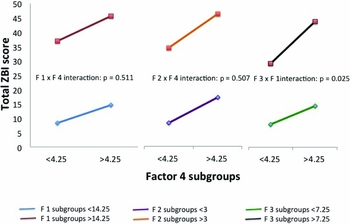
Two-way ANVOVA revealed a statistically significant individual effect on total ZBI score for each of the four factors (p < 0.01). In terms of the magnitude of effect size as measured by partial η 2, factor 4 had a smaller effect size compared with the other three factors (F4, range of partial η 2 = 0.11–0.21 vs. F1 = 0.66; F2 = 0.56; F3 = 0.60). Factor 4 had a small albeit significant interaction effect with factor 3 (F (1,126) = 5.17, p = 0.025, partial η 2 = 0.04) on total ZBI score (Figure 1), but there was no significant interaction with either factor 1 (F (1,126) = 0.43, p = 0.51) or factor 2 (F (1,126) = 0.44, p = 0.51).
Interaction effect between factor 4 and factors 1, 2, and 3.

Discussion
Even though Knight first described the three-factor structure of ZBI as early as 2000 (Knight et al., Reference Knight, Fox and Chou2000), the paradigm shift away from the canonical bi-factorial structure only gained traction with the recent emergence of studies that consistently reported multidimensionality involving three to five factors (Ankri et al., Reference Ankri, Andrieu, Beaufils, Grand and Henrard2005). The multi-factorial structure of ZBI despite its overall high internal consistency has been attributed to items that do not correlate well with other items and the overall ZBI (Chattat et al., Reference Chattat2011). Of note, only items 20 and 21 have consistently formed a distinct factor across different studies; other items tend to load onto factors that are variants of either role or personal strain (Leggett et al., Reference Leggett, Zarit, Taylor and Galvin2011; Cheah et al., Reference Cheah, Han, Chong, Anthony and Lim2012; Table 1). Our results affirm this observation by demonstrating how WaP differs from factors 1 to 3, which more closely relate to conventional domains of role and personal strains. The high internal consistency of WaP coupled with total ZBI's increase in Cronbach's α without items 20 and 21, support the stability of this construct. We also reported the novel finding that WaP has a unique stage-dependent effect, being more prominent in the early stages of dementia, and interacts with high-burden subgroups of psychological strain (factor 3) to accentuate total burden. This is the first study to systematically examine the unique dimension of WaP and pave the way for future studies to further delineate this construct.
The relative lack of influence of disease characteristics on WaP differs from total ZBI and the other factors, which are heavily influenced by behavior and to a lesser extent, physical function. In contrast, the only significant predictor of WaP is younger caregiver age. This suggests that adult children caregivers are more vulnerable to WaP, corroborating two Caucasian studies that reported similar associations with younger age and adult children caregivers (Ankri et al., Reference Ankri, Andrieu, Beaufils, Grand and Henrard2005; Leggett et al., Reference Leggett, Zarit, Taylor and Galvin2011). However, we did not find any association with other caregiver characteristics such as gender, education, and living arrangement with patient. The final model accounts for only about 5% of the total variance, suggesting that there are other predictors that are unaccounted for.
WaP exhibits a unique pattern of non-linear progression across the severity spectrum, being significantly endorsed as early as the MCI stage and peaking at CDR 1. On the contrary, total ZBI and other dimensions have lower ITR at MCI, and then increase through mild stages of dementia to peak at CDR 2. WaP also exhibits significant interaction effect with factor 3, such that high-burden subgroups of both factors have significantly higher total ZBI scores than would have been expected with either factor alone. The above observations suggest that WaP exerts a unique effect independent of total burden in the early stages of cognitive impairment, but as dementia progresses to the moderate stage where behavioral and functional issues abound, it interacts with psychological strain to accentuate burden.
We conceptualize WaP as part of a broader concept of “self-appraisal of caregiving performance” that encompasses both positive and negative valences (Lawton et al., Reference Lawton, Kleban, Moss, Rovine and Glicksman1989). On the one hand, caregivers may have a positive self-perception of their performance, in which case they are likely to respond “never” to items 20 and 21. On the other, they may be less positive about their performance and endorse items 20 and 21 as part of the spectrum of WaP burden that ranges from more positive aspects of conscientiousness and wanting to do better, through intermediate degrees of inadequacy and self-criticism, to more negative facets of guilt and shame on the other extreme.
Thus, WaP may represent a more benign construct of conscientious worry and anxiety about caregiving performance in relation to anticipated levels of task-related responsibilities, typically in the milder stages of cognitive impairment (Garand et al., Reference Garand, Dew, Eazor, DeKosky and Reynolds2005). Conversely, WaP may also connote complex feelings of guilt associated with the caregiving role (Ankri et al., Reference Ankri, Andrieu, Beaufils, Grand and Henrard2005). This typically occurs in the later stages of dementia where behavioral and functional issues are common, and is associated with caregiver depression, anxiety, and appraisal of behavioral problems as upsetting or irritating (Losada et al., Reference Losada, Márquez-González, Peñacoba and Romero-Moreno2010). This supports the importance of equipping caregivers with relevant coping skills to increase self-efficacy and caregiver mastery, so that they experience more positive gains and lower burden in the caregiving process (Cheng et al., Reference Cheng, Lam, Kwok, Ng and Fung2013).
In light of this, WaP would appear to be particularly salient in the Chinese culture, where Confucianism values may impose societal expectations of filial piety and an obligatory duty to provide care for infirmed family members, and result in complicated feelings of burden that are not captured by traditional domains of caregiver burden (Lai, Reference Lai2007; Ko et al., Reference Ko, Yip, Liu and Huang2008). Similar findings were observed in immigrant Canadian Chinese (Lai et al., Reference Lai2007), American Chinese (Sun et al., Reference Sun, Ong and Burnette2012), as well as Chinese in multiethnic Southeast Asian societies such as ours, where it was noted that being Chinese predisposes to greater burden than Malay or Indian ethnicities (Choo et al., Reference Choo, Low, Karina, Poi, Ebenezer and Prince2003). Obligation values may be more influential than family solidarity as a cultural value among younger and more junior members of the family network such as adult children (Cheah et al., Reference Cheah, Han, Chong, Anthony and Lim2012).
Several study limitations should be noted. Our results are based on exploratory factor analysis and need to be verified with confirmatory factor analysis in a larger sample. Nonetheless, the prevalence of WaP as a unique burden dimension in other Chinese and Caucasian studies is reassuring and corroborates our findings. We studied a convenience sample of family caregivers who are caring for recipients with a spectrum of diseases, biased towards the earlier stages of cognitive impairment, so the results may not apply to other caregivers such as friends or employed help or to greater severity of dementia. In addition, we have used two different language versions of the 22-item ZBI to accommodate a multilingual population in this study. While the multivariate regression analysis highlights differences in predictors with other factors, it is grossly inadequate in explaining the predictors that are specifically attributable to WaP. Future research should examine if differences in the construct of WaP exist between different socio-ethnic groups.
In summary, we highlighted the distinct dimension of WaP that tends to predominate in younger caregivers and in milder stages of cognitive impairment, and interact with psychological strain to accentuate total burden. The negative impact of WaP on caregivers in isolation and in concert with other burden dimensions should be a concern for healthcare providers of persons with dementia. Future studies are needed to better delineate this construct across its spectrum and among different socio-ethnic groups, as well as understand its predictors and the potential relationship with self-efficacy among family caregivers.
Conflict of interest
None.
Description of authors’ roles
W.S. Lim and W.K. Cheah designed the study, conducted the statistical analysis, and wrote the first paper; N. Ali, H.C. Han, P.V. Anthony, and M. Chan helped in patient recruitment and data collection, and contributed to the final paper; and M.S. Chong supervised the data collection and contributed to the final paper.
Acknowledgments
We thank the Ministry of Health of Malaysia for sponsoring Dr. Cheah Wee Kooi's training in Tan Tock Seng Hospital in Singapore and Dr. Cindy Yeo Ying Ying of Tan Tock Seng Hospital for her substantial contribution in data acquisition.