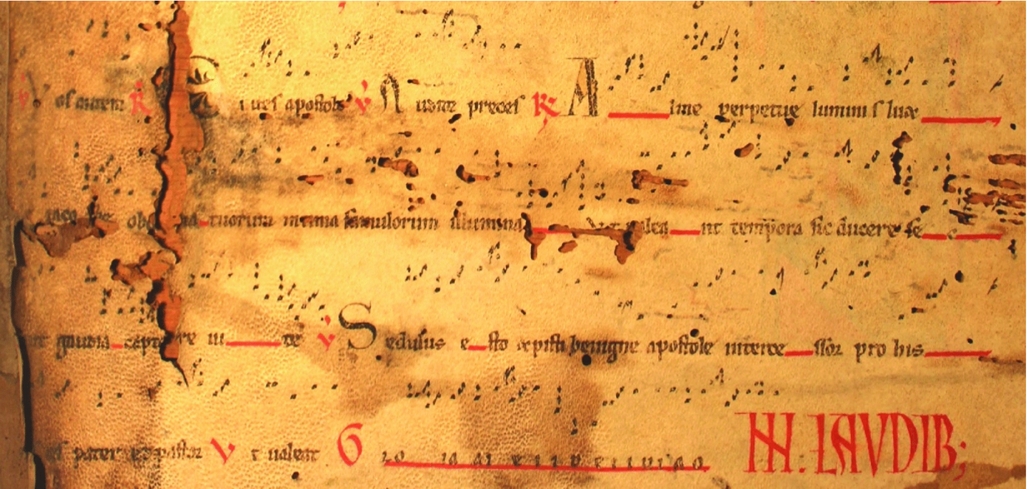
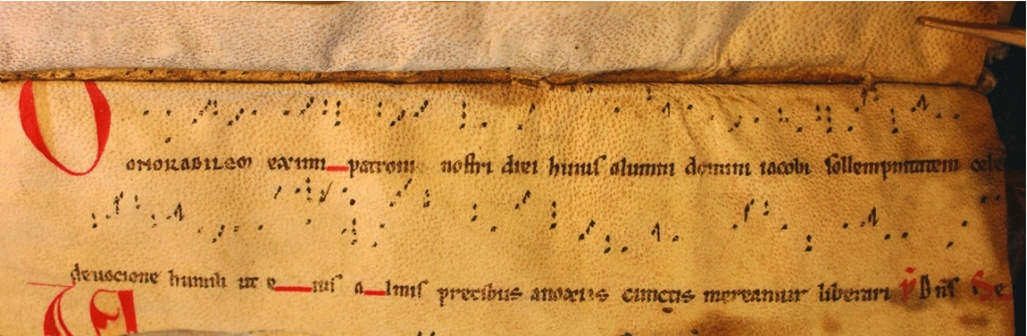
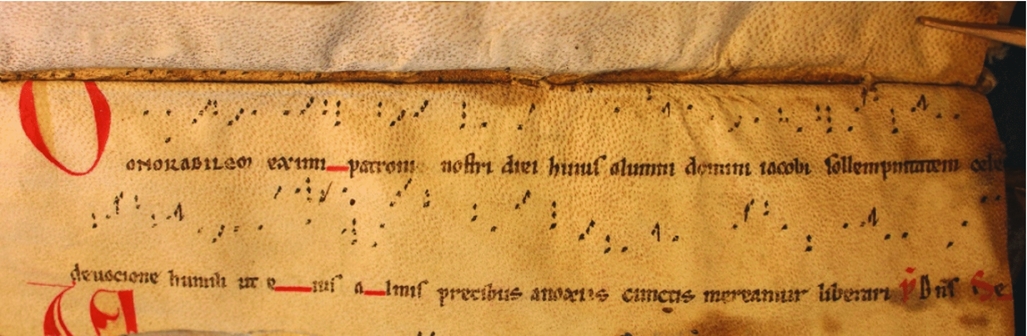
While conducting research at the Archive of the Cathedral of Sigüenza (Guadalajara) in May 2013, I discovered fragments of an antiphoner (hereafter A-Sig) comprising a nearly complete bifolio and three fragments of different bifolios, all originally belonging to a same codex dating c.1100.Footnote 1 The parchment fragments are attached to the front cover of ms. 1 of the archive, a source containing the St Gregory's Morals.Footnote 2 Several chants commemorating St James the Apostle and St Nazarius are collected in A-Sig. The presence of the first feast holds exceptional interest because it demonstrates the existence of a hitherto unknown Proper Office of St James in the Iberian Peninsula before the Codex Calixtinus (hereafter CC).Footnote 3 But there is an even more important fact, namely the discovery of concordances between A-Sig and CC: the responsory Alme perpetue (Fig. 1)Footnote 4 with text correspondence and the antiphon Honorabilem eximii (Fig. 2)Footnote 5 with text and music concordances. Curiously, the former appears in CC as an antiphon, whereas it figures as a responsory in A-Sig, a peculiarity to which I have previously drawn attention.Footnote 6
Responsory Alme perpetue in A-Sig.

Antiphon Honorabilem eximii in A-Sig.
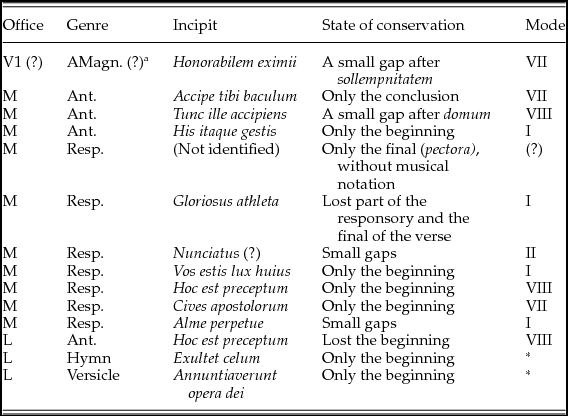
The Sigüenza antiphoner contained at least fourteen chants for St James the Apostle.Footnote 7 Table 1 lists them together with information about their liturgical genre, state of conservation and modal assignment. The placement of two responsories that include the doxology, Nunciatus and Alme perpetue, in between three responsories without doxologies suggests the manuscript followed the monastic cursus, with nocturns of four responsories, rather than the Roman cursus.
Chants for the Office of St James the Apostle in A-Sig.

Abbreviations: L = Lauds; M = Matins; V1 = First Vespers; * = insufficient information.
a Based on its location this must be the Magnificat antiphon since immediately after it appears the rubric of the invitatory and the capital letter V (for the psalm Venite). Nonetheless, I read ‘Benedictus’ in the Psalm tone, text that would normally be associated with the homonymous canticle of Lauds. As will be shown later, the antiphon Honorabilem eximii was linked to Vespers in the Hispanic Office, often accompanying the Magnificat.
It is worth noting that six of the fourteen chants come from the Common of Apostles: the responsories Vos estis lux huius, Hoc est preceptum, Cives apostolorum, the antiphon Hoc est preceptum, the hymn Exultet celum and the versicle Annuntiaverunt opera dei, all found in the Corpus Antiphonalium Officii.Footnote 8 As distinctive attributes, all six are cued in A-Sig by text and melodic incipits. The Proper corpus of the pre-Calixtine Office is thus reduced to only eight chants, including the antiphon Accipe tibi baculum and an as yet unidentified responsory for which just a few notes survive.Footnote 9
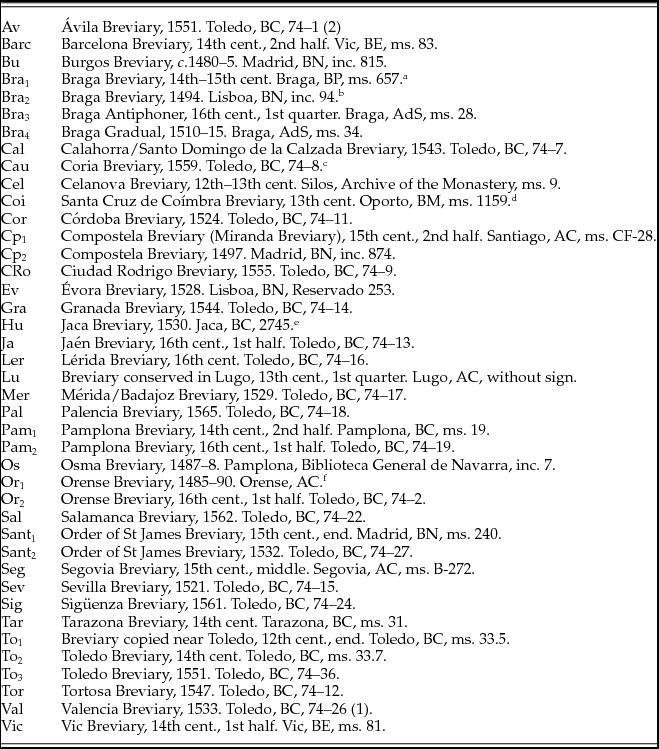
One might wonder why CC incorporates only two chants in the older A-Sig office, especially given the anthological character of the former, offering more than enough liturgical and paraliturgical repertoire to cover all the celebrations of St James.Footnote 10 The lack of overlap is all the more surprising since several of the Proper chants in A-Sig, namely the Matins antiphons Accipe tibi baculum, Tunc ille accipiens and His itaque gestis, had fairly wide dissemination across the Iberian Peninsula before Trent, and the antiphon Honorabilem eximii and responsory Alme perpetue were also well known. (Responsories Gloriosus athleta and Nunciatus, on the contrary, left no trace.) To gain an accurate idea of the transmission of these five chants across the Iberian ecclesiastical geography, I have consulted representative Peninsular liturgical sources dated between the twelfth and the sixteenth centuries (see Table 2).
Manuscript and prints examined.

Abbreviations: inc. = incunabulum; ms. = manuscript. For archives and libraries: AC = Archive of the Cathedral; AdS = Arquivo da Sé; AHP = Archivo Histórico Provincial (Provincial Historical Archive); BC = Biblioteca Capitular (Chapter Library); BCat = Biblioteca de Catalunya (National Library of Catalonia); BE = Biblioteca Episcopal (Episcopal Library); BM = Biblioteca Municipal (Municipal Library); BN = Biblioteca Nacional (National Library); BP = Biblioteca Pública (Public Library).
a Pedro-Romano Rocha, L'Office divin au Moyen Âge dans l’Église de Braga, Cultura Medieval e Moderna 15 (Paris, 1980), 49–378.
b Breviário bracarense de 1494. Reprodução em fac-símile do exemplar da Biblioteca Nacional com introdução de Pedro Romano Rocha (Lisboa, 1987).
c To avoid the repetition of the same abbreviation for Coria and Córdoba (= Cor), the former is identified by its Latin name, Caurium (= Cau).
d I am grateful to Diogo Alte da Veiga for providing me with information about this breviary.
e The seats of Jaca and Huesca were united in a single episcopal institution until 1571. This is why I abbreviate the former as Hu rather than Ja, used for the Breviary of Jaén.
f José Ignacio Cabano Vázquez and José María Díaz Fernández, ed., Breviario Auriense o Incunable de 1485–1490, Bibliofilia de Galicia 21 (Santiago de Compostela, 2004).
Examination of these sources indicates that the five aforementioned chants (Honorabilem eximii, Accipe tibi baculum, Tunc ille accipiens, His itaque gestis and Alme perpetue) found great acceptance in Castile and Aragon. Av, Bu, Cau, Cal, Cor, Cp1, Cp2, Ja, Mer, Or1, Or2, Os, Pal, Sal, Sev, Sig, To2, To3, Sant1 and Seg attest to this on the Castilian side, and Hu, Tar and Val on the Aragonese. It is curious that two sources from Compostela, Cp1 and Cp2 from the second half of the fifteenth century, also prescribe all five of the chants. This confirms what I noted in a previous study, namely the scant dissemination of the CC monophonic repertoire.Footnote 11 The only sources considered here that do not include the five chants are Cel, Lu, To1, CRo and Gra. The early dates of the first three (between the twelfth and thirteenth centuries) could explain this, but the case of Lu is disconcerting given that it appears to have been copied near Santiago de Compostela. As a possible explanation, one must consider that the Galician churches maintained a certain degree of liturgical autonomy with respect to medieval Compostela.Footnote 12 It should also be noted that it is unclear whether Lu really belonged to the Church of Lugo.Footnote 13
The presence of the five St James chants distinctive to A-Sig in sources from the fourteenth century onwards, on the other hand, confirms that their spread across Iberia took place mainly in that century. CRo and Gra reflect very particular situations. The Ciudad Rodrigo Breviary incorporates few Proper formularies for the feast of St James; it largely prescribes the Common of Apostles instead. Moreover, the omission of the feast of the Translation of St James, with strong ties to Castilian lands, suggests that devotion to St James in this diocese was weak.Footnote 14 Gra presents the peculiarity of offering a Proper Office of St James different from the one studied here.
Of the four Catalan sources examined, only Ler includes the texts of the five chants under consideration. Bar, Tor and Vic instead employ the Common of Apostles, including some lessons and prayers. The uneven penetration of the A-Sig St James Office into Catalonia suggests that devotion to the saint here was less than fervent. In this regard it should be noted that St James's preaching in Spain was considered less relevant in this territoryFootnote 15 and that his summer feast (25 July) conflicted with that of St Cucuphas, which was deeply rooted in the tradition there. However, one suspects that the choice of chants from the Common of Apostles may respond to a desire to venerate St James with formularies reliably based on Scripture and the euchological tradition of the Church, a topic to be addressed later. It should also be emphasised that, from the eleventh century onwards, testimony of Catalan pilgrims travelling to Santiago de Compostela is abundantFootnote 16 and local liturgical sources include prayers in which the shrine of St James is referred to obliquely if not pointed out explicitly as a destination of pilgrimage.Footnote 17
Examination of Navarre sources reveals that the transmission of the Office of St James there was slower than to Castile and Aragon. Pam1, dating from the second half of the fourteenth century, has just two Proper antiphons in the apostle's honour, namely O lux et decus and O Iacobe beate omnium, which flank the Magnificat. Otherwise, like most of the Catalan sources and CRo, Pam1 prescribes chants from the Common of Apostles. Pam2, dated nearly two centuries later than Pam1, incorporates the Proper Office, even though, of all chants analysed, it includes only the Matins antiphons Accipe tibi baculum, Tunc ille accipiens and His itaque gestis.
Finally, the A-Sig repertoire was also well known in Portuguese lands. Four of the six sources consulted, namely Bra2, Bra3, Bra4 and Ev, prescribe them; Bra2, Bra3 and Ev, in their entirety (with the exception of the antiphon Honorabilem eximii in the Braga sources); Bra4 has only the responsory Alme perpetue. (I should note that Bra4 is a gradual, a type of book not intended to contain chants of the Divine Office.) In Bra1 we observe a situation similar to Pam1: it has but two unique Proper chants for St James, O lux et decus and O Iacobe beate omnium, using the Common of Apostles for the rest. Coi, on the other hand, does not include repertoire for the feast of any apostle. The limited number of Lusitanian sources that can be examined and compared (due to the scarcity of Roman-diocesan breviaries from this area) suggests caution should be exercised when seeking to determine the true extent to which this corpus penetrated Portuguese liturgies. In this respect, of all the sources digitised by Portuguese Early Music (PEM), only Bra3 and Bra4 transmit this group of chants.Footnote 18
Yet documentary evidence suggests that this corpus of chants was more widely disseminated in Portugal than the liturgical sources would suggest. In 1120, during the pontificate of Diego Gelmírez, numerous Portuguese dioceses became suffragan to Santiago de Compostela. This scenario persisted until 1393, when an arrangement more closely aligned to the political reality was reached, assigning the Galician sees to Santiago and the Portuguese sees to Braga. The point is that the period when Portuguese churches were dependent on Santiago coincides with the time when the local liturgical uses were configured. It is logical that this corpus of St James chants was transmitted from Compostela then. Further evidence in support of this hypothesis is the remarkable devotion to the apostle in these lands. It should be stressed in this regard that the two main feasts of St James, his martyrdom (25 July) and the translation of his relics (30 December), were celebrated in many Portuguese sees until the seventeenth and eighteenth centuries.Footnote 19
In general, the antiphon Honorabilem eximii is associated with the Magnificat, primarily for First Vespers (Av, Cp1, Cp2, Ev, Hu, Ja, Or2, Os, Pal, Sant1, Seg, Sev, Sig, Tar, Tol2 and Tol3), as in CC. However, it is also found for Second Vespers (Val and Sant2). It is not uncommon, however, that this antiphon is omitted in favour of O lux et decus (Bra2, Bu, Cau, Cor, CRo, Gra, Mer, Pam2 and Sal). For their part, Ler and Cal transmit Honorabilem eximii as a simple antiphon for Vespers.
The responsory Alme perpetue appears even more irregularly in sources of the officium proprium. It is lacking in Av, Bu, Ja, Mer, Os, Pam2, Sant2, Sig,Footnote 20 Tar, To2 and To3. In those that include it, there is no consensus on its position. It figures in Matins as the third (Hu), the sixth (Ler, Cal) or the seventh responsory (Cp1, Cp2, Ev, Or1, Or2, Sal and Sant1). Sometimes it was sung during First Vespers (Bra2, Cau, Cor, Ler, Or1, Or2,Footnote 21 Pal, Seg and Sev). Val places it in the hour of Terce. In Cal, Cor, Cp1, Cp2, Or1 and Seg it is the eighth responsory for the feast of the translation.
The position of Matins antiphons Accipe tibi baculum, Tunc ille accipiens and His itaque gestis is more uniform. Without exception they figure in the third nocturn and always in this order except in Mer, where the antiphon Accipe tibi baculum occupies the final position. Sig has only Accipe tibi baculum, but it was the practice of the printer of this breviary to copy only the first antiphon of every nocturn.
Having gathered all this evidence, let us return to the fundamental question: given the earlier date of the Office of St James in A-Sig and its wide diffusion across Iberia, why did the compilers of CC assimilate it only partially? They knew the pre-Calixtine version, at least in part, since the text and melodic concordances between A-Sig and CC cannot be explained otherwise. On this matter, I would argue that the main problem with the earlier office is its marked legendary component. The Matins antiphons were inspired by the so-called Passio magna of St James, a story that first came into currency at the end of the fifth century in the Rhône region and already known in Visigothic Spain in the mid-seventh.Footnote 22 Additionally the responsories Gloriosus athleta and Nunciatus enhance the sanctity of the apostle through a narrative that seeks to embody in the apostle the actions of Christ. Thus James heals wounds (Gloriosus athleta) and walks on water (Nunciatus). Unlike these, the antiphon Honorabilem eximii and the responsory Alme perpetue, the only texts incorporated into CC, underline James's intercessory role.
The monophonic chants in CC, on the other hand, reveal a strong biblical and patristic substrate.Footnote 23 Even the Office's non-scriptural texts, also numerous, do not rely heavily on legends. Only the antiphons Videns Herodes and Regis vero facinus and the responsory Cum adpropinquaret are rooted in the apostle's two passions – the antiphons with texts from the Passio modica, the responsory from the Passio magna – but these chants would not have been necessary in the secular cursus of Matins. If that were not enough, the provenance of the sung texts is indicated with few exceptions, a peculiarity almost certainly aimed at silencing potential critics of the texts’ veracity.Footnote 24
The remaining CC chants with non-scriptural texts proclaim James's apostolicity and seek his intercession along lines similar to Honorabilem eximii and Alme perpetue. We may conclude that this similarity would have made them admissible into CC in the long run. Such chants were useful to its copyists because they did not introduce any suspicious or spurious elements. The same scribes did not hesitate to alter dubious passages. For example, the text ‘alumni domini’ in the A-Sig antiphon Honorabilem eximii is replaced by ‘apostoli domini’ in CC.
The position of these two chants in CC should also be considered. As Villaverde Temperán has shown, Honorabilem eximii and Alme perpetue belong to the group of seven antiphons of unknown origin.Footnote 25 With one exception, all are invitatory antiphons or antiphons accompanying the Gospel canticles. It may be assumed that as such they were well known to the clergy of Compostela at the time when CC was copied, which made their integration into the new liturgy prudent.Footnote 26 Their textual content, of clear laudatory character, is also unproblematic.Footnote 27 From this perspective, one might view the liturgical repertoire of the Codex Calixtinus as responding to a lack of suitable and worthy formularies to solemnise the apostle's feasts.Footnote 28 This predilection for a liturgically impeccable repertoire was certainly justified. The famous opening epistle, attributed to Callixtus II, indicates that everything sung for St James must have authority in the Gospels. What is written in the passions of the apostles is not appropriate since not everyone considered it to be true.Footnote 29
This heightened effort to incorporate biblical and patristic texts reveals a double intention, both liturgical and ecclesiastical. Between the end of the eleventh and the mid-twelfth centuries, the Church of Compostela confronted great challenges. Like most Spanish dioceses, it was forced to suppress the Visigothic rite in favour of the Roman-Frankish liturgy. To this already complex process yet another major obstacle had to be overcome: the replacement of the monastic liturgy practised in the communities of San Pelayo de Antealtares and San Martín Pinario with a secular one, all this within the framework of the transfer of the diocese from Iria to Compostela. The Historia Compostellana describes the difficulties the Church experienced in liturgical matters. There it is recounted that during the pontificate of Diego Gelmírez, the Church was uneducated and lacking in discipline, which led the pontiff to apply French ecclesiastical customs.Footnote 30
At the same time, Compostela had to defend the apostolicity of its Church, which Rome seriously questioned. At the beginning of the liturgical reform in the Hispanic kingdoms, Gregory VII brought under scrutiny the preaching of the apostle in Spain, the transfer of his body to Galicia and the linkage to St James of the seven Apostolic men.Footnote 31 Moreover, the episcopal character of the Church of Santiago de Compostela was also under suspicion, whilst the canonical see was still Iria in accordance with the existing scheme in Visigothic times. Only the support of the Castilian monarchy and the determination of the Compostelan prelates could smooth the tensions over. And yet, the price paid to meet the papal demands was quite burdensome: for some time it had to sustain the apostolicity of the Church in the sepulchral presence, ratified by the contemporary argument of the existence of a growing crowd of pilgrims to the shrine.Footnote 32 It is reasonable that, in order to mitigate Roman suspicions, the compilers of CC developed a liturgy against which no objection could be raised. The solution lay, necessarily, in biblical and patristic content.
Another previously overlooked aspect, which may have helped reduce the strain between Santiago and Rome concerns the music. Pioneering work by Peter WagnerFootnote 33 and Germán Prado,Footnote 34 followed years later by that of Michel HugloFootnote 35 and Susan Rankin,Footnote 36 has demonstrated that CC contains many pre-existing melodies, some of them belonging to the Gregorian repertoire.Footnote 37 Although in the mid-twelfth century, the time when CC was copied, Rome had its own melodic corpus of the so-called Old-Roman chant, it may nevertheless be assumed that the newly imported repertoire was pleasing to the papacy due to its attribution to St Gregory the Great. The Gregorian melodies would also have been familiar to many pilgrims coming from Europe. For a cosmopolitan city such as Compostela, in which all kinds of languages were spoken,Footnote 38 the option of a chant repertoire as universal as the Gregorian might well have had the advantage of encouraging a sense of unity around the apostle's tomb. The responsory Alme perpetue is a good example of this. As mentioned previously, its text in A-Sig concords with CC; however, the melodies differ, apparently because the chant is a responsory in A-Sig but an antiphon for Compline in CC. What is striking, as Rankin observes, is the setting of the latter text to the melody of the Marian antiphon, Ave regina cælorum.Footnote 39 The regular performance of the chant at Compline makes it reasonable to assume that pilgrims and others who heard Alme perpetue would have recognised the Marian tune.
The sequence of events outlined here would fit with Hendrik van der Werf's hypothesis concerning the compilation of CC and the supposed debate between ‘purists’ and ‘liberals’.Footnote 40 The former defended the idea that only biblical texts or compositions of proven authority should be sung in the Mass and Divine Office, preferably with melodies sanctioned by the authority of Pope Gregory the Great; the latter were favourable to introducing more heterodox materials. It can be presumed that Frankish clergy mainly constituted the ‘purists’, particularly due to the notable influence of Cluny. In this way the presence of elements of clear French filiation in CC can be explained.Footnote 41 In the end, the ‘purist’ criterion would prevail, implying the suppression of legendary elements, such as found in A-Sig prevalent before the ecclesiastical reform that Diego Peláez promoted.Footnote 42 However, the triumph was short-lived. Once relations with the papacy were normalised and the ecclesiastical status of the Compostelan see consolidated, it recovered its old themes. Precisely when the legendary Office was reintroduced is uncertain due to the loss of liturgical materials during the twelfth to the fourteenth centuries. The absence of evidence that can prove the regular use of the folios with music in CCFootnote 43 suggests that this may have occurred as soon as the beginning of the thirteenth century if we consider the date when use of the codex was supposedly abandoned.Footnote 44 We must also bear in mind that, despite its late dating, Cp1 is regarded as a true representative of the current liturgical tradition in the ecclesia compostellana since the twelfth century.Footnote 45 It is hard to believe that a liturgically faultless repertoire was suppressed in favour of a more problematic one. This demonstrates the great popularity of saints’ legends in the Middle Ages.
Another detail that may be deduced here is the negligible spread of the monophonic repertoire of CC outside Santiago. Clear proof of this is the small number of sources that transmit its music: the copy made by the monk of Ripoll Arnaldo de Monte in 1173Footnote 46 and a Missal of St Jacques-la-Boucherie in Paris, dated to the fifteenth century and containing the 25 July Mass.Footnote 47 Moreover, the few pieces that were disseminated owe this not to CC, but to their having been copied from still earlier sources such as A-Sig and including the antiphon Honorabilem eximii and the text of Alme perpetue, transmitted as a responsory. We should also add to this group the Magnificat antiphon O lux et decus, the Invitatory antiphon Venite omnes Christicole, the Matins antiphon O venerande Christi and the Benedictus antiphon Apostole Christi Iacobe, which appear regularly in Peninsular sources from the thireenth century onwards. Despite not being included in A-Sig, possibly as a result of the fragmentary nature of the source, the composition of these chants was contemporary with that of Honorabilem eximii and Alme perpetue and that they form part of the same pre-Calixtine stratum. It should be noted in this regard that these two are also found in CC (together with the Invitatory Regem regum dominum), in which their provenance is not mentioned, and that their texts are neither biblical nor patristic. In fact, such texts are regularly attributed to Pope Callixtus. All these pieces, except O venerande Christi, were spread across the Iberian Peninsula with melodies with marked similarities to those in CC.Footnote 48 In O venerande Christi, meanwhile, we encounter a situation identical to Alme perpetue: it must originally have been a text for a responsory – as it is transmitted in Hispanic sources – and later adapted as an antiphon in CC and given a new melody.Footnote 49
From a different perspective, we could credit the pieces attributed to Callixtus in CC to its compilers and it would be fair to consider them as providing a genuine stratum of new composition. For the pre-existing repertoire, the compilers decided not to show any possible authorship, which could have led to confusion since these chants were already known.
Conclusions
In the foregoing, I have demonstrated the existence of an officium proprium of St James the Apostle prior to that collected in the Codex Calixtinus. Text and melodic concordances strongly suggest that the CC compilers knew the A-Sig versions. These findings reinforce the character of CC as a work in progress in which different and not necessarily contemporary liturgical and documentary materials were amalgamated over time.Footnote 50
It can also be concluded that the version of the St James Office transmitted in A-Sig ultimately prevailed in Hispanic churches, including Santiago de Compostela itself, whereas the liturgical repercussions of CC were minimal if not negligible. The four chants in CC known across the Peninsula (Apostole Christi Iacobe, Honorabilem eximii, O lux et decus and Venite omnes Christicole) owe their dissemination not to their inclusion in CC, but to their belonging to a pre-Calixtine stratum. The presence of texts for the Proper and Common of Apostles in A-Sig proves that at the time when the antiphoner from which these fragments come was copied, the Office of St James was still far from being fully configured. It later incorporated more chants seemingly created ex novo as substitutes for the common chants. As a defining feature, they emphasise the legendary elements of St James at the expense of the biblical and patristic foundation. What happened to the responsories Gloriosus athleta and Nunciatus has yet to be determined. Their absence from Peninsular sources suggests that their dissemination was both geographically and temporally limited.
In a previous publication I attributed the St James Office in A-Sig to a French rather than a Hispanic cleric based on the melodic language and modal behaviour of the chants, which are demonstrably connected to a Gregorian aesthetic.Footnote 51 However, we cannot rule out the possibility that it may have had a dual authorship: the text could have been created by a Spaniard, which would explain the local references in the chant texts, while the music could be attributed to a Frenchman well trained in the Gregorian traditions. Some (weaker) evidence even suggests a possible origin of the Office within the ecclesiastical circle of the Cathedral of León.Footnote 52
Nonetheless, French provenance has a certain logic since the adoption of the Roman-Frankish rite meant that the feast of St James, commemorated on 30 December in the Hispanic calendar, was moved to 25 July. One might imagine the composition of a Proper office for the summer feast as a sort of French stratagem intended to mitigate likely resistance among the Iberian clergy over the change of date.Footnote 53 Some local references in the chant texts – ‘our patron’ in Honorabilem eximii and ‘light and glory of Spain’ in O lux et decus, which despite its absence in A-Sig I associate with the pre-Calixtine substrate – would have contributed to a calming of tensions. Another factor supporting a French origin for the Office is its preservation in later French manuscripts. Following a clue provided by Huglo,Footnote 54 I have verified it in a breviary from Angers, dating to the sixteenth centuryFootnote 55 though this testimony is anecdotal: the French sources, including those from Angers,Footnote 56 regularly prescribe the Common of Apostles for the feast of St James. It is also interesting to note here the inclusion of this Office in Italian sources. The Antiphonary ms. 57 of the Museo Archeologico Nazionale of Cividale (dated to the fourteenth and fifteenth centuries) contains the five chants the dissemination of which is studied here,Footnote 57 although these are divergent melodic versions with respect to A-Sig.Footnote 58 It might be taken into account that one of the most prominent centres of the cult of St James in Europe was the Tuscan city of Pistoia.Footnote 59
The results of this study represent a significant advance in the knowledge of the origin of the monophonic chants in CC. It is important to underline here that this advance has been possible thanks to the discovery of a fragmentary antiphoner. This confirms how ostensibly marginal sources, such as membra disiecta, possess great value. The incomplete knowledge of these sources in Spain should encourage, with even more conviction, the development of studies that could foster their localisation and subsequent description.
Appendix. Chants of the summer Office of St James the Apostle in Cp1
I offer in this appendix a textual transcription of the St James chants in the Breviary of Santiago de Compostela ms. CF-28 (Cp1), better known as the Breviary of the Canon Miranda, for the feast of July 25. Its interest lies not only for being the model observed in the Compostelan Church at the end of the Middle Ages, but also, and to a large extent, because it is representative of a good part of the Peninsular ecclesiastical map during a similar period. I reproduced the texts as faithfully to the original source as possible, so certain erroneous spellings have been preserved. Additions to the text to make the meaning more comprehensible appear between brackets < >. When the copyist provides only the incipit, it has been transcribed in italics. To facilitate the identification of formularies I have added, whenever possible, references to the Corpus Antiphonalium Officii [=CAO] or, in its absence, to the CANTUS INDEXFootnote 60 [=CANTUS ID]; for hymns, I include the numbering provided by Analecta Hymnica Footnote 61 [=AH]. The texts in A-Sig are indicated by a plus sign (+), those in CC by an asterisk (*). The following abbreviations are used for liturgical genres: A. = Antiphon; ABen. = Benedictus antiphon; AInv. = Invitatory antiphon; Al. = Alleluia; ANunc = Nunc dimittis antiphon; AMagn. = Magnificat antiphon; H. = Hymn; P. = Prosa; R. = Responsory; W. = Versicle.
FIRST VESPERS /fol. 404r/
-
1 A. Audiens hec ergo Hermogenes (CANTUS ID a00195)
-
2 R. Sancte Iacobe Christi apostole
-
3 H. Lux de celis, dux fidelis (AH 16, 261)
-
4 W. Ora pro nobis beate Iacobe (CAO 8164)
-
5 AMagn. Honorabilem eximii+*
COMPLINE /fol. 404r/
-
6 A. Quidam autem <deorum> (CANTUS ID a00327)
-
7 ANunc In nomine regis <trium> (CANTUS ID 202444)
MATINS / fol. 404r/
-
8 AInv. Venite omnes Christicole* (CANTUS ID 100288)
-
9 H. Eterne rex superne (AH 16, 262)
/first nocturn/
-
10 A. Apostolus Christi Iacobus per sinagogas (CANTUS ID a00306)
-
11 A. Docente namque eo contigit (CANTUS ID a00307)
-
12 A. Cum autem venisset Philetus (CANTUS ID a00308)
-
13 W. In omnem terram exivit (CAO 8097)
-
14 R. Apostolus Christi Iacobus per sinagogas. V. Monita sequens magistri (CANTUS ID a00309)
-
15 R. Sanctissimo Iacobo veritatem. V. Furorem gentilium adhuc (CANTUS ID a00311)
-
16 R. Cum venisset Philetus. V. Prius ergo quam audisset (CANTUS ID a00310)
-
17 P. Discipline radio dominice
/second nocturn/
-
18 A. Eo namque predicacioni (CANTUS ID a00312)
-
19 A. Ait namque Philetus (CANTUS ID a00313)
-
20 A. Audiens hec ergo Hermogenes (CANTUS ID a00195)
-
21 W. Constitues eos (CAO 7994)
-
22 R. Facta autem in turba. V. In fontem et iustum (CANTUS ID a00314)
-
23 R. Gloriosus domini apostolus. V. Lavacro sancte regenerationis (CANTUS ID a00315)
-
24 R. Sancte Iacobe Christi apostole. V O sancte Iacobe sidus
-
25 P. Inter concives glorie
/third nocturn/
-
26 A. Accipe tibi baculum+ (CANTUS ID a00317)
-
27 A. Tunc ille accipiens+ (CANTUS ID a00318)
-
28 A. His itaque gestis+ (CANTUS ID a00319)
-
29 W. Nimis honorati (CAO 8148)
-
30 R. Alme perpetui luminis lux+*. V. Sedulus esto Christi benigne+ (CANTUS ID a00194)
-
31 R. Adest nobis valde letabunda. V. Divini muneris claritate (CANTUS ID a00316)
-
32 R. O speciale decus generali. V. O Iacobe tuis virtus (CANTUS ID a00323)
-
33 P. Corde te pie parilis
-
34 <H.> Te deum laudamus (CANTUS ID 909010)
-
35 <W. (?)> Constitues eos (CAO 7994)
LAUDS /fol. 407r/
-
36 A. Predicante apostolo iugiter (CANTUS ID a00324)
-
37 A. Apostolus Christi fidem (CANTUS ID a00325)
-
38 A. Videns ergo pontifex (CANTUS ID a00326)
-
39 A. In nomine regis trium (CANTUS ID 202444)
-
40 A. Quidam autem deorum (CANTUS ID a00327)
-
41 H. Laudes Christi psalant isti (AH 16, 263)
-
42 W. Ora pro nobis beate Iacobe (CAO 8164)
-
43 ABen. Apostole domini Iacobe*
SECOND VESPERS /fol. 407v/
-
44 Al. Hodie per Christo beatus Iacobus
-
45 H. Lux de celis (AH 16, 261)
-
46 W. Ora pro nobis beate Iacobe (CAO 8164)
-
47 AMagn. O lux et decus* (CANTUS ID a00193)