
Introduction
Even though many of the tissues and organs have the capacity to self-repair, sometimes injuries exceed their capacity. Hence, the field of tissue engineering has emerged in order to repair the damage or replace missing tissues. Some of those materials used for this purpose are named biomaterials due to their ability to interact with biological systems. They are usually employed in medical applications to enhance or replace a natural function.
The success of the biomaterials depends on different factors that affect the response of the surface of the material to the surrounding environment. In recent years, numerous investigations have been performed to modify surfaces for promoting cell adhesion and proliferation to maintain cellular functions, including adhesion, spreading, migration, and differentiation.[Reference Girard-Lauriault, Truica-Marasescu, Petit, Wang, Desjardins, Antoniou, Mwale and Wertheimer1–Reference Bullett, Bullett, Truica-Marasescu, Lerouge, Mwale and Wertheimer5] It is well known that most cells cannot adhere to hydrophobic surfaces; however, modified hydrophobic surfaces facilitate their adhesion, especially those rich in nitrogen.
There has been a substantial research effort regarding the influence of several functional groups on cell functions.[Reference Girard-Lauriault, Truica-Marasescu, Petit, Wang, Desjardins, Antoniou, Mwale and Wertheimer1,Reference Curran, Chen and Hunt3,Reference Bullett, Bullett, Truica-Marasescu, Lerouge, Mwale and Wertheimer5–Reference Sridharan, Cameron, Kelly, Kearney and O'Brien9] It has been demonstrated that those surfaces rich in nitrogen, especially primary and second amines, compared with those modified with oxygen, facilitated cell adhesion of macrophages, myoblast, and mesenchymal stem cells, allowing the development of their functions.
Amino groups have been associated with positive charges that are able to attract negatively charged biomolecules (proteins, DNA) and thus living cells in aqueous solutions at a physiological pH. The most common method to incorporate functional groups on polymeric materials is by a plasma technique, but these synthesized systems present some disadvantages, such as partial solubility in water and formation of a substantial amount of free radicals, which cause the incorporation of oxygen (aging) when in contact with air. Moreover, the final chemistry of the surfaces is complex and difficult to define and depends on the type of gas and the discharge conditions used.[Reference Ruiz, St-Georges-Robillard, Thérésy, Lerouge and Wertheimer10–Reference Klages, Khosravi and Hinze12] Therefore, the synthesis of the grafting monomers via gamma radiation with functional groups that can react and form primary, secondary amines, or derivatives on the surface is more appropriate.[Reference Pérez-Calixto, González-Pérez, Dionisio, Bucio, Burillo and Garciá-Uriostegui13,Reference Rodríguez-alba, Huerta, Ortega and Burillo14]
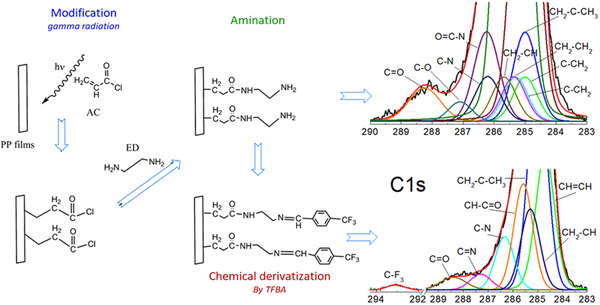
In this work, the synthesis was realized in two steps: a radiation grafting direct method of acryloyl chloride (AC, Sigma-Aldrico, USA) onto polypropylene (PP) films has been applied to insert acyl functionalities, and then, the radiation-grafted films were reacted with ethylenediamine (ED). Amine concentration was determined immediately after being synthesized and after a period of time. The effect of aging on the amine functional groups was determined by x-ray photoelectron spectroscopy (XPS, VersaProbe II from Japan) after derivatization with 4-trifluoromethyl benzaldehyde (TFBA).
The functional groups present in the samples were studied by XPS, elemental analysis (EA), and Fourier transform infrared spectroscopy with attenuated total reflection (FTIR-ATR). The change in hydrophobicity was measured by the contact angle, while morphology was measured by atomic force microscopy (AFM, Nanosurf model NaioAFM equipment, Liestal, Switzerland) and scanning electron microscopy (SEM).
Experimental section
Chemicals and reagents
PP films purchased from Goodfellow (Huntington, UK), of 0.1 mm thickness and were cut into pieces measuring 1 × 5 cm, washed with methanol (analytic grade) for 2 h and dried at reduced pressure during 4 h and 40 °C temperature. AC (97%) supplied by Sigma-Aldrich Co., was distilled at reduced pressure, and anhydrous methanol (99.8%), TFBA, ED (96%), and triethylamine were acquired from Sigma-Aldrich, USA and were used as acquired. Tetrahydrofuran (THF) and N,N-dimethylformamide (DMF) (JT Baker, Mexico City, Mexico) were distilled before use, and dichloromethane (DCM, CH2Cl2) was distilled and stored over CaCl2.
Radiation grafting by the direct method
Films were grafted with AC by the direct method. Briefly, two films were weighed and introduced in separated glass ampoules, and a solution of 30% v/v of AC in toluene were added until the film was completely covered (6 mL). Subsequently, degassing of the ampoules was carried out with freeze/thaw cycles with liquid nitrogen and then sealed and irradiated at dose from 1 to 6 kGy with a doses rate of I = 5.5 kGy/h, using a 60Co γ-source (Gammabeam 651 PT, MDS Nordion, Canada), at room temperature. After, grafted films were washed with DCM for 24 h (changing the solvent every 12 h) to remove any homopolymer formed during irradiation.
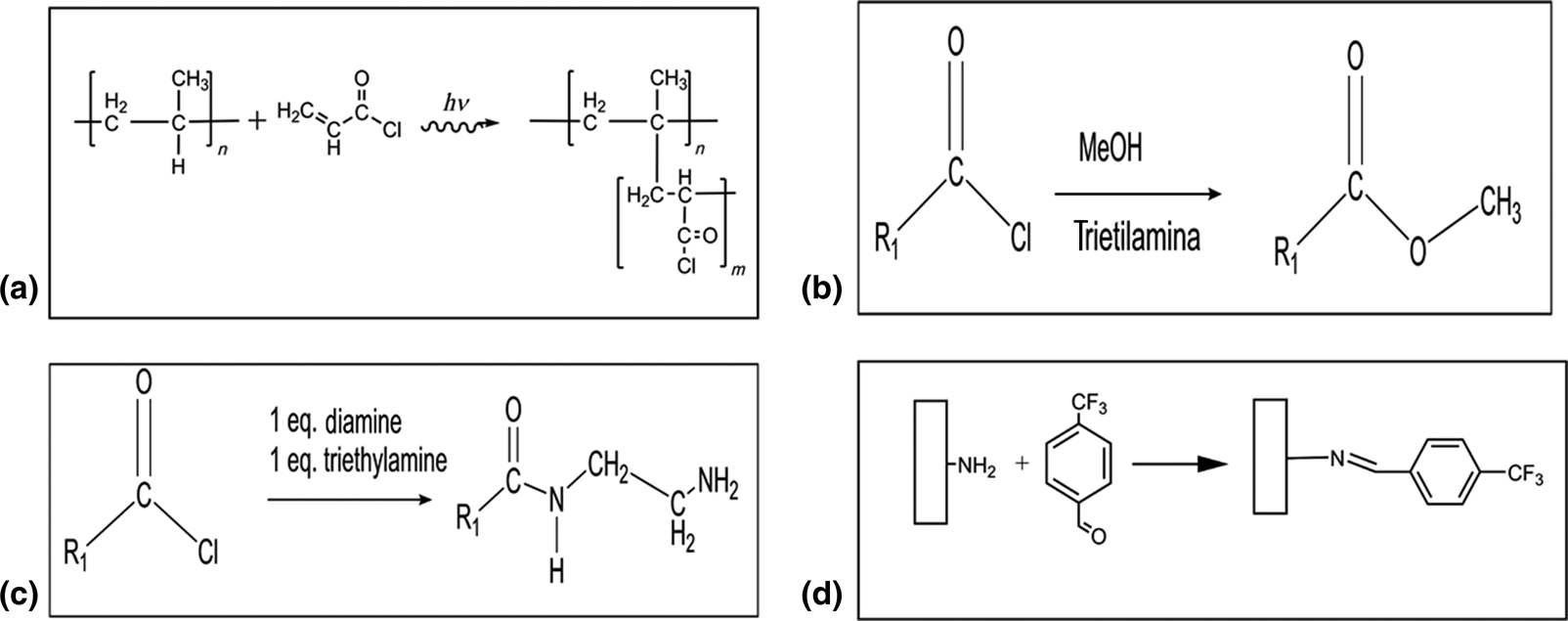
Reaction grafting of AC by gamma radiation is shown in Fig. 1(a)
(a) Reaction of AC grafted onto PP; (b) alcoholysis reaction of AC with methanol to obtain a methacrylate; (c) aminolysis reaction with ED; and (d) chemical derivatization with TFBA.

.
Finally, one grafted film was reacted with methanol (reference film), in order to determine the percent yield of grafting, and the other one was reacted with ED.
Alcoholysis reaction (esterification)
The reference film was immediately placed in anhydrous methanol for 24 h under constant stirring to carry out the corresponding esterification and thus obtain the methacrylate compound (PP-g-MA). To avoid the reversibility of the reaction and neutralize the HCl formed, triethylamine was added. The reference film was only used to calculate the percent of AC grafted because AC is an unstable functional group and difficult to handle due to reactivity with humidity of the environment, resulting in hydrolysis of AC. Since the weight of the methoxy group (31 g/mol) is similar to that of the chloride group (35.5 g/mol), it is possible to obtain an approximate calculation of the grafting percent. To determine the percent of grafting, the following equation was used:
 $$G \,\lpar \% \rpar = \displaystyle{{W_g-W_o} \over {W_o}} \times 100$$
where Wo and W g are the weight of the film before and after being grafted, respectively.
The reaction is shown in Fig. 1(b).
Aminolysis reaction
To carry out the aminolysis reaction, the second film was placed in a solution of 2 M diamine in different solvents such as DCM, DMF, and THF. Triethylamine was added to avoid reaction reversibility. ED was used for this reaction. It was kept under constant stirring for 0.5, 1, 2, 6, 18, and 24 h at room temperature. The aminated film was washed with distilled water and then was dried under in a vacuum oven at 50 °C for 6 h. The film was named with the acronym of the diamine in parentheses, PP-g-AC(ED). The reaction is shown in Fig. 1(c).
Characterization
FTIR-ATR
Physicochemical properties of unmodified and modified films were determined by infrared spectra using an FTIR-ATR equipment. Spectra were recorded with a Perkin-Elmer Spectrum 100 spectrometer (Perkin-Elmer Cetus Instruments, Norwalk, CT, USA).
Contact angle measurements
Contact angle measurements were carried out in triplicate, at room temperature (23 °C), using a KRÜSS DSA 100 apparatus (Matthews, NC, USA). Small drops of water were deposited on the surface of the pristine material (PP) and functionalized films (PP-g-AC(ED)). The contact angle was measured immediately after depositing the drop of water.
Determination of roughness of the films by AFM
Characterization of surface roughness by AFM was performed on a Nanosurf model NaioAFM equipment. It was measured, on a scale of 10 µm, in two different regions per sample, in contact mode. The tip used was a Budget Sensors ContAl-G tip.
Scanning electron microscopy
Surface and cross-sectional morphology of the films were observed in a Tescan Mira 3 LMU at different scales. The dried samples were coated with Au under vacuum for 10 s, using a sputter coating of the SPI module.
X-ray photoelectron spectroscopy
XPS analyses were performed in an ultrahigh vacuum (UHV) system Scanning XPS microprobe PHI 5000 VersaProbe II, with an Al Kα x-ray source (hν = 1486.6 eV) monochromatic with a 100 µm beam diameter, and an MCD analyzer. The surface of the samples was not etched. The XPS spectra were obtained at 45° to the normal surface in the constant pass energy mode (CAE) E 0 = 117.40 and 11.75 eV survey surface and high-resolution narrow scan. The peak positions were referenced to the background silver 3d 5/2 photopeak at 368.20 eV, having a full width at half maximum of 0.56 eV, and C1s hydrocarbon groups at 285.00 eV.
Chemical derivatization with TFBA
To know the amount of primary amines on the surface and determine if there is oxidation with time, chemical derivatization was carried out. A method, that is, normally used for chemical derivatization, is a selective reaction of a primary amine with TFBA. The scheme of reaction is shown in Fig. 1(d).[Reference Rodríguez-alba, Huerta, Ortega and Burillo14–Reference Yegen, Zimmermann, Unger and Braun16] The percent of primary amines was deduced from the concentration group's fluorine (CF3) on the surface by using the XPS technique. The reaction was performed as a gas phase at 40 °C for 4 h. Functionalized films were hung up inside a flask over a bed of 1 cm thick glass beads, and then, 0.5 mL of TFBA was added to the glass beads, avoiding direct contact of the sample. The flask was closed and allowed to react. The proportion of amines on the surface can be calculated with the following equations according to Girad-Lauriault:[Reference Girard-Lauriault, Dietrich, Gross and Unger15]
 $$[{\rm N}{\rm H}_2]_{\rm N} = \displaystyle{{{{I_{\rm F1s,D}} \big / {3{\rm AS}{\rm F}_{\rm F1s}}}} \over {{{I_{\rm N1s,D}} \big / {{\rm RS}{\rm F}_{\rm N1s}}}}}$$
 $$[{\rm N}{\rm H}_{\rm 2}]_{\rm C} = \left( {\displaystyle{{{{I_{\rm F1s, D}} \big / {3{\rm AS}{\rm F}_{\rm F1s}}}} \over {{{I_{\rm C1s,D}} \big / {{\rm AS}{\rm F}_{\rm C1s}}}}}} \right)\left( {\displaystyle{{I_{\rm N1s,ND}} \over {I_{\rm N1s,D}}}} \right)$$
 $$[{\rm NH}_2]_{\rm T} = \left[\displaystyle{{{{I_{\rm F1s,D}} \bigg/ {3{\rm ASF}_{\rm F1s}}}} \over {{{I_{\rm C1s,ND}} \bigg/ {{\rm ASF}_{\rm C1s}}}} + {{{I_{\rm N1s,ND}} \bigg/ {{\rm ASF}_{\rm N1s} + {{I_{\rm O1s,ND}} \bigg/ {{\rm ASF}_{\rm O1s}}}}}}}\right]\left( {\displaystyle{{I_{\rm N1s,ND}} \over {I_{\rm N1s,D}}}} \right) $$
where I is the intensities or area of photoelectron peaks of each element, of derivatized groups, D, and nonderivatized groups, ND. ASF is the sensitivity factor of each element.
Elemental analysis
Functionalized films were analyzed by EA to determine their percent of carbon, hydrogen, and nitrogen of the whole sample.
Results and discussion
Grafting of AC onto PP
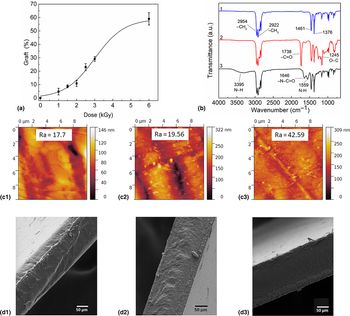
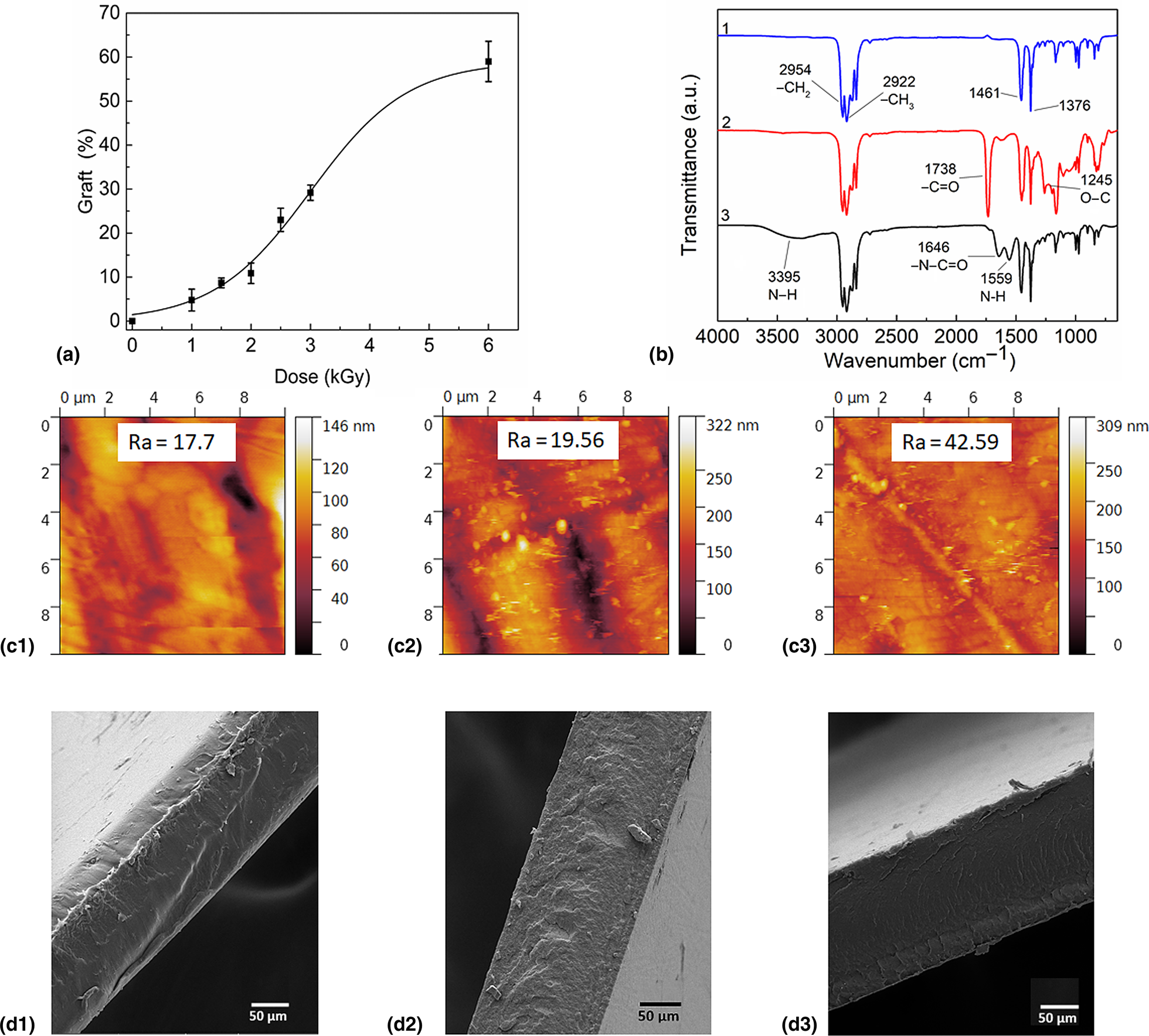
AC was grafted onto PP using the direct method because it produced better grafting yield.[Reference Bucio, Burillo, Carreón-Castro and Ogawa17,Reference Aliev, Del Pilar Carreón-Castro, Rivera and Burillo18] Figure 2(a) shows an increase of grafting as a function of dose. Doses up to 6 kGy lead the formation of a great amount of homopolymer; hence, solution's viscosity increased, decreasing mobility of the macro radicals, diffusion of the monomer in the system and thus diminishing the amount of grafted AC.
(a) Grafting (%) of AC on PP films as a function of dose. [AC]: 30% v/v in toluene. I: 4.16 kGy/h. (b) FTIR of different systems: (1) PP film, (2) PP-g-AM, and (3) PP-g-AC(ED). (c) AFM surface roughness value by AFM of (c1) PP film, (c2) PP-g-C(ED)g:14%, (c3) PP-g-AC(ED)g:24%, and (d) SEM micrographs of cross section of (d1) PP, (d2) PP-g-AC(ED)g:14%, and (d3) PP-g-AC(ED)g:24%.
The grafting percent of AC onto PP was measured gravimetrically [Eq. (1)] by an indirect method through esterification with methanol because of the high reactivity and easy decomposition of the acyl chloride group.[Reference Martínez-Cocoletzi, Ruiz, Kasparek, Ortega, Garcia-Uriostegui, Girard-Lauriault and Burillo19]
Aminolysis reaction
To introduce amine groups on surfaces, films that were 14% and 24% of grafting (3 and 6 kGy) were chosen to determine the suitable grafting percent for this reaction.
The reaction between ED and AC could cause crosslinking because the two amine groups of ED react with the acyl groups of the two polymer chains. To perform this reaction, it is necessary to control some factors such as the time of reaction and grafting percent of AC.
The reaction time was tested, and it was found that 30 min was sufficient to react with the amine groups, with the chloride group; for longer times, the reaction yield was the same.
The solvent was another factor that was studied. Three different solvents were chosen to carry out the reaction: DCM, DMF, and THF. The best results were obtained using THF. Films in which DCM was used showed unfavorable yields, regardless of the amount of monomer graft. On the other hand, it is well known that DMF is a good solvent for substitution reactions; however, it is difficult to remove from the samples. Consequently, these two solvents were not used to carry out the reaction.
A low grafting percent was chosen because only a small amount of primary amine demonstrated a change related to hydrophilicity; moreover, it is suitable for cell adhesion.[Reference Martínez-Cocoletzi, Ruiz, Kasparek, Ortega, Garcia-Uriostegui, Girard-Lauriault and Burillo19,Reference Girard-Lauriault, Dietrich, Gross, Wirth and Unger20] Films with a higher grafting percent did not experience modification of their hydrophobicity (see section “Contact angle measurements” under “Characterization”).
Characterization
FTIR-ATR
FTIR-ATR spectra [Fig. 2(b)] confirmed the grafting of AC and esterification with methanol onto PP. The PP film [Fig. 2(b1)] showed two bands at 2922 and 2954 cm−1, corresponding to asymmetric and symmetric methyl (CH3) and methylene (CH2) stretch, respectively. Two bands at 1376 and 1461 cm−1 belong to asymmetric bending of CH2 and CH3, respectively. The system PP-g-AM showed a new band at 1738 cm−1, which is attributed to C=O stretching ester vibration [Fig. 2(b2)]. The modified system with ED [Fig. 2(b3)] showed a band associated with amine groups at 3395 cm−1, a single band corresponding to secondary amines (instead of double or primary); further, two bands at 1646 and 1559 cm−1 correspond to C=O stretching and N–H bending vibrations of the amide group, respectively.
Contact angle measurements
The contact angle (θ) of pristine PP was 91.1° ± 0.29, showing its hydrophobic characteristics. This value decreased to 73.4° ± 1.32 when it was modified with 14% grafted films, due to amine groups were introduced to the structure and hydrogen bonds formed between water and amines group. On the other hand, higher grafting yield (24%) leads to an angle rising to 88.2° ± 1.37, likely for an increase in hydrocarbon density (weight) on PP surface.[Reference Stevens21]
Determination of roughness by AFM and SEM analysis of the films
Engler et al.[Reference Engler, Richert, Wong, Picart and Discher22] have demonstrated the importance of changing the topography on the surface for cell adhesion, they showed an improvement of cell adhesion when the roughness increased. This change can be studied by means of AFM.
Figures 2(c1)–2(c3) show the different roughness between modified and unmodified films. Darker areas represent depressions, whilst brighter areas mean ridges on the surface. Roughness average (Ra) of the PP [Fig. 2(c1)] was 17.7 that can be observed a relatively smooth and flatter surface. PP-g-AC(ED)g:24% exhibited the highest Ra. Samples with 14% of grating showed slightly increased regard to PP films. Introduction of branches on the backbone chain of lead to increment to roughness.
Cross-sectional SEM images are shown in Figs. 2(d1)–2(d3). Cross-sectional morphologies of PP and PP-g-AC modified with ethylenediamines (PP-g-AC(ED)) with 14% and 24% grafted films were investigated.
Pristine films of PP [Fig. 2(d1)] show a compact and smooth surface, with a thickness of 76.9 ± 2.9 µm. Figures 2(d2) and 2(d3) show an increased thickness of 120.4 ± 3.65 at 14% graft and 123.4 ± 2.77 µm at 24% graft, respectively. Figure 2(d3) displays a roughness surface, different from the homogeneous smooth surface of pristine PP, as a result of the addition of the larger groups of the ED in the system, and the interactions between the amine and carbonyl groups, because the grafting was performed in both bulk and surface. Figure 2(d2) with 14% graft shows a lower roughness structure than films grafted at 24% because of a crosslinking structure from the reaction of the primary amine groups of the ED with the acyl groups.
XPS characterization of functionalized PP surfaces
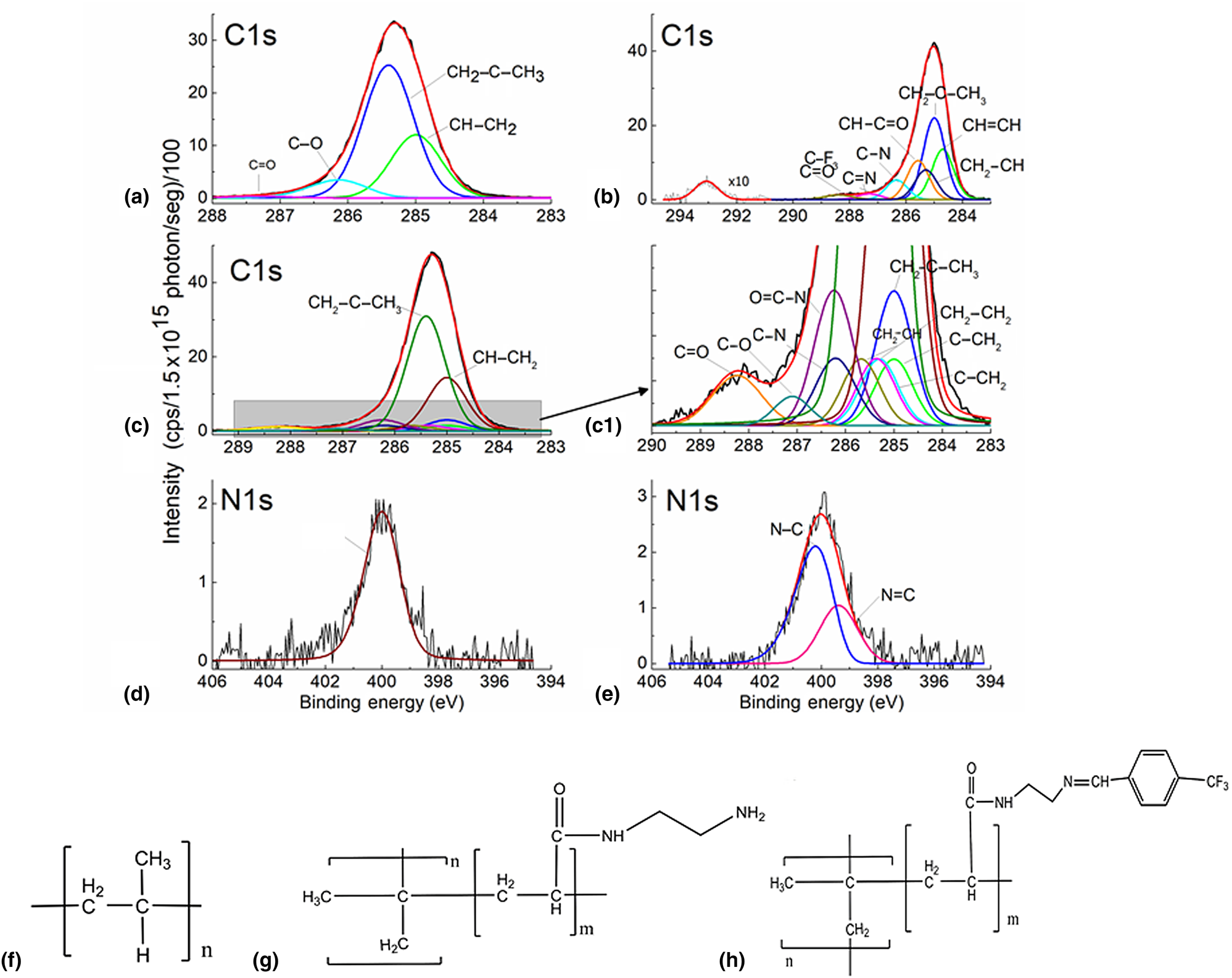
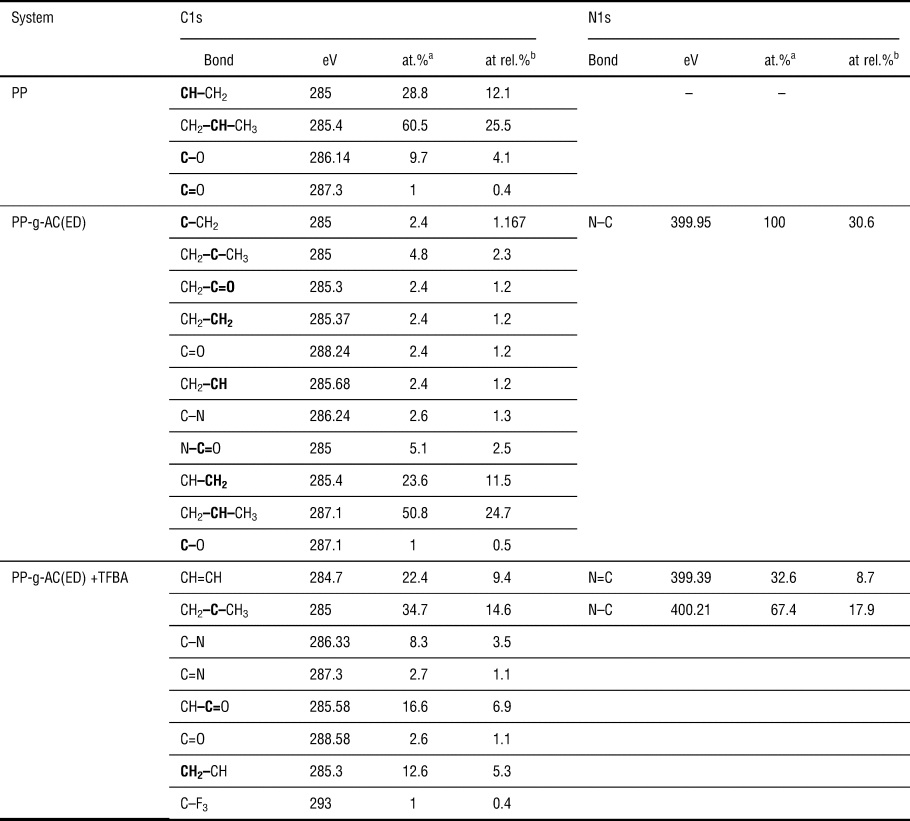
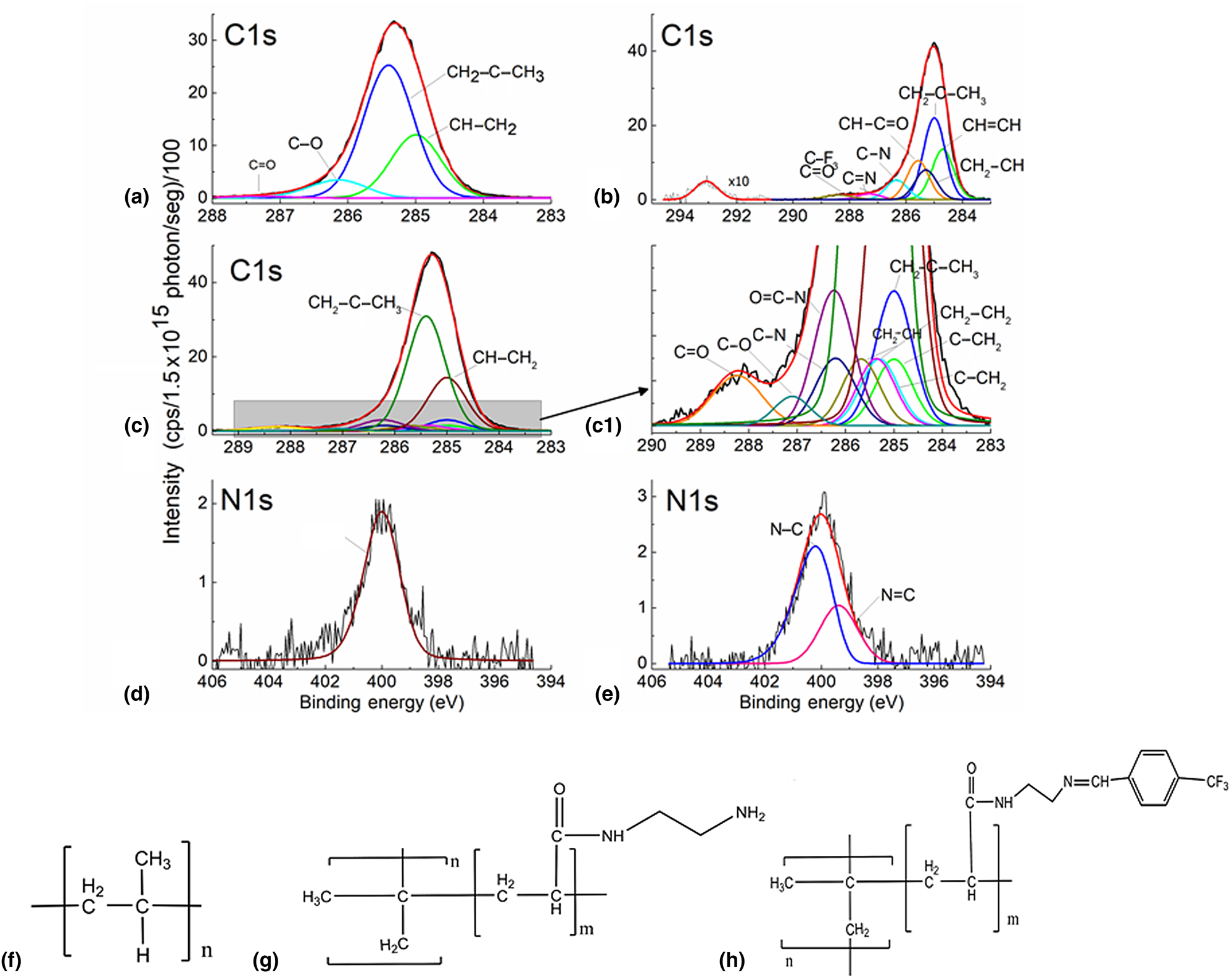
The systems modified were chemically characterized by an XPS technique. The high-resolution spectra are shown in Fig. 3 and the binding energy (BE) of functional groups in Table I. Figure 3(a) shows C1s core level of PP films without functionalizing, with both peaks corresponding to the structure of PP CH–CH2 (BE = 285.0 eV), CH2–CH–CH3 (0.4 eV shift, in 285.40 eV).[Reference Beamson and Briggs23] The presence of other contributions to C1s core level as the peak C–O at 286.14 eV and C=O at 287.30 eV in pristine PP substrate film could be from plasticizers or other additives added during the film production.[Reference Akishev, Grushin, Dyatko, Kochetov, Napartovich, Trushkin, Minh Duc and Descours24–Reference Couturaud, Bondia, Faye, Garrelly, Mas and Robin27] After the modification of the PP surface, additional peak contributions are observed due to the new chemical structure grafted [Fig. 3(c)]. For the sake of clarity, an enlargement is shown in the right side of Fig. 3(c). The new peak of C1s core level corresponding to C–N is found in BE = 286.21 eV, and the peak of amide (O=C–N) is at 286.24 eV. These results clearly show the presence of nitrogen and the formation of the C–N bond in the new structure, which is confirmed in the high-resolution spectrum of N1s core level [Fig. 3(d)] on 399.95 eV corresponding to the C–NH2 bond. It can be noted that the peak of C=O [Fig. 3(c1)] increased its proportion regarding PP pristine (Table I) because of the new grafted structure [Fig. 3(g)].
High-resolution XPS core level spectra deconvoluted of C1s: (a) PP film, (b) PP-g-AC(ED) + TFBA, (c) PP-g-AC(ED), and (c1) amplification of PP-g-AC(ED). N1s contributions of (d) PP-g-AC(ED) and (e) PP-g-AC(ED) + TFBA. Structures of (f) PP, (g) PP-g-AC(ED), and (h) PP-g-AC(ED) + TFBA.
XPS surface distribution of carbon and nitrogen species resulting from the curve-fitting of the corresponding photoelectron peaks for PP-g-AC(ED)g:24%.

Bold text is pointing out the main carbon, which the energy bond refers.
a Contribution percents of carbon and nitrogen bonds at core level peak.
b Chemical state percent relative to total concentration, using atomic sensitivity factor (ASF) of C1s = 0.314, N1s = 0.499, F1s = 1.000, and O1s = 0.733.
Because other functional groups with nitrogen such as amides could exist on the surface, chemical derivatization with TFBA was performed. Since this selective reaction has been widely studied, it will not be explained in detailed equations [Eq. (2)].[Reference Klages, Khosravi and Hinze12,Reference Rodríguez-alba, Huerta, Ortega and Burillo14–Reference Yegen, Zimmermann, Unger and Braun16] The amount of amines can be known by measuring the fluorine element in the new structure [Fig. 3(h)]. In its C1s spectrum, the C–F bond on 293.07 eV is observed in Fig. 3(b). In the same way, other contributions appear localized in BE = 287.30 eV, corresponding to the C–N bond, and the amide bond (C=N) that are formed by the binding of C=O of TFBA with a primary amine. Figure 3(e) shows nitrogen of the reaction of ED with TFBA. Two species of nitrogen can be observed, a single bond to carbon (400.21 eV) and a double bond at 399.39 eV. Derivatization of primary amines with TFBA yielded for films PP-g-AC(ED)g:24% [NH2]N = 12.3%, while [NH2]C is close to 0.8; while PP-g-AC(ED)g:14% [NH2]N = 49% and [NH2]C = 1.6. This evidence indicates that secondary amines are present in a higher content than primary amines due to the reaction of the carbonyl group of AC and a free amine of ED to form amide groups.[Reference Stevens21] The lessening in the percentage of total primary amines in the highest value of grafting can be due to modification was carried out also in the bulk and cannot be measured by XPS; besides, higher grafting yield (AC), rising the possible reactions between the two free amines of ED and the acyl groups of polymer chains, as it was demonstrated.
Stability in air
According to some authors,[Reference Girard-Lauriault, Truica-Marasescu, Petit, Wang, Desjardins, Antoniou, Mwale and Wertheimer1,Reference Bullett, Bullett, Truica-Marasescu, Lerouge, Mwale and Wertheimer5,Reference Ruiz, St-Georges-Robillard, Thérésy, Lerouge and Wertheimer10,Reference Siow, Britcher, Kumar and Griesser28] when the plasma technique is used for polymerization, the newly synthesized material can incorporate oxygen when it is coming into contact with air; this can lead to the formation of new reactive species that react with functional groups present on the surface. To evaluate whether functionalized films by gamma radiation occurred by the same phenomenon, a test of stability was performed: functionalized films were exposed at room temperature in darkness condition for 90 days. Supplementary Table S1 shows elemental compositions by XPS at 0 and 90 days in the survey spectra. The atomic percentage of most elements was not modified after 90 days. Changes are not meant for its environmental stability. An increase of oxygen from 12.6% to 15.6% after 90 days was accompanied by a slight decrease of nitrogen (11.9%–10.1%) and disappearance of 0.4% of Cl; this change can be attributed to a small quantity of amine groups that were converted into imides or oximes[Reference Bullett, Bullett, Truica-Marasescu, Lerouge, Mwale and Wertheimer5,Reference Ruiz, St-Georges-Robillard, Thérésy, Lerouge and Wertheimer10] due to environment.
Conclusions
It is possible to modify the surfaces of PP films with ED by the technique of gamma radiation (the direct method), by different steps of synthesis, PP irradiation, and AC grafting and further reaction with ED. The modified system was characterized, and it confirmed the grafting reaction. Films with less than 24% grafting improved their hydrophilicity, a desirable property for cell adhesion. XPS chemical derivatization indicated a higher content of secondary amines than primaries amines due to a reaction between functional groups. The concentration of primary amines on the surface with regard to total nitrogen was 12.3% and 49% for PP-g-AC(ED)24% and PP-g-AC(ED)14%, respectively. The stability of ED grafted on PP under environmental conditions was 90 days without presenting “aging”. The proposed synthetic technique has promising applications for cell adhesion, without presenting the disadvantages of modification by plasma deposition with less stability of primary amines in about 1 week.
Supplementary material
The supplementary material for this article can be found at https://doi.org/10.1557/mrc.2019.133.
Acknowledgments
The authors thank A. Ortega, F. Garcia, and B. Leal from ICN UNAM, A. Lopez-Vivas and A. Pompa from IIM-UNAM for technical support, and Yasab Ruiz Hernández from LaNSBioDyT for supporting in measurements of AFM and DGAPA UNAM, Grant No. IN200116 for financial support.