Introduction
Nasopharyngeal carcinoma (NPC) is the most common type of head and neck cancer that is reported annually with approximately 86,500 cases worldwide and 50,000 deaths from it. The nasopharynx is located in the upper part of the throat behind the nasal cavity and below the base of the skull, and tumours arising here can be difficult to treat due to the close proximity of many critical organ structures.Reference Mahdavifar, Ghoncheh, Mohammadian-Hafshejani, Khosravi and Salehiniya1,2 The Radiation Therapy Oncology Group (RTOG 0225) recommended that Intensity-Modulated Radiation Therapy (IMRT) combined with chemotherapy should be the current standard treatment for NPC patients with staging I-IVB.3 Therefore, IMRT has become a standard clinical treatment for NPC.
IMRT delivers radiation by the multileaf collimator (MLC) position changing continuously while the dynamic gantry rotates during irradiation, which is arc-based IMRT. Currently, there are two main types of arc-based IMRT available, volumetric-modulated arc therapy (VMAT) (RapidArc or RA) and helical tomotherapy (HT). Both techniques can provide treatment plans with conformal and homogeneous dose distribution while reducing the radiation dose to the organ-at-risks (OARs).Reference Wu, Choi, Chan, Lam, Wong, Mui and Chiu4
Varian RapidArc (Varian Medical Systems, Palo Alto, CA, USA), an advanced form of IMRT technique, is a modulation of varying MLC aperture shapes, dose rate and gantry rotation speed. In treatment planning, RA uses the Eclipse treatment planning system (TPS) (Eclipse, Varian Medical Systems) for optimisation and dose calculation algorithm using Anisotropic Analytical Algorithm (AAA).Reference Teoh, Clark, Wood, Whitaker and Nisbet5,6 HT is another arc-based IMRT technique, delivered using a narrow fan beam modulated by fast-switching binary MLC on the ring gantry while the patient moves through the scanner. The treatment plan is optimised in a tomotherapy planning station (Accuray, Incorporated, Sunnyvale, CA, USA) using a convolution superposition dose calculation algorithm.Reference Mackie7
The TPSs differ in terms of the dose calculation algorithm and dose optimisation procedure, which may affect the dosimetric results. The dosimetric differences between the two planning systems were of interest in order to inform and select the optimum treatment plan and best radiotherapy technique for patients. Therefore, the purpose of this study was to compare the dosimetric results with regard to the sparing effect on normal tissue between the RA plan and the HT plan for NPC patients in cases where the target doses were the same between the two techniques.
Materials and Methods
Patients
Thirteen patients were randomly selected for a retrospective study from the patient database. All patients diagnosed with NPC were treated with HT at the Division of Radiation Oncology, Faculty of Medicine, Chiang Mai University. All patients underwent three-dimensional simulation in the supine position with appropriate headrest and a personalised head, neck and shoulder mask. All targets and OARs were localised by the radiation oncologist.
Dose prescription and dose constraint
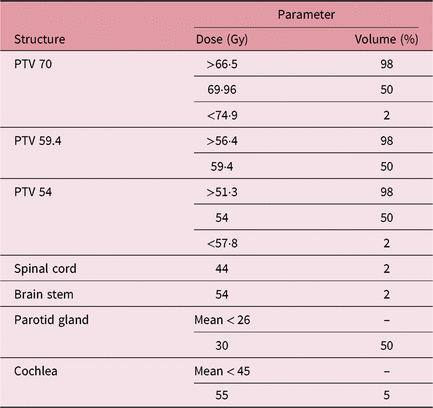
The prescription dose of the target for all patients was given as 69·96, 59·4 and 54 Gy for planning target volume (PTV)-70, PTV-59.4 and PTV-54, respectively. The treatment was delivered in 33 fractions with the simultaneous integrated boost technique according to the RTOG 0225. Regarding the prescribing and reporting for IMRT cases, the constraints were determined by the International Commission on Radiation Units and Measurements (ICRU) no. 838 as in Table 1.
Dose constraint for PTV and OARs of the RA and HT plans

Abbreviations: PTV, planning target volume; OARs, Organs-at-risk; RA, RapidArc; HT, Helical tomotherapy; Gy, Gray.
RapidArc planning
The RA plans were created using the Varian Eclipse TPS (ver. 15.6.03, Varian Medical Systems), and the AAA algorithm was used to compute the final dose calculation with 2·5 mm default calculation grid size. VMAT treatment plans were created using dual arcs of 181–179° with start and stop angles in a clockwise direction and 179–181° in a counterclockwise direction. The collimator angle rotation of 15° to reduce the tongue and groove effect and the maximum dose rate (600 MU/minutes) were applied for all RA treatment plans.
Tomotherapy planning
The HT plans were created using tomotherapy planning station version 5.1.1.6 (Accuray, Incorporated). The convolution/superposition was the use of the dose calculation algorithm. All HT plan parameters were set with a jaw width of 5·02 cm, a pitch of 0·287 and a modulation factor of 2·2–3·0. The directional block was applied to limit the entrance dose to OARs for spinal cord and brain stem.
Target dose optimising
Regarding the target dose optimising, we determined the target dose (PTV-70) of the RA plan to be equal to the HT plan in terms of target coverage, dose conformity and dose homogeneity for assessing the normal tissue sparing between the two treatment planning processes. The process to control the target dose from the RA plan to be equal to that of the HT plan was managed by stopping optimisation iterations when the target dose became out of the planning goal. In regard to the dose conformity index (CI)Reference Zhao, He and Cheng9 and dose homogeneity index (HI),8 these were evaluated using the Equations (1) and (2).
 $$CI = {{{\rm{ }}{{(T{V_{PI{V_{95\% }}}})}^2}} \over {(TV \times PI{V_{95\% }})}}$$
(1)
where  $T{V_{PI{V_{95\% }}}}$
is the volume of the target receiving 95% of the prescription dose, TV is target volume and PIV 95% is 95% of prescription isodose volume. CI close to 1 indicates a better conformity.
 $$HI = {{({D_{2\% }} - {D_{98\% }})} \over {{D_{50\% }}}} \times 100$$
(2)
where D 2%, D 98% and D 50% refer to the near-maximum, near-minimum and median dose, respectively, a HI close to 0 indicates a better homogeneity.
OARs dose comparison
Regarding the OARs dose sparing, the maximum dose and D2% of the brain stem and spinal cord were evaluated. Moreover, the mean dose and D50% to both of the parotid glands and the mean dose and D5% of the left and right cochlea were assessed. In addition, the number of monitor units (MUs) and delivery time were also investigated for measuring the efficiency of the plan.
Statistical analysis
The normality of the variable distribution was verified using the Shapiro–Wilk test with SPSS statistical software (ver. 23.0, IBM). The paired sample t-test was used to test the difference between RA plan and HT plan. A value of p < 0·05 was considered statistically significant in our case study. This study was approved by the Institutional Review Board of the Faculty of Medicine, Chiang Mai University (study code: RAD-2562-06080/Research ID: 6080).
Results
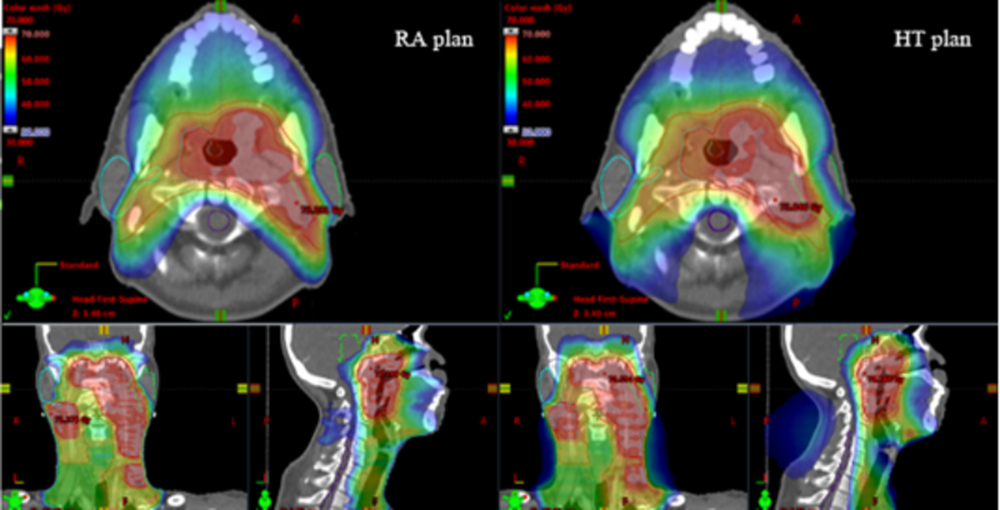
Figure 1 shows the colour wash of the dose distribution of one typical NPC patient demonstrating the differences between the RA plan and HT plan on the axial, coronal and sagittal planes. For all 13 patients, the plans were evaluated according to the ICRU 83 recommendation. For each patient, both the RA and HT plans were clinically acceptable with a dose fulfilled planning objective.
Colour wash of dose distribution for one typical NPC patient between RA and HT plans.

Target (PTV-70) Dose Optimising
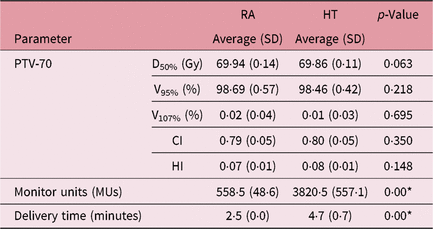
Regarding the target coverage, the PTV-70 of RA and HT plans were able to achieve a similar dose coverage and were not significantly different with a p-value of 0·063. The average of D50% of RA and HT plans was close to a prescription dose (69·94 and 69·86 Gy, respectively). In terms of cold and hot spot areas, there were no statistically significant differences between the RA and HT with a p-value of 0·218 and 0·695, respectively. The average of V95% of RA plans (98·69%) was slightly higher than the HT plan (98·46%), likewise, the V107% of RA plans was slightly higher than the HT plans (0·02 and 0·01, respectively). All target doses met the acceptable criteria followed RTOG 0225 guideline for both the RA and HT plans. Regarding the plan quality indexes (CI and HI), these were able to achieve similarities in both the RA and HT plans. The CIs for the RA and HT plans were 0·79 and 0·80, respectively, with p-value = 0·350. Moreover, the HIs were similar in both treatment plans 0·07 (RA) and 0·08 (HT) with a p-value of 0·148. These values were found not to be of a statistical significant difference in both indices. All the results are given in Table 2.
Dose comparison of PTV-70, monitor unit and delivery time between RA and HT plans

* Statistical significance (p < 0·05).
Abbreviations: PTV, planning target volume; RA, RapidArc; HT, Helical tomotherapy; Gy, Gray; SD, standard deviation.
OARs Dose Comparison
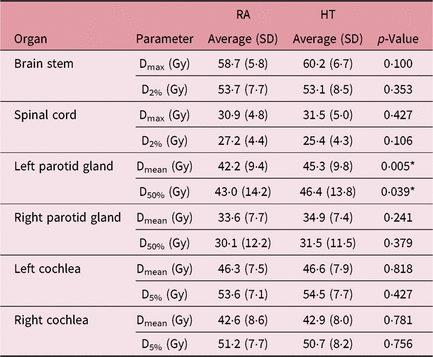
The dosimetric parameter comparisons of OARs are shown in Table 3. There was no significant differences between the RA and HT plans for all of the OARs except for the left parotid gland.
Dosimetric comparison of OARs between RA and HT plans

* Statistical significance (p < 0.05).
Abbreviations: OARs, Organs-at-risk; RA, RapidArc; HT, Helical tomotherapy; Gy, Gray; SD, standard deviation.
The mean and median left parotid doses for RA plans (42·2 and 43·0 Gy, respectively) were significantly lower than those of the HT plans (45·3 and 46·4 Gy, respectively) with a p-value = 0·005 (mean dose) and a p-value = 0·039 (median dose). The dosimetric results exceed the planning criteria due to a large volume of overlapping area between the PTV and left parotid gland. However, 69·2% of the RA plans and 61·5% of the HT plans could reach acceptable criteria for the median dose to spare at least one parotid gland.
MUs and Delivery Time
The MUs and delivery time of RA and HT are shown in Table 2. Compared to HT (3820·5 MUs), RA reduced MUs by 85·4% (558·5 MUs) with a p-value = 0·00. Regarding the delivery time, RA (2·5 minutes) was significantly shorter than HT (4·7 minutes) by a p-value of 0·00.
Discussion
This study compared the dosimetric results between RA and HT plans when focusing on normal tissue sparing, meanwhile, equally controlling the target dose of the two techniques in terms of target coverage, CI and HI.
Regarding the OARs, the maximum dose to the brainstem of RA and HT plans could not meet the required criteria due to a large overlapping area between the brain stem and PTV. Whereas, the Dmax and D2% of the spinal cord were not significantly different between the RA and HT plans which were consistent with Li et al.Reference Li, Zhou and Shen10 who showed the Dmax of the spinal cord for RA plans were 36·0 and 34·1 Gy for HT plans with a p-value > 0·05. However, Wu et al.Reference Wu, Choi, Chan, Lam, Wong, Mui and Chiu4 showed the HT plans significantly reduced the Dmax and D2% of the spinal cord dose more than the RA plan with p-value < 0·001.
For the parotid gland dose, both the RA and HT plans are over the criteria dose since 9 of 13 patients had a target involvement to the left side of the parotid gland. Moreover, the average of the overlapping areas of the left and right parotid gland and PTV were 39·1 and 21·2%, respectively. However, 69·2% of RA plans and 61·5 % of HT plans were able to meet the planning goal to spare at least one parotid gland. Compared to the HT, for the RA plans, there was a lower Dmean and D50% for both parotid glands, the results were consistent with Lu et al.Reference Lu, Cheng and Kuo11 who demonstrated VMAT to be superior to HT in mean dose, affording parotid glands sparing.
For sparing of the cochlea, the dose for the RA plans were slightly lower than the HT plans for both sides. Our results were consistent with Lee et al.Reference Lee, Yip, Cheung, Leung, Chau and Ngan12 and Lu et al.Reference Lu, Cheng and Kuo11 who reported the RA plans showed better sparing to the auditory instrument for late-stage NPC patients.
Doses to all of the OARs did not show a significant difference between the RA and HT plans except in the left parotid gland. Both techniques were able to achieve similarities in normal tissue sparing. However, a tendency for better sparing of OARs was seen in the RA plans. This could be explained because the RA plans are delivered on a TrueBeam with 2·5–5·0 mm MLC width, which is smaller than the HT plans that are delivered using tomotherapy with a leaf width of 6·25 mm. The size of the MLC width would be affected by the size of beamlets used in optimisation. This may be a factor related to the OARs dose sparing being better in the RA plans. Moreover, the planned parameters for all HT patients were performed with a field width of 5 cm to reduce delivery time to patients, instead of using the smaller field width from 5 to 2·5 cm which may increase the plan quality. Yawichai et al.Reference Yawichai, Chitapanarux and Wanwilairat13 showed that a smaller field width is able to improve the effectiveness of normal tissue sparing but increased the treatment time.
Regarding the MUs and delivery time, the RA plans were associated with an 85·4% reduction in MUs and a 46·8% reduction in delivery time compared to HT. Lu et al.Reference Lu, Cheng and Kuo11 reported a comparison of RA/VMAT and HT for NPC treatment. Their study showed that the RA plans reduced the MUs by 92·3% of and 40% of delivery time when compared to HT. In our study, there was concordance with several studies which demonstrated the benefits of RA in terms of reduced MUs and delivery time.Reference Wu, Choi, Chan, Lam, Wong, Mui and Chiu4,Reference Li, Zhou and Shen10,Reference Lee, Yip, Cheung, Leung, Chau and Ngan12,Reference Ogata, Nishimura and Mayahara14
The results of this study demonstrate the dosimetric effectiveness of the two radiotherapy techniques used to treat NPC patients and aid the selection of the most superior technique in terms of decreased normal tissue complication probability. Therefore, the choice of technique is important to avoid dose to OARs and also to be able to provide better plan quality for NPC patients to improve clinical outcome.
One limitation of this study is the small number of patients included in this study, which may affect the results. In addition, another limitation is the variation in the sizes of the PTVs between the patients. Therefore, these limitations should be considered for future studies to increase the number of patients and include patients with the same sized PTV for further investigation.
Conclusion
With the same PTV coverage, homogeneity and conformity, treatment planning using RA and HT meet the planning goal for normal tissue sparing. There were no significant differences between the two treatment plans in doses to the brain stem, spinal cord and cochlea. However, the RA plans showed a significantly lower dose to the left parotid gland. The RA was superior to the HT by effectively reducing the MUs and treatment time.
Acknowledgements
The authors thank Varian Medical Systems Pacific, Inc. and Business Alignment Public Company Limited for supporting the Eclipse treatment planning software.
Financial Support
This research received no specific grant from any funding agency, commercial or not-for-profit sectors.
Conflicts of Interest
None.