It was all very terrifying. An apparently uncreated man walking straight across the face of creation
John Goodwin, South African archaeologist
The place of imagination
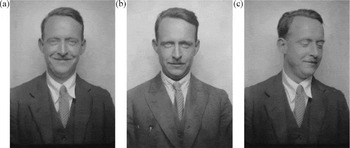
What is the place of imagination in archaeology? On the one hand, the territory of the discipline presents a rich array of possibilities for the exercise of imagination. On the other hand, precisely because it invites imagination, the discipline has tended to proceed on the basis of its disavowal. ‘Imagination’ has emerged as a key term in defining disciplinary boundaries. It has been assigned to space outside the discipline, a demoted realm of speculative fiction and ‘alternative archaeologies’. In this version of the discipline, where imagination is, we might say, archaeology is not. Or, as the South African archaeologist John Goodwin put it in his textbook Method in prehistory (1945), ‘Legitimate deduction and logical reasoning are the materials of which the discipline is made . . .’ (but even in this supposedly simple statement, the double positives ‘legitimate deduction . . . logical reasoning’ open the space for a series of questions).
Goodwin Triptych: John Goodwin (1900–59), South African archaeologist. On the back of the third photograph is pencilled ‘the modest violet’.

Can we trust such a neat distinction between reason and imagination in archaeological method? Is it desirable, or even possible, to construct knowledge of human pasts in the absence of imagination? What kind of impoverishment of archaeological method might this entail? Can any science proceed on the basis of a stricture placed on imagination? One form of the question that we might ask of the relation between archaeology and imagination is: what happens to imagination in the process of the production of archaeological knowledge? Another form of the question might be: what can we learn about the nature of the disciplinary discourse from the place (the non-place) of imagination?Footnote 1
One starting point for my own engagement with questions of imagination is the proposition that questions of imagination, like questions of desire, carry the potential to prise apart the terms of the disciplinary discourse, to the extent that they are experienced as troubling and difficult. A second is the idea that in colonial and former-colonial contexts, questions of imagination and desire become strongly historically overdetermined. Black pasts and black bodies, experienced as other, combine in an ambiguous play of attraction and repulsion, a proliferation of meanings and responses. It becomes the job of the disciplinary discourse to rein in this profusion. Not to cause such responses to disappear (for a simple erasure is impossible), but to convert them into a series of more or less acceptable forms.
Karoo
Here is another beginning. We see the figure of a man seated at a desk, a notebook open before him. He is engaged in an act of composition. He thinks of himself as a man of science, but he also has another, parallel life as a writer of fiction. In this parallel life he writes plays, poems, short stories. As his imagination roams he draws freely on the materials presented by the science to which he applies himself in his professional life, as he does on the materials presented by a particular education and experience of life. Some of his plays have been produced by the university amateur dramatic society, but most of his output remains unpublished and unknown. It functions as a diversion, an outlet for something which remains unanswered in his professional life, a secret between himself and the open page. He picks up his pen. He writes, ‘It was one of those wispy days, when the smaller clouds hang lazily entwined about the columns and peaks of Olympus . . .’
Many archaeological tales begin with an act of discovery, and this is mine. The collection relating to the life and work of the South African archaeologist A.J.H. ‘John’ Goodwin (1900–59) is held in the manuscripts and archives division of the University of Cape Town Library. John Goodwin was the first professional archaeologist in South Africa, and a key figure in the local history of the discipline. In the 1920s he originated a typology and nomenclature for the African Stone Ages which is still in general use. In the mid-1940s he was a leading figure in the founding of the Archaeological Society, and was the founder–editor of the Southern African archaeological bulletin. The Goodwin Collection runs to over a hundred boxes, and it contains manuscripts and typescripts, lecture notes, field notebooks, an extensive personal and professional correspondence, and ephemera. Twenty boxes are given over to a set of notes of an ethnological nature, a monumental project of collection and collation. From ‘Abortion to Beads’ runs the heading on one box, from ‘Circumcision to Disposal of the Dead’, from ‘Frobenius to Huts’. Several boxes around the 100-mark contain thousands of photographic prints and negatives, most of them uncaptioned, or with the briefest contextualizing information (‘rock art’, ‘Cave, Southern Cape’, ‘Bushman wizard’). Parts of the collection have been loosely catalogued and arranged, but most of it is unsorted. Goodwin died while in office, and the latter part of the collection shows a sad decline for a normally punctilious correspondent: letters unanswered, requests unmet, papers put aside for review. The impression one has is of a hurried post-mortem scooping up of papers, the accumulated litter of a scholarly life.
This was my discovery. In Box 102 of the Goodwin Collection is a pair of buff-coloured stenographer's notebooks held together by a rubber band. Goodwin's handwriting fills all of the first notebook and most of the second, over a hundred pages in total. The heading at the top of the first page is Karoo, the name of the semi-arid region in the centre of South Africa. Karoo is the manuscript of a previously unknown fictional narrative by Goodwin, a longish short story or novella, on a broadly archaeological theme. It takes the form of a fable, and its subject, one familiar to the fabular form, is the story of creation. Karoo opens with the gods on Olympus, led by Rhadamanthus, in the act of creating the features of the newly cooled Earth. They choose the Karoo as a ground on which to experiment. It begins:
It was one of those wispy days, when the smaller clouds hang lazily entwined about the columns and peaks of Olympus.
‘Well’ said Rhadamanthus, ‘I think we shall try out some of our ideas soon. I am keen that when we go into the matter of polishing up the globe, we shall know exactly what we are going to do. It has cooled of course, Gabriel?’
‘Yes, sire. More or less. I have asked Vulcan to keep a few hell-vents open for the Work, and he is looking after them at present. Hell-vents are a little apt to get out of hand.’
‘But they will be very useful in laying down fundament and for general annealing, brazing, the baking of pot-clays and so on. Now when we do start, I shall want a clear stage, good cyclorama effects and a free hand. What region have we not arranged for? Look it up will you?’
‘Well nothing's been touched yet. We've got the whole globe to play with.’
‘Then turn it round slowly, and don't drop it. The last time it got dropped a corner of Africa had to be mended. You will see the crack there, we call it the Great Rift Valley. Ah – here's a good spot, sticking right out into the sea, what is it?’ Rhadamanthus peered at the globe through his eternal spectacles. ‘The southern extremity of the grand continental land mass of Africa, and the spot where I have my finger is marked Karoo.’
‘What is Karoo?’ asked Ethnos, who had a morbid love of names and origins.
‘I have no idea. It may be a type of country, or it may be going to be called after someone – but that's its name. We shall experiment with all of the southern extremity of the grand continental land mass of Africa. Gabriel, turn out Olympus, and get ready. Ethnos, your part will be arranged. This is the great rehearsal for the grand act of Creation.’
The story continues as a discussion of the form that the Karoo landscape should take. There are several bits of interplay between the various gods, as well as sidelong references to events in contemporary South African society. Pan creates an ostrich. A committee is formed to oversee the act of creation, and then abandoned as Rhadamanthus decides that the job is better left to himself. The story continues:
The great wide plain which was marked Karoo lay stretched on the globe, waiting for the loving hand of creation. Rhadamanthus looked down at it beneath his feet, picked up a little of the deep subsoil, powdered it, and threw it down. It was extremely difficult to know just where to begin, but begin he must . . .
The second notebook begins with Rhadamanthus having completed his work, busy contemplating the results:
Rhadamanthus was looking complacently at the Karoo. Suddenly he leaned forward with an ejaculation. Gabriel had caught the direction of his gaze, and followed it up. Surely, – yes, – no, – something was moving. Far down, on the surface of the globe, in the Karoo, a diminutive less than ant-like speck moved methodically across a plain ten million times its size. This was puzzling. ‘Pan’, said Radamanthus, ‘Is that an ostrich?’
Pan looked across space. ‘It has two legs. No it is certainly not an ostrich. It has a hairy skin, so it should be one of my inventions – but it is not an ostrich.’
‘What animals with hairy skins have you invented for the Karoo?’
‘Well, nothing as big as that. I have tried jackals, meercats, ground-squirrels and rats, and field-mice, but that is about all. It is very puzzling.’
‘None of your fawns could have . . .?’
‘None. They are capable of moulding or developing a creation, but not to that extent. They can only specialise a creation. This is not a specialisation of any invention of mine – unless it is a perpendicular jackal!’
‘A perpendicular jackal! Well, perhaps so. Dear, dear, most extraordinary’ Rhadamanthus adjusted his spectacles and leant forward in the Great White Throne. ‘It has a queer smell.’
‘It certainly smells of jackal, and the skin looks like a jackal – in fact lots of jackals,’ said Pan.
‘Very puzzling,’ said Rhadamanthus, ‘Send Ethnos’.
‘Ethnos,’ continued Rhadamanthus when she has appeared, ‘have any of your peoples a legend about a perpendicular jackal?’
‘A perpendicular . . .! What in heaven are you talking about, sire?’
‘Pan identifies that object as a perpendicular jackal. Explain it. I cannot have a creation trodden over by perpendicular jackals, jackasses, or jack-a-napes.’
Ethnos leaned forward from the cloud. Her mouth fell open slowly, then very quietly, with a wealth of awe in her voice, she whispered, ‘It's a Man, sire.’
‘A what?’ said Rhadamanthus ‘but . . .’.
‘It is a Hottentot,’ said Ethnos, ‘he smells of jackal and looks like jackal because he is wearing a kaross and cap of jackal skin.’
‘Ethnos, you are responsible for this. How did it happen? Nothing is ready for the appearance of man, and yet you dare . . .’
‘Oh, sire. I can't understand it. Of course we did discuss it, but only the titles and modes of subsistence of the Karoo races. I'm sure I never created any’.
It was all very terrifying. An apparently uncreated man walking straight across the face of creation.
Actually, he was not walking straight, and as all Olympus watched him with excited eyes they saw him double back, turn, cross his trail, go on, turning now left and now right in a mad meander. ‘What on earth is he doing?’ asked Rhadamanthus.
‘What is he doing on earth?’ asked Mammon.
‘Ethnos, go and ask him what he is looking for.’
‘I can't, sire, I cannot manage the clicks in his language.’
‘Fool. Then send down Pan's Parrot.’
Like a streak of grey and scarlet lightning Echo flew down to Earth. She circled to locate her prey, then dropped upon a rock near by. There was a sharp rattle as of machine-gun fire as the two conversed in Hottentot. After a few moments, Echo flew up once again, climbing tediously to Olympus . . .
‘What is he doing?’ asked Rhadamanthus.
‘He says he is looking for his sheep,’ said Echo.
Jupiter Pluvius pulled his halo well down over his ears, ‘I am going straight down to help him.’
‘Come back,’ said Rhadamanthus, ‘sheep haven't been created yet.’ . . .
‘We must catch this intrusive Hottentot,’ said Rhadamanthus, ‘or he will breed.’ The Hounds of Heaven were unleashed, and they shortened and lengthened as they shot off on their first hunt to Earth. Their bays filled creation with sound, and their tongues dripped the Milky Way. On Earth they sped across to the Hottentot, leaping and yapping at the now terror stricken man, tumbling him over, while one more brutal than the rest bit the Man on the knee. He rose and hobbled on, intent on leaving the horrid pack . . .
The Olympic hunters, blowing on conch-shells and cornucopia, filled with a noisy blood-lust, came trooping up.
‘Kill him,’ said Mars. ‘He has been taken in war. He is a spy.’
‘Psychoanalyze him’ said Psyche, ‘I must try my intelligence tests on a Lower Race.’
‘Give him wine’ said Bachhus.
‘Give him women’ said Venus.
‘Give him song’ said Orpheus.
‘All, all, and ever more, in good time’ said Rhadamanthus ‘But what shall we do with him now. Mors, can you kill him?’
‘I am uncertain how this new concept of Death works; but I feel that there should be some excuse for it. It is rather an extreme penalty, and quite as irrevocable as a creation.’ . . .
‘Mors, you are a weakling’ said Mars, ‘Let me have at him. I need no excuse for killing.’
‘Your methods prove expensive indeed Mars. Send me a Gorgon.’ The gods all looked the other way as Medusa appeared veiled, and Rhadamanthus said, ‘Gorgon, get on with it.’
Slowly, for she was a Sadist, Medusa raised her writhing veil, the Hottentot looked, shivered, and fell, a solid stone. There was a silence as the hated Gorgon turned and flew laughing back to Olympus.
‘What shall we do with him, sire,’ asked Gabriel.
‘Cover him with sedimentaries, he shall be our first fossil.’
Gabriel hurriedly wrote down the new creation in his note-book, while Pluto's sedimentary rocks bubbled over the place where the first true Hottentot lay. They ceased, and were still. Only a dull olive shale marked the spot where uncreated man lay dead.
Noises off
There are a number of ways of approaching Karoo. For a start, it might be situated in the context of Goodwin's own literary production, which amounts almost to a parallel life of writing. A curriculum vitae of 1946 lists five plays, The Honeymoon, Circumstantial Evidence and The Ray, all produced by the Mummer's Club in 1925; Mandrake Passes, produced by the Repertory Society in 1929; and The Corpse That Never Forgot, produced by the university play-reading circle in 1944, based on The Troublesome Corpse by Soschenko. The boxes of the Goodwin Collection contain a number of other short plays and fragments, many of them written under pseudonyms. These include The Merchant of Cape Town by A.J.H.G., Brilliance by Sour Grapes, Underexposed by M.Q. Pyro-Soda, Soft Goods by A. Flat, and the promisingly louche The Sultan; or, A Peep into the Seraglio. Most of the plays are of the type of Mandrake Passes, whose opening scene is described as follows:
A panelled smoking room. There is a door back centre, which opens forward on to the stage, to conceal partially a small butler's table. Down stage centre are two club-easies, facing a small occasional table. When the curtain rises, Patricia and Mandrake are seating themselves in the club-easies . . .
There is also Noises Off, an attempt at a kind of Brechtian modernism, with a cast consisting of ‘A man with a garden roller; A man with a whistle; A man with a compressed-air cylinder; A man with a tumbler and mirror; A man with a bowler hat’. The Ray is memorable for featuring ‘Colonel Soblightly: in charge of the South African War Office’ and ‘Egbert Jefferson Gink: Inventor’.
In addition to the plays there is an operetta, a sheet of ‘Limerix’, two other short stories (‘The Einstein Wells machine’, written at Cambridge, and ‘For two pins’, written later), and a long poem on archaeological method. The first stanza runs as follows:
There is also at least one attempt at serious verse, called, appropriately enough, ‘Speculation’:
Speculation is a sufficiently unusual word to register in general reading. We encounter it again in an exhaustive study by Goodwin of bored stones. This was begun in 1923 as part of the typological and distributional analysis which resulted in his three-age schema for the Southern African Stone Ages, and was completed and published in 1947. In a section on ‘general principles’, he writes,
Work of this nature should be limited by certain strict rules. It depends fundamentally upon deductions, or logical judgements, made from available data, while speculation (probability suggested by an insufficiency of available data) must not be permitted to affect the main issues of the survey (Goodwin Reference Goodwin1947, 2).
A discourse of the Cape
Karoo is significant in that it is Goodwin's most sustained piece of fiction writing. It is also the work that deals most directly with archaeological and ethnographic contexts. It takes us out of the imagined universe of the Mummer's Club and the drawing room drama, and into something more engaging and direct. As such, it gives us several things. One of these is the sense of a specific cultural response to a landscape and a set of histories experienced as alien. The story's premise involves a striking superimposition of the gods of Europe onto the distant landscape of the Karoo. Goodwin's gods comprise a kind of compendium of Euro-modern thought. Their sources include Greek and Roman classical antiquity (Rhadamanthus, Mars, Venus, Bacchus, Orpheus, Medusa, Vulcan), Christian mythology (Babel, Gabriel, Mammon), Shakespeare (Puck), and what might be described as a general Enlightenment project (Ethnos, Psyche) (Price and Kearns Reference Price and Kearns2003). Part of the effect of the story depends on the sense of incongruity between this pantheon of gods and, as the story has it, the unpromising ground of the Karoo.
Ideas about landscape and a sense of place are one of the central elements of the story. The other central element is the figure of the ‘Hottentot’, the mistaken creation, or the ‘uncreated man’. In White Writing (Coetzee Reference Coetzee1988), author and critic J.M. Coetzee writes of the advent of a ‘discourse of the Cape’ in the work of travel writers and commentators on this part of the world. This operated with respect to notions of place and person. On the one hand, it was built around a set of ‘remarkable facts’ – stereotypes – concerning the indigenous people of the Cape, the Khoikhoi or Khoekhoen, and the San (‘Hottentots’ and ‘Bushmen’ in the terms of the discourse).Footnote 2 This included details about their supposed idleness, their apparent lack of religion, their habit of clothing themselves in animal skins, certain dietary peculiarities, the implosives (click sounds) which made their speech impenetrable to the European ear, and so on. On the other hand, it was founded on the idea that the Khoekhoen and San exemplified a primitive form of humanity. The figure of the Hottentot assumed key importance in a developing typology of race in early modern Europe. The Cape and its inhabitants came to stand in as a foil to the New World, whose discovery had so energized the world of the Renaissance. In this scenario it figured not as another New World, but as the furthest reaches of the Old. Scientific and public interest gave rise to intense forms of scrutiny, and practices of collection, representation and display. Goodwin's ‘Hottentot’ falls into a genealogy which includes the life and fate of Sarah Baartman, the widespread collection of human skeletal remains and ‘trophy skulls’, practices of anthropometric photography, practices of public exhibition and forms of invasive anatomical research. More immediately, it included the Denver Africa Expedition of 1925 (in which Goodwin was an early participant), an ambitious project of body casting instituted by the South African Museum, and the ‘Bushman Camp’ of the 1936 Empire Exhibition (Gordon Reference Gordon1997; Reference Gordon and Lindfors1999; Rassool and Hayes Reference Rassool, Hayes, Woodward, Hayes and Minkley2002; Skotnes Reference Skotnes1996).
A second aspect of the discourse of the Cape was a response to landscape. Coetzee writes of the advent of a set of ‘dream topographies’ in the traditions of settler writing and thought. One of these imagines South Africa as ‘a network of boundaries criss-crossing the surface of the land, marking off thousands of farms, each a separate kingdom ruled over by a benign patriarch’ (Coetzee Reference Coetzee1988, 6). A rival dream topography figures the South African landscape as ‘a vast, empty, silent space, older than man, older than the dinosaurs whose bones lie bedded in its rocks’ (ibid., 7). The Karoo itself has come to exemplify this ‘land of rock and sun’ (ibid., 7). For generations of South African writers, including Coetzee himself, the landscape of the Karoo stands in for an essential South Africa, hostile and unforgiving, but evincing a kind of elemental beauty. In the traditions of settler writing, made anxious by its tenuous claim to place, this is the landscape which must be won, named, made to speak; which must emerge into a legible landscape of signs. The figure who stands as representative of this tradition is that of ‘the lone poet in empty space’ (ibid., 8), who calls forth in the hope of an answering echo – a self-evidently ‘foredoomed quest’: ‘What response do rocks and stones make to the poet who urges them to utter their true names? As we might expect, it is silence’.
Goodwin's Karoo invokes this trope of landscape in novel ways by suggesting that the landscape itself is unformed, semi-created (a test site for ‘the grand act of Creation’). It evokes Coetzee's dream topography of stone, sand and fossil. More directly, and probably inadvertently, it evokes a subset of the landscape of empty space, ‘crypto-prophetic poems’ of earthbound monsters and giants, who wake from the sleep of centuries to ‘erupt back into history’ and ‘claim their due’ (ibid., 168). The most striking of these poems is Roy Campbell's ‘Rounding the Cape’, with its stirring evocation of the Adamastor legend.Footnote 3
Goodwin, Rhadamanthus
Karoo raises the question of the place of imagination in archaeology in striking ways. Commonplace considered in its own terms, the interest of the story lies in the manner in which it is doubled by Goodwin's output as an archaeologist. Goodwin the archaeologist becomes the inheritor of the fossil Hottentot created (and uncreated) by Goodwin the fabulist. The story suggests an identification between Goodwin and the figure of Rhadamanthus (in Greek mythology a son of Zeus and Europa, and one of the judges of the lower world). As an archaeologist, Goodwin has the task of descrying landscape, making sense of an otherwise puzzling creation. Like Rhadamanthus, he is able to do so because of his Olympian perspective, his overview, which is also his long view (as the story has it, his ‘eternal spectacles’). Like Rhadamanthus deploying the lesser gods, he deploys the methods of his discipline to weigh, to sift, to analyse, to distinguish fact from fiction (or speculation). The shocking nature of the story's ending lies in the fact that it translates, as it were, the epistemic violence of a tradition of encountering ‘Hottentots’ into the actual violence of his ‘uncreation’. His fossilization becomes a literally extreme form of objectification in a tradition of objectification. We might say that the desire of Goodwin the archaeologist, as enacted by Goodwin the fabulist, is for the Hottentot to be immobilized, rendered in a form accessible to the discipline of archaeology.
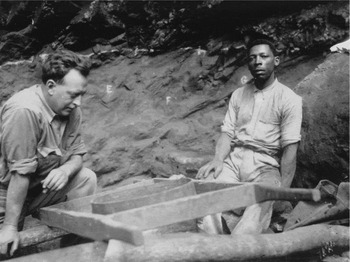
Goodwin and Adam Windwaai (Adam Blowing-in-the-wind) at Oakhurst Cave, sometime in the early 1930s. For an account of the ambiguous place of so-called ‘native’ labour in archaeology, see Shepherd (Reference Shepherd2003).

One of the strongest resonances of the story is with a common trope of the period which saw the indigenous people of the Cape as ‘living fossils’, a hold-over from an earlier period of human evolution, condemned to hover on the brink of extinction (in fact, Goodwin's story might be read as a fable for the instantiation of this trope).Footnote 4 Like Goodwin's Hottentot, the Khoekhoen and the San of the early part of the twentieth century figured in the settler imagination as people out of time, not too early as in the case of the uncreated man, but too late. Like Goodwin's Hottentot, they were ‘fated to perish’. As a story set in the deep past, the uncreating of Goodwin's Hottentot looks ahead to the genocide of the Khoekhoen and San, carried out on much the same terms, on the basis of the idea that they were/are a mistaken creation, people out of place and time.
Such are the currents linking Goodwin's flight of fancy, the imagined world of Karoo, to the time and place of its composition, and the concerns of its creator. Karoo describes a scene of imaginary encounter. As a way of pursuing some of these themes and issues, I move to describe two encounters in life involving John Goodwin and indigenous people of the Cape. The first was the occasion in early 1937 on which Goodwin photographed a group of N/u-speaking San/Bushmen from the Southern Kalahari, when they were placed on public display at the Rosebank Showgrounds, close to the university. This was the same group of persons who had been exhibited in the ‘Bushman Camp’ at the Empire Exhibition in Johannesburg the previous year, and whose spectacular appearance in the public sphere was to cause a ‘feeding frenzy of the eye by ethnologists, anatomists, photographers and filmmakers’ (Rassool and Hayes 2002, 118). The second encounter involved a group of hunter-gatherers exhumed by Goodwin from Oakhurst Cave on the southern Cape coast over a period of four years from 1932 to 1935: an encounter not with the living but with the dead. In my reading, both are ambiguous encounters, as ambiguous and open-ended in their way as the imaginary meeting with the uncreated man.
Framed as exercises in science and dispassionate observation, the terms of both encounters slipped into something more complex and less defined, as the distinctions upon which science depends began to break down. As encounters which slipped out of control, Goodwin did not have the option of ‘uncreating’ them. Rather he converted them into ‘bare description’, or consigned them to the layered depths of the archive, a kind of death-in-life. Both encounters left an extensive photographic record. In fact, my interest in these two occasions began with the question of what to do with the photographs that they left. The themes that I pursue through a reading of these encounters fall under three headings: first, an interest in what might be called the terms of engagement, in the kinds of encounter through which knowledge emerges, and in the nature of this knowledge; second, an interest in a set of linked epistemic sites – the archive, the photograph and the grave – and in the themes that hold them in common; third, an interest in the limits of representation – the unspeakable, and the unshowable – and in the kinds of violence implicit in certain ways of knowing.
Science and spectacle in the Southern Kalahari
The events of 1936–37 leading up to the public display of a group of N/u-speaking San at the Rosebank Showgrounds fall into three parts. First, the main protagonist and prime mover of events, Donald Bain, great-grandson of Andrew Geddes Bain the famous road-maker and explorer, set up a camp at Tweerivieren in the Southern Kalahari, at the confluence of the Auob and Nossop rivers, preparatory to taking a group of Bushmen to the Empire Exhibition in Johannesburg later that year. Bain, a ‘failed farmer and publicist of bushman causes’, had a long history of involvement with Bushman affairs at the peripheries of science, including acting as local guide to the quasi-scientific Denver Africa Expedition of 1925. His ostensible purpose in taking the Bushmen to the Empire Exhibition was to pressure the Union government to create a Bushman reserve, as a way of ‘saving the Bushmen from extinction’. Bain drew people to his camp ‘by enticing them with game’. This was followed by a ‘sorting out process’ aimed at extracting ‘the best specimens for study and exhibition’ (Rassool and Hayes Reference Rassool, Hayes, Woodward, Hayes and Minkley2002, 140, 133).
From the beginning, the Bushmen were subject to intense forms of scrutiny and control. This combined a kind of improvised scientificity with the updating and modernization of a set of practices in relation to the Khoekhoen and San with a long history in the discourse of the Cape. In July 1936 a University of the Witwatersrand Expedition arrived at Tweerivieren, under the direction of the physical anthropologist Raymond Dart. This was unusual, even unprecedented, in that it involved five full professors from a range of disciplines (in addition to Dart there were the linguists C.M. Doke and L.F. Maingard, the musicologist P.R. Kirby, and I.D. MacCrone). With the arrival of the University of the Witwatersrand Expedition, the Bushmen were made to wear ‘little cardboard dogtags’, with their measurements and identifying characteristics. These were added to incrementally as they passed through the hands of the different professors. A medical laboratory was set up in a large, grass-walled enclosure at the centre of the camp. Here individuals were checked for illness or disease, and it was here that physical anthropological and anthropometric studies were conducted. Raymond Dart and his assistant, John Maingard, the professor's son, took detailed physical measurements of the Bushmen, collecting information on facial form, ‘constitution’, features, bodily habitus and stature, skin and eye colour, hair distribution, limbs and ‘mammae’. Close attention was paid to the external genitalia in both men and women, and to evidence of ‘steatopygy’ (Dart Reference Dart1937b; Rassool and Hayes Reference Rassool, Hayes, Woodward, Hayes and Minkley2002).
A speculative interest in the external genitalia of women, in particular, had been a long-running feature of travellers’ accounts to the Cape, and a subtext to public displays of ‘Bushmen’ and ‘Hottentots’.Footnote 5 This was mainstreamed as part of medical discourse in a paper published by James Drury and Matthew Drennan on ‘The pudendal parts of the South African bush race’ (Drury and Drennan Reference Drury and Drennan1926). Dart elaborated on this research at Tweerivieren, and produced a typology of Bushman groups based, in part, on the size and shape of the labia minora (in women), and the disposition of the penis (in men). These features were also deduced as indicators of racial ‘purity’. From the site of the grass-walled enclosure, individuals passed to the face-casting section. Bushman subjects were placed on a long table with reeds inserted into their nostrils to allow them to breathe: ‘An application of damp plaster of Paris was applied to cover [the] face, allowed to dry, and then removed along with facial hair’ (Rassool and Hayes Reference Rassool, Hayes, Woodward, Hayes and Minkley2002, 135). Photography was a central component of the physical anthropological studies conducted at Tweerivieren. James van Buskirk, a member of the expedition, was responsible for a series of anthropometric studies of adult and child, female and male ‘types’. These, together with detailed studies of individual body parts, form an important part of the report on Tweerivieren published in two issues of the journal Bantu studies (Dart Reference Dart1937a; Reference Doke1937b; Doke Reference Doke1936a; Reference Doke1936b; Kirby Reference Kirby1936). Publicity was an important element of the self-styled ‘laboratory in the desert’. Van Buskirk, who also acted as the official publicist of the expedition, sent regular reports ‘by a special camel patrol furnished through the courtesy of the Desert Police’ (Rassool and Hayes Reference Rassool, Hayes, Woodward, Hayes and Minkley2002, 133).
In the public eye
In September 1936 seventy of the Tweerivieren Bushmen were taken to the university research farm at Frankenwald outside Johannesburg. It was from here that groups daily made the journey to be exhibited at the reconstructed ‘Bushman Camp’ at the Empire Exhibition in Milner Park. Organized to celebrate the fiftieth anniversary of the founding of the city of Johannesburg, the exhibition was part of a genre of spectacular public exhibitions that had sprung up in the wake of the Great Exhibition of 1851 in the Crystal Palace. It was designed to present the modern face of the Union and its place in the Dominion, and included pavilions representing Canada, Australia and New Zealand, as well as a number of British colonies in Africa (Gordon Reference Gordon and Lindfors1999). The largest structure was the South African government's four-acre model farm, featuring the world's largest rock garden. The ‘Bushman Camp’ was located in a corner, to the right of the entrance. It featured a number of grass shelters, and an open, sandy area for dancing. It was ‘one of the sensations of the exhibition’, rivalled only by a replica of the Victoria Falls, which reportedly used over 2,000 gallons of water per minute (Gordon Reference Gordon and Lindfors1999, 267). The ‘Bushman Camp’ drew over half a million viewers, including a record 7,692 in a single day.
A typical show began with a talk by Bain over the public-address system. Spectators could purchase an illustrated brochure, which featured an introduction by ‘Kalahari Bain’, and numerous photographs. Visitors were also encouraged to take their own photographs, as a way of capturing the experience. Early in 1937 Bain took fifty-three members of the group to Cape Town. In addition to being displayed in the Rosebank Showgrounds, their itinerary included a symbolic march on Parliament as part of the campaign to create a Bushman Reserve. It also included ‘an interesting scientific experiment’ whereby one of the senior women from the group, /Khanako, and four members of her family, were induced to pose in the Bushman cast room of the South African Museum, so that as ‘living Bushmen’ they could be compared with the casts made earlier by the renowned modeller James Drury (Rassool and Hayes Reference Rassool, Hayes, Woodward, Hayes and Minkley2002, 141).
Ciraj Rassool and Patricia Hayes, on whose account I have relied, focus their interest in these events around the life and fate of /Khanako. Begun as an exercise in ‘biographical rehumanization’ (Rassool and Hayes Reference Rassool, Hayes, Woodward, Hayes and Minkley2002, 118), their study develops into something more far-reaching: a searching indictment of the legitimization of forms of racial science and their institutionalization in the South African academy, and a meditation on the violence of ways of looking and of knowing. The events of 1936–37 looked backwards and forwards: backwards to an embedded set of practices and ideas in the discourse of the Cape, and forwards to the growth and mainstreaming of Bushman studies and Kalahari studies through the 1950s and 1960s, under the auspices of a range of disciplines (anthropology, archaeology, linguistics, musicology, anatomy). Rassool and Hayes argue (ibid., 137) that these events constituted a key convergence between science and spectacle. There were two features of the science that emerged. The first was a focus on racial purity, often in the face of ‘potentially interesting data hinting at massive hybridity in a highly fluid region’. For example, Dart records but does not develop the information that /Khanako had five daughters:
No. 51, female, /keri-/keri and No. 7, Marta, young women, her daughters by a bushman booi, No. 6 female, klein /khanako (or klein /ganaku) and No. 9 female, kuskai, young girls, her daughters by an unnamed Hottentot, and No. 8 female lena, her daughter by an unnamed European (Dart Reference Dart1937a, 162, cited in Rassool and Hayes Reference Rassool, Hayes, Woodward, Hayes and Minkley2002, 136).
This selective focus on ‘pure specimens’ reinforced an image of the Bushmen as a people apart, rather than being a group knitted into society at a complexly changing colonial frontier.Footnote 6 A second, and related, feature of the discourse was a salvage paradigm, or ‘paradigm of preservation’, which increasingly informed public and scientific responses to the Bushmen.
What Mr Goodwin saw at the showgrounds
Goodwin's photographs of the Tweerivieren Bushmen are contained in six envelopes of prints in Box 98 of the Goodwin Collection. None of the photographs are captioned, although one of the envelopes has ‘Bushman wizard?’ written on an inside flap. The box also includes the original roll of negatives from which the prints were made, so that it becomes possible to reconstruct the order in which the photographs were taken. In the spatial rendering of the Bushman display at the Rosebank Showgrounds it becomes possible to reconstruct Goodwin's walk-path, as he moved among the groups of Bushmen, pausing here and there to snap off a photograph.
The Bushmen were loosely arranged in an open area close to the public stands. Unlike the ‘Bushman Camp’ at the Empire Exhibition, they were exhibited without the benefit of supporting props. Neither was there a clear demarcation of space. The Bushmen stood in groups – a line of men, several groups of women, lone figures, a group of children playing – with the spectators arranged in a half-circle around them. The men and women wore loincloths or short skirts, but little else. Many had what appear to be an improvised set of accessories. Some of the men wore leg-rattles crossed over their chests like bandoliers. Several wore elaborate headdresses.Footnote 7 In some of the photographs, onlookers are visible in the background. Their formally dressed figures contrast with the near-nakedness of the Bushmen; in fact, the distinction between clothed and unclothed figures was one of the features that marked the observers off from the observed in the improvised exhibitionary space.
In some of the early photographs an attempt has been made at an anthropometric front-and-sides approach, but this is quickly abandoned. Most seem simply to record impressions. Goodwin gets in close: a single figure or a row of faces fills the frame. In one image, the heads of a group of women have been cropped, so that they appear as a line of torsos (one woman holds a child to her breast). The photographs are black-and-white and have a grainy quality. The effect is to aestheticize the scene, and to impart to it an atmospheric quality, a kind of stillness. The figures loom out of the surrounding background, frozen in a set of characteristic poses. For the most part, they look at the camera. Their expressions are open but unreadable. This is, after all, an intensely photographed and scrutinized group of persons, certainly one of the most photographed groups of the period. There must be literally thousands of private collections of photographs of the Tweerivieren Bushmen, in addition to their scientific and media representations. Gordon notes that Bain's Bushman displays ‘set the standard of the emergent current “tradition” of Bushman displays in South Africa’ (Gordon Reference Gordon and Lindfors1999, 266). They also constituted a key moment in a local history of looking, an intense scopic regard, in many cases mediated by the camera and by processes of photographic representation and reproduction. It is possible that there was some form of interaction between Goodwin and his subjects. In some photographs a group of men appear to have been arranged in a straggling line. Many photographs repeat themselves. Groups and individuals appear and reappear. A group of women is singled out for particular attention. In the sequence of photographs, Goodwin returns to this group again and again, as he traces his path among the Bushmen.
The profusion here is the profusion of skin, of surface. What can it mean, this proliferation of bodies and parts of bodies, breasts, arms, legs? Persons and parts of persons are photographed and rephotographed, image piles on image. Is this an exercise in compiling information, and, if so, what is the nature of this information? Is there a narrative organization to these images, besides the narrative of Goodwin's own restless movement? Is it hoped that a single, overarching meaning will emerge through repetition, through the adding of ever more detail? If so, this hope is frustrated as meaning is submerged, overwhelmed by sensory impressions and ‘data’. There is at once an excess of impressionistic detail, and a paucity of interpretation. Meanings fly off in all directions. Is that a twinkle in ‘Old Abraham's’ eye? Can it be that he is enjoying this accumulated attention? Or is it another privation, a further indignity, in a life of hardship and privation (as signified by his furrowed brow)? A young woman has painted her face with markings intended to signify the onset of menstruation and womanhood. Here is the beginning of narrative, a message of sorts. Yet she appears with painted face over all the weeks and months of her exhibition. Is this another accessory, part of Bain's patter? Do the markings signify anything beyond themselves (‘markings intended to signify the onset of menstruation and womanhood’)?
The woman with the painted face is young and attractive. She is foregrounded in Goodwin's photographs, as she is in many of the media images of the group. Is this the basis of her appeal? Or rather, in the ambiguous, layered nature of the encounter, what part does this play in her appeal, and in what terms do the different protagonists – the observer and the observed, the photographer and the photographed – know this, describe this to themselves? Can Goodwin say what it is that he saw at the showgrounds? Ultimately, it appears that he is defeated by the open-ended nature of the encounter, by its lack of a convincing metanarrative. As an encounter whose terms slip out of control it cannot be ‘uncreated’. Instead he consigns it to the layered depths of the archive, as a set of uncaptioned images, kept without commentary.Footnote 8
The events around the Tweerivieren Bushmen constitute a significant convergence of science and spectacle. Goodwin's own encounter with them was a hybrid moment, snatching images for science in the midst of a public spectacle. We might imagine this scene of encounter from two perspectives. First, from the perspective of the Bushmen: a figure separates itself from the crowd. He is carrying a camera, into whose viewfinder he peers. He steps in close, first to one group, then to another. Sometimes he offers direction, but mostly he just moves among the people, taking photographs. Second, we imagine the scene from the perspective of the crowd of onlookers. One of its number steps forward and moves among the Bushmen, taking photographs. To the choreography of the spectacle – the dancing figures, the children playing, the groups of men and women – is added a new element, a figure with a camera, weaving among the Bushmen, clicking away.
Showing, telling, looking
There is an ambiguous play of showing and not showing, exhibiting and withholding, which is deeply a part of the events around the Tweerivieren Bushmen. Dart's report on the University of the Witwatersrand Expedition published in Bantu studies includes over ninety plates made up of Van Buskirk's photographs. A small number of these, the ones dealing with male and female genetalia and steatopygia, were withheld from general circulation, and made available in loose leaf only to scientists and research libraries. Reprinted editions of the journal include some but not all of these plates. Rassool and Hayes write of their own struggle to evolve critically accountable forms of practice in relation to the images of /Khanako. When they first presented their paper at a Gender and Colonialism conference at the University of the Western Cape in 1997, they made the decision not to show the images. In the resultant debate over ‘censorship’, some of their colleagues argued that the sources should be ‘quoted’, so that the readers/audiences could ‘judge for themselves’. In the published version of the paper they include some of the images of /Khanako, writing, ‘we must take full responsibility for the new circuits of representation which we have generated in our own academic genre’ (Rassool and Hayes Reference Rassool, Hayes, Woodward, Hayes and Minkley2002, 127, 154).
On the one hand, this ambivalent play of showing and not showing is an admission of uneasiness about the kinds of practice and forms of representation which might legitimately go under the heading of science. On the other hand, it is part of a deeper ambivalence around looking, seeing and being seen, and the terms under which this takes place. This extended to the motivation behind ethnographic displays-in-life like the Bushman Camp. In preparing for the Empire Exhibition, Bain had to defend himself against charges that the Bushmen were being displayed for purposes of profit and entertainment. The elaborately choreographed science of Tweerivieren was itself part of an attempt to offset such criticism.Footnote 9
Staged as spectacle, the bodies of the Tweerivieren Bushmen invited looking, and not just any looking, but free and uninhibited looking, looking without consequences. They were subject to intense forms of contemplation and ‘hyperfocalization’. To what end did this focused looking take place? The answer is likely to be complex (information, entertainment, pleasure, desire, data). Part of the point of the exercise was that the Bushmen were available for exhibition in this way, that they could be subject to certain kinds of looking. Another part of the point of the exhibition-in-life was its repeatability and profusion. What counted was not the specific instance but the general condition, and a specific category within this general condition – the type. The staging of these various encounters specifically excluded the possibility of dialogic interaction, and what follows from it, interiority and individuality. The conclusion that this demanded from those who looked was that the nature of things is revealed in their surface aspect. States of mind, forms of culture, ways of being: all are read off from appearances.
As the characteristic artefact of these encounters, the photograph condenses and perfects this objectification. It decisively removes the possibility of dialogue. All is surface, and not just any surface, but the detailed, mimetic surface of the photographic print. At the same time as it suggests an array of possible meanings it offers its own surface as being indexical of a kind of truth. This is the source of its power, and the nature of its ‘second life’. Each viewing of the image restages the original drama of looking and being seen, not as an event in life but, as it were, through association, through replaying the tropes and ideas that clustered around the original encounter (primitiveness, blackness, sexuality, otherness, fascination and denial, desire and fear). At the same time it recalls the violently objectifying nature of the act. In an interview conducted long after the fact, Ouma/Una Rooi, one of the survivors of the 1936 Kalahari anthropometric research, described some of the photographs as the product of ’n kamera wat verkrag (‘a camera that rapes’) (Rassool and Hayes Reference Rassool, Hayes, Woodward, Hayes and Minkley2002, 123).
Set in these terms, the question of reprinting the images of the Tweerivieren Bushmen is not supplementary to the telling of the tale, but central to it. Neither is this a decision about evidence and ‘sources’. Rather, it raises a set of issues which strike at the foundations of knowledge and a politics of representation. What happens if we decline the invitation in the image? What happens if we refuse to replay these mini-dramas of looking and being seen, these occasions of violent objectification and the banal science that frames them? What if we treat these encounters as phenomena not of surfaces, but of depths? What if we use these photographs as opportunities for asking questions? Every act of looking is predicated on the seeing subject, the one who looks and the one who is seen. These images are not for reproducing, not here, not now, not by me.
Living and dead Bushmen
The photographs from Oakhurst Cave form a coda to the images of the Tweerivieren Bushmen. Images of another encounter – this time not with the living, but with the dead – they invite us, as it were, to follow the uncreated man in his passage beneath the earth, and to reflect on his fossil being. In this instance, the reappearance of the buried dead came about not through their waking and sudden eruption (as in the settler fantasy of buried giants and monsters), but through the pathos of their exhumation, a less dramatic but far more common set of events. They also provide an opportunity to reflect on the different modalities of the archive (the public archive, the hidden archive, the official archive, the illicit archive). The photographs from Oakhurst Cave are semi-public. A carefully edited selection of photographs was published in the extensive report on the Oakhurst Cave excavation (Goodwin Reference Goodwin1937). The unpublished photographs attest to the more impromptu aspects of the excavation, but even in the published selection there is something unsettling, something which is in excess of their purpose. Meant to demonstrate the methodical nature of the excavation, and to give information about the disposition of the dead, they also speak of other things: the intimacy of death and interment, the poignancy of the grave, and about care of the dead, and its corollary, grieving and loss on the part of the living.
Oakhurst Cave is a large and productive site on the southern Cape coast, remarkable for the number of burials found there and the richness of the associated material culture. It was probably Goodwin's most extensive and most ambitious excavation. He returned for six field seasons over the course of four years. He had made his name in his 20s as a laboratory practitioner and stone-tool analyst. Oakhurst Cave was intended to establish his reputation as a fieldwork practitioner. The extended report on Oakhurst Cave published in the Transactions of the Royal Society of South Africa is a model of timely reportage. Goodwin was its principal author, with sections by J.F. Schofield on the pottery and M.R. Drennan on the skeletal remains (Drennan Reference Drennan1937a; Reference Drennan1937b; Schofield Reference Schofield1937). Mary Nicol, later Mary Leakey (described in the report (Goodwin Reference Goodwin1937, 244) as ‘a European prehistorian’) visited the shelter and excavated ‘Grave XVII’. She also commented favourably on Goodwin's field methods. The idea of method was important to Goodwin. Ten years after the publication of the Oakhurst Cave report he published Method in prehistory (Goodwin Reference Goodwin1945), the first manual on archaeology written for local conditions.
Goodwin's move to install method in the practice of prehistory was part of the modernization of the discipline. He was also reacting against comparatively widespread practices of casual excavation and exhumation. These ranged from trophy hunting to more self-consciously scientific, but often no less casual, harvestings of material. Drennan confirms this (Reference Drennan1937b, 281) in the second part of his report on Oakhurst Cave, on ‘The children of the cave dwellers’, when he notes that it is rare that ‘such a good series of infant skeletons’ should be retrieved from excavation and made available for physical anthropological study. This is because of the delicate nature of the remains. The skull bones are ‘as thin as paper in certain regions’. He writes, ‘As a result the casual collector usually passes them by in favour of less delicate trophies’ (ibid., 281).
Goodwin reports that the ‘greatest care’ was taken in excavating ‘skeletons’. Each took an average of twelve hours, using a small bricklayer's trowel and a rubber-mounted distemper brush. This careful practice made it possible to recover ‘grave furniture’, including ostrich eggshells, arrow points and linkshafts, stone implements, grindstones, tortoise shells containing pigment, ochre, ostrich eggshell beads, marine shells and bored stones. Many of the bodies are foetally flexed. Some lie on beds of sea grass (Zostera capensis), material ‘used as bedding, both by the living and the dead’ (Goodwin Reference Goodwin1937, 238). Indeed, the dead mirror the living, whose sleeping hollows lie just above them.
The photographs from Oakhurst Cave occupy a number of folders in the Goodwin Collection. Some are mounted on card and annotated. A number are reprinted in large format, six-by-eight-inch black-and-white prints. It was Goodwin's practice with the better-preserved graves to take photographs at regular intervals during the excavation, in some cases as close as ten minutes apart. Meant to indicate order, method and control, to the contemporary eye there is something more haphazard about the progress that they detail. Sections are cut roughly, rootlets emerge and spread their tendrils, a scatter of tools is left lying about, a skull is rolled out of context and lies gape-jawed on the deposit. The photographs chosen for publication are the most diagrammatic. They show more complete exposure, and fewer signs of the work of exhumation. Yet even in these images meanings threaten to overwhelm their purpose, as our responses move in unintended directions (horror, curiosity, sympathy, interest). The intention was that these remains should be proudly captured for science, instead they excite our pity.
Like the ambiguous encounter with the Tweerivieren Bushmen, the riskiness of the act of exhumation and its attendant documentary project is impressed upon us by these images. The nature of the revealed material is profuse, threatening to outrun attempts to impose order and meaning. In contrast, what emerges in the written report is thin, attenuated, a mixture of empiricism and what might be called ‘bare description’. Here, chosen more or less at random, is a description of Grave III: ‘Buried beneath a horizontal white sealing layer at a depth of 48 inches. Fully flexed, lying on right side, facing south, head to east. The entire skeleton was intact and undisturbed . . . Smithfield B or C’ (Goodwin Reference Goodwin1937, 248). Of the opening of Grave VII he writes,
The skeleton proved to be that of a child of about seven years. Most of the skull was broken. The body was flexed and lay on its right side, facing east, head to the south. A number of shells of Donax serra lay along the spinal column. A girdle consisting of a single strand of ostrich eggshell beads was strung round the waist. Red ochre was present on the skull and the neighbouring bones (ibid., 252).Footnote 10
Drennan's reports consist of diagrams of the skulls and tables of measurements. Much of the discussion is taken up with the vexed question of assigning the remains to a ‘tribe’ or ‘race’. Although they resemble ‘modern Hottentots’, he decides that they are better described as part of a ‘Wilton race’ or ‘pre-Bushman type’ (in his tables he describes them as an ‘Oakhurst tribe’).
As a set of representative objects, the photographs from Oakhurst Cave textualize the experience of exhumation in ways which allow for a more complex response, these images of the remains of the newly exhumed dead, bodies bared for bare description. Our inescapable impression is of the sanctity and intimacy of the grave site, and the violence of this act of exposure. Can we talk of pornographies of death and desire? Is there an erotics of exhumation and display at work here, in these tales of living and dead Bushmen (as in a set of practices articulated by a logic of desire)? At what point do we pass beyond the limits of representation, or is there no limit to the pursuit of information, and the requirement that all shall be bared, all shall be uncovered?
The archive, the photograph and the grave
The archive, the photograph and the grave: each is threaded through by a thematics of death and desire. They are also the characteristic sites of the set of encounters that I have described here. They become sites of emergence of particular kinds of knowledge; as such, they double and repeat one another. The resurfacing of the photograph from the intimate depths of the archive mirrors the act of exhumation. The ghostliness of the grave is repeated in the archive, a site replete with traces, where we simultaneously confront the presence of the past and its irreducible absence. Haunted sites, sites of objectification, intimacy and violence, they deliver up the disappearing past as bone/light/text. The different modalities of these traces speak to the inner workings of the discipline: the archive, home of the declarative voice of text, site of emergence of a particular kind of knowledge; the grave, sign of an assertive presence, site of fugitive knowledges; the photograph, brimming over with meanings, as intimate as a voice whispered in the ear, and as enigmatic as the bone in the grave.
Archaeological imaginaries track between these exemplary sites, just as they track between the living body and the body in the grave. This becomes the basis for an alternative dream topography which imagines the South African landscape as a network of graves, a landscape of sacred sites and sites of interment. A landscape of depths, it also has a surface aspect, as a landscape of traces. The hermeneutic eye of the archaeologist scans this landscape for signs of habitation and past life, is able to interpret the traces left in stone and bone.
Tenderly interred in life, the bodies of the buried dead are exhumed ‘with the greatest care’ by the archaeologist. The sweeping actions of the rubber-mounted distemper brush mirror, in reverse, the actions of the hand that patted the soil home. Bared by excavation, the bodies are subject to a different regime of care, and to the logic of the archive. They are numbered, accessioned, boxed, shelved, catalogued. Their reanimation takes place within the strict limits of this logic. Not so the uncreated man, whose peculiar fate it was briefly to escape the grave/archive, so that along with the gods we are presented with the puzzle of his being.
Ultimately, we are confronted with the surprising nature of the exhumed dead. The grave is a place to which the dead of Oakhurst Cave have been assigned in order to put them beyond the reach of the living, yet here they are among us: partial, decayed, fossilized, articulated, scattered. In the world of their re-emergence, their death figures as a double death. They are individually dead (dead to themselves and others), but they also represent a way of life which is dead and in the past: fossil bones and fossil people. This image of death-in-life haunts the Bushmen of these various accounts. It amounts to a status, a way of being, so that we might talk of an ontology of death-in-life. This is true of ‘Bain's Bushmen’, explicitly framed as ‘living fossils’, who had constantly to confront their being as death-in-life (in the encounter with the ghostly ‘life casts’, in the way in which parts of their bodies were externalized as memento mori, not least in the act of photography itself). It is also true of the uncreated man, a being whose status was to vex even the gods. This status of death-in-life continues into the present, in a chain of literal and figurative deaths. Gordon writes (Reference Gordon1992, 3) of his first visit to Tsumkwe, the capital of the apartheid-inspired Bushman ‘homeland’: ‘What I saw there on my brief three-day visit was profoundly disturbing. I had never been in a place where one could literally smell death and decay’.
In Goodwin's own practice, the living Bushmen of the Rosebank Showgrounds are doubled by the dead Bushmen of Oakhurst Cave, just as the imagined world of Karoo is doubled by the ‘bare description’ of his archaeological reports. Is this bare description, this language shorn of imagination, the truth of these encounters? Does it capture their meaning? Perhaps, in fairness, we can say that it captures a kind of truth, a possible meaning, even as we leave the door open for other ways of rendering the truth and meaning of these encounters, in life, in death and in imagination.
Archaeological imaginaries
We return to the figure at the desk, the bowed head, the raised pen, the busy imagination. Goodwin's fiction amounts to a kind of secret life of the mind. Part of its interest is the manner in which it doubles, or mirrors, his output as an archaeologist. Goodwin was concerned to hold these two writing projects apart. He understood them to belong to different realms of thought and expression. His more self-consciously archaeological writing, done under the heading of the discipline, is markedly different in style and register. It takes the form of stripped-down prose, offering bare, empirical detail (free, as Goodwin understood it, of speculation). However, the kind of reading that I am working towards here sets out to complicate this neat distinction. What the fiction gives us – what is made plain in the fiction – is a set of attitudes, positions, embedded assumptions, underlying ideas and values. These have to do with notions of the human, with ideas about place, with notions of civilization, even with a conception of proper (and improper) creation. Taken together, they amount to a kind of cultural stance, a broad set of attitudes, analogous to the kind of structural and epistemological positioning that Edward Said so famously describes in Orientalism (Reference Said1978). In Goodwin's case, this cultural stance operates in relation to African people, places and histories. Nor are such ideas and attitudes confined to the world of fiction. I think that we can accept that the same broad cultural stance and set of positions underlies Goodwin's archaeological writing, even if what is made plain in the fictional world is more buried in the world of the discipline.
Colonial archaeology placed its agents in a strange, double relation to their disciplinary objects. On the one hand, they claimed the privileged perspective that comes from an assumption of universal knowledge and scientific method. On the other hand, they viewed such objects through a paradigm of irreducible difference. Archaeologists like Goodwin understood themselves to be culturally, racially and spatially distanced from the people and places that formed the substance of their contemplation. In a talk given for radio in the mid-1930s, Goodwin said, ‘We understand the African as little as he understands us’ (Goodwin Reference Goodwin1935). This was said at a point when Goodwin was one of the foremost archaeologists and ethnologists working in southern Africa. Elsewhere, he would describe sub-Saharan Africa as a ‘giant cul-de-sac’ which swallows energies from the north, without returning anything of value (Goodwin and Van Riet Lowe Reference Goodwin and van Riet Lowe1929; Shepherd Reference Shepherd2002). Richly imagined encounters, viewed through a paradigm of irreducible difference, rendered in the language of bare description: such are the broad contours of the kinds of encounter that I describe here.
By way of closing, I want to propose that such deep structures of thought and feeling – archaeological imaginaries, as we might call them – constitute a kind of secret life of the discipline itself. Archaeological imaginaries vary in their details, are particular to particular times and places. However, as a formal, structural element they are common to the discipline as a whole, even if they are commonly disavowed. Goodwin was unusual – but by no means unique – in externalizing an imaginary, in giving it fictional form, and the fiction, in turn, allows us to see the archaeological imaginary at work. A final, speculative point is that the fable of the uncreated man constitutes a kind of creation myth for the discipline of archaeology itself, or at least for its southern African variant. As an archaeologist in the postcolony, the discipline that I inherit is one that sees itself in, and is haunted by, the ambiguous status of the uncreated man, his troubled presence in the ground, and the originary violence of the act of his uncreation.